Tavily alternatives: five agent workloads priced per 1,000 calls
Tavily basic search costs $5 to $8 per 1,000 calls and a 10-page crawl starts at $15. We paid $0.694 for search and for 5 full pages. Failures cost $0.

Tavily bills in credits. A basic search costs 1 credit and an advanced search costs 2. Extract charges 1 credit per 5 good URLs, and Map charges 1 credit per 10 pages. On a plan, one credit costs $0.005 to $0.0075, and pay-as-you-go costs $0.008. Per 1,000 requests, basic search costs $5.00 to $8.00 and a 10-page crawl costs $15 to $24. A 200-URL site map costs $100 to $160.
On November 15, 2026, we made 36 live calls to the EveryInfra search API. Web search, deep search with 5 full pages, a site crawl, and a site map each cost $0.000694 per call, or $0.694 per 1,000. Across five workloads, Tavily costs 7.2 to 230 times more. Two results go the other way: Firecrawl Map at $0.749 per 1,000 is almost our price. Serper's largest pack at $0.30 beats us on plain search. The 15 failed, empty, or malformed calls in our test cost $0.
How we calculated the numbers
For Tavily, Firecrawl, Serper, and SerpAPI, we took each plan's monthly price from its public pricing page or billing docs. We divided it by the credits or calls in the plan, then multiplied by the credits that one request uses. Each figure assumes that you use the full allowance. All four vendors reset or expire unused allowance, so your real unit price can only be higher.
For EveryInfra, each figure is the billing.charged_usd value from our live responses, times 1,000. We checked every charge against the search tool catalog and the capability catalog for the same day. No charge differed from the listed price.
We read the four vendor pages between 00:20 and 00:41 Singapore time on 2026-11-15. We did not sign up for these services or call their APIs, so their numbers are list prices. Each service runs its own search, and the fields, counts, and ranking differ. This article compares price, billing rules, free tiers, failure charges, and MCP setup, not result overlap.
Tavily alternatives: the summary table
Each cell is dollars per 1,000 requests. For other vendors, the left number is the largest public self-serve plan and the right number is the smallest paid plan or pay-as-you-go. The last column divides the Tavily range by our charge.
| Workload (per request) | Tavily | Firecrawl | Serper | SerpAPI | EveryInfra, charged | Tavily ÷ ours |
|---|---|---|---|---|---|---|
| S1 search only, about 10 results | basic $5.00–$8.00, advanced $10–$16 | $1.498–$7.60 | $0.30–$1.00 | $9.17–$25.00 | web $0.694 | 7.2–11.5x, advanced 14.4–23.1x |
| S2 search plus 5 full pages | with full text $5–$8, plus Extract $10–$16 | $5.243–$26.60 | snippets only | snippets only | deep full $0.694 | 7.2–23.1x |
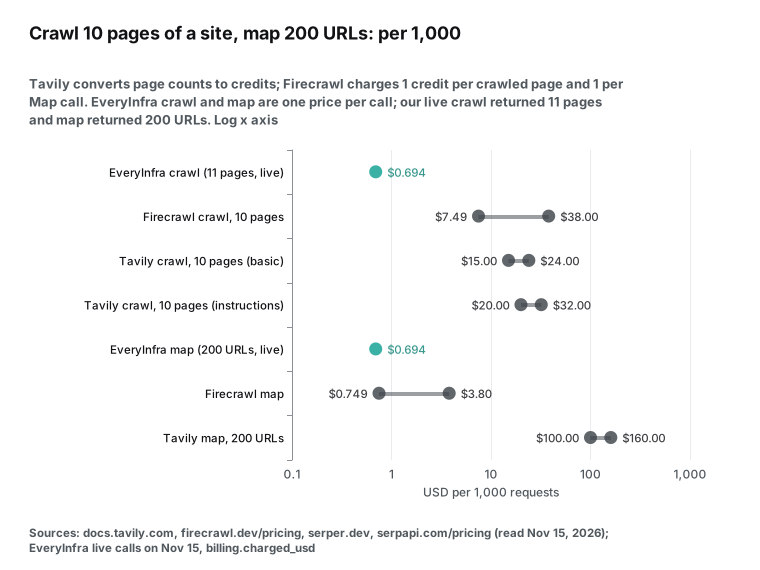
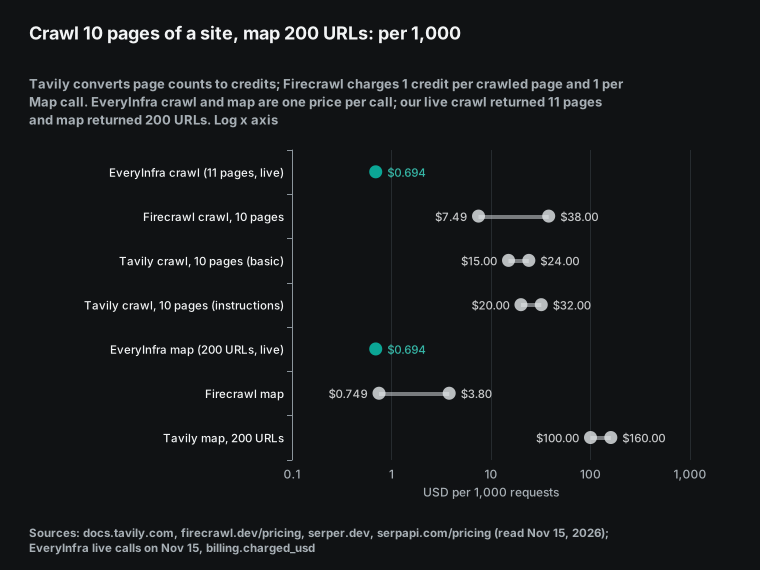
| S3 crawl 10 pages of one site | basic $15–$24, with instructions $20–$32 | $7.49–$38.00 | none | none | crawl $0.694 | 21.6–46.1x |
| S4 map 200 URLs of one site | $100–$160, with instructions $200–$320 | $0.749–$3.80 | none | none | map $0.694 | 144–230x |
| S5 one multi-source check | Research mini 4–110 credits, pro 15–250 | none | none | none | crosscheck $2.778 | not comparable |
The S5 row has no ratio: Tavily Research delivers a report, and crosscheck delivers evidence in tiers without a conclusion. In the S2 row, "snippets only" means that Serper and SerpAPI return titles, links, snippets, and other page blocks. They do not return the full text of each result. For full text, you need a separate scraper, so these two sit outside S2.
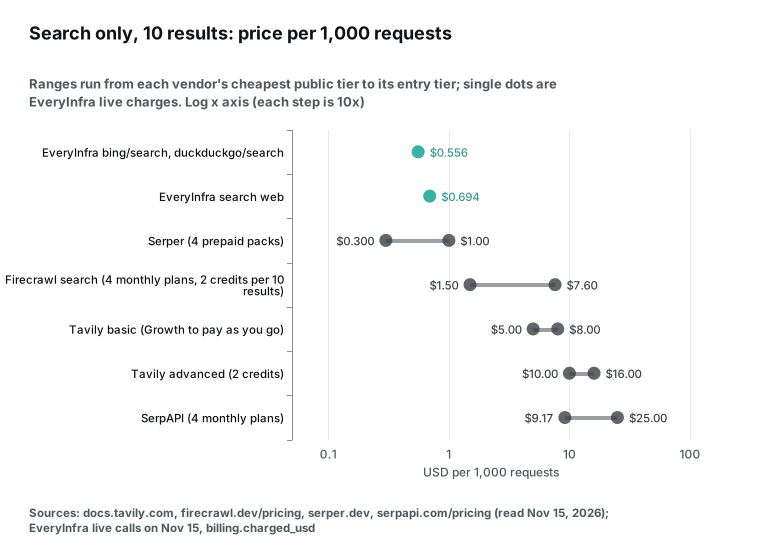
In S1, Serper is the only vendor with plans below our price. Its Ultimate pack costs $3,750 for 12.5 million searches, or $0.30 per 1,000, which is 57% less than our web tool. Its Scale pack costs $1,250 for 2.5 million, or $0.50 per 1,000, which is 28% less.
The other two Serper packs cost more than ours. Standard costs $375 for 500,000, or $0.75 per 1,000 (8% more), and Starter costs $50 for 50,000, or $1.00 per 1,000 (44% more). Firecrawl charges 2 credits per 10 results, so its search costs $1.498 per 1,000 on Scale and $7.60 on Hobby. On annual billing, Firecrawl search costs $1.198 on Scale and $6.40 on Hobby, still 1.7 to 9.2 times our price. Tavily basic and SerpAPI both cost more than 7 times our price.
The two cheap Serper packs have a condition. Prepaid packs expire after 6 months, and the per-1,000 price assumes that you use the full pack in that time. To beat our $0.694, the Scale pack needs more than 1.8 million searches in 6 months, or 300,000 per month. The Ultimate pack needs more than 5.4 million, or 900,000 per month. Below that line, your real unit price is higher than ours.
For example, a team at 100,000 searches per month uses 600,000 of a Scale pack and pays $2.08 per 1,000, 3 times our price. A team at 1 million per month uses 6 million of an Ultimate pack and pays $0.625 per 1,000, 10% below ours. So the two cheap Serper packs suit steady, snippet-only volume of several hundred thousand searches per month or more.
| Serper prepaid pack | Price | Searches (valid 6 months) | Per 1,000 at full use | Rate limit | Monthly volume to beat $0.694 |
|---|---|---|---|---|---|
| Starter | $50 | 50,000 | $1.00 | 50 per second | costs more even at full use |
| Standard | $375 | 500,000 | $0.75 | 100 per second | costs more even at full use |
| Scale | $1,250 | 2.5 million | $0.50 | 200 per second | over 300,000 |
| Ultimate | $3,750 | 12.5 million | $0.30 | 300 per second | over 900,000 |
How Tavily converts credits: six endpoints
Tavily's billing docs list the credit cost of each endpoint. We read them at 00:20 Singapore time and took a screenshot at 00:41. Search charges by search_depth: basic, fast, and ultra-fast cost 1 credit, and advanced costs 2. With auto_parameters on, Tavily can switch the depth to advanced, and the call then costs 2 credits. The max_results parameter defaults to 10 and goes up to 20.
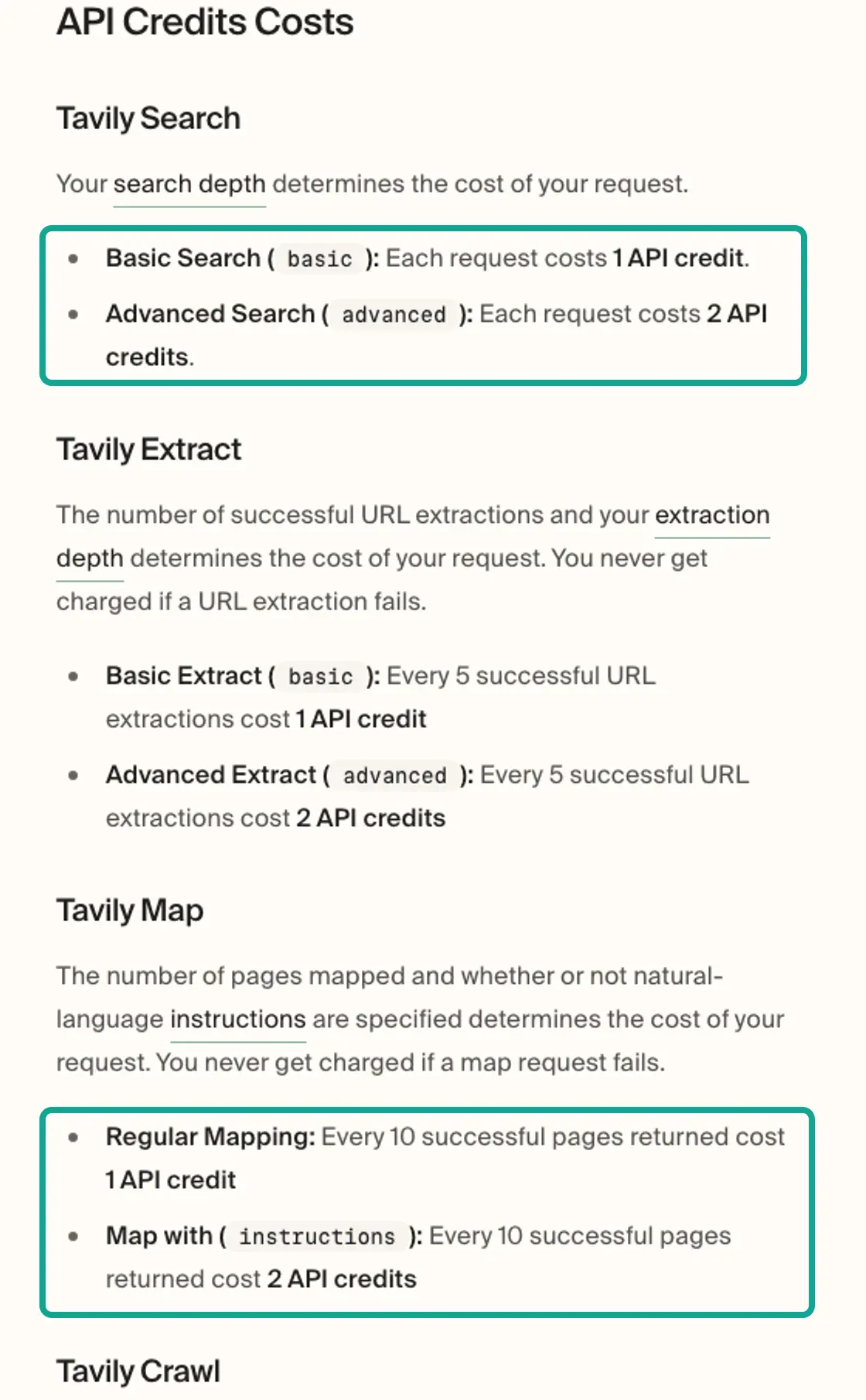
For full text, you add include_raw_content, which returns cleaned page content, as the Search endpoint reference says. The billing docs add no credit for it. Extract costs 1 credit per 5 good URLs at basic depth and 2 at advanced depth. Failed URLs cost nothing, and one request takes up to 20 URLs, per the Extract reference. Map costs 1 credit per 10 pages, or 2 with instructions, per the Map reference.
Crawl costs the Map fee plus the Extract fee. The Crawl reference gives 10 pages at 3 credits for basic and 5 for advanced. With instructions, the Map part doubles, so 10 basic pages cost 4 credits. Research mini costs 4 to 110 credits per call and pro costs 15 to 250. The charge depends on how many sources the run reads, per the Research reference.
| Endpoint | Tavily credits | At $0.008 pay-as-you-go | At $0.005 on Growth | EveryInfra tool | Charged per call |
|---|---|---|---|---|---|
| Search basic | 1 | $0.008 | $0.005 | web | $0.000694 |
| Search advanced | 2 | $0.016 | $0.010 | deep | $0.000694 |
Search with include_raw_content | 1 (basic) | $0.008 | $0.005 | deep with full=true | $0.000694 |
| Extract 5 URLs, basic | 1 | $0.008 | $0.005 | read 5 times | $0.003470 |
| Crawl 10 pages, basic | 3 | $0.024 | $0.015 | crawl | $0.000694 |
| Map 200 URLs | 20 | $0.160 | $0.100 | map | $0.000694 |
| Research mini | 4–110 | $0.032–$0.880 | $0.020–$0.550 | crosscheck | $0.002778 |
Extract has the smallest gap. One Tavily request holds 20 URLs, and 5 good URLs cost 1 credit, so 5 pages cost $0.005 on Growth and $0.008 at pay-as-you-go. Our read tool takes one URL per call, so 5 pages cost $0.00347, only 1.4 to 2.3 times less than Tavily. Crawl and Map go the other way, because Tavily converts page counts into credits while our crawl (20 pages) and map (200 URLs) charge once per call.
The same docs list the plans. Researcher is free with 1,000 credits per month. Project costs $30 for 4,000 credits, Bootstrap $100 for 15,000, Startup $220 for 38,000, and Growth $500 for 100,000. Pay-as-you-go costs $0.008 per credit, and allowances reset on the first of each month. The Tavily pricing page matches. The startup program offers 100,000 credits, and the student account page offers four months of Project.
S1: search only, $0.556 to $25 per 1,000
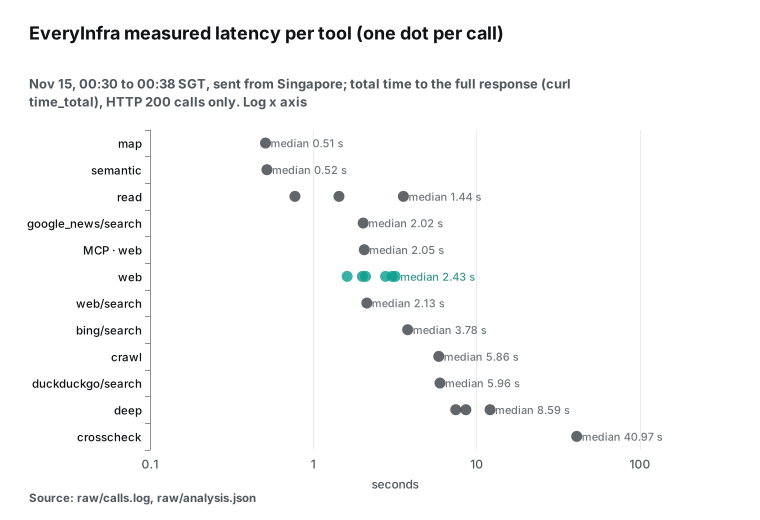
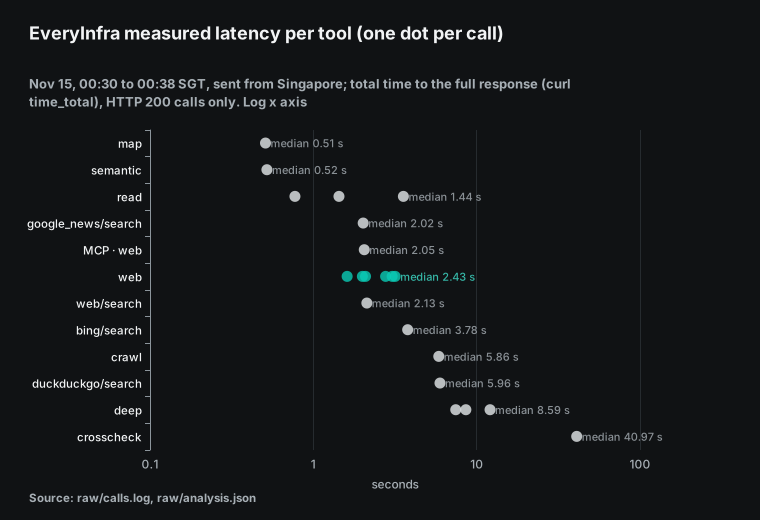
Search with titles, links, and snippets is the most common workload. Between 00:30 and 00:38 Singapore time, we ran 5 queries and one repeat through the web tool. All 6 calls returned 10 results and charged $0.000694 each. They took 1.61 to 3.17 seconds, with a median of 2.43 seconds. We searched "tavily alternatives" at 00:30:36 and again at 00:37:54 Singapore time. Both calls returned the same 10 URLs in the same order, at the same price.
We also called three search capabilities from the capability catalog once each. At 00:36 Singapore time, bing/search returned 7 results for $0.000556. duckduckgo/search returned 10 results for $0.000556, and its first 7 matched the Bing order. web/search returned 10 results for $0.001389. Each has a page with parameters and a test console: Bing Scraper API, DuckDuckGo Scraper API, and Web Search Scraper API. The overviews are the Bing platform page, the DuckDuckGo platform page, and the web search platform page.
| Monthly volume | Tavily basic | Tavily advanced | EveryInfra `web` |
|---|---|---|---|
| 1,000 calls | $0 (free plan) | $8 (free plus 1,000 pay-as-you-go) | $0.69 |
| 10,000 calls | $72 (free plus 9,000 pay-as-you-go) | $140 (Bootstrap plus 5,000) | $6.94 |
| 100,000 calls | $500 (Growth) | $1,300 (Growth plus 100,000) | $69.40 |
| 1,000,000 calls | $7,700 (Growth plus 900,000) | $15,700 (Growth plus 1,900,000) | $694 |
On the Tavily side, each row uses the cheapest mix: plan credits first, then pay-as-you-go at $0.008. We assume that pay-as-you-go can sit on top of a plan. At 1,000 calls, the Tavily free plan beats our $0.69. At 10,000 calls, Tavily basic costs 10.4 times our price, and at 1 million calls it costs 11.1 times.
Result count also needs a check. One Tavily search returns up to 20 results for 1 credit, and our web tool returns 10 per page. For 20 results, our price becomes $1.388 per 1,000, and the gap shrinks to 3.6 to 5.8 times. Most agents read only the top 5 to 10 results, so this case is rare. Still, add it to your math when your agent always asks for 20.
S2: one search plus 5 full pages
With include_raw_content, one Tavily request returns the ranking and the cleaned content for 1 credit, with no extra charge. That costs $5 to $8 per 1,000. A search followed by Extract on 5 URLs costs 2 credits, or $10 to $16.
Our equivalent is the deep tool with full=true. At 00:34:13 Singapore time, it returned 5 pages on the 2025-11-25 MCP specification changelog in 7.45 seconds. At 00:38:03 Singapore time, it returned 5 pages on Tavily alternative pricing in 8.59 seconds. Those pages had 20,000, 20,000, 11,152, 2,952, and 152 characters, and each page has a cap of 20,000. Both calls charged $0.000694, which is 7.2 to 11.5 times less than Tavily with full text.
You can also run one web search plus 5 read calls. That makes 6 calls and costs $4.164 per 1,000, a little below Tavily with full text. It pays off only when your agent wants to pick which pages to read.
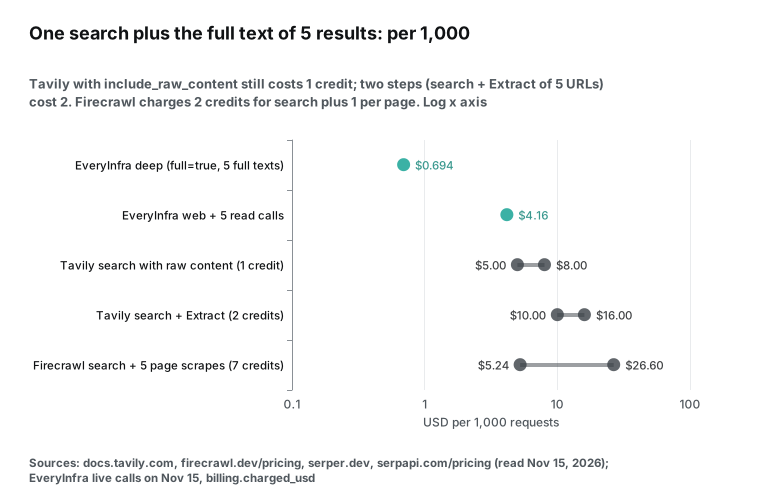
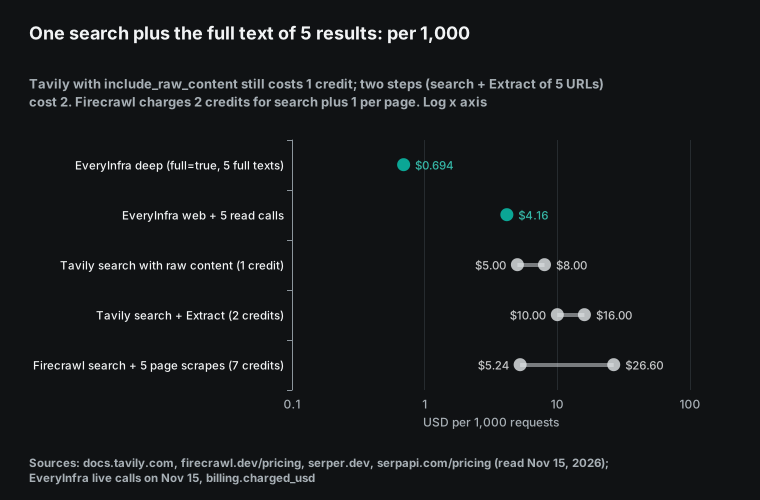
Firecrawl puts search and scraping into one credit pool. Its search docs charge 2 credits per 10 results, plus 1 credit per scraped page, so 5 pages make 7 credits. Since 2026-09-04, the Firecrawl pricing page lists Hobby at $19 for 5,000 credits and Standard at $99 for 100,000. Growth costs $399 for 500,000, and Scale costs $749 for 1 million. Seven credits come to $5.243 to $26.60 per 1,000.
Full text has a second bill on the model side. We counted the tokens in each results field with the o200k_base encoding. Our two full-text deep calls came to 12,037 and 12,447 tokens, against 848 without full text. At $3 per million input tokens, one full-text search adds about $0.034 of model cost, or 49 times the search price. So filter with snippets first and then read two or three pages.
S3: crawl 10 pages of one site
Agents crawl sites to answer questions from a docs site or to pull new pages on a schedule. Tavily Crawl is Map plus Extract: 10 basic pages cost 3 credits, or 4 with instructions. That is $15 to $24 per 1,000, or $20 to $32 with instructions. The Firecrawl Crawl docs charge 1 credit per page, so 10 pages cost $7.49 to $38 per 1,000.
At 00:34:41 Singapore time, we ran crawl on Tavily's own docs at docs.tavily.com/documentation. We set num to 20 and asked for pricing, credits, rate limits, and API reference pages in instructions. After 5.86 seconds, it returned 11 pages, all of the requested type, with no blog or home page. The 11 pages held about 138,000 characters in total. The call charged $0.000694. Under Tavily's rules, the same 11 pages with instructions would cost 7 credits, or $0.056 at pay-as-you-go.
Our crawl tool covers up to 20 pages per call, and each page keeps up to 20,000 characters. For a larger site, run map first and send the URLs to crawl or read in batches. Tavily Crawl has max_depth, max_breadth, and limit, and limit defaults to 50 pages. For 500 pages, Tavily takes one request at a per-page price. We need 25 crawl calls plus 3 map calls, about $0.019 in total.
S4: map 200 URLs of one site
Site mapping shows the largest gap. Tavily Map costs 1 credit per 10 pages, so 200 URLs cost 20 credits, or $0.10 to $0.16 per call. At 00:35:03 Singapore time, our map call on the Firecrawl docs returned 200 URLs in 0.51 seconds for $0.000694. Per 1,000 calls, that is $0.694 against $100 to $160, a gap of 144 to 230 times.
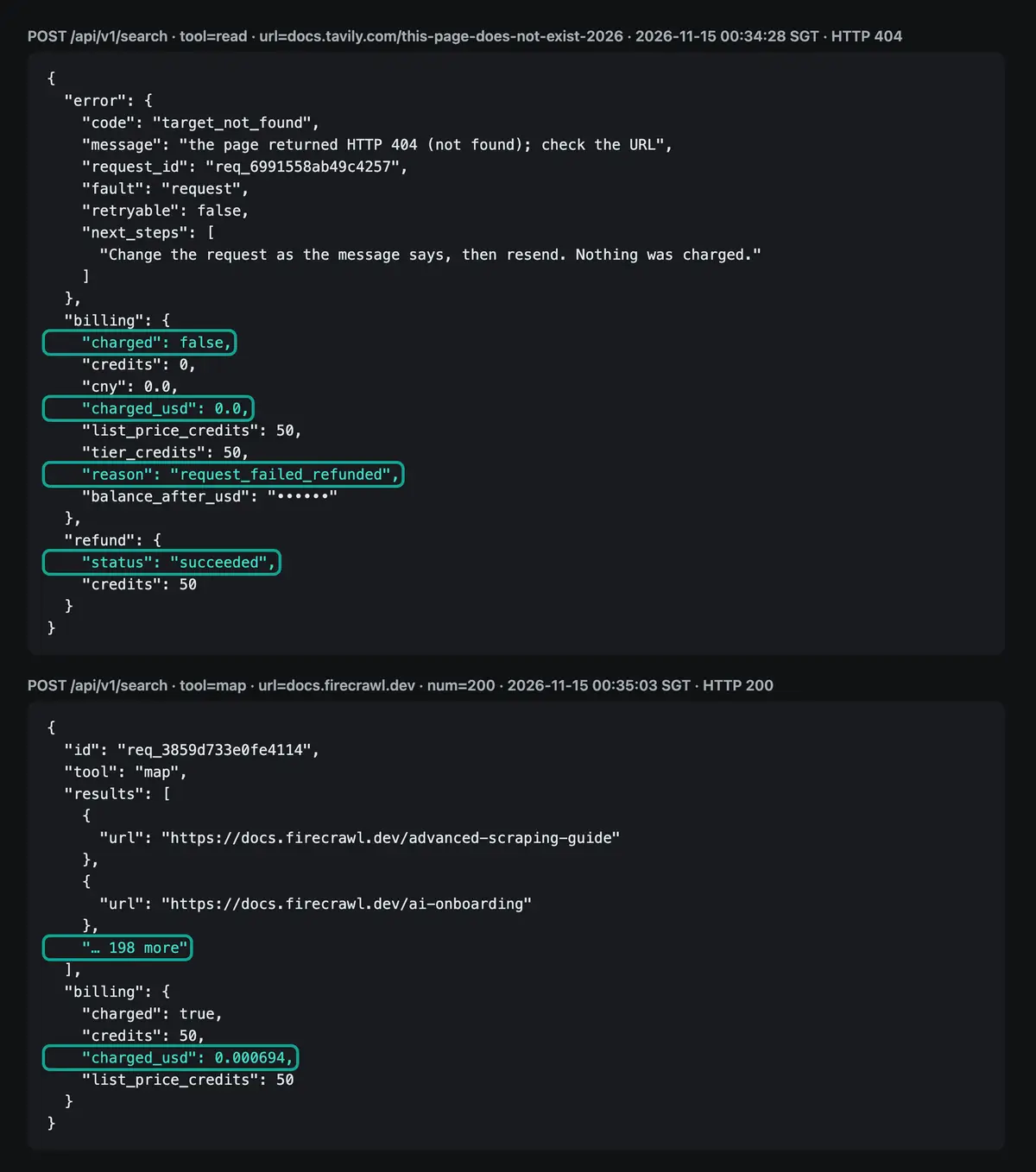
Firecrawl is close to us here. Its Map docs charge 1 credit per map, so Scale costs $0.749 per 1,000, or 1.08 times our price. The large gap applies to Tavily only, because it bills Map by page count. Picture a team that maps 30 competitor sites each day at 200 URLs per site. That is 900 calls per month, or $90 to $144 on Tavily and $0.62 with us.
S5: Research and cross-check deliver different things
Tavily Research splits a question, searches in rounds, reads sources, and writes a cited report. At pay-as-you-go, mini costs $0.032 to $0.88 per call and pro costs $0.12 to $2.00. Our crosscheck tool runs four retrieval methods in parallel, groups sources by how many methods found them, and fetches the top two. Each call costs $0.002778.
At 00:35:19 Singapore time, we checked the claim that Nebius agreed to buy Tavily for $275 million. After 40.97 seconds, the four methods converged. Three methods each found the Bloomberg report and the sacra profile, so both landed in the top tier. Research gives you a conclusion, and crosscheck gives you evidence. If you need a report for a user, Research saves work. If your own model writes the conclusion, crosscheck costs under 0.3 cents per call.
The same monthly budget, in searches
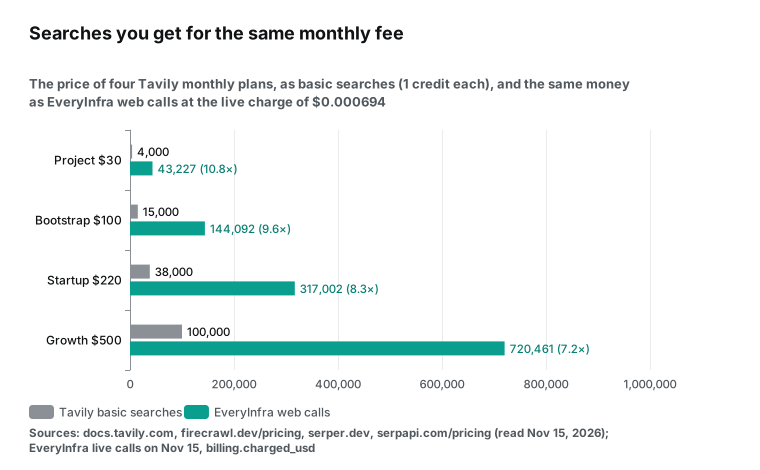
Each Tavily plan price buys far more web calls with us. The $30 Project plan buys 4,000 basic searches on Tavily and 43,227 calls with us, or 10.8 times more. The $500 Growth plan buys 100,000 and 720,461, or 7.2 times. Tavily's ratio falls as plans grow, because each credit gets cheaper.
Allowance lifetime also differs. Tavily credits reset on the first of each month, Firecrawl grants credits per month, and Serper packs last 6 months. Our balance does not reset or expire. If your agent runs one big batch at the start of a month and little after, monthly allowances go unused. Your real unit price then ends up above the full-use figures here.
The token bill: the other half of the cost
The model also pays to read results. The public search-api-cost-benchmark on GitHub, published 2026-08-06, ran 100 questions and priced reading at $3 per million tokens on Claude Sonnet 5. In it, tavily-basic used 3,166 tokens per call and cost $17.50 per 1,000 in total, with 88% correct. tavily-advanced used 12,749 tokens and cost $54.25, with 91% correct. firecrawl-search used 16,458 tokens and cost $55.77, with 94% correct.
The author posted the same numbers on r/AI_Agents and disclosed that they build one of the tested APIs. They also published every payload, grade, and price. One commenter said reading tokens made up 60 to 70 percent of total cost on their own agents.
We counted our tokens with tiktoken and the o200k_base encoding. Our 6 web calls used 765 to 879 tokens, a median of 807. read used 643 to 2,591, full-text deep used a median of 12,242, and the 11-page crawl used 45,715. At $3 per million tokens, web totals about $3.11 per 1,000 with the API fee. Full-text deep totals about $37.42. The benchmark used other questions and another count method, so compare only the order of magnitude.
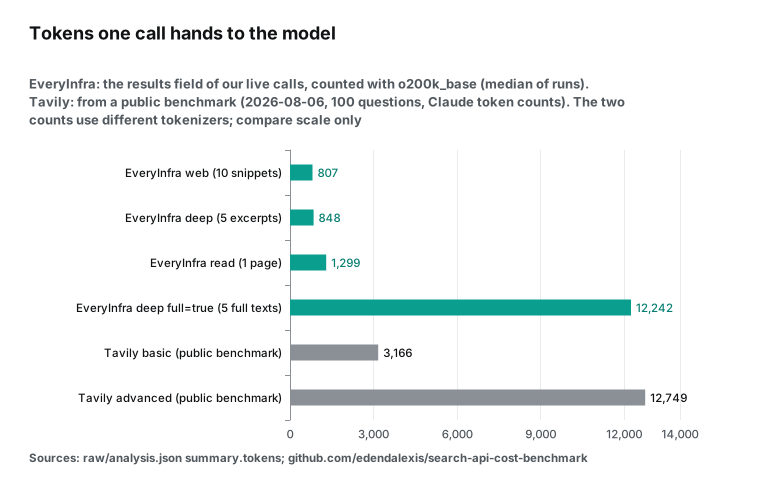
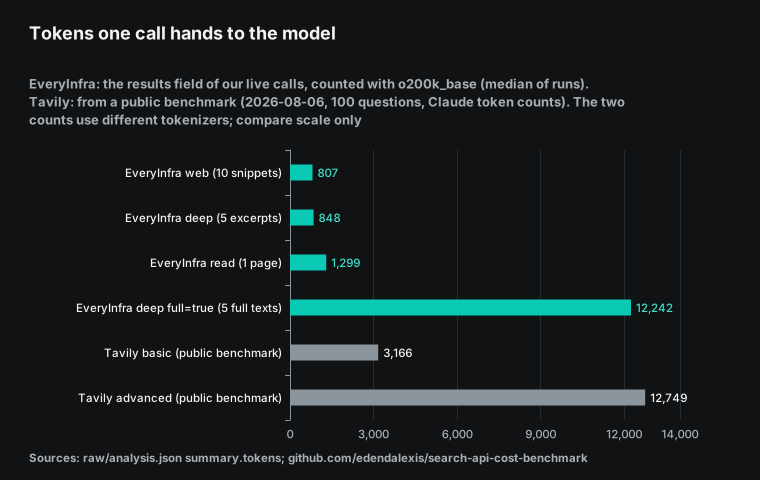
For snippet search, API fee and token cost sit in the same range, so a cheaper API lowers the total. Our web results carry only a title, link, snippet, and date, so they use fewer tokens than Tavily basic results with passages. For full-text search, tokens cost dozens of times the API fee, and the saving comes from reading less.
Failures, empty results, and wrong parameters
We tested six kinds of failure on purpose. Between 00:31 and 00:34 Singapore time, we hit the 429 rate limit 10 times. At 00:33:22 we sent a call without a key, and at 00:33:14 we sent Tavily-style query and search_depth. At 00:33:06 and 00:34:28 we read two missing pages, and at 00:37:35 we searched for nonsense words.
| Case | Tavily | Firecrawl | Serper | SerpAPI | EveryInfra (this test) |
|---|---|---|---|---|---|
| Page cannot be fetched | failed Extract and Map URLs cost nothing | 403 or 404 target still costs 1 credit | n/a | n/a | two 404s charged $0 |
| Empty search result | not stated in billing docs | no result, no charge | only successful responses count | counts as 1 search | charged $0 |
| Errors and rate limits | 429, limit per organization | not listed | only successful responses count | errors and cache hits free | 429 and 401 charged $0 |
| Wrong parameter name | not listed | not listed | not listed | not listed | 422, $0, with did_you_mean |
Both 404 responses show charged_usd at 0.0, reason as request_failed_refunded, and refund status as succeeded. The empty result shows empty_result_refunded. All 10 responses with status 429 say "Nothing was charged" and give a retry_after of 22 seconds. Our test key has its own cap of 10 calls per minute, and a normal account defaults to 60. Watch the Firecrawl rule: its pricing FAQ charges 1 credit for a 403 or 404 target, so dead links cost money.
In a migration from Tavily, parameter names cause the first error. We sent Tavily's query and search_depth to the web tool as they were. The API returned 422 in 0.10 seconds with the code unknown_param. The message says "query is not a parameter of tool web — did you mean q?" and lists the 7 parameters that web accepts. It also states that nothing was charged, so an agent can rename the field and resend without help.
EveryInfra live test: 36 calls at 12 moments
This table lists the 21 charged calls plus one example of each failure. Times are Singapore time, durations come from curl, and charges come from charged_usd. The 21 charged calls total $0.017175, with no charge off the catalog price.
| Time (Singapore) | Tool or capability | Key parameters | Returned | Duration | Charged |
|---|---|---|---|---|---|
| 00:30:36 | web | tavily alternatives | 10 results | 2.00 s | $0.000694 |
| 00:31:21 | web | Nebius Tavily acquisition | 10 results | 2.77 s | $0.000694 |
| 00:31:32 | web | MCP specification changelog | 10 results | 3.17 s | $0.000694 |
| 00:32:07 | deep | EU AI Act code signatories | 5 results | 12.08 s | $0.000694 |
| 00:32:28 | read | Tavily billing docs | 2,412 characters | 3.56 s | $0.000694 |
| 00:32:39 | read | Firecrawl pricing page | 10,602 characters | 1.44 s | $0.000694 |
| 00:32:49 | read | MCP specification changelog | 5,470 characters | 0.77 s | $0.000694 |
| 00:33:06 | read | missing domain | 404 | 0.45 s | $0 |
| 00:33:14 | web | Tavily-style parameters | 422 | 0.10 s | $0 |
| 00:33:22 | web | no key | 401 | 0.11 s | $0 |
| 00:33:45 | web | firecrawl search credits | 10 results | 1.61 s | $0.000694 |
| 00:34:03 | web | EU AI Act code signatories | 10 results | 3.04 s | $0.000694 |
| 00:34:13 | deep | MCP changelog, full=true | 5 full pages | 7.45 s | $0.000694 |
| 00:34:28 | read | missing page on docs.tavily.com | 404 | 5.98 s | $0 (refunded) |
| 00:34:41 | crawl | Tavily docs, with instructions | 11 pages | 5.86 s | $0.000694 |
| 00:35:03 | map | docs.firecrawl.dev, num 200 | 200 URLs | 0.51 s | $0.000694 |
| 00:35:11 | semantic | search API token benchmark | 8 results | 0.52 s | $0.000694 |
| 00:35:19 | crosscheck | Nebius acquires Tavily | 4 methods converged | 40.97 s | $0.002778 |
| 00:36:07 | bing/search | tavily alternatives, us | 7 results | 3.78 s | $0.000556 |
| 00:36:17 | duckduckgo/search | tavily alternatives, us | 10 results | 5.96 s | $0.000556 |
| 00:36:31 | web/search | tavily alternatives, us | 10 results | 2.13 s | $0.001389 |
| 00:37:24 | MCP everyinfra_search | web, a Tavily comparison query | 10 results | 2.05 s | $0.000694 |
| 00:37:35 | web | nonsense words | 0 results | 2.71 s | $0 (refunded) |
| 00:37:45 | google_news/search | Tavily, past month | 10 results | 2.02 s | $0.000792 |
| 00:37:54 | web | tavily alternatives, repeat | 10 results | 2.09 s | $0.000694 |
| 00:38:03 | deep | Tavily pricing, full=true | 5 full pages | 8.59 s | $0.000694 |
map and semantic took about half a second, and read, web, news, and MCP took 1 to 3 seconds. crawl, duckduckgo/search, and deep took 6 to 12 seconds, and crosscheck took 41. The slowest deep call ran without full text, so retrieval time matters more than page length. Keep web in interactive paths and move deep and crosscheck to the background. The news call used the Google News Scraper API, with an overview on the Google News platform page.
At 00:37 Singapore time, we searched "Tavily" news from the past month. Only 2 of the 10 results were about Tavily. One was the AIMultiple agentic search benchmark updated on 2026-11-10. The other was an HPCwire copy of the Nebius deal press release dated 2026-10-19. Two more were Nebius pages, and the other 6 were news about investment, gaming, a voice model, and an ecommerce tool. A news search on a brand name returns mostly noise, so filter by title and source before your agent uses the results.
The results for "tavily alternatives" tell their own story. Of the 10 URLs from web at 00:30 Singapore time, 6 were comparison pages from search or scraping vendors. One was the Tavily home page. The other 3 were a Reddit thread, a Medium post, and a GitHub topic page. The top result was the Firecrawl article on Tavily alternatives, and the top bing/search result was the same page. Use each vendor's pricing page as the source for prices.
What each side returns
After price, the next thing a migration meets is the result shape. Tavily returns a credit count in usage, and we return a dollar charge in billing. Both let an agent keep a running tally, but only ours needs no plan rate to convert.
| Item | Tavily search | EveryInfra `web` | EveryInfra `deep` |
|---|---|---|---|
| Fields per result | title, url, content, score, raw_content, published_date, favicon, images | title, url, snippet, published | the web fields plus content |
| Text per result | a relevant passage, full text with include_raw_content | a snippet of about 140 characters | an excerpt of 424–469 characters, or full text up to 20,000 |
| Relevance score | yes, score | no, order is the rank | no, order is the rank |
| Generated answer | optional, include_answer | no | no |
| Cost receipt | usage.credits | billing.charged_usd, plus reason and refund on failure | same as web |
If your code filters by score, take the top results by rank or let your model judge relevance. If it relies on include_answer, move that step to your own model. The reason and refund fields explain each $0 charge, so your agent can log why a call was free.
Migrating from Tavily: parameter map
Our endpoint is POST /api/v1/search, and the body has tool and params. This table maps the Tavily Search reference parameters. A wrong name returns 422 with the right name, so you can start from your old request and fix it from the error.
| Tavily parameter or endpoint | EveryInfra equivalent | Notes |
|---|---|---|
query | q | query returns 422, and did_you_mean gives q |
search_depth: basic | the web tool | title, link, and snippet |
search_depth: advanced | the deep tool | excerpt per result, optional full |
max_results (0–20) | num (up to 10) plus page | 20 results take two calls |
include_raw_content | deep with full=true, or read | 20,000 characters per page |
include_domains (up to 300) | site (one domain) | one call per domain |
time_range, start_date, end_date | after, before | date filters |
country | location | country name or two-letter code |
topic: news | the news tool, or google_news/search | news has its own tool |
include_answer | none | we do not generate answers |
| Extract (up to 20 URLs) | read (1 URL per call) | run URLs in parallel |
| Crawl | crawl (up to 20 pages, instructions) | one price per call |
| Map | map (up to 200 URLs) | one price per call |
| Research | crosscheck | evidence tiers, no report |
The curl below repeats our full-text deep call from 00:38 Singapore time. Put in your own key. Change tool to web, crawl, or map and fill params from the table.
curl -s https://api.everyinfra.com/api/v1/search \
  -H "Authorization: Bearer $EVERYINFRA_API_KEY" \
  -H "Content-Type: application/json" \
  -d '{"tool":"deep","params":{"q":"tavily alternatives pricing per 1000 searches","num":5,"full":true}}'
A wrapped Tavily client needs changes in three places. First, the body moves from flat parameters to tool plus params. Second, results come from title, url, snippet, and content in results. Third, the cap drops from 20 results to 10 per page. Split multi-domain include_domains into separate site calls, and let your own model write any answer.
MCP setup: both are remote, with different sign-in
Tavily's remote MCP server lives at mcp.tavily.com/mcp. Its MCP docs list 5 tools: tavily_search, tavily_extract, tavily_crawl, tavily_map, and tavily_research. It supports OAuth, so you sign in through the browser and paste no key. The Claude connector directory has a Tavily entry. Clients without remote MCP can use mcp-remote or a local server with TAVILY_API_KEY.
Our remote MCP server lives at https://api.everyinfra.com/mcp, and tools/list works without a key. At 00:37 Singapore time, it listed 12 tools. One of them, everyinfra_search, holds the 17 search tools, and its description reads "Failed or empty searches leave no final charge". Sign-in uses a Bearer key in a header. Our MCP web call at 00:37:24 returned 10 results in 2.05 seconds for $0.000694, the same price as a direct call. In Claude Code, one command adds it:
claude mcp add --transport http everyinfra https://api.everyinfra.com/mcp \
  --scope user \
  --header 'Authorization: Bearer ${EVERYINFRA_API_KEY}'
claude mcp get everyinfra
For Cursor and other JSON configs, add the block below and replace YOUR_API_KEY. The MCP setup page lists all clients. Both servers follow the 2025-11-25 MCP specification.
{
  "mcpServers": {
    "everyinfra": {
      "url": "https://api.everyinfra.com/mcp",
      "headers": { "Authorization": "Bearer YOUR_API_KEY" }
    }
  }
}
Firecrawl runs its own MCP server, as its MCP docs show. The SerpAPI pricing page lists MCP among its integrations, and the Serper home page that we read does not mention MCP. Tavily's one-click OAuth suits a solo user who does not want keys. A team config can keep the key in an environment variable and send it in a header. That way, the config file holds no secret.
Free tiers, rate limits, and minimum spend
| Tavily | Firecrawl | Serper | SerpAPI | EveryInfra | |
|---|---|---|---|---|---|
| Free allowance | 1,000 credits per month, plus keyless trial | 1,000 credits per month | 2,500 searches, one time | 250 per month | $1 for starring two GitHub repos, 24 hours |
| Searches on it | 1,000 basic | 500 | 2,500 | 250 | about 1,440 web calls |
| Lowest paid option | $30 per month, or $0.008 per credit | $19 per month | $50 prepaid, 6 months | $25 per month | per call, balance never expires |
| Default rate limit | free 100 per minute, paid 1,000 to 1,500 | Hobby 100 per minute | 50 to 300 per second, by pack | hourly cap per plan | 60 per minute, more with boosts or total top-ups |
The Tavily rate limit docs set one limit per organization, shared by all keys. Free allows 100 requests per minute, paid plans allow 1,000, and Growth and Scale allow 1,500. Crawl and Map have their own cap of 100 per minute, and Research has 20. Under heavy load, the free plan can return 434 for requests with max_age_hours. Tavily keyless access opens search and Extract with one header before sign-up.
With credit-based free tiers, the number of free calls depends on the workload. The 1,000 Tavily credits give 1,000 basic searches, 500 advanced searches, 250 crawls of 10 pages with instructions, or only 50 maps of 200 URLs. The 1,000 Firecrawl credits give 500 searches, 100 crawls of 10 pages, or 1,000 maps. Serper and SerpAPI cover search only, with 2,500 and 250 searches. Our $1 trial charges per call, so web, deep, crawl, and map each give about 1,440 calls, and crosscheck gives about 360. You must use it within 24 hours.
A team that tests site discovery on the Tavily free plan runs out after 50 site maps.
Each EveryInfra account defaults to 60 calls per minute, shared by all its keys. The pricing page gives two ways to go higher. You can buy a 30-day boost: 180 per minute for $10, 600 for $30, or 1,800 for $78. Or you get the same tier at no cost after total top-ups of $50, $150, or $750, and the higher of the two applies.
Here Tavily's paid plans start higher at no extra cost. Below $750 in total top-ups, 1,800 calls per minute costs us $78 per month. So 1 million web calls cost $772 in the first month with the boost. By the second month, total top-ups pass $750 and the boost costs nothing. The same Tavily basic volume costs $7,700 per month.
Serper sets the highest limits of all. Its pricing cards list 50 queries per second for Starter, 100 for Standard, 200 for Scale, and 300 for Ultimate. Its FAQ says that Ultimate allows about 15,000 to 18,000 searches per minute and can go higher on request. Per minute, even the smallest Serper pack allows 3,000 searches, 50 times our default and 3 times the Tavily paid plans. For batch jobs that fan out thousands of plain searches at once, this limit can matter more than the unit price.
When Tavily or another vendor fits better
Each row names a case where the other side fits better and the doc that supports it.
| Case | Who fits better | What their docs say | Our side |
|---|---|---|---|
| 20 full-text results in one call | Tavily | max_results up to 20, include_raw_content adds no credit | 10 per call, so two calls |
| A written research report | Tavily | Research writes a cited report, include_answer adds an answer | evidence only, no answers |
| Search inside many allowed domains | Tavily | include_domains up to 300, exclude_domains up to 150 | one site per call |
| No key management | Tavily | OAuth MCP, Claude directory, keyless trial | Bearer key in a header |
| High concurrency at no extra cost | Tavily | 1,000 to 1,500 calls per minute on paid plans | 60 per minute, boosts from $10 |
| Already on the Nebius cloud | Tavily | sold next to Nebius inference | not part of that cloud |
| Students and startups | Tavily | four months of Project, or 100,000 credits | $1 trial |
| Strict data retention terms | Tavily, Firecrawl | zero data retention on enterprise plans | negotiate separately |
| High-volume plain search | Serper | $0.30 per 1,000 on its largest pack | $0.694 per 1,000 |
| Rich scrape formats and page actions | Firecrawl | Markdown, actions such as click and scroll | text only |
| Full results page blocks | SerpAPI | ads, knowledge panel, related questions | title, link, snippet |
Nebius announced the Tavily deal on 2026-02-10. The Nebius press release adds agent search to its AI cloud, and its agentic search page sells Tavily with inference. SiliconANGLE cited Calcalist: $275 million up front and up to $400 million with performance terms. The Tavily post about joining Nebius says the API and data policies stay the same.
Two softer costs also favor staying. Teams that lean on the Tavily integrations in LangChain and similar frameworks get prompts and parsing for free, and a switch touches that code. Count those hours in your migration cost. For Serper and Firecrawl in depth, see Serper API alternative and Firecrawl alternatives, plus Serper and SerpAPI pricing.
A bill that grew in the telling: 100,000 pages on Tavily
Firecrawl updated its Tavily alternatives article on 2026-10-27. Its table row "Pricing (100K pages)" lists Firecrawl Standard at $99 per month and Tavily at about $800, with a note: pay-as-you-go basic search. That $800 is 100,000 basic searches at $0.008 per credit. If the job is to extract 100,000 pages, Extract basic needs only 20,000 credits, or $160 at pay-as-you-go and $100 on Growth. The row compares a Firecrawl price per page with a Tavily price per search.
Search charges per request, Extract per 5 URLs, and Map per 10 pages. The same "100,000" can differ by more than 5 times across them. On our side, 100,000 pages cost $69.40 with read, or $3.47 with 5,000 crawl calls plus some map calls.
Switch or stay: break down one month of a Tavily bill
Real agents mix endpoints. Here is an assumed month of 100,000 requests. It holds 60,000 basic searches, 20,000 advanced searches, 15,000 Extract calls with 5 URLs, 4,000 crawls of 10 pages, and 1,000 maps of 200 URLs. Tavily converts these into 147,000 credits. Growth covers 100,000 for $500, and the other 47,000 cost $376, for a bill of $876.
| One month of usage | Tavily credits | Share of credits | EveryInfra calls | EveryInfra charged |
|---|---|---|---|---|
| 60,000 basic searches | 60,000 | 40.8% | 60,000 web | $41.64 |
| 20,000 advanced searches | 40,000 | 27.2% | 20,000 deep | $13.88 |
| 15,000 Extract calls (5 URLs) | 15,000 | 10.2% | 75,000 read | $52.05 |
| 4,000 Crawl calls (10 pages) | 12,000 | 8.2% | 4,000 crawl | $2.78 |
| 1,000 Map calls (200 URLs) | 20,000 | 13.6% | 1,000 map | $0.69 |
| Total | 147,000 ($876) | 100% | 160,000 | $111.04 |
On our side, the same work takes 160,000 calls and costs $111.04, about one eighth of Tavily. The extra calls all come from splitting Extract into single-URL read calls. If deep with full=true replaces that part, the count drops to 100,000 calls and $69.40.
Map is 1% of requests but 13.6% of credits. If Map or Crawl takes a high share in your Tavily dashboard, move those first. Extract is the cheapest part on Tavily and our most expensive row, though still under Tavily's $120 for it. So move Map, Crawl, and advanced search first, and move Extract later.
Retries add one more cost. A commenter on the benchmark post noted that a bad first search makes the agent search again, and the model reads a second payload. Our failed calls cost no API fee, but your model still reads the error. Our 422 used 60 English words to say "change query to q", and one resend worked.
Industry moves: October and November 2026
| Date | Event | Source |
|---|---|---|
| 2026-10-27 | Firecrawl updates its Tavily alternatives article | Firecrawl blog |
| 2026-11-02 | SerpAPI adds a udm=web mode for web-only Google results | SerpAPI release notes |
| 2026-11-10 | AIMultiple updates its agentic search benchmark with 120 questions | AIMultiple |
| 2026-11-11 | SerpAPI adds an API for one more search engine | SerpAPI release notes |
| 2026-11-12 | firecrawl-py 4.57.0 ships | PyPI |
| 2026-11-13 | @tavily/cli 1.0.0 ships on npm (UTC) | npm |
In the AIMultiple test, Tavily Ultra Fast scored 26.3% on freshness. Firecrawl and Tavily Advanced both scored 64.0% on source support. Tavily records API changes in its changelog, and its Python client is tavily-python.
Limits: when these numbers stop holding
All vendor prices come from public pages read on 2026-11-15, and any vendor can change them. Enterprise plans use custom prices and are not in the tables. The per-1,000 figures assume full use, so partial use raises the vendor's real unit price. If your Tavily account cannot combine pay-as-you-go with a plan, its high-volume bills go up. Our prices can change too, so check the pricing page.
This article does not compare result quality. Run your own question set to see which side suits your agent.
Get started: run your own queries
- Get a key from the quickstart and start with the trial credit.
- Pick 50 real queries from your Tavily logs and rewrite them with the parameter map.
- Run each query through
webanddeep, and record the charge, the count, and the duration. - Run
mapandcrawlon three sites that you fetch often, and compare with your Tavily credits. - Add the MCP server and run the same questions through
everyinfra_search. - Compare one month of bills and tokens, then decide how much traffic to move.
The search product page covers all tools, with pages for web search, deep search, read, crawl, and map. For a general method, see choosing agent search tools.
Related articles: the best web search API for AI agents, SerpAPI pricing explained, and parameter migration after a search API shutdown.
FAQ
Are there free Tavily alternatives? (search phrase "tavily alternatives free") Tavily gives 1,000 credits per month and Firecrawl gives 1,000. Serper gives 2,500 searches once, and SerpAPI gives 250 per month. We give $1 of trial credit for 24 hours, about 1,440 web calls. For no time limit, self-host an open-source metasearch engine and pay for the server.
Is there an open-source, self-hosted Tavily alternative? (search phrases "tavily alternative open source", "self hosted") Yes. You can host an open-source metasearch engine on your own server, and it combines results from several search services. This type of engine does not fetch full text, so you add a scraper. Firecrawl also has an open-source scraper. You save the API fee and take on the server, rate limits, and bot checks.
How do I choose for the search phrase "tavily vs exa"? On the Tavily side, basic search costs 1 credit and advanced costs 2. A credit costs $0.005 to $0.0075 on a plan and $0.008 pay-as-you-go. So basic search costs $5 to $8 per 1,000, and advanced costs $10 to $16. Then run the same real queries through both services and record the fee, the result count, and the tokens. Snippet search uses a few thousand tokens at most and full text over 10,000, so tokens often decide more than price.
Tavily vs Firecrawl: which one costs less? (search phrase "tavily vs firecrawl") It depends on the workload. Firecrawl costs less for search only and for site maps, and Tavily has a lower ceiling for search plus 5 pages. The summary table at the top gives each price.
How does Tavily API pricing work? (search phrase "tavily api pricing") In credits, with a rule for each of Search, Extract, Map, Crawl, and Research. Plans run from $30 to $500 per month, and pay-as-you-go costs $0.008 per credit. The section on how Tavily converts credits gives each rule.
Does Tavily still work after the Nebius acquisition? (search phrase "tavily nebius") Yes. The post Tavily is joining Nebius says nothing changes about how you use Tavily and the API stays the same. On 2026-11-15, its billing, rate limit, and MCP docs were current, and CLI 1.0 shipped in November.
What does Reddit say about Tavily? (search phrase "tavily alternatives reddit") On r/AI_Agents, a vendor-disclosed benchmark put tavily-basic at $17.50 per 1,000 in total with 88% correct. On r/mcp, a thread asks whether Tavily MCP is still worth it, and one user says the free plan hit its limit fast. Another thread asks for the best and cheapest web search tool. Check forum numbers against each pricing page.
References
- API Credits Overview (billing docs), Tavily, read 2026-11-15 00:20 Singapore time
- Tavily Search endpoint reference, Tavily, read 2026-11-15
- Tavily Extract endpoint reference, Tavily, read 2026-11-15
- Tavily Crawl endpoint reference, Tavily, read 2026-11-15
- Tavily Map endpoint reference, Tavily, read 2026-11-15
- Tavily Research endpoint reference, Tavily, read 2026-11-15
- Rate Limits, Tavily, read 2026-11-15
- Keyless access, Tavily, read 2026-11-15
- Tavily MCP, Tavily, read 2026-11-15
- Tavily Changelog, Tavily, read 2026-11-15
- Tavily docs index, llms.txt, Tavily, read 2026-11-15
- Best practices for search, Tavily, read 2026-11-15
- Student account, Tavily Help Center, read 2026-11-15
- @tavily/cli, npm, 1.0.0 published 2026-11-13
- tavily-python, PyPI, read 2026-11-15
- Tavily Pricing, Tavily, read 2026-11-15
- Tavily is joining Nebius, Tavily, read 2026-11-15
- Tavily for Startups, Tavily, read 2026-11-15
- Tavily in the Claude connector directory, Anthropic, read 2026-11-15
- Nebius announces agreement to acquire Tavily, Nebius, 2026-02-10
- Agentic search solution page, Nebius, read 2026-11-15
- Nebius buys agentic search startup Tavily, SiliconANGLE, 2026-02-10
- Firecrawl Pricing, Firecrawl, read 2026-11-15 00:25 Singapore time
- Firecrawl Search docs, Firecrawl, read 2026-11-15
- Firecrawl Crawl docs, Firecrawl, read 2026-11-15
- Firecrawl Map docs, Firecrawl, read 2026-11-15
- Firecrawl MCP Server, Firecrawl, read 2026-11-15
- Firecrawl Changelog, Firecrawl, read 2026-11-15
- firecrawl-py, PyPI, 4.57.0 published 2026-11-12
- 5 Tavily Alternatives for Better Pricing, Performance, and Extraction Depth, Firecrawl, updated 2026-10-27
- Serper home page (pricing and FAQ), Serper, read 2026-11-15
- SerpApi Plans and Pricing, SerpApi, read 2026-11-15
- Google Search API, SerpApi, read 2026-11-15
- Markdown output, SerpApi, read 2026-11-15
- SerpApi Release Notes, SerpApi, latest entry 2026-11-12
- search-api-cost-benchmark, GitHub, 2026-08-06
- tiktoken, OpenAI (GitHub), read 2026-11-15
- I measured what 13 search APIs actually cost to run inside an agent, Reddit r/AI_Agents, read 2026-11-15
- Is Tavily MCP still worth it or are there better options?, Reddit r/mcp, read 2026-11-15
- Best and cheapest web search tool option?, Reddit r/AI_Agents, read 2026-11-15
- Agentic Search API Benchmark, AIMultiple, updated 2026-11-10
- MCP specification 2025-11-25 changelog, Model Context Protocol, read 2026-11-15
- EveryInfra search tool catalog, EveryInfra, read 2026-11-15 00:29 Singapore time
- EveryInfra capability catalog, EveryInfra, read 2026-11-15
- EveryInfra remote MCP server, EveryInfra, read 2026-11-15 00:37 Singapore time
Reference BL-161