SerpAPI pricing, tier by tier: what 1,000 searches cost on each of 61 plans
SerpAPI's 61 tiers cost $25.00 to $1.96 per 1,000 searches, and empty results count. Per 1,000 web searches, ours cost $0.694 to $1.389, 1.4x to 36x less.

SerpAPI sells its search API as a monthly subscription with 61 self-serve tiers. The smallest paid tier, Starter, costs $25 a month for 1,000 searches, which is $25.00 per 1,000. The largest, Cloud 54M, costs $106,050 a month for 54 million searches, which is $1.96 per 1,000. On November 14, 2026 we ran live calls against two EveryInfra web search endpoints. The web tool on the unified search endpoint charged $0.000694 per call, and web/search charged $0.001389 per call.
Per 1,000 web searches, the web tool at $0.694 costs 36 times less than SerpAPI Starter ($25.00) and 2.83 times less than Cloud 54M ($1.96). For web/search at $1.389, the ratios are 18 and 1.41. The two services return different fields. Each web tool result has only a title, a URL and a snippet. A SerpAPI Google search returns the full results page, with blocks such as ads and the knowledge graph. The section under the main table lists both sides.
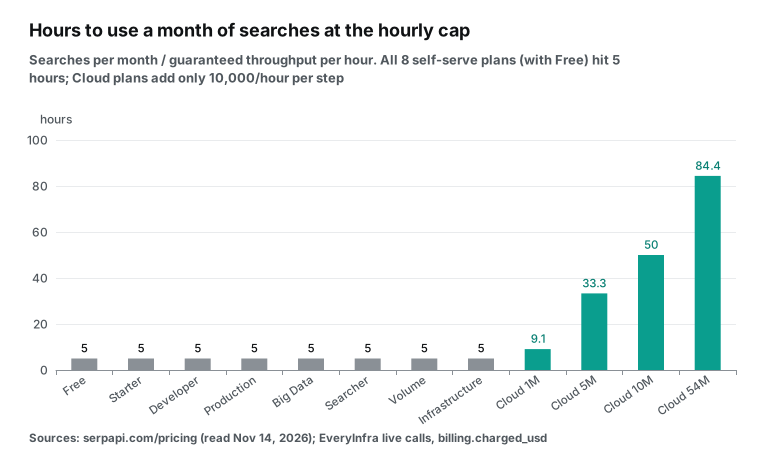
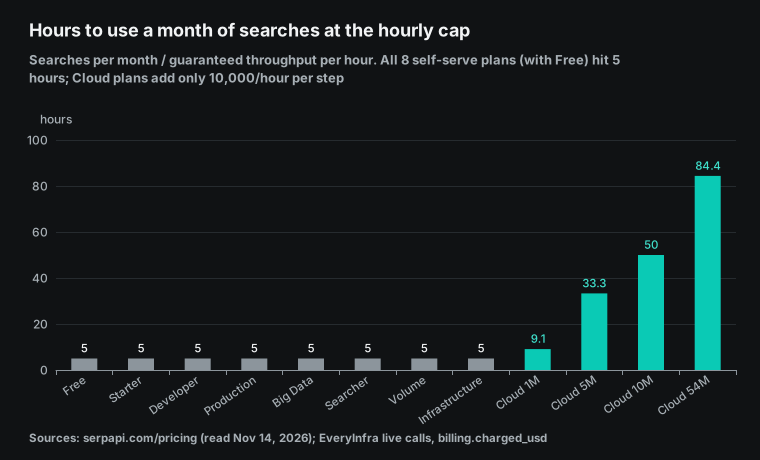
The billing rules also differ. SerpAPI counts an empty result as one search. When we searched for a string that does not exist, we got zero results and a charge of $0. SerpAPI also has an hourly cap on each tier. At that cap, each of the eight self-serve tiers uses its monthly allowance in 5 hours.
How we got the numbers
All SerpAPI numbers in this guide come from public pages. We read the pricing page, the Enterprise page, the feature pages, the engine documentation and the release notes between 00:15 and 00:40 SGT on 2026-11-14. We saved the plan data embedded in the pricing page and counted 61 Best Effort tiers. We did not create a SerpAPI account and we did not call the SerpAPI API. So every SerpAPI number here is a list price. Every EveryInfra number is a live charge.
For SerpAPI, "price per 1,000 searches" means the monthly fee divided by the monthly searches of that tier, times 1,000. This assumes that you use the full allowance. If you do not, the leftover searches reset at renewal and your real price per 1,000 is higher. For EveryInfra, "price per 1,000" means the sum of billing.charged_usd from our live responses, divided by the number of calls, times 1,000. We checked each value against price_usd in the capability catalog. The two services return different fields and row counts, so we compare prices and billing rules only.
SerpAPI pricing in one table: 61 self-serve tiers
The SerpAPI pricing page shows four large cards at the top (Starter, Developer, Production and Big Data) and two small cards (Free and Enterprise). The full list is lower on the page, in the "All plans" table. That table has seven named tiers, from Starter to Infrastructure, and 54 cloud tiers, from Cloud 1M to Cloud 54M. The table below shows 12 of them. The last column divides each tier's price per 1,000 by our live web search charge of $0.694 per 1,000.
| Tier | Monthly fee | Searches per month | Hourly cap | Per 1,000 | Legal Shield | Per 1,000 web searches ÷ our `web` tool |
|---|---|---|---|---|---|---|
| Free | $0 | 250 | 50 | — | No | — |
| Starter | $25 | 1,000 | 200 | $25.00 | No | 36.0x |
| Developer | $75 | 5,000 | 1,000 | $15.00 | No | 21.6x |
| Production | $150 | 15,000 | 3,000 | $10.00 | Yes | 14.4x |
| Big Data | $275 | 30,000 | 6,000 | $9.17 | Yes | 13.2x |
| Searcher | $725 | 100,000 | 20,000 | $7.25 | Yes | 10.4x |
| Volume | $1,475 | 250,000 | 50,000 | $5.90 | Yes | 8.5x |
| Infrastructure | $2,750 | 500,000 | 100,000 | $5.50 | Yes | 7.9x |
| Cloud 1M | $3,750 | 1,000,000 | 110,000 | $3.75 | Yes | 5.4x |
| Cloud 5M | $11,475 | 5,000,000 | 150,000 | $2.30 | Yes | 3.3x |
| Cloud 10M | $21,125 | 10,000,000 | 200,000 | $2.11 | Yes | 3.0x |
| Cloud 54M | $106,050 | 54,000,000 | 640,000 | $1.96 | Yes | 2.83x |
The last column compares the price of 1,000 web searches, but one search does not return the same data on each side. In our 00:23 SGT call, the EveryInfra web tool returned 10 results. Each result had three fields: title, url and snippet, and a page parameter gets the next page. Each web/search result has four fields: rank, title, url and text.
A SerpAPI Google search returns the whole page. Each organic result has position, title, link, displayed_link and snippet, and some results also have snippet_highlighted_words, date, sitelinks or rich_snippet. The same response can also hold blocks such as Ads, Knowledge Graph, Related Questions, Local Results, Top Stories and AI Overview. The sidebar of the Google Search API docs lists more than 60 block names. If you need only the title, URL and snippet of the top 10, the ratio in the last column applies. If you need ads, the knowledge panel or the page layout, one SerpAPI search gives you more, and the ratio does not apply.
| What 1,000 web searches buy | EveryInfra `web` tool | EveryInfra `web/search` | SerpAPI Google search |
|---|---|---|---|
| Price per 1,000 | $0.694 (live charge) | $1.389 (live charge) | $25.00 (Starter) to $1.96 (Cloud 54M), list price |
| Fields per result | title, url, snippet | rank, title, url, text | position, title, link, displayed_link, snippet, plus optional fields |
| Whole-page blocks | None | None | Ads, Knowledge Graph, Related Questions; more than 60 block names in all |
| Results per page | 10 (10 returned this time) | 10 (10 returned this time) | 10 (per the docs) |
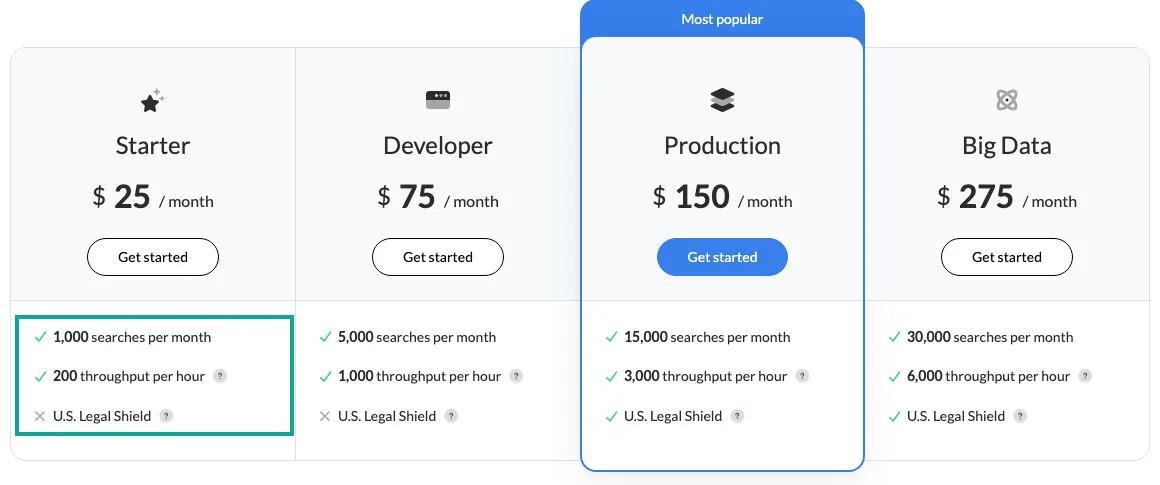
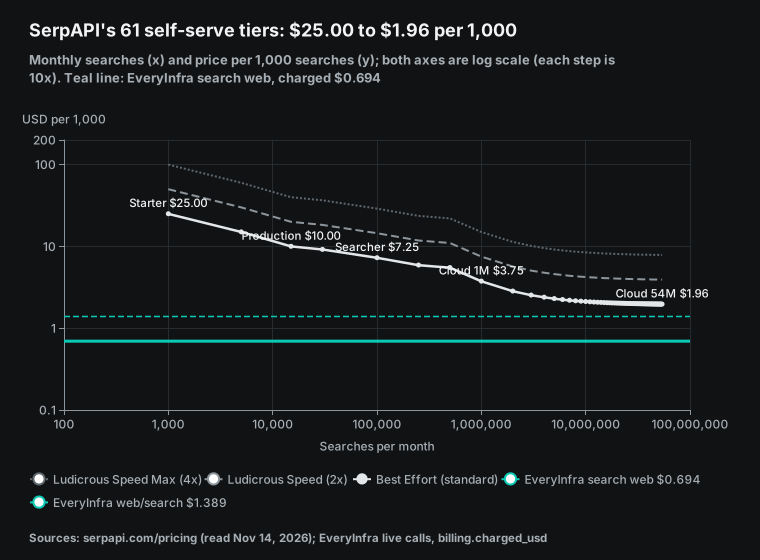
When you plot all 61 tiers, the price drops in two stages. From Starter to Cloud 1M, the price per 1,000 falls from $25 to $3.75, a drop of 85 percent. From Cloud 1M to Cloud 54M, volume grows 54 times, but the price per 1,000 falls only from $3.75 to $1.96. More than 50 tiers sit close to $2.00.
The cloud tiers add about $1,925 to $1,950 for each additional million searches, so the price per 1,000 levels off near $1.93. Our web search at $0.694 is a flat line below all 61 points. Our pay-per-call web/search at $1.389 is also below every tier.
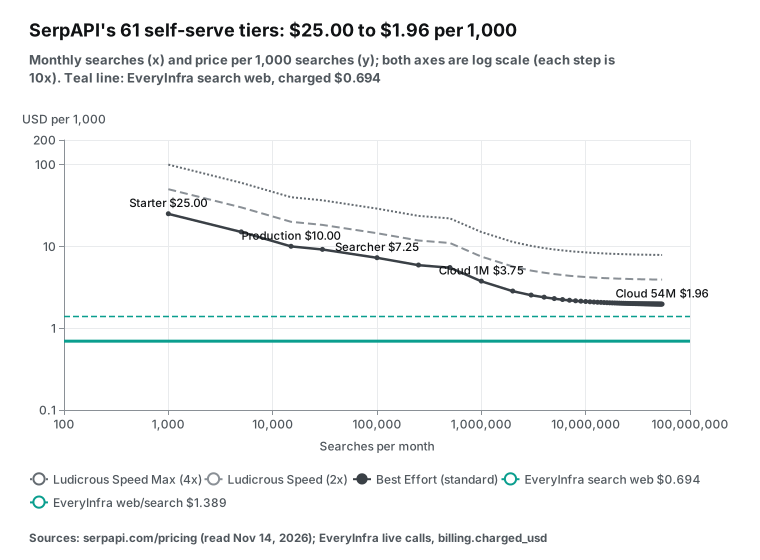
First, the step from Developer to Production doubles the fee but triples the searches. The price per 1,000 falls from $15 to $10, and you also get Legal Shield. If your volume is between 5,000 and 15,000 searches a month, Production is the smoothest self-serve tier, and SerpAPI marks that card "Most popular".
Second, Volume ($5.90 per 1,000) and Infrastructure ($5.50) are cheaper per search than Searcher ($7.25), but only when you use 250,000 or 500,000 searches. A team that needs 300,000 searches a month pays $2,175 for three Searcher renewals. That is less than two Volume renewals ($2,950) and less than one Infrastructure plan ($2,750). The monthly-bill section below shows this with a script.
What counts as a search: the rules behind serpapi cost
The counting rules are in the FAQ at the bottom of the SerpAPI pricing page. Only successful searches count toward your monthly allowance. Cached, errored and failed searches do not count. The number of results does not change the count: a search with 100 results and a search with no results both count as one. The Enterprise page adds more detail. Only fully successful searches count; blocked, errored or CAPTCHA-hit searches do not; legitimately empty searches do count; and pagination queries count separately.
The cache rule is under the no_cache parameter in each engine's documentation. A cache hit needs the same query and parameters. The cache expires after one hour, and cached searches are free (Google Search API docs). The status and error codes page says that a search with no results is still a success. Its search_metadata.status is Success.
Three of these rules change your real price. Empty results cost money. If you monitor long-tail or brand keywords, many rare terms return nothing, and each of those still uses one search. Pages cost money.
A Google web page has 10 results, so the top 50 positions take five searches. A Maps page has 20 places, so 100 places take five searches. The cache saves money only for identical requests within one hour. A rank tracker that runs once an hour always lands after the cache expires.
| Billing rule | SerpAPI (public text) | EveryInfra (catalog plus our test) |
|---|---|---|
| Unit | One successful search uses one search from the monthly allowance | One successful call deducts the catalog price_usd from a USD balance |
| Empty result | Counts as one search | Refunded; our empty call had charged_usd of 0 |
| Error, failure, block | Not counted | Not charged; a bad parameter returns 422 with "Nothing was charged" |
| Cache | Identical requests within one hour are free | No cache discount; each call is charged |
| Pagination | Each page is one search | Each page is one call (page or page_token) |
| Rows per call | Fixed by engine: 10 web results, 20 Maps places, about 40 Shopping items | Set by capability: web 10, news 20, maps up to 50, shopping up to 100, YouTube up to 50 |
| Expiry | Allowance resets at renewal | Balance does not expire monthly |
| Minimum spend | $25 a month above Free | No monthly fee; minimum top-up $10, then each call is deducted from the balance, from $0.000556 a call |
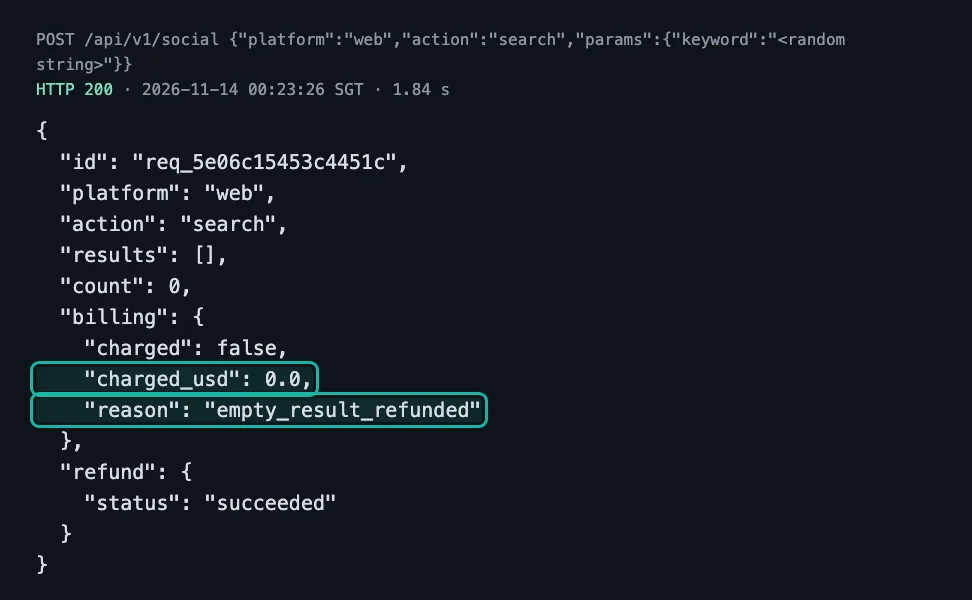
The empty-result refund shows in billing.reason. Our probe at 00:23 SGT returned "charged_usd": 0.0 and "reason": "empty_result_refunded".
Hourly throughput: every self-serve tier runs dry in 5 hours
The second line on each plan card is "throughput per hour". The tooltip calls it the guaranteed hourly throughput of the plan. It also says to spread searches evenly across the hour and across many hours (SerpAPI pricing page). The status page explains what happens above the cap. You get HTTP 429 for one of two reasons. The key went above the hourly limit, or the account ran out of searches (status and error codes).
We divided each tier's monthly searches by its hourly cap. The result is the number of hours at full speed that it takes to use the whole month. For Free, Starter, Developer, Production, Big Data, Searcher, Volume and Infrastructure, the answer is exactly 5 hours. Each of these tiers has an hourly cap of one fifth of its monthly allowance.
The cloud tiers follow a different rule. Cloud 1M allows 110,000 searches an hour, and each larger cloud tier adds only 10,000 an hour, up to 640,000 for Cloud 54M. So larger cloud tiers take longer to drain: 9.1 hours for Cloud 1M and 84.4 hours for Cloud 54M.
For a batch job, the cap sets the pace: 20,000 keywords on Big Data (6,000 an hour) take at least 3 hours and 20 minutes. For a chat product, it sets the peak: Starter allows one search every 18 seconds, and a few dozen active users can hit 429. EveryInfra limits requests per account per minute. The pricing page says each account gets 60 requests a minute by default, shared by all of its API keys. For more, you can buy a 30-day rate package in the console (180 a minute for $10, 600 a minute for $30), or reach the same tier through your total top-ups.
Sixty a minute is 3,600 an hour. That is more than the 1,000 an hour on SerpAPI Developer and less than the 6,000 an hour on Big Data. The difference is that our limit has no monthly allowance behind it. Because we charge per call, there is no allowance that runs out in a few hours.
Renewal, downgrade and refunds
SerpAPI bills monthly, and the allowance follows the billing cycle. The pricing page FAQ covers each case in one or two sentences (SerpAPI pricing FAQ).
If you use all searches before the month ends, you can turn on Automatic Early Renewal or renew by hand. In both cases, the allowance refills, the renewal date moves to that day, and searches reset at the start of the new billing cycle. Use Starter's 1,000 searches by the 15th and renew early. You pay another $25, and the new cycle starts on the 15th.
If you upgrade, you pay only the difference and the renewal date stays the same. If you downgrade, the renewal date stays the same and the next cycle uses the lower price. Leftover searches move to your Extra Credits balance. If you cancel, you can use the remaining searches until the renewal date.
The refund rule is a full refund within 7 days of subscribing, unless you have used more than 20 percent of your searches. Section 9 of the SerpAPI Terms of Service, last updated on August 27, 2026, has the same sentence. On Starter, that means no refund after 200 searches. If you only want to try the service, the 250 searches of the Free tier are a better start than paying $25. The Enterprise page also says that unused reserved searches do not roll over to the next month (SerpAPI Enterprise).
The self-serve FAQ does not use the word "roll over". It says that searches "reset" at renewal. So on a monthly plan, unused searches expire at the start of the next cycle. That is why our price per 1,000 for SerpAPI is a floor, not an average.
To check what is left, use the free Account API. It returns searches used and searches left this month, the plan allowance, the next renewal date and the hourly limit. The docs say that calls to the Account API are free and do not count toward the monthly allowance. Read plan_searches_left daily and spend the remainder on backlog work before renewal.
SerpAPI free plan: 250 searches a month
The Free tier is listed under "Flexible options for every stage" on the SerpAPI pricing page: $0 a month, 250 searches, 50 searches an hour, and no U.S. Legal Shield, ZeroTrace or priority support. The 250 searches renew every month; this is not a one-time trial. Like the paid tiers, it runs dry in 5 hours at full speed.
This number is higher than the one in older community posts. In an n8n thread, the author called the free 100 searches a month hard to work with. Another user wrote that they "charge $15 per 1k" against a market rate of about $0.60 to $1.20 (r/n8n thread). Another thread said that the first paid tier was $75 (r/n8n thread).
Today the Free tier has 250 searches, there is a $25 Starter tier below Developer, and $15 per 1,000 is the Developer price. We could not get an archived copy of the pricing page, because the archive returned a bot check. So we report only the current page and the posts, not the date of the change.
What can you do with 250 searches? You can check the first page of results for 25 keywords on 10 days, or let an AI assistant answer 8 web questions a day. Above that, the next step is Starter at $25 for 1,000. The same 250 searches with the EveryInfra web tool cost $0.17 at our live rate. Our pricing page lists a $1 trial credit that you claim under the conditions on that page. It is valid for 24 hours after you claim it, which is about 1,440 web tool calls.
Ludicrous Speed and Max: the same tier at 2x and 4x
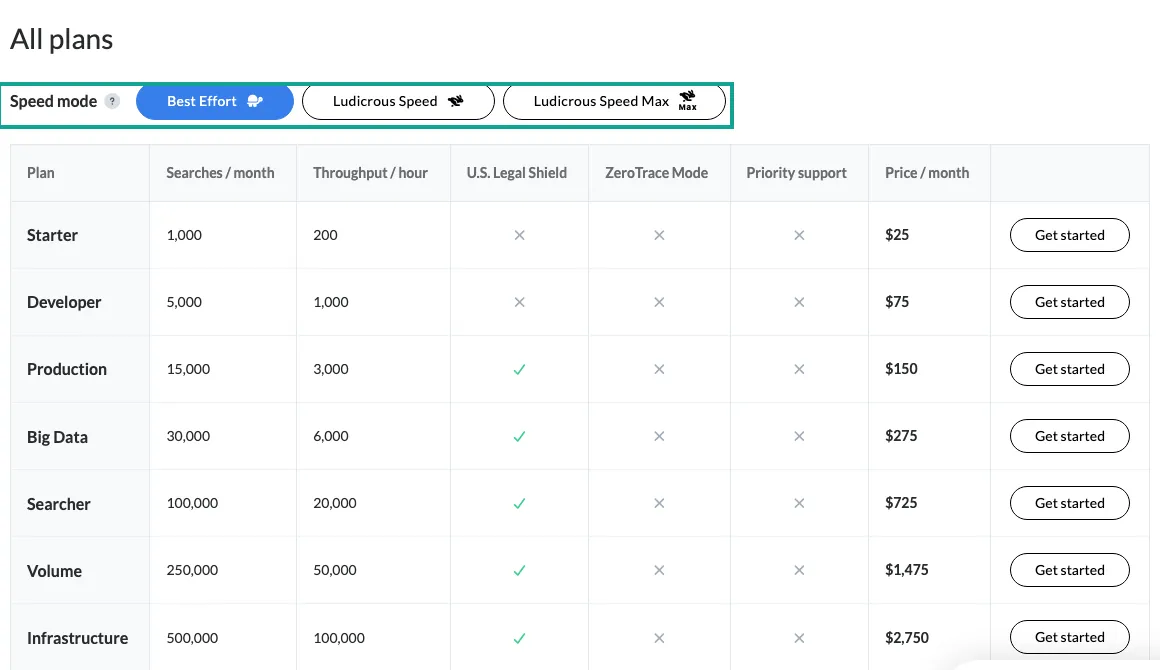
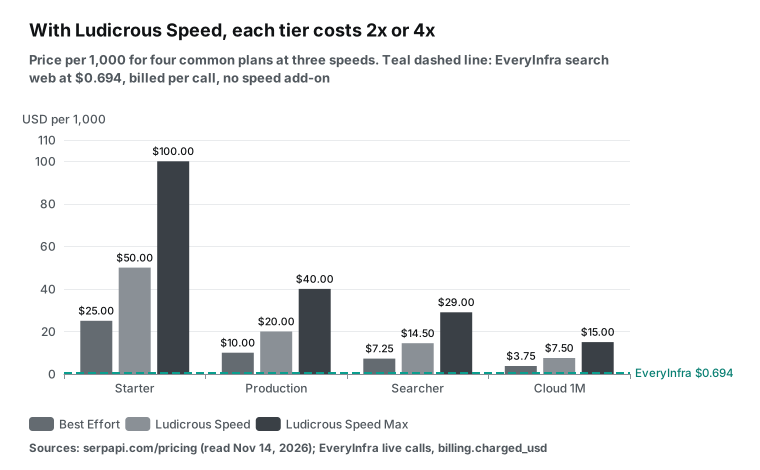
Above the "All plans" table there is a "Speed mode" switch with three values: Best Effort, Ludicrous Speed and Ludicrous Speed Max. The faster modes keep the same searches and hourly cap but multiply the monthly fee by 2 and 4. Ludicrous Speed costs 2x the Best Effort price. It uses 2x the server resources and sends many requests in parallel.
Ludicrous Speed Max costs 4x and adds 4x more resources than Ludicrous Speed. SerpAPI's published results, each from 10,000 searches: Ludicrous Speed is 2.2 times faster on average and 4.2 times faster at p99. Max is another 9.6 percent faster on average and 35.4 percent faster at p99.
| Tier | Best Effort per 1,000 | Ludicrous Speed per 1,000 | Ludicrous Speed Max per 1,000 |
|---|---|---|---|
| Starter | $25.00 | $50.00 | $100.00 |
| Production | $10.00 | $20.00 | $40.00 |
| Searcher | $7.25 | $14.50 | $29.00 |
| Cloud 1M | $3.75 | $7.50 | $15.00 |
| Cloud 54M | $1.96 | $3.93 | $7.86 |
In our three rounds, EveryInfra web search took 1.6 to 2.3 seconds, including the round trip from Singapore. News took 1.6 to 2.1 seconds, Bing 3.6 to 11.0 seconds, YouTube 8.4 to 14.7 seconds and Maps 7.1 to 10.7 seconds. Shopping was the slowest: 72.7, 22.8 and 12.3 seconds in the three rounds. We charge per call, we have no speed tier, and we do not publish a p99. If each search has a hard latency limit, as in a voice assistant, you can buy SerpAPI's speed modes. They cost one to three times more per 1,000.
Enterprise: $3,750 a month with 100,000 searches included
The SerpAPI Enterprise page splits the price into two parts. The base fee is $3,750 a month and includes 100,000 searches (50,000 with Ludicrous Speed, 25,000 with Max).
You buy extra searches in one of two ways. On-demand searches need no volume commitment and cost $7.50 per 1,000 ($15.00 with Ludicrous Speed, $30.00 with Max), prepaid or postpaid. Reserved searches need a monthly commitment and cost $2.75 per 1,000 ($5.50, $11.00); unused reserved searches do not roll over. The page also lists a custom U.S. contract, priority support, ZeroTrace and an SLA of 99.97 percent.
| Enterprise part | Best Effort | Ludicrous Speed | Ludicrous Speed Max |
|---|---|---|---|
| Monthly base fee | $3,750 | $3,750 | $3,750 |
| Searches in base fee | 100,000 | 50,000 | 25,000 |
| On-demand, per 1,000 | $7.50 | $15.00 | $30.00 |
| Reserved, per 1,000 | $2.75 | $5.50 | $11.00 |
If you use only the 100,000 included searches, you pay $37.50 per 1,000. If you use 1 million a month with 900,000 reserved, you pay $3,750 + 900 × $2.75 = $6,225, or $6.23 per 1,000. That is more than the self-serve Cloud 1M tier at $3,750. The page does not say whether the included 100,000 searches count toward the reserved commitment, so we simply add the two parts. Enterprise buys contract terms, an SLA and ZeroTrace. On price per 1,000 alone, the self-serve cloud tiers are cheaper.
Same price per search, different results per page
The counting rules on the pricing page say "search" and do not split by engine. The speed-mode and ZeroTrace pages say that they support all SerpAPI search APIs. So one Google web search, one Google Maps search and one YouTube search each use one search from the same monthly allowance. The pricing page navigation lists 155 APIs. 64 of them have names that start with Google; others include Amazon, Bing, Baidu, DuckDuckGo, eBay, Walmart, Yelp and YouTube.
The price per search is the same, but the number of results per search depends on the engine. The Google Shopping API docs say that the current Google Shopping layout does not support offset pagination. The start parameter is ignored, and each request returns only the first page, about 40 products. The num parameter is still sent to Google, but the layout fixes the page size.
The Google Maps API docs say that start is the result offset: 0 is the first page, 20 the second, 40 the third. There is no hard limit, but SerpAPI recommends a maximum of 100 (page six). After that, results can repeat or lose relevance.
EveryInfra sets price and row count by capability. The five capabilities in this test, with catalog values: web/search costs $0.001389 per call and returns up to 10 rows. google_news/search costs $0.000792 and returns up to 20. google_shopping/search costs $0.000556 and returns up to 100.
google_maps_reviews/search costs $0.001389, returns 15 by default and up to 50, and pages with page_token. youtube/search costs $0.000778, returns 10 by default and up to 50. We also used bing/search at $0.000556 and the web tool of the unified search endpoint POST /api/v1/search at $0.000694 (search tools catalog).
When you change "per search" to "per 1,000 results", the gap for Shopping and Maps grows. One SerpAPI Shopping search returns about 40 items. That is $0.625 per 1,000 items on Starter, $0.25 on Production and $0.049 on Cloud 54M. One of our google_shopping/search calls returned 100 items for $0.000556, which is $0.0056 per 1,000 items: 1/112 of Starter and 1/8.8 of Cloud 54M. One SerpAPI Maps page has 20 places, which is $1.25 per 1,000 on Starter and $0.098 on Cloud 54M. One of our google_maps_reviews/search calls returned 50 places, which is $0.0278 per 1,000: 1/45 of Starter and 1/3.5 of Cloud 54M.
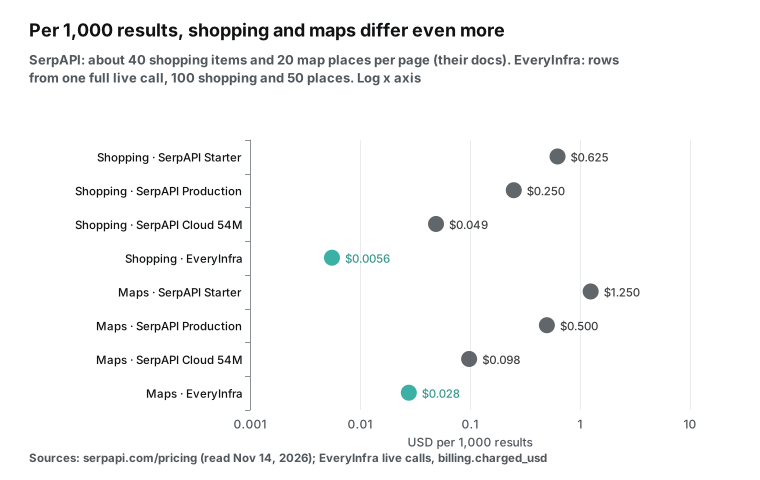
Two conditions apply. First, the SerpAPI row counts ("about 40", "20 per page") come from its docs; we did not test them.
Second, we used the rows that our calls returned at the maximum limit (100 Shopping rows, 50 Maps places). Our default calls returned 20 Shopping rows and 15 Maps places. At those counts, our price per 1,000 rows is $0.028 and $0.093. That is still below every SerpAPI tier, but by a smaller multiple. Per-row cost matters when you need many rows, and on SerpAPI only a bigger tier lowers it.
Our live test: 5 capabilities at 3 times
On November 14, 2026, we called the EveryInfra API in three rounds. Each round covered web, news, shopping, maps and YouTube. We also tested pagination on the unified search endpoint, Bing, one empty result and one bad parameter. We saved every raw response and took the charge from billing.charged_usd. The Rows column is the number of rows that each call returned.
| Time (SGT) | Capability | Parameters | Rows | Time taken | Charged |
|---|---|---|---|---|---|
| 00:21 | web/search | serpapi pricing, us | 10 | 1.7 s | $0.001389 |
| 00:21 | google_news/search | search API pricing, past month | 20 | 2.0 s | $0.000792 |
| 00:21 | google_shopping/search | mechanical keyboard | 20 | 72.7 s | $0.000556 |
| 00:22 | google_maps_reviews/search | coffee shop, Austin, TX | 15 | 7.1 s | $0.001389 |
| 00:23 | youtube/search | serpapi tutorial | 10 | 8.5 s | $0.000778 |
| 00:23 | Search endpoint, web tool | serpapi pricing, pages 1 and 2 | 10 + 10 | 1.6 s, 2.2 s | $0.000694 × 2 |
| 00:23 | bing/search | serpapi pricing | 10 | 3.6 s | $0.000556 |
| 00:23 | web/search | string that does not exist | 0 | 1.8 s | $0 (empty result refunded) |
| 00:27 | web/search | serp api pricing | 10 | 2.3 s | $0.001389 |
| 00:27 | google_news/search | SerpApi, past month | 9 | 1.6 s | $0.000792 |
| 00:27 | google_shopping/search | mechanical keyboard, limit 100 | 100 | 22.8 s | $0.000556 |
| 00:27 | google_maps_reviews/search | coffee shop, Austin, TX, limit 50 | 50 | 10.7 s | $0.001389 |
| 00:27 | youtube/search | sort=popular (invalid) | — | 0.1 s | $0 (422) |
| 00:29 | youtube/search | serpapi tutorial, limit 50 | 50 | 14.7 s | $0.000778 |
| 00:29 | bing/search | serp api pricing | 6 | 11.0 s | $0.000556 |
| 00:50 | web/search | serpapi cost, us | 10 | 1.9 s | $0.001389 |
| 00:50 | google_news/search | web search API, past week | 20 | 2.1 s | $0.000792 |
| 00:50 | google_shopping/search | wireless earbuds, limit 100 | 100 | 12.3 s | $0.000556 |
| 00:50 | google_maps_reviews/search | dentist, Austin, TX, limit 50 | 50 | 9.7 s | $0.001389 |
| 00:50 | youtube/search | serpapi pricing, limit 20 | 20 | 8.4 s | $0.000778 |
| 00:50 | Search endpoint, web tool | serpapi free plan | 10 | 2.1 s | $0.000694 |
Each charge matched the catalog price_usd in all three rounds. More rows did not cost more. Shopping at 100 rows, Maps at 50 places and YouTube at 50 videos cost the same as the default call. SerpAPI follows the same principle, one search is one search. The difference is how many rows one call can hold.
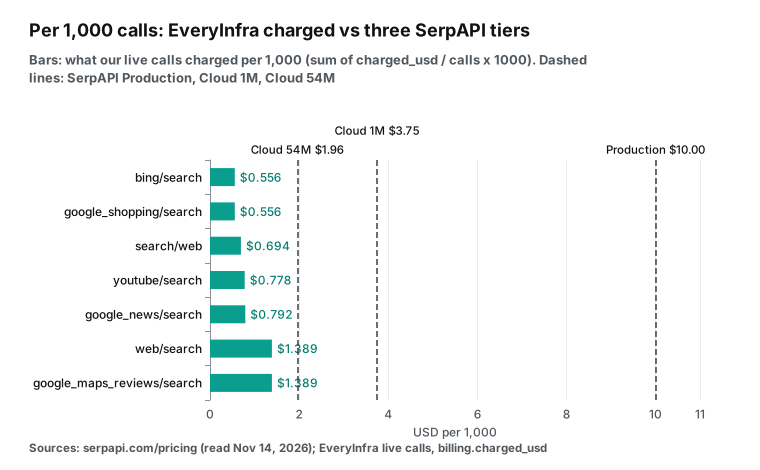
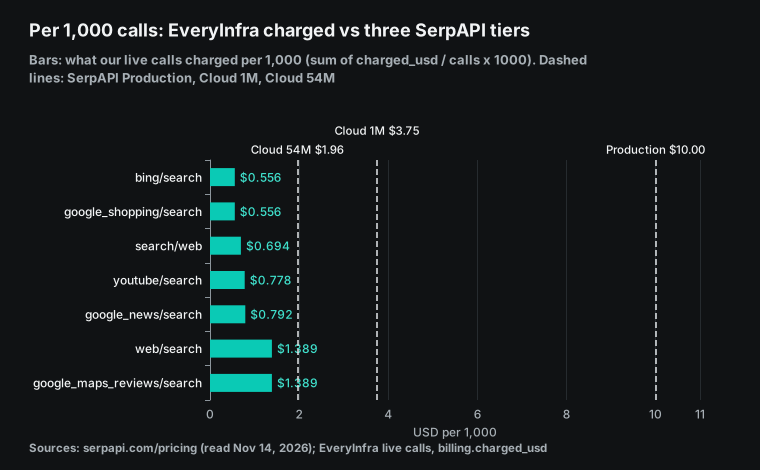
This is the web search request from our first round. Replace the key with yours to repeat it. To test another capability, change platform and action, and fill params from param_meanings in the catalog.
curl -s https://api.everyinfra.com/api/v1/social \
  -H "Authorization: Bearer $EVERYINFRA_API_KEY" \
  -H "Content-Type: application/json" \
  -d '{"platform":"web","action":"search","params":{"keyword":"serpapi pricing","country":"us","language":"en"}}'
The table below sums up what each capability returned across the three rounds. "Times cheaper" divides the SerpAPI price per 1,000 searches by our live charge per 1,000 calls.
| Capability | Charge per call | Rows per call | Main fields | Times cheaper than Starter | Times cheaper than Cloud 54M |
|---|---|---|---|---|---|
Search endpoint web tool | $0.000694 | 10 per page | title, link, snippet, page | 36.0x | 2.83x |
web/search | $0.001389 | 10 | rank, title, url, text | 18.0x | 1.41x |
google_news/search | $0.000792 | up to 20 | title, source, date; time_window hour to year | 31.6x | 2.48x |
google_shopping/search | $0.000556 | up to 100 | price, merchant, rating, review_count, product_id | 45.0x | 3.53x |
google_maps_reviews/search | $0.001389 | up to 50, then page_token | place_id, rating, address, lat, lng, website | 18.0x | 1.41x |
youtube/search | $0.000778 | up to 50 | views, likes, channel subscribers, search_rank | 32.1x | 2.52x |
A few details from the raw responses. On page two of "serpapi pricing", 6 of 10 web results were 2026 articles that explain SerpAPI prices. The news search for "SerpApi" in round two returned 9 rows this time. We charge per call, so 9 rows and 20 rows both cost $0.000792, and only zero rows are refunded. In round one, the first news result was a Perplexity pricing article from 2026-11-04. The AWS Web Search API announcement of 2026-11-11 was near the top in rounds one and three.
Shopping took the longest: 72.7, 22.8 and 12.3 seconds, with a median of 22.8 seconds over three calls. For batch work, send calls in parallel and set the timeout above 120 seconds. The catalog says that Maps returns up to 60 rows in sync mode and 120 in async mode. Place details and reviews cost the same $0.001389 per call. The top YouTube result for "serpapi tutorial" was a Python tutorial with 46,862 views.
Check our prices yourself in the public catalog
You can check every EveryInfra price in this guide. The capability catalog, GET /api/v1/social/catalog, is our public price list. Each capability has price_usd (the price per call in USD) and available (whether you can use it now). The 17 tools of the unified search endpoint are in GET /api/v1/search/tools, where the web tool shows price_usd: 0.000694. The Python below reads the catalog, picks the six capabilities that we used, and prints the price per call and per 1,000. It uses the Requests library.
import requests

CATALOG = "https://api.everyinfra.com/api/v1/social/catalog"
WANT = {"web/search", "google_news/search", "google_shopping/search",
        "google_maps_reviews/search", "youtube/search", "bing/search"}

caps = requests.get(CATALOG, timeout=30).json()["capabilities"]
for c in caps:
    key = f'{c["platform"]}/{c["action"]}'
    if key in WANT and c.get("available"):
        print(f'{key:<28} ${c["price_usd"]:.6f} per call   ${c["price_usd"] * 1000:.3f} per 1,000')
The catalog that we read at 00:14 SGT on 2026-11-14 had 106 platforms and 574 capabilities, of which 540 were available. All six capabilities above were available, and each price matched our three rounds of live charges. The full parameter and field definitions are in the OpenAPI file. A short version for AI assistants is in llms.txt.
The pricing page, read on 2026-11-14, explains how money gets into the account. The balance is prepaid in USD. The smallest top-up is $10, and the larger amounts are $50, $100, $500 and $1,000. The balance does not reset and does not expire. Failed calls and empty results are not charged.
So the minimum spend has two parts. Your first top-up is at least $10. After that, each call takes its catalog price from the balance: $0.000694 for the web tool, so $10 covers about 14,400 web searches. All multiples in this guide use the standard catalog prices. The console shows the prices for your account.
Monthly bills at seven volumes
Unit price is half the story; the rest is volume and unused searches. We wrote a short Python script that applies each service's public rules to seven monthly volumes. For SerpAPI, it picks the cheapest way to buy each month, including early renewal of the same tier. For Serper, credits last six months, so it mixes packs to cover six months at the lowest cost and divides by six. For EveryInfra, it uses the live web tool charge of $0.000694 per call.
| Searches per month | Cheapest SerpAPI option | SerpAPI bill | SerpAPI per 1,000 | Serper (6-month use) | EveryInfra web search | SerpAPI ÷ EveryInfra |
|---|---|---|---|---|---|---|
| 1,000 | Starter × 1 | $25 | $25.00 | $8.33 | $0.69 | 36.0x |
| 5,000 | Developer × 1 | $75 | $15.00 | $8.33 | $3.47 | 21.6x |
| 20,000 | Big Data × 1 (10,000 unused) | $275 | $13.75 | $25.00 | $13.88 | 19.8x |
| 100,000 | Searcher × 1 | $725 | $7.25 | $79.17 | $69.40 | 10.4x |
| 300,000 | Searcher × 3 | $2,175 | $7.25 | $208.33 | $208.20 | 10.4x |
| 1,000,000 | Cloud 1M × 1 | $3,750 | $3.75 | $541.67 | $694.00 | 5.4x |
| 5,000,000 | Cloud 5M × 1 | $11,475 | $2.30 | $1,666.67 | $3,470.00 | 3.3x |
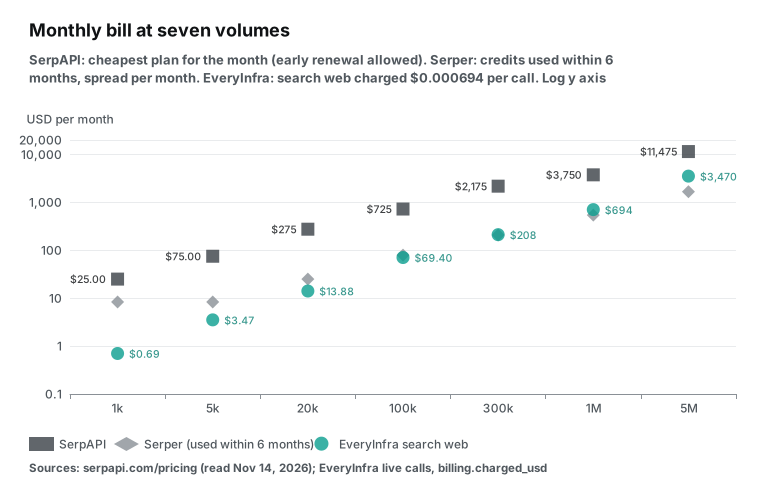
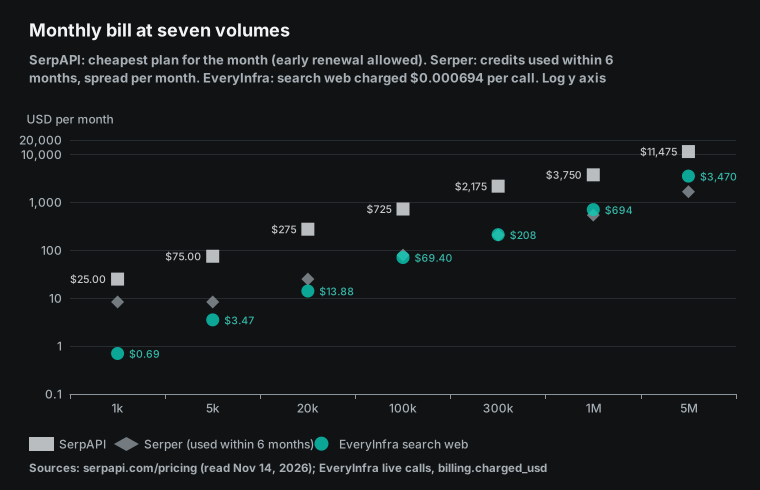
At low volume (a few thousand searches a month), SerpAPI's minimum fee stands out: $25 for 1,000 searches against $0.69 on EveryInfra. At medium volume, tier gaps make you overpay. 20,000 searches fall between Production (15,000) and Big Data (30,000), so you throw away 10,000 searches and pay $13.75 per 1,000. At 300,000, three Searcher renewals beat Volume and Infrastructure. At high volume, 1 million and up, SerpAPI cloud tiers cost $2 to $3.75 per 1,000, 3 to 5 times our price. Serper's large packs cost $0.30 to $0.50 per 1,000, which is less than our price.
import math

# SerpAPI self-serve Best Effort tiers (serpapi.com/pricing, read 2026-11-14): (name, monthly fee, searches)
SERPAPI = [("Starter", 25, 1_000), ("Developer", 75, 5_000), ("Production", 150, 15_000),
           ("Big Data", 275, 30_000), ("Searcher", 725, 100_000), ("Volume", 1_475, 250_000),
           ("Infrastructure", 2_750, 500_000), ("Cloud 1M", 3_750, 1_000_000), ("Cloud 5M", 11_475, 5_000_000)]
EVERYINFRA_WEB = 0.000694  # live charge per call, web tool of POST /api/v1/search

def serpapi_month(u):
    if u <= 250:
        return "Free", 0
    # early renewal allowed: pay for the same tier k times in one month
    return min(((n, math.ceil(u / s) * p) for n, p, s in SERPAPI), key=lambda x: x[1])

for u in (1_000, 5_000, 20_000, 100_000, 300_000, 1_000_000, 5_000_000):
    plan, cost = serpapi_month(u)
    ours = u * EVERYINFRA_WEB
    print(f"{u:>9,}  SerpAPI {plan:<14} ${cost:>9,.2f}  EveryInfra ${ours:>9,.2f}  {cost / ours:5.1f}x")
The script uses only math.ceil from the standard library (math module docs). Our own check used all 61 tiers and matched the table. For u, use your average monthly searches over the last three months.
serp api pricing by workload: four real jobs
In a real project, you start from a workload: how many keywords, how often, and how many rows. The four jobs below turn a workload into searches with the same script. A month is 30 days and a week is 30/7 of a month. SerpAPI uses the cheapest option for the month, and EveryInfra uses our live charge.
| Job | Workload | SerpAPI searches per month | Cheapest SerpAPI option | SerpAPI bill | EveryInfra calls | EveryInfra bill | Multiple |
|---|---|---|---|---|---|---|---|
| Rank tracking | 500 keywords, top 20 daily | 30,000 | Big Data × 1 | $275 | Search web × 30,000 | $20.82 | 13.2x |
| AI assistant | 300 questions a day, 2 searches each | 18,000 | Big Data × 1 (12,000 unused) | $275 | Search web × 18,000 | $12.49 | 22.0x |
| Price monitoring | 2,000 product terms weekly | 8,572 | Developer × 2 or Production × 1 | $150 | google_shopping/search × 8,572 | $4.77 | 31.4x |
| Local business list | 50 categories, 100 places each, weekly | 1,072 | Starter × 2 (one early renewal) | $50 | google_maps_reviews/search × 429 | $0.60 | 83.3x |
Rank tracking fits SerpAPI's tiers best. 500 keywords at two pages a day is exactly 30,000 searches, which is Big Data at $9.17 per 1,000. But a 31-day month needs 1,000 more searches and an early renewal, and the one-hour cache never helps a daily job. On EveryInfra, 30,000 calls cost $20.82 and a 31-day month costs $21.51.
An AI assistant often needs more than one search per question. A community post says that one API needed about two searches per question, which doubled its real cost (r/WebScrapingInsider thread). 18,000 searches fall between Production and Big Data, so the real price is $15.28 per 1,000. On Starter or Developer, a burst of a few hundred questions in one hour can also hit the hourly cap.
Price monitoring depends on rows. SerpAPI Shopping returns one fixed page of about 40 products. Our google_shopping/search returned the full 100 products in rounds two and three. The local business list has the largest multiple, because row counts and tier gaps add up. 100 places take 5 SerpAPI searches but 2 of our calls.
And 1,072 searches are 72 more than Starter covers, so you renew early once and pay $50. The multiple is 83x, the largest of the four, but the bills are small in dollars. All four jobs count only the search step. Reviews, page text and comments cost extra on both sides.
Serper's public price, side by side
The Serper home page lists four prepaid packs. Starter is $50 for 50,000 searches ($1.00 per 1,000) and Standard is $375 for 500,000 ($0.75). Scale is $1,250 for 2.5 million ($0.50), and Ultimate is $3,750 for 12.5 million ($0.30). Each pack says that credits last six months.
New accounts get 2,500 free queries. The FAQ says that credits are deducted only for successful responses, and that Serper does not cache results. We read the page at 00:20 SGT on 2026-11-14.
Two things make Serper much cheaper than SerpAPI at medium and high volume. You buy prepaid packs and have six months to use them, with no monthly reset. And Serper's most expensive pack, at $1.00 per 1,000, is already below SerpAPI's largest cloud tier ($1.96). Against EveryInfra, the crossover is near 300,000 searches a month.
Below that, you must use Serper's $50 pack within six months. At a few thousand searches a month, you really pay $1.67 to $8.33 per 1,000. Above that, Serper's Scale and Ultimate packs ($0.50 and $0.30) are below our $0.694. Our Serper API pricing article models this crossover for five usage curves, and Serper API alternative compares fields and failure handling.
| Item | SerpAPI | Serper | EveryInfra |
|---|---|---|---|
| Billing model | Monthly subscription with a monthly allowance | Prepaid packs, valid 6 months | Per call from a balance that does not expire monthly |
| Smallest payment | $25 a month above Free | $50 once | Minimum top-up $10, then per call from $0.000556 |
| Free allowance | 250 searches a month | 2,500 queries once | $1 trial credit, valid 24 hours after you claim it |
| Lowest per 1,000 | $1.96 (Cloud 54M) | $0.30 (Ultimate) | $0.556 (bing/search, google_shopping/search) |
| Empty result | Counts as a search | Not stated on the pricing page | Refunded |
| Engines and data types | 155 APIs on the pricing page | 10 Google result types on the home page | Catalog of 106 platforms and 540 available capabilities |
| MCP | Hosted MCP server | No MCP listed on the home page | Remote MCP with everyinfra_* tool names |
Failures, empty results and typos: who charges what
We quoted SerpAPI's rules above. Errors, failures, blocks and CAPTCHAs do not count; empty results count; cached results are free. On the EveryInfra side, we tested two cases that should cost nothing.
The first case is an empty result. At 00:23 SGT we used web/search with a quoted string of random letters and digits. The response had an empty results array and a count of 0. The billing block showed "charged": false, "charged_usd": 0.0 and "reason": "empty_result_refunded", and refund.status was succeeded. On SerpAPI, the same search would use one search, which is $0.025 on Starter.
The second case is a bad parameter. At 00:27 SGT we sent sort=popular to youtube/search. The catalog allows most_viewed, newest, relevance and top_rated. The API returned HTTP 422 with the error code invalid_value. The allowed field listed the four valid values, and did_you_mean suggested most_viewed.
The next_steps field said to change only sort and try again. It also said that nothing was charged. After a 422, an agent can apply did_you_mean, change one parameter and send the call again. For a missing parameter, SerpAPI returns HTTP 400, for example Missing query q parameter. The failed search does not count (status and error codes).
| Our test case | Time (SGT) | Result | EveryInfra charge | Same search on SerpAPI Starter |
|---|---|---|---|---|
Empty result, web/search | 00:23 | 0 rows, empty_result_refunded | $0 | $0.025 (counts) |
Invalid sort, youtube/search | 00:27 | HTTP 422, did_you_mean | $0 | Not counted (error) |
Counting empty results raises the effective unit price. Suppose that 20 percent of your keywords often return nothing. On SerpAPI, divide the price by 0.8, so Starter becomes $31.25 per 1,000 searches with results. On EveryInfra, empty results are free, so the price stays the same.
When SerpAPI is the better choice
Here is what SerpAPI has and we do not:
| What SerpAPI has | Where it is stated | Who needs it |
|---|---|---|
| 155 APIs, 64 of them Google (Flights, Scholar, Patents, AI Mode and more) | Pricing page navigation, release notes | Teams that need result types outside our catalog |
| Whole-page SERP blocks, more than 60 block names | Google Search API docs | Rank trackers and SERP layout research |
| U.S. Legal Shield up to $2 million, from Production | U.S. Legal Shield page | Buyers who want contract cover for U.S. claims |
| ZeroTrace, SOC 2 Type II, ISO 27001, SLA up to 99.97% | ZeroTrace page, pricing page | Procurement with strict data and audit rules |
| Ludicrous Speed and Max | Feature pages | Live products with hard latency limits |
Official libraries, hosted MCP, json_restrictor | GitHub, PyPI, docs | Teams that want a ready SDK in many languages |
Engine range is the largest gap. The release notes show a Brave Search API on 2026-11-11, DuckDuckGo Images on 2026-11-12 and TikTok Trends on 2026-11-03. If you need a Google Flights price calendar or a Scholar author page, SerpAPI sells it today. Its Google results split one page into organic results, ads, knowledge panel, related questions, AI Overview, local pack and more. Our web/search returns rank, title, link and snippet, and our other capabilities return their own result types, not whole-page blocks.
U.S. Legal Shield is included from Production up and not on Free, Starter or Developer. It covers claims about crawling and parsing search engine data, up to $2 million, if your use is lawful, and only claims under U.S. law in U.S. courts.
We have no similar clause. ZeroTrace Mode stops SerpAPI from storing search parameters, files and results, and it is Enterprise only.
The ecosystem is mature. There are official libraries such as serpapi-python (the serpapi package on PyPI), serpapi-javascript and serpapi-ruby. Older projects often use google-search-results, with code in google-search-results-python. There is a public product roadmap, and the MCP server is open source on GitHub.
Its MCP docs give two ways to connect. The recommended way puts the key in the Authorization header, because "the key stays out of URLs and logs". Clients that cannot set headers can put the key in the URL path.
Market moves, October–November 2026
- 2026-11-09: the amended complaint in Google v. SerpApi was dismissed with leave to amend. The court granted SerpApi's motion and gave Google one more chance (court order PDF, case 4:25-cv-10826-YGR). Search Engine Roundtable reported on 2026-11-10 that Google must file by 2026-11-30 and that the court did not rule the scraping lawful (report). Google filed on 2025-12-19 (Google blog); the first dismissal came on 2026-07-20, and Google filed an amended complaint on 2026-08-10. The 11-09 order says that the July order dismissed the DMCA claims about results with no copyrighted content without leave to amend. It allowed amendment of the claims about results with copyrighted content. So the August complaint focused on content that Google licenses. All filings are on the CourtListener docket. For you: the risk behind Legal Shield is an open lawsuit. We take no position on either side.
- 2026-11-11: AWS launched a Web Search API on Bedrock AgentCore. One
InvokeWebSearchcall returns ranked results with excerpts. It uses IAM signing (AWS blog, developer guide). For you: more agent search APIs bill per call with no monthly plan. - 2026-11-11 to 2026-11-13: SerpApi added Brave Search and DuckDuckGo Images APIs and logged 7 fixes from 2026-11-10 to 2026-11-13 (release notes). For you: every new engine draws on the same monthly allowance.
- 2027-01-01: Google's Custom Search JSON API shuts down. It is closed to new customers. It costs $5 per 1,000 above 100 free queries a day (Custom Search JSON API). The Site Restricted JSON API already stopped on 2025-01-08 (Site Restricted JSON API). For you: about six weeks remain to move; our Google Custom Search API alternative article maps the parameters.
- Per-call search prices, read on 2026-11-14. Anthropic's web search tool costs $10 per 1,000 (Claude docs). OpenAI's web search tool costs $10.00 per 1,000 calls plus content tokens (OpenAI pricing). Perplexity's Search API costs $5.00 per 1,000 (Perplexity pricing). Tavily charges 1 credit per basic search (Tavily credits). For you: SerpAPI Starter at $25 is the highest entry price here.
- The Bing Search APIs retired on 2025-08-11 (Microsoft Lifecycle). Grounding with Bing Search in Azure is for paid subscriptions only. Developers do not get the raw content that it returns (Grounding with Bing Search). For you: raw Bing results now come from third parties, such as SerpAPI's Bing API or our
bing/searchat $0.000556 per call.
Limits: when these numbers do not hold
First, SerpAPI's price per 1,000 is a floor that assumes full use. If you use less, your real price is higher. Second, we tested each of five capabilities only two or three times. Row counts and response times change with keyword, location and time of day. The 72.7-second shopping call is one observation, not an average. Third, the two services return different fields.
We compared prices and billing rules, not result quality or coverage. If you need whole-page SERP blocks, Google Flights, or Scholar and Patents, SerpAPI's price buys things that we do not have. Fourth, we read SerpAPI prices at 00:15 SGT on 2026-11-14. They may change, so check the pricing page before you buy. EveryInfra prices are in the public capability catalog.
For six web search APIs side by side, see Best web search API for AI agents. For a feature-by-feature comparison of SerpAPI and EveryInfra, see SerpApi alternative.
Getting started: run your own keywords on trial credit
- Open the infrastructure market and find web search, news, shopping, maps and YouTube. Each capability page has parameter notes and a test console. Start with web search scraper API and Google Shopping scraper API. Then try Google Maps reviews scraper API, YouTube scraper API and Google News scraper API.
- Follow the quickstart to sign up and create a key. New accounts get a trial credit.
- Run 50 keywords that you really used last week. Record
billing.charged_usdand the row count for each call, and checkreasonon empty results. - Change the SerpAPI side of the Python script to your current tier and compare the two monthly bills. For more platforms, see the web search, Google Shopping, Google Maps reviews and YouTube platform pages. Prices are on the pricing page.
- To let an AI assistant call the API, add the remote MCP server to your client. Tool names start with
everyinfra_; see MCP setup.
{
  "mcpServers": {
    "everyinfra": {
      "type": "http",
      "url": "https://api.everyinfra.com/mcp",
      "headers": { "Authorization": "Bearer ${EVERYINFRA_API_KEY}" }
    }
  }
}
This configuration follows the MCP specification and uses its Streamable HTTP transport (transports section). The key goes in a request header, not in the URL. The authorization section of the spec asks for the token in the Authorization header on every HTTP request and never in the URI query string. SerpAPI's MCP docs also recommend the header method and keep the URL path method for clients that cannot set headers. When a team shares one MCP config, a header with an environment variable keeps the key out of the config file.
FAQ
What does the SerpAPI free plan include, and what happens when I run out?
You get 250 searches a month and 50 an hour, renewed monthly, without Legal Shield. When you run out, the API returns HTTP 429 with "Your account has run out of searches". Wait for the next cycle or move to Starter ($25 a month for 1,000). Question source: search suggestions "serpapi free plan" and "serpapi free tier limit exceeded".
Is SerpAPI legal, and what does Legal Shield cover?
SerpAPI offers U.S. Legal Shield from the Production tier up. It covers claims about crawling and parsing search engine data, up to $2 million. It applies only to claims under U.S. law in U.S. courts.
Illegal use of the data, such as copyright infringement, is not covered. In Google's case against SerpApi, the court dismissed Google's amended complaint on 2026-11-09 and gave Google 21 days to amend again (the report says by 2026-11-30). The case is still open. This guide is not legal advice. Question source: search suggestion "is serpapi legal".
What is the least I can spend on EveryInfra?
The first top-up is at least $10. The balance does not reset and does not expire. After that, each call takes its catalog price from the balance: $0.000694 for the web tool and $0.000556 for shopping and Bing. Empty results and failed calls are not charged. $10 covers about 14,400 web tool calls. Question source: the "Minimum spend" row in this guide.
If I go to page 5 of one keyword, how many searches is that?
The SerpAPI Enterprise page says that each page counts as one search, so page 5 means 5 searches. The EveryInfra web tool also charges per page, at $0.000694 a page. Question source: an r/WebScrapingInsider thread about an API that needed two searches per question.
References
- SerpApi: Plans and Pricing (pricing page, FAQ and embedded plan data), SerpApi, read 00:15 SGT on 2026-11-14
- Enterprise plan offering and pricing, SerpApi, read 2026-11-14
- U.S. Legal Shield, SerpApi, read 2026-11-14
- Ludicrous Speed, SerpApi, read 2026-11-14
- Ludicrous Speed Max, SerpApi, read 2026-11-14
- ZeroTrace Mode, SerpApi, read 2026-11-14
- API Status and Error Codes, SerpApi, read 2026-11-14
- Google Search API (no_cache parameter), SerpApi, read 2026-11-14
- Google Shopping API (start and num parameters), SerpApi, read 2026-11-14
- Google Maps API (start parameter), SerpApi, read 2026-11-14
- Account API, SerpApi, read 2026-11-14
- SerpApi Release Notes, SerpApi, latest entry November 13, 2026, read 2026-11-14
- Terms of Service, section 9 refund policy, SerpApi, updated August 27, 2026, read 2026-11-14
- serpapi-mcp, SerpApi on GitHub, read 2026-11-14
- serpapi-python, SerpApi on GitHub, read 2026-11-14
- serpapi on PyPI, PyPI, read 2026-11-14
- serpapi-javascript, SerpApi on GitHub, read 2026-11-14
- serpapi-ruby, SerpApi on GitHub, read 2026-11-14
- google-search-results on PyPI, PyPI, read 2026-11-14
- google-search-results-python, SerpApi on GitHub, read 2026-11-14
- public-roadmap, SerpApi on GitHub, read 2026-11-14
- Serper home page (pricing and FAQ), Serper, read 00:20 SGT on 2026-11-14
- EveryInfra capability catalog, EveryInfra, read 00:14 SGT on 2026-11-14
- EveryInfra search tools catalog, EveryInfra, read 00:14 SGT on 2026-11-14
- EveryInfra OpenAPI, EveryInfra, read 2026-11-14
- EveryInfra llms.txt, EveryInfra, read 2026-11-14
- Google LLC v. SerpApi, LLC, Order Granting Motion to Dismiss with Leave to Amend (Dkt. 62), U.S. District Court, N.D. Cal., November 9, 2026
- Google LLC v. SerpApi, LLC, 4:25-cv-10826 docket, CourtListener, read 2026-11-14
- Google Loses Another Round in Legal Battle Against SerpApi Over Scraping, Search Engine Roundtable, November 10, 2026
- Why we're taking legal action against SerpApi's unlawful scraping, Google, December 19, 2025
- Introducing the Web Search API on Amazon Bedrock AgentCore, AWS, November 11, 2026
- Web Search API, Amazon Bedrock AgentCore developer guide, AWS, read 2026-11-14
- Custom Search JSON API, Google for Developers, updated 2026-02-18, read 2026-11-14
- Custom Search Site Restricted JSON API, Google for Developers, updated 2026-09-03, read 2026-11-14
- Bing Search APIs Retiring on August 11, 2025, Microsoft, May 16, 2025
- Grounding with Bing Search (classic), Microsoft Learn, read 2026-11-14
- Web search tool, Anthropic, read 2026-11-14
- OpenAI API pricing, built-in tools, OpenAI, read 2026-11-14
- Pricing, Perplexity, read 2026-11-14
- API Credits, Tavily, read 2026-11-14
- Model Context Protocol Specification 2025-11-25, MCP, read 2026-11-14
- MCP Specification: Transports, MCP, read 2026-11-14
- math — Mathematical functions, Python docs, read 2026-11-14
- Requests: HTTP for Humans, Requests docs, read 2026-11-14
- We should look for another option besides SerpAPI, right?, Reddit r/n8n, read 2026-11-14
- SERP alternative (web search), Reddit r/n8n, read 2026-11-14
- Picking one Google SERP API in 2026 feels less…, Reddit r/WebScrapingInsider, read 2026-11-14
- MCP Specification: Authorization, MCP, read 2026-11-14
Reference BL-147