Firecrawl pricing: what every credit costs, endpoint by endpoint
Firecrawl costs $0.60 to $3.80 per 1,000 pages and $1.20 to $7.60 per 1,000 searches. We priced every plan and option against 22 live API calls.

For 1,000 plain web pages, Firecrawl costs $3.80 on Hobby billed monthly and $0.599 on Scale billed annually. Those numbers assume you use the whole monthly allowance. On EveryInfra, our read tool costs $0.694 per 1,000 pages at one call per page. Only Growth annual and Scale annual are cheaper than read, by 4% and 14%. That is true at about 480,000 to 510,000 or 860,000 to 1,300,000 pages a month.
For 1,000 searches with 10 results each, Firecrawl costs $7.60 to $1.198. That is 1.7 to 11 times the price of our web search tool at $0.694.
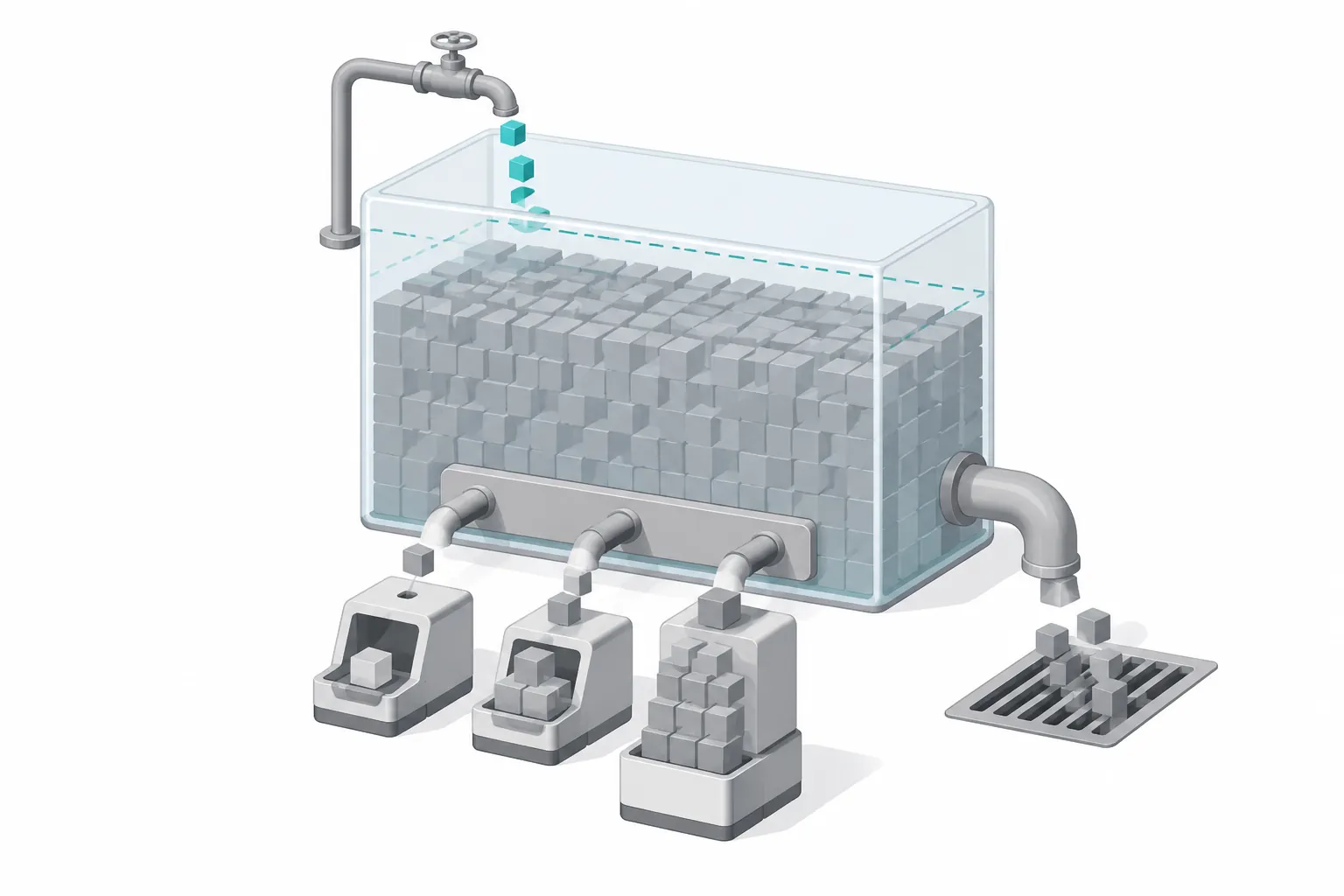
All Firecrawl numbers come from its pricing page, the billing docs, the rate limit docs and the changelog. We read them on 2026-11-16 between 00:12 and 00:40 Singapore time (SGT), with two archived copies of the pricing page. We made no live Firecrawl calls.
Every EveryInfra number is a live charge. It comes from the charged_usd field in the API response. We checked each one against price_usd in the capability catalog and the search tools catalog.
Firecrawl pricing table: five plans, credits and cost per 1,000
The Firecrawl pricing page says "Effective September 4, 2026" and lists prices in USD. The Free plan gives 1,000 credits each month with no card. Monthly prices for the four paid plans are $19, $99, $399 and $749. They include 5,000, 100,000, 500,000 and 1,000,000 credits per month.
The annual cards show $16, $83, $333 and $599 per month, with yearly savings of $38, $198, $798 and $1,798. We worked back from the savings. Hobby annual is $190 per year, or $15.83 per month, so the $16 on the card is rounded. The first three plans save 16.7% per year, and Scale saves 20%. The table uses the exact values, so some numbers differ slightly from other articles.
| Plan | Monthly / annual per month | Credits per month | Concurrent browsers | Per 1,000 pages, monthly / annual | Per 1,000 searches of 10 results, monthly / annual | Per 1,000 pages with JSON, monthly |
|---|---|---|---|---|---|---|
| Free | $0 | 1,000 | 2 | $0 within the allowance | $0 within the allowance | — |
| Hobby | $19 / $15.83 | 5,000 | 5 | $3.80 / $3.17 | $7.60 / $6.33 | $19.00 |
| Standard | $99 / $82.50 | 100,000 | 25 | $0.99 / $0.825 | $1.98 / $1.65 | $4.95 |
| Growth | $399 / $332.50 | 500,000 | 50 | $0.798 / $0.665 | $1.596 / $1.33 | $3.99 |
| Scale | $749 / $599.17 | 1,000,000 | 100 | $0.749 / $0.599 | $1.498 / $1.198 | $3.745 |
| EveryInfra, live charges | No monthly fee | Per call | — | read $0.694; crawl at 20 pages per call $0.0347, text cut at 20,000 characters per page | web $0.694; bing/search $0.556 | harvest at one call per page $0.694 |
Table note: Firecrawl price per 1,000 = monthly fee ÷ monthly credits × credits per request × 1,000, with the full allowance used. On Hobby, LLM extraction to JSON raises 1,000 pages from $3.80 to $19.00, five times more. Our harvest tool extracts named fields and returns up to 50 rows per call. In our test it pulled 6 rows from the Firecrawl pricing table for $0.000694.
The two products do the job in different ways. Firecrawl's JSON format uses a model to fill a schema or answer a prompt. Our harvest tool takes field names and returns rows with those fields. We compare them only as two prices for one need: structured fields from a page.
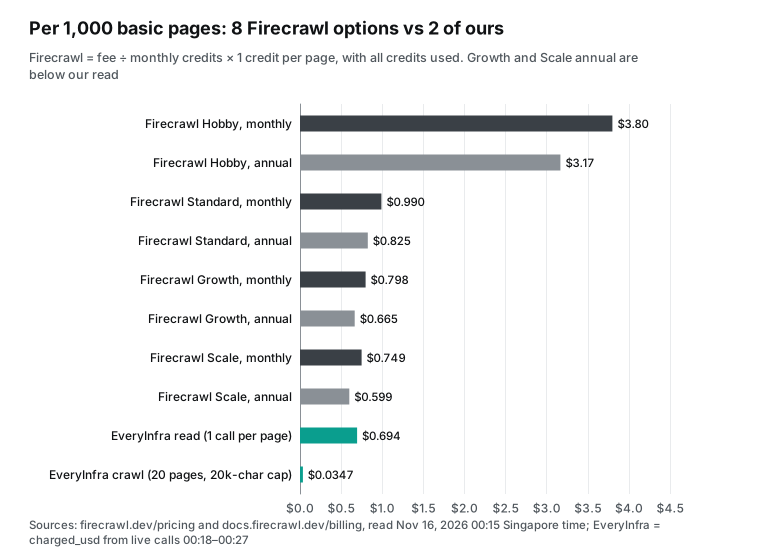
Growth annual and Scale annual are only 4% and 14% cheaper than our read tool. Scale monthly and Growth monthly are 8% and 15% more expensive. Hobby monthly at $3.80 costs 5.5 times more than read. Our crawl tool returns 20 pages per call and cuts the text of each page at 20,000 characters. That gives $0.0347 per 1,000 pages, but only for short pages on one site. If you also read the cut pages at the rate from our test, the price is $0.208 per 1,000 pages.
Monthly or annual billing
Annual credits still reset every month on a virtual renewal date, and unused credits still expire. Only annual Scale rolls credits over, for one month. If your team barely uses the service four months a year, those idle months can cost more than the discount saves. If you use the full allowance every month, the discount is free money. Hobby annual costs $190 up front, which is $38 less than twelve monthly payments.
By monthly page count: two bands where Firecrawl is cheaper
We scanned every 100 pages from 1,000 to 2,000,000. For Firecrawl we took the cheapest way to buy N credits: the smallest plan that fits, plus $5 packs for the rest. For EveryInfra we took one read call per page.
On monthly billing, Firecrawl is never cheaper than read in that range. The Growth and Scale monthly rates are already above $0.694, and extra packs cost more.
On annual billing there are two bands. Growth annual wins from about 479,200 to 510,000 pages per month. Scale annual wins from about 863,400 to 1,305,000 pages. Growth packs at $2.00 per 1,000 credits close the first band, and Scale packs at $1.00 close the second.
Below 1,000 pages a month, the Firecrawl Free plan costs $0, and nothing beats free. Batch crawl of short pages from one site is outside this scan, because its price depends on how many pages are cut.
Firecrawl credits pricing: what each endpoint costs
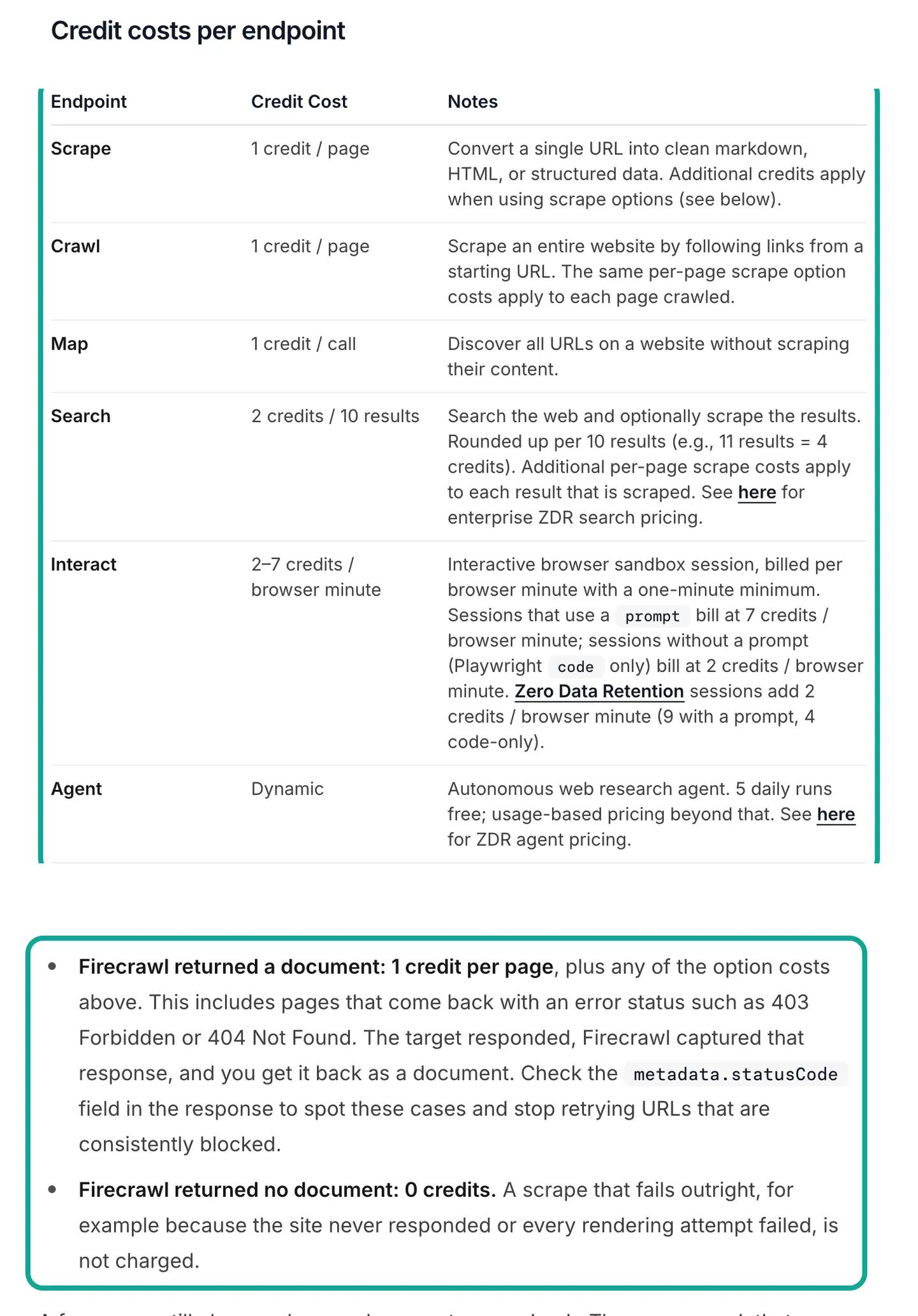
The table "Credit costs per endpoint" in the billing docs holds the base rules. Scrape costs 1 credit per page. Crawl also costs 1 credit per page, and each page takes the same option surcharges as Scrape. Map costs 1 credit per call, whatever the number of URLs. Search costs 2 credits per 10 results, rounded up, so 11 results cost 4 credits.
Interact is a browser sandbox billed per browser minute. Code-only sessions cost 2 credits per minute. Sessions with a natural-language prompt cost 7 credits per minute. Zero data retention adds 2 credits per minute, and the minimum charge is one minute. Agent gives 5 free runs per day and then uses dynamic, usage-based pricing. The docs say the credit table is the same on every plan.
| Endpoint | Rule in the docs | USD per request, Hobby monthly | USD per request, Scale annual | Closest EveryInfra tool and live charge |
|---|---|---|---|---|
| Scrape | 1 credit per page | $0.0038 | $0.000599 | read $0.000694 per page |
| Crawl | 1 credit per page | $0.0038 per page | $0.000599 per page | crawl $0.000694 per call, up to 20 pages |
| Map | 1 credit per call | $0.0038 | $0.000599 | map $0.000694 per call, up to 200 URLs |
| Search | 2 credits per 10 results | $0.0076 | $0.0012 | web $0.000694 per call, 10 results |
| Search and scrape 10 results | 2 + 10 = 12 credits | $0.0456 | $0.0072 | deep with full=true $0.000694, up to 10 results |
| Interact | 2 to 7 credits per browser minute | $0.0076 to $0.0266 per minute | $0.0012 to $0.0042 per minute | No equivalent |
| Agent | 5 free runs a day, then dynamic | No unit price in the docs | No unit price in the docs | No equivalent |
| Extract, removed 2026-12-10 | 15 tokens per credit | Depends on tokens | Depends on tokens | harvest $0.000694 per call |
The Extract docs say it is deprecated. It will be removed on December 10, 2026 at 15:00 UTC. Single-page extracts move to Scrape with a JSON format. Multi-page and search extracts move to Agent. The migration guide gives the steps.
Teams still on Extract will see a billing change next month. The rule moves from tokens per credit to 1 + 4 credits per page. On Hobby monthly, that is $0.019 per page. To estimate the new cost, multiply last month's Extract page count by 5.
Crawl a whole site, or Map first and pick pages
Crawl costs 1 credit for every page it returns, while Map costs 1 credit for any number of URLs. Take a documentation site with 2,000 pages, where you need only 300 pages about pricing and APIs. Map costs 1 credit for the URL list. You filter the list and send 300 URLs to batch scrape, for 301 credits in total. A full Crawl of the site costs 2,000 credits, which is 6.6 times more.
Crawl also has filters. The Crawl docs describe includePaths and excludePaths as regex rules on the URL path. The maxDiscoveryDepth option limits how many link hops the crawl follows. By default, Crawl stays under the start URL. To reach sibling or parent paths, set crawlEntireDomain. To follow outside links, set allowExternalLinks. Each switch changes the page count, so each switch changes the bill.
Our map tool lists up to 200 URLs per call. In our test it listed docs.firecrawl.dev in 0.39 seconds. Our crawl tool accepts one plain-English sentence that says which pages you want. With the sentence "pages that describe credits, billing, pricing or rate limits", it returned 2 pages. Both tools charge per call. A strict filter returns fewer pages, so the price per page goes up, but the bill stays the same.
Options stack: one page can cost 9 credits
The second table in the billing docs lists Scrape options with a surcharge. The docs say the options stack. Crawl and Search use Scrape for each page, so the same surcharges apply there. The USD columns below use Hobby monthly at $0.0038 per credit and Scale annual at $0.000599 per credit.
| Options | Credits per page | Hobby monthly per 1,000 pages | Scale annual per 1,000 pages | Source in the docs |
|---|---|---|---|---|
| Basic scrape | 1 | $3.80 | $0.599 | Scrape |
| JSON format, LLM extraction | 5 | $19.00 | $2.996 | LLM Extract |
| JSON + zero data retention | 6 | $22.80 | $3.595 | Example in the billing docs |
| JSON + PII redaction | 9 | $34.20 | $5.393 | PII redaction |
| question, highlights, audio or video format | 5 | $19.00 | $2.996 | Surcharge table in the billing docs |
| 15-page PDF | 15 or 16 | $57.00 to $60.80 | $8.99 to $9.59 | Document parsing |
| lockdown cache hit | 5 | $19.00 | $2.996 | Lockdown |
| X post through the Grok API | 30 | $114.00 | $17.98 | X billing section of the billing docs |
| LinkedIn profile, by matched provider | 5 to 40 | $19.00 to $152.00 | $3.00 to $23.97 | Provider-routed URLs section |
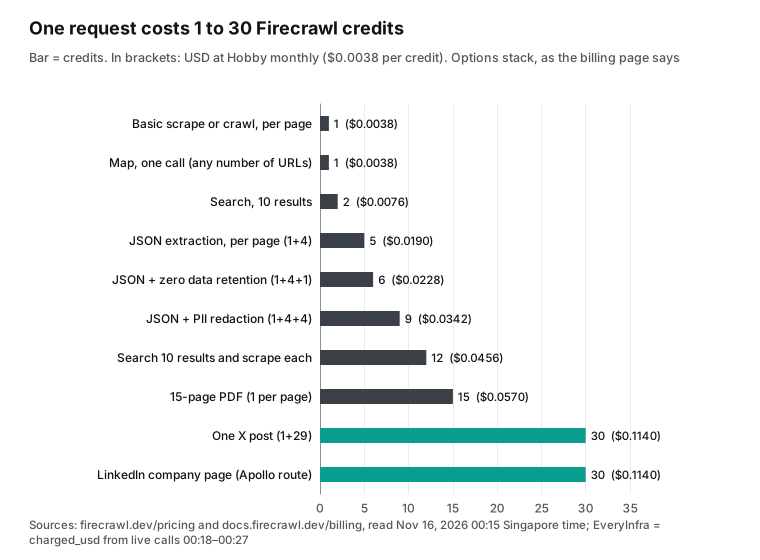
The PDF row shows two numbers because Firecrawl's own pages disagree. The billing table says "PDF parsing +1 credit / PDF page". Read literally, a 15-page PDF costs 1 base credit plus 15, or 16 credits. The document parsing page and the search docs both say "1 credit per PDF page", which gives 15. One credit does not change the scale of the bill. For a budget, use 16 as the upper limit.
On our side, read fetched a 15-page arXiv paper (1706.03762). At 00:22 SGT it returned 52,380 characters in 1.51 seconds and cost $0.000694. That is the same price as a plain web page.
X and LinkedIn links take special routes. The billing docs say that x.com and twitter.com profile and post URLs go through the Grok API from xAI. Each request costs 1 base credit plus 29 credits for "Grok X Query", so 30 in total, or 34 with JSON. The result is structured data and summaries that Grok generates. The docs also suggest the X Enterprise API for raw structured data at scale.
LinkedIn person and company pages go to third-party data vendors. FullEnrich costs 5 credits, Data Legion base 10, Apollo 30 and Data Legion premium 40. A vendor with no record charges nothing, so you pay the price of the vendor that matched.
We have dedicated tools for both. Our twitter/user_posts returns up to 200 posts per call, and in our test it returned 20 posts for $0.000556. Our linkedin/company_profile call for Firecrawl's own company page returned 87,606 followers and other fields for $0.000556.
Does JS rendering or the proxy option cost extra
No. The credit table has no separate JS rendering line. The enhanced mode docs say an enhanced proxy request costs the same as a basic request, 1 credit. A request can start on the basic proxy and retry on the enhanced proxy. That retry is not charged separately. The same page and the proxy docs say the proxy parameter is deprecated. They recommend the default auto mode.
This is a change from early 2026. The January archive and a thread on r/ProxyEngineering both say JSON plus enhanced mode costs 5 to 9 credits per page. The August FAQ still said that advanced features such as JSON and Enhanced Mode "cost additional credits". A May 2026 Firecrawl blog post already lists enhanced mode at 1 credit. "Enhanced costs 5 credits" is the rule from before September.
The cache can make pages faster, but it does not make them cheaper. The fast scraping docs set the default maxAge to 2 days. If the cache holds a copy younger than that, Firecrawl returns it at once. Set maxAge to 0 to force a fresh fetch. A cache hit still costs 1 credit per page, but it is faster and fails less often.
The lockdown option reads only from the cache and never contacts the target site. A lockdown hit adds 4 credits. A miss returns no document but still costs 1 credit.
Interact and Agent: billed per minute and per use
Interact is the Firecrawl browser sandbox. The Interact docs bill per browser minute with a one-minute minimum. You pay per minute whether or not the session gets the result you want.
| Interact session | Credits per minute | 10-minute session | Hobby monthly | Scale annual |
|---|---|---|---|---|
| Playwright code only | 2 | 20 credits | $0.076 | $0.012 |
| Natural-language prompt | 7 | 70 credits | $0.266 | $0.042 |
| Code only, zero data retention | 4 | 40 credits | $0.152 | $0.024 |
| Prompt, zero data retention | 9 | 90 credits | $0.342 | $0.054 |
So a clear timeout on prompt sessions saves more than a review of the bill later.
Agent is an autonomous research tool. It gives 5 free runs a day and then uses dynamic pricing. Neither the pricing page nor the billing docs give a unit formula. To estimate Agent costs, run a few typical tasks with the free runs. Then read the credits used in the Credit Usage endpoint.
What the free allowance buys
The Free plan gives 1,000 credits a month. The table converts them with the rules above.
| Use of the Free plan | Credits each | What 1,000 credits buy |
|---|---|---|
| Plain page scrape | 1 | 1,000 pages |
| Search with 10 results | 2 | 500 searches |
| Page with JSON format | 5 | 200 pages |
| X post | 30 | 33 posts |
| LinkedIn profile at the Data Legion premium rate | 40 | 25 profiles |
Free rate limits are 10 requests a minute on Scrape, Map and Search. Crawl, Agent and Interact allow 2 a minute, and you get 2 concurrent browsers. When the credits run out, requests return HTTP 402, because the Free plan has no pay-as-you-go option.
Some free use sits outside the 1,000 credits. Searches in the government and legal index cost no credits, and Agent gives 5 free runs a day. Keyless use has its own daily cap per IP address. Partner offers usually give 10,000 credits, which expire after 3 months, says the partner credits page. During that time the account keeps Free plan rate limits.
Firecrawl search pricing: 2 credits per 10 results, and 11 costs double
The "Cost Implications" section of the search docs gives the rule. One to 10 results cost 2 credits, and 11 to 20 results cost 4 credits. If you also scrape each result, each page adds 1 credit, and JSON adds 4 more. Searches in the government and legal category add no search credits.
Enterprise zero data retention search has two rates. End-to-end retention control costs 10 credits per 10 results, and the anonymized mode costs 2 credits per 10 results.
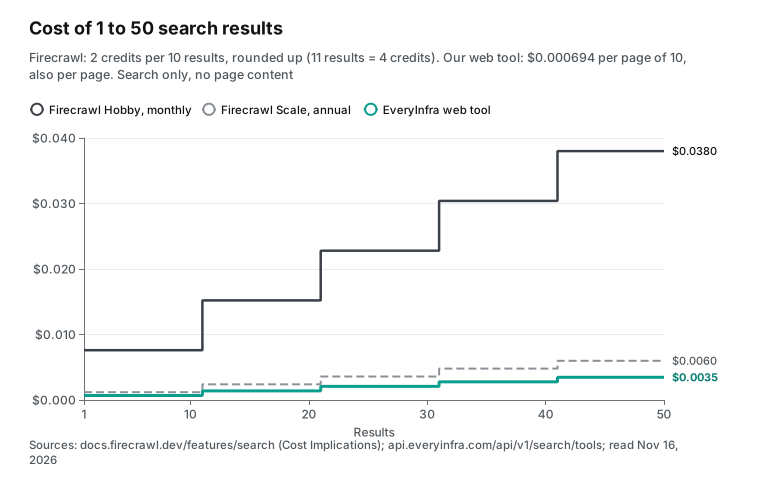
Eleven results and 20 results cost the same: 4 credits. An agent that searches with the default 10 results avoids the issue. Some frameworks set the default limit to 15 or 20. Then each search costs twice the list price, and the bill shows it.
Our web tool returns up to 10 results per call for $0.000694. For 20 results, request page 2. At 00:20 SGT and 00:22 SGT we searched "firecrawl pricing" for page 1 and page 2. Each call returned 10 results and cost $0.000694.
Agents often search and then read the top results in full. In Firecrawl, 5 results plus 5 scraped pages cost 2 + 5 = 7 credits. That is $0.0266 on Hobby monthly and $0.0042 on Scale annual.
Our deep tool returns full text when full=true is set. At 00:27 SGT we searched "firecrawl search pricing credits per 10 results" with it. It returned 5 results with about 81,000 characters of full text in 8.14 seconds, for $0.000694. That is 6 times less than the cheapest Firecrawl option and 38 times less than Hobby. The deep tool returns up to 10 results per call, so split larger jobs into batches.
When Firecrawl charges for failures: a returned document costs 1 credit
The current rule is in the section "When credits are charged" of the billing docs. The charge depends on whether Firecrawl returns a document. The HTTP status of the target site does not decide it. If the target responds and Firecrawl gives you that response, you pay 1 credit per page plus options. This includes 403 Forbidden and 404 Not Found pages.
The docs suggest that you check metadata.statusCode in the response. Stop retrying URLs that stay blocked. You pay 0 credits only when no document comes back, for example when the site never responds or every render attempt fails.
A few cases charge even without a document. A threat protection scan costs 2 credits per scanned URL, including scrapes that the scan blocks. A prompt injection check costs 5 credits once it runs. A lockdown cache miss costs 1 credit. A page that errors during a monitor check costs the base 1 credit. Interact and browser sessions bill per minute, with a one-minute minimum, whatever the result.
Crawl and batch scrape credits post as each page completes. Your balance can lag behind a job by minutes or even hours, the docs say. Status checks cost nothing.
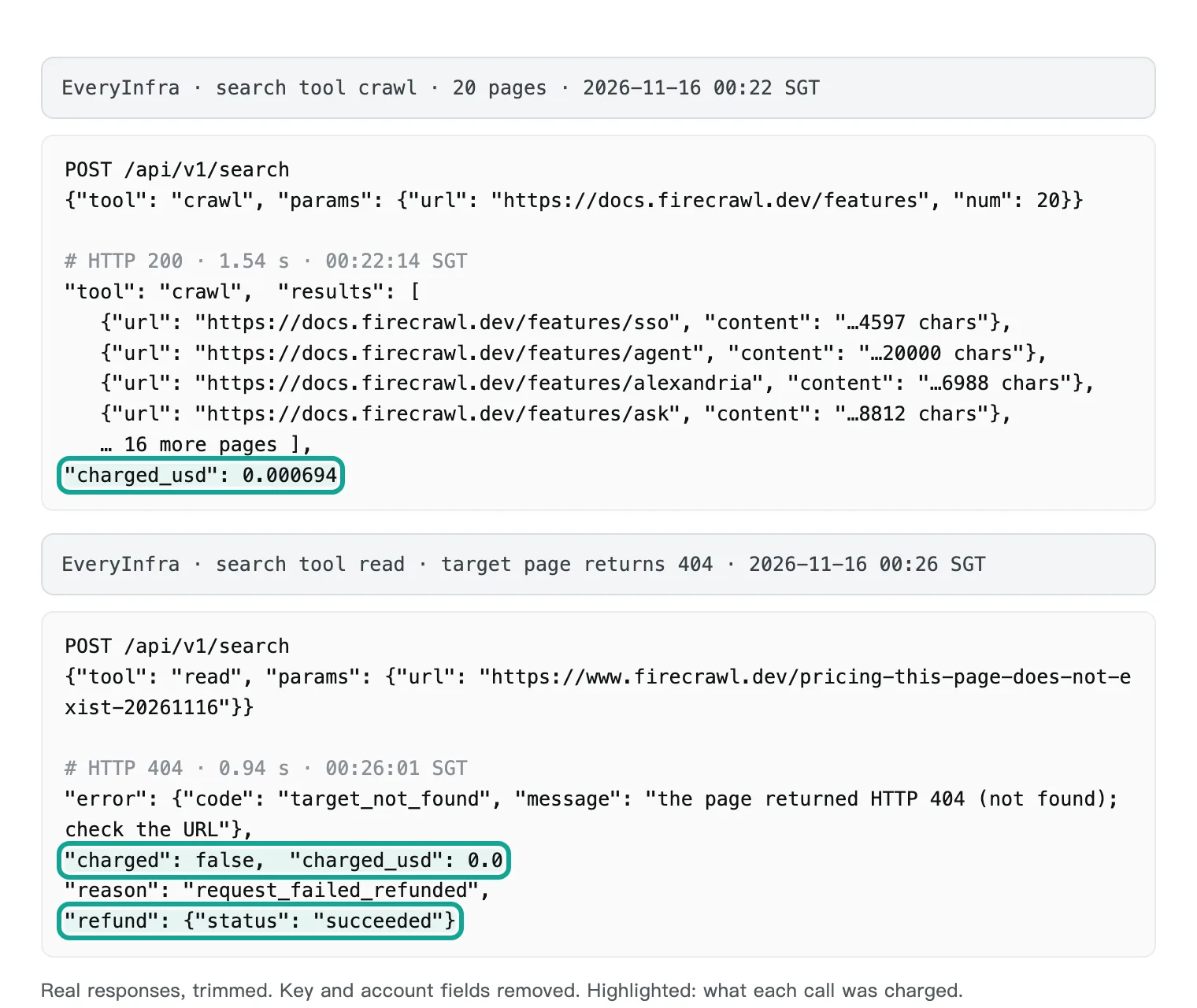
Our rule is different. We do not charge when the target page returns 404 or the domain does not exist. At 00:22 SGT we read a domain that does not exist, and at 00:26 SGT a page under firecrawl.dev that does not exist. Both calls returned HTTP 404 with the error code target_not_found. The field billing.charged_usd was 0, the reason was request_failed_refunded, and refund.status was succeeded.
Under Firecrawl's rule, the second request would cost 1 credit, because the target sent back a 404 page. The first would cost 0, because the domain did not resolve and no document came back.
This difference shows up when you scrape a batch of old links. Say 15% of 10,000 URLs now return 404. Firecrawl charges 1,500 extra credits for them, which is $5.70 on Hobby monthly.
The FAQ in the August 11 archive answers "Do you charge for failed requests?" with "No, we only charge for successful requests". Today the same question says that 403 and 404 pages come back to you and cost 1 credit. Each answer matched its own billing rule. Keep this in mind when you read older tutorials.
How overage works: pay-as-you-go in $5 packs
When the monthly credits run out, paid plans use pay-as-you-go. The Free plan has no such option. It returns HTTP 402 until the next month. Pay-as-you-go adds one pack at a time, and each pack costs $5. The number of credits in a pack depends on the plan. You can also buy packs by hand with "Load more credits" in billing settings, at the same rate.
| Plan | Credits per $5 | Per 1,000 credits | Times the plan rate, monthly | Extra credits in the January archive | Change | Overage headroom after zero balance |
|---|---|---|---|---|---|---|
| Hobby | 1,000 | $5.00 | 1.32 | $9 per 1,000 | −44.4% | 1,500 |
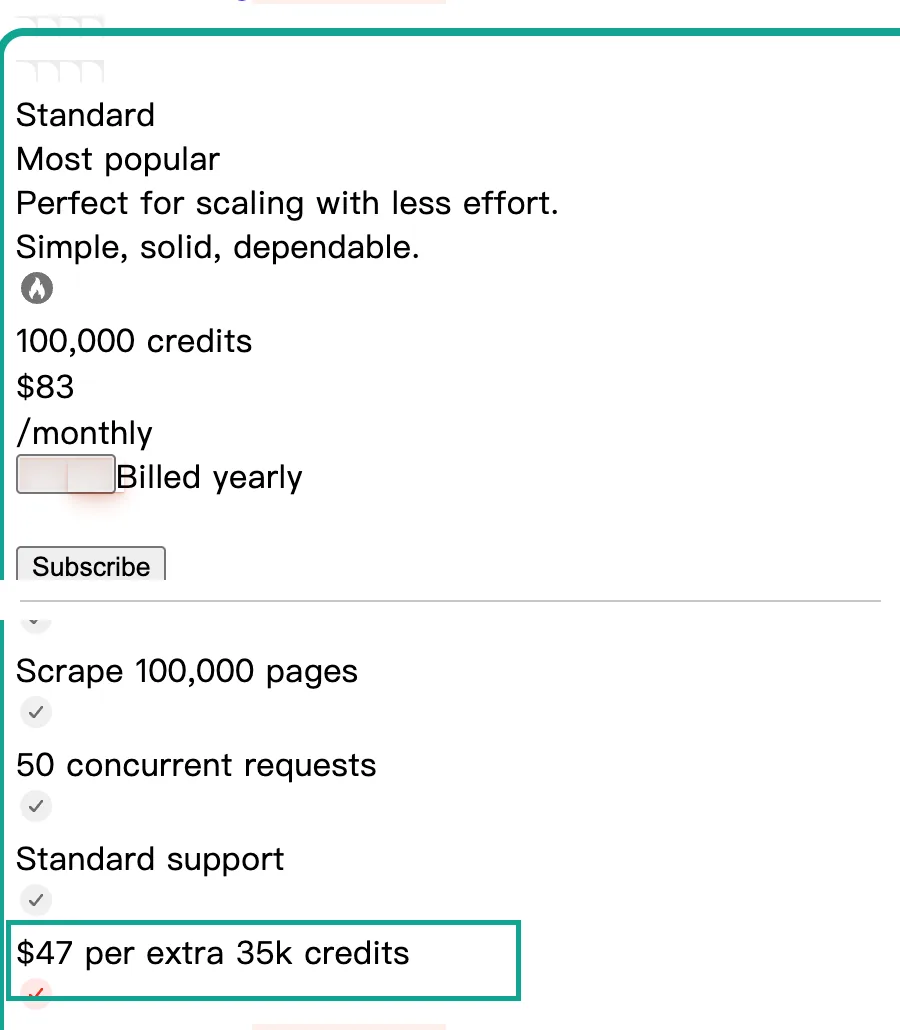
| Standard | 2,000 | $2.50 | 2.53 | $47 per 35,000, or $1.343 per 1,000 | +86.2% | 30,000 |
| Growth | 2,500 | $2.00 | 2.51 | $177 per 175,000, or $1.011 per 1,000 | +97.7% | 150,000 |
| Scale | 5,000 | $1.00 | 1.34 | Not listed | — | 600,000 |
Four rules in the billing docs decide what you really pay. First, the monthly pay-as-you-go limit rounds down to whole $5 packs. A $22 limit allows 4 packs. A blank limit means no cap. A limit of 0 turns pay-as-you-go off, and then requests return 402 without a card charge.
Second, with pay-as-you-go on, requests do not stop at exactly zero. Each plan has an overage allowance so that a burst keeps running while a top-up settles. The allowance is 1,500 credits on Hobby, 30,000 on Standard, 150,000 on Growth and 600,000 on Scale. The docs say this is headroom, not extra credits you keep.
Third, credits you buy by hand are spent first and do not count toward the monthly limit. Fourth, bought credits do not reset each month. They expire at the end of the billing period when you cancel your plan.
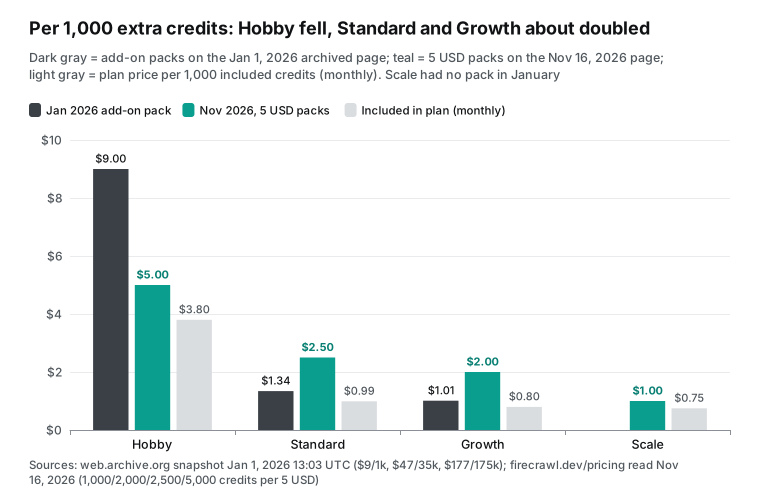
Hobby overage got cheaper. Standard and Growth overage nearly doubled. Take a Standard team that uses 150,000 credits in one month. The extra 50,000 credits now cost 25 packs, or $125. Under the January rule, two packs of 35,000 at $47 each cost $94 and left 20,000 credits spare.
For teams with seasonal peaks, a move up one plan is often cheaper than overage today. Standard plus $125 is $224. Growth gives 500,000 credits for $399 a month. The two options break even at about 2.2 times the Standard allowance.
Rollover matters too. The billing docs say plan credits reset at month end by default. Only annual Scale rolls unused credits over for one month, and annual Enterprise for two. Annual plans also reset each month on a virtual renewal date, so you do not get one large yearly pool.
An upgrade takes effect at once. You pay the full new price that day with no proration, and the billing cycle restarts. Unused credits from the old plan carry over. A downgrade starts at the next renewal, and the rest of the current period is not refunded.
On Hobby, low use raises the real unit price. At 500 credits used in a month, 1,000 credits cost $38. At 1,000 used they cost $19, and at 2,500 used they cost $7.60. Only at the full 5,000 do you reach $3.80.
A user on r/n8n asked for pay-as-you-go scrapers whose credits do not expire. The complaint was credits that vanish at month end. EveryInfra has no monthly fee, and the balance does not expire. Each call takes its listed price from the balance.
Spend limits per API key
The billing docs add one more control: a spend limit per API key. In billing settings you give one key a credit cap per day, week or month. When that key reaches the cap, it stops. Other keys on the team keep working. The docs say the cap is a number of credits, not money. A cap of 1 means one credit per period.
This helps teams that give keys to agents. An agent with a broken loop can burn a month of credits in minutes. A daily cap per key limits the worst case to one day of use. The crawl pre-flight check also respects this cap and returns 402 when the cap blocks a request.
On EveryInfra, calls stop when the balance reaches zero, and the catalog lists each price before you call. We do not offer separate caps per key today. Teams that need isolation can fund separate accounts.
Where to read the bill
Firecrawl posts charges after the work. Pages with metadata.statusCode of 403 or 404 have already cost 1 credit. The crawl status endpoint returns creditsUsed, which keeps rising while credits post. The Credit Usage endpoint returns usage over time for a daily check. On EveryInfra, every response carries billing.charged_usd, and nothing posts later.
Before and after September 4, 2026: three versions of the pricing page
The Internet Archive holds two older copies of the Firecrawl pricing page: January 1, 2026 and August 11, 2026. We compared each with the live page on 2026-11-16. The changes cluster in three places: the free plan, extra credits and concurrency.
| Item | Archive of 2026-01-01 | Archive of 2026-08-11 | Live page on 2026-11-16 |
|---|---|---|---|
| Free plan | 500 credits, one time | 1,000 a month | 1,000 a month |
| Hobby credits per month | 3,000 at $16 per month annual | 5,000 at $16 per month annual | 5,000 at $19 monthly or $16 per month annual |
| Extra credits | Hobby $9 per 1k, Standard $47 per 35k, Growth $177 per 175k, auto-recharge packs | FAQ: no pay-per-use plan | $5 packs, pay-as-you-go |
| Concurrency on Standard / Growth / Scale | 50 / 100 / 150 | 50 / 100 / 150 | 25 / 50 / 100 |
| Failed requests | — | "only charge for successful requests" | 403 and 404 cost 1 credit |
| Enhanced mode | Extra credits | FAQ: advanced features cost extra | +0 |
| Rollover | — | No rollover on self-serve plans; Scale and Enterprise can roll over | Annual Scale for 1 month, annual Enterprise for 2 months |
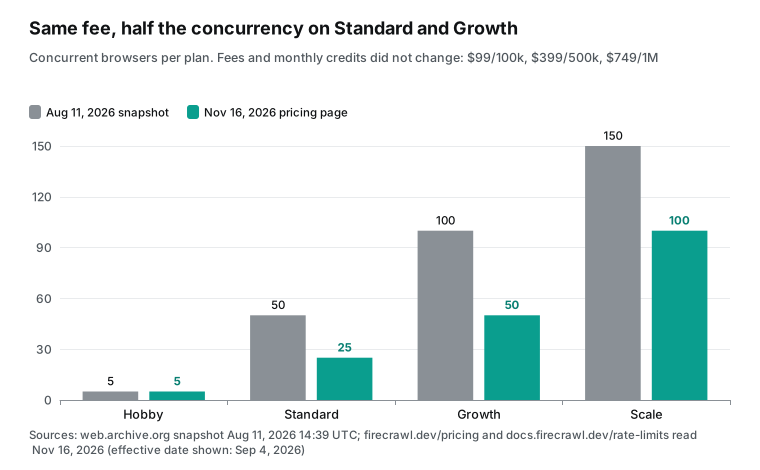
Half the concurrency does not change the bill. It changes how long a batch takes. The rate limit docs say concurrent browsers set how many pages render at the same time. Extra jobs wait in a queue, and queue time counts against the request timeout.
Assume 3 seconds per page. With 25 browsers, Standard can render about 30,000 pages an hour at most. In August, 50 browsers allowed about 60,000. Requests per minute have their own limits, shown in the table.
| Plan | Concurrent browsers | Scrape, Map, Search per minute | Crawl, Agent per minute | Max queued jobs |
|---|---|---|---|---|
| Free | 2 | 10 | 2 | 50,000 |
| Hobby | 5 | 100 | 20 | 50,000 |
| Standard | 25 | 500 | 100 | 50,000 |
| Growth | 50 | 5,000 | 1,000 | 100,000 |
| Scale | 100 | 10,000 | 2,000 | 200,000+ |
An Arabic-language video on Firecrawl pricing shows the credit slider from before the change. With the Standard slider at 130,000 credits the price was $156. At 160,000 credits it was $213. Growth at 650,000 credits was $616. The live page no longer has a slider, and all extra credits come in $5 packs.
The presenter calls Scale "expensive". A second video comparing Crawl4AI and Firecrawl describes Firecrawl as a subscription with usage limits. It says self-hosted Crawl4AI costs only the server. A third video shows only the 1-credit basic scrape and the Free plan.
Five places where Firecrawl's own pages disagree
The pricing page and the docs disagree in five places. The first one has the largest effect on a budget. It is about whether a crawl with no limit must reserve 10,000 credits.
| Item | One page says | Another page says | Effect on the bill |
|---|---|---|---|
| Crawl pre-flight check | Crawl docs: default limit 10,000 pages; the endpoint checks that your credits cover the limit, else 402 | Billing docs: with no limit, the check uses 1 credit and reserves nothing; pages bill as processed | With a low balance, one reading gives 402 and the other runs. Set an explicit limit either way |
| Batch scrape rate limit | Pricing page: batch scrape shares the crawl limit | Billing docs: batch scrape shares the scrape limit | On Free, that is 2 or 10 requests a minute |
| Map unit | Pricing page API table: 1 per page | Pricing summary and billing docs: 1 per call | Billed per call, so 5,000 URLs still cost 1 credit |
| Interact rate | Pricing page: 2 per browser minute | Billing docs: 2 to 7 per browser minute | Prompt sessions cost 7, so the pricing page gives a figure 3.5 times too low |
| Billing docs: +1 per PDF page | Document parsing page: 1 per page | A 15-page PDF costs 16 or 15 credits |
Firecrawl MCP pricing: MCP and keyless use
The Firecrawl MCP server has no price list of its own. With an API key or account sign-in, MCP tools such as scrape and search use the same credits as the API. The MCP docs have no separate pricing table. The changelog entry "Introducing Firecrawl MCP v3" from November 12, 2026 claims "60x higher rate limits" and "4x more usage". It does not give the base numbers. For MCP v3 tools that query Alexandria data vendors, the docs say discovery is free and each run costs the price on that tool.
The other path is keyless access. The keyless docs give the address https://mcp.firecrawl.dev/v2/mcp with no credential. It exposes three tools only: Search, Scrape and Parse.
The rate limit docs say keyless use is free with two daily caps per IP address. One cap counts requests and the other counts credits, and past either cap you get 429. The docs do not publish either number. So "is firecrawl mcp free" has a short answer: yes for a trial, with caps that are not published. Real workloads need a key and draw on the same credit pool.
Our remote MCP address is https://api.everyinfra.com/mcp and needs a key. The everyinfra_search tool charges the search tool price per call. At 00:24 SGT we ran one web search for "firecrawl search pricing" through MCP. It returned 10 results in 1.89 seconds and cost $0.000694. That is the same price as a direct call to /api/v1/search.
{
  "mcpServers": {
    "everyinfra": {
      "type": "http",
      "url": "https://api.everyinfra.com/mcp",
      "headers": { "Authorization": "Bearer ${EVERYINFRA_API_KEY}" }
    },
    "firecrawl": {
      "type": "http",
      "url": "https://mcp.firecrawl.dev/v2/mcp"
    }
  }
}
This config follows the Streamable HTTP transport in the MCP specification. The second entry is the keyless address from the Firecrawl docs. We copied it as written and did not connect to it. You can add both servers to one client. Put keys in headers, not in URLs.
EveryInfra live test: 22 requests in five rounds
On 2026-11-16 between 00:18 and 00:27 SGT we sent 22 requests in five rounds. Five hit the test key limit of 10 requests a minute and returned HTTP 429 with the note "Nothing was charged". Two targets did not exist and were refunded. Fifteen calls succeeded and were charged, for $0.010553 in total. The table lists the 17 successful and failed calls, with each rate-limited call resent after 34 to 80 seconds and merged into its row.
| SGT | Tool | Request | Result | Time | Charged |
|---|---|---|---|---|---|
| 00:18 | /api/v1/search read | firecrawl.dev/pricing | 10,602 characters of text | 3.72 s | $0.000694 |
| 00:19 | /api/v1/search map | docs.firecrawl.dev, num 200 | 200 URLs | 0.39 s | $0.000694 |
| 00:19 | web/search | keyword firecrawl pricing, US | 10 results | 2.02 s | $0.001389 |
| 00:20 | /api/v1/search web | firecrawl pricing, page 1 | 10 results | 1.70 s | $0.000694 |
| 00:20 | /api/v1/search crawl | features section with one filter sentence | 2 pages about credits | 5.02 s | $0.000694 |
| 00:20 | /api/v1/search harvest | pricing page, 5 fields | 6 rows | 13.83 s | $0.000694 |
| 00:22 | /api/v1/search web | firecrawl pricing, page 2 | 10 results | 1.91 s | $0.000694 |
| 00:22 | /api/v1/search crawl | features section, num 20 | 20 pages, 209,239 characters | 1.54 s | $0.000694 |
| 00:22 | /api/v1/search read | 15-page arXiv PDF | 52,380 characters | 1.51 s | $0.000694 |
| 00:22 | /api/v1/search read | domain that does not exist | 404, target_not_found | 4.12 s | $0, refunded |
| 00:24 | MCP everyinfra_search | web: firecrawl search pricing | 10 results | 1.89 s | $0.000694 |
| 00:25 | bing/search | firecrawl credits pricing | 10 results | 9.62 s | $0.000556 |
| 00:26 | /api/v1/search read | firecrawl.dev page that does not exist | 404, target_not_found | 0.94 s | $0, refunded |
| 00:26 | duckduckgo/search | firecrawl mcp pricing | 10 results | 3.98 s | $0.000556 |
| 00:27 | /api/v1/search deep, full | 5 results with full text | about 81,000 characters | 8.14 s | $0.000694 |
| 00:27 | linkedin/company_profile | firecrawl | 1 company profile | 4.50 s | $0.000556 |
| 00:27 | twitter/user_posts | firecrawl, limit 20 | 20 posts | 2.65 s | $0.000556 |
With the filter sentence, crawl returned 2 pages. Without it, crawl returned the full 20. Both calls cost $0.000694, so the filter does not change the price. The price per 1,000 pages moved from $0.0347 to $0.347.
In the 20-page crawl call, 5 pages had exactly 20,000 characters. The text of one page is cut at that length, so use read on long pages. The read call on the pricing page returned the plan prices. But the small per-endpoint credit table lost its cells in the text conversion, and only the labels remained.
For tables, use harvest with named fields. Its 6 rows matched the pricing page value for value. Speed: harvest took 13.83 seconds and bing/search took 9.62 seconds. For low latency, use web at 1.70 to 1.91 seconds.
The 5 cut pages were the agent, browser, crawl, interact and monitoring feature pages. The other 15 pages had 2,944 to 17,037 characters. All 20 pages had 209,239 characters, about 10,500 per page.
Here is the cost at this rate. One crawl call for 20 pages plus one read call for each of the 5 cut pages is 6 calls, or $0.004164. That is $0.208 per 1,000 pages. It is between the best crawl case at $0.0347 and read per page at $0.694. It is still about 65% below Firecrawl Scale annual at $0.599. More cut pages move the price toward read per page. Run one crawl on your own site first and count the pages at exactly 20,000 characters.
Here is the crawl call and the web/search call. The key comes from an environment variable.
curl -s https://api.everyinfra.com/api/v1/search \
  -H "Authorization: Bearer $EVERYINFRA_API_KEY" \
  -H "Content-Type: application/json" \
  -d '{"tool":"crawl","params":{"url":"https://docs.firecrawl.dev/features","num":20}}'

curl -s https://api.everyinfra.com/api/v1/social \
  -H "Authorization: Bearer $EVERYINFRA_API_KEY" \
  -H "Content-Type: application/json" \
  -d '{"platform":"web","action":"search","params":{"keyword":"firecrawl pricing","country":"us","language":"en"}}'
One entry point costs twice as much as the other. The web tool on /api/v1/search costs $0.000694 per call. The web/search capability on /api/v1/social costs $0.001389. It can target results by country and language, and it returns the fields listed in response_fields in the catalog. If you need only titles, URLs and snippets, the first one is enough. At $0.000556 per call, bing/search and duckduckgo/search are the cheapest of the four.
Rate limits and queues: neither side charges
All five 429 replies came on the eleventh request inside one minute. The reply said the key had its own limit of 10 requests a minute. It gave a retry_after of 8 seconds and said nothing was charged. We waited and resent each call, and all five succeeded.
The Firecrawl rate limit docs say a 429 comes back when you pass the per-minute limit or the concurrency limit. The job queue also has a cap: 50,000 jobs from Free to Standard and 100,000 on Growth. New jobs past that cap also get 429. A rejected request returns no document, so under the billing rules it costs no credits.
Time in the queue costs nothing, but it counts against the request timeout. A timeout means no document, so it costs nothing either. On this point both services work the same way. Rate limits cost time, not money.
At the Scrape rate limit, each plan uses its monthly credits fast. Free and Growth need 100 minutes, Hobby needs 50 and Standard needs 200. Scale also needs 100 minutes. So the per-minute limit does not control the monthly bill.
The rate limit docs say your "real bottleneck will be concurrent browsers". All keys on one team share one set of per-minute counters. An agent with a bad loop can use a full month of credits in one to four hours. A daily cap per key stops that.
Eight monthly workloads, priced
For Firecrawl we took the cheapest way to buy enough credits: the lowest plan that fits, plus $5 packs on that plan. We priced it monthly and annual. For EveryInfra we took the cheapest method from our live test.
| Monthly workload | Firecrawl credits | Firecrawl monthly | Firecrawl annual | EveryInfra | Gap, monthly |
|---|---|---|---|---|---|
| Agent research: 3,000 searches, read 3 pages each | 15,000 | Hobby + 10 packs = $69 | $65.83 | deep with full text, 3 results $2.08; web + read $8.33 | 33× |
| Docs ingest: 10,000 pages refreshed monthly | 10,000 | Hobby + 5 packs = $44 | $40.83 | 500 crawl calls plus 50 map calls $0.38; plus read for cut pages at 5 of 20, $2.12; read per page $6.94 | 115× (21× with re-reads) |
| JSON fields from 2,000 pages | 10,000 | $44 | $40.83 | harvest per page $1.39 | 32× |
| 500,000 plain pages | 500,000 | Growth $399 | $332.50 | read $347 | 1.15× monthly; annual 4% cheaper |
| 1,000,000 plain pages | 1,000,000 | Scale $749 | $599.17 | read $694 | 1.08× monthly; annual 14% cheaper |
| 1,000 X posts | 30,000 | Standard $99 | $82.50 | twitter/user_posts at 20 posts $0.028; twitter/post one by one $0.556 | 178× to 3,561× |
| 500 LinkedIn company pages, Apollo route | 15,000 | $69 | $65.83 | linkedin/company_profile $0.28 | 248× |
| 500 LinkedIn company pages, FullEnrich route | 2,500 | Hobby $19 | $15.83 | $0.28 | 68× |
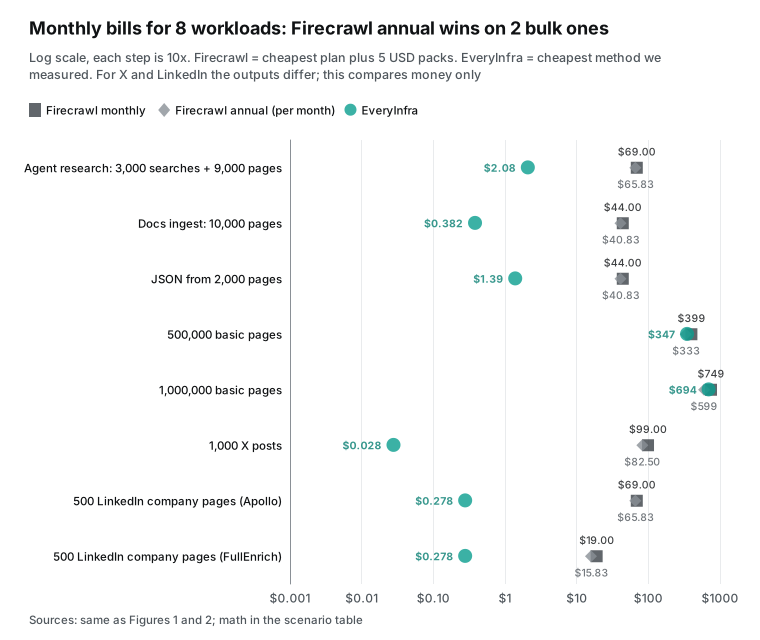
In the docs ingest row, one map call lists up to 200 URLs, so 10,000 pages need 50 calls. At 5 cut pages in 20, about 2,500 long pages also need a read call. That moves our bill from $0.38 to $2.12, and the gap falls from 115 times to 21 times. In the large workloads the two services come close, and Firecrawl annual wins above 500,000 pages.
The X row shows the largest gap because the units differ. Firecrawl sends each post through the Grok API for 30 credits. Our twitter/user_posts returns up to 200 posts from one account per call. If you need one post each from 1,000 different accounts, use twitter/post one by one. That costs $0.556 against $99, still 178 times less.
One month on Standard: a worked bill
A worked month shows how the credit rules add up. Take a team that monitors competitors. Each month it scrapes 60,000 plain pages, and 3% of those URLs now return 404. Its agent runs 5,000 searches a month, and the framework asks for 15 results by default. It also extracts price and stock fields from 2,000 product pages with the JSON format.
| Line item, month 1 | Firecrawl credits | EveryInfra calls | EveryInfra cost |
|---|---|---|---|
| 58,200 live pages | 58,200 | 58,200 read | $40.39 |
| 1,800 pages that return 404 | 1,800 | 1,800 read, refunded | $0 |
| 5,000 searches of 15 results | 20,000, rounded to 20 results | 10,000 web, two pages each | $6.94 |
| 2,000 pages with JSON fields | 10,000 | 2,000 harvest | $1.39 |
| Total | 90,000, inside Standard at $99 | — | $48.72 |
The month uses 90,000 credits and fits inside the 100,000 on Standard. The bill is $99, or $1.10 per 1,000 credits. A search limit of 10 instead of 15 cuts search from 20,000 credits to 10,000. The bill stays the same, but the team gets more room under the cap.
In the second month the business grows by half, and use rises to 135,000 credits. On Standard, the extra 35,000 credits need 18 packs of 2,000. That adds $90, so the bill is $189, or $1.40 per 1,000 credits. Growth at $399 still costs more. Under the January rule, one $47 pack of 35,000 credits would cover the gap, for a bill of $146. On EveryInfra the second month costs $73.08.
Search and JSON extraction make most of the gap. In Firecrawl they take 30,000 credits, which is about $30 at the Standard rate. On EveryInfra they cost $8.33 together. For plain pages, Standard at $0.99 per 1,000 and read at $0.694 differ by only 30%.
Firecrawl next to Tavily and ScraperAPI
People often compare Firecrawl with Tavily and ScraperAPI. All three bill in credits, but each credit means something different. The Tavily credit docs say a basic search costs 1 credit and an advanced search 2. Extract costs 1 credit per 5 successful URLs, Map 1 credit per 10 pages, and failures cost nothing. Pay-as-you-go costs $0.008 per credit. Monthly plans run from Project at $30 for 4,000 credits to Growth at $500 for 100,000.
The ScraperAPI credit docs charge 1 credit for a plain page and 5 for e-commerce. Google and other search engines cost 25, and LinkedIn 30. JS rendering costs 10. On the ScraperAPI pricing page, Hobby is $49 for 100,000 credits and Scaling is $475 for 5 million. ScraperAPI charges for both 200 and 404 responses.
| Per 1,000 | Firecrawl, Hobby monthly to Scale annual | Tavily, pay-as-you-go to Growth | ScraperAPI, Hobby to Scaling | EveryInfra, live charges |
|---|---|---|---|---|
| Plain web pages | $3.80 to $0.599 | $1.60 to $1.00, extract at 1 credit per 5 URLs | $0.49 to $0.095 | read $0.694; crawl plus re-reads of cut pages about $0.208 |
| Searches of 10 results | $7.60 to $1.198 | $8.00 to $5.00, basic search | $12.25 to $2.375, Google at 25 credits | web $0.694; bing/search $0.556 |
| JS-rendered pages | Same as plain pages | Same as extract | $4.90 to $0.95 at 10 credits | read $0.694 |
| 404 pages | 1 credit | Failed extracts free | Charged, 200 and 404 both count | Free, refunded |
For plain pages, ScraperAPI is the cheapest of the four. Even its Hobby plan at $0.49 per 1,000 is below our read tool. For search, all three cost more than our web tool, from 1.7 to 18 times.
Three other articles on our site cover the details. Firecrawl alternatives covers other scraping options and what each one fits. Tavily alternatives covers options for Tavily search and extract. ScraperAPI pricing converts each ScraperAPI plan by target site. For a short summary, see the Firecrawl comparison page.
When Firecrawl is the better choice
Based on Firecrawl's own docs and the numbers above, Firecrawl fits better in the cases below. In some of them we have no equivalent tool.
| Case | What Firecrawl offers | What EveryInfra offers |
|---|---|---|
| Bulk plain pages, annual plan | $0.665 to $0.599 per 1,000 pages | read $0.694 per 1,000 |
| Whole site in one job | Crawl up to 10,000 pages by default | crawl up to 20 pages per call |
| Browser interaction | Interact at 2 to 7 credits a minute | No equivalent |
| Change monitoring | Monitor at 1 credit per page per check | No equivalent |
| Self-hosting | AGPL-3.0 open source | Hosted only |
| Zero data retention per request | Option on scrape, search and Interact | No per-request switch |
| US government and legal search | Free index of 30 million pages | General web search per call |
Bulk plain pages of one kind. At 500,000 pages a month or more, with full use and annual billing, Growth costs $0.665 per 1,000 and Scale $0.599. That is 4% to 14% below our read tool at $0.694. By page count, the bands are about 479,000 to 510,000 pages a month on Growth and 863,000 to 1,305,000 on Scale. Annual Scale also rolls unused credits over for one month, which helps in uneven months.
A team with steady volume in those bands and a budget for a year up front saves money with Firecrawl annual. For a hobby project under 1,000 pages a month, the Firecrawl Free plan costs nothing and needs no card.
A whole site in one job. Crawl defaults to 10,000 pages. You control it with path rules, depth and an option for outside links, and it bills as pages complete. Our crawl tool returns up to 20 pages per call and cuts the text of one page at 20,000 characters. For a large site you list URLs with map and then call in batches, which means more calls to manage. To pull a documentation site of several thousand pages in one job, Firecrawl is simpler.
Browser interaction. Some pages need a login, a button click, infinite scroll or a form. Firecrawl offers the Interact sandbox, billed per minute, with Playwright code or a natural-language prompt. We have no such tool. The same goes for change monitoring. Firecrawl has Monitor and Change Tracking at 1 credit per page per check.
Self-hosting, with data kept inside your network. The Firecrawl open-source repository uses the AGPL-3.0 license and passed 200,000 GitHub stars, says the changelog entry of November 9, 2026. The self-hosting docs give Docker Compose steps. Self-hosting uses no credits. You run upgrades, storage and monitoring yourself, and you bring your own proxies and search.
In a thread on r/LocalLLaMA, a Firecrawl employee said the self-hosted version needs your own proxies and SearXNG for search. The original poster worked out $0.0008 per page at 500,000 pages. That matches Growth monthly at $0.000798.
Zero data retention, SSO or audit needs. Firecrawl offers zero data retention on scrape, search and Interact. Enterprise adds SSO, SIEM logging and custom concurrency. We do not offer a per-request zero retention switch. Teams with that purchase requirement should start with the Firecrawl Enterprise docs.
US government and legal research. The Government and Legal Index went live on October 22, 2026. It covers 30 million US federal, state and local government pages. The Gov docs say searches cost no credits, with or without zero data retention. For statutes, case law and local codes, it is free.
Check the math yourself: a Python script
The script below recomputes every per-1,000 price in this article. Change the numbers in MIX to get your own monthly Firecrawl and EveryInfra bills.
import math

# Firecrawl pricing page, effective September 4, 2026, read 2026-11-16
# plan: (monthly price, yearly saving, credits per month, credits per $5)
TIERS = {
    "Hobby":    (19, 38, 5_000, 1_000),
    "Standard": (99, 198, 100_000, 2_000),
    "Growth":   (399, 798, 500_000, 2_500),
    "Scale":    (749, 1_798, 1_000_000, 5_000),
}
# Billing docs: credits per request
CREDITS = {"page": 1, "page_json": 5, "search10": 2, "x_post": 30}

def search_credits(results: int) -> int:
    return 2 * math.ceil(results / 10)          # 11 results = 4 credits

def firecrawl_month(credits_needed: int, annual: bool = False):
    best = None
    for name, (monthly, save, included, per5) in TIERS.items():
        fee = (monthly * 12 - save) / 12 if annual else monthly
        packs = max(0, math.ceil((credits_needed - included) / per5))
        total = fee + 5 * packs
        if best is None or total < best[1]:
            best = (name, round(total, 2), packs)
    return best

# EveryInfra live charges (charged_usd)
EI = {"read": 0.000694, "web": 0.000694, "crawl_20": 0.000694, "harvest": 0.000694}

MIX = {"searches": 3_000, "pages": 9_000}       # your monthly volume
need = MIX["searches"] * search_credits(10) + MIX["pages"] * CREDITS["page"]
print("Firecrawl credits:", need)
print("Firecrawl monthly:", firecrawl_month(need))
print("Firecrawl annual:", firecrawl_month(need, annual=True))
print("EveryInfra:", round(MIX["searches"] * EI["web"] + MIX["pages"] * EI["read"], 3))
With the sample mix of 3,000 searches and 9,000 pages, Firecrawl needs 15,000 credits. The cheapest option is Hobby plus 10 packs: $69 monthly or $65.83 annual. EveryInfra with web and read costs $8.33.
What changed at Firecrawl in the last 30 days
From mid-October to mid-November, the Firecrawl changelog had a new entry every two or three days. Most were about the Alexandria data layer. Three entries affect billing directly.
On November 12, 2026, MCP v3 launched. It claims more than 3,000 tools, automatic vendor fallbacks, 60 times higher rate limits and 4 times more usage, with no credit prices. On November 13, 2026, company data grew to 75 million companies, billed at each tool's price. On November 2, 2026, the headless Clay entry promised 1,000 free credits a month inside ChatGPT and Claude.
Other entries do not change billing. These are the AI/ML research index, job search tools and 200K GitHub stars. Also on the list are eve, people data and Google Cloud. The last is Alexandria with the Series B on September 22.
One older entry does affect billing. On October 8, 2026, Universal Scrape put web pages, files and data vendors behind one scrape API. The special routes and vendor credits for X and LinkedIn links come from that change.
For pricing, this means one thing. The Firecrawl credit pool now covers vendor queries as well as web scraping. One credit can be worth 5 to 40 times more on one tool than on another. Split the bill by tool, because the total credit count alone does not show where the money goes. The Credit Usage endpoint returns balance and usage history.
Limits: when these numbers do not hold
Every per-1,000 price assumes full use of the allowance. With partial use, the real Firecrawl unit price rises in proportion. At 10% use of Hobby, it is 10 times the list price. Firecrawl prices come from the pages we read on 2026-11-16. The pricing page gives an effective date of September 4, 2026, and prices have changed at least twice this year. Read the page again before you buy. Tax is extra, by local rules.
EveryInfra prices come from 15 live charges and the catalog prices at that time. read charges the same price for pages that need JS rendering. We did not test success rates on every type of protected site. The two services return different content. By default Firecrawl returns Markdown, with HTML, screenshots and JSON as options. Our read tool returns body text. A price comparison does not mean one output can replace the other.
Two more costs are not in the tables. The first is retries. Firecrawl charges 1 credit for a 403 page. An agent that retries without checking metadata.statusCode can pay three or four times for one blocked URL. On our side failures cost nothing, so a retry costs only time.
The second is tokens. Both services return long text, and a model bills that text by the token. One crawl call returned 209,239 characters, and one deep call returned about 81,000. At about 4 characters per token, 200,000 characters are about 50,000 tokens. At an assumed $1 per million input tokens, that is $0.05. That is 72 times the cost of the crawl call, so add model cost to the total.
Get started: run your own workload on a trial
- Find the tools you need in the infrastructure market. Platform pages: Web search API, Bing API, DuckDuckGo API. Capability pages: web search, Bing search, DuckDuckGo search, LinkedIn company profile, X user posts. Each page has parameters and a playground.
- Follow the quickstart to get a key. See page reading and site crawling for the search tools.
- Take 50 real URLs and 50 real keywords from last month. Run each one once. Record
billing.charged_usd, the result count and any failure reason. - Put your volume into the Python script above to get both monthly bills. All EveryInfra prices are on the pricing page. To connect an AI client, follow MCP setup.
FAQ
What does firecrawl pricing look like per plan? (search suggestion "firecrawl pricing plan") Free gives 1,000 credits a month. Hobby is $19 monthly or about $15.83 a month annual for 5,000 credits. Standard is $99 for 100,000, Growth $399 for 500,000 and Scale $749 for 1,000,000. Per 1,000 pages, that is $3.80 down to $0.599.
Firecrawl credits pricing: what does one credit buy? (search suggestions "firecrawl credits pricing", "firecrawl credits usage") One credit scrapes one plain page or runs one Map call. Two credits buy one search of 10 results. JSON costs 5 credits per page, and one X post costs 30.
Is Firecrawl free? (search suggestions "is firecrawl free", "is firecrawl api free") The Free plan gives 1,000 credits a month with no card, then returns 402. Keyless use has daily caps per IP that the docs do not publish. The self-hosted open-source version uses no credits, but you pay for servers and proxies.
Firecrawl MCP pricing: does MCP cost extra? (search suggestions "firecrawl mcp pricing", "is firecrawl mcp free") No. MCP tools use the same account credits. Keyless MCP exposes only search, scrape and parse, with daily caps per IP. Alexandria vendor tools bill at their listed prices.
How does firecrawl search pricing work? (search suggestions "firecrawl search pricing", "firecrawl search api pricing") Each 10 results cost 2 credits, rounded up, so 11 results cost 4. Scraping each result adds 1 credit per page. Searches in the government and legal index cost no credits.
Is there a firecrawl credits coupon or free credits code? (search suggestions: firecrawl credits coupon, firecrawl free credits code) The billing docs say you can enter a credit coupon on the billing page. Coupon credits stay through plan changes. Partner offers usually give 10,000 credits that expire after 3 months, per the partner credits page. The pricing page showed no public coupon when we read it.
Is self-hosted Firecrawl free? (search suggestions "is firecrawl self hosted free", "is firecrawl open source") The open-source version uses the AGPL-3.0 license and uses no credits. You pay for servers, proxies and time. The docs say self-hosting lacks some cloud features, such as Agent and Interact.
Does Firecrawl charge for failed requests? (the r/ProxyEngineering thread quotes an older rule) No document means no charge. A 403 or 404 page costs 1 credit. The August pricing page said "only successful requests" were charged, and that wording has changed.
References
- Pricing, Firecrawl, effective September 4, 2026, read 2026-11-16 00:15 SGT
- Billing, Firecrawl docs, read 2026-11-16
- Rate Limits, Firecrawl docs, read 2026-11-16
- Scrape, Firecrawl docs
- Crawl, Firecrawl docs
- Map, Firecrawl docs
- Search, Firecrawl docs
- Extract, removed 2026-12-10, Firecrawl docs
- Migrating from /extract, Firecrawl docs
- Enhanced Mode, Firecrawl docs
- Proxies, Firecrawl docs
- Faster scraping with maxAge, Firecrawl docs
- LLM Extract and JSON format, Firecrawl docs
- PII redaction, Firecrawl docs
- Lockdown, Firecrawl docs
- Document parsing, Firecrawl docs
- Interact, Firecrawl docs
- Agent, Firecrawl docs
- Batch scrape, Firecrawl docs
- Monitoring, Firecrawl docs
- Change Tracking, Firecrawl docs
- Government and Legal Index, Firecrawl docs
- MCP Server, Firecrawl docs
- Keyless MCP, Firecrawl docs
- Partner Credits, Firecrawl docs
- Self-hosting Firecrawl, Firecrawl docs
- Enterprise, Firecrawl docs
- Credit Usage endpoint, Firecrawl docs
- Changelog, Firecrawl, read 2026-11-16
- Introducing Firecrawl MCP v3, Firecrawl changelog, 2026-11-12
- Company data relaunch, Firecrawl changelog, 2026-11-13
- AI/ML Research Index, Firecrawl changelog, 2026-11-11
- Job search tools, Firecrawl changelog, 2026-11-10
- 200K GitHub stars, Firecrawl changelog, 2026-11-09
- Headless Clay for agents, Firecrawl changelog, 2026-11-02
- Firecrawl in eve, Firecrawl changelog, 2026-10-30
- Government and Legal Index launch, Firecrawl changelog, 2026-10-22
- Free People Data, Firecrawl changelog, 2026-10-20
- Firecrawl for Google Cloud, Firecrawl changelog, 2026-10-19
- Introducing Universal Scrape, Firecrawl changelog, 2026-10-08
- Introducing Alexandria and our $75M Series B, Firecrawl changelog, 2026-09-22
- Mastering the Scrape endpoint, Firecrawl blog, 2026-05-04
- firecrawl/firecrawl, GitHub, AGPL-3.0
- Pricing page archive, 2026-01-01, Internet Archive
- Pricing page archive, 2026-08-11, Internet Archive
- API Credits, Tavily docs, read 2026-11-16 00:17 SGT
- Tavily Pricing, Tavily, read 2026-11-16
- Credits and Requests costs, ScraperAPI docs, read 2026-11-16
- ScraperAPI Pricing, ScraperAPI, read 2026-11-16
- EveryInfra capability catalog, read 2026-11-16 00:17 SGT
- EveryInfra search tools catalog, read 2026-11-16 00:18 SGT
- MCP Specification 2025-11-25, Model Context Protocol
- Attention Is All You Need, the 15-page PDF in our test, arXiv
- Low-cost alternatives to Firecrawl?, r/LocalLLaMA
- FireCrawl just hit 121k GitHub stars, r/ProxyEngineering
- Any pay-as-you-go scrapers that don't expire credits, r/n8n
- Firecrawl Pricing Explained: Plans and Features, YouTube
- Crawl4AI vs Firecrawl AI, YouTube
- Firecrawl AI clearly explained, YouTube
Reference BL-168