Serper vs Tavily: Price per 1,000 Searches and the Break-Even Point
Serper costs $0.30 to $1 per 1,000 searches and Tavily $5 to $8. Serper wins above 2,042 a month. With page text, Tavily docs imply a win up to 28,550.

We read both pricing pages at 00:14 Singapore time on November 25, 2026. A normal Serper search costs 1 credit, and its four prepaid packs put that at $0.30 to $1.00 per 1,000. A basic Tavily search also costs 1 credit, but that is $5 to $8 per 1,000. On a monthly bill, Tavily is cheaper below 2,042 searches a month because of its 1,000 free credits. Above that point Serper is cheaper, and at 50,000 searches a month the bills are $50 and $316.
The result changes when every search must bring back the text of the top 5 pages. Serper charges 2 credits to read a normal page, so one such task costs 11 credits. The Tavily credits page lists no extra charge for include_raw_content. From the docs, the same task stays at 1 credit, but we did not call Tavily to confirm this. On that basis, Tavily is cheaper up to 28,550 tasks a month. The two trade places up to 115,650, and above that Serper is always cheaper.
On the same night we made 26 live requests on EveryInfra. 22 requests were charged, for $0.014938 in total. 18 of them were search and page read calls at $0.000694 each, and 4 were YouTube search and transcript calls at other prices. The 4 requests with a wrong parameter, a missing URL or an empty result cost $0.
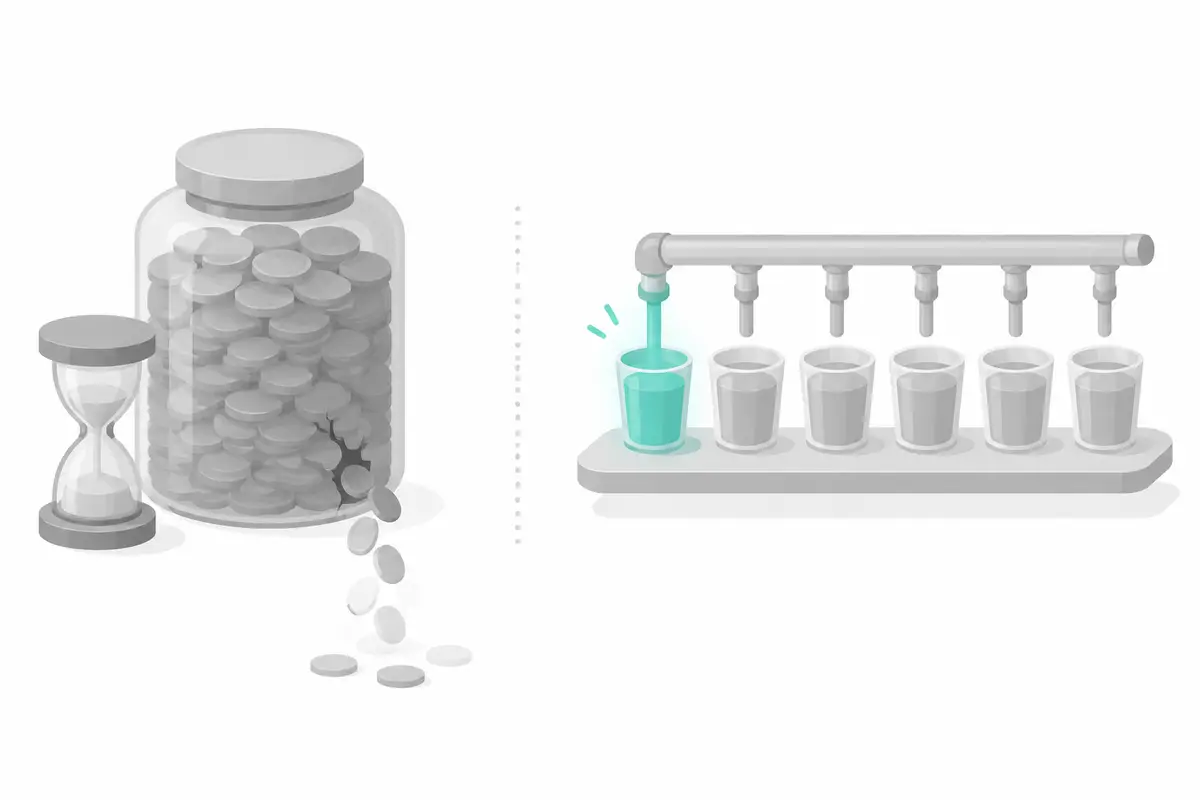
On the Serper side, we used the home page pricing cards and the terms of service. We also used the credit counter in the Playground script. On the Tavily side, they are the pricing page, the credits page, the search reference and the rate limits page. We read them between 00:14 and 00:15 Singapore time, and all times below are Singapore time. We did not open an account with either company or call their APIs. Every number on their side comes from public rules.
Serper vs Tavily at a glance: what you buy and how you pay
Serper sells Google results pages as JSON. A response has organic results, the knowledge panel, "People also ask" and related searches. Other types cover news, images, maps, places, videos, shopping, scholar, patents and autocomplete. There is no monthly plan, and the smallest prepaid pack is $50.
Tavily sells content for a model to read. It picks results, cuts passages from the source pages and gives each result a relevance score. It also has Extract for page text, Map for site URLs, Crawl for whole sites and Research for multi-step work. Its credits come each month, as a plan or as pay as you go. Both are called search APIs, but the outputs differ a lot, so we compare prices task by task.
| Item | Serper | Tavily |
|---|---|---|
| What you get | Google results page as JSON, each result with title, link and a snippet of about 150 characters | Selected results with up to 3 passages and a relevance score each, plus optional page text and a short answer |
| Billing unit | Search, news, places 1 credit; shopping 2; maps 3; page read 2, 6 or 10 | Basic search 1 credit, advanced 2; Extract 1 per 5 successful URLs (advanced 2) |
| How you pay | Prepaid packs of $50, $375, $1,250 and $3,750, tax not included | Free tier, pay as you go at $0.008, monthly plans from $30 to $500, enterprise |
| Per 1,000 basic searches | $1.00, $0.75, $0.50, $0.30 | $8 (pay as you go), $7.50, $6.67, $5.79, $5.00 |
| Free use | 2,500 queries for new users, no card, no reset stated | 1,000 credits a month, no card |
| Validity | 6 months per pack | Reset on the 1st of each month |
| When credit runs out | New queries are refused | Requests stop until reset or upgrade |
| When you pay | Only for successful responses | Failed Extract and Map calls are free |
| Speed and limits | 1 to 2 seconds, 50 to 300 queries per second | 100 to 1,500 requests per minute per organization |
| Refund | Within 7 days of first payment, under 20% used | No refund terms on the pricing page |
| MCP | Community servers only | Official remote server, OAuth or key, keyless trial |
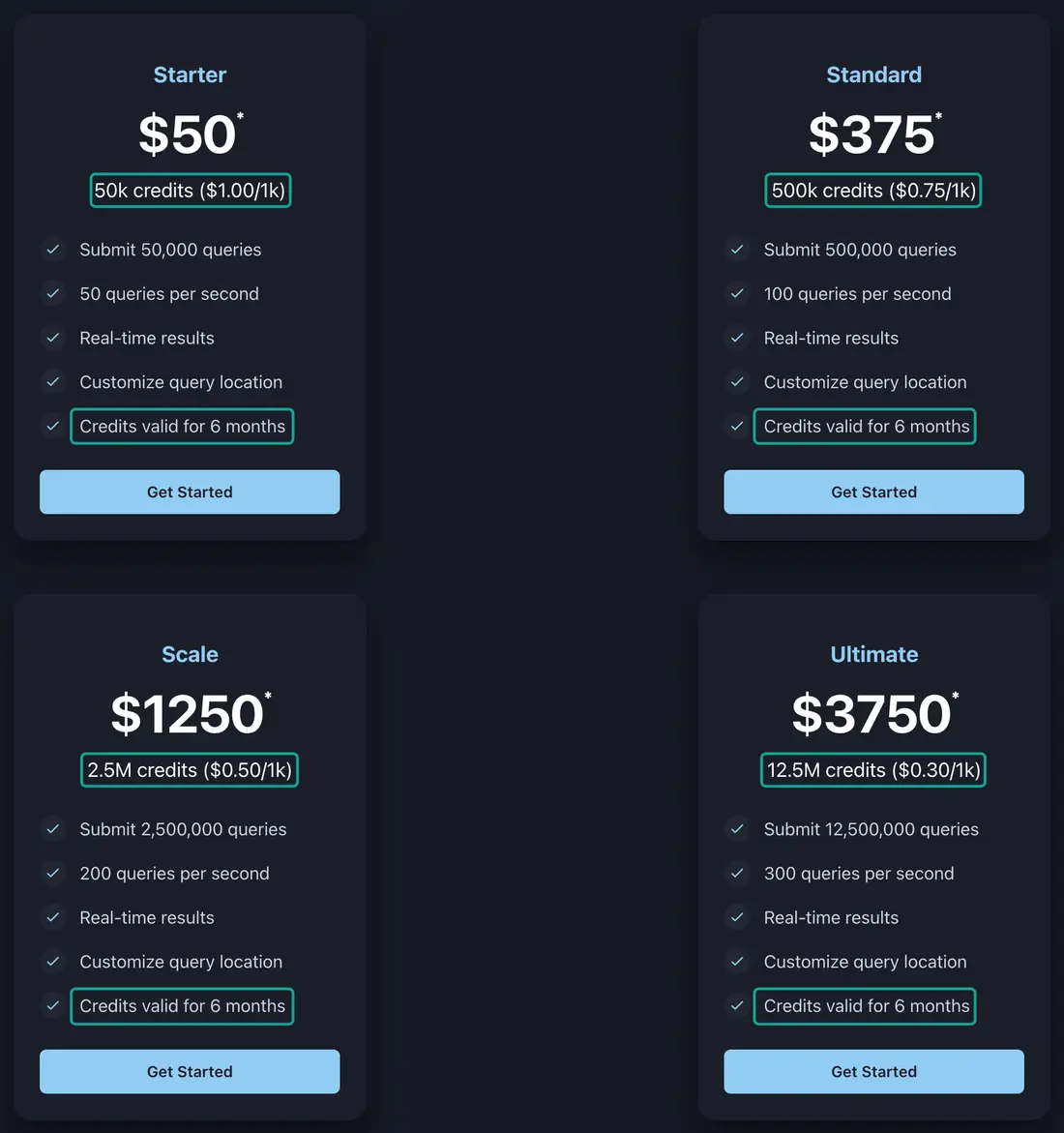
The Serper prices come from the four cards on its home page. Starter is $50 for 50,000 credits, and Standard is $375 for 500,000. Scale is $1,250 for 2.5 million, and Ultimate is $3,750 for 12.5 million. Each card ends with the line "Credits valid for 6 months". The FAQ says Serper does not cache anything, so the same query twice costs 2 credits. The terms of service allow a refund within 7 days of the first payment if you used less than 20% of the credits.
The Tavily column comes from the plan table on the credits page. The free tier gives 1,000 credits a month. Project is $30 for 4,000 credits, Bootstrap $100 for 15,000, Startup $220 for 38,000 and Growth $500 for 100,000. Pay as you go is $0.008 per credit, and the same rate applies after a plan runs out. The pricing page FAQ says credits reset on the 1st of each month, whatever day you pay. Startup and student programs need an application, so the calculations leave them out.
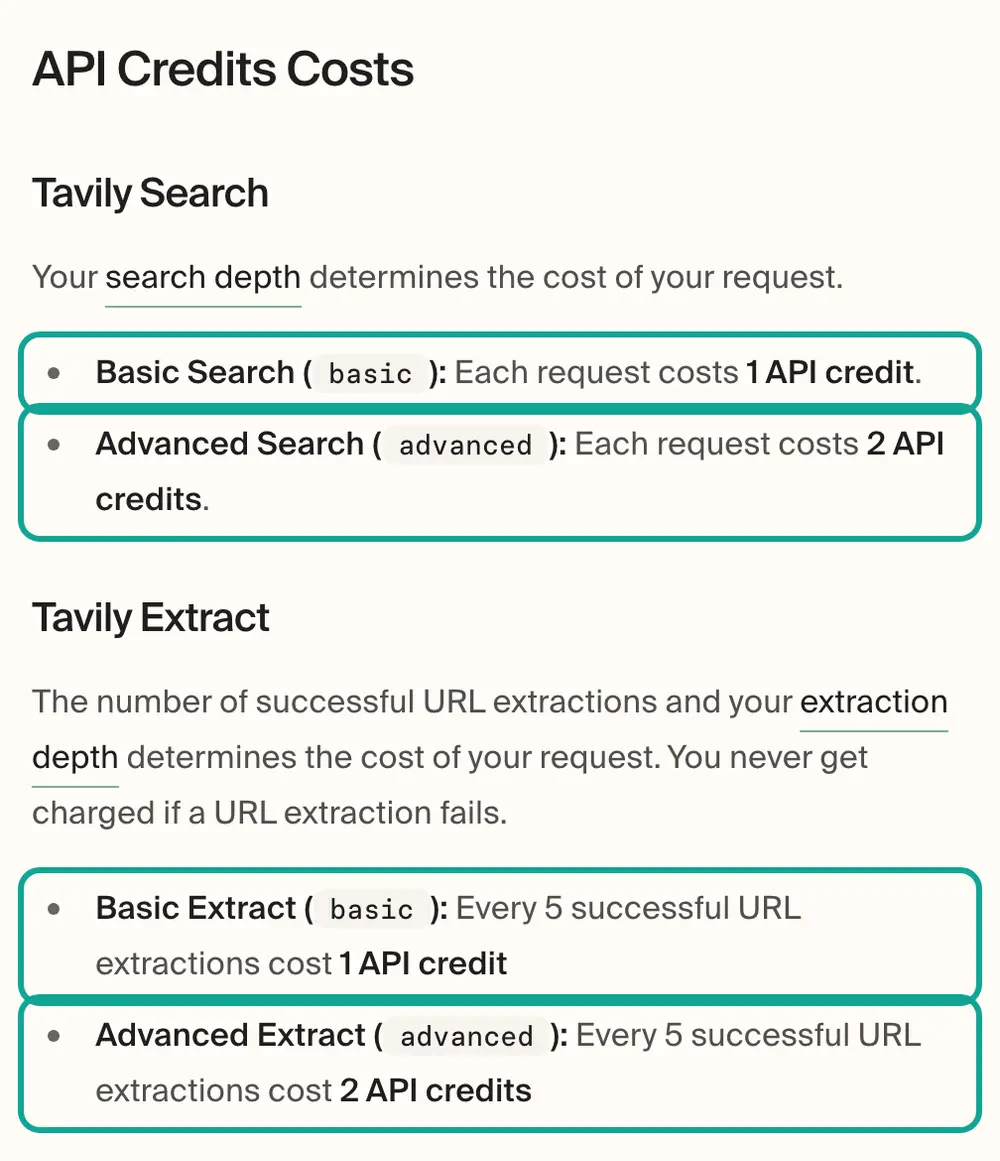
A normal search is 1 credit on both, so the two can look equal. But a credit costs 5 to 27 times more on Tavily. The most expensive Serper credit is $0.001, and the cheapest Tavily credit is $0.005. Two other things decide the real bill: how much you use each month, and whether each search must also read pages.
Price per 1,000 tasks: four common agent jobs
We split common agent searches into four jobs. They are one page of results, a search plus 5 page reads, a search with the text of 5 pages, and 100 results. Serper credit counts come from the function in the Playground script that shows "Credits: N". For page reads it says "Most webpages typically incur 2 credits", and harder pages cost 6 or 10.
Tavily counts come from the credits page and the search reference. The EveryInfra column is the charged amount from our live calls, times the number of calls. We tested only 2 result pages and no hard pages, so the "100 results" and "5 hard pages" rows use the unit price.
| Per 1,000 tasks | Serper credits / USD | Tavily credits / USD | EveryInfra calls / charged USD |
|---|---|---|---|
| One page of results (10) | 1 / $0.30–$1.00 | 1 / $5.00–$8.00 | 1 web / $0.694 |
| Search + read 5 pages (Extract) | 11 / $3.30–$11.00 | 2 / $10.00–$16.00 | 1 web + 5 read / $4.164 |
| Search with text of 5 pages (raw_content) | 11 / $3.30–$11.00 | 1 / $5.00–$8.00 | 1 deep with full=true / $0.694 |
| 100 results | 10 / $3.00–$10.00 | 5 / $25.00–$40.00 | 10 web pages / $6.94 (calculated) |
| 5 hard pages | up to 51 / $15.30–$51.00 | 3 / $15.00–$24.00 | 1 web + 5 read / $4.164 (calculated) |
The low end of each range is the Serper Ultimate pack or the Tavily Growth plan. The high end is Serper Starter or Tavily pay as you go.
In the Serper Playground script, the result count menu for web search has only one choice, 10. So the "100 results" row counts 10 pages at 1 credit each. In 2025, a Hacker News user wrote that Serper charges 2 credits for 20 to 100 results (the comment). That report is more than a year old and does not match the menu today, so test it with free credits first. Tavily returns at most 20 results per call, so 100 results take 5 calls.
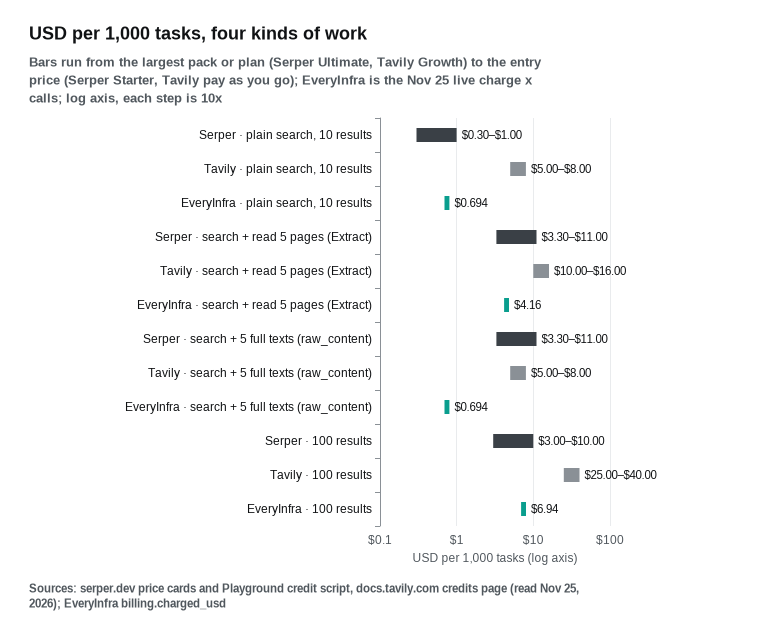
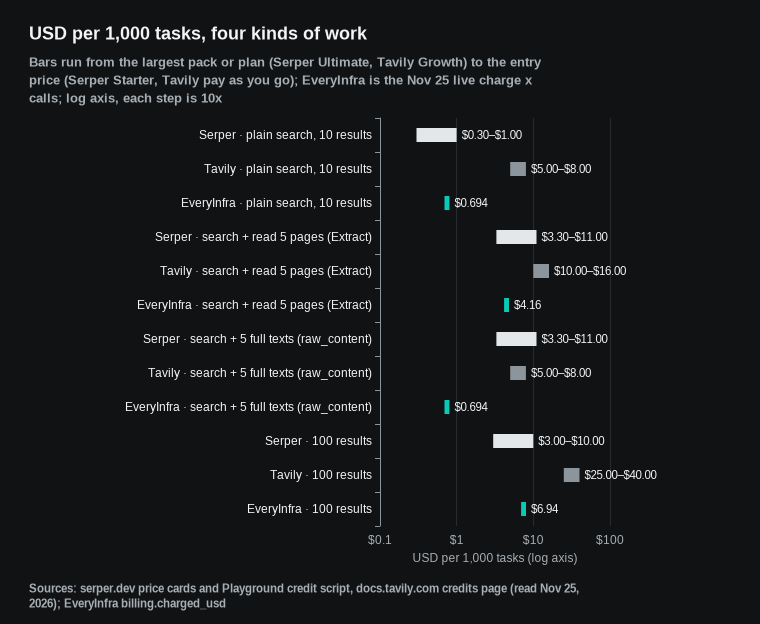
Compare the Extract job with the raw_content job. With Extract, Tavily uses 2 credits, 1 for the search and 1 for 5 URLs. That is fewer credits than Serper's 11, but each credit costs more, so the price is $10 to $16 per 1,000. With include_raw_content, the credits page lists no extra charge, so the task stays at 1 credit. Now Tavily's $5 to $8 sits inside the Serper range. We did not confirm this with an account, but the include_usage parameter returns the credits for each request.
For hard pages, Serper can charge up to 51 credits per task and Tavily 3. Serper says a page read can cost 6 or 10 credits by difficulty, and the response shows the real number. If all 5 pages cost 10, one task costs 51 credits. Tavily advanced Extract costs 2 credits per 5 successful URLs, with no charge for difficulty or failure.
EveryInfra read has a catalog price of $0.000694 with no difficulty tiers. Our 5 test pages were forum and blog pages, and we did not test pages with anti-bot protection. A page that cannot be read is free.
Monthly volume: which one is cheaper at your usage
A monthly bill also depends on how credit expires. For each Serper pack, we took the pack price divided by 6 or monthly use times the unit price, whichever is larger. Then we took the cheapest pack. For Tavily, we took the cheapest of the free tier plus pay as you go and each plan plus overage. For EveryInfra, we multiplied the charged price by the calls, as on our pricing page.
| Searches per month | Serper (cheapest pack) | Tavily (cheapest option) | EveryInfra |
|---|---|---|---|
| 1,000 | $8.33 (Starter) | $0 (free tier) | $0.69 |
| 2,000 | $8.33 (Starter) | $8.00 (free + pay as you go) | $1.39 |
| 5,000 | $8.33 (Starter) | $32.00 (free + pay as you go) | $3.47 |
| 10,000 | $10.00 (Starter) | $72.00 (free + pay as you go) | $6.94 |
| 50,000 | $50.00 (Starter) | $316.00 (Startup + pay as you go) | $34.70 |
| 100,000 | $75.00 (Standard) | $500.00 (Growth) | $69.40 |
| 300,000 | $208.33 (Scale) | $2,100.00 (Growth + pay as you go) | $208.20 |
| 1,000,000 | $500.00 (Scale) | $7,700.00 (Growth + pay as you go) | $694.00 |
The break-even point is 2,042 searches a month. Below it, the 1,000 free Tavily credits win. Above it, the Serper $50 pack spread over six months, $8.33 a month, beats $0.008 per credit. At 1,000 searches a month on Serper, you use 6,000 of 50,000 credits in six months and lose the rest. So you really pay $8.33 per 1,000, as in our article on the Serper free tier.
EveryInfra is cheaper than Serper below 300,200 searches a month, and the large Serper packs win above that. Our guide to the four Serper packs models this over 24 months.
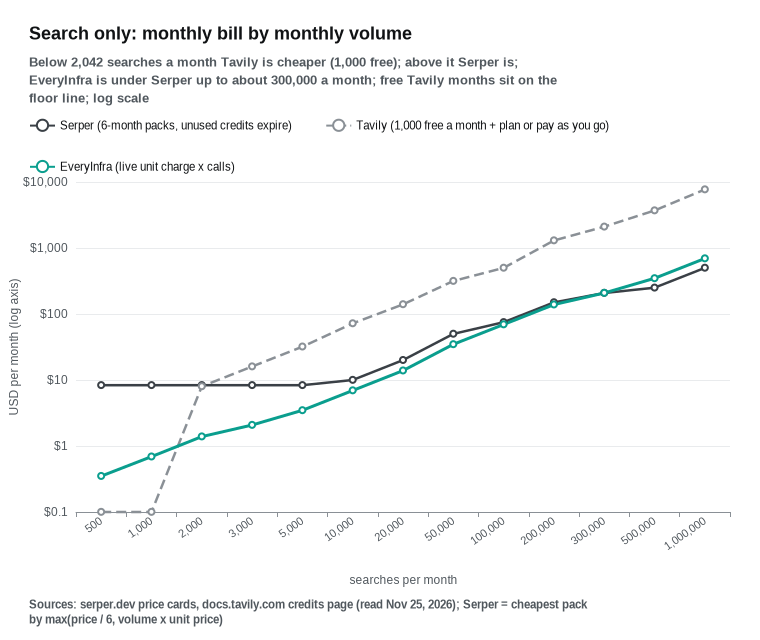
The model has four assumptions. It assumes you buy a new Serper pack only when the old one expires. It assumes the free Tavily credits do not add to a paid plan, so plan rows may be up to $8 too high. It leaves out the 2,500 free Serper queries for new users, because the page does not say that they reset. The Serper cards do not say whether the 6 months start at payment or at first use, so we assumed payment. Tavily shows monthly prices only, so put any negotiated price into the model yourself.
Four common usage patterns and their monthly bills
When you choose a service, you usually know the daily runs of your agent. Four common patterns, turned into monthly tasks, give these bills under the same model.
| Pattern | Tasks per month | Serper | Tavily | EveryInfra |
|---|---|---|---|---|
| Support assistant: 60 searches a day, no page reads | 1,800 | $8.33 (Starter) | $6.40 (free + pay as you go) | $1.25 (web) |
| Research agent: 400 questions a day, 5 page texts each | 12,000 | $99.00 (Standard) | $88.00 (raw_content) | $8.33 (deep) |
| Same research agent with search + Extract | 12,000 | $99.00 (Standard) | $172.00 (Bootstrap + overage) | $49.97 (web + 5 read) |
| Rank tracking: 500 keywords × 3 countries × daily | 45,000 | $45.00 (Starter) | $276.00 (Startup + overage) | $31.23 (web) |
| News monitoring: 200 brands × hourly | 144,000 | $108.00 (Standard) | $852.00 (Growth + overage) | $99.94 (news) |
The support assistant sits near the break-even point. Tavily uses the free credits and then charges 800 × $0.008, or $6.40, against $8.33 on Serper. At this volume, setup matters more than price, and Tavily has a ready MCP server and CLI. If use doubles to 120 searches a day, Serper becomes cheaper.
The two research agent rows show that the read method can double a bill. With include_raw_content, Tavily costs $88. With Extract, it costs $172, because Extract adds 12,000 credits and pushes the total into Bootstrap. Rank tracking and news monitoring only need results pages. There Serper costs one sixth of Tavily at 45,000 tasks and one eighth at 144,000.
When you need page text: from the docs, the break-even moves to 28,550
A RAG or research agent often searches once, reads a few pages and then answers. Serper results have short snippets, so page text needs its page read endpoint at 2 credits per normal page. Tavily returns page text in the same call with include_raw_content, and its credits page lists no extra charge for it. The Tavily numbers here use that rule, and we did not call Tavily to confirm it. Each task brings back the text of the top 5 pages.
| Tasks per month | Serper (1 search + 5 reads × 2) | Tavily (raw_content) | Tavily (search + Extract) | EveryInfra (`deep` with full text) |
|---|---|---|---|---|
| 1,000 | $11.00 | $0 | $8.00 | $0.69 |
| 10,000 | $82.50 | $72.00 | $140.00 | $6.94 |
| 50,000 | $275.00 | $316.00 | $500.00 | $34.70 |
| 100,000 | $550.00 | $500.00 | $1,300.00 | $69.40 |
| 1,000,000 | $3,300.00 | $7,700.00 | $15,700.00 | $694.00 |
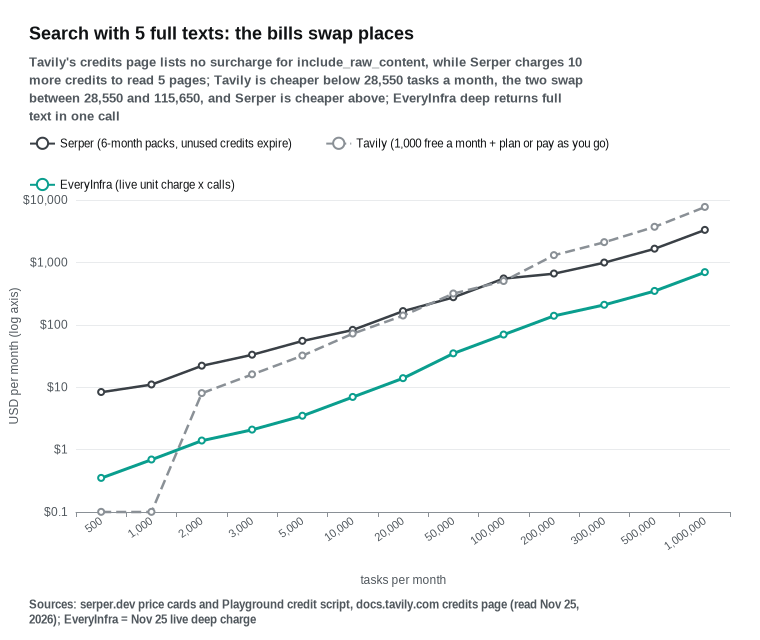
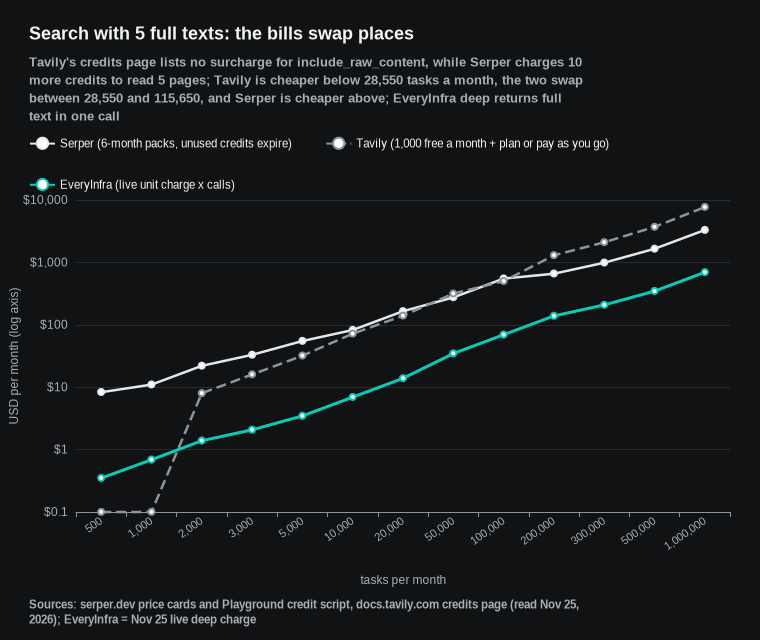
With include_raw_content, Tavily is cheaper up to 28,550 tasks a month. Between 28,550 and 115,650, the Tavily plan steps and the Serper pack steps cross several times. Above 115,650, the Serper Ultimate pack is always cheaper. With Extract, the break-even comes much earlier, at 1,601 tasks, because Extract adds a charge per URL.
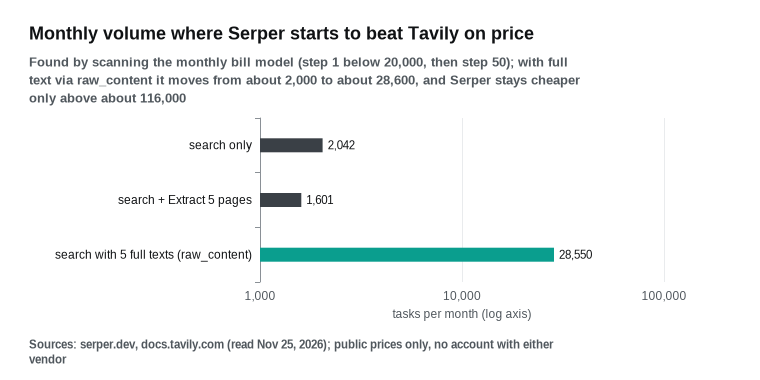
These break-even points depend on two facts that we did not test. The first is the free include_raw_content. The credits page says "Your search depth determines the cost of your request" and lists only basic and advanced. The search best practices page shows no charge for page text either. The second is the 2-credit Serper page read, which holds for news and docs sites but can rise on shops and forums.
The Extract parameters control how much text goes to the model. In the Extract reference, a request with query can use chunks_per_source, from 1 to 5 with a default of 3. Then each page returns only its most relevant chunks of about 800 characters. A page with fewer chunks than that limit returns in full.
Without query, Extract returns the whole page. format is markdown or text. timeout can be 1 to 60 seconds, and the default is 10 seconds for basic and 30 seconds for advanced. Advanced extraction gets more tables and embedded content, with a higher success rate, at twice the basic price. URLs that fail go into failed_results, and they cost no credits.
EveryInfra deep with full=true returns 5 results with full text in one call. In our two calls, the 10 texts were 1,996 to 20,000 characters long, and 20,000 is the limit. Each call cost $0.000694.
News search: how each service does it
In an r/LangChain thread, a developer asks whether to choose Serper or Tavily for current news in CrewAI agents. Serper news comes from the Google News tab at 1 credit. Its home page sample has 10 items with title, link, snippet, source, image and a relative date such as "2 weeks ago". Tavily switches to news with topic: "news", which turns on an estimated publish date. Its docs say that date can be later than the original, because it uses the publish or update time.
To filter by date, Tavily has time_range, start_date, end_date and filter_by_published_date. Serper uses the Google tbs parameter, which the LangChain community wrapper exposes as an optional field.
We ran EveryInfra news for "AI search API", "Tavily search API" and "Serper API". Each call returned 10 items with a published field and cost $0.000694. For the CrewAI news use in that thread, the Tavily free tier is enough for a few hundred news searches a day. Above a few thousand a day, Serper and EveryInfra cost about one tenth of Tavily per search, so use the monthly tables. See our Google News API page and news search capability.
Search by country and language
All four Serper cards say "Customize query location". The CrewAI SerperDevTool docs list country, location and locale, and the LangChain wrapper defaults to gl="us" and hl="en". These parameters choose the country and language in which Google opens, so ranking and sites change to local ones.
Tavily country is a boost, not a switch. The search reference says "Boost search results from a specific country", only for the general topic. language is also a boost, and a strict filter needs filter_by_language: true. So Serper fits "what do users in Germany see on Google", and Tavily fits "give me more sources in Spanish".
EveryInfra web has a country-level location parameter. At 00:16 we searched "best running shoes for flat feet" with no region, location=de and location=mx, and each call returned 9 results. The German list shared 5 URLs with the no-region list, and the Mexican list shared 4. We also sent Serper-style gl and hl, which returned 422 with the 7 supported parameters and "Nothing was charged". Tavily-style query returned 422 with did_you_mean: ["q"].
What the model receives: one line, or several passages
The Serper home page sample has 10 organic results with a median snippet of 156.5 characters. The full response is 4,934 characters, and title, link and snippet alone are 2,545. A snippet lets the model pick results, but not answer detail questions. The Haystack Serper example sends the links to LinkContentFetcher for page text.
Each Tavily result has content with up to 3 passages of about 500 characters (basic) or 800 (advanced). So 10 basic results are up to about 15,000 characters. In the Haystack Tavily example, search output goes straight into the prompt. The keyless trial page says built-in web tools return raw HTML or thin snippets that cost tokens to parse.
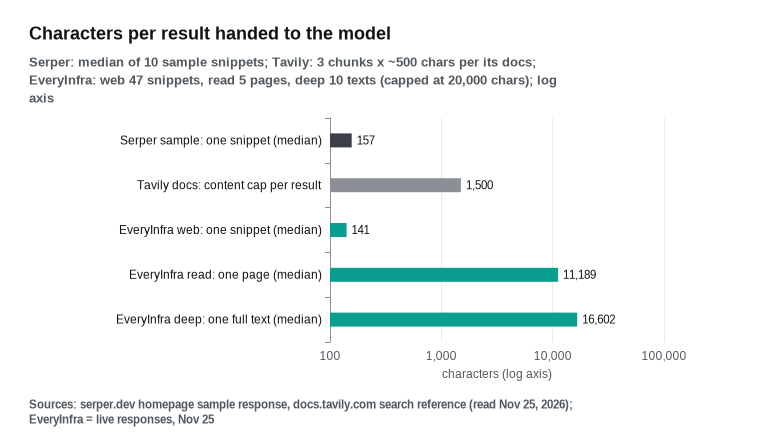
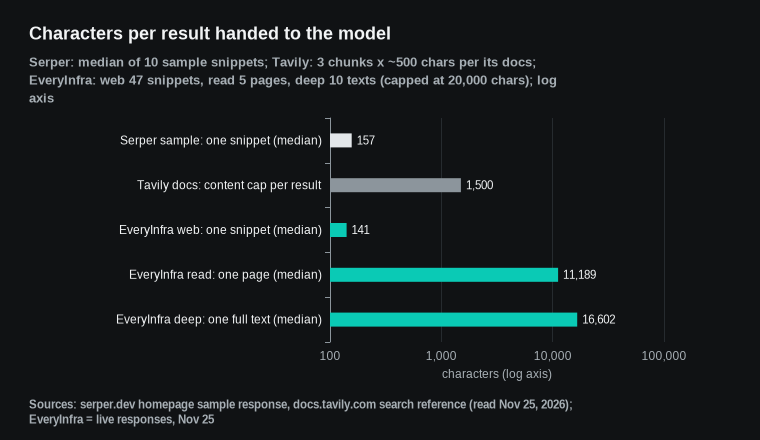
Each EveryInfra web result has a title, a link and a one-line snippet. Over 47 results, the median snippet was 141 characters. Our 5 read pages were 5,711 to 38,266 characters, with a median of 11,189. A Reddit thread had 6,567 characters, and a DEV Community article had 11,189. Three blog posts from search API vendors had 5,711, 16,922 and 38,266 characters. Long text costs model tokens, so a snippet is the cheapest way to pick results.
Failures, empty results and empty balances
Serper uses credits for each successful response and refuses new queries at zero balance. It does not say whether an empty result counts as successful. Tavily says failed Extract and Map calls are never charged. With auto_parameters, Tavily search depth can switch to advanced at 2 credits, so the docs suggest you set search_depth: "basic". The MCP docs let you set defaults in a DEFAULT_PARAMETERS header, and an advanced default doubles every MCP call.
We made 4 EveryInfra requests that should be free. Two web calls with gl/hl and with query returned 422 at 00:18. A read of a missing Tavily docs URL at 00:26 returned 404 target_not_found with request_failed_refunded. A nonsense web query at 00:33 returned 200 with empty results and empty_result_refunded.
All 4 had charged_usd of 0. The 404 error body had retryable set to false. Its next_steps said "Change the request as the message says, then resend. Nothing was charged." Both 422 bodies had the allowed parameter list and a catalog_url, so a client model can fix the name and send again.
Speed and concurrency
| Limit | Serper | Tavily | EveryInfra (this test) |
|---|---|---|---|
| Typical response | 1 to 2 s, 2 to 4 s with retry | not stated | web/news 1.86 to 2.71 s, read 0.62 to 1.89 s |
| Entry level | 50 per second (Starter) | 100 per minute (free) | see the API docs |
| Paid level | 100 to 300 per second by pack | 1,000 per minute, 1,500 on Growth | see the API docs |
| Special endpoints | none listed | Crawl and Map 100, Research 20 per minute | deep with full text 11.59 and 41.54 s |
Serper says Ultimate allows about 15,000 to 18,000 searches a minute. Its smallest pack allows 3,000 a minute, three times the Tavily paid limit. Since November 2026, Tavily development and production keys share one organization limit (changelog).
For rank tracking with tens of thousands of keywords, Serper has more room. For an agent with a few searches at a time, both are enough. The EveryInfra deep time goes mostly to fetching full text from the target sites. To keep latency low, use web for snippets first, then read one or two pages. Rate limits for EveryInfra keys are in the API docs.
Adding them to AI tools: MCP, CLI and frameworks
The Tavily MCP docs have one-click setup for Claude, Claude Code, ChatGPT, Codex, Cursor and VS Code. The remote URL is https://mcp.tavily.com/mcp, with OAuth or a key in the URL. With the header X-Tavily-Access-Mode: keyless, the keyless trial runs search and Extract without an account.
On November 13, 2026, Tavily released @tavily/cli 1.0.1, which sets up MCP for editors with npx @tavily/cli init. The October changelog says the CLI prints plain text in pipes and agent shells. tvly search runs up to 5 queries in parallel, and --max-chars sets the printed length per result, with a default of 600. The tavily-mcp repository has 2,498 stars.
We found no MCP mention on the Serper home page, Playground or scripts. Its footer lists Haystack, Jan AI, CrewAI and LangChain. marcopesani/mcp-server-serper has 171 stars, and its last push was on March 13, 2025. garylab/serper-mcp-server has 39 stars, with version 0.0.10 on PyPI from November 10, 2025. For n8n there is a community node, n8n-nodes-serper.
The EveryInfra remote MCP URL is https://api.everyinfra.com/mcp, and one key covers search, page reads and platform data. The MCP server page has the steps. These are configuration examples for Claude Code. We did not run the Tavily and Serper lines on our machine:
# Tavily: remote MCP with the key in the URL; remove the parameter to sign in with OAuth
claude mcp add --transport http tavily "https://mcp.tavily.com/mcp/?tavilyApiKey=$TAVILY_API_KEY"

# Serper: no MCP server of its own, so this uses the community package serper-mcp-server
claude mcp add serper -e SERPER_API_KEY=$SERPER_API_KEY -- uvx serper-mcp-server

# EveryInfra: remote MCP with the key in a header
claude mcp add --transport http everyinfra https://api.everyinfra.com/mcp \
  --header "Authorization: Bearer $EVERYINFRA_API_KEY"
Without MCP, EveryInfra search has one endpoint, with tool for the capability and params for the parameters. We sent these two requests in our first round. The second one is the "search with full text" job:
curl -s https://api.everyinfra.com/api/v1/search \
  -H "Authorization: Bearer $EVERYINFRA_API_KEY" -H "Content-Type: application/json" \
  -d '{"tool":"web","params":{"q":"serper vs tavily","num":10}}'

curl -s https://api.everyinfra.com/api/v1/search \
  -H "Authorization: Bearer $EVERYINFRA_API_KEY" -H "Content-Type: application/json" \
  -d '{"tool":"deep","params":{"q":"how to reduce LLM hallucination with web search grounding","num":5,"full":true}}'
The CrewAI TavilySearchTool defaults to 5 results and basic depth, and the SerperDevTool defaults to 10 results. Tavily maintains langchain-tavily (0.2.18 on PyPI, April 16, 2026), with tools for Search, Extract, Crawl and Map. See the LangChain Tavily page and the Tavily LangChain docs.
Switching between them: parameters and fields
The Serper column comes from its home page samples and the LangChain wrapper. The Tavily column comes from the search reference. The EveryInfra column comes from our responses and the search tools catalog. Some names match by chance, but meaning and length differ.
| Purpose | Serper | Tavily | EveryInfra `web` / `deep` |
|---|---|---|---|
| Query | q | query | q |
| Result count | num (10 in the Playground) | max_results, 0 to 20 | num, up to 10 |
| Paging | page | none | page |
| Region | gl, location | country, a boost | location, country level |
| Language | hl | language, filter_by_language | write the query in that language |
| Time | tbs | time_range, start_date, end_date | after, before |
| Result array | organic | results | results |
| Link | link | url | url |
| Text | snippet, one line | content, up to 3 passages | snippet, full content in deep |
| Order | position | score | array order |
| Date | date on news, relative | published_date, estimated | published in deep and news |
| Extra blocks | knowledgeGraph, peopleAlsoAsk, relatedSearches | answer, images, favicon, usage | billing, quota |
From Serper to Tavily, link becomes url, snippet becomes content, and position becomes a score from 0 to 1. Code that takes the top three by position must use array order or score. From Tavily to Serper, three passages shrink to one line, so add a page read step. On EveryInfra, deep content is the full page, up to 20,000 characters, so adjust your prompt size.
The same searches, live on EveryInfra
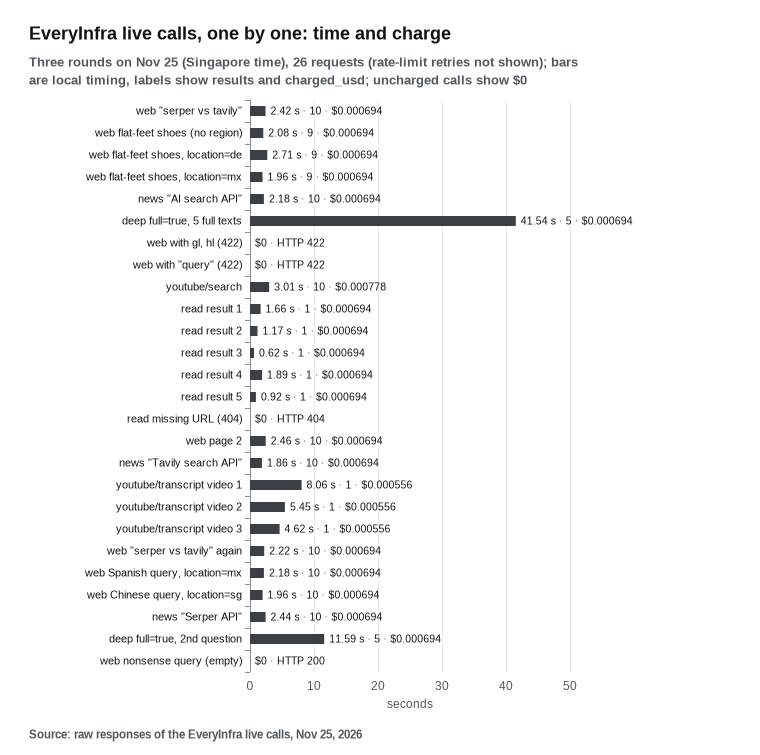
The three rounds ran on November 25, 2026, at 00:16 to 00:19, 00:25 to 00:28 and 00:32 to 00:33 Singapore time. Of the 26 requests, 22 were charged, for $0.014938 in total, and 4 cost $0.
| Time (Singapore) | Capability | Request | Result | `charged_usd` |
|---|---|---|---|---|
| 00:16:15 | web | "serper vs tavily" | 200, 10 results, 2.42 s | $0.000694 |
| 00:16:24–00:16:43 | web | running shoes: no region / de / mx | 9 each, 5 and 4 shared | $0.000694 each |
| 00:17:54 | news | "AI search API" | 10 results | $0.000694 |
| 00:18:03 | deep | full=true, 5 results | 5 full texts, 41.54 s | $0.000694 |
| 00:18:52, 00:18:59 | web | gl/hl; query | 422 | $0 |
| 00:19:15 | youtube/search | "serper vs tavily" | 10 results | $0.000778 |
| 00:25:04–00:26:39 | read | top 5 URLs | 5 page texts, 0.62–1.89 s | $0.000694 each |
| 00:26:47 | read | missing docs URL | 404, target_not_found | $0 |
| 00:27:58 | web | page 2 | 10 results, 2 shared with page 1 | $0.000694 |
| 00:28:07 | news | "Tavily search API" | 10 results | $0.000694 |
| 00:28:16–00:28:44 | youtube/transcript | 3 videos | 3 transcripts | $0.000556 each |
| 00:32:11 | web | "serper vs tavily" again | same 10 in the same order | $0.000694 |
| 00:32:20, 00:32:30 | web | Spanish query mx, Chinese query sg | 10 each | $0.000694 each |
| 00:32:39 | news | "Serper API" | 10 results | $0.000694 |
| 00:32:48 | deep | full=true, second question | 5 full texts, 11.59 s | $0.000694 |
| 00:33:07 | web | nonsense query | 200, 0 results | $0 |
The repeated query 16 minutes later gave the same 10 results in the same order, so short-term results are stable. Page 2 shared only 2 results with page 1, so paging returns new results. We tested 2 pages, not all 10 in the "100 results" row. The deep times differ because full text depends on the target sites. Our web search API page and web search capability describe search.
We used youtube/search and the 3 youtube/transcript calls to check videos on the same topic. None of the top 10 results for "serper vs tavily" compares only these two services. The 3 videos with transcripts were published on November 20, 2026, November 8, 2026 and March 9, 2026. They mention the 1,000 free Tavily credits each month and the 6-month Serper packs. One video uses Claude as a judge: it picks Serper for deep research and Tavily as the long-term free option. None of the 3 gives a price per 1,000 tasks or explains how each service charges for page text.
Beyond the results page: images, maps, shopping, and Tavily Map, Crawl and Research
The Serper home page shows sample responses for ten types. The Playground script sets a credit count for each type. Search, images, news, places, videos, scholar, patents and autocomplete cost 1 credit each. Shopping costs 2 credits, maps cost 3 and Lens image search costs 3. An image request for more than 10 images costs 2 credits.
At the four pack prices, a 1-credit type costs $0.30 to $1.00 per 1,000. Shopping costs $0.60 to $2.00, and maps cost $0.90 to $3.00.
Tavily has no types that follow the Google tabs. The nearest feature is include_images on a search. It adds a top-level list of images for the query and an image list inside each result. With include_image_descriptions, each image also gets a short description.
| Type | Serper credits | What the Serper sample returns | Serper per 1,000 | Tavily match |
|---|---|---|---|---|
| Images | 1 (2 above 10 images) | 10 images with sizes, thumbnails and source domain | $0.30–$1.00 | include_images on search |
| Maps | 3 | 20 places with coordinates, rating, rating count, phone, website and placeId | $0.90–$3.00 | none |
| Places | 1 | 10 places with address, category, rating and phone | $0.30–$1.00 | none |
| Videos | 1 | 10 videos with channel, duration and date | $0.30–$1.00 | no separate type |
| Shopping | 2 | 18 products with price, delivery, offer count, rating and productId | $0.60–$2.00 | none |
| Scholar | 1 | 10 papers with source, year and citation count | $0.30–$1.00 | no separate type |
| Patents | 1 | 10 patents with assignee, inventor, priority and grant dates and a PDF link | $0.30–$1.00 | none |
| Autocomplete | 1 | 10 suggestions | $0.30–$1.00 | none |
The Tavily credits page also prices three other endpoints. Map lists the URLs of a site. It costs 1 credit per 10 pages it returns, or 2 credits with natural-language instructions, and a failed Map call is free. Crawl costs the Map charge plus the Extract charge. The docs example is 10 pages for 3 credits with basic extraction, or 5 credits with advanced extraction.
Research has a dynamic price. One model=mini request costs 4 to 110 credits, and one model=pro request costs 15 to 250 credits. At the Growth price of $0.005 per credit, one pro request costs $0.075 to $1.25. At the pay-as-you-go price, it costs $0.12 to $2.00. Plan your budget for the maximum.
Serper has none of these three endpoints. The EveryInfra search tools catalog also lists map, crawl, places, shopping, scholar, media and suggest. We did not call them in this test, so use the catalog for their parameters and prices.
When Serper fits better
- Steady volumes of a few thousand searches a month or more, for results pages only: $75 against $500 at 100,000 a month.
- Google ranking in a given country and language, such as local rank tracking, because
glandhlswitch Google's region. - Results page blocks such as the knowledge panel, "People also ask", maps, shopping, scholar and patents, which Tavily does not return.
- Batch jobs that need 50 to 300 queries per second.
- Uneven use without a monthly fee, with packs that last six months and a 7-day refund rule.
When Tavily fits better
- Prototypes and personal agents with one or two thousand searches a month, inside 1,000 free credits that reset each month. The Serper page does not say that its 2,500 free queries reset.
- RAG and research agents that need page text, where
include_raw_contentkeeps Tavily cheaper up to 28,550 tasks a month, if the docs-based rule holds. - Agents that want passages and relevance scores ready for a model, plus an optional short answer.
- Teams that want an official remote MCP server, a CLI and a keyless trial.
- Jobs beyond search, such as Crawl, Map and Research, under the same key.
When to use EveryInfra, and when not to
EveryInfra web, news, read and deep each cost $0.000694, failures and empty results are free, and the minimum top-up is $10. The Tavily free tier is cheaper below 1,095 searches a month, and the large Serper packs above 300,200. With page text, deep costs $694 for 1 million tasks, against $3,300 on Serper and $7,700 on Tavily. The same key covers data such as YouTube search and transcripts. The YouTube API page gives an overview, and the data market lists all capabilities.
Our location works only at country level, so Serper fits city-level Google ranking. Our web has no knowledge panel or "People also ask" blocks, and it returns 10 results per page. For a few hundred searches a month with no top-up, the Tavily free tier is simpler.
We published related articles from October 26, 2026 to November 22, 2026. Four cover one service each: Serper alternatives, Serper keys and docs, Tavily alternatives and Tavily credits per call. Three add a third service. They are Serper and a Google results API, Tavily and a crawling API and a Google results API and Tavily.
Check the numbers yourself with the free tiers
Two numbers come from rules, not tests: the Tavily include_raw_content charge and the Serper page read charge. A test of 50 questions, each with one search and 5 page reads, costs 550 Serper credits or 50 Tavily credits. The free tiers cover that.
On Tavily, add "include_usage": true, and the response returns the credits for that request. Compare a plain search, one with include_raw_content and one with advanced depth. The usage endpoint gives account totals, but it allows only 10 requests per 10 minutes.
On Serper, read the 20 URLs you use most and record the credits in each response. If your average is 4 or more, the Serper page text costs double, and the break-even moves above 28,550. On EveryInfra, each response has billing.charged_usd, and each charge in our test table comes from that field. After one round on all three, record your 50 questions in one table. Add the cost on each service and your score for each answer. That gives a bill and a quality check for your own use.
What changed in October and November 2026
| Date | Change | What to do |
|---|---|---|
| November 18, 2026 | tavily-mcp stops logging whole error objects that can hold the key | Update a local MCP server |
| November 13, 2026 | @tavily/cli 1.0.1 replaces the Python CLI | Use npx @tavily/cli init |
| November 2026 | Tavily rate limits move to the organization (changelog) | Add up all keys in load tests |
| October 2026 | Tavily adds max_age_hours, which can return 434 on the free tier under load | Retry or use a paid plan |
| November 19, 2026 | Serper pack prices and 6-month validity match our November 5, 2026 reading | No change needed |
Earlier, on February 10, 2026, Nebius announced an agreement to acquire Tavily, and Tavily keeps its brand (Tavily blog). As of November 25, 2026, prices and APIs have not changed because of it.
How we tested, and which numbers to read with care
Every Serper and Tavily number comes from public pages, not API calls. The real Serper charge is what its response shows, and include_usage confirms the Tavily charge. The monthly model assumes even use, and its error is at most one sixth of a pack price or $8 a month.
Tavily pay as you go has no stated monthly cap, so add a daily call limit in your own code before a large run.
The EveryInfra numbers come from 26 raw responses, a small sample at one time of night. We did not compare relevance or accuracy, because that needs a question set with known answers.
FAQ
Serper vs Tavily: which one is cheaper?
For search only, Serper is cheaper above 2,042 searches a month, at $0.30 to $1.00 per 1,000 against $5 to $8. Below that, the 1,000 free Tavily credits win. With 5 page texts per search and include_raw_content, the Tavily docs make it cheaper up to 28,550 tasks a month.
Tavily vs Serper API: which one for news in a LangChain or CrewAI agent?
Both have ready tools, and news costs 1 credit on both. Tavily adds an estimated publish date, and Serper is more than five times cheaper per search. Use the Tavily free tier for a few hundred a day, and the monthly tables above that. The question comes from the r/LangChain thread, where a developer needs current news for CrewAI agents.
How many credits does Serper charge for 100 results?
The Playground offers only 10 results for web search today, so we counted 10 pages at 10 credits. A 2025 Hacker News comment says 2 credits, which does not match the current menu. Test it once with free credits.
Google Serper vs Tavily: which one can search by country?
Serper gl, hl and location switch Google's country and language. Tavily country only boosts results for the general topic, and language needs filter_by_language for a strict filter.
Do Serper and Tavily have official MCP servers?
Tavily has one at mcp.tavily.com/mcp, with OAuth, a key or a keyless trial. Serper has none, and the last commits on both community servers were in 2025.
Can I use Serper and Tavily together?
Yes. You can use Serper to pick URLs and Tavily Extract for page text, at about $5.30 to $9.00 per 1,000. That beats Serper Starter with page reads ($11) but not Serper Ultimate ($3.30). The question comes from the top web result for "serper vs tavily", an r/Rag thread where one reply says "Tavily and Serper for RAG retrieval".
What is the minimum to pay after the free tier?
The smallest Serper pack is $50 for 50,000 queries over 6 months. Tavily pay as you go is $0.008 per credit, or $30 for Project. EveryInfra has a $10 minimum top-up.
How to get started
- Sign up on EveryInfra and create an API key, as in the quickstart. Prices are on the pricing page.
- Read the free search tools catalog for
web,news,readanddeep. - Send one
webrequest with the curl example and look atbilling.charged_usd. - Add
https://api.everyinfra.com/mcpto Claude Code or Cursor, as on the MCP server page. - From Serper, change
glandhltolocation. From Tavily, changequerytoqand usedeepfor page text.
References
- Serper home page and pricing cards, read November 25, 2026
- Serper Terms of Service, updated May 29, 2024
- Serper Playground, page script read November 25, 2026
- Tavily Pricing, read November 25, 2026
- Tavily Credits & Pricing, read November 25, 2026
- Tavily Rate Limits, read November 25, 2026
- Tavily Search API reference, read November 25, 2026
- Tavily Extract API reference
- Tavily Crawl API reference
- Tavily Map API reference
- Tavily Research API reference
- Tavily Usage API reference
- Tavily MCP, read November 25, 2026
- Try Tavily Without an API Key
- Tavily CLI
- Tavily Changelog, November 2026 entries
- Tavily Best Practices for Search
- Tavily Best Practices for Extract
- Tavily LangChain integration
- Tavily Agent Skills
- tavily-ai/tavily-mcp, latest merge November 18, 2026
- tavily-ai/langchain-tavily
- marcopesani/mcp-server-serper, latest push March 13, 2025
- garylab/serper-mcp-server, latest push November 10, 2025
- SanderSpiegelaar/n8n-nodes-serper
- @tavily/cli on npm, 1.0.1, November 13, 2026
- @tavily/core on npm, 1.1.0, November 12, 2026
- tavily-mcp on npm, 0.2.22, August 5, 2026
- langchain-tavily on PyPI, 0.2.18, April 16, 2026
- serper-mcp-server on PyPI, 0.0.10, November 10, 2025
- google_serper.py in the LangChain community package
- LangChain Tavily integrations
- CrewAI SerperDevTool
- CrewAI TavilySearchTool
- Haystack SerperDevWebSearch
- Haystack TavilyWebSearch
- Nebius announces agreement to acquire Tavily, February 10, 2026
- Tavily is Joining Nebius, February 10, 2026
- Connect Claude Code to tools via MCP, Anthropic
- MCP Transports, Model Context Protocol
- EveryInfra search tools catalog, read November 25, 2026
- EveryInfra data capability catalog, read November 25, 2026
- How are you guys doing internet search?, r/LangChain
- Hacker News comment on Serper result count and credits, 2025
- r/Rag thread on search APIs for RAG retrieval, r/Rag
Reference BL-230