Serper API Free Tier: How Long 2,500 Queries Last, and What Comes Next
Serper gives 2,500 free queries with no card and no stated end date. After that the floor is $50. At 1,000 searches a month, year one costs $100 vs $10.
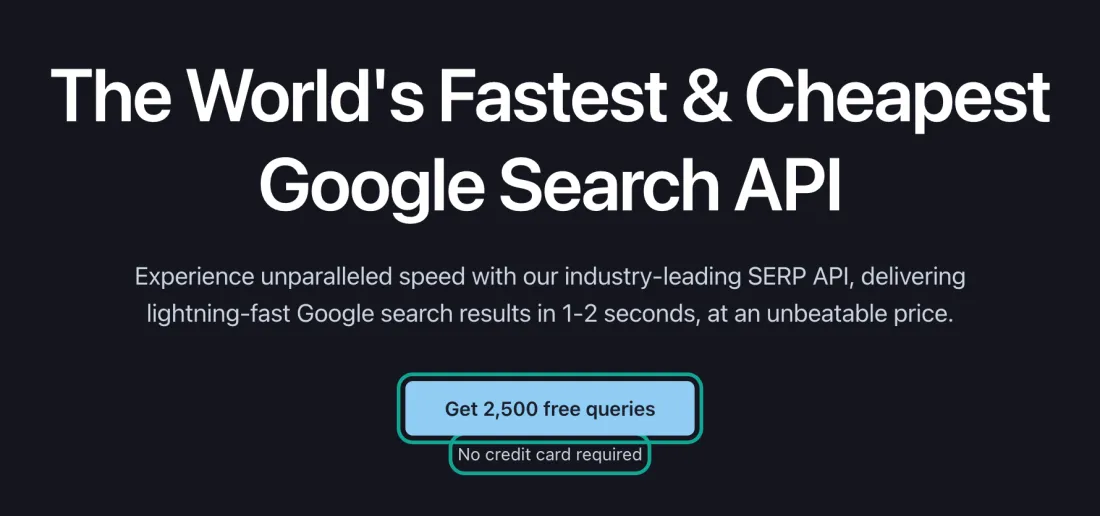
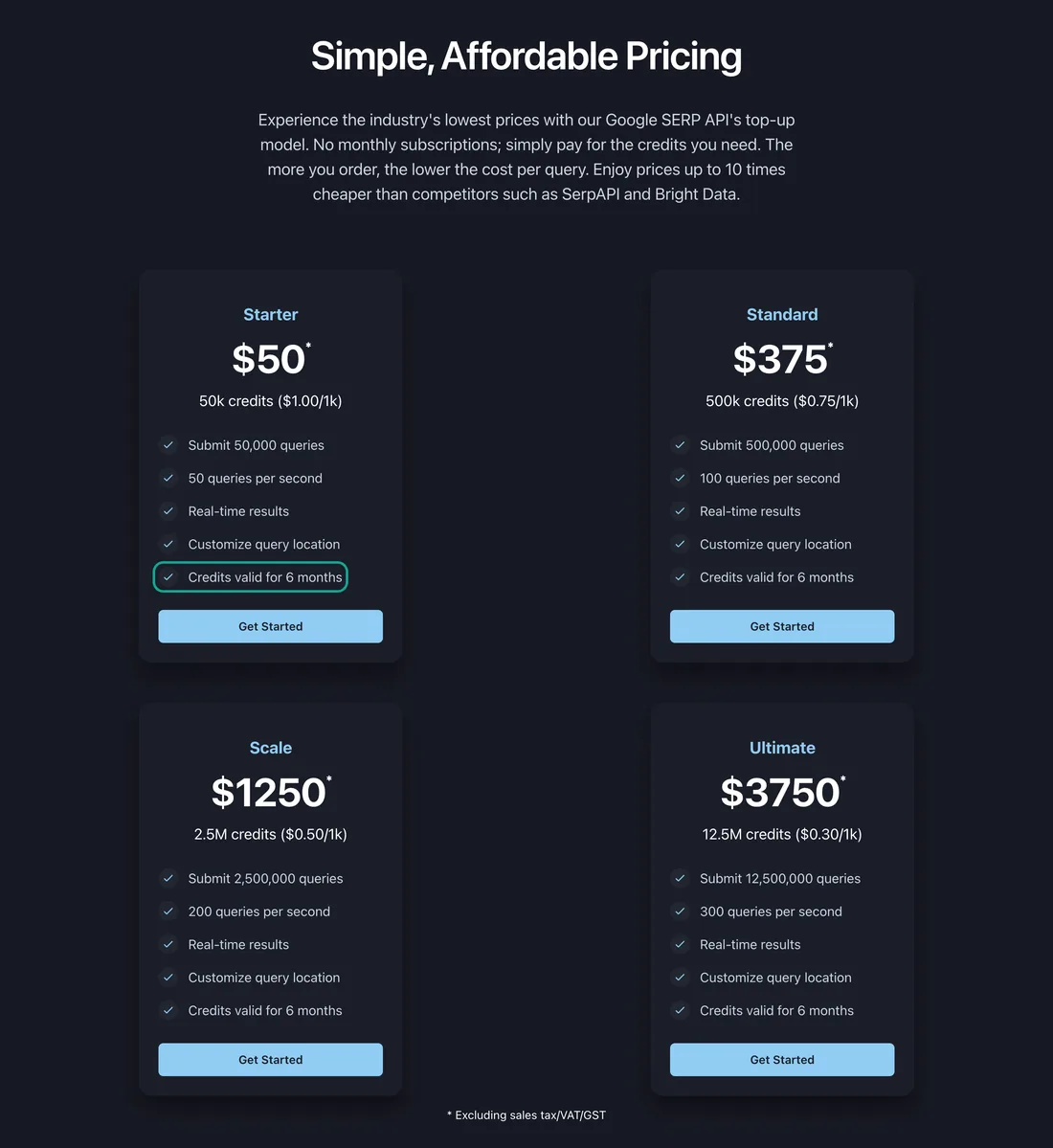
Serper's home page says "Get 2,500 free queries" and "No credit card required". We saved the page on November 1, 2026, at 00:46 Singapore time (SGT). The page does not say "per month", and it gives no end date for those 2,500 queries. After the free queries, the smallest paid pack is $50 for 50,000 credits, which expire after 6 months. That is $1.00 per 1,000 searches.
The EveryInfra trial is smaller. You star a GitHub repository and claim $1, and the $1 expires 24 hours later. At our search price of $0.000694, $1 buys 1,440 searches. After the trial, the minimum top-up is $10, the balance never expires, and we measured $0.694 per 1,000 searches.
At 1,000 searches a month, year one costs $100 in cash with Serper and $10 with us.
Serper's second pack still holds 46,000 searches at year end. But at this volume you buy a new pack every 6 months. So from year two, Serper still costs about $100 a year, and we cost about $8.33.
At 20,000 searches a month, the year-one gap shrinks to $250 vs $170. If you only need a few hundred searches a month, the monthly free credits from some search APIs cost you nothing. In that case they beat both Serper and us, and we show the numbers below.
This article follows our October 26, 2026 post, Serper API alternative: price per 1,000 and expiry, tested. That post compared paid prices and showed how the 6-month expiry raises the real price. This post answers the three questions behind searches like "serper api alternative free" and "serper api free tier". How large is the free allowance, and how long does it last?
What is the smallest first payment after it? Which free options can you use for a long time? We do not compare response fields. For EveryInfra fields, use our search tool catalog as the reference.
On the Serper side, we used public material only: the home page, the terms page, and public third-party articles. We did not sign up for Serper. We did not buy credits, and we did not use a Serper key. So every Serper number in this post is "what the page says", not "what we measured".
The serper api free tier next to six other free allowances
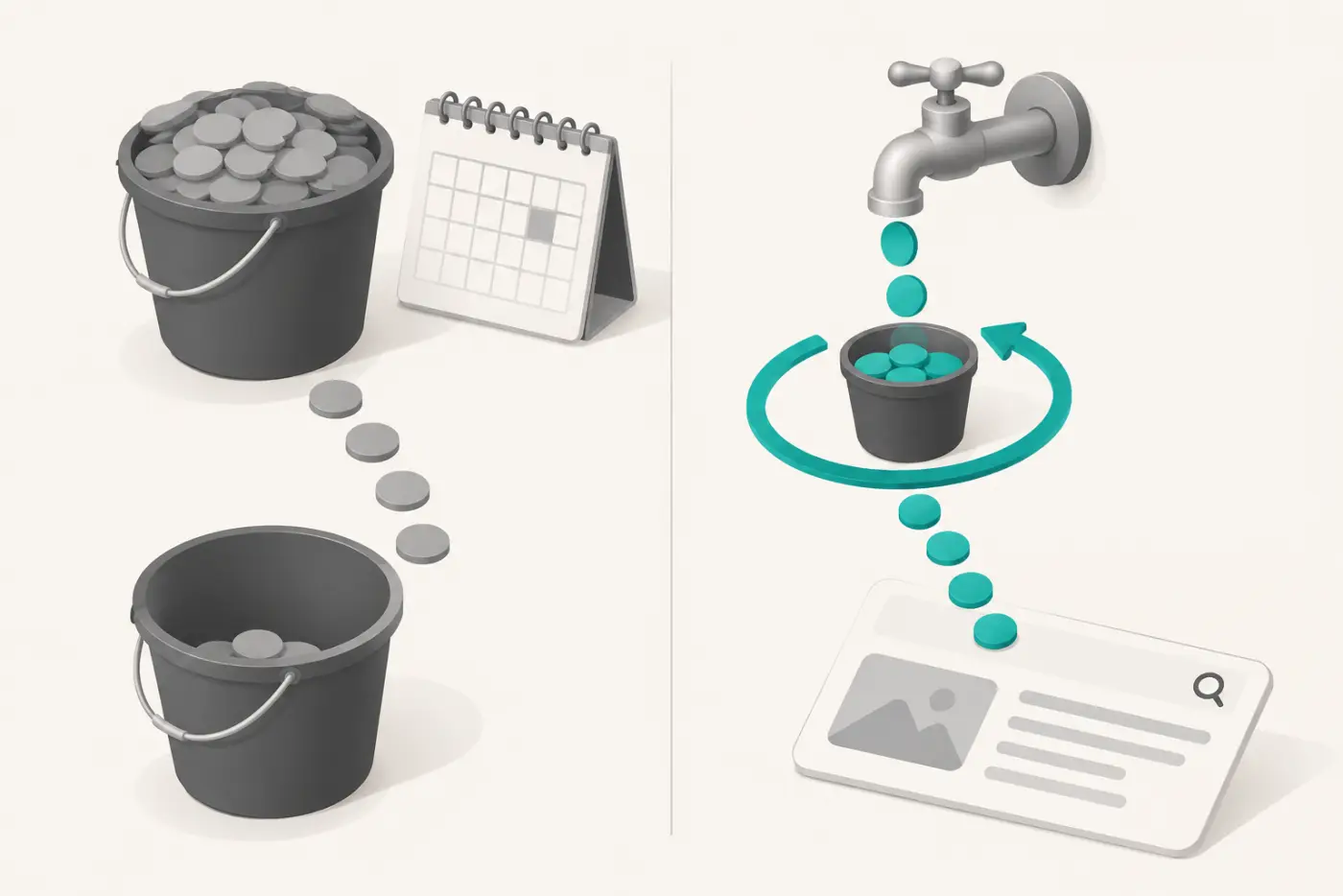
A free allowance has three properties that matter more than the headline number. First, is it one-time or does it reset? That sets your total for a year. Second, how many days does it last at your daily volume?
Third, after it runs out, what is the smallest payment, and when does that money expire? The table below lists seven web search APIs. We read every page on November 1, 2026 (SGT).
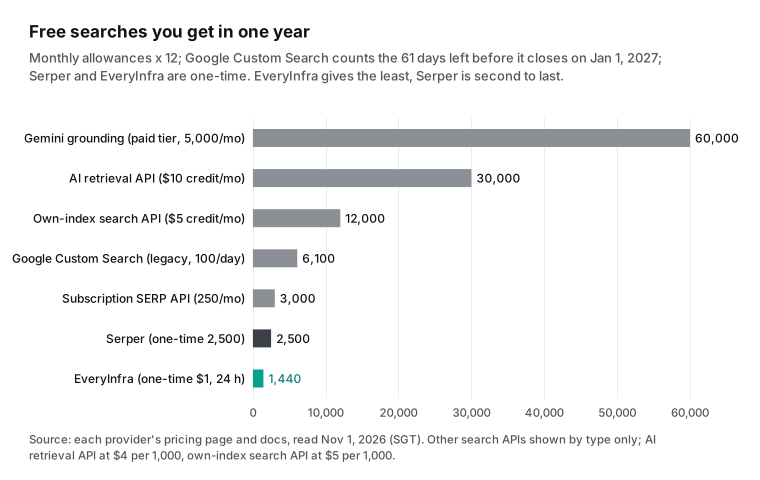
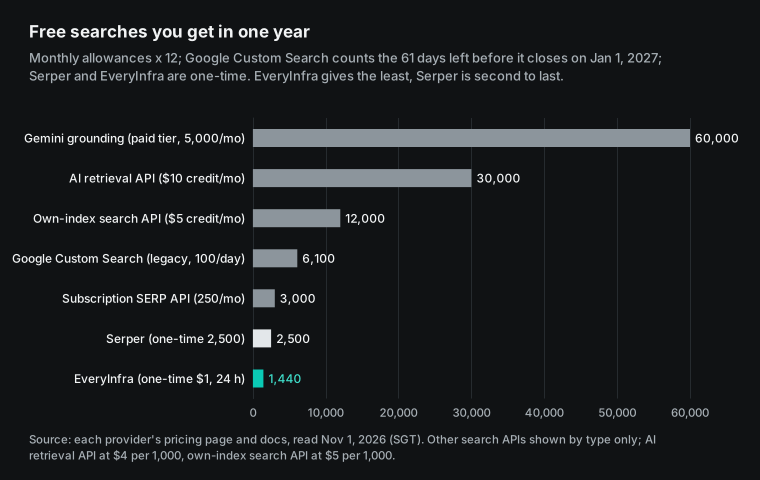
"Free searches per year" is our conversion. Monthly allowances are multiplied by 12. Dollar credits are converted at the cheapest standard search price of that provider. For Google Custom Search, we count the 61 days between November 1 and December 31, 2026. Apart from Serper and platform owners such as Google, we name other search API companies by type only. Their numbers come from their public pricing pages on November 1.
| Service | Free allowance (page summary) | Resets? | Free searches per year | Price after free (per 1,000) |
|---|---|---|---|---|
| Gemini grounding | 5,000 a month on the paid tier only | Monthly | 60,000 | $14 plus model tokens, 1,500 a day max |
| AI retrieval API | $10 credit a month | Monthly | 30,000 (at its cheapest $4 tier) | From $4 (up to 10 results) |
| Own-index search API | $5 credit a month | Monthly | 12,000 (at $5) | $5 |
| Google Custom Search JSON API | 100 a day, existing customers only | Daily | 6,100 (61 days left) | $5, up to 10,000 a day |
| Subscription SERP API | 250 a month on the free plan | Monthly | 3,000 | From $25 a month for 1,000 |
| Serper | "Get 2,500 free queries" | Not stated | 2,500 | From $1.00 ($50 minimum) |
| EveryInfra (pricing) | $1 for a GitHub star, 24 hours | One-time | 1,440 | $0.694 measured, billed per call with results |
EveryInfra has the smallest free allowance in this table, and Serper is second smallest. We did not want that result, but it is the fact. If your goal is "never pay", the providers with a monthly reset suit you better.
Two notes before we go on. The Gemini row applies to the paid tier only, and the free tier shows "Not available" for this feature. Each search also adds model token costs, so it is a model feature, not a standalone search API. The AI retrieval API and the own-index search API give dollars, not searches. We converted them at the cheapest standard search price. A more expensive search mode gives fewer searches.
What Serper's page says about the 2,500 free queries
We started from the original pages. On November 1, 2026, at 00:46 SGT, we saved the full serper.dev home page and the terms page. Then we searched the text for every sentence about the free allowance.
The first screen of the home page has two lines: "Get 2,500 free queries" and "No credit card required". The button at the bottom says "Try 2,500 queries for free". In the pricing section, each of the four paid packs shows "Credits valid for 6 months". That sentence appears under the paid packs only.
No sentence about a validity period appears next to the free lines. Our script looked for "per month", "/month", or "monthly" within 30 characters after "free". It found 0 matches.
The terms page shows "Updated on May 29, 2024". Three rules in it matter for the free tier. First, the usage license says you may not "Register more than one account at any point in time". So several accounts for several free allowances break the terms.
Second, the same section says you may not try to get around the limits on your API key or account. Third, the refund rule gives a full refund in two cases together. You ask within 7 calendar days of your first payment. You also used less than 20% of the credits.
The home page FAQ says the same thing in short form. On the Starter pack, 20% is 10,000 searches. So the refund window works like a second trial. Use the 2,500 free queries and then buy the $50 pack. If you use less than 10,000 in 7 days, you can ask for a refund.
The FAQ also has two sentences that affect your budget. Credits are deducted only for successful responses. When the balance reaches zero, Serper stops taking new queries. The price table also has an asterisk: prices exclude sales tax, VAT, or GST.
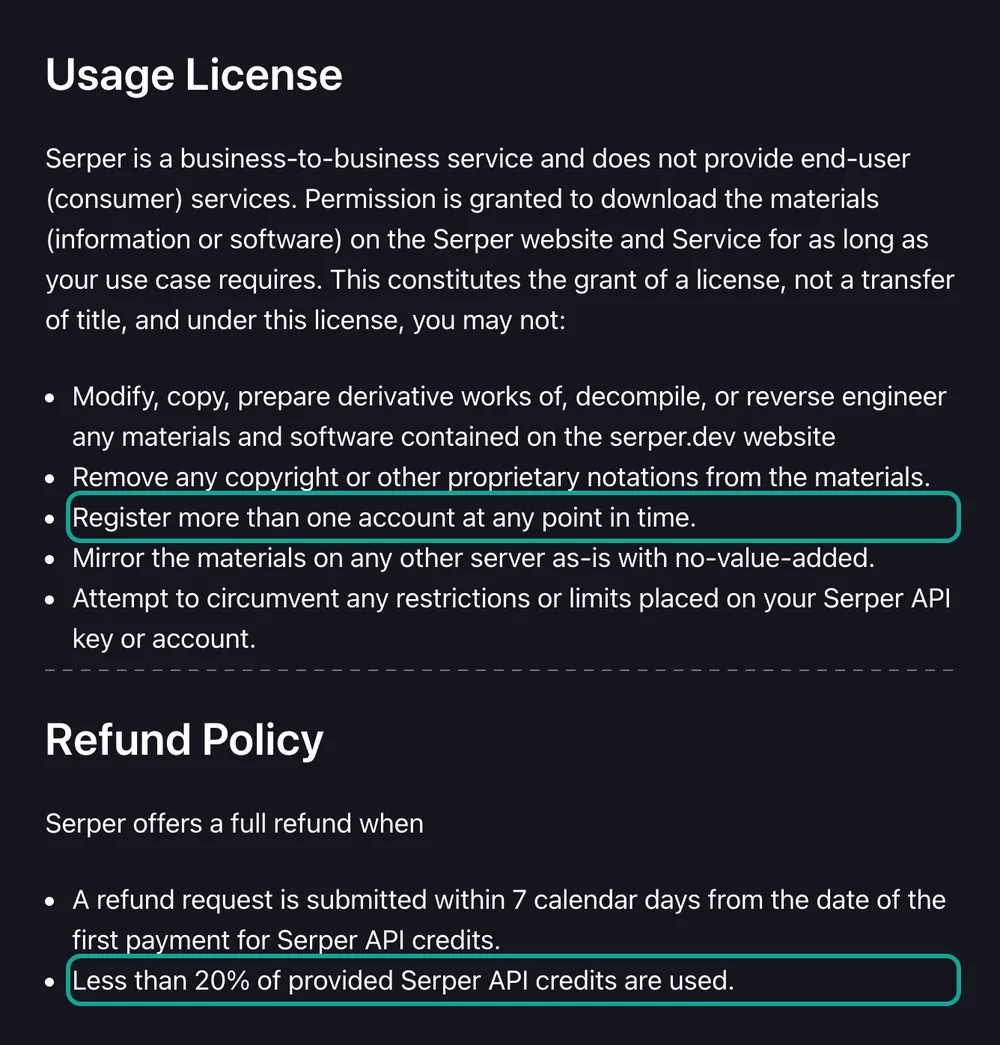
So the page itself confirms four facts about the Serper free tier. You get 2,500 queries. You need no card. You may hold only one account at a time.
Serper deducts credits only for successful responses. The page does not say whether the allowance resets each month or expires. We do not answer that for Serper. The next section shows what third parties say.
Where "2,500 per month" comes from: 8 third-party pages
When you search "serper api free", most results after Serper's own page are price comparisons by other search API companies and tool sites. We opened and read 8 of them on November 1, 2026. We recorded only their exact words about the free allowance.
Most of these pages come from other search API or data companies. We do not name them, so the table shows the page type and the quote. The Reddit post is a public thread, so we link it. They split into two groups. Three pages say "per month". Five pages say "once, at sign-up".
| Page | What it says about Serper's free allowance | Date on the page |
|---|---|---|
| SERP API comparison by a web scraping company | "2,500 searches/mo" | Only two rows checked 2026-08-04 |
| Serper comparison page by a data API company | "2,500 requests/month", and Serper paid plans "monthly only" | None |
| Reddit post in r/PiCodingAgent | "2500 free/mo" | None |
| Free SERP API comparison by a scraping software company | "2,500 credits on sign-up", "One-time" | August 2026 |
| Serper pricing guide by a SERP API company | "One-time allowance" | Serper page checked 2026-10-06 |
| Serper pricing post by a sales consultancy | "Every new account gets 2,500 free queries" | 2026-07-05 |
| Serper setup guide by a search API company | "2,500 free queries when you sign up" | None |
| Serper comparison by another SERP API company | "every new account 2,500 free queries" | Updated 2026-10-27 |
Why does "per month" appear at all? We can confirm only one pattern. The pages that say "per month" put Serper in the same column as monthly allowances from other providers. The column is named "Free Tier" or "free/mo". The Reddit post shows the pattern clearly.
In the same list, it gives an own-index search API "2000 free/mo". But that provider changed its free plan on February 12, 2026, to a $5 monthly credit. At $5 per 1,000, that is 1,000 searches. So the list already had an old number in it.
The data API comparison page also says Serper's paid plans are "monthly only". That does not match the Serper home page, which says "No monthly subscriptions". Our conclusion: no first-party source says "2,500 per month". For your budget, count 2,500 queries once.
Our rule is not to open accounts with competitors, so we did not check a Serper dashboard balance. At the time of writing, the Serper home page, terms, and FAQ do not say "resets monthly" anywhere. If you plan for one-time use, the worst case is a surprise extra allowance later. If you plan for a monthly reset, the worst case is a program that stops one day.
This matters when you plan a small tool. Suppose you plan 80 searches a day and think the 2,500 resets every month. In fact, the allowance runs out on about day 32. The FAQ says Serper then stops taking new queries. Your program loses its results on that day without a warning in your code.
How many days the free allowance lasts
A one-time allowance is worth as much as your daily volume lets it be. The table below shows how many days 2,500 queries last at five daily volumes. Days equal 2,500 divided by searches per day. The EveryInfra $1 trial expires 24 hours after you claim it. Unused searches do not carry over. So at any volume, it lasts one day.
| Searches per day | Typical use | Serper's 2,500 lasts | EveryInfra $1 trial lasts |
|---|---|---|---|
| 10 | A personal coding agent that checks docs | 250 days | 1 day (expires after 24 hours) |
| 50 | A small team's Q&A bot | 50 days | 1 day |
| 100 | 100 keyword rank checks a day | 25 days | 1 day |
| 167 | A small product at about 5,000 a month | 15 days | 1 day |
| 500 | A content site that researches in bulk | 5 days | 1 day |
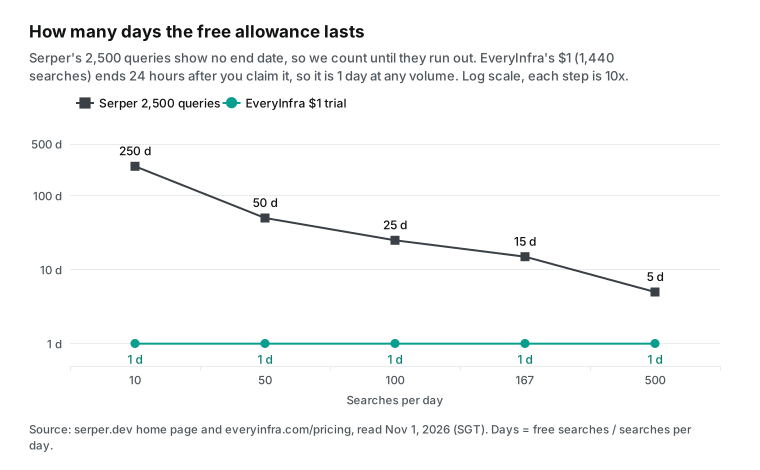
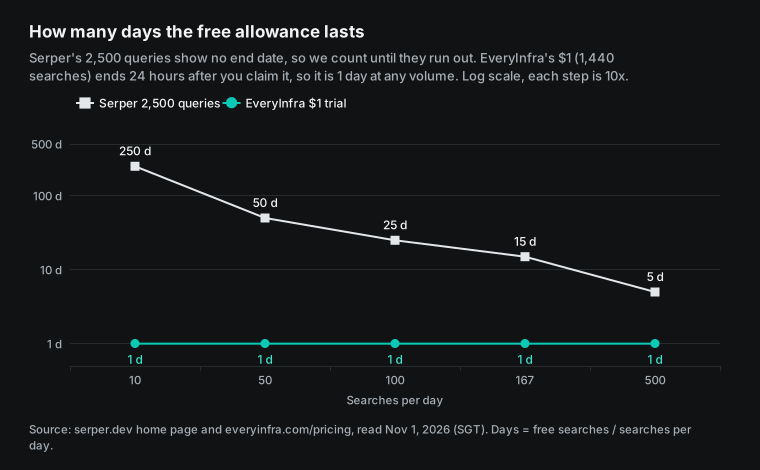
The table makes the difference plain. At 10 searches a day, Serper's free allowance lasts most of a year. Our trial lasts one day. So our trial is not for long free use.
It lets you run every capability you need in one day. You see the content, the speed, and the billing before you pay. For long free use, see the section on free alternatives below.
From free to the first payment: a 5x difference in the minimum
Serper has no pay-as-you-go option. The smallest pack is Starter: $50 for 50,000 credits, $1.00 per 1,000, 50 queries per second, valid for 6 months. EveryInfra starts at a $10 top-up. At $0.000694 per search, $10 buys 14,400 searches. The pricing page says the balance never expires.
| Serper | EveryInfra | |
|---|---|---|
| Smallest payment | $50 (Starter, before tax) | $10 |
| Searches it buys | 50,000 | 14,400 |
| Price per 1,000 | $1.00 | $0.694 |
| Validity | 6 months | Never expires |
| Refund | Full refund within 7 days if under 20% used | Failed and empty calls cost $0, no request needed |
| When it charges | Successful responses only | Calls with results only, empty results refunded at once |
| Monthly use to finish Starter in time | 8,334 | Not applicable |
The payment method can also block the first payment. The Serper FAQ lists Visa, Mastercard, American Express, Discover, and PayPal. Prices exclude sales tax, VAT, or GST. The EveryInfra English pricing page lists methods by region. Cards work in all regions.
Mainland China has Alipay and WeChat Pay. Singapore has PayNow. South Korea, Indonesia, and Malaysia have local wallets. All top-ups are in US dollars. Many solo developers without an international credit card stop at this step.
The last row of the table is the key point. To use 50,000 credits within 6 months, you need 8,334 searches a month on average. Below that volume, part of the Starter pack expires. Our earlier post, Serper API alternative: price per 1,000 and expiry, tested, already shows the expiry effect by monthly volume. Here we ask a question that fits a person who just used up the free tier: how much cash do you pay in year one?
Cash out in year one: a month-by-month model at four volumes
We wrote a month-by-month model. All rules come from public pages. On the Serper side, you use the 2,500 free queries first. We assume they never expire, which is the best case for Serper. When the balance is too low, you buy one $50 Starter pack. Each pack expires 6 months after the month you buy it.
On the EveryInfra side, the $1 trial covers the first day only. After that, each search costs $0.000694, and you top up in $10 steps. The balance never expires. The other providers follow their own pages. For the subscription SERP API, we take the cheapest monthly plan that covers the volume.
The own-index search API first uses its $5 monthly credit, then charges $5 per 1,000. The AI retrieval API first uses its $10 monthly credit, then charges $4 per 1,000 at its cheapest tier. DeepSeek has no free allowance and charges $0.75 per 1,000. For Gemini, we count the search fee only, not the tokens.
| Searches a month | Serper | EveryInfra (used) | Own-index search API | AI retrieval API | Subscription SERP API | DeepSeek | Gemini search fee (plus tokens) |
|---|---|---|---|---|---|---|---|
| 1,000 | $100 | $10 ($8.33) | $0 | $0 | $300 | $9 | $0 |
| 3,000 | $100 | $30 ($25.00) | $120 | $24 | $900 | $27 | $0 |
| 5,000 | $100 | $50 ($41.67) | $240 | $120 | $900 | $45 | $0 |
| 20,000 | $250 | $170 ($166.67) | $1,140 | $840 | $3,300 | $180 | $2,520 |
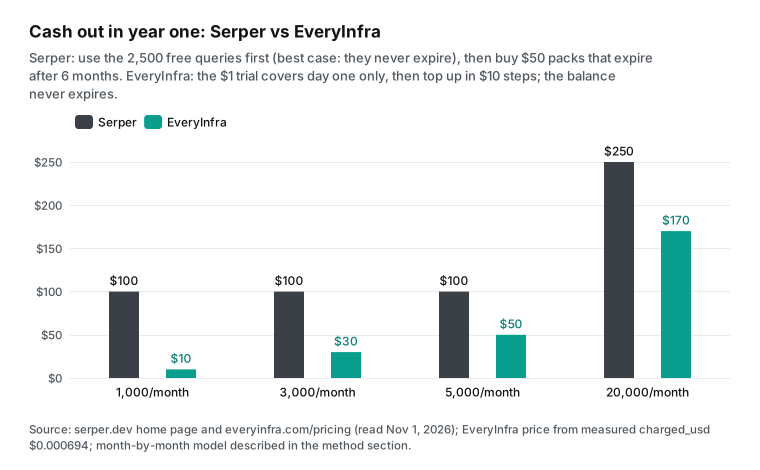
Look at the Serper and EveryInfra columns first. At 1,000 searches a month, the free queries last until month 3. In month 3 you buy a Starter pack. That pack expires at the end of month 8, after you used only 5,500 searches from it. So 44,500 searches expire.
In month 9 you buy a second pack. The total is $100, or $8.33 per 1,000 searches you used. With us, you top up $10 once and use $8.33. The rest stays in your balance.
The table below shows the 1,000-a-month case month by month. It is the direct output of the model.
| Month | Serper free left | Serper pack bought | Serper cash so far | Serper searches expired | EveryInfra cash so far |
|---|---|---|---|---|---|
| 1 | 1,500 | 0 | $0 | 0 | $10 (trial covers day one, then first top-up) |
| 2 | 500 | 0 | $0 | 0 | $10 |
| 3 | 0 | 1 Starter | $50 | 0 | $10 |
| 4 to 7 | 0 | 0 | $50 | 0 | $10 |
| 8 | 0 | 0 | $50 | 44,500 | $10 |
| 9 | 0 | 1 Starter | $100 | 0 | $10 |
| 10 to 12 | 0 | 0 | $100 | 0 | $10 (about $1.67 left) |
At the end of year one, Serper's second pack still holds 46,000 searches. You must use them by the end of month 14, or they expire too.
At 1,000 a month, you use only 2,000 of them in months 13 and 14. In month 15 you buy a new pack. So from year two, Serper still costs $100 a year (one pack every 6 months), and we cost about $8.33. The year-one figure of $100 vs $10 does not charge Serper for year two in advance. EveryInfra uses 12,000 searches for $8.33, and about $1.67 stays in the balance. For a low-volume user, most of the Serper bill pays for "too much bought at once, with an end date".
It does not pay for searches. That is why the free allowance is not the main point. The first payment after it is.
As volume grows, less of each Serper pack expires, and the gap gets smaller. At 3,000 a month the gap is 3.33 times. At 5,000 it is 2 times. At 20,000 it is 1.47 times. Our earlier post also shows the other end. Above about 300,000 searches a month, Serper's larger packs at $0.50 and $0.30 per 1,000 cost less than we do.
Now look at the other columns. Below 1,000 searches a month, the monthly credits from the own-index search API, the AI retrieval API, and Gemini cover all use. The year costs $0, which is less than Serper or us. DeepSeek has no free allowance, but at $0.75 per 1,000 the year costs $9, close to our $10.
At 5,000 a month, the own-index search API's free credit covers one fifth, and the year costs $240. The AI retrieval API costs $120. We cost $50. DeepSeek costs $45, which is $5 less than us.
At 20,000 a month, DeepSeek ($180) and we ($170) stay under $200. Serper costs $250. The other three search APIs each cost more than $800. The Gemini search fee alone is $2,520.
So "cheap" depends on volume. A few hundred searches a month fit a monthly free tier. A few thousand to a few hundred thousand fit per-call billing. Above that, large prepaid packs win.
The table has three limits. First, the EveryInfra and DeepSeek numbers include only the per-call price, not your own servers or models. Second, the Gemini column is the search fee only. Each search also adds token costs for the model you choose, and the free tier cannot use this feature.
So its "$0" does not mean free. Third, the providers return different things. The own-index search API uses its own index. The AI retrieval API finds content for AI by meaning.
Gemini lets the model search for itself. One "search" gives a different number of results and different content at each provider. This table answers the money question only.
Where the EveryInfra trial and price come from
Our price is in a catalog, not in this article. We read the search tool catalog on November 1, 2026, at 00:46 SGT. The standard tier is $0.00069444 per call, shown as $0.000694, or $0.694 per 1,000. Fifteen tools are in this tier, including web, news, and suggest. Only the crosscheck tool is higher, at $0.002778.
The web/search capability on the data API side uses a different catalog, the data catalog for web. It costs $0.001389 per call. On the test day, it returned 10 rows per call. Each live response has a billing.charged_usd field that shows the real charge for that call. We added up every number in this article from that field.
The trial rules are on the pricing page. You star everyinfra/everyinfra-agent-plugins on GitHub. Then you claim $1 under Balance and top-ups in the console. The $1 goes to your bonus balance, which we use first. It is valid for 24 hours after you claim it.
A normal sign-up does not add it. We got 1,440 by dividing $1 by $0.00069444 and rounding down. The data API costs $0.001389 per call, so the same $1 gives about 720 calls. The minimum top-up is $10, and the other steps are $50, $100, $500, and $1,000. The unit price is the same at every step.
Below is the simplest request, with the first keyword from our tests. The body holds only the tool name and parameters. The key goes in the Authorization header.
curl -X POST https://api.everyinfra.com/api/v1/search \
  -H "Authorization: Bearer $EVERYINFRA_API_KEY" \
  -H "Content-Type: application/json" \
  -d '{"tool":"web","params":{"q":"fastapi background tasks documentation","num":10}}'

# Real response at 00:50:03 SGT on 2026-11-01 (first result and billing fields only; balance fields removed)
{
  "tool": "web",
  "results": [
    {"title": "Background Tasks",
     "url": "https://fastapi.tiangolo.com/tutorial/background-tasks/",
     "snippet": "You can define background tasks to be run after returning a response. ..."}
  ],
  "billing": {"charged": true, "credits": 50, "charged_usd": 0.000694}
}
Test 1: ten documentation searches, one day of a coding agent
Who needs a free tier the most? In forums, the most common case is a solo developer who adds search to a coding agent. The agent searches the docs each time it meets an error or a new library. So our first test models one such day. We sent 10 real developer questions, one search each, 10 results each.
The 10 requests went out on November 1, 2026, between 00:50:03 and 00:52:28 SGT. The fifth request got a 429. During the tests, several jobs shared the per-minute limit of one key. This article sent only 5 calls in that minute. We waited 60 seconds and sent it again. The 429 cost nothing.
| Query | Rows | First result from | Seconds | Charged |
|---|---|---|---|---|
| fastapi background tasks documentation | 10 | fastapi.tiangolo.com (official docs) | 1.67 | $0.000694 |
| pydantic v2 migration guide field validator | 10 | pydantic.dev (official docs) | 1.89 | $0.000694 |
| langgraph postgres checkpointer example | 10 | reference.langchain.com (official reference) | 1.90 | $0.000694 |
| nextjs 15 hydration error github issue | 10 | github.com (issue) | 1.70 | $0.000694 |
| playwright python wait for network idle | 10 | stackoverflow.com | 1.75 | $0.000694 |
| uv python lock file workspace | 10 | docs.astral.sh (official docs) | 1.60 | $0.000694 |
| mcp streamable http server python sdk | 9 | github.com (example) | 2.11 | $0.000694 |
| react 19 useActionState example | 10 | react.dev (official docs) | 2.43 | $0.000694 |
| postgres jsonb index performance | 10 | reddit.com | 1.61 | $0.000694 |
| docker compose healthcheck depends_on | 10 | docs.docker.com (official docs) | 1.91 | $0.000694 |
The 10 calls returned 99 rows for $0.00694, less than one cent. For 6 of the 10 questions, the first result was the official documentation. At this volume, 10 a day is 300 a month and 3,600 a year. That costs about $2.50 a year with us. With Serper, the 2,500 free queries last 250 days, and you buy one $50 pack for the remaining 115 days.
With the own-index search API, 300 a month stays inside the $5 monthly credit, so the year costs $0. This is the point from above. For a low-volume personal project, a monthly free tier is the best deal. Our advantage starts after the free tier. A personal project should move to us only when it also needs data from TikTok, Amazon, or Xiaohongshu. Then one key covers all your calls.
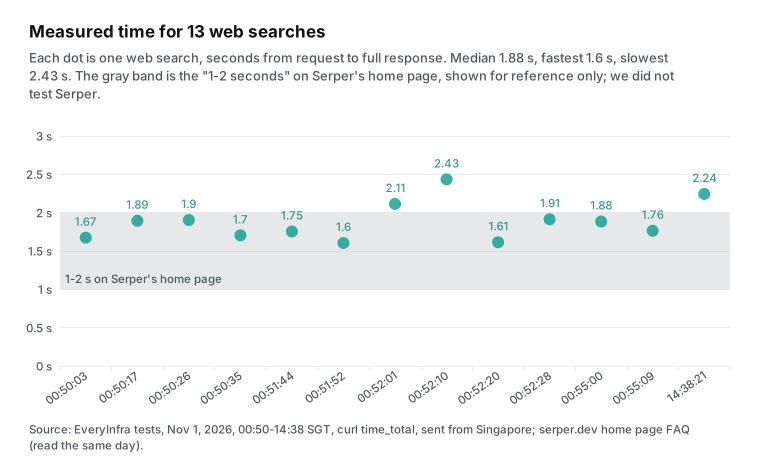
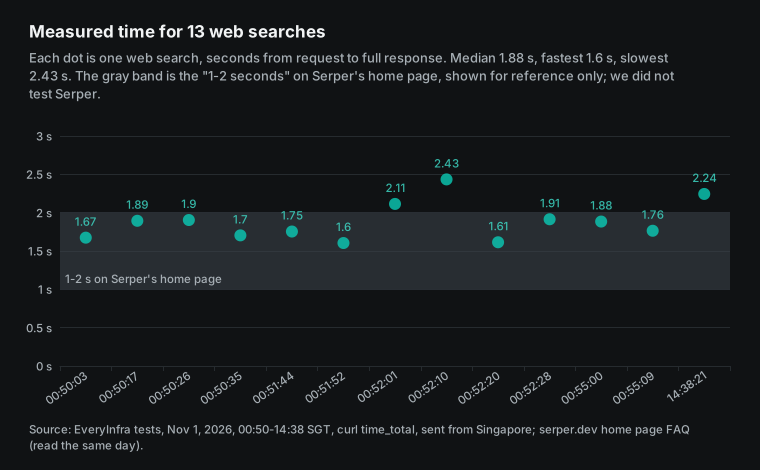
On speed, we can report our own numbers only. With two later calls, this article made 13 web searches with results between 00:50 and 14:38 SGT. We do not count one empty result, one 422, one 401, and one 429. We sent them from Singapore and timed each full response with curl. The median was 1.88 seconds, the fastest 1.60, and the slowest 2.43.
The Serper FAQ says most queries return in 1 to 2 seconds, and 2 to 4 seconds when a retry is necessary. Do not compare the two sets directly. We did not test Serper, and the test location and network were different. The gray band in the chart only shows Serper's claim for reference.
Test 2: we asked for 100 rows and got 10, and how the two web searches differ
With a free allowance, many people want more results per call to save calls. We tried two kinds of search. One was the web tool in the search API. The other was the web/search capability in the data API. Both returned at most 10 rows per call.
| Request | SGT time | Rows asked | Rows returned | Charged |
|---|---|---|---|---|
web/search, limit=100 | 2026-11-01 00:52:39 | 100 | 10 | $0.001389 |
web/search, no limit | 2026-11-01 00:54:52 | default | 10 | $0.001389 |
web/search, limit=30 | 2026-11-01 14:38:19 | 30 | 10 | $0.001389 |
web tool, num=20 | 2026-11-01 14:38:21 | 20 | 10 | $0.000694 |
naver/search, no limit | 2026-11-01 00:55:18 | default (catalog max 20) | 20 | $0.001389 |
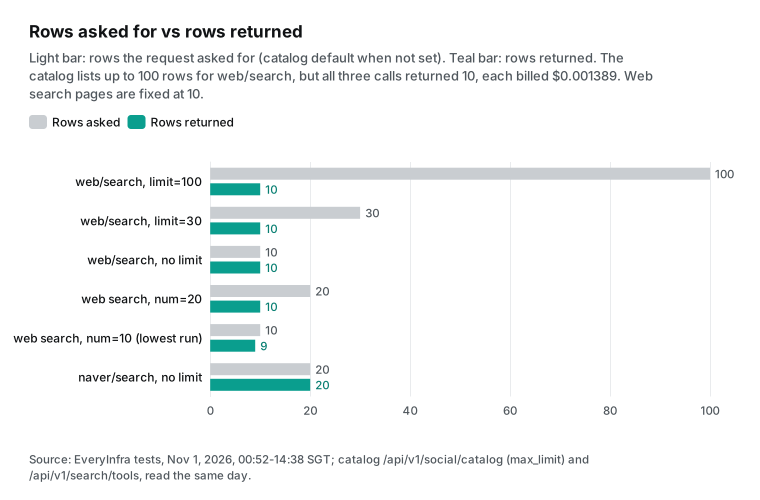
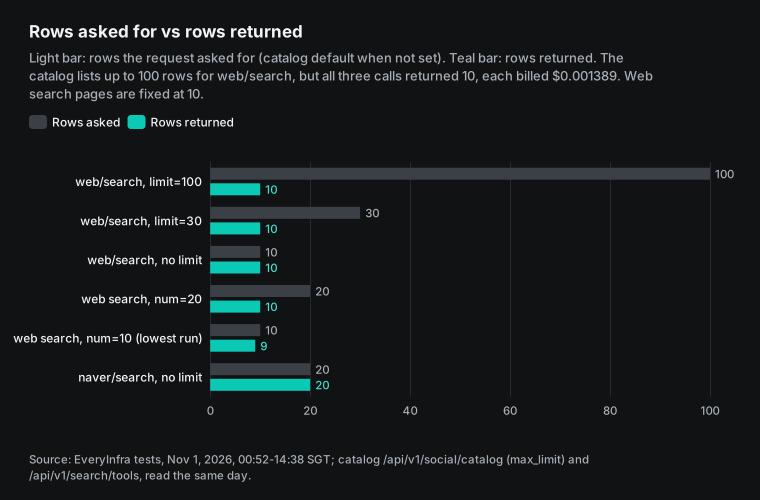
We report what we measured. On the test day, web/search returned 10 rows per call. Calls that asked for 100 rows and 30 rows also returned 10. The calls did not fail, and each one was charged $0.001389. So plan on 10 rows per call. That makes web/search $0.139 per 1,000 rows and the web tool about $0.070 per 1,000 rows.
By that evening, the data catalog also gave this rule. web/search returns 10 rows or fewer per call, and a larger limit is accepted but returns 10. For more rows, use the web tool of the search API and page through results with page. Each page is one call. We sent limit: 100 again at 19:24 SGT and got 10 rows for $0.001389.
The web tool costs half as much. So what does the extra money for web/search buy? The parameters are different. web/search has country and language, and the web tool has only location.
To see the difference, we searched 4 more keywords with both at 15:42 to 15:43 SGT. With the pair from 14:38, that gives 5 pairs.
| Query | `web/search` parameters | `web` parameters | Same URLs | First result |
|---|---|---|---|---|
| free search api for ai agents | country=us, language=en | None | 7 of 10 | Same (reddit.com) |
| python asyncio timeout example | country=us, language=en | None | 10 of 10 | Same (docs.python.org) |
| kubernetes ingress nginx retirement | country=us, language=en | None | 10 of 10 | Same (kubernetes.io) |
| mejor framework javascript 2026 | country=es, language=es | location=es | 3 of 10 | Different |
| Japanese query for "free search API" | country=jp, language=ja | location=jp | 10 of 10 | Same (note.com) |
The result is clear. For the English and Japanese queries, both returned almost the same 10 rows. Three pairs were identical. The first result was the same official page, for example the Python asyncio tasks page and the Kubernetes Ingress NGINX retirement post.
The Spanish query was different. With language=es, web/search returned 8 Spanish pages out of 10. With only location=es, the web tool returned 1 Spanish page. The other 9 were English framework rankings and Reddit threads.
So use the web tool when you need English web results and no language filter. When you need results in one language, the language parameter of web/search is worth the extra half.
These 8 calls cost $0.008332. The 4 web calls took 2.35 to 2.62 seconds, slower than the 13 earlier calls. The 4 web/search calls took 1.49 to 2.38 seconds. Five pairs is a small sample. It shows what the parameters do, not which search is better.
The web tool with num 20 also returned 10 rows. This matches Google's own rule. The Custom Search JSON API cse.list reference says num must be from 1 to 10. For more results, request the next page. Set page to 2, and the call costs one more $0.000694.
At 00:55:09 SGT we requested page 2 for the same keyword. None of its 10 rows repeated a row from page 1. On the Serper side, the sales consultancy post from the table above says that 11 to 100 results cost 2 credits (checked July 5, 2026). We did not find this rule on the Serper home page, so we treat it as a third-party claim.
Test 3: empty results, bad parameters, no key, rate limits
The worst use of a free allowance is a call that returns nothing useful. The Serper home page says credits are deducted only for successful responses. Our rule is the same. Below are the 6 calls out of 33 that cost nothing. All rows come from real responses.
| Case | SGT time | HTTP status | What the response says | Charged |
|---|---|---|---|---|
| A query with no matches, 0 rows | 00:53:29 | 200 | reason: empty_result_refunded, 50 credits back | $0 |
Serper's gl parameter copied as is | 00:53:37 | 422 | unknown_param, with the 7 supported parameters | $0 |
limit at the top level of the body | 00:52:53 | 422 | did_you_mean: params.limit | $0 |
| No API key | 00:53:44 | 401 | Missing API key | $0 |
| Test key limit of 10 calls a minute, shared with other tests at the time | 00:50:43 and 00:53:51 | 429, "too many requests" in RFC 6585 | retry_after of 17 and 8 seconds, plus "Nothing was charged" | $0 |
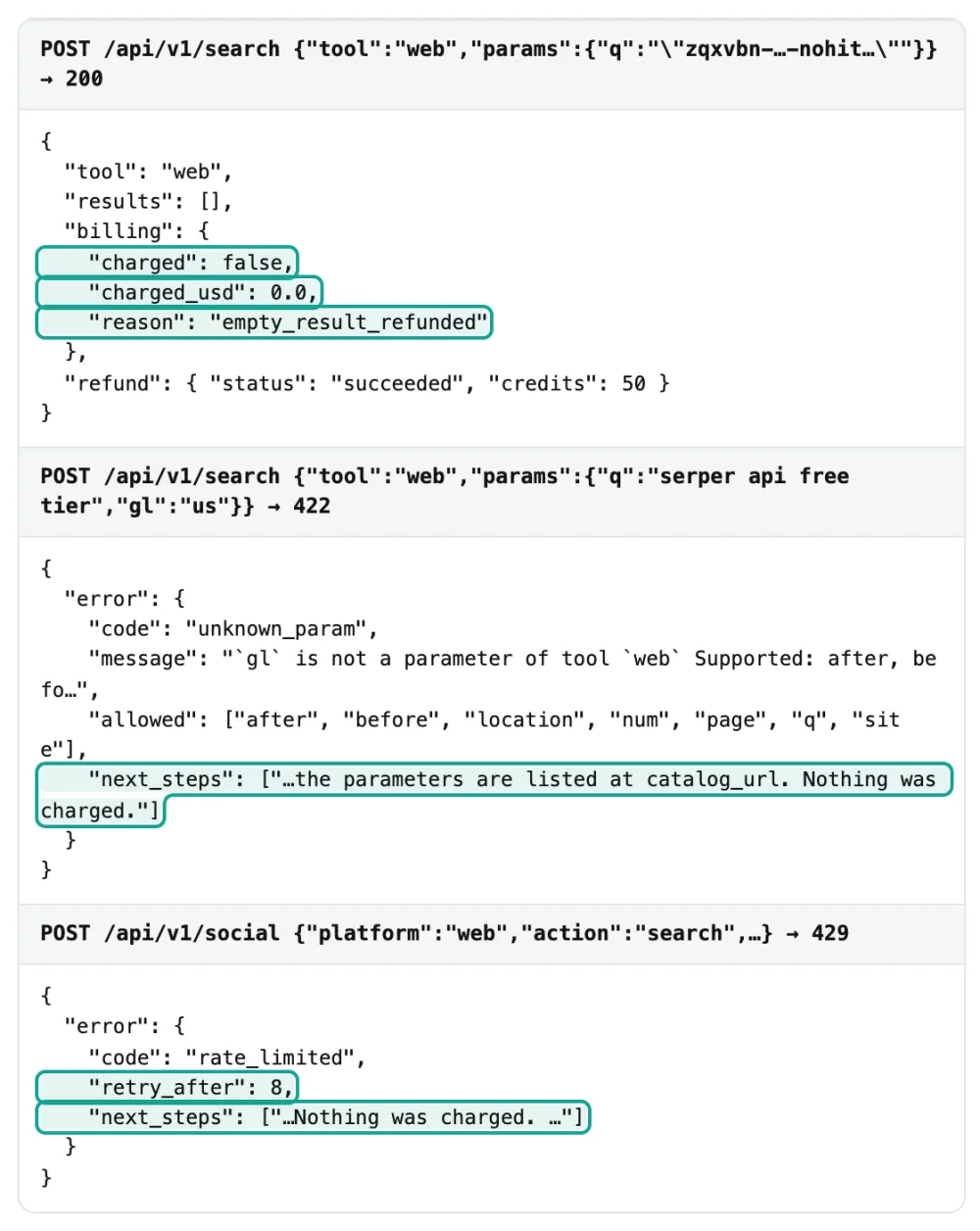
The second row matters most. When people move from Serper, the most common error is to copy its parameters as they are. We do not drop an unknown parameter and charge you as usual. We return 422.
The response names the unknown parameter, lists the supported ones, and says what to change. The error is written for your code and your AI agent to read. An agent that reads allowed and did_you_mean can fix the call and send it again.
DeepSeek works the other way. Its search guide says "Unknown fields in the request body are ignored". A wrong field is dropped, and the call succeeds. Both designs have reasons. For a free allowance, the first design does not charge you for a call you wrote wrong.
{
  "error": {
    "code": "unknown_param",
    "message": "`gl` is not a parameter of tool `web` Supported: after, before, location, num, page, q, site. See GET /api/v1/search/tools",
    "param": "gl",
    "allowed": ["after", "before", "location", "num", "page", "q", "site"],
    "retryable": false,
    "next_steps": ["Remove `gl`; the parameters are listed at catalog_url. Nothing was charged."]
  }
}
A 429 response can tell the client how long to wait (see the MDN page on 429). We put that value in retry_after in the body. For both 429 calls, we waited 60 seconds, and the first retry worked. You can change the rate limit for a paid account in the console.
Test 4: other languages and countries, including Naver in Korean
Most third-party comparisons test English only. We tested three more cases. At 00:54:52 SGT, web/search searched the Spanish keyword "alternativa gratis a serper api" with country es. It returned 10 rows. The first was a Reddit thread in the n8n community, followed by the Spanish site of a data company and Spanish SEO blogs.
It cost $0.001389. At 00:55:00 SGT, the web tool searched a Chinese keyword about Serper's free quota, with location tw. It returned 10 rows, including Taiwanese blogs (vocus.cc and ftdesign.tw) and the Serper home page. It cost $0.000694.
At 00:55:18 SGT we tried a search platform that the Serper home page does not list: Naver in Korea. naver/search searched "검색 API 무료" (free search API). It returned 20 rows for $0.001389.
Ten rows came from Naver Blog, posted between August 5 and October 31, 2026. Ten came from Naver Cafe. The oldest Cafe post is from October 26, 2023, the newest from October 22, 2026, and one row has no date.
| Naver source | Rows | Oldest post | Newest post |
|---|---|---|---|
| Naver Blog | 10 | 2026-08-05 | 2026-10-31 |
| Naver Cafe | 10 (1 with no date) | 2023-10-26 | 2026-10-22 |
So the Cafe posts span three years, and you must filter by date for market research. The cost in time was high. This call took 37.3 seconds, about 20 times the median of our web searches.
Naver also has its own open search API. Its docs give a limit of 25,000 calls a day. You register an app in the developer center to get a client ID and secret. If you need Naver only, at low volume, look at it first.
If you want Naver and other platforms under one key, see the Naver scraper API and the Naver search capability. For Russian-language markets, see Yandex search. All of these use the same key and the same balance as web search.
Test 5: who ranks for "serper api alternative free"
Before we wrote this post, we searched its own keyword with our API. At 00:52:39 SGT on November 1, 2026, web/search searched "serper api alternative free" with country us and language en. It returned 10 rows. Five were comparison pages by other search API or data companies.
Two were Reddit threads, one from r/LocalLLaMA two years ago and one from r/n8n. The Serper home page was fourth. The last two were an SEO forum thread and a list on GitHub.
So half of what a searcher sees comes from vendors with an interest in the result. This post is one more of those. That is why we put a link to the original page next to every Serper number. You can check each one yourself and trust none of the summaries.
At 00:53:20 SGT we used the news tool to search "search API free tier". The second result was a page by a search API company about alternatives to the Google search API before its 2027 shutdown. Most of the rest were roundups of free tiers for AI APIs. The Google Custom Search shutdown is now a common topic for every vendor that writes about alternatives.
Truly free options: SearXNG, the old Google API, and model search
Some people who search "serper api alternative free" do not want "cheaper". They want "no cost at all". We read the original pages for each common option and checked if you can use it for a long time.
The first option is to host SearXNG yourself. It is an open-source metasearch engine. Its docs say it can combine results from up to 261 search services. The software is free, and the code is on GitHub. But only the software is free. You pay for the server, and you handle blocks from the search engines.
Its search settings enable only the html result format by default. To get JSON, you add json in settings.yml. The Search API page says a request for a disabled format returns 403, and many public instances disable JSON. The same settings page lists pause times after a block. A "too many requests" error pauses an engine for 1 hour.
An access-denied error pauses it for 1 day. A Google human check pauses it for 7 days. So a self-hosted SearXNG suits personal use at low volume when an empty result is acceptable. It is a weak choice as the only search source for a customer product.
The second option is Google's own Custom Search JSON API. It gives 100 free queries a day. But the overview page is clear. That price applies to existing customers only.
New customers cannot sign up, and the service stops on January 1, 2027. Microsoft retired the Bing Search APIs even earlier, on August 11, 2025 (Microsoft lifecycle notice). So neither large company now offers an official web search API that a new project can use for free over the long term.
The third option is a monthly free allowance. An own-index search API now gives $5 every month on each plan. At $5 per 1,000 requests, that is 1,000 searches. An AI retrieval API gives $10 every month.
Its cheapest tier costs $4 per 1,000 for up to 10 results, plus $1 per 1,000 for each result above 10. A subscription SERP API gives 250 searches a month on its free plan, at up to 50 an hour. All three numbers come from public pricing pages on November 1, 2026. If your monthly volume stays inside these limits, they are free for the long term.
The fourth option is to let the model search. Gemini grounding with Google Search gives 5,000 free searches a month on the paid tier. After that, it costs $14 per 1,000, with a cap of 1,500 a day. The Claude web search tool costs $10 per 1,000.
OpenAI web search also costs $10 per 1,000. Both also charge tokens for the search content. This option removes your own search code. But you get no structured result list, and the price per search is about ten times higher than a standalone search API.
The table below sums up the free options in this section.
| Option | What is free | The catch |
|---|---|---|
| Self-hosted SearXNG | The software | Your server, JSON off by default, engine pauses after blocks |
| Google Custom Search | 100 a day | Existing customers only, ends January 1, 2027 |
| Search APIs with monthly credits | Monthly credits or searches | Small volume only |
| Gemini, Claude, OpenAI search | 5,000 a month on Gemini paid tier, none on the others | Token costs, no plain result list |
| DeepSeek server-side search | Ended at 16:00 UTC on October 31, 2026 | Now $0.75 per 1,000 |
One more free option closed at midnight on the day we wrote this. On October 17, 2026, DeepSeek opened its search API at $0.75 per 1,000 calls (DeepSeek news). Search calls through server-side tools in DeepSeek Harness, Claude Code, and Codex were free at first. Its pricing page says billing starts at 00:00 Beijing time on November 1, 2026 (16:00 UTC on October 31).
So this free period lasted two weeks. Free allowances change. That is why we suggest that you choose by the price after the free part.
Serper dev alternative: what to change when you move
If you already use Serper, you probably connect through a framework. LangChain's GoogleSerperAPIWrapper reads the SERPER_API_KEY environment variable. CrewAI's SerperDevTool and Haystack's SerperDevWebSearch work the same way. This is a real strength of Serper. Major frameworks ship ready wrappers, so a move away from Serper takes some extra code.
You can move to EveryInfra in two ways. The first way is to write search as a small function of your own. Change the URL to https://api.everyinfra.com/api/v1/search. Put the key in an Authorization: Bearer header.
Put tool and params in the body, and take the parameters from the search tool catalog. An unknown parameter returns 422, and the allowed list tells you what to use. The response field names differ from Serper's. Rewrite the lines that read the results by our catalog, and do not assume the two match.
The second way is MCP for an AI agent. The Claude Code MCP docs support remote HTTP servers, and one command adds ours. After that, the agent sees tools such as everyinfra_search. The tool list follows the MCP specification.
# Add the EveryInfra remote MCP server to Claude Code (keep the key in an environment variable)
claude mcp add --transport http everyinfra https://api.everyinfra.com/mcp \
  --header "Authorization: Bearer $EVERYINFRA_API_KEY"

# Then run /mcp inside Claude Code. Tool names start with everyinfra_, for example everyinfra_search
The safest move is to run both sources side by side for a week, not to switch at once. At 100 queries a day, a week is 700 searches. Serper stays inside its free allowance, and EveryInfra costs 700 × $0.000694, about $0.49. After the week, put the top results from both sources for the same query side by side.
Check the query types your app cares about, such as docs, news, local businesses, and products. If none got clearly worse, switch. One week costs less than one dollar, which is far less than a problem you find after the switch.
For the full MCP setup, see our MCP server page. For how an agent picks between our search tools, see agent search tool selection. For how an agent fixes its own calls from our errors, see API errors and self-healing.
Pick by use case: four common jobs
The tables above count searches a month. Your use case decides more than that. We went through the four uses we see most often in forums. For each one, we show how we estimated the volume and why one provider fits.
The first use is a personal coding agent at about 300 searches a month. Test 1 already does the math for it, so we do not repeat it here.
The second use is a Q&A bot or RAG app for customers. Each user question starts 1 to 3 searches on average. At 100 questions a day, that is 3,000 to 9,000 searches a month. Monthly free tiers cover only a small part.
The own-index search API at 3,000 a month costs $120 a year, and the AI retrieval API starts at $24. Serper starts at $100 in year one, and you buy a new pack every 6 months. With us it costs $2.08 to $6.25 a month, or $25 to $75 a year, billed by real use. This is the range where per-call billing saves the most. In year-one cash at 3,000 a month, we cost 3.33 times less than Serper.
The third use is SEO rank tracking. At 100 keywords a day, first page only, that is 3,000 searches a month. To see the top 50, you read 5 pages, so it becomes 15,000. Pages multiply the call count, so check how each provider bills for more results. We charge once per page.
A third party says Serper charges 2 credits for 11 to 100 results. The Serper home page does not state this rule, so confirm it before you buy. Rank tracking also needs a stable location setting. Our web tool has a location parameter. The Serper home page says you can set the country and language.
The fourth use is research across languages and markets. If you need Naver in Korea or Yandex in Russian-speaking markets as well as Google, free allowances help very little. The two search APIs with dollar credits use their own indexes, and Serper covers Google results only. Our naver/search returns 20 Naver Blog and Cafe rows for $0.001389, but one call can take tens of seconds. For this kind of work, one per-call API is simpler than a mix of free tiers.
The table below puts the four use cases side by side.
| Use case | Searches a month | Best fit | Year one with us |
|---|---|---|---|
| Personal coding agent | About 300 | A monthly free credit ($0) | About $2.50 used from a $10 top-up |
| Q&A bot or RAG app | 3,000 to 9,000 | Per-call billing | $25 to $75 |
| SEO rank tracking, top 50 | Up to 15,000 | Per-call billing, check paging rules | About $125 |
| Research across Naver and Yandex | Varies | One per-call API | $0.001389 per call |
When Serper is the better choice
This section lists where Serper does better than we do, and where other providers beat both of us. Each point has a source.
First, Serper's one-time free allowance is larger than ours and lasts longer. Its 2,500 queries are 1.74 times our 1,440. Our trial expires after 24 hours, and Serper's page states no end date. For a weekend project that you want to finish on free queries, Serper is the better fit.
Second, Serper costs less at high volume. Above about 300,000 searches a month, its Scale pack ($0.50 per 1,000) and Ultimate pack ($0.30) cost less than our $0.694. Our earlier Serper API alternative post shows the exact crossover.
Third, framework support. LangChain, CrewAI, and Haystack support Serper out of the box. With us, you write a few lines or use MCP. Fourth, Serper's home page lists many Google result types: images, maps, places, videos, shopping, scholar, and patents. Our search catalog has tools such as news, places, shopping, scholar, and media, but the coverage is not the same.
Check each type against our catalog. Fifth, concurrency. Serper's Starter pack allows 50 queries per second, and Ultimate allows 300. We set the rate limit for each account in the console, so for high concurrency you must raise it first.
| Where Serper or others win | Detail | Source |
|---|---|---|
| Larger one-time free allowance | 2,500 vs our 1,440, no stated end date | Serper home page |
| High volume | $0.50 and $0.30 per 1,000 above about 300,000 a month | Serper home page, our earlier post |
| Framework wrappers | LangChain, CrewAI, Haystack | Framework docs |
| Google result types | Images, maps, places, videos, shopping, scholar, patents | Serper home page |
| Concurrency | 50 to 300 queries per second by pack | Serper home page |
| No new account | Cloudflare Web Search API for AI Gateway users | Cloudflare changelog and providers page |
In two more cases, other options suit you better than we do. The first case is a team that already uses Cloudflare AI Gateway. On October 2, 2026, Cloudflare launched its Web Search API (changelog). You choose one of three search providers. Its providers page says that with AI Gateway credits, you pay each provider's list price with no markup, and you need no new account.
When we read that page on November 1, we found no price table that we could save, so we give no unit price here. The feature is also still in beta. The second case is a few hundred searches a month. Then the two search APIs with monthly credits cost you nothing and beat us.
What changed in October 2026
Free allowances for search APIs changed fast in the past month. Below are the changes we checked in the original pages, each with one line on what it means for you.
| Date | What happened | What it means for you |
|---|---|---|
| 2026-10-02 | Cloudflare launched the Web Search API beta with three providers at list price (changelog) | Cloudflare users get one more search source with no new account |
| 2026-10-06 | A SERP API company checked the Serper home page: four packs, 6-month validity, 2,500 free | Same as what we read on November 1, so no price change in a month |
| 2026-10-13 | Gemini 4 Argon became generally available (Gemini release notes) | The 5,000 free grounding searches a month are shared by Gemini 3 and newer models |
| 2026-10-17 | DeepSeek opened its search API at $0.75 per 1,000 (news) | One more per-call option that bills only successful calls, with no free allowance |
| 2026-10-26 | New Gemini paid-tier projects now store generateContent requests by default (release notes). We also published our earlier Serper alternative post that day | Teams that send sensitive queries through Gemini grounding should check the storage setting |
| 2026-10-27 | Another SERP API company updated its Serper comparison and still says 2,500 per new account | Most third parties describe the allowance as one-time |
| 2026-10-30 | Gemini Computer Use became generally available. SearXNG docs moved to version 2026.10.30 (Search API docs) | Self-hosting stays active, and JSON is still off by default |
| 2026-10-31 | The free period for DeepSeek server-side search ended at 16:00 UTC (pricing) | People who search through DeepSeek in Claude Code or Codex now pay per call |
| 2026-11-01 | We read the Serper home page and terms and made 33 live calls | All numbers in this post are as of this day |
Looking ahead, Google Custom Search JSON API stops on January 1, 2027. The Gemini pricing page shows higher prices for some models from December 1, 2026. Projects that depend on either should have a replacement ready before the end of the year.
How we checked these numbers
Every number followed the same order. We saved the original page or response first. Then a script computed each number from the saved copy. Last, we matched each number against the text and the charts.
Serper prices, the free allowance, and the refund rule come from two saved pages. We saved the home page and the terms on November 1, 2026, at 00:46 SGT. The script first checks that the exact text "Get 2,500 free queries", "No credit card required", and all four packs are in the copy. Then it reads the numbers.
EveryInfra prices come from the two catalogs we read at the same time. The real charges come from billing.charged_usd in each of the 33 live responses, added call by call. 27 of the 33 calls were billed, $0.024298 in total.
Apart from Serper, we name other search API and data companies by type only. We opened their pricing pages and articles on November 1, 2026, and copied the numbers as written. Free allowances and prices of other providers come from their pricing pages and docs, and the tables give each read date. The year-one model follows the rules in that section, and we matched its output with the chart one number at a time.
These conclusions have five limits. First, every Serper number is what its page says. We did not sign up, and we did not test its speed or results. If the Serper dashboard shows a different rule for the free allowance, the dashboard is correct. Second, our sample is 33 calls, including 17 web searches with results.
It is enough to check prices and billing rules, but not enough to judge search quality. Third, prices change, and this post shows November 1, 2026 only. Fourth, the web/search row count is what we measured on November 1, 2026: 10 rows per call, so plan on 10. By that evening the catalog also gave this limit and the paging method. Fifth, Serper's prices exclude tax, so the checkout page shows the real amount. Our prices are in US dollars, and the console shows which payment methods you can use.
Get started: from one trial to a daily job
Step one: create an account, star everyinfra/everyinfra-agent-plugins on GitHub, and claim the $1 trial in the console. It lasts 24 hours. Step two: send your first request with the quickstart. To see parameters, fields, and prices, open the infrastructure market.
The web search product page and the web search capability page show them too. Step three: during the 24 hours, search each keyword you really plan to use. Write down the rows and charged_usd for each call. Step four: do the math for your monthly volume.
Use a search API with monthly free credits for a few hundred searches a month. Use per-call billing for a few thousand to a few hundred thousand. Above that, look at Serper's large packs.
To run the job every day, see failure refund reconciliation for how to match failed and empty calls with your bill. The status page shows the health of each capability over the last 24 hours. For a wider comparison, start from the alternatives overview. For platforms beyond web search, see the web scraper API.
Frequently asked questions
These questions come from 10 autocomplete suggestions that the EveryInfra suggest tool returned for "serper api free" on November 1, 2026, at 00:53 SGT. Each answer names its source suggestion.
Is the Serper API free tier 2,500 queries per month?
The Serper home page says only "Get 2,500 free queries" and "No credit card required". It does not say "per month", and it gives no end date (read November 1, 2026). Of the 8 third-party pages we checked, 3 say per month and 5 say once at sign-up. The "per month" claim has no first-party source. Plan on 2,500 queries once. (Suggestion: serper api free tier)
How do I get a free Serper API key, and can I open more accounts for more free queries?
Sign up for a Serper account to get a key and 2,500 free queries, with no card. But its terms say you may not register more than one account at any point in time. They also forbid any attempt to get around key or account limits. So extra accounts break the terms. (Suggestions: serper free api key, serper dev api key free)
Is the free Google Serper API the same as Google's own search API?
No. Serper's terms say it is not affiliated with or endorsed by Google. Google's own Custom Search JSON API gives 100 free queries a day, but only to existing customers, and it stops on January 1, 2027. (Suggestion: google serper api free)
How is a SERP API free tier different from Serper?
"SERP API" is a general name for search result page APIs. Some companies use it as their name, so people often mix it up with Serper.
The subscription SERP API from our tables gives 250 searches a month on its free plan, at up to 50 an hour. Its paid plans are monthly subscriptions, from $25 a month for 1,000 searches. Serper gives 2,500 free queries once and sells prepaid packs that expire after 6 months. If your volume is the same every month, a subscription fits. If it goes up and down, prepaid packs or per-call billing fit better. (Suggestion: serp api free tier)
What is the minimum you pay when the serper api free queries run out?
The smallest Serper pack is Starter at $50 before tax. It gives 50,000 searches at $1.00 per 1,000, valid for 6 months. You get a full refund within 7 days of your first payment if you used less than 20%. EveryInfra starts at a $10 top-up, about 14,400 searches, and the balance never expires. (Suggestion: serper api free)
References
- Serper home page (pricing, FAQ, free allowance), Serper, read 2026-11-01
- Serper Terms of Service, Serper, updated 2024-05-29, read 2026-11-01
- Gemini Developer API pricing, Google, read 2026-11-01
- Grounding with Google Search, Google, read 2026-11-01
- Gemini API billing, Google, read 2026-11-01
- Gemini API release notes, Google, latest entry 2026-10-30
- Custom Search JSON API overview, Google, updated 2026-02-18
- cse.list reference, Google, read 2026-11-01
- DeepSeek Search and Fetch guide, DeepSeek, read 2026-11-01
- DeepSeek Models and Pricing, DeepSeek, read 2026-11-01
- DeepSeek-V4.1-Flash-1017 and Search and Fetch APIs, DeepSeek, 2026-10-17
- Introducing Web Search API, Cloudflare, 2026-10-02
- Cloudflare Web Search API, Cloudflare, read 2026-11-01
- Web Search API providers, Cloudflare, read 2026-11-01
- Cloudflare AI Gateway, Cloudflare, read 2026-11-01
- OpenAI API pricing, OpenAI, read 2026-11-01
- Claude web search tool, Anthropic, read 2026-11-01
- Bing Search APIs retiring on August 11, 2025, Microsoft, updated 2025-05-16
- SearXNG documentation, SearXNG, read 2026-11-01
- SearXNG Search API, SearXNG, docs version 2026.10.30
- SearXNG search settings, SearXNG, read 2026-11-01
- searxng/searxng, GitHub, read 2026-11-01
- RFC 6585: Additional HTTP Status Codes, IETF, April 2012
- RFC 9110: HTTP Semantics, IETF, June 2022
- Model Context Protocol specification 2025-11-25, MCP, read 2026-11-01
- MCP introduction, MCP, read 2026-11-01
- Connect Claude Code to tools via MCP, Anthropic, read 2026-11-01
- everyinfra/everyinfra-agent-plugins, EveryInfra, read 2026-11-01
- EveryInfra search tool catalog, EveryInfra, read 2026-11-01
- EveryInfra data catalog, EveryInfra, read 2026-11-01
- EveryInfra data catalog for web, EveryInfra, read 2026-11-01
- EveryInfra OpenAPI, EveryInfra, read 2026-11-01
- GoogleSerperAPIWrapper, LangChain, read 2026-11-01
- langchain-community, PyPI, read 2026-11-01
- CrewAI Google Serper Search, CrewAI, read 2026-11-01
- Haystack SerperDevWebSearch, deepset, read 2026-11-01
- haystack-integrations: serperdev, GitHub, read 2026-11-01
- I built a web search extension for pi that chains 9 backends together, Reddit, read 2026-11-01
- NAVER Search API: blog search, NAVER Developers, read 2026-11-01
- 429 Too Many Requests, MDN, read 2026-11-01
- asyncio: Coroutines and Tasks, Python docs, read 2026-11-01
- Ingress NGINX Retirement: What You Need to Know, Kubernetes, 2025-11-11
Reference BL-63