Apify vs ScraperAPI: real cost per 1,000 requests in five cases
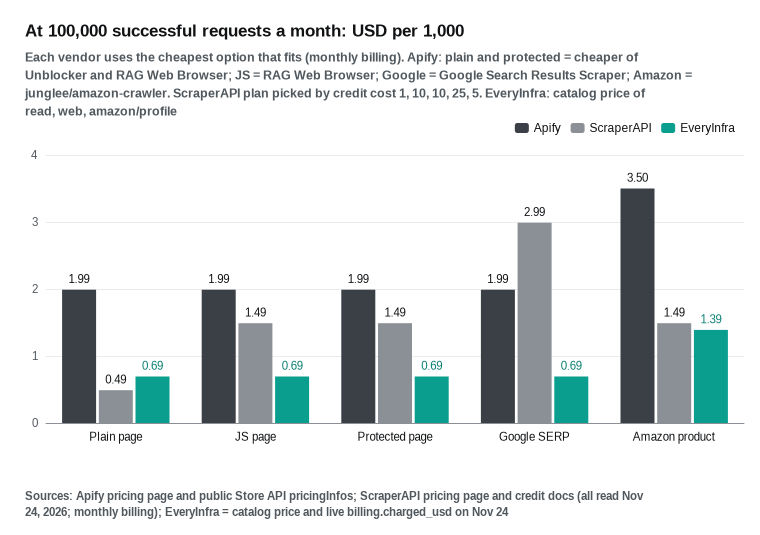
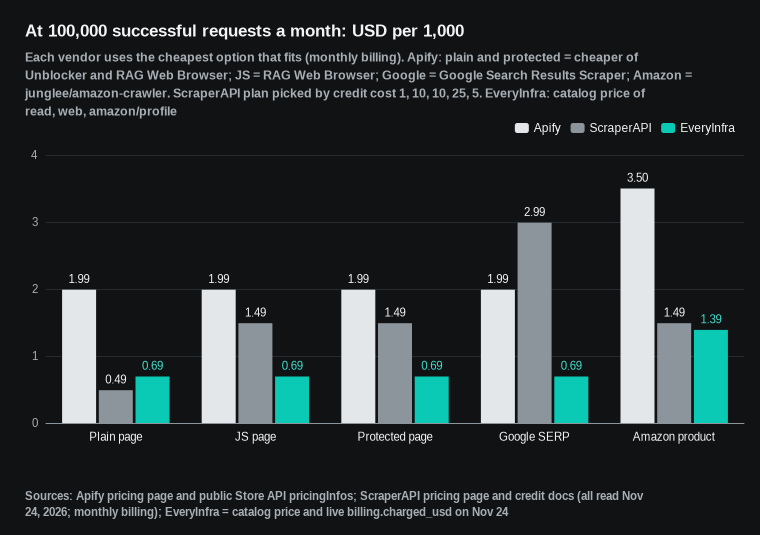
Apify vs ScraperAPI at 100k requests a month, per 1,000 (Apify first): plain pages $1.99 vs $0.49, Google $1.99 vs $2.99, Amazon $3.50 vs $1.49.

At 100,000 successful requests a month, plain web pages cost $0.49 per 1,000 on ScraperAPI and $1.99 on Apify. Google results pages go the other way: $1.99 on Apify and $2.99 on ScraperAPI. Amazon products cost $1.49 on ScraperAPI and $3.50 on Apify. We read both pricing pages, the ScraperAPI credit docs and the public Apify Store API from 00:13 SGT on 2026-11-24. A script then picked the cheapest plan that fits each volume.
For Amazon, our break-even point does not match the public comparison pages. The difference is the Starter usage limit, and Apify describes it in two ways.
The subscription docs say each plan has a "maximum usage limit", $100 on Starter. A help center article says the limit is the most you can spend "beyond your prepaid credits". If total usage stops at $100, ScraperAPI stays cheaper from 25,250 products a month. If only the overage stops at $100, the point is 30,000. In both readings, the third-party figure of 37,250 is too late.
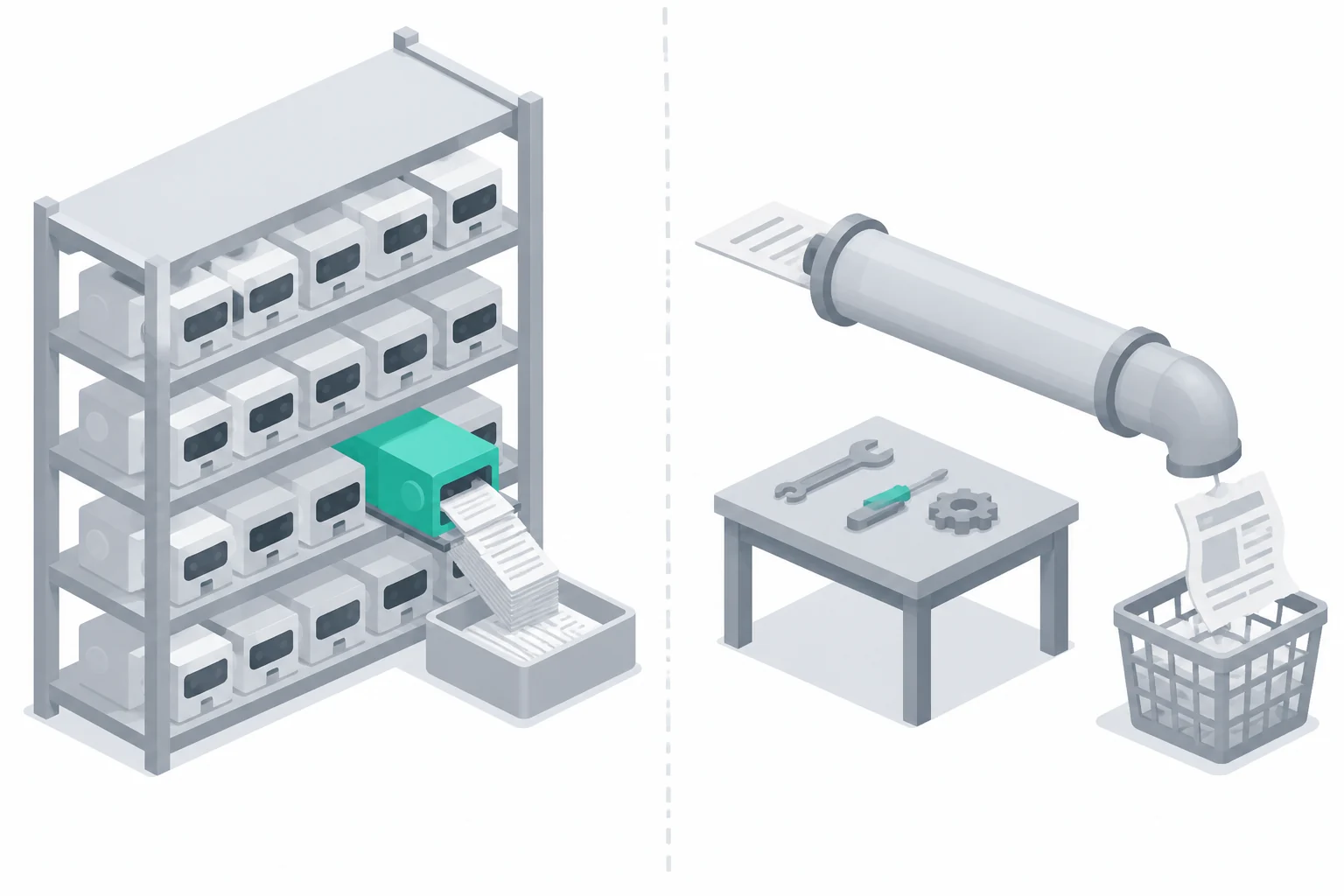
Both vendors get you web data, but they start from opposite ends. ScraperAPI is a proxy-style API: you send a URL and get the page back. It rotates IPs, renders JavaScript and gets past bot walls. It charges in credits, and the HTML parsing is your job.
Apify is a cloud platform that runs scraping programs called actors. Its Store has ready-made actors for Google, Amazon and social sites, priced per result or per event. You can also deploy your own scraper and pay for compute units. For 1,000 Amazon products, an Apify actor takes one input and returns one JSON file. ScraperAPI takes 1,000 requests, and you parse the HTML. So we convert every price to one unit: US dollars per 1,000 successful requests or results.
Apify vs ScraperAPI in one table
We read the vendor figures between 00:13 and 00:30 SGT on 2026-11-24. The sources are pricing pages, docs and the public Store endpoint api.apify.com/v2/acts/<author>~<name>. That endpoint returns a pricingInfos field and needs no account. We did not open accounts with either vendor, so their figures are list prices, not invoices.
The EveryInfra column uses catalog prices and the billing.charged_usd field from real calls on the same day. It shows the closest tool, and the output differs. The read tool returns body text as Markdown. The amazon/profile action returns fixed fields. Neither returns raw HTML.
| Item | Apify | ScraperAPI | EveryInfra |
|---|---|---|---|
| Billing unit | Plan fee buys usage; Store actors charge per event; your own actors use compute units (1 GB for 1 hour) | Credits in a plan, multiplied by domain and parameter | Per call, USD |
| Monthly fee | Free $0 ($5 usage); Starter $19; Scale $199; Business $999 | Free 1,000 credits; Hobby $49; Startup $149; Business $299; Scaling $475; Professional $975; Advanced $1,975 | None |
| Free allowance | $5 usage, reset monthly | 7-day trial, 5,000 credits; then 1,000 credits a month | Shown in the console |
| Plain page (per 1k, 100k/mo) | $1.99 (Scale; Unblocker usage $125) | $0.49 (Hobby) | $0.694 (read) |
| JS-rendered page | $1.99 (RAG Web Browser) | $1.49 (Startup, 10 credits) | $0.694 |
| Protected page | $1.99 | $1.49 (10 credits) | $0.694 |
| Google results page | $1.99 (Google Search Results Scraper) | $2.99 (Business, 25 credits) | $0.694 (web) |
| Amazon product | $3.50 (junglee/amazon-crawler) | $1.49 (Startup, 5 credits) | $1.389 (amazon/profile) |
| Failed requests | Event actors charge only when the event happens; usage actors burn memory on retries | 200 and 404 charged; other failures free | 422, 404, empty result: $0 in our tests |
| Concurrency | Actor runs: 5 / 32 / 128 / 256 | Requests: 5 on Free, 20 to 500 on paid plans | Rate limit per key |
| Remote MCP | mcp.apify.com | mcp.scraperapi.com/mcp | api.everyinfra.com/mcp |
Every per-1,000 price uses one method. We take 100,000 successful requests a month and find each vendor's cheapest way to pay. On Apify the bill is the larger of the plan fee and actual usage. On ScraperAPI it is the cheapest plan with enough credits. This method favors users who fill their plan. At a plan edge the unit price jumps: 11,000 JS pages a month need ScraperAPI Startup at $149, about $13.5 per 1,000.
How each vendor charges
ScraperAPI has one layer: a monthly pack of credits. Each request uses credits based on the domain and the parameters. The credit docs list the domain multipliers. A normal site costs 1 credit. Amazon, Walmart and eBay cost 5. Google and Bing cost 25, and LinkedIn costs 30.
The parameter multipliers come next. render=true, premium=true and screenshots cost 10 each. premium plus render costs 25. ultra_premium costs 30, or 75 with rendering. Requests that must get past Cloudflare, DataDome, PerimeterX or Akamai cost 10. Country, session, device type and autoparse add nothing.
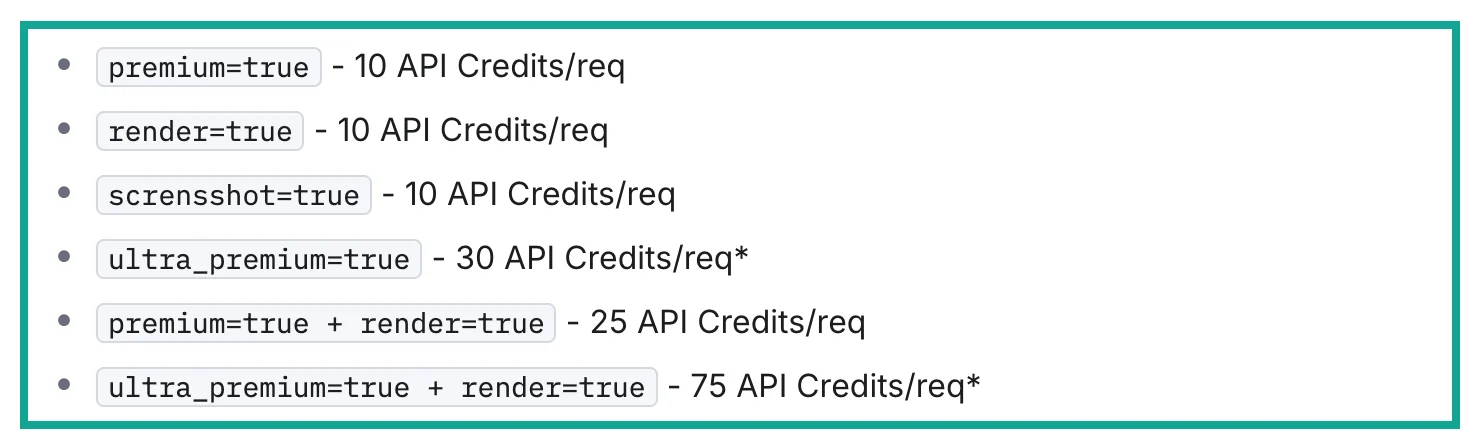
The sa-credit-cost response header shows the cost of each request. The max_cost parameter caps it and returns 403 above the cap (cost control docs). Two details need care. The docs table gives protected sites "10 per scrape", but the pricing FAQ says "add 10". The parameter list also spells the screenshot parameter scrensshot=true. Pay-as-you-go starts on Scaling, and pricing.md does not publish its per-credit rate.
Apify has three layers, as its pricing file explains. Layer one is the plan, where the fee is prepaid usage that expires each month. Layer two is the price of each Store actor. Most actors charge per event, such as "one result returned", with tiers Free, Bronze, Silver and Gold. Starter maps to Bronze, Scale to Silver and Business to Gold. Layer three is platform usage: compute units, proxy, storage and data transfer.
| Item | Free | Starter | Scale | Business |
|---|---|---|---|---|
| Fee / included usage | $0 / $5 | $19 / $19 | $199 / $199 | $999 / $999 |
| Store tier | Free | Bronze | Silver | Gold |
| Compute unit | $0.2 | $0.2 | $0.16 | $0.13 |
| Residential proxy | $8 / GB | $8 / GB | $7.5 / GB | $7 / GB |
| SERPs proxy | $2.5 / 1k | $2.5 / 1k | $2 / 1k | $1.7 / 1k |
| Unblocker (pricing page) | $1.5 / 1k | $1.5 / 1k | $1.25 / 1k | $1 / 1k |
| Concurrent runs | 5 | 32 | 128 | 256 |
| Usage above the plan | Stops | Pay as you go, $100 at most | Pay as you go | Pay as you go |
The last row has two readings. The pricing file says the Starter plan covers the first $19, "and the rest is pay as you go, up to a usage limit you set (at most $100 on Starter)". The subscription docs say the usage limit "defines how much you can spend in a billing cycle" and list "$100 on Starter, $1,000 on Scale, and $5,000 on Business". With that reading, total Starter usage stops at $100.
The help center article on platform limits, updated 2026-09-04, says the limits "define the maximum amount you can spend beyond your prepaid credits". With that reading, total Starter usage can reach $119. We have no paid account, so we cannot see the largest value the Console accepts. The script runs both readings: calc.py for $100 and calc_cap119.py for $119.
The Scale limit of $1,000 changes no result, because Business is cheaper once Scale usage passes $999. The Business limit of $5,000 does apply. At Gold prices it is reached at about 1.67 million Amazon products, 2.94 million Google pages or 3.76 million JS pages a month. Above that you need an enterprise deal, and the Apify line in the charts is only an extension of the unit price. The compute unit docs define 1 CU as 1 GB of memory for 1 hour. The billing docs add that overage is invoiced at once when it reaches $20 on Starter.
How to calculate cost per 1,000
Both price lists have steps, so hand math misses plan limits. We put the prices from 2026-11-24 into prices.json. A Python script tries every payment option for both vendors at every volume and keeps the cheapest. Free is invalid above $5 of usage, and Starter is invalid above $100 (or $119 in the second run).
# From raw/calc.py: cheapest monthly bill (USD) for n successful requests
def sa_bill(kind, n):
    need = n * SA["credits_per_request"][kind]          # plain 1, js 10, protected 10, google 25, amazon 5
    if need <= SA["free_monthly_credits"]:
        return 0.0, "Free"
    for p in SA["plans"]:                                # Hobby 49/100k ... Advanced 1975/21.5M
        if p["credits"] >= need:
            return float(p["usd"]), p["name"]
    return None, "Enterprise (custom)"

def ap_bill(kind, n, cap=True):
    best = None
    for p in AP["plans"]:                                # Free / Starter / Scale / Business
        usage = n / 1000 * ap_unit(kind, p)
        if cap and p["usage_cap"] is not None and usage > p["usage_cap"]:
            continue                                     # Free caps at $5, Starter at $100
        bill = max(float(p["usd"]), usage) if p["usd"] else (0.0 if usage <= p["included"] else None)
        if bill is not None and (best is None or bill < best[0]):
            best = (round(bill, 2), p["name"], ap_unit(kind, p))
    return best
The function ap_unit picks the Apify unit price for each case. Plain and protected pages use the lower of Unblocker and RAG Web Browser. JS pages use the "Fetched page" event of RAG Web Browser. Google uses the lower of Google Search Results Scraper and the SERPs proxy. Amazon uses the "Result" event of junglee/amazon-crawler. For example, RAG Web Browser charges $0.0019 per page on Bronze from 2026-10-02.
Plain pages: ScraperAPI is cheaper above 33k a month
A plain page needs no rendering and has no bot wall, so ScraperAPI charges 1 credit. A full Startup plan costs $0.149 per 1,000, and a full Scaling plan $0.095. Apify's cheapest path is its Unblocker proxy at $1.5, $1.25 or $1.0 per 1,000. The other path is RAG Web Browser at $0.0019 a page on Bronze. Both Apify paths are linear, so the gap grows with volume.
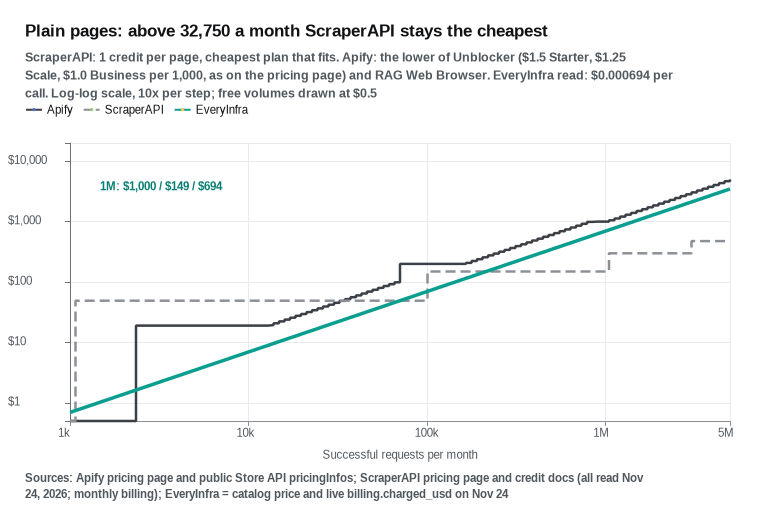
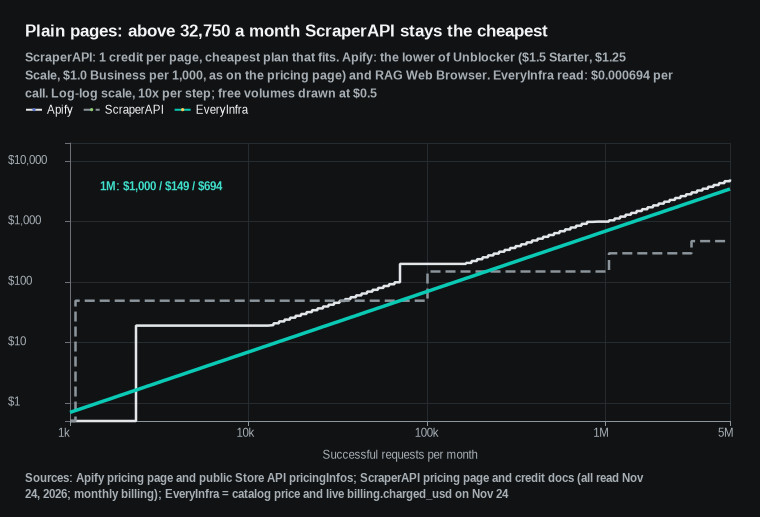
The script checked every 250 requests. From 1,250 to 32,500 a month, Apify is cheaper, because Starter costs $19 and ScraperAPI needs Hobby at $49. From 32,750 on, ScraperAPI stays cheaper. At 1 million it is $149 against $1,000, a 6.7x gap.
EveryInfra read costs $694 for 1 million, 4.7x the ScraperAPI Startup price. The difference is the output. read returns clean body text that a model can use directly. ScraperAPI returns raw HTML with every node on the page. For full HTML at volume, ScraperAPI costs less.
One condition applies: the site must stay "plain". ScraperAPI sets the multiplier by domain, so a URL can go from 1 credit to 10 when the site adds Cloudflare. The docs suggest the account/urlcost endpoint to check the price first. Apify Unblocker has one price whatever the protection level.
Apify Unblocker: the pricing page and the docs differ by 10x
The pricing page lists Unblocker at "$1.5 / 1,000 requests" on Starter. The Unblocker docs use a different unit. They say "each successful request consumes 10 units", and units are priced per 1,000.
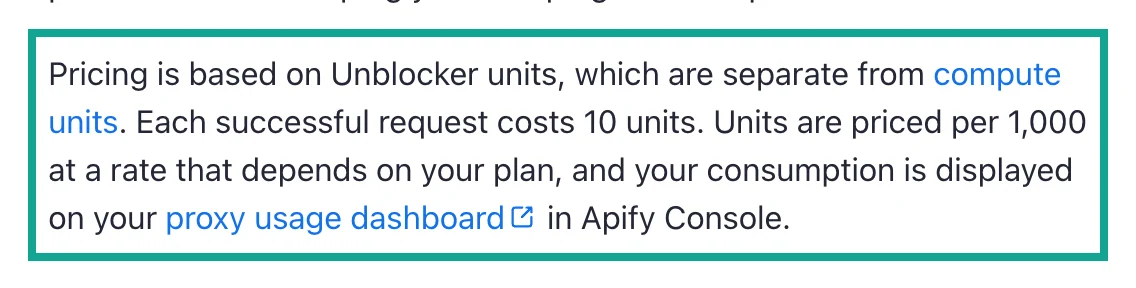
If $1.5 buys 1,000 units, then 1,000 requests cost $15. If $1.5 buys 1,000 requests, the units are only bookkeeping. We use the pricing page text because it names requests. Even with the docs reading, our plain-page price for Apify goes up to $1.90 at most. The script takes the lower of Unblocker and RAG Web Browser.
To find the correct reading, run 100 requests on the free allowance. Then read the unit count in the Console proxy usage panel. Note one more limit from the pricing FAQ. On Free, Apify Proxy works only inside the platform, so external use needs Starter.
JS pages and protected pages: the bill lines cross many times
On ScraperAPI both cases cost 10 credits, so each plan covers 10x fewer requests. Hobby covers 10,000 and Startup covers 100,000. On Apify, JS pages use RAG Web Browser at $1.90, $1.62 or $1.33 per 1,000. Protected pages use the lower of Unblocker and RAG Web Browser.
| Requests a month | JS: Apify | JS: ScraperAPI | Protected: Apify | Protected: ScraperAPI | EveryInfra `read` |
|---|---|---|---|---|---|
| 5,000 | $19 | $49 | $19 | $49 | $3.47 |
| 20,000 | $38 | $149 | $30 | $149 | $13.88 |
| 50,000 | $95 | $149 | $75 | $149 | $34.70 |
| 100,000 | $199 | $149 | $199 | $149 | $69.40 |
| 200,000 | $324 | $299 | $250 | $299 | $138.80 |
| 500,000 | $810 | $475 | $625 | $475 | $347 |
| 1,000,000 | $1,330 | $975 | $1,000 | $975 | $694 |
| 2,000,000 | $2,660 | $1,975 | $2,000 | $1,975 | $1,388 |
For JS pages, Apify is cheaper up to 52,750 a month. At 101,000, ScraperAPI must move to Business at $299, so Apify is cheaper again until 185,000.
This pattern goes on until 2.15 million, where ScraperAPI needs a sales quote. Protected pages cross near 66,750, 101,000, 240,000 and 301,000.
The first crossing in both cases is the Starter limit: at 52,750 JS pages or 66,750 protected pages, Apify usage passes $100. With the $119 reading these points move to 62,750 and 79,500, and the later points stay the same. If your volume moves between 50,000 and 250,000, the gap is $50 to $150 a month.
ScraperAPI has one more variable. premium with render costs 25 credits, and ultra_premium with rendering costs 75. A site that needs residential IPs and a browser gets only 4,000 requests on Hobby. EveryInfra read has one price, $0.000694, so it is the lowest in every row. It returns body text, not HTML.
Google results: Apify is cheaper at every volume
On ScraperAPI, Google costs 25 credits, so Startup covers only 40,000 searches. Even Advanced covers only 860,000. On Apify we use Google Search Results Scraper. Its page event costs $0.0045 on Free and $0.0025 on Bronze from 2026-10-07. It has 240,973 total users and 27,062 in the last 30 days.
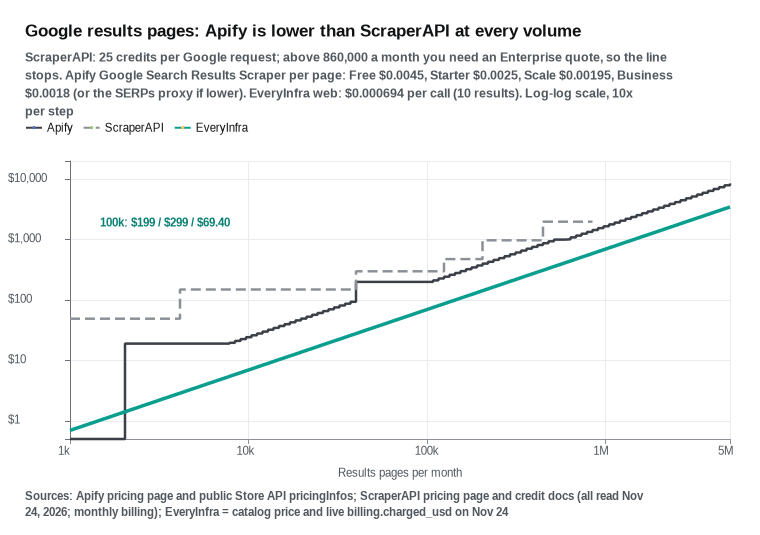
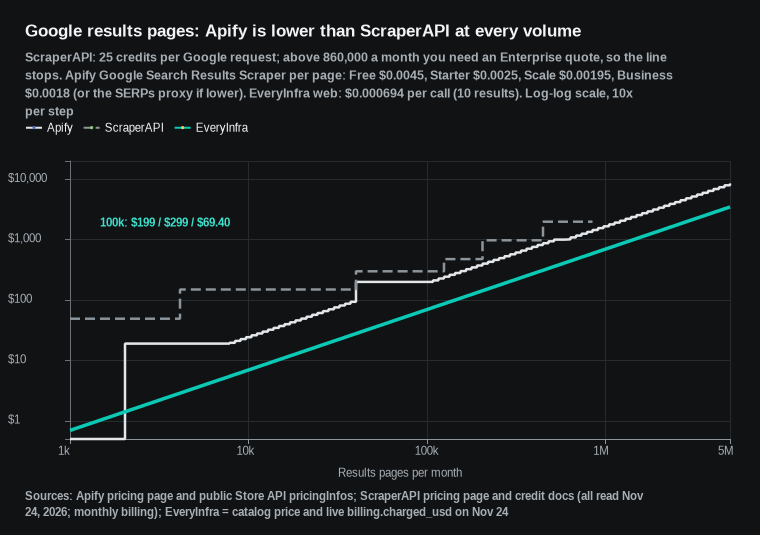
Apify is cheaper at every volume. At 10,000 pages it is $25 against $149, and at 500,000 it is $975 against $1,975. The ScraperAPI Google SERP API returns JSON at the same 25 credits. The Apify actor also offers add-ons such as AI Overview and ads. The ads add-on charges for every page "regardless of whether ads are present". AI mode add-ons cost $0.2 each on Free, 44x the page price.
EveryInfra web costs $0.000694 a page with 10 results, or $69.40 for 100,000 pages. That is 2.9x below Apify and 4.3x below ScraperAPI. We called it at 00:15 and 00:30 SGT, and both calls returned 10 results. It returns titles, links and snippets only. For ad slots and related questions, use the Apify actor or the ScraperAPI endpoint.
27 price records for Google Search Results Scraper
The pricingInfos field is a list, and each price change adds a record. On 2026-11-24 this actor had 27 records from 2024-05-14 to 2026-10-07. The Get Actor API docs describe the endpoint, and it needs no token. Its stats field gives total users and users in the last 30 days.
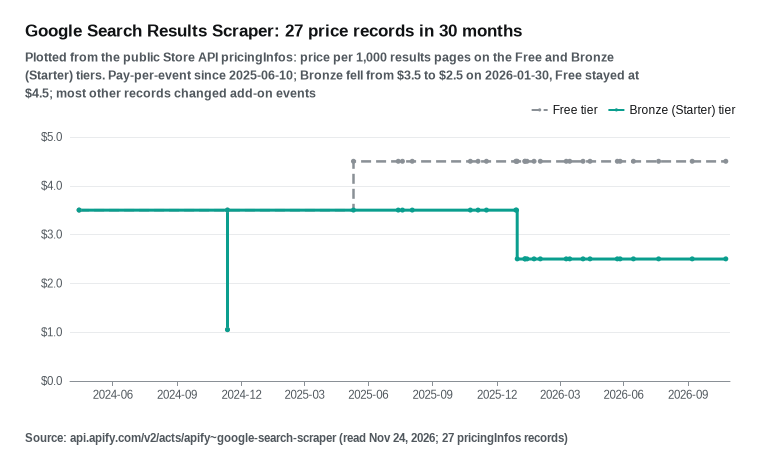
The actor moved to pay-per-event on 2025-06-10. On 2026-01-30 the Bronze price fell from $3.5 to $2.5 per 1,000 pages. The other records changed add-on events, not the page price. Apify prices are set per actor, and the author can change them. The Store docs promise notice before a change. A Google comparison from before January 2026 overstates the Bronze price by 40%.
Amazon products: the Starter limit moves the break-even to 25,250 or 30,000
On ScraperAPI, Amazon costs 5 credits in the "E-commerce" group of pricing.md. The Amazon Product API returns JSON at the same multiplier. On Apify we use junglee/amazon-crawler. Each result costs $0.005 on Free, $0.004 on Bronze, $0.0035 on Silver and $0.003 on Gold. Until 2026-04-14 it was a monthly rental at $40.
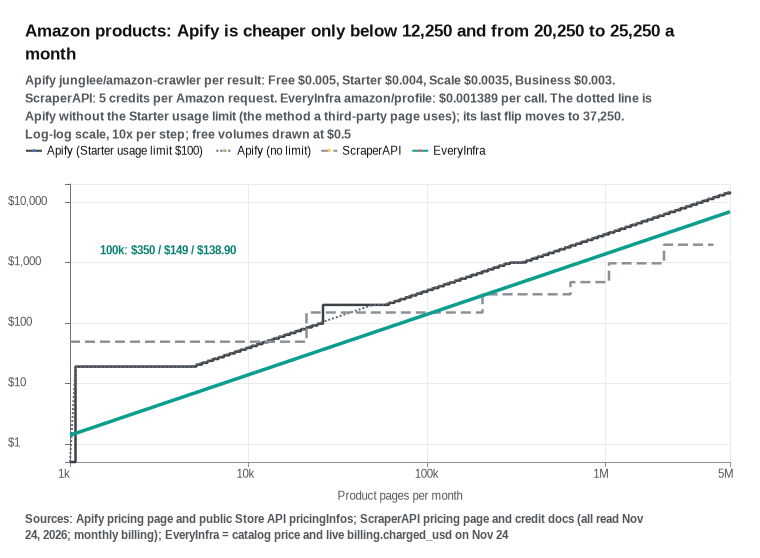
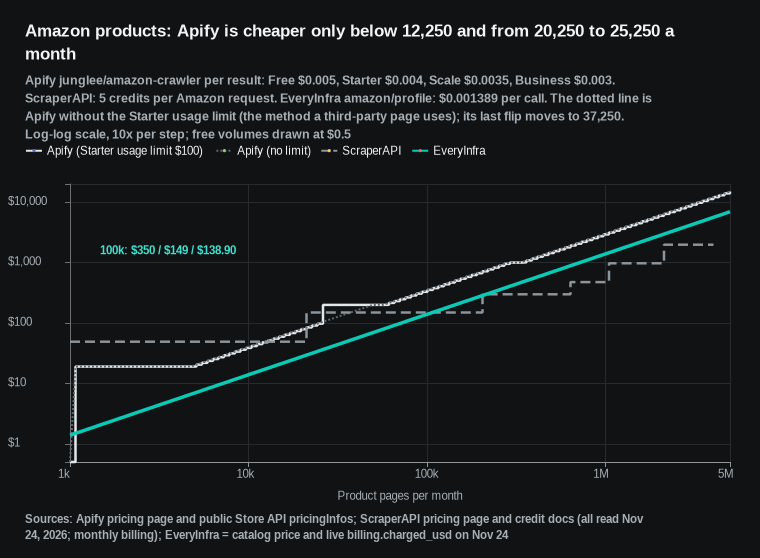
The use-apify.com comparison used prices from 2026-09-09. Its table marks 12,250 products as "tie, first crossover" and 37,250 as "tie, second crossover". Its title, "$60 vs $49 for 15k Amazon URLs", matches our script: 15,000 products cost $60 on Apify Starter and $49 on ScraperAPI Hobby. Our first crossing also matches: at 12,250, Apify usage is $49, the same as ScraperAPI Hobby.
The second crossing does not match, because of the Starter limit. If total usage stops at $100, Starter covers 25,000 products at $0.004 each. Above that you need Scale at $199, while ScraperAPI Startup costs $149, so ScraperAPI is cheaper from 25,250. If only the overage stops at $100, Starter covers 29,750 products and the point is 30,000. At 37,250 the third-party table shows Apify Starter at $149, which is above the Starter limit in both readings. The dotted line shows the uncapped result.
| Products a month | Apify ($100 total) | Apify ($119 total) | Apify (no limit) | ScraperAPI | EveryInfra `amazon/profile` |
|---|---|---|---|---|---|
| 5,000 | $20 | $20 | $20 | $49 | $6.95 |
| 12,250 | $49 | $49 | $49 | $49 | $17.02 |
| 20,000 | $80 | $80 | $80 | $49 | $27.78 |
| 25,250 | $199 | $101 | $101 | $149 | $35.07 |
| 30,000 | $199 | $199 | $120 | $149 | $41.67 |
| 37,250 | $199 | $199 | $149 | $149 | $51.74 |
| 100,000 | $350 | $350 | $350 | $149 | $138.90 |
| 1,000,000 | $3,000 | $3,000 | $3,000 | $475 | $1,389 |
If you are on Starter, open Billing, then Limits, in the Console and check the largest "Custom usage limit" you can set. Without a paid account, plan for 25,250.
EveryInfra amazon/profile costs $0.001389 a call, below both vendors up to 107,271 products. Above that, ScraperAPI Startup is cheaper. At 00:15 SGT we called it once and got 17 fields, such as price, rating, stock and seller. At 00:17, amazon/search for "wireless earbuds" returned 10 results for $0.002236, about $0.00022 per product. If list fields such as title, price and rating are enough, search costs about 6x less per product than detail calls. On ScraperAPI, rendering or residential IPs add credits on top of the 5. Check the sa-credit-cost header for each request.
Failures, 404s and empty results
ScraperAPI charges only for successful requests, which means status codes 200 and 404. It also charges for requests you cancel before 70 seconds. The 404 rule matters for bulk product pages, because delisted products always return 404. In a batch of old URLs, the 404 share is money lost.

On Apify, the rule depends on the pricing model. The "Result" event of junglee/amazon-crawler charges "per result returned", so no result means no charge. Usage-based actors such as the Apify Web Scraper and SuperScraper API have no concept of success. Failed retries still use memory and proxy traffic, as the pricing file notes.
We tested three cases on EveryInfra. At 00:17 SGT, an unsupported gl parameter returned 422 unknown_param with "Nothing was charged". At 00:29, read on a missing URL returned 404 target_not_found with request_failed_refunded. At 00:30, reddit/search with no results returned 200 with empty_result_refunded. All three cost $0.
Concurrency, free allowances and running out
The vendors measure concurrency differently. ScraperAPI counts HTTP requests in flight: 20 on Hobby up to 500 on Advanced. Above the limit you get a rate-limit error and no charge.
Apify counts actor runs: 32 on Starter, 128 on Scale and 256 on Business. Each run can send hundreds of requests, limited by memory (limits docs). On 2026-09-09 use-apify.com found 25 runs for Free in the limits docs and 5 on the pricing page. On 2026-11-24 the limits table shows 5, 32, 128 and 256, the same as the pricing page.
| Item | Apify | ScraperAPI |
|---|---|---|
| Trial | No trial; Free gives $5 every month | 7 days, 5,000 credits, no card |
| Free forever | $5 usage a month | 1,000 credits a month, 5 threads |
| Amazon products for free | About 1,000 | About 1,000 in the trial, then 200 a month |
| Google pages for free | About 1,111 | 200 in the trial, then 40 a month |
| When it runs out | Free stops; Starter capped at $100 | Stop or upgrade; pay as you go from Scaling |
| Rollover | No | No |
| Refund | Not stated | 7-day refund |
| Country targeting | All plans | Hobby and Startup: US and EU only |
The country row matters. ScraperAPI Hobby and Startup offer only "US & EU" targeting. To scrape local sites in Japan or Brazil, you need Business at $299.
Apify proxies take a country on all plans. The residential proxy takes a code such as country-JP in the username. The datacenter proxy has shared and dedicated groups. For multi-country price tracking, recalculate with this rule.
SuperScraper: ScraperAPI parameters at a higher unit price
SuperScraper API accepts the parameters of ScraperAPI and other proxy-style APIs. It runs as a Server Actor and takes requests like a REST API. The ScraperAPI parameters render, premium, ultra_premium and country_code work as they are. It ignores session_number and autoparse. The Apify blog calls it a "potentially cheaper drop-in replacement".
Apify gives free-account estimates per 1,000: $1 without rendering and $5 with rendering and residential proxies. A full ScraperAPI plan costs $0.49 for plain pages and $1.49 for rendered pages. So by Apify's own estimates, SuperScraper costs more at volume. It helps at small volumes and when you want Apify datasets and scheduling.
The Store API on 2026-11-24 shows 1,133 total users and 43 in the last 30 days. RAG Web Browser had 214,494 and 23,545 on the same day. The repo apify/super-scraper has 45 stars and no license file. Before production, run 100 of your own URLs and check the usage.
Server Actors and spending limits
The Server Actors docs describe two billing types. A multi-tenant Server Actor runs in the developer's account, and you pay only for its events. A single-tenant one runs in your account, and you pay platform usage plus events. The docs warn that a run uses resources while it waits for requests. So you can get a bill with no requests.
A Server Actor request must get its first response within 5 minutes. The rate limit per account is the same on all standard plans (header X-RateLimit-Limit). For long jobs on ScraperAPI, use its async API.
Both vendors can cap the cost. ScraperAPI uses max_cost per request. Apify lets you set a maximum cost per run, and the platform aborts the run at the limit (pay-per-event docs). The run uses a little more platform time before it stops. On Free, Apify pays the platform usage of pay-per-event actors, so you pay only the events.
Results storage and open-source parts
ScraperAPI sends the page to your code, and storage is your job. Apify writes results to a dataset that exports to JSON, CSV, Excel and more. Named datasets stay forever. Unnamed datasets expire after 7 days by default, so name them for long jobs.
Apify maintains Crawlee, with 26,526 GitHub stars and a push on 2026-11-23. Its MCP server, apify-mcp-server, has 17,561 stars. The ScraperAPI local MCP server, scraperapi-mcp, has 5 stars and a last push on 2026-07-17. A Crawlee scraper can run on Apify, or on your server through the ScraperAPI proxy. Neither path needs a rewrite.
MCP and AI tools
Both vendors expose tools under the MCP specification. The ScraperAPI MCP docs offer a remote server or a local one in Python or Docker. Each call uses the same credit multipliers. The docs have pages for Claude Code, Cursor, n8n and LangChain.
The Apify MCP docs describe a hosted server with OAuth or a Bearer token. It exposes Store actors as tools and tells the model which output fields to expect. Search tools work without sign-in. Apify also lets AI agents prepay over x402 or MPP without an account (agents.md).
{
  "mcpServers": {
    "apify": { "url": "https://mcp.apify.com" },
    "scraperapi": { "url": "https://mcp.scraperapi.com/mcp" },
    "everyinfra": {
      "url": "https://api.everyinfra.com/mcp",
      "headers": { "Authorization": "Bearer ${EVERYINFRA_API_KEY}" }
    }
  }
}
This sample config uses the addresses from each vendor's docs. We did not connect to the two vendor servers in a client. The use-apify.com page lists ScraperAPI MCP as "none", which is out of date.
Agent bills take different shapes. Take one search plus 5 page reads. On ScraperAPI that is 30 credits, about $0.0045 on a full Startup plan. On Apify it is about $0.012 plus a start fee per run. On EveryInfra it is 6 calls at $0.000694, or $0.0042.
The AIMultiple agentic data benchmark, updated 2026-11-13, connected several data services to one agent through their MCP servers. The agent was Claude Haiku 5.5 at high reasoning effort. It ran 200 questions with one checkable answer each, 3 times per question. On 100 open-data questions, Apify was 90% correct and cost $8.75, with $8.33 in actor fees and $0.42 in model cost. On 100 questions about public Instagram, X, Facebook and YouTube accounts, it was 98% correct for $1.11. The benchmark did not test ScraperAPI.
Code changes: how you call each vendor
| Method | What you change | Notes |
|---|---|---|
| ScraperAPI proxy mode | Proxy address proxy-server.scraperapi.com:8001; parameters in the username | Docs example uses -k; your request code stays the same |
| ScraperAPI API mode | Send the target as the url parameter | Response body is the page |
| ScraperAPI price check | Call account/urlcost with the same parameters | Returns the price only |
| Apify sync run | POST the actor input to run-sync-get-dataset-items | 300-second server limit |
| Apify Proxy | Point the exit to Apify Proxy; group and country in the username | Needs Starter for external use |
The cost control docs give the username example scraperapi.premium=true.max_cost=5. The quickstart for AI agents describes the sync endpoint and its 300-second limit. For longer jobs, start a run and poll for the results.
If you have your own scraper and parser, ScraperAPI proxy mode is mostly a config change. An Apify actor replaces your parser, but you must map its output fields. To move from an actor to ScraperAPI, you must add parsing and retries. EveryInfra works like the Apify sync endpoint: one POST, fixed fields back.
EveryInfra tests: three times, nine data calls
We made three rounds of calls at 00:15, 00:17 and 00:29 SGT on 2026-11-24. Each charge comes from billing.charged_usd, and each matched the catalog price we read at 00:14.
| SGT | Call | Result | charged_usd |
|---|---|---|---|
| 00:15:00 | web, q=apify vs scraperapi | 200, 10 results | 0.000694 |
| 00:15:05 | read, react.dev/learn (JS site) | 200, 1 body text | 0.000694 |
| 00:15:06 | amazon/profile, an AirPods product | 200, 17 fields | 0.001389 |
| 00:17:15 | amazon/search, wireless earbuds | 200, 10 results | 0.002236 |
| 00:17:42 | web with an extra gl parameter | 422 unknown_param | 0 |
| 00:29:19 | read, G2 Apify reviews (protected) | 200, 18,223 characters; one URL only, not a success rate | 0.000694 |
| 00:29:28 | read, a missing docs URL | 404 target_not_found | 0 |
| 00:30:15 | web, q=web scraping api pricing | 200, 10 results | 0.000694 |
| 00:30:17 | reddit/search, apify scraperapi | 200, 0 results | 0 |
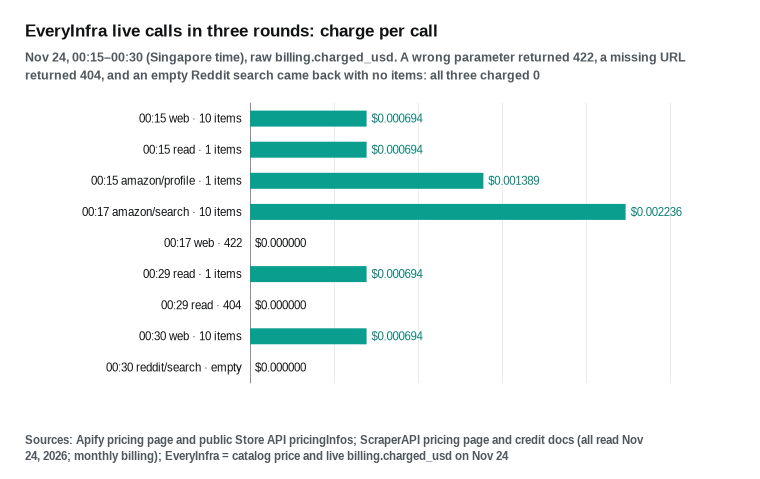
The 9 calls cost $0.006401 in total. Here is the Amazon search request. Its 19 fields, such as asin, price and rating, match response_fields in the catalog.
curl -s https://api.everyinfra.com/api/v1/social \
  -H "Authorization: Bearer $EVERYINFRA_API_KEY" \
  -H "Content-Type: application/json" \
  -d '{"platform":"amazon","action":"search","params":{"keyword":"wireless earbuds"}}'
# returns results[] with 10 items; billing.charged_usd = 0.002236
Public comparison pages and videos vs the source text
We used youtube/search for "apify vs scraperapi" and pulled transcripts from the 3 most relevant videos. We also checked the top web pages against the source text of 2026-11-24.
| Source | Claim | Source text on 2026-11-24 | What it means |
|---|---|---|---|
| use-apify.com | Amazon crossing at 37,250 | Starter limit of $100: 25,250 (total) or 30,000 (overage) | Apify up to 37,250 costs $50 more a month |
| Same | ScraperAPI has no MCP | Docs list mcp.scraperapi.com/mcp | Both connect to AI tools |
| Same | Free gets 25 concurrent runs | Limits docs say 5 | Plan for 5 |
| Apify blog | ScraperAPI has no integrations | Docs have n8n, LangChain and MCP | Both connect to workflow tools |
| Video uAZuLOyFJS8 (2026-11-07) | Multipliers 1, 5, 25, 30 | Correct; no 404 or country rule | Old URLs and other countries cost more |
| Video YKs-I-2K1Rg | After the move, a similar price to the old proxy-style API | $1 to $5 per 1,000 vs $0.49 to $1.49 on full ScraperAPI plans | No saving at volume |
The video on the Apify Web Scraper actor shows run modes. Development mode shows the scrape in Chrome DevTools, so use it on the first run. Then switch to Production and click "Schedule" for regular runs. The video says the Store has 2,000 tools. On 2026-11-24 the pricing page button says "Browse 131,507 Actors".
The SuperScraper video shows the move from another vendor. You change the request address and use the personal token from the Console "Integrations" page. Since 2026-11-16, tokens show only once, when you create them. So you cannot copy an old token as the video shows. Create a new one and store it.
Industry updates (last 60 days)
| Date | Event | What it means for you |
|---|---|---|
| 2026-11-09 to 2026-11-20 | Apify handled an account credential incident. It now stores API tokens only as hashes and shows them only once, and it suggests setting "General resource access" to Restricted. A preliminary report came out on 2026-11-20 (status page, BleepingComputer) | Check integration tokens and storage access settings |
| 2026-10-30 | Latest revision of the ScraperAPI credit docs, per the page metadata | Check your URLs with account/urlcost before a large batch |
| 2026-10-13 | Latest change to the ScraperAPI pricing page, per its dateModified field | Hobby and Startup are still US and EU only |
| 2026-10-07 | Latest Google Search Results Scraper price change | Page price unchanged |
Monthly bill for a price-tracking team (example)
A team checks 2,000 Amazon products a day and 300 Google keywords a day. It also reads 1,000 competitor pages a day, 30% behind Cloudflare. In 30 days that is 60,000 Amazon requests, 9,000 Google pages, 21,000 plain pages and 9,000 protected pages.
| Option | Amazon 60k | Google 9k | Plain 21k | Protected 9k | Monthly bill |
|---|---|---|---|---|---|
| ScraperAPI (shared credits) | 300,000 | 225,000 | 21,000 | 90,000 | 636,000 credits → Startup $149 |
| Apify (Scale) | $210 | $17.55 | $26.25 | $11.25 | $265.05 |
| EveryInfra | $83.34 | $6.25 | $14.57 | $6.25 | $110.41 |
On ScraperAPI all four types share one credit pack, and 636,000 credits fit in Startup. On Apify, usage is above the $100 Starter cap, so the team needs Scale. If Google keywords grow to 2,000 a day, ScraperAPI needs 1.9 million credits and Business at $299. Apify and EveryInfra grow in a straight line, by $99.45 and $35.39.
When to choose Apify and when to choose ScraperAPI
| Your situation | Better choice | Why |
|---|---|---|
| A ready-made actor exists and you do not want a parser | Apify | One input, JSON output |
| Small volume, a few thousand a month | Apify | Starter $19 vs Hobby $49 |
| You need scheduling, datasets or Zapier and n8n links | Apify | Built into the platform |
| Google results pages at any volume | Apify | Cheaper at every volume |
| Your scraper and parser already work | ScraperAPI | Change the proxy address only |
| Plain pages above 33,000 a month | ScraperAPI | $0.149 per 1,000 on full Startup |
| Amazon above 25,250 a month (30,000 with the overage reading) | ScraperAPI | $149 Startup vs $199 Scale |
| Many countries on a small budget | Apify | ScraperAPI Hobby is US and EU only |
Neither vendor fits well in one case. You need structured social or ecommerce fields, you do not want a parser, and you need up to about 100,000 a month. Here EveryInfra costs $0.000694 per Google page and $0.001389 per Amazon product, with no monthly fee. Its limits: only catalog platforms, fixed fields, no raw HTML, no code hosting.
When both vendors fit better than EveryInfra
For full HTML of plain pages at high volume, ScraperAPI costs $0.095 to $0.149 per 1,000, and our read costs $0.694. Above 107,000 Amazon products a month, ScraperAPI is cheaper. For sites outside our catalog, the Apify pricing page lists 131,507 actors and ScraperAPI fetches any URL. To host your own scraper code, use Apify. For Google ad slots and AI Overview, use the Apify actor or the ScraperAPI endpoint.
EveryInfra fits a narrow band. It suits teams that need fixed fields from listed platforms at low to medium volume, with no monthly plan. Outside that band, pick one of the two vendors with the tables above. Then test it on your own URLs for one week before you commit to a plan. A one-week test shows your real share of 404s, retries and protected pages. Those three numbers change the bill more than the list price does.
FAQ
Apify vs ScraperAPI: which one is cheaper?
It depends on the case and the volume. At 100,000 a month, ScraperAPI is cheaper for plain, JS, protected and Amazon pages. Apify is cheaper for Google results. At a few thousand a month, the $19 Apify Starter usually beats the $49 ScraperAPI Hobby.
What is the difference between Apify and Scrapy?
Scrapy is a free Python framework that runs on your machine, and you set up proxies and storage. Apify is a hosted platform that can run Scrapy code. ScraperAPI can act as the proxy exit for Scrapy.
What does Reddit say about ScraperAPI?
The posts we found on 2026-11-24 are mostly ranking lists. A post in r/Agrtech says ScraperAPI suits general use and Apify suits custom workflows. It shows no bills. Our reddit/search for "apify scraperapi" returned 0 results.
Does ScraperAPI charge for a 404?
Yes. The credit docs say it charges for 200 and 404, and for requests you cancel before 70 seconds. Apify event actors charge no result fee when they return no result.
Can I move from ScraperAPI to Apify directly?
Yes, with SuperScraper API. In the Apify migration video, only two things change: the request address and the token. It ignores session_number and autoparse. At high volume it costs more than a full ScraperAPI plan.
Getting started
To compare the three with your own workload, follow these steps:
- Open the EveryInfra market page and find your platform.
- For Amazon, open Amazon Scraper API, product details and keyword search.
- For search, open web search and the search tool.
- Get a key from the quickstart and run the curl call on 10 of your products.
- Run the same batch on both vendors' free allowances.
- Divide each cost by the number of successful results.
- To connect an AI tool, use the MCP server page.
Related guides: Apify pricing explained, the Apify pricing calculator and ScraperAPI pricing, plan by plan. For other approaches, see the Apify alternatives guide and the ScraperAPI alternatives guide. See also the ScraperAPI alternative page, Reddit search, YouTube transcripts and our pricing page.
References
- Apify Pricing, Apify, read 2026-11-24
- Apify Pricing (Markdown), Apify, read 2026-11-24
- Google Search Results Scraper public metadata, Apify Store API, read 2026-11-24
- Amazon Product Scraper (junglee/amazon-crawler) public metadata, Apify Store API, read 2026-11-24
- RAG Web Browser public metadata, Apify Store API, read 2026-11-24
- Website Content Crawler public metadata, Apify Store API, read 2026-11-24
- SuperScraper API public metadata, Apify Store API, read 2026-11-24
- Unblocker, Apify docs, read 2026-11-24
- Apify Proxy, Apify docs, read 2026-11-24
- Google SERP proxy, Apify docs, read 2026-11-24
- Compute units, Apify docs, read 2026-11-24
- Actor usage and resources, Apify docs, read 2026-11-24
- Actors in Store, Apify docs, read 2026-11-24
- Limits, Apify docs, read 2026-11-24
- Billing, Apify docs, read 2026-11-24
- Apify MCP server, Apify docs, read 2026-11-24
- Apify quickstart for AI agents, Apify, read 2026-11-24
- apify/super-scraper, GitHub, read 2026-11-24
- ScraperAPI vs. Apify, Apify blog, read 2026-11-24
- Apify Status: security incident updates, Apify, 2026-11-12 to 2026-11-20
- ScraperAPI Pricing (Markdown), ScraperAPI, read 2026-11-24
- Credits and Requests costs, ScraperAPI docs, read 2026-11-24
- Cost Control, ScraperAPI docs, read 2026-11-24
- Supported Parameters, ScraperAPI docs, read 2026-11-24
- Structured Data Endpoints Overview, ScraperAPI docs, read 2026-11-24
- Amazon Product API, ScraperAPI docs, read 2026-11-24
- Google SERP API, ScraperAPI docs, read 2026-11-24
- Async API Overview, ScraperAPI docs, read 2026-11-24
- ScraperAPI Crawler Introduction, ScraperAPI docs, read 2026-11-24
- ScraperAPI MCP Server, ScraperAPI docs, read 2026-11-24
- ScraperAPI docs index llms.txt, ScraperAPI, read 2026-11-24
- Best Apify Alternative in 2026, ScraperAPI, read 2026-11-24
- Apify vs ScraperAPI: $60 vs $49 for 15k Amazon URLs, use-apify.com, prices checked 2026-09-09
- Apify rotates API tokens, prompts 2FA resets after breach, BleepingComputer, 2026-11-12
- Apify subscription plans (Pay as you go, Adjust your usage limit), Apify docs, read 2026-11-24
- Reaching platform limits, Apify help center, updated 2026-09-04, read 2026-11-24
- Agentic Data Benchmark, AIMultiple, updated 2026-11-13, read 2026-11-24
- Apify vs 6 Rivals: Best Web Scraping Tool in 2026?, YouTube, 2026-11-07
- SuperScraper API Tutorial, YouTube (Apify channel)
- How to scrape ANY website with Apify's Web Scraper, YouTube (Apify channel), 2024-08-21
- Best Web Scraping APIs? Here's What I Found, Reddit
- Server Actors, Apify docs, read 2026-11-24
- Pay per event, Apify docs, read 2026-11-24
- Dataset, Apify docs, read 2026-11-24
- Residential proxy, Apify docs, read 2026-11-24
- Datacenter proxy, Apify docs, read 2026-11-24
- Get Actor, Apify API docs, read 2026-11-24
- apify/crawlee, GitHub, read 2026-11-24
- apify/apify-mcp-server, GitHub, read 2026-11-24
- scraperapi/scraperapi-mcp, GitHub, read 2026-11-24
- Model Context Protocol Specification, MCP specification, read 2026-11-24
- EveryInfra data catalog, EveryInfra, read 00:14 SGT on 2026-11-24
- EveryInfra search tool catalog, EveryInfra, read 2026-11-24
Reference BL-224