WeChat Official Account Data API in 2026: Official, GitHub or Pay-per-Call
WeChat Official Account API in 2026: the official API reads only your own account, top GitHub tools stopped, and pay-per-call starts at $5.56 per 1,000.

Yes, you can get WeChat Official Account data through an API, and the first question is whose account you want to read. There are three kinds of routes. The first route is the official server API of the WeChat Official Accounts Platform. The second route is an open-source scraper from GitHub.
The third route is a pay-per-call data API. We compare two pay-per-call vendors: EveryInfra, which is our own API, and TikHub. The EveryInfra numbers come from live calls at three times on November 22, 2026. The TikHub numbers come from its public price list; we did not call it.
Each route fits a different job. Use the official API to manage your own account. It can publish posts, read the traffic sources of your own posts and moderate comments. The official API has no endpoint that reads other accounts. Do you want to read public posts, read counts and comments from other accounts in bulk? Then choose between open-source tools and pay-per-call APIs.
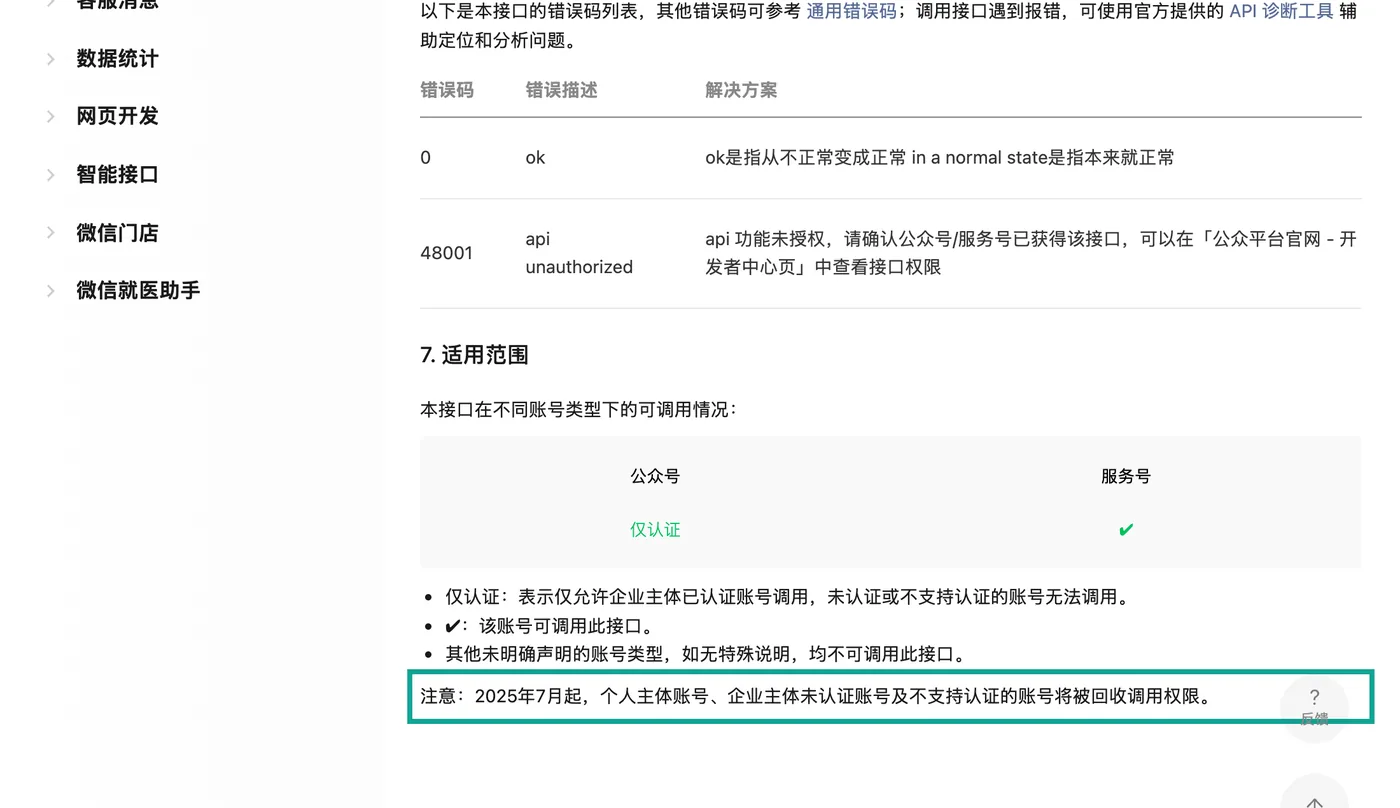
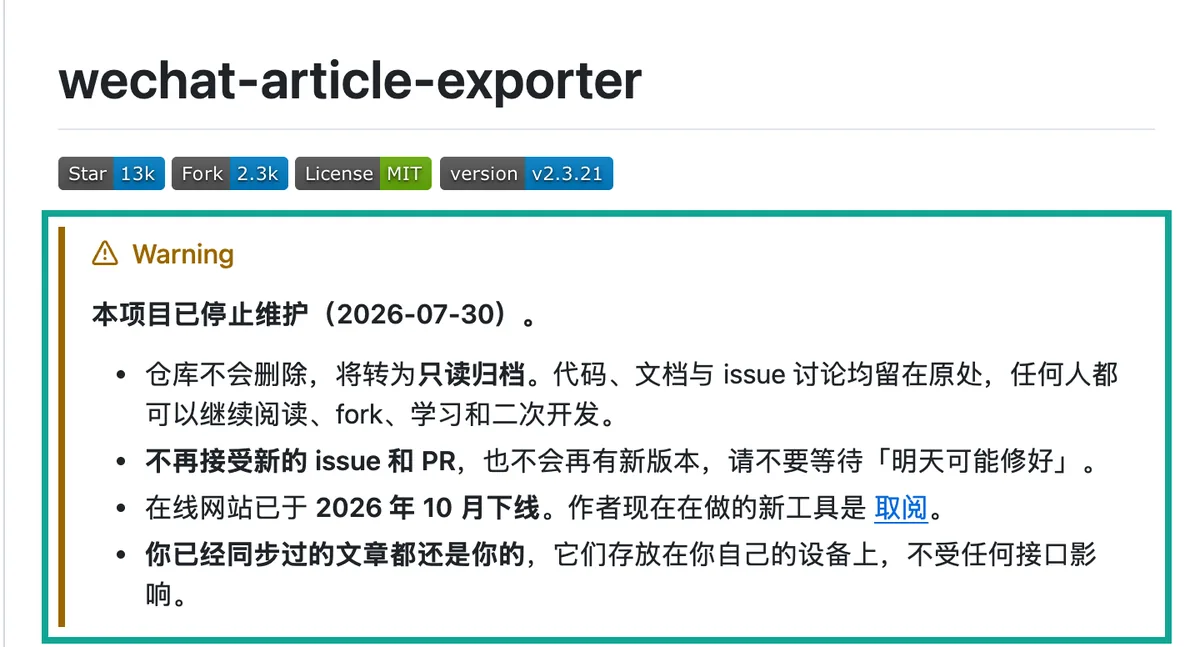
Each of the three routes changed in 2026. The official page for the published-post list was last edited on November 11, 2026. Its scope table says "verified only" for Official Accounts. It also says that from July 2025, WeChat takes back this API from personal accounts and from unverified company accounts. On GitHub, the most-starred export tool, wechat-article-exporter (13,172 stars), stopped on July 30, 2026. Its website closed in October.
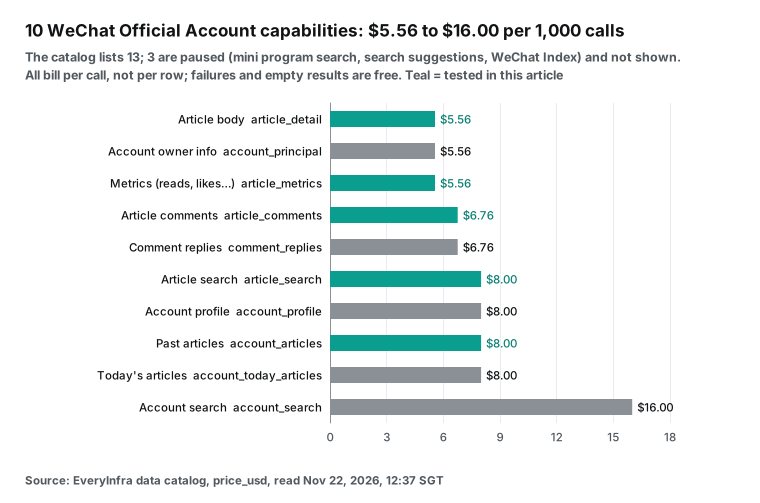
The second, wewe-rss (9,615 stars), is archived. On the pay-per-call side, the EveryInfra catalog lists 13 Official Account capabilities, and 10 are available. They cost $5.56 to $16.00 per 1,000 calls. Billing is per call, not per row. At 12:56 SGT we read the metrics of one health article. The reply gave read_count 100001, 122 "Wow" taps and 3,469 shares, for $0.005556.
What is a WeChat Official Account, and why is its data hard to get?
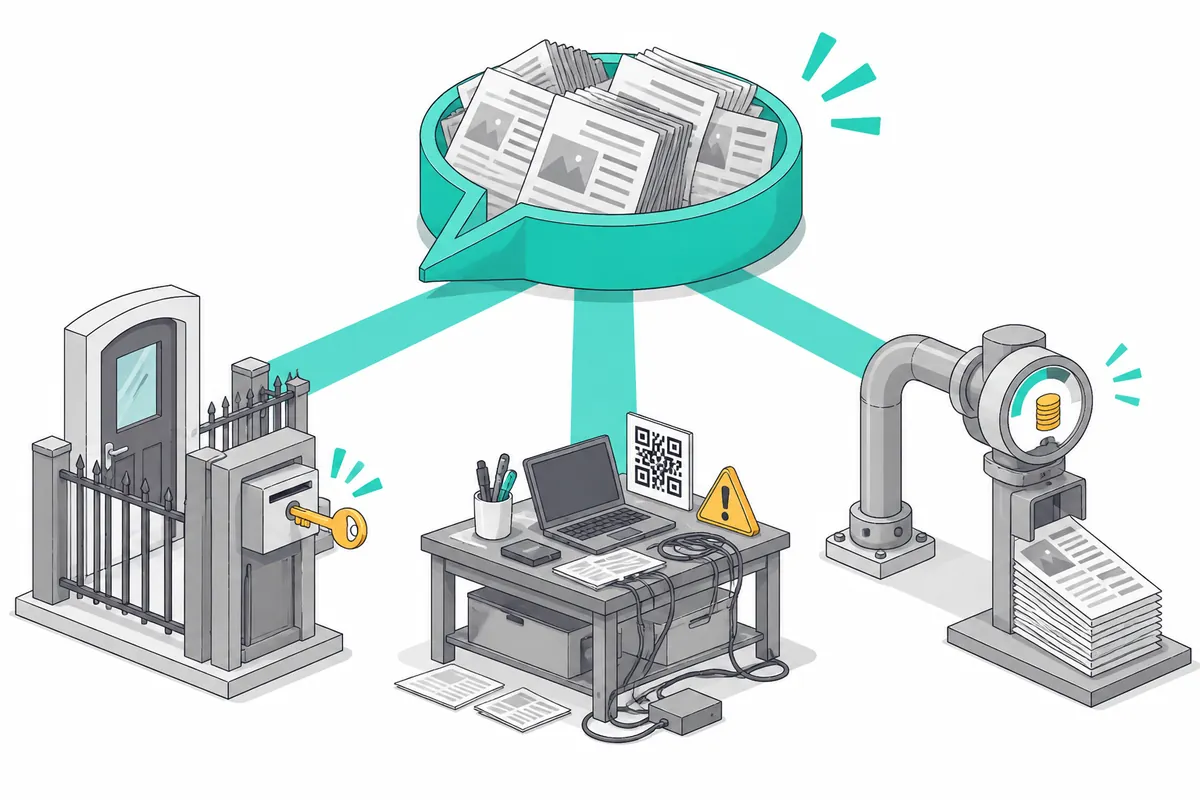
A WeChat Official Account is a publishing account inside WeChat. Brands, media, schools and government offices use it to push articles to followers. The articles live at mp.weixin.qq.com web addresses. You can open one in a normal browser. But the read count, the "Wow" count and the comments load later, through calls that expect the WeChat app. For this reason, the text of one article is easy to get, but the numbers around it are not.
An Official Account is not a personal WeChat account. It is also not WeChat Channels, which is the short video product. WeChat has a separate developer program for mini programs and another for WeChat Pay. Here, "Official Account data" means four things: the list of articles from one account, the article text, the article metrics (reads, likes, "Wow", shares, saves, comment count), and the public comments.
There is one more difference for readers outside mainland China. The official documents are in Chinese. Account verification needs a mainland company or an overseas company that WeChat accepts, and it has a yearly fee. Many open-source tools assume that you run a WeChat client with a Chinese phone number. A pay-per-call API avoids these steps, because you only send an HTTP request with a key.
WeChat Official Account API comparison: one table for all three routes
The official column comes from the WeChat Open Docs, which we read page by page on November 22, 2026. The open-source column comes from the README files of 10 popular projects on GitHub, which we read at 12:44 SGT on the same day. For the two pay-per-call columns, we read EveryInfra prices from its public catalog at 12:37:42 SGT. We read TikHub prices from its public price list, which needs no key, at 12:47:43 SGT, and from its FAQ. For a line-by-line price comparison, read our TikHub alternatives page and TikHub pricing explained.
| Item | Official API (WeChat Official Accounts Platform) | Open-source scrapers on GitHub | TikHub | EveryInfra |
|---|---|---|---|---|
| Whose data | Only your own account (or accounts that authorize your third-party platform) | Any public post, through the account back office search, WeChat Read or the WeChat desktop app | Public posts, accounts, comments | Public posts, accounts, comments, metrics |
| Account and paperwork | Company account with WeChat verification; personal accounts lost the publish API from July 2025 | Most need a QR login to an Official Account or a WeChat Read account | Sign up | Sign up |
| Cookie or session | AppSecret for an access_token; your server IP must be on an allowlist | Yes; scan again when it expires | Post web address or gh_ ID; no cookie from you | No |
| Billing unit | The API is free; verification has a fee | Free; you pay for servers, accounts and upkeep | Per request, charged only on HTTP 200 | Per call, not per row; failures and empty results are free |
| Price per 1,000 calls | None | None | $10.00 (23 entries), $1.00 (1 entry) | $5.56 to $16.00 |
| Daily cap | "List published posts": 100 a day for a new account | Until the account gets blocked | 10 requests per second per endpoint | Per key; the test key here allows 10 a minute |
| MCP | Community MCP servers for your own account, still with your AppSecret | Some offer RSS or an API | Has MCP | Remote MCP, tool names everyinfra_* |
| Best for | Your own account: publishing, traffic sources, comment moderation | Small one-off jobs, if you can fix breaks | Teams that already use its other platforms | Bulk reads of other accounts' posts, reads and comments |
Both pay-per-call vendors bill per call, so first convert prices to one unit. For article text or metrics, one request gives one result, so compare the price per 1,000 calls. For search, comments and article lists, one call gives many rows. The price per 1,000 rows then depends on the number of rows per call. EveryInfra wechat_oa/article_search costs $0.008 per call, and one call can return up to 400 rows.
At 12:38 SGT we searched for "camping" with default settings. We got 18 rows, which is $0.444 per 1,000 rows. If a keyword is popular enough to fill 400 rows, the cost falls to $0.020 per 1,000 rows. The TikHub FAQ says that its WeChat search has no pages: to get more results, you send the same request again and accept some repeats. We did not test how many rows it returns, so the table gives no per-row price for TikHub.
Does WeChat have an official API for Official Accounts?
Yes. The WeChat Official Accounts Platform gives each account a full server API. The documents are at developers.weixin.qq.com. They are now split into one set for Official Accounts (the old "subscription accounts") and one set for Service Accounts. To call the API, you must own an account. You scan a QR code on the WeChat developer platform and get the AppID and the AppSecret.
You add your server IP to an allowlist. Then you call Get access token. The API guide says that a token lasts 2 hours, and a new token makes the old one invalid. It tells you to refresh tokens from one central server. A server IP that is not on the allowlist gets error 61004.
Three groups of endpoints give data, and all three work only on your own account. The first group is publishing. List published posts (/cgi-bin/freepublish/batchget) returns 1 to 20 posts per call, with title, author, summary, HTML body and a deleted flag. Get a published post reads one post by article_id. The second group is statistics. The statistics guide says these endpoints are open to all verified accounts.
The old daily article summary is no longer maintained. The new daily read data splits readers by source: account messages, chats, Moments, recommendations, search and others. It has data only from November 1, 2025, and each call covers one day. The third group is comments. List comments reads comments by the msg_data_id from a mass send. It refuses 50 or more per call, and it returns each commenter's openid.
The scope table on these pages says the same thing: "verified only" for Official Accounts. That means only verified company accounts can call them. The publishing pages add a note. From July 2025, WeChat takes back the API from personal accounts, from unverified company accounts and from accounts that cannot be verified. Here is the original text, captured on November 22, 2026.
| Official endpoint | Path | What you get | What you do not get | Scope for Official Accounts |
|---|---|---|---|---|
| List published posts | /cgi-bin/freepublish/batchget | Title, author, summary, body and deleted flag of your own posts | Other accounts' posts; mass-sent posts with notification (a pinned forum reply says there is no endpoint for them) | Verified only |
| Daily read data | /datacube/getarticleread | Readers per post, split by source, for your own account | Data before Nov 1, 2025; other accounts' reads | Verified only |
| Daily article summary (old) | /datacube/getarticlesummary | Reads, shares and saves | No longer maintained; posts with a total under 3 are not counted | Verified only |
| List comments | /cgi-bin/comment/list | Comments, featured flag, author replies, openid for your own posts | Other accounts' comments; 50 or more per call is refused | Verified only |
| Get access token | /cgi-bin/token | access_token, valid 2 hours | Error 61004 when the IP is not on the allowlist | All accounts |
The note about mass-sent posts comes from a pinned reply on the WeChat developer forum on June 27, 2024. It says that the list endpoint returns only posts published without a push notification. So for an account that pushes most posts to followers, the official API may not list even its own full history. You then copy links by hand from the back office.
How many official calls can you make each day?
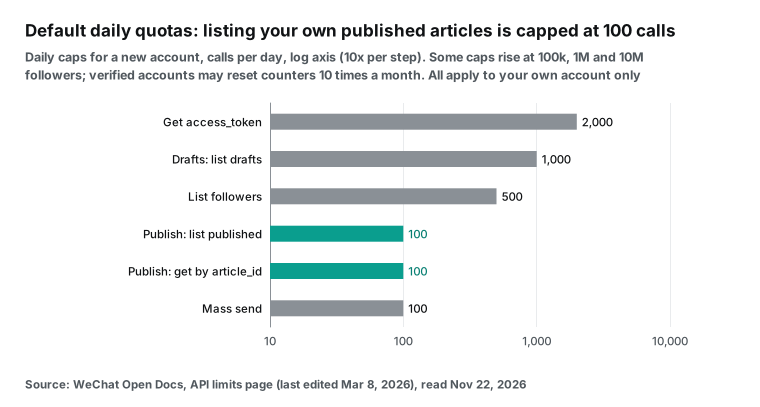
The API limits page gives daily caps for a new account. Get access token: 2,000. List drafts: 1,000. List followers: 500. List published posts and get a published post by article_id: 100 each.
One call lists up to 20 posts. So a new account can list up to 2,000 of its own published posts a day. Most accounts can export their full history in one day. Mass-sent posts with notification are not in this endpoint. Copy those links by hand.
A third-party platform that calls for an account uses that account's own quota. For a team that manages its own account, 100 calls a day is enough. For monitoring other accounts, the number does not matter, because the API returns only your own posts.
When the official route is the right one
For your own account, the official API gives more than any third party. For traffic sources, getarticleread tells you how many readers came from account messages, from Moments or from recommendations. Only the account owner can see this split. No tool that reads public pages has it.
For comments, comment/list returns the commenter's openid, which you can match with your own follower data. A third-party API sees only the public nickname and region. Drafts, publishing and deleting are write actions, and only the official API can do them.
If you do not want to write the code, community MCP servers exist for your own account.
One example is xwang152-jack/wechat-official-account-mcp. Its README says it stores the AppSecret encrypted on your machine. It still calls the official API, so it still reads only your own account.
WeChat article scrapers on GitHub: do they still work?
We searched GitHub for WeChat article scrapers and sorted by stars. We picked 10 projects that read Official Account articles. At 12:44 SGT on November 22, 2026, we read their stars, last commit and license with the GitHub REST API. Then we read each README to see what login it needs. None of the 10 can list the full history of an account, with read counts, without a login or a WeChat session.
| Repository | Stars | Last commit (UTC) | License | How it gets data, and login needs (from the README) | Status |
|---|---|---|---|---|---|
| wechat-article/wechat-article-exporter | 13,172 | 2026-11-09 | MIT | Uses the article search inside the Official Account editor; QR login to an account; reads and comments need captured credentials | Stopped on 2026-07-30; website closed in October |
| cooderl/wewe-rss | 9,615 | 2026-03-20 | MIT | Uses WeChat Read; QR login; the README warns that frequent adds get the account blocked for 24 hours | Archived |
| chyroc/WechatSogou | 6,411 | 2026-10-23 | Apache-2.0 | Sogou WeChat search; no login; captcha retry setting; optional proxy | Still has commits |
| rachelos/we-mp-rss | 5,225 | 2026-11-22 | Custom | Self-hosted service; QR authorization; scheduled updates of followed accounts | Active |
| wnma3mz/wechat_articles_spider | 3,486 | 2024-04-18 | Apache-2.0 | Cookie and token from the WeChat desktop app by hand; read parameters expire in 4 hours | No commits for over two years |
| bowenpay/wechat-spider | 3,402 | 2021-08-10 | None | Sogou WeChat | README says it stopped after Sogou removed the feature on Oct 29, 2019 |
| jackwener/wechat-article-to-markdown | 1,091 | 2026-03-22 | None | One article link to Markdown; no login | Single posts only |
| yeximm/Access_wechat_article | 749 | 2026-08-23 | Custom | Windows desktop tool; a MITM proxy reads the WeChat desktop app traffic | Updated |
| wonderfulsuccess/weixin_crawler | 494 | 2024-02-27 | None | Proxies the WeChat client and WeChat Read; reads, likes, "Wow" | Not updated |
| Moore-developers/moore-wechat-article-downloader | 297 | 2026-08-01 | MIT | Short session from the WeChat desktop app; body, featured comments, metrics | Updated |
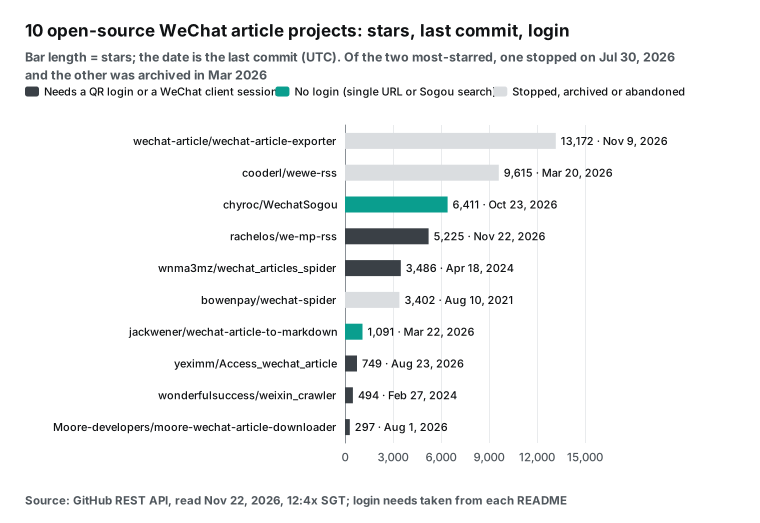
The project with the most stars changed the most this year. The README of wechat-article-exporter explains its method. In the Official Account editor, you can search other accounts' posts and insert a link. The tool used this search to list all posts of any account.
On July 30, 2026, the author announced the end of the project in issue #200. The author wrote that the one-click sync of Official Account posts "no longer exists". The repository became read-only, with no new issues or pull requests. A note at the top of the README adds that the website closed in October 2026.
The second project, wewe-rss, used a different path: the Official Account subscriptions inside WeChat Read. Its README has an account state called "today's penalty box", which means that the account is blocked for a day. The repository has been archived since March 20, 2026. The fourth project, we-mp-rss, is still active. Its last commit was on the day we read it (November 22, 2026, 04:22 UTC).
Five new issues opened in the last 30 days. In issue #485 (October 30, 2026), a user reports a crypto-mining process and an unknown SSH key inside a self-hosted we-mp-rss container. The reporter also writes that the entry point is unknown, and that the cause may not be in the project code. In issue #489 (November 19, 2026), a user asks why the WeChat authorization QR code returns 404. If you host such a service yourself, do not put its admin port on the public internet.
Licenses decide whether you can reuse the code. Three of the 10 use MIT (wechat-article-exporter, wewe-rss, Moore). Two use Apache-2.0 (WechatSogou, wechat_articles_spider). The we-mp-rss and Access_wechat_article projects use custom terms that GitHub cannot classify. Three have no license file: wechat-spider, wechat-article-to-markdown and weixin_crawler.
By default, code without a license is for reading only, not for copying into your product. Read custom terms line by line. The we-mp-rss settings even include a license encryption key, so ask the author before commercial use. Open source is fine for learning and one-off research. For a long-term company pipeline, check three things: the license, the maintenance status and the account risk.
Four methods in open source, and where each one breaks
The 10 projects use four methods, and each method has a known failure point. The table maps each method to its projects and to the failure that the projects themselves describe.
| Method | Projects | What you get | Where it breaks, per the project itself |
|---|---|---|---|
| Article search in the Official Account back office | wechat-article-exporter, we-mp-rss | Full post lists of any account | The exporter's author says in issue #200 that WeChat closed the core interface it used |
| WeChat Read subscriptions | wewe-rss | New posts as RSS | Its README describes blocks and a 24-hour wait |
| Sogou WeChat search | WechatSogou, bowenpay/wechat-spider | Search results, no login | No full account history; frequent requests trigger a captcha; wechat-spider stopped when Sogou removed the feature in 2019 |
| Session or captured traffic from the WeChat desktop app | wechat_articles_spider, Access_wechat_article, Moore | Reads, likes and "Wow" counts | Parameters expire in a few hours; someone must keep the WeChat client open |
Only the fourth method gets reads, likes and "Wow" counts, and it is also the method with the most upkeep. Access_wechat_article shows the cost in its own tracker. Issue #33, opened on November 15, 2026, says that the tool installs and runs without errors. But its window stays blank.
Single article bodies are the exception. A WeChat article page is a public web page. The jackwener/wechat-article-to-markdown tool takes one mp.weixin.qq.com/s/... link and converts it to Markdown. A Juejin post from April 2026 compared six ways to get articles. The author found that a plain request often gets a slider captcha.
With the User-Agent of the WeChat in-app browser, the full HTML comes back. The author also warns to keep the rate low, because WeChat can change its rules at any time. You can get the body this way. You cannot get reads and comments this way, because they are not in the HTML. The page asks WeChat for them after it opens, with identity parameters from the WeChat client.
YouTube demos follow the same methods. At 12:49 SGT we ran youtube/search for "WeChat Official Account scraper" in Chinese. The most-viewed of the top 10 results was an n8n workflow tutorial from July 2025, with 11,275 views. It gets the article list from a paid data service (the video says 0.06 yuan per call, about $0.009 at 6.69 yuan per dollar, from the two currencies in the 12:37 SGT catalog).
An HTTP node then fetches each article, strips the HTML tags and saves the text to Notion. We read 20 comments. One viewer asks about read counts and follower counts. One says that the fetch still fails after setting a User-Agent. One asks why the HTTP node never returns. Lists and bodies are easy; metrics and stability are hard.
Is there a ready-made WeChat Official Account API? How pay-per-call vendors compare
Yes. A pay-per-call API moves the login, the session, the parameter refresh and the retry after a block to the vendor. You send one HTTP request. Here we compare EveryInfra and TikHub on four things. They are the billing unit, the price per 1,000 calls, the cost of failures and the need for your own account.
At 12:37:42 SGT on November 22, 2026, the EveryInfra catalog had 13 Official Account capabilities, and 10 were available. They are article search, article body, account search, account profile, account owner info, past articles, today's articles, comments, comment replies and article metrics. Mini program search, search suggestions and WeChat Index were paused. The 10 available capabilities have only four prices. Article body, owner info and metrics cost $0.005556 per call. Comments and replies cost $0.006764.
Article search, account profile, past articles and today's articles cost $0.008. Account search costs $0.016. Each capability page says that billing is per call, not per row, and that failures and empty results are free. For example, the comments page says one call can return up to 260 rows, and the past articles page says up to 160.
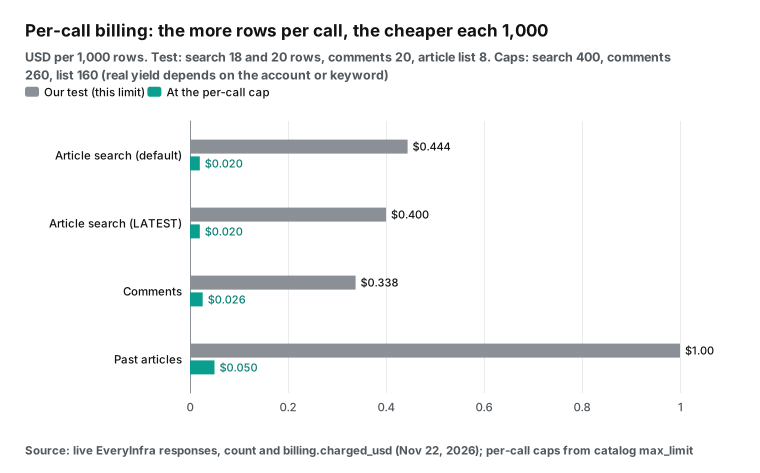
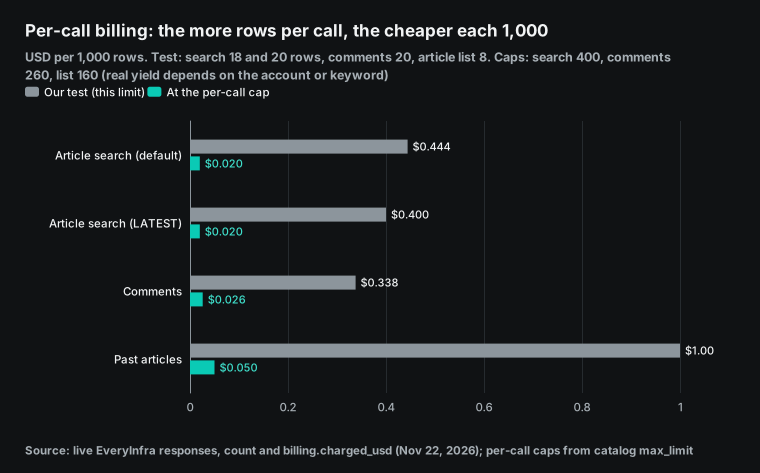
Because the price is per call, more rows per call means a lower price per 1,000 rows. Our tests used small limits. At 12:46 SGT we read the comments of one article with limit 20. We got 20 rows for $0.006764, which is $0.338 per 1,000 rows.
If the same article had 260 readable comments, one call would cost $0.026 per 1,000 rows. The real yield depends on the comment count and on the keyword. The "cap" bars in the chart show an upper bound, not a measured number.
At 12:47:43 SGT, the TikHub public price list had 24 Official Account entries: 12 in wechat_mp/v2 and 12 in wechat_mp/web. Twenty-three cost $0.01 per call and cannot use the sign-up credit or volume discounts. One old web endpoint, which returns the article body as JSON, costs $0.001 per call. The TikHub FAQ says that the old Official Account and Channels series were retired on June 13, 2026, and rebuilt as the v2 series.
Article endpoints take the article web address, and account endpoints take the gh_ user name. TikHub charges only successful requests, which means HTTP 200. We did not call TikHub, so we cannot tell which old web entries still work.
The evidence in the table below is not equal on both sides. The TikHub column has only public prices. It cannot show how many rows TikHub returns, whether the fields are right, or what a failure looks like. The EveryInfra column has catalog data and live calls. The live test also lists our five failed calls.
| Pay-per-call item | TikHub (public price list, not tested) | EveryInfra (catalog plus live test) |
|---|---|---|
| Billing unit | Per request, charged on HTTP 200 | Per call; failures and empty results are free |
| Article body | $0.01 per call (v2); old web JSON version $0.001 | $0.005556 per call; our test returned 3,578 characters and 27 images |
| Article metrics | $0.01 per call | $0.005556 per call; our test returned 6 numbers: reads, likes, "Wow", shares, saves, comments |
| Comments | $0.01 per call | $0.006764 per call; up to 260 rows |
| Past articles | $0.01 per call, by gh_ user name | $0.008 per call; up to 160 rows; WeChat ID, gh_ ID or article link (see the live test) |
| Free credit | $0.05 at sign-up; these Official Account endpoints cannot use it | See the pricing page |
| Top-up fee | Alipay 2.6% + $0.30; PayPal and USDT 5% + $0.30 | See the pricing page |
| MCP | Has MCP | Remote MCP |
In AI tools that support remote MCP, such as Claude or Cursor, you can add EveryInfra as an MCP server. The model then calls everyinfra_call_api with the platform wechat_oa. Keep the key in an environment variable, and put only the variable name in the config file:
{
  "mcpServers": {
    "everyinfra": {
      "type": "http",
      "url": "https://api.everyinfra.com/mcp",
      "headers": { "Authorization": "Bearer ${EVERYINFRA_API_KEY}" }
    }
  }
}
Fields: what the API returns, and which numbers need care
The EveryInfra catalog lists response_fields for each capability. For the five capabilities we tested, the field counts come from the catalog that we read at 12:37 SGT. The live reply is what counts, and the catalog notes say which fields can be missing in some replies.
| Capability | Fields | Common fields | Missing fields noted in the catalog |
|---|---|---|---|
wechat_oa/article_search | 10 | title, summary, url, account_name, posted_at | kind can be missing; on some requests id and relative_time too |
wechat_oa/article_detail | 16 | content_text, content_html, author, account_ghid, is_original, ip_region | digest and hashtags can be missing |
wechat_oa/article_metrics | 7 | read_count, like_count, watching_count, share_count, collect_count, comment_count | None |
wechat_oa/article_comments | 11 | text, like_count, reply_count, is_top, province, posted_at | None |
wechat_oa/account_articles | 12 | title, url, posted_at, position, is_original | account_id and is_deleted can be missing |
Start with links. With default settings, the url from article search is a temporary link with signature and timestamp. All 18 rows from our 12:38 search were of this type. With "category":"LATEST" at 12:56, all 20 rows had links with __biz, mid, idx and sn.
The body, comments and metrics need the article's own link, the catalog says. That is a /s/<id> short link, or a link with __biz, mid, idx and sn. To go from a default search to the body, look up the account from account_name, then call past articles for permanent links. By the catalog rule, LATEST links can go straight to the body, comments and metrics, but we did not test that.
Read counts need care too. When read_count is a number such as 100001, we read it as the "100k+" label on the WeChat page. It means "more than 100,000". Only the owner can see the exact number in the back office.
Do not misread position. It is the slot inside one push (the lead post is 1). It is not a ranking by reads.
Which WeChat Official Account API should you use? Choose by job
| Job | Route | Why | Watch out |
|---|---|---|---|
| Weekly report for your own accounts, with traffic sources | Official statistics API | Only the owner gets reads split by source | Needs a verified company account; data starts Nov 1, 2025 |
| Moderate, feature and reply to comments on your own posts | Official comment API | Has openid; can write back | Fewer than 50 per call |
| Watch 50 competitor accounts every day | Pay-per-call API | The official API cannot read other accounts; open source needs QR accounts | Past articles: up to 160 rows per call |
| Track the newest posts on a keyword | Pay-per-call API | Article search can sort by newest | Search returns temporary links; swap for permanent links before reading bodies |
| Study one viral post: reads, likes, comments | Pay-per-call API | Metrics return 6 numbers in one call | "100k+" means more than 100,000 |
| Save a few dozen bodies for a knowledge base | Single-post open-source tool, or copy by hand | Small volume; text only | Keep the rate low |
| Academic archive of a full account history | Ask the owner, or use a public dataset | Better for consent and completeness | Copying a post does not give you its copyright |
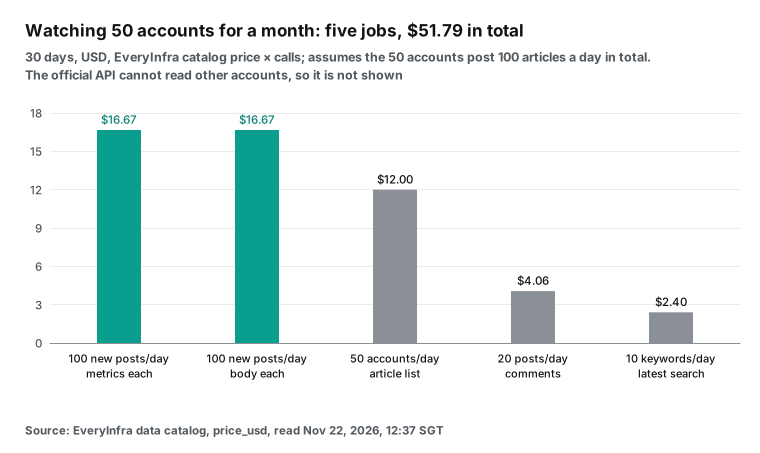
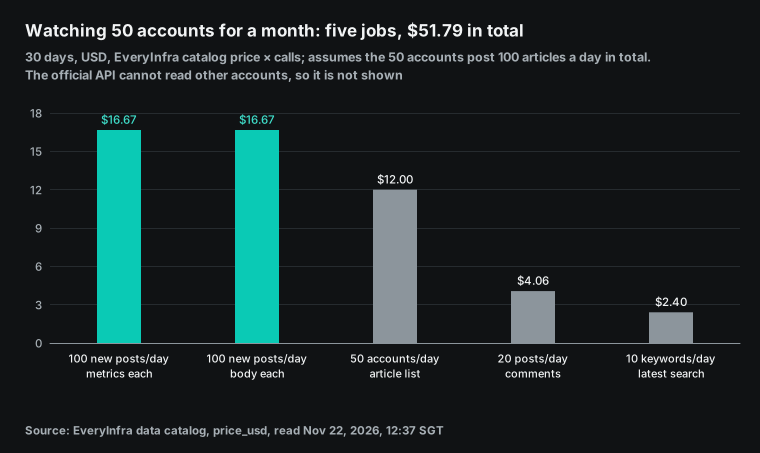
Here is a monthly bill for "watch 50 competitor accounts". Assume the 50 accounts post 100 articles a day in total. One article list per account per day is 50 calls at $0.008, or $12.00 for 30 days. Metrics once per new post is 100 calls at $0.005556, or $16.67. The body once per post is also $16.67. Comments for 20 selected posts cost $4.06.
One latest search for each of 10 keywords per day costs $2.40. The total is $51.79 a month. Metrics and bodies are the two largest items. If you need only titles and read counts, skip the bodies and save about one third. One metrics read per post misses later growth. To see how reads grow, read metrics on several days; each extra round adds $16.67 for 30 days.
The official API cannot do this job. Open source can, but its cost is elsewhere. To search 50 accounts, you need an Official Account with a QR login. The wewe-rss README already warns that frequent adds get an account blocked. For read counts, someone keeps the WeChat desktop app open and captures traffic, and the parameters expire in hours. Our Douyin data API comparison looks at the same question for Douyin. For Official Accounts, the open-source options are narrower, because the two most-starred projects have stopped.
A live test: body, comments and metrics of a "100k+" post
On November 22, 2026, from 12:38 to 12:56 SGT, we sent 13 requests to the EveryInfra Official Account capabilities. We chose a post from the health account Dingxiang Life Research, published on July 31, 2026 (__biz=MzA4MTg0MjA5OQ==, gh_038cf5c345ed). It is also the sample post on our capability pages. The request looks like this, with the key read from an environment variable:
curl -s https://api.everyinfra.com/api/v1/social \
  -H "Authorization: Bearer $EVERYINFRA_API_KEY" \
  -H "Content-Type: application/json" \
  -d '{"platform":"wechat_oa","action":"article_metrics",
       "params":{"url":"https://mp.weixin.qq.com/s?__biz=MzA4MTg0MjA5OQ==&mid=2655362972&idx=1&sn=b56fabd8e4c53259498100f05f20dbb0"}}'
# reply at 12:56:01 SGT: read_count 100001, like_count 1043, watching_count 122,
# share_count 3469, collect_count 358, comment_count 40; charged_usd 0.005556
At 12:46:02 SGT we read the body. The reply came in 4.45 seconds. The content_text had 3,578 characters, the post had 27 images, ip_region was Zhejiang and is_original was false. The charge was $0.005556.
The reply had 15 of the 16 catalog fields; hashtags was missing, which the catalog allows. The author field held a pen name, which differs from the account name, so count posts per account with account_name or account_ghid. The digest was only two characters long, so use the body for summaries. The post went out at 03:55 UTC, and the first comment came three minutes later. At 12:46:15 SGT we read the comments with limit 20. We got 20 rows for $0.006764.
The top comment had 1,056 likes, and the 20 comments had 2,817 likes in total. Eight comments had replies, 20 replies in total.
The commenters came from 10 provinces, and Guangdong had the most, with 7. All 20 comments came within two hours after the post went out. The metrics show comment_count 40. We set limit to 20, so we did not read the rest. Billing is per call, so limit 40 would have read all of them for the same $0.006764.
For topic research, the comments show what readers want next. One comment with 235 likes asks for an antiperspirant review, and another asks which home hair-removal device to buy. Likes are concentrated: the top 3 comments have 1,586 of the 2,817 likes, or 56%. None of the 20 has is_top set. Reading the top dozen comments by likes is usually enough; you do not need all 260 for every post.
At 12:56:13 SGT we called past articles with the account's gh_ ID. We got 8 rows in 2.29 seconds for $0.008. The account pushed once a day on each of the last three days, with 3 posts per push (position 1 to 3). The newest push was at 04:14 UTC on November 22, 2026. Each url was a permanent link with __biz, mid, idx and sn. You can pass it straight to the body, comments and metrics capabilities.
In Beijing time, the three pushes went out on November 20, 2026 (12:01), November 21, 2026 (11:48) and November 22, 2026 (12:14). The 3 posts of one push share the same posted_at to the second, so group by posted_at and sort by position to rebuild each push. For an account like this, one list call in the afternoon catches the day's push, and limit 8 covers three days.
The 11 calls that reached the WeChat capabilities are listed below in time order (SGT, November 22, 2026). The two HTTP 429 replies at 12:45:54 and 12:46:51 are left out; they came back in under a second and cost nothing.
| Time (SGT) | Capability and input | HTTP | Time to reply | Rows or result | Charged |
|---|---|---|---|---|---|
| 12:38:41 | article_search, "camping", default order | 200 | 75.4 s | 18 rows, 2021 to 2024 | $0.008 |
| 12:40:11 | account_articles, 36Kr by WeChat ID | 503 | 12.2 s | None | $0 |
| 12:44:02 | account_articles, same input, retry | 503 | 15.2 s | None | $0 |
| 12:44:21 | account_search, 36Kr by name | 503 | 14.4 s | None | $0 |
| 12:46:02 | article_detail, permanent link | 200 | 4.5 s | 3,578 characters, 27 images | $0.005556 |
| 12:46:15 | article_comments, limit 20 | 200 | 4.3 s | 20 comments | $0.006764 |
| 12:47:01 | article_detail, temporary search link (another account's camping post) | 503 | 7.6 s | None | $0 |
| 12:47:19 | account_articles, 36Kr by name | 503 | 13.9 s | None; reply suggests a ticket | $0 |
| 12:56:01 | article_metrics, permanent link | 200 | 4.5 s | Six numbers | $0.005556 |
| 12:56:13 | account_articles, Dingxiang Life Research by gh_ ID | 200 | 2.3 s | 8 posts with permanent links | $0.008 |
| 12:56:24 | article_search, LATEST | 200 | 9.3 s | 20 rows, Nov 18 to 22 | $0.008 |
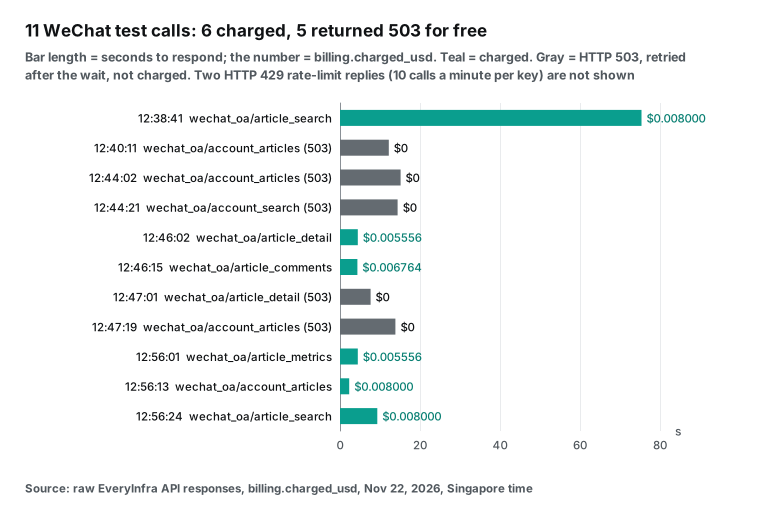
At 12:38:41 SGT we searched for "camping" with default settings. After 75.4 seconds we got 18 rows. Their dates ran from June 12, 2021 to April 22, 2024, and 13 were from 2022. All were older than 2024. At 12:56:24 SGT we searched again with "category":"LATEST".
In 9.3 seconds we got 20 rows. All were posted between November 18, 2026 and November 22, 2026, by 19 different accounts. The default order favors relevant old posts. For monitoring, always pass LATEST. The default call was also much slower. When a call comes near the 85-second sync limit, add "mode":"async" to get a job_id, and poll it.
| Item | Default (12:38:41) | `"category":"LATEST"` (12:56:24) |
|---|---|---|
| Time to reply | 75.4 s | 9.3 s |
| Rows | 18 | 20 |
| Post dates | 2 in 2021, 13 in 2022, 2 in 2023, 1 in 2024 | Nov 18: 2, Nov 19: 3, Nov 20: 7, Nov 21: 5, Nov 22: 3 (2026) |
| Different accounts | 14 | 19 |
url form | All 18 with signature and timestamp | All 20 with __biz, mid, idx, sn |
| Charge | $0.008 | $0.008 |
The two calls reached different accounts. The 14 accounts in the default order are mostly media outlets, such as New Weekly (3 posts), 36Kr and Huxiu (2 each), The Paper and TMTPost. The 19 accounts in the LATEST order include local tourism offices, a city management office, a campsite's own account, companies and personal travel accounts. To find new accounts in your field, use LATEST. To find the most-shared old posts on a topic, the default order fits better, but it is slow, so use async mode.
Five calls returned HTTP 503 between 12:40 and 12:47 SGT, and none was charged. Four were for the tech media account 36Kr. At 12:40:11 and 12:44:02 we asked for its past articles by WeChat ID wow36kr.
At 12:44:21 we searched for the account by name. At 12:47:19 we asked for its past articles by name. The catalog lists a WeChat ID, a gh_ ID or a link as valid input. A name is not on that list.
The fifth failure, at 12:47:01, read the body of another account's camping post through a temporary search link.
We never got any 36Kr data in this test, and we did not retry 36Kr with its gh_ ID. The past-articles call that worked at 12:56:13 was for a different account, Dingxiang Life Research, by its gh_ ID. So we have not shown that a different input format gets 36Kr through.
The 503 reply body tells your code how to retry:
| Field | Value in our test | What your code does |
|---|---|---|
retryable | true | Retry only when it is true |
retry_after | 20 | Wait 20 seconds, then retry |
max_retries | 2 | Retry at most 2 times |
recent_failures | 1, 2, 3 for past articles | Failures in 10 minutes |
next_steps | Third failure: the fault is on the EveryInfra side if more targets fail | Ask the user before a ticket |
support | Third failure only: ticket endpoint and request_id | Use both for the ticket |
billing.charged | false | No charge |
If the retries also fail, put the target in a queue and try it again later. Do not send it again and again in the same minute. When recent_failures reaches 3, next_steps tells you to ask the user. Then pause the batch for that capability. For an account like 36Kr, you can try the other formats in the catalog: the gh_ ID or an article link. We have no evidence that they work.
The test key allows 10 calls a minute and is shared by seven writers, so two 429 replies were retried after retry_after. Treat 429 and 503 apart. The 429 reply has fault account and reason key_limit, with retry_after 9 and max_retries 3: slow down, or ask the user to raise the limit. The 503 reply has fault service: retry as in the table, and ask the user on the third failure. The six charged calls cost $0.041876 in total.
A daily routine: from search to body
Here is a routine that can run every day. Each step maps to one capability and one fixed price. We built it from the live calls above and the catalog. We did not run it end to end, and step two failed in our test. The table uses the 50-account example from the cost chart above, so the monthly numbers add up to the same $51.79.
| Step | Capability | When it runs | Price per call | Monthly cost in the example |
|---|---|---|---|---|
| 1. Find new posts on 10 keywords | article_search with LATEST | Every morning | $0.008 | $2.40 |
| 2. Turn a new account name into a gh_ ID | account_search | Only for a new account | $0.016 | Not in the $51.79; $0.016 per new account |
| 3. List new posts of each account | account_articles | Once a day per account | $0.008 | $12.00 |
| 4a. Read the six metrics of each new post | article_metrics | Once per post | $0.005556 | $16.67 |
| 4b. Read the body | article_detail | Only when you need full text | $0.005556 | $16.67 |
| 4c. Read the comments | article_comments | For 20 chosen posts a day | $0.006764 | $4.06 |
Step one gives you the titles, summaries and account names of recent posts. In our 12:56 SGT search, the 20 rows came from November 18, 2026 to November 22, 2026, and from 19 different accounts. This step finds new competitors.
Step two is the most expensive capability, but you pay for it once per account. Store the ID in your own table, so you never look it up again.
Our account search for 36Kr at 12:44:21 returned 503, so this step did not work in our test. In step three, use the permanent link to drop posts you have already seen. The LATEST links from step one already have __biz, mid, idx and sn. By the catalog rule, you can merge them with step three before you remove duplicates. We checked only the link form. We did not read a body with these links.
Step three grows with the number of accounts, and step four grows with the number of posts. In the example, steps three and four make up about 95% of the bill. To cut cost, cut bodies first. Titles and metrics already show which posts deserve a closer look. If you read bodies only for the top 10% of posts by reads, the body item falls from $16.67 to about $1.67 a month.
When another route fits better
| Case | Better route | Reason |
|---|---|---|
| Dashboard for your own verified account | Official API | Traffic sources by channel, openid, drafts and publishing; no call fees, only the verification fee |
| A few dozen bodies, no metrics | Single-post open-source tool, or copy links by hand | Small volume; no paid account needed |
| Team already pays one TikHub bill for other platforms | TikHub | One vendor; its v2 series has related articles, ad slots and account services |
For your own account, no third-party API can match the official one, because the owner-only data never reaches a public page. For bodies alone, tools like jackwener/wechat-article-to-markdown turn one link into Markdown. A 2022 Juejin tutorial shows how to copy post links from the "recent posts" list of your own account.
For TikHub, the v2 Official Account series covers related articles, article ad slots and account services, which the EveryInfra catalog does not have. For WeChat Channels, it has live history and collections. EveryInfra Channels capabilities are five today: search, video, user posts, profile and comments. Some TikHub endpoints get daily volume discounts, but these Official Account entries do not. We did not call its Official Account endpoints. Before you switch, test its reply format on another endpoint with the free credit.
Law and limits
A pay-per-call API reads posts and comments that are public. That does not make every use acceptable. Three Chinese rules matter most for this data.
| Rule | What it says that matters here | Practical step |
|---|---|---|
| Personal Information Protection Law | Article 13 allows reasonable processing of information made public lawfully; Article 27 says to stop when the person clearly refuses, and to get consent when the effect on the person is major | For statistics, drop nicknames and avatars; keep text, like counts and provinces |
| Network Data Security Management Regulations | In force from January 1, 2025, with detailed duties for data handlers | Keep a record of what you collect and why |
| Anti-Unfair Competition Law, 2025 revision | A clause on obtaining or using other businesses' data by improper technical means | Do not rebuild a competitor's product from its data |
Copying other accounts' posts to your own account is a copyright question, no matter which tool you use. Ask your own lawyer about your use case.
FAQ
What WeChat Official Account data APIs exist?
There are three kinds. The official server API (publishing, statistics, comments) works only on your own account. Open-source scrapers on GitHub use the back office search, WeChat Read, Sogou or a WeChat desktop session. Pay-per-call data APIs include EveryInfra and TikHub. To read other accounts, choose from the last two. Source of the question: Google suggestion for "Official Account data API" in Chinese (read November 22, 2026).
Which WeChat Official Account data scraping APIs do you recommend?
It depends on the job. For reports on your own account, use the official statistics API. To save a few dozen bodies, use a single-post tool such as jackwener/wechat-article-to-markdown. To read lists, read counts and comments of competitor accounts in bulk, use a pay-per-call API. EveryInfra costs $5.56 to $16.00 per 1,000 calls, and most TikHub Official Account entries cost $0.01 per call. Source: the Google suggestion "Official Account API endpoints" in Chinese (read November 22, 2026).
Which WeChat Official Account API is best?
No route covers everything. The official API gives the most for your own account and nothing for other accounts. Open source is free, but of the top two projects by stars, one stopped and one is archived. Pay-per-call removes the login and the upkeep, and you pay per call. With our numbers, watching 50 competitor accounts costs about $51.79 a month. Source: Google suggestion "WeChat Official Account API endpoints" in Chinese (read November 22, 2026).
Is there a ready-made Official Account API, so I do not have to write a scraper?
Yes. A pay-per-call API returns JSON for one HTTP request. For example, wechat_oa/article_metrics returns six numbers (reads, likes, "Wow", shares, saves, comments) for $0.005556 per call, and failures and empty results are free. You can also add the remote MCP server to Claude or Cursor and let the AI call it. Source: a V2EX thread from July 2026 that asks how people get Official Account posts with an AI agent.
Can the WeChat Official Account API read other accounts' posts?
No. The official publish, statistics and comment endpoints accept only your own account's access_token, and they return only your own content. A third-party platform also needs the other account to authorize it. Source: Google suggestions "WeChat Official Account API" and "Official Account get access token" in Chinese (read November 22, 2026).
Do the WeChat scrapers on GitHub still work?
Some work, with upkeep. The most-starred one, wechat-article-exporter, stopped on July 30, 2026, and wewe-rss is archived. The we-mp-rss project is active, but it needs a QR authorization. Single-post body tools work without a login. Source: Google suggestion "WeChat Official Account scraper GitHub" in Chinese (read November 22, 2026).
Can I get read counts and follower counts?
Read counts, yes. The pay-per-call metrics capability returns read_count. Above 100,000 it shows 100001, which matches "100k+" on the page. Follower counts are private data in the owner's back office. They are not on public pages, and the EveryInfra catalog has no such field. Source: a viewer question under YouTube video ATwEruPuAWI (read November 22, 2026, 12:50 SGT).
How do I set up an MCP server for WeChat Official Account data?
There are two ways. For your own account, use a community MCP server for account management, such as xwang152-jack/wechat-official-account-mcp, with your own AppID and AppSecret. For other accounts, add the EveryInfra remote MCP server (https://api.everyinfra.com/mcp, key in an environment variable) to your AI tool, and let the model call everyinfra_call_api. Source: Google suggestion "WeChat Official Account scraper MCP" in Chinese (read November 22, 2026).
How to start
- Read the free catalog:
GET https://api.everyinfra.com/api/v1/social/catalog. It needs no key. Find the 13 entries withplatformset towechat_oa, and checkavailable,price_usdand the parameters. The Official Account pages are at WeChat Official Account data API, and Channels at WeChat Channels data API. - Create a key in the console. Use the curl example in the quickstart, and change the platform to
wechat_oa. See prices on the pricing page. To try without code, use the playground on the market page. - Start with one account. Call
wechat_oa/account_articleswith its gh_ ID to get permanent links. Then callwechat_oa/article_metricsandwechat_oa/article_commentsfor a few posts. - For keyword monitoring, always pass
"category":"LATEST"towechat_oa/article_search. Raiselimitas far as you need, because billing is per call. - Use it in an AI tool: add the MCP config above. To compare prices with TikHub line by line, read TikHub alternatives and TikHub free credits explained.
References
- List published posts, WeChat Open Docs, last edited Nov 11, 2026, read Nov 22, 2026, https://developers.weixin.qq.com/doc/subscription/api/public/api_freepublish_batchget
- Publishing capability, WeChat Open Docs, read Nov 22, 2026, https://developers.weixin.qq.com/doc/subscription/guide/product/publish.html
- Get a published post, WeChat Open Docs, read Nov 22, 2026, https://developers.weixin.qq.com/doc/subscription/api/public/api_freepublishgetarticle
- Statistics API guide, WeChat Open Docs, read Nov 22, 2026, https://developers.weixin.qq.com/doc/subscription/guide/product/analysis_data/analysis_data.html
- Daily article summary, WeChat Open Docs, read Nov 22, 2026, https://developers.weixin.qq.com/doc/subscription/api/wedata/news/api_getarticlesummary.html
- Daily read data, WeChat Open Docs, read Nov 22, 2026, https://developers.weixin.qq.com/doc/subscription/api/wedata/news/api_getarticleread
- List comments, WeChat Open Docs, read Nov 22, 2026, https://developers.weixin.qq.com/doc/subscription/api/leaving/api_listcomment.html
- API overview, WeChat Open Docs, read Nov 22, 2026, https://developers.weixin.qq.com/doc/subscription/guide/dev/api/
- Get access token, WeChat Open Docs, read Nov 22, 2026, https://developers.weixin.qq.com/doc/subscription/api/base/api_getaccesstoken
- API limits, WeChat Open Docs, read Nov 22, 2026, https://developers.weixin.qq.com/doc/subscription/guide/dev/api/limit
- Service Account documents, WeChat Open Docs, read Nov 22, 2026, https://developers.weixin.qq.com/doc/service/guide/
- Pinned reply on the published-post list, WeChat developer forum, Jun 27, 2024, https://developers.weixin.qq.com/community/minihome/doc/000684561e06307dd4b10a7386fc00
- wechat-article/wechat-article-exporter, GitHub, read Nov 22, 2026, https://github.com/wechat-article/wechat-article-exporter
- wechat-article-exporter issue #200 (Jul 30, 2026), GitHub, https://github.com/wechat-article/wechat-article-exporter/issues/200
- cooderl/wewe-rss, GitHub, read Nov 22, 2026, https://github.com/cooderl/wewe-rss
- chyroc/WechatSogou, GitHub, read Nov 22, 2026, https://github.com/chyroc/WechatSogou
- rachelos/we-mp-rss, GitHub, read Nov 22, 2026, https://github.com/rachelos/we-mp-rss
- we-mp-rss issue #485 (Oct 30, 2026), GitHub, https://github.com/rachelos/we-mp-rss/issues/485
- we-mp-rss issue #489 (Nov 19, 2026), GitHub, https://github.com/rachelos/we-mp-rss/issues/489
- wnma3mz/wechat_articles_spider, GitHub, read Nov 22, 2026, https://github.com/wnma3mz/wechat_articles_spider
- bowenpay/wechat-spider, GitHub, read Nov 22, 2026, https://github.com/bowenpay/wechat-spider
- jackwener/wechat-article-to-markdown, GitHub, read Nov 22, 2026, https://github.com/jackwener/wechat-article-to-markdown
- yeximm/Access_wechat_article, GitHub, read Nov 22, 2026, https://github.com/yeximm/Access_wechat_article
- wonderfulsuccess/weixin_crawler, GitHub, read Nov 22, 2026, https://github.com/wonderfulsuccess/weixin_crawler
- Moore-developers/moore-wechat-article-downloader, GitHub, read Nov 22, 2026, https://github.com/Moore-developers/moore-wechat-article-downloader
- xwang152-jack/wechat-official-account-mcp, GitHub, read Nov 22, 2026, https://github.com/xwang152-jack/wechat-official-account-mcp
- Sogou WeChat search, read Nov 22, 2026, https://weixin.sogou.com/
- TikHub public price list, read Nov 22, 2026, 12:47 SGT, https://api.tikhub.io/api/v1/tikhub/user/get_all_endpoints_info
- TikHub FAQ, read Nov 22, 2026, https://tikhub.io/faq
- TikHub MCP, read Nov 22, 2026, https://tikhub.io/mcp
- TikHub docs, read Nov 22, 2026, https://docs.tikhub.io/
- EveryInfra social data catalog, read Nov 22, 2026, 12:37 SGT, https://api.everyinfra.com/api/v1/social/catalog
- Model Context Protocol, https://modelcontextprotocol.io/
- Personal Information Protection Law of the PRC, full text reposted by the National Bureau of Statistics, https://www.stats.gov.cn/gk/tjfg/xgfxfg/202503/t20250310_1958923.html
- Network Data Security Management Regulations, Cyberspace Administration of China, Sep 30, 2024, https://www.cac.gov.cn/2024-09/30/c_1729384452307680.htm
- Anti-Unfair Competition Law of the PRC (2025 revision), China National Intellectual Property Administration, https://www.cnipa.gov.cn/art/2026/5/20/art_104_206437.html
- How do you get WeChat Official Account posts with an AI agent? V2EX, Jul 2026, https://www.v2ex.com/t/1198827
- I tried six ways to get WeChat Official Account posts, Juejin, Apr 2026, https://juejin.cn/post/7624018983559397376
- How to get the history links of your Official Account, Juejin, 2022, https://juejin.cn/post/7106768099361161223
- Monitor Official Accounts in real time with an AI workflow, YouTube, Jul 3, 2025, https://www.youtube.com/watch?v=ATwEruPuAWI
- WeChat Official Accounts Platform, read Nov 22, 2026, https://mp.weixin.qq.com/
Reference BL-211