Douyin API in 2026: Official Platform, GitHub Scrapers or Pay-per-Call
Douyin API in 2026: the official platform reads only authorized accounts, GitHub scrapers get blocked, and search costs $0.42 vs $1.00+ per 1,000.

Yes, you can get Douyin data through an API, and there are three kinds of routes. We compare two pay-per-call routes: EveryInfra, which is our own API, and TikHub. The first route is the Douyin Open Platform, which is Douyin's own developer program. The second route is an open-source scraper from GitHub. The third route is a third-party data API that charges per request.
Each route fits a different job. Use the Open Platform for your own account, authorized accounts, shop orders and ad data. Use an open-source project to test on your own computer, if you can fix it when it breaks. Use a pay-per-call API to read public videos, comments and trending lists in bulk. You keep no Douyin login and no request signatures.
Between the two pay-per-call vendors, the largest price gap is in video search. EveryInfra charges $0.008333 for one douyin/search call. Our test at 00:14 Singapore time (SGT) on November 21, 2026 returned 20 videos, so the price is $0.417 per 1,000 results. TikHub charges $0.01 for one call on its Douyin search line. Its FAQ says that one call returns about 6 to 10 results, so the price is $1.00 to $1.67 per 1,000.
For comments, the two prices are almost equal, at about $0.033 per 1,000. On the open-source side, we counted the new issues in 6 maintained Douyin repositories over the last 30 days. There were 37 issues. We removed 8 non-technical posts and 7 issues whose titles name TikTok, Bilibili, YouTube or Xiaohongshu. Of the 22 Douyin technical issues that were left, 7 (about 32%) were about blocks: verification pop-ups, HTTP 403 errors, security checks or risk control.

Douyin is not TikTok: why the TikTok API does not help
Many English-language teams look for a Douyin API after they have used TikTok data. Both apps come from ByteDance, but they are separate products. Douyin serves mainland China, and TikTok serves users outside it. Accounts, videos, comments and trending lists are all different.
The developer programs are separate too. TikTok for Developers lives at developers.tiktok.com. Its Research Tools page describes public data on TikTok accounts, content and shops, for approved researchers. The page says that approval typically takes about 4 weeks. Nothing on that page reaches Douyin content. The Douyin Open Platform lives at developer.open-douyin.com, and its documentation is in Chinese.
| Item | Douyin | TikTok |
|---|---|---|
| Market | Mainland China | Outside mainland China |
| Developer program | Douyin Open Platform, documentation in Chinese | TikTok for Developers, documentation in English |
| Public research access | No public research program in the docs we read | Research Tools for approved researchers, about 4 weeks to approve |
| Content language | Mostly Chinese titles, hashtags and comments | Many languages |
| EveryInfra platform name | douyin (50 capabilities, 43 available) | tiktok (24 capabilities, 22 available) |
If you need both markets, treat them as two data sources with two schemas. In the EveryInfra catalog, douyin and tiktok are two platforms with different capability lists and different fields. Our TikTok API page covers the second platform. The rest of this article is about Douyin only.
Douyin titles, hashtags and comments are almost all in Chinese. If your team does not read Chinese, plan a translation step, and keep the original text too.
Douyin API comparison: one table for all three routes
The official column comes from Douyin Open Platform documents that we read on November 21, 2026. The open-source column comes from the README files of the most-starred repositories that are still maintained. For the two pay-per-call vendors, we read the EveryInfra prices from the public catalog at 00:14 SGT on November 21, 2026. We read the TikHub prices at 00:21 SGT on the same day. They come from its public price endpoint, which needs no key, and from its FAQ.
| Item | Douyin Open Platform | GitHub open-source scrapers | TikHub | EveryInfra |
|---|---|---|---|---|
| Whose data | Accounts that authorized you, your own shop and ad accounts | What public pages show, plus what your logged-in account sees | Public data, plus creator-dashboard endpoints that need your own cookie | Public data |
| Billing unit | No per-call fee; daily free quota per capability | Your own servers, proxies and staff time | Per request, $0.001 to $0.25 | Per request; comments per block of 20 |
| Video search per 1,000 results | Keyword search returns the last 1 day only, for keywords that you registered | Your own run cost: machines and maintenance | $1.00 to $1.67 | $0.417 (20 per call in our test); $0.167 at the 50-result maximum |
| Comments per 1,000 | Only comments under authorized accounts' videos | Same as above | $0.033 to $0.050 | $0.033 |
| Charged on failure | Not applicable | Not applicable | Failures free; any 200 reply is billed | Failures and empty results free |
| Douyin account or cookie | Company credentials, developer account and user consent | 5 of 9 repositories need a QR login or a pasted cookie | No Douyin account; a TikHub account and key | No Douyin account; an EveryInfra key |
| MCP for AI tools | None | 1 repository has MCP built in; 1 MCP repository is archived | Yes, one server per platform | Yes, one remote URL |
| Time to start | Capability review takes 5 to 7 working days | Install, log in and tune; depends on the repository | Sign up, verify email, top up | Create a key, top up |
The TikHub rule "any 200 reply is billed" comes from the FAQ question "What exactly gets billed?". The answer says that only requests that return 200 are billed, and failed requests are not. Another FAQ question explains how to read the reason code when a 200 reply has no results. The EveryInfra rule "empty results are free" comes from the catalog notes and from our own test. At 00:27 SGT we asked for a post that does not exist. The reply was 200 with empty_reason set to post_unavailable, and billing.reason was empty_result_refunded, with $0 charged.
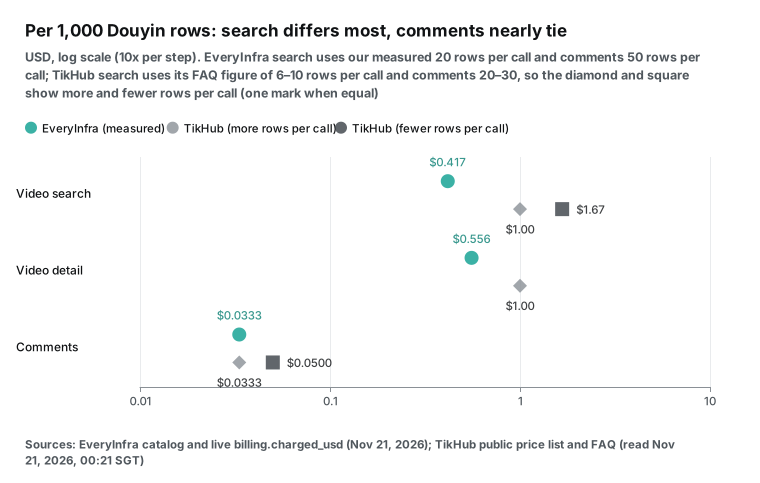
One table cannot show how many results one call returns. Douyin search returns results in pages, and the caller does not control the page size. The TikHub FAQ says that one Douyin search call returns about 6 to 10 results, and that the number changes from call to call.
The EveryInfra catalog says that each page returns at least limit results, with a default of 10 and a maximum of 50. A page often returns a few more, and the next page skips videos that the last page already returned. So, for search prices, we use cost per 1,000 results: the actual charge divided by the actual result count. For endpoints that return one item per call, such as video detail, we use cost per 1,000 calls.
Does Douyin have an official API? What the Open Platform gives and asks for
Yes. The Douyin Open Platform at developer.open-douyin.com has an OpenAPI list with more than ten groups. The groups include profile, relationships, content, search, private messages, data services, local services, mini programs and tools. On November 21, 2026, we read each page in the groups that relate to data collection. Our conclusion is simple. The official API serves a third-party app and that app's own users, and almost every data read starts with user consent to your app.
The first gate is the developer role. The role overview says that any registered user can choose the "self-built developer" role and get basic capabilities after review. A "system service provider" can also apply for shop, product catalog and transaction capabilities. A developer with a verified enterprise account gets one more group of enterprise capabilities. The permission table marks follower count, follower profile and video data as Douyin data permissions. They are off by default, and you apply for them in the console.
Reviews take time. The capability overview gives 5 to 7 working days for a capability application, and the same time for a quota increase. A new app starts as a test app. The create app page says that actions in a test app have no effect on the live environment. Commercial use starts only after the app goes live.
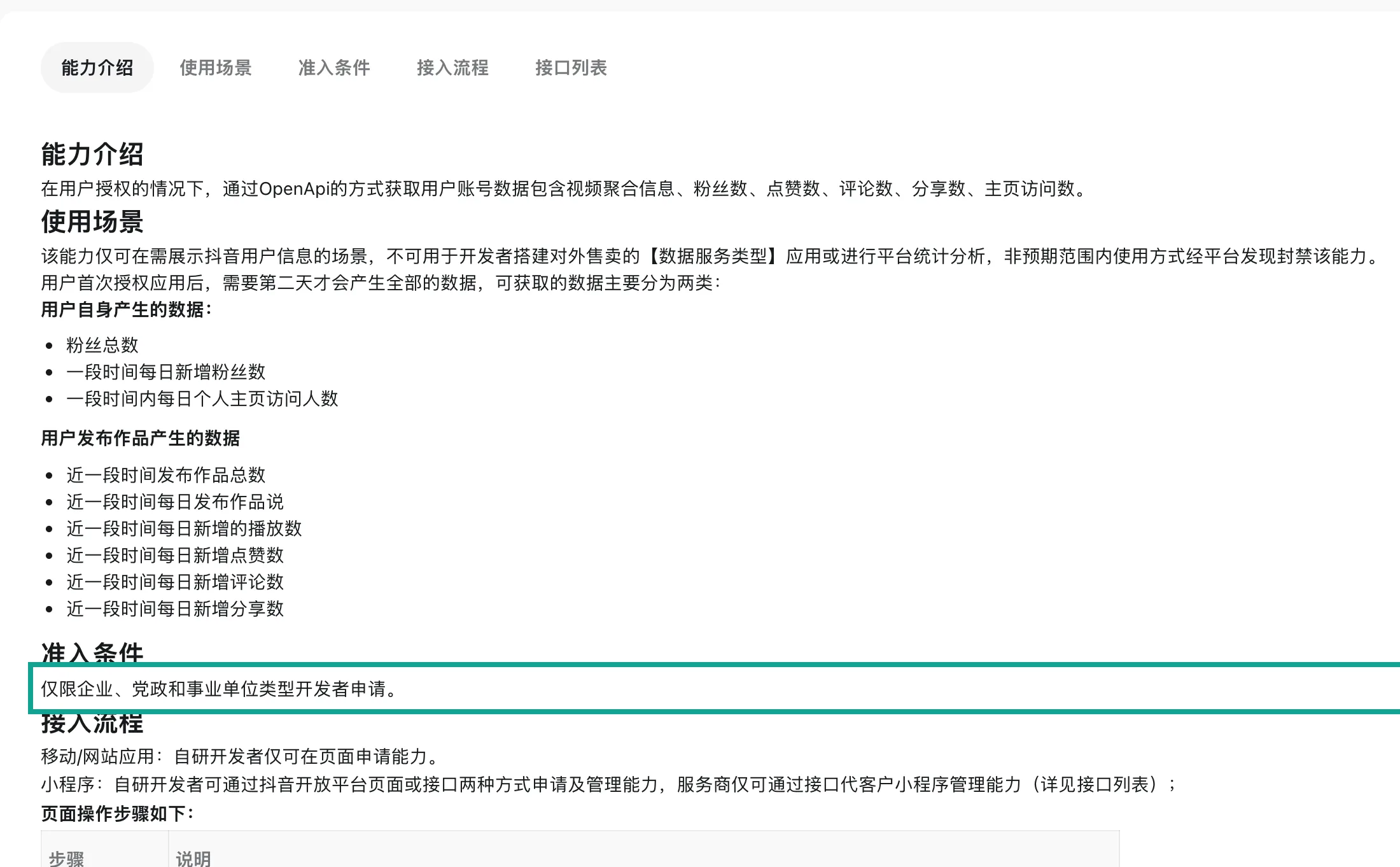
The second gate is the purpose limit. The user interaction data capability returns the authorized user's total followers, new followers per day and profile visits. It also returns new plays, likes, comments and shares for recent posts. The admission rule has one line: only enterprise, government and public institution developers can apply.
The use case section limits the purpose too. You may use the data only where you show Douyin user information. The page excludes data services for sale and platform statistics. The page warns that use outside this scope can lead to a ban on the capability.
The video data capability also starts from user consent. Its suggested use pairs it with the "publish content to Douyin" capability. A user posts a video from your app, grants consent at the same time, and your app reads back the data for that video. This design suits campaign tools and creator dashboards. It does not suit market research across accounts that never used your app.
| Official capability | Whose data | Key limit (from the docs) | Good fit |
|---|---|---|---|
| Basic public user info | The authorized user | Nickname, avatar, gender and region only | Sign in to your app with a Douyin account |
| User interaction data | The authorized user | Companies, government and public institutions only; no data service or platform statistics | An organization that tracks its own accounts |
| Video data and authorized account video list | The authorized user | Needs user consent; the list has no time filter yet | Read back posts from a campaign |
| Video comment management | Comments under authorized accounts' videos | Apply for the interaction scope video.comment | An agency or SaaS that replies to comments in one place |
| Keyword video search | Public videos on the whole app | Last 1 day only; register keywords first; needs user consent | A brand account that finds and answers recent mentions |
| Douyin search capability | Content on the whole app | Closed beta; apply and wait for approval | Show Douyin search results inside your own app |
The closest thing to data collection in this table is keyword video search. Its API document says that it searches videos across the whole app, like the search box in the Douyin app. Two limits follow at once. Before you use it, you must create the keywords in the keyword manager of the console. The endpoint returns videos from the last 1 day only. Its scope is video.search, which needs an application and user consent.
So the official search can answer "who posted a video about our brand yesterday". It cannot answer "how did likes spread across camping gear videos in the last six months". The Douyin search capability page describes a content search service for third-party apps. Access starts with a closed-beta request form, and you can connect only after approval.
The official API has no per-call fee. The free quota FAQ gives video.list as an example: 1,000 calls per day, reset at 8 a.m. the next day. For comments, the video comment management guide lists four endpoints: comment list, reply list, reply to comment and pin comment. Its use case is a back office that connects Douyin accounts and handles their video comments in real time. It still reads comments under authorized accounts only.
When the official route is the right one: shop orders, ads and your own accounts
Some data exists only on the platform side and with the account owner. No pay-per-call API can replace that. Shop orders live on the Douyin shop open platform. Its order list endpoint sorts by order time or update time and covers the last 90 days at most. It allows 1,000 calls per second per app.
Ad data lives in the Ocean Engine Marketing API. Its developer quick start asks you to register as a developer, create an app and apply for endpoint permissions. The changelog entry of November 3, 2026 announces a change for accounts on the old workbench. From November 30, 2026, write endpoints are limited for those accounts. Read endpoints (GET) stay, and the Marketing API itself stays online.
This data is not public. No third-party data API can get it, and none should try. For a shop ERP or an ad report, go straight to these two platforms.
Douyin scrapers on GitHub: do they still work?
Yes, but check three things first: whether the project needs a login, whether its license allows commercial use, and whether someone fixed it recently. At 00:2x SGT on November 21, 2026, we used the GitHub REST API to read stars, last commit and license for 9 often-cited Douyin repositories. Then we read the login and cookie sections of each README.
| Repository | Stars | Last commit (UTC) | License | Login and cookie (from the README) |
|---|---|---|---|---|
| NanmiCoder/MediaCrawler | 71,466 | 2026-11-17 | Custom non-commercial learning license 1.1 | Saves the login state with Playwright; by default reuses cookies from your own Chrome |
| Evil0ctal/Douyin_TikTok_Download_API | 21,501 | 2026-11-20 | Apache-2.0 | v5 builds a guest identity pool in a headless browser; v4 needs you to swap cookies |
| JoeanAmier/TikTokDownloader | 17,588 | 2026-11-03 | GPL-3.0 | Write the cookie by hand or from the clipboard |
| jiji262/douyin-downloader | 12,642 | 2026-11-20 | MIT | Log in to Douyin in a browser, then save it with cookie_fetcher |
| cv-cat/DouYin_Spider | 3,705 | 2026-10-23 | None stated | Needs the full cookie after login; without the UIFID field, risk control blocks you |
| Johnserf-Seed/f2 | 2,745 | 2026-10-06 | Apache-2.0 | Public posts work with a guest cookie; private posts and favorites need a login |
| saermart/DouyinLiveWebFetcher | 1,907 | 2026-09-08 | AGPL-3.0 | Live-room chat messages only; for learning only |
| erma0/douyin | 1,625 | 2026-08-14 | None stated | README says the code was removed in June 2026 after a compliance review |
| yzfly/douyin-mcp-server | 1,287 | 2026-07-02 | Apache-2.0 | Repository archived |
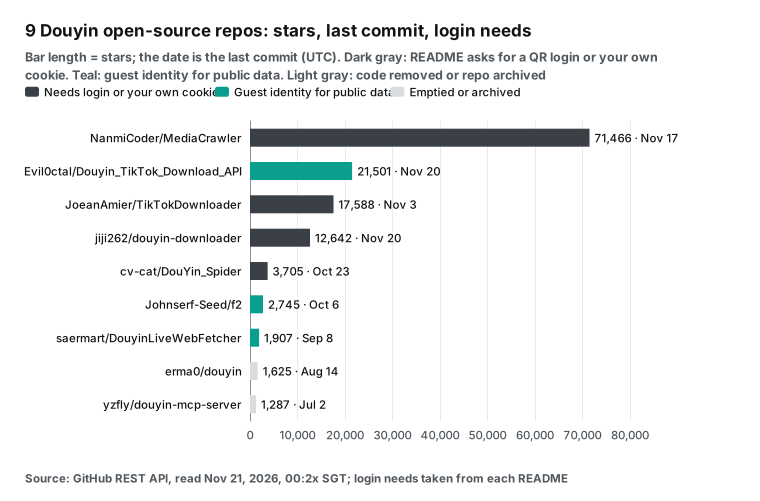
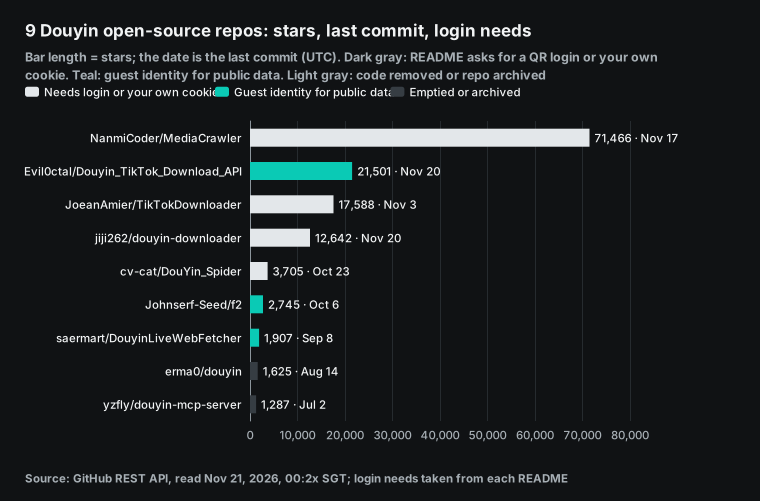
The MediaCrawler license does not allow commercial use. Its LICENSE is the author's own "NON-COMMERCIAL LEARNING LICENSE 1.1". Conditions 2 and 3 allow learning and research only, forbid large-scale crawling, and forbid commercial use without written consent. The README disclaimer also forbids commercial use. If your company wants to run it for business, check the license terms yourself first.
At the other end, Douyin_TikTok_Download_API released v5.1.12 on November 20, 2026. The author rewrote v5 from an empty branch. A headless browser now creates guest identities, and the identity pool refills on its own. Requests return a task_id by default, and you poll for the result later.
The project runs as three images under Docker Compose, with REST, MCP and command-line entry points. The README is direct about the old v4 problems. Cookies expire, the signature algorithm changes, and rate limits hit. Then an endpoint fails without a warning, and users often find out only when someone opens an issue.
Open issues also show how each project works. MediaCrawler has 13,478 forks and 217 open issues. Douyin_TikTok_Download_API has 2,988 forks and only 5 open issues, and its v5 issue template asks users to remove cookies and keys from logs. DouYin_Spider has 3,705 stars and 84 open issues, the highest ratio in the group.
TikTokDownloader has 2,891 forks and 44 open issues. douyin-downloader has 1,933 forks and 40 open issues. f2 has 420 forks and 75 open issues, and its default branch is a version branch, v0.0.1.8-pw3. The emptied erma0/douyin and the archived douyin-mcp-server still have more than 300 forks each. Code in a fork does not get updates from the original repository.
New issues in 30 days: about a third of Douyin technical issues are blocks
Stars show how many people tried a project. Issues show what it is like to use it now. We used the GitHub search API to pull every issue that was opened between October 22, 2026 and November 21, 2026 in 6 maintained repositories. There were 37 issues, and we sorted each one by hand from its title and body.
Douyin_TikTok_Download_API alone had 17. douyin-downloader had 9. The other 4 repositories had 11 together. Some of these repositories also support TikTok, Bilibili and other platforms. We did not count the 7 technical issues whose titles name another platform. We counted issues with no platform in the title as Douyin issues.
| Repository | Issues | Platform in the title | Topic |
|---|---|---|---|
| Douyin_TikTok_Download_API | #830, #831, #832 (all November 20, 2026) | TikTok | Signature self-check, 403 on play URLs, msToken |
| Douyin_TikTok_Download_API | #819 | TikTok | 502 on an author post list |
| MediaCrawler | #1004 | Bilibili | WBI signature on comments |
| douyin-downloader | #265 | YouTube | Download with no sound |
| douyin-downloader | #264 | Xiaohongshu, Kuaishou, Weibo | Feature request for original quality |
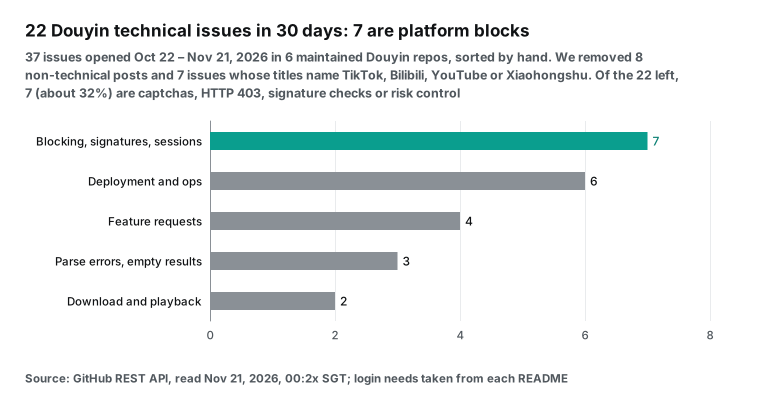
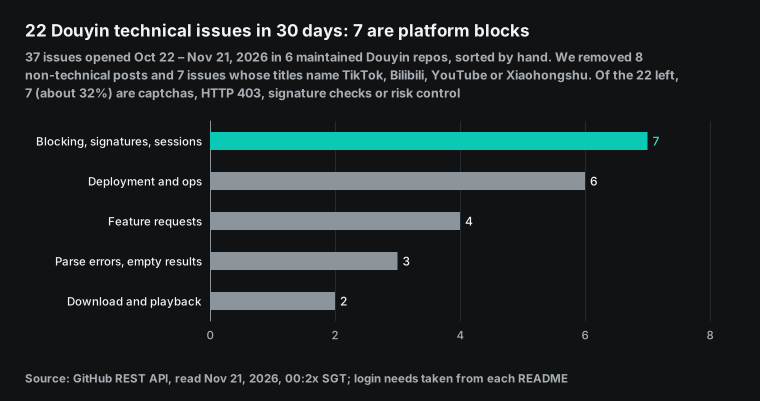
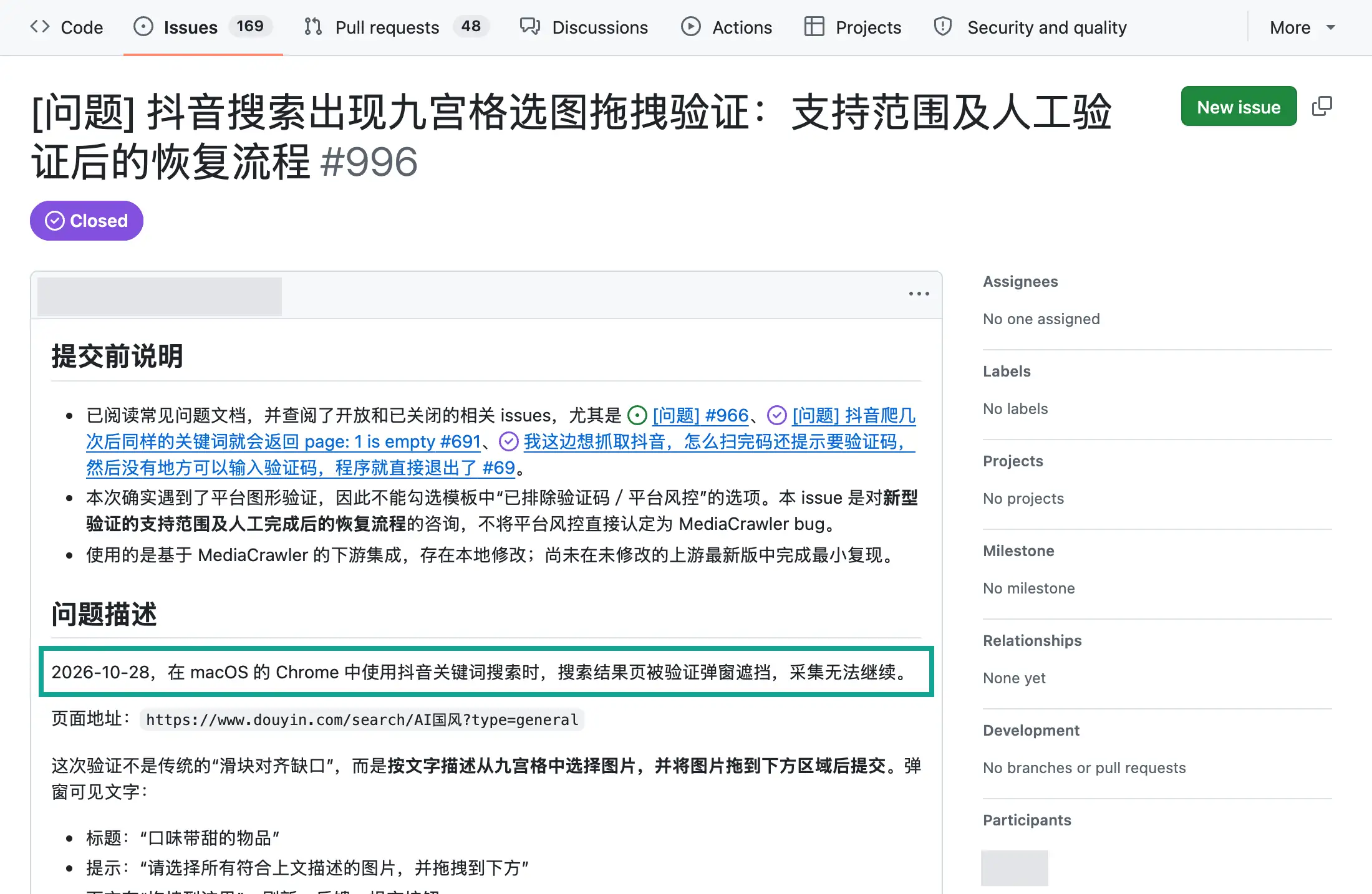
The largest group is blocks by the platform, with 7 issues. They include verification pop-ups, waves of 403 errors, a security check that rejects outside requests and private messages blocked by risk control. Here are four examples. We translated the issue text from Chinese.
| Issue | Opened | What the user reported |
|---|---|---|
| MediaCrawler #996 | October 28, 2026 | A new nine-grid image drag puzzle covered the keyword search results, and collection stopped |
| Douyin_TikTok_Download_API #829 | November 17, 2026 | Title: "Suddenly a flood of 403 errors this afternoon" |
| douyin-downloader #258 | October 26, 2026 | A Douyin security check accepted only requests sent from inside the web page; a retry or a new login did not help |
| DouYin_Spider #103 | October 26, 2026 | Private messages blocked by risk control |
We removed 8 non-technical posts, such as chats, ads and empty titles, and the 7 issues for other platforms. That left 22 Douyin technical issues, and blocks are 7 of them, about 32%. Deployment and operations had 6, feature requests 4, parse errors and empty results 3, and download and playback 2.
Some of the other groups also follow Douyin changes. In douyin-downloader, #263 reports that Douyin returned no post detail, and #257 reports an empty file when it saved comments. In Douyin_TikTok_Download_API, #803 says that the browser build always hangs. #797 and #817 ask for mirrors in China for the install script and the build container.
22 issues in one month is a small sample, sorted by hand. Each issue has one group only, and a 403 with no platform in the title can also come from TikTok. People who open issues are the users who hit a problem. So 32% does not mean that 32% of requests fail. It means that most maintenance work goes into keeping up with the platform's checks. If you choose open source, budget time to watch issues, swap cookies and upgrade.
Two more repositories show a different risk. The erma0/douyin README now says that the code was removed in June 2026 after a compliance review. yzfly/douyin-mcp-server, an MCP tool for Douyin video links and captions, has been archived since July 2, 2026. Plan for the day an open-source project stops.
Is there a ready-made Douyin API? How the two pay-per-call vendors compare
Yes. A pay-per-call API keeps the login state, the signatures and the data cleanup on its own servers. You send an HTTP request with one key, and you get structured JSON back. There are more than two vendors of this kind. We checked the price lists of TikHub and EveryInfra only, so the other pay-per-call services are not in the tables.
Neither of the two vendors asks you for a Douyin account or for Open Platform credentials. They differ in price structure, billing rules and results per call.
We read the TikHub public price endpoint once, without a key, at 00:21:36 SGT on November 21, 2026. It returned 1,484 rows, and 424 of them are Douyin rows. Xingtu is Douyin's creator marketplace.
The TikHub FAQ says that Douyin search must use the dedicated search line. The search endpoints in the App V3 and Web series do not work for search. The search line costs $0.01 per call and has no discount. Of the 424 Douyin rows, 156 take part in a daily volume discount of up to 50%, which resets each day on Los Angeles time. 217 rows accept the $0.05 free credit that you get when you verify your email. Top-ups carry a fee: 2.6% plus $0.30 for Alipay, and 5% plus $0.30 for PayPal and USDT.
| TikHub Douyin prices (Nov 21, 2026, 00:21 SGT) | Rows | Notes |
|---|---|---|
| $0.001 per call | 308 | Most App, Web and ranking endpoints |
| $0.002 to $0.005 per call | 43 | Xingtu V2, some Web endpoints |
| $0.01 per call | 32 | 29 of them are the search line |
| $0.02 per call | 29 | Mostly Xingtu V1; the docs say these use an enterprise account |
| $0.025 to $0.25 per call | 12 | Index and dataset endpoints; the highest is $0.25 |
| Total | 424 | 156 with discount, 217 accept free credit |
At 00:14:09 SGT on November 21, 2026, the EveryInfra Douyin catalog had 50 capabilities, and 43 of them were available. 7 were marked as unavailable: douyin/music_search, douyin/user_overview and 5 Xingtu analysis capabilities. The 43 available capabilities use only 6 price levels. 20 of them cost $0.000556 per call, including video detail, comments, post lists, trending, transcripts and Xingtu creator search. Hot boards cost $0.000806, video search $0.008333, product capabilities $0.008, and topic capabilities $0.015556. Comments are billed per block of 20, and a block that returns no rows is free.
| Item | TikHub | EveryInfra |
|---|---|---|
| Douyin endpoints | 424 rows in the price list, with several versions per feature | 50 capabilities in the catalog, 43 available |
| Video search price | Search line $0.01 per call; FAQ says about 6 to 10 results | douyin/search $0.008333 per call; at least limit results per page, up to 50 |
| Comments | $0.001 per call; FAQ suggests no more than 30 per call | douyin/comments $0.000556 per block of 20 |
| One video detail | $0.001 per call | douyin/video $0.000556 per call |
| Trending | Ranking endpoints mostly $0.001 per call | douyin/trending $0.000556 per call; 56 rows in our test |
| Failures and empty results | Failures free; any 200 reply is billed | Failures and empty results free; charged_usd is 0 |
| Discounts and free credit | Daily volume discount up to 50%; $0.05 for email verification | No daily discount; trial credit for new accounts |
| Rate limit | 10 requests per second by default; rate plans for sale | Per-key limit |
| MCP | mcp.tikhub.io/{platform}/mcp, one server for each of 16 platforms | One URL, https://api.everyinfra.com/mcp, with 12 tools |
Three tests check any other pay-per-call service for a few cents. The last column has our EveryInfra results from the live test.
| Test | How | What to look for | Our EveryInfra result |
|---|---|---|---|
| Results per call | Search one keyword and read three pages | Count per page, repeats across pages, price per 1,000 results | 20 results for one call, $0.417 per 1,000 |
| Missing item | Ask for a post that does not exist | Whether a 200 reply with no results costs money | 200, post_unavailable, $0 |
| Wrong parameter | Send an invalid value on purpose | Whether the error lists allowed values, and whether you paid | 422 with allowed values and did_you_mean, $0 |
For a line-by-line price check, TikHub Douyin API alternative compares 37 endpoints. Three points move a decision most.
The first point is search. Search is the most frequent call in monitoring work. The price per call and the results per call multiply, so the gap grows to 2.4 to 4 times. The second point is discounts. The TikHub endpoints that take the discount are mostly in the ranking, App and Web series. At tens of thousands of calls per day, its average price drops, but the search line is not part of the discount.
The third point is how MCP connects. TikHub splits MCP into 16 servers by platform, so in Claude or Cursor you add one config entry per platform. EveryInfra has one remote URL. Its tools have generic names such as everyinfra_call_api, and you pass the platform and capability as parameters.
The two MCP designs differ in size. The TikHub MCP page lists more than 990 tools on 16 servers, with stdio, SSE and Streamable HTTP transports. Each endpoint gets its own parameter notes, but the model must choose from a long tool list. The EveryInfra remote MCP has 12 tools. The model calls everyinfra_list_capabilities first and then everyinfra_call_api.
Here is the EveryInfra MCP config. The key comes from an environment variable and does not go into the file. In Claude Code, you can also use claude mcp add. The MCP setup page has the command.
{
  "mcpServers": {
    "everyinfra": {
      "type": "http",
      "url": "https://api.everyinfra.com/mcp",
      "headers": { "Authorization": "Bearer ${EVERYINFRA_API_KEY}" }
    }
  }
}
Fields: what a pay-per-call API returns, and which numbers need care
The EveryInfra catalog lists response_fields for each capability. The table covers the four capabilities from our live test. The counts come from the catalog of November 21, 2026. The fields in a live reply depend on that reply, and the catalog notes say which fields some requests do not return.
| Capability | Fields | Fields used most in a selection | Gaps that the field notes state |
|---|---|---|---|
douyin/search | 55 | like_count, comment_count, share_count, collect_count, posted_at, author_follower_count, search_rank, next_page_token | view_count is not a real play count; most results lack it, and it is sometimes 0 |
douyin/comments | 23 | text, like_count, reply_count, ip_location, posted_at | Without a page token, it usually returns top-level comments only; use douyin/comment_replies for replies |
douyin/video | 57 | The search counts plus duration_seconds, hashtags, music, is_ad, cart_products | Some requests lack shop products, and others lack download counts and city |
douyin/trending | 21 | rank, keyword, hot_value, video_count, board | hot_value is often empty on the hot list; most requests lack url |
Douyin does not publish video play counts. None of the 20 results from our search had a view_count field. The catalog note for view_count says that this field is not a real play count. To judge popularity, use likes, comments, shares and favorites.
Only a few boards, such as the hot video board douyin/billboard_video_hot, carry a play_count that Douyin counts itself. The TikHub FAQ also says that the standard video reply has no play count. It points to a separate fetch_video_statistics endpoint, and that count excludes plays bought through DOU+, Douyin's paid promotion. With any vendor, confirm which kind of number you have before you build a ranking by plays.
Which Douyin API should you use? Choose by job
We split common needs into 7 jobs. For each, the table gives a route, a reason and a warning. Prices come from the catalog and the public price list above.
| Your job | Route | Reason | Watch out |
|---|---|---|---|
| Let users sign in with Douyin and show their own posts in your app | Douyin Open Platform | Only the official route has user consent | Company credentials; 5 to 7 working days of review |
| An organization tracks followers and plays for its own accounts | Douyin Open Platform | Daily new plays are visible only to the account owner | User interaction data is for companies, government and public institutions only |
| Shop orders, after-sales and ad spend | Douyin shop open platform, Ocean Engine Marketing API | The data is not public, and third parties cannot get it | Orders cover the last 90 days at most |
| Monitor public videos by keyword (brand mentions, product research) | Pay-per-call API | Official search covers 1 day only; open source must handle the checks itself | Search is the largest cost; compare per 1,000 results |
| Read comments on a fixed set of videos in bulk | Pay-per-call API; both prices are close | Both are about $0.033 per 1,000 | At tens of thousands of calls per day, the TikHub discount can make it cheaper |
| Download the posts of a few accounts once, as an archive | Open-source project | Small and one-time, so not worth paying for | Check the license; log in again when the session expires |
| Let an AI tool such as Claude or Cursor query Douyin | MCP on a pay-per-call API | No code; the AI builds parameters from the tool notes | Each call is billed, so set a budget first |
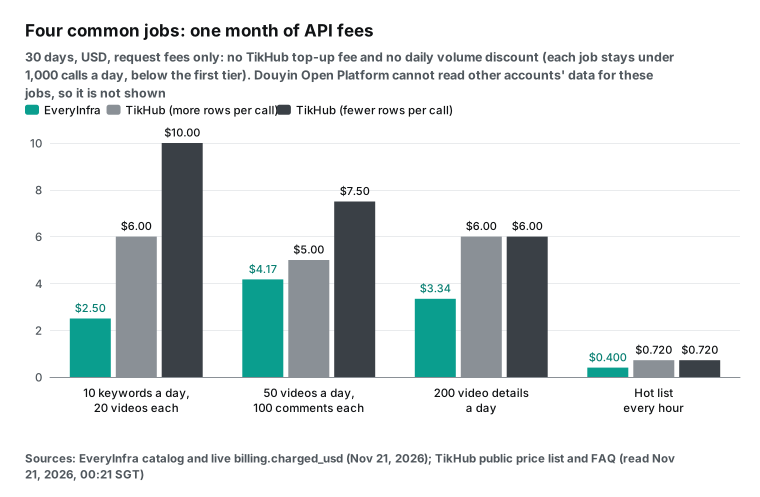
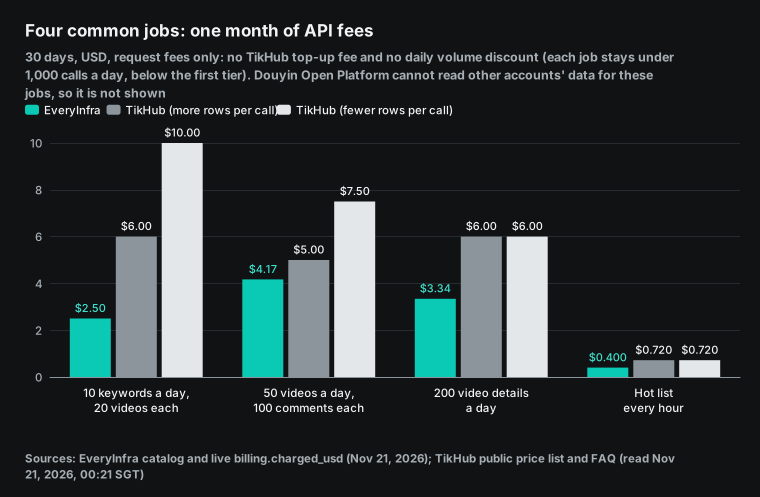
With 10 keywords a day and 20 videos each, you collect 6,000 videos a month. At EveryInfra, that is 300 searches at $0.008333, or $2.50. At TikHub, with 6 to 10 results per call, it takes 600 to 1,000 calls at $0.01, or $6.00 to $10.00.
With 50 videos a day and the first 100 comments of each, you collect 150,000 comments a month. At EveryInfra, that is 7,500 blocks of 20 at $0.000556, or $4.17. At TikHub, with 20 to 30 comments per call, it takes 5,000 to 7,500 calls at $0.001, or $5.00 to $7.50. With 200 video details a day, you make 6,000 calls a month: $3.34 against $6.00. With the hot list once an hour, you make 720 calls a month: $0.40 against $0.72.
The four jobs add up to $10.41 at EveryInfra and $17.72 to $24.22 at TikHub. Each job stays below 1,000 calls a day, which is below the first TikHub discount step. So the math includes no discount, and it also excludes the TikHub top-up fee.
Most of the gap comes from search. For comments alone, the gap is 1.2 to 1.8 times, and the monthly difference is less than $3.40. If your work uses almost no search and only reads comments on a fixed set of videos, price is not the main reason to choose. Then compare which fields fit your work better and which MCP setup is easier for you. If you run hundreds of keywords a day, search alone sets the bill.
A live test: the same video, read three times in 18 minutes
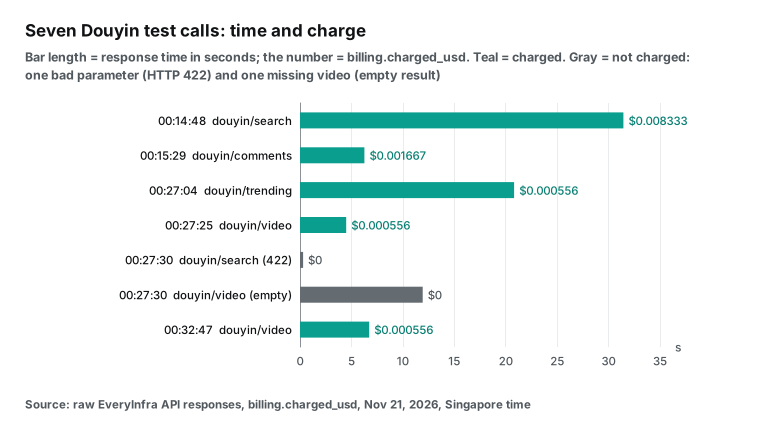
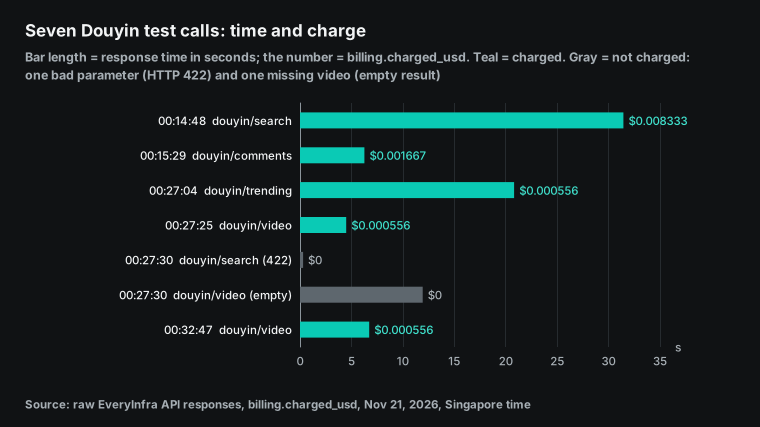
From 00:14 to 00:33 SGT on November 21, 2026, we sent 7 Douyin requests through EveryInfra. They covered 4 capabilities: douyin/search, douyin/comments, douyin/trending and douyin/video. We saved every raw reply.
Step one, at 00:14:48 SGT, used douyin/search with a Chinese keyword that means "camping gear review". We asked for the last 7 days and 20 results. After 31.4 seconds, it returned 20 videos and charged $0.008333. All 20 videos were posted between November 16, 2026 and November 20, 2026. Their likes ranged from 3 to 10,023, with a median of 41, and only 3 had more than 1,000.
The 20 authors had 22 to 257,937 followers, with a median of about 2,740, and none was a verified account. The video with the most likes came from an author with 12,814 followers. The author with 257,937 followers got 1,836 likes. If you monitor a keyword and watch only large accounts, you miss hits like this one from small accounts.
The same search shows that you cannot keep video URLs for long. 17 of the 20 results had has_watermark set to true. For video_url_expires_at, 9 links expired about 1 hour after the call, and 11 expired after about 48 hours. Store the video ID and the counts. When you need the file, read the detail again to get a fresh URL.
Step two, at 00:15:29 SGT, called douyin/comments for the video with the most likes and asked for 50 comments. After 6.3 seconds, it returned 50 comments with 50 unique comment IDs. That is 3 blocks of 20, so the charge was $0.001667. 13 of the 50 comments had replies, and the top comment had 79 likes. The commenters came from 23 different IP locations, including 1 in Singapore and 1 in Vietnam. Shandong province had the most, with 5.
All 50 were top-level comments (is_reply was false for each). 32 had no likes, and 37 had no replies. The 13 comments with replies had 63 replies in total, and you need douyin/comment_replies to read them. Likes sat on a few comments: the top 10 had 349 of the 363 likes, or 96%. The median comment was about 22 characters long, from 2 to 115 characters. Short texts like these suit keyword and sentiment tags better than long summaries.
curl -s https://api.everyinfra.com/api/v1/social \
  -H "Authorization: Bearer $EVERYINFRA_API_KEY" \
  -H "Content-Type: application/json" \
  -d '{"platform":"douyin","action":"comments","params":{"url":"https://www.douyin.com/video/7708772129973587235","limit":50}}'
# reply: billing.units = 3, rows_per_unit = 20, charged_usd = 0.001667
Step three showed how the counts on one video change. In the 00:14:48 SGT search result, the video had 10,023 likes and 554 comments. At 00:27:25 SGT, douyin/video returned 10,097 likes and 557 comments, plus 3,143 shares and 3,680 favorites. The video was 174 seconds long, and the author had 12,816 followers. At 00:32:47 SGT, a second read gave 10,127 likes and 558 comments. Likes grew by 104 in 18 minutes.
Counts in a search result are a snapshot at the time of the call, so trend work must read again at fixed intervals. A second read of the same video within 1 hour is billed as usual: the second read also cost $0.000556. The catalog note about free repeat reads within 1 hour applies only to posts that do not exist or are not visible.
| SGT | Capability | Parameters | Result | Charge |
|---|---|---|---|---|
| 00:14:48 | douyin/search | Camping gear review, last 7 days, 20 results | 20 results, 31.4 s | $0.008333 |
| 00:15:29 | douyin/comments | Top video above, 50 comments | 50 comments, 3 blocks, 6.3 s | $0.001667 |
| 00:27:04 | douyin/trending | Hot list and seeding list, 60 rows | 56 rows, 20.8 s | $0.000556 |
| 00:27:25 | douyin/video | Same video | 10,097 likes, 4.5 s | $0.000556 |
| 00:27:30 | douyin/search | sort set to hot | 422, lists allowed values and most_liked | $0 |
| 00:27:30 | douyin/video | A post that does not exist | 200 empty, post_unavailable | $0 |
| 00:32:47 | douyin/video | Same video again | 10,127 likes, 6.7 s | $0.000556 |
All 56 rows from the trending call were on the hot list. 50 of them had a heat value, from 7,657,168 to 12,143,221, and 6 had an empty heat value. None of the 56 rows had a url, which matches the catalog note that most requests do not return one.
Each topic linked to at most 13 related videos, and the median was 3. The 6 rows with no heat value were the pinned row at rank 1 and ranks 52 to 56. Among the 50 rows with a value, the highest was only about 1.6 times the lowest, so ranks that sit close together differ very little.
The event_time field gives the time that a topic joined the list. 41 topics joined on November 20, 14 on November 19 and 1 early on November 21. The trending list suits an hourly time series, for example to see how long a term stays on the list. A single heat value is comparable only within the same list and the same time window.
The 2 free calls each tell you something. At 00:27:30 SGT, we set sort to hot on purpose. The API replied with 422 in 0.23 seconds. The error listed the allowed values most_liked, newest and relevance, gave did_you_mean: most_liked, and said that no charge was made. In an AI tool, the model can read this error, fix the parameter and send the call again.
In the same second, we asked for a post that does not exist. The reply was 200 with an empty result, and empty_reason.code was post_unavailable. The held amount came back at once.
The 5 charged Douyin calls cost $0.011668 in total. For research, we also called YouTube search and YouTube comments once each ($0.001334), and the full spend on live calls for this research was $0.013002. On speed, search at 31.4 seconds and trending at 20.8 seconds were slow. Video detail and comments took 4.5 to 6.7 seconds. For slow capabilities, add "mode":"async" to the request body. You get a job_id first, and then you read the result from /api/v1/jobs/{job_id}.
When another route fits better
Start with the official route. Your product may need Douyin sign-in, may show users their own post data, may handle shop orders and after-sales, or may pull ad reports. All of these belong on the Douyin Open Platform, the Douyin shop open platform or Ocean Engine. Only the platform and the account owner have the right to give this data. A pay-per-call API cannot get it. The free quotas on the official route are often enough, the platform stands behind the fields, and the review and credentials are a one-time cost.
Next, open source. For a small archive, a code study or a team with a maintainer, open source costs the least. Douyin_TikTok_Download_API v5 has a guest identity pool, health checks and an MCP entry, and f2 reads public posts without a login. Expect the same blocks as in the last 30 days, and read the license terms yourself first: the MediaCrawler license does not allow commercial use.
Five questions also help you decide.
| Question | Points to the official route | Points to open source | Points to pay-per-call |
|---|---|---|---|
| Whose data is it? | Your own accounts, shops and ad accounts | Public posts, for your own tests | Public posts by others, in bulk |
| How fresh must it be? | The last 1 day is enough for keyword search | Any, if the scraper still runs | 24 hours, 7 days, six months or no limit |
| How much volume? | Inside the daily free quota | Tens of calls a day | Hundreds to tens of thousands a day; compare discounts and concurrency |
| Who maintains it? | The platform | Someone on your team watches issues and swaps cookies | The vendor |
| Do you need AI tools? | No MCP | One self-hosted project has MCP | Check how MCP connects and what one call costs |
Last, TikHub. Its Douyin price list has 424 rows. It includes Xingtu V1, the Douyin index, DOU+, creator dashboard and live-room gift ranking endpoints. The EveryInfra catalog has no match or only a partial match for these. Its trending and topic detail endpoints cost $0.001 per call, much less than our topic price of $0.015556.
At tens of thousands of calls per day on discount-eligible endpoints, its daily discount can cut the average price in half. It also sells historical datasets, which help when you need data on an account from years ago that no endpoint can still return. In these cases, use TikHub. You can also use both: EveryInfra for search and comments, TikHub for Xingtu and topics.
What changes when you switch: IDs, paging and slow requests
Teams move from open source to an API when the scraper stops, or move between APIs. The cost of a switch sits in three places: IDs, paging and slow requests.
One Douyin author has several IDs, and each route names them differently. Save every kind of ID when you store data, so that records still match after a switch. Paging tokens do not mix between vendors, so store the checkpoint for incremental collection by each vendor's rules. In our test, one search took 31.4 seconds. Write your client as three steps: submit, poll and fetch. Then a switch changes only the submit step.
| Switch point | EveryInfra | TikHub | Open source |
|---|---|---|---|
| Author ID | author_id (secUid), author_uid, author_douyin_id | aweme_id, sec_uid, share link or search term | Different names in each project |
| Paging | page_token, valid for 24 hours | Cursor; page size changes | Depends on the project |
| Slow requests | Sync waits up to 85 s; "mode":"async" returns a job_id | Synchronous calls | Douyin_TikTok_Download_API v5 returns a task_id |
Law and limits
Public data on Douyin is not free to use in any way you like, whichever route you choose. Collected data contains commenter nicknames, avatars and IP locations, and all of these are personal information under Chinese law. The Personal Information Protection Law of China (PIPL) has a rule for teams outside China. Under Article 3, the law also applies outside China. It applies when you process the personal information of people in China to analyze their behavior. If your team is outside China and studies Douyin comments, read the article text and check the scope yourself.
For brand monitoring, the easiest practice is to replace nicknames with codes and keep only the text and the counts.
| Rule | Article | What it says (our translation, shortened) | Common practice (check the terms yourself) |
|---|---|---|---|
| PIPL | 3 | Applies outside China when you analyze the behavior of people in China | Check whether your analysis covers people in China |
| PIPL | 27 | Public personal information is allowed within a reasonable scope, unless the person refuses | Keep the purpose narrow |
| PIPL | 6 | Collect the minimum scope for the purpose | Replace nicknames with codes |
| Network Data Security Management Regulations | 18 | Automated collection must not disturb the service | Respect rate limits |
| Anti-Unfair Competition Law (2025) | 13 | Do not get data by breaking technical controls | Use routes that do not bypass logins or checks |
The table links each rule to the full text. The Regulations on Network Data Security Management cover automated collection. The Anti-Unfair Competition Law, as revised in 2025, covers data that another business holds lawfully.
A court case from October 26, 2026 shows how courts read this. The company sold an auto-click tool to food-delivery riders. China National Radio reported that the Huangpu court in Guangzhou ordered it to pay 3 million yuan. The judge said that the test was the purpose and marketing of the product. It was not only whether the tool broke into a back end or changed data.
A YouTube search shows where the line sits in practice. At 00:22 SGT on November 21, 2026, we called EveryInfra youtube/search for the Chinese phrase that means "Douyin data collection API" and took the top 10 videos. They had 154 to 421 views each. 5 of the 10 titles were about collecting the phone numbers of live-stream viewers, or about scraping anonymous or private live rooms.
That kind of use involves personal information that is not public, and the laws above put clear limits on it. EveryInfra provides only data that public pages show. It does not provide private accounts, private messages, phone numbers or similar data.
Douyin's own robots.txt is also worth a look. It lists allowed and blocked paths for a set of search engines and AI crawlers. For example, it blocks the Baidu crawler from paths such as /video/ and /search/. robots.txt guides search engine crawlers and is not a law, but it shows which areas the platform does not want crawled in bulk. The text above describes data methods and limits, and it is not legal advice. For a real project, check the terms yourself or ask your own lawyer.
News from October and November 2026
- November 20, 2026: Douyin_TikTok_Download_API released v5.1.12. The v5 line uses a guest identity pool and has an MCP entry. For you: self-hosting open source is easier now, but you still own the maintenance.
- November 3, 2026: the Ocean Engine changelog announced that old-workbench accounts lose write endpoints from November 30. For you: if you automate ads with the Marketing API, move to the upgraded workbench before the end of the month.
- October 26, 2026: a court ordered 3 million yuan in damages in the delivery auto-click case (China National Radio). For you: in this case, the court looked at the purpose and marketing of the tool to decide on unfair competition.
FAQ
Does Douyin have an official API?
Yes. The Douyin Open Platform (developer.open-douyin.com) offers an OpenAPI. Almost every data endpoint needs user consent, so it reads accounts that authorized you, plus your own shop and ad accounts. Its keyword search across the whole app returns the last 1 day only. The official route does not give bulk access to public videos and comments by other users. Source of this question: Google autocomplete for "douyin api" and the Chinese query "does Douyin have an API" (read on November 21, 2026).
Which Douyin API should I use?
Choose by job. Use the official route for your own accounts, shops and ad data. Use open source for a small one-time download. Use a pay-per-call API for public data in bulk. Video search costs $0.417 per 1,000 results at EveryInfra and $1.00 to $1.67 at TikHub. TikHub has more Xingtu and index endpoints. Source of this question: Google autocomplete for "douyin api".
Is there a ready-made Douyin API, so I do not have to write a scraper?
Yes. A pay-per-call API returns JSON for one HTTP request, and it needs no Douyin account or cookie. In AI tools such as Claude or Cursor, you can also call it through MCP. The EveryInfra Douyin catalog has 43 available capabilities, and the market page shows the parameters and samples for each one. Source of this question: help posts under the V2EX "scraping" tag that ask for an API with no client (v2ex.com tag page).
Which Douyin data scraping APIs do you recommend?
For the official route, start with the "video data" capability on the Douyin Open Platform. For open source, start with Douyin_TikTok_Download_API (Apache-2.0, released on November 20, 2026). For pay-per-call, start with EveryInfra or TikHub. Compare price, failure billing and cookie needs. Source of this question: Google autocomplete for "douyin scraper api".
Can I use the Douyin scrapers on GitHub for commercial work?
Check the license. The MediaCrawler license allows non-commercial learning only. TikTokDownloader uses GPL-3.0 and DouyinLiveWebFetcher uses AGPL-3.0, and both carry source-sharing duties.
douyin-downloader uses MIT, and Douyin_TikTok_Download_API and f2 use Apache-2.0. DouYin_Spider states no license, so ask the author before you use it. A license covers only the code. The collection itself also touches platform rules and laws, so check the terms yourself. Source of this question: Google autocomplete for "douyin scraper github" and "douyin api github".
Can a Douyin scraper collect comments?
Yes. The pay-per-call douyin/comments capability returns up to 50 top-level comments per page, and douyin/comment_replies returns replies. Among the open-source projects, MediaCrawler and DouYin_Spider both support comments, but they need a login. The official comment endpoints read comments under authorized accounts only. Source of this question: Google autocomplete for "douyin scraper comment".
Can I collect Douyin live-stream data?
Public live-room information, such as the title, the viewer count and the products, is fine. EveryInfra has douyin/live_room, and the open-source DouyinLiveWebFetcher reads live chat. Phone numbers of viewers and content from private live rooms are personal information and non-public content, and EveryInfra does not provide them. Source of this question: Google autocomplete for "douyin live api".
Where do I get a Douyin API key?
The official key is the client_key of an Open Platform app. You get it after you create an app in the console, and you must also apply for each capability. A pay-per-call key comes from each vendor's console. At EveryInfra, you create it in the console after sign-up. Source of this question: Google autocomplete for "douyin api key".
Can I use the TikTok API to get Douyin data?
No. TikTok and Douyin are separate apps with separate accounts and content. The TikTok Research Tools describe public data on TikTok accounts, content and shops only. For Douyin, use the Douyin Open Platform, an open-source Douyin project or a Douyin pay-per-call API. Source of this question: teams that already use TikTok data, as described in the Douyin vs TikTok section above. We did not find this exact phrase in autocomplete.
How to start
- Read the free catalog:
GET https://api.everyinfra.com/api/v1/social/catalog?platform=douyin. It needs no key and shows the parameters,price_usdandavailablefor each capability. The Douyin API page lists the capabilities. Compare TikTok, Kuaishou and Xiaohongshu. - Sign up, create a key, and send your first request with the quick start. Prices are on the pricing page.
- Start with one keyword: take 20 to 50 results from
douyin/search. Then calldouyin/commentsanddouyin/transcripton a few videos. For popularity, usedouyin/trending. - Query from Claude or Cursor: add the MCP config above, and let the model make the calls.
- For Python code, read douyin api python: three routes tested. For profiles and post lists, read Douyin user profile API test. For a TikHub price check, read TikHub Douyin API alternative and TikHub alternatives. For the same choice on Xiaohongshu, read Xiaohongshu API: official vs third-party.
References
- OpenAPI list, Douyin Open Platform, read on November 21, 2026, https://developer.open-douyin.com/docs/resource/zh-CN/dop/develop/openapi/list
- Role overview, Douyin Open Platform, read on November 21, 2026, https://developer.open-douyin.com/docs/resource/zh-CN/developer/introduction/type-and-permission
- Keyword video search, Douyin Open Platform, read on November 21, 2026, https://developer.open-douyin.com/docs/resource/zh-CN/dop/develop/openapi/search-management/keywords-video-list/keywords-video
- Free quota FAQ, Douyin Open Platform, read on November 21, 2026, https://developer.open-douyin.com/docs/resource/zh-CN/dop/common-question/free-quota-common-question
- Authorized account video list, Douyin Open Platform, read on November 21, 2026, https://developer.open-douyin.com/docs/resource/zh-CN/dop/develop/openapi/video-management/douyin/search-video/account-video-list
- Video comment management guide, Douyin Open Platform, read on November 21, 2026, https://open.douyin.com/platform/resource/docs/ability/interaction-management/video-comment-management-solution
- User interaction data (capability page), Douyin Open Platform, read on November 21, 2026, https://developer.open-douyin.com/capacity-center-page/capacity-detail/7180284622729658424
- Video data (capability page), Douyin Open Platform, read on November 21, 2026, https://developer.open-douyin.com/capacity-center-page/capacity-detail/7180522194714230845
- Douyin search capability, Douyin Open Platform, read on November 21, 2026, https://developer.open-douyin.com/product/search
- Capability overview, Douyin Open Platform, read on November 21, 2026, https://developer.open-douyin.com/docs/resource/zh-CN/dop/ability/common-solution
- Create mobile and web apps, Douyin Open Platform, read on November 21, 2026, https://developer.open-douyin.com/docs/resource/zh-CN/dop/develop/app-mgmt/create-mobile-and-web-app
- order/searchList, Douyin shop open platform, read on November 21, 2026, https://op.jinritemai.com/docs/api-docs/15/1342
- Changelog (November 3, 2026), Ocean Engine open platform, https://open.oceanengine.com/changelog/1
- Developer quick start, Ocean Engine open platform, read on November 21, 2026, https://open.oceanengine.com/labels/7/docs/1696710498372623
- robots.txt, Douyin, read on November 21, 2026, https://www.douyin.com/robots.txt
- NanmiCoder/MediaCrawler, GitHub, read on November 21, 2026, https://github.com/NanmiCoder/MediaCrawler
- MediaCrawler LICENSE, GitHub, read on November 21, 2026, https://github.com/NanmiCoder/MediaCrawler/blob/main/LICENSE
- MediaCrawler issue #996 (October 28, 2026), GitHub, https://github.com/NanmiCoder/MediaCrawler/issues/996
- Evil0ctal/Douyin_TikTok_Download_API, GitHub, read on November 21, 2026, https://github.com/Evil0ctal/Douyin_TikTok_Download_API
- Douyin_TikTok_Download_API v5.1.12 (November 20, 2026), GitHub, https://github.com/Evil0ctal/Douyin_TikTok_Download_API/releases/tag/v5.1.12
- Douyin_TikTok_Download_API issue #829 (November 17, 2026), GitHub, https://github.com/Evil0ctal/Douyin_TikTok_Download_API/issues/829
- JoeanAmier/TikTokDownloader, GitHub, read on November 21, 2026, https://github.com/JoeanAmier/TikTokDownloader
- jiji262/douyin-downloader, GitHub, read on November 21, 2026, https://github.com/jiji262/douyin-downloader
- douyin-downloader issue #258 (October 26, 2026), GitHub, https://github.com/jiji262/douyin-downloader/issues/258
- cv-cat/DouYin_Spider, GitHub, read on November 21, 2026, https://github.com/cv-cat/DouYin_Spider
- DouYin_Spider issue #103 (October 26, 2026), GitHub, https://github.com/cv-cat/DouYin_Spider/issues/103
- Johnserf-Seed/f2, GitHub, read on November 21, 2026, https://github.com/Johnserf-Seed/f2
- saermart/DouyinLiveWebFetcher, GitHub, read on November 21, 2026, https://github.com/saermart/DouyinLiveWebFetcher
- erma0/douyin, GitHub, read on November 21, 2026, https://github.com/erma0/douyin
- yzfly/douyin-mcp-server, GitHub, read on November 21, 2026, https://github.com/yzfly/douyin-mcp-server
- TikHub public price endpoint, read at 00:21 SGT on November 21, 2026, https://api.tikhub.io/api/v1/tikhub/user/get_all_endpoints_info
- TikHub FAQ, read on November 21, 2026, https://tikhub.io/faq
- TikHub pricing, read on November 21, 2026, https://tikhub.io/pricing
- TikHub Douyin API, read on November 21, 2026, https://tikhub.io/douyin-api
- TikHub MCP, read on November 21, 2026, https://tikhub.io/mcp
- TikHub docs, read on November 21, 2026, https://docs.tikhub.io/
- EveryInfra social data catalog, read at 00:14 SGT on November 21, 2026, https://api.everyinfra.com/api/v1/social/catalog
- Model Context Protocol, https://modelcontextprotocol.io/
- Personal Information Protection Law of the People's Republic of China, full text reposted by the National Bureau of Statistics, https://www.stats.gov.cn/gk/tjfg/xgfxfg/202503/t20250310_1958923.html
- Regulations on Network Data Security Management, Cyberspace Administration of China, September 30, 2024, https://www.cac.gov.cn/2024-09/30/c_1729384452307680.htm
- Anti-Unfair Competition Law of the People's Republic of China (2025 revision), China National Intellectual Property Administration, https://www.cnipa.gov.cn/art/2026/5/20/art_104_206437.html
- Report on 3 million yuan damages for a delivery auto-click tool, China National Radio, October 26, 2026, https://news.cnr.cn/native/gd/20261026/t20261026_527853357.shtml
- V2EX "scraping" tag, read on November 21, 2026, https://www.v2ex.com/tag/%E9%87%87%E9%9B%86
- YouTube search for "Douyin data collection API" in Chinese, top result, read on November 21, 2026, https://www.youtube.com/watch?v=PkJOOjlxZEg
- TikTok Research Tools: access and eligibility, TikTok for Developers, read on November 21, 2026, https://developers.tiktok.com/products/research-api/
Reference BL-204