TikHub Pricing Explained: All 1,470 Endpoint Prices, Decoded
TikHub pricing, decoded: 990 of 1,470 endpoints cost $0.001 and only 30.8% get the volume discount. See when it beats us, from 14 live calls.

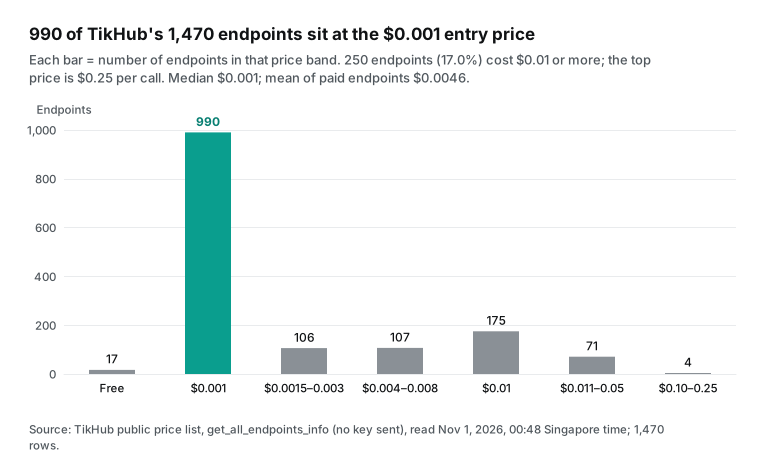
You can read TikHub's per-endpoint prices without an account. Its get_all_endpoints_info endpoint returned all 1,470 price rows to a request with no API key. One path (Douyin live search V2) appears twice, so there are 1,469 unique endpoints; our counts use the 1,470 rows. We saved a copy on November 1, 2026, at 00:48 Singapore time. In that list, 990 endpoints (67.3%) cost the $0.001 entry price per call.
250 endpoints (17.0%) cost $0.01 or more, and the top price is $0.25 per call. Only 452 endpoints (30.8%) take part in the daily volume discount that the pricing page advertises. Of the 1,453 paid endpoints, 789 (54.3%) get neither the discount nor the free sign-up credit.
We put that price list next to the EveryInfra catalog and 14 live calls from the same day. Per 1,000 requests, TikHub costs 1.2 to 18.0 times what we charge for the same kind of data. TikHub only drops below our $0.000556 base price on one condition. You must send more than 118,791 calls a day to a single $0.001 endpoint that is in the discount.
This article follows our earlier TikHub alternative test of cost per 1,000 results, but the angle is different. On October 26, 2026, that article compared the cost of 1,000 results by use case. At that time we thought TikHub's per-endpoint prices needed a login. So for Douyin comments, TikTok search and TikTok comments we could only use the $0.001 entry price and write "at least".
This article takes TikHub's bill apart line by line: unit prices, the tiered discount, free credit, top-up fees, the monthly rate-limit fee and refunds. It uses the public price list to turn every "at least" into an exact number. It also shows the volume at which TikHub becomes cheaper than us. For a short summary, see /en/alternatives/tikhub.

TikHub pricing in one table: how the bill is built
Most people who search for "tikhub pricing" want to know what a month will cost. The TikHub pricing page explains billing in five points. You top up a balance first. The balance has a paid pool and a free pool.
Each endpoint has its own unit price. Rate limits are a separate purchase. The Chrome extension and MCP bill the same as direct calls.
The TikHub FAQ adds the details. Only requests that return status 200 are billed. Repeat requests with identical parameters are billed each time. The discount resets at midnight Los Angeles time. Put together, a TikHub month is a formula. Sum each endpoint's unit price times its discounted daily calls, add the rate-limit fee, then multiply by the top-up fee rate.
The table below puts each part of that formula next to the matching EveryInfra rule. The TikHub column uses only TikHub's own public pages. The EveryInfra column uses our catalog and pricing page from November 1, 2026.
| Part of the bill | TikHub (public pages, read 2026-11-01) | EveryInfra (catalog and pricing page, 2026-11-01) |
|---|---|---|
| Billing unit | Per request; 1,470 endpoints, each priced from $0 to $0.25 | Per request; 573 capabilities (read at 15:40), each priced; a few list capabilities bill per 20 rows |
| Most common price | $0.001 (990 endpoints) | $0.000556 (base tier, $0.56 per 1,000) |
| Volume discount | Daily brackets, up to 50% off; only 452 endpoints qualify | No daily discount; enterprise volume is negotiated |
| Free credit | $0.05 after email check; 631 endpoints accept it | $1 after a GitHub star; valid for 24 hours |
| What gets billed | Any status 200 response, empty results included | Failures and empty results are refunded; charged_usd is 0 |
| Rate limit | 10 per second by default; more costs $5 to $55 a month | 60 per minute by default; more with a 30-day speed pack or by total top-ups |
| Top-up | $5 minimum; Alipay 2.6% + $0.30, PayPal and USDT 5% + $0.30 | Listed amounts start at $10; checkout shows the total and the fee before you pay |
| Refunds | Not refundable by default; only when TikHub confirms an endpoint is down | Balance does not expire; each failed call is refunded automatically |
Rows three and five matter most. "Up to 50% off" is the biggest promise on the TikHub pricing page, but it covers only about three in ten endpoints. "Billed on status 200" means a request with a wrong parameter can still cost money if the platform returns an empty list. In the earlier article we counted 18 endpoints whose public docs say exactly this (TikHub alternative test). These two rows decide whether "from $0.001" holds up on a real bill.
Two more rules do not appear in the table, but they change the bill. First, repeat requests are billed each time. The FAQ entry "Do repeat requests return cached data?" says identical requests return fresh data and are billed separately. Each success response has a cache_url.
The FAQ says two things about it. One entry calls it "a separate debugging aid, not a cheaper way to re-fetch". Another entry ("What is the cache_url in my response?") says that opening it is free, and that it is "worth saving the cache_url if you expect to read the same data more than once inside the day". Put together: for 24 hours you can reread the same response free, but you do not get new data. New data is a new billed request.
If your retry logic does not tell a network timeout apart from a 200 that already arrived, you pay twice.
Second, pagination. Comment and search endpoints return one page per call. The FAQ suggests 30 comments or fewer per call. So "1,000 results" on TikHub usually means 34 to 167 requests, depending on the page size. The sections below include both rules in the math.
TikHub's public price list: 1,470 endpoints, no login needed
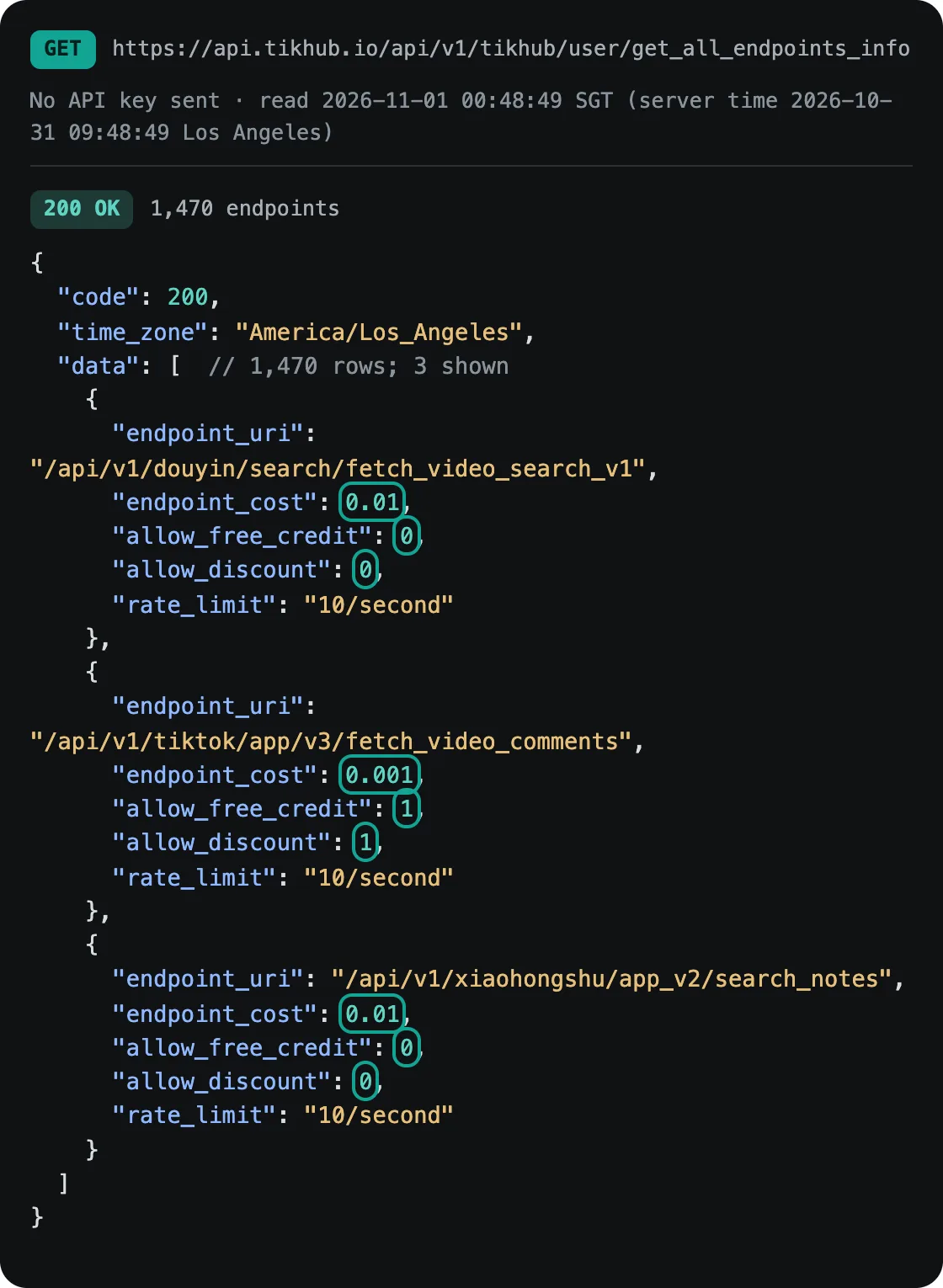
TikHub documents an endpoint called "Get all endpoints information" (docs) at /api/v1/tikhub/user/get_all_endpoints_info. The docs say it needs a Bearer token. On November 1, 2026, at 00:48:49 Singapore time, we sent a plain GET with no key. It returned status 200 and a data array with 1,470 rows. Each row has the endpoint path, the unit price endpoint_cost, a free-credit flag allow_free_credit, a discount flag allow_discount, a rate_limit and an endpoint type.
The response time stamp was 09:48:49 on October 31, 2026, Los Angeles time. That matches the FAQ, which says the usage log runs on the Los Angeles clock. The same group also has endpoints to read one endpoint's info, to calculate a price and to read the discount brackets. We saved the public response of the last one as well.
This list turns the range "$0.001 to $0.01" into an exact price for each endpoint. We grouped the prices into seven bands, shown in the chart below. 990 endpoints (67.3%) cost exactly $0.001. 17 cost nothing; most of them are account and test endpoints. 106 sit between $0.0015 and $0.003, 107 between $0.004 and $0.008, and 175 cost $0.01. Another 71 sit between $0.011 and $0.05, and 4 cost $0.10 to $0.25.
The median is $0.001. But the mean of the paid endpoints is $0.004554, which is 4.6 times the median, because the expensive tail is heavy. If you only use entry-price endpoints such as TikTok data or Douyin comments, "from $0.001" is close to true. If you work with RedNote, WeChat Channels, WeChat Official Accounts or LinkedIn, most of the endpoints you need cost $0.01.
The four most expensive endpoints show that TikHub's price spread is not only "complex endpoints cost a little more". The table lists typical endpoints from the expensive end, with prices taken from the November 1, 2026 list.
| TikHub endpoint path | Price | Discount | Free credit | What it does |
|---|---|---|---|---|
/api/v1/douyin/app/v3/fetch_multi_video_high_quality_play_url | $0.25 | No | No | Batch highest-quality Douyin play URLs (docs) |
/api/v1/douyin/web/fetch_batch_user_profile_v2 | $0.15 | No | No | Batch Douyin user profiles |
/api/v1/sora2/create_video | $0.10 | No | Yes | AI video generation, not social data; the FAQ says it is deprecated |
/api/v1/linkedin/web_v2/get_job_detail | $0.05 | No | No | LinkedIn job details |
/api/v1/tiktok/web/fetch_batch_check_live_alive | $0.05 | No | No | Batch check if TikTok live rooms are on air |
/api/v1/douyin/search/fetch_video_search_v1 | $0.01 | No | No | Douyin keyword search (docs) |
/api/v1/xiaohongshu/app_v2/search_notes | $0.01 | No | No | RedNote note search (docs) |
The Sora row needs a note. The TikHub FAQ says that sora2/create_video in the social API is deprecated and not maintained. Sora video now lives in its AI Proxy. But the November 1 price list still shows this endpoint at $0.10, so it stays in our counts.
Two structural details were missing from our earlier article. First, 433 priced endpoints are not in TikHub's public openapi.json, which is version V5.3.2 with 1,056 operations. Counted by unique path, the two sources overlap on only 1,036 endpoints. If you choose endpoints from the public API docs, you do not see almost three in ten priced endpoints. In the other direction, 20 operations in the docs are not in the price list.
Second, 28 endpoints have the type third-party. They are 11 WeChat Channels endpoints, 9 WeChat Official Accounts endpoints and 8 RedNote endpoints, all at $0.01, and none of them get the discount. TikHub's public pages do not say why they are priced this way.
The rate_limit field is also set per endpoint, and it is not always the "10 per second" on the pricing page. Of the 1,470 endpoints, 1,393 allow 10 per second.
47 endpoints allow 5 per second. 24 of them are the full Instagram web_app series; the others are 13 Douyin, 9 TikTok and 1 Kuaishou endpoint. The 12 Threads endpoints allow 3 per second, and YouTube comments V2 allows 4 per second. Account and price endpoints, and the Sora video endpoints, allow 1 per second. The public pages do not say if a higher paid rate level also raises these per-endpoint limits.
If your batch job runs mostly on Instagram web_app, Threads or YouTube comments, use the price-list rate. Do not plan with 10 per second. For example, 10,000 Instagram web_app calls take at least 33 minutes at 5 per second, not 17 minutes.
Same feature, different version: up to 10 times the price
The price list shows one more pattern. The same feature often exists in several versions, such as web, app, v2 and v3, and their prices can differ a lot. We grouped endpoints by platform and by the last path segment without its version suffix. We kept only endpoints with a price above zero. In 36 groups, the most expensive version costs at least twice the cheapest one. The widest gaps are below, with prices from the November 1, 2026 list.
| Platform and feature | Cheapest version | Most expensive version | Ratio |
|---|---|---|---|
RedNote note details get_note_info | web get_note_info_v5, $0.001 | five other web and app versions, $0.01 | 10x |
Douyin user search fetch_user_search | search fetch_user_search_v2, $0.001 | search v3, v4 and others, $0.01 | 10x |
RedNote trending list fetch_hot_list | web_v3, $0.001 | web_v2, $0.01 | 10x |
| Instagram user ID to username | v1, $0.001 | v3, $0.008 | 8x |
YouTube video captions get_video_captions | web_v2 _v2, $0.001 | web_v2 original, $0.008 | 8x |
| Douyin batch user profiles | web v1, $0.03 | web v2, $0.15 | 5x |
| Instagram user, hashtag and location search | v2, $0.002 | v3, $0.008 | 4x |
On TikHub, picking the right version is a cost decision in itself. But versions differ in more than price. Fields, stability, cookie needs and maintenance status also change. The TikHub FAQ says the old RedNote App and Web series were retired on June 13, 2026.
It also says Douyin search must use its dedicated search series, not the search endpoints in the Web or App V3 series. So the cheapest version in the table may not work for you. Check the docs and the price list together.
On EveryInfra, each capability has one price. For example, xiaohongshu/search costs $0.005556 per call, and you do not choose a version. The trade-off is that you also cannot pick a cheaper version yourself.
Average prices by platform also differ a lot. The 95 RedNote endpoints average $0.0111 per call, with a median of $0.01. All 24 WeChat Channels endpoints cost $0.01, and WeChat Official Accounts average $0.0096. LinkedIn has a median of $0.001, but job and company-post endpoints at $0.05 lift its mean to $0.0071. Kuaishou averages $0.0051 with a median of $0.002.
Douyin averages $0.0049, lifted by the batch endpoints at $0.15 to $0.25. TikTok, YouTube, Reddit, Weibo, Zhihu and X all average between $0.001 and $0.002. So "is TikHub expensive?" has no single answer. X, Weibo and Zhihu data are cheap there, while RedNote, WeChat and LinkedIn data sit at a different price level.
Who gets the discount, who gets the free credit
The TikHub FAQ says that free credit and the tiered discount apply "per endpoint". The price list has both flags, so we counted them. 452 endpoints (30.8%) take part in the discount. 631 (42.9%) accept the free credit, and 409 accept both. Of the 1,453 paid endpoints, 789 (54.3%) accept neither. Even among the 990 entry-price endpoints at $0.001, only 431 get the discount, which is less than half.
By platform, the gaps are wider. The chart shows, for 15 common platforms, the share of endpoints with the discount and the share with free credit. On X (Twitter), 24 of 26 endpoints get the discount (92%). Zhihu has 72%, TikTok 54% and Douyin 38%.
Reddit (41 endpoints), LinkedIn (47), WeChat Channels (24) and Threads (13) have no discounted endpoint at all. RedNote has only 3 of 95. That fits the FAQ answer "What does Rednote cost?", which says RedNote gets no volume discount below one million requests a month.
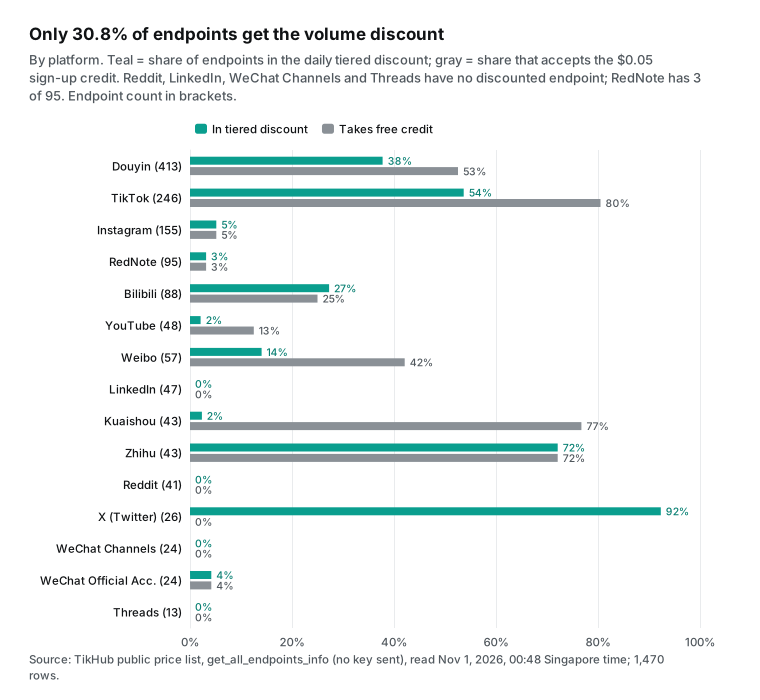
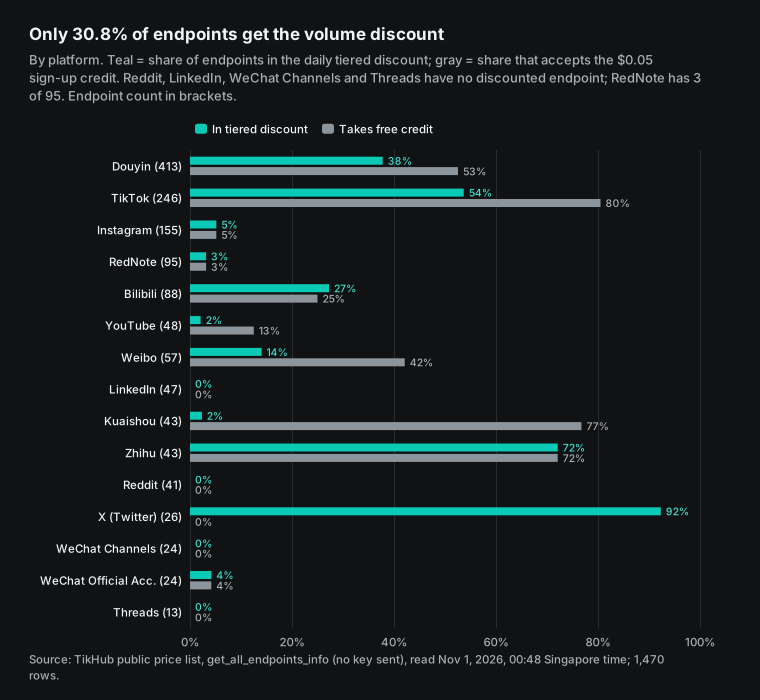
For buyers, the message is direct. If you mainly pull X, Zhihu or TikTok data, the tiered discount can actually apply to you. If you pull Reddit, LinkedIn, Instagram, RedNote or YouTube data, almost every endpoint stays at list price, and "up to 50% off" does not apply to you. Free credit works the same way. Reddit and LinkedIn endpoints do not accept the $0.05 sign-up credit. A new user who wants to test Reddit must top up at least $5 first.
| Flag combination (1,470 endpoints) | Endpoints | Share |
|---|---|---|
| Discount and free credit | 409 | 27.8% |
| Discount only | 43 | 2.9% |
| Free credit only | 222 | 15.1% |
| Neither (includes 7 zero-price endpoints) | 796 | 54.1% |
25 endpoints where the docs and the price list disagree
TikHub's public API docs also state a price in the description of 124 endpoints. We compared those 124 prices with the price list, and 25 do not match. In 15 of them the list is cheaper than the docs; in 10 it is more expensive. 24 of the 25 are in the Douyin Xingtu series (/api/v1/douyin/xingtu_v2/), the creator marketplace data. The docs say "$0.002" for all of them. In the price list, 14 cost $0.001 (half the docs price), and 10 cost $0.003 to $0.01 (1.5 to 5 times the docs).
The last mismatch is the TikTok live-room comment stream tiktok_live_room. Its docs say "$0.001 per 10 rows" (docs), but the price list says 0.
So a budget from the doc text is usually too high, but sometimes too low. The amounts do not cancel out. One call to each of the 24 Xingtu endpoints costs $0.048 by the docs. By the list it costs $0.055, 15% more. Each of the 14 cheaper endpoints saves only $0.001, while each of the 10 dearer ones adds $0.001 to $0.008.
| Endpoint (sample: 3 dearer, 3 cheaper) | Price in docs | Price in list | Gap |
|---|---|---|---|
Xingtu get_author_business_card_info | $0.002 | $0.01 | List is 5x |
Xingtu get_demander_mcn_list | $0.002 | $0.005 | List is 2.5x |
Xingtu get_author_cp_info | $0.002 | $0.004 | List is 2x |
Xingtu search_anchor | $0.002 | $0.001 | List is half |
Xingtu get_ranking_list_catalog | $0.002 | $0.001 | List is half |
TikTok live comments tiktok_live_room | $0.001 per 10 rows | $0 | List is free |
We do not know which number the billing system uses, because we have no TikHub account and did not call these endpoints. A fair guess is that the price list is closer to billing, because it sits in the same group as the calculate-price endpoint. The doc text is written by hand and may lag. Our advice is simple. Budget with the price list endpoint or the dashboard price table, not with the doc text. Before a large batch, run the calculate-price endpoint once with your daily volume.
How the tiered discount works: daily, by bracket, reset in Los Angeles
TikHub's discount has three key properties. It is daily: the FAQ says the count resets every day at midnight Los Angeles time. In Singapore that is 3 p.m. or 4 p.m., depending on US daylight saving time. It is by bracket: it does not discount the whole day once you pass 10,000 calls.
Like income tax, each bracket only discounts the calls inside it. It is per endpoint: it only applies where allow_discount = 1. The public discount endpoint returned six brackets with no key, and they match the FAQ.
| Call number in the day | Discount in this bracket | Price per call at a $0.001 base |
|---|---|---|
| 0 to 1,000 | None | $0.001 |
| 1,000 to 5,000 | 10% | $0.0009 |
| 5,000 to 10,000 | 20% | $0.0008 |
| 10,000 to 20,000 | 30% | $0.0007 |
| 20,000 to 30,000 | 40% | $0.0006 |
| Above 30,000 | 50% | $0.0005 |
We wrote a function for this bracket rule and tested it against TikHub's own two examples. The FAQ says 20,000 calls in one day at a $0.001 base cost $15.60. The calculate-price docs say 12,000 calls cost $10. Our function returns $15.60 and $10.00, so both match.
Then we used it to find the all-day average price per call at each volume. Up to 1,000 calls, the average is $0.001. At 5,000 calls it is $0.00092, at 10,000 it is $0.00086, and at 30,000 it is $0.00072. At 100,000 calls it is $0.000566.
The average reaches $0.00055556, our base-tier price, only at 118,791 calls. Above that point TikHub is cheaper. At one million calls a day its average is $0.000507, about 9% below ours.
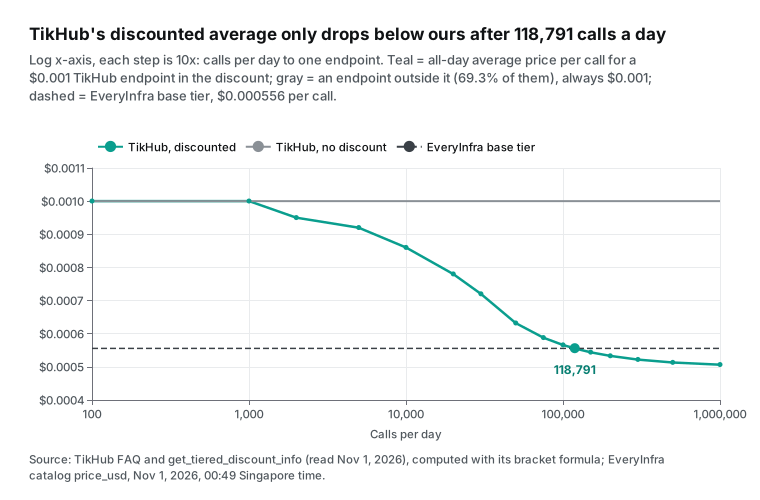
What does this crossing point need? First, the endpoint must be in the discount, and seven in ten are not. Second, the count is daily. TikHub's calculate-price endpoint takes one endpoint plus a daily request count, so we model the volume of one endpoint.
The public pages do not say if calls to different endpoints add up into one count. If they do, the crossing point becomes "118,791 calls a day across all discounted endpoints". The shape of the curve stays the same.
Third, 118,791 calls a day is about 3.56 million calls a month. That is close to the FAQ line that asks customers above 4.5 million calls a month to contact TikHub for custom pricing. At the default 10 calls per second, 118,791 calls take 3.3 hours. So the rate limit is not the obstacle.
Here is a concrete job: Douyin comments every day. Both sides bill 20 rows as one unit. TikHub's Douyin comments endpoint returns 20 rows per call by default, and its FAQ suggests 30 or fewer for comment endpoints. Our douyin/comments capability lists 20 rows per billing unit in the catalog. So the gap per 1,000 comments equals the gap in unit price. The table shows a 30-day bill at different daily volumes, without top-up fees.
| Douyin comments per day | Calls per day | TikHub, 30 days | EveryInfra, 30 days | TikHub ÷ EveryInfra |
|---|---|---|---|---|
| 2,000 | 100 | $3.00 | $1.67 | 1.80 |
| 20,000 | 1,000 | $30.00 | $16.67 | 1.80 |
| 200,000 | 10,000 | $258.00 | $166.67 | 1.55 |
| 2,000,000 | 100,000 | $1,698.00 | $1,666.68 | 1.02 |
| 2,376,000 | 118,800 | $1,980.00 | $1,980.02 | 1.00 |
| 4,000,000 | 200,000 | $3,198.00 | $3,333.36 | 0.96 |
| 10,000,000 | 500,000 | $7,698.00 | $8,333.40 | 0.92 |
The result is clear. Up to 20,000 Douyin comments a day, TikHub costs 80% more. At 200,000 a day, it costs 55% more. Above two million a day, the two are about even, and higher still TikHub is 4% to 8% cheaper. This is already TikHub's best case, because this endpoint is both at the entry price and in the discount. For an endpoint outside the discount, such as Douyin search at $0.01 or any RedNote endpoint, the line is flat and never crosses ours.
Top-ups, fees and refunds: money outside the TikHub API pricing table
Many people check "tikhub api pricing" and stop at the unit price. They miss the cost of moving money in and out. TikHub bills from a prepaid balance. The minimum top-up is $5 and there is no maximum (pricing page, "How billing works").
TikHub charges its own top-up fee: 2.6% + $0.30 for Alipay, and 5% + $0.30 for PayPal and USDT. The FAQ gives its own example: a $5 PayPal top-up costs $5.55. Because of the fixed $0.30, small top-ups pay a higher share. Even large PayPal top-ups never go below 5%.
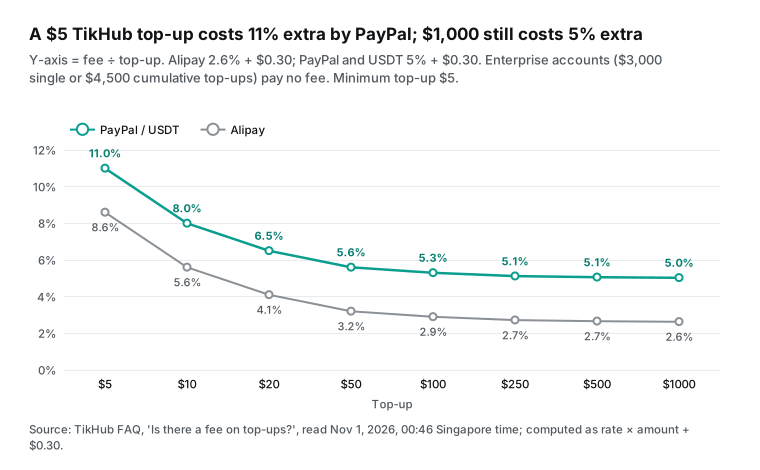
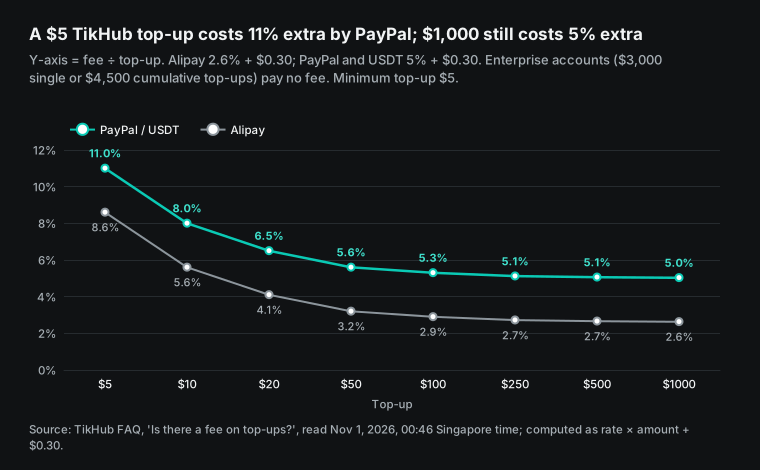
| TikHub top-up | Alipay total | Alipay extra | PayPal or USDT total | PayPal or USDT extra |
|---|---|---|---|---|
| $5 | $5.43 | 8.6% | $5.55 | 11.0% |
| $20 | $20.82 | 4.1% | $21.30 | 6.5% |
| $100 | $102.90 | 2.9% | $105.30 | 5.3% |
| $500 | $513.30 | 2.7% | $525.30 | 5.1% |
| $1,000 | $1,026.30 | 2.6% | $1,050.30 | 5.0% |
| $3,000 (Enterprise, single top-up) | $3,000.00 | 0 | $3,000.00 | 0, plus a $100 bonus |
Add the fee to the unit price, and a $0.001 endpoint costs $0.00111 per call after a $5 PayPal top-up. A $0.01 endpoint costs $0.0111. The way to avoid the fee is an Enterprise account: one top-up of $3,000 or $4,500 in total top-ups. Enterprise accounts also get 3% to 10% bonus credit on each top-up, by amount and time since the last one.
A single $3,000 top-up adds a $100 bonus (FAQ, "What do Enterprise accounts get?"). A B2B bank transfer costs your bank's wire fee, which the FAQ puts at about $50, plus a $20 TikHub fee. USDT works on TRC20 only. You must send the exact amount to the last decimal and add any gateway gas fee yourself.
Read the refund rules before a large top-up. TikHub's refund policy is titled "All Sales Are Final". The policy text says it was last updated on July 20, 2026. The docs page changed on September 15, 2026, but the date in the text did not. API credits, subscription fees and prepaid balances are not refundable by default. A refund needs two conditions: the endpoint you paid for is down, and TikHub's technical team confirms it. The policy rules out refunds for a change of mind, a misread output, your own integration errors and rate limits.
It also rules out temporary maintenance, and third-party platform changes while TikHub "continues to function as documented". The FAQ advice is to read the policy first, then use balance alerts and auto top-up day to day. For invoices, you can download them from order history, and TikHub issues US invoices only. A combined invoice or a custom billing entity needs an Enterprise account or a single order above $500.
We also pass on payment fees from our payment channels to the customer. Checkout shows the total and the fee before you pay. Because the fee depends on the method, we do not add a fixed rate on our side in this comparison. We refund each call that returned nothing. For a failure or an empty result, the prepaid amount goes back to the balance in the same response. The balance itself does not expire (pricing page).
Rate limits are a TikHub strength, and we say so. Every account gets 10 calls per second for free. Higher levels are a monthly purchase. 20 per second costs $5 a month, 30 costs $10, 40 costs $20 and 50 costs $30. The top level is 100 per second for $55 a month (FAQ, "What do the higher levels cost?").
This fee is separate from request fees and does not change unit prices. Our default is 60 calls per minute across all keys on an account. For more, you can buy a 30-day speed pack: 180 per minute for $10, 600 for $30 and 1,800 for $78. Total top-ups of $50, $150 or $750 unlock the same levels for free. If your job is tens of thousands of calls in a few minutes, TikHub's default rate is clearly easier.
| Rate level | TikHub (per second, per month) | EveryInfra (per minute, per 30 days) |
|---|---|---|
| Default | 10 per second, free | 60 per minute, free |
| First paid level | 20 per second, $5 | 180 per minute, $10, or free after $50 in total top-ups |
| Middle level | 50 per second, $30 | 600 per minute, $30, or free after $150 in total top-ups |
| Top listed level | 100 per second, $55 | 1,800 per minute, $78, or free after $750 in total top-ups |
Fees and rate plans spread into the unit price: a small team's month
Unit price, top-up fee and rate-limit fee are three separate charges. Each one looks small, but together they push "$0.001" toward $0.0012. Take a common small-team load: 50,000 calls a month, all on $0.001 endpoints. The team tops up $50 by PayPal once a month.
It also buys 20 calls per second, because it runs jobs in a short daytime window. The table uses TikHub's public rates. The last column shows our base-tier request cost for the same 50,000 calls.
| Item for one month | TikHub | EveryInfra (base tier, same 50,000 calls) |
|---|---|---|
| Request fees | 50,000 × $0.001 = $50.00 | 50,000 × $0.000556 = $27.78 |
| Top-up fee | One $50 PayPal top-up: $2.80 | Shown at checkout, not estimated here |
| Rate limit | 20 per second: $5.00 a month | 60 per minute by default, no extra fee |
| Total | $57.80 | $27.78 plus the payment fee |
| Per call | $0.001156 | $0.000556 |
In this example, an endpoint listed at $0.001 really costs $0.001156 per call, 15.6% above the list price. Without the rate plan it still costs $0.001056, 5.6% above. 50,000 calls a month is about 1,667 calls a day, only a little above the first bracket at 1,000. Only the calls above 1,000 get 10% off, so the discount saves only about $2.00 a month at this volume. For a small team, the payment method and the rate plan move the bill more than the tiered discount does.
Trial credit: 50 calls versus 1,799 calls
TikHub's sign-up credit is $0.05, about 50 calls at the $0.001 entry price, as its FAQ says. But only 631 endpoints accept it. RedNote, Reddit, LinkedIn and WeChat Channels endpoints do not, so you must top up at least $5 before you test them. The daily check-in bonus was removed. The $2 referral reward needs both sides to be paid users (FAQ, "Is there a referral reward?").
Our trial works differently. You star our plugin repository on GitHub, then claim $1 in the dashboard. It goes into your bonus balance and is valid for 24 hours. At the base tier of $0.000556 that is about 1,799 calls, and at the standard tier on our pricing page it is about 720 calls. Every data capability accepts it, except CAPTCHA solving.
Neither trial needs a card. The point of a trial is not the few cents. It is whether you can rerun this article's "per 1,000 results" math with your own keywords. 50 calls are enough to check a few endpoints' fields, but not enough to measure a stable page size.
| Trial | TikHub | EveryInfra |
|---|---|---|
| Amount | $0.05 after email check | $1 after a GitHub star |
| Calls it buys | About 50 at $0.001 | About 1,799 at base tier, about 720 at standard tier |
| Endpoints that accept it | 631 of 1,470 | All data capabilities, CAPTCHA solving excluded |
| Expiry | Not stated in the FAQ | 24 hours |
| Card needed | No | No |
Per 1,000 requests: 12 matching capabilities
With an exact price list, we can compare "per 1,000 requests" directly, without counting rows. The left side of the table lists EveryInfra capabilities and their price_usd from our November 1, 2026 catalog. The right side lists the closest TikHub endpoint, from the series its FAQ recommends or the main endpoint in its docs. All TikHub prices are list prices, because only two of these TikHub endpoints, TikTok comments and Douyin comments, get the discount.
| EveryInfra capability | Per 1,000 | Closest TikHub endpoint | Per 1,000 | Discount / free credit | Ratio |
|---|---|---|---|---|---|
tiktok/search | $0.556 | tiktok/app/v3/fetch_video_search_result | $1.00 | No / Yes | 1.8 |
tiktok/comments | $0.556 | tiktok/app/v3/fetch_video_comments | $1.00 | Yes / Yes | 1.8 |
douyin/search | $8.333 | douyin/search/fetch_video_search_v1 | $10.00 | No / No | 1.2 |
douyin/comments | $0.556 | douyin/app/v3/fetch_video_comments | $1.00 | Yes / Yes | 1.8 |
xiaohongshu/search | $5.556 | xiaohongshu/app_v2/search_notes | $10.00 | No / No | 1.8 |
xiaohongshu/comments | $5.556 | xiaohongshu/app_v2/get_note_comments | $10.00 | No / No | 1.8 |
kuaishou/search | $0.556 | kuaishou/app/search_video_v2 | $10.00 | No / No | 18.0 |
weibo/search | $0.806 | weibo/app/fetch_search_all | $1.00 | No / Yes | 1.2 |
reddit/search | $0.556 | reddit/app/fetch_dynamic_search | $1.00 | No / No | 1.8 |
reddit/comments | $0.556 | reddit/app/fetch_post_comments | $1.00 | No / No | 1.8 |
instagram/user_posts | $0.556 | instagram/v3/get_user_posts | $8.00 | No / No | 14.4 |
youtube/comments | $0.556 | youtube/web_v2/get_video_comments | $1.00 | No / No | 1.8 |
Eight of the 12 rows show 1.8x. In six of them the price per 1,000 calls is $1.00 against $0.556; in the two RedNote rows it is $10.00 against $5.556. The two widest gaps are Kuaishou search and Instagram user posts. TikHub's Kuaishou search V2 (docs) costs $0.01 per call, and its Instagram V3 user posts (docs) cost $0.008. That is 18.0x and 14.4x our price.
The closest rows are Douyin search at 1.2x and Weibo search at 1.24x. Our douyin/search has cost $0.008333 per call since October 28, 2026, and is no longer in the base tier. weibo/search costs $0.000806 per call. TikHub also has an Instagram V1 user-posts endpoint (docs) at $0.001 in the price list.
If V1 has the fields you need, that row becomes 1.8x. This table compares unit prices only. The next section uses live calls to compare rows per call.
Per 1,000 results: 14 live calls on November 1, 2026
The price per 1,000 requests is only half of the answer. The other half is how many rows one request returns. For TikHub, we take page sizes from its FAQ and endpoint docs. Douyin search returns about 6 to 10 results per call, and RedNote paginated endpoints about 6 to 20. TikTok search and comments default to count=20 (TikTok search docs, TikTok comments docs). The FAQ suggests 30 or fewer per call for comment endpoints.
For our side we do not estimate from list prices. We use the count and billing.charged_usd fields from live calls on November 1, 2026. The table lists all 14 valid responses, in Singapore time.
Three more calls at 00:50:59 returned 429 and cost nothing. During the test, several jobs shared the per-minute limit of one test key. The three calls succeeded on retry after 72, 89 and 106 seconds (the three 00:52 rows). A normal account gets 60 calls per minute by default; see the rate section below.
| Singapore time | Capability | Key parameters | Rows | `charged_usd` |
|---|---|---|---|---|
| 00:49:39 | tiktok/search | air fryer recipe, limit 50 | 17 | $0.000556 |
| 00:49:54 | reddit/search | tikhub, limit 25 | 0 | $0 (empty, refunded) |
| 00:50:00 | reddit/search | tiktok api pricing, limit 25 | 14 | $0.000556 |
| 00:50:07 | xiaohongshu/search | air fryer recipes (Chinese keyword) | 19 | $0.005556 |
| 00:50:26 | tiktok/comments | one video, limit 200 | 200 | $0.000556 |
| 00:52:11 | reddit/comments | one r/scrapingtheweb post, limit 100 | 6 | $0.000556 |
| 00:52:28 | reddit/comments | one r/AI_Agents post, limit 100 | 8 | $0.000556 |
| 00:52:45 | douyin/search | air fryer recipes (Chinese keyword), limit 50 | 50 | $0.008333 |
| 00:53:21 | kuaishou/search | air fryer recipes (Chinese keyword), limit 100 | 20 | $0.000556 |
| 00:54:40 | xiaohongshu/comments | one note | 10 | $0.005556 |
| 00:54:51 | xiaohongshu/comments | a note that does not exist | 0 | $0 (empty, refunded) |
| 00:56:27 | tiktok/search | extra count parameter | 422 | $0 |
| 00:56:36 | weibo/search | air fryer (Chinese keyword), limit 50 | 50 | $0.000806 |
| 00:57:52 | douyin/comments | one video, limit 100 | 80 | $0.002222 |
The 14 calls returned 474 rows and cost $0.025809 in total. The chart below shows the cost per 1,000 results. For Douyin search we paid $0.167 per 1,000. TikHub, at 6 to 10 results per call, costs $1.00 to $1.67, so the gap is 6.0x to 10.0x.
For TikTok comments, one call of 200 rows cost us $0.000556, which is $0.0028 per 1,000. Our Claude Code subagents test found the same flat price per 200-row call. TikHub at 20 to 30 rows per call costs $0.034 to $0.05, which is 12.1x to 17.9x. Douyin comments show 1.8x, TikTok search 1.5x and RedNote search 1.7x to 5.7x.
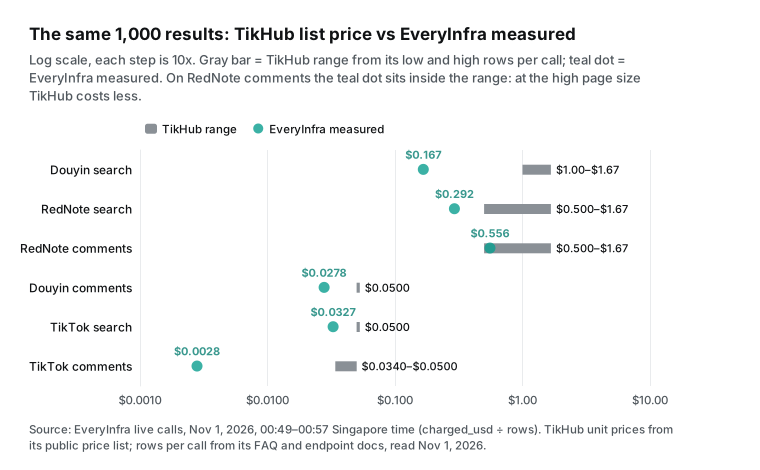
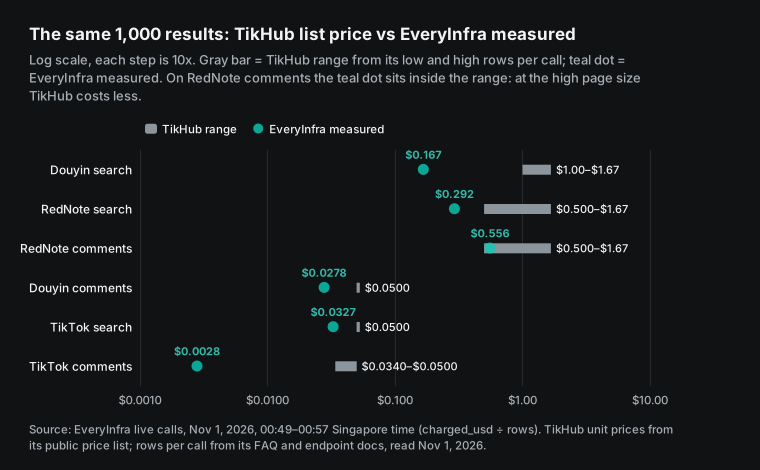
One row needs a plain statement: RedNote comments. Our call returned only 10 rows, which is $0.556 per 1,000. TikHub at 6 to 20 rows per call costs $0.50 to $1.67 per 1,000. If TikHub returns a full 20 rows every time, it is 10% cheaper than us.
We only win when it returns 18 rows or fewer. This is not about unit price. Our call returned few rows: the catalog page size for xiaohongshu/comments is 15, and that page held only 10.
Compare these numbers with our earlier test on October 26, 2026, and you can see how unstable "per 1,000 results" is.
| Use case | October 26, 2026 (earlier article) | November 1, 2026 (this article) | Why it changed |
|---|---|---|---|
| Douyin search | $0.505 | $0.167 | Limit 50 returned all 50 rows; before, two calls returned 18 and 15 |
| TikTok search | $0.0111 | $0.0327 | Limit 50 returned only 17 rows |
| TikTok comments | $0.0028 | $0.0028 | Both calls returned the full 200 rows |
| Douyin comments | $0.0283 | $0.0278 | Billed per 20 rows, so row changes matter little |
| RedNote search | $0.278 | $0.292 | 19 rows, close to last time |
| RedNote comments | $0.445 | $0.556 | Only 10 rows this time |
Unit prices did not change between the two tests; we repriced Douyin search at its October 28 price. What changed was the row count. So read these comparisons as orders of magnitude. Capabilities with a flat price per call and many rows per call show big gaps, such as TikTok comments and Douyin search.
Capabilities billed per 20 rows show the unit-price gap, such as Douyin comments. Capabilities with small pages may not win, such as RedNote comments. Your keywords and your videos will give different numbers. The "Getting started" section shows how to rerun the math.
Empty results, bad parameters, rate limits: which calls cost nothing
TikHub bills every status 200 response. Our earlier article listed 18 TikHub endpoints whose docs say bad parameters or deleted content are still billed. Two examples are the Instagram username-change count and the YouTube captions endpoint, which costs $0.008 per call in the price list.
On our side, three calls returned no data. At 00:49:54 Singapore time, reddit/search for "tikhub" returned 0 posts. At 00:54:51, xiaohongshu/comments with a note URL that does not exist returned 0 rows. Both show billing.reason as empty_result_refunded and refund.status as succeeded.
At 00:56:27, we sent tiktok/search with an extra count parameter on purpose. It returned 422 with the error code unknown_param. The response listed the allowed parameters keyword, content_type and limit, and ended with "Nothing was charged".
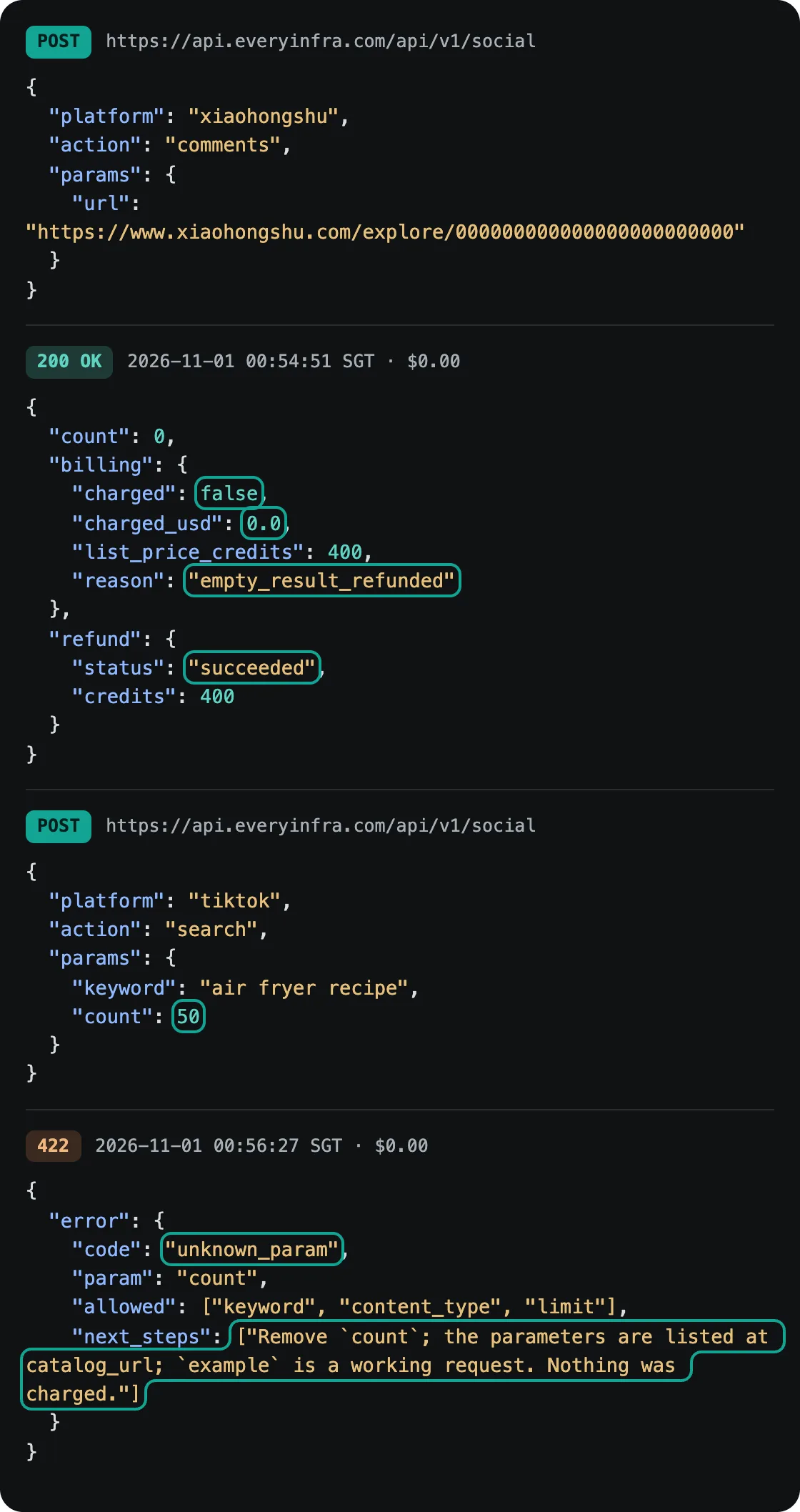
The douyin/comments call shows one more detail. We asked for 100 rows, so the system reserved 5 units of 20 rows. It returned 80 rows, so it billed 4 units and refunded the extra unit in the same response. The billing object shows requested_units: 5 and billed_units: 4. Here is the billing part of that response, with balance fields removed:
{
  "platform": "douyin",
  "action": "comments",
  "count": 80,
  "billing": {
    "charged": true,
    "charged_usd": 0.002222,
    "rows_per_unit": 20,
    "requested_units": 5,
    "billed_units": 4,
    "units": 4
  }
}
Why does this matter for price comparison? On TikHub, empty results and deleted content stay on the bill. So you should divide cost by the rows you actually received, not by the requests you sent. On our side, the part you did not receive is not billed. For a monitoring list, more dead links mean a bigger real gap between the two. Dead links come from creators who delete posts and notes that go offline.
A monitoring list: the 30-day bill
Now combine unit prices, rows per call and the discount for a common cross-platform list. Each day it pulls 20,000 TikTok comments, 1,000 Douyin search results, 1,000 RedNote search results and 500 RedNote comments, for 30 days. For TikHub we use list prices and the FAQ page sizes. That is 8 rows for Douyin search, the middle of 6 to 10, and 13 rows for RedNote.
TikTok comments go through the bracket discount, but 1,000 calls a day stays just below the first bracket. For our side we use rows per call and the amounts charged in the November 1 calls. Neither side includes top-up fees.
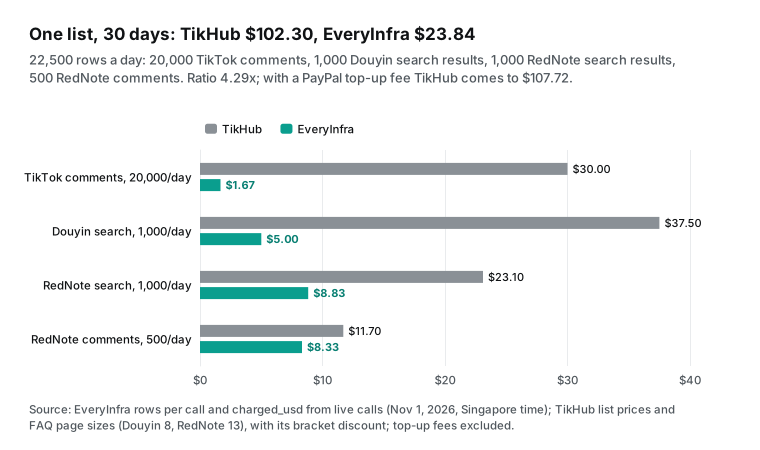
The total is $102.30 on TikHub and $23.84 on EveryInfra, a 4.29x gap. With a PayPal top-up fee, TikHub comes to $107.72. Two rows drive most of the gap. TikTok comments cost us one price per 200 rows, while TikHub charges one price per 20 rows.
Douyin search returned 50 rows per call this time. If the list only pulled Douyin comments, the gap would fall back to 1.8x. If daily volume reached millions of rows, the earlier table shows TikHub would be a few percent cheaper.
TikHub on Reddit: what people say about the price
"tikhub reddit" is one of the most common suggestions for this brand. People who search it probably want real bills and complaints. On November 1, 2026, we looked in two ways. First, our own reddit/search searched Reddit for "tikhub" at 00:49:54 Singapore time and returned 0 posts.
Second, we used public web search and forum search across Reddit, V2EX, Hacker News and GitHub discussions. We found no user who posted a TikHub bill or a price complaint. The table lists the only public posts with any price content. We do not show usernames.
| Post | Price-related content | Our check |
|---|---|---|
| r/influencermarketing, "Influencer Discovery Help" | A long comment lists the data prices the writer pays, including "YouTube search by topic keyword: $0.001 per page of results (tikhub)" | The price list shows youtube/web/search_video at $0.001, with no discount and no free credit |
| r/Seedance_AI, "Is TikHub AI legit" | The poster says it "seems very cheap" and asks if it is reliable; no reply answers that | The question is about Seedance video generation, not social data. The price list has no Seedance endpoint; the TikHub FAQ puts Seedance and Kling in its AI Proxy at 65% below the model makers' list prices, outside this price list |
| r/ClaudeAI, an n8n and Claude workflow post | Describes using TikHub endpoints to find trending TikTok videos; no prices | The posting account is linked to TikHub, so we treat it as a product example only |
| r/scrapingtheweb, "Top 5 TikTok Scraping APIs Compared" | A comparison from October 22, 2026, lists five providers, and TikHub is not one; none of the comments we read mention it | The post shows 7 comments; reddit/comments returned 6. The latest is from October 30, 2026, 09:48 Singapore time |
We also searched Reddit for October 2026 posts about "tiktok api pricing" and got 14 results. The earliest is an r/SaaS post from October 4, 2026, about reverse engineering the TikTok mobile API. The latest is an r/buildinpublic post from October 31, 2026, about API costs that surprised people. None mention TikHub.
On October 20, 2026, an r/SaasDevelopers post, "Top 5 TikTok Data APIs for Developers", also listed five providers without TikHub. An r/AI_Agents question from October 13, 2026, asked which TikTok and Instagram data tools people use for influencer sourcing. The post shows 14 comments. We read back 8, the latest from October 28, 2026, and none of them mention TikHub.
In English-speaking communities, TikHub gets far less discussion than its name recognition among Chinese developers suggests. The most reliable source for its prices is still its own price list and FAQ. That is why this article uses only first-party sources for TikHub.
Reddit itself has news that matters to data teams. In an r/redditdev post, Reddit gave a shutdown schedule for its public Data API. From October 31, 2026, it no longer accepts new public API access requests. Registration for the migration bounty closes on November 30, 2026. From January 12, 2027, it starts to remove access for apps that did not register.
All public access ends in March 2027 (r/redditdev post; migration guide). In TikHub's price list, none of the 41 Reddit endpoints get the discount or accept free credit. Our reddit/search and reddit/comments are base tier at $0.000556 per call. In the live calls above, they returned 14 posts, then 6 and 8 comments.
When TikHub is the better choice
In four cases, TikHub is the better fit, and we say so plainly.
First, you send more than about 100,000 calls a day to one discounted endpoint. By the bracket math above, a discounted $0.001 endpoint drops below our price after 118,791 calls a day. At 500,000 calls a day its average is $0.000513, about 8% below ours. Your main endpoints may be among the 452 discounted ones, such as parts of TikTok, X, Zhihu and Douyin. If your volume is also that high, TikHub has the better price. Above 4.5 million calls a month it also offers custom pricing.
Second, you need endpoints that we do not offer. TikHub's 1,470 endpoints include many narrow features. Examples are Douyin Xingtu creator rates and reach scores, live-room comment streams and batch highest-quality play URLs. Others are TikTok Shop data, ad library data and Sora video generation.
At 15:40 Singapore time on November 1, 2026, our catalog had 106 platforms and 573 capabilities. It covers more ground, such as e-commerce, reviews, jobs and maps. But for depth on Douyin and TikTok alone, TikHub has many more endpoints.
Third, you must finish a large batch in a few minutes. TikHub gives 10 calls per second by default and up to 100 per second for $55 a month. Our default is 60 calls per minute. Our largest speed pack is 1,800 per minute, or 30 per second, for $78 for 30 days.
Fourth, you want to reread the same result for free within 24 hours. Every TikHub success response has a cache_url that opens free for 24 hours (FAQ, "What is the cache_url in my response?"). We have no free 24-hour link. Another read is a new request.
In the other direction, the numbers here point our way when your volume is tens of thousands of calls a day or less. They also point our way when you mainly pull RedNote, Kuaishou, Instagram, Reddit or YouTube data, or often hit empty results and dead links. In those cases the same data costs 1.2 to 18 times less with us.
Recent changes
- October 31, 2026: Reddit stopped accepting new public Data API requests (r/redditdev post). What it means for you: the route of applying for Reddit's own API is closed. Teams that need Reddit data can move to its Developer Platform or use a third-party data API. When you compare prices, note that TikHub's Reddit endpoints get no discount.
- **October 28, 2026: EveryInfra repriced
douyin/search** from $0.000556 to $0.008333 per call, or $8.33 per 1,000 calls. See our pricing page and the catalog. What it means for you: the unit-price gap for Douyin search fell from 18x to 1.2x. Per 1,000 results it is still 6x to 10x, because our calls return more rows. - October 3, 2026: TikHub released Python SDK v2.2.0. The notes say it syncs to the live spec of 1,050 operations. It generates 1,048 methods and skips deprecated endpoints (GitHub release; PyPI). What it means for you: the SDK covers the endpoints in the public docs. About 433 priced endpoints are not in the docs, so you do not see them through the SDK.
- October 1, 2026: TikHub updated its Business Restriction page (Business Restriction). It lists industries TikHub does not accept, including virtual currency businesses, and says it freezes violating accounts with no appeal. Its Reddit dynamic search docs changed on the same day. What it means for you: top-ups are not refundable by default, and a frozen balance is hard to recover. Check this page before a large top-up.
Limits: where these conclusions do not hold
First, every TikHub price here comes from its public price list, read with no key on November 1, 2026, at 00:48 Singapore time. We did not open a TikHub account or call its data endpoints. So we did not check that real charges match the list. The list and the doc text disagree in 25 places, and we always use the list.
Second, we model the discount crossing point on the daily volume of one endpoint. TikHub's public pages do not say if calls to different endpoints add up in one count. If they do, the crossing point applies to the total of all discounted endpoints. The direction of the conclusion stays the same.
Third, results-based comparisons depend on rows per call. We did not run live calls on TikHub, so its rows per call come from its own stated ranges.
We use the high end for its lowest price and the low end for its highest price, which is a generous range for TikHub. On our side we use one live call per capability on November 1, 2026. The sample is 14 requests and 474 rows, which is enough for orders of magnitude only. Compared with October 26, 2026, the cost per 1,000 results for one capability moved by up to 3x. That is why this article gives no single ratio. Put in your own endpoints, daily volume and rows per call, and you can recompute every table.
Fourth, this article compares prices and billing rules only. It does not compare field coverage, success rates or latency, and it does not judge whose data is better. The fields differ between the two. If you migrate, map fields again against response_fields on capability pages such as tiktok/comments.
FAQ
These questions come from Google autocomplete for "tikhub", "tikhub api pricing" and "tikhub reddit" (read November 1, 2026), from user questions in TikHub's FAQ and from the Reddit posts cited above.
What is TikHub pricing per request?
In the public list of 1,470 endpoints, 990 cost $0.001 per call and 175 cost $0.01. The top price is $0.25, and the median is $0.001. The TikHub pricing page says "$0.001 - 0.01 / request". Source: autocomplete "tikhub pricing". To check one endpoint, call the price list endpoint or open the dashboard price table.
Is there a TikHub API pricing calculator?
Yes. TikHub's calculate-price endpoint returns a total for one endpoint and a daily call count, but it needs a key. Without an account, use the bracket formula from this article. For each bracket, multiply its calls by the base price times one minus its discount, then add the brackets. Source: autocomplete "tikhub api pricing calculator".
Does TikHub have free credit?
After you register and verify your email, you get $0.05, about 50 calls at $0.001. The daily check-in bonus is gone, and only 631 endpoints accept the credit (TikHub FAQ, "What do I get for free?"). Source: autocomplete "tikhub api key" and the FAQ question. On our side, you get $1 after a GitHub star, valid for 24 hours; see the quickstart.
Do people on Reddit say TikHub is expensive?
We found none. A Reddit search for "tikhub" returned 0 posts. Public search found one comment that quotes its YouTube search price at $0.001 per page, and one question that calls its AI video "very cheap". Source: autocomplete "tikhub reddit" and the posts listed above.
Does TikHub charge for failed requests?
Non-200 responses are free, but every 200 response is billed, empty results included. The FAQ says "only successful requests" are billed and that a request "is billed when it returns status 200". Its docs name 18 endpoints that bill for deleted content or invalid input (TikHub FAQ, "What exactly gets billed?"). Source: the TikHub FAQ question "I get status 200 but the result is empty".
Getting started: rerun the math with your own data
Step one: read both free catalogs, with no key. These two commands pull unit prices for matching capabilities, so you can price your own list.
# TikHub public price list (no key): Douyin search and RedNote search
curl -s https://api.tikhub.io/api/v1/tikhub/user/get_all_endpoints_info \
  | jq '.data[] | select(.endpoint_uri | test("douyin/search/fetch_video_search_v1|xiaohongshu/app_v2/search_notes"))'

# EveryInfra catalog (no key): price_usd, rows_per_unit, limits
curl -s "https://api.everyinfra.com/api/v1/social/catalog?platform=douyin" \
  | jq '.capabilities[] | select(.action=="search" or .action=="comments") | {action, price_usd, rows_per_unit, default_limit, max_limit}'
Step two: claim the trial credit in the dashboard and create a key. Then run one live call with your own keyword, and read count and billing.charged_usd in the response.
curl -s https://api.everyinfra.com/api/v1/social \
  -H "Authorization: Bearer $EVERYINFRA_API_KEY" \
  -H "Content-Type: application/json" \
  -d '{"platform":"douyin","action":"search","params":{"keyword":"air fryer","limit":50}}' \
  | jq '{count, charged: .billing.charged_usd, reason: .billing.reason}'
Step three: if you use an AI tool such as Claude or Cursor, add our remote MCP server. The AI can then call capabilities and read charged_usd itself. You need one URL and one key. At 15:39 Singapore time on November 1, 2026, tools/list returned 12 tools (MCP setup; protocol at Model Context Protocol).
{
  "mcpServers": {
    "everyinfra": {
      "url": "https://api.everyinfra.com/mcp",
      "headers": { "Authorization": "Bearer YOUR_API_KEY" }
    }
  }
}
TikHub's pricing page says its MCP servers and Chrome extension bill the same as direct calls. Its MCP page lists 990+ tools across 16 platforms. Finally, compute your own cost per 1,000 results as total charged ÷ total rows × 1,000. Compare it with TikHub's unit price × ⌈1,000 ÷ rows per call⌉ for the matching endpoint. For capability lists, see the Douyin, TikTok, RedNote and Reddit platform pages. For all capabilities and the trial, see the data market.
References
- TikHub, "Pricing", pricing page, read 2026-11-01, <https://tikhub.io/pricing>
- TikHub, "FAQ — Billing, Rate Limits and Platform Support", read 2026-11-01, <https://tikhub.io/faq>
- TikHub, public price list get_all_endpoints_info, response with no key, 2026-11-01 00:48 SGT, <https://api.tikhub.io/api/v1/tikhub/user/get_all_endpoints_info>
- TikHub, tiered discount endpoint get_tiered_discount_info, response with no key, read 2026-11-01, <https://api.tikhub.io/api/v1/tikhub/user/get_tiered_discount_info>
- TikHub, public API spec openapi.json (V5.3.2), read 2026-11-01 00:46 SGT, <https://api.tikhub.io/openapi.json>
- TikHub docs, "Get all endpoints information", modified 2026-07-31, <https://docs.tikhub.io/186826055e0>
- TikHub docs, "Get information of an endpoint", modified 2026-07-31, <https://docs.tikhub.io/186826054e0>
- TikHub docs, "Calculate price", modified 2026-07-31, <https://docs.tikhub.io/186826052e0>
- TikHub docs, "Get tiered discount percentage information", modified 2026-07-31, <https://docs.tikhub.io/186826053e0>
- TikHub docs, "Batch get the highest quality play URL of videos", modified 2026-07-31, <https://docs.tikhub.io/360401425e0>
- TikHub docs, "Fetch video search V1" (Douyin search), modified 2026-07-31, <https://docs.tikhub.io/370212779e0>
- TikHub docs, "Search notes" (RedNote App V2), modified 2026-07-31, <https://docs.tikhub.io/420136398e0>
- TikHub docs, "Get note comments" (RedNote App V2), modified 2026-08-14, <https://docs.tikhub.io/420136394e0>
- TikHub docs, "Extract live room danmaku" (TikTok), modified 2026-07-31, <https://docs.tikhub.io/198386127e0>
- TikHub docs, "Get single video comments data" (Douyin App V3), modified 2026-07-31, <https://docs.tikhub.io/186826225e0>
- TikHub docs, "Get single video comments data" (TikTok App V3), modified 2026-07-31, <https://docs.tikhub.io/186826110e0>
- TikHub docs, "Get video search results of specified keywords" (TikTok App V3), modified 2026-07-31, <https://docs.tikhub.io/186826113e0>
- TikHub docs, "Search video V2" (Kuaishou), modified 2026-07-21, <https://docs.tikhub.io/467698481e0>
- TikHub docs, "Get user posts" (Instagram V3), modified 2026-07-31, <https://docs.tikhub.io/419083061e0>
- TikHub docs, "Get user posts list" (Instagram V1), modified 2026-07-31, <https://docs.tikhub.io/387337786e0>
- TikHub docs, "Comprehensive search" (Weibo App), modified 2026-07-31, <https://docs.tikhub.io/410358109e0>
- TikHub docs, "Fetch Reddit APP Dynamic Search Results", modified 2026-10-01, <https://docs.tikhub.io/369454687e0>
- TikHub docs, "Fetch Reddit APP Post Comments", modified 2026-09-04, <https://docs.tikhub.io/369454681e0>
- TikHub docs, "Fetch Reddit Post Details in Large Batch (Max 30)", modified 2026-09-04, <https://docs.tikhub.io/400217402e0>
- TikHub docs, "Get username change count" (Instagram), modified 2026-09-27, <https://docs.tikhub.io/425942864e0>
- TikHub docs, "Get video captions" (YouTube), modified 2026-08-10, <https://docs.tikhub.io/431829301e0>
- TikHub docs, "Search Videos Within a WeChat Channel", modified 2026-09-08, <https://docs.tikhub.io/472974850e0>
- TikHub docs, "Getting Started", modified 2026-09-15, <https://docs.tikhub.io/5432442m0>
- TikHub docs, "Business Restriction", modified 2026-10-01, <https://docs.tikhub.io/5432446m0>
- TikHub docs, "TikHub Refund Policy", text last updated 2026-07-20 (page changed 2026-09-15), <https://docs.tikhub.io/9453198m0>
- TikHub docs, "TikHub Terms of Use", text effective and last updated 2026-03-17 (page changed 2026-09-15), <https://docs.tikhub.io/9453286m0>
- TikHub, "MCP Servers for Social Media Data", read 2026-11-01, <https://tikhub.io/mcp>
- TikHub, "About TikHub", read 2026-11-01, <https://tikhub.io/about>
- TikHub, Python SDK v2.2.0 release notes, GitHub, 2026-10-03, <https://github.com/TikHub/TikHub-API-Python-SDK/releases/tag/v2.2.0>
- TikHub, Python SDK releases, GitHub, read 2026-11-01, <https://github.com/TikHub/TikHub-API-Python-SDK/releases>
- PyPI, "tikhub" project page (2.2.0 uploaded 2026-10-03), <https://pypi.org/project/tikhub/>
- EveryInfra, capability catalog /api/v1/social/catalog, read 2026-11-01 00:49 SGT, <https://api.everyinfra.com/api/v1/social/catalog>
- EveryInfra, xiaohongshu capability catalog, read 2026-11-01, <https://api.everyinfra.com/api/v1/social/catalog?platform=xiaohongshu>
- Reddit, "Moving Data API Apps to the Developer Platform: migration dates and next steps", r/redditdev, about 2026-10-01, <https://www.reddit.com/r/redditdev/comments/1wubcvf/moving_data_api_apps_to_the_developer_platform/>
- Reddit developer docs, "Data API/PRAW → Devvit Migration Guide", read 2026-11-01, <https://developers.reddit.com/docs/guides/migrate/public-api>
- Reddit Help, "Reddit Developer Platform App Migration Program 2026 Terms", read 2026-11-01, <https://support.reddithelp.com/hc/en-us/articles/47822311698452-Reddit-Developer-Platform-App-Migration-Program-2026-Terms>
- Reddit, r/influencermarketing, "Influencer Discovery Help", read 2026-11-01, <https://www.reddit.com/r/influencermarketing/comments/1unw6ci/influencer_discovery_help/>
- Reddit, r/Seedance_AI, "Is TikHub AI legit and works?", read 2026-11-01, <https://www.reddit.com/r/Seedance_AI/comments/1u2gjmx/is_tikhub_ai_legit_and_works_seems_very_cheap_for/>
- Reddit, r/ClaudeAI, "Day 1 on TikTok … Claude + TikHub API + n8n", read 2026-11-01, <https://www.reddit.com/r/ClaudeAI/comments/1levnmu/day_1_on_tiktok_400_likes_90_saves_on_first_video/>
- Reddit, r/scrapingtheweb, "Top 5 TikTok Scraping APIs Compared", 2026-10-22, <https://www.reddit.com/r/scrapingtheweb/comments/1xc4zin/top_5_tiktok_scraping_apis_compared_features/>
- Reddit, r/AI_Agents, "Automating influencer sourcing + outreach", 2026-10-13, <https://www.reddit.com/r/AI_Agents/comments/1x4scth/automating_influencer_sourcing_outreach_what/>
- Model Context Protocol, specification and docs, read 2026-11-01, <https://modelcontextprotocol.io/>
Reference BL-62