TikHub Free Credits Explained: What $0.05 Buys
TikHub gives $0.05 in free credit after email verification. 649 of 1,482 endpoints accept it. We count what it buys and test 4 capabilities at 3 times.

The TikHub free credit is $0.05, and it arrives only after you verify your email. At the most common TikHub price of $0.001 per request, that is 50 calls. We read the public TikHub price list without a key on November 14, 2026 at 13:06 Singapore time (SGT). Of 1,482 endpoint rows, 649 (43.8%) accept free credit, and no Reddit, LinkedIn, X, Threads or WeChat Channels endpoint accepts it. At the same daily volume of 500 video-detail calls, list prices give $15.00 a month on TikHub and $8.34 a month on EveryInfra, about 1.8x. We also ran tiktok/video, youtube/video, douyin/video and xiaohongshu/note at 3 times between 13:09 and 13:50 SGT, and every charged_usd matched the catalog price.
We already compared TikHub several times on this blog. The per-1,000-results test came on October 26, 2026. The TikHub pricing breakdown priced all 1,470 endpoints on November 1, 2026.
Those articles mention the $0.05 sign-up credit in one or two sentences. How far does $0.05 go before you pay anything, and what does a normal day cost after that? To answer, we checked each rule against the TikHub public pages. We did the arithmetic with four price-list snapshots and live calls at three times.
The TikHub free trial rules, checked line by line
TikHub describes its free credit on four public pages. They are the pricing page, the FAQ, the Getting Started guide and the Terms of Use. We saved the pricing page, the FAQ and Getting Started between 13:06 and 13:08 SGT on November 14, 2026. The Terms page shows its text only after a browser runs its scripts. We saved the rendered text at 14:50 SGT on the same day. The Terms say they took effect on March 17, 2026.
| Question | TikHub public text (read 2026-11-14) | Where |
|---|---|---|
| How much | $0.05, added after email verification, "about 50 requests at the $0.001 base price" | FAQ "What do I get for free?" |
| How to get it | Register and click the link in the verification email | FAQ "How do I get an API key?" |
| How many times | Once per user. Deleted accounts do not get it again | Getting Started, step 1 |
| Daily check-in | Removed and replaced by the sign-up credit | FAQ |
| Which endpoints | Not every endpoint accepts free credit | FAQ and pricing page |
| Expiry | Not stated on public pages | All four pages |
| After it runs out | $5 minimum top-up, no maximum | Pricing page |
| Top-up fees | Alipay 2.6% + $0.30, PayPal and USDT 5% + $0.30 | FAQ |
| Refunds | All sales final, with two narrow exceptions. The FAQ says a top-up is not refundable by default | Terms, section 5.2; FAQ "Do you give refunds?" |
| Referral | $2, only when both sides are paid users | FAQ |
The pricing page and the FAQ disagree in two places. The pricing-page FAQ says new accounts get "~50 free requests to test every endpoint". The same page and the main FAQ also say "Not every endpoint accepts it". The price list settles this point. Only 649 of 1,482 rows have allow_free_credit set to 1. So "test every endpoint" means every endpoint inside that group of 649.
The rate limit wording also differs. The FAQ says "Every account starts at Level 1, 10 RPS". The pricing-page FAQ says the default 10 requests per second "applies to each API path separately". For a free-credit user this difference does not matter much. At 10 requests per second, 50 calls to one endpoint take about 5 seconds. If you spread them over 5 or more paths, the per-path limit lets them finish in one second.
For the expiry question, we searched all four pages for "expire", "expiry" and "valid". In the FAQ, "expire" refers to four things: API keys, video download links, the cache_url link and dataset download files. No sentence gives an expiry date for free credit or for paid balance. Section 5.2 of the Terms lists "API usage credits" as non-refundable. Sections 1 to 8 of the Terms, which we read, give no expiry rule for credit or balance. If you sign up now and build next month, check the free credit line on the Overview page. The FAQ says that page shows both the total balance and the free credit.
649 endpoints accept TikHub API free credits: the split by platform
The TikHub docs list an endpoint called Get all endpoints information. Its path is /api/v1/tikhub/user/get_all_endpoints_info. The docs say it needs a bearer token, but a GET without a key also returns 200. We saved one copy at 13:06:38 SGT on November 14, 2026. The server clock in the response said 21:06:38 on November 13 in Los Angeles. The data array had 1,482 rows, and one path appears twice, so there are 1,481 unique paths.
Each row has a price (endpoint_cost), a free-credit flag (allow_free_credit), a discount flag (allow_discount) and a rate limit.
The same docs group has Calculate price, Get tiered discount percentage and Get TikHub user info. The user-info endpoint needs your own key, so we did not call it. Everything below uses the public price list only.
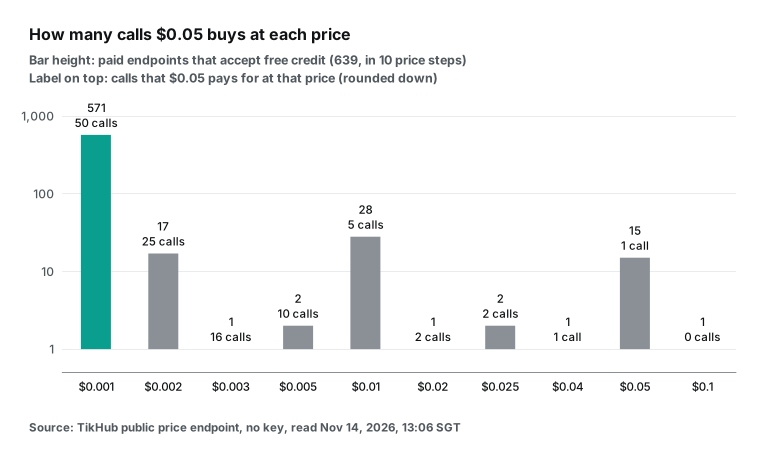
We counted the rows one by one. 649 rows accept free credit, which is 43.8% of the list. 10 of those 649 rows cost $0, and most of them are TikHub account endpoints. Of the 639 paid rows that accept free credit, 571 cost $0.001, 17 cost $0.002, 28 cost $0.01 and 15 cost $0.05. The highest price in the group is $0.1. The other 833 rows do not accept free credit at all.
When you add the discount flag, four groups appear. 409 rows accept both free credit and the daily discount. 240 rows accept free credit only. 43 rows get the discount only. 783 paid rows accept neither, which is 53.4% of all paid rows.
Compared with the November 1 list, the list has 12 more rows and 18 more free-credit rows. The number of discount rows did not change and stays at 452.
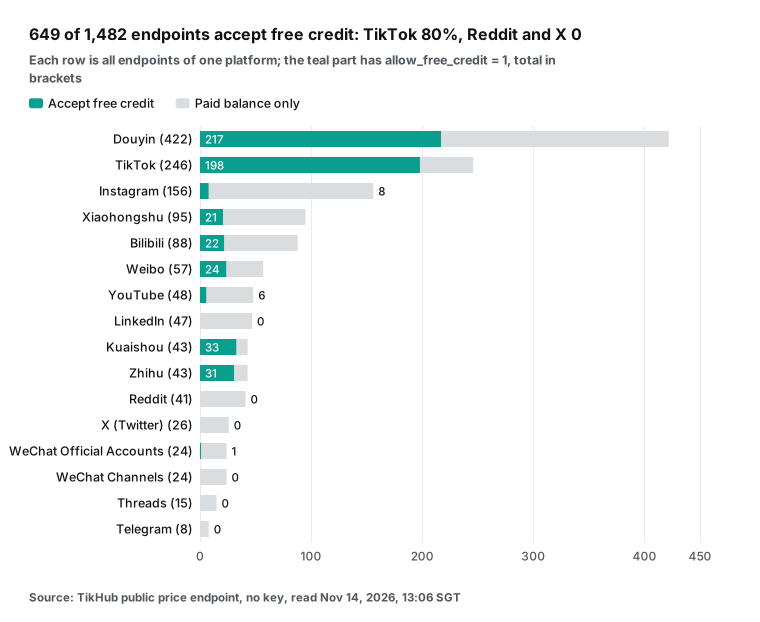
The platform split matters more than the total. On TikTok, 198 of 246 endpoints accept free credit, which is 80.5%. Kuaishou is at 76.7% and Zhihu at 72.1%. Douyin is just above half, with 217 of 422. On the other side, Instagram has 8 of 156, YouTube has 6 of 48, and WeChat Official Accounts has 1 of 24. LinkedIn, Reddit, X, WeChat Channels, Threads and Telegram have zero.
So "try it with the free $0.05" works well for TikTok and Douyin. It does not work at all for Reddit, LinkedIn or X. To see one real Reddit response from TikHub, you must top up at least $5 first. For English-language teams, this is the most practical fact in the whole free-credit policy.
| Platform | Endpoints | Accept free credit | Share | Lowest free-credit price | Calls with $0.05 at that price |
|---|---|---|---|---|---|
| TikTok | 246 | 198 | 80.5% | $0.001 | 50 |
| Douyin | 422 | 217 | 51.4% | $0.001 | 50 |
| 156 | 8 | 5.1% | $0.001 | 50 | |
| YouTube | 48 | 6 | 12.5% | $0.001 | 50 |
| Xiaohongshu | 95 | 21 | 22.1% | $0.001 | 50 (only 3 endpoints at this price) |
| Kuaishou | 43 | 33 | 76.7% | $0.001 | 50 |
| Zhihu | 43 | 31 | 72.1% | $0.001 | 50 |
| LinkedIn, Reddit, X, WeChat Channels, Threads, Telegram | 161 | 0 | 0% | none | 0 |
The Xiaohongshu row needs one more sentence. The $0.001 minimum applies to only 3 endpoints: web/sign, web/get_note_id_and_xsec_token and web/get_note_info_v5. The other 18 Xiaohongshu endpoints that accept free credit cost $0.01 each. The TikHub RedNote page calls the app_v2 series the "recommended default" at $0.01 per request. If you follow that advice, $0.05 reads 5 notes.
November 8 to 11: 18 Xiaohongshu endpoints started to accept free credit
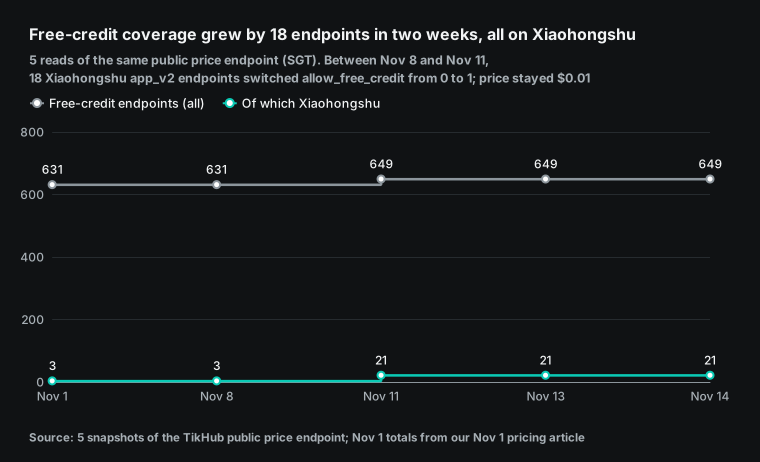
This section uses four snapshots of the same public price endpoint. All four come from GET requests without a key, compared row by row on endpoint_uri. We saved the first one at 00:20 SGT on November 8 for another article. The second is from 00:14 SGT on November 11 and the third from 21:32 SGT on November 13. The fourth is the November 14 copy above. The November 1 totals (1,470 rows, 631 free-credit rows, 452 discount rows) come from our TikHub pricing breakdown.
| Read at (SGT) | Server time (Los Angeles) | Rows | Accept free credit | Daily discount | Xiaohongshu with free credit |
|---|---|---|---|---|---|
| 2026-11-01 00:48 | 2026-10-31 09:48 | 1,470 | 631 | 452 | 3 |
| 2026-11-08 00:20 | 2026-11-07 08:20 | 1,472 | 631 | 452 | 3 |
| 2026-11-11 00:14 | 2026-11-10 08:14 | 1,481 | 649 | 452 | 21 |
| 2026-11-13 21:32 | 2026-11-13 05:32 | 1,482 | 649 | 452 | 21 |
| 2026-11-14 13:06 | 2026-11-13 21:06 | 1,482 | 649 | 452 | 21 |
Here is the diff between November 8 and November 14. TikHub removed no rows. It added 10 rows: 9 Douyin creator-marketplace endpoints (douyin/xingtu/author_*_v1) at $0.02, and 1 Instagram endpoint (v2/fetch_user_about_info) at $0.002. None of the 10 new rows accepts free credit or the discount.
Separately, 18 existing rows changed one flag. All 18 are in the Xiaohongshu app_v2 series, and allow_free_credit went from 0 to 1. The price of $0.01 and the "no discount" flag did not change.
Those 18 endpoints cover image notes, video notes, comments, replies, user profiles, user note lists, product search, product detail, product reviews, topics and creator feeds. They span four groups: notes, comments, users and products.
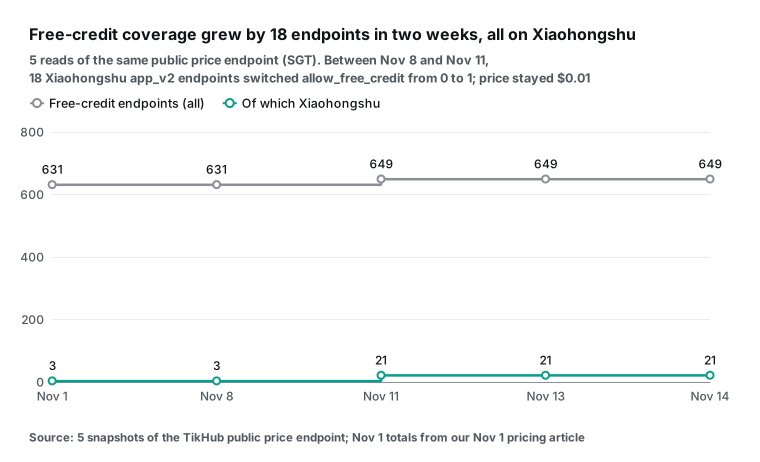
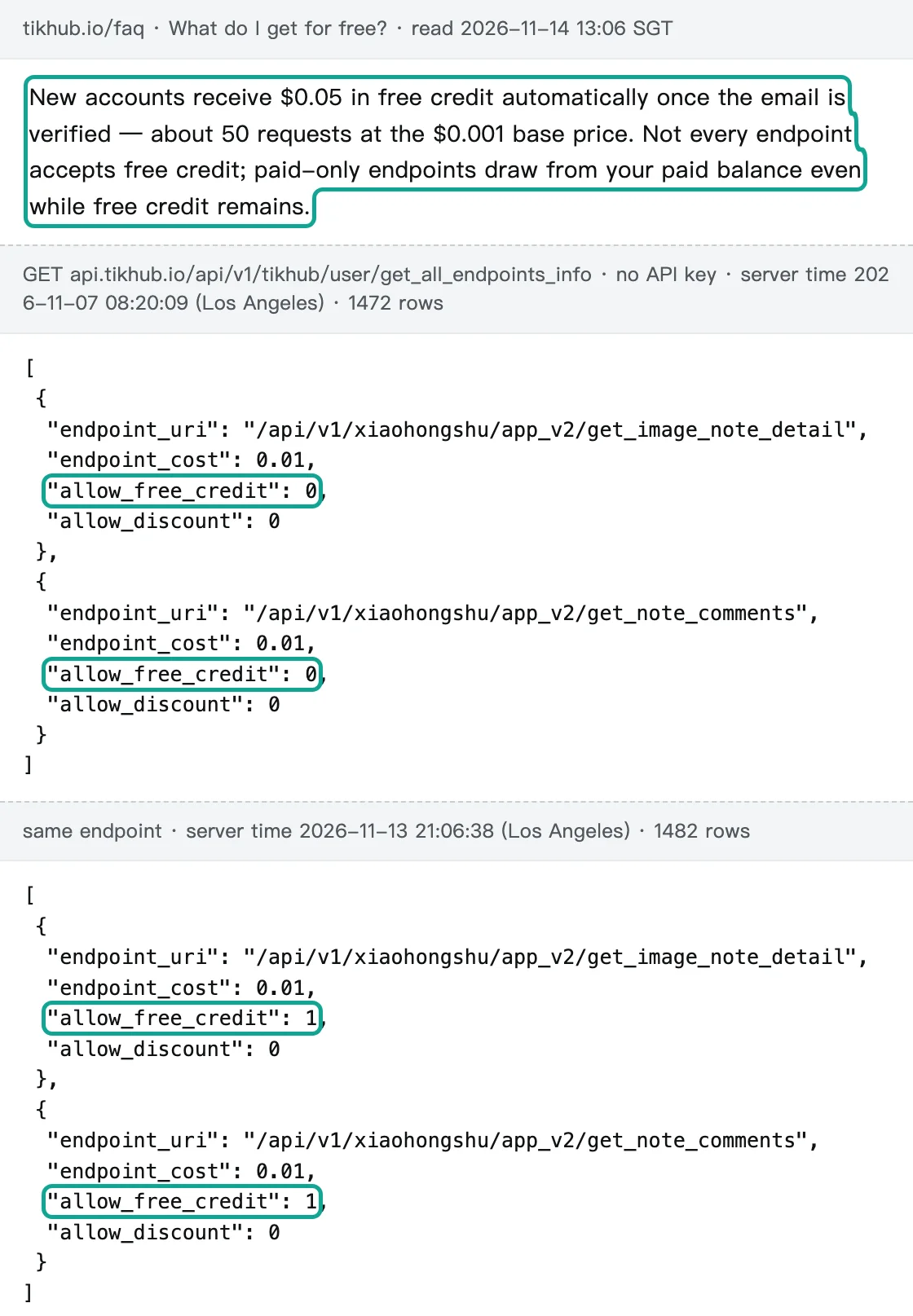
The recommended series now accepts free credit, but at $0.01 per call, $0.05 gives 5 calls. That is 5 notes, or 1 note and 4 comment pages. Before November 8, the only way to see Xiaohongshu note fields with free credit was the $0.001 web/get_note_info_v5 endpoint.
Five samples are too few to judge field stability or empty values. Our Xiaohongshu API comparison from November 5 explains that note links need an xsec_token that expires in about 15 minutes. The TikHub note search endpoints, app_v2/search_notes and web/search_notes, do not accept free credit. So with only $0.05 you cannot search first. You must copy note links from the web or the app, and then convert each link with web/get_note_id_and_xsec_token at $0.001.
The timeline also shows that TikHub sets free-credit eligibility per endpoint, and that it changes over time. We saw no notice of the November 8 to 11 change in the FAQ, the pricing page or the docs home page. We did not check the TikHub community channels or social accounts. If you plan around free credit, save the price endpoint output every week and compare the flags.
What $0.05 buys in real tasks: 50 video details or 5 notes
You can group the 649 free-credit rows by price and divide. At $0.001, each of 571 endpoints gives 50 calls. At $0.002, 17 endpoints give 25 calls each. At $0.005, 2 endpoints give 10 calls. At $0.01, 28 endpoints give 5 calls.
At $0.04 and $0.05, 16 endpoints give 1 call. The single $0.1 endpoint gives zero calls, because $0.05 does not cover one request.
Free credit is one balance, not a separate allowance per endpoint. Each call takes its own price from the same $0.05. So the number of tasks you can finish depends on the mix of endpoints you call.
The next table turns common "first test" tasks into calls. For each task we took the endpoint that TikHub uses in its own product-page sample code. When that sample endpoint is not in the price list, we took the version that accepts free credit and we say so.
| Task | TikHub endpoint (price, free credit) | What $0.05 covers |
|---|---|---|
| TikTok video detail | tiktok/app/v3/fetch_one_video ($0.001, yes) | 50 videos |
| YouTube video detail | youtube/web/get_video_info_v2 ($0.001, yes) | 50 videos |
| Douyin video detail | douyin/app/v3/fetch_one_video ($0.001, yes) | 50 videos |
| Xiaohongshu image note | xiaohongshu/app_v2/get_image_note_detail ($0.01, yes) | 5 notes |
| Xiaohongshu note, older series | xiaohongshu/web/get_note_info_v5 ($0.001, yes) | 50 notes |
| Reddit post detail | reddit/app/fetch_post_details ($0.001, no) | 0 |
| Instagram post by URL | instagram/web_app/fetch_post_details_by_url ($0.001, no) | 0 |
| X post | none of the 26 X endpoints accepts free credit | 0 |
The YouTube row needs a note. The sample code on the TikHub YouTube API page calls youtube/web/get_video_info. That path is not in the November 14 price list.
Of the similar paths in the list, only web/get_video_info_v2 accepts free credit. web/get_video_info_v3, web_v2/get_video_info and web_v2/get_video_info_v2 do not. The public pages do not compare the fields of these versions. To test the web_v2 series, you must top up first.
If your goal is to compare fields before you choose a vendor, here is one way to split $0.05. Run 10 TikTok, 10 YouTube and 10 Douyin video details for $0.03. Then run 2 Xiaohongshu app_v2 note details for $0.02. You see real responses and can check field names and empty values. You cannot estimate success rates or response times from so few calls.
Our trial credit: $1, 24 hours, two GitHub stars
The EveryInfra rules are on the pricing page and in the Terms of Service, last updated on November 1, 2026. We read both at 13:08 SGT on November 14. You star two GitHub repositories, everyinfra-agent-plugins and seo-skills. Then you sign up and claim $1 under "Balance and top-up" in the console.
The credit goes into the bonus balance and is used first. It is valid for 24 hours after you claim it, and the unused part then expires. Each account and each GitHub account can claim it once. It does not cover CAPTCHA solving. GitHub explains stars in its documentation.
With the November 14 catalog, $1 is about 1,798 calls at $0.000556 ($1 ÷ $0.000556). It is about 720 calls at the standard price of $0.001389, which is the number on the pricing page. It is about 179 calls of xiaohongshu/note at $0.005556. Of the 574 capabilities in our catalog, 104 cost $0.000556 and 253 cost $0.001389.
The limit of our trial is time. It suits "test all the capabilities I need this afternoon". It does not suit "claim it now and use it next week". You can wait to star and claim until the day you start, because the 24 hours start only at the claim.
| TikHub free credit | EveryInfra trial credit | |
|---|---|---|
| Amount | $0.05 | $1 |
| How to get it | Register and verify email | Star two GitHub repositories, then claim in the console |
| Valid for | Not stated on public pages | 24 hours after claim |
| How many times | Once per user | Once per account and once per GitHub account |
| Coverage | 649 of 1,482 endpoints | All data capabilities, CAPTCHA solving excluded |
| Calls at the most common price | 50 (at $0.001, the price of 571 endpoints) | About 720 (standard price $0.001389, 253 capabilities); about 1,798 on the 104 capabilities at $0.000556 |
| Card needed | No | No |
| When a call is billed | Billed on HTTP 200, failures not billed (FAQ) | Empty results and failures not billed (Terms) |
The last row decides how long a small credit lasts. The TikHub FAQ says: "A request is billed when it returns status 200; failed requests are not charged." Our terms say that authentication errors, parameter errors, failed runs and empty responses are not billed.
At 13:09 SGT, in our first test round, we typed the TikTok post-list capability as tiktok/user_posts. The API answered with HTTP 400 and the hint "did you mean user_videos". The response had no charge, and the balance did not change.
Live calls at 3 times: tiktok/video, youtube/video, douyin/video, xiaohongshu/note
We made live calls to the EveryInfra API at 3 times on November 14, 2026. All times are Singapore time (SGT). The first round ran from 13:09 to 13:13, the second from 13:29 to 13:30, and the third from 13:48 to 13:49. The full window was 40 minutes. In each round we called the same 4 detail capabilities: douyin/video, tiktok/video, xiaohongshu/note and youtube/video.
Xiaohongshu note links need a fresh xsec_token. So in each round we first searched for "coffee" in Chinese with xiaohongshu/search, and then read the top note. In the first round we also called two list capabilities, youtube/user_posts and tiktok/user_videos, to get a cost per 1,000 items. Each cost in the table comes from billing.charged_usd in the response, not from the catalog price.
| Capability | 13:09–13:13 | 13:29–13:30 | 13:48–13:49 | Items per call | charged_usd per call | Catalog price_usd |
|---|---|---|---|---|---|---|
tiktok/video | 200 | 200 | 200 | 1 | $0.000556 | $0.000556 |
youtube/video | 200 | 200 | 200 | 1 | $0.000556 | $0.000556 |
douyin/video | 200 | 200 | 200 | 1 | $0.000556 | $0.000556 |
xiaohongshu/note | 200 | 200 | 200 | 1 | $0.005556 | $0.005556 |
xiaohongshu/search | 200 | 200 | 200 | 20 | $0.005556 | $0.005556 |
youtube/user_posts | 200 | — | — | 10 | $0.000556 | $0.000556 |
tiktok/user_videos | 200 | — | — | 10 | $0.000556 | $0.000556 |
The 17 requests in the table cost $0.039452 in total: 11 at $0.000556 and 6 at $0.005556. Each charged_usd was equal to the catalog price_usd of that capability. All 4 detail capabilities returned data in all 3 rounds, with no empty results.
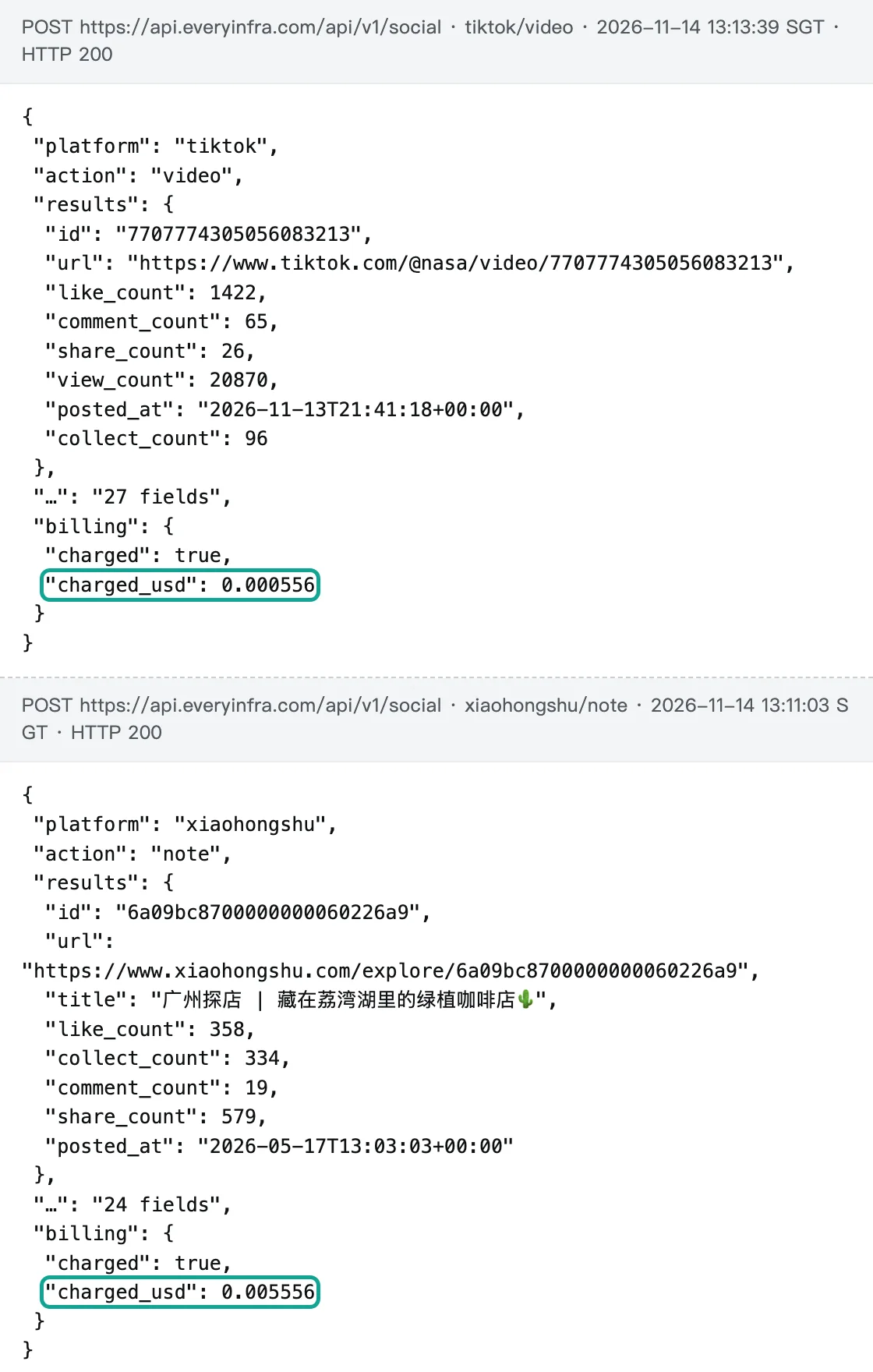
The responses match the public pages, and the counts change over time. tiktok/video read a NASA video posted on November 13. Its views in the three rounds were 20,870, 21,284 and 21,730, and its likes were 1,422, 1,435 and 1,450. youtube/video read the NASA video "MAX POWER" from November 9, and its views went from 70,767 to 70,847. douyin/video read a cooking video with more than 5 million likes. In a trial, call the same link again later to see if the counts are live.
The Xiaohongshu result changed between rounds. At 13:10 the top search result was a café review from May 17 with 358 likes and 334 saves. At 13:29 and 13:48 the top result was a newer note from October 30 with 1,316 likes, 565 saves and 88 comments. Our script reads the top note, so rounds 2 and 3 read a different note. Search order can change within 20 minutes. To keep a fixed sample, save the note IDs and links first, and read the details within 15 minutes.
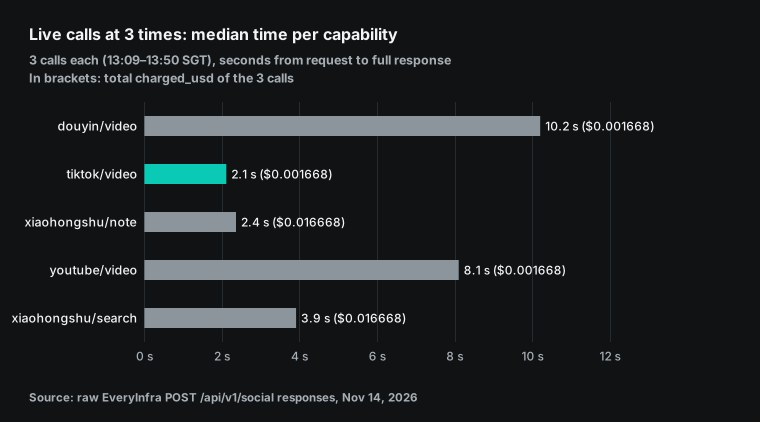
The response time is the median of 3 calls for each capability. tiktok/video took 2.1 seconds, xiaohongshu/note 2.4 seconds, xiaohongshu/search 3.9 seconds, youtube/video 8.1 seconds and douyin/video 10.2 seconds. Each median uses 3 samples. Three samples show only the general size of the time. For example, the three xiaohongshu/search calls took 3.9, 19.7 and 0.8 seconds.
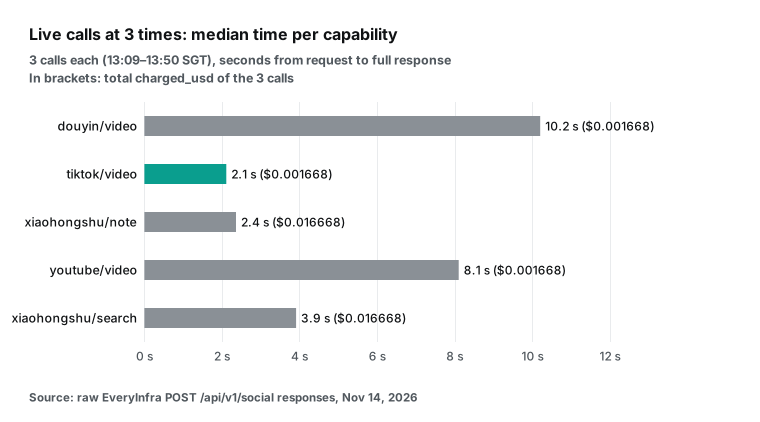
Per 1,000 items, the detail capabilities return 1 item per call. So tiktok/video, youtube/video and douyin/video cost $0.556 per 1,000 items, and xiaohongshu/note costs $5.556. xiaohongshu/search returned 20 items for $0.005556, which is about $0.28 per 1,000 items. If you only need titles and engagement counts, search is about 20x cheaper than note details. youtube/user_posts and tiktok/user_videos returned 10 items for $0.000556, which is about $0.056 per 1,000 items.
Now put these calls back into the free-credit question. The 4 detail capabilities at 3 rounds are 12 calls, and we paid $0.021672. On TikHub, the matching endpoints for the same 12 calls cost 3 × ($0.001 × 3 + $0.01) = $0.039. The $0.05 free credit covers that, with $0.011 left.
Two more Xiaohongshu app_v2 notes would go over the limit. So the TikHub free credit covers one test of this size. On our side, these 17 charged requests used less than 4% of the $1 trial.
Note also that list endpoints are rare in the TikHub free-credit group. The TikTok app/v3/fetch_user_post_videos endpoints, the Douyin app/v3/fetch_user_post_videos endpoint and the YouTube web/get_channel_videos endpoints all cost $0.001, but none accepts free credit. So with only $0.05, you cannot start from an account page or a keyword. You must prepare the video links yourself. On our side, tiktok/user_videos, youtube/user_posts and xiaohongshu/search all work with the trial credit.
50, 500 or 5,000 calls a day: costs after the TikHub free trial
After the free credit, you pay per call. We calculated a 30-day month at three daily volumes. Both sides use list prices from November 14, 2026. For TikHub we use the endpoint_cost of the matching endpoint. If that endpoint takes part in the daily discount, we apply the tiers from the FAQ.
Calls 0 to 1,000 cost full price, calls 1,000 to 5,000 get 10% off, calls 5,000 to 10,000 get 20% off, and so on. The count resets at midnight in Los Angeles. For EveryInfra we use catalog price_usd without the monthly top-up discount. Neither side includes top-up fees or free credit here.
| Capability | TikHub endpoint and price | 50/day (month) | 500/day (month) | 5,000/day (month) |
|---|---|---|---|---|
| TikTok video detail | tiktok/app/v3/fetch_one_video $0.001, discount | $1.50 vs $0.83 | $15.00 vs $8.34 | $138.00 vs $83.40 |
| YouTube video detail | youtube/web/get_video_info_v2 $0.001, no discount | $1.50 vs $0.83 | $15.00 vs $8.34 | $150.00 vs $83.40 |
| Douyin video detail | douyin/app/v3/fetch_one_video $0.001, no discount | $1.50 vs $0.83 | $15.00 vs $8.34 | $150.00 vs $83.40 |
| Xiaohongshu note detail | xiaohongshu/app_v2/get_image_note_detail $0.01, no discount | $15.00 vs $8.33 | $150.00 vs $83.34 | $1,500.00 vs $833.40 |
In each cell, the first number is TikHub and the second is EveryInfra. The ratio is about 1.8x almost everywhere, because $0.001 ÷ $0.000556 is about 1.80. TikTok at 5,000 calls a day is the one exception. That endpoint takes part in the daily discount, so the ratio drops to 1.65x. The first 1,000 calls cost $0.001 each and the next 4,000 cost $0.0009 each. That is $4.60 a day, or $138.00 a month.
For the TikHub daily average to drop below our $0.000556, one discounted $0.001 endpoint needs about 119,000 calls a day. Our November 1 article calculated that number, and the November 14 price list does not change it.
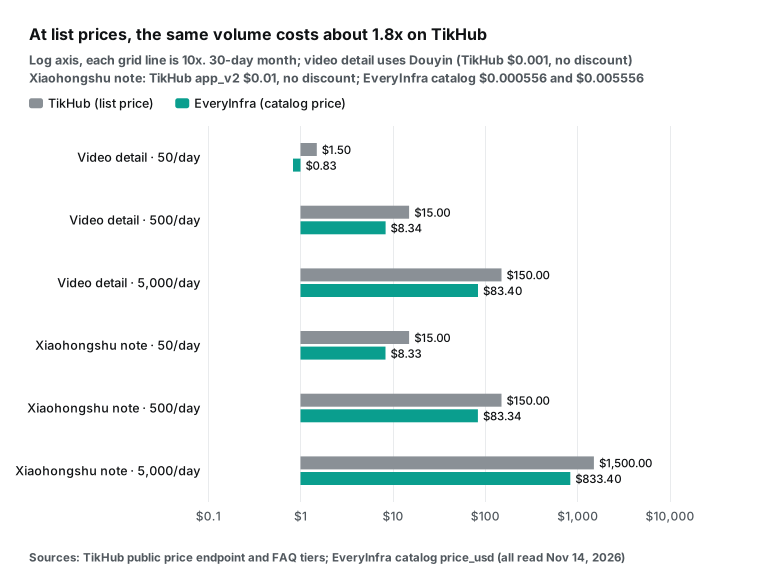
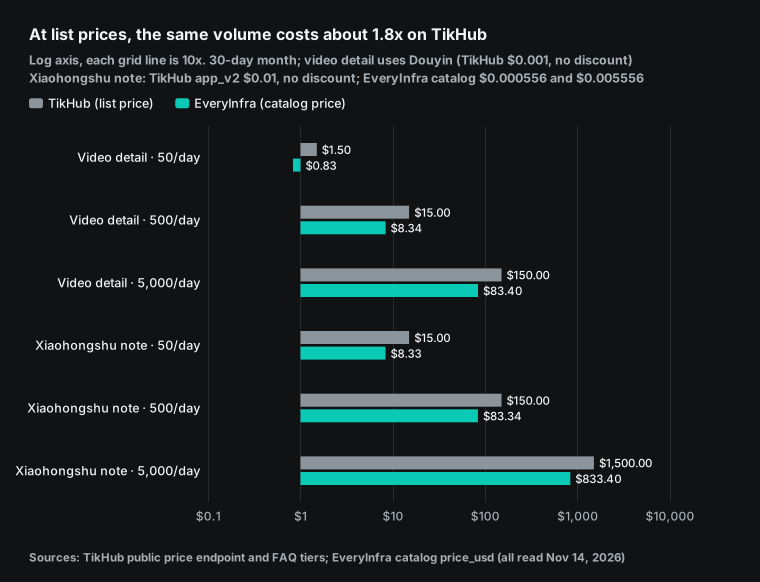
The Xiaohongshu row needs a condition. The TikHub list also has web/get_note_info_v5 at $0.001. It accepts free credit and takes part in the daily discount. If its fields meet your needs, 500 calls a day cost $15.00 a month. Our xiaohongshu/note at the same volume costs $83.34 a month, so v5 is about 5.6x cheaper.
TikHub docs and product pages recommend app_v2 and do not describe the v5 fields or stability. We did not sign up for TikHub, so we did not test v5. If you read Xiaohongshu notes at low volume, spend 5 free calls on v5 before you decide.
The free credit also lasts a different number of days on each side. At 50 video details a day, the TikHub $0.05 lasts exactly 1 day. Our $1 covers 36 days of that volume by price, but it expires after 24 hours, so in practice it also covers 1 day. At 500 a day, about 21 calls an hour, the TikHub credit covers 50 calls, or about 2.4 hours. Our $1 covers the full day, because 500 × $0.000556 is $0.278. At 5,000 a day, neither trial covers one day, and only the paid price matters.
After the free credit: top-ups, fees, daily tiers and refunds
TikHub works on prepaid balance. The pricing page says "there is no subscription and no monthly minimum". The minimum top-up is $5 with no maximum. The FAQ lists the fees: Alipay is 2.6% + $0.30, and PayPal and USDT are 5% + $0.30. A $5 top-up through PayPal costs $5.55. Enterprise accounts do not pay the fee.
The Getting Started page adds an Alipay limit of $250 per day. For USDT, you must add the network gas fee to the amount on the payment page.
Enterprise status starts at a single $3,000 top-up or $4,500 in total. It removes the 5% fee and adds 3% to 10% bonus credit on each top-up. The Enterprise page says the bonus cannot pay for Xiaohongshu or WeChat Channels endpoints. It also says TikHub does not discount per-endpoint prices for enterprise accounts.
| After the free credit | TikHub (read 2026-11-14) | EveryInfra (read 2026-11-14) |
|---|---|---|
| Minimum top-up | $5 | Top-up tiers start at $10 on the pricing page |
| Top-up fee | Alipay 2.6% + $0.30, PayPal and USDT 5% + $0.30 | The payment page shows the total before you pay |
| Volume discount | Daily tiers up to 50% off, on 452 endpoints, reset at midnight Los Angeles time | Monthly tiers by top-up total, from the next call |
| Balance expiry | Not stated on public pages | Paid balance does not expire |
| When a call is billed | When the response is HTTP 200; failures are not billed | Failures, empty results and parameter errors are not billed |
| Refunds | Final by default, with exceptions for billing errors, duplicate charges and outages over 72 hours, within 7 days | A failed call has no final charge |
| Rate limit | 10 requests per second by default, up to 100 for $5 to $55 a month | 60 requests per minute by default, more with a 30-day boost or top-up tier |
Section 5.2 of the TikHub Terms says in capital letters: "ALL SALES ARE FINAL. NO REFUNDS." It covers subscription fees, API usage credits and other charges. Only two exceptions exist: verified billing errors or duplicate charges, and outages longer than 72 consecutive hours. You must email within 7 days of the charge, and the TikHub decision is final. Section 5.3 adds that statutory consumer rights in the EU, the UK and Australia still apply.
The FAQ links to a separate page at user.tikhub.io/refund. That page needs a browser to run scripts, and our four fetch methods did not get its text. So we quote section 5.2 of the Terms (rendered text saved at 14:50 SGT) and the FAQ: "A top-up or a dataset order is not refundable by default."
For free-credit users, the practical advice follows. Test the endpoints you need with the free credit. Check the fields and the success rate. Then top up only what you need. The TikHub FAQ itself recommends balance alerts and auto top-up instead of one large payment.
The rate limit is another cost that appears only after the free credit. For a few hundred calls a day, both default limits are enough. The difference shows in a one-time backfill. To read 100,000 details from one endpoint at the default limits, TikHub at 10 requests per second needs about 2.8 hours (100,000 ÷ 10 ÷ 3,600). We need about 27.8 hours at 60 requests per minute (100,000 ÷ 60 ÷ 60). To go faster, you buy a higher RPS level on TikHub or a 30-day boost from us.
When the TikHub free credit is the better choice
First, you may not want to use GitHub. TikHub needs only an email address. Our $1 trial needs a GitHub account that stars two repositories. If you have no GitHub account, or your company does not allow personal accounts, TikHub has the lower barrier.
Second, you may start work days after sign-up. TikHub public pages do not state an expiry for free credit, but our $1 expires 24 hours after you claim it. On our side, you can wait to star and claim until the day you start. The 24 hours start only at the claim.
Third, you may need a platform or endpoint series that only TikHub covers. At 14:48 SGT on November 14 we read our own catalog again. We compared it with the TikHub list of the same day, item by item. Lemon8 (16 endpoints), Pipixia (17) and Xigua Video (7) all accept free credit at $0.001 per call, and our catalog has no matching platform. The TikTok Ads series (39 endpoints for ad creatives, ad keywords and top products, 31 with free credit) and the TikTok Creator series (14 endpoints for a creator's own account health, video and product analytics, all with free credit) also have no matching capabilities in our catalog.
Douyin Xingtu creator data is on both sides. Our catalog has 4 available Xingtu capabilities at $0.000556 each: douyin/xingtu_creator_search, douyin/xingtu_creator_analytics, douyin/xingtu_rate_card and douyin/xingtu_creator_rankings (see the Douyin page). The two TikHub Xingtu series have 87 endpoints from $0.001 to $0.04, and 10 of them accept free credit. In the other direction, our catalog lists 106 platforms, and the TikHub FAQ says it does not support Facebook, Pinterest or Snapchat.
| Platform or series | TikHub endpoints | With free credit | TikHub price | EveryInfra catalog (Nov 14, 14:48) |
|---|---|---|---|---|
| Lemon8 | 16 | 16 | $0.001 | None |
| Pipixia | 17 | 17 | $0.001 | None |
| Xigua Video | 7 | 7 | $0.001 | None |
| TikTok Ads | 39 | 31 | $0.001 | None |
| TikTok Creator | 14 | 14 | $0.001 | None |
| Douyin Xingtu | 87 | 10 | $0.001 to $0.04 | 4 available, $0.000556 each |
Fourth, you may read Xiaohongshu notes, and web/get_note_info_v5 may give you enough fields. The TikHub Xiaohongshu web series has 3 endpoints at $0.001: note detail get_note_info_v5, get_note_id_and_xsec_token for the note ID and token, and sign. All three accept free credit and the daily discount.
For note details, $0.001 against our $0.005556 for xiaohongshu/note makes TikHub about 5.6x cheaper ($0.005556 ÷ $0.001). At 500 calls a day, that is $15.00 against $83.34 a month. The other 13 paid endpoints in that series, such as search, comments and users, cost $0.01 or $0.011 and do not accept free credit. The condition is important: TikHub itself recommends the $0.01 app_v2 series, and public pages do not describe v5.
Fifth, you may need free re-reads within 24 hours, or a high burst rate. Each successful TikHub response has a cache_url that reopens the same response for free for 24 hours. The TikHub default of 10 requests per second per path is much higher than our default of 60 requests per minute.
We have no free re-read link, so a second read is a new request. For scheduled jobs and retries, send REST calls with an Idempotency-Key header. Our guide to AI agent retries and idempotency keys shows how. The header itself is an IETF draft.
Official free tiers as a reference point
TikHub and EveryInfra are both third parties. For some data, the platform's own free tier may be enough. We read and saved all four sources below on November 14, 2026. Official tiers are large, but they need review, OAuth or a card, and they cover less. Third-party credits are small, but they work at once.
| Official API | Free allowance (source text) | Requirement | Source |
|---|---|---|---|
| YouTube Data API | 10,000 units a day per project, plus 100 search.list calls. videos.list costs 1 unit | Google Cloud project and credentials | Quota calculator, last updated 2026-11-12 |
| Reddit Data API | 100 queries per minute per OAuth client for free access, averaged over 10 minutes | OAuth and the Data API Terms | Reddit Data API Wiki, read 2026-11-14 |
| X API | Pay per use. $20 credit after you save a card and buy credit once. A post read costs $0.005 | Card and first purchase | X API pricing, read 2026-11-14 |
| TikTok Research API | For eligible researchers, answer usually within 4 weeks | Academic or non-profit research | Research tools page, read 2026-11-14 |
YouTube is the clearest example. With the default quota, one project can make up to 10,000 videos.list calls a day if it uses all units on that method. That costs nothing and is more than both 50 TikHub calls and the about 1,798 calls that our $1 buys on $0.000556 capabilities. The cost is setup work: a Google Cloud project, credentials, and the YouTube API Services Terms. The method reference is on the videos.list page, and the general setup is in the YouTube Data API overview.
X is the opposite case. It has no free read allowance without a card, the $20 bonus needs a first payment, and a post read costs $0.005. That is five times the TikHub base price. X also bills the same resource only once in a 24-hour UTC window. The TikHub FAQ says requests are "billed independently, even with identical parameters". Our TikHub Twitter API comparison from November 12 and our YouTube API comparison from November 13 give the numbers for these two platforms.
Reddit needs OAuth for all data access and follows its Data API Terms and Developer Terms. TikTok research access lists its fields in the Research API Codebook and its setup in Getting Started. The TikTok Display API shows a creator's own profile and videos with their permission, so it does not read other public videos. X adds its own Developer Terms.
The TikHub MCP server is also relevant here. The TikHub MCP page lists more than 990 tools on 16 platforms, and the config uses the same bearer key. The pricing page says: "Usage through them consumes requests and deducts from your balance exactly as a direct call would." So when you test TikHub MCP inside an AI tool, you spend the same $0.05 on the same 649 endpoints. Its distribution repository is tikhub-mcp-dist. Our remote server is on the MCP page, it follows the MCP specification, and the $1 trial works there too.
FAQ
How do I start a tikhub api free trial?
Register a TikHub account and click the link in the verification email. The $0.05 credit then arrives, and you do not need a card (Getting Started). Create an API key in the dashboard and send it in the Authorization: Bearer header. Before each new endpoint, check that its allow_free_credit flag is 1. If it is 0, the call fails with an insufficient-balance error. Question source: Google autocomplete "tikhub api free trial", read November 14, 2026.
Does the tikhub api free tier reset every day?
No. The daily check-in bonus was removed, and only the one-time $0.05 sign-up credit remains (FAQ "Is there still a daily check-in bonus?"). The daily volume discount resets every day at midnight in Los Angeles, but that is a discount, not free calls. Question source: autocomplete "tikhub api free tier".
Is a tikhub api free api key free forever?
The key itself is free, and you can create up to 100 keys (FAQ "How many API keys can I have?"). Calls spend balance. After the free credit, you top up at least $5. Question source: autocomplete "tikhub api free api key".
Do TikHub API free credits expire?
We checked the FAQ, the pricing page, Getting Started and sections 1 to 8 of the Terms of Use on November 14, 2026. None of them states an expiry date for free credit. Section 5.2 of the Terms says that all payments, including API usage credits, are non-refundable. Question source: the keyword "tikhub api free credits" and autocomplete "tikhub api free version".
Can the TikHub free credit read Xiaohongshu (RedNote)?
Yes, on 21 endpoints. 3 cost $0.001 and 18 in the app_v2 series cost $0.01. The 18 app_v2 endpoints started to accept free credit between November 8 and 11, 2026. At $0.01, the $0.05 credit covers 5 calls. Question source: autocomplete "tikhub api free version".
Try it: check what free credit buys
Step 1 needs no key. This Python script uses only the standard library (urllib.request). It counts free-credit endpoints by platform in the TikHub public list. It also shows how many calls $0.05 buys at each price.
import json, re, urllib.request, collections

UA = {"User-Agent": "Mozilla/5.0"}
url = "https://api.tikhub.io/api/v1/tikhub/user/get_all_endpoints_info"
rows = json.load(urllib.request.urlopen(urllib.request.Request(url, headers=UA)))["data"]

free = [r for r in rows if r["allow_free_credit"]]
print("rows", len(rows), "free-credit rows", len(free))

pat = re.compile(r"/api/v1/([^/]+)/")
by_platform = collections.Counter(pat.match(r["endpoint_uri"]).group(1)
                                  for r in free if pat.match(r["endpoint_uri"]))
print(by_platform.most_common(10))

for price, n in sorted(collections.Counter(r["endpoint_cost"] for r in free if r["endpoint_cost"] > 0).items()):
    print(f"${price}: {n} endpoints, $0.05 buys {int(0.05 / price + 1e-9)} calls")
If you prefer Requests, use requests.get(url, headers=UA).json()["data"] for the two urllib.request lines. The result is the same. This script needs no TikHub account. Run it again a week later and compare the two outputs on endpoint_uri to see which flags changed.
Step 2: claim the $1 trial in the console and create a key. Make one live call with your own link, and read billing.charged_usd in the response. Keep the key in an environment variable, not in your code.
export EVERYINFRA_API_KEY=your_key
curl -s https://api.everyinfra.com/api/v1/social \
  -H "Authorization: Bearer $EVERYINFRA_API_KEY" \
  -H "Content-Type: application/json" \
  -d '{"platform":"youtube","action":"video","params":{"url":"https://www.youtube.com/watch?v=eXrd5sNdacA"}}'
Step 3: use two formulas. Cost per 1,000 calls is price × 1,000. Cost per 1,000 results is total charge ÷ total results × 1,000. For detail capabilities that return one item per call, both formulas give the same number. For list capabilities, the per-result cost is much lower. For example, tiktok/user_videos returned 10 items for $0.000556, which is about $0.06 per 1,000 items.
Platform pages: TikTok, YouTube, Douyin and Xiaohongshu. Capability pages: tiktok/video, youtube/video, douyin/video and xiaohongshu/note. The market lists every capability, and the TikHub alternative page gives the short version.
References
- TikHub, Pricing, read 2026-11-14.
- TikHub, FAQ: Billing, Rate Limits and Platform Support, read 2026-11-14.
- TikHub, Getting Started: First API Call in 4 Steps, read 2026-11-14.
- TikHub, Terms of Use, effective 2026-03-17, rendered text read 2026-11-14 14:50 SGT.
- TikHub, Refund policy, needs scripts, text not retrieved on 2026-11-14.
- TikHub, Enterprise plans, read 2026-11-14.
- TikHub, Public price endpoint get_all_endpoints_info, read 2026-11-14 13:06:38 SGT.
- TikHub Docs, Get all endpoints information.
- TikHub Docs, Calculate price.
- TikHub Docs, Get tiered discount percentage.
- TikHub Docs, Get TikHub user info.
- TikHub Docs, Home.
- TikHub, Swagger UI.
- TikHub, RedNote API page, read 2026-11-14.
- TikHub, Douyin API page, read 2026-11-14.
- TikHub, YouTube API page, read 2026-11-14.
- TikHub, TikTok API page, read 2026-11-14.
- TikHub, MCP page, read 2026-11-14.
- TikHub, tikhub-mcp-dist, GitHub.
- EveryInfra, Capability catalog, read 2026-11-14 13:08 SGT.
- EveryInfra, Douyin catalog.
- EveryInfra, TikTok catalog.
- EveryInfra, Xiaohongshu catalog.
- EveryInfra, YouTube catalog.
- EveryInfra, Terms of Service, updated 2026-11-01.
- EveryInfra, everyinfra-agent-plugins, GitHub.
- EveryInfra, seo-skills, GitHub.
- GitHub Docs, Saving repositories with stars.
- Google for Developers, YouTube Data API quota calculator, updated 2026-11-12.
- Google for Developers, YouTube Data API Overview.
- Google for Developers, videos.list.
- Google for Developers, YouTube API Services Terms of Service.
- Reddit Help, Reddit Data API Wiki.
- Reddit, Data API Terms.
- Reddit, Developer Terms.
- X Developer Platform, X API pay-per-usage pricing and credits.
- X Developer Platform, Developer Terms.
- TikTok for Developers, Research Tools: Access and Eligibility.
- TikTok for Developers, Research API Getting Started.
- TikTok for Developers, Research API Codebook.
- TikTok for Developers, Display API Overview.
- Model Context Protocol, Specification 2025-06-18.
- IETF, The Idempotency-Key HTTP Header Field (draft).
- Python Docs, urllib.request.
- Requests Docs, Requests: HTTP for Humans.
Reference BL-156