TikTok API Pricing in 2026: Is the TikTok API Free to Use, and What Third-Party Data Costs per 1,000 Results
TikTok API pricing: official APIs cost $0 but need approval. Per 1,000 videos, Apify costs $1.70+, TikHub about $0.05, and EveryInfra $0.011 in our tests.
TikTok charges nothing for its APIs, but the only one that reads public data, the Research API, is for approved non-profit researchers. Companies must use a third party. For 1,000 videos, the most used Apify tool costs $3.70 on its Free tier. TikHub costs about $0.05, and our live test on November 7, 2026 (UTC) cost $0.011.
How we compared prices
People who search for "tiktok api pricing" usually ask three different questions. First, does TikTok have an API, and does it cost money? Second, if the official API is closed to you, what does a third-party API cost per 1,000 results? Third, when is the official route still the better choice? Many articles answer only the first question, or list third-party prices in different units. This article puts all three on one scale.
For the official side, we read each page on TikTok for Developers on November 8, 2026 (Singapore time). For Apify and TikHub, we used only their public price lists and docs. We did not sign up, buy anything or send a request with their keys. So their numbers are list prices, not tested bills. Every EveryInfra number comes from a raw response that we saved.
We used one formula for every price per 1,000. Take the money that one request really cost. Divide it by the rows that the request really returned. Multiply by 1,000.
We use the returned rows, not the limit that we asked for. For example, we asked tiktok/search for 200 videos and got 50, so we divide by 50. This choice can only make our price look higher.
Apify charges per result, so its list price is already a price per row. TikHub charges per request. We divide its price by the default page size (count) in its public OpenAPI file. TikHub can return fewer rows than the default, so its real price per 1,000 can be higher than our estimate.
TikTok API pricing at a glance
The table below covers six common types of public TikTok data. The Apify columns use tools by the developer Clockworks. Its TikTok Scraper had 35,115 users in the last 30 days, the most of any TikTok tool in Apify Store.
Apify plans map to price tiers. The Free plan uses FREE prices and Starter ($19 a month) uses BRONZE. Scale ($199) uses SILVER, and Business ($999) uses GOLD (Apify pricing, read on November 8, 2026, 00:33 SGT). The TikHub column divides the unit price by the default page size. The EveryInfra column divides charged_usd by the rows returned in our live calls.
| Data | Apify Clockworks, Free tier | Apify Clockworks, Business tier | TikHub (price ÷ default rows) | EveryInfra, tested | EveryInfra rows per call |
|---|---|---|---|---|---|
| Video search by keyword | $3.70 | $1.70 | $0.050 ($0.001 ÷ 20) | $0.0111 | 50 |
| Video comments | $1.25 | $0.50 | $0.050 ($0.001 ÷ 20) | $0.0028 | 200 |
| Videos of one account | $3.00 | $1.00 | $0.050 ($0.001 ÷ 20) | $0.0111 | 50 |
| Hashtag videos | $3.00 | $1.00 | $0.100 ($0.001 ÷ 10) | $0.0185 | 30 |
| Account search | $6.00 | $2.50 | $0.050 ($0.001 ÷ 20) | $0.0278 | 20 |
| Profiles (per 1,000 accounts) | see below | see below | $1.00 | $0.556 | 1 |
Compare each price with our tested price. For video search, the Apify Free tier is 333 times higher. The Business tier is 153 times higher, and TikHub is 4.5 times higher. For comments, the two Apify tiers are 446 and 180 times higher, and TikHub is 18 times higher. Account search has the smallest gap: TikHub is 1.8 times our price.
The profile row is one request per account in every service. So we can only compare it per 1,000 accounts: $1.00 on TikHub and $0.556 on EveryInfra. The table does not include the Apify start fee ($0.001 per run for Clockworks TikTok Scraper) or TikHub's top-up fee. With those fees, the gaps get a little larger.
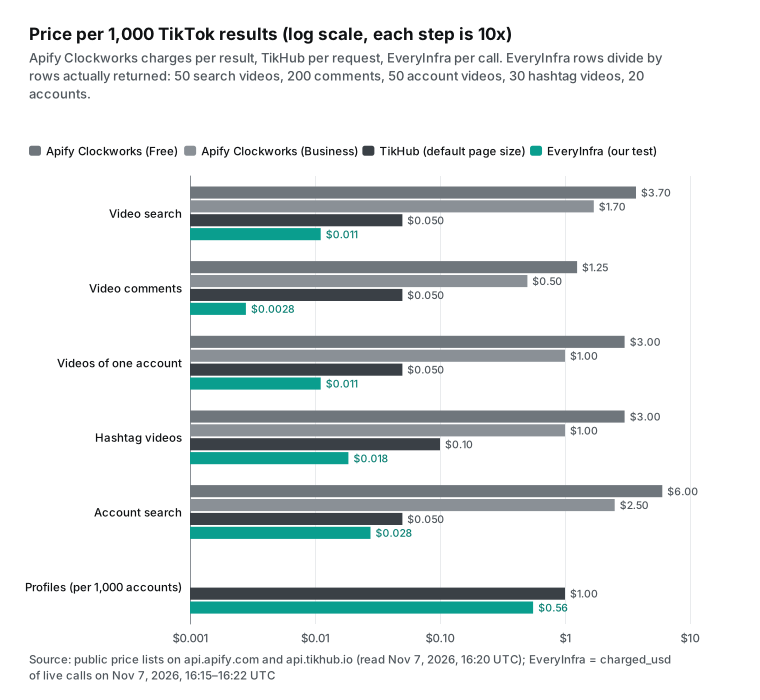
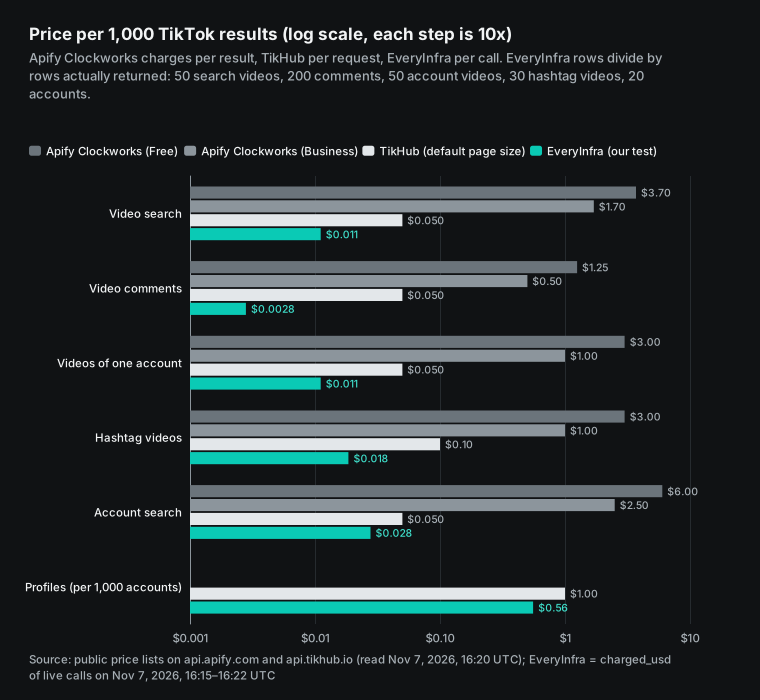
Why are the gaps so large? The reason is the billing unit, not the cost of servers. Apify developers charge for each result, so 1,000 rows cost 1,000 events. TikHub charges for each request, but one request returns 10 to 20 rows. We also charge per request, but one request returns 50 videos or 200 comments. So the cost per row is low.
If you need only one row per request, such as one profile, the gap becomes 2 to 5 times. Per 1,000 profiles, TikHub and the Clockworks Business tier cost $1.00, the Free tier costs $3.00, and we cost $0.556. The break-even section shows where the prices meet.
Is TikTok API free to use? The seven official APIs
Everything that TikTok gives developers is on TikTok for Developers. Each product has "API" in its name, but the uses are very different. We read each page on November 8, 2026. No page showed a price table, a per-call fee or a paid plan. The pages only describe who can apply and how many calls you can make.
So the honest answer to "is TikTok API free to use" is: yes in money, but each API has its own gate. Most of these gates are closed to commercial teams. The table below lists the gate and limit of each API.
| TikTok API | Who can apply | What you get | Fee | Limit |
|---|---|---|---|---|
| Research API | Academic institutions in the US, EEA, UK, Canada and Switzerland; EU non-profit research bodies; Brazilian academic or non-profit groups that study youth safety | Public videos, comments, profiles, follower and following lists, EU TikTok Shops | No fee listed | 1,000 requests and 100,000 records a day; follower lists 20,000 calls and 2 million records a day |
| Display API | Developers with a registered and reviewed app | Profile and videos of users who authorize your app | No fee listed | 600 requests a minute per endpoint |
| Content Posting API | Apps approved for the video.publish scope | Posts videos and photos for authorized users | No fee listed | 6 requests a minute per user token, plus a daily post cap |
| Commercial Content API | The public and researchers, in any country | Ad library: ads, advertisers, targeting (EU ads only for now) | No fee listed | Up to 50 results per query |
| Data Portability API | Apps that users authorize | A user's own posts, follows, messages and more | No fee listed | Per user consent |
| Marketing API (TikTok API for Business) | Advertisers and agencies | Your own ad accounts and reports | No API fee listed in the docs; ad spend is separate | Per ad account |
| TikTok Shop Partner API | Sellers and service providers | Products and orders of authorized shops | No API fee listed in the docs | Per shop authorization |
The first five rows come from developers.tiktok.com. The last two are on the TikTok ads developer portal and the TikTok Shop Partner Center. The next sections explain which of these can read public data. Public data is what most people who search for "tiktok api free" really want.
Research API: the only official API for public data, for non-profit research only
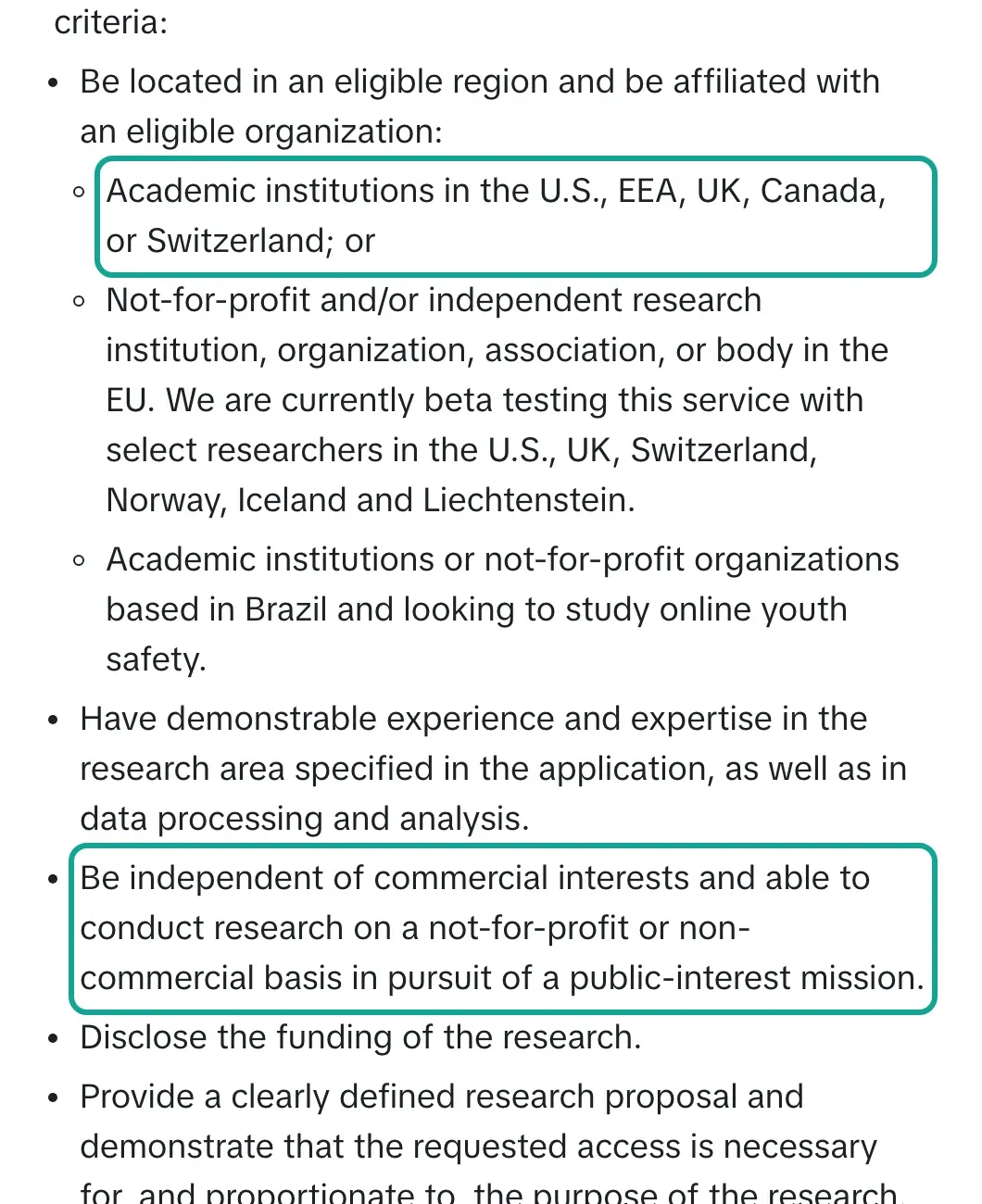
The Research API product page sets the rules (Research Tools page, read on November 8, 2026, 00:19 SGT). The applicant must be in an eligible region and belong to an eligible organization. That means an academic institution in the US, the EEA, the UK, Canada or Switzerland. It can also be a non-profit research body in the EU. A beta is open to some researchers in the US, the UK, Switzerland, Norway, Iceland and Liechtenstein. A third group is Brazilian academic or non-profit groups that study online youth safety.
The applicant must also be independent of commercial interests and disclose research funding. They must send a research plan and show an ethics review. A PhD student needs a letter from a professor. TikTok usually replies within 4 weeks. FAQ question 6 is direct: creators, advertisers and commercial users are not eligible (Research API FAQ).
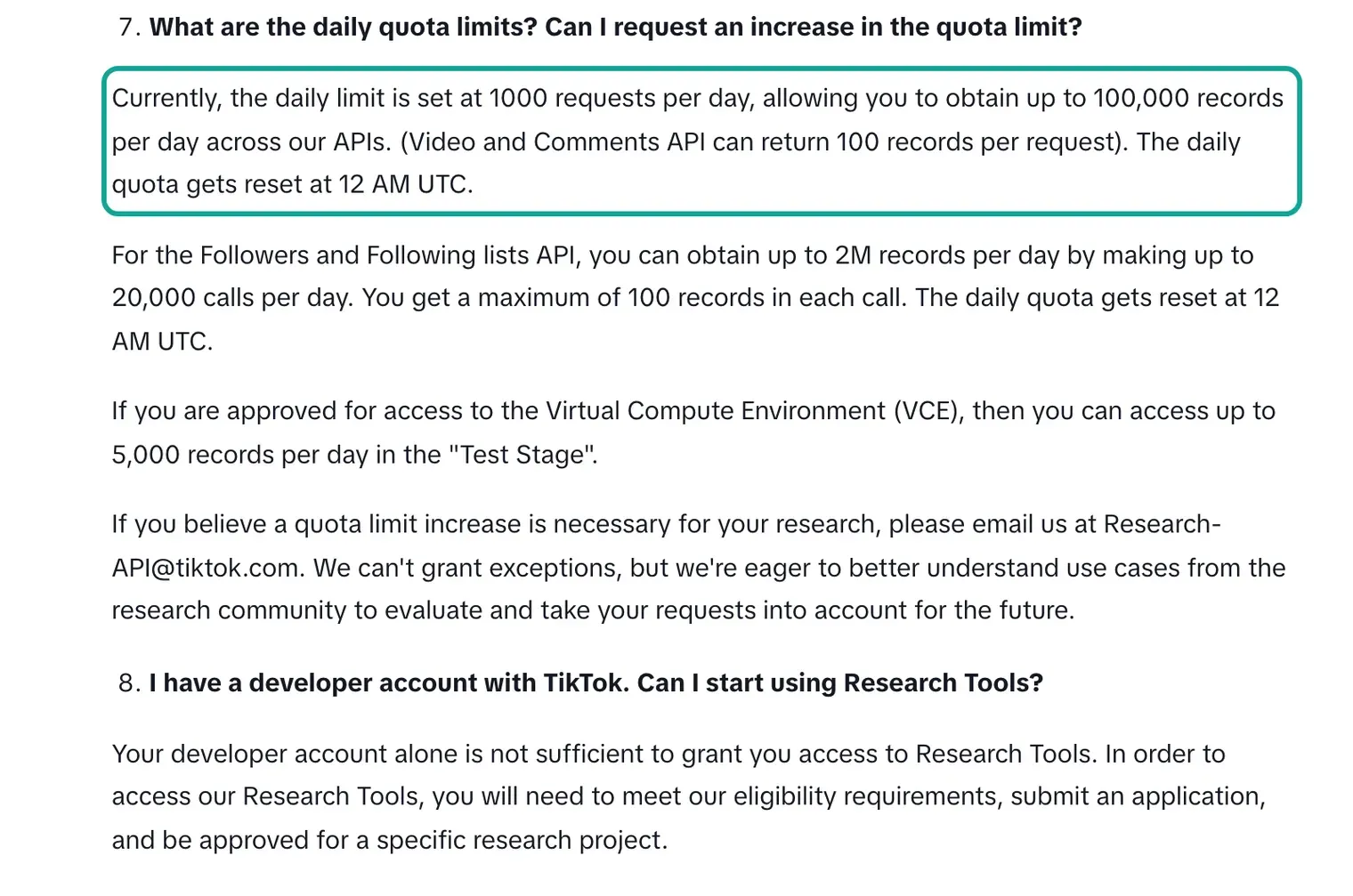
After approval, the quota is generous. The table lists the limits from FAQ question 7 and the VCE guide. Non-academic groups use the Virtual Compute Environment (VCE).
| Research API limit | Value |
|---|---|
| Requests per day | 1,000 |
| Records per day | Up to 100,000 |
| Records per request (videos, comments) | Up to 100 |
| Follower and following lists | 20,000 calls and 2 million records a day |
| Quota reset | Midnight UTC |
| VCE test stage | 5,000 records a day |
To connect, you exchange a client key and secret for a client token. The token expires after two hours. Then you query videos with SQL-like conditions (getting started, client tokens). The comment endpoint returns only id, text, likes, reply count, parent comment and time. Phone numbers and emails in comments are masked (query video comments).
One scope limit is easy to miss. The Codebook says that the research data only includes public videos from creators aged 18 or older. It also excludes videos that belong to Canada. So a Canadian university can apply but cannot query Canadian videos.
There is also a gap for the rest of the world. The region list has no country in Asia, Africa or Oceania, and none in Latin America except Brazil. A university in Singapore, India, Australia or Mexico cannot apply alone. A common workaround is a joint project with a partner in an eligible region. The FAQ says that each organization must apply separately, and that a lead researcher can add up to 9 collaborators.
Display API and Content Posting API: only for users who authorize your app
The Display API has three endpoints: /v2/user/info/, /v2/video/list/ and /v2/video/query/ (Display API overview, last updated on August 4, 2026). The scopes are user.info.basic and video.list. The key word is "user". It means a person who logs in to your app with Login Kit and gives you consent.
You can show a creator's own profile and videos on your site. You cannot look up a stranger's account. The rate limit is 600 requests a minute per endpoint (rate limits).
A developer on Stack Overflow asked the same question that many people ask. Can the TikTok API return public likes and follower counts without a login? The answer was no: every official endpoint needs user consent. The replies only offered embed code or a third-party service (Stack Overflow question 74610840).
The Content Posting API publishes content. It does not read data. Your app must get approval for the video.publish scope. Until your app passes an audit, every post is private.
Each user token allows 6 init requests a minute. Past the daily post cap, the API returns spam_risk_too_many_posts (Direct Post reference, getting started). It is free too. If you only want to post videos automatically, this API is all you need.
Commercial Content API, Marketing API and Shop API: useful, but only for ads and your own shop
The Commercial Content API is an ad transparency library. It returns ads, advertisers, targeting and reach. Each ad stays in the library for one year after it last ran. The public and researchers in any country can apply, and TikTok replies in 1 to 2 weeks.
But the product page says that it only includes ads from EU countries for now (Commercial Content API). One query returns up to 50 results (getting started). It works for European ad research. It does not help with US or Asian ads.
The Marketing API manages your own ad accounts: you create ads and pull reports.
Its getting started guide covers a developer account, an app, a review and a token. The official docs that we read on November 8, 2026 list no API fee. You pay for the ads. The TikTok Shop Partner Center serves sellers and service providers. It reads and writes products and orders of the shops that authorize you. The Data Portability API lets a user export their own posts, following and follower lists to an app they trust.
All of these are free. But each one only covers your own data or data that someone authorized. None of them returns a competitor's videos, a stranger's profile or all videos for a hashtag.
What the Research API's free quota is worth
The official API is free and third parties charge money. So what is the free daily quota of 100,000 records worth? We priced the same quota at three list prices and at our tested price.
For 100,000 comments, we return 200 per call, so we need 500 calls: 500 × $0.000556 = $0.28. TikHub returns 20 per call by default, so it needs 5,000 requests. The first 1,000 are $0.001 each and the next 4,000 get a 10% discount, which totals $4.60. The cheapest Apify comment tool costs $0.30 per 1,000, so $30. The Clockworks comment tool costs $50 on the Business tier and $125 on the Free tier.
For 100,000 videos, we return 50 per call, so 2,000 calls cost $1.11. TikHub's video search endpoint gets no discount, so 5,000 requests cost $5.00. The cheapest Apify tier costs $30. Clockworks costs $170 on Business and $370 on Free.
| 100,000 records a day | EveryInfra (tested) | TikHub (with daily tiers) | Cheapest Apify Store tool | Apify Clockworks, Business | Apify Clockworks, Free |
|---|---|---|---|---|---|
| Comments | $0.28 | $4.60 | $30 | $50 | $125 |
| Videos | $1.11 | $5.00 | $30 | $170 | $370 |
| Comments for 30 days | $8.34 | $138 | $900 | $1,500 | $3,750 |
| Videos for 30 days | $33.4 | $150 | $900 | $5,100 | $11,100 |
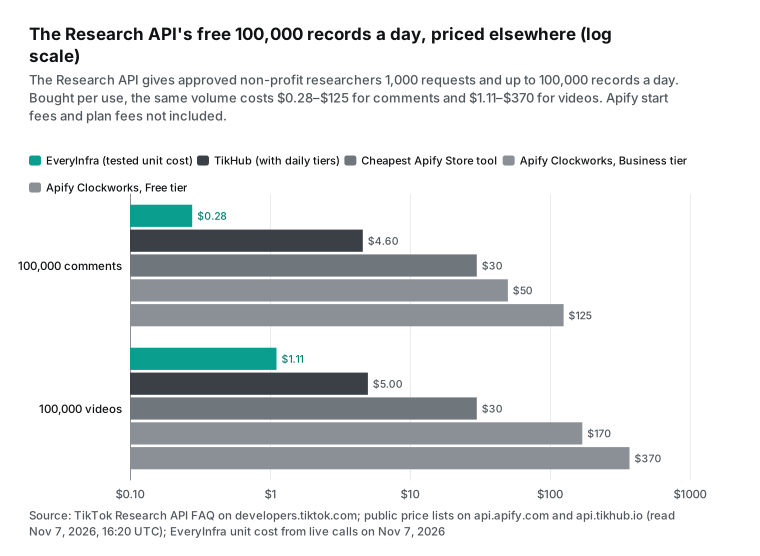
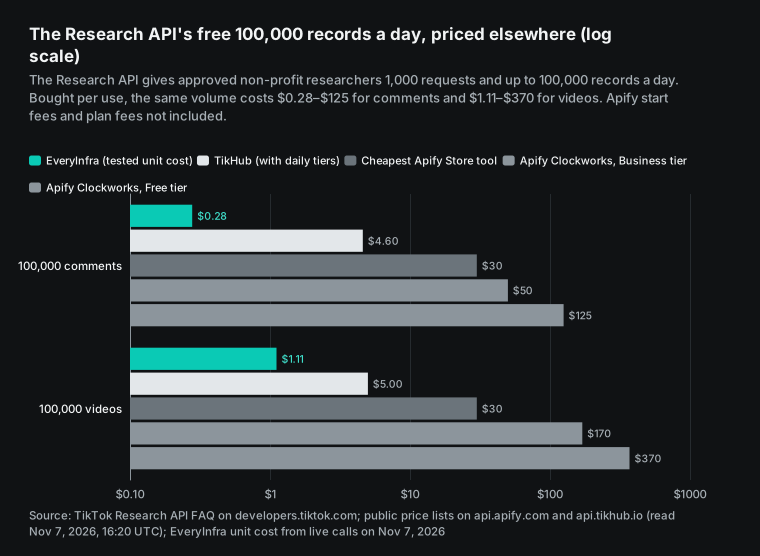
These numbers show two things. First, the free quota is worth a lot to approved researchers. At the most used Apify tool, the daily video quota is worth $370, which is over $10,000 a month. This explains why some graduate students rewrite their applications again and again. In one Reddit thread, the author says TikTok rejected the application for different reasons several times. Another user says approval came after about 5 weeks (r/CompSocial thread).
Second, "free" is not the only low-cost option for teams that cannot apply. At per-call prices, the same volume costs $8 a month for comments and about $33 a month for videos. For a commercial team, that cost is very small. Also, you do not wait 4 weeks, write a research plan or accept a non-commercial rule.
Four hidden costs of the free official API
A price of zero is not a cost of zero. After reading TikTok's pages and studies by researchers, we found four costs of the Research API that are not money.
The first cost is eligibility. Commercial users, creators and advertisers cannot apply. Non-academic groups must use the VCE. Its test stage allows 5,000 records a day, and TikTok reviews the output so that you only get aggregated results (VCE guide). An influencer marketing agency cannot pass this gate at any budget.
The second cost is time. The product page says TikTok usually replies within 4 weeks, and longer if it needs more details. In the EU, there is another route: vetted researcher status under Article 40 of the Digital Services Act. The European Commission adopted the delegated act on data access on July 2, 2025 (delegated act page). It also opened the DSA data access portal. But national Digital Services Coordinators must first vet each researcher, so this route takes even longer.
The third cost is delay. The Research API FAQ says that the video query uses archived data. New videos can take up to 48 hours to appear in search. Counts such as views and followers can take up to 10 days to update (Research API FAQ).
For social listening, 48 hours is enough for a trend to rise and fall. In our test at 00:15:50 SGT on November 8 (16:15 UTC on November 7), the newest of 200 comments was 14 minutes old. In our test at 00:17:18 SGT, the newest Duolingo video was about 23 hours old.
The fourth cost is sample quality. A 2026 study in Social Science Computer Review compared the Research API with manual collection and third-party analytics. It used 6,373 videos from 14 creators in the US and the UK (Harnessing Big Data, Hindered by Bias). The API found more videos and gave 8 variables that other sources did not have. But transcripts covered only about 10% of the content. View counts were lower than manual counts, while comment and share counts were higher.
A 2024 US election dataset of 3.14 million videos also used third-party tools to fill gaps in the Research API (arXiv 2412.15583). If approved researchers still add third-party data, then "free" and "enough" are not the same thing.
Third-party route one: Apify charges per result
Apify is a platform, and most TikTok tools on it come from third-party developers who set their own prices. Its Store search API is public. On November 8, 2026, at 00:20 SGT, a search for "tiktok" returned 3,729 results. We read the first 96 by relevance (Store search API).
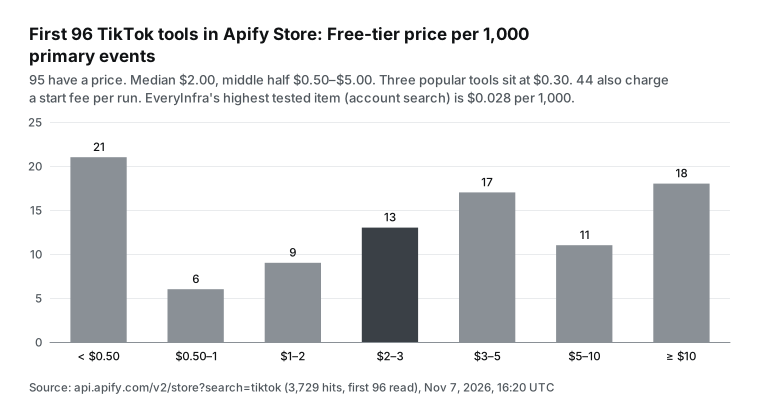
Of these, 95 had a price and 1 was free. All of them use pay-per-event pricing. The developer defines the events. The most common event is "one result returned", and some tools add a start fee per run (Actors in Apify Store, pay per event).
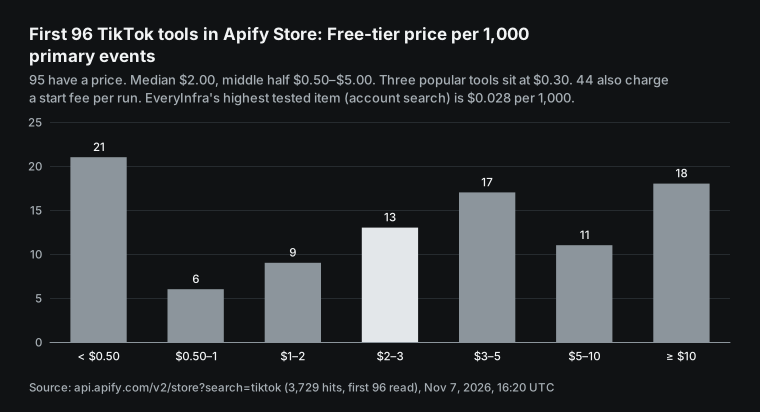
We converted the main event of each tool to a Free-tier price per 1,000. The median was $2.00, and the middle half was $0.50 to $5.00. 44 tools also charge a start fee. The cheapest was an ad library tool at $0.01 per 1,000, with 27 users in the last 30 days.
Among popular tools, the cheapest tier was $0.30. Three tools use it: one for videos, one for comments and one for search. The most expensive group was transcript and "AI influencer search" tools, at $35 to $288 per 1,000.
Clockworks has one of the largest user bases among TikTok developers on Apify. Its prices are public. See the pages for TikTok Scraper, Comments Scraper and Profile Scraper. The other three are Hashtag Scraper, User Search Scraper and Followers Scraper. We read all six on November 8, 2026, 00:20 SGT.
The table shows prices per 1,000. Higher tiers cost less, and the enterprise DIAMOND tier costs the least.
| Clockworks tool (per 1,000) | FREE | BRONZE (Starter) | SILVER (Scale) | GOLD (Business) | DIAMOND | Users, last 30 days |
|---|---|---|---|---|---|---|
| TikTok Scraper (videos) | $3.70 | $3.00 | $2.30 | $1.70 | $0.50 | 35,115 |
| Comments Scraper | $1.25 | $1.00 | $0.75 | $0.50 | $0.15 | 6,699 |
| Profile Scraper | $3.00 | $2.00 | $1.50 | $1.00 | $0.30 | 9,134 |
| Hashtag Scraper | $3.00 | $2.00 | $1.50 | $1.00 | $0.30 | 2,073 |
| User Search Scraper | $6.00 | $5.00 | $3.80 | $2.50 | $0.80 | 506 |
| Followers Scraper | $1.00 | $1.00 | $1.00 | $1.00 | $0.50 | 458 |
Add-on fees and plan fees come on top of the result price. The table lists them (Apify pricing).
| Apify cost item | Amount (read on November 8, 2026) |
|---|---|
| TikTok Scraper start fee | $0.001 per run |
| Date, popularity and country filters, video downloads | $0.17 to $1.30 extra per 1,000 each |
| Transcripts | $0.015 to $0.048 per minute of video |
| Free plan | $0 a month, $5 of usage, stops when used up |
| Starter, Scale, Business plans | $19, $199 and $999 a month, same amount of usage |
| Unused usage | Does not roll over |
Apify's strength is that the tools are ready to use. There are many tools, you can schedule runs, and you can connect n8n or Zapier. Apify also has its own MCP server.
Prices can change at any time. All six Clockworks tools were updated on November 6, 2026, and each one ran on November 7, 2026. Its reliability is public too. In the last 30 days, TikTok Scraper had 14,275,085 public runs, with 150,789 failures and 92,760 timeouts, about 1.7%.
One Store tool is called "Full TikTok API Scraper". It charges per request, not per result: $0.002 per request. It had 1,216 users in the last 30 days (Store search API). Its model is the same as TikHub and EveryInfra. But its unit price is 2 times TikHub and 3.6 times ours, and the rows per request depend on the endpoint.
Third-party route two: TikHub charges per request
TikHub uses another model. You top up a balance first, and each request costs a fixed price per endpoint. Its price list endpoint works without a key. On November 8, 2026, at 00:20 SGT, it returned 1,472 endpoints, and 246 of them were for TikTok (price list endpoint).
Of these 246, 222 cost $0.001 per request, 7 cost $0.002, 10 cost $0.01 and the most expensive costs $0.05. Write actions, such as posting a comment, cost $0.01. 132 endpoints take part in daily volume discounts, and 198 accept the free sign-up credit.
The discount grows with the requests in one day. Below 1,000 requests there is no discount. From 1,000 to 5,000 the discount is 10%, and each higher tier adds 10%, up to 50% above 30,000 requests. The count resets at midnight Los Angeles time (discount tiers endpoint, TikHub FAQ).
| TikHub rule | What TikHub publishes (read on November 8, 2026) | EveryInfra rule |
|---|---|---|
| Billing unit | Per request, $0.001 to $0.01 by endpoint | Per request, $0.000556 to $0.000806 for TikTok |
| Rows per request | 10 to 20 by default; the FAQ says 30 or fewer for comments | Up to 50 videos or 200 comments in our tests |
| What is charged | Any status 200 response; failed requests are free | Failed and empty results are refunded |
| Minimum top-up | $5, no maximum | Top-up options start at $10; balance does not expire |
| Free credit | $0.05 after email check | $1 for starring two GitHub repos, valid 24 hours |
| Payment fee | Alipay 2.6% + $0.30; PayPal and USDT 5% + $0.30 | The checkout page shows the total |
| Refunds | Not by default; only the cases in the refund policy | Each failed call is refunded at once |
| Rate | 10 per second per endpoint by default; more costs $5 to $55 a month | 60 a minute per account by default; more costs a 30-day pack |
The TikHub column comes from its pricing page, FAQ and refund policy. The default page sizes come from its public OpenAPI file. For example, count defaults to 20 for fetch_video_comments and fetch_video_search_result, and to 10 for fetch_hashtag_video_list. The web endpoint for account videos returns at most 15 per page. The EveryInfra column comes from our pricing page and capability catalog.
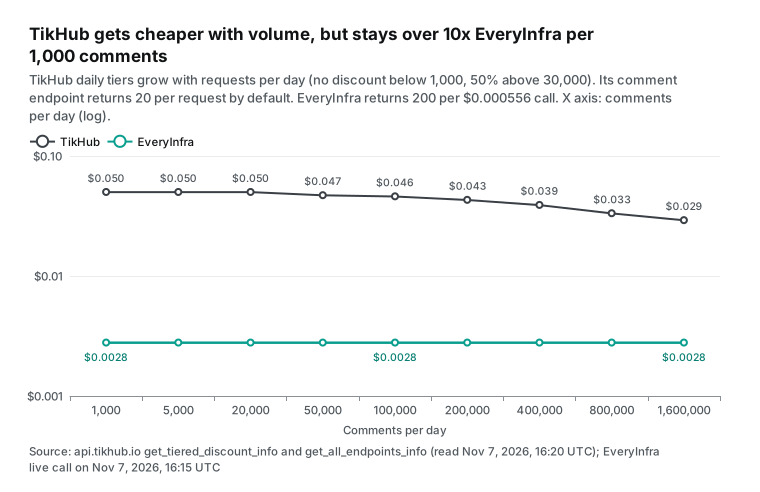
The discount matters most for high-volume comment pulls, so we drew it as a curve. The x axis shows comments per day. The y axis shows the average price per 1,000 comments. TikHub's comment endpoint takes part in the discount.
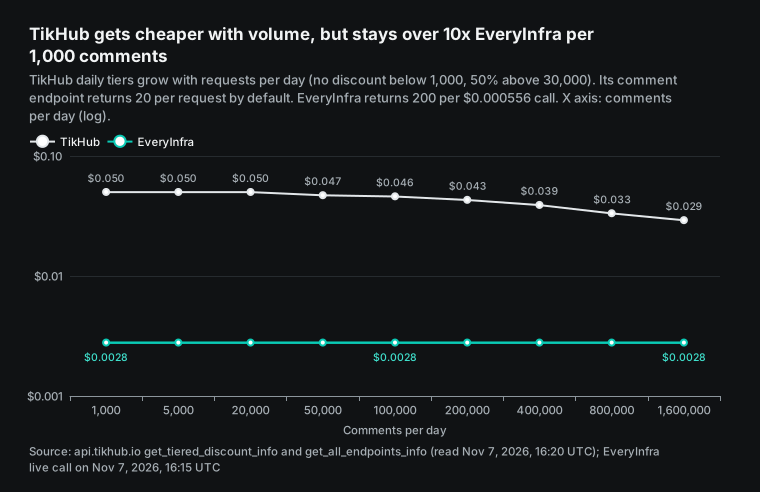
Up to 20,000 comments a day (1,000 requests), the price is $0.050. At 100,000 a day it falls to $0.046, and at 1.6 million to $0.029. We return 200 per call, so our price is $0.0028 at any volume.
On the chart, from 1,000 to 1.6 million comments a day, TikHub goes from 18 times our price to about 10 times. If every request got the full 50% discount, TikHub would stay near $0.025 per 1,000 comments, about 9 times our price. So per row, TikHub costs 9 to 18 times our price.
This does not conflict with TikHub pricing explained. That article found that TikHub is cheaper per request above about 119,000 requests a day on one endpoint. That article compares requests. This one compares rows, and our comment call returns 10 times TikHub's default page.
TikHub does two things better than we do. First, it has more endpoints. Its 246 TikTok endpoints cover ads, the creator back office, live rooms and many TikTok Shop details. Our catalog has 24 TikTok capabilities. Second, it has a higher rate.
It allows 10 requests a second per endpoint by default, and it counts each endpoint on its own. We allow 60 requests a minute for all keys in one account. Do you need tens of thousands of requests in a few minutes, or data that only TikHub has? Then TikHub is the easier choice.
Break-even: how many rows per call make per-call billing cheaper
Per-result and per-call billing compete on one number: rows per call. Our call costs $0.000556. Divide it by the other service's price per row, and you get the minimum rows per call for us to be cheaper.
For Clockworks TikTok Scraper on the Business tier ($0.0017 per row), the break-even is 0.33 rows, so one row is enough. On the DIAMOND tier ($0.0005 per row), it is 1.1 rows. For Clockworks Comments Scraper on DIAMOND ($0.00015 per row), it is 3.7 rows, and our test returned 200. For the cheapest Store tier ($0.30 per 1,000), it is 1.9 rows.
| Other price | Price per row | Break-even rows per EveryInfra call | Our tested rows per call |
|---|---|---|---|
| Clockworks TikTok Scraper, Business | $0.0017 | 0.33 | 50 (video search) |
| Clockworks TikTok Scraper, DIAMOND | $0.0005 | 1.1 | 50 (video search) |
| Clockworks Comments Scraper, DIAMOND | $0.00015 | 3.7 | 200 (comments) |
| Cheapest Apify Store tier | $0.0003 | 1.9 | 20 to 200 |
| TikHub, $0.001 endpoint at full price | $0.001 per request | Per request, we are always cheaper | — |
| TikHub, $0.001 endpoint at 50% off | $0.0005 per request | Per request, TikHub is cheaper in this tier | — |
The last two rows need a note. TikHub and EveryInfra both charge per request, so you can compare unit prices directly. The full price of $0.001 is 1.8 times ours. But the discount is marginal. Above 30,000 requests in a day, each extra request costs $0.0005, which is less than our $0.000556. The daily average falls below ours only at about 119,000 requests a day, as TikHub pricing explained calculated.
Some teams send over 100,000 requests a day to one discounted endpoint and need only a few rows per request. For them, TikHub's bill can be lower. If each request needs dozens or hundreds of rows, our price per row is still lower.
How we tested: 15 live calls
On the EveryInfra side, every call goes to one endpoint, POST /api/v1/social. You send platform, action and params with the names in the catalog. The catalog is public. When we read it on November 8, 2026, at 00:15 SGT, all 24 TikTok capabilities were available.
Prices ranged from $0.000556 to $0.000806, and every capability in this article cost $0.000556 (capability catalog). Here is the first live request. The key comes only from an environment variable:
curl -s https://api.everyinfra.com/api/v1/social \
  -H "Authorization: Bearer $EVERYINFRA_API_KEY" \
  -H "Content-Type: application/json" \
  -d '{"platform":"tiktok","action":"search","params":{"keyword":"skincare routine","limit":200}}'
# 2026-11-08 00:15:17 SGT (2026-11-07 16:15:17 UTC) -> HTTP 200, 22.8 s, count 50, billing.charged_usd 0.000556
We sent 15 requests that used eight capabilities: tiktok/search, tiktok/comments, tiktok/profile, tiktok/user_videos, tiktok/hashtag, tiktok/user_search, tiktok/followers and tiktok/shop_search. Ten requests succeeded at $0.000556 each. Five cost nothing. The total was $0.00556. The table lists the calls in time order. Times are UTC on November 7, 2026, which is 00:15–00:25 SGT on November 8.
| Time (UTC) | Capability | Parameters | HTTP | Rows | Charge | Per 1,000 |
|---|---|---|---|---|---|---|
| 16:15:17 | tiktok/search | skincare routine, limit 200 | 200 | 50 | $0.000556 | $0.0111 |
| 16:15:50 | tiktok/comments | a video with 1,889 comments, limit 200 | 200 | 200 | $0.000556 | $0.0028 |
| 16:17:02 | tiktok/profile | duolingo | 200 | 1 | $0.000556 | — |
| 16:17:18 | tiktok/user_videos | duolingo, limit 50 | 200 | 50 | $0.000556 | $0.0111 |
| 16:17:35–16:17:48 | hashtag, user_search, followers | — | 429 | 0 | $0 | — |
| 16:17:45 | tiktok/search | wrote query instead of keyword | 422 | 0 | $0 | — |
| 16:18:55 | tiktok/hashtag | booktok, limit 30 | 200 | 30 | $0.000556 | $0.0185 |
| 16:19:20 | tiktok/user_search | coffee roaster | 200 | 20 | $0.000556 | $0.0278 |
| 16:19:38 | tiktok/followers | duolingo | 200 | 1 | $0.000556 | — |
| 16:20:00 | tiktok/shop_search | vitamin c serum | 200 | 10 | $0.000556 | $0.0556 |
| 16:21:17 | tiktok/profile | a username that does not exist | 200 | 0 | $0 (empty, refunded) | — |
| 16:22:05 | tiktok/search | a nonsense keyword | 200 | 50 | $0.000556 | — |
| 16:25:09 | tiktok/search | skincare routine again, limit 50 | 200 | 50 | $0.000556 | $0.0111 |
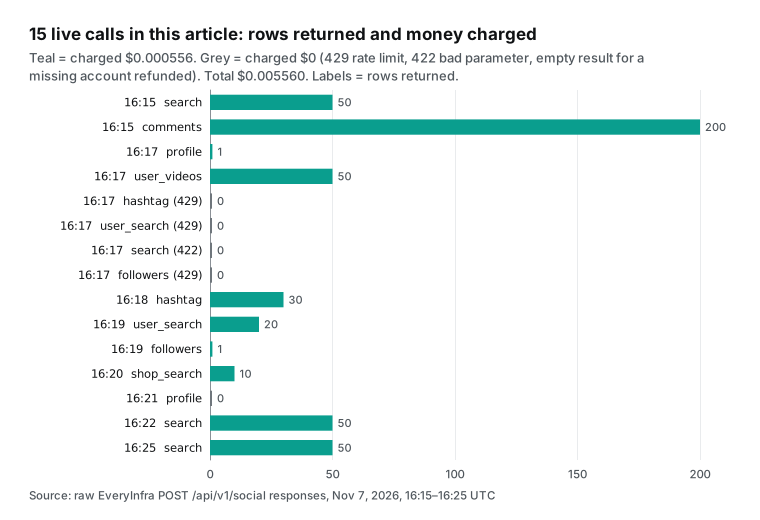
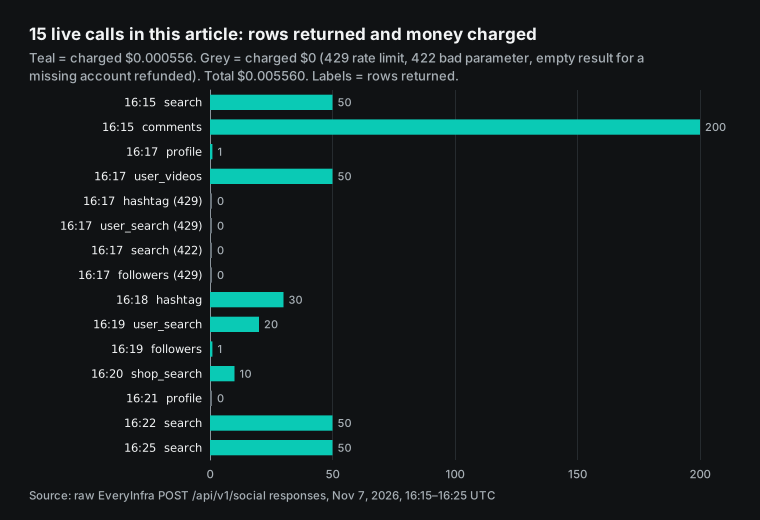
First, two results that do not help us. The catalog lists a max_limit of 200 for tiktok/search, but our only call that asked for 200 rows returned 50. The other two calls asked for 50. So the table divides by 50 and does not claim $0.0028. Also, three calls at 16:17 UTC got a 429.
Our test key had its own limit of 10 calls a minute. The default for a normal account is 60 a minute. The error body said "Retry after 25s". The same requests worked one minute later. These three calls and the 422 call cost nothing.
Test 1: video search, and only 15 of 50 videos repeat after 10 minutes
We searched "skincare routine" at 16:15 UTC and again at 16:25 UTC. Each search returned 50 videos, and only 15 videos were in both results. The first 50 videos had a median of about 99,000 views. Their post dates ran from February 2026 to November 7, 2026. The top result was posted on October 12, 2026, and had 57,214 views.
This shows that TikTok search results move. Each call returns a slice, not a fixed list. If you want to count the videos for a keyword, sample several times and remove duplicates by video id. Do not treat one search as the full set. The Research API uses an archive and SQL-like queries.
Its results are stable but up to 48 hours old. A third-party API reads the live search page. Its results are new but change. The two kinds of data answer different questions.
How new were these results? In the first search, 39 of 50 videos were from the last 30 days. Of these, 5 were posted on November 5, 2026, 8 on November 6, 2026 and 4 on November 7, 2026. In the second search, 30 of 50 were from the last 30 days, and the oldest was from August 2024.
Hashtag results were different. Most of the 30 booktok videos were from 2022 and 2023. Only 5 were from the last 30 days, and the newest was posted on October 27, 2026. This result looks like a list of all-time hits. It is good for classic content but not for new trends.
The 200 comments ran from October 14, 2026 to November 7, 2026. 70 of them were posted on one day, October 16, 2026. The 12 videos from November 6 and 7 were less than 48 hours old when we called. Under the Research API FAQ, the official API may not show them yet. All these dates are the raw posted_at values from our API.
The nonsense keyword at 16:22 UTC is also worth a note. We sent a random string of letters and numbers. TikTok search still returned 50 unrelated popular videos. They had no overlap with the "skincare routine" results. Their median was about 82,700 views, and their dates ran from April 2023 to November 7, 2026. When search finds no match, TikTok seems to fill the page with popular videos.
That call cost $0.000556 because the result was not empty. Our refund rule covers results with zero rows. It does not judge relevance. Before you run a large job, test one or two keywords with known results.
Test 2: 200 comments on one video, half of them replies
At 16:15:50 UTC, we asked for 200 comments on a video that showed 1,889 comments. The call took 66.9 seconds and returned 200 comments: 100 top-level comments and 100 replies. They ran from October 14, 2026, to November 7, 2026, 16:01 UTC. One call for $0.000556 returned 200 rows, so the price was $0.0028 per 1,000. This was the lowest price per row in this article.
For the same 200 comments, Clockworks Comments Scraper costs $0.25 on the Free tier and $0.10 on Business. TikHub needs 10 requests at the default 20 per request, which costs $0.01. For a full script that pages through replies and exports a CSV, see How to scrape TikTok comments.
Test 3: profiles, account videos, hashtags and account search
tiktok/profile for duolingo took 10.7 seconds. It returned 18,500,000 followers, 1,116 videos, 511.8 million likes and a verified badge. tiktok/followers for the same account returned the exact count, 18,457,236, with precision set to exact. The profile number is the rounded value from the profile page. For a follower growth chart, use the exact count.
Note that our tiktok/followers returns one summary row, not a list of followers. If you need the list, Apify's Followers Scraper ($1.00 per 1,000) and TikHub's follower list endpoint (20 per request) can do it. We cannot do it yet. Our only list of accounts is tiktok/following.
tiktok/user_videos returned 50 Duolingo videos in 12.8 seconds. The newest was posted on November 6, 2026, at 17:24 UTC. tiktok/hashtag returned 30 videos for booktok, with a median of 1.15 million views. tiktok/user_search for "coffee roaster" returned 20 accounts with a median of 2,134 followers and no verified accounts. That is useful to find small peers.
tiktok/shop_search for "vitamin c serum" returned 10 TikTok Shop products. At $0.0556 per 1,000, it was the highest price per row in this article, because one call returns only 10 rows. The 10 prices ran from $12.90 to $54.99, and units sold ran from 2 to 631. Each row had a shop name, rating and review count. The Research API covers only EU TikTok Shops, so US shop prices and sales come mostly from third-party APIs.
Fields: the Research API compared with our catalog
Fields matter as much as price. The table compares the comment and video fields of the TikTok Research API with the response_fields in our catalog for tiktok/comments and tiktok/search. The official fields come from the comment endpoint and the Codebook. We do not compare fields with Apify or TikHub. Their output depends on each developer, and we did not call them with a key.
| Data | TikTok Research API | EveryInfra (catalog `response_fields`) |
|---|---|---|
| Comments | id, text, video_id, parent_comment_id, like_count, reply_count, create_time; replies also have display_name | id, text, author_username, author_id, like_count, reply_count, reply_to_id, is_reply, liked_by_author, pinned_by_author, posted_at |
| Videos | id, create_time, username, region_code, video_description, music_id, like_count, comment_count, share_count, view_count, hashtags and more | id, url, text, author_name, author_username, like_count, comment_count, share_count, view_count, collect_count, posted_at, duration_sec, hashtags, music, is_ad and more |
| Freshness | Archive; new videos in up to 48 hours, counts in up to 10 days | Live page; newest comment was 14 minutes old |
| Personal data | Phone numbers and emails in comments are masked | Public fields as returned; the user is responsible for compliance |
The official API has things that we do not have. It gives region_code, the region where the creator registered. It also supports queries by date and region together. That matters for research on one country over one period. A third-party search API cannot give that kind of repeatable sample.
We have things that the official API does not have. We return page states such as "liked by author", "pinned" and "is an ad", and the data is live at the time of the request. A comment posted on the evening of November 7, 2026 (UTC) was in our result at 16:15 UTC the same day. Under the official FAQ, counts for the same video are only certain to update by about November 17, 2026. Choose the official API for repeatable research. Choose a third-party API for timely operations.
Failures, empty results and unrelated results: who pays?
The worst risk with per-call billing is to pay for nothing. The three services write their rules in different ways. Apify bills per event. If a run returns no results, the "result" event does not fire, but the start fee still applies.
The TikHub FAQ says that only requests with status 200 are charged and that failed requests are free. But a status 200 with an empty result is still charged. The FAQ even has a question about this case: "I get status 200 but the result is empty." The answer is to retry with the web version and check the reason code. Our rule is that failures and empty results are refunded in the same request.
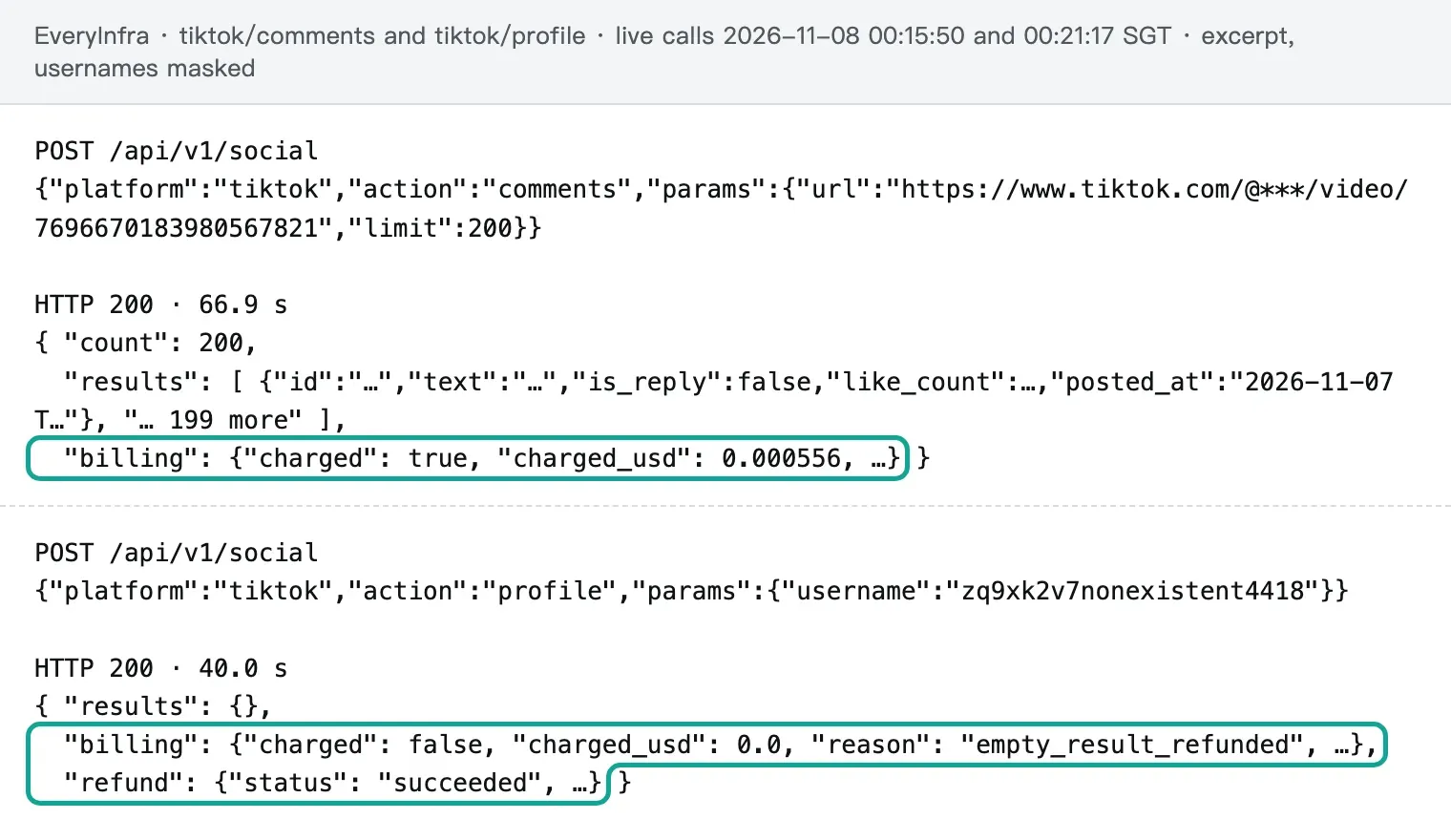
Of our 15 requests, five cost nothing. Three got a 429 rate limit. One got a 422 because we wrote query instead of keyword. The error body said "missing required param: keyword" and gave the catalog address.
One returned an empty result for a missing account. That call took 40 seconds. The response had charged false, reason set to empty_result_refunded, and refund.status set to succeeded.
The nonsense search is the other side of this rule. Its content was unrelated, but it was not empty, so it was charged. We state this limit here so that no reader expects a refund for results that they do not want.
A month of costs for three common workloads
Unit prices are one view. A month of real work is another. The table prices three workloads with this article's tested and list prices for 30 days. It does not include Apify start fees or TikHub payment fees. The EveryInfra column uses the rows per call from our tests. If your keywords return fewer rows, you need more calls, and the price goes up.
| Workload (30 days) | EveryInfra | TikHub | Apify |
|---|---|---|---|
| Brand monitoring: 20 keywords × 50 videos a day, plus 200 comments on each of the top 10 videos | 900 requests, $0.50 | 4,500 requests, $4.50 | $150 of usage at Starter prices ($186 at Free prices, above the Free plan's $5) |
| Research scale: 100,000 comments a day | 15,000 requests, $8.34 | 150,000 requests, $138 with discounts | $900 with the cheapest tool, $1,500 with Clockworks Business |
| Creator checks: 5,000 profiles a month | 5,000 requests, $2.78 | 5,000 requests, $5.00 | At least 1 result per profile: at least $15 on Free and $5 on Business |
Brand monitoring is the most common case. At our price it costs $0.50 a month, so a $10 top-up lasts about 20 months. TikHub costs $4.50 a month, so its $5 minimum lasts one month. The Apify Free plan includes only $5 of usage a month, which is not enough. You need Starter at $19 a month with $19 of usage, and the BRONZE usage for this job is $150.
Research scale is the same as buying the Research API's daily comment quota. It costs $8.34 a month with us, $138 with TikHub, and at least $900 with Apify. Creator checks need only one row per call, so per-call billing has the smallest advantage: $2.78 with us and $5.00 with TikHub. The Apify profile tool bills per result, and the floor is $5 to $15. That floor is an estimate, based on one result per profile.
Use it from AI tools: a remote MCP configuration example
Many teams send TikTok data to a language model next, to classify comments or write summaries. MCP (Model Context Protocol) is an open protocol that lets AI clients call outside tools (specification). If you work in an MCP client such as Claude or Cursor, the model can call the API directly. The EveryInfra remote MCP address is https://api.everyinfra.com/mcp.
The data tool takes the same platform, action and params as above (MCP setup). This is a configuration example. The key comes from an environment variable:
{
  "mcpServers": {
    "everyinfra": {
      "type": "http",
      "url": "https://api.everyinfra.com/mcp",
      "headers": { "Authorization": "Bearer ${EVERYINFRA_API_KEY}" }
    }
  }
}
The format follows the Claude Code MCP docs, where .mcp.json expands ${VAR} environment variables (Claude Code MCP docs). The numbers in this article come from direct HTTP calls, not from MCP. The official Research API gives you client credentials for one research project. The Research Tools terms control how you use, store and publish the data, so check them before you connect an AI tool. Apify has its own MCP server and bills at each tool's price.
When the official API, Apify or TikHub is the better choice
Price is not the only test. In the cases below, we suggest that you do not use us, or at least not only us. The table is the short version, and the paragraphs after it give the reasons.
| Your situation | Better choice |
|---|---|
| Eligible non-profit research that needs a citable source | Research API |
| Data of your own account, users, ads or shop | Display, Content Posting, Marketing or Shop API |
| EU ad research | Commercial Content API |
| A list of followers, or a detail outside our catalog | TikHub or Apify |
| A student project with schedules and no code | Apify with the student discount |
| One row per call at many calls a second | TikHub |
You are an eligible academic or non-profit researcher, and your work needs a paper and an ethics review. The Research API is free, the data comes from the platform, and you can cite the Codebook. Journals and ethics boards accept it more easily. Its archive queries also go back by date, region and topic. A search-page API cannot do that. Third-party data can add to it, but the main source should be official.
You need data about your own account or users who authorize you. Use the Display API to show a creator's videos. Use the Content Posting API to post for users. Use the Marketing API for your ad reports. Use the TikTok Shop Partner API for your shop. These are free, compliant and complete, so there is no reason to buy a third party.
You need EU ads. The Commercial Content API is free and open to applicants in any country. It includes targeting and reach. Third parties rarely match that detail.
You need a follower list, or a detail that our catalog does not cover. Our tiktok/followers gives a count, not a list. Apify's Followers Scraper and TikHub's follower list endpoint give the list. TikHub's 246 TikTok endpoints also cover ad insights, the creator back office, live rooms and more. The Apify ecosystem suits teams that want scheduled runs, visual setup and n8n.
You are a student or a non-profit that cannot get the Research API, and you want ready schedules and visual setup. The Apify pricing page gives students 50% off Starter, Scale and Business. Non-profits can ask for a custom discount, and startups get 30% off Scale (Apify pricing). With 50% off, Starter costs $9.50 a month. For a short class project without code, that can save time. At tens of thousands of rows, the price per row still decides the bill.
You need one row per call at a very high rate. For profile lookups, per-call billing has no advantage. TikHub allows 10 requests a second per endpoint by default, which is much more than our 60 a minute.
Recent changes
| Date | Change |
|---|---|
| August 25, 2026 | Last TikTok for Developers changelog entry (Data Portability Login Kit setup) |
| September 1, 2026 | Research API follower list docs updated |
| November 8, 2026 | TikHub lists 1,472 endpoints, 2 more than on November 1, 2026 |
The last entry in the TikTok for Developers changelog is dated August 25, 2026. It covers Login Kit setup for the Data Portability API. On November 8, 2026, the changelog had no new entry for 75 days (Changelog). What it means for you: TikTok has not widened eligibility or quotas this quarter, so the rules in this article should hold for now.
On September 1, 2026, TikTok updated the Research API follower list docs. One call returns 20 followers by default and up to 100, and you page back by follow time (Query User Followers). What it means for you: approved researchers can pull follower lists by time slice, which helps account growth studies.
On November 8, 2026, the TikHub price list had 1,472 endpoints. That is 2 more than the 1,470 that we counted on November 1, 2026, in TikHub pricing explained. Clockworks TikTok Scraper had 14.28 million public runs in the last 30 days, with the latest run on November 7, 2026. What it means for you: third-party prices and tools change every week, so check prices again before you buy.
Limits: when this article's conclusions do not hold
First, we read only public price lists for the third parties and did not test their bills. For TikHub, we used the default page size from its OpenAPI file. If it returns fewer rows, its price per 1,000 is higher. For Apify, we showed the Free and Business tiers. The enterprise DIAMOND tier is lower, for example $0.50 per 1,000 for TikTok Scraper, and we did not cover it in depth.
Second, our prices use the rows from 15 calls on one evening. Other keywords and videos return other row counts. Our only tiktok/search call that asked for 200 rows returned 50, and the other two asked for 50. We cannot promise 50 rows every time.
Third, "free" for the official APIs means free in money only. This article does not decide whether anyone is eligible for the Research API, and it is not legal advice. Public data collection involves platform terms and data protection laws in each region. Check them before commercial use.
Get started: from one test call to a daily job
| Step | Where | What to check |
|---|---|---|
| 1. Try one call | Data market playground | The fields that you need |
| 2. Send the API request | Quickstart | billing.charged_usd |
| 3. Schedule a daily job | cron or your scheduler | Remove duplicates by video id |
Step 1: open the data market, find TikTok, and run one keyword or one video link in the playground. Check that the fields are what you need. The playground bills per call like the API, and failures and empty results cost nothing.
Step 2: get an API key in the console. Follow the quickstart and send the curl request above. Check billing.charged_usd in the response.
Step 3: put your keywords, accounts or video links in a list. Run them once a day with cron or your own scheduler. Remove duplicates by video id before you store them.
All TikTok capabilities and fields are on the TikTok API overview. The same key also reads public YouTube and Instagram data; you only change platform. Prices follow the pricing page and price_usd in the catalog. For a short TikHub comparison, see /en/alternatives/tikhub. For tests by scenario, see TikHub alternative.
Three more articles go deeper. Apify TikTok Scraper alternative compares Apify across seven data types. TikHub pricing explained prices all 1,470 TikHub endpoints. How to scrape TikTok comments shows how to collect and export comments.
FAQ
Is TikTok API free to use?
Yes, in money. On November 8, 2026, we read the TikTok for Developers pages for the Research API, Display API, Content Posting API and Commercial Content API. None of them lists a fee. The docs for the Marketing API and TikTok Shop APIs also list no API fee. But only the Research API reads arbitrary public data, and only approved non-profit researchers can use it. Source: the Google suggestion "is tiktok api free to use".
Does TikTok have an API?
Yes, more than one: research, display, posting, ad library, data export, ads and commerce. The Display API is the one people often misread. It only reads the profile of users who authorize your app, not a stranger's account. Source: the suggestion "does tiktok have an api".
Is the TikTok Research API free, and how long does approval take?
It is free, with 1,000 requests and up to 100,000 records a day. The quota resets at midnight UTC. The product page says that TikTok usually replies within 4 weeks. In a Reddit thread, one researcher got approval after about 5 weeks, and others were rejected several times (r/CompSocial). Commercial users cannot apply. Source: the suggestion "tiktok research api free".
Can I get a TikTok free API key?
The official key is a client key that you get free when you register an app. What it can call depends on approval. Among third parties, TikHub gives $0.05 after an email check, which is about 50 requests at $0.001. We give $1 for starring two GitHub repos, which is about 1,800 TikTok requests at $0.000556, valid for 24 hours. The Apify Free plan includes $5 of usage a month. Source: the suggestion "tiktok free api key".
Can I try the TikTok API without a website or a privacy policy?
Not easily. On Stack Overflow, a developer asked about this. TikTok asks for terms of service and privacy policy URLs when you register an app, but the app was still on localhost. The question has no answer yet (Stack Overflow question 78094675). If you only want to see the data first, one or two calls with trial credit on a per-call API is faster.
References
- Research Tools: Access and Eligibility, TikTok for Developers, read November 8, 2026, https://developers.tiktok.com/products/research-api/
- Research API FAQ, TikTok for Developers, read November 8, 2026, https://developers.tiktok.com/doc/research-api-faq
- Guide to Using the TikTok Research API, TikTok for Developers, read November 8, 2026, https://developers.tiktok.com/doc/research-api-get-started
- Query Video Comments, TikTok for Developers, read November 8, 2026, https://developers.tiktok.com/doc/research-api-specs-query-video-comments
- Query User Followers, TikTok for Developers, updated September 1, 2026, https://developers.tiktok.com/doc/research-api-specs-query-user-followers
- Research Tools Codebook, TikTok for Developers, read November 8, 2026, https://developers.tiktok.com/doc/research-api-codebook
- Guide to Accessing TikTok's Virtual Compute Environment, TikTok for Developers, read November 8, 2026, https://developers.tiktok.com/doc/vce-getting-started
- Client Access Token Management, TikTok for Developers, read November 8, 2026, https://developers.tiktok.com/doc/client-access-token-management
- Display API Overview, TikTok for Developers, updated August 4, 2026, https://developers.tiktok.com/doc/display-api-overview
- Understanding TikTok API Rate Limits, TikTok for Developers, read November 8, 2026, https://developers.tiktok.com/doc/tiktok-api-v2-rate-limit
- Content Posting API: Direct Post, TikTok for Developers, read November 8, 2026, https://developers.tiktok.com/doc/content-posting-api-reference-direct-post
- Guide to Using the Content Posting API, TikTok for Developers, read November 8, 2026, https://developers.tiktok.com/doc/content-posting-api-get-started
- Commercial Content API Overview, TikTok for Developers, read November 8, 2026, https://developers.tiktok.com/products/commercial-content-api
- Getting Started with the Commercial Content API, TikTok for Developers, read November 8, 2026, https://developers.tiktok.com/doc/commercial-content-api-getting-started
- Data Portability API Overview, TikTok for Developers, read November 8, 2026, https://developers.tiktok.com/products/data-portability-api/
- Changelog, TikTok for Developers, updated August 26, 2026, https://developers.tiktok.com/doc/changelog
- TikTok Research Tools Terms of Service, TikTok, read November 8, 2026, https://www.tiktok.com/legal/page/global/terms-of-service-research-api/en
- Marketing API docs portal, TikTok API for Business, read November 8, 2026, https://business-api.tiktok.com/portal/docs
- Get started for Marketing API, TikTok API for Business, read November 8, 2026, https://business-api.tiktok.com/portal/docs/marketing-api-get-started/v1.3
- Create your App, TikTok Shop Partner Center, read November 8, 2026, https://partner.tiktokshop.com/docv2/page/create-your-app
- Delegated act on data access under the DSA, European Commission, July 2, 2025, https://digital-strategy.ec.europa.eu/en/library/delegated-act-data-access-under-digital-services-act-dsa
- DSA Data Access Portal, European Commission, read November 8, 2026, https://data-access.dsa.ec.europa.eu/
- Harnessing Big Data, Hindered by Bias: Evaluating TikTok Research API, Social Science Computer Review, 2026, https://doi.org/10.1177/08944393251413277
- Tracking the 2024 US Presidential Election Chatter on TikTok, arXiv, December 20, 2024, https://arxiv.org/abs/2412.15583
- Apify pricing, Apify, read November 8, 2026, https://apify.com/pricing
- Clockworks TikTok Scraper public pricing, Apify Store, read November 8, 2026, https://apify.com/clockworks/tiktok-scraper
- Clockworks TikTok Comments Scraper public pricing, Apify Store, read November 8, 2026, https://apify.com/clockworks/tiktok-comments-scraper
- Clockworks TikTok Profile Scraper public pricing, Apify Store, read November 8, 2026, https://apify.com/clockworks/tiktok-profile-scraper
- Clockworks TikTok Hashtag Scraper public pricing, Apify Store, read November 8, 2026, https://apify.com/clockworks/tiktok-hashtag-scraper
- Clockworks TikTok User Search Scraper public pricing, Apify Store, read November 8, 2026, https://apify.com/clockworks/tiktok-user-search-scraper
- Clockworks TikTok Followers Scraper public pricing, Apify Store, read November 8, 2026, https://apify.com/clockworks/tiktok-followers-scraper
- Apify Store search for "tiktok", Apify API, read November 8, 2026, https://api.apify.com/v2/store?search=tiktok&limit=100
- Actors in Apify Store, Apify docs, read November 8, 2026, https://docs.apify.com/platform/actors/running/actors-in-store
- Pay per event, Apify docs, read November 8, 2026, https://docs.apify.com/platform/actors/publishing/monetize/pay-per-event
- Apify MCP server, Apify docs, read November 8, 2026, https://docs.apify.com/platform/integrations/mcp
- TikHub Pricing, TikHub, read November 8, 2026, https://tikhub.io/pricing
- TikHub FAQ, TikHub, read November 8, 2026, https://tikhub.io/faq
- TikHub price list for all endpoints, TikHub API, read November 8, 2026, https://api.tikhub.io/api/v1/tikhub/user/get_all_endpoints_info
- TikHub daily discount tiers, TikHub API, read November 8, 2026, https://api.tikhub.io/api/v1/tikhub/user/get_tiered_discount_info
- TikHub OpenAPI file, TikHub API, read November 8, 2026, https://api.tikhub.io/openapi.json
- TikHub Refund Policy, TikHub docs, read November 8, 2026, https://docs.tikhub.io/9453198m0
- EveryInfra capability catalog, EveryInfra, read November 8, 2026, https://api.everyinfra.com/api/v1/social/catalog
- Model Context Protocol Specification, MCP, read November 8, 2026, https://modelcontextprotocol.io/specification
- Connect Claude Code to tools via MCP, Anthropic, read November 8, 2026, https://code.claude.com/docs/en/mcp
- Official TikTok API, has anyone managed to apply for it?, Reddit r/CompSocial, 2023, https://www.reddit.com/r/CompSocial/comments/11bq1ju/official_tiktok_api_has_anyone_managed_to_apply/
- Get user data without login using TikTok API, Stack Overflow, 2022, https://stackoverflow.com/questions/74610840/get-user-data-without-login-using-tiktok-api
- How to use TikTok API without a website/privacy policy url, Stack Overflow, 2024, https://stackoverflow.com/questions/78094675/how-to-use-tiktok-api-without-a-website-privacy-policy-url-terms-of-service-url
Reference BL-112