TikHub Alternative: TikHub API Pricing per 1,000 Results
We priced TikHub against EveryInfra per 1,000 results for TikTok, Douyin and RedNote, using 13 live calls and TikHub's own public prices.

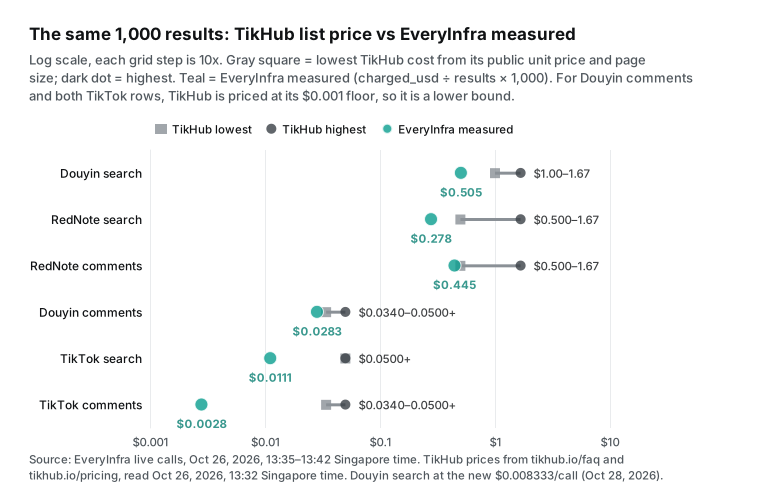
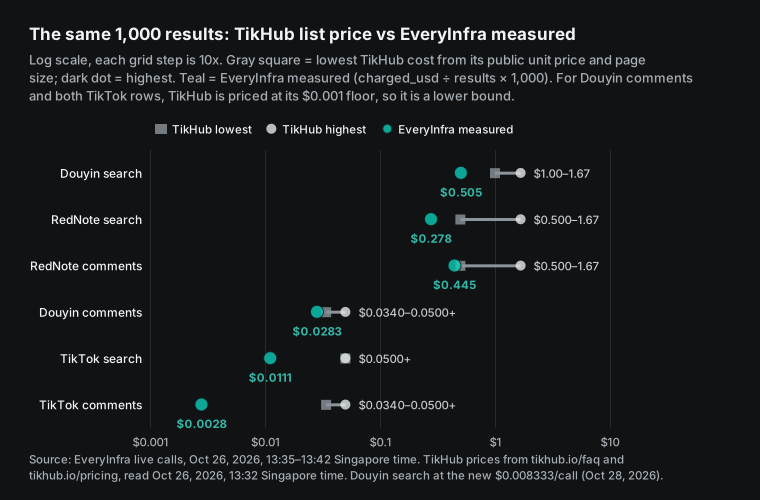
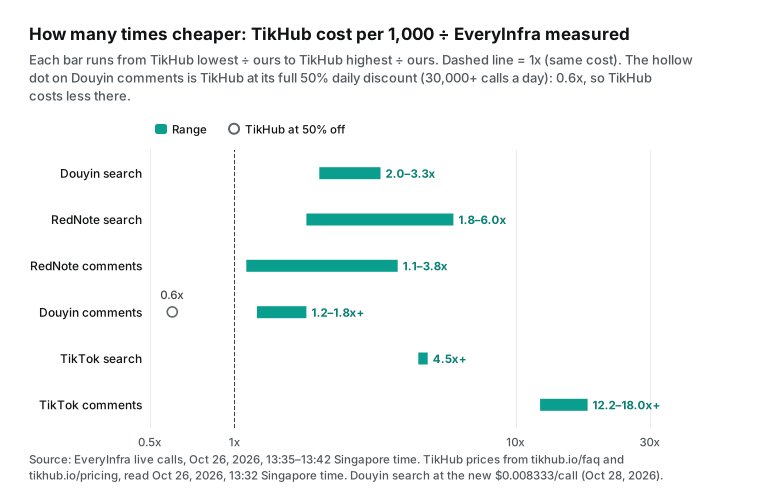
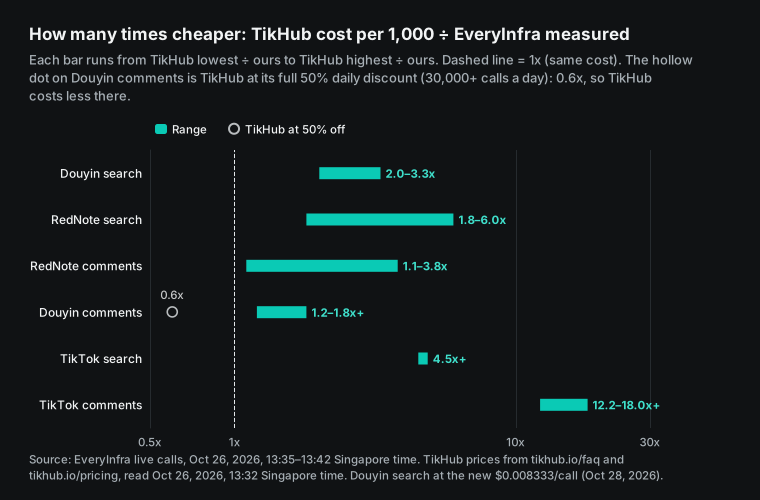
To get 1,000 TikTok comments, TikHub's public prices come to at least $0.034–$0.05, and EveryInfra measured $0.0028. That is a gap of 12.2x to 18.0x or more. For Douyin keyword search the gap is 2.0x to 3.3x at the price that applies since October 28, 2026 ($0.008333 per call), using the result counts we measured on October 26. That holds only if you need the first page of each keyword and get around 15 results per call; at 5 results per call it is a tie. The smallest gap is Douyin comments, at 1.2x to 1.8x, and at more than 30,000 calls a day TikHub is cheaper there.
We made 13 live calls on October 26, 2026, from 13:35 to 13:42 Singapore time. Eleven calls were billed, for a total of $0.023338. Two calls had bad input on purpose, and neither one was billed. (These are the charges of that day. Since October 28, 2026 douyin/search costs $0.008333 per call and douyin/product_search $0.013333, and the Douyin search figures below are recalculated at the new price.)
In this article, "cost per 1,000" means the US dollars you pay to collect 1,000 items of one kind. An item can be one TikTok search result or one comment under a Douyin video. TikHub bills per request, and each endpoint has its own price. So its cost per 1,000 is the number of calls you need times the price per call.
EveryInfra bills by the price_usd in its catalog, and a few list actions bill per block of rows. So on our side we divide the real charge, charged_usd, by the number of items that came back. Both formulas are spelled out in the section on how we computed cost per 1,000, so you can run them again.


TikHub vs EveryInfra in one table
This table holds only facts that you can check in public. The TikHub column comes from its pricing page, its FAQ, its refund policy and its public API spec. We read them on October 26, 2026, at 13:32 Singapore time. The EveryInfra column comes from the capability catalog, the pricing page and our live calls on the same day.
We did not open a TikHub account or buy its service. So TikHub prices that show only after login are not in the table. Where a cell says "at least" or "from", we used TikHub's public floor price of $0.001.
| Item | TikHub (public sources) | EveryInfra (catalog and live calls) |
|---|---|---|
| Billing unit | Per request, $0.001–$0.01, price differs by endpoint | Per request, listed in the catalog; a few list actions bill per block of rows |
| Douyin search price | Dedicated search series, $0.01 per call, no volume discount | douyin/search $0.008333 per call (since 2026-10-28; $0.000556 before) |
| RedNote price | $0.01 per call, no discount below 1 million calls a month | xiaohongshu/search and xiaohongshu/comments $0.005556 per call |
| Cost per 1,000 | Douyin search $1.00–$1.67; RedNote search $0.50–$1.67 | Douyin search $0.505 (recalculated at the new price); RedNote search $0.278 |
| 200 with empty content | Billed when status is 200; 18 endpoints say bad input, deleted or empty content is billed | Hold is refunded, reason = empty_result_refunded |
| Start | $0.05 free credit (about 50 calls); minimum top-up $5 | $1 credit for a GitHub star (about 720 data calls), valid 24 hours |
| Top-up fee | Alipay 2.6% + $0.30; PayPal and USDT 5% + $0.30 | The customer pays the payment channel fee; the total and the fee are shown before you pay. We do not list the rates here |
| Refunds | Not by default; only when TikHub confirms an endpoint is down | Each failed or empty call is refunded to the balance |
| Default rate | 10 per second (600 per minute), counted per endpoint; more costs a monthly fee | 60 per minute; more with a 30-day pack or by total top-ups |
| Coverage | 16 social platforms, 1,000+ endpoints; no Facebook, Snapchat or Pinterest | 91 platforms and 426 actions, including Facebook, Pinterest, Snapchat, e-commerce, reviews and jobs |
| AI tools | One MCP server per platform, 990+ tools | One MCP address, 25 tools |
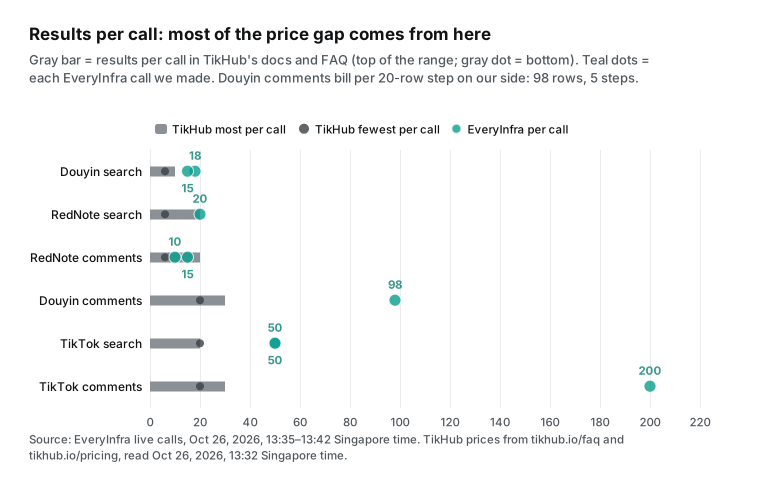
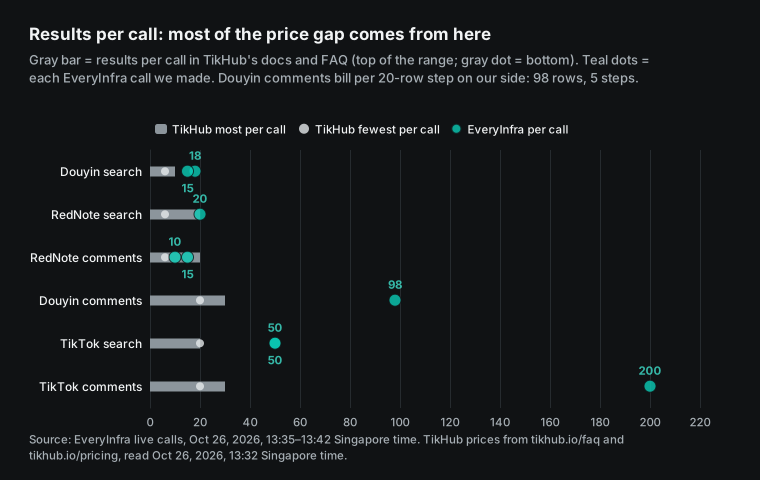
The most important row is not the unit price. It is the "cost per 1,000" row. A unit price tells you the cost of one call, but not how many items one call returns. TikHub's own FAQ says that Douyin search returns about 6–10 results per call.
It says RedNote list endpoints return about 6–20 items per call (TikHub FAQ, the question "What page sizes should I expect?"). At the same $0.01, 6 items and 20 items give a cost per 1,000 that differs by more than 3x. All the tests below use cost per 1,000.
How we computed cost per 1,000
Both sides use the same idea: for 1,000 items, count the calls, then multiply by the price per call. The difference is where "price per call" and "items per call" come from.
For TikHub, we use the page-size range in its FAQ and docs. The top of the range gives the lowest cost, and the bottom of the range gives the highest cost. We round the number of calls up, because you cannot send half a call. For example, Douyin search returns 6–10 items per call. So 1,000 items need 100 to 167 calls.
At $0.01 per call, that is $1.00 to $1.67. Where TikHub does not publish a price, we use its public floor of $0.001 and say "at least". Volume discounts start only above 1,000 calls a day. So the single-case numbers use no discount, and we show the full-discount case on its own.
For EveryInfra, we do not estimate from the catalog price. We use the count and billing.charged_usd from each response. Cost per 1,000 equals total charge divided by total items, times 1,000. This means that a bad result for us, such as "asked for 50, got 18", goes into the number. One exception is Douyin search, which was repriced on October 28, 2026: the October 26 charges no longer show the current price, so for that one case we keep the measured result counts and multiply the number of calls by the new price of $0.008333. The other cases are unchanged, so we still use their measured charges.
Where TikHub has no public unit price, we use its public floor of $0.001 and write "at least". In three cases, Douyin search, RedNote search and RedNote comments, both sides have exact prices. In Douyin comments, TikTok search and TikTok comments, the TikHub side is a lower bound. We keep the raw responses, the script and its output on file, and each number in the charts is read from that output by script, not typed by hand.
The table below lists all 13 calls. Times are Singapore time on October 26, 2026. The charges are those of that day; since October 28, 2026 douyin/search costs $0.008333 per call ($8.33 per 1,000) and douyin/product_search $0.013333 ($13.33 per 1,000).
| Time | Action | Input | Items | charged_usd |
|---|---|---|---|---|
| 13:35:02 | douyin/search | Chinese for "camping gear", limit 50 | 18 | 0.000556 |
| 13:35:26 | douyin/comments | tent video, limit 100 | 98 | 0.002778 |
| 13:36:03 | xiaohongshu/search | Chinese for "camping gear" | 20 | 0.005556 |
| 13:36:27 | xiaohongshu/comments | note, page 1 | 10 | 0.005556 |
| 13:36:36 | tiktok/search | "camping gear", limit 50 | 50 | 0.000556 |
| 13:37:18 | xiaohongshu/note | ID of 24 zeros | 0 | 0 |
| 13:38:09 | douyin/video | ID that does not exist | 0 | 0 |
| 13:38:29 | douyin/product_search | Chinese for "camping tent" | 5 | 0.000556 |
| 13:39:01 | tiktok/comments | camping video, limit 200 | 200 | 0.000556 |
| 13:40:38 | tiktok/search | "recetas fáciles", limit 50 | 50 | 0.000556 |
| 13:41:21 | xiaohongshu/comments | note, page 2 | 15 | 0.005556 |
| 13:41:38 | douyin/search | Chinese for "latte art", limit 50 | 15 | 0.000556 |
| 13:42:06 | douyin/search | Chinese for "camping gear", limit 10 | 10 | 0.000556 |
This method has one bias, and you should know it. On the TikHub side we use the full page-size range. On our side we use only 13 real calls. If a rare keyword gives us only 5 results per call, our Douyin search cost becomes $1.67 per 1,000.
Then the gap falls from 2.0x–3.3x to 0.6x–1.0x, which is a tie, or TikHub slightly cheaper. So these numbers show the size of the gap for this sample on October 26, 2026. They are not a promise. You can run the same formula with your own keywords.
TikHub pricing, line by line
People who search for "tikhub pricing" usually want to know the cost of 1,000 or 10,000 calls. TikHub's pricing page says three things. Requests start at $0.001. One balance covers all 16 platforms. Daily volume discounts apply automatically. All three are true, but each one has conditions, and the conditions are in its FAQ.
The first condition is that the price depends on the endpoint. The FAQ says prices run from $0.001 to $0.01 per request, and more complex endpoints cost more. The price of each endpoint, and whether it takes free credit or discounts, shows in its API Marketplace after login. Two high-price endpoints are public, and both are Chinese platforms.
Douyin search has a dedicated series at $0.01 per call with no volume discount, "because of what it costs us to keep running" (FAQ, "Why is Douyin search priced differently?"). RedNote is $0.01 per call, with no discount below 1 million calls a month (FAQ, "What does Rednote cost?"). So the two endpoints that China-focused teams use most are not in the "$0.001" group.
The second condition is that discounts are daily and progressive, like income tax brackets. The FAQ gives an example. At a $0.001 base price, 20,000 calls in one day cost $15.60, not 20,000 times $0.0007, which is $14.00. Discounts reset at midnight Los Angeles time, the same clock as the usage log (FAQ, "When do discounts reset?"). For a team in New York, the reset happens at 3 a.m.; for a team in Singapore, it happens in the afternoon.
| TikHub calls per day (endpoint with $0.001 base price) | Price in this bracket | Discount |
|---|---|---|
| 0–1,000 | $0.001 | None |
| 1,000–5,000 | $0.0009 | 10% |
| 5,000–10,000 | $0.0008 | 20% |
| 10,000–20,000 | $0.0007 | 30% |
| 20,000–30,000 | $0.0006 | 40% |
| 30,000 and more | $0.0005 | 50% |
The third condition is that some costs are not per request. Rate limits are a separate monthly purchase. A free account gets 10 requests per second. Twenty per second costs $5 a month, and 100 per second costs $55 a month (FAQ, "What do the higher levels cost?"). Top-ups have a fee.
Alipay costs 2.6% + $0.30, and PayPal or USDT costs 5% + $0.30. The FAQ's own example is that a $5 PayPal top-up costs $5.55. TikHub also gives a cache_url that opens the same response free for 24 hours (FAQ, "What is the cache_url in my response?"). That helps if you read the same data again on the same day, and we come back to it in the section on when TikHub fits better. The same FAQ also says that repeat requests with identical parameters are billed as new requests, and that the cache_url is a debugging aid, not a cheaper way to re-fetch (FAQ, "Do repeat requests return cached data?").
TikHub also documents a Calculate price endpoint and a tiered discount endpoint. Its docs give the formula: final price equals base price times (1 minus the discount). These endpoints need a TikHub key, so we did not call them. We quote only the formula.
EveryInfra pricing, line by line
On our side there is no daily progressive discount and no price behind a login. The pricing page lists four tiers per 1,000 calls for platform data. The base tier is $0.56 (105 actions). The standard tier is $1.39 (271 actions).
The deep tier is $2.78 (5 actions), and the complex tier is $5.56 (28 actions). The tier depends on the platform and the collection method. Search, detail and comments on one platform mostly cost the same, with a few exceptions priced on their own: since October 28, 2026 douyin/search costs $0.008333 per call ($8.33 per 1,000) and is no longer in the base tier. Other common Douyin and TikTok actions stay in the base tier at $0.000556 per call. The tier sizes above are as read on October 26, 2026.
RedNote is in the complex tier at $0.005556 per call. These numbers match the price_usd in the catalog on the same day. You can read the catalog without a key.
One detail needs a clear statement: a few list actions bill per block of rows. douyin/comments is one of them, at one block per 20 rows. We asked for 100 comments and got 98. We paid for 5 blocks, $0.002778 in total.
The other actions in this article cost one price per call, no matter how many items come back. They are douyin/search, tiktok/search, tiktok/comments, xiaohongshu/search and xiaohongshu/comments. That is why 200 TikTok comments in one call cost only $0.000556. For the same money, more items per call means a lower cost per 1,000.
Each response includes billing.charged_usd, the real charge for that call. When a call fails or comes back empty, the hold goes back to the balance. Then charged_usd is 0 and reason gives the cause. Every number in the tests below comes from this field.
Test 1: TikTok search and comments, 4.5x to 18.0x
We start with TikTok, because most English-speaking readers start there. TikHub has many TikTok endpoints. Its MCP page lists 204 TikTok tools, and its public spec has 164 paths that start with TikTok. Our catalog has 10 TikTok actions, and search and comments are two of them.
At 13:36 Singapore time we called tiktok/search for "camping gear" with limit 50. We got 50 results and paid $0.000556. At 13:40 we searched the Spanish phrase "recetas fáciles" in the same way. We got 50 results and paid $0.000556. That is 100 results for $0.001112, or $0.0111 per 1,000.
TikHub's TikTok video search endpoint has a default count of 20. At its floor price of $0.001, 1,000 results cost at least $0.05. That is at least 4.5x our cost. At the full 50% discount it is $0.025, which is still 2.25x our cost.
The gap for comments is larger. At 13:39 we called tiktok/comments on a camping video with 2,075 comments, with limit 200. One call returned 200 comments for $0.000556, or $0.0028 per 1,000. Of the 200, 84 were replies (is_reply = true), posted from 2026-10-19 to 2026-10-26. TikHub's TikTok comments endpoint shows 20 per call in its example.
Its FAQ says to ask for 30 or fewer comments per call, because larger counts "can cause errors or silently dropped items". At the floor price, 1,000 comments cost at least $0.034 to $0.05. That is 12.2x to 18.0x our cost. At the full discount it is $0.017, which is still 6.1x.
| Case | TikHub per 1,000 | EveryInfra per 1,000 (measured) | Times cheaper |
|---|---|---|---|
| TikTok search (13:36, 13:40) | at least $0.05 | $0.0111 (2 calls, 100 results) | at least 4.5x |
| TikTok comments (13:39) | at least $0.034–$0.05 | $0.0028 (1 call, 200 comments) | at least 12.2x–18.0x |
TikHub's comments endpoint suggests 30 or fewer per call; our call returned 200 at once. For the same 1,000 comments, one side needs 5 calls and the other needs 34 to 50 calls. Fewer calls at a lower price give a cost per 1,000 that is about ten times lower.
Test 2: Douyin search, 2.0x to 3.3x at the new price
Douyin is the Chinese version of TikTok, and it is a separate platform with separate data. At 13:35 we called douyin/search for the Chinese keyword for "camping gear" with limit 50. We got 18 results and paid $0.000556. At 13:41 we searched the Chinese term for "latte art", also with limit 50. We got 15 results and paid $0.000556.
At 13:42 we searched "camping gear" in Chinese again with limit 10. We got 10 results and paid $0.000556 (the prices of that day; since October 28, 2026 douyin/search costs $0.008333 per call, $8.33 per 1,000, and we recalculate at that price). The first two calls gave 33 results. At the new price they cost 2 × $0.008333 = $0.016666, or $0.505 per 1,000. The third call alone gives $0.833 per 1,000.
One fact here is bad for us, and we must state it. A limit of 50 does not always return 50 items. The platform decides how many results one page can hold, and we got only 18 and 15. Also, douyin/search has only two optional parameters in the catalog, publish_time and sort.
It has no page parameter. So one keyword gives one page per call. TikHub's Douyin search series uses a cursor to page down (video search V1 docs). If you must go ten or more pages deep on one keyword, TikHub can do it and this action of ours cannot.
On the TikHub side, the FAQ says Douyin search returns about 6–10 results per call, and "the number moves each time". The price is $0.01 with no discount. So 1,000 results need 100 to 167 calls, which is $1.00 to $1.67. Against our recalculated $0.505 at limit 50, that is 2.0x to 3.3x. Against our limit 10 call at $0.833, it is 1.2x to 2.0x.
| Case: 1,000 Douyin search results | Results per call | Calls needed | Price per call | Per 1,000 |
|---|---|---|---|---|
| TikHub (from its FAQ) | 6–10 | 100–167 | $0.01 | $1.00–$1.67 |
EveryInfra, limit 50 (13:35, 13:41; counts measured, price recalculated) | 18 and 15 | about 61 | $0.008333 | $0.505 |
EveryInfra, limit 10 (13:42; count measured, price recalculated) | 10 | 100 | $0.008333 | $0.833 |
Freshness is worth a look too. All 15 latte-art results were posted after 2026-09-26. The newest one was posted at 13:36 Singapore time on 2026-10-26, a few minutes before our call. Of the 18 camping results, 7 were posted after 2026-09-26.
The newest was posted on 2026-10-21, and the next ones on 2026-10-18 and 2026-10-11. So the default sort does not return only old posts. But search results also change, and the order can be different a few minutes later.
Test 3: RedNote search and comments, 1.1x to 6.0x
RedNote (Xiaohongshu) is the most expensive platform on both sides. TikHub charges $0.01 per call. Our xiaohongshu/search costs $0.005556 per call, so the unit price differs by only 1.8x. The page size makes the rest of the gap.
At 13:36 we searched the Chinese keyword for "camping gear". One page returned 20 results for $0.005556, which is $0.278 per 1,000. Of the 20 notes, 10 were videos; the median like count was 965 and the top was 52,783, and they were posted from December 2025 to the test day, so the first page is mostly notes that already have traction. The catalog says this action has a page_size of 20 and ignores limit. For more results, you pass back the next_page_token, which stays valid for 24 hours.
TikHub's FAQ says RedNote list endpoints return about 6–20 items per call, and "the first page may return fewer". At $0.01 per call, that is $0.50 to $1.67 per 1,000, or 1.8x to 6.0x our cost. Its search notes docs page by page and need search_id and search_session_id on the next pages. Both sides need a few lines of paging code.
The gap for comments is smaller. At 13:36 we called xiaohongshu/comments on a camping-gear note with 202 comments. The first page returned 10 comments. At 13:41 we passed the page token and got 15 more. Two pages gave 25 comments for $0.011112, or $0.445 per 1,000.
At 6–20 items per call and $0.01, TikHub costs $0.50 to $1.67 per 1,000. That is 1.1x to 3.8x our cost. If TikHub's comments endpoint always returns 20 per page, the gap is only $0.055 per 1,000, which is almost the same. This is our second-smallest lead of the six cases.
| Case | TikHub per 1,000 | EveryInfra per 1,000 (measured) | Times cheaper |
|---|---|---|---|
| RedNote search (13:36) | $0.50–$1.67 | $0.278 (1 page, 20 results) | 1.8x–6.0x |
| RedNote comments (13:36, 13:41) | $0.50–$1.67 | $0.445 (2 pages, 25 comments) | 1.1x–3.8x |
There is one more money rule here. TikHub's note comments docs have a billing notice. It covers a wrong or missing note ID, or a share link that does not parse. In those cases the endpoint still responds, and the request is still billed as normal.
That page was last changed on 2026-08-14. One RedNote call costs $0.01. If you run thousands of old links, the share of dead links turns straight into cost. Our test of the same case is in Test 5.
Test 4: Douyin comments, the closest case
This is the case where we come closest to TikHub. It is also the only case where TikHub is cheaper at some volume.
At 13:35 we called douyin/comments on a camping-tent video with 14,077 comments, with limit 100. We got 98 comments. We paid for 5 blocks of 20 rows, $0.002778 in total, or $0.0283 per 1,000. The 98 comments came from 21 different IP regions. The oldest was posted on 2026-10-11 and the newest on 2026-10-25 (UTC dates).
The 98 comments also show how to use comments for brand monitoring. Likes were very uneven: 66 comments had no likes, the top one had 53,948, and the top 5 held 98% of all likes. 50 comments had replies under them. The top regions were Guangdong 11, Henan 10, Shandong 9, and Jiangsu and Sichuan 7 each. So if you weight sentiment by likes, a few top comments decide the result; if you average per comment, many short comments with no likes flatten it. Compute both, and treat ip_location as a rough regional signal: fewer than 100 comments on one video cannot support a province-level claim.
TikHub has two Douyin comments endpoints, App V3 and Web. Both use a default count of 20. The App V3 docs add: "keep the default, otherwise there will be BUG". The FAQ suggests 30 or fewer per call.
TikHub does not publish this price, so we use the floor of $0.001. At 20 per call, 1,000 comments need 50 calls, or $0.05. At 30 per call, they need 34 calls, or $0.034. Our $0.0283 is 1.2x to 1.8x cheaper.
At high volume, the result can flip. If this base-price endpoint takes the daily discount, calls above 30,000 a day cost $0.0005. Then 34 calls cost $0.017, which is less than our $0.0283. The ratio is 0.6. To reach that bracket, you must first make 30,000 calls in the day.
Those first 30,000 calls cost $21.60 under the progressive rules. So the result is this. Teams with a few hundred to a few thousand calls a day pay less with us. Teams with tens of thousands of calls a day, mostly on Douyin comments, should check TikHub's real price after login against their own volume. TikHub may be the better choice for them.
Test 5: Bad input and deleted content, billed or not?
This is where the two sets of rules are furthest apart. It is also a common TikHub question. Its FAQ has a question called "I get status 200 but the result is empty". The answer is to retry with the Web version, then read the reason code in filter_list (8 means copyright or deleted, 5 means private, 10 means partly visible). Another FAQ answer, "What exactly gets billed?", says that a request is billed when it returns status 200, and failed requests are not charged.
The problem is that "status 200" does not mean "you got content". We searched every endpoint note in TikHub's public openapi.json (version V5.3.2, 1,050 paths). We looked for notes that say bad input, deleted, unavailable or empty content is still billed. We found 18 endpoints: 13 for RedNote, 3 for Douyin, 1 for WeChat Search and 1 for YouTube. The WeChat Search note says that in some regions results "currently always come back empty" and are still billed as a normal call. We did not count Instagram's former-usernames endpoint: its note says a result of 0 is still a normal billed call, and 0 there is a valid answer, not bad input or empty content.
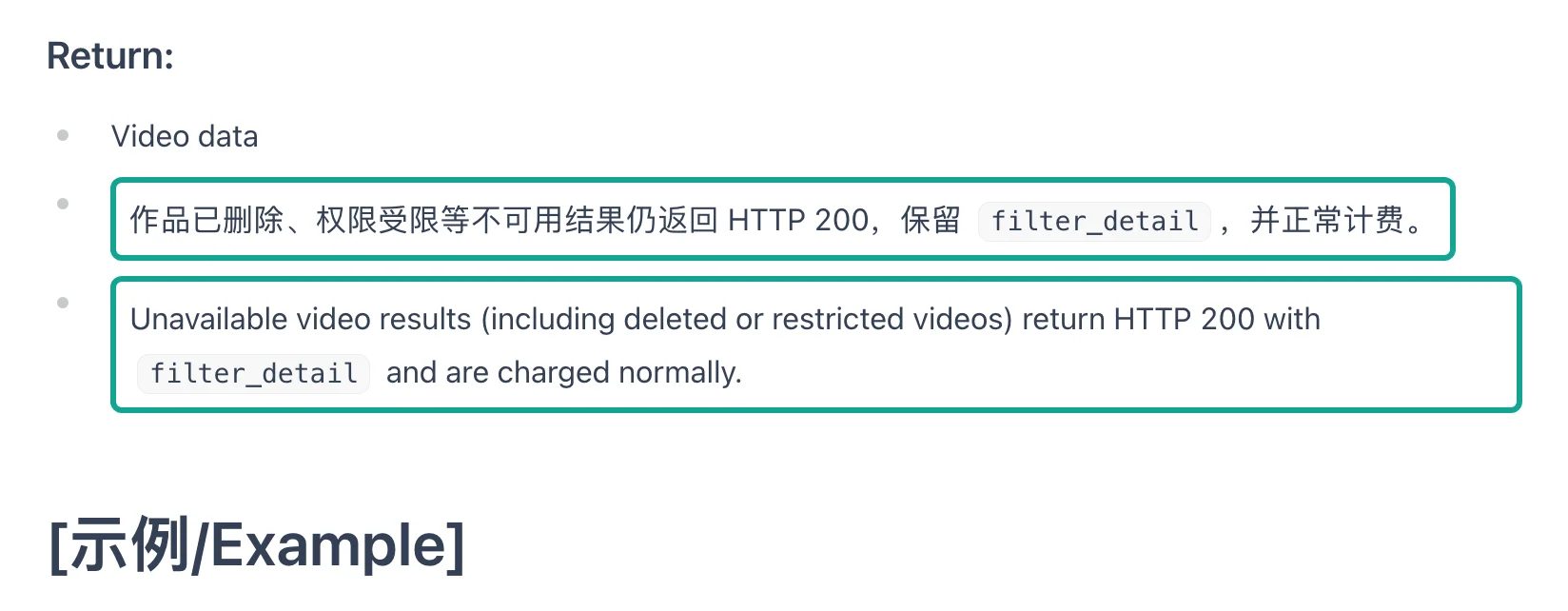
The 3 Douyin endpoints all fetch one video. Take fetch_one_video as an example (all notes are on its docs site). Its docs were last changed on 2026-09-10. They say that deleted or restricted videos return HTTP 200 with filter_detail and are charged normally.
The HTTP standard does not decide this. RFC 9110 says only that 200 means the request succeeded, and the content depends on the method. It does not promise business data. So "billed at 200" is a business rule at TikHub, not a technical need.
We ran two checks on our side. At 13:37 we called xiaohongshu/note with a note ID of 24 zeros. At 13:38 we called douyin/video with a video ID that does not exist. Both returned status 200 with empty results. In both, billing.charged was false, charged_usd was 0, reason was empty_result_refunded, and refund.status was succeeded. The hold went back at once, and the bill shows the reason.
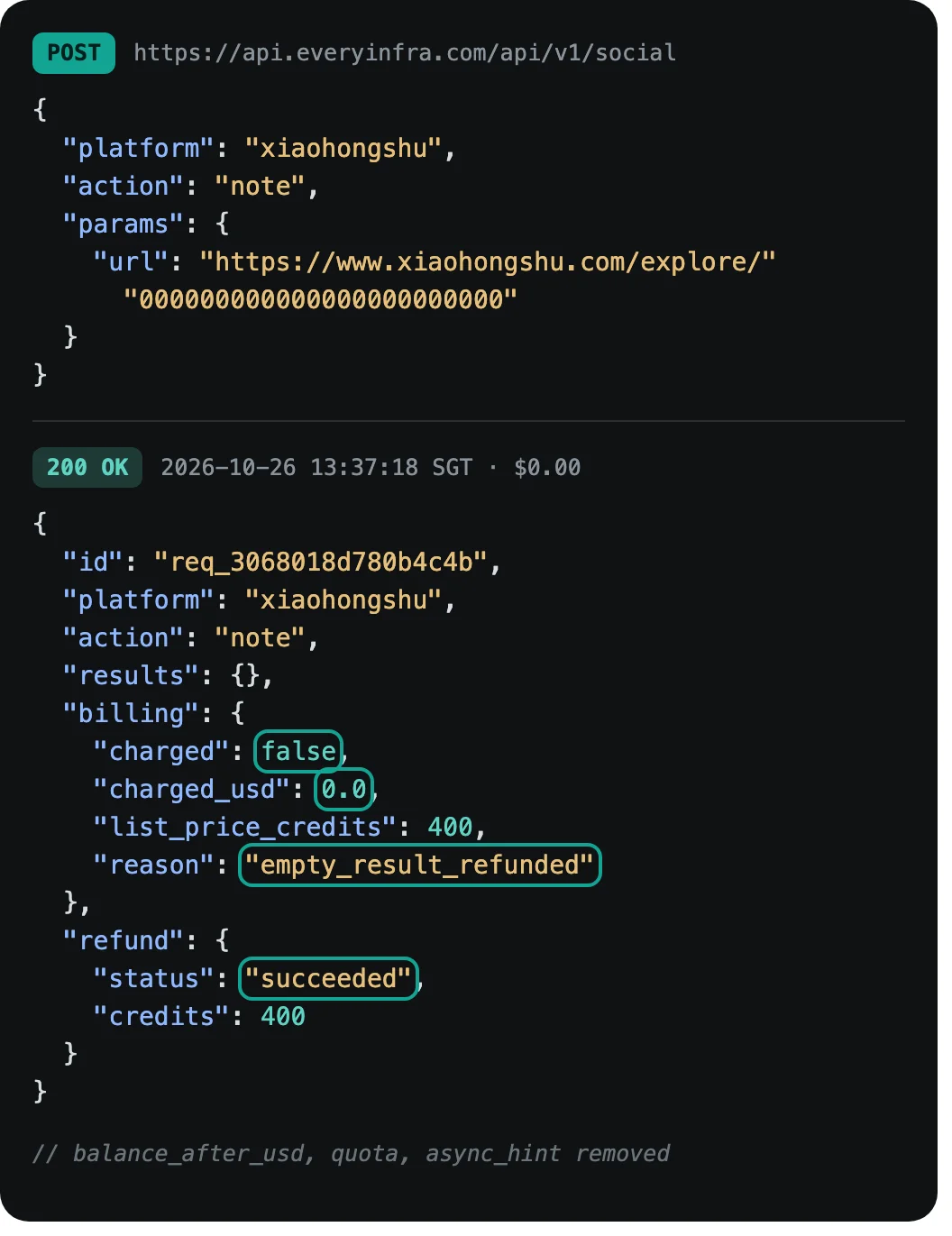
How much this matters depends on how clean your input is. Links that users paste, and video IDs from months ago, often have 10% or more dead entries. On TikHub's RedNote endpoints, 100 dead links per 1,000 cost $1.00 for nothing. Its refund policy (dated July 20, 2026; page changed 2026-09-15) does not refund a "misunderstanding of an endpoint's documented functionality" or errors in your own integration. With us, the same 100 dead links cost $0.
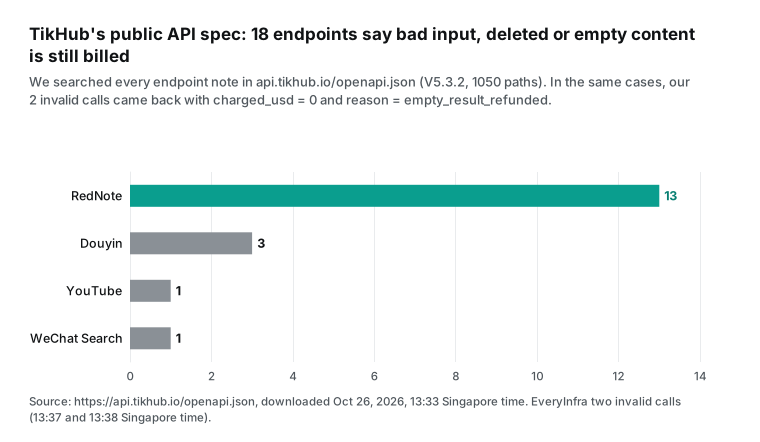
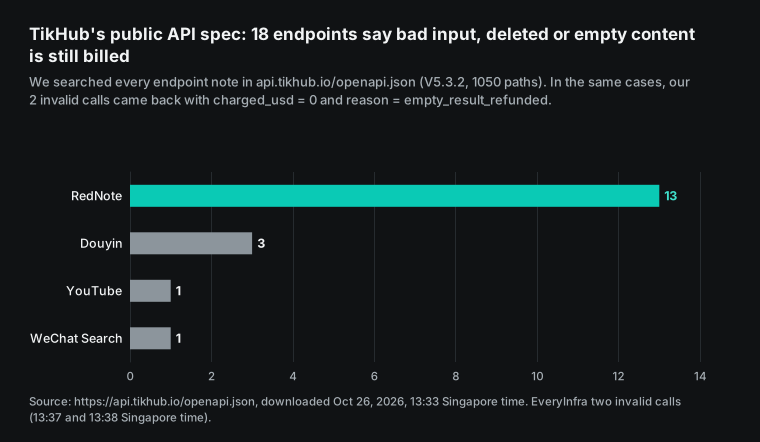
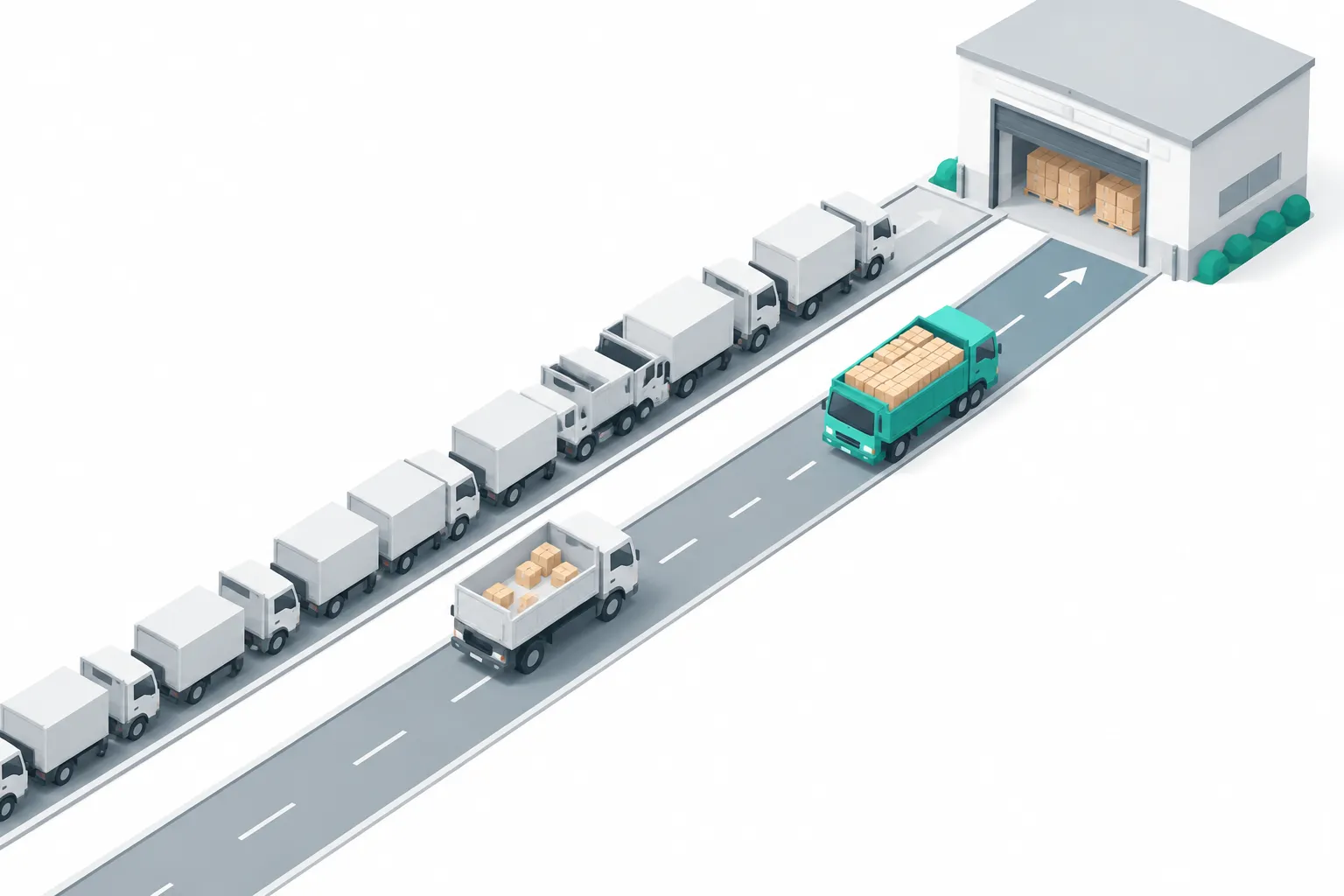
The chart below shows how one of our calls is billed. First the catalog price is held. When the result comes back, we check count. With results, the charge is booked. With no results, the hold is refunded with a reason.


One month of data: 271,500 results
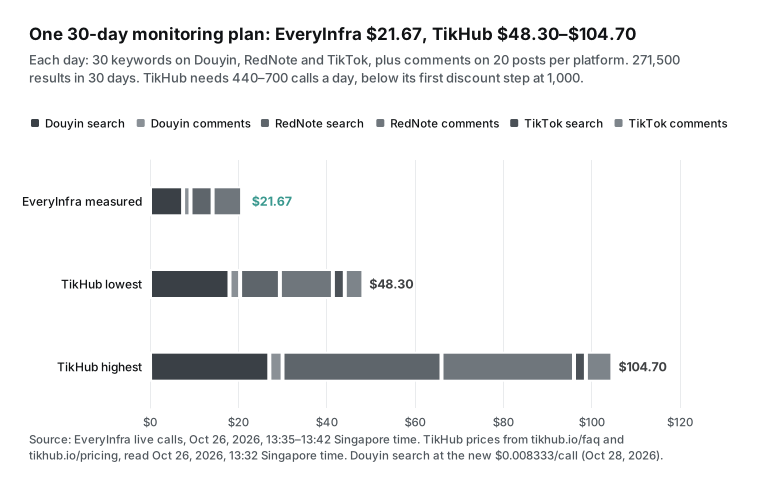
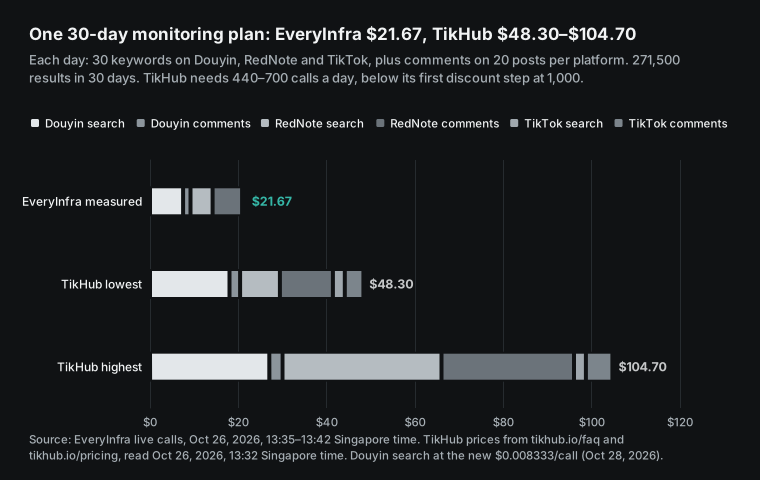
Single-case ratios make people remember only the largest one. So we priced a list that looks more like real work. A small brand-monitoring team watches 30 keywords each on Douyin, RedNote and TikTok every day. It also pulls comments from 20 posts on each platform, for 30 days. Items per task come from what one of our calls really returned, so our side does not claim more than it gave.
| Daily task (× 30 days) | Results in 30 days | EveryInfra | TikHub lowest | TikHub highest |
|---|---|---|---|---|
| Douyin search: 30 keywords × 15 | 13,500 | $7.50 | $18.00 | $27.00 |
| Douyin comments: 20 videos × 100 | 60,000 | $1.67 | $2.40 | $3.00 |
| RedNote search: 30 keywords × 20 | 18,000 | $5.00 | $9.00 | $36.00 |
| RedNote comments: 20 notes × 25 | 15,000 | $6.67 | $12.00 | $30.00 |
| TikTok search: 30 keywords × 50 | 45,000 | $0.50 | $2.70 | $2.70 |
| TikTok comments: 20 videos × 200 | 120,000 | $0.33 | $4.20 | $6.00 |
| Total | 271,500 | $21.67 | $48.30 | $104.70 |
In the EveryInfra column, Douyin search uses the price since October 28, 2026 ($0.008333 per call, 900 calls); the other rows use the prices measured on October 26, which have not changed. In total, TikHub costs 2.2x to 4.8x our price. These TikHub numbers already favor TikHub. Douyin comments and both TikTok tasks use its floor of $0.001. It needs 440 to 700 calls a day, below its first discount at 1,000. So "no discount" is correct here. Two costs are not in the table: TikHub's top-up fee (next section) and the money you pay for bad input or deleted content (Test 5).
The cost shape is different too. More than half of our cost is RedNote ($11.67, or 54%), because RedNote is in our complex tier. Douyin search is now second ($7.50, or 35%). TikHub's largest line is Douyin search (at least $18.00), because each call costs $0.01 and returns only 6–10 results. If your work is TikTok only, both sides are cheap, and the rules matter more than the price. If your work depends on Douyin search, there is still a gap, but it is now 2x to 3x instead of dozens of times, and it gets smaller when each call returns fewer results.
Top-ups, fees, refunds and rate limits
If you compare only unit prices, you miss the cost of getting money in and out. TikHub runs on prepaid credit. You top up first, and each request takes from the balance. The minimum top-up is $5 with no maximum (pricing page, "How billing works").
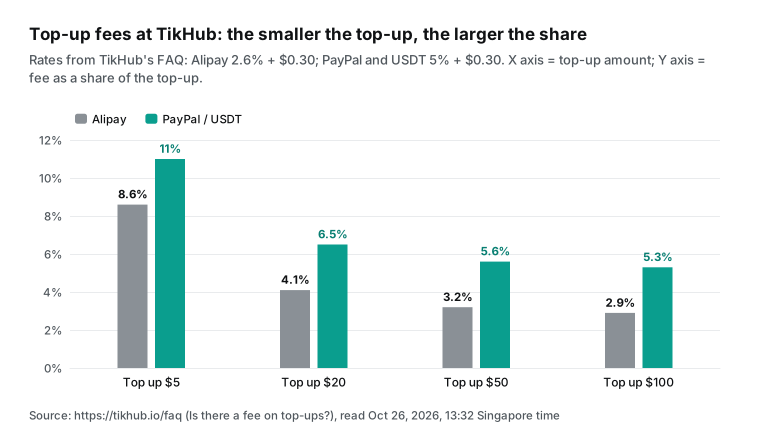
TikHub charges the top-up fee itself: Alipay 2.6% + $0.30, PayPal and USDT 5% + $0.30. Enterprise accounts do not pay it (FAQ, "Is there a fee on top-ups?"). At these rates, a smaller top-up pays a larger share in fees.
| Top-up | Alipay fee | Share | PayPal / USDT fee | Share |
|---|---|---|---|---|
| $5 | $0.43 | 8.6% | $0.55 | 11.0% |
| $20 | $0.82 | 4.1% | $1.30 | 6.5% |
| $50 | $1.60 | 3.2% | $2.80 | 5.6% |
| $100 | $2.90 | 2.9% | $5.30 | 5.3% |
On refunds, TikHub's refund policy has the heading "All Sales Are Final". API credits, subscription fees and prepaid balances are not refunded by default. A refund is possible only when the endpoint you paid for is down and TikHub's team confirms it. A change of mind is not refunded.
A misread of the docs, your own code errors, rate limits, short outages and platform changes are also not refunded, if the service "continues to function as documented". A signed enterprise contract can set other terms. The FAQ says to read the policy before you fund a large balance, and to use balance alerts and auto top-up day to day, "adding what you need rather than a lump sum" (FAQ, "Do you give refunds?").
On our side, refunds happen per call and by themselves. When a call fails or returns nothing, the hold goes back in that same call, and the response shows refund.status. We charge a payment channel fee too, paid by the customer; the payment page shows the total and the fee before you pay. New users can star everyinfra-agent-plugins on GitHub and claim $1 of trial credit in the console. That is about 720 data calls, valid for 24 hours. A normal sign-up gets no free credit (see the quickstart).
Rate limits are a TikHub strength. It gives 10 requests per second, or 600 per minute, at no cost, and the limit counts per endpoint, so different endpoints run in parallel without sharing it (pricing page FAQ). We give 60 per minute by default. For more, you can buy a 30-day pack: 180 per minute for $10, 600 for $30, or 1,800 for $78. You also get the same tiers when your total top-ups reach $50, $150 or $750 (pricing page, rate packs). If your job is tens of thousands of calls within a few minutes, TikHub's default rate is easier.
TikHub API vs EveryInfra API: setup, fields and MCP
Both sides use one key with Bearer authentication, as defined in RFC 6750. The difference is how the endpoints are grouped. TikHub has a set of paths for each platform and each version. Douyin, for example, has Web, App V3, search, creator, Xingtu, billboard and index series.
The FAQ says to use App V3 first and fall back to Web on errors. RedNote uses App V2, with Web V3 as the fallback. The old RedNote App and Web series stopped on June 13, 2026.
TikHub's setup steps are in its Getting Started page. You sign up, verify your email (the free credit comes only after this) and make a key in the dashboard. Then you send requests to paths from the Swagger UI or the docs site. Its user endpoints show your balance and daily usage. Two more documents are worth a read before you pay.
One is the terms of use. The other is the business restriction list. That list rules out government-related business, fraud, and sanctioned regions or entities. The FAQ also says a normal account needs a Gmail, Outlook or Yahoo style address. A company-domain address needs an Enterprise account that TikHub sets up by hand.
On our side there is no series to choose. You use one endpoint and one catalog. This is the first request from Test 1. Put in your own key, and it runs:
curl -X POST https://api.everyinfra.com/api/v1/social \
  -H "Authorization: Bearer $EVERYINFRA_API_KEY" \
  -H "Content-Type: application/json" \
  -d '{"platform":"tiktok","action":"search","params":{"keyword":"camping gear","limit":50}}'
For comments, use "action":"comments" and pass the full video link as url, with limit up to 200.
The items are in the results array. The catalog lists the fields of tiktok/comments in response_fields. We group them by use below, and each name matches the catalog.
| Use | Fields (as in the catalog response_fields) |
|---|---|
| The comment | id, text, posted_at |
| Engagement | like_count, reply_count, liked_by_author, pinned_by_author |
| Replies | is_reply, reply_to_id |
| Author | author_username, author_id |
| Source | platform |
Billing fields are in billing. charged_usd is the real charge in US dollars for this call, and reason gives the cause of a refund. An empty result also adds a refund object. On errors, a call with no key returns 401. A wrong parameter name or value returns 422 with the supported parameters and values, and it is not billed.
Too many calls return 429 ("Too Many Requests" in RFC 6585), so wait for the time in Retry-After. For slow jobs, add "mode":"async" to the body, take the job_id, and poll GET /api/v1/jobs/{job_id}. TikHub lists its error codes in the FAQ section "Error codes". There, 402 means a low balance and 429 means you are above your RPS level.
For AI tools, both sides support MCP, the Model Context Protocol. The current spec is the 2025-11-25 version. TikHub runs one server per platform at https://mcp.tikhub.io/{platform}/mcp. Its own FAQ says to "add only the ones you use", because all of them make the tool list too long.
Desktop clients that support only local servers need mcp-remote (npm package) as a bridge, which needs Node.js. We run one address with 25 tools. They cover action lookup, data calls, async jobs and balance:
{
  "mcpServers": {
    "everyinfra": {
      "url": "https://api.everyinfra.com/mcp",
      "headers": { "Authorization": "Bearer YOUR_API_KEY" }
    }
  }
}
See the MCP server page for Claude, Cursor and other clients. On both sides an MCP call costs the same as a direct API call. TikHub's FAQ says the Chrome extension, MCP, Zapier and n8n all use the same balance. On our side, each MCP call bills the API action under it.
Moving from TikHub: what changes in your code
If you already use TikHub and want to move some calls, four parts of your code change. All four are about how you point at one item and how you check the bill.
The first is input. Many TikHub Douyin endpoints take numeric IDs such as aweme_id. Our douyin/video and douyin/comments take the full video link, such as https://www.douyin.com/video/7695367173275083506. For TikTok, our tiktok/comments takes the full video link too. For RedNote, our xiaohongshu/comments needs the note link. The url in our search results already has the access token xsec_token, so you can pass it back as is.
The second is paging. TikHub endpoints use different page parameters, such as cursor, page, or search_id with search_session_id. We use one pattern: pass the next_page_token from the response back as page_token. RedNote tokens stay valid for 24 hours. Actions without a page parameter, such as douyin/search, give one page per call, as Test 2 shows.
The third is time and reconciliation. TikHub splits days for usage and discounts at midnight Los Angeles time (FAQ, "Why do my usage numbers not line up with my day?"). Each of our responses carries its own charged_usd, so you can add them up in your own time zone. In the first week, log the item count and the charge of each call on both sides. Then compute cost per 1,000 with the formula above. Decide with your own data, not with our sample.
| What changes | On TikHub | On EveryInfra |
|---|---|---|
| Douyin input | Numeric ID (aweme_id) | Full video link |
| Paging | cursor, page or search_id, by endpoint | next_page_token sent back as page_token |
| Day boundary | Midnight Los Angeles time | Each response has its own charged_usd; you pick the time zone |
| Bad input | Can return 200 and be billed | Refunded with reason = empty_result_refunded |
The fourth is error handling. On TikHub, a call with bad input or deleted content can return 200 and be billed. So many teams check IDs before each call. Keep that step after you move. It still cuts useless calls and saves rate limit, even though it no longer saves money.
When TikHub is the better TikHub alternative to keep
Price is not the only factor. TikHub has some things that we do not have or do not do as well, and here they are.
The first is the number of endpoints and the long tail. TikHub's about page states 30,000+ developers and 300M+ requests a day. Its public spec has 1,050 paths, and Douyin alone has 319. They cover live rooms, the Douyin index (about 44 endpoints), Xingtu, billboards and creator back-office series. Its MCP page lists 247 Douyin tools, 204 TikTok tools and 71 RedNote tools.
Our catalog has 21 Douyin actions, 11 RedNote actions and 10 TikTok actions. We focus on common search, detail, comments and profile data, plus some e-commerce and Xingtu data. For live danmaku, Douyin index audience data or the TikTok ad library, look in TikHub's catalog first. TikHub also sells live-room WebSocket source code that you run yourself. We have no product like that.
The second is page depth. Our douyin/search has no page parameter, so one keyword gives one page per call. TikHub's Douyin search series can page down with a cursor. If you need thousands of videos under one keyword, TikHub is the better fit, even at a higher cost per 1,000.
The third is depth inside one platform. TikHub covers WeChat Official Accounts, WeChat Channels, Zhihu, Kuaishou, Pipixia, Xigua, Lemon8, Threads, LinkedIn and more. It also has many endpoints per platform. Kuaishou has 38 paths in its public spec, and our catalog has only two Kuaishou actions, kuaishou/search and kuaishou/user_posts.
On the other side, its FAQ says it does not support Facebook, Snapchat or Pinterest. We support all three: Facebook with 10 actions, Pinterest with 7 and Snapchat with 4, all available in the catalog on the same day. So coverage has two layers. We are wider across platforms, and TikHub is deeper inside each social platform.
The fourth is price and rate at very high volume. Above 30,000 calls a day, a base-price endpoint with the discount can cost $0.0005 per call at TikHub. In Douyin comments, where page sizes on both sides are close, that is cheaper than us. Its default rate of 600 per minute counts per endpoint, so one endpoint alone gets 10x our default. Each successful response also carries a cache_url that reopens the same result free for 24 hours, which helps teams that read the same data several times a day.
The fifth is datasets. TikHub sells ready-made datasets with a $150 minimum order and per-1,000 tiers. The TikTok video dataset is $2.00 per 1,000 records from 100K to 500K and falls to $0.40 above 20 million (FAQ, "What do the tiers look like?"). TikHub also says this data was collected at random and is not real time. For current data on one account or post, you still need the API. We do not sell datasets.
| Need | Better fit in this article | Why |
|---|---|---|
| Live rooms, Douyin index, TikTok ad library | TikHub | Long-tail endpoints that we do not have |
| Many pages of one Douyin search | TikHub | Paging with cursor |
| Tens of thousands of Douyin comments a day | Check real prices | At 50% off, TikHub costs $0.017 per 1,000 |
| First page of Douyin or RedNote search | EveryInfra | 2.0x–3.3x (Douyin, at the October 28 price) and 1.8x–6.0x (RedNote) cheaper |
| TikTok comments | EveryInfra | At least 12.2x cheaper per 1,000 |
| Facebook, Pinterest, Snapchat, e-commerce | EveryInfra | TikHub does not cover these platforms |
You can also use both. Use TikHub for long-tail endpoints and deep paging, and use us for common search, comments, profiles and e-commerce data. Each one is paid for the work it does best. A shorter TikHub comparison page is on our site for readers who want only the summary. This article is the long version, with live calls and line-by-line costs.
When EveryInfra is the better TikHub alternative
If your work matches any item below, our tests say EveryInfra costs much less.
- You run many keyword searches, and the first page is enough (RedNote search is 1.8x to 6.0x cheaper per 1,000; Douyin search is 2.0x to 3.3x cheaper at the October 28 price, and the gap closes when each call returns fewer results).
- You need list data where one call can return many items, such as TikTok comments (at least 12.2x cheaper per 1,000).
- Your input has many dead links or old IDs, and you do not want to pay for empty results (Test 5).
- You also need data outside social media, such as e-commerce, reviews or jobs, with one key and one balance. Douyin Mall is an example. TikHub's FAQ says Douyin has no shop or product endpoints, and TikTok Shop is its only e-commerce option. At 13:38 we called
douyin/product_searchfor the Chinese term for "camping tent". We got 5 products and paid $0.000556 (the price of that day; since October 28, 2026douyin/product_searchcosts $0.013333 per call, $13.33 per 1,000).
You can test each of these with the $1 trial credit in the steps below.
Can an official API replace TikHub?
Some people who search "tikhub alternative" really want to know if they can use the platform's own API. We list the public terms of three official routes below. The answer: the use cases are narrow, and they are a different kind of product from third-party data APIs.
TikTok's Research API is open only to eligible non-profit researchers who send a research plan and get approval. Its FAQ says creators, advertisers and commercial users are not eligible. The limit is 1,000 requests a day, for up to 100,000 records. Video and comment calls return up to 100 records each (Research API FAQ, comments endpoint).
Its research terms took effect on January 22, 2026, with TikTok USDS as the party (Research Tools Terms of Service). Parameter changes go in the developer changelog. Researchers have also found problems with it. A June 2025 preprint reports missing and inconsistent data with no explanation (TikTok's Research API: Problems Without Explanations).
The Douyin Open Platform is for mobile and web apps. They use it to add video, user and data features for their own users, with consent. The RedNote Open Platform is mainly for merchants and service partners. Neither one is a route to pull public content by keyword at scale.
| Official route | Who can use it | Daily limit | Fit for keyword data at scale |
|---|---|---|---|
| TikTok Research API | Approved non-profit researchers; not creators, advertisers or businesses | 1,000 requests, up to 100,000 records | No, unless you qualify |
| Douyin Open Platform | Apps that serve their own users with consent | Per app and per scope | No |
| RedNote Open Platform | Merchants and service partners | Per program | No |
What changed recently
- October 3, 2026: TikHub's Python SDK released v2.2.0. The SDK now follows the live spec and skips deprecated endpoints (GitHub release). The commit counts 1,048 endpoints. The June 4, 2026 release had 1,106 (all releases). What it means for you: endpoints get retired and moved. List the exact paths your code uses, and check them on a schedule.
- September 15, 2026: TikHub updated its refund policy page. The policy version shown is July 20, 2026, and the heading is still "All Sales Are Final" (refund policy). What it means for you: the terms you should read before a top-up changed recently, so check the page on the day before you fund a large balance.
- September 10, 2026: TikHub's Douyin single-video docs were last changed. The current note says deleted or restricted videos return HTTP 200 and are charged normally (docs). What it means for you: billing notes change with the docs, so reread the notes of the endpoints you use before a batch job.
- October 7, 2026: Blotato published a social media API change report (Blotato report). It counted 130 changes on 10 platforms. Of X's 6 dated breaking changes, 4 gave five days' notice or less. Reddit will start to close access for unregistered apps on January 12, 2027. Blotato sells a social API, so read it with care. X keeps its own log in the X changelog. What it means for you: official APIs change fast, and third-party APIs follow.
Limits: where these results do not hold
The results have four limits. Outside them, the ratios change.
First, TikHub shows its per-endpoint prices only after login. For Douyin comments, TikTok search and TikTok comments, we used its public floor of $0.001. If those endpoints cost more, the gap gets larger. If there is a promotion that we do not know about, the gap gets smaller. TikHub's FAQ also says free credit and discounts apply per endpoint.
Second, items per call change. TikHub says "the number moves each time". On our side, Douyin search with limit 50 gave only 18 and 15, and two RedNote comment pages gave 10 and 15. Our sample is 13 calls. That is enough to show the size of the gap, but not enough for a stable average. Your keywords and your videos will give different numbers.
Third, we did not make calls on TikHub. So we did not compare field coverage, success rate or speed between the two sides. This article compares public prices, public billing rules and our own live calls. It does not rate whose data is better.
Fourth, exchange rates and taxes are not part of the comparison. Both sides price in US dollars. We counted only TikHub's public top-up fees. Our payment channel fee is shown before you pay and is not part of the comparison.
FAQ
These questions come from Google autocomplete (read on October 26, 2026), from the user questions in TikHub's own FAQ, and from posts on Reddit and V2EX.
How much does TikHub cost per request?
The public price is $0.001 to $0.01 per request, and it differs by endpoint. Douyin search and RedNote are both $0.01 per call (TikHub FAQ). Source: autocomplete "tikhub pricing". For cost per 1,000, divide by the items per call. The six tests above show the results.
Does TikHub have a free tier, and how do I get a TikHub API key?
After you sign up and verify your email, you get $0.05, which is about 50 base-price calls. Not every endpoint takes free credit (TikHub pricing). Source: autocomplete "tikhub api key". On our side, you star the GitHub repo and claim $1 in the console, valid for 24 hours; see the quickstart.
Am I billed when the API returns 200 but no content?
At TikHub, yes. Its FAQ says a request is billed at status 200, and it has a question named "I get status 200 but the result is empty". Its public spec lists 18 endpoints that bill bad input, deleted or empty content. With us, no: empty results are refunded, and our 2 invalid calls show charged_usd = 0. Source: TikHub's FAQ and Test 5.
Is there a TikHub GitHub repo or SDK?
Yes. TikHub has a Python SDK on GitHub, with v2.2.0 released on October 3, 2026. It also has a downloader and demo projects (TikHub on GitHub, PyPI). Source: autocomplete "tikhub github" and "tikhub api docs". We publish an OpenAPI spec (openapi.json), so you can make a client in any language or use curl.
What does Reddit say about TikHub?
We searched Reddit, V2EX and Zhihu. On Reddit, we found mainly a workflow post from TikHub's own account about n8n and Claude (r/ClaudeAI). We found no user bills. On V2EX, one user calls it an aggregated API, and says its coverage may not fit every need (V2EX thread).
In another thread about WeChat articles, one user names it and another says the related platform API is now closed (V2EX thread). Source: autocomplete "tikhub reddit". So this article uses only TikHub's public prices and no third-party bills.
What is a good Douyin API or Xiaohongshu API option for pricing?
Search terms such as "douyin api pricing" and "xiaohongshu api" (autocomplete) usually mean public data by keyword. The official Douyin and RedNote platforms do not offer that, as the official API section shows. Among third-party options, check the cost per 1,000 and the empty-result rule. Our pages for Douyin and RedNote list each action and its price.
Can I use it with n8n or Claude?
Both sides work. TikHub has Zapier and n8n integrations and one MCP server per platform. We have one MCP address; see the MCP server page for Claude and Cursor. In n8n, an HTTP Request node can call POST /api/v1/social. Source: TikHub's n8n and Claude post on Reddit.
Get started: check our numbers with $1 of credit
- Star everyinfra-agent-plugins on GitHub, sign up, and claim $1 in "Balance and top-up" in the console. It covers about 720 data calls and stays valid for 24 hours. See the quickstart.
- Open the pages for the actions in this article and use their one-click trial: TikTok comments, Douyin search and RedNote search. Each response shows
charged_usd. Divide it by the item count and multiply by 1,000 to get your cost per 1,000. - Repeat the method with 10 of your own keywords and 5 of your own videos. Then do the same with TikHub's per-endpoint prices after login, and compare.
- To connect an AI tool, add the address and key once from the MCP server page. To see other actions, open the infrastructure market and the Douyin, RedNote and TikTok pages.
For brand and creator work, read creator data due diligence. Also read RedNote data export and snapshot analysis. For research, read sample integrity in social media research. It explains why each item needs its collection time.
References
- TikHub pricing, TikHub, read 2026-10-26, https://tikhub.io/pricing
- TikHub FAQ (171 questions on billing, discounts, page sizes, fees and refunds), TikHub, read 2026-10-26, https://tikhub.io/faq
- About TikHub, TikHub, read 2026-10-26, https://tikhub.io/about
- TikHub MCP Integration, TikHub, read 2026-10-26, https://tikhub.io/mcp
- TikHub API docs home, TikHub, read 2026-10-26, https://docs.tikhub.io/
- Getting Started, TikHub docs, https://docs.tikhub.io/5432442m0
- Business Restriction, TikHub docs, https://docs.tikhub.io/5432446m0
- TikHub Terms of Use, TikHub docs, https://docs.tikhub.io/9453286m0
- TikHub Refund Policy (July 20, 2026 version; page changed 2026-09-15), TikHub docs, https://docs.tikhub.io/9453198m0
- Calculate price, TikHub docs, https://docs.tikhub.io/186826052e0
- Tiered discount percentage, TikHub docs, https://docs.tikhub.io/186826053e0
- Douyin Web: get single video data (changed 2026-09-10), TikHub docs, https://docs.tikhub.io/186826141e0
- Douyin Web: single video comments, TikHub docs, https://docs.tikhub.io/186826152e0
- Douyin App V3: single video comments, TikHub docs, https://docs.tikhub.io/186826225e0
- TikTok App V3: single video comments, TikHub docs, https://docs.tikhub.io/186826110e0
- TikTok App V3: video search results, TikHub docs, https://docs.tikhub.io/186826113e0
- Douyin search: video search V1, TikHub docs, https://docs.tikhub.io/370212779e0
- RedNote App V2: search notes, TikHub docs, https://docs.tikhub.io/420136398e0
- RedNote App V2: note comments (changed 2026-08-14), TikHub docs, https://docs.tikhub.io/420136394e0
- TikHub user endpoints, TikHub docs, https://docs.tikhub.io/186826050e0
- TikHub OpenAPI spec V5.3.2 (1,050 paths), TikHub, downloaded 2026-10-26, https://api.tikhub.io/openapi.json
- TikHub Swagger UI, TikHub, https://api.tikhub.io/docs
- TikHub GitHub organization, GitHub, https://github.com/TikHub
- TikHub-API-Python-SDK, GitHub, https://github.com/TikHub/TikHub-API-Python-SDK
- TikHub-API-Python-SDK v2.2.0 release (2026-10-03), GitHub, https://github.com/TikHub/TikHub-API-Python-SDK/releases/tag/v2.2.0
- v2.2.0 commit (2026-10-03, 1,048 endpoints), GitHub, https://github.com/TikHub/TikHub-API-Python-SDK/commit/0cb40ede6ae12be34428ac446dd0a4fed1238a73
- TikHub-API-Python-SDK releases, GitHub, https://github.com/TikHub/TikHub-API-Python-SDK/releases
- tikhub package, PyPI, https://pypi.org/project/tikhub/
- EveryInfra capability catalog (read 2026-10-26), EveryInfra, https://api.everyinfra.com/api/v1/social/catalog
- EveryInfra OpenAPI spec, EveryInfra, https://api.everyinfra.com/openapi.json
- Introduction to the Model Context Protocol, MCP project, https://modelcontextprotocol.io/docs/getting-started/intro
- MCP specification 2025-11-25, MCP project, https://modelcontextprotocol.io/specification/2025-11-25
- mcp-remote source, GitHub, https://github.com/geelen/mcp-remote
- mcp-remote package, npm, https://www.npmjs.com/package/mcp-remote
- RFC 9110 HTTP Semantics, 200 OK, IETF, https://www.rfc-editor.org/rfc/rfc9110#name-200-ok
- RFC 6585 section 4, 429 Too Many Requests, IETF, https://www.rfc-editor.org/rfc/rfc6585#section-4
- RFC 6750 Bearer Token Usage, IETF, https://datatracker.ietf.org/doc/html/rfc6750
- TikTok Research API FAQ, TikTok for Developers, https://developers.tiktok.com/docs/en/research-api-faq
- TikTok Research API product page, TikTok for Developers, https://developers.tiktok.com/products/research-api/
- TikTok Research API: Query Video Comments, TikTok for Developers, https://developers.tiktok.com/doc/research-api-specs-query-video-comments
- TikTok for Developers changelog, TikTok, https://developers.tiktok.com/docs/en/changelog
- TikTok Research Tools Terms of Service, TikTok, https://www.tiktok.com/legal/page/us/terms-of-service-research-api/en
- Douyin Open Platform: mobile and web app guide, Douyin, https://developer.open-douyin.com/docs/resource/zh-CN/dop/overview/usage-guide
- RedNote Open Platform, Xiaohongshu, https://open.xiaohongshu.com/
- TikTok's Research API: Problems Without Explanations, arXiv, 2025-06-12, https://arxiv.org/abs/2506.09746
- Social Media API Report 2026, Blotato, checked 2026-10-07, https://www.blotato.com/research/social-media-api-report
- X developer changelog, X, https://docs.x.com/changelog
- TikHub's workflow post in r/ClaudeAI, Reddit, https://www.reddit.com/r/ClaudeAI/comments/1levnmu/day_1_on_tiktok_400_likes_90_saves_on_first_video/
- "What do your agents use for search?" thread, V2EX, https://cn.v2ex.com/t/1237036
- "How to collect WeChat articles" thread, V2EX, https://jp.v2ex.com/t/1223955
Reference BL-49