TikHub Twitter API Alternative: 26 X Endpoints Priced per Request
TikHub bills $0.001 per X call. Our matching X capabilities cost $0.000556 to $0.000806 per call, cheaper in 17 of 18 pairs. Big profile jobs favor TikHub.

TikHub lists all 26 of its X (Twitter) endpoints at $0.001 per request. Its two busiest endpoints, search and comments, get no volume discount. None of the 26 can use the free sign-up credit. Our catalog of November 12, 2026, lists our 21 X capabilities at $0.000556 to $0.002153 per request. We are cheaper per request in 17 of the 18 pairs that match.
Search costs $0.000792 per call with us, 21% below TikHub. Replies, user profiles, account posts and follower lists cost $0.000556, 44% below TikHub. Both sides bill per request, so rows per request are the other half of the bill.
In our live calls on November 11, 2026, one search returned 200 posts, and one follower list call returned up to 2,000 accounts. TikHub does not publish its page size. So the conversion to price per 1,000 is in the body of this article, with the estimate stated. Single user profiles are one row per call on both sides. Above 117,858 calls a day to the same endpoint, TikHub's daily average falls below our price.
In this article, "price per 1,000" is the money one request cost, divided by the rows it returned, times 1,000. It answers one question: how much do you pay to get 1,000 results? Both EveryInfra and TikHub bill per request. So the unit price is only half of the answer. The other half is how many rows one request returns.
On the TikHub side we use public material only. The first two sources are the price list endpoint, which answers without a key, and the public openapi.json. The others are the pricing page, the FAQ, the X (Twitter) API page and the MCP page. We read them on November 11, 2026, at 00:14 SGT. We did not sign up for TikHub and did not call its paid endpoints.
So every TikHub number below is a public unit price, not a measured bill. Our side is 24 live calls from 00:18 to 00:39 SGT on the same day. Money comes from billing.charged_usd in each response, and rows come from the length of results. We read our catalog again on November 12, 2026. On that day the twitter/search price had changed from $0.000556 to $0.000792 per call. Below, we say where we use the measured charge and where we use the new price.
For a short summary of both services, see /en/alternatives/tikhub. TikHub pricing explained breaks down the bill formula for all TikHub platforms. X API alternative covers the official X pay-per-use plan.
tikhub twitter api vs EveryInfra: the whole bill in one table
TikHub data comes from its public material read at 00:14 SGT on November 11, 2026. Our data comes from the capability catalog read again on November 12, 2026, the pricing page and the live calls of November 11.
| Bill item | TikHub (public material, read 2026-11-11) | EveryInfra (catalog 2026-11-12, live calls 2026-11-11) |
|---|---|---|
| X endpoints | 26 in the price list, 25 in the public docs | 21 capabilities, 20 available (twitter/check_retweet paused) |
| Billing unit | Per request, $0.001 for all 26 | Per request, five prices: $0.000556, $0.000792, $0.000806, $0.000958, $0.002153 |
| Rows per request | Not stated. The docs only say pages "have a cap" | Search and account posts up to 200, followers up to 2,000, replies up to 50 |
| Volume discount | Daily tiers, down to 50%. 24 of 26 qualify. Search and comments do not | No daily discount |
| Free credit | $0.05 after email check, but no X endpoint can use it | $1 for starring two GitHub repos, valid 24 hours, works on X |
| When you pay | Any HTTP 200 is billed. Repeat calls are billed each time | Failures and empty results are refunded, charged_usd is 0 |
| Top-up | $5 minimum. Alipay 2.6% + $0.30, PayPal and USDT 5% + $0.30 | Tiers from $10, checkout shows the full amount |
| Rate limit | 10 per second per endpoint, more for $5–$55 a month | 60 per minute per account, 30-day boost packs |
| AI tools | One MCP server per platform. The X server lists 13 tools | One remote MCP address, 12 tools, the capability is a parameter |
Two rows matter most for X users: free credit and empty results. TikHub's X API page says you get "$0.05 free credit" with no credit card. The pricing page says that is "~50 free requests". But TikHub's own price list sets allow_free_credit to 0 for all 26 X endpoints.
The pricing page also says that paid-only endpoints use paid balance even when free credit remains. So to test one X endpoint on TikHub, you must top up at least $5. The FAQ says a $5 top-up through PayPal is charged as $5.55.
Empty results are the second trap. TikHub's FAQ says only successful requests are billed, and a 200 response is billed. Its X page also says that deleted, suspended or private posts and accounts return empty results or errors.
If such an empty result comes back as 200, the rule says it is billed. On our side, two live calls for a missing post and a missing account both cost $0. We show them later in this article.
tikhub twitter api price: all 26 endpoints
TikHub's price list lives at /api/v1/tikhub/user/get_all_endpoints_info. Its endpoint doc says you need a Bearer token. We sent one GET with no key at 00:14:22 SGT on November 11, 2026.
It returned 200 and an array of 1,481 rows. The copy we saved on November 1, 2026, had 1,470 rows, and the November 2 copy had 1,472. So 11 rows were added in ten days, and the numbers below are true only for the November 11 copy.
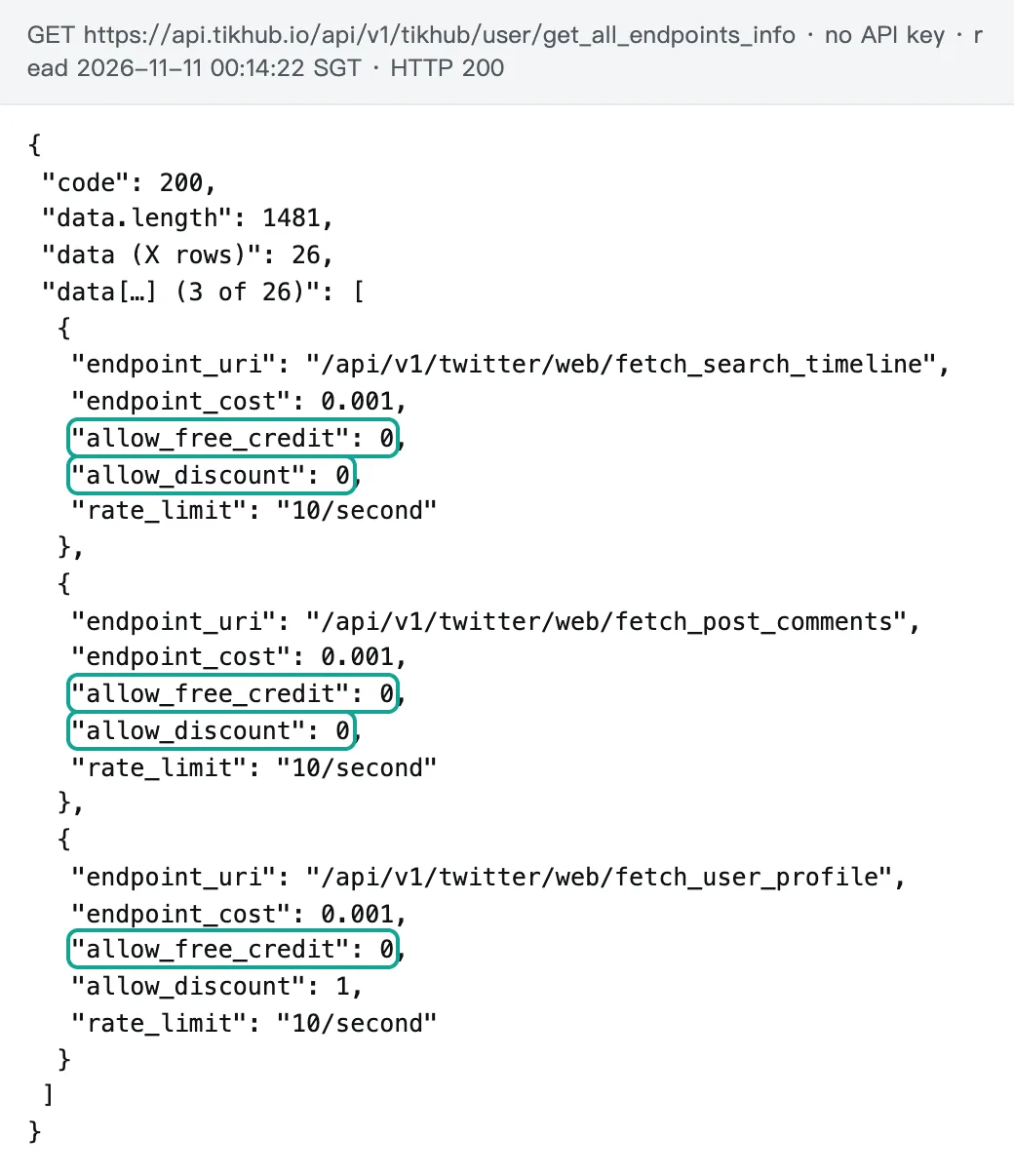
All 26 X rows sit under /api/v1/twitter/web/. TikHub calls this group the Twitter Web API and describes it as a full set of read-only public data endpoints (X API page). We counted four fields in the price list. The unit price endpoint_cost is 0.001 for all 26.
The rate limit rate_limit is 10/second for all 26. The free-credit flag allow_free_credit is 0 for all 26. The discount flag allow_discount is 1 for 24 and 0 for two: fetch_search_timeline (search) and fetch_post_comments (comments).
So X pricing at TikHub is very regular. It does not have the Douyin and Xiaohongshu problem, where two versions of the same feature can differ 10 times in price. TikHub pricing explained counted 36 such pairs.
For X you only need to check two things. Does the endpoint get the discount? How many rows does one call return?
| Use | TikHub endpoint (`/api/v1/twitter/web/…`) | Unit price | Discount | Free credit |
|---|---|---|---|---|
| Keyword search | fetch_search_timeline | $0.001 | No | No |
| Post comments | fetch_post_comments | $0.001 | No | No |
| Latest comments | fetch_latest_post_comments | $0.001 | Yes | No |
| Single post | fetch_tweet_detail | $0.001 | Yes | No |
| User profile | fetch_user_profile | $0.001 | Yes | No |
| Profiles by ID | fetch_user_profiles_by_rest_ids | $0.001 | Yes | No |
| User posts | fetch_user_post_tweet | $0.001 | Yes | No |
| User replies, media, highlights | 3 endpoints | $0.001 | Yes | No |
| Followers, followings | 2 endpoints | $0.001 | Yes | No |
| Retweeters | fetch_retweet_user_list | $0.001 | Yes | No |
| Trends | fetch_trending | $0.001 | Yes | No |
| Communities (info, members, posts, search) | 4 endpoints | $0.001 | Yes | No |
| Lists (posts, members, followers) | 3 endpoints | $0.001 | Yes | No |
| Other (about, affiliates, check follow, check retweet, live status) | 5 endpoints | $0.001 | Yes | No |
The endpoint counts do not agree across TikHub pages. The price list has 26. The openapi.json of that day (version V5.3.2) has 25.
The missing one is fetch_user_highlights_tweets, which has a price but no documented parameters. The MCP metadata endpoint /platforms says X has 25 endpoints. The MCP page and the FAQ say "Twitter 13 tools".
We cannot tell which 13 tools those are. The MCP tool list needs a key, and our tools/list call with no key got 401. This does not matter if you call endpoints from code. It does matter if you want an AI client to use TikHub's X tools directly. In that case, first check that the endpoint you need is in those 13.
The 26 endpoints matched to our 21 X capabilities
Our catalog has 21 X capabilities. We read it again on November 12, 2026, when it had 573 capabilities in total and 538 available. The table matches each one to a TikHub endpoint by use. Prices are per request. "Rows per call" shows the catalog limit and what we measured.
| Use | EveryInfra capability | Our price | Rows (limit / measured) | TikHub endpoint | TikHub price |
|---|---|---|---|---|---|
| Keyword search | twitter/search | $0.000792 ($0.000556 charged on Nov 11) | 200 / 200 | fetch_search_timeline | $0.001, no discount |
| Account posts | twitter/user_posts | $0.000556 | 200 / 200 | fetch_user_post_tweet | $0.001 |
| Replies to a post | twitter/comments | $0.000556 | 50 / 11–50 | fetch_post_comments | $0.001, no discount |
| Single post | twitter/post | $0.000556 | 1 / 1 | fetch_tweet_detail | $0.001 |
| User profile | twitter/profile | $0.000556 | 1 / 1 | fetch_user_profile | $0.001 |
| Profiles by ID | twitter/profiles_by_ids | $0.000806 | 20 / 20 | fetch_user_profiles_by_rest_ids | $0.001 |
| Follower list | twitter/followers_list | $0.000556 | 2,000 / 835–2,000 | fetch_user_followers | $0.001 |
| Following list | twitter/following_list | $0.000556 | 2,000 | fetch_user_followings | $0.001 |
| Retweeters | twitter/retweeters | $0.000806 | about 100 / 19 | fetch_retweet_user_list | $0.001 |
| User replies | twitter/user_replies | $0.000806 | about 30 / 20 | fetch_user_tweet_replies | $0.001 |
| User media | twitter/user_media | $0.000806 | about 12 | fetch_user_media | $0.001 |
| Trends | twitter/trending | $0.000556 | no limit / 65 | fetch_trending | $0.001 |
| Thread (one author's chain) | twitter/thread | $0.002153 | 100 / 9 | No match | — |
| Video transcript | twitter/video_transcript | $0.000958 | 1 | No match | — |
| User search | twitter/search_users | $0.000556 | about 20 | fetch_search_timeline (People) | $0.001, no discount |
| Communities (info, posts, search) | 3 capabilities | $0.000806 | 10–20 | 3 endpoints | $0.001 |
| Account location and name history | twitter/user_about | $0.000806 | 1 | fetch_user_about | $0.001 |
| Check follow, check retweet | 2 capabilities | $0.000806 | 1 | 2 endpoints | $0.001 |
Per request, we are cheaper in 17 of the 18 matched pairs. $0.000556 is 44% below $0.001, search at $0.000792 is 21% below, and $0.000806 is 19% below. The 18th pair is twitter/check_retweet, which was paused that day. A call returns 503 and costs nothing.
TikHub has 8 endpoints that our catalog does not have. They are user highlights, latest-comment sorting, community members, user affiliates, live status, and the three List endpoints (posts, members and followers). We have 2 capabilities that TikHub does not have. twitter/thread returns one author's whole chain of posts in order. twitter/video_transcript returns the spoken text of a video.
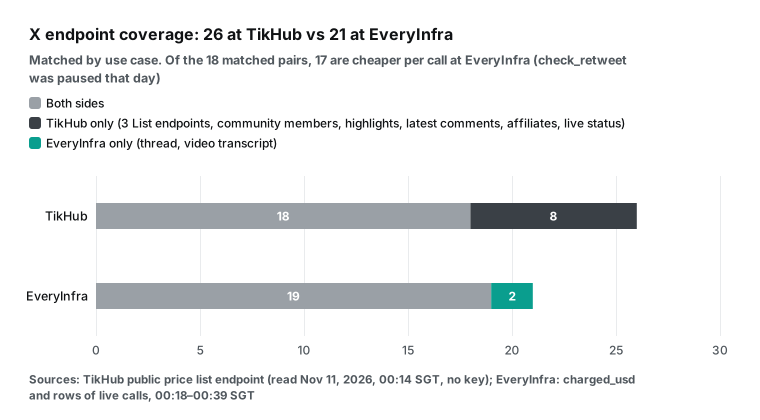
On coverage alone, the two services are close on X, and each has a few endpoints the other lacks. The large gap comes from rows per request, which the next section explains.
If your work needs X Lists or community members, TikHub can do it today and we cannot.
Rows per request: the other half of the price per 1,000
Both services bill per request, so rows per request decide the price per 1,000. TikHub's public wording on this point is vague. Its X page says that timelines, search, followers and comments use cursor pagination. It adds that each call returns a capped number of rows, so full follower lists need many calls. The FAQ question "What page sizes should I expect?" covers Douyin, Xiaohongshu and WeChat, but not X.
The docs for all 26 endpoints show only a cursor parameter, with no count or limit. Examples are the search doc and the user profile doc. So public material does not say how many posts one TikHub X search returns.
Public material does not say, so we use one reference point: the page size of the X web app itself. An open-source bug report reproduced on August 20, 2026, shows the raw X web search request (XActions issue #42).
The search returned 22 timeline entries, which is 20 posts plus two page cursors. The follower call returned 72 entries. A 2026 public review of twscrape also says search pages hold about 20 tweets (twscrape in 2026).
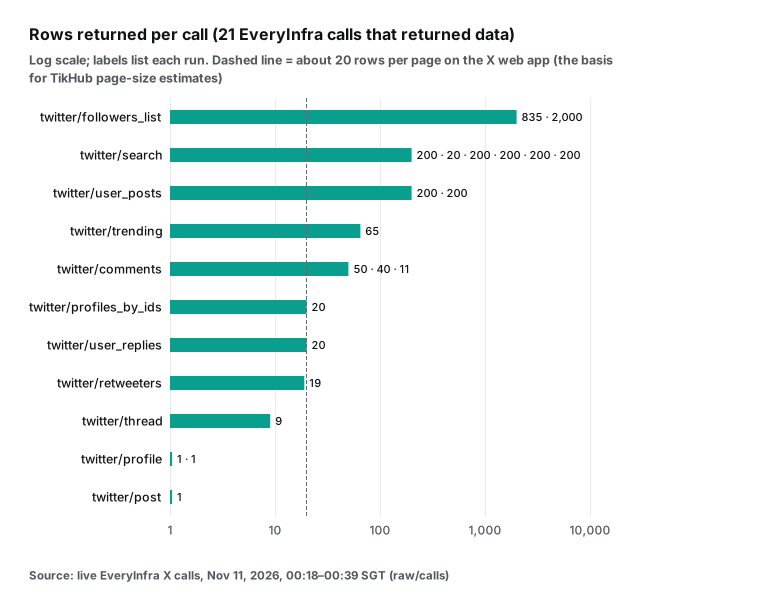
So when we convert TikHub to a price per 1,000, we assume 20 rows per page for search and account posts. We assume 20 to 40 for comments and 20 to 70 for followers. This is our estimate from the X web app, not a number TikHub publishes. Every TikHub price per 1,000 and every ratio below depends on this estimate.
An estimate can be wrong. So we also compute a number that does not depend on it. How many rows must one TikHub call return to match our measured price?
At the catalog price of November 12, 2026, search needs 253 rows per call (360 at the $0.000556 we were charged on November 11). Comments need 61. The follower list needs 1,275, even at the full 50% discount.
The X web app returns about 20 search posts per page. So for search, the result holds unless TikHub returns 253 or more posts per page. Comments are different. 61 is not far from 20 to 40, so that result depends on the actual page size, and we show it as a range.
Test 1: 1,000 posts from keyword search
twitter/search takes keyword and sort, plus the common limit (up to 200). The keyword accepts X search operators such as from:, since:, until: and lang:. sort set to latest asks for newest posts first.
We ran four searches on November 11, 2026, each with limit 200. The three openai calls returned 600 posts for $0.001668, which is $0.00278 per 1,000. After we removed duplicate post IDs, 471 posts remained, which is $0.00354 per 1,000 unique posts. On November 12, 2026, the catalog price of twitter/search was $0.000792 per call. At that price the same three calls give $0.0040 per 1,000 posts, or $0.0050 per 1,000 unique posts.
The effect of the price change is easy to compute. Search went from $0.000556 to $0.000792, a 42% rise. It is still 21% below TikHub's $0.001 per call, so the per-request result does not change. Only the break point moves: TikHub search used to need 360 posts per page to match us, and now it needs 253.
| `twitter/search` | Charged on Nov 11, 2026 | Catalog on Nov 12, 2026 |
|---|---|---|
| Price per call | $0.000556 | $0.000792 |
| Price per 1,000 posts (200 per call) | $0.0028 | $0.0040 |
| Below TikHub's $0.001 per call | 44% | 21% |
| TikHub page size needed to match us | 360 posts | 253 posts |
| Time (SGT) | Keyword | `sort` | Rows | Seconds | Charged |
|---|---|---|---|---|---|
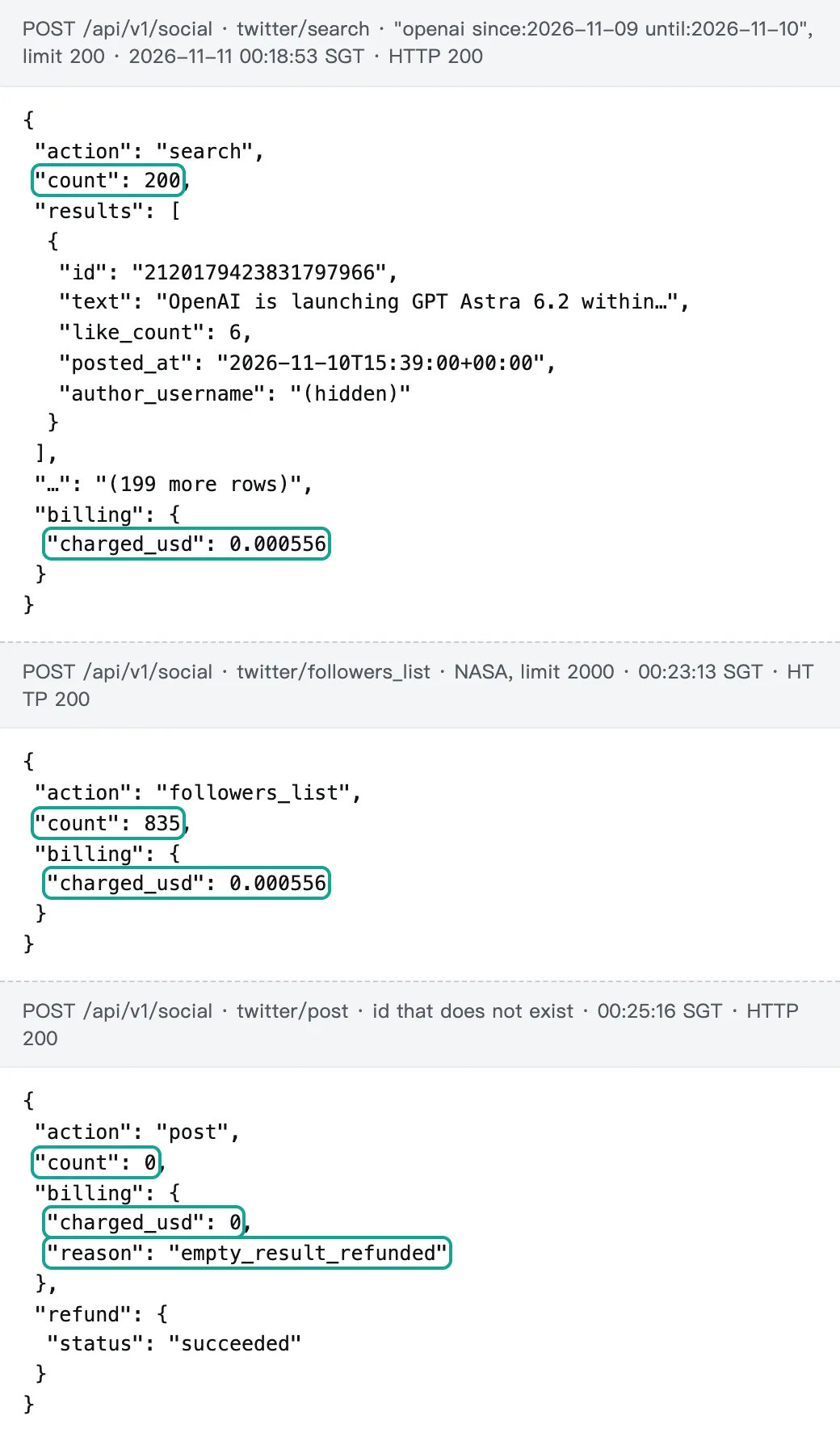
| 00:18:53 | openai since:2026-11-09 until:2026-11-10 | latest | 200 | 42.7 | $0.000556 |
| 00:25:43 | openai lang:en | default (top) | 200 | 47.5 | $0.000556 |
| 00:31:55 | openai since:2026-11-08 until:2026-11-09 | latest | 200 | 47.8 | $0.000556 |
| 00:33:31 | "Black Friday" lang:en | latest | 200 | — | $0.000556 |
For a US retail team, we searched for Black Friday this month. At 00:33:31 SGT we searched "Black Friday" lang:en with sort set to latest. It returned 200 posts from 155 different authors for $0.000556. 167 of the 200 posts came from verified authors, and 144 carried media.
The median post had 153 likes, and the 200 posts had 131.9 million views in total. Those numbers tell you something about the search itself. A "latest" query on a big shopping term still returns mostly large, verified accounts. If you want small shoppers' complaints, add more words, such as a store name or "shipping".
For the same 1,000 posts, TikHub needs 50 requests at an estimated 20 rows per page, which is $0.05. Its search endpoint gets no discount, so the price stays the same at any daily volume. At our new price, that is about 13 times our $0.0040, or about 10 times our $0.0050 per unique post. These ratios are true only if TikHub returns about 20 posts per page.
Each of our posts has 38 fields, and they match the catalog's response_fields. They include post ID, URL, text, like, repost, reply, view, quote and bookmark counts, post time, language and conversation ID. They also include flags for reply, quote, repost and pinned, the replied-to post and user, client, media, hashtags, mentions and links. 13 more fields describe the author, such as ID, username, name, follower count, following count, post count, verified flag, avatar, bio and join date.
TikHub's X page shows a sample response with tweet_id, text, created_at, favorite_count, retweet_count, reply_count, quote_count and views. The author part has screen_name, name, followers_count and verified. We cannot see TikHub's full field list. So we only say that both sides return text, engagement counts and basic author data. We do not say the fields are the same.
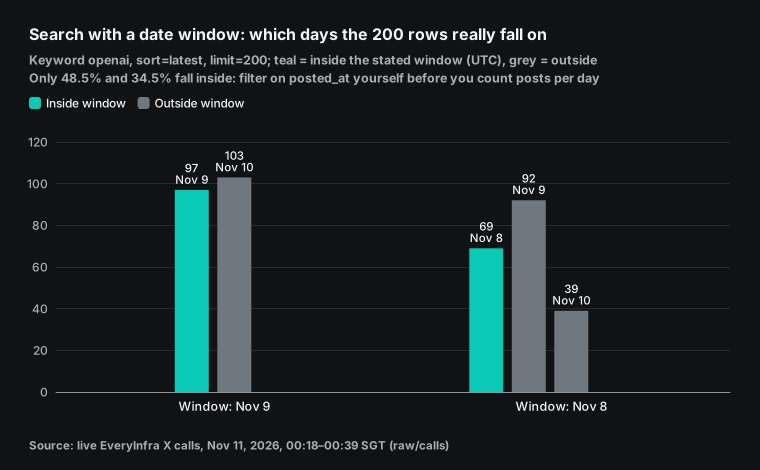
This test found something more important than price. The search did not keep to the date window. By the X search operator rules, since:2026-11-09 until:2026-11-10 should return only posts from November 9 (UTC) (X search operators). But only 97 of the 200 posts were from November 9, and 103 were from November 10.
The third search, for November 8, was worse. 69 posts were from November 8, 92 from November 9 and 39 from November 10. Only 34.5% fell inside the window. The two searches shared 78 posts.
Our advice to readers is simple. Filter on posted_at yourself after you get the rows. Do not use the row count as "posts per day".
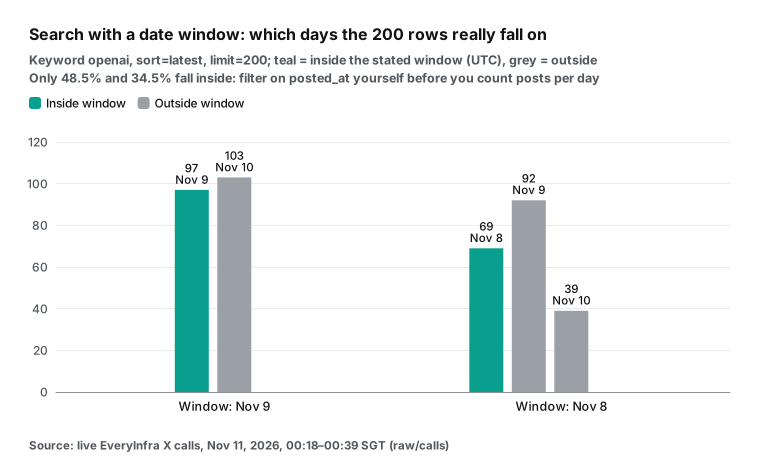
sort is not a strict rule either. In the Black Friday search with sort set to latest, 158 of 200 posts were from 2026. But the oldest post was from November 2015, and 42 posts were from 2015 to 2025. The three most viewed posts were from November 2024, November 2023 and November 2025.
Only 50 posts were from November 9, 2026, or later. The catalog says that X returns top posts by default and that latest does not guarantee strict time order. The test agrees with that sentence. If you need "all posts from the last 24 hours", put since: in the keyword, filter by time, and run several searches with de-duplication.
Test 2: posts from one account
twitter/user_posts needs only a username. At 00:19:42 SGT we asked for NASA's account with limit 200. It returned 200 posts in 40.1 seconds for $0.000556, which is $0.00278 per 1,000. The posts ran from September 25 to November 10, 2026.
64 were reposts (is_repost true) and 54 were replies. At 00:37:01 SGT we asked for the Royal Spanish Academy account (RAE), and it also returned 200 posts for $0.000556. 166 of them were answers to readers' language questions. The two calls returned 400 posts for $0.001112, which is $0.00278 per 1,000.
| Account | Time (SGT) | Rows | Reposts | Replies | Charged |
|---|---|---|---|---|---|
| NASA | 00:19:42 | 200 | 64 | 54 | $0.000556 |
| RAE | 00:37:01 | 200 | — | 166 | $0.000556 |
TikHub's fetch_user_post_tweet gets the discount. At an estimated 20 rows per page, 1,000 posts need 50 requests. That is $0.05 at list price and $0.025 at the full 50% discount, so 9 to 18 times our price. Keep one point in mind. The mix of reposts and replies depends on the page X returns.
NASA's 200 posts held 64 reposts, and RAE's held 166 replies. If you want original posts only, you get far fewer than 200 useful rows. The same is true for budgets at TikHub. Its docs do not say whether the user posts endpoint includes reposts and replies. The user replies doc is for a different endpoint.
Test 3: replies, the closest result
Replies show the smallest gap in this article. twitter/comments returns replies for a post ID, up to 50 per call. At 00:22:43 SGT we asked for a NASA post from November 7, 2026, with 847 replies. It returned 50 replies in 22.6 seconds. 40 replied to the post directly, and 10 replied to other replies.
At 00:30:14 SGT we asked for a NASA post from October 11 with 791 replies. We asked for 50 and got 40. At 00:38:30 SGT, an RAE post with 12 replies returned 11. The three calls returned 101 replies for $0.001668, which is $0.0165 per 1,000. For the two NASA posts alone it is 90 replies and $0.0124 per 1,000.
| Post | Time (SGT) | Asked / returned | Charged | Note |
|---|---|---|---|---|
| NASA, Nov 7, 847 replies | 00:22:43 | 50 / 50 | $0.000556 | 40 reply to the post directly |
| NASA, Oct 11, 791 replies | 00:30:14 | 50 / 40 | $0.000556 | First row is NASA's own reply |
| RAE, Nov 7, 12 replies | 00:38:30 | 50 / 11 | $0.000556 | Small post, all replies in one call |
TikHub's fetch_post_comments gets no discount. At 20 to 40 replies per page, it costs $0.025 to $0.05 per 1,000, which is 1.5 to 3 times our average. If TikHub's comment pages return 61 or more replies, TikHub is cheaper for this item. We computed that break point earlier.
One more limit is on our side. We return at most 50 replies per call. The catalog shows no page parameter for twitter/comments. So for a post with thousands of replies, you must change sort or time range across calls.
TikHub's comment endpoints take a cursor, so you can page through them (latest comments doc). If you need every reply on one big post, TikHub's paging is easier. We list this in "When TikHub is the better choice".
twitter/user_replies is a different kind of reply: the replies one account sent. At 00:30:45 SGT we asked for NASA. It returned 20 replies for $0.000806, with a next_page_token for the next page, so $0.0403 per 1,000. TikHub's fetch_user_tweet_replies gets the discount and costs $0.025 to $0.05 per 1,000 at 20 rows per page. The two sides are about even, and the winner depends on your daily volume.
Test 4: user profiles, followers and retweeters
A user profile is one account per call on both sides, so price per row equals price per call. At 00:20:30 SGT, twitter/profile for NASA returned 13 fields in 20.8 seconds for $0.000556. The fields included user ID, username, name, URL, 92,260,434 followers, 115 following, 74,529 posts, verified flag, location, avatar and join date. At 00:37:45 SGT the RAE profile (2,112,698 followers) also cost $0.000556.
That is $0.556 per 1,000 profiles. TikHub's fetch_user_profile costs $1.00 per 1,000 at list price, 1.8 times ours. But it gets the discount. Above 30,000 calls a day to the same endpoint, each extra call costs $0.0005, which is 10% below our price.
For a large batch of accounts, we have a much cheaper option. twitter/profiles_by_ids takes 20 user IDs per call. At 00:23:33 SGT it returned 20 profiles in 1.7 seconds for $0.000806, which is $0.0403 per 1,000. The trade-off is that it does not return bio, follower count, following count or post count. The catalog says to get those fields with twitter/profile by username.
So it is good for turning IDs into usernames, avatars and verified flags. It is not good for ranking accounts by followers. TikHub's fetch_user_profiles_by_rest_ids also looks up by ID at $0.001 per call. Its doc does not say how many IDs one call accepts or which fields it returns.
The follower list shows the largest gap in this article. At 00:23:13 SGT, twitter/followers_list for NASA with limit 2,000 returned 835 accounts in 12.9 seconds for $0.000556. At 00:34:26 SGT, the same call for Nike returned 2,000 accounts for $0.000556.
Together that is 2,835 accounts for $0.001112, or $0.000392 per 1,000. Each row has 14 fields, including that follower's own follower count, following count, post count and join date. So you do not need one profile call per follower to build an audience view.
TikHub's fetch_user_followers costs $0.0071 to $0.05 per 1,000, at an estimated 20 to 70 rows per page and list price to 50% off. That is 18 to 128 times our price. Official X pay-per-use bills follow and follower reads at $0.010 each, which is $10 per 1,000 (X pricing page).
The Nike follower list also shows why you should look at the data before you buy profile lookups. The list seems to start with the newest followers, because most rows are very new accounts. Of those 2,000 accounts, 949 were created in 2026, and 377 were created in November 2026 alone. The median account had 2 followers.
595 had no followers at all, 671 had never posted, and 263 were protected. Only 68 had 1,000 followers or more. NASA's 835 recent followers looked the same: 574 were created in 2026, and 500 had no followers.
| Recent followers | Nike (2,000 rows) | NASA (835 rows) |
|---|---|---|
| Created in 2026 | 949 | 574 |
| Zero followers | 595 | 500 |
| Median follower count | 2 | 0 |
| 1,000+ followers | 68 | — |
So if your plan is "get each new follower's profile", most of those lookups return small new accounts. The follower list already carries their counts. Filter there first, and pay for full profiles only for the 3% to 5% that matter.
| User data | EveryInfra measured | Per 1,000 | TikHub estimate | Ratio |
|---|---|---|---|---|
| Single profile | 2 calls, 2 profiles, $0.001112 | $0.556 | $1.00 (list) to $0.50 (50% off) | 0.9–1.8 |
| Profiles by ID (no follower counts) | 1 call, 20 profiles, $0.000806 | $0.0403 | Doc does not say IDs per call | Not compared |
| Follower list | 2 calls, 2,835 accounts, $0.001112 | $0.000392 | $0.0071–$0.05 | 18–128 |
| Retweeters | 1 call, 19 accounts, $0.000806 | $0.0424 | $0.025–$0.05 (20 per page) | 0.6–1.2 |
The retweeter row needs a note. At 00:30:57 SGT, twitter/retweeters for the NASA post with 847 replies returned only 19 accounts for $0.000806, which is $0.0424 per 1,000.
At 19 accounts per call, TikHub's discounted price is lower than ours. So the ratio is 0.6 to 1.2, and we cannot call ourselves cheaper here.
Test 5: threads and single posts
A thread is a chain of posts that one author writes under their own post. On X, brands and agencies often post launches, live events and long notes this way. twitter/thread takes the URL of the first post and returns the chain in order.
At 00:29:45 SGT we asked for NASA's spacewalk live thread from November 5, 2026. It returned 9 posts in 22.9 seconds for $0.002153. The posts ran from 12:00 to 20:39 UTC on that day, in the same order as NASA's account timeline.
This is our most expensive X capability, $0.239 per 1,000 posts. TikHub has no matching endpoint. To get the same 9 posts, you can call fetch_tweet_detail once per post (9 calls, $0.009) if you already know the 9 IDs. Or you can page the account's reply timeline and build the chain yourself. With single lookups, TikHub costs 4.2 times our price.
Single posts are one row per call on both sides. At 00:38:59 SGT, twitter/post for one OpenAI post returned in 12.6 seconds for $0.000556. TikHub's fetch_tweet_detail costs $0.001 and gets the discount. As with profiles, TikHub's average gets lower at high daily volume. The next sections compute the break point.
US trends are a small test, but they show the shape of the data. At 00:21:05 SGT, twitter/trending for the United States returned 65 live trends for $0.000556. The list was collected at 16:21 UTC on November 10, 2026. It held "Semper Fi" (the US Marine Corps birthday), "Veterans Day", "October CPI", "Hot CPI" and "Taco Tuesday".
Each row had name, rank and period. The volume field was empty for all 65 rows. If you need post counts per trend, run a twitter/search for each trend and count the rows yourself.
Converted to 1,000 results: the full comparison
Now we put the five tests and TikHub's public prices on the same base. Our side is all measured. TikHub's side is the public unit price divided by the estimated page size, so it is a range. The low end uses the full 50% discount (only for endpoints that get it) or the larger page size. The high end uses list price and the smaller page size.
| Data | EveryInfra measured: calls / rows / charged | EveryInfra per 1,000 | TikHub per 1,000 (estimate) | TikHub ÷ EveryInfra |
|---|---|---|---|---|
| Keyword search posts | 3 / 600 / $0.001668 | $0.00278 ($0.00354 unique); $0.0040 at the Nov 12 price ($0.0050 unique) | $0.05 (20 per page, no discount) | 10–18 |
| Account posts | 2 / 400 / $0.001112 | $0.00278 | $0.025–$0.05 | 9–18 |
| Replies to a post | 3 / 101 / $0.001668 | $0.0165 | $0.025–$0.05 (no discount) | 1.5–3.0 |
| Single profile | 2 / 2 / $0.001112 | $0.556 | $0.50–$1.00 | 0.9–1.8 |
| Follower list | 2 / 2,835 / $0.001112 | $0.000392 | $0.0071–$0.05 | 18–128 |
| Retweeters | 1 / 19 / $0.000806 | $0.0424 | $0.025–$0.05 | 0.6–1.2 |
| Thread | 1 / 9 / $0.002153 | $0.239 | $1.00 (one call per post) | 4.2 |
| Trends | 1 / 65 / $0.000556 | $0.0086 | $0.001 per call, rows not stated | Not compared |
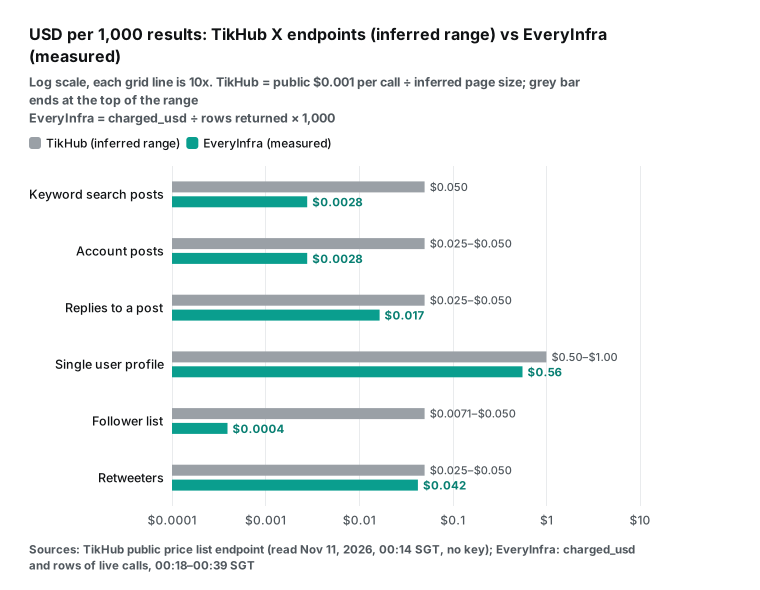
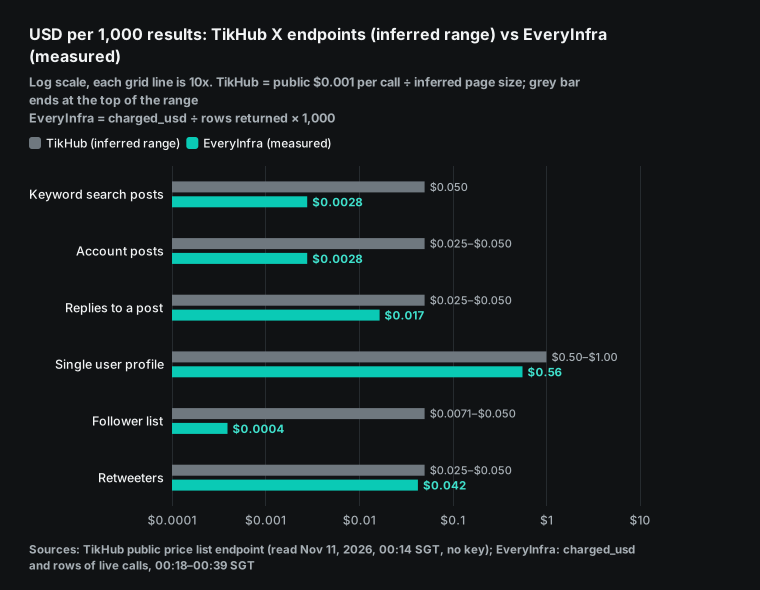
The table draws a clear line, and every TikHub value in it uses the estimated page size. Data that comes many rows per call (search, account posts, follower lists) differs 9 to 128 times. We return 200 to 2,000 rows per call, and TikHub returns about 20 if it follows X web paging. Data that comes one row per call (profiles, single posts) differs less than 2 times, and at high volume the order flips.
Replies and retweeters sit between 1 and 3 times, and the result depends on TikHub's page size. So there is no single answer to "which is cheaper". It depends on the mix of data in your job. The section "A month of bills" works through one real mix.
Tiered discount: when TikHub's unit price is lower
TikHub's tiered discount has three key parts. It is daily. The FAQ says tiers count requests per day and reset at Los Angeles midnight. In New York that is 3 a.m., and in London it is 8 a.m. in winter.
It is marginal. It does not work like "past 10,000 calls, the whole day gets 30% off". It works like income tax brackets, and each tier discounts only the calls inside that tier. The FAQ example is 20,000 calls at $0.001 for a total of $15.60, not 20,000 × $0.0007 = $14.00. The pricing page example is 12,000 calls for $10.00.
It is per endpoint. It applies only to endpoints with allow_discount set to 1, which on X means all except search and comments. We read the tiered discount endpoint with no key, and the tiers match the FAQ. 0 to 1,000 calls cost $0.001.
Calls 1,000 to 5,000 get 10% off, and calls 5,000 to 10,000 get 20% off. Calls 10,000 to 20,000 get 30% off, and calls 20,000 to 30,000 get 40% off. Above 30,000 calls, the discount is 50%.
| Calls a day to one X endpoint | TikHub daily total | TikHub average per call | Our $0.000556 tier | Our $0.000806 tier |
|---|---|---|---|---|
| 1,000 | $1.00 | $0.001000 | $0.56 | $0.81 |
| 10,000 | $8.60 | $0.000860 | $5.56 | $8.06 |
| 15,095 | $12.17 | $0.000806 | $8.39 | $12.17 |
| 30,000 | $21.60 | $0.000720 | $16.68 | $24.18 |
| 117,858 | $65.53 | $0.000556 | $65.53 | $94.99 |
| 150,000 | $81.60 | $0.000544 | $83.40 | $120.90 |
First we checked the marginal formula against the two FAQ examples. 20,000 calls give $15.60 and 12,000 calls give $10.00, so the formula is right. Then we raised the call count step by step and found two break points.
For our $0.000806 capabilities, TikHub's daily average is lower above 15,095 calls a day to the same endpoint. These capabilities are user replies, user media, retweeters, profiles by ID, communities and account location. For our $0.000556 capabilities, the break point is 117,858 calls a day. These are profile, single post, account posts, follower list and trends.
At TikHub's default 10 calls per second, 117,858 calls take 3.3 hours of nonstop work. That volume is real, but only large single-lookup jobs reach it. Search and comments get no discount, so they have no break point. TikHub always charges $0.001 per call for them.
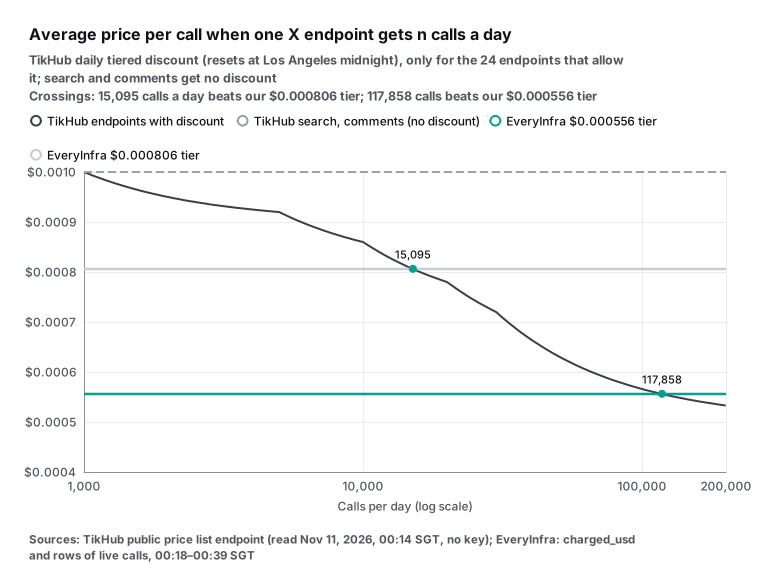
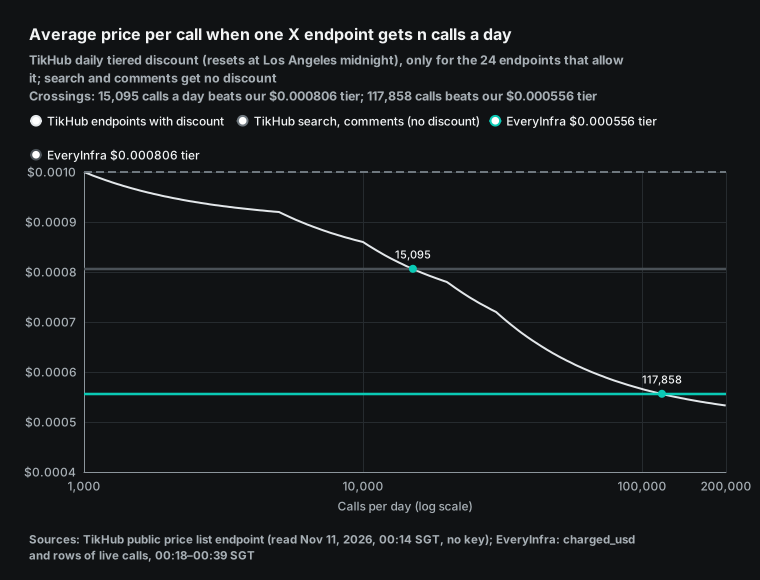
Keep in mind that these break points compare price per request. For one-row-per-call data (profiles, single posts) that is the final answer. For many-rows-per-call data, the break points mean almost nothing. We return 200 rows per call and TikHub about 20 per page. Even at the full 50% discount, TikHub costs $0.025 per 1,000, which is still 9 times our price.
Are failures and empty results billed?
3 of our 24 live calls returned no data. At 00:20:57 SGT, a search with no key returned 401 missing_key in 0.13 seconds, with the message "Nothing was charged". At 00:25:16 SGT, a missing post ID returned 200 with count 0.
billing.reason was empty_result_refunded, charged_usd was 0 and refund.status was succeeded. At 00:31:06 SGT, a missing account came back as an empty result after 42.2 seconds and was also refunded automatically. All three cost $0.
TikHub's rule is "a 200 response is billed, failures are not" (FAQ, "What exactly gets billed?"). Repeat calls with the same parameters return live data each time and are billed each time. Each successful response carries a cache_url that you can reopen free for 24 hours. The FAQ suggests you keep the cache_url if you need the same data more than once a day.
The X page also says that deleted, suspended or private posts and accounts return empty results or errors. It tells monitoring users to treat sudden empty results as a signal and not to retry forever. The case to watch is "200 with no data".
TikHub's rule bills it, and our rule refunds it. Say you monitor 10,000 accounts and 2% of them change names or close each day. That is 200 such calls every day.
| Case | EveryInfra (measured here) | TikHub (public rule) |
|---|---|---|
| No key | 401, $0 | Not 200, not billed |
| Post or account does not exist | 200 empty result, refunded, $0 | Empty result or error. An empty 200 is billed |
| Same request sent again | Billed each time | Billed each time, cache_url free for 24 hours |
A month of bills: 1,000 posts, replies and profiles a day
Here is the bill for the question at the top of this article. A brand team needs 1,000 keyword posts, 1,000 replies and 1,000 user profiles every day for 30 days. Our side uses measured rows, the measured duplicate rate and the catalog price of November 12, 2026. TikHub's side uses estimated page sizes and public prices, with no rate-limit add-ons.
| Daily job | EveryInfra calls / cost | TikHub calls / cost |
|---|---|---|
| 1,000 unique posts | 7 calls (at the 471/600 unique rate, $0.000792 each) / $0.0055 | 50 calls (20 per page) / $0.05 |
| 1,000 replies | 31 calls (33 replies per call, from the measured 33.7 average) / $0.0172 | 50 calls (20 per page) / $0.05 |
| 1,000 user profiles | 1,000 calls / $0.556 | 1,000 calls / $1.00 (first tier of the day, no discount) |
| Daily total | $0.5788 | $1.10 |
| 30-day total | $17.36 | $33.00. One top-up for the month: $34.95 by PayPal, $34.16 by Alipay |
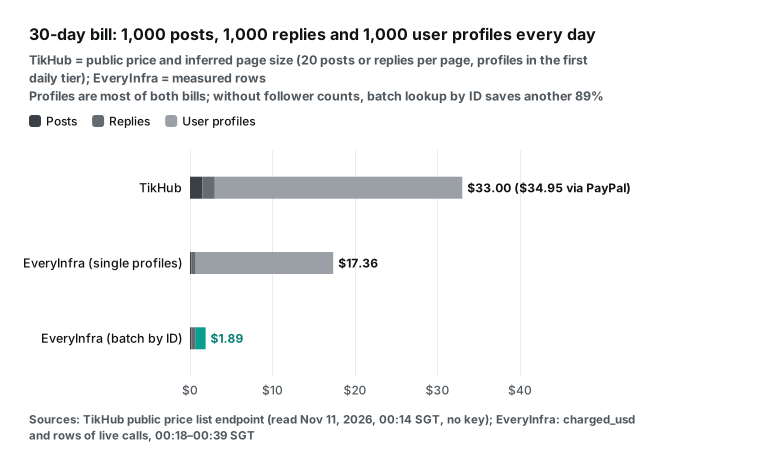
In this mix, profiles are most of both bills. They are 91% of TikHub's bill and 96% of ours. Profiles are also the item with the smallest gap, so the total differs only 1.9 times. The search price change has a very small effect on this bill. At the search price we were charged on November 11, the bill is $17.31. At the price of November 12, it is $17.36, only 5 cents more in 30 days.
A different method changes the result a lot. If you need only usernames, avatars and verified flags, use twitter/profiles_by_ids with 20 IDs per call. That is 50 calls and $0.0403 a day, or $1.89 for 30 days, about 1/17 of TikHub's bill. If your profiles come from a big account's followers, use twitter/followers_list directly.
One call returns 2,000 accounts with follower counts, and that costs three orders of magnitude less than one profile call per account. Whether profiles come one by one or in batches changes the bill more than the choice of provider.
Free credit and minimum top-up: what one test costs
What is the least you can spend to test one X endpoint on TikHub? By its public material, you get $0.05 after sign-up and email check. But the price list blocks free credit on all 26 X endpoints, so you must top up. The minimum top-up is $5, with no maximum.
TikHub charges the top-up fee. Alipay is 2.6% + $0.30, and PayPal and USDT are 5% + $0.30. The FAQ says a $5 PayPal top-up is charged as $5.55. Top-ups are not refundable, except when an endpoint is confirmed as not working (FAQ, "Payments and fees" and "Invoices and refunds"). So your first X test costs at least $5.43 (Alipay) or $5.55 (PayPal) in cash.
| First X test | TikHub | EveryInfra |
|---|---|---|
| Free credit | $0.05, not usable on X | $1, usable on X, 24 hours |
| Least cash for one X call | $5.43 (Alipay) or $5.55 (PayPal) | $0 |
| Smallest paid top-up | $5 plus fee | $10 |
| Refund of top-up | Only if an endpoint is confirmed broken | See pricing page |
TikHub's X page and pricing page show "$0.05 free credit" and "~50 free requests" in large text. They do not say that X endpoints cannot use it. This is the trap readers fall into most often.
On our side, the pricing page and the quickstart say you get $1 of credit when you star two GitHub repos. You claim it in the console after sign-up. It is valid for 24 hours and covers about 720 data calls at the base price. All X capabilities can use it.
Only CAPTCHA solving cannot. At the catalog price of November 12, 2026, $1 pays for about 1,262 searches, or up to about 250,000 posts. Paid top-ups start at $10, and the balance does not expire.
twitter api alternative: TikHub, official X and EveryInfra
People who search "twitter api alternative" usually start from the official X API. TikHub's X page compares itself with official plans at "Basic $200/month, Pro $5,000/month, Enterprise $42,000+/month". It adds that the official figures are about mid-2026 and may change. By X's own docs, that comparison is out of date.
The X API now uses pay-per-use pricing with no subscription and no minimum spend. A post read costs $0.005, a user read $0.010, a follow or follower read $0.010 and a trends call $0.010. Reads are capped at 3 million posts a month (X pricing page).
X announced the move of legacy Basic plans on May 21, 2026 (Basic migration notice). Legacy Pro plans followed on August 14, 2026 (Pro migration notice). Our full math for official X is in X API alternative. Here we show only the result.
Two recent changes at X also affect this bill. From October 2, 2026, new pay-per-use accounts get $20 of credit after a card and a first purchase. The credit ends after 3 months (X free credit page). On October 23, 2026, X said that expansion objects will be billed separately from November 22, 2026 (developer forum notice). So official calls that pull author and media data will cost more.
At $0.005 per post read, 1,000 official posts cost $5.00 before expansions. TikHub and EveryInfra are both read only, bill per request, and return author data with each post.
Official X costs more, but it has two things no third party has. It can write (post, send DMs, like), and your data use rests on X's own Developer Agreement. X also has a rule that third parties do not have. Reading the same resource more than once in one UTC day is billed once (the "Deduplication" part of the same pricing page). If you poll the same keyword every 15 minutes and few new posts appear, this rule removes most of the cost.
Speed: how many rows per minute
TikHub allows 10 calls per second by default. The pricing FAQ says the limit is per endpoint, not per account, so different endpoints can run in parallel. Higher limits are monthly add-ons, from 20 calls per second for $5 a month to 100 per second for $55 a month (FAQ, "Rate limits (RPS)"). Our default is 60 calls per minute per account, shared by all keys on the account. For more speed, buy a 30-day boost pack (180 calls per minute for $10, 600 for $30), or reach a top-up total that includes it (pricing page).
By call count, one TikHub endpoint allows 600 calls per minute, 10 times our default. By rows, the two sides are almost the same on search. We get 60 calls × 200 rows = 12,000 posts per minute. TikHub's search endpoint gets 600 calls × about 20 rows = 12,000 posts. We are faster on follower lists (60 × 2,000 = 120,000 accounts against 600 × 20 to 70). TikHub is much faster on single profiles (600 against 60, and more if you use several endpoints at once).
| Per minute, default limits | TikHub | EveryInfra |
|---|---|---|
| Calls (one endpoint) | 600 | 60 (whole account) |
| Search posts | about 12,000 (20 per page) | 12,000 (200 per call) |
| Follower accounts | 12,000–42,000 | 120,000 |
| Single profiles | 600 per endpoint | 60 |
AI tools: how to set up MCP on both sides
Both sides offer MCP, the protocol that lets AI clients such as Claude or Cursor call tools directly (MCP specification 2025-06-18). TikHub runs one server per platform. The X server is at https://mcp.tikhub.io/twitter/mcp. The FAQ says Claude Desktop and Claude Code connect through npx mcp-remote (mcp-remote), and Cursor and Cline connect over HTTP.
Our call with no key got 401, so we could not see the tool list. The MCP page says X has 13 tools, and the /platforms metadata says 25 endpoints. The two numbers do not match. We wrote the TikHub part of this config from its MCP page sample and did not run it.
{
  "mcpServers": {
    "tikhub-twitter": {
      "command": "npx",
      "args": ["mcp-remote", "https://mcp.tikhub.io/twitter/mcp",
               "--header", "Authorization: Bearer ${TIKHUB_API_KEY}"]
    },
    "everyinfra": {
      "type": "http",
      "url": "https://api.everyinfra.com/mcp",
      "headers": { "Authorization": "Bearer ${EVERYINFRA_API_KEY}" }
    }
  }
}
We use one address for all platforms. At 00:29:07 SGT we sent tools/list to https://api.everyinfra.com/mcp with no key. It returned 200 and 12 tools. They include everyinfra_list_capabilities (read the catalog), everyinfra_call_api (call a capability), everyinfra_get_job (get an async result) and everyinfra_list_requests (read call history). Our 21 X capabilities are not separate tools.
You call everyinfra_call_api with platform: "twitter" and an action. The tool list in your AI client stays short, and a new platform needs no new server. The cost is that the model must read the catalog once to learn the parameters. Anthropic's setup guide is the Claude Code MCP doc, and our setup page is /en/mcp-server.
Fields: the two sides return different things
One point is easy to miss in a price comparison. "1,000 posts" is not the same thing on both sides. Each post from our twitter/search and twitter/user_posts has 38 fields, and 13 of them describe the author. The author's follower count, following count, post count, bio and join date sit flat in every post row. So for "who is talking" analysis, you do not need a second profile call.
The first openai search alone returned 187 different authors. To look up those 187 profiles one by one would cost $0.187 at TikHub's single price and $0.104 at ours. Both are more than 180 times the cost of the search itself ($0.000556). In TikHub's sample on its X page, the author also comes with the post, with username, name, follower count and verified flag. We cannot see its full response, so we cannot say whether it also returns following count, post count and bio.
We also have one tip for long-term monitoring. If a whole batch of search results has empty hashtags and mentions, retry once before you use it. Do not assume that those posts have no hashtags or mentions. All 5 of our searches returned the full 200 rows.
Moving from TikHub: how the request changes
The requests have different shapes. TikHub uses GET with parameters in the URL and one path per endpoint. We use POST to one address, choose the capability with platform and action, and put parameters in params. Below is one job (search a keyword, get one account's followers) written both ways. We wrote the TikHub part from its docs and did not call it.
# TikHub (from public docs, not called): search, one page per call, page with cursor
curl "https://api.tikhub.io/api/v1/twitter/web/fetch_search_timeline?keyword=black%20friday&search_type=Latest" \
  -H "Authorization: Bearer $TIKHUB_API_KEY"

# EveryInfra: the same search, up to 200 posts per call
curl -s https://api.everyinfra.com/api/v1/social \
  -H "Authorization: Bearer $EVERYINFRA_API_KEY" -H "Content-Type: application/json" \
  -d '{"platform":"twitter","action":"search","params":{"keyword":"\"Black Friday\" lang:en","sort":"latest","limit":200}}'

# EveryInfra: one account's followers, up to 2,000 per call
curl -s https://api.everyinfra.com/api/v1/social \
  -H "Authorization: Bearer $EVERYINFRA_API_KEY" -H "Content-Type: application/json" \
  -d '{"platform":"twitter","action":"followers_list","params":{"username":"Nike","limit":2000}}'
Map the field names again. TikHub's sample tweet_id, favorite_count, views, created_at and author screen_name are id, like_count, view_count, posted_at and author_username on our side. Author data is flat in the post, not a nested object.
In Python, keep the key in an environment variable. On failure, read error.code and next_steps. Do not retry only because of the HTTP status.
import os, requests

def x_search(keyword, limit=200):
    r = requests.post("https://api.everyinfra.com/api/v1/social",
        headers={"Authorization": f"Bearer {os.environ['EVERYINFRA_API_KEY']}"},
        json={"platform": "twitter", "action": "search", "params": {"keyword": keyword, "limit": limit}},
        timeout=120)
    body = r.json()
    if r.status_code != 200:
        raise RuntimeError(body.get("error", {}).get("code"))
    rows = body.get("results", [])
    print(len(rows), "rows, charged", body["billing"]["charged_usd"])
    return rows

# Keep only new low-activity followers out of the profile budget
fans = requests.post("https://api.everyinfra.com/api/v1/social",
    headers={"Authorization": f"Bearer {os.environ['EVERYINFRA_API_KEY']}"},
    json={"platform": "twitter", "action": "followers_list", "params": {"username": "Nike", "limit": 2000}},
    timeout=120).json()["results"]
worth_a_profile = [f["username"] for f in fans if (f.get("follower_count") or 0) >= 1000]
print(len(worth_a_profile), "of", len(fans), "followers have 1,000+ followers")
When TikHub is the better choice
Here are the cases where TikHub has something we do not have, or where TikHub costs less.
First, you need X Lists or community members. TikHub has four endpoints for List posts, List members, List followers and community members, and our catalog has none of them. For jobs like "what are the people on this industry List saying", TikHub is more direct today. User highlights, live status and affiliates also exist only at TikHub.
Second, you look up a very large number of single profiles or posts and need full fields. Above 117,858 calls a day to one endpoint, TikHub's daily average is below our $0.000556. Above 30,000 calls, each extra call costs only $0.0005. A project that refreshes 200,000 profiles a day pays $106.60 at TikHub and $111.20 with us.
Third, you need every reply on one post. Our twitter/comments returns at most 50 per call and has no page parameter. TikHub's comment endpoints page with cursor. At its no-discount comment price, 50 pages and 1,000 replies cost $0.05, and the bill is easy to predict.
Fourth, you need high throughput across different endpoints. Each TikHub endpoint allows 10 calls per second. With several endpoints in parallel, the total is far above our default of 60 calls per minute.
Fifth, you want a large historical dataset, not live collection. TikHub sells prepared datasets. The FAQ says its October snapshot held more than 11 million X posts and more than 27 million comments. The pricing page says datasets start at $0.40 per 1,000 rows at volume (pricing page). We do not sell datasets.
Sixth, you already use TikHub for other platforms. One key covers 16 platforms, and X is one more path. If most of your work uses platforms or endpoints we do not have, a second account just for X may not be worth it.
| Your job | Better choice | Why |
|---|---|---|
| X Lists, community members, highlights, live status | TikHub | We have no such capability |
| More than 117,858 single profiles or posts a day | TikHub | Marginal price falls to $0.0005 |
| Every reply on one big post | TikHub | Cursor paging, we cap at 50 |
| Historical X dataset | TikHub | We do not sell datasets |
| Search, account posts, follower and following lists | EveryInfra | 200 to 2,000 rows per call |
| Empty results in monitoring | EveryInfra | Empty results are refunded |
Outside these cases, your job may be mostly search, account posts, follower lists and following lists. Then our public price per request is 21% to 44% lower. With our measured rows and the estimated TikHub page size, our price per 1,000 is 9 to 128 times lower. The free trial also works on X right away.
Terms and legal limits: public data, X rules and research access
Both sides read public data only. Neither can post or read DMs, and neither makes your use lawful for you. The X Terms of Service limit automated collection without permission. The X automation rules add separate rules for automated accounts. TikHub's X page itself says that X's terms limit automated access and that account or IP blocks are a real operating risk.
The same TikHub page cites the US Ninth Circuit decision in hiQ v. LinkedIn (2022 opinion). That decision asks whether access to public data breaks the US Computer Fraud and Abuse Act. It does not mean you can ignore platform terms, and it does not cover privacy law.
If you are an academic who studies systemic risk in the EU, there is a more formal path. Article 40 of the Digital Services Act gives vetted researchers a right to ask very large platforms for data access (regulation text). The European Commission's delegated act on data access sets out the process. This article is not legal advice.
For projects that touch personal data, assess the law where you work before you collect. Our test samples used only organization accounts such as NASA, OpenAI, Nike and RAE. No personal username appears in this article.
What videos and forums say
We read the transcripts of the top YouTube results for "twitter api alternative". None of them compared TikHub or per-call prices. Two points were still useful.
A founder video on X DM tools shows a plan that sells "2,000 DM credits" when each DM uses 10 credits (video). That is the same kind of trap as free credit that X endpoints cannot use. Read the unit, not the headline number.
A video about bring-your-own-key X bots spends most of its time on app permissions and callback URLs (video). Read-only third-party APIs skip all of those steps. You need only one key in one header.
On Reddit, the most common question is whether a free tier still exists. The answers point to official pay-per-use and to small RSS-style workarounds. We answer that question in the FAQ.
FAQ
How do I get a tikhub twitter api key, and can I test X endpoints for free? (from the suggestion "tikhub twitter api key")
At TikHub, sign up, check your email and create a key in the console. Each account can hold up to 100 keys, and you send the key in the Authorization: Bearer header (FAQ, "Account and keys"). Sign-up gives $0.05.
But in the price list of November 11, 2026, no X endpoint can use free credit. So you must top up at least $5 first. Our $1 starring credit works on X capabilities right away.
Is there a free twitter api alternative? (from the suggestion "free twitter api alternative" and the Reddit r/Twitter thread "X/Twitter api free tier?")
That thread asks whether official X still has a free tier. By the current pricing page, official X is pay-per-use with no subscription. New accounts get $20 after they add a card and make a first purchase.
No third party is free for long. TikHub's X endpoints cannot use sign-up credit, and our $1 trial lasts 24 hours. Only RSS-style methods stay free, and they follow a few accounts with no search and no follower data.
How can I get "posts from people I follow in the last 24 hours" through an API? (from the Reddit r/n8n thread "How to get my X feed through api")
In that thread, one answer suggests getting your following list first, then the recent posts of each account, and merging them in n8n. At our prices, twitter/following_list returns up to 2,000 accounts for $0.000556. One twitter/user_posts call for each of 200 accounts then costs $0.11 a day. At TikHub's estimated page size, the following list takes about 10 calls and the 200 accounts one page each, about $0.21. Note that this gives you public posts, not the ranked X home timeline.
Getting started: run the numbers yourself with both free catalogs
Step one: read both public price lists. Our capability catalog needs no key. The 21 rows with platform set to twitter are all our X capabilities and prices. TikHub's price list also answered without a key that day. Filter the 26 rows with /twitter/ in the path.
Step two: get the trial credit. Star two GitHub repos, sign up, and claim $1 in the console. The credit is valid for 24 hours (quickstart). You can also find the X capability pages by platform in the infrastructure market.
Step three: run one search with your own keyword. Write down count and billing.charged_usd. Compute your own price per 1,000 as charged ÷ rows × 1,000. Then use this article's break points (at the catalog price of November 12, 2026: 253 posts per search page, 61 replies per comment page) to see whether TikHub is cheaper for your job.
Step four: if profiles are most of your job, test twitter/followers_list and twitter/profiles_by_ids first. They may remove the need for one profile call per account.
Further reading
- TikHub pricing explained: 1,470 endpoints priced one by one
- TikHub Douyin API alternative: 37 items compared
- TikHub alternative: measured price per 1,000
- X API alternative: $5 against $0.0033 per 1,000 posts
- X (Twitter) scraper API platform page, plus the Threads and Reddit platform pages for other public discussion
References
- TikHub public price list endpoint get_all_endpoints_info, TikHub, read 2026-11-11 00:14 SGT with no key, https://api.tikhub.io/api/v1/tikhub/user/get_all_endpoints_info
- TikHub openapi.json (V5.3.2), TikHub, read 2026-11-11, https://api.tikhub.io/openapi.json
- Social Media API Pricing, TikHub, read 2026-11-11, https://tikhub.io/pricing
- FAQ — Billing, Rate Limits and Platform Support, TikHub, read 2026-11-11, https://tikhub.io/faq
- X API (Twitter) — Tweets, Profiles and Search Data, TikHub, read 2026-11-11, https://tikhub.io/twitter-api
- MCP Integration, TikHub, read 2026-11-11, https://tikhub.io/mcp
- TikHub MCP /platforms metadata, TikHub, read 2026-11-11, https://mcp.tikhub.io/platforms
- Get all endpoints info (doc), TikHub, https://docs.tikhub.io/186826055e0
- Tiered discount percentage (doc), TikHub, https://docs.tikhub.io/186826053e0
- Search (Twitter Web API, edited 2026-09-04), TikHub, https://docs.tikhub.io/215701673e0
- Get user profile, TikHub, https://docs.tikhub.io/191321710e0
- Get single tweet data, TikHub, https://docs.tikhub.io/191321709e0
- Get the latest tweet comments, TikHub, https://docs.tikhub.io/219522631e0
- ReTweet user list, TikHub, https://docs.tikhub.io/219522632e0
- Get user tweet replies, TikHub, https://docs.tikhub.io/215701675e0
- Search communities, TikHub, https://docs.tikhub.io/511118451e0
- TikHub API docs home, TikHub, https://docs.tikhub.io/
- TikHub-API-Python-SDK, TikHub (GitHub), https://github.com/TikHub/TikHub-API-Python-SDK
- TikHub tiered discount endpoint response, TikHub, read 2026-11-11 with no key, https://api.tikhub.io/api/v1/tikhub/user/get_tiered_discount_info
- X API pay-per-usage pricing and credits, X Developer Platform, read 2026-11-11, https://docs.x.com/x-api/getting-started/pricing
- Free credit incentives for X API pay-per-use accounts, X Developer Platform, https://docs.x.com/x-api/getting-started/free-credits
- X API changelog (entries of 2026-11-05, 10-29, 10-26 and 10-02), X Developer Platform, https://docs.x.com/changelog
- Search operators, X Developer Platform, https://docs.x.com/x-api/posts/search/integrate/operators
- Rate limits, X Developer Platform, https://docs.x.com/x-api/fundamentals/rate-limits
- Usage and billing (monthly cap), X Developer Platform, https://docs.x.com/x-api/fundamentals/post-cap
- Developer Agreement, X, https://docs.x.com/developer-terms/agreement
- [Inform] X API PPU - Expansions Update, X Developers forum, 2026-10-23, https://devcommunity.x.com/t/inform-x-api-ppu-expansions-update/279110
- Legacy X API Basic Plans Are Moving to Pay-Per-Use, X Developers forum, 2026-05-21, https://devcommunity.x.com/t/important-update-legacy-x-api-basic-plans-are-moving-to-pay-per-use-ppu/266305
- Legacy X API Pro Plans Are Moving to Pay-Per-Use, X Developers forum, 2026-08-14, https://devcommunity.x.com/t/important-update-legacy-x-api-pro-plans-are-moving-to-pay-per-use-ppu/273255
- X Terms of Service, X, https://x.com/en/tos
- X automation rules, X Help Center, https://help.x.com/en/rules-and-policies/x-automation
- XActions issue #42: SearchTimeline and Followers request parameters and row counts, GitHub, 2026-08-20, https://github.com/nirholas/XActions/issues/42
- twscrape in 2026: Accounts, Locks, Migration, TwitterAPI.io blog, 2026-10-16, https://twitterapi.io/blog/twscrape
- X/Twitter api free tier?, Reddit r/Twitter, https://www.reddit.com/r/Twitter/comments/1r2xosn/xtwitter_api_free_tier/
- How to get my X feed through api or some kind of integration?, Reddit r/n8n, https://www.reddit.com/r/n8n/comments/1rdif9z/how_to_get_my_x_feed_through_api_or_some_kind_of/
- Model Context Protocol Specification 2025-06-18, modelcontextprotocol.io, https://modelcontextprotocol.io/specification/2025-06-18
- Connect Claude Code to tools via MCP, Anthropic, https://code.claude.com/docs/en/mcp
- mcp-remote, npm, https://www.npmjs.com/package/mcp-remote
- hiQ Labs v. LinkedIn (Ninth Circuit opinion, 2022-04-18), uscourts.gov, https://cdn.ca9.uscourts.gov/datastore/opinions/2022/04/18/17-16783.pdf
- Regulation (EU) 2022/2065 (Digital Services Act), EUR-Lex, https://eur-lex.europa.eu/eli/reg/2022/2065/oj
- Delegated act on data access under the DSA, European Commission, https://digital-strategy.ec.europa.eu/en/library/delegated-act-data-access-under-digital-services-act-dsa
- The Best Drippi.ai Alternative In 2026 (DM credit units), YouTube, https://www.youtube.com/watch?v=03y1CBNYdjQ
- Building Twitter bots after API changes (bring-your-own-key setup), YouTube, https://www.youtube.com/watch?v=6qXPTb5OzgM
- EveryInfra data capability catalog, EveryInfra, read 2026-11-11 00:12 SGT, https://api.everyinfra.com/api/v1/social/catalog
- EveryInfra remote MCP (tools/list with no key), EveryInfra, 2026-11-11 00:29 SGT, https://api.everyinfra.com/mcp
Reference BL-135