TikHub Xiaohongshu API Alternative: 95 Endpoints Priced, 11 Live Calls
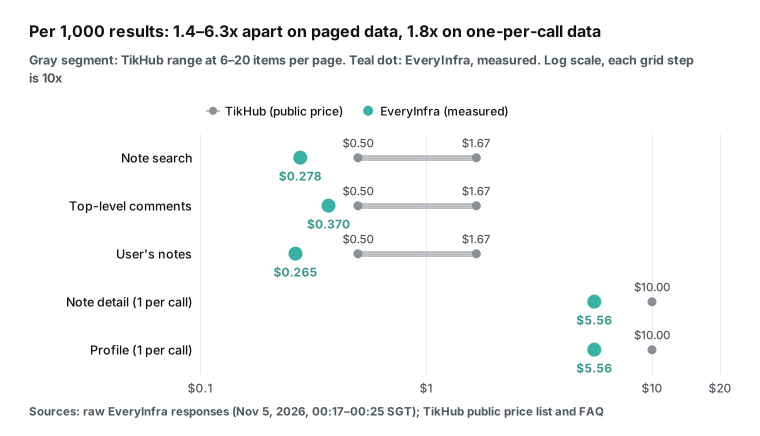
TikHub charges $0.01 per Xiaohongshu request. Our 11 live calls put search at $0.278 per 1,000 results, 1.8-6x less; profiles are only 1.8x less.

TikHub charges $0.01 for each request to its recommended Xiaohongshu (rednote) search endpoint. Its FAQ says that one page holds about 6 to 20 results, so 1,000 search results cost $0.50 to $1.67. On November 5, 2026 at 00:17 Singapore time (SGT), we called EveryInfra xiaohongshu/search for two pages. We got 40 results for $0.011112 in total, which is $0.278 per 1,000 results. That is 1.8 to 6.0 times less than TikHub.
The gap is large only for data that comes back in pages. For single objects, such as one note detail or one user profile, TikHub charges $0.01 and we charge $0.005556. That gap is only 1.8 times. Xiaohongshu is also priced high in our catalog: by median unit price, it ranks 15th of 106 platforms. So a full section below shows how to make fewer calls.
We also read every Xiaohongshu row in the public TikHub price list, which TikHub publishes on a doc page (read on November 5, 2026 at 00:13 SGT). Of its 95 priced endpoints, 42 belong to series that TikHub itself marks as deprecated. Four of the five endpoints that cost $0.001 are in those deprecated series.
This article uses one unit: cost per 1,000 returned rows. To get it, divide the money that a request actually charged by the rows that it actually returned, then multiply by 1,000. On our side, we always use the returned row count, not the number in the request. On the TikHub side, we use only public material. That is its pricing page, FAQ and rednote API page.
We also use its OpenAPI file and its public price-list doc page. We read them on November 5, 2026 between 00:13 and 00:15 SGT. We did not open a TikHub account or call its data endpoints. So every TikHub number below is a public price times a public page size, not a measured bill.

The full table: tikhub xiaohongshu endpoints against EveryInfra capabilities
The table below puts every number that you can check in one place. TikHub unit prices come from the endpoint_cost field in its price list. TikHub page sizes come from the FAQ question "What page sizes should I expect?". It says that paged Xiaohongshu endpoints return about 6 to 20 items per call, and that the first page can return fewer.
User search is an exception: the TikHub search users guide states a fixed 20 users per page. EveryInfra unit prices come from the Xiaohongshu catalog on the same day. Our row counts and charges come from the raw responses of our live calls.
| Data | TikHub endpoint (maintained series) | TikHub price / page | TikHub per 1,000 | EveryInfra capability | Live test: calls / rows / charged | EveryInfra per 1,000 | Ratio |
|---|---|---|---|---|---|---|---|
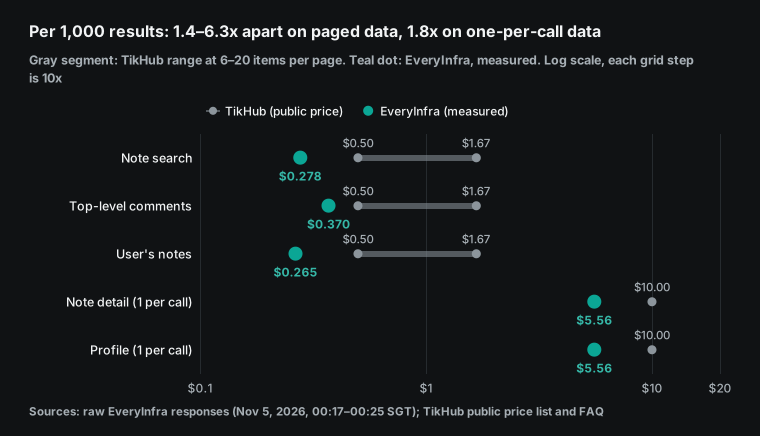
| Note search | app_v2/search_notes | $0.01 / 6-20 | $0.50-$1.67 | xiaohongshu/search | 2 / 40 / $0.011112 | $0.278 | 1.8-6.0 |
| Top-level comments | app_v2/get_note_comments | $0.01 / 6-20 | $0.50-$1.67 | xiaohongshu/comments | 2 / 30 / $0.011112 | $0.370 | 1.35-4.5 |
| User note list | app_v2/get_user_posted_notes | $0.01 / 6-20 | $0.50-$1.67 | xiaohongshu/user_posts | 1 / 21 / $0.005556 | $0.265 | 1.9-6.3 |
| User search | app_v2/search_users | $0.01 / 20 | $0.50 | xiaohongshu/search_users | 1 / 20 / $0.005556 | $0.278 | 1.8 |
| Note detail | app_v2/get_image_note_detail | $0.01 / 1 | $10.00 | xiaohongshu/note | 1 / 1 / $0.005556 | $5.56 | 1.8 |
| User profile | app_v2/get_user_info | $0.01 / 1 | $10.00 | xiaohongshu/profile | 1 / 1 / $0.005556 | $5.56 | 1.8 |
| Trending list | web_v3/fetch_hot_list | $0.001 / not stated | not stated | xiaohongshu/trending | 1 / 20 / $0.005556 | $0.278 | TikHub unit price is 5.6x lower |
Every ratio is the TikHub price divided by our price. The two ends of a range match 20 rows per page and 6 rows per page on the TikHub side. Three points help you read this table.
First, the three widest gaps are all paged data. When TikHub returns fewer rows per page, its cost per 1,000 rises. When it returns a full page of 20, our lead shrinks to the 1.8x unit-price gap, and for comments it shrinks to 1.35x. Second, the last row is a place where TikHub costs less.
Its maintained Web V3 series has a trending endpoint at $0.001, which is 1/5.6 of our xiaohongshu/trending price. That endpoint is not in the public OpenAPI file, and TikHub does not say how many rows it returns, so you must test it yourself. Third, the TikHub PGY series has 18 influencer-data endpoints at $0.02 each, and we cover only one of them. The coverage section below lists them.
How the per-1,000 number works on each side
Both sides use the same formula. Count the requests that you need for 1,000 rows, then multiply by the price per request. On the TikHub side, the request count is 1,000 divided by the page size, rounded up, because you cannot send half a request. At 6 to 20 rows per page, search needs 50 to 167 requests. At $0.01 each, that is $0.50 to $1.67.
On our side, we do not estimate from the catalog price. We take count and billing.charged_usd from each response and compute the total charged divided by the total rows, times 1,000. Two search pages gave 40 rows for $0.011112, so $0.278. Two comment pages gave 30 rows for $0.011112, so $0.370.
All of our calls ran on one test key on November 5, 2026. The table lists each one in order, with the rows that came back and the money that the response says it charged.
| Time (SGT) | Capability | Rows | `charged_usd` | Note |
|---|---|---|---|---|
| 00:17:04 | xiaohongshu/search page 1 | 20 | $0.005556 | Chinese keyword, no options |
| 00:17:41 | xiaohongshu/search page 2 | 20 | $0.005556 | page_token from page 1 |
| 00:17:59 | xiaohongshu/note | 1 | $0.005556 | URL from search results |
| 00:18:31 | xiaohongshu/comments page 1 | 15 | $0.005556 | Note with 253 comments |
| 00:18:34 | xiaohongshu/comments page 2 | 15 | $0.005556 | One repeat of page 1 |
| 00:18:42 | xiaohongshu/comments_batch | 30 | $0.011111 | Two notes, units 2 |
| 00:18:51 | xiaohongshu/user_posts | 21 | $0.005556 | Includes one pinned note |
| 00:18:54 | xiaohongshu/profile | 0 | $0 | 429, key limit, three tries |
| 00:22:08 | xiaohongshu/profile | 1 | $0.005556 | Retry worked |
| 00:22:16 | xiaohongshu/note | 0 | $0 | Missing note, refunded |
| 00:23:47 | xiaohongshu/search | 0 | $0 | 422, unknown page parameter |
| 00:23:57 | xiaohongshu/trending | 20 | $0.005556 | Default list |
| 00:25:31 | xiaohongshu/search_users | 20 | $0.005556 | Seven business accounts |
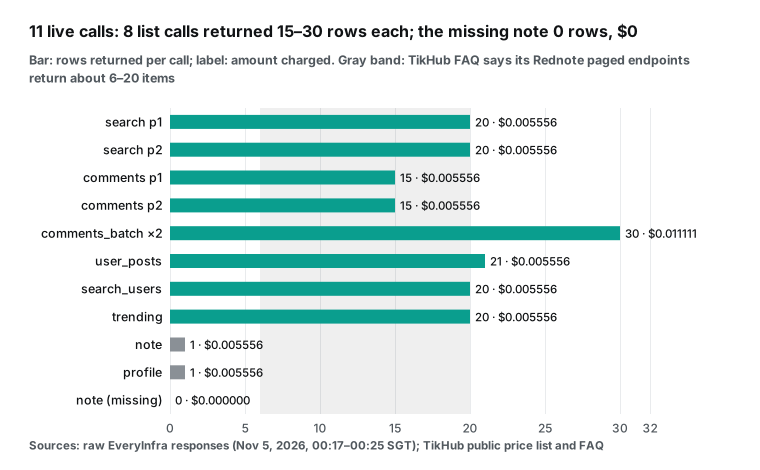
The 11 calls that returned data charged $0.061115 in total.
The method has two biases, and you should know both. First, it gives TikHub the full page-size range, but it gives us one keyword, one note and one account. With a rare keyword, our search page can also come back with fewer than 20 rows. We ran a test on November 2, 2026 for our post on pulling Xiaohongshu comments with Claude Code.
In it, several of eight xiaohongshu/comments pages returned only 10 rows. At that rate our cost is $0.556 per 1,000, which is about equal to TikHub at a full page of 20. In that case TikHub is slightly cheaper.
Second, comments can repeat. In this test, one comment appeared on both page 1 and page 2, with the same id. If you count only the 29 unique comments, our cost is $0.383 per 1,000. Thus the numbers here describe the sample from November 5, 2026. They are a scale, not a promise. The getting-started section at the end shows how to repeat the math with your own keyword.
TikHub's Xiaohongshu price list: 95 endpoints, 42 in deprecated series
TikHub publishes a price list for all of its endpoints ("get all endpoints information", doc page). Each row gives the path, the unit price endpoint_cost, the free-credit flag allow_free_credit, the discount flag allow_discount and the rate limit rate_limit. We read it on November 5, 2026 at 00:13:25 SGT. It had 1,472 rows, or 1,471 unique paths. Of these, 95 paths contain /xiaohongshu/. All 95 show a rate limit of 10 per second, which matches the FAQ default.
The time stamp on the list was 08:13:25 on November 4 in Los Angeles. This matches the FAQ, which says that the usage log runs on Los Angeles time. Our post on TikHub pricing read 1,470 rows on November 1, so two rows were added in four days.
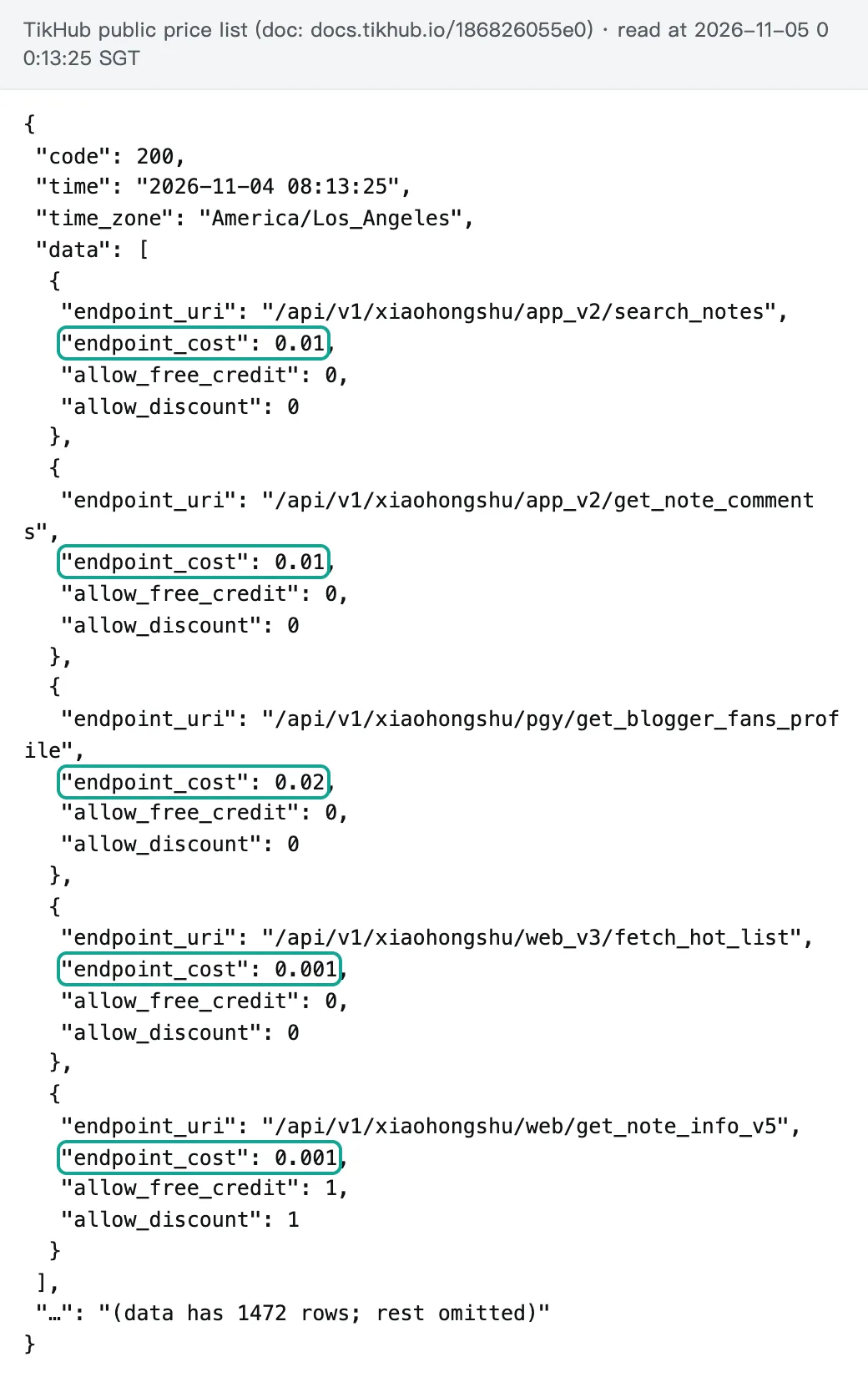
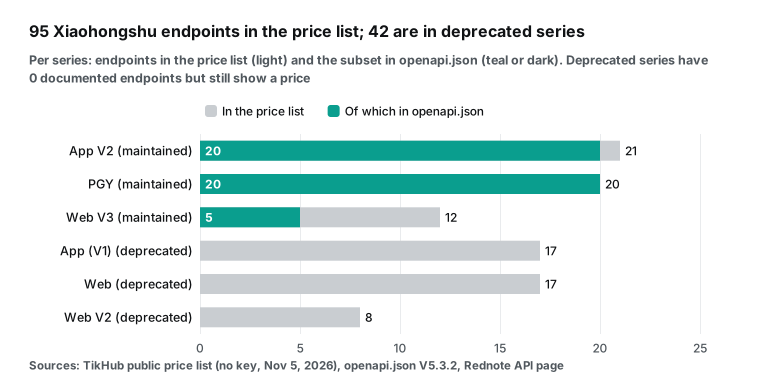
Each path in the price list carries a series name: app_v2, pgy, web_v3, app, web or web_v2. The TikHub rednote API page is clear about them. It says that App V1 (/xiaohongshu/app/), Web (/xiaohongshu/web/) and Web V2 are deprecated. It tells developers to build on App V2, PGY and Web V3, which are maintained. With that split, 42 of the 95 priced endpoints are in deprecated series and 53 are in maintained series.
We then matched the paths against the OpenAPI file, version 5.3.2. Only 45 Xiaohongshu endpoints are documented there. None of the deprecated ones are in it. Even the maintained Web V3 series has only 5 documented endpoints, and its other 7 appear only in the price list.
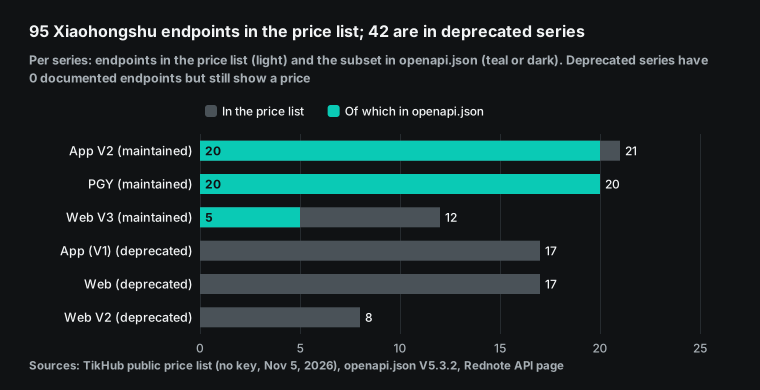
| Series | Status (TikHub rednote API page) | Endpoints in price list | In OpenAPI file | Unit prices |
|---|---|---|---|---|
| App V2 | Maintained, recommended | 21 | 20 | All $0.01 |
| PGY | Maintained | 20 | 20 | 18 at $0.02, 1 at $0.01, 1 at $0 |
| Web V3 | Maintained | 12 | 5 | 11 at $0.01, 1 at $0.001 |
| App V1 | Deprecated | 17 | 0 | 15 at $0.01, 1 at $0.001, 1 at $0 |
| Web | Deprecated | 17 | 0 | 12 at $0.01, 3 at $0.001, 1 at $0.011, 1 at $0 |
| Web V2 | Deprecated | 8 | 0 | All $0.01, type marked third-party |
This table matters when you choose an endpoint. The 52 paid endpoints in the maintained series have an average price of $0.01329. That is higher than the FAQ line "$0.01 per request", because the PGY series costs $0.02. In other words, $0.01 is the price for App V2 and Web V3.
Teams that buy influencer data from the PGY series pay twice that. On our side, 16 of 17 Xiaohongshu capabilities cost $0.005556 per call. Only xiaohongshu/pgy_content_square, the PGY content ranking, costs $0.016.
Where the cheap endpoints are: five at $0.001, four of them deprecated
Readers who search for "tikhub xiaohongshu" often see a few $0.001 rows and expect a cheap entry price. The table below lists every priced Xiaohongshu endpoint below $0.01. The series status comes from the page above. The free-credit and discount columns come from the allow_free_credit and allow_discount fields in the price list.
| Endpoint | Price | Series status | Free credit / discount | In OpenAPI file |
|---|---|---|---|---|
web/get_note_info_v5 (note detail) | $0.001 | Deprecated | Yes / Yes | No |
web/get_note_id_and_xsec_token | $0.001 | Deprecated | Yes / Yes | No |
web/sign (signature) | $0.001 | Deprecated | Yes / Yes | No |
app/get_user_id_and_xsec_token | $0.001 | Deprecated | No / No | No |
web_v3/fetch_hot_list (trending) | $0.001 | Maintained | No / No | No |
The cheapest note detail, web/get_note_info_v5, costs $0.001. That is 1/5.6 of our xiaohongshu/note. If it works, TikHub is 5.6 times cheaper for note details. But it belongs to the deprecated Web series. Under "Which Rednote series is current?", the TikHub FAQ says that the old App and Web series were fully retired on June 13, 2026.
So the three Xiaohongshu endpoints that accept free credit and discounts are all in retired series. For all 53 maintained endpoints, both allow_free_credit and allow_discount are 0. Under "What do I get for free?", the FAQ says that the $0.05 sign-up credit equals about 50 requests at the base price. In practice, you cannot use it to test any maintained Xiaohongshu endpoint.
Three TikHub sources describe the live series differently
While we compared the documents, we found that three public TikHub sources do not say the same thing about which Xiaohongshu series still work.
| Source | What it says | How it differs |
|---|---|---|
| FAQ, "Which Rednote series is current?" | App V2 is current and Web V3 is the fallback. Old App and Web retired on June 13, 2026. Web V2 is unmaintained. | Retirement date is June 13 |
| Rednote API page | Maintained: App V2, PGY, Web V3. Deprecated: App V1, Web, Web V2. | Agrees with the FAQ and adds PGY |
| Xiaohongshu API guide (TikHub blog, in Chinese) | App V1 and the Web series (Web V2 and Web V3) are permanently offline from June 17, 2026. App V2 is the only supported series, so no fallback is needed. | Counts Web V3 as offline, with a June 17 date |
| OpenAPI file, v5.3.2 | Documents 20 App V2, 20 PGY and 5 Web V3 endpoints | Web V3 is still documented |
| Public price list | All 95 endpoints in 6 series have a price | The 42 deprecated endpoints still show prices |
There is one more difference. Under "Can I list notes by topic or tag?", the FAQ says that topic lists are not supported and the old get_notes_by_topic endpoint is unmaintained. It suggests keyword search instead. But the App V2 topic feed endpoint is in the OpenAPI file and in the guide, with a price of $0.01.
We have no TikHub account, so we cannot test which statement is current. We list them as they are. Our advice is simple. Build on App V2, treat Web V3 as "may work", and do not budget around the $0.001 rows.
Test 1: note search, 40 rows over two pages for $0.011
At 00:17:04 SGT on November 5, 2026, we called xiaohongshu/search with a Chinese keyword that means "down jacket recommendations". We sent no optional parameters. It returned 20 rows and charged $0.005556. At 00:17:41 SGT we passed the returned next_page_token back unchanged and got page 2, with 20 more rows for $0.005556.
After de-duplication by id, all 40 rows were unique. The catalog lists a page_size of 20 for this capability and says that limit has no effect. A page token stays valid for 24 hours. Both pages came back full.
The 40 rows show what the default sort returns. Only 1 of 40 was a video note. 35 of 40 were posted on or after October 6, 2026, which is within 30 days of our call. The median like count was 130, the highest 8,822 and the lowest 0.
The newest note was posted at 19:18 SGT on November 4, only 5 hours before our call. For a brand that watches winter clothing around Singles' Day, this means the default sort already favors recent notes. You may not need date_range. The catalog also warns that filters such as date_range=last_30_days can return a page with fewer than 20 rows, and then your cost per 1,000 rises.
One detail matters a lot when you start: all 40 result URLs include an xsec_token. Under "Where does the xsec_token come from?", the TikHub FAQ says that xsec tokens are no longer returned in its API responses. You must copy them from the query string of a web link. Its Web V3 note detail endpoint needs both note_id and xsec_token. The App V2 endpoints accept a share_text share link instead.
On our side, you can pass the URLs from search results straight to xiaohongshu/note, xiaohongshu/comments and xiaohongshu/comments_batch. The next three tests all used URLs that we copied from the search results with no extra parsing.
On the TikHub side, the search notes guide pages with a page number from 1. On each next page you must send back the search_id and search_session_id from the first response. It offers six sort orders: general, newest, most liked, most commented, most collected and English first. Time filters are one day, one week and half a year.
Our sort has five values: relevance, newest, most liked, most commented and most collected. Our date_range adds last 30 days and last year. At a full page of 20, TikHub costs $0.50 per 1,000, or 1.8 times our measured cost. At 6 per page it costs $1.67, or 6.0 times.
Test 2: comments and multi-note batches, one repeat in 30 rows
At 00:18:31 SGT we called xiaohongshu/comments on a note from the first search page. That note had 253 comments. Page 1 returned 15 rows. At 00:18:34 SGT we sent the page token and got page 2, with 15 more. The two pages cost $0.011112 for 30 rows, which is $0.370 per 1,000. The catalog lists a page size of 15, and both pages were full.
One normal comment appeared on both pages with the same id. With 29 unique rows, the cost is $0.383 per 1,000. Three of the 30 comments had images, and one was a reply from the note author. The comments carried 8 inline sub-replies, but their sub_comment_count values add up to 71. To get every reply, you must call xiaohongshu/sub_comments for each comment.
The TikHub note comments guide pages with three fields: cursor, index and pageArea. Its default sort is newest first (latest_v2). The guide itself warns that the default sort can skip or repeat comments while you page. The guide does not state a page size.
The FAQ gives about 6 to 20 per call for paged Xiaohongshu endpoints, and says that the first page can return fewer. At 6 to 20, TikHub costs $0.50 to $1.67 per 1,000 comments, or 1.35 to 4.5 times our cost. To be fair: if TikHub returns a steady 20 per page, the gap is only $0.13 per 1,000. Comments are the paged data where our lead is smallest.
At 00:18:42 SGT we tried xiaohongshu/comments_batch. One request carried two note URLs. It returned 30 rows, 15 per note, and charged $0.011111, with billing.units set to 2. It bills per target note, up to 20 notes per request. So it does not save money against single calls. It saves requests and code: one request gets the first comment page of 20 notes.
Under "What does Rednote cost?", the TikHub FAQ says: "Notes are fetched one at a time — there is no batch note endpoint." That line is about notes. We also found no batch comment endpoint in its Xiaohongshu price list. If you scan the first comments of hundreds of notes each day, this difference matters more than the unit price.
Test 3: profiles and note lists, and why single objects cost more
At 00:18:51 SGT we called xiaohongshu/user_posts for the author of the note above. It returned 21 rows, one more than the catalog page size of 20. The extra row was a pinned note, with is_pinned set to true. 18 of the 21 notes were videos.
The oldest was posted on March 18, 2026 and the newest on November 4, and the response had a next-page token. The cost was $0.265 per 1,000, the lowest of all our paged data. The TikHub user notes guide pages with the cursor of the last note and does not state a page size. At the FAQ range of 6 to 20, TikHub costs $0.50 to $1.67 per 1,000, or 1.9 to 6.3 times our cost.
Profiles are different. At 00:18:54 SGT our xiaohongshu/profile call got HTTP 429. We had set a limit of 10 calls per minute on this test key. The account default is 60 per minute. The response gave reason as key_limit, retry_after as 6 seconds, and the text "Nothing was charged".
Retries at 00:19:54 and 00:20:54 SGT got 429 again, and none of the three 429s cost money. The retry at 00:22:08 SGT worked. It returned one account object with 18 filled fields, such as follower count, likes and collects, note count, IP location and verification status. It charged $0.005556. The account is an ordinary creator with close to 200,000 followers, so we do not name it.
A profile call returns one account on both sides. The TikHub user info guide is the same, at $0.01 each. Thus 100 profiles cost $1.00 against $0.56, a gap of only 1.8 times.
If you only need follower counts and verification flags for a list of accounts, you can skip profile calls. At 00:25:31 SGT we called xiaohongshu/search_users with a Chinese keyword for "down jacket". One page returned 20 accounts. Each row had a follower count, a verified flag and a verification type. Seven of the 20 were business-verified accounts. The call charged $0.005556.
Five pages screen 100 accounts for $0.028. One hundred profile calls cost $0.56, which is 20 times more. The trade-off is that user search returns only 9 fields, with no bio, like total or IP location. Use it to screen first, then call profiles for the few accounts that matter. TikHub user search returns a fixed 20 per page at $0.01, so 100 accounts cost $0.05, or 1.8 times our cost.
Test 4: empty results, wrong parameters and rate limits
TikHub bills every HTTP 200. Under "What exactly gets billed?", the FAQ says that only successful requests are billed, and a request is successful when it returns 200. The problem is that "successful" covers a lot for Xiaohongshu. We read the description of each of the 45 documented Xiaohongshu endpoints in the OpenAPI file. 33 of them say that a wrong or missing ID, a failed share-link parse or an empty result is still billed. These are 13 App V2 endpoints and all 20 PGY endpoints.
The App V2 text says that with a wrong note ID, the endpoint still responds with a "service error" message in data. It bills that request as normal. The PGY text says that HTTP 200 is billed, including empty results where data is null. Only HTTP 400 is free.
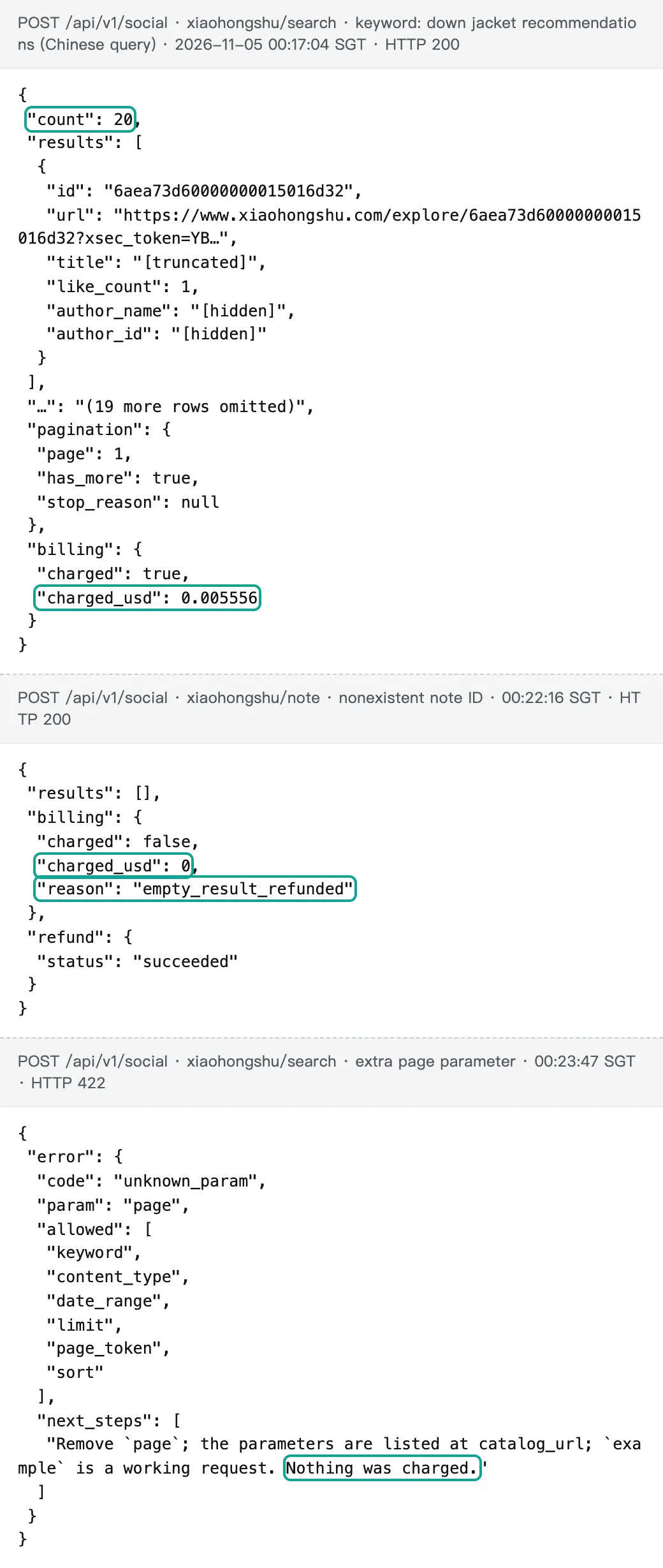
In our test, three calls returned no data, and none of them cost money. At 00:22:16 SGT we called xiaohongshu/note with a note link whose 24-digit ID was all zeros. It returned 200 with empty results, billing.charged_usd 0, reason empty_result_refunded, and refund.status succeeded. At 00:23:47 SGT we sent xiaohongshu/search with a page parameter on purpose, as a TikHub user would.
It returned 422 with code unknown_param. The error listed the 6 allowed parameters and a working example request, and it ended with "Nothing was charged". The third was the 429 from test 3. The table below puts the rules for each case side by side.
| Case | TikHub (docs text) | EveryInfra (this test) |
|---|---|---|
| Note or user ID does not exist | App V2 responds and bills $0.01 | Empty result, hold refunded, $0 charged |
PGY empty result (data is null) | HTTP 200, billed $0.02 | Not applicable (we have only the content ranking) |
| Wrong parameter | HTTP 400 is free. The FAQ says some 400s are temporary and suggests retries | 422 with allowed parameters and an example, $0 |
| Over the rate limit | 429, free | 429 with retry_after, free |
| Default rate | 10 per second (600 per minute) | 60 per minute across all keys on the account |
The last row is a point for TikHub. Its default of 10 requests per second is 10 times our default. To reach 600 per minute with us, you buy a $30 boost for 30 days. You also get it for free after $150 in total top-ups (see pricing).
The rows above it hide money that batch jobs often miss. Say that you export 10,000 note links from a spreadsheet, and 5% of the notes were deleted or the links expired. On TikHub those 500 calls cost $5.00. With us they cost $0.
Coverage: what TikHub has and we do not
Unit prices tell only half of the story, because the two sides do not offer the same Xiaohongshu data. The table below maps the maintained TikHub endpoints to our 17 Xiaohongshu capabilities by function. It leaves out the deprecated series.
| Function | TikHub endpoint | EveryInfra capability | Who has it |
|---|---|---|---|
| Keyword note search | app_v2/search_notes | xiaohongshu/search | Both |
| Note detail (image or video) | app_v2/get_image_note_detail, get_video_note_detail | xiaohongshu/note, xiaohongshu/video | Both |
| Comments and replies | app_v2/get_note_comments, get_note_sub_comments | xiaohongshu/comments, xiaohongshu/sub_comments | Both |
| Comments for many notes in one request | None (FAQ: no batch note endpoint; no batch comment endpoint in the price list) | xiaohongshu/comments_batch, 1-20 notes | EveryInfra only |
| Profile and note list | app_v2/get_user_info, get_user_posted_notes | xiaohongshu/profile, xiaohongshu/user_posts | Both |
| A user's public saved notes | app_v2/get_user_faved_notes | None | TikHub only |
| Follower list | None | xiaohongshu/followers_list | EveryInfra only |
| User search | app_v2/search_users | xiaohongshu/search_users | Both |
| Image search, group search | app_v2/search_images, search_groups | None | TikHub only |
| Topic info, topic feed | app_v2/get_topic_info, get_topic_feed | xiaohongshu/hashtag (topic notes) | Topic info: TikHub only |
| Product search, detail, reviews | app_v2/search_products, get_product_detail, get_product_reviews | xiaohongshu/product_search, product_detail, reviews | Both |
| Review overview, product recommendations | app_v2/get_product_review_overview, get_product_recommendations | None | TikHub only |
| Creator inspiration, search suggestions, home feed | Two App V2 inspiration feeds, web_v3/fetch_search_suggest, fetch_homefeed | None | TikHub only |
| Trending list | web_v3/fetch_hot_list at $0.001 (not documented) | xiaohongshu/trending | Both |
| Note location | None | xiaohongshu/note_location | EveryInfra only |
| PGY content ranking | pgy/get_content_square at $0.02 | xiaohongshu/pgy_content_square at $0.016 | Both |
| PGY influencer detail, audience profile, growth, rate-card data, keyword index | The other 17 paid pgy/ endpoints | None | TikHub only |
The PGY row is the widest coverage gap. PGY (Pugongying) is the Xiaohongshu platform where brands hire creators. TikHub sells several PGY data types at $0.02 each. They include creator detail (doc) and audience profile (doc), with age, gender, region, device and interest splits. They also include creator marketplace search (doc) and keyword overview (doc), with a search index.
Influencer agencies need exactly this data to pick creators and check their rates. We have only the content ranking (TikHub's matching endpoint is documented here). If your main job is "pull an audience profile for each of these 200 creators", we cannot do it, and you should use TikHub. The TikHub FAQ also notes one number that neither side can give you: Xiaohongshu does not expose play counts or download counts.
One job priced in full: an agency that watches five brands
English-speaking readers often watch rednote for brands that sell into China, such as beauty, outdoor wear or wine. Take an agency that tracks five brands. For each brand, it pulls 500 search results and 500 top-level comments each day. TikHub is priced at 20 rows per page and at 6 rows per page. Our side uses the page sizes that we measured: 20 for search and 15 for comments. Top-up fees are not included on either side.
| Item (per day, five brands) | TikHub requests | TikHub cost | EveryInfra requests | EveryInfra cost |
|---|---|---|---|---|
| 2,500 search results | 125-420 | $1.25-$4.20 | 125 | $0.69 |
| 2,500 comments | 125-420 | $1.25-$4.20 | 170 | $0.94 |
| Total per day | 250-840 | $2.50-$8.40 | 295 | $1.64 |
| Total for 30 days | 7,500-25,200 | $75.00-$252.00 | 8,850 | $49.17 |
Over 30 days, that is $75.00 to $252.00 on TikHub against $49.17 with us, or 1.5 to 5.1 times. TikHub's FAQ says that Xiaohongshu discounts start only at 1 million requests per month. This job uses 7,500 to 25,200 requests per month, which is far below that line, so list prices are the right basis. Our request count is higher than TikHub's best case, because our comment pages hold 15 rows. Even so, our lower unit price wins at every point in TikHub's range.
The same math also covers the standard job that we use in all our Xiaohongshu comparisons: 1,000 search results, 1,000 comments and 100 profiles. The chart below shows it.
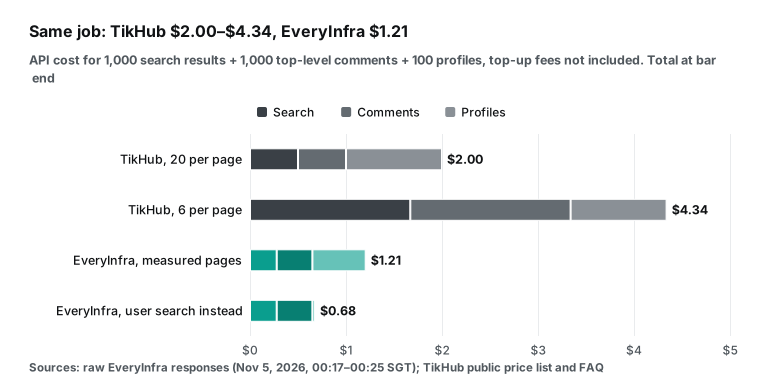
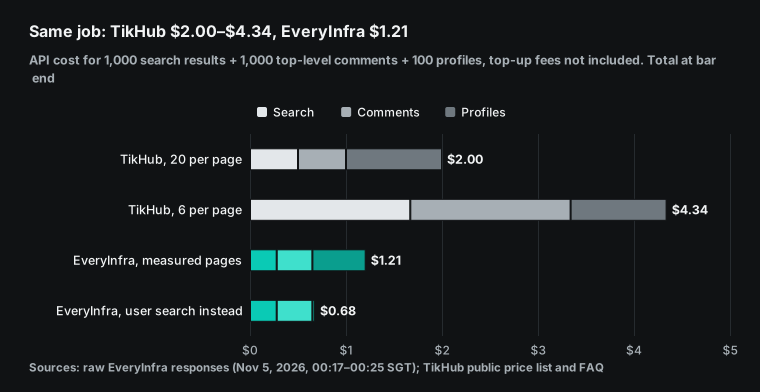
That job costs $2.00 to $4.34 on TikHub and $1.21 with us, or 1.66 to 3.60 times. Profiles are 46% of our total, because single objects are where our lead is smallest. If you screen with 5 pages of user search first, the job drops to $0.68.
The opposite case is a job made mostly of single objects. Suppose that you fetch 10,000 note details per day. That costs $100 on TikHub and $55.56 with us. The gap stays at 1.8 times and never grows, because both sides return one note per request.
Top-ups, free credit and rate limits: costs beyond the unit price
Some costs and limits sit outside the unit price, and they matter for small teams. The TikHub side comes from its pricing page and FAQ. Our side comes from our pricing page and docs. We read all of them on November 5, 2026.
| Item | TikHub | EveryInfra |
|---|---|---|
| Minimum top-up | $5 | Lowest tier on the pricing page is $10 |
| Payment fees | Alipay 2.6% + $0.30. PayPal and USDT 5% + $0.30 (FAQ example: a $5 PayPal top-up costs $5.55) | Depends on the payment method. The console shows the amount due and the fee before you pay |
| Free trial | $0.05 after email check. No maintained Xiaohongshu endpoint accepts it | Star two GitHub repos to get $1, valid for 24 hours. Xiaohongshu calls are included, about 179 calls |
| Refunds | All sales final, except when TikHub confirms an endpoint is unavailable (refund policy, updated July 20, 2026) | Failed and empty calls go back to your balance one by one. Top-up balance does not expire |
| Discounts | Xiaohongshu: only at 1 million or more requests per month | The pricing page shows list prices. Your account price is in the console, and each charge is in the billing field of the response |
| Default rate | 10 per second. 20 per second for $5 per month, up to 100 per second for $55 per month | 60 per minute. 180 per minute for $10 per 30 days, 600 for $30 per 30 days |
For a first test, the free-trial row matters most. To see real Xiaohongshu fields on TikHub, you must top up $5 first, which costs $5.43 with Alipay. With us, the $1 trial covers 179 xiaohongshu/search calls at $0.005556. That is enough to repeat all 11 live calls in this article more than a dozen times. For rate limits, the picture flips: TikHub is far more generous. A job that must scan thousands of links in a few minutes will queue on our default limit, or you buy a boost.
Xiaohongshu is one of our pricier platforms: how to call less
In our catalog, Xiaohongshu is in the complex tier at $0.005556 per call. That is 10 times $0.000556, the price of the cheapest basic tier on Douyin and TikTok. In our full catalog on November 5, 2026, 16 Douyin and 13 TikTok capabilities had that price. So budget it on its own line. Each method in the table comes from this test or from the catalog, and each one turns into money that you can count.
| Method | What to do | Example from this test | Saving |
|---|---|---|---|
| Use search rows, skip details | Read title, likes, collects, comments, shares, post time and author from xiaohongshu/search; call xiaohongshu/note only when you need full text or hashtags | 1,000 notes: 50 search calls ($0.28) against 1,000 detail calls ($5.56) | 20x |
| Screen accounts first | Use xiaohongshu/search_users for follower counts and verified flags, then call profiles for a short list | 100 accounts: $0.028 against $0.56 | 20x |
| Read the first comment page | Use xiaohongshu/comments_batch for one page of up to 20 notes, then page deeper only where it matters | 8 replies already came inline, so sub_comments was not needed for them | Fewer requests |
| Keep page tokens | Tokens stay valid for 24 hours, so a stopped job continues from the last token | No repeat of page 1 after a stop | Pages you skip |
De-duplicate by id | Count unique rows before you work out cost or coverage | 1 repeat in 30 comment rows (3.3%) | A true cost figure |
The first method saves the most. The catalog says that the search text field is a summary of about 60 characters. If your analysis needs only engagement counts and titles, that summary is enough, and you never pay for 1,000 single-note calls. If you read the same results more than once a day, store a copy and do not call again.
TikHub has one saving trick that is worth copying. Each response includes a cache_url that you can open again for free for 24 hours (see the rednote API page). But the FAQ also says that a repeat request with the same parameters is billed as a new request. So cache_url is a debugging aid, not a cache.
MCP and AI tools: how to connect each side
Both sides work with MCP clients. MCP (Model Context Protocol) is an open protocol that lets AI clients call outside tools; see the specification. The setups are different.
The TikHub MCP page describes one server per platform at https://mcp.tikhub.io/{platform}/mcp. The FAQ says that the Xiaohongshu server has 71 tools. Desktop clients such as Claude Desktop use npx mcp-remote to bridge the remote server to stdio, which needs Node.js. The FAQ also says that MCP, the Chrome extension, Zapier and n8n are billed the same as direct API calls.
Our side is one address, https://api.everyinfra.com/mcp. The default entry has 12 tools, which we confirmed by reading tools/list without a key at 00:24:25 SGT. Xiaohongshu and more than 100 other platforms all go through one tool, everyinfra_call_api. The setup is on the MCP server page.
| Item | TikHub | EveryInfra |
|---|---|---|
| Server address | One per platform, https://mcp.tikhub.io/{platform}/mcp | One, https://api.everyinfra.com/mcp |
| Xiaohongshu tools | 71 (FAQ) | Reached through everyinfra_call_api |
| Default tools listed | 990+ across 16 servers | 12 (tools/list, 00:24:25 SGT) |
| Desktop setup | npx mcp-remote bridge, needs Node.js | URL and header in the client config |
| Billing | Same as direct API calls | Same as direct API calls, failed and empty calls free |
{
  "mcpServers": {
    "everyinfra": {
      "url": "https://api.everyinfra.com/mcp",
      "headers": { "Authorization": "Bearer YOUR_API_KEY" }
    }
  }
}
71 tools and 12 tools each have a cost. With many tools, the AI can pick an exact tool such as "get PGY creator audience profile". But the client must load 71 tool descriptions into context at the start of each chat. The AI also has more chances to pick the wrong version.
With few tools, the AI first calls everyinfra_list_capabilities to read the catalog, then fills in platform and action. That is one more step, but each capability has one price and one way to write its parameters. When an AI agent runs Xiaohongshu jobs in bulk, write the capability and page size in the prompt. For example: "Use xiaohongshu/search for 3 pages of 20 rows each, and remove duplicates by id." Then the agent will not fall back to note detail calls that return one row each.
curl and fields: what to change when you move from TikHub
TikHub Xiaohongshu endpoints use GET with query parameters and an Authorization: Bearer header. We use one POST address, with the platform and capability in the request body. Below is the exact request from test 1. Replace the key with your own.
curl -X POST https://api.everyinfra.com/api/v1/social \
  -H "Authorization: Bearer $EVERYINFRA_API_KEY" \
  -H "Content-Type: application/json" \
  -d '{"platform":"xiaohongshu","action":"search","params":{"keyword":"羽绒服推荐"}}'

# Next page: copy next_page_token from the response into page_token and keep the rest
curl -X POST https://api.everyinfra.com/api/v1/social \
  -H "Authorization: Bearer $EVERYINFRA_API_KEY" \
  -H "Content-Type: application/json" \
  -d '{"platform":"xiaohongshu","action":"search","params":{"keyword":"羽绒服推荐","page_token":"<next_page_token>"}}'
Most changes are parameter names and the path to the data. TikHub wraps each response in code and data, and PGY endpoints add a second data layer (its docs say that you must unwrap two layers). Our rows are in the top-level results, the page token is in the top-level next_page_token, and the charge is in billing.charged_usd. The table lists only the fields that this article uses. We checked each name against the catalog response_fields.
| Purpose | TikHub (App V2) | EveryInfra |
|---|---|---|
| Paging | Search: page + search_id + search_session_id. Comments: cursor + index + pageArea | One page_token, taken from the last next_page_token |
| Pick a note | note_id or share_text (share link) | url (note link with xsec_token; search result URLs work as they are) |
| Sort | sort_type (6 values), comments sort_strategy | sort (5 values for search; comment values are in the catalog) |
| Likes, collects, comments | interact_info.liked_count and similar | like_count, collect_count, comment_count, share_count |
| Author | user.user_id, user.nickname | author_id, author_name, author_red_id |
| Cost of this call | Not in the response; check the usage log (Los Angeles time) | billing.charged_usd |
If you keep a TikHub-style parameter by mistake, we return 422 and tell you what to send. We do not charge you, as test 4 showed. For the parameters and fields of every Xiaohongshu capability, see the Xiaohongshu platform page.
Terms and law: what the platform, regulators and courts say
This section covers data methods and public texts only. It is not legal advice. Xiaohongshu has a separate rednote Terms of Service for users outside mainland China. Its Chinese user agreement was updated on March 23, 2026. Clause 3.4 says that nobody may copy, read, use or compile platform content or data without written permission. Clause 4.1 lists illegal scraping and simulated downloads of videos, posts and user data as banned acts.
The Xiaohongshu open platform serves ERP, order and in-house systems that shops authorize. On October 19, 2026 it posted a notice that a category-prediction API is retired and moving. Note and comment content is not open there, which is why third-party APIs exist. Our post on how to choose a Xiaohongshu API compares the three routes.
Two laws matter for comment data. The Personal Information Protection Law covers the handling of personal data such as commenter nicknames and IP regions. The Network Data Security Management Regulations (State Council Order no. 790) add two rules. Article 18 says that automated collection must assess its effect on the network service and must not disturb normal operation.
Article 24 says that unneeded personal data collected by automated tools must be deleted or anonymized. So whichever API you use, the simplest step is to drop unneeded nicknames and user IDs as soon as you get comments. We did this for every screenshot and number in this article.
Court rulings give two limits. On April 24, 2026, the Fujian High Court published cases (Xinhua report, in Chinese). Software that downloaded Xiaohongshu posts one by one with watermarks kept was not found to be unfair competition. But software that changed video MD5 values to help repost content was. In a 2025 criminal case published by the Changzhou court, three people cracked app encryption, forged requests, scraped user data and sent bulk messages. They were convicted of illegally controlling computer systems, and more than 6.53 million yuan in illegal gains was seized.
In both cases, the acts that the courts ruled against were cracking encryption, forging requests and helping to repost other people's content.
When TikHub is the better choice
Here are the cases where TikHub makes more sense, stated plainly. The table gives the reason for each case and what our side offers instead.
| Your need | Why TikHub fits | Our side |
|---|---|---|
| PGY influencer data: audience profiles, follower growth, marketplace filters, keyword index | 17 paid pgy/ endpoints at $0.02 | Only the PGY content ranking |
| Image search, group search, public saved notes, review overviews, product recommendations, inspiration feeds, search suggestions | Documented App V2 and Web V3 endpoints | Not in our Xiaohongshu catalog |
| High throughput | 10 requests per second by default | 60 per minute by default |
| Only short share links | App V2 accepts share_text from xhslink.com | Needs a note URL with xsec_token |
| Very high daily volume on other platforms | Some endpoints get a 0% to 50% daily tiered discount | List price per capability |
| Trending data at the lowest unit price | web_v3/fetch_hot_list at $0.001, if it works | xiaohongshu/trending at $0.005556 |
Two of these rows need more words. For short share links, our note capabilities work best with URLs from our own search results, which already carry the token. For the discount row, the FAQ says that the discount works like tax brackets. Our TikHub pricing post works out where the lines cross. The maintained Xiaohongshu endpoints are not in that discount, so this row applies to other platforms only.
Now the other way round. Say that you mostly monitor Xiaohongshu search, comments and account note lists, and you often hit deleted or expired links. Or you want comments for many notes in one request, or a free test before you pay. By the numbers here, the same data costs 1.35 to 6.3 times less with us, and failed or empty calls cost nothing.
For a wider comparison, see the TikHub alternative page.
Market signals, September to November 2026
Five public events from the last two months change how you should plan a rednote data budget. The table lists them, and the paragraphs below explain the two that matter most.
| Date | Source | What happened | What it means for your budget |
|---|---|---|---|
| October 9, 2026 | China Daily | Red Land festival drew more than 200,000 visitors; Xiaohongshu cites 120 million monthly users interested in gaming | Count gaming and anime keywords, not only beauty and fashion |
| October 12, 2026 | Eastmoney / Southern Metropolis Daily | Xiaohongshu started its Singles' Day live week on October 10, before JD.com and Douyin | Budget for sale-season volume from mid-October |
| October 19, 2026 | Xiaohongshu open platform | A category-prediction API was retired and moved | The official platform serves shop APIs and changes over time |
| October 20, 2026 | People's Daily Online | A week-long city event in Beijing's Shougang Park from October 24 | City events also drive note volume |
| October 21, 2026 | Jing Daily | #nicheshoes reached 1 billion impressions and luxury brands joined in | Trend tracking needs notes by topic |
The Singles' Day row explains our own sample. In our "down jacket recommendations" search, 35 of 40 notes were from the last 30 days. If you plan a monthly budget from a quiet week, you will be short during the sale season. The topic row matters for tool choice. TikHub's topic endpoints have conflicting docs (see above). On our side, xiaohongshu/hashtag pulls notes by topic.
From November 1 to November 5, 2026, the TikHub public price list grew from 1,470 to 1,472 rows, with Xiaohongshu still at 95. In the same week, the open-source xiaohongshu-mcp project had a push on November 4, 2026 (SGT) and 16,895 stars. Its README says that you must log in with your own Xiaohongshu account first. It also says that one account cannot stay logged in on several web clients at once. For readers, this means that open-source tools save money but put your own account at risk. Paid APIs need no account, but you must check whether each endpoint is still maintained.
Limits: when these conclusions do not hold
The ratios in this article change in the cases below. The table names each assumption and what happens to the result if it does not hold.
| Assumption | If it does not hold | Effect |
|---|---|---|
| TikHub returns 6 to 20 rows per page (FAQ range) | It returns a full 20 every time | Search gap 1.8x, comment gap 1.35x |
| Our page sizes from 1 keyword, 1 note, 1 account | A rare keyword or a filter gives short pages | Our cost per 1,000 rises, up to $0.556 for 10-row comment pages |
| Deprecated TikHub endpoints do not respond | web/get_note_info_v5 still works | TikHub 5.6x cheaper for note details |
| Prices as read on November 5, 2026 | Either side changes a price | Read both price lists again |
| Fees only | You also count waiting time | See the last paragraph |
This article also does not compare data quality. Field names differ, and the number of fields for the same note may differ too. Our note detail had 24 filled fields in this test. We have no real TikHub response to compare field by field. So we do not claim that the fields are the same or that one side is more complete.
The totals here count API fees only, not staff time or waiting. The TikHub FAQ suggests a 30 to 60 minute wait after repeated 400 errors. With us, a 429 means a wait of retry_after seconds. Neither wait costs money, but both make a job take longer. If your report must be ready by 9 a.m. each day, plan for the worst-case wait before you choose a provider or buy a rate boost.
FAQ
tikhub xiaohongshu login: do I need a Xiaohongshu account to use TikHub?
Under "Do I have to give you my TikTok or Instagram login?", the TikHub FAQ says that standard endpoints need no social account, cookie or session, only a TikHub API key. A few endpoints need an extra session token, and their docs say so. Our side is the same: Xiaohongshu capabilities need only an EveryInfra API key. Both differ from the open-source xiaohongshu-mcp, which needs you to log in with your own account.
xiaohongshu api alternatives reddit: is there a free Xiaohongshu API?
The official open platform does not open note or comment data. TikHub gives $0.05 at sign-up, but no maintained Xiaohongshu endpoint accepts it. Our $1 GitHub-star trial covers about 179 xiaohongshu/search calls within 24 hours. The only long-term free route is open source, and then you log in with your own account and maintain the signing logic yourself.
rednote api key: how do I get a key for rednote data?
Xiaohongshu does not issue content-data keys to the public, because its open platform is for authorized shop systems. On TikHub you sign up, verify your email and create a key in the dashboard. With us, you sign up, claim the trial in the console and create a key; the steps are in quickstart. In both cases the key is a third-party key, not a Xiaohongshu key.
xiaohongshu search api: how many results does one search call return?
Our xiaohongshu/search returned 20 rows per page on both pages in this test, and the catalog lists 20. The TikHub FAQ gives about 6 to 20 for paged Xiaohongshu endpoints, and says that the first page can return fewer. Filters can lower the count on both sides, so measure your own keyword before you budget.
xiaohongshu api documentation: where are the docs for each side?
TikHub documents 45 Xiaohongshu endpoints in its OpenAPI file and on docs.tikhub.io. The other 50 priced endpoints appear only in the price list. Our parameters, enum values and response fields for each capability are in the catalog, which needs no key, and on each capability page.
xiaohongshu scraper api: what is the cheapest way to collect comments?
If you need only the first comment page of each note, use xiaohongshu/comments_batch with up to 20 notes per request. It bills per note in one request. For all comments on one note, page through xiaohongshu/comments with page_token, at 15 rows per page. Some replies already come inline, and xiaohongshu/sub_comments gets the rest. De-duplicate by id: we found 1 repeat in 30 rows.
Getting started: repeat the math with your own keyword
Step 1: star the everyinfra/everyinfra-agent-plugins and everyinfra/seo-skills repos on GitHub. Sign up, claim the $1 trial in the console and create an API key. The details are in quickstart. Step 2: run the curl above with a keyword that you care about. Note the count and billing.charged_usd in the response, then fetch one more page with page_token. Step 3: pick one note from the results and pass its url once to xiaohongshu/comments and once to xiaohongshu/comments_batch.
Step 4: compute your own number with "total charged divided by total rows, times 1,000". Compare it with the matching TikHub row, at $0.01 times 1,000 divided by the page size, rounded up. For TikHub unit prices, see its public price-list doc page. You can read our catalog with the command below. All capabilities and the trial are in the data market. For similar Douyin capabilities, see the Douyin platform page.
# EveryInfra Xiaohongshu catalog (no key): unit price, page size and fields
curl -s "https://api.everyinfra.com/api/v1/social/catalog?platform=xiaohongshu" \
  | jq -r '.capabilities[] | select(.platform=="xiaohongshu") | "\(.price_usd)\t\(.action)\t\(.page_size // "-")"'
References
- TikHub, "Get all endpoints information" public price-list doc page, read 2026-11-05 00:13 SGT, <https://docs.tikhub.io/186826055e0>
- TikHub, openapi.json (v5.3.2), read 2026-11-05, <https://api.tikhub.io/openapi.json>
- TikHub, FAQ (billing, rate limits and platform support), read 2026-11-05, <https://tikhub.io/faq>
- TikHub, Pricing, read 2026-11-05, <https://tikhub.io/pricing>
- TikHub, Rednote API page, read 2026-11-05, <https://tikhub.io/xiaohongshu-api>
- TikHub blog, Xiaohongshu API guide (in Chinese), <https://blog.tikhub.io/zh/article/7>
- TikHub, MCP integration page, <https://tikhub.io/mcp>
- TikHub, llms.txt, <https://tikhub.io/llms.txt>
- TikHub docs, Search notes (App V2), <https://docs.tikhub.io/420136398e0>
- TikHub docs, Get note comments (App V2), <https://docs.tikhub.io/420136394e0>
- TikHub docs, Get note sub-comments (App V2), <https://docs.tikhub.io/420748830e0>
- TikHub docs, Get user info (App V2), <https://docs.tikhub.io/420136395e0>
- TikHub docs, Get user posted notes (App V2), <https://docs.tikhub.io/420136396e0>
- TikHub docs, Get image note detail (App V2), <https://docs.tikhub.io/420136391e0>
- TikHub docs, Get video note detail (App V2), <https://docs.tikhub.io/420136392e0>
- TikHub docs, Search users (App V2), <https://docs.tikhub.io/420136399e0>
- TikHub docs, Search products (App V2), <https://docs.tikhub.io/420136401e0>
- TikHub docs, Get product detail (App V2), <https://docs.tikhub.io/420136403e0>
- TikHub docs, Get product reviews (App V2), <https://docs.tikhub.io/420136405e0>
- TikHub docs, Get topic feed (App V2), <https://docs.tikhub.io/420136408e0>
- TikHub docs, PGY note detail, <https://docs.tikhub.io/479321007e0>
- TikHub docs, PGY creator detail, <https://docs.tikhub.io/479321008e0>
- TikHub docs, PGY creator audience profile, <https://docs.tikhub.io/479321014e0>
- TikHub docs, PGY creator marketplace, <https://docs.tikhub.io/479321016e0>
- TikHub docs, PGY content square, <https://docs.tikhub.io/505354737e0>
- TikHub docs, PGY keyword overview, <https://docs.tikhub.io/505354738e0>
- TikHub docs, Get note detail (Web V3), <https://docs.tikhub.io/438852168e0>
- TikHub docs, Get search suggestions (Web V3), <https://docs.tikhub.io/438852174e0>
- TikHub docs, TikHub Refund Policy, updated 2026-07-20, <https://docs.tikhub.io/9453198m0>
- TikHub docs index, llms.txt, <https://docs.tikhub.io/llms.txt>
- TikHub, GitHub organization, <https://github.com/TikHub>
- EveryInfra, Xiaohongshu capability catalog, read 2026-11-05 00:13 SGT, <https://api.everyinfra.com/api/v1/social/catalog?platform=xiaohongshu>
- Model Context Protocol, Specification (latest), <https://modelcontextprotocol.io/specification/latest>
- Xingin Information Technology (Shanghai), Xiaohongshu user agreement (in Chinese), updated 2026-03-23, <https://agree.xiaohongshu.com/h5/terms/ZXXY20220331001/-1>
- Xiaohongshu, rednote Terms of Service, <https://agree.xiaohongshu.com/h5/terms/ZXXY20251205003/-1>
- Xiaohongshu, user privacy policy (in Chinese), <https://agree.xiaohongshu.com/h5/terms/ZXXY20220509001/-1>
- Xiaohongshu open platform, home page and notices (2026-10-19 category-prediction API retirement), <https://open.xiaohongshu.com/>
- Standing Committee of the National People's Congress, Personal Information Protection Law (in Chinese), <http://www.npc.gov.cn/npc/c30834/202108/a8c4e3672c74491a80b53a172bb753fe.shtml>
- State Council, Network Data Security Management Regulations (Order No. 790), reprinted by the Ministry of Ecology and Environment (in Chinese), <https://www.mee.gov.cn/zcwj/gwywj/202410/t20241003_1087417.shtml>
- Xinhua Fujian, Fujian courts set limits on scraping Xiaohongshu content (in Chinese), 2026-04-24, <http://fj.news.cn/20260424/93e71786d4b9436cb93a8383c8ebdba4/c.html>
- Changzhou Intermediate People's Court, Scraping Xiaohongshu data for 6.5 million yuan, three sentenced (in Chinese), 2025-03-24, <http://fy.changzhou.gov.cn/index.php?c=phone&a=show&id=13787&catid=40000>
- Eastmoney, reprinting Southern Metropolis Daily, Singles' Day starts early on Kuaishou and Xiaohongshu (in Chinese), 2026-10-12, <https://finance.eastmoney.com/a/202610123893038013.html>
- China Daily, "Xiaohongshu's 'Red Land' ACGN festival draws a growing community of fans", 2026-10-09, <https://www.chinadaily.com.cn/a/202610/09/WS6ac88df2e4b06d4aa0561e81.html>
- People's Daily Online, Xiaohongshu city event at Beijing Shougang Park from October 24 (in Chinese), 2026-10-20, <http://finance.people.com.cn/n1/2026/1020/c1004-40818242.html>
- Jing Daily, "Weird shoes are 2026's Xiaohongshu viral opportunity", 2026-10-21, <https://jingdaily.com/posts/weird-shoes-are-2026-s-xiaohongshu-viral-opportunity>
- xpzouying, xiaohongshu-mcp (GitHub repository and README, read 2026-11-05), <https://github.com/xpzouying/xiaohongshu-mcp>
Reference BL-93