Bright Data vs ScraperAPI: ScraperAPI for plain pages, Bright Data for Google search
Bright Data vs ScraperAPI at Nov 21, 2026 prices: 1M plain pages cost $1,100.20 vs $149, but Bright Data costs less for Google search at every volume.
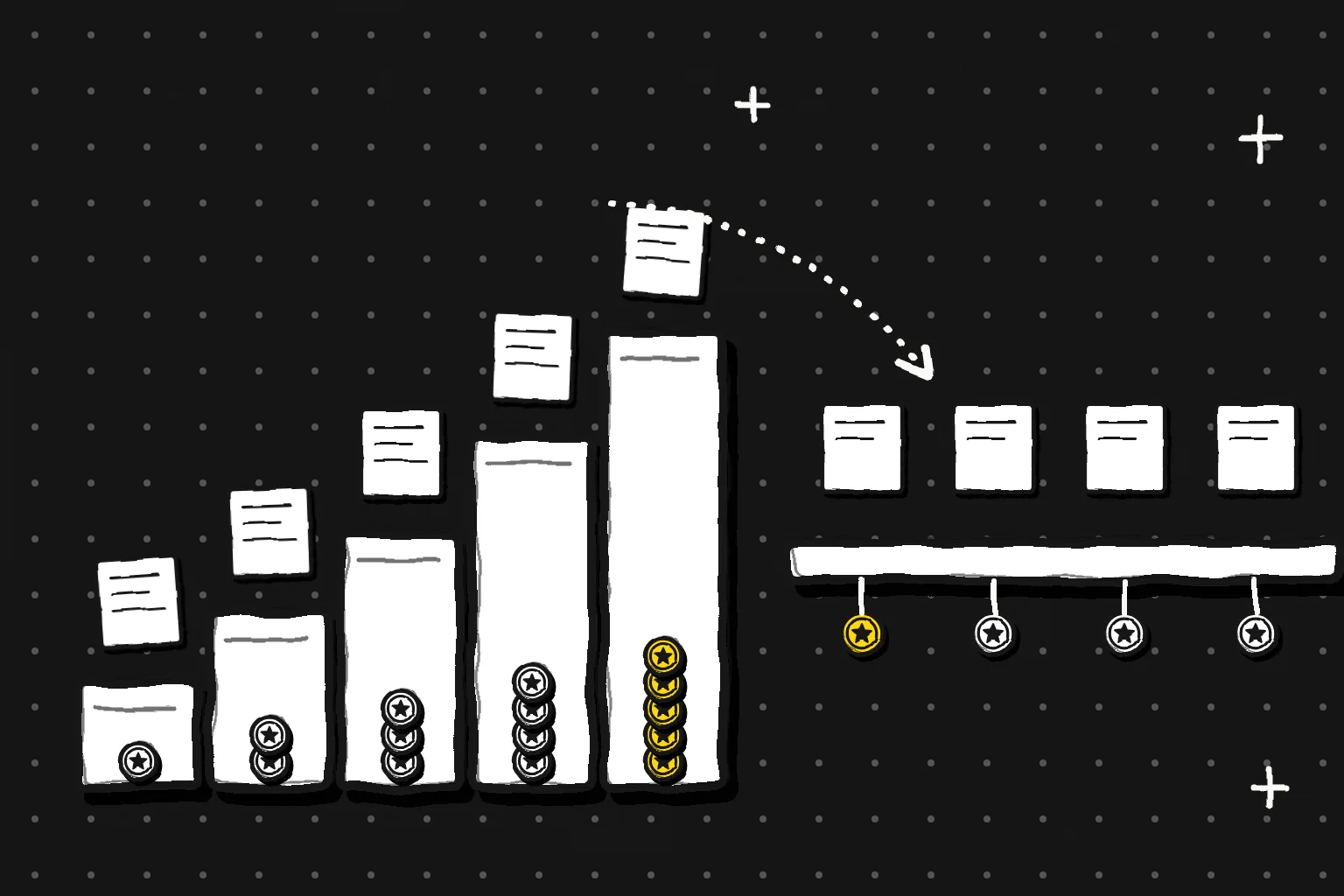
Bright Data and ScraperAPI both turn a URL into a page you can parse. They charge for that work in very different ways. Bright Data charges one flat price per 1,000 successful requests, and that price does not change with page difficulty. ScraperAPI sells a monthly pool of credits, and each request takes 1 to 75 credits, depending on the site and the options you turn on.
We read both public price pages and both sets of docs on November 21, 2026, between 00:14 and 00:19 Singapore time (SGT). Then we computed one monthly bill per vendor at 10,000 volumes, from 1,000 to 10 million successful requests a month. At each volume, we took the cheapest way to pay at each vendor. For Bright Data, that is pay as you go or one of three monthly plans. For ScraperAPI, that is the smallest self-serve plan that holds the credits.
The result splits by page type. For plain HTML pages, ScraperAPI has the lower bill at almost every volume above 38,000 a month. At 1 million plain pages, the bills are $1,100.20 at Bright Data and $149 at ScraperAPI, a factor of 7.4. For Google results pages, the order flips. ScraperAPI takes 25 credits per Google search, and Bright Data has the lower bill at every volume we checked. At 100,000 searches a month, the bills are $142.50 and $299.
JS-rendered pages and pages behind bot protection sit between those two cases. ScraperAPI takes 10 credits for each. Bright Data has the lower bill at 90.7% of the volumes we checked. ScraperAPI wins only in four bands, where a volume has just entered a plan and the plan still has room.
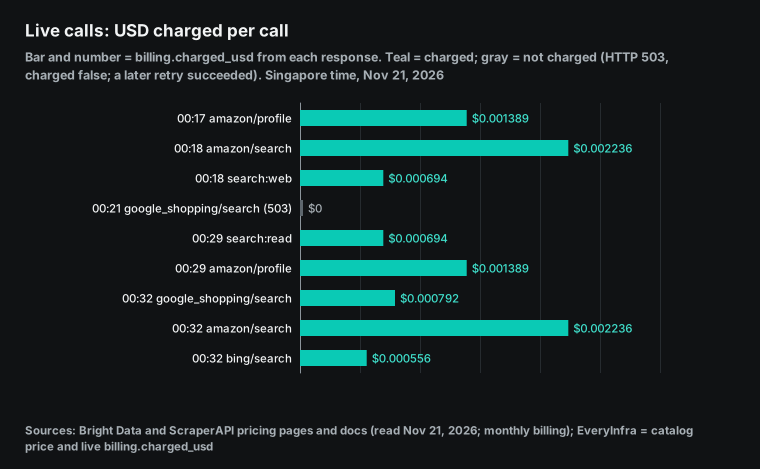
EveryInfra does not sell an unlocker for any URL. We sell structured data calls at a fixed price per call, with no monthly fee. From 00:17 to 00:32 SGT on November 21, 2026, we called amazon/profile, amazon/search, google_shopping/search, bing/search and our web search tool. We called them the same way a customer does. Each charge matched the catalog price at the time of the call, and failed calls were not charged.
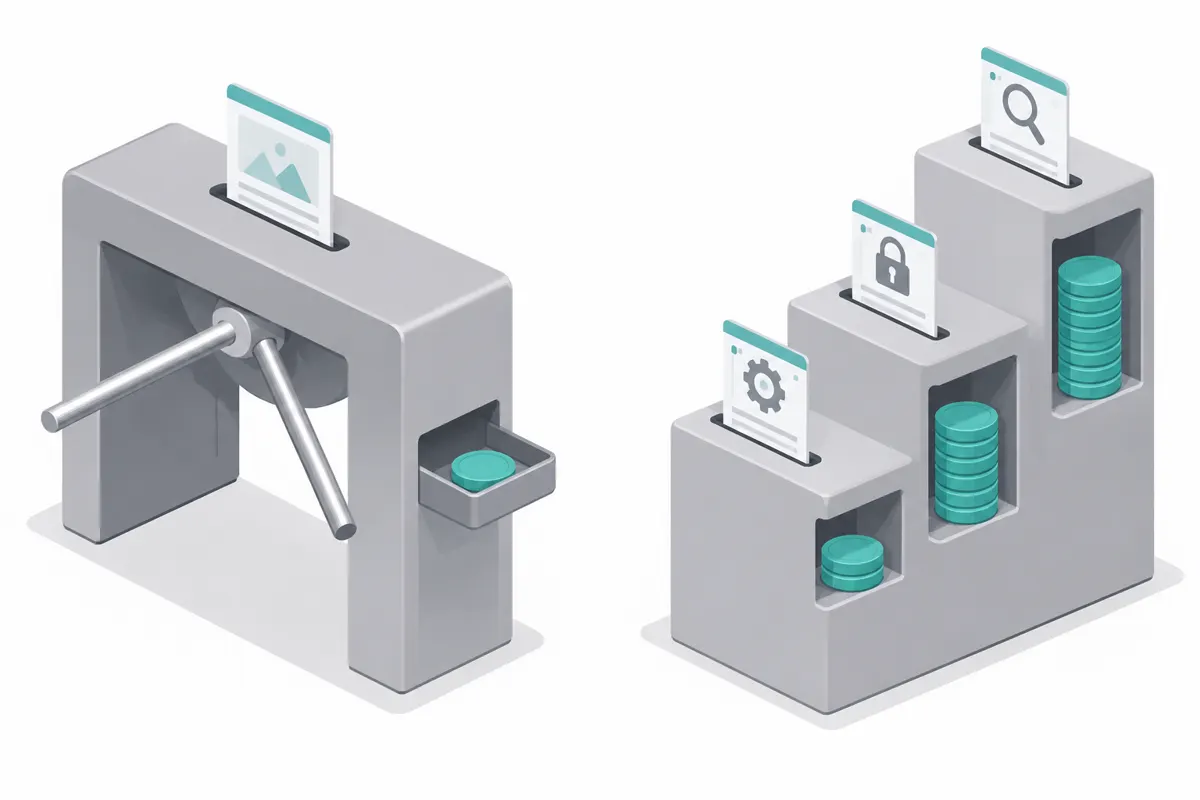
Bright Data vs ScraperAPI in one table
Both vendors can fetch any URL and return the page. Both also sell structured endpoints for Amazon and Google.
Scraping any URL and running proxy networks is home ground for both vendors. EveryInfra has no general unlocker, so the plain page row shows our read tool, which returns static page text only.
| Item | Bright Data | ScraperAPI | EveryInfra |
|---|---|---|---|
| Billing unit | USD per 1,000 requests or records, prepaid wallet | Credits in a monthly plan | USD per call, prepaid balance |
| Plain page | Web Unlocker $1.50 per 1,000 | 1 credit | read $0.694 per 1,000 (static text only) |
| JS-rendered page | Same price, rendering included | render=true 10 credits | Not sold as a separate item |
| Protected page | Same price; no premium domain fee for accounts opened after May 20, 2026 | 10 credits for five bypass types; premium plus render 25 credits | Not sold as a separate item |
| Amazon product page | Scraper API $1.50 per 1,000 records | 5 credits | amazon/profile $1.389 per 1,000 |
| Google search | SERP API $1.50 per 1,000 | 25 credits | Web search $0.694 per 1,000 (10 results) |
| Monthly plans | $499, $999, $1,999, holding 383,000, 908,000 and 2 million requests | Six self-serve plans, $49 to $1,975 | No monthly fee |
| Free use | 5,000 credits a month, shared across APIs, no card | 5,000 credits for 7 days, then 1,000 a month | Trial balance for new accounts |
| Failed requests | Not charged by default; all charged with custom headers or cookies | Not charged; 200 and 404 are charged | Failures and empty results not charged |
| Concurrency | Listed as unlimited on pay as you go and plans | 5, 20, 50, 100, 200, 300, 500 | Per-key rate limit per minute |
| Rollover | Free credits do not roll over; wallet is prepaid | No rollover | Balance does not expire |
| MCP | Remote mcp.brightdata.com/mcp | Remote mcp.scraperapi.com/mcp | Remote MCP, tools named everyinfra_* |
We read the vendor rules on November 21, 2026, from 00:14 to 00:19 SGT. The Bright Data figures come from three price pages. The Web Unlocker price page lists $1.50 per 1,000 requests pay as you go. Its Scale plan costs $499 a month for 383,000 requests, with overage at $1.30 per 1,000. The SERP API price page shows the same $1.50, with 380,000 requests in the $499 plan. The Scraper API price page bills per record, at $1.50 per 1,000 pay as you go and 384,000 records for $499.
The Web Unlocker page also has a slider with two more plans. The $999 plan holds 908,000 requests with overage at $1.10. The $1,999 plan holds 2 million with overage at $1.00.
We took these two plans from the data-tiers attribute of the slider in the page source. The ScraperAPI figures come from its pricing.md file. Hobby costs $49 for 100,000 credits, Startup $149 for 1 million and Business $299 for 3 million. Scaling costs $475 for 5 million, Professional $975 for 10.5 million and Advanced $1,975 for 21.5 million. The credit weights are in its credits documentation.
How each vendor charges: one flat price, or credits times a weight
Each of the three Bright Data APIs has its own price list, but no list changes with page difficulty. The Web Unlocker introduction says one call handles proxy rotation, browser fingerprints, CAPTCHAs and retries, and that only successful requests are charged. Bright Data used to charge more for a group of hard sites, called premium domains. In the Web Unlocker configuration docs, that section now says premium domains were deprecated on May 20, 2026. Accounts opened after that date do not have the option, and older accounts are moving off it. So on a new account, a static blog page and a protected product page cost the same.
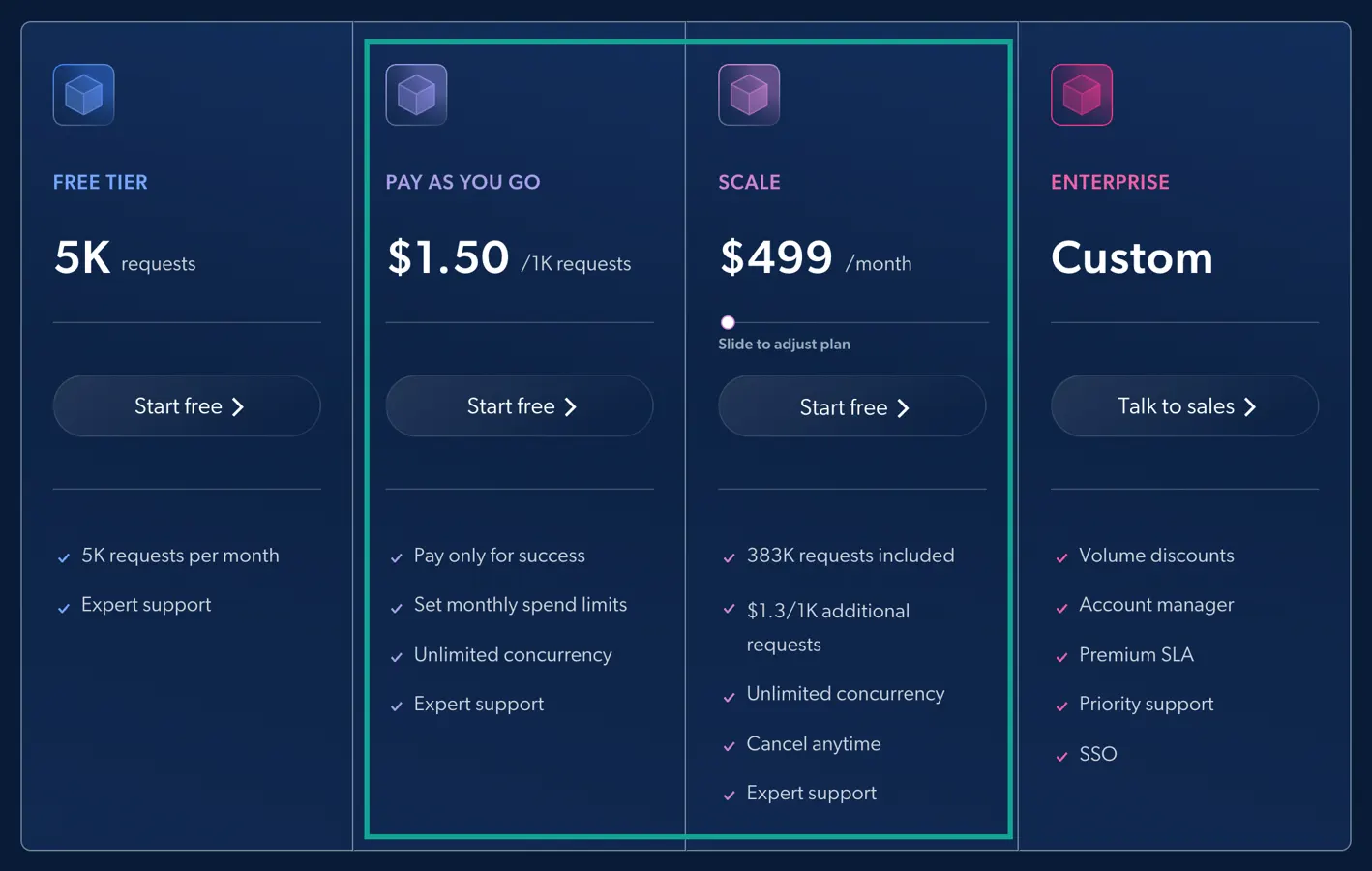
Divide each Bright Data plan by what it holds, and you get the real rate per 1,000. The $499 plan comes to $1.303, the $999 plan to $1.100 and the $1,999 plan to $0.999. Each plan holds exactly its monthly fee divided by its overage rate. So if you buy a plan and then go over, the unit price stays the same.
Pay as you go has one more benefit. The free tier docs give each account 5,000 free credits a month, shared across Web Unlocker, SERP API, Scraper API and Scraper Studio. One request or one record takes one credit. The same page says the free credits stop on a prepaid monthly plan. So our bills subtract 5,000 on pay as you go only.
ScraperAPI counts in credits. A monthly plan gives you a fixed number, and each request takes a number that depends on the site and the options.
A plain page takes 1. Amazon, Walmart, eBay and other shops take 5. Google and Bing take 25, and LinkedIn takes 30. A bypass for Cloudflare, DataDome, PerimeterX or Akamai takes 10. The render=true, premium=true options take 10 each, and both together take 25. The ultra_premium option takes 30, or 75 with rendering.
ScraperAPI also gives you two tools to watch credits. Each response carries an sa-credit-cost header with the credits that request used. You can also add max_cost to a request, to cap the credits for one call. The cost control docs show both.
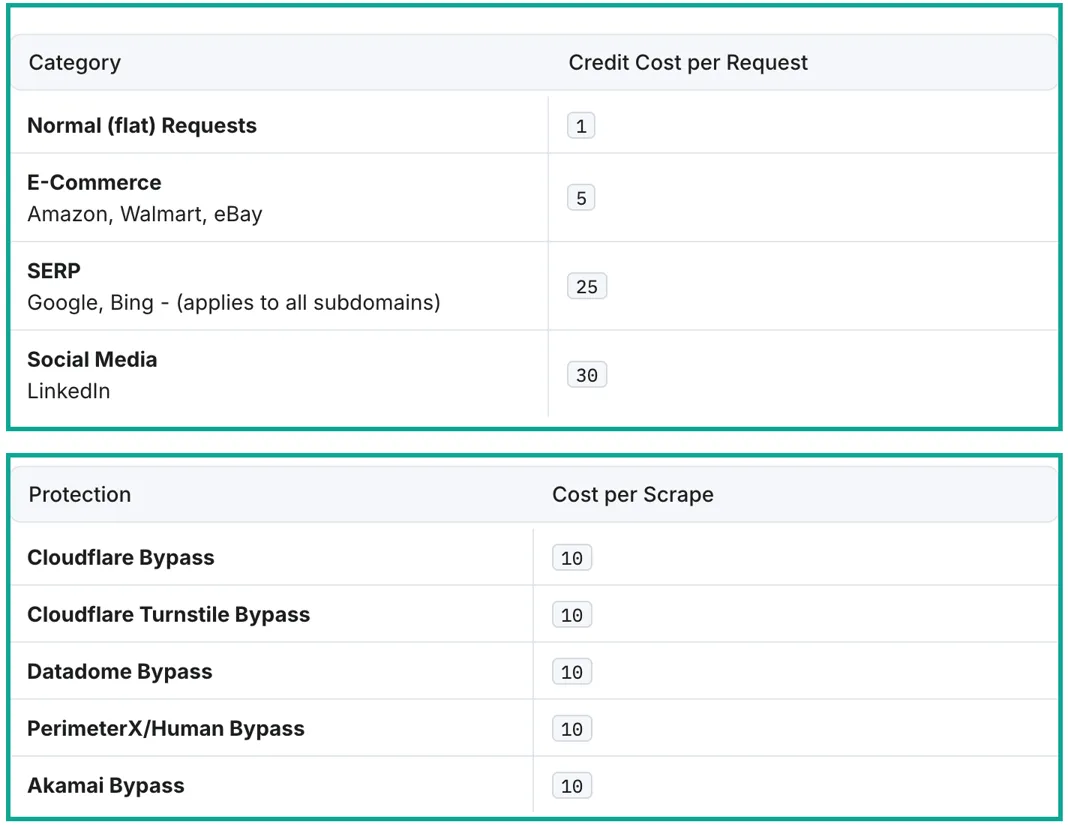
Now convert ScraperAPI plans to dollars per 1,000 credits. Hobby comes to $0.49, Startup to $0.149 and Business to $0.0997. The rate then falls slowly to $0.0919 on Advanced. Multiply by the weight, and the same Startup plan gives $0.149 per 1,000 plain pages but $3.725 per 1,000 Google searches. So a price per 1,000 credits does not compare with a price per 1,000 requests until you apply the weight.
Because the units differ, all comparisons use one measure: the monthly bill for N successful requests. For Bright Data, we take the lowest of pay as you go and the three plans. For ScraperAPI, we take the cheapest self-serve plan that holds N times the weight, billed monthly. We leave out annual discounts. We also leave out ScraperAPI overage, which opens only from Scaling up and has no public unit price.
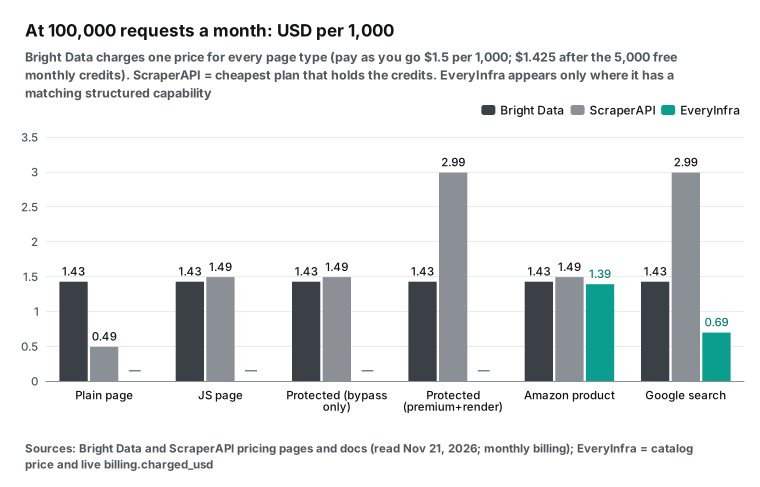
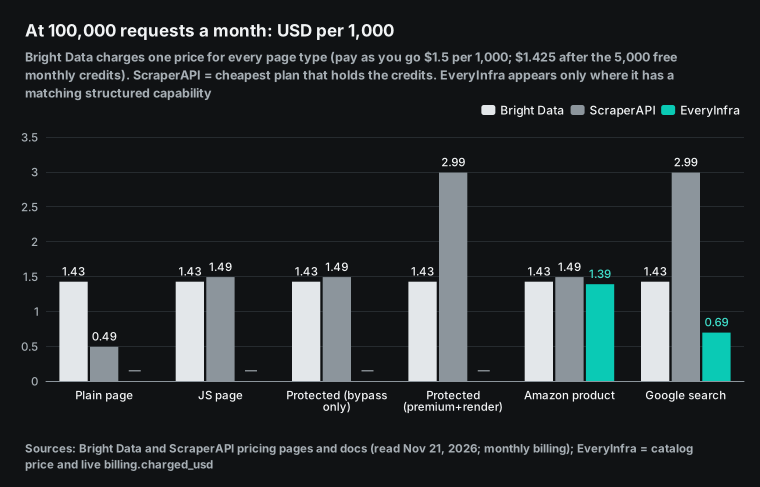
At 100,000 requests a month, only plain pages show a large gap. ScraperAPI costs $0.49 per 1,000 and Bright Data $1.43. That Bright Data figure is $142.50 divided by 100,000, after the 5,000 free requests. For JS pages, protected pages and Amazon product pages, the two vendors are within 5% of each other. The winner there depends on where the volume lands inside a ScraperAPI plan. For Google search, and for protected pages that need premium plus render, ScraperAPI costs about twice as much.
Plain pages: ScraperAPI costs less from 38,000 a month
A plain page needs no rendering and has no bot protection. News articles, docs sites and static product lists are examples. ScraperAPI takes 1 credit per page, so the $149 Startup plan holds 1 million pages. Bright Data Web Unlocker charges the same for every page type. One million pages need the $999 plan plus 92,000 requests of overage, which comes to $1,100.20.
| Pages a month | Cheapest Bright Data option | Bright Data bill | ScraperAPI plan | ScraperAPI bill | Ratio |
|---|---|---|---|---|---|
| 1,000 | Pay as you go (free credits) | $0 | Free | $0 | — |
| 10,000 | Pay as you go | $7.50 | Hobby | $49 | 0.15 |
| 50,000 | Pay as you go | $67.50 | Hobby | $49 | 1.4 |
| 100,000 | Pay as you go | $142.50 | Hobby | $49 | 2.9 |
| 300,000 | Pay as you go | $442.50 | Startup | $149 | 3.0 |
| 1,000,000 | $999 plan plus overage | $1,100.20 | Startup | $149 | 7.4 |
| 3,000,000 | $1,999 plan plus overage | $2,999 | Business | $299 | 10.0 |
| 10,000,000 | $1,999 plan plus overage | $9,999 | Professional | $975 | 10.3 |
The ratio column is the Bright Data bill divided by the ScraperAPI bill.
At small volumes, Bright Data costs less for two reasons. Its free tier gives 5,000 requests, against 1,000 credits at ScraperAPI. Its pay as you go price also has no minimum, so 10,000 pages cost $7.50. ScraperAPI, once past the free credits, starts at the $49 Hobby plan. The two lines cross at 38,000 pages. There, Bright Data costs (38,000 − 5,000) × 1.5 ÷ 1,000 = $49.50, just above the $49 Hobby plan.
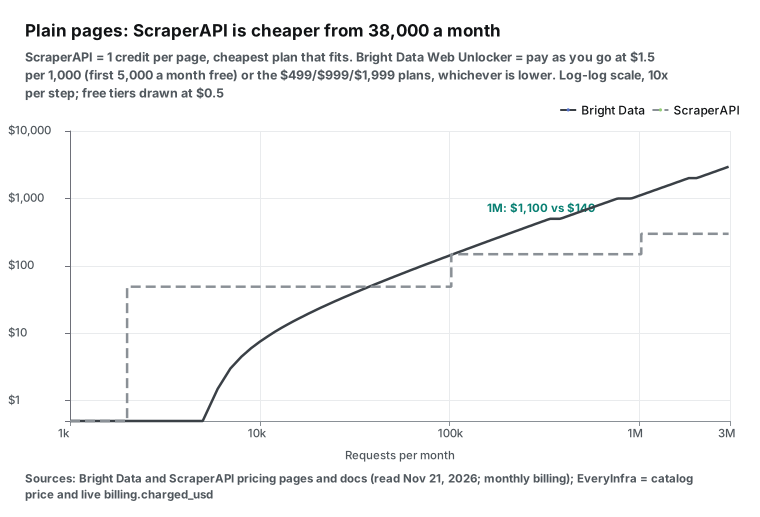
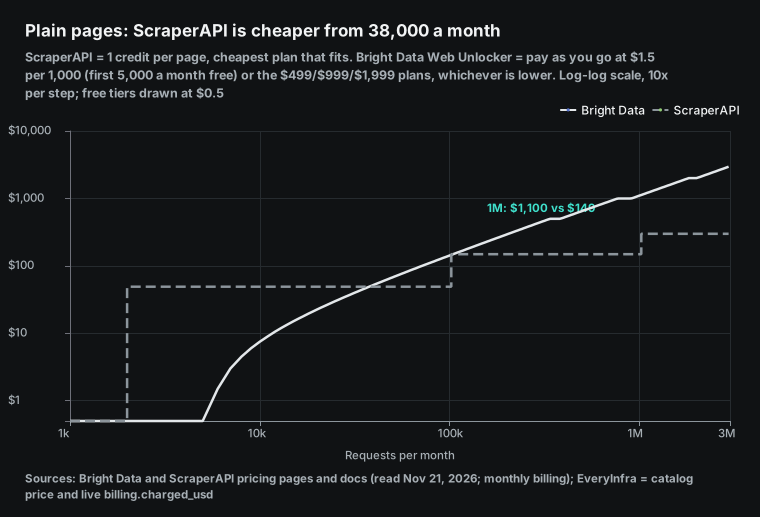
Our scan found one exception, 4,000 requests wide, from 101,000 to 104,000 pages. Hobby holds only 100,000 credits. One more page forces the $149 Startup plan, while Bright Data pay as you go costs $144 to $148.50 there. Real traffic moves around, so few teams sit in a band that narrow.
Also note the plan edge. pricing.md says Hobby, Startup and Business have no overage. When the credits run out, you either turn on auto-upgrade or wait for next month. So a small rise in volume can move the bill from $49 to $149 in one step.
At 1 million plain pages, the gap is $951.20 a month, or $11,414 a year. The Bright Data price is the same for every page. If your URLs include some protected pages, the average ScraperAPI weight goes up.
JS pages and protected pages: Bright Data costs less at 90% of volumes
ScraperAPI takes 10 credits for a page that needs browser rendering with render=true. It also takes 10 for a bypass of Cloudflare, DataDome and similar protection. Premium proxies plus rendering take 25. Bright Data charges one price for all three cases, with rendering and unblocking included.
| Requests a month | Bright Data bill | ScraperAPI at 10 credits | ScraperAPI at 25 credits |
|---|---|---|---|
| 10,000 | $7.50 | $49 (Hobby) | $149 (Startup) |
| 100,000 | $142.50 | $149 (Startup) | $299 (Business) |
| 300,000 | $442.50 | $299 (Business) | $975 (Professional) |
| 500,000 | $651.10 | $475 (Scaling) | $1,975 (Advanced) |
| 1,000,000 | $1,100.20 | $975 (Professional) | No self-serve plan |
| 3,000,000 | $2,999 | No self-serve plan | No self-serve plan |
For the 10-credit case, we checked one point every 1,000 requests, from 1,000 to 10 million. That is 10,000 points.
Bright Data had the lower bill at 9,069 points (90.7%), and ScraperAPI at 931 points. The ScraperAPI points fall in four bands: 205,000 to 300,000, 322,000 to 500,000, 750,000 to 1.05 million, and 1.796 million to 2.15 million. Each band starts where a volume has just entered a plan and the plan still has room. Above 2.15 million, the credits needed pass the 21.5 million in Advanced. ScraperAPI then has no self-serve plan, and you talk to sales.
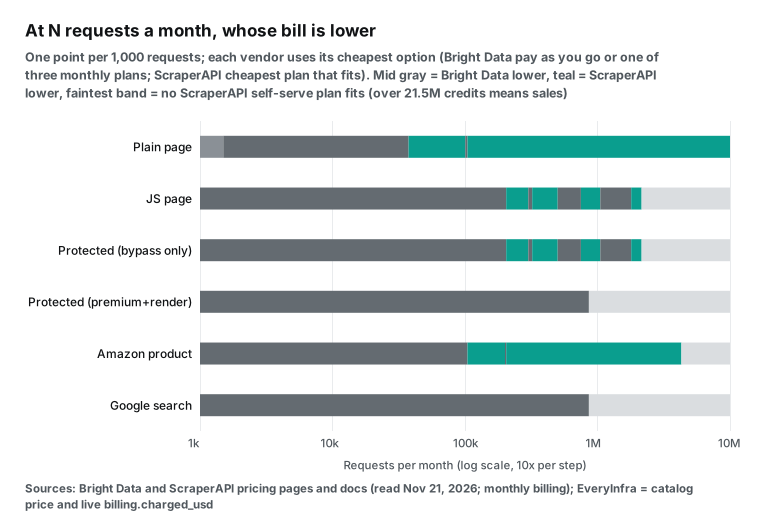
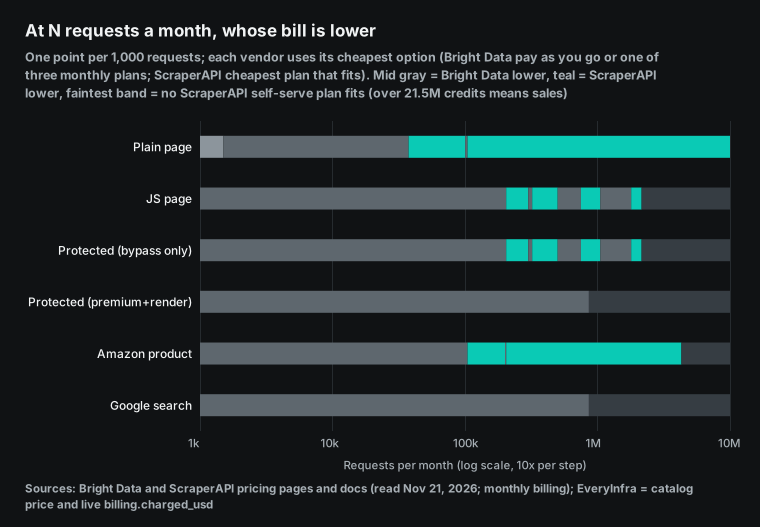
In the 25-credit column, Bright Data has the lower bill at all 10,000 points. At 100,000 requests, the bills are $142.50 and $299. At 500,000, they are $651.10 and $1,975, a factor of 3.
Protected pages add one more variable. When a site changes its protection, the ScraperAPI credit count for it can change too. Its credits page warns that domains can change their protection.
It suggests that you check first with the Domain Multiplier in the dashboard or the /account/urlcost endpoint. In October 2026, ScraperAPI posted a release note. It says sites behind Akamai no longer need premium=true or ultra_premium=true, and a standard request now works. The note also tells you to check the credit cost before you scale up.
On the Bright Data side, the variable is the success rate. The Web Unlocker configuration docs say Bright Data slows traffic to a site when its success rate drops below 70%. This stops a loop of failed attempts. You pay nothing for those requests, but you also get no data.
Small volumes: under 10,000 requests a month
For side projects and early products with a few thousand requests a month, the free tier and the entry price decide the bill. Bright Data gives 5,000 free credits every month, with no end date. After that, pay as you go has no minimum, so 10,000 requests cost $7.50 for any page type. After the ScraperAPI trial, you keep 1,000 credits a month. Past that, the next step is the $49 Hobby plan. Hobby's 100,000 credits are more than enough for plain pages, but they cover only 4,000 Google searches.
| 10,000 a month of | Bright Data | ScraperAPI | EveryInfra |
|---|---|---|---|
| Plain pages | $7.50 | $49 (Hobby) | $6.94 (read, static text) |
| JS or protected pages | $7.50 | $49 (Hobby) | Not sold |
| Amazon product pages | $7.50 | $49 (Hobby) | $13.89 |
| Google searches | $7.50 | $149 (Startup) | $6.94 (web search) |
So at small volumes, Bright Data pay as you go almost always costs less. The one exception is a few hundred plain pages a month, which the ScraperAPI free tier covers. EveryInfra has no free monthly allowance and charges per call. At this volume, it costs more than Bright Data for Amazon product data and a little less for search.
Setup time also counts at this stage. On Bright Data, you first create a zone in the dashboard and copy the zone name and key. On ScraperAPI and EveryInfra, you can send the first request as soon as you have a key.
Mixed URLs: use the average weight
Real scraping jobs seldom have only one page type. A competitor-monitoring team might have 70% plain pages, 20% that need rendering and 10% behind protection. The ScraperAPI average weight is then 0.7 × 1 + 0.2 × 10 + 0.1 × 10 = 3.7 credits per request. With a 50/30/20 split, the average rises to 5.5. The Bright Data price does not change with the split. So, for mixed URLs, replace the ScraperAPI weight with the average and look up the plan again.
| Requests a month | Bright Data | ScraperAPI (70/20/10, 3.7 credits) | ScraperAPI (50/30/20, 5.5 credits) |
|---|---|---|---|
| 50,000 | $67.50 | $149 (Startup) | $149 (Startup) |
| 100,000 | $142.50 | $149 (Startup) | $149 (Startup) |
| 300,000 | $442.50 | $299 (Business) | $299 (Business) |
| 500,000 | $651.10 | $299 (Business) | $299 (Business) |
| 1,000,000 | $1,100.20 | $475 (Scaling) | $975 (Professional) |
| 2,000,000 | $1,999 | $975 (Professional) | $1,975 (Advanced) |
With mixed URLs, Bright Data costs a little less or about the same up to 100,000 requests. From 300,000 up, ScraperAPI costs less. At 500,000, the bills are $299 and $651.10. The result goes back toward the JS page row only when the share of protected pages keeps rising and the average weight nears 10.
This table assumes that ScraperAPI charges each URL exactly what its weight table says. Its docs warn more than once that sites change protection and that costs can change. So before you scale up, sample your own URLs through /account/urlcost and use the real average weight.
Amazon product pages and search: each of three options wins one range
Amazon is the structured endpoint that buyers compare most often. ScraperAPI takes 5 credits for an e-commerce domain. That applies to the raw page and to the JSON from its Amazon Product API. Bright Data sells Amazon data through its Scraper API. It bills per record delivered, one record per product, at $1.50 per 1,000 pay as you go. EveryInfra amazon/profile returns one product per call at a catalog price of $0.001389, with no monthly fee.
| Product pages a month | Bright Data | ScraperAPI | EveryInfra `amazon/profile` | Lowest |
|---|---|---|---|---|
| 10,000 | $7.50 | $49 | $13.89 | Bright Data |
| 20,000 | $22.50 | $49 | $27.78 | Bright Data |
| 50,000 | $67.50 | $149 | $69.45 | Bright Data |
| 100,000 | $142.50 | $149 | $138.90 | EveryInfra |
| 300,000 | $442.50 | $299 | $416.70 | ScraperAPI |
| 1,000,000 | $1,299.80 | $475 | $1,389 | ScraperAPI |
We checked one point every 1,000 products, up to 3 million. Bright Data is lowest from 1,000 to 67,000, with its free credits and then pay as you go. EveryInfra is lowest from 68,000 to 107,000.
ScraperAPI is lowest from 108,000 to 200,000. EveryInfra is lowest again from 201,000 to 215,000, because ScraperAPI has just passed the 1 million credits in Startup. From 216,000 up, ScraperAPI is lowest. At a few hundred thousand pages a month, ScraperAPI costs $0.475 per 1,000 product pages. That is its weight of 5 times the Scaling rate of $0.095 per 1,000 credits.
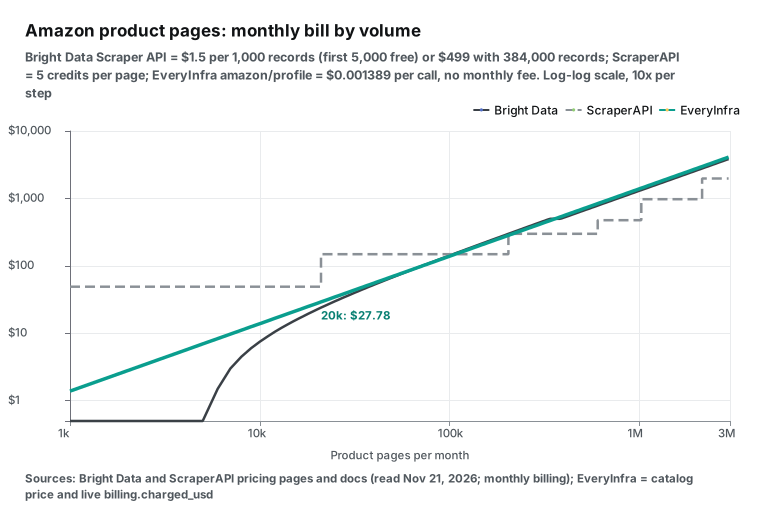
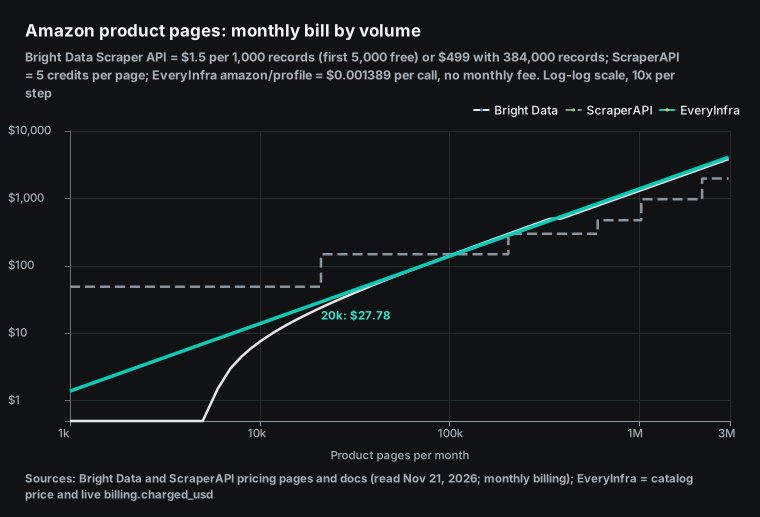
The Bright Data bill of $1,299.80 for 1 million records uses the $499 plan plus overage. The static source of the Scraper API price page shows no larger plan.
Search result pages use a different count. The Bright Data Scraper API FAQs say billing is per record delivered. The MCP tools docs say discover_by_* methods return 10 records per input by default, and each record is billed. So one keyword that returns 10 products is 10 records, or $0.015 pay as you go.
The ScraperAPI Amazon Search API takes 5 credits per call, which is $0.00245 on Hobby and $0.000745 on Startup. EveryInfra amazon/search costs $0.002236 per call. At 00:18 SGT we searched for "robot vacuum", and at 00:32 SGT for "air fryer". Each call returned 10 products and charged $0.002236. Per keyword, ScraperAPI is cheapest from Startup up, and Bright Data, billed per record, is the most expensive.
One line in the Bright Data FAQ needs attention: records that fail because of bad input are still charged, because the request used resources. So clean your input list before a large ASIN batch.
Google search: the largest gap between Bright Data and ScraperAPI
Search is where the two prices differ most. ScraperAPI takes 25 credits for every Google or Bing request, on all subdomains. The Bright Data SERP API billing docs price per 1,000 successful requests. Parsing and unblocking are included, and there is no bandwidth fee. Automatic retries cost nothing extra. In async mode, only the step that sends the request is charged, and the step that collects the result is free.
| Searches a month | Bright Data SERP API | ScraperAPI (25 credits) | EveryInfra web search |
|---|---|---|---|
| 10,000 | $7.50 | $149 (Startup) | $6.94 |
| 100,000 | $142.50 | $299 (Business) | $69.40 |
| 300,000 | $442.50 | $975 (Professional) | $208.20 |
| 1,000,000 | $1,109 | No self-serve plan | $694 |
The largest ScraperAPI self-serve plan holds 860,000 Google searches (21.5 million ÷ 25). Above that, you talk to sales. Bright Data is lower than ScraperAPI at every point we checked, and at 100,000 searches it costs 2.1 times less.
Bright Data SERP API returns JSON, Markdown or raw HTML. The SERP API introduction lists five engines: Google, Bing, DuckDuckGo, Baidu and Yandex.
ScraperAPI products share one credit pool. The 25 credits of one Google search pay for 25 plain pages.
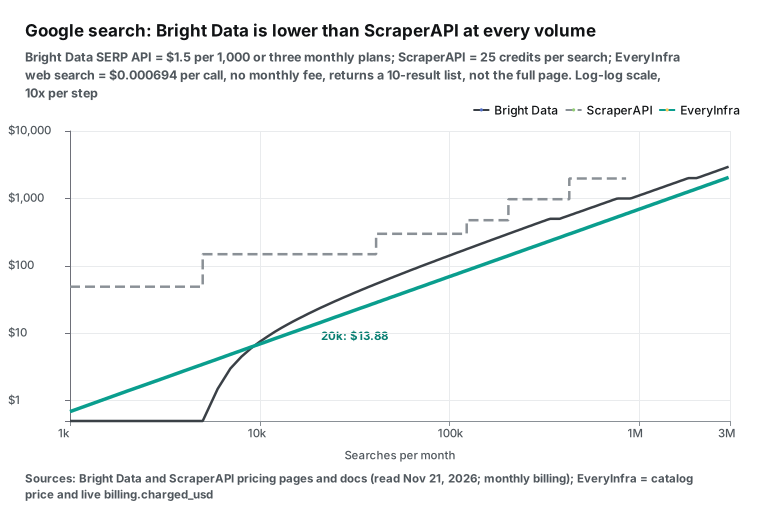
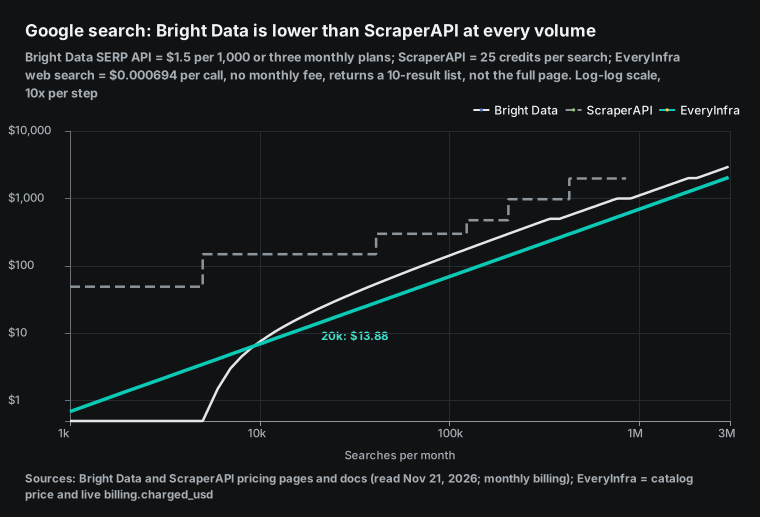
EveryInfra web search costs $0.694 per 1,000. We read the search tool catalog on November 21, 2026. One call returns up to 10 results, each with a title, URL and snippet. That is not the same output as a SERP API. A SERP API returns the parsed full page, with ads, knowledge panels and related questions, which suits rank tracking. Web search returns a result list, which suits AI tools that look for sources.
At 00:18 SGT, we used it to search for "bright data vs scraperapi". It returned 10 results and charged $0.000694. The top results were Bright Data product pages, a ScraperAPI page about Bright Data alternatives and a few third-party comparisons. If you need only links and snippets, web search costs less than both vendors from 10,000 searches up. If you need the full SERP, choose Bright Data.
Google Shopping is another structured case that buyers ask about. At 00:32 SGT, EveryInfra google_shopping/search returned 20 products for "air fryer". Each product had a price, a merchant, a rating and a review count, and 11 of the 20 had an old price. The call charged $0.000792.
Failures, empty results and 404s: what each vendor charges
Both price pages say you pay only for success. The detailed rules differ. The vendor columns come from their docs, read on November 21, 2026, from 00:14 to 00:19 SGT.
| Case | Bright Data | ScraperAPI | EveryInfra |
|---|---|---|---|
| Request fails | Not charged (Web Unlocker and SERP API default) | Not charged | Not charged; the response shows charged: false |
| Target site returns 404 | Docs say only successful responses are charged; 404 not listed | Charged (200 and 404 count as success) | Empty results not charged |
| Custom headers or cookies | Once on for a zone, every request is charged, failures too | No effect | Not applicable |
| Record with bad input | Charged on Scraper API | Not applicable | Bad parameters return 422, not charged |
| Client cancels | Not stated | Two docs give opposite rules (see below) | Not stated separately |
| Over concurrency | Not stated (sold as unlimited) | Returns 429, not charged | Returns 429, not charged |
| Async result fetch | Send is charged, fetch is free | No extra charge | Polling is free |
Read the Bright Data custom header row with care. The SERP API configuration docs and the Web Unlocker configuration docs state the same rule. If you select custom headers and cookies on a zone, billing changes from success only to every request. The reason given is that Bright Data no longer controls the success rate once you change the request. For a team that needs a login cookie to fetch pages, this rule moves the cost of a failure from zero to the full price.
ScraperAPI describes its cancellation rule in two ways. The FAQ in pricing.md says requests cancelled after 70 seconds are charged. The credits documentation says requests that you cancel before you give them the full 70 seconds are charged. Read literally, one rule charges a cancel after 70 seconds, and the other charges a cancel before 70 seconds. The safe choice is a client timeout above 70 seconds, with no early disconnect. Then check the dashboard bill.
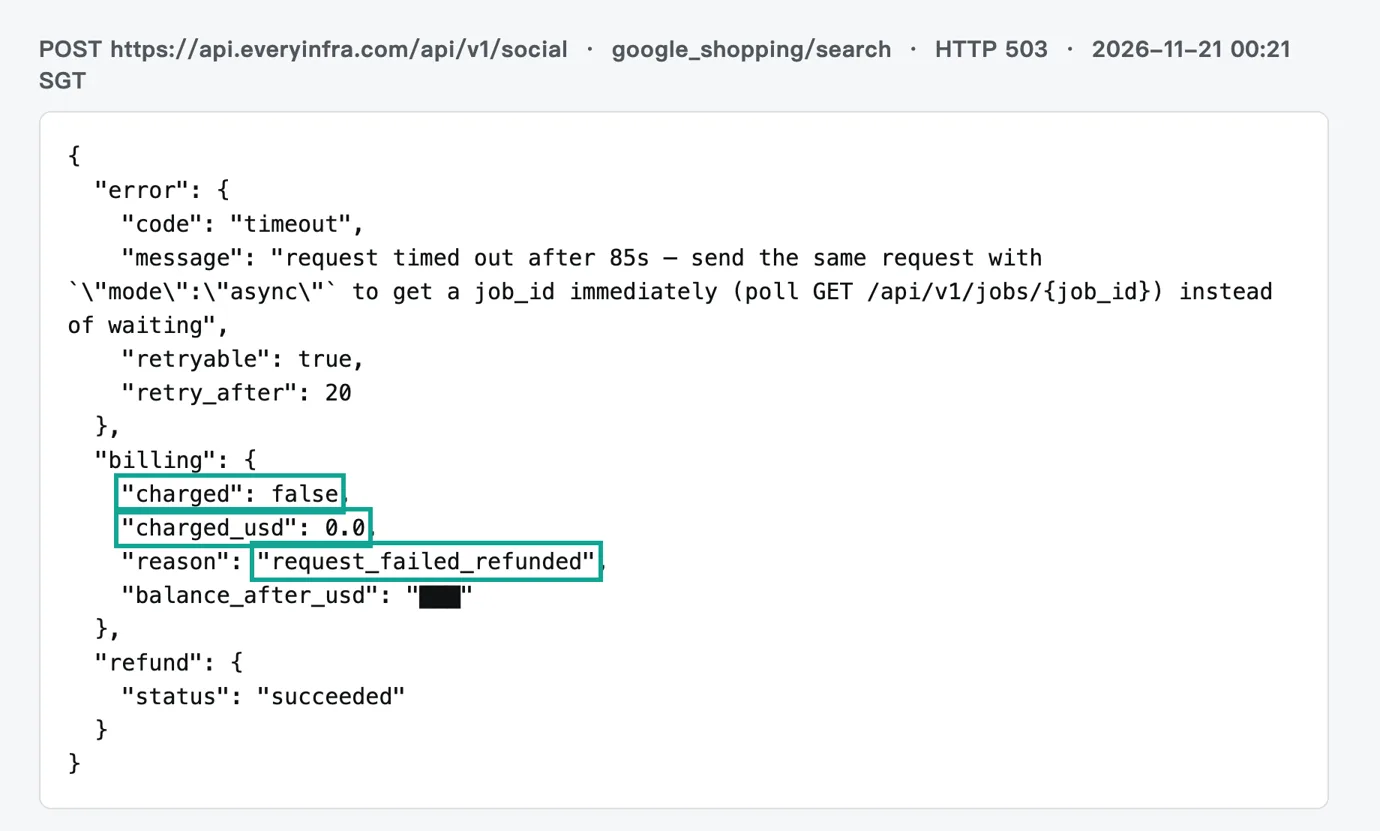
On EveryInfra, a failed call carries charged: false and the refund status in the response. At 00:21 SGT, google_shopping/search for "robot vacuum" returned HTTP 503 with no charge. The response carried retry_after: 20 and suggested the same request with "mode":"async", which returns a job_id that you poll. The screenshot above shows that response. At 00:32 SGT, a retry with the query "air fryer" succeeded and returned 20 products.
Concurrency, rate limits and free credits
| Item | Bright Data | ScraperAPI |
|---|---|---|
| Free use | 5,000 credits a month, shared, no card, hard stop when used | 5,000 credits for 7 days, then 1,000 a month at 5 concurrent |
| Rate limit before first top-up | 1,000 requests a minute across SERP API, Web Unlocker and proxies | 5 concurrent on the free plan |
| Paid concurrency | Listed as unlimited on pay as you go and plans | Hobby 20, Startup 50, Business 100, Scaling 200, Professional 300, Advanced 500 |
| First deposit offer | Price page lists a dollar-for-dollar match up to $500 | 10% off annual billing |
| Overage | Pay as you go has no cap; you can set a monthly spend limit | From Scaling up, with no public unit price |
The SERP API rate limit docs say a fair use limit started on the SERP service in January 2026. An account with no top-up gets 1,000 requests a minute. You can see your limit under Access details in the dashboard, or read it with the x-brd-get-rate-limit header. ScraperAPI lists concurrency in the plan table in pricing.md. Over the limit, it returns 429 and charges nothing.
At small volumes, the two free tiers differ a lot. Bright Data's 5,000 requests a month have no end date. The June 2026 release notes made that the default for every new account. The MCP server free use draws from the same pool. After its trial, ScraperAPI leaves 1,000 credits a month. At 25 credits per Google search, that is 40 searches.
Two Bright Data documents describe the free tier scope in different ways. The free tier docs say Browser API is included, at 5 credits per MB. The brightdata.com/llms.txt file says the free tier does not include Browser API. If you plan to run browser jobs on free credits, check the real count in the dashboard first.
MCP and AI tools: both vendors run a remote server
Both vendors wrap their APIs in an MCP server, so you can connect them to Claude, Cursor and similar tools. The Bright Data MCP overview gives each account 5,000 free requests a month, from the same pool as the account free tier. Its remote quickstart gives the address as https://mcp.brightdata.com/mcp?token=YOUR_API_TOKEN, with the key in the URL query string.
The ScraperAPI MCP docs give the remote address https://mcp.scraperapi.com/mcp. You can also run it on your own machine with Python or Docker. Its March 2026 update added the Google, Amazon, Walmart, eBay and Redfin structured endpoints and the crawler to MCP.
| Item | Bright Data MCP | ScraperAPI MCP | EveryInfra MCP |
|---|---|---|---|
| Remote address | mcp.brightdata.com/mcp | mcp.scraperapi.com/mcp | api.everyinfra.com/mcp |
| Auth | Key in URL query string, or OAuth | Key | Key in a request header |
| Open source repo | brightdata/brightdata-mcp, 2,732 stars, MIT | scraperapi/scraperapi-mcp, 5 stars, MIT | Not open source |
| Latest release | v4.8.0, 2026-11-10 | Last push 2026-07-17 | Tool names are only added, never removed |
| Billing | Same as the API; run_scraper per record | Same credit rules | Same catalog prices |
We read the GitHub figures with gh api on November 21, 2026. The brightdata-mcp repo had its last push on 2026-11-18. It shipped v4.6.0, v4.7.0 and v4.8.0 on 2026-11-05, 2026-11-09 and 2026-11-10. The scraperapi-mcp repo is the self-hosted version, and its last commit was on 2026-07-17.
A key in a URL needs care. Proxy logs, browser history and tool config files all store the full URL. The Bright Data OAuth option avoids that problem.
In Claude Code, a config that connects both vendors and EveryInfra looks like this. It is an example: the three addresses come from each vendor's docs, and the keys come from environment variables.
{
  "mcpServers": {
    "brightdata": { "type": "http", "url": "https://mcp.brightdata.com/mcp?token=${BRIGHTDATA_API_TOKEN}" },
    "scraperapi": { "type": "http", "url": "https://mcp.scraperapi.com/mcp", "headers": { "Authorization": "Bearer ${SCRAPERAPI_KEY}" } },
    "everyinfra": { "type": "http", "url": "https://api.everyinfra.com/mcp", "headers": { "Authorization": "Bearer ${EVERYINFRA_API_KEY}" } }
  }
}
For the ScraperAPI auth header, follow its MCP docs; the line above is a sketch. With three servers connected, the AI tool picks tools from their descriptions, and the bills land in three places. To control spend, tell the model in the prompt which server to use for Google search and which for Amazon product data. You can also connect one server per type of task. The EveryInfra setup is on the MCP server page.
Beyond unit price: what else each vendor sells
The two product lines differ a lot in width, and that affects whether you will need to switch later. The Bright Data pricing hub lists more than ten products. Among them are Web Unlocker, SERP API, Browser API (a cloud browser from $5 per GB), Scraper API and Scraper Studio, which builds a scraper from a plain sentence. It also sells ready-made datasets from $250 per 100,000 records and Data Firehose from $0.20 per 1,000 HTML pages.
Bright Data also sells proxies. Residential proxies start at $2.50 per GB on the page, marked at 50% off. Datacenter proxies start at $0.90 per IP and ISP proxies at $1.30 per IP. A team may later need its own browser control, raw proxies or a full history dataset. It can buy all of these in one Bright Data account, from one wallet.
ScraperAPI focuses on one job: scraping. It sells the standard API, the async API, structured endpoints for Amazon, Walmart, eBay, Home Depot, Google search and Google News, a crawler and DataPipeline. Its July 2026 release note says DataPipeline dropped its old 5x credit weight. It now uses the same weight table as the standard API, with no project fee. The same month, it added an endpoint that turns AI chat answers into JSON.
ScraperAPI does not sell proxy bandwidth or datasets. You may only want to turn URLs into pages or JSON, without proxies to manage. For that job, its product line is simple and complete. If you expect to need proxies, browsers or datasets, one Bright Data account covers more.
Moving from one vendor to the other
The request shapes differ, so a switch needs a few specific code changes. The ScraperAPI standard API is a GET to api.scraperapi.com with api_key and url. You add render, premium or country_code as needed. Structured endpoints use their own paths.
Bright Data Web Unlocker needs a zone that you create in the dashboard first. The first request docs show a POST to https://api.brightdata.com/request, with zone, url and format in the body and the key in the Authorization header. SERP API also needs a zone before the first call. On ScraperAPI, rendering and protection are request options. On Bright Data, the service decides these by itself, so you do not send them.
| Item | ScraperAPI | Bright Data Web Unlocker |
|---|---|---|
| Method and address | GET api.scraperapi.com | POST api.brightdata.com/request |
| Key | api_key query parameter | Authorization header |
| Setup before first call | None | Create a zone in the dashboard |
| Rendering and bypass | render, premium, ultra_premium options | Decided by the service |
| Cost per request | sa-credit-cost response header | Zone bill in the dashboard |
| Spend cap | max_cost per request | Daily or monthly limit per zone |
Cost tracking changes too. On ScraperAPI, you can log the sa-credit-cost header of each response and sum it by URL type. Bright Data bills by zone, and the dashboard lets you set a daily or monthly spend limit. Its billing docs explain top-ups and auto top-up. When the balance falls below a quarter of the amount you set, it charges your card a whole-dollar amount.
The step teams miss most often is custom cookies. If requests you move from ScraperAPI carry cookies, the Bright Data zone needs custom headers turned on. Billing then covers every request, so cost rises fast on sites with many failures.
Public reviews and videos show prices that differ from the November 21 price pages
We used youtube/search to search for "bright data vs scraperapi". None of the top 10 results compared only these two vendors. We took the three most relevant videos and used youtube/transcript to get their transcripts. The first, posted on 2026-11-17, compares Bright Data with a self-hosted scraper at 100,000 requests and had 1 view when we read it at 00:20 SGT. The second, posted on 2026-10-19, compares five scraping APIs and had 175 views. The third is a Bright Data Scraper API e-commerce demo, posted on 2026-11-18, with an Arabic voice track and 104,513 views.
| Video | Posted | Views at 00:20 SGT | What it shows | What it misses |
|---|---|---|---|---|
| Bright Data vs a self-hosted scraper | 2026-11-17 | 1 | Cost of 100,000 requests | Uses starting prices, not pay as you go |
| Five-vendor scraping API comparison | 2026-10-19 | 175 | Feature walk-through | No prices for the two vendors |
| Bright Data Scraper API e-commerce demo | 2026-11-18 | 104,513 | Keyword discovery, delivery to S3 or Snowflake | Per-record billing of discovery |
The first video uses $0.75 per 1,000 records for Scraper API and $1 per 1,000 for Web Unlocker. It says 10,000 requests a month cost $3.75. Those two numbers are the starting prices on the Bright Data pricing hub. There, the Scraper API card strikes out $1 and shows $0.75.
All three product price pages list pay as you go at $1.50. The lowest of the four rates in the Scraper API calculator is $1.00, and we found no self-serve option at $0.75. At today's pay-as-you-go price, 10,000 requests cost $7.50, twice the figure in the video. The TechRadar list of scraping APIs also gives Bright Data pay as you go at $1 per 1,000. The price page shows $1.50.
| Claim | Where | Price page on 2026-11-21 |
|---|---|---|
| Scraper API $0.75 per 1,000 records | Bright Data pricing hub, first video | Pay as you go $1.50; lowest calculator rate $1.00 |
| Web Unlocker $1 per 1,000 | Bright Data pricing hub, first video | Pay as you go $1.50; $1.00 is the $1,999 plan overage |
| 10,000 requests cost $3.75 | First video | $7.50 after the 5,000 free requests |
| Bright Data pay as you go $1 per 1,000 records | TechRadar list | $1.50 |
| Save $77,412 a year with ScraperAPI | ScraperAPI alternative page | Compares a scraping API with residential proxy bandwidth |
The ScraperAPI page "ScraperAPI: The Best Alternative to Bright Data" compares its $299 Business plan, with 3 million credits, against 750 GB of Bright Data residential proxies at $6,750 a month. It then claims a saving of $77,412 a year. That compares a scraping API with proxy bandwidth, which use different units.
At today's Web Unlocker price, 3 million plain pages cost $2,999 against $299, a gap of $32,400 a year. If those 3 million requests were Google searches, no ScraperAPI self-serve plan would hold them, and the comparison would go the other way.
The third video, the Bright Data demo, shows a step that none of the top 10 web pages explain. You can skip URLs and discover products by keyword, then send the results to S3 or Snowflake. Discovery mode bills per record delivered, and one keyword returns 10 records by default. So the cost per keyword is the record price times 10. That rule gives the $0.015 per keyword for Amazon search results. The transcript and comments do not mention any problem points.
In its transcript, the author of the first video asks one open question. The price page does not say if paid plans keep the 5,000 free records a month. If they do not, his crossover point between self-hosting and Bright Data drops from 51,000 to 34,900 requests. The Bright Data free tier docs answer it: pay as you go keeps the free credits, and prepaid monthly plans do not get them. So for monthly plan users, the 34,900 figure applies.
The same video puts Scraper API at $146.25 for its 250,000-request example, at $0.75 per 1,000. That is 195,000 billed records. At today's pay-as-you-go price of $1.50, the same records cost $292.50, twice the video figure.
In the 10 YouTube results, 8 titles name Bright Data and only 2 name ScraperAPI; one of those 2 is a coupon review. The two official Bright Data videos have 99.7% of all views in the list. The other 8 videos have 2,686 views in total.
In one Reddit thread, a developer who builds e-commerce software asked which scraping API is cost-effective on Amazon, Walmart and smaller shops (r/WebScrapingInsider). One reply posted tests across 15 sites. At 100,000 Amazon pages a month, the estimated bills ran from about $20 to $300. The vendor that was cheapest at 10,000 requests was still cheapest at 1 million in only about 15% of cases. That matches the crossover points in our scan.
EveryInfra live test: three time slots, six capabilities
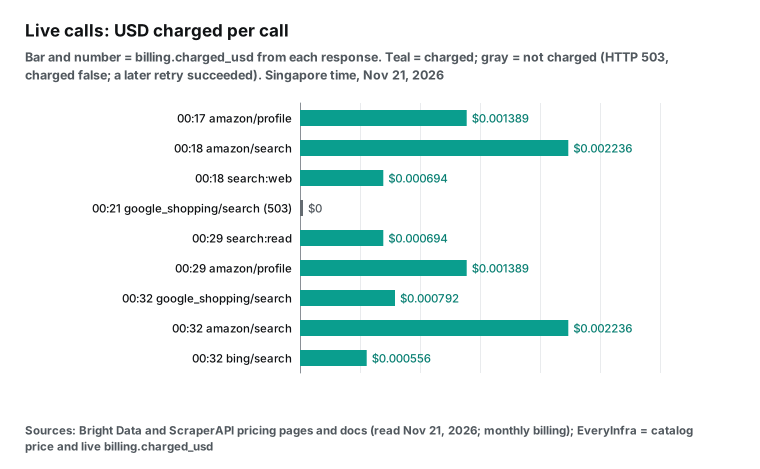
From 00:17 to 00:32 SGT on November 21, 2026, we called the EveryInfra API the same way a customer does. The charge for each call is the billing.charged_usd value in the response.
| Time (SGT) | Capability | Request | HTTP | Items | charged_usd |
|---|---|---|---|---|---|
| 00:17 | amazon/profile | B0CHWRXH8B | 200 | 1 | 0.001389 |
| 00:18 | amazon/search | robot vacuum | 200 | 10 | 0.002236 |
| 00:18 | web search | bright data vs scraperapi | 200 | 10 | 0.000694 |
| 00:21 | google_shopping/search | robot vacuum | 503 | 0 | 0 |
| 00:29 | read | scrapingcourse.com/ecommerce/ | 200 | 1 | 0.000694 |
| 00:29 | amazon/profile | B0F3337BV7 | 200 | 1 | 0.001389 |
| 00:32 | google_shopping/search | air fryer | 200 | 20 | 0.000792 |
| 00:32 | amazon/search | air fryer (fast) | 200 | 10 | 0.002236 |
| 00:32 | bing/search | bright data vs scraperapi | 200 | 9 | 0.000556 |
The 8 charged calls in the table cost $0.009986 in total, the same as the sum of their catalog prices. The 503 call added nothing.
At 00:29 SGT, read fetched the scrapingcourse.com e-commerce practice page and returned 5,734 characters of text. At 00:32 SGT, bing/search returned 9 results for "bright data vs scraperapi". The first was the G2 comparison page for the two vendors. The third was a Bright Data docs page that compares Scraper API with writing your own scraper.
The two result lists for the same query are different. In the 10 web search results at 00:18, 4 came from the two vendors' own sites. The other 6 were third-party blogs and comparison pages, one GitHub test repo and one Reddit thread.
In the 9 Bing results, only 2 came from the vendors. The other 7 were G2 and review or price-comparison sites, and 5 titles carried the year 2026. Only 2 results were in both lists. The two searches cost $0.00125 together.
The two 00:32 calls also matched on products. The 20 Google Shopping results for "air fryer" came from 10 merchants: Target had 6, Walmart 5 and Best Buy 2. Prices ran from $29.99 to $279.95. The 10 amazon/search results ran from $49.99 to $149.99. The Cosori TurboBlaze 9-in-1 cost $89.98 both at the brand store on Google Shopping and on Amazon. For $0.003028, the two calls gave prices for one query across 11 stores.
One amazon/search call returns 10 products for $0.002236, or $0.000224 per product. Bright Data discovery mode bills $0.0015 per record, 6.7 times that. Each amazon/search result also carries is_amazon_choice and a list_price field.
Each charge matched the catalog price we read before the calls: amazon/profile $0.001389, amazon/search $0.002236, google_shopping/search $0.000792 and bing/search $0.000556. The 00:17 amazon/profile call returned second-generation AirPods Pro at $236.55, with a 4.7 rating and 28,867 reviews. The 00:29 call returned a robot vacuum at $119.99, down from $249.99, with 18,111 reviews.
We took its ASIN, B0F3337BV7, from the first result of the 00:18 amazon/search call for "robot vacuum". That search result showed the same $119.99 and 18,111 reviews, 11 minutes earlier. The fast option on amazon/search changes only the response time. The 00:32 call came back in 3.7 seconds at the same charge.
One call to amazon/profile with curl looks like this:
curl -s https://api.everyinfra.com/api/v1/social \
  -H "Authorization: Bearer $EVERYINFRA_API_KEY" \
  -H "Content-Type: application/json" \
  -d '{"platform":"amazon","action":"profile","params":{"url":"https://www.amazon.com/dp/B0CHWRXH8B"}}'
The results part of the response holds asin, title, brand, price, currency, rating, rating_count, in_stock, category, images and features. These match the response_fields for this capability in the catalog. The billing part holds charged_usd for the call. For slow capabilities, add "mode":"async" to the request body. You get a job_id at once, and then you poll GET /api/v1/jobs/{job_id}. The async_mode field in the catalog describes this.
Market moves in the last 60 days
- 2026-11-19: Bright Data added 80,000 US IPs to its shared datacenter proxy pool, at no price change, its release notes say. The reason is the Black Friday and Cyber Monday traffic peak. What it means for you: success rates and response times at both vendors can move in these weeks, so price-monitoring teams should load test early.
- 2026-10-27: the Bright Data success rate endpoint added date range and URL pattern filters. It now also returns the P90 response time. What it means for you: you can check the success rate for a target site before you scale up.
- 2026-10-24: Bright Data limited instant access to residential proxies. From 2026-10-19, new accounts cannot use the residential network at once, and proxies that did not pass review were deleted on 2026-11-09. What it means for you: teams that use only the unlocker and SERP API are not affected; teams that buy residential proxies must pass a review first.
- 2026-11-05 to 2026-11-10: brightdata-mcp shipped v4.6.0, v4.7.0 and v4.8.0 in six days, with another commit on 2026-11-18. What it means for you: the tool list and parameters can change every week, so check tool names that you hard-code in prompts. The self-hosted ScraperAPI MCP repo has had no commits since 2026-07-17, so its changes happen on the remote server side.
- October 2026: ScraperAPI now handles Akamai sites without the premium options. What it means for you: credit costs for these sites can drop, so check them again with
/account/urlcost.
One price-monitoring team's monthly bill
Here is one example. Each day, a team tracks 2,000 Amazon product pages and checks Google results for 300 keywords. It also fetches 500 plain competitor pages a day, such as notices and price pages. Over 30 days, that is 60,000 Amazon product pages, 9,000 Google searches and 15,000 plain pages, or 84,000 requests in total. The mix is an assumption, used to show how the three billing models add up.
On Bright Data, the three jobs go to Scraper API, SERP API and Web Unlocker. Pay as you go costs $1.50 per 1,000 on each, and the 5,000 free credits are shared. The bill is (84,000 − 5,000) × 1.5 ÷ 1,000 = $118.50.
On ScraperAPI, 60,000 Amazon pages take 300,000 credits, 9,000 Google searches take 225,000 and 15,000 plain pages take 15,000. That is 540,000 credits. The team must buy the $149 Startup plan, and 460,000 credits go unused, with no rollover.
On EveryInfra, 60,000 amazon/profile calls cost $83.34, 9,000 web searches cost $6.25 and 15,000 read calls for static page text cost $10.41. The total is $100. That assumes the 500 competitor pages need no rendering and have no protection.
| Item | Bright Data | ScraperAPI | EveryInfra |
|---|---|---|---|
| 60,000 Amazon product pages | Pay as you go, in the total | 300,000 credits | $83.34 |
| 9,000 Google searches | Pay as you go, in the total | 225,000 credits | $6.25 (list of 10 results) |
| 15,000 plain pages | Pay as you go, in the total | 15,000 credits | $10.41 (static text only) |
| Monthly bill | $118.50 | $149 (Startup) | $100 |
The three totals are close, so the choice depends on which part will grow. Suppose Amazon tracking grows to 10,000 products a day. Then 300,000 product pages need 1.5 million credits, Startup is too small, and the team moves to the $299 Business plan. Bright Data pay as you go rises to $478.50 and EveryInfra to about $433. At that point, ScraperAPI is the cheapest.
Now suppose Google keywords grow to 3,000 a day instead. ScraperAPI then takes 2.025 million more credits a month, while the increase at Bright Data and EveryInfra is much smaller.
Annual billing takes another 10% off ScraperAPI. Its pricing.md lists 10% off every self-serve plan on annual terms, so Startup drops to $134.10 a month and Business to $269.10. The Bright Data price page banner offers a dollar-for-dollar match on the first deposit, up to $500. The Scraper API page also shows a code for 40% off the first three months. These offers are time-limited, so we left them out of long-term costs.
Run the numbers yourself: price rules as functions
Both vendors change prices, and plan names change too. The code below uses the same rules as the bill tables. When a price changes, edit the numbers at the top and run it again. For Bright Data, it takes the lowest of pay as you go and three plans. For ScraperAPI, it takes the cheapest plan that holds the credits.
BD_PAYG, BD_FREE = 1.5, 5000                     # USD per 1,000; free requests per month
BD_PLANS = [(499, 383_000, 1.3), (999, 908_000, 1.1), (1999, 2_000_000, 1.0)]
SA_RUNGS = [(49, 100_000), (149, 1_000_000), (299, 3_000_000), (475, 5_000_000), (975, 10_500_000), (1975, 21_500_000)]

def bright_data(n):
    payg = max(0, n - BD_FREE) * BD_PAYG / 1000
    plans = [price + max(0, n - incl) * over / 1000 for price, incl, over in BD_PLANS]
    return min([payg] + plans)

def scraperapi(n, credits_per_request):
    need = n * credits_per_request
    if need <= 1000:
        return 0
    return next((price for price, credits in SA_RUNGS if credits >= need), None)  # None = talk to sales

print(bright_data(1_000_000), scraperapi(1_000_000, 1))   # 1100.2 149
print(bright_data(100_000), scraperapi(100_000, 25))      # 142.5 299
The function holds the Web Unlocker plans. The $999 SERP API plan holds 900,000 searches, 8,000 fewer than Web Unlocker. So for 1 million Google searches, the function gives $1,100.20, while the Google table uses the SERP plan: $999 + 100,000 × $1.10 ÷ 1,000 = $1,109.
Four items are not in the functions:
| Left out of the functions | Why | Effect on the bill |
|---|---|---|
| ScraperAPI overage from Scaling up | No public unit price | Can lower bills just above a plan edge |
| Annual terms | 10% off at ScraperAPI | ScraperAPI bills drop by 10% |
| First-deposit and coupon offers | Time-limited | Lower first-month bills only |
| Bright Data enterprise prices | Not public | Can lower bills above a few million |
Connecting a scraping service to AI tools: cost per task
Connect a service to Claude, Cursor or a similar tool, and the unit of cost changes. It is no longer requests a month, but tool calls per task. A task that asks an AI tool to research a product often runs one search, reads a few pages and then checks a few products. Take 1 Google search, 5 plain pages and 3 Amazon product pages.
| Item | Bright Data | ScraperAPI | EveryInfra |
|---|---|---|---|
| One task (1 search, 5 pages, 3 products) | 9 requests, $0.0135 | 45 credits, $0.0067 on Startup | $0.0083 |
| 3,000 tasks a month | 27,000 requests, $33 after free credits | 135,000 credits, $149 (Startup) | About $25 |
The EveryInfra figure is 0.000694 + 5 × 0.000694 + 3 × 0.001389, for web search, read and amazon/profile. For ScraperAPI, 135,000 credits do not fit in Hobby, so the bill is the $149 Startup plan.
AI tools make the call count harder to predict than a fixed script. A model can search a few more times or read a few more pages.
On Bright Data and EveryInfra, which charge per call, extra calls add cost in a straight line. On ScraperAPI, a monthly plan either absorbs the extra calls or forces an upgrade at the plan edge. The spend controls differ as well. Bright Data lets you set a daily or monthly limit on a zone. ScraperAPI uses max_cost to cap one call. EveryInfra charges against your balance and stops when the balance runs out.
When to choose Bright Data, and when to choose ScraperAPI
| Your main workload | Lower bill | Why |
|---|---|---|
| Plain pages, above 38,000 a month | ScraperAPI | 1 credit per page; $149 for 1 million |
| Google or Bing search pages | Bright Data | $1.50 per 1,000 against 25 credits per search |
| JS or protected pages | Bright Data at 90.7% of volumes | Same flat price; ScraperAPI takes 10 to 25 credits |
| Amazon products, above 216,000 a month | ScraperAPI | 5 credits; $0.475 per 1,000 on Scaling |
| Under 10,000 requests a month | Bright Data | 5,000 free requests, no minimum |
| Search links for an AI tool | EveryInfra web search | $0.694 per 1,000, no monthly fee |
Choose ScraperAPI for mostly plain pages above a few tens of thousands a month. It also fits when most of your pages are Amazon, Walmart or other shop pages, at more than about 100,000 a month. Its weight table puts plain pages at 1 credit, and each plan step lowers the price per credit. One million plain pages cost $149, a price that no Bright Data option can match.
The ScraperAPI weak point is its plan steps. The first three plans have no overage, so when volume passes a plan edge, you must upgrade and the bill can double. A Google search takes 25 credits, so at high search volume ScraperAPI costs more than twice as much as Bright Data.
Choose Bright Data for mostly search result pages, protected pages or rendered pages. It also fits when your volume is small and you want to start on free credits. The price does not change with page difficulty, so costs are easy to predict. The 5,000 free requests a month have no end date. Pay as you go has no plan steps, so you pay for what you use.
Bright Data also has the wider product line, with residential and datacenter proxies, a cloud browser and ready-made datasets, none of which ScraperAPI sells. Its weak points are the higher price for plain pages and the charge for failed requests once you turn on custom headers or cookies. On Bright Data Scraper API, billing per record means one keyword that returns 10 results costs 10 times the unit price.
If you are not sure, you can run your own URL list through both free tiers. Take a sample of 500 URLs from your production list, with plain pages, JS pages, protected pages and searches in their real shares. Use the 5,000-credit ScraperAPI trial and the 5,000 free Bright Data requests.
Then record three numbers for each vendor: successful results, what each result cost, and average response time. For ScraperAPI, read the cost on the Credit Usage page in the dashboard. For Bright Data, read the request count on the billing page. Convert the results into a price per 1,000 successes, and multiply by your monthly volume. Then find your range in the plan tables.
Neither vendor fits well in one common case. You want structured fields from a known platform, such as product prices, reviews or search result lists. Your volume is a few thousand to about 100,000 calls a month, and you do not want a monthly plan.
EveryInfra sells structured capabilities per call, with no parsing on your side. Amazon product details cost $1.389 per 1,000, Google Shopping search costs $0.000792 per call for 20 products, and web search costs $0.694 per 1,000. Above a few hundred thousand Amazon product pages a month, the ScraperAPI Scaling plan costs less. For full-page SERP data and proxy networks, use Bright Data.
Two related articles: Bright Data alternatives lists other options by use case, and ScraperAPI pricing explained works through the credits plan by plan. The alternatives hubs for both vendors are /alternatives/brightdata and /alternatives/scraperapi.
FAQ
Bright Data vs ScraperAPI: which one costs less?
It depends on page type and volume. For plain pages above 38,000 a month, ScraperAPI costs less at almost every volume: $149 against $1,100.20 at 1 million. For Google search, Bright Data costs less at every volume: $142.50 against $299 at 100,000. For JS and protected pages, Bright Data costs less at 90% of volumes. Search suggestions on November 21, 2026 show this question as "scraperapi vs bright data pricing comparison".
What does Reddit say about Bright Data vs ScraperAPI?
The suggestion "bright data vs scraperapi reddit" shows people look for this. The Reddit threads we read do not compare only these two vendors. An r/WebScrapingInsider thread agrees that value changes a lot from site to site. So test on your own site mix. An r/datamining thread discusses scraping APIs against proxies that you manage yourself.
Does ScraperAPI have a free tier?
Yes. The suggestions "scraperapi free tier" and "scraperapi free plan" both point to it. You get 5,000 credits for a 7-day trial with no card, then 1,000 credits a month at 5 concurrent requests, with no end date. At 25 credits per Google search, 1,000 credits cover 40 searches.
How much does Bright Data Web Unlocker cost?
This matches the suggestion "bright data web unlocker pricing". On November 21, 2026, pay as you go cost $1.50 per 1,000 requests. The Scale plan cost $499 for 383,000 requests, with overage at $1.30 per 1,000, and the page slider also shows $999 and $1,999 plans. The first 5,000 requests each month are free. The "from $1 per 1,000" figure on the pricing hub matches the overage rate of the $1,999 plan.
Do failed requests cost money at either vendor?
Not by default. ScraperAPI counts a 404 as a success and charges for it. Bright Data charges for failures once you turn on custom headers or cookies for a zone. Bright Data Scraper API also charges for records with bad input. This question comes from the suggestion "brightdata vs scraper api cost".
Do both vendors support MCP?
Yes. Bright Data runs a remote server at mcp.brightdata.com/mcp, and its open source repo has 2,732 stars, with v4.8.0 on 2026-11-10. ScraperAPI runs a remote server at mcp.scraperapi.com/mcp, and you can also run it locally. The suggestions include "brightdata vs scraper api integration".
How do I use the free credits to test both vendors?
The suggestions include "brightdata vs scraper api testing". Bright Data gives 5,000 free credits a month, and ScraperAPI gives 5,000 for 7 days, both with no card. Split your URLs into plain, rendered and protected groups, and take 50 to 100 from each. Run them through both vendors, and record the success rate and the real cost per URL. On ScraperAPI, one Google search takes 25 credits, so 200 searches use up the trial.
Is there a ScraperAPI alternative that costs less than both?
The suggestions include "scraperapi free alternative". The answer depends on the data you need. For structured fields such as Amazon products, Google Shopping or search results, a per-call API with no monthly fee costs less at small volumes. For raw pages from any URL, these two vendors remain the main choice. Our ScraperAPI alternatives article lists switch paths by use case.
Getting started
- Sign up in the EveryInfra console and get an API key. New accounts get a trial balance.
- Find the capability in the API market. Examples are the Amazon Scraper API, Google Shopping Scraper API and Web Search API. Each capability page has a playground for a first test.
- Use the curl call above on
amazon/profileorgoogle_shopping/search. Check the returned fields andcharged_usd. - To connect an AI tool, add
https://api.everyinfra.com/mcpas the MCP server page shows. To estimate a monthly bill, see the pricing page and theprice_usdof each capability in the catalog.
Other capability pages you may need: web/search, walmart/search, youtube/transcript and bing/search. The platform page is Walmart Scraper API.
References
- Bright Data, Web Unlocker API Pricing, read 2026-11-21
- Bright Data, SERP API Pricing, read 2026-11-21
- Bright Data, Web Scraper API Pricing, read 2026-11-21
- Bright Data, Pricing, read 2026-11-21
- Bright Data, llms.txt, read 2026-11-21
- Bright Data Docs, Free tier, read 2026-11-21
- Bright Data Docs, SERP API fair use: rate limit, read 2026-11-21
- Bright Data Docs, MCP server overview, read 2026-11-21
- Bright Data Docs, MCP tools, read 2026-11-21
- Bright Data Docs, Remote MCP quickstart, read 2026-11-21
- Bright Data Docs, Scraper API FAQs, read 2026-11-21
- Bright Data Docs, Web Unlocker API introduction, read 2026-11-21
- Bright Data Docs, Web Unlocker configuration, read 2026-11-21
- Bright Data Docs, Web Unlocker error codes, read 2026-11-21
- Bright Data Docs, SERP API introduction, read 2026-11-21
- Bright Data Docs, SERP pricing & billing, read 2026-11-21
- Bright Data Docs, SERP API configuration, read 2026-11-21
- Bright Data Docs, Billing, read 2026-11-21
- Bright Data Docs, Fetch API introduction, read 2026-11-21
- Bright Data Docs, Release notes, updated 2026-11-19, read 2026-11-21
- Bright Data Docs, Get success rate API, read 2026-11-21
- Bright Data Docs, Documentation index llms.txt, read 2026-11-21
- GitHub, brightdata/brightdata-mcp, v4.8.0 2026-11-10, read 2026-11-21
- ScraperAPI, Pricing (pricing.md), read 2026-11-21
- ScraperAPI Docs, Credits and Requests costs, read 2026-11-21
- ScraperAPI Docs, Cost Control, read 2026-11-21
- ScraperAPI Docs, MCP Server, read 2026-11-21
- ScraperAPI Docs, ScraperAPI MCP: Expanded Capabilities, March 2026
- ScraperAPI Docs, Akamai-protected sites now unblocked automatically, October 2026
- ScraperAPI Docs, Amazon Product API, read 2026-11-21
- ScraperAPI Docs, Google SERP API, read 2026-11-21
- ScraperAPI Docs, Async API overview, read 2026-11-21
- ScraperAPI Docs, Documentation index llms.txt, read 2026-11-21
- GitHub, scraperapi/scraperapi-mcp, last push 2026-07-17, read 2026-11-21
- ScraperAPI, ScraperAPI: The Best Alternative to Bright Data, read 2026-11-21
- TechRadar, Best Scraper API of 2026, read 2026-11-21
- Reddit r/WebScrapingInsider, Which is the best web scraping API for e-commerce sites?, read 2026-11-21
- Reddit r/datamining, Thoughts on API vs proxies for web scraping?, read 2026-11-21
- YouTube, Bright Data vs a Self-Hosted Scraper: What 100k Requests Actually Cost, 2026-11-17
- YouTube, Five-vendor web scraping API comparison, 2026-10-19
- YouTube, Scrape eCommerce Data at Scale | Bright Data Scraper API Demo, 2026-11-18
- Model Context Protocol, Specification, read 2026-11-21
- EveryInfra, Data API catalog, read 2026-11-21 00:14 SGT
- EveryInfra, Search tool catalog, read 2026-11-21 00:14 SGT
- ScraperAPI Docs, DataPipeline is Now Up to 80% Cheaper, July 2026
- Bright Data Docs, Send your first Web Unlocker request, read 2026-11-21
Reference BL-203