Bright Data Alternatives: Data or Proxies, Six Vendors Priced per 1,000 Results
Bright Data alternatives fall into data and proxies. Live test Nov 16: Instagram posts $0.0028 per 1K, Maps reviews $0.0139, vs Bright Data's $1.50.

Bright Data sells its ready-made scrapers at $1.50 per 1,000 records on pay-as-you-go. On November 16, 2026, from 00:21 to 00:31 Singapore time (SGT), we ran live EveryInfra calls on Instagram, Amazon and Google Maps. Per 1,000 results, Instagram account posts cost $0.0028 and Google Maps reviews cost $0.0139. Google Maps places cost $0.0278, and Amazon search items cost $0.0447. That is 33.5x to 540x below the Bright Data list price.
The smallest gap is a single Instagram profile. Our call returns one profile, so 1,000 profiles cost $0.556, which is 2.7x below Bright Data. With the API60 promo code on its pricing page, Bright Data drops to $0.60 for three months, only 8% above us.
The second kind of buyer wants proxy traffic. Bright Data residential traffic lists at $8 per GB ($4 with a 50% code), and ZenRows Scale S5 works out to $1.67 per GB. Our pricing page lists IP proxies sold as traffic packs, but on November 16 our proxy shelf showed every proxy type as unavailable.
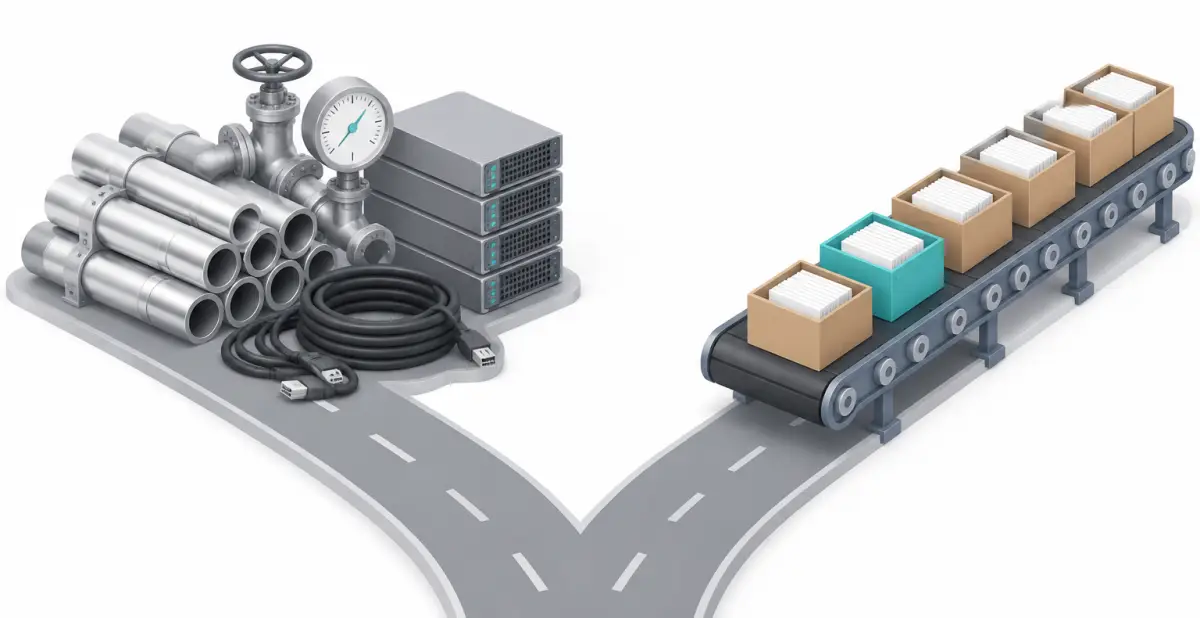
People who search for "bright data alternatives" usually want one of two things. The first group uses the Bright Data Web Scraper API, its datasets or Scraper Studio. They want Instagram profiles, Amazon products and Google Maps places as clean rows, and they pay per row. The second group uses Bright Data proxies or its Web Unlocker. They write their own scrapers, need clean IPs and unblocking, and pay per GB, per IP or per request.
We put the five alternatives into the same two groups. Apify sits in both: its Store sells per-result scrapers, and Apify also sells proxies. ZenRows, ScraperAPI and Firecrawl mainly sell general scraping, where one request returns one web page for some credits. EveryInfra sits mainly in the first group, where it bills per call and returns fixed field names. In the second group it has the read tool for single pages at $0.694 per 1,000. Its listed IP proxies were unavailable on the day of the test.
Every price table below compares vendors inside one group only.
We already published a Bright Data pricing breakdown. That article covers eight Bright Data products and the Scale plan break-even point. It tested Amazon product pages, TikTok posts and Google search. The Bright Data alternatives page is a one-page summary. This article adds the five alternatives and tests new jobs. These are Instagram profiles, posts and comments, Google Maps places and reviews, and Amazon search in fast mode.
All vendor prices come from public pricing pages, docs and Store pages. We read them on November 16, 2026, between 00:16 and 00:40 SGT. We did not open accounts with the five vendors, and we did not call their APIs. So the vendor column shows the public list price. The EveryInfra column shows the amount charged on this run, from billing.charged_usd in each response. Each side returns fields from its own system, so we compare only price, billing rules and setup.
Bright Data alternatives in two groups: what each vendor sells
The six companies sell very different things. The Bright Data pricing hub lists four product groups. Web access holds Unlocker, Crawl, SERP and Browser API. Data holds Scraper API, Scraper Studio, datasets and Data Firehose. Then come data insights, managed collection and proxies.
| Bright Data menu item | "From" price on the menu | What the product page says |
|---|---|---|
| Unlocker and SERP | $1 per 1,000 requests | SERP page lists tiers per 1,000 results |
| Scraper API | $1, struck through to $0.75 per 1,000 records | Pay-as-you-go $1.50, Scale overage $1.30 |
| Datasets | $250 per 100,000 records | Up to 80% off for monthly refresh |
| Residential proxies | $5, struck through to $2.50 per GB | Pay-as-you-go $8, or $4 with a code |
| Datacenter proxies | $0.90 per IP | Per IP |
| ISP proxies | $1.30 per IP | Per IP |
Most "from" prices on the menu are top-tier or promo rates. The product pages show the pay-as-you-go rates that you pay without a monthly commitment. In this article, we use the product page rates.
| Vendor | Ready-made records | General scraping (returns pages) | Proxies | Historical datasets | Billing unit |
|---|---|---|---|---|---|
| Bright Data | Web Scraper API, 1,301 scrapers | Unlocker, Crawl, Browser API | Residential, datacenter, ISP | Yes, from $250 per 100K | Per record, per request, per GB, per IP |
| Apify | Store scrapers billed per result or usage | Website Content Crawler and others | Residential $7–$8 per GB, datacenter IPs | No | Per result, per compute unit, per GB |
| ZenRows | No per-platform fields; Extract returns JSON | Fetch, Crawl, Batch, Browser | Residential at 25,000 credits per GB | No | Credits per page |
| ScraperAPI | Structured endpoints for Amazon, Google, Walmart | Standard API, Crawler, DataPipeline | Not sold alone | No | Credits per request |
| Firecrawl | No per-platform fields; JSON format costs extra | Scrape, Crawl, Map, Search | No | No | Credits per page |
| EveryInfra | 106 platforms, 574 capabilities, fixed fields | read tool for single pages, billed per call | Listed; shelf unavailable on Nov 16 | No | Fixed USD price per call |
The Bright Data scraper count comes from its scrapers.json file, which it refreshes daily. On November 16 it listed 1,301 scrapers across 1,207 domains. Of these, instagram.com had 4 (comments, posts, profiles, Reels), amazon.com had 5 and google.com had 10. Our counts come from the EveryInfra catalog, read at 00:16:37 SGT the same day. It listed 106 platforms and 574 capabilities, and 539 of them were available.
ZenRows and Firecrawl can both turn a page into JSON. But both bill per page, not per record. One Amazon search page holds dozens of products, and both vendors charge it as one page. A model or a rule picks the fields, so field names can change from run to run.
Start with one question: where does most of your Bright Data bill go today? If it goes to residential traffic, ZenRows and Apify are direct substitutes. EveryInfra cannot help there today, because its proxy shelf was unavailable on November 16. If it goes to record fees for Instagram, Amazon or Google Maps, Apify and EveryInfra are direct substitutes. ScraperAPI structured endpoints can also replace part of that work.
The master table: units, failures, minimum spend, free tier, MCP
| Item | Bright Data | Apify | ZenRows | ScraperAPI | Firecrawl | EveryInfra |
|---|---|---|---|---|---|---|
| Minimum paid entry | Pay-as-you-go, no monthly fee, prepaid | Starter $19/mo | Build B1 $19/mo | Hobby $49/mo | Hobby $19/mo | No monthly fee, first top-up $10 |
| Free tier | 5,000 credits/mo | $5 platform credit/mo | 5,000 credits/mo | 5,000 credits for 7 days, then 1,000/mo | 1,000 credits/mo | $1 once, 24 hours |
| Record price | $1.50 per 1K ($1.30 on Scale overage) | $1.50–$5.00 per 1K (three scrapers) | None | Amazon page 5 credits, Google 25 | None | $0.000556–$0.002236 per call (this test) |
| Proxies | Residential $8/GB, $4 with code | Residential $7–$8/GB | 25,000 credits per GB | Not sold alone | No | No |
| Failed requests | Failed deliveries free; bad-input records billed | Events billed as they run | Free; 404 and 410 count as success | Billed on 200 and 404 | No result, no charge; 403 and 404 cost 1 credit | Failures and empty results free, refund shown in response |
| Rollover | Free credits do not roll over | Plan credit is monthly | Plan credits expire; add-ons roll once | No rollover | Scale rolls one month | Balance never expires |
| MCP | Remote MCP, 5,000 free requests/mo | https://mcp.apify.com | https://mcp.zenrows.com/mcp | https://mcp.scraperapi.com/mcp | Firecrawl MCP v3 | https://api.everyinfra.com/mcp |
Three gaps matter more than the rest. First, Bright Data and EveryInfra have no monthly fee. You prepay, and the balance goes down as you use it. Apify, ZenRows, ScraperAPI and Firecrawl are subscriptions, and the unused part of each month's credits is mostly lost.
The ZenRows pricing docs say plan credits expire at each renewal. The ScraperAPI pricing file shows no credit rollover on any tier. Firecrawl rolls credits for one month on Scale only. Our pricing page says top-up balances never expire.
Second, each vendor defines "failure" in its own way. The Firecrawl pricing page says a page that returns 403 or 404 still costs 1 credit. ZenRows counts 404 and 410 as valid results. ScraperAPI bills 200 and 404, plus any request that you cancel after 70 seconds. Third, all six vendors now offer MCP. What separates them is the unit that each MCP call bills in.
The data group: what 1,000 results cost
In the first group, the unit is 1,000 results. The Bright Data Web Scraper API page lists three numbers. The free tier is 5,000 records a month, and pay-as-you-go is $1.50 per 1,000. The Scale plan costs $499 a month for 384,000 records, then $1.30 per 1,000. The page also shows the code API60 for 60% off the Scraper API for three months.
| Bright Data Web Scraper API option | Price per 1,000 records | Condition |
|---|---|---|
| Free tier | $0 | 5,000 records a month, no rollover |
| Pay-as-you-go | $1.50 | No monthly fee |
| Pay-as-you-go with API60 | $0.60 | First three months |
| Scale plan included volume | $1.30 (about $499 / 384,000) | $499 a month |
| Scale plan overage | $1.30 | Above 384,000 records |
Apify Store scrapers use pay-per-event pricing. One scraper has a different price on each plan. We read each tier from three scraper pages: the Instagram Scraper, the Amazon Product Scraper and the Google Maps Scraper.
| Apify scraper, per 1,000 results | Free | Starter | Scale | Business |
|---|---|---|---|---|
| Instagram Scraper (per result) | $2.70 | $2.30 | $1.90 | $1.50 |
| Amazon Product Scraper (per product) | $5.00 | $4.00 | $3.50 | $3.00 |
| Google Maps Scraper (per place) | $4.00 | $3.00 | $2.00 | $1.50 |
| Google Maps review add-on (per review) | $0.50 | $0.50 | $0.37 | $0.26 |
| Google Maps run start (per run) | $0.007 | $0.007 | $0.007 | $0.007 |
On the EveryInfra side, the formula is simple. Take charged_usd from one call, divide by the rows that came back and multiply by 1,000. We divide by the rows returned, not by the limit that we sent. The Instagram hashtag call asked for 100 rows and got 24. If we divided by 100, our price would look more than four times lower.
| Time (SGT) | Capability | Input | Rows | Time taken | Charged | Per 1,000 |
|---|---|---|---|---|---|---|
| 00:21:11 | instagram/profile | nasa | 1 | 12.4 s | $0.000556 | $0.556 |
| 00:21:32 | instagram/hashtag | coldbrew, limit 100 | 24 | 8.1 s | $0.000556 | $0.0232 |
| 00:22:46 | amazon/search | robot vacuum, limit 50 | 50 | 44.3 s | $0.002236 | $0.0447 |
| 00:25:02 | google_maps_reviews/search | dentist, Denver CO, limit 50 | 50 | 8.1 s | $0.001389 | $0.0278 |
| 00:26:03 | google_maps_reviews/reviews | one clinic, limit 100 | 100 | 6.7 s | $0.001389 | $0.0139 |
| 00:26:43 | instagram/user_posts | nasa, limit 200, async | 200 | 74 s to result | $0.000556 | $0.0028 |
| 00:29:30 | google_maps_reviews/search | same, page 2, async | 50 | 64 s to result | $0.001389 | $0.0278 |
| 00:29:39 | amazon/search | same, fast: true | 48 | 8.5 s | $0.002236 | $0.0466 |
| 00:31:04 | instagram/comments | one NASA post, limit 100 | 30 | 17.5 s | $0.000792 | $0.0264 |
The table lists nine charged calls from November 16, 00:21 to 00:31 SGT. The 00:29:30 call is page 2 of the 00:25:02 search, and it bills as its own call. The nine charges add up to $0.011099. Seven more requests cost nothing: three 429 rate limits, one 422 that asked for async mode, and three 503 errors. Every charge matched the catalog price_usd for that capability.
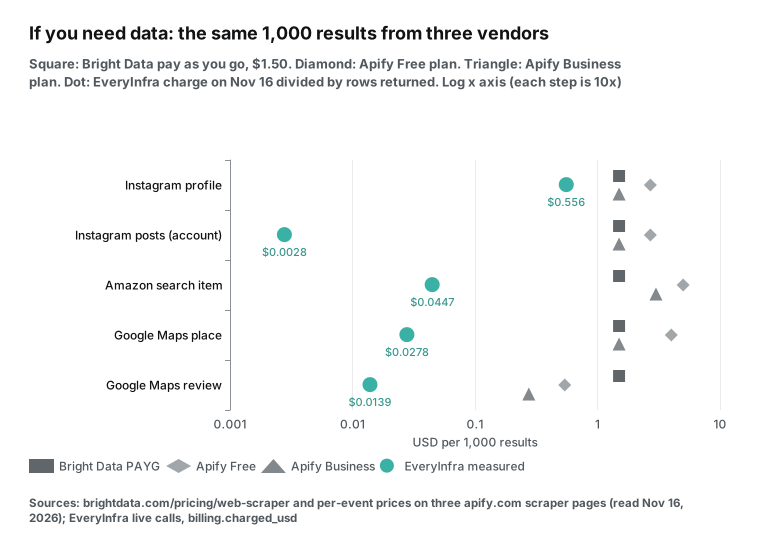
The Instagram profile row has the smallest gap. Our $0.556 is 2.7x below Bright Data at $1.50 and 4.9x below Apify Free at $2.70. The other four rows sit one to two orders of magnitude apart. The cause is the billing unit: Bright Data and Apify bill each row, and we bill each call.
| Job, per 1,000 rows | EveryInfra (live) | Bright Data pay-as-you-go | Ratio | Apify Business | Ratio |
|---|---|---|---|---|---|
| Instagram profile | $0.556 | $1.50 | 2.7x | $1.50 | 2.7x |
| Instagram account posts | $0.0028 | $1.50 | 540x | $1.50 | 540x |
| Instagram hashtag posts | $0.0232 | $1.50 | 64.7x | $1.50 | 64.7x |
| Instagram comments | $0.0264 | $1.50 | 56.8x | $1.50 | 56.8x |
| Amazon search items | $0.0447 | $1.50 | 33.5x | $3.00 | 67.1x |
| Google Maps places | $0.0278 | $1.50 | 54x | $1.50 | 54x |
| Google Maps reviews | $0.0139 | $1.50 | 108x | about $0.275 | 19.8x |
Job 1: Instagram profiles, posts and comments
At 00:21:11 SGT we called instagram/profile for NASA. It took 12.4 seconds and returned one object. The account had 104,331,773 followers, 91 following and 5,010 posts, and both the verified and business flags were true. The object also held 5 outside links and the recent posts. The catalog lists 19 fields for this capability, such as follower_count, post_count, is_verified and recent_posts.
The catalog adds one note: some calls do not return recent_posts, avatar_hd_url, category and highlight_count. One profile is one call at $0.000556, so 1,000 profiles cost $0.556.
The Bright Data Instagram scraper docs split profiles, posts, Reels and comments into four dataset IDs. A profile record holds fields such as followers, posts_count, is_verified and biography. The sample record in the docs is dated September 6, 2026. At pay-as-you-go, 1,000 profiles cost $1.50.
The Apify Instagram Scraper counts one profile as one result, at $2.70 per 1,000 on Free and $1.50 on Business. Say your job is a weekly refresh of follower counts for a few thousand creators. Then the three vendors differ by a few dollars a month. At that size, fields and uptime matter more than price.
At 00:26:43 we sent an async instagram/user_posts job for NASA with limit 200. After 1.9 seconds we had a 202 and a poll_url, and the call charged $0.000556. At 00:27:57 the poll showed 200 posts: 137 images and 63 videos, posted from June 9 to November 14, 2026 (SGT). The poll itself costs nothing.
Each of the 200 posts had a caption, a like count, a comment count, a post time and an image URL. The 63 video posts also had video URLs. Two fields were missing from all 200 rows: view_count and top_comments. The catalog lists both fields as ones that some calls do not return. At 200 rows, the price is $0.0028 per 1,000, which is 540x below the $1.50 of both Bright Data and Apify Business.
Hashtags and comments fall in between. At 00:21:32 we called instagram/hashtag for #coldbrew with limit 100. It took 8.1 seconds and returned 24 rows, so the price is $0.0232 per 1,000. Of the 24 rows, 19 had an author name and 8 had a location. At 00:31:04 we called instagram/comments on the NASA post with the most comments (19,543).
We asked for 100 comments and got 30 in 17.5 seconds. The call charged $0.000792, which is $0.0264 per 1,000. The catalog states the limits: some calls return at most 80 comments, and some return at most 30. This run hit exactly 30. For sentiment work on a viral post, one call will not get every comment, so spread the job across more posts.
Bright Data and Apify bill per row, so more rows cost more. Their scrapers decide how deep one run can go. The Apify page also says that the Free plan gets only one page of comments per post, about 15. For a field comparison of six Instagram methods, see our best Instagram scraper ranking.
Job 2: Amazon search items, and when ScraperAPI costs less
At 00:22:46 SGT we called amazon/search for "robot vacuum" with limit 50. It took 44.3 seconds, returned 50 products and charged $0.002236, or $0.0447 per 1,000. At 00:29:39 we ran the same query with "fast": true. It took 8.5 seconds, returned 48 products and charged the same amount, or $0.0466 per 1,000. The catalog says that fast mode drops 8 fields per row and keeps the price.
| Field group | Full mode (50 rows) | Fast mode (48 rows) |
|---|---|---|
| ASIN, title, URL, rating, rating count | 50 of 50 | 48 of 48 |
| Brand, stock, category, features, best-seller rank | 50 of 50 | Not returned |
| Price | 44 of 50 | 48 of 48 |
| Seller name | 45 of 50 | Not returned |
| List price | 38 of 50 | 37 of 48 |
| Description | 20 of 50 | Not returned |
| Fields per row | 20 | 12 |
| Time taken | 44.3 s | 8.5 s |
So fast mode cut the wait from 44.3 to 8.5 seconds and cut the fields from 20 to 12. Use full mode when you need sellers or descriptions. Use fast mode for rank tracking and price checks.
The Bright Data Amazon products scraper opens each search result and returns a full product record, at $1.50 per 1,000. The Apify Amazon Product Scraper charges $5.00 per 1,000 on Free and $3.00 on Business. Their records hold more fields than our list rows, such as variants and review summaries. If you need full product pages, compare them with our amazon/profile capability. Its catalog price is $0.001389 per call, or $1.389 per 1,000.
That is only 7.4% below Bright Data pay-as-you-go, and it is above the $1.30 Scale overage rate. Our Bright Data pricing breakdown tested this case, so we did not call it again here.
The ScraperAPI Amazon Search endpoint bills like a normal request. An Amazon domain costs 5 credits per call, and each call returns one search page. The docs do not say how many products one page holds. We estimated 48 per page, the count that our fast-mode call returned.
| ScraperAPI plan | Monthly fee | Per 1,000 Amazon requests | Per 1,000 products (48 per page, estimate) | Compared with our $0.0447 |
|---|---|---|---|---|
| Hobby | $49 | $2.45 | $0.051 | We cost 1.14x less |
| Startup | $149 | $0.745 | $0.0155 | We cost 2.88x more |
| Business | $299 | $0.498 | $0.0104 | We cost 4.3x more |
| Advanced | $1,975 | $0.459 | $0.0096 | We cost 4.67x more |
Two conditions apply to this table. You must use the full monthly credit bucket. Each page must also hold about 48 products, and small categories or deep pages hold fewer. So a team with large monthly volume that only needs Amazon search lists will pay less on the middle and upper ScraperAPI tiers.
We did not get Amazon reviews in this run. At 00:26:16 and 00:28:20 SGT we called amazon/reviews on two Shark robot vacuums. After 20.5 and 23.9 seconds, both returned 503 with the reason access_blocked. This means that the product needs a login or is restricted. Both calls were refunded, so charged_usd was 0. Bright Data and the Apify Store both list Amazon review scrapers.
Job 3: Google Maps places and reviews
At 00:25:02 SGT we called google_maps_reviews/search for dentists in Denver with limit 50. It took 8.1 seconds, returned 50 places and charged $0.001389. All 19 fields had values in all 50 rows. These include place ID, name, category, address, coordinates, phone, website, rating and review count. The response also held a next_page_token.
At 00:28:12 we asked for page 2 in sync mode. After 0.2 seconds it returned 422 async_required, because page 2 counts past 60 rows from the start. This call cost nothing. At 00:29:30 we sent it again with "mode": "async", and the 00:30:34 poll returned 50 more places for another $0.001389. One place appeared on both pages, so the two pages hold 99 unique places.
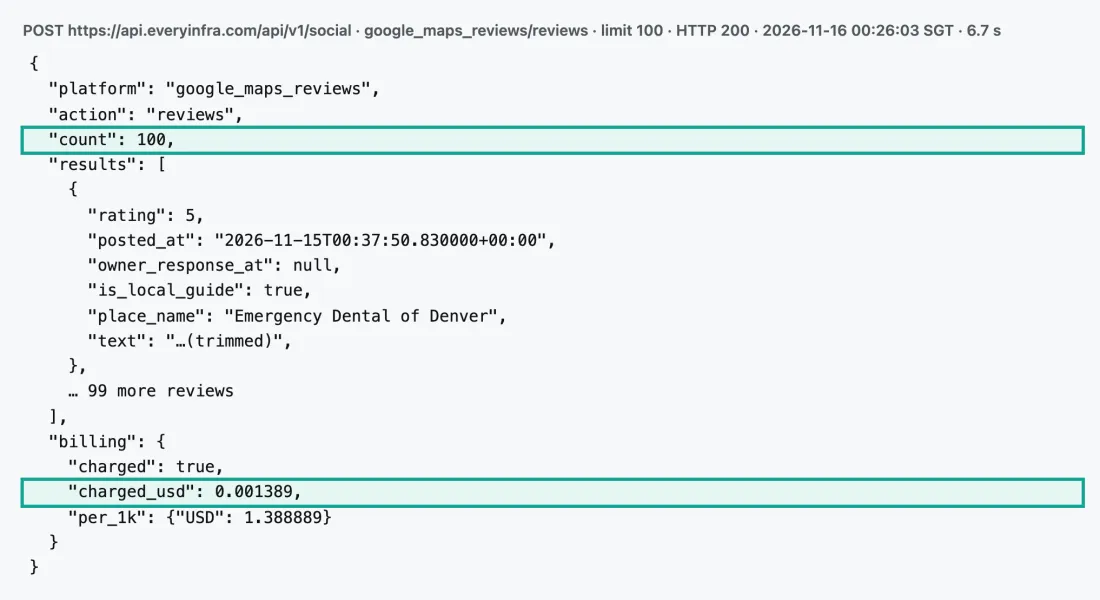
Across the 99 places, the median rating was 4.8. The median review count was 371, with a range of 8 to 2,263. All 100 rows had a phone number, and 98 had a website. At 00:26:03 we called google_maps_reviews/reviews for the first clinic on page 1, with limit 100. It took 6.7 seconds, returned 100 reviews and charged $0.001389, or $0.0139 per 1,000.
Of the 100 reviews, 94 had five stars, 2 had four, 1 had three and 3 had one. Text was present in 70 reviews, and the owner had replied to 88. The review dates ran from October 8, 2022 to November 15, 2026. A local agency can use this data as is: rank the top shops in one city, then read where their bad reviews cluster. For 100 places with 100 reviews each, that is 102 calls, or about $0.14 at catalog prices.
The Apify Google Maps Scraper uses pay-per-event pricing, as the tier table above shows. The Apify help center pricing note uses the base rate of $4 per 1,000 places. Filters such as category, minimum stars or "has website" add $0.001 per place per filter. So 1,000 Denver dentists cost at least $4.00 on Apify Free, and $5.00 with a "has website" filter.
For reviews, the Apify unit price is much lower. Take our shape of one place with 100 reviews. Apify Free comes to $0.54 per 1,000 reviews, which is one place fee plus 100 review fees, divided by 100. Apify Business comes to $0.275. The Bright Data Google Maps Reviews scraper bills $1.50 per 1,000. Its Google scraper docs say that you can filter reviews by a look-back window.
The ScraperAPI Google Maps Search endpoint costs 25 credits per call on a Google domain. The pagination URL in its docs steps by 20 results, so we estimated 20 places per page.
| Vendor and plan | 1,000 Google Maps places | 1,000 reviews (1 place, 100 reviews per run) |
|---|---|---|
| EveryInfra (live) | $0.0278 | $0.0139 |
| Bright Data pay-as-you-go | $1.50 | $1.50 |
| Apify Free | $4.00 (plus $0.007 per run) | $0.54 |
| Apify Business | $1.50 (plus $0.007 per run) | $0.275 |
| ScraperAPI Hobby (20 per page, estimate) | $0.61 | No review endpoint read |
| ScraperAPI Startup (estimate) | $0.19 | No review endpoint read |
| ScraperAPI Advanced (estimate) | $0.11 | No review endpoint read |
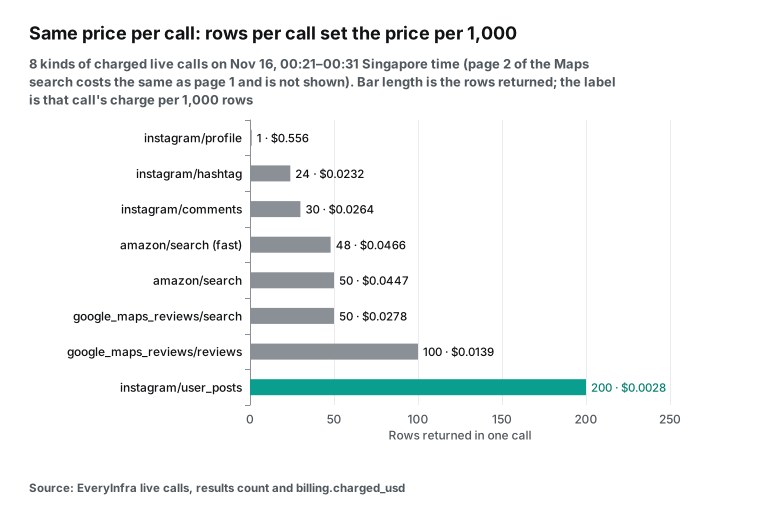
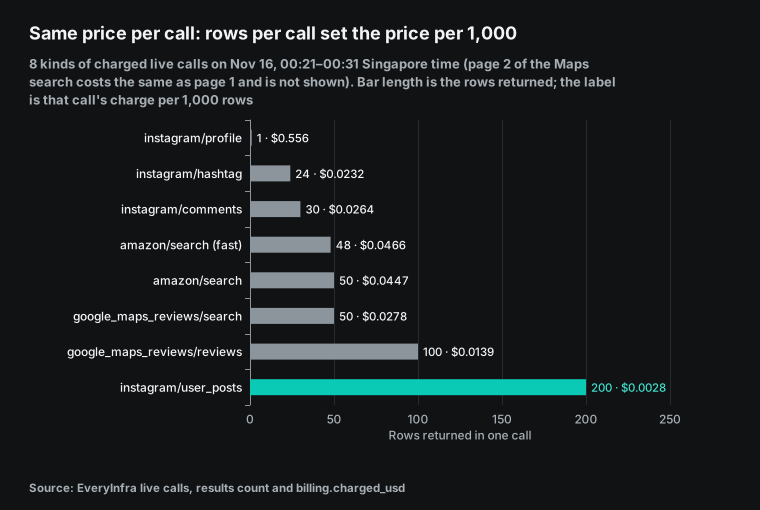
A per-call price list shows one number, such as $0.000556 for Instagram. Per 1,000 rows, the profile costs $0.556 and the posts cost $0.0028. That is a 200x gap, because one call returns 1 row and the other returns 200. To estimate your own bill, convert each call into a price per 1,000 rows first. Use the rows that such calls usually return, not the limit that you send.
The proxy and general scraping group: per GB and per page credit
In the second group, the units are GB of traffic and credits per page. Start with proxies. On November 16, the Bright Data residential proxy pricing page listed four tiers. All four show the code RESIGB50 for 50% off. The page also says that Bright Data matches your first deposit, up to $500.
| Bright Data residential tier | Included traffic | Per GB | Per GB with RESIGB50 |
|---|---|---|---|
| Pay-as-you-go | None | $8 | $4 |
| $499 a month | 141 GB (at the code price) | $7 | $3.54 (shown as $4) |
| $999 a month | 332 GB (at the code price) | $6 | $3.01 (shown as $3) |
| $1,999 a month | 798 GB (at the code price) | $5 | $2.51 (shown as $3) |
The included GB on each plan uses the code price, not the list price. $499 divided by 141 GB is $3.54, and the page rounds it to $4. Without the code, $499 at $7 buys only 71 GB, about half of what the page shows.
The pricing hub menu says "from $5, now $2.50 per GB." That is the list price and the code price of the $1,999 plan. Take 100 GB of residential traffic a month as an example. Bright Data pay-as-you-go costs $400 with the code and $800 without it. The $499 plan costs $499 even when you use less, so below about 125 GB a month ($499 / $4), pay-as-you-go with the code costs less. On Apify Scale at $7 per GB, the same 100 GB costs $700.
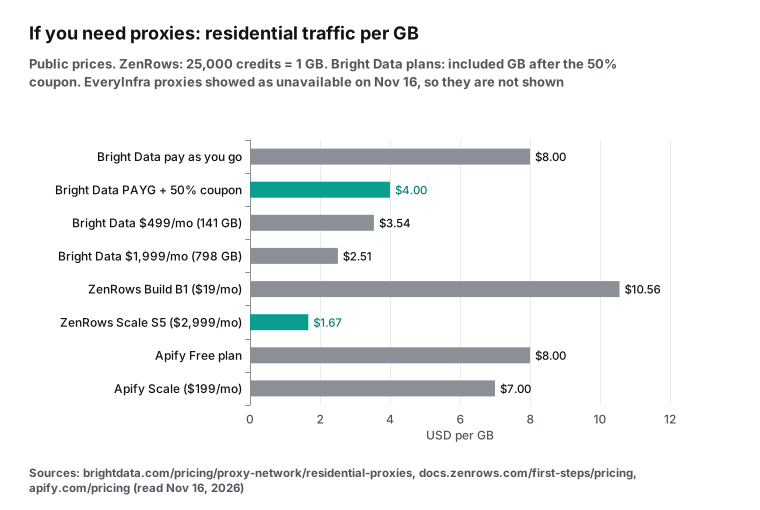
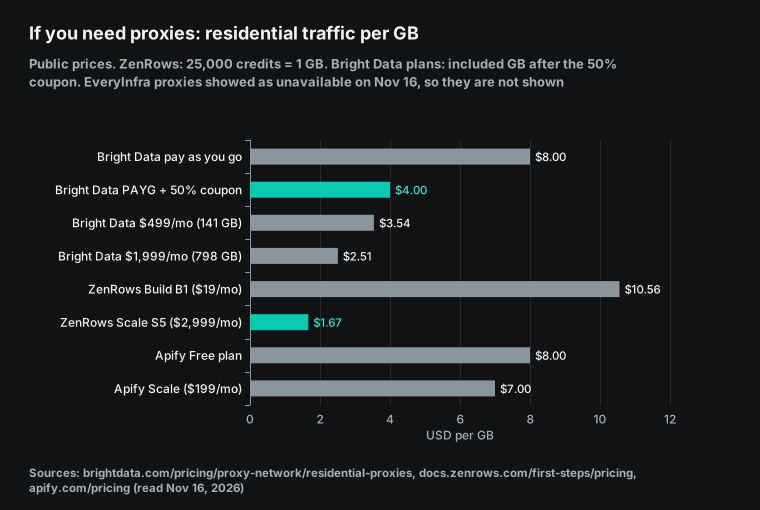
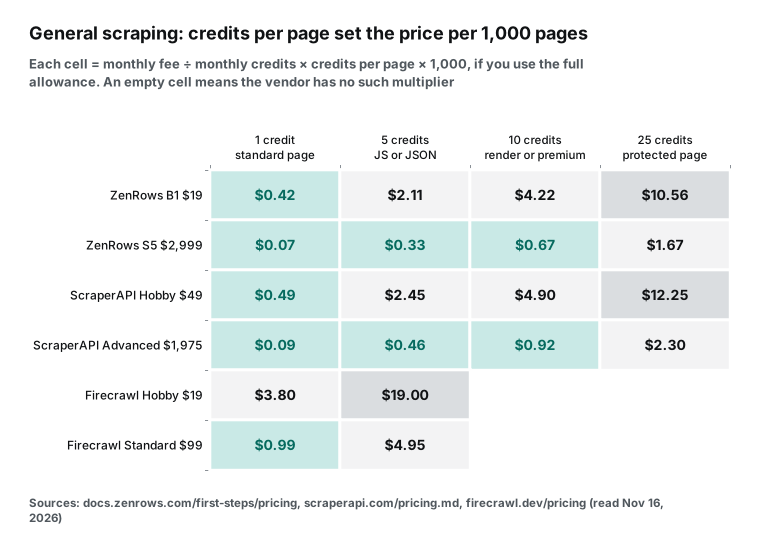
ZenRows does not list a separate per-GB price. Its pricing docs say that paid plans bill residential traffic at 25,000 credits per GB. The docs also give a rule of thumb: 1 GB equals 25,000 credits, which equals 1,000 protected pages. So the per-GB price depends on the plan. Build B1 costs $19 a month for 45,000 credits, which covers at most 1.8 GB, or $10.56 per GB.
Scale S5 costs $2,999 a month for 45 million credits, or $1.67 per GB. That is the lowest rate on the chart. But you get it only if you spend 1,800 GB a month on residential traffic. The Apify pricing page lists residential proxies at $8 per GB on Free, $7.50 on Starter and $7 on Scale. Datacenter IPs start at $0.60 each as an add-on.
Bright Data also raised a gate on residential proxies in the past month. Its release notes for October 19, 2026 say that the residential network no longer supports instant access without KYC. On October 24, it told users to move the remaining instant-access proxies to ISP proxies or Web Unlocker. Those proxies left accounts from November 9, 2026. The residential proxy docs list KYC as a separate step, and for a solo developer that step can matter more than the price.
General scraping bills credits per page, and all three vendors publish their multipliers. ZenRows charges 1 credit for a standard page, 5 with JS rendering, 10 with premium proxies and 25 with both. Its docs say that these multipliers are the same on every plan. The ScraperAPI credit cost docs list 1 for a standard page, 5 for Amazon, 25 for Google, 30 for LinkedIn and 10 for rendering. Firecrawl charges 1 credit per page, plus 4 for JSON format, and 2 credits per 10 search results.
| Plan | Monthly fee | Monthly credits | Standard page per 1K | Protected page (25 credits) per 1K | Structured (JSON or retail) |
|---|---|---|---|---|---|
| ZenRows Build B1 | $19 | 45,000 | $0.42 | $10.56 | Extract adds no fee, bills as the Fetch used |
| ZenRows Scale S5 | $2,999 | 45,000,000 | $0.07 | $1.67 | Same |
| ScraperAPI Hobby | $49 | 100,000 | $0.49 | $12.25 | Amazon page $2.45 per 1K |
| ScraperAPI Advanced | $1,975 | 21,500,000 | $0.09 | $2.30 | Amazon page $0.46 per 1K |
| Firecrawl Hobby | $19 | 5,000 | $3.80 | No such multiplier | JSON format $19.00 per 1K |
| Firecrawl Standard | $99 | 100,000 | $0.99 | No such multiplier | JSON format $4.95 per 1K |
The heat table shows one clear point. For general scraping, the multiplier moves the price more than the plan does. On ZenRows B1, a standard page costs $0.42 per 1,000 and a protected page costs $10.56, a 25x gap. The ZenRows FAQ says that Adaptive Stealth Mode starts from the lightest setup and bills only the setup that works. So you cannot know the credit cost of a page in advance.
| ZenRows plan | Monthly billing | Annual billing shown per month | Monthly credits |
|---|---|---|---|
| Build B1 | $19 | $16 | 45,000 |
| Launch L1 | $69 | $58 | 250,000 |
| Growth G1 | $199 | $166 | 1,200,000 |
| Scale S1 | $549 | $458 | 5,000,000 |
| Scale S5 | $2,999 | About $2,499 | 45,000,000 |
Annual billing means 12 months for the price of 10. The ZenRows pricing page shows these annual prices by default, such as $16 and $58. Use the monthly numbers when you compare, or you will price ZenRows about 17% too low.
Each group has its own sweet spot. Scrape an Instagram profile as a ZenRows protected page, and 1,000 profiles cost $10.56 on B1 or $1.67 on S5, plus your own parser. On EveryInfra, instagram/profile costs $0.556 per 1,000, and on Bright Data it costs $1.50. Now flip the job to 10,000 plain blog, docs or news pages. ZenRows S5 costs $0.07 per 1,000 pages and ScraperAPI Advanced costs $0.09. On EveryInfra, those pages go through the read tool at $0.694 per 1,000, or 7.7x to 9.9x those plans.
Bright Data alternatives free: what each free tier buys
The search "bright data alternatives free" asks one thing: can you do this without paying? Every vendor has a free tier. But the unit, the products it covers and the refresh cycle all differ.
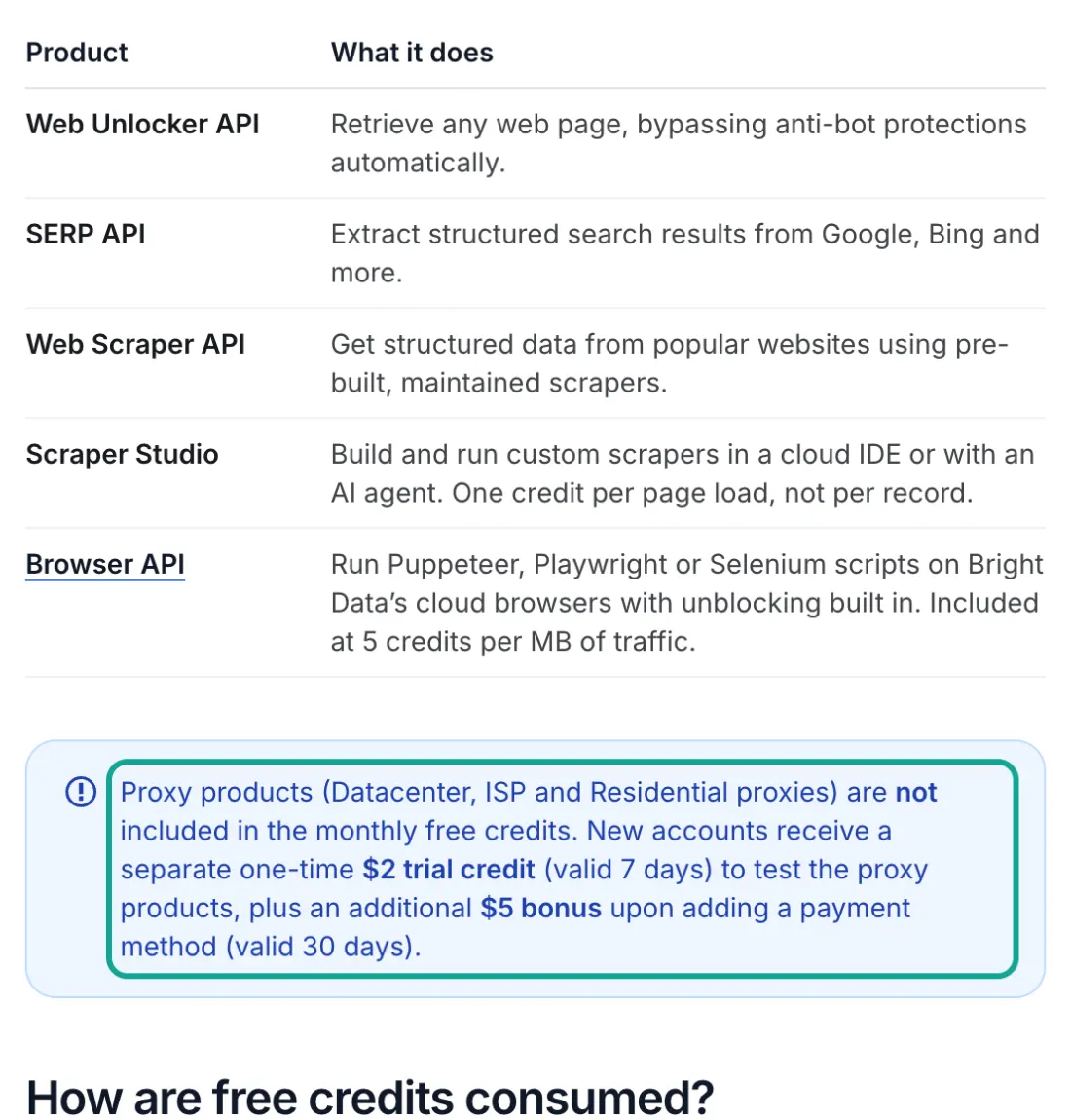
The Bright Data free tier docs give each new account 5,000 credits a month, worth about $7.50, with no credit card. The credits cover Web Unlocker, SERP, Web Scraper API, Scraper Studio and Browser API. For the first three, one credit is one request or one record. Browser API uses 5 credits per MB.
The same page lists three limits. Proxies are outside the free tier. They get only a one-time $2 trial for 7 days, plus $5 for 30 days after you add a payment method. Free accounts without a deposit are capped at 1,000 requests per minute on SERP, Unlocker and proxies. Accounts on a monthly commitment do not get the monthly free credits. The Bright Data MCP docs say that the 5,000 free MCP requests a month come from the same pool.
| Vendor | Free tier | Refresh | What it buys for the jobs in this article |
|---|---|---|---|
| Bright Data | 5,000 credits/mo, about $7.50 | 1st of each month, no rollover | 5,000 Instagram, Amazon or Google Maps records; no proxies |
| Apify | $5 platform credit/mo | Monthly | About 1,851 Instagram results, or 1,250 Maps places, or 1,000 Amazon items at Free rates |
| ZenRows | 5,000 credits/mo, 5 concurrent | Monthly, no rollover | 5,000 standard pages, or 200 protected pages; no stand-alone residential proxies |
| ScraperAPI | 5,000 credits for 7 days, then 1,000/mo | Monthly | 200 Amazon requests or 40 Google requests a month on Free |
| Firecrawl | 1,000 credits/mo | Monthly | 1,000 standard pages, or 200 JSON pages, or 5,000 search results |
| EveryInfra | $1 once, valid 24 hours after claim | Does not refresh | 1,798 instagram/profile calls, or 719 Maps searches (about 36,000 places at 50 each) |
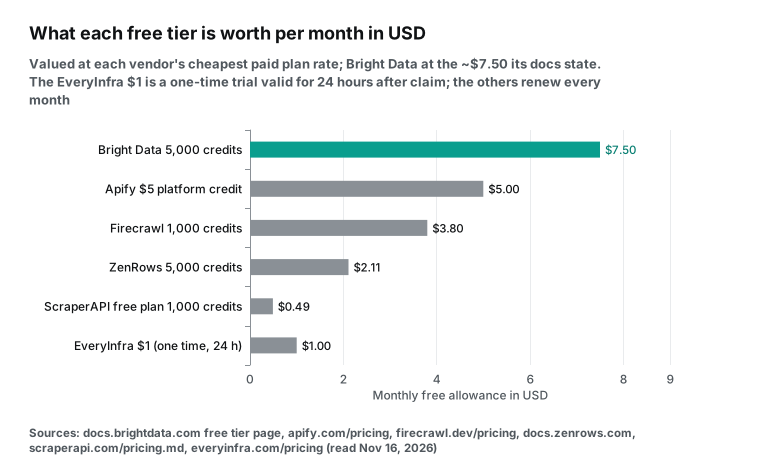
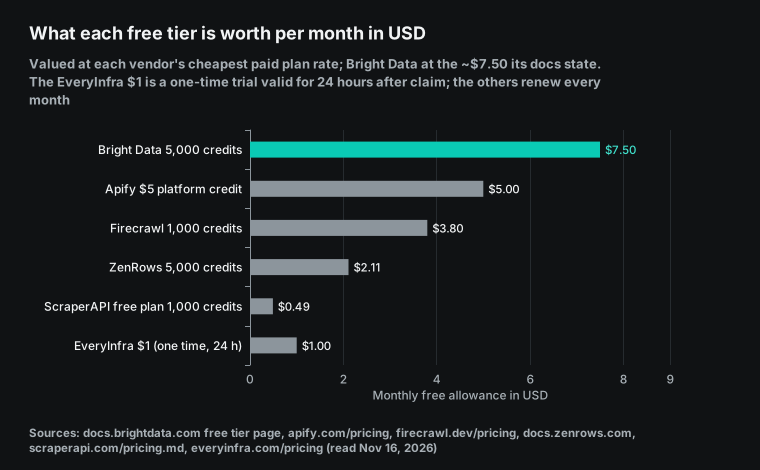
In USD per month, Bright Data has the largest free tier, at about $7.50. It bills per record, so 5,000 credits equal 5,000 records. The Apify $5 buys 1,851 Instagram results or 1,250 Maps places at Free rates. In an r/apify thread, one user asked whether 8 to 10 LinkedIn profiles a day would fit. A reply said that the free $5 is enough. The ScraperAPI free tier runs out fast on high-multiplier sites, because 1,000 credits buy only 40 Google requests.
The EveryInfra $1 is the smallest tier, and it lasts only 24 hours. But per-call billing buys more rows on list requests. It buys 719 Maps searches at 50 places each, about 36,000 places, which is more than the 5,000 Bright Data records. For one-row calls such as Instagram profiles, the $1 buys only 1,798. A free tier works best for one test run on your own sample. Every vendor's terms ban multiple accounts per person.
A month of work: 420,000 results
Now combine the three platforms into one small team's monthly need. The team needs 20,000 Instagram profiles, 100,000 Instagram posts and 50,000 Amazon search items. It also needs 50,000 Google Maps places and 200,000 Google Maps reviews. That is 420,000 results.
| Monthly need | Bright Data pay-as-you-go | Apify Scale ($199/mo, usage included) | EveryInfra calls | EveryInfra cost |
|---|---|---|---|---|
| 20,000 Instagram profiles | $30.00 | $38.00 | 20,000 | $11.12 |
| 100,000 Instagram posts | $150.00 | $190.00 | 500 (200 each) | $0.28 |
| 50,000 Amazon search items | $75.00 | $175.00 | 1,000 (50 each) | $2.24 |
| 50,000 Google Maps places | $75.00 | $100.00 | 1,000 (50 each) | $1.39 |
| 200,000 Google Maps reviews | $300.00 | $74.00 | 2,000 (100 each) | $2.78 |
| Free tier | −$7.50 | Not counted | Not counted | Not counted |
| Total | $622.50 | $577.00 | 24,500 | $17.80 (sum before rounding) |
On the Bright Data Scale plan, $499 covers 384,000 records. The other 36,000 cost $1.30 per 1,000, so the total is $545.80. The break-even point is about 332,667 records a month, and below that, pay-as-you-go costs less. The Apify Scale plan includes $199 of usage, so you pay $378 on top for this job. EveryInfra costs $17.80, and $11.12 of it goes to the 20,000 profiles.
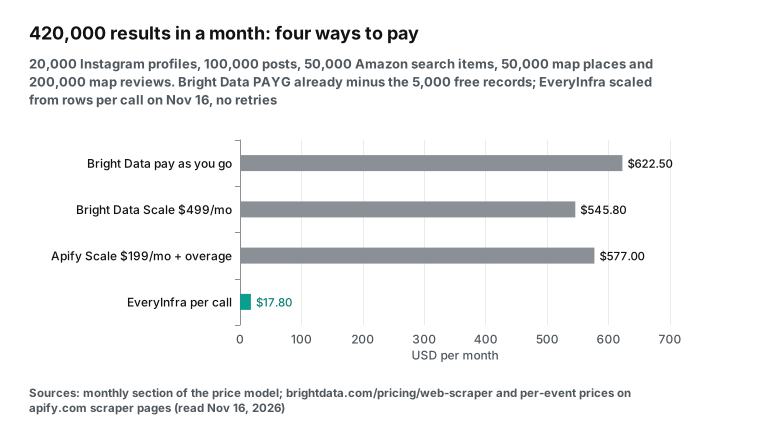
This bill rests on three conditions. First, rows per call come from the November 16 test. If a call returns only 48 posts, the low case in the catalog, the posts line rises from $0.28 to about $1.16. Second, we did not count retries, which cost nothing but add delivery time. Third, we did not count vendor promos. With API60, the same 420,000 results on Bright Data cost about $244.50 after the free tier.
At low volume, the math flips. Say a side project needs 5,000 results a month: 1,000 profiles, 2,000 posts, 1,000 Amazon items and 1,000 places. The Bright Data free tier covers all of it, so the cost is $0. On EveryInfra, the same job costs about $0.63, and after the 24-hour trial the first top-up is $10. On Apify Free rates it costs $17.10, which is above the free $5, so you need Starter at $19.
| 5,000 results a month | Bright Data | Apify | EveryInfra |
|---|---|---|---|
| 1,000 Instagram profiles | Free tier | $2.70 (Free rate) | $0.556 |
| 2,000 Instagram posts | Free tier | $5.40 (Free rate) | $0.0056 |
| 1,000 Amazon search items | Free tier | $5.00 (Free rate) | $0.0447 |
| 1,000 Google Maps places | Free tier | $4.00 (Free rate) | $0.0278 |
| Total | $0 | $17.10, or $13.90 on Starter | About $0.63 |
So for a few thousand rows a month with no need for fresh data, the Bright Data free tier costs least. Past 5,000 rows a month, the $1.50 rate starts, and the gaps from the bigger table open up.
Failures and empty results: 7 requests that cost nothing
We sent 16 requests in total. Nine were charged and seven were not. The table lists each one.
| Time (SGT) | Capability | HTTP | Reason | Charged |
|---|---|---|---|---|
| 00:21:41 | amazon/search | 429 | Per-minute cap that we set on the test key; retried after 19 s as the response said | $0 |
| 00:23:56 | google_maps_reviews/search | 429 | Same; retried after 4 s | $0 |
| 00:26:16 | amazon/reviews | 503 | access_blocked, product needs login or is restricted; refunded | $0 |
| 00:28:12 | google_maps_reviews/search | 422 | async_required, page 2 too deep for sync | $0 |
| 00:28:20 | amazon/reviews | 503 | Same as 00:26:16, second product | $0 |
| 00:29:03 | instagram/profile | 503 | Lookup of an account that does not exist; refunded | $0 |
| 00:29:52 | instagram/profile | 503 | Same account again; refunded | $0 |
The last two rows are one test. We looked up an Instagram username that does not exist, to see how "no such user" bills. At 00:29:03 and 00:29:52, both tries returned 503 and were refunded. They did not return a 404 or an empty result. If you check a batch of accounts that may be deleted, retry each 503 later. If a later retry still returns 503, check the profile page.
The other vendors use different failure rules. The Bright Data Web Scraper API page says that you pay only for successful deliveries. Its Scraper API FAQ adds that records that fail because of bad input are still billed. Apify pay-per-event bills each row written to the dataset, and it always bills the start fee. ZenRows and ScraperAPI both bill 404 as a success, and Firecrawl bills 1 credit for 403 and 404.
In an r/automation review thread, the poster set a row cap on one Apify YouTube scraper. The scraper still pulled thousands of extra rows, and the poster got no refund. Before you compare unit prices, estimate how many of your rows will be 404 or empty. For account checks or delisted-product monitors, that share can be high.
Setup: steps to the same job on six vendors
Take 1,000 Google Maps places as the job. On Bright Data, you open an account, get an API key and find the dataset ID in scrapers.json. You send keywords to /datasets/v3/trigger and download the snapshot when the async job ends. The Scraper API limits page says that a sync request waits at most 1 minute.
On Apify, you pick a Store scraper, fill in the input JSON, start a run and read the dataset. For pay-per-event scrapers, also check the unit price of each add-on. ZenRows, ScraperAPI and Firecrawl return pages or extracted JSON, so you build the search URL, page through results and parse the output. On EveryInfra, the job is one POST request:
curl -s https://api.everyinfra.com/api/v1/social \
  -H "Authorization: Bearer $EVERYINFRA_API_KEY" \
  -H "Content-Type: application/json" \
  -d '{"platform":"google_maps_reviews","action":"search","params":{"keyword":"dentist","location":"Denver, CO","limit":50}}'
# Returns results (50 places), next_page_token and billing.charged_usd
# From page 2, add "mode":"async" and poll the poll_url
To get the next page, send next_page_token back without changes. The catalog says that the token lasts 24 hours and each page bills as one call. The field names match the catalog response_fields. The google_maps_reviews/search capability returns 22 fields, such as place_id, name, lat, lng, rating and review_count. The google_maps_reviews/reviews capability returns 18 fields, such as rating, text, posted_at and owner_response.
In AI tools such as Claude or Cursor, all six vendors can connect over MCP. On November 16, the EveryInfra remote MCP tools/list call returned 12 tools. Use everyinfra_call_api to get data and everyinfra_get_job to read async results:
{
  "mcpServers": {
    "everyinfra": {
      "type": "http",
      "url": "https://api.everyinfra.com/mcp",
      "headers": { "Authorization": "Bearer ${EVERYINFRA_API_KEY}" }
    }
  }
}
This config follows the Streamable HTTP transport in the MCP specification. The key goes in a header, not in the URL. One client can hold several servers, and the model can pick one per task. Our MCP server page shows configs for more clients.
| Vendor | MCP server | Source code |
|---|---|---|
| Bright Data | Remote MCP, 5,000 free requests a month | brightdata-mcp |
| Apify | https://mcp.apify.com | apify-mcp-server |
| ZenRows | https://mcp.zenrows.com/mcp | zenrows-mcp |
| ScraperAPI | https://mcp.scraperapi.com/mcp | MCP docs |
| Firecrawl | Firecrawl MCP v3 | firecrawl-mcp-server |
| EveryInfra | https://api.everyinfra.com/mcp, 12 tools | MCP server page |
Moving off Bright Data: four places your code changes
If you use the Bright Data Web Scraper API today, the move touches four parts of your code. The first is the job model. Bright Data scrapers are mostly async: you send a batch, get a snapshot_id, check progress and download the snapshot. Its async request docs show the flow. The limits page says that snapshots stay available for 30 days after the job ends.
EveryInfra is sync by default, so one request returns the result. Above 60 rows, or on deep pages, add "mode": "async" and poll the poll_url. We got the 200 Instagram posts and Maps page 2 this way. Code that downloads snapshots in batches can switch to one request per input, or it can keep a poll loop.
| Bright Data concept | EveryInfra equivalent | What to change |
|---|---|---|
| Dataset ID | platform plus action | Map each dataset to one capability |
| Input array of URLs or keywords | params object, one input per call | Loop over inputs |
snapshot_id and download | Sync result, or poll_url in async mode | Keep a poll loop only for async |
Record fields such as followers | Catalog response_fields such as follower_count | Rewrite the parser |
| Bill per delivered record | billing.charged_usd in every response | Log and sum per day |
The second change is the input. Bright Data takes an array of URLs or keywords. We take three parts: platform, action and params. Parameter names follow the catalog, so Maps search uses keyword and location, and Instagram profile uses username. If a parameter is wrong or unknown, we return 422 at once with the supported values, and the call costs nothing. A batch script sees the mistake on the first call.
The third change is field mapping. The two sides use different field names, and they do not map one to one. Pick 20 to 50 typical records from your old data and call both sides with the same inputs. Align each field and record the missing rate. Then decide which fields you need from another source.
The fourth change is billing checks. Each EveryInfra response holds a billing object with charged, charged_usd and refund status. For the first two weeks, run both systems side by side and send 10% of the batch to the new one. Compare the real cost per 1,000 rows and the missing-field rate. Switch when the numbers hold steady.
Move list jobs first, such as posts, Maps places, reviews and Amazon search. Those jobs differ by tens to hundreds of times per 1,000 rows, so the bill drops fastest. Single profiles and product pages return one row per call, and the gap is small, so move them later. Keep proxy traffic and long-tail sites with your current vendor.
Among Bright Data competitors, when Bright Data or another vendor fits better
For most jobs in the first group, EveryInfra costs one to two orders of magnitude less. But in the cases below, Bright Data or another vendor is the better pick. Each case comes from the vendors' public material.
| Your situation | Better pick | Public evidence |
|---|---|---|
| You need proxies | Bright Data, ZenRows, Apify | Residential, datacenter and ISP proxies on self-serve plans |
| Your site is not in our catalog | Bright Data, Apify, ZenRows | 1,301 Bright Data scrapers across 1,207 domains |
| You need a bulk history | Bright Data datasets | From $250 per 100,000 records |
| You need Amazon reviews this week | Bright Data, Apify | Both of our amazon/reviews calls returned 503 |
| You run large Amazon search volume | ScraperAPI Startup or higher | About $0.0096 to $0.0155 per 1,000 products (estimate) |
| You need very high concurrency | Bright Data, ZenRows, ScraperAPI | Unlimited, 200 to 400, and 500 concurrent requests |
| You need compliance papers | Bright Data, ZenRows Enterprise | ISO 27001, SOC 2, SOC 3 report, DPA |
| You feed any web page to a model | Firecrawl, ZenRows | 1 credit per page, Markdown output |
You need proxies. Bright Data sells residential, datacenter and ISP proxies with no monthly fee on pay-as-you-go, and ZenRows and Apify also sell residential traffic. Our pricing page lists IP proxies (POST /api/v1/proxy/order, sold as traffic packs). But at 01:45 SGT on November 16, our proxy shelf showed all five proxy types as unavailable. To buy GB on demand today, pick one of those three vendors.
Your site is not in our catalog. Our catalog covers 106 platforms, so most long-tail sites are not in it. Web Unlocker aims to open any public URL, and the Apify Store has thousands of community scrapers. In the other direction, the Bright Data list has no scrapers for Xiaohongshu, Douyin, Taobao, JD.com, Weibo or Kuaishou, and our catalog covers them.
You need a one-time bulk history. The Bright Data dataset pricing page starts at $250 per 100,000 records, or $2.50 per 1,000. Its Marketplace Dataset API lets you filter and download. For tens of millions of records, a ready dataset is faster than live calls one by one.
You need very high concurrency. The Bright Data Web Scraper API page lists unlimited concurrency. ZenRows Scale allows 200 to 400 concurrent requests, and ScraperAPI Advanced allows 500. By default we allow 60 requests per minute per account, and boost packs or top-ups raise that to 180 or 600.
Your buyers need compliance papers. The Bright Data security and compliance page lists ISO 27001 and SOC 2. Its security policy aligns with ISO 27001:2022, ISO 27017 and ISO 27018. The page also has a SOC 3 report from a Deloitte network firm for June 2024 to May 2025. The ZenRows Enterprise tier also lists SOC 2, ISO 27001 and a DPA. When a buying process asks for these papers, those vendors have them ready.
Your job is to feed any web page to a model. Firecrawl charges 1 credit per page and returns Markdown by default, so Standard costs $0.99 per 1,000 pages. Its MCP v3, released on November 12, 2026, lists more than 3,000 tools and 60x higher rate limits. At volume, ZenRows S5 costs $0.07 per 1,000 standard pages, far below the $0.694 of our read tool. For small batches of docs, read is enough, and it costs less than the $0.99 per 1,000 pages of a full Firecrawl Standard plan. See our Firecrawl alternatives comparison.
Changes in the last 30 days
| Date | Vendor | Change | What it means for you |
|---|---|---|---|
| 2026-11-12 | Firecrawl | MCP v3 with higher rate limits | Agent tools that read pages can run more calls |
| 2026-11-10 | Bright Data | Perplexity scraper unavailable | A ready-made scraper can stop as a whole category |
| 2026-11-08 | Bright Data | New proxy errors peer_30060 (501) and policy_20231 (402) | Treat 402 as "do not retry" in scripts |
| 2026-11-05 | Bright Data | Extension port moves to 44445; port 22225 ends after 2026-11-25 | Update old configs before the end of the month |
| 2026-10-30 | Apify | Store search API moves to a new backend on 2026-11-15 | Retest workflows that find scrapers by keyword |
| 2026-10-27 | Bright Data | Unlocker success-rate API adds date filters and P90 | Track success rate per URL pattern |
| 2026-10-24 | Bright Data | Instant-access residential proxies end, removed from 2026-11-09 | Complete KYC or move to ISP proxies |
| 2026-10-09 | ZenRows | Crawl launched | Site-wide crawls now run inside ZenRows |
| October 2026 | ScraperAPI | Akamai sites unblock without the premium flag | Drop premium=true for Akamai sites and retest |
The Bright Data items come from its release notes. The Apify item comes from its Store API changelog. The ZenRows item comes from its changelog, which also says that on October 5 AI agents could buy Fetch and Extract at agents.zenrows.com. The ScraperAPI item comes from its October 2026 release note.
The Perplexity outage carries the main lesson for buyers. A per-record scraper that you rely on can stop without warning, even on a large vendor. For critical jobs, keep a second vendor that can return the same kind of record. Test it once a month on a small sample, so that a switch takes hours, not weeks.
What forum users say
Search Reddit for "bright data alternatives" and the top threads fall into two kinds. In one r/proxies thread, the poster used Bright Data dedicated datacenter and ISP proxies and found them too costly. Most replies were proxy sellers that pitched themselves. One reply warned that sellers often post such threads. That is a proxy need.
In the r/automation review thread, the poster said that Bright Data has a low error rate. The poster also said that "the pricing is quite aggressive" for one person.
The post itself lists problems with one YouTube scraper in the Apify Store. It fetched thousands of extra rows past the set maximum, it returned old videos instead of new ones, and the poster got no refund. Before you compare prices, ask two things: can a run go past the row cap, and do you get a refund if it does. The EveryInfra capabilities in this article bill per call, so one call costs the same whatever number of rows comes back. Our pricing page also says that a few list capabilities bill per block of rows, and the price shows the block size.
The r/apify pricing thread asks a different question. The poster wanted to run one scraper at $4 per 1,000 and asked if that needed the $29 Starter plan. A reply said that the $5 free tier is enough. The $29 figure is now out of date, because Apify cut Starter to $19 on September 11, 2026. The tracker UsagePricing logged the change, and the Apify subscription change docs use $19 in their example. Check the date on forum threads, because prices change within months.
Limits: where these results do not hold
All vendor prices come from public pages that we read on November 16, 2026, from 00:16 to 00:40 SGT. We did not sign up, log in or call any vendor API. Enterprise prices, stacked promo prices and in-account prices can differ. The Bright Data pricing page footer says that local currencies are for reference only, and that billing is in USD.
The EveryInfra side rests on 9 charged requests, one or two per job, which is a small sample. Instagram posts returned 200 rows this time, but the catalog says that some calls return at most 48. The hashtag call asked for 100 rows and got 24. Amazon search took 44.3 seconds, and slow runs take longer. The ScraperAPI rows per page (48 for Amazon, 20 for Google Maps) are our estimates.
One "row" also means different things on each side. A Bright Data or Apify product or place is often a full detail record, and our list rows hold fewer fields. For detail records, use a detail capability such as amazon/profile, where the price is $1.389 per 1,000. This article does not compare whether the data on both sides is the same, and it is not legal advice. Before you scrape public data, check the terms of the target site.
FAQ
What are the free Bright Data alternatives?
Source: Google suggestion "bright data alternatives free." Bright Data itself has the largest free tier, at 5,000 credits a month, about $7.50. Apify gives $5 a month, ZenRows 5,000 credits and Firecrawl 1,000 credits. ScraperAPI gives 5,000 credits for 7 days, then 1,000 a month. EveryInfra gives $1 once, valid for 24 hours. A free tier covers one small test run, and steady use needs a paid plan on every vendor.
Who are Bright Data's competitors, and how do they differ?
Source: Google suggestions "bright data competitors" and "bright data competition." Sort them by what you buy. For ready-made records, the alternatives are the Apify Store and EveryInfra, and ScraperAPI covers part of the work. For general scraping, the alternatives are ZenRows, ScraperAPI and Firecrawl. For proxies, the alternatives are ZenRows, Apify and other proxy sellers.
Bright Data vs Apify: which costs less?
Source: Google suggestion "bright data vs apify." For Instagram, both cost about $1.50 per 1,000 (Apify Business $1.50, Apify Free $2.70). Amazon products cost more on Apify, at $3.00 to $5.00. Google Maps places cost $4.00 on Apify Free and $1.50 on Business. The Apify review add-on is only $0.26 to $0.50 per 1,000, below the $1.50 of Bright Data. Apify also adds a monthly fee and run start fees.
Bright Data vs Firecrawl: how do you choose?
Source: Google suggestion "bright data vs firecrawl." Firecrawl sells general scraping only. It charges 1 credit per page and returns Markdown, which suits feeding pages to a model. Bright Data sells both groups. For platform fields from Instagram or Amazon, Firecrawl needs the JSON format, so Hobby costs $19.00 per 1,000 pages.
Is Bright Data free?
Source: Google suggestion "is bright data free." Yes, 5,000 credits a month, but not for proxies. The free tier section above has the details.
Is Bright Data legit and safe to use?
Source: Google suggestions "is bright data legit" and "is bright data safe." Bright Data lists ISO 27001, SOC 2 and a SOC 3 audit report on its security page. Residential proxies need KYC for full access, and it tightened instant access in October 2026. Whether your use is safe also depends on what you scrape and how. Public data still falls under site terms and local law, and this article gives no legal advice.
Are the cheaper Bright Data alternatives on Reddit worth it?
Source: Google suggestions "cheaper alternative to bright data" and "bright data alternatives reddit," plus the r/proxies thread. Most picks in proxy threads come from sellers, and one reply says so directly. Check whether the vendor publishes a price per GB or per row. Also check whether failures cost money and whether credits expire. Then run your own sample on the free tier.
Get started: rerun the math on your own sample
First, sign up and get an API key from the quickstart. Then claim the $1 trial on the pricing page by starring two GitHub repos. The trial lasts 24 hours.
Second, find your capability on the Instagram API page, the Amazon API page or the Google Maps reviews API page. You can also read price_usd, max_limit and response_fields in the capability catalog. The API market lists capabilities by platform.
Third, run the curl above 5 to 10 times with your own keywords or accounts. Log billing.charged_usd and the rows returned each time. Work out the price per 1,000 rows. Compare that number with your current Bright Data bill, and then move all jobs, some jobs or only list jobs.
References
- Bright Data Pricing (hub), Bright Data, read 2026-11-16
- Web Scraper API Pricing, Bright Data, read 2026-11-16
- Datasets Pricing, Bright Data, read 2026-11-16
- Residential Proxies Pricing, Bright Data, read 2026-11-16
- SERP API Pricing, Bright Data, read 2026-11-16
- Free tier, Bright Data docs, read 2026-11-16
- Release notes, Bright Data docs, latest entry 2026-11-10, read 2026-11-16
- Instagram Scraper API, Bright Data docs, read 2026-11-16
- Google Scraper API, Bright Data docs, read 2026-11-16
- Scraper API FAQs, Bright Data docs, read 2026-11-16
- Scraper API limits, Bright Data docs, read 2026-11-16
- MCP server overview, Bright Data docs, read 2026-11-16
- scrapers.json (scraper list), Bright Data docs, refreshed daily, read 2026-11-16
- Security and compliance, Bright Data docs, read 2026-11-16
- Async requests, Bright Data docs, read 2026-11-16
- SERP API rate limits, Bright Data docs, read 2026-11-16
- Marketplace Dataset API, Bright Data docs, read 2026-11-16
- Residential proxies introduction, Bright Data docs, read 2026-11-16
- Proxy error catalog, Bright Data docs, read 2026-11-16
- brightdata-mcp, Bright Data, GitHub, read 2026-11-16
- ZenRows Pricing, ZenRows, read 2026-11-16
- Zenrows Pricing (docs), ZenRows docs, read 2026-11-16
- Changelog, ZenRows, latest entry 2026-10-09, read 2026-11-16
- MCP tool reference, ZenRows docs, read 2026-11-16
- Agentic Payments, ZenRows docs, read 2026-11-16
- Crawl endpoints, ZenRows docs, read 2026-11-16
- zenrows-mcp, ZenRows, GitHub, read 2026-11-16
- ScraperAPI Pricing, ScraperAPI, read 2026-11-16
- pricing.md, ScraperAPI, read 2026-11-16
- Credits and Requests costs, ScraperAPI docs, read 2026-11-16
- Google Maps Search API, ScraperAPI docs, read 2026-11-16
- Amazon Search API, ScraperAPI docs, read 2026-11-16
- Akamai-protected sites now unblocked automatically, ScraperAPI docs, October 2026, read 2026-11-16
- Release Notes, ScraperAPI docs, read 2026-11-16
- ScraperAPI MCP Server, ScraperAPI docs, read 2026-11-16
- Apify pricing, Apify, read 2026-11-16
- Instagram Scraper, Apify Store, read 2026-11-16
- Google Maps Scraper, Apify Store, read 2026-11-16
- Amazon Product Scraper, Apify Store, read 2026-11-16
- Apify Store API: new search backend and breaking changes, Apify, 2026-10-30
- Apify Store docs (running Store scrapers), Apify docs, read 2026-11-16
- Apify MCP server, Apify docs, read 2026-11-16
- Google Maps Scraper is going to pay-per-event pricing, Apify help center, read 2026-11-16
- Subscription changes, Apify docs, read 2026-11-16
- apify-mcp-server, Apify, GitHub, read 2026-11-16
- Firecrawl Pricing, Firecrawl, effective 2026-09-04, read 2026-11-16
- Billing, Firecrawl docs, read 2026-11-16
- Introducing Firecrawl MCP v3, Firecrawl, 2026-11-12
- Firecrawl MCP Server, Firecrawl docs, read 2026-11-16
- firecrawl-mcp-server, Firecrawl, GitHub, read 2026-11-16
- MCP Specification 2025-11-25, Model Context Protocol, read 2026-11-16
- EveryInfra capability catalog, EveryInfra, read 2026-11-16 00:16 SGT
- EveryInfra search tool catalog, EveryInfra, read 2026-11-16
- Whats a better/cheaper alternative to Brightdata?, Reddit r/proxies, read 2026-11-16
- Reviews after getting into web scrape tools, Reddit r/automation, read 2026-11-16
- Confusion on Apify Pricing!, Reddit r/apify, read 2026-11-16
- Apify cuts the Starter plan from $29 to $19, UsagePricing, 2026-09-11
Reference BL-170