Bright Data vs Firecrawl: Firecrawl for pages, Bright Data for search
Bright Data vs Firecrawl at list prices read on Nov 23, 2026: 1M plain pages cost $1,100 vs $749; 100k link-only searches cost $142.50 vs $349.
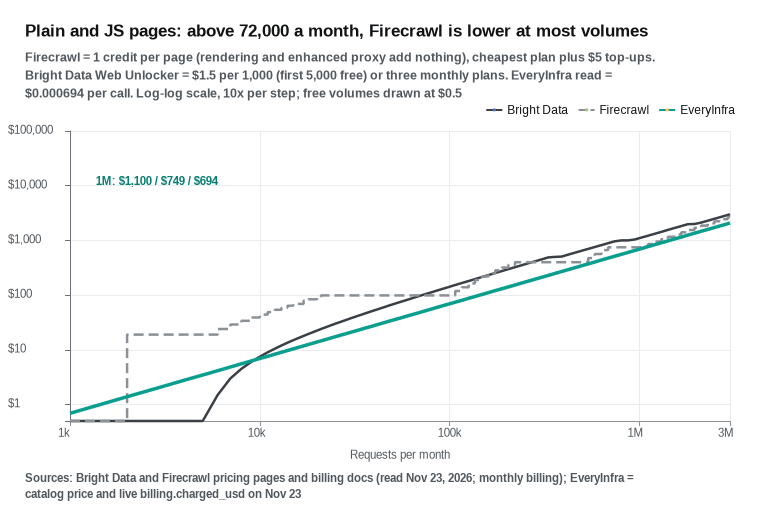
We read both pricing pages on November 23, 2026. At 1 million plain pages a month, Firecrawl's Scale plan costs $749. The cheapest Bright Data Web Unlocker option is the $999 plan plus overage, a total of $1,100.20. We priced every volume from 1,000 to 10 million pages in steps of 1,000. Firecrawl costs less at 9,799 of those 10,000 points.
Search goes the other way. When you only need 10 result links, Firecrawl charges 2 credits per search. Bright Data's SERP API charges $1.50 per 1,000 requests. At 100,000 searches a month, that is $349 against $142.50. Bright Data costs less at every volume from 1,000 to 10 million.
Bright Data vs Firecrawl in one table
Both vendors take a URL and give you back the page. They start from different places. Bright Data sells an unblocking and proxy network, and it bills USD per request or per record. Firecrawl sells a page-to-Markdown and page-to-JSON API, and it bills credits that come inside monthly plans.
The vendor numbers come from pricing pages and docs read between 00:13 and 00:30 Singapore time on November 23, 2026. The EveryInfra column uses the catalog price read at 00:18 on the same day. EveryInfra has no general unblocking product. Each EveryInfra cell names the closest tool, and that tool returns less than the two vendors do. A later section lists the differences.
| Item | Bright Data | Firecrawl | EveryInfra (page text or platform fields only) |
|---|---|---|---|
| Billing unit | Per 1,000 requests or records, USD, prepaid wallet | Credits in a monthly plan, then $5 top-up packs | Per call, USD balance |
| Plain and JS pages | Web Unlocker, $1.50 per 1,000 pay as you go; rendering included | 1 credit per page; rendering and enhanced proxy +0 | read, text only, $0.000694 per call |
| Protected pages | Same price; only successful requests billed | 1 credit; 403 and 404 also billed | No general unblocking |
| Search, 10 links | SERP API, $1.50 per 1,000 | 2 credits | web, $0.000694 per call |
| Search + 10 full texts | 1 SERP + 10 Unlocker requests | 2 + 10 = 12 credits | deep (full=true), $0.000694 per call; up to 20,000 characters per text |
| Structured product data | Scraper API, $1.50 per 1,000 records | 1 + 4 (JSON format) = 5 credits | amazon/profile, Amazon only, $0.001389 per call |
| Site crawl | Fetch API, one record per page | 1 credit per page | crawl, up to 20 pages for $0.000694 |
| Monthly plans | $499, $999, $1,999 with 383k, 908k, 2M requests | $19, $99, $399, $749 with 5k, 100k, 500k, 1M credits | No monthly fee |
| Free tier | 5,000 credits a month, shared, no card | 1,000 credits a month, no card | No free tier; pay per call |
| Concurrency | "Unlimited concurrency" on PAYG and plans | 2, 5, 25, 50, 100 browsers | Per-key rate limit per minute |
| MCP | Remote and local, 30 tools | Remote MCP v3, keyless trial | Remote MCP, tools named everyinfra_* |
| Open source | MCP server is MIT; unblocking is not open | Main repo AGPL-3.0; self-host lacks the anti-bot part | No |
The Bright Data prices come from three pages. The Web Unlocker pricing page shows $1.50 per 1,000 requests pay as you go. Its Scale plan costs $499 a month with 383,000 requests, and overage costs $1.30 per 1,000. The plan slider holds two more tiers in its data-tiers attribute: $999 with 908,000 requests ($1.10 overage) and $1,999 with 2 million ($1.00 overage). The SERP API pricing page uses the same $1.50 rate, with 380,000, 900,000 and 2 million requests in the three plans. The Scraper API pricing page bills per record: $1.50 per 1,000 pay as you go, and $499 for 384,000 records.
The Firecrawl prices come from its pricing page. Hobby costs $19 a month for 5,000 credits. Standard costs $99 for 100,000. Growth costs $399 for 500,000. Scale costs $749 for 1 million. Annual billing lowers these to $16, $83, $333 and $599 a month.
A $5 top-up pack holds 1,000, 2,000, 2,500 or 5,000 credits on those four plans. The Billing doc shows the same table. The pricing page says these prices took effect on September 4, 2026. For each vendor's full price structure, see Bright Data pricing explained and Firecrawl pricing explained.
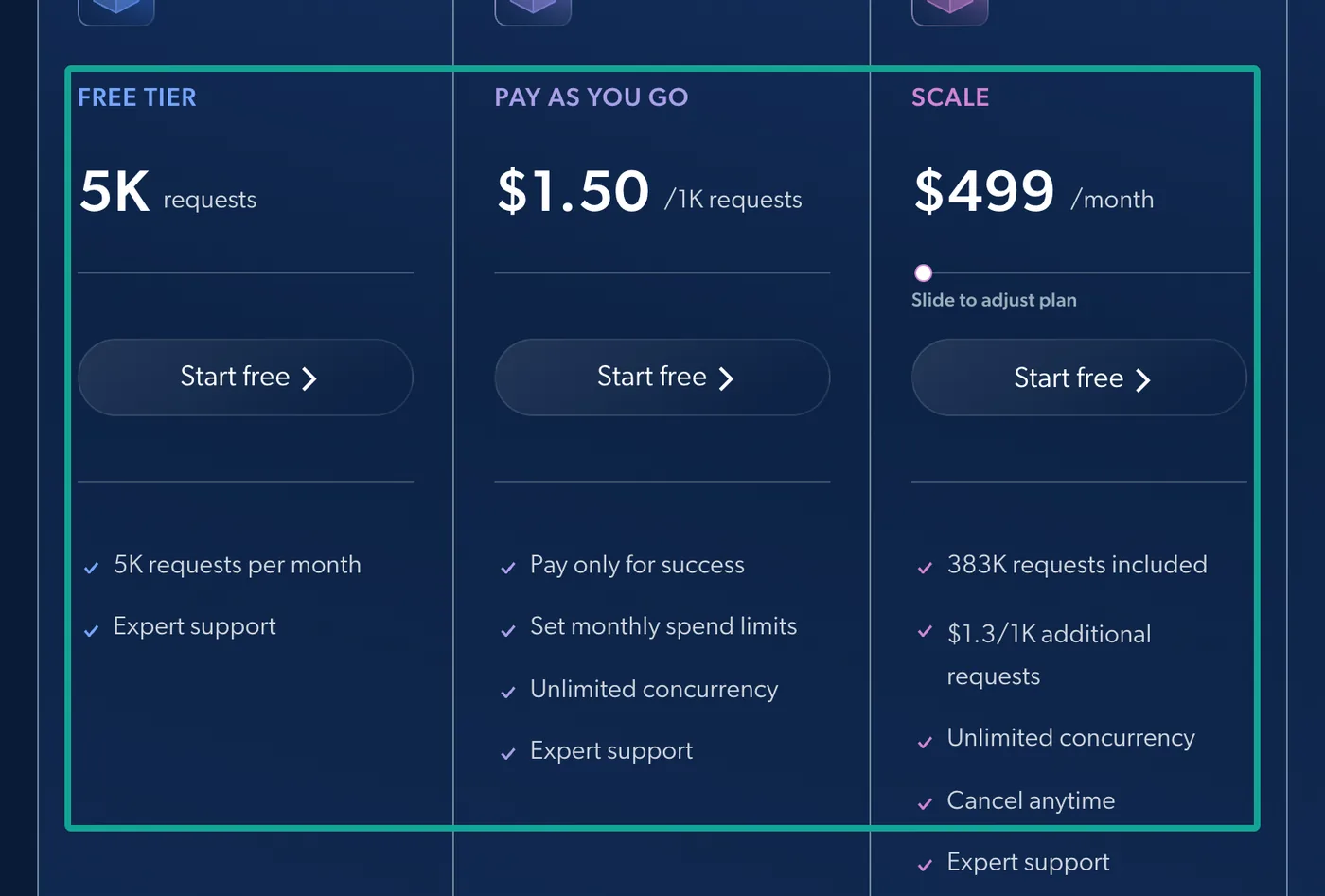
How each vendor charges: USD per request, or credits in a plan
Bright Data bills a request or a record. Web Unlocker and SERP API bill per request. Scraper API bills per delivered record. The price does not change with page difficulty. A static blog page and a protected store page cost the same $1.50 per 1,000 Unlocker requests.
The wallet is prepaid. The free tier doc gives every new account 5,000 free credits a month. Web Unlocker, SERP API, Web Scraper API, Scraper Studio and Browser API all draw from that one pool. Each request or record uses 1 credit. Only pay-as-you-go accounts get this allowance. When you move to a monthly plan, the monthly free credits stop.
Firecrawl bills credits, and each endpoint and option uses a different number. The Billing doc lists the rules. Scrape and crawl cost 1 credit per page. Map costs 1 credit per call. Search costs 2 credits per 10 results, and 11 results cost 4. If you scrape the results, each result costs 1 more credit.
Options add to the base price. JSON format, the question format, highlights, audio and video transcription and PII redaction each add 4 credits per page. PDF parsing adds 1 credit per PDF page. Zero data retention adds 1 credit per page. These options stack, so JSON plus zero data retention costs 6 credits.
One 2026 change matters for protected sites. The enhanced proxy costs the same 1 credit as a basic request. This applies to proxy: "enhanced" and to an automatic step up.
Bright Data's monthly bill is close to a straight line. Firecrawl's bill is a staircase. Bright Data's unit price stays flat, with small bends at plan limits. Firecrawl's unit price depends on the plan. Inside the plan, Standard works out to $0.99 per 1,000 credits and Scale to $0.749.
After the plan runs out, top-up packs cost $5, $2.50, $2 and $1 per 1,000 credits on Hobby, Standard, Growth and Scale. That is two to five times the in-plan rate. Firecrawl is cheapest when your usage sits just under a plan limit.
| Action | Bright Data billing | Firecrawl credits | Firecrawl USD (Scale, in plan) |
|---|---|---|---|
| Fetch one plain page | 1 Unlocker request | 1 | 0.000749 |
| Fetch one JS-rendered page | 1 Unlocker request | 1 | 0.000749 |
| Fetch a page and extract JSON | 1 Scraper API record (only for sites with a ready scraper) | 5 | 0.003745 |
| One search, 10 links | 1 SERP request | 2 | 0.001498 |
| One search plus 10 full texts | 1 SERP + 10 Unlocker requests | 12 | 0.008988 |
| List the URLs of a site | No direct product | 1 map call | 0.000749 |
| One LinkedIn profile | 1 Scraper API record | 5 to 40, by data source | 0.003745 to 0.02996 |
| One X post | 1 Scraper API record | 30 | 0.02247 |
The LinkedIn and X rows come from the end of the Firecrawl Billing doc. LinkedIn person and company pages go to third-party data sources that your team picks in the dashboard. They cost 5 to 40 credits per request. X posts and profiles use another AI company's interface and cost 1 base credit plus 29, or 30 credits in total. If these URLs are a large part of your list, "1 page = 1 credit" no longer holds.
Plain pages and JS pages: Firecrawl is lower at most volumes
Firecrawl bills 1 credit per page and adds nothing for rendering. Bright Data Web Unlocker bills $1.50 per 1,000 requests, with rendering included. We wrote both price lists as functions. Then we priced every monthly volume from 1,000 to 10 million pages in steps of 1,000. At each point, the script picks the cheapest option for each vendor.
For Bright Data, the options are pay as you go (after the 5,000 free credits) and the three monthly plans. For Firecrawl, the options are the free tier and the four monthly plans plus $5 top-up packs. Of the 10,000 points, Firecrawl is lower at 9,799, Bright Data at 197, and 4 are ties.
Bright Data wins in two ranges. The first range is under 72,000 pages a month. Here Bright Data needs only pay as you go, and the first 5,000 requests are free. Firecrawl needs the $99 Standard plan.
The second range is 143,000 to 272,000 pages. Here Firecrawl's Standard plan is used up, and top-up packs at $2.50 per 1,000 credits cost more than Bright Data's pay-as-you-go rate. This lasts until the volume justifies the $399 Growth plan.
| Pages per month | Cheapest Bright Data option | Bright Data bill | Cheapest Firecrawl option | Firecrawl bill (monthly) | Firecrawl, annual per month |
|---|---|---|---|---|---|
| 10k | Pay as you go | $7.50 | Hobby + packs | $44 | $41 |
| 50k | Pay as you go | $67.50 | Standard | $99 | $83 |
| 100k | Pay as you go | $142.50 | Standard | $99 | $83 |
| 300k | Pay as you go | $442.50 | Growth | $399 | $333 |
| 1M | $999 plan | $1,100.20 | Scale | $749 | $599 |
| 3M | $1,999 plan | $2,999 | Scale + packs | $2,749 | $2,599 |
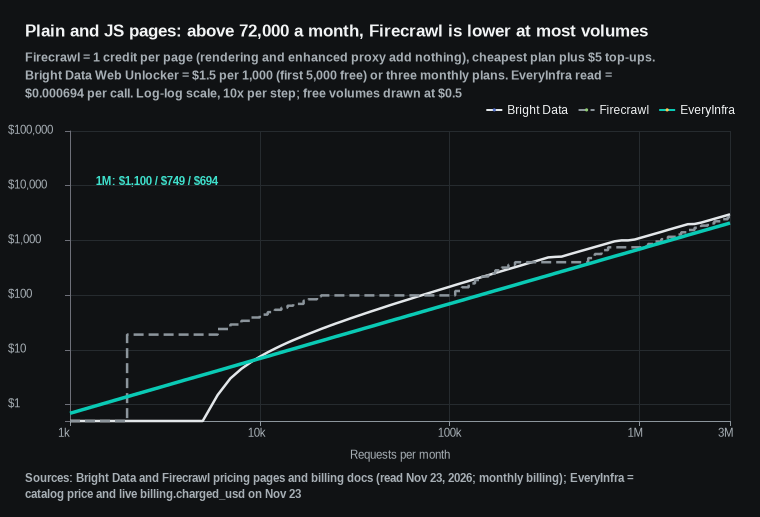
Firecrawl's annual plans cost $16, $83, $333 and $599 a month. At 1 million pages, the bill drops from $749 to $599, and the gap to Bright Data grows to $501. The cost is a one-year commitment. Also, only the annual Scale plan rolls unused credits over, and only for one month.
Volume just above a plan limit needs its own check. At 1.1 million pages a month, Firecrawl costs $749 plus 100,000 credits in top-ups (20 packs, $100), so $849. Bright Data's $999 plan includes 908,000 requests. The other 192,000 requests cost $1.10 per 1,000, so the total is $1,210.20. As long as you stay out of the expensive top-up ranges, Firecrawl stays lower.
When Firecrawl's bill jumps: just above a plan limit
Firecrawl's in-plan price is low, and its top-up price is high. The unit price jumps when you go a little over a plan. Take the Standard plan: $99 a month for 100,000 credits, then $5 for each 2,000 more, which is $2.50 per 1,000.
At 120,000 credits, you pay $99 + 10 packs × $5 = $149. At 150,000 you pay $224. At 200,000 you pay $349. At 220,000 you pay $399, the same as the Growth plan.
Above that, move up a plan. Growth costs $399 for 500,000 credits, and its packs cost $2 per 1,000. At 675,000 credits it ties with the $749 Scale plan.
| Credits per month | Standard + packs | Growth + packs | Scale | Cheapest |
|---|---|---|---|---|
| 100k | $99 | $399 | $749 | Standard |
| 120k | $149 | $399 | $749 | Standard |
| 150k | $224 | $399 | $749 | Standard |
| 220k | $399 | $399 | $749 | Tie |
| 600k | $1,349 | $599 | $749 | Growth |
| 675k | $1,539 | $749 | $749 | Tie |
| 1M | $2,349 | $1,399 | $749 | Scale |
The Billing doc says an upgrade starts at once. You pay the full new price that day with no proration. The billing cycle restarts on the upgrade date. Unused credits from the old plan carry over. A move to a lower plan starts only at the next renewal.
If your usage moves between two plans month to month, the higher monthly plan usually costs less than repeated mid-month changes. Bright Data's pay-as-you-go rate is flat, and its plan overage rate is lower than the pay-as-you-go rate.
Bright Data bills by calendar month. Its Billing doc says the monthly commitment is charged on the 1st of each month. If you join mid-month, you pay the first commitment on the day you join. On the 1st, the commitment is prorated by active days.
The doc's example: you join on June 25 with a $500 commitment. Six active days are 20% of June, so June costs $100. On July 1, your card is charged $100 to bring the balance back to $500.
Search: Bright Data is lower at every volume
Firecrawl charges 2 credits per 10 results, which is the price of two pages for each search. Bright Data's SERP API charges one price per request, $1.50 per 1,000, and returns a structured result list.
We ran the same scan from 1,000 to 10 million searches. Bright Data is lower at every point. At 100,000 searches a month it is $142.50 against $349, a 2.4x gap. At 1 million it is $1,109 against $1,749. At 3 million it is $2,999 against $5,749.
| Searches per month | Bright Data SERP API | Firecrawl search (10 results) |
|---|---|---|
| 10k | $7.50 (pay as you go) | $94 (Hobby + packs) |
| 50k | $67.50 | $99 (Standard) |
| 100k | $142.50 | $349 |
| 300k | $442.50 | $599 |
| 1M | $1,109 ($999 plan) | $1,749 |
| 3M | $2,999 ($1,999 plan) | $5,749 |
Both search docs have rules that change the price per call. The SERP API billing doc bills only successful responses. Automatic retries behind the scenes cost nothing extra. In async mode, the "send request" call is billed and the "collect" call is free. JSON, Markdown and HTML parsing are in the unit price, with no bandwidth fees. As with Web Unlocker, custom headers or cookies on the zone make every request billable.
The Firecrawl Search doc rounds up per 10 results: 1 to 10 results cost 2 credits, and 11 to 20 cost 4. Searches in the gov category add no search credits. End-to-end zero data retention, an Enterprise option, costs 10 credits per 10 results. Anonymized retention stays at 2. The first feedback you send on a search job can refund 1 credit, within team limits. Set parsers: [] if you do not need PDF parsing, so PDF results do not add credits per page.
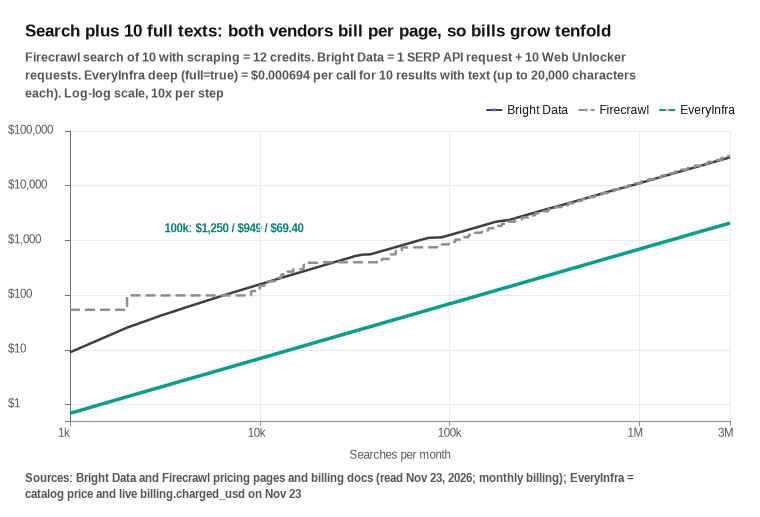
When you also need the text of each result, the bill grows by an order of magnitude. In Firecrawl, you add scrapeOptions to the search, and each result costs 1 more credit, so 12 credits for 10 results. Bright Data has no single "search and fetch" call. You call the SERP API, then call Web Unlocker once for each of the 10 URLs, which is 11 requests.
At 10,000 searches a month, Firecrawl costs $149 and Bright Data $157.50, almost equal. At 100,000, it is $949 against $1,250.20, so Firecrawl is lower. The Bright Data figure has two parts. The 1 million Unlocker requests use the $999 plan, $1,100.20. A monthly plan ends the 5,000 free credits, so the 100,000 SERP requests cost the full $150.
Above 373,000 searches, Bright Data's $1,999 plan with its $1.00 rate takes over. At 1 million searches, it is $11,108 against $11,749, and Bright Data is lower again.
Structured product data: Firecrawl JSON extraction costs the most
Price monitoring and product research need fields: title, price, rating, review count, stock. Firecrawl gets fields through the JSON format on scrape. You give a schema or a prompt, and a model extracts the fields. That costs 1 + 4 = 5 credits per page. Bright Data gets fields through the Scraper API. Its prebuilt scrapers return JSON, and it bills per delivered record at $1.50 per 1,000.
At 100,000 product pages a month, Firecrawl needs 500,000 credits, which is the $399 Growth plan. Bright Data pay as you go costs $142.50. At 1 million pages, Firecrawl costs Scale plus 4 million credits in top-ups, $4,749. Bright Data costs the $499 plan plus overage, $1,299.80.
| Product pages per month | Bright Data Scraper API | Firecrawl JSON extraction |
|---|---|---|
| 10k | $7.50 | $99 |
| 50k | $67.50 | $399 |
| 100k | $142.50 | $399 |
| 300k | $442.50 | $1,249 |
| 1M | $1,299.80 | $4,749 |
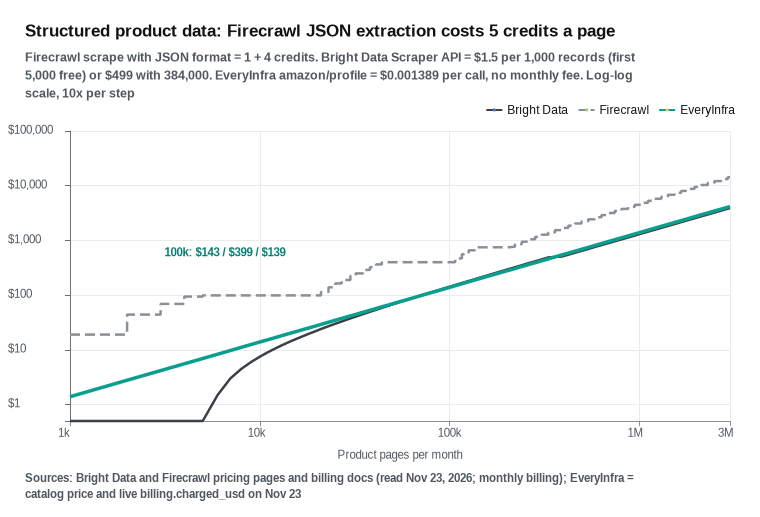
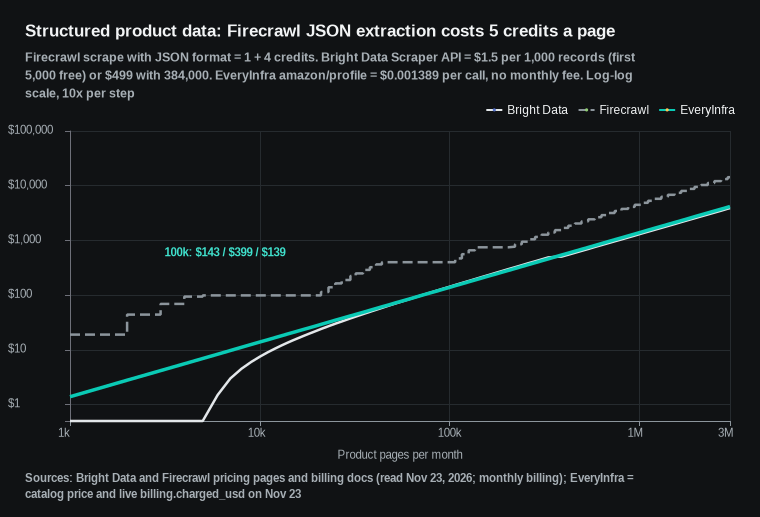
The Scraper API calculator lists four rates, 1.5, 1.3, 1.1 and 1, but the static page source holds plan data for the $499 tier only. Higher tiers probably exist. The $1,299.80 figure at 1 million pages uses only the tier we could read, so the real bill may be lower.
Firecrawl also has a product format on scrape. The Scrape doc says it extracts a product "deterministically" with no model call and no schema. It returns title, brand, category and variants with price, original price and availability. Neither document we read on November 23 lists its credit cost. The Billing surcharge table lists JSON, question and highlights at +4 each. The pricing page says the deterministic extraction engine in Monitor bills 7 credits per page per check.
How many credits a single product scrape uses is not in writing, so check your dashboard. If it uses only the base 1 credit, 100,000 product pages fit the $99 Standard plan and cost less than Bright Data's $142.50. If it costs as much as JSON, the bill is the $399 in the table. We did not open a Firecrawl account to test it, so the table uses the documented JSON format.
Firecrawl JSON extraction works on any URL with your own schema. Bright Data's Scraper API covers only sites with a prebuilt scraper. The Fetch API doc says the general-purpose endpoint does not parse site-specific fields such as prices or follower counts.
Site crawls and site maps
Crawling a whole docs site for a RAG index is Firecrawl's home ground. Crawl costs 1 credit per page, the same as scrape. You can set a limit, and pages bill as they finish. The docs warn that batch charges can show up minutes or hours after you submit the job. Map lists every URL on a site for 1 credit per call.
Bright Data has no direct match here. The usual method is to fetch page by page with the Fetch API or Web Unlocker, at $1.50 per 1,000 pages and up. You keep your own URL queue and remove duplicates.
Firecrawl uses a default crawl limit of 10,000 pages when you omit one, and the Billing doc says so. One mistake can cost 10,000 credits. The Crawl doc adds a check. Before a crawl starts, Firecrawl checks that your remaining credits cover the limit. If they do not, it returns 402. So set the limit to the real page count, for example limit: 100.
The same doc explains how to tell if a crawl is complete. When a crawl ends, completed equals total, but that does not mean every page worked, because total leaves out failed pages. You read failed pages from GET /v2/crawl/{id}/errors. That call returns errors (network errors, timeouts) and robotsBlocked (pages blocked by robots.txt).
A page where the target returned 404 is not a crawl error. It appears in data, it costs 1 credit, and its status code is in metadata.statusCode. By default, crawl follows only child paths of the start URL. Use crawlEntireDomain for sibling and parent paths. The sitemap option defaults to include; with skip, sitemap-only pages such as PDFs are missed.
Map costs 1 credit per call, whatever the number of URLs. The Map doc says a limit of 100,000 still costs 1 credit. Map reads the sitemap first and adds search results and cached crawl data. The doc says it favors speed, so it may miss some links.
What each vendor returns
Firecrawl scrape can return several formats at once. The list includes Markdown, cleaned HTML, raw HTML, a screenshot, links, image URLs, a summary, JSON and product. For URLs such as YouTube, it can also return audio or video file links.
Screenshot links expire after 24 hours. Audio and video links expire after 1 hour. The default output is Markdown, ready for a model's context.
For pages that need sign-in or clicks, Firecrawl has interact browser sessions. The Interact doc bills by the second with a one-minute minimum. Code-only sessions cost 2 credits a minute, and sessions with AI prompts cost 7. Zero data retention adds 2 a minute. Each scrape inside a session costs 1 more credit. Sessions expire after 10 minutes, or after 5 idle minutes, so stop them when you finish.
Bright Data Web Unlocker returns the target page's raw response. The introduction page says that with direct API access you set format to raw (unchanged) or json (wrapped). You parse it yourself. For Markdown, you switch to the Fetch API. It returns Markdown, plain text, raw HTML and JSON-LD in one record, at the Scraper API record price. SERP API returns a structured result list.
The Fetch API doc lists how calls differ from Unlocker. The Fetch API needs no zone. The sync endpoint /datasets/v3/scrape works best with one URL. If the fetch takes more than 1 minute, it returns HTTP 202 with a snapshot_id and goes async. Batches use /datasets/v3/trigger, with no URL limit and up to 1 GB of input per job. Each record also has final_url, page_title and country, and every request fetches the live page.
| Output you want | Bright Data | Firecrawl | EveryInfra |
|---|---|---|---|
| Raw HTML | Web Unlocker raw | rawHtml format | Not offered |
| Markdown or page text | Fetch API | markdown (default) | read, crawl, deep return text |
| Screenshot | Browser API | screenshot (not in self-host) | Not offered |
| Fixed fields | Scraper API site scrapers | json (+4) or product | Platform capabilities; fields in the catalog |
| Search results | SERP API | search | web, deep |
Protected pages: are failed requests billed?
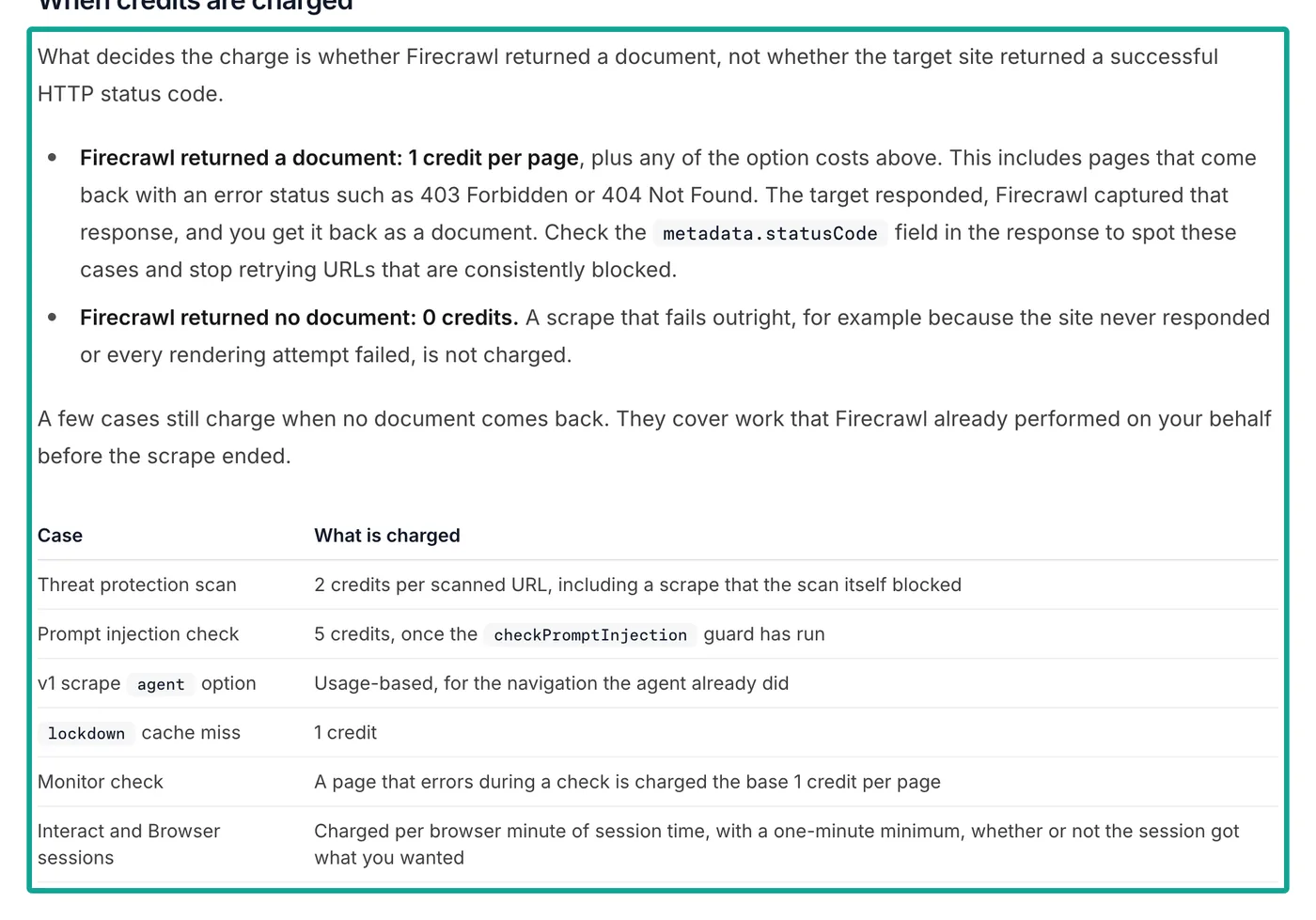
The Firecrawl Billing doc has a section called "When credits are charged". The test is whether Firecrawl returned a document. The target's HTTP status code does not matter. If the target returns 403 Forbidden or 404 Not Found, Firecrawl returns that response as a document and bills 1 credit.
The doc tells you to check metadata.statusCode and stop retrying URLs that stay blocked. Only when the site never responds, or every render fails, does Firecrawl bill 0. Some cases bill even with no document. A threat protection scan costs 2 credits per URL, and a prompt injection check costs 5 once it runs. Browser sessions bill per minute, with a one-minute minimum.
Bright Data does the opposite. The Web Unlocker introduction says Web Unlocker and SERP API bill only successful requests to the target domain.
The exception is in the configuration doc. If you turn on "Custom Headers & Cookies" for a zone, Bright Data bills 100% of requests, successful and failed. The reason given is that you now control the headers, so Bright Data no longer controls the success rate. Scraper API bills per delivered record. Its FAQ page says records that fail because of a wrong input are still billed, because the request used resources.
| Case | Bright Data | Firecrawl | EveryInfra |
|---|---|---|---|
| Target returns 404 | Web Unlocker: no charge | 1 credit | Live on November 23: read returned 404, charged $0 |
| Target returns 403 (blocked) | Web Unlocker: no charge | 1 credit | Failures are not billed (no 403 in this test) |
| No response, all renders fail | No charge | No charge | No charge |
| Custom headers or cookies on | All requests billed | Not applicable | Not applicable |
| Wrong input (wrong URL type) | Scraper API still bills | Depends on whether a document returns | 422 with the valid parameters |
| Credits run out | Error with no funds; PAYG with funds | Free tier returns 402; paid tier with top-ups off returns 402 | Billed from balance; no monthly quota |
Assume 3 in 10 requests to your target return 403. To get 1,000 good pages, Firecrawl sends about 1,429 requests and bills 1,429 credits. On Scale top-ups at $1 per 1,000 credits, that is $1.43. On Standard top-ups, it is $3.57.
Bright Data pay as you go stays at $1.50, and the $1,999 plan is about $1.00. At a 50% success rate, Firecrawl Standard top-ups cost $5 per 1,000 good pages.
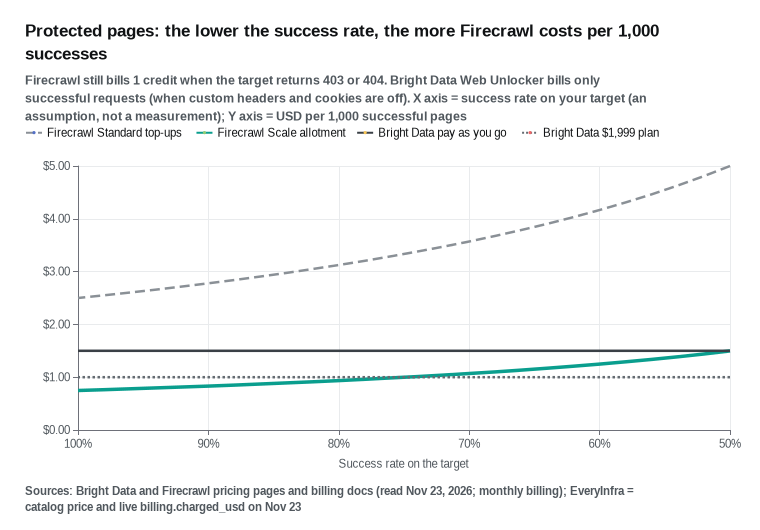
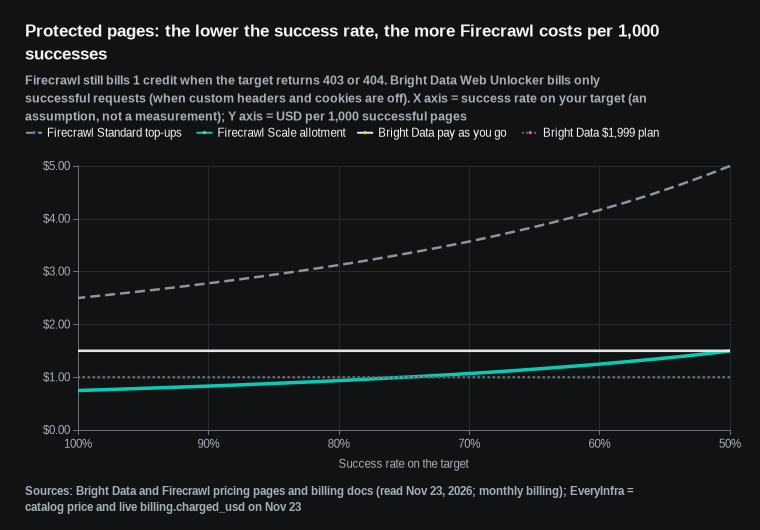
Your target site sets the success rate. We did not measure either vendor's success rate on protected pages, so the X axis is an assumption. Bright Data's introduction page claims a 98% success rate. Firecrawl's self-host doc says the open-source stack does not include the anti-bot part.
The Web Unlocker error codes doc shows how to tell a target failure from an unblocking failure. On the direct API, the outer status is 200 OK once the request reaches the unlocker. The target's status is in the x-brd-status-code header, and the unlocker's error is in x-brd-error-code. Only requests rejected before unblocking get a real outer status, such as 401 for a bad key or 400 for a wrong zone name.
The doc sorts errors into three groups. A retry can work for reject_block and resolve_failed_*, because each request uses a different peer. Errors from the target or your parameters, such as an expired certificate or no_peers, return the same result on every retry. Configuration errors such as premium and feature_not_active stay until you change the zone.
Concurrency and rate limits
| Item | Bright Data | Firecrawl |
|---|---|---|
| Free-tier rate limit | Unfunded accounts: 1,000 requests a minute by default | scrape, map, search: 10 a minute; crawl: 2 a minute |
| Concurrency | PAYG and plan cards say "Unlimited concurrency" | Free 2, Hobby 5, Standard 25, Growth 50, Scale 100 browsers |
| Paid rate limits | Not listed | scrape: 100, 500, 5,000, 10,000 a minute (Hobby to Scale) |
| Spend control | Monthly spend limit, auto-recharge | Monthly top-up limit, per-key credit limit |
Firecrawl counts concurrency as browsers that render at the same time. Standard has 25. Extra jobs wait in a queue, and queue time counts against the request timeout. Bright Data's Web Unlocker and SERP API pricing pages both say unlimited concurrency.
Suppose a job must finish 500,000 pages in a fixed window each day. On Firecrawl, you buy Growth or above, or you accept the queue. The rate limits doc lists requests per minute for each plan.
The free tiers differ by five times. Bright Data gives 5,000 credits a month, about $7.50 at $1.50 per 1,000. The free tier doc says Browser API can use the same pool at 5 credits per MB, which is close to 1 GB a month. Proxy networks are not in the pool. New accounts get a separate one-time $2 trial credit, plus $5 after adding a payment method.
Bright Data asks for a payment method at signup as a check. The free tier doc says it will not charge you unless the free credits run out and you have added funds. Firecrawl gives 1,000 credits a month. It also has a keyless path with a daily limit per IP address. You can try search and scrape in MCP or the CLI before you sign up, and see what the output looks like.
MCP and AI tools: both vendors focus on agents
Both vendors shipped new MCP versions in the last month. Firecrawl released MCP v3 in its November 12, 2026 changelog. The post lists more than 3,000 tools, automatic source switching, rate limits 60 times higher and subtasks that run in parallel. The MCP doc gives three ways to connect: no sign-in (search, scrape and parse with daily limits), browser sign-in, or an API key. It also lists one-click connectors for ChatGPT, Claude and Grok.
Bright Data's MCP tools doc lists 30 tools, all on by default. You can turn on a subset with groups= or tools= to save tokens. Search runs on the SERP API and page fetches run on the Fetch API. The MCP overview says the 5,000 free MCP requests a month come from the same pool as the account free tier.
| Item | Bright Data MCP | Firecrawl MCP | EveryInfra MCP |
|---|---|---|---|
| Endpoint | https://mcp.brightdata.com/sse?token=…, or run locally | https://mcp.firecrawl.dev/v2/mcp-oauth (sign-in), or with a key | https://api.everyinfra.com/mcp |
| Tools | 30, can be trimmed by group | v3; changelog says 3,000+ | Tool names everyinfra_* |
| Free | 5,000 a month, shared with the account pool | Keyless path with a daily IP limit; 1,000 credits a month on an account | No monthly fee; pay per call |
| Open-source repo | brightdata-mcp, MIT, 2,733 stars, v4.8.0 on November 10, 2026 | firecrawl-mcp-server, MIT, 7,884 stars, commit on November 22, 2026 | Not open source |
An MCP client puts each tool's name, description and parameter list into the model's context. Bright Data turns on all 30 tools by default. The overview tells you to use groups=scrapers,browser and similar values to load only what you need. Firecrawl v3 puts its thousands of tools behind a few entry points and expands them on demand. An agent that only searches and reads pages needs two tools from either vendor: search and fetch-as-Markdown.
Here are the three remote MCP configs side by side:
{
  "mcpServers": {
    "brightdata": { "type": "sse", "url": "https://mcp.brightdata.com/sse?token=YOUR_BRIGHTDATA_KEY" },
    "firecrawl": { "type": "http", "url": "https://mcp.firecrawl.dev/v2/mcp-oauth" },
    "everyinfra": {
      "type": "http",
      "url": "https://api.everyinfra.com/mcp",
      "headers": { "Authorization": "Bearer ${EVERYINFRA_API_KEY}" }
    }
  }
}
A 2026 Bright Data review post on r/marketinteltools retells one user's story. Normal use cost $11.86 over 90 days. One afternoon, a dataset scrape with no limit matched 682,000 records, and the bill went past $1,000. Bright Data refunded it in full. The post says dashboard spend limits are checked about every 15 minutes, and the MCP protocol shows no cost estimate before a call.
On Firecrawl, crawl uses a default limit of 10,000 pages when you omit one. The Firecrawl Billing doc shows how to set a daily, weekly or monthly credit limit per key. For EveryInfra's remote MCP, see the MCP server page.
Firecrawl open source and self-hosting: what you save
Firecrawl's main repo, firecrawl/firecrawl, uses the AGPL-3.0 license. At 00:13 Singapore time on November 23, it had 206,741 stars, and the last push was on November 22, 2026. The team marked 200,000 stars in a November 9, 2026 update.
The self-host doc lists the limits. The default Docker stack includes scrape, crawl, map, search and Playwright rendering. Fire-engine, the anti-bot service, is not included and must run on its own. Screenshots and page actions are not available in the default stack. Agent, browser, interact and audio or video formats need the cloud.
Section 13 of the AGPL-3.0 text covers a modified program that users reach over a network. It sets terms for offering those users the source code. Check the license text yourself to see whether your deployment falls under that section.
On November 18, 2026, Firecrawl released Firecrawl Local. It rewrites scrape, crawl and map in Rust. The changelog says it is 37 times faster than self-hosted and uses 11 MB of memory when idle. It is open source under the same license and works with Firecrawl's MCP and SDKs. A team that reads only public docs sites, with no bot protection, can cut the cost per page to server and bandwidth.
A r/LocalLLaMA thread with 75 votes shows the other side. Users complain that the self-hosted repo has many errors and thin docs. Firecrawl's CEO replied in the thread and asked for feedback.
Bright Data has no self-hosted unblocking service. Its open-source parts are the MCP server (MIT) and two URL-to-Markdown tools that call the Fetch API (Apache 2.0). Unblocking, proxies and scrapers all run in its cloud. If you need to own the code and the deployment, Firecrawl is the only choice of the two.
Compliance, retention and account checks
Bright Data's docs index lists ISO/IEC 27001:2022, ISO 27017, ISO 27018 and SOC 2 Type II. The scope covers the MCP server and agent use. See its security and compliance page.
Residential proxies now need a company-level manual review. The release notes for October 19 and October 24, 2026 say the residential network is no longer available on demand. Those two notes cover the residential network. For Web Unlocker, SERP API and Scraper API, check the access terms in your own dashboard and the service terms.
The error codes doc lists one more account-level case. An account in immediate access mode has no identity review yet. In that mode, a path that the target's robots.txt disallows is refused with 400 and the code ub_bad_endpoint_robots. The doc tells you to ask your account manager for full access.
Firecrawl sells zero data retention as a per-page option. zeroDataRetention on scrape adds 1 credit per page. Browser sessions add 2 credits a minute. Zero-retention search needs an Enterprise plan. With this option on, a plain page goes from 1 credit to 2, and every plain-page bill above doubles.
Public videos and reviews that differ from the November 23 docs
We used EveryInfra youtube/search for "bright data vs firecrawl" and took the top 10 results. We picked the 3 most relevant to these two vendors and pulled their captions with youtube/transcript, at $0.000556 per call.
| Video | Published | Claim in the video | What the docs say on November 23, 2026 |
|---|---|---|---|
| Best web scrapers for AI agents (3:37) | November 8, 2026 | Firecrawl costs are hard to predict; self-host is weaker than cloud; Bright Data is expensive and has many confusing products | Firecrawl lists credits for every action; the hard parts to predict are 403 and 404 billing and top-up prices; the self-host gap (no Fire-engine) is in the docs |
| Three AI scraping APIs compared (15:03) | November 18, 2026 | Firecrawl "credit scaling with page complexity"; use the extract endpoint with a schema for JSON | Rendering and the enhanced proxy add 0; JSON and other formats add credits; /extract is deprecated and goes away on December 10, 2026 at 15:00 UTC |
| Three scraping services, pricing compared (made by another scraping vendor) | June 18, 2026 | Bright Data's free tier needs a credit card | The free tier doc says "No credit card"; a card is only a check |
None of the three videos gives a price per 1,000 for either vendor. None mentions that Firecrawl bills 403 and 404 pages. The three videos have 0, 0 and 2 comments, and the comments name no specific problems.
The second video shows /extract with a schema. The notice at the top of the Extract doc says this endpoint will be removed on December 10, 2026. If you copy code from that video, move single-page work to /v2/scrape with the JSON format. Move multi-page work to /v2/agent.
The three videos also skip two steps that matter in practice. First, check the status code. When a Firecrawl document has metadata.statusCode 403 or 404, you have already paid. Batch jobs must find these URLs and stop retrying them, as the Billing doc advises.
Second, set limits. Firecrawl lets you set a daily, weekly or monthly credit limit per key, and a monthly USD limit on top-ups. Bright Data lets you set a monthly spend limit and an auto-recharge amount.
Page text or platform fields only: EveryInfra per-call prices and live calls
EveryInfra is a pay-per-call API with no monthly fee. It does not sell the same thing as the two vendors. It has no general unblocking or proxy network. If read cannot get a page, it returns no page. It does not switch to a residential IP or solve a challenge and retry, as Bright Data does.
It returns no raw HTML or screenshots. It has no browser sessions or clicks, so it does none of the signed-in actions that Firecrawl interact or Bright Data Browser API support. crawl returns up to 20 pages per call and up to 20,000 characters per page. For a site with thousands of pages, you split it by section and make many calls.
The five closest tools, with monthly bills at the catalog price read at 00:18 on November 23, 2026:
| Use | Vendor products | EveryInfra tool | What it returns, and what it does not | Per call | 100k calls a month | 1M calls a month |
|---|---|---|---|---|---|---|
| Text of plain and JS pages | Unlocker; Firecrawl scrape | read | Text only; no raw HTML, no screenshots, no unblocking promise | $0.000694 | $69.40 | $694 |
| Search, 10 links | SERP API; Firecrawl search | web | Title, URL and snippet per result | $0.000694 | $69.40 | $694 |
| Search + 10 texts | SERP + 10 Unlocker; search with scrapeOptions | deep (full=true) | Up to 20,000 characters per text; you cannot pick which results | $0.000694 | $69.40 | $694 |
| Amazon product fields | Scraper API; Firecrawl JSON | amazon/profile | Amazon only; fixed fields | $0.001389 | $138.90 | $1,389 |
| A few pages from one section | Fetch API; Firecrawl crawl | crawl | Up to 20 pages per call | $0.000694 (20 pages) | 100k pages: $3.47 | 1M pages: $34.70 |
We ran three rounds on November 23, 2026, at 00:18, 00:21 and 00:29 Singapore time. We called five search tools, web, read, deep, crawl and map, and three data capabilities, amazon/profile, amazon/search and google_shopping/search. That makes 12 calls. The 4 YouTube calls in the previous section ran in the same rounds. Each charge is the billing.charged_usd value in the response. Every charge matched the catalog price we read at 00:18 the same day.
| Singapore time | Call | Result | charged_usd |
|---|---|---|---|
| 00:18 | web "bright data vs firecrawl" | 10 results | 0.000694 |
| 00:18 | read react.dev/learn (JS page) | 17,387 characters | 0.000694 |
| 00:19 | crawl docs.python.org tutorial, num=10 | 10 pages | 0.000694 |
| 00:19 | amazon/profile, one product (out of stock) | 14 fields, no price | 0.001389 |
| 00:21 | deep full=true, num=5 | 5 results with text | 0.000694 |
| 00:21 | read review-site product page (bot protection) | 22,465 characters | 0.000694 |
| 00:23 | amazon/search "mechanical keyboard" | 10 items, 20 fields each | 0.002236 |
| 00:29 | deep full=true, num=10 | 10 results with text | 0.000694 |
| 00:29 | crawl Bright Data docs, num=20 | 20 pages | 0.000694 |
| 00:29 | read missing URL | 404, target_not_found | 0 |
| 00:30 | map docs.firecrawl.dev, num=50 | 50 URLs | 0.000694 |
| 00:30 | google_shopping/search "mechanical keyboard" | 20 items | 0.000792 |
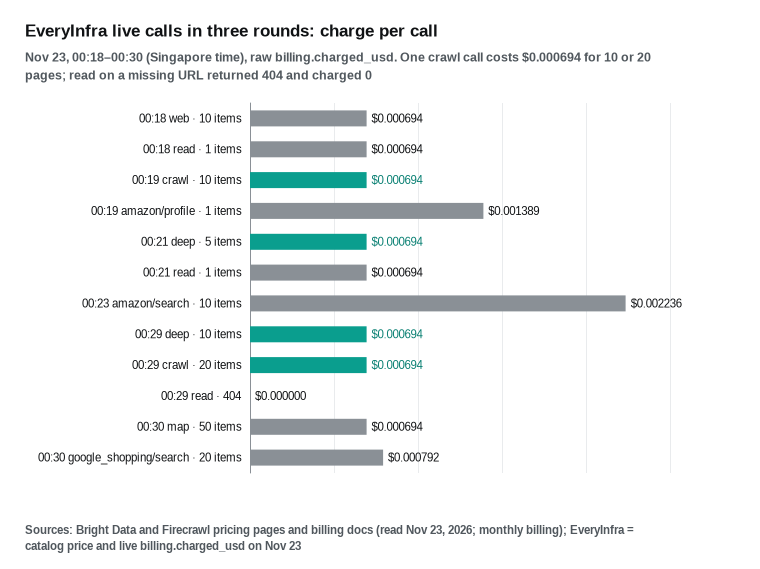
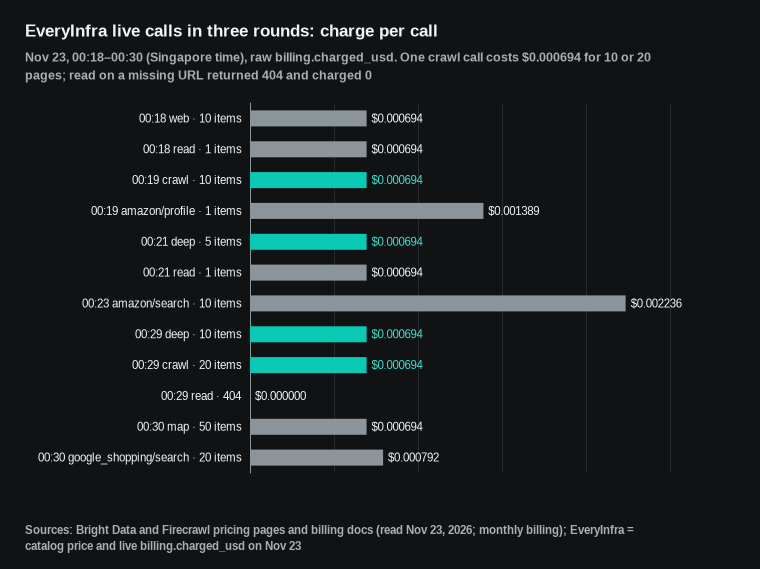
At 00:18, read fetched react.dev/learn, a JavaScript-rendered docs site, and returned 17,387 characters. At 00:21 it read a product page on a review site with bot protection and returned 22,465 characters. Each call cost $0.000694.
At 00:21, deep with 5 results returned 5 texts of 2,856 to 11,887 characters. At 00:29 we asked for 10. Eight texts had more than 500 characters, and two were cut at 20,000 characters. Two others had only 238 and 466 characters. If you need full HTML, control over which results to fetch, or texts over 20,000 characters, use web plus one read per result. That costs $7.63 per 1,000 searches.
At 00:19, amazon/profile returned a pair of AirPods Pro with 14 fields. The fields include brand, a 4.7 rating, 28,874 ratings and 7 images. The item was out of stock (in_stock: false), so the response had no price field. For items in stock, see the 00:23 amazon/search call. Its 10 items have 20 fields each, including price, list_price, currency, seller_name and bestseller_ranks.
At 00:30, google_shopping/search for the same term returned 20 offers. Each offer has merchant, price, rank and a product link. The first 6 offers are different models from different stores. Prices run from $29.99 at Micro Center to $124.99 at a brand store, with Target, Walmart and Best Buy in between. The call cost $0.000792, or $0.0000396 per offer.
At 00:19, crawl fetched 10 pages from the Python tutorial, with 5,278 to 20,000 characters each. At 00:29 it fetched 20 different URLs from Bright Data's MCP docs, with 2,561 to 16,104 characters each. Each call cost $0.000694, or $0.0000347 per page. At 00:30, map listed 50 URLs on docs.firecrawl.dev for $0.000694. At 00:29, read on a missing URL returned 404 with target_not_found, charged_usd 0, and refund status succeeded.
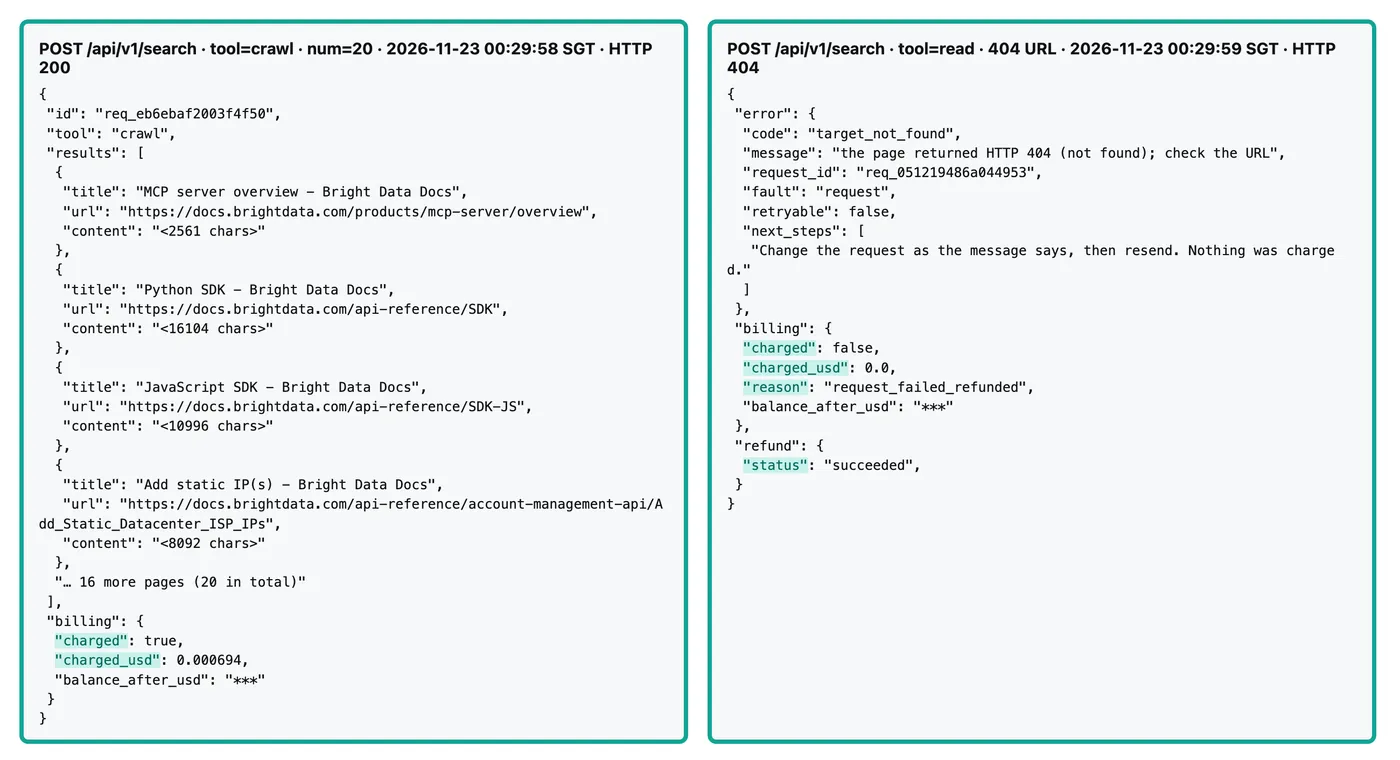
The same crawl request in curl looks like this. num can be up to 20:
curl -s https://api.everyinfra.com/api/v1/search \
  -H "Authorization: Bearer $EVERYINFRA_API_KEY" \
  -H "Content-Type: application/json" \
  -d '{"tool":"crawl","params":{"url":"https://docs.brightdata.com/products/mcp-server/overview","num":20}}'
# Returns results[] (title, url, content) and billing.charged_usd
All 16 calls, including the YouTube research, cost $0.012415 in total. For fields and prices, see the amazon/profile page, amazon/search, google_shopping/search, youtube/transcript and web/search.
Market moves in the last 60 days
- November 12, 2026: Firecrawl released MCP v3 (changelog). It is easier to connect Firecrawl in Claude and ChatGPT. More tools also mean more tokens per chat, so trim them.
- November 17, 2026: Firecrawl launched UltraSearch (changelog), with people, company and stock snippets in results. Check the credits per call when you compare prices.
- November 18, 2026: Firecrawl Local went open source (changelog). Teams that read only public pages get a path that uses no credits.
- December 10, 2026: Firecrawl removes
/extract(Extract doc). Code that still uses it must move to the scrape JSON format or to agent before then. - November 19, 2026: Bright Data added 80,000 US IPs to its shared datacenter pool (release notes) for the Black Friday and Cyber Monday peak. The same page says on November 10 that the Perplexity scraper is unavailable.
- November 10, 2026: Bright Data MCP v4.8.0 (GitHub release). Earlier versions shipped on November 5 and November 9.
- October 27, 2026: Bright Data improved the Web Unlocker success rate check API (release notes). You can check a domain's success rate before you pick a vendor.
Moving from one vendor to the other
For Bright Data Web Unlocker, you first create a zone in the dashboard. Requests go to https://api.brightdata.com/request with the zone name, the target URL and format. Firecrawl needs no zone. Requests go to https://api.firecrawl.dev/v2/scrape with the URL and a formats array. A comment in the Scrape doc example says you can start without a key and add one for higher rate limits.
The two requests below are configuration examples from both vendors' docs. We did not run them with vendor keys.
# Bright Data Web Unlocker: raw HTML, you parse it
curl -H "Authorization: Bearer $BRIGHTDATA_API_KEY" -H "Content-Type: application/json" \
  -d '{"zone":"YOUR_ZONE_NAME","url":"https://example.com","format":"raw"}' \
  https://api.brightdata.com/request

# Firecrawl scrape: ask for Markdown
curl -s -X POST https://api.firecrawl.dev/v2/scrape \
  -H "Authorization: Bearer $FIRECRAWL_API_KEY" -H "Content-Type: application/json" \
  -d '{"url":"https://example.com","formats":["markdown"]}'
From Bright Data to Firecrawl, code that read the x-brd-status-code header must read metadata.statusCode in the response body instead. If it does not, you will store block pages as content.
From Firecrawl to Bright Data, add two steps. Unlocker returns raw HTML. A pipeline that sent Markdown straight to a model needs a conversion step, or the Fetch API at the record price. Also, the direct API's outer status is almost always 200. To decide success, read the x-brd-status-code and x-brd-error-code headers.
A research-agent team's monthly bill (an assumed example)
Assume a team that runs a market-research agent. Each month it runs 50,000 searches, and 20,000 of them also fetch the text of 10 results. It crawls 3 docs sites, 30,000 pages in total. It also pulls price and rating from 10,000 product pages. On November 23, 2026 prices:
| Part | Volume | Bright Data | Firecrawl | EveryInfra |
|---|---|---|---|---|
| Link-only search | 30k | 30k SERP | 60k credits | web, $20.82 |
| Search + text | 20k | 20k SERP + 200k Unlocker | 240k credits | deep, $13.88 |
| Docs sites | 30k pages | 30k Unlocker | 30k credits | crawl, 1,500 calls, $1.04 |
| Product pages | 10k | 10k Scraper API records | 50k credits (JSON) | amazon/profile, $13.89 |
| Total | — | 290k requests, $427.50 PAYG | 380k credits, Growth $399 | $49.63 |
For Bright Data, SERP, Unlocker and Scraper API share the 5,000 free credits. The total is 30k + 20k + 200k + 30k + 10k = 290,000 requests. So (290,000 − 5,000) × 1.5 ÷ 1,000 = $427.50. Another option puts the 230,000 Unlocker requests on the $499 plan and the rest on pay as you go. That costs more: $589.
For Firecrawl, 60k + 240k + 30k + 50k = 380,000 credits fit in Growth's 500,000, so $399, or $333 on annual billing. The EveryInfra column uses catalog prices, with crawl at 20 pages per call, and its product pages cover Amazon only. It returns text and fixed fields, with text up to 20,000 characters and no general unblocking.
Connecting scraping to AI agents: cost per task
Assume a research task with 3 searches and 15 page reads.
Bright Data needs 3 SERP plus 15 Unlocker requests, 18 in total, which is $0.027 pay as you go. Firecrawl needs 3 × 2 + 15 = 21 credits: $0.0157 at the Scale in-plan rate, or $0.0525 on Standard top-ups. EveryInfra with web plus read is 18 × $0.000694 = $0.0125. If the 3 searches use deep with text and 5 results each, it is 3 × $0.000694 = $0.0021, with the 20,000-character text limit.
| One research task (3 searches + 15 pages) | Billed units | Per task | 10,000 tasks a month |
|---|---|---|---|
| Bright Data PAYG | 18 requests | $0.027 | $262.50 (after 5,000 free) |
| Firecrawl, cheapest option | 21 credits | $0.0157 (Scale in-plan rate) | $374 (Standard $99 + 55 packs) |
EveryInfra web + read | 18 calls | $0.0125 | $124.92 |
EveryInfra deep with text | 3 calls | $0.0021 | $20.82 |
At 10,000 tasks a month, Bright Data's 180,000 requests cost (180,000 − 5,000) × 1.5 ÷ 1,000 = $262.50. Firecrawl's 210,000 credits cost $749 on Scale, but only $374 on Standard plus packs. Models retry and page through results, so real call counts can be higher than your estimate. Before launch, set a spend limit on the key.
Run the numbers yourself: prices as functions
The monthly bills use the two functions below. The prices come from both pricing pages on November 23, 2026. Change the volumes to yours:
def bd(n, plans=((499, 383_000, 1.3), (999, 908_000, 1.1), (1999, 2_000_000, 1.0))):
    """Bright Data Web Unlocker: lowest of PAYG (first 5,000 a month free) and three plans."""
    best = max(0, n - 5_000) * 1.5 / 1000
    for price, incl, over in plans:
        best = min(best, price + max(0, n - incl) * over / 1000)
    return round(best, 2)

def fc(credits, monthly=True):
    """Firecrawl: 1,000 free credits; four monthly (or annual) plans plus $5 top-up packs."""
    if credits <= 1_000:
        return 0.0
    tiers = ((19, 16, 5_000, 1_000), (99, 83, 100_000, 2_000), (399, 333, 500_000, 2_500), (749, 599, 1_000_000, 5_000))
    costs = []
    for m, a, incl, per5 in tiers:
        extra = max(0, credits - incl)
        packs = -(-extra // per5)
        costs.append((m if monthly else a) + packs * 5)
    return min(costs)

print(bd(1_000_000), fc(1_000_000))        # 1M plain pages: 1100.2 749
print(bd(100_000), fc(100_000 * 2))        # 100k searches: 142.5 349
print(fc(100_000 * 5))                     # 100k JSON extractions: 399
Note three points when you use these functions. Bright Data's free tier applies only to pay-as-you-go accounts, not to plans. Firecrawl top-ups need a paid plan first. For Bright Data's Scraper API, we could read only the $499 tier.
Test your own target site with free credits
Pick 200 random URLs from your target site, and add 20 dead ones. Run them on Bright Data's 5,000 free credits and on Firecrawl's 1,000 free credits. On Firecrawl, record each response's metadata.statusCode and the balance from the Credit Usage endpoint. On Bright Data, record the billed count in the dashboard, and log the x-brd-status-code and x-brd-error-code headers. Divide billed calls by pages with text. Put that ratio into the functions above to get your price per 1,000 good pages.
When to choose Bright Data, and when to choose Firecrawl
| Your situation | Choose | Why |
|---|---|---|
| Hundreds of thousands to millions of plain or JS pages, as Markdown for a model | Firecrawl | $749 vs $1,100.20 at 1M pages; output is Markdown |
| Search result lists, no page text | Bright Data | $142.50 vs $349 at 100k; lower at every volume |
| Targets with strong bot protection and many failures | Bright Data | Bills only successes; large proxy network; Firecrawl bills 403 |
| Fixed fields from known platforms | Bright Data (or a per-call structured API) | Scraper API at $1.50 per 1,000 records; Firecrawl JSON at 5 credits |
| Any URL with your own schema | Firecrawl | Bright Data's general Fetch API does not parse site-specific fields |
| High concurrency in a short window | Bright Data | Unlimited concurrency stated; Firecrawl Standard has 25 browsers |
| Run and change the code yourself | Firecrawl | AGPL-3.0 open source, plus Firecrawl Local |
| Trial under 5,000 requests a month | Bright Data | 5,000 free credits vs 1,000 |
| Only page text or fields such as Amazon's, no raw page | EveryInfra | deep, crawl and read bill one call, $0.694 per 1,000 |
Bright Data also sells things Firecrawl does not. It has residential, ISP, datacenter and mobile proxy networks. Its pricing overview lists residential proxies from $2.50 per GB and datacenter IPs from $0.90 each. Ready datasets start at $250 per 100,000 records. Browser API costs $8 per GB pay as you go, and the $499 plan includes 71 GB. Firecrawl also has things Bright Data lacks: map, monitoring, the interact browser sandbox and an open-source repo.
Where both vendors overlap, the choice depends on whether you mostly fetch pages or mostly search. If you do both, you can mix them. Use Bright Data's SERP API for the result list, then Firecrawl to fetch the text. For 100,000 "search plus 10 texts" a month, that split costs $142.50 for SERP plus $749 for 1 million Firecrawl credits on Scale, $891.50 in total. That beats Firecrawl alone at $949 and Bright Data alone at $1,250.20. The cost is two keys and two sets of failure checks.
FAQ
Do Firecrawl credits roll over to the next month?
Monthly plans do not roll over; credits reset each month. Annual Scale rolls over for 1 month, and annual Enterprise for 2 months. Top-up credits you buy do not expire, but they end if you cancel. In the r/LocalLLaMA thread, a user's first request to the Firecrawl CEO was "Credits should roll-over". The answer comes from the Billing doc. On Bright Data, the wallet balance stays, and the 5,000 monthly free credits do not roll over.
Why did one page use more than 1 Firecrawl credit?
This was the second request in the same thread. Per the Billing doc, JSON, question and highlights formats add 4 each. PDF pages add 1 each. Zero data retention adds 1.
LinkedIn pages cost 5 to 40 by data source, and X posts cost 30. Threat protection scans add 2 per URL. Crawl and batch jobs bill as pages finish, so charges can appear hours later.
Can self-hosted Firecrawl replace the cloud?
For open public pages, yes. For bot protection, screenshots or page actions, no. The self-host doc says these need Fire-engine, which is not open source. Users in the r/LocalLLaMA thread also say the self-hosted repo has many errors and thin docs. Firecrawl Local, released November 18, 2026 and written in Rust, suits agents that read public pages on your machine.
Can Bright Data run up a large bill by surprise?
The r/marketinteltools review post retells one case. A dataset scrape with no limit matched 682,000 records in one afternoon, the bill passed $1,000, and Bright Data refunded it in full. The wallet is prepaid. With free credits used up and no funds, requests fail. With funds and auto-recharge on, set a monthly spend limit.
The Billing doc says auto-recharge charges your set amount when the available balance drops below a quarter of it. With $200 set, a balance under $50 triggers a $200 charge. Each later drop below that line triggers another one.
Getting started
- Open the API market, sign up and get an API key in the console. Then send the first request in the quickstart.
- Send one
crawlordeepcall with the curl example above, and checkbilling.charged_usdin the response. - For fields, use a data capability. Examples are the Amazon API, the Google Shopping API and the web API. Prices are on the pricing page.
- In Claude or Cursor, connect the remote MCP with the config above.
- If you still compare vendors, read Bright Data alternatives and Firecrawl alternatives. For more detail, read Bright Data alternatives (blog) and Firecrawl alternatives (blog).
References
- Web Unlocker API Pricing, Bright Data, read November 23, 2026, https://brightdata.com/pricing/web-unlocker
- SERP API Pricing, Bright Data, read November 23, 2026, https://brightdata.com/pricing/serp
- Web Scraper API Pricing, Bright Data, read November 23, 2026, https://brightdata.com/pricing/web-scraper
- Pricing overview, Bright Data, read November 23, 2026, https://brightdata.com/pricing
- Browser API Pricing, Bright Data, read November 23, 2026, https://brightdata.com/pricing/scraping-browser
- Bright Data MCP Server, Bright Data, read November 23, 2026, https://brightdata.com/ai/mcp-server
- Free tier, Bright Data docs, read November 23, 2026, https://docs.brightdata.com/general/account/billing-and-pricing/free-tier
- Billing, Bright Data docs, read November 23, 2026, https://docs.brightdata.com/general/account/billing-and-pricing/billing
- Web Unlocker API introduction, Bright Data docs, read November 23, 2026, https://docs.brightdata.com/products/web-unlocker/introduction
- Web Unlocker configuration, Bright Data docs, read November 23, 2026, https://docs.brightdata.com/products/web-unlocker/configuration
- Web Unlocker API error codes, Bright Data docs, read November 23, 2026, https://docs.brightdata.com/products/web-unlocker/error-codes
- Scraper API FAQs, Bright Data docs, read November 23, 2026, https://docs.brightdata.com/products/scrapers/scrapers-library/faqs
- Fetch API introduction, Bright Data docs, read November 23, 2026, https://docs.brightdata.com/products/scrapers/fetch-api/introduction
- MCP server overview, Bright Data docs, read November 23, 2026, https://docs.brightdata.com/products/mcp-server/overview
- Bright Data MCP tools, Bright Data docs, read November 23, 2026, https://docs.brightdata.com/products/mcp-server/tools
- Remote MCP quickstart, Bright Data docs, read November 23, 2026, https://docs.brightdata.com/products/mcp-server/remote/quickstart
- SERP API pricing and billing, Bright Data docs, read November 23, 2026, https://docs.brightdata.com/products/serp-api/pricing-and-billing
- Release notes, Bright Data docs, updated November 19, 2026, https://docs.brightdata.com/release-notes
- Security and compliance overview, Bright Data docs, read November 23, 2026, https://docs.brightdata.com/general/security/security-overview
- brightdata/brightdata-mcp, GitHub, pushed November 22, 2026, https://github.com/brightdata/brightdata-mcp
- brightdata-mcp v4.8.0, GitHub, November 10, 2026, https://github.com/brightdata/brightdata-mcp/releases/tag/v4.8.0
- Bright Data docs llms.txt, Bright Data, read November 23, 2026, https://docs.brightdata.com/llms.txt
- Pricing, Firecrawl, read November 23, 2026 (effective September 4, 2026), https://www.firecrawl.dev/pricing
- Billing, Firecrawl docs, read November 23, 2026, https://docs.firecrawl.dev/billing
- Rate Limits, Firecrawl docs, read November 23, 2026, https://docs.firecrawl.dev/rate-limits
- Scrape, Firecrawl docs, read November 23, 2026, https://docs.firecrawl.dev/features/scrape
- Crawl, Firecrawl docs, read November 23, 2026, https://docs.firecrawl.dev/features/crawl
- Search, Firecrawl docs, read November 23, 2026, https://docs.firecrawl.dev/features/search
- Map, Firecrawl docs, read November 23, 2026, https://docs.firecrawl.dev/features/map
- Extract (deprecation notice), Firecrawl docs, read November 23, 2026, https://docs.firecrawl.dev/features/extract
- MCP Server, Firecrawl docs, read November 23, 2026, https://docs.firecrawl.dev/mcp-server
- Keyless MCP, Firecrawl docs, read November 23, 2026, https://docs.firecrawl.dev/mcp-server/keyless
- Self-host, Firecrawl docs, read November 23, 2026, https://docs.firecrawl.dev/contributing/self-host
- Open Source vs Cloud, Firecrawl docs, read November 23, 2026, https://docs.firecrawl.dev/contributing/open-source-or-cloud
- Credit Usage API, Firecrawl docs, read November 23, 2026, https://docs.firecrawl.dev/api-reference/endpoint/credit-usage
- Interact, Firecrawl docs, read November 23, 2026, https://docs.firecrawl.dev/features/interact
- firecrawl/firecrawl, GitHub, pushed November 22, 2026, https://github.com/firecrawl/firecrawl
- firecrawl/firecrawl-mcp-server, GitHub, pushed November 22, 2026, https://github.com/firecrawl/firecrawl-mcp-server
- Introducing Firecrawl MCP v3, Firecrawl, November 12, 2026, https://www.firecrawl.dev/changelog/firecrawl-mcp-v3
- Introducing Firecrawl Local, Firecrawl, November 18, 2026, https://www.firecrawl.dev/changelog/firecrawl-local
- Introducing UltraSearch for agents, Firecrawl, November 17, 2026, https://www.firecrawl.dev/changelog/ultrasearch
- 200K GitHub stars, Firecrawl, November 9, 2026, https://www.firecrawl.dev/changelog/200k-github-stars
- Introducing Universal Scrape, Firecrawl, October 8, 2026, https://www.firecrawl.dev/changelog/universal-scrape
- Changelog, Firecrawl, read November 23, 2026, https://www.firecrawl.dev/changelog
- GNU Affero General Public License v3, Free Software Foundation, https://www.gnu.org/licenses/agpl-3.0.html
- What's your opinion about Bright Data?, Reddit r/marketinteltools, read November 23, 2026, https://www.reddit.com/r/marketinteltools/comments/1w63fzc/whats_your_opinion_about_bright_data/
- What is the best scraper tool right now? Firecrawl is great…, Reddit r/LocalLLaMA, read November 23, 2026, https://www.reddit.com/r/LocalLLaMA/comments/1jw4yqv/what_is_the_best_scraper_tool_right_now_firecrawl/
- Best web scrapers for AI agents (video), YouTube, November 8, 2026, https://www.youtube.com/watch?v=bFHUm0jdkuo
- AI scraping APIs compared 2026 (video), YouTube, November 18, 2026, https://www.youtube.com/watch?v=0SNrU2Ufqww
- Scraping API pricing comparison (video), YouTube, June 18, 2026, https://www.youtube.com/watch?v=mi7cYug7AP4
- EveryInfra data catalog, EveryInfra, read November 23, 2026 at 00:18, https://api.everyinfra.com/api/v1/social/catalog
- EveryInfra search tool list, EveryInfra, read November 23, 2026 at 00:18, https://api.everyinfra.com/api/v1/search/tools
Reference BL-217