 Written byKenji WatanabeData ResearcherFact-checked
EveryInfra publishes this index, and EveryInfra also sells search, scraping and CAPTCHA APIs. Our own three rows follow the same reading rules. They are not part of any median, count, lowest price or highest price in this report. A section near the end describes them, with three rounds of live calls that check our catalog price against the amount we charged. The data tables at the end of the page also list them, with the label (publisher).
We opened each pricing page logged out, in its default state, on 22 November 2026, between 20:29 and 20:52 Singapore time (SGT). The Wayback Machine saved a copy of each page the same day, and a script then looked for every quoted price in that copy. A second reader recomputed every row from the saved pages without seeing the first reader's work. That pass found one error, and we corrected it before release.
The full data set is public. The repository holds the price table and every plan we read, each with its exact quote and the archive link of its page. It also holds the script that rebuilds every number in this report. The data is under CC BY 4.0 and the code is under the MIT licence. If you find an error, open an issue in the repository. We will then publish a corrected version with a new number.
How we read a price page: entry price, lowest price and conversions
The index records one thing: the published, self-serve list price of each product, in US dollars per 1,000 calls. It does not measure speed, success rate, data quality or what a customer pays after a sales call. We wrote every rule in METHODOLOGY.md before we read the pages. A table at the end of that file gives the decision and the reason for each case that the rules did not decide.
The three lines of the index use different units. A search call is one query that returns one page of results, normally 10. A scraping or platform-data call is one request, result or record, as the provider bills it. A CAPTCHA call is one solved CAPTCHA, priced for five types: reCAPTCHA v2, reCAPTCHA v3, Cloudflare Turnstile, hCaptcha and the normal image CAPTCHA.
Each product gets two prices. The entry price is what 1,000 base calls cost on the paid option with the smallest minimum spend. That is the pay-as-you-go rate if one exists, otherwise the cheapest one-time pack, otherwise the cheapest monthly plan. The lowest price is the lowest price per 1,000 base calls on any paid self-serve option of the same product, usually the largest plan.
| Term | What it means in this index | Example from the data |
|---|---|---|
| Base call | The cheapest ordinary call of the product, synchronous only | Exa lists Lite, Auto and Deep search; the base call is Lite Search at $4.00 |
| Entry price | Price per 1,000 base calls on the option with the smallest minimum spend | Serper: the smallest pack, $50 for 50,000 searches, gives $1.00 |
| Lowest price | Lowest price per 1,000 base calls on any paid self-serve option | Serper: $3,750 for 12.5 million searches gives $0.30 |
| Minimum payment | The smallest amount a new customer must pay | SerpApi: the Starter plan at $25 a month |
| Subscription-only | No pay-as-you-go rate and no one-time pack on the page | Zenserp: monthly plans from $49.99 only |
| Failed calls | Whether the pricing page says failed calls are billed | SerpApi: "Cached, errored, and failed searches are not" counted |
Two rules decide most hard cases. First, if a provider sells several modes of one product at different prices, the base call is the cheapest mode that returns ordinary results. The other modes stay in the plan table as recorded variants. Second, only synchronous calls count. A queued mode that returns results later is recorded but not used. That is why the DataForSEO base call is "Live mode" at $2.00 and not the "Standard queue" at $0.60.
Conversions: prepaid units, tokens, results and daily allowances
Many pages sell prepaid units, tokens or daily allowances and say how many units one call uses. Every conversion uses only numbers printed on the page. When a price needs more than one division, the row has derived = true and the conversion column says what we did. The section "Notes on conversions" at the end gives the rule for each case.
Jina sells tokens. Its page says every request costs a fixed number of tokens "starting from 10,000". So $0.50 per 1,000 searches is the lowest possible price, not a typical one. We mark it as derived, and every headline that depends on it also has a strict version without it. The strict numbers are in the section on limits.
What we leave out
Offers labelled "Contact sales", "Enterprise" or "Custom" are not options, because a reader cannot buy them from the page. Annual prices are not used when a monthly price exists. Free allowances are recorded, but they are never an entry or lowest price. Volume prices for 10,000, 100,000 and 1,000,000 calls a month are in the table as indicative values. They do not feed any headline.
For the statistics we use Python's statistics module: statistics.median for the median and statistics.quantiles(n=4, method="inclusive") for the quartiles. With an even number of providers, the median is the mean of the two middle values. It can therefore be a price that no provider charges. Every headline gives its number of providers. Prices in sentences have two decimals from ten cents up and three decimals below ten cents.
How we checked each number
On the read date, each page went to the Wayback Machine through Save Page Now. We then downloaded each copy and confirmed that the archive serves it at the saved time. All copies are dated 22 November 2026, between 19:19 and 21:19 SGT. The read time of each page, to the minute, is in pages.csv.
A script then looked for each quote, or for the numbers in it that set the price, in the archived copy. The result for each plan is in the archive_check column of tiers.csv. For 37 of the 39 providers, every option that sets an entry or lowest price passes on the archived page itself. The other two, Jina and Capzy, load their prices from a public data address after the page opens. For them, the check passes on the archived copy of that address.
Search APIs: 16 providers, median entry price $3.00
The search line has 16 providers. Eight return Google or Bing result pages, and eight run their own index or sell a search API built for AI use. The spread is wide. Entry prices run from $0.50 (Jina, converted from token pricing) to $25.00 (SerpApi); the median of the lowest published prices is $1.25.
The segment follows the product description on the pricing page. For three providers (SearchApi.io, Scrapingdog and Jina), the pricing page does not name an engine, and the segment is our judgement. The segment_quote and notes columns of providers.csv give the quote for each segment and the reason for each judgement.
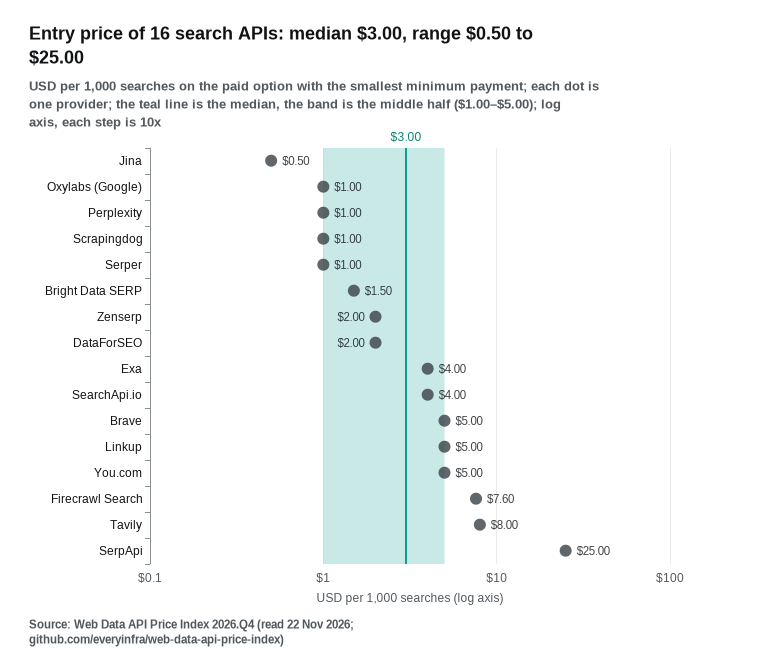
| Provider | Segment | Entry per 1,000 | Lowest per 1,000 | Billing | Minimum payment |
|---|---|---|---|---|---|
| Brave | AI web search | $5.00 | $5.00 | Pay as you go | Not stated ("No minimums") |
| Bright Data SERP | Google results | $1.50 | $1.00 | Pay as you go | Not stated |
| DataForSEO | Google results | $2.00 | $2.00 | Pay as you go | Not stated |
| Exa | AI web search | $4.00 | $4.00 | Pay as you go | Not stated |
| Firecrawl Search | AI web search | $7.60 | $1.50 | Subscription only | $19 |
| Jina | AI web search | $0.50 (derived) | $0.45 | One-time pack | $50 |
| Linkup | AI web search | $5.00 | $5.00 | Pay as you go | Not stated |
| Oxylabs (Google) | Google results | $1.00 | $0.70 | Subscription only | $15 |
| Perplexity | AI web search | $1.00 | $1.00 | Pay as you go | Not stated |
| Scrapingdog | Google results | $1.00 | $0.14 | Subscription only | $40 |
| SearchApi.io | Google results | $4.00 | $1.00 | Subscription only | $40 |
| SerpApi | Google results | $25.00 | $1.96 | Subscription only | $25 |
| Serper | Google results | $1.00 | $0.30 | One-time pack | $50 |
| Tavily | AI web search | $8.00 | $5.00 | Pay as you go | Not stated |
| You.com | AI web search | $5.00 | $5.00 | Pay as you go | Not stated ("No minimums") |
| Zenserp | Google results | $2.00 | $0.90 | Subscription only | $49.99 |
Entry price and lowest price are far apart
The gap between the two prices tells you how much a provider rewards volume. SerpApi charges $25.00 per 1,000 searches on Starter and $1.96 on its largest self-serve plan, Cloud 54M, which costs $106,050 a month. Scrapingdog goes from $1.00 on Lite to $0.14 on Nova Pro, a plan at $30,000 a month. Firecrawl Search goes from $7.60 on Hobby to $1.50 on Scale.
Brave, DataForSEO, Exa, Linkup, Perplexity and You.com publish one pay-as-you-go rate for the base call, so their entry and lowest prices are equal. Tavily has a pay-as-you-go rate of $8.00 and a lower plan rate of $5.00 on Growth. For a small buyer, a flat price is easy to plan. For a large buyer, the plan ladder on the subscription pages can cut the unit price by an order of magnitude.
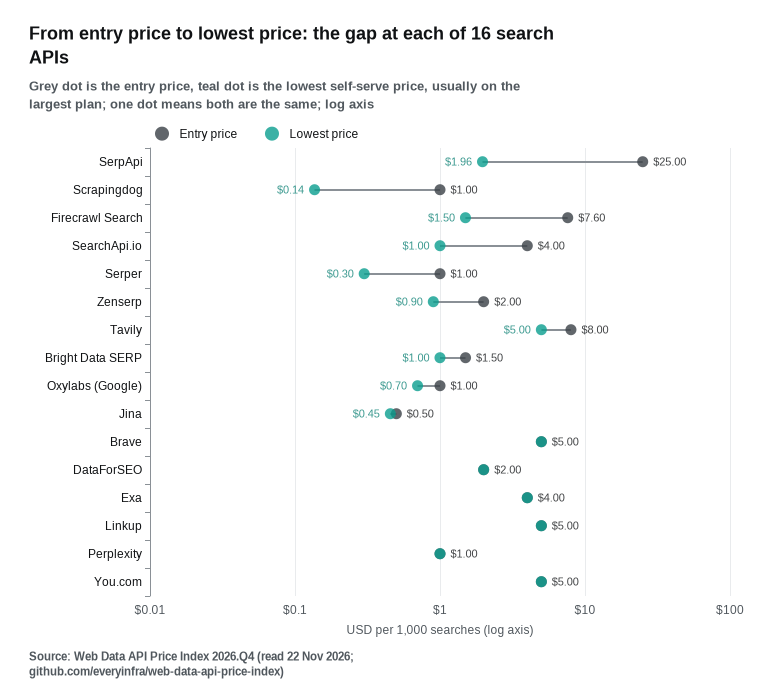
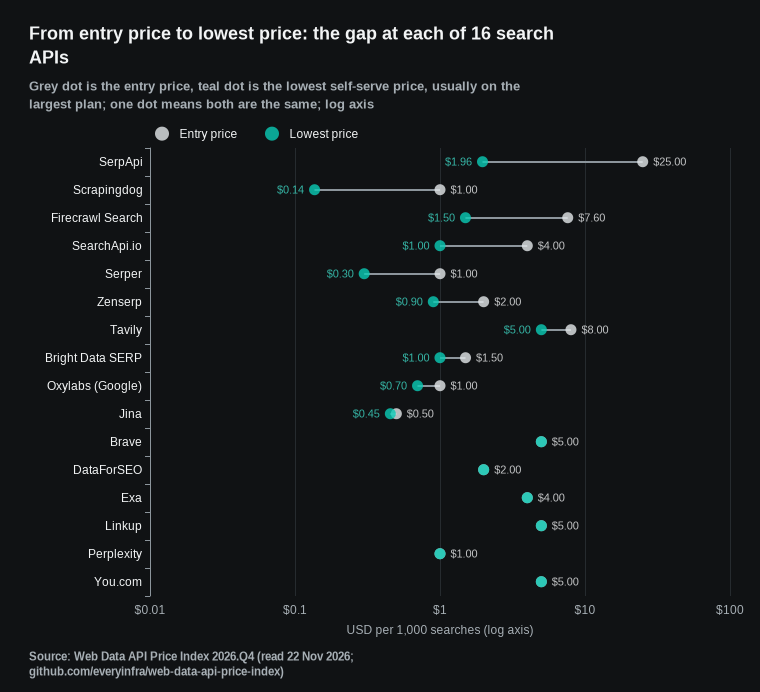
The table below gives the cheapest published way to buy 10,000, 100,000 or 1,000,000 base calls in one month, per 1,000. "Not modelled" means that the page gives no way to buy that volume. For example, the largest plan is smaller and the page shows no overage rate. These figures are indicative and do not feed any headline. The six providers with one flat rate are not in the table, because their cell is the entry price at every volume.
| Provider | Per 1,000 at 10,000 a month | At 100,000 a month | At 1,000,000 a month |
|---|---|---|---|
| Bright Data SERP | $1.50 | $1.50 | $1.11 |
| Firecrawl Search | $9.40 | $3.49 | $1.75 |
| Jina | $5.00 | $0.50 | $0.50 |
| Oxylabs (Google) | $1.50 | $1.00 | (not modelled) |
| Scrapingdog | $4.00 | $0.90 | $0.35 |
| SearchApi.io | $4.00 | $2.50 | $1.50 |
| SerpApi | $15.00 | $7.25 | $3.75 |
| Serper | $5.00 | $1.00 | $0.75 |
| Tavily | $7.80 | $5.00 | $7.70 |
| Zenserp | $5.00 | $1.50 | $0.90 |
At 10,000 searches, six of the ten rows cost more per 1,000 than at entry: Firecrawl Search, Jina, Oxylabs (Google), Scrapingdog, Serper and Zenserp. For five of them, the smallest plan or pack buys more than 10,000 calls, and you pay for the unused part. For Firecrawl Search, the smallest plan buys 2,500 searches, and the rest is overage at a higher rate. The Tavily cell at 1,000,000 is higher than the cell at 100,000. The largest Tavily plan stops below that volume, and the rest is overage. So the cheapest option changes with volume.
Google results APIs start lower than AI web search APIs
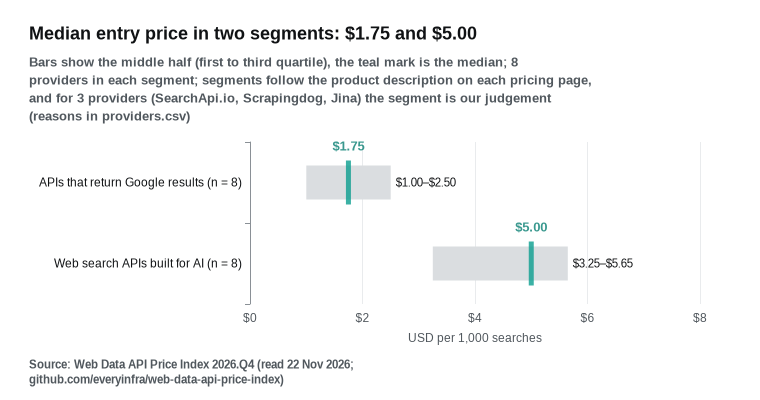
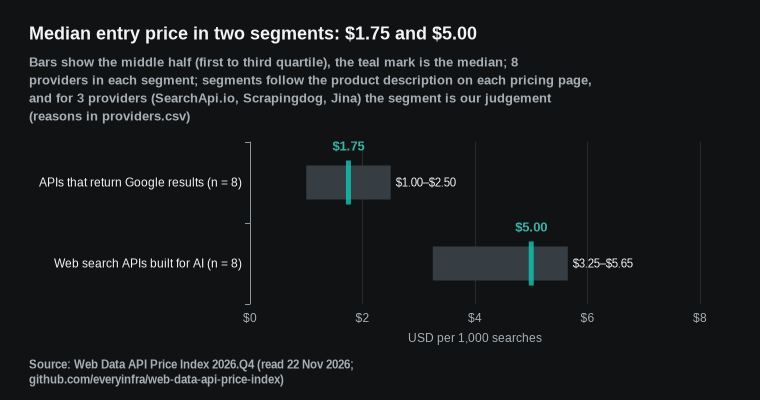
The middle halves of the two groups do not overlap: $1.00–$2.50 against $3.25–$5.65. The full ranges do overlap. APIs that return Google results have a median entry price of $1.75 (n = 8); web search APIs built for AI have $5.00 (n = 8). The Google results group runs from $1.00 to $25.00 (SerpApi), and the AI web search group runs from $0.50 (Jina) to $8.00 (Tavily).
The Google results group is Bright Data SERP, DataForSEO, Oxylabs (Google), Scrapingdog, SearchApi.io, SerpApi, Serper and Zenserp. These APIs parse a results page and return its blocks as JSON. The AI web search group is Brave, Exa, Firecrawl Search, Jina, Linkup, Perplexity, Tavily and You.com. Each group has eight providers, so one provider can move a group median.
If you compare a Google results API with an AI search API, compare the job and not only the price. A results page with 10 links costs less to buy, but your code must still fetch and clean each page. An AI search response with passages costs more per call and can save a second call. Our article on SerpApi vs Tavily works through that trade with token counts. Serper vs SerpApi compares two APIs inside the Google results group.
Subscription-only search APIs and minimum payment
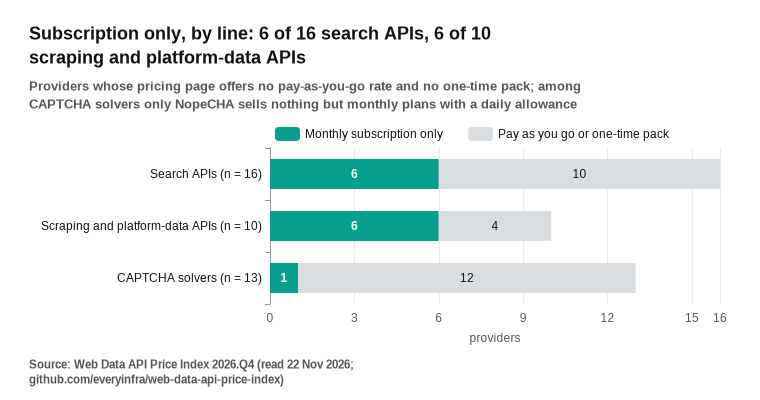
Six search APIs sell only monthly plans: Firecrawl Search, Oxylabs (Google), Scrapingdog, SearchApi.io, SerpApi and Zenserp. All of them except Firecrawl Search return Google results. The two one-time packs in the search line are Jina and Serper, and the rest sell pay as you go. A subscription can be cheap per call. Check whether unused searches roll over to the next month; the index does not record it.
The minimum payment is the other half of the entry decision. Oxylabs (Google) starts at $15 a month, Firecrawl Search at $19, SerpApi at $25, Scrapingdog and SearchApi.io at $40, and Zenserp at $49.99. Jina and Serper each sell a $50 pack. Many pay-as-you-go pages do not state a minimum top-up, and Brave and You.com say "No minimums" in plain words.
Our SerpApi alternatives and Tavily alternatives articles group the same providers by use case.
How much one provider moves the median
A median of 16 values can move when one provider leaves. The index gives the leave-one-out range: the lowest and highest median when we remove any one provider. With 16 providers, the median is the mean of the two middle values, $2.00 and $4.00. Remove any one of the eight providers above the middle and the median falls to $2.00. Remove any one of the eight below it and the median rises to $4.00. No other value is possible.
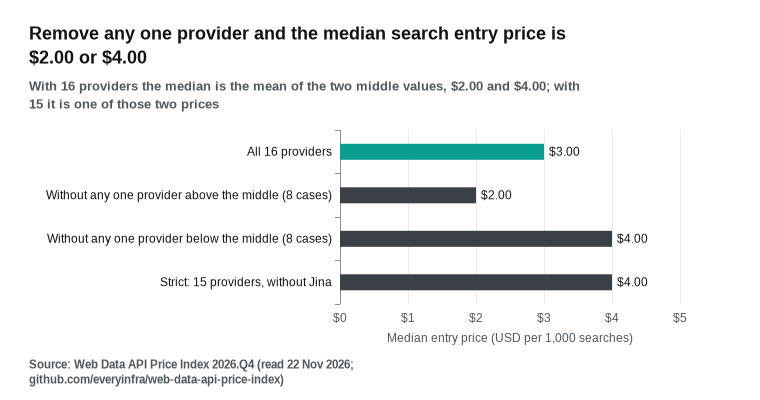
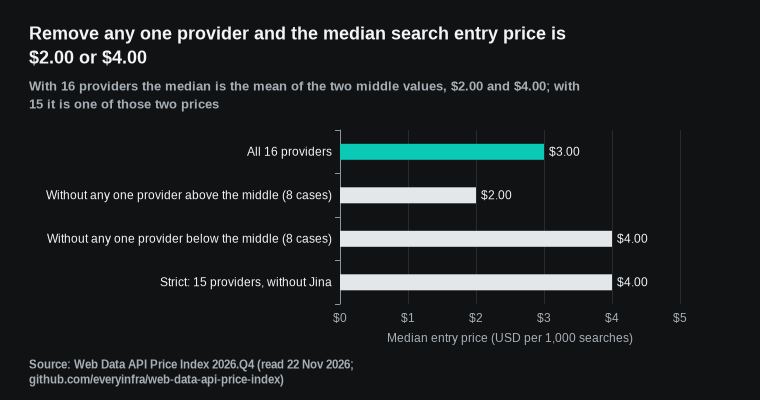
The range is wide because the 16 entry prices cluster at $1.00 and at $5.00, with few values between. A buyer should read the $3.00 median as "the middle of two clusters", not as a typical price. The quartiles, $1.00 and $5.00, describe the market better than the median does.
Perplexity describes Fast Search as a lower-latency mode, and its pricing page lists it next to the standard Search API. Exa explains its endpoint prices in its pricing documentation, and DataForSEO describes its live and queued modes in its SERP API overview.
Linkup's pricing page gives one range, "$0.005 - $0.006" per request, for its Fast, Standard and Deep modes. Its pricing documentation prices standard search at $0.005 and deep search at $0.05 a request. The index uses the low end of the pricing page, so the Linkup base call is $5.00 per 1,000. Deep search costs $50.00 per 1,000.
Scraping and platform-data APIs: 10 providers, no single median
The data line has 10 providers, and they do not bill the same thing. Bright Data Web Scraper bills per record. Apify Store and Oxylabs Web Scraper bill per result. EnsembleData, Firecrawl, ScrapeCreators, ScraperAPI, ScrapingBee, TikHub and Zyte bill per request. A median across records, results and requests would mix units, so the index gives no overall median for this line.
6 of 16 search APIs and 6 of 10 scraping and platform-data APIs can only be bought as a monthly subscription. In the data line, the six are Apify Store, EnsembleData, Firecrawl, Oxylabs Web Scraper, ScraperAPI and ScrapingBee. Bright Data Web Scraper, TikHub and Zyte sell pay as you go, and ScrapeCreators sells one-time packs.
| Provider | Product | Unit | Entry per 1,000 | Lowest per 1,000 | Billing | Minimum payment |
|---|---|---|---|---|---|---|
| Apify Store | Facebook Ads Library Scraper | result | $5.00 | $3.40 | Subscription only | $19 |
| Apify Store | Instagram Scraper | result | $2.30 | $1.50 | Subscription only | $19 |
| Apify Store | TikTok Scraper | result | $3.00 | $1.70 | Subscription only | $19 |
| Apify Store | Tweet Scraper V2 | result | $0.40 | $0.40 | Subscription only | $19 |
| Apify Store | YouTube Scraper | result | $3.00 | $2.40 | Subscription only | $19 |
| Bright Data Web Scraper | Web Scraper API | record | $1.50 | $1.30 | Pay as you go | Not stated |
| EnsembleData | Social media APIs | request | $2.22 (derived) | $0.93 | Subscription only | $100 |
| Firecrawl | Scrape API | request | $3.80 | $0.75 | Subscription only | $19 |
| Oxylabs Web Scraper | Web Scraper API, other targets | result | $1.00 | $0.80 | Subscription only | $15 |
| ScrapeCreators | Social media APIs | request | $1.88 | $0.99 | One-time pack | $47 |
| ScraperAPI | Scraping API | request | $0.49 | $0.092 | Subscription only | $49 |
| ScrapingBee | Web Scraping API | request | $0.25 | $0.048 | Subscription only | $19 |
| TikHub | Social Media API | request | $1.00 | $0.50 | Pay as you go | $5 |
| Zyte | Zyte API, HTTP response, tier 1 | request | $0.13 | $0.060 | Pay as you go | Not stated |
Each actor on the Apify Store has its own price. Our sample is the first five actors in Apify's "Social media scrapers" category on the read date. The entry price is the Starter plan price, and Starter is the cheapest paid Apify plan at $19 a month. The lowest price is the Business plan price. Apify explains how store actors are paid for in its documentation on actors in the store.
Harder targets cost more: the list price is for the easiest page
Most scraping prices in the table are for the cheapest request: a plain page, no JavaScript rendering, no premium proxy and no special target. Harder targets cost more. The multiplier is often larger than the gap between two providers, so it can change the order of a comparison.
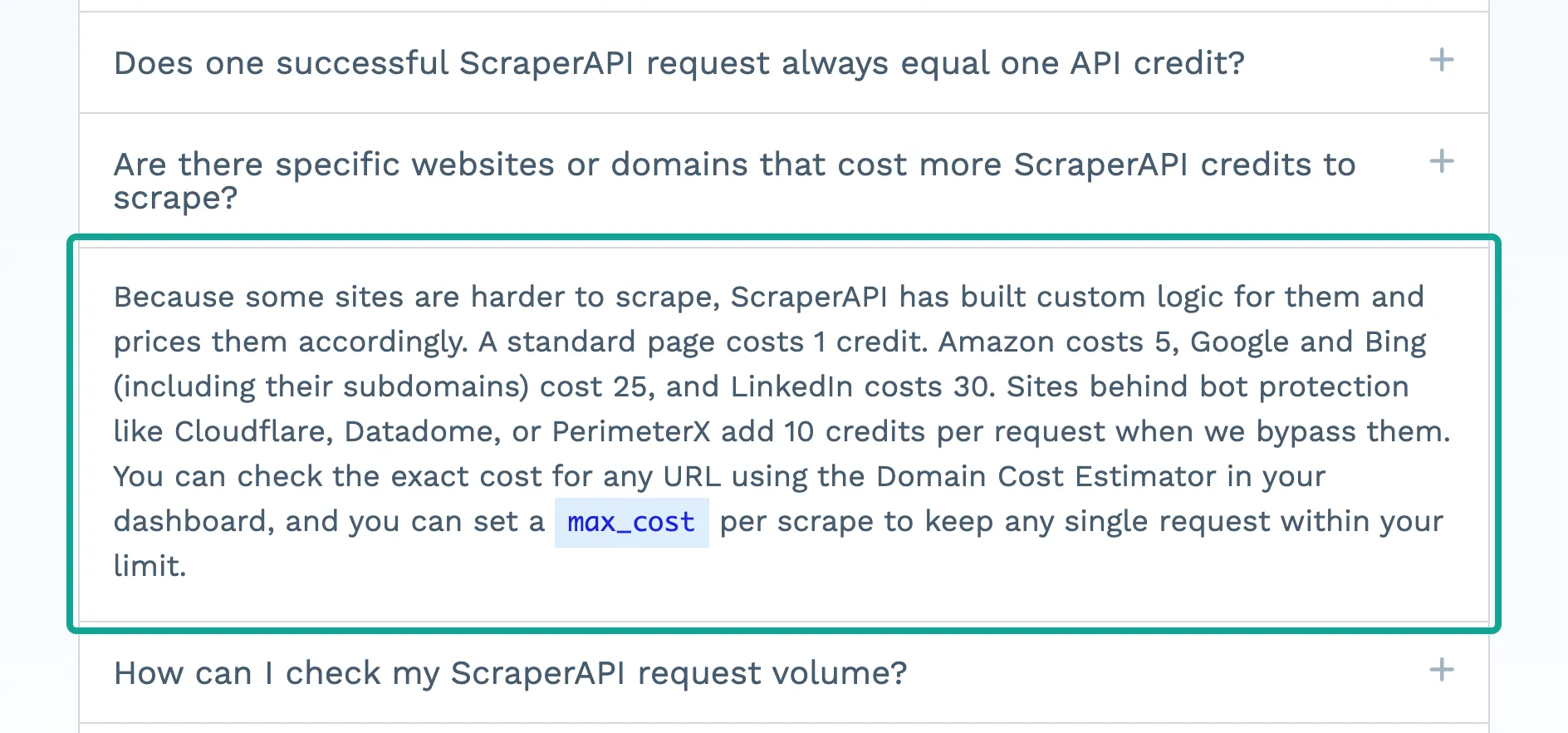
ScraperAPI gives the clearest example. On ScraperAPI, one Google request costs as much as 25 standard requests, so 1,000 Google requests cost $12.25 at the entry price. Bot protection adds the price of 10 standard requests. The FAQ of its pricing page (archived copy of 22 November 2026) gives these rules.
The table gives prices per 1,000 calls at the entry price of each provider, with the multiplier in brackets. The notes at the end quote each page.
| Provider | Base call in the index | What costs more, per 1,000 at the entry price |
|---|---|---|
| ScraperAPI | Standard page, $0.49 | Amazon $2.45 (×5); Google and Bing $12.25 (×25); LinkedIn $14.70 (×30) |
| ScrapingBee | Plain page, no JavaScript, $0.25 | JavaScript rendering $1.27 (×5); premium proxies $2.53 or $6.33 (×10 or ×25) |
| Zyte | HTTP response, tier 1, $0.13 | Tiers 2 to 5 cost $0.23, $0.44, $0.70 and $1.27 |
| Firecrawl | Plain page, $3.80 | JSON, Question and Highlight formats $19.00 (×5) |
| TikHub | Base endpoint, $1.00 | "$0.001 - $0.01 per API request depending on the endpoint" (up to ×10) |
| EnsembleData | Simple endpoint, $2.22 | Detail endpoints ×2 to ×4; User Detailed Info ×10 |
| Oxylabs Web Scraper | Other targets, no JavaScript, $1.00 | Custom domain with JavaScript $1.50 |
| Scrapingdog | Google SERP Light, $1.00 | Google SERP Advance $2.00 (×2) |
| Linkup | Standard search, $5.00 | Deep search $50.00 (×10, from the Linkup documentation) |
| DataForSEO | Live mode, 10 results, $2.00 | Search operators ×5; each extra 10 results adds the base price |
| Zenserp | 1 search, $2.00 | "An AI Overview request uses 3 searches" (×3) |
Zyte prices by the difficulty of the target site. The page gives a price for each of five tiers, but it does not say which tier a given site is in. You learn the real price only after you run a test. With JavaScript rendering, ScrapingBee costs $1.27 per 1,000 requests, five times the plain-page price. So its $0.25 entry price applies only to pages that do not need a browser. The Zyte API pricing documentation and the Firecrawl billing page explain how those extra costs build up.
For platform data, the base call is often one endpoint among many. TikHub prices its endpoints from $0.001 to $0.01, so a mix of endpoints can cost up to ten times the base price. EnsembleData counts units per endpoint and sells them as a daily allowance, so an unused day is lost. If you know which endpoints you need, convert each one with the provider's own table before you compare.
CAPTCHA solvers: 13 providers, five CAPTCHA types
The CAPTCHA line has 13 providers, and each provider gets five rows, one for each type. The median entry price per 1,000 solves is $1.00 for reCAPTCHA v2 (n = 11) and $1.00 for reCAPTCHA v3 (n = 11). It is $1.20 for Cloudflare Turnstile (n = 11), $2.00 for hCaptcha (n = 3) and $0.50 for image CAPTCHA (n = 10). The n is the number of providers whose pricing page shows a price for that type.
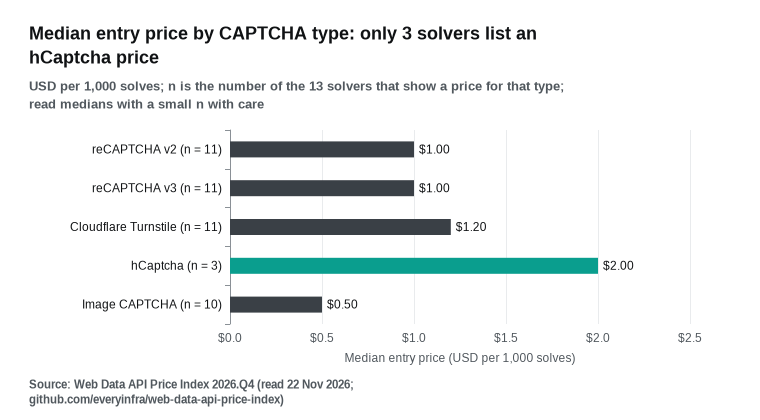
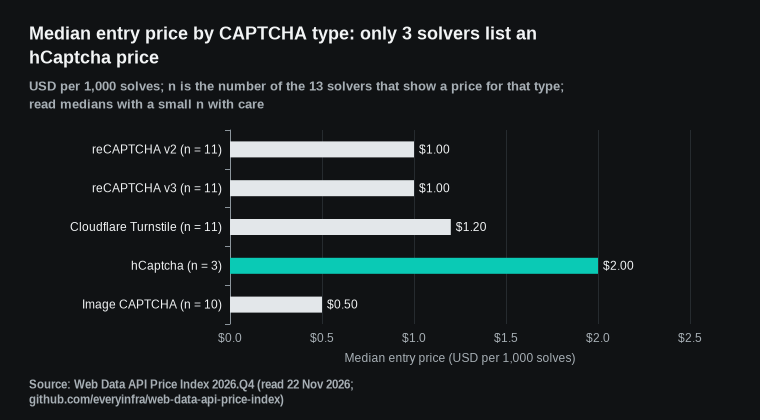
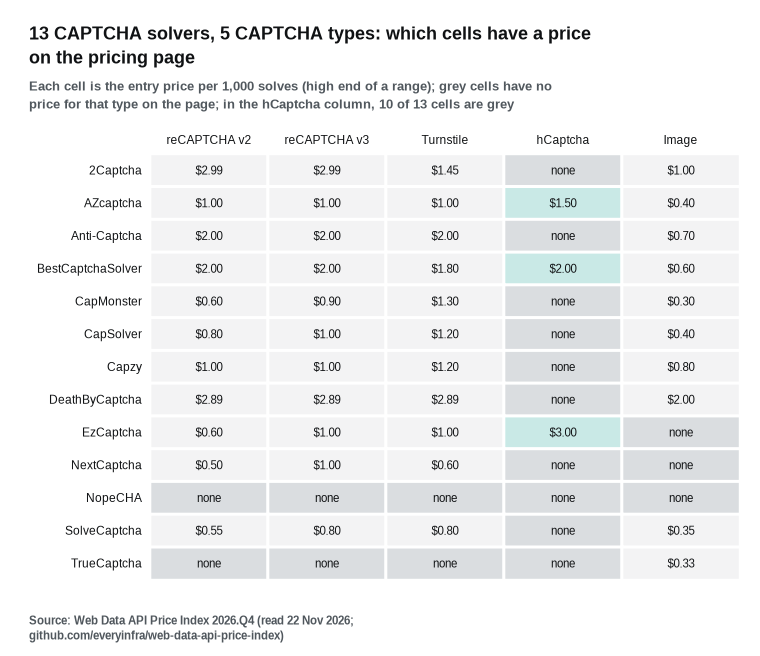
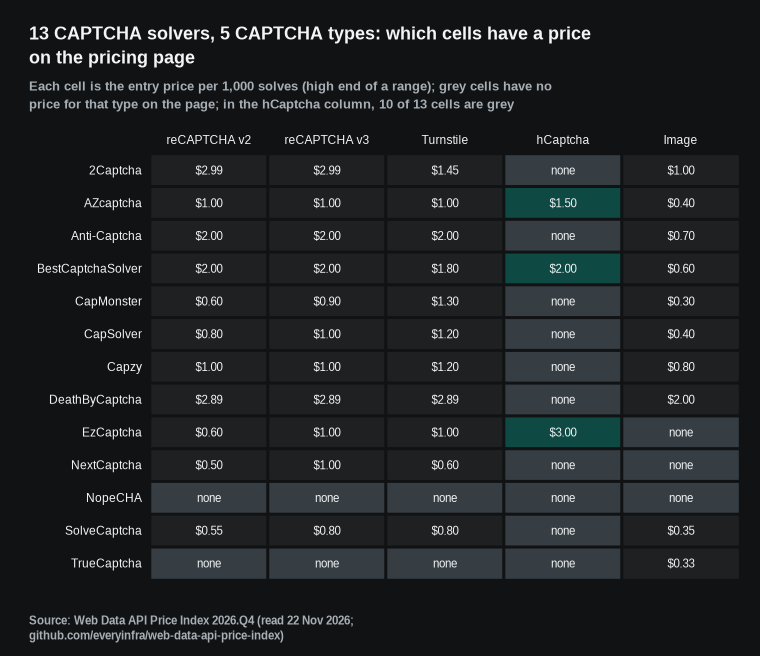
The hCaptcha column is nearly empty. 10 of 13 CAPTCHA solvers show no hCaptcha price on their pricing page. The ten are 2Captcha, Anti-Captcha, CapMonster, CapSolver, Capzy, DeathByCaptcha, NextCaptcha, NopeCHA, SolveCaptcha and TrueCaptcha. The three that show a price are AZcaptcha at $1.50, BestCaptchaSolver at $2.00 and EzCaptcha at $3.00, which gives the $2.00 median.
That count says only whether the pricing page lists a price. It does not say whether a service can solve hCaptcha, and the pricing page does not say either way. hCaptcha is a widely used CAPTCHA, so a buyer who needs it should ask each provider directly before they compare prices.
NopeCHA sells only plans with a daily number of solves, not a price per type. All five of its type rows are empty, and its plans sit in a sixth row.
TrueCaptcha shows one price, "$0.33 USD for 1000 captchas", with no type, so we recorded it as image CAPTCHA. The 2Captcha page source holds a price map with "hCaptcha":2.99, but the rendered page shows no hCaptcha row. The index therefore reads it as not listed.
We chose to read what a buyer sees. A value hidden in the source can be old, a test value or a price for a variant. The decision is in the decisions table of the methodology file. If 2Captcha shows the row again, the next edition will record it.
| Provider | reCAPTCHA v2 | reCAPTCHA v3 | Turnstile | hCaptcha | Image |
|---|---|---|---|---|---|
| 2Captcha | $2.99 | $2.99 | $1.45 | none | $1.00 |
| AZcaptcha | $1.00 | $1.00 | $1.00 | $1.50 | $0.40 |
| Anti-Captcha | $2.00 | $2.00 | $2.00 | none | $0.70 |
| BestCaptchaSolver | $2.00 | $2.00 | $1.80 | $2.00 | $0.60 |
| CapMonster | $0.60 | $0.90 | $1.30 | none | $0.30 |
| CapSolver | $0.80 | $1.00 | $1.20 | none | $0.40 |
| Capzy | $1.00 | $1.00 | $1.20 | none | $0.80 |
| DeathByCaptcha | $2.89 | $2.89 | $2.89 | none | $2.00 |
| EzCaptcha | $0.60 | $1.00 | $1.00 | $3.00 | none |
| NextCaptcha | $0.50 | $1.00 | $0.60 | none | none |
| NopeCHA | none | none | none | none | none (plans by daily solves) |
| SolveCaptcha | $0.55 | $0.80 | $0.80 | none | $0.35 |
| TrueCaptcha | none | none | none | none | $0.33 (one price, no type) |
Prices given as a range
Some solvers publish a range rather than one price. 2Captcha, for example, lists reCAPTCHA v2 at "$1 — $2.99" per 1,000. The page does not say what sets the price inside the range. The index uses the high end as the entry price, $2.99, and the low end, $1.00, as the lowest price.
Anti-Captcha shows ranges by volume and by reCAPTCHA v3 quality score, and NextCaptcha uses a three-step price for reCAPTCHA v3. AZcaptcha says "No subscriptions" in its hero text, but the same page sells AZ1 to AZ12 monthly plans with a lower rate column. We count those plans as self-serve options and note the contradiction. CapSolver prices "per 1000 tokens" without a definition of a token, so we read a token as one solved task.
The NopeCHA row shows how a plan-only service looks in the index. Its entry plan costs $4.99 a month, and the daily allowance of each plan resets every 23 hours. If you use the whole daily allowance every day, the price per 1,000 solves is $0.083 on Starter and $0.017 on the Enterprise plan.
The type definitions come from the CAPTCHA owners. Google documents reCAPTCHA v2 and v3 on its reCAPTCHA developer site, and Cloudflare documents Turnstile on its Turnstile developer pages. CapSolver's pricing documentation says it was last updated on 4 November 2026. The CapMonster Cloud FAQ gives an average solve time of 1 to 30 seconds by type. It also sets a limit of 120 result requests per task. Neither of those figures is in the index, but both affect the cost of a solve in a real pipeline.
What changed between 13 September and 22 November 2026
Between 13 September and 22 November 2026, 4 of 39 providers changed an entry or lowest price (Exa, Oxylabs Web Scraper, Perplexity, ScrapingBee); archived copies of the earlier pages confirm each change, and every change was a decrease.
Period 0 is the reading of the same 39 providers that everyinfra.com published on 26 September 2026. It has no archived copies of its own. We checked each difference against the latest Wayback copy of the page on or before that date. The oldest of those copies is from 13 September 2026. So the count starts on that date, not on the date of the previous reading.
Prices differ from period 0 for 12 providers in all. Only the four named above are price changes. The other differences come from a reading rule that period 0 did not apply, or from a period-0 figure that no archived copy shows. The file changes.csv gives the cause, the earlier archive and a quote for each difference, and its timing column dates each price change. The period-0 values are in readings.csv.
| Provider | Price | 26 Sep 2026 | 22 Nov 2026 | Cause |
|---|---|---|---|---|
| Exa | Entry and lowest | $7.00 | $4.00 | Price change |
| Perplexity | Entry | $5.00 | $1.00 | Price change |
| Oxylabs Web Scraper | Entry | $1.15 | $1.00 | Price change |
| ScrapingBee | Lowest | $0.075 | $0.048 | Price change |
| Oxylabs Web Scraper | Lowest | $0.25 | $0.80 | Rule: sales-only offers excluded |
| Oxylabs (Google) | Lowest | $0.50 | $0.70 | Rule: sales-only offers excluded |
| DataForSEO | Lowest | $0.60 | $2.00 | Rule: queued modes excluded |
| Firecrawl Search | Lowest | $1.20 | $1.50 | Rule: monthly price, not annual |
| Firecrawl | Lowest | $0.60 | $0.75 | Rule: monthly price, not annual |
| ScraperAPI | Lowest | $0.083 | $0.092 | Rule: monthly price, not annual |
| Tavily | Entry | $7.50 | $8.00 | Rule: pay as you go as entry |
| Bright Data Web Scraper | Lowest | $1.10 | $1.30 | Rule: period-0 figure not on the earlier page |
| AZcaptcha | Lowest, v2, v3 and image | $1.00, $1.00, $0.40 | $0.50, $0.50, $0.20 | Rule: plan rate now included |
| AZcaptcha | Turnstile and hCaptcha | $1.20 and none | $1.00 and $1.50 | Not verified |
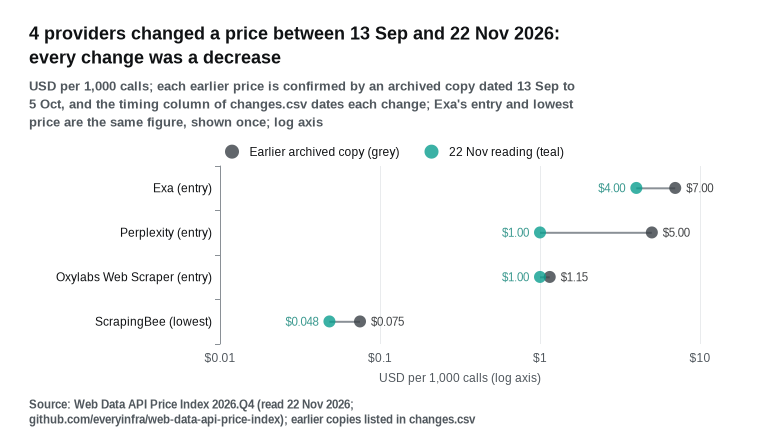
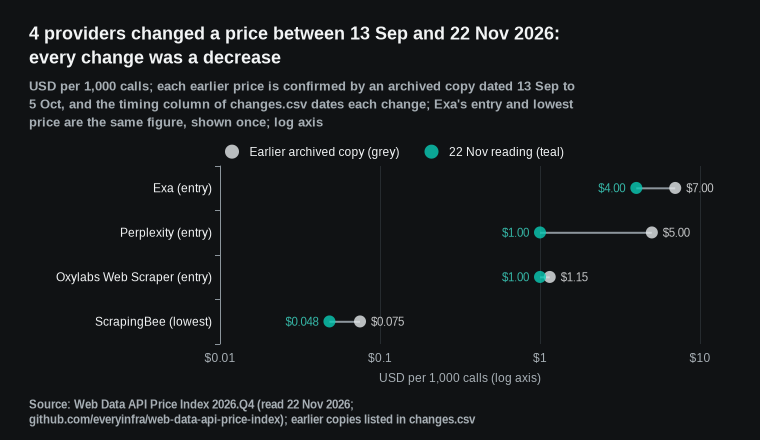
The table below dates each change against the previous reading of 26 September 2026.
| Provider | Earlier evidence | Later evidence | When the price fell |
|---|---|---|---|
| Exa | Copy of 19 September: Search $7, no cheaper mode | Copy of 29 September: Instant Search $4 | Between 19 September and 29; the archives cannot place it before or after 26 September |
| Perplexity | Copy of 13 September: Search API $5.00, no Fast Search | Fast Search announced at $1.00 on 24 September; listed in the changelog under September 2026 | Two days before the previous reading, which still recorded $5.00 |
| Oxylabs Web Scraper | Copy of 5 October: other targets $1.15 | Copy of 22 November: $1.00 | After the previous reading |
| ScrapingBee | Copy of 17 September: largest plan $599 for 8 million requests | Copy of 5 October: up to $3,599 for 69 million; copy of 22 November: up to $5,799 for 120 million | Partly after the previous reading |
The four price changes
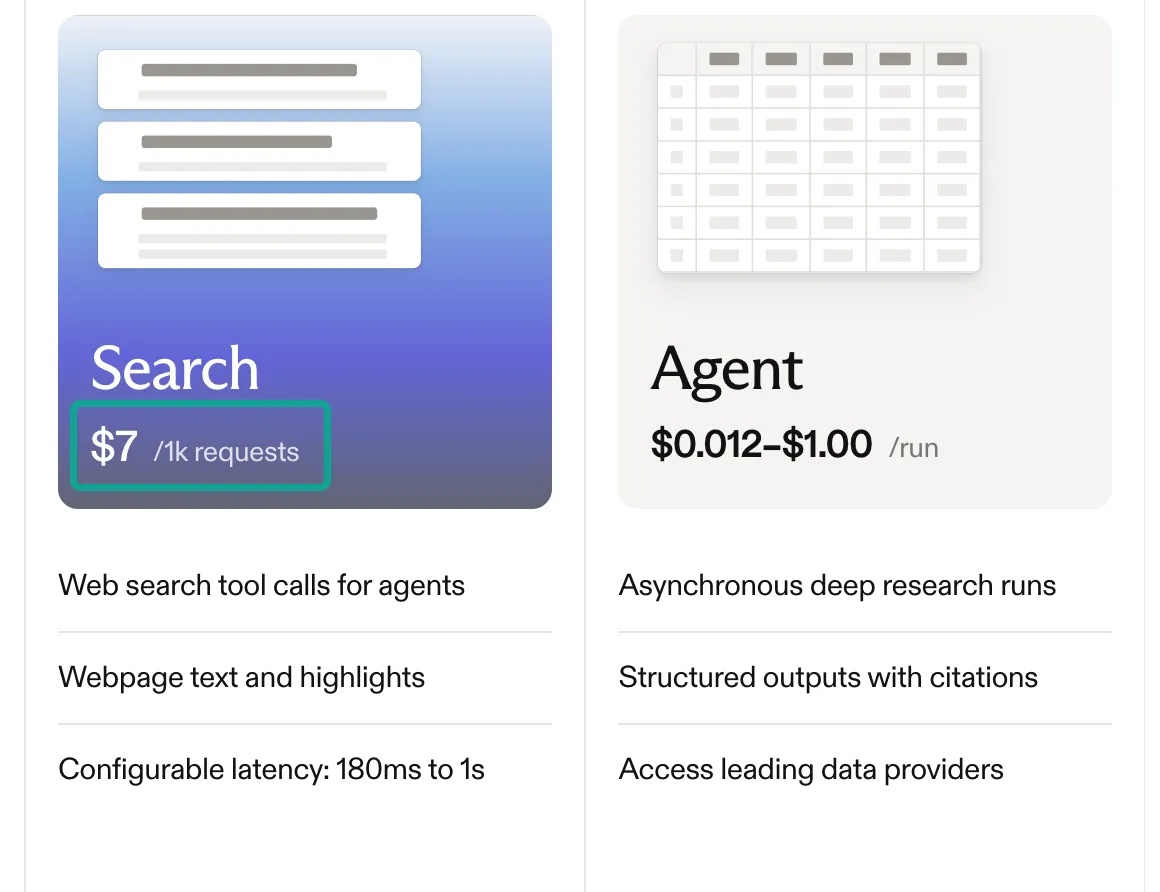
Exa added a cheaper search mode at $4.00 per 1,000 requests. Auto Search stays at $7.00, so the base call, and the Exa entry price, fell from $7.00 to $4.00. The 19 September 2026 copy of the Exa pricing page lists Search at "$7/1k requests" and has no cheaper mode.
The 29 September 2026 copy lists Instant Search at $4. On 19 October 2026, Lite Search took over the $4 price, as the Exa changelog shows. The Exa 3 announcement gives Lite at $4 and Auto at $7. The 22 November 2026 copy lists Lite, Auto and Deep Search at $4, $7 and $12.
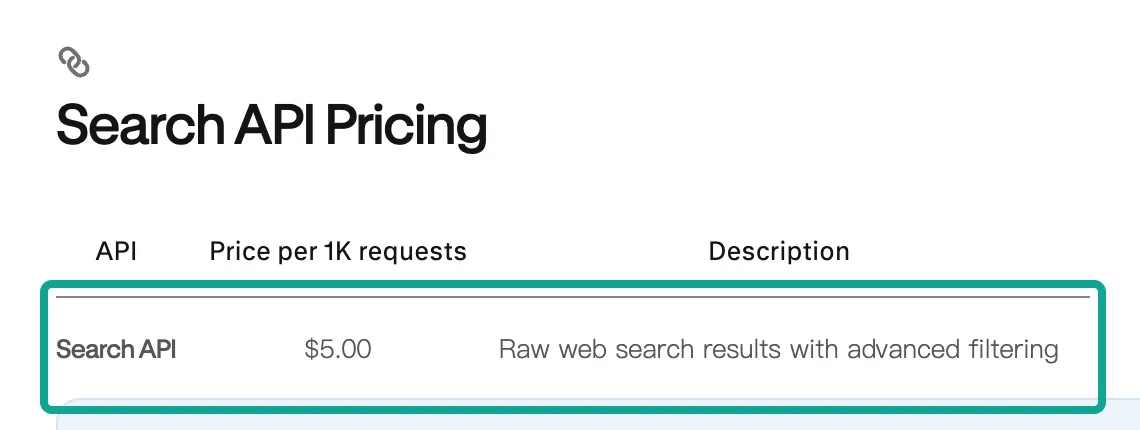
Perplexity added a cheaper mode to its Search API, so its entry price fell from $5.00 to $1.00. The 13 September 2026 copy of the Perplexity pricing page lists "Search API $5.00" and no Fast Search. Perplexity announced Fast Search at $1.00 on 24 September 2026, two days before the previous reading. Its changelog lists Fast Search under September 2026. The changelog copy archived at 00:04 UTC on 24 September does not show it yet, and the copy of 29 September does. So the previous reading recorded a price that was already out of date.
The 22 November 2026 copy lists "Search API with Fast Search $1.00 Lower-latency results". The standard mode is still on the page at $5.00, and the index keeps it as a recorded variant.
Oxylabs Web Scraper cut its price for other targets from $1.15 to $1.00 per 1,000 results. It also lowered the smallest plan from $49 to $15. The 5 October 2026 copy still lists other targets at $1.15 per 1,000 results on a $49 plan. The 22 November 2026 copy lists "From $1.00/1K res." on a $15 plan. So this price fell after the previous reading.
ScrapingBee did not change any existing plan, but it added larger ones, so its lowest price fell from $0.075 to $0.048 per 1,000 requests. The largest plan in the 17 September 2026 copy is Business +, at $599 for 8 million requests. The 5 October 2026 copy lists plans up to $3,599 for 69 million requests. The 22 November 2026 copy lists plans up to Enterprise 120, at $5,799 for 120 million requests. So part of the fall came after the previous reading. The entry price did not move.
Differences that are not price changes
The other providers in the table differ from period 0 because of the reading rules. Period 0 used the DataForSEO queued mode at $0.0006 a search. This edition uses only synchronous calls, so the Live price of $0.002 a search counts. Period 0 used annual prices for Firecrawl ($599 a month) and ScraperAPI ($1,777.50), and this edition uses the monthly prices ($749 and $1,975). Period 0 used the Oxylabs enterprise column, which needs a sales contact, so the Oxylabs (Google) lowest price moves from $0.50 to $0.70.
The Tavily entry price moves from $7.50 to $8.00 for the same kind of reason. Period 0 used the Tavily Project plan, $30 for 4,000 basic searches, as the entry option. This edition uses the pay-as-you-go rate of $8.00 per 1,000 basic searches. The Bright Data Web Scraper lowest price moves from $1.10 to $1.30. The earlier copy already shows the same plan, $499 for 384,000 records, and it does not show $1.10 anywhere. For AZcaptcha, the earlier copy of 9 June 2026 already had the plan rates that this edition includes.
Two AZcaptcha differences are not verified. Period 0 recorded Turnstile at $1.20, and no archived copy shows $1.20. The June copy shows Turnstile at $0.90, and the page now shows $1.00. So the Turnstile price rose to $1.00, but we cannot date the rise, and it is not in the count of confirmed changes.
The AZcaptcha page now also lists Cloudflare Challenge at $1.20, a row that the June copy does not have. Period 0 recorded no hCaptcha price, but the June copy lists hCaptcha at $1.80, and the page now lists $1.50. We do not count either difference as a price change or as a mistake in period 0.
What a price page does not tell you
A list price is the start of a cost estimate, not the end. The pricing page often leaves out four things that change the real cost. They are the billing of failed calls, the minimum payment, the free allowance and the end of an unused balance. The index records what each page says about them in providers.csv, and a blank cell means the page is silent.
Failed calls matter most for scraping, where a blocked page is common. A provider that bills every attempt costs more than a provider with the same list price that bills only successful calls. The index uses false when the page prices only successful calls, partial when it frees only some failures and blank when it does not say.
| Provider | Failed calls on the pricing page | The page's words |
|---|---|---|
| Bright Data SERP | Not billed | "Pay only for success" |
| SerpApi | Not billed | "Cached, errored, and failed searches are not" counted |
| SearchApi.io | Not billed | "Only successful searches with a 200 status code incur charges." |
| Scrapingdog | Not billed | "Failed requests never charged" |
| Zenserp | Not billed | "Only successful requests are billed" |
| Jina | Not billed | "No, tokens are not deducted for failed requests." |
| Zyte | Not billed (the price is per successful response) | "From $0.06 per 1,000 successful responses" |
| Firecrawl | Partly billed | A page that answers 403 or 404 is returned and billed |
| EnsembleData | Partly billed | Only "failed requests caused by internal errors" are free |
| Tavily | Not stated for search | Stated only for Extract and Map |
| You.com | Not stated | One request is one billable call, whatever it returns |
| Capzy | Not billed | "Only pay for successful solves. Failures are always free" |
The index reads three providers as "not billed" from a sentence that prices only successful responses: Zyte, Serper and Bright Data SERP. Their pages have no separate clause on failed calls.
Documentation pages often answer what the pricing page leaves open. The Bright Data SERP API billing page says that it bills per 1,000 successful requests and that failed requests are not billed. The Tavily rate limits page gives the requests per minute of each plan, set per organization. It also says that each request counts once against the rate limit, whatever its search depth. For billing, an advanced search costs twice a basic one. Those pages are outside the pricing page, so the index does not use them for prices.
Free allowances come in different units: dollars, searches, prepaid units and tokens. Brave gives $5 of free use every month, which is 1,000 searches at its price. Exa gives $10 every month, which is 2,500 Lite searches, plus a $10 onboarding bonus. SerpApi gives 250 searches a month, and Serper gives 2,500 free queries once. Tavily gives 1,000 basic searches a month, and Zenserp gives 50 searches a month. None of these allowances enters an entry or lowest price.
The difference between a subscription and a pack is also missing from most comparisons. A monthly plan resets each month, so a quiet month wastes part of the plan. A one-time pack, such as the Serper and Jina packs or the ScrapeCreators $47 pack, keeps its balance until it expires under the provider's terms. A daily allowance, such as the EnsembleData and NopeCHA plans, loses whatever you do not use that day.
The last missing item is the default view of the page. Firecrawl opened on annual prices in Singapore dollars for our reader in Singapore, and its US dollar monthly prices appeared only in the "Pricing at a glance" text. A buyer who compares the first number on each page can compare an annual price with a monthly one without noticing.
Limits of this index
Before release, a second reader recomputed every row from the archived pages without seeing the first reader's working. That reader found one error. The Bright Data SERP lowest price had missed two steps of the plan slider. It is now $1,999 for 2,000,000 requests instead of the first step. The fix and the decisions that came out of the same pass are in the CHANGELOG.
The sample is 39 providers, not the whole market. They are the providers that the public price comparison on everyinfra.com has tracked since 26 September 2026, and the publisher chose that list. Providers such as ZenRows, ScrapFly and Decodo are not in it. To propose a provider for the next edition, use the correction form in the repository issues.
We read every page in its default state, and tabs that we did not open are not in the index. The Oxylabs page has a "/Search" tab that we did not open. The Oxylabs (Google) row therefore uses the Google price on the default tab of the page. We did not check whether the "/Search" tab shows the same price. The "Subscription" tab of the Anti-Captcha page is also not in the index. The index reads list prices only, so it does not include discounts after a sales call or negotiated rates.
One base call does not return the same amount at every provider. A SerpApi search returns one full results page, whatever the number of results on it. A Jina search returns the top five results, and an Exa Lite search returns up to 10. The index does not adjust any price for the number or the type of results in one call. Before you compare two prices, compare what one call returns.
Two providers, Jina and Capzy, load their prices from a public data address after the page opens. A script checks their numbers on the archived copy of that address. But a reader who opens the archived page in a browser sees no price. The strict version of the headlines leaves out both.
In the strict version, the search line has 15 providers and a median entry price of $4.00. Its lowest entry price is $1.00, shared by four providers: Oxylabs (Google), Perplexity, Scrapingdog and Serper. Its median lowest price is $1.50.
The strict search line still has 6 subscription-only providers. In the strict CAPTCHA line, 9 of 12 solvers show no hCaptcha price. The change is small for the CAPTCHA line and larger for the search median, because Jina sits at the bottom of the search distribution.
Converted prices are best cases. The Jina price assumes the minimum of 10,000 tokens a request. The NopeCHA and EnsembleData prices assume that you use the whole daily allowance every day. The TrueCaptcha page showed a notice that the service was down, but its price still counts in the image CAPTCHA median of $0.50 (10 providers). Without TrueCaptcha, that median is $0.60 (9 providers).
The Bright Data SERP page also needs the source view. It keeps its prices in data-usd and data-tiers attributes, and in the Wayback Machine replay the price slots stay empty ("$ /1K requests"). The numbers are in the archived HTML, so a reader must open the page source and search for data-usd or data-tiers to confirm them. We checked three other pages at source level: SerpApi, Anti-Captcha and Bright Data Web Scraper. We opened their replays in a browser on 22 November 2026, and they show their prices.
In all, three providers show no price on the replay page: Jina, Capzy and Bright Data SERP. For those three, the archive is still the reference, but you need the page source or the data address to read it.
This is a reading on one day. Pricing pages change without notice, and a price that we read at 20:30 SGT can be different the next morning. Prices shown to a reader in Singapore can also differ from prices shown in other countries. The Wayback Machine made its copies from the United States, and those copies are the reference.
Some cells are blank because the page does not give the number. DeathByCaptcha and BestCaptchaSolver show their top-up amounts only after login. In tiers.csv, 45 plan rows have no match in the archived copy, but none of them sets an entry or lowest price. 44 are larger AZcaptcha plan cards (AZ2 to AZ12) that the page draws by script, and one is the Bright Data Web Scraper free tier. We keep them only for completeness.
The publisher's rows: EveryInfra
EveryInfra sells products in all three lines, so the index has three EveryInfra rows. They follow the same rules as every other row, but they are not part of any median, count, lowest price or highest price in this report. This section describes them so that you can judge them. The data tables at the end of the page list them next to the other providers, with the label (publisher).
The search row is $0.69 per 1,000 requests. The EveryInfra pricing page gives one range for search by search tool, "$0.69–$2.78 per 1,000 requests". The base call uses the low end, the same rule as for Linkup and TikHub.
The data row is $0.56 per 1,000 requests, the "from" price of data collection. In the data catalog, capabilities such as TikTok profile and YouTube video have that price. The CAPTCHA rows come from the EveryInfra CAPTCHA pricing page. They are $1.11 for reCAPTCHA v2, $1.39 for reCAPTCHA v3, $1.53 for Turnstile, $4.58 for hCaptcha and $0.83 for image CAPTCHA.
EveryInfra bills all three rows pay as you go, and the page says that failed calls are not charged. Each top-up must be at least $10. The pricing page did not state this amount on 22 November 2026. EveryInfra added the amount to the page before this report was published, so the archived copy of 22 November does not show it.
The EveryInfra pricing page also sells rate packages at $10, $30 and $78 per 30 days. A rate package raises the limit of requests per minute. The index treats rate packages as limits, not prices, so a reader who needs a higher limit should add their cost. For every other provider, the index counts a product as subscription-only when the page sells no use without a monthly plan. EveryInfra sells use without a rate package, so its rows count as pay as you go under the same rule.
We also checked that EveryInfra charged its catalog price. We used an EveryInfra account billed at list price. On 22 November 2026, we made three rounds of calls, at 22:03, 22:07 and 22:21 to 22:22 Singapore time. Before the calls we read the free search tools list and the data catalog. They give the list price of each search tool and each data capability.
The two data capabilities that we called are in the catalog under the TikTok API and the Google News API. We did not make live calls to CAPTCHA solving, because a solve needs a live target page.
| Time (SGT) | Call | HTTP | Results | Catalog price | Charged |
|---|---|---|---|---|---|
| 22:03:25 | EveryInfra search tool web, "serp api pricing per 1000 searches" | 200 | 10 | $0.000694 | $0.000694 |
| 22:03:33 | EveryInfra tiktok/profile, username nasa | 200 | 1 | $0.000556 | $0.000556 |
| 22:07:20 | EveryInfra google_news/search, "web scraping API pricing" | 200 | 20 | $0.000792 | $0.000792 |
| 22:07:31 | EveryInfra search tool web, "hcaptcha solver price per 1000" | 200 | 10 | $0.000694 | $0.000694 |
| 22:21:59 | EveryInfra search tool web, "web scraping api cost per 1000 requests" | 200 | 10 | $0.000694 | $0.000694 |
| 22:22:08 | EveryInfra tiktok/profile, username natgeo | 200 | 1 | $0.000556 | $0.000556 |
All six calls charged exactly the catalog price, read from billing.charged_usd in each EveryInfra response. The six charges add up to $0.003986. One earlier request failed with HTTP 401 because of a wrong header, and EveryInfra did not charge it. The web charge of $0.000694 is $0.69 per 1,000, the search row, and the tiktok/profile charge of $0.000556 is $0.56 per 1,000, the data row.
These calls test our billing, not the other 38 providers. We did not call their APIs, and every number on their side comes from their public pages and the archived copies of those pages.
Recent developments in web data API pricing
The items below come from each company's own changelog, documentation or court record, from the 60 days before this reading. The Exa and Perplexity price changes are in the section on changes above.
On 29 October 2026, Exa announced Monitors v2 in its changelog, at $2 per 1,000 requests, down from $15. Monitors are outside the index. On 13 November 2026, Exa made its search available in the European Union, as its EU announcement describes.
Oxylabs added a remote MCP server for its Web API on 29 October 2026, according to its developer changelog. On 12 November 2026, it added parsed results for Google Travel hotel pages. On 19 November 2026, it updated its MCP server and added a Skill for Agent Browser. None of these changes moved an Oxylabs price.
The court record of Google LLC v. SerpApi LLC on CourtListener has two new orders. On 9 November 2026, the court granted the motion to dismiss with leave to amend. On 18 November 2026, it set 10 December 2026 as the date for a second amended complaint and 11 January 2027 for the response. No price in the index depends on the case.
On 18 November 2026, DeepSeek changed its API pricing. From 12:00 that day (UTC+8), DeepSeek no longer bills per call for the server-side search and fetch tools that a model call uses. It bills their results as model tokens. DeepSeek is not in the index, because it sells a model, not a search API.
Two CAPTCHA pages had notices on the read date. DeathByCaptcha had a banner dated 19 November about a change of crypto payment processor. TrueCaptcha had a banner that said "The service is currently down". Both notices are in the service_notice column of providers.csv, and neither one changed a price.
| Date | Company | Change | What it can mean for a buyer |
|---|---|---|---|
| 24 September 2026 | Perplexity | Fast Search added to the Search API | Entry price falls from $5.00 to $1.00 per 1,000 |
| 19 September to 29, 2026 | Exa | Instant Search at $4 per 1,000 | Exa entry price falls from $7.00 to $4.00 |
| 19 October 2026 | Exa | Lite search takes over the $4 price | No price change; Auto Search stays at $7 |
| 29 October 2026 | Exa | Monitors v2 at $2 per 1,000, down from $15 | Outside the index; check endpoints other than search too |
| 29 October 2026 | Oxylabs | Remote MCP server for Web API | If your agent uses MCP, count its calls per task |
| 9 November 2026 | Court | Google against SerpApi: dismissed with leave to amend | If you buy Google results, follow the case |
| 13 November 2026 | Exa | Search available in the European Union | If your data must stay in the EU, check this option |
| 18 November 2026 | DeepSeek | Search tool calls inside model calls billed as tokens, not per call | Compare the token cost with a per-call price |
| 19 November 2026 | Oxylabs | Updated MCP and new Skill for Agent Browser | No Oxylabs price moved |
Reproduce and cite this index
Every number in this report comes from the files in the repository, and one script rebuilds all of them. The script reads the plan table, computes each entry and lowest price, recomputes every headline and compares the result with the committed files. If any output differs, the check fails.
git clone https://github.com/everyinfra/web-data-api-price-index.git
cd web-data-api-price-index
python3 recompute.py --check
The script is recompute.py, and its outputs are index.csv and headlines.json. It uses only the Python standard library, so you do not need to install packages. The free EveryInfra catalog is also public, and the command below reads it without a key. The quickstart gives the request format for the other EveryInfra endpoints.
curl -s "https://api.everyinfra.com/api/v1/social/catalog?compact=1" | head -c 600To cite the index, use the text below. The repository also has a CITATION.cff file that GitHub turns into a citation.
EveryInfra (2026). Web Data API Price Index, Q4 2026 (version 2026.Q4) [Data set]. Zenodo. https://doi.org/10.5281/zenodo.24453414
Data: https://github.com/everyinfra/web-data-api-price-index (CC BY 4.0; code MIT)
The data is under CC BY 4.0, so you can reuse it if you name the source. The licence file gives the full terms. Quoted text and screenshots of provider pages remain the property of their owners. To report an error, open an issue in the repository or write to partners
Frequently asked questions
What is the cheapest search API in this index?
By entry price, Jina is lowest at $0.50 per 1,000 searches, but that figure is converted from token pricing and is a lower bound. Among prices printed per search, Oxylabs (Google), Perplexity, Scrapingdog and Serper each list $1.00 at entry. By lowest price, Scrapingdog's Nova Pro plan gives $0.14 per 1,000, and that plan costs $30,000 a month. The right answer depends on your volume and on whether you need Google results or passages for a model.
Is SerpApi free?
SerpApi has a free plan with 250 searches a month. Paid plans start with Starter at $25 a month, which is $25.00 per 1,000 searches, the highest entry price in the search line. The largest self-serve plan, Cloud 54M, brings the price down to $1.96 per 1,000. SerpApi counts only successful searches, so cached, errored and failed searches do not use the plan.
Is there a free alternative to SerpApi?
Several Google results APIs have a free allowance, but none is free at volume. Serper gives 2,500 free queries once, and Bright Data SERP has a free tier of 5,000 requests a month. Zenserp gives 50 searches a month, and SearchApi.io gives 100 free requests at signup. Scrapingdog has a free plan worth 20 Google searches. After the allowance, the entry prices in the search table apply.
How much does a CAPTCHA solver cost per 1,000 solves?
The median entry price is $1.00 for reCAPTCHA v2 and v3, $1.20 for Cloudflare Turnstile, $2.00 for hCaptcha and $0.50 for image CAPTCHA. The hCaptcha median has only three providers behind it, so treat it with care. When a page gives a range, such as the 2Captcha range for reCAPTCHA v2, the entry price in the index is the high end.
How much does a web scraping API cost per 1,000 requests?
Take a plain page with no JavaScript and no premium proxy. For that page, entry prices in the index run from $0.13 for Zyte tier 1 to $3.80 for Firecrawl. ScrapingBee starts at $0.25, ScraperAPI at $0.49 and Oxylabs Web Scraper at $1.00 per 1,000 results. Harder targets cost several times more, so convert your real target mix with each provider's own price table before you compare.
Why can two APIs with the same list price cost different amounts?
The list price covers the easiest call. Price multipliers for harder targets, failed calls that are still billed, the minimum payment and an unused plan allowance all change what you pay. A provider that bills only successful calls can cost less than a provider with a lower list price that bills every attempt.
Which CAPTCHA solvers show an hCaptcha price?
Only three of the 13 solvers in the index show one: AZcaptcha at $1.50, BestCaptchaSolver at $2.00 and EzCaptcha at $3.00 per 1,000. The other ten pricing pages show no hCaptcha price. That does not mean they cannot solve hCaptcha. It means a buyer cannot see the price on the page.
Notes on conversions
This section gives the conversion rules and quotes each page in its own unit. Most of these pages sell credits.
| Case | Rule | Example |
|---|---|---|
| Credits | Price per 1,000 credits times credits per base request | ScraperAPI Hobby: $49 a month for 100,000 credits, 1 credit a standard page, gives $0.49 |
| Credits per search | As stated on the page | Scrapingdog Lite: $40 a month for 200,000 credits at 5 credits a search gives $1.00 |
| Per 10 results | One call is one page of 10 results | Firecrawl Search Hobby: $19 for 5,000 credits at 2 credits per 10 results gives $7.60 |
| Tokens | Price per token times tokens per call, a lower bound | Jina: $50 for 1 billion tokens at 10,000 tokens a request gives $0.50 |
| Daily allowance | Units per day times 30 | EnsembleData Wood: 1,500 units a day for $100 a month gives $2.22 |
| Monthly or annual | The monthly price | Firecrawl Hobby: $19 billed monthly, not $16 billed annually |
| Currency | The page's own US dollar price | Firecrawl showed Singapore dollar cards; its text gives the US dollar prices we used |
Each price in the multiplier table is the entry price times the credits of the harder call. For example, ScrapingBee charges $0.2533 per 1,000 plain requests, and JavaScript rendering uses 5 credits, so it costs $1.27 per 1,000.
| Provider | Unit on the page | The page's words |
|---|---|---|
| ScraperAPI | Credit | "A standard page costs 1 credit. Amazon costs 5, Google and Bing (including their subdomains) cost 25, and LinkedIn costs 30. Sites behind bot protection like Cloudflare, Datadome, or PerimeterX add 10 credits per request" |
| ScrapingBee | Credit | "Each successful request with JS rendering enabled costs 5 API credits." and "Each successful request with Premium proxies costs 10 or 25 credits depending on JS rendering." |
| Firecrawl | Credit | "On Scrape and Crawl, the JSON, Question, and Highlight formats add 4 credits per page" |
| Firecrawl Search | Credit | "Search costs 2 credits per 10 results" |
| Scrapingdog | Credit | "Google SERP Light API 5 credits / req"; the Advance search uses 10 credits a request |
| Tavily | Credit | "Basic Search (basic): Each request costs 1 API credit." and "Advanced Search (advanced): Each request costs 2 API credits." |
| ScrapeCreators | Credit | "1 credit === 1 request (for most endpoints). A few use more, and the exact cost is shown in the docs." |
| Serper | Credit | "$50* 50k credits ($1.00/1k) Submit 50,000 queries" |
The ScraperAPI credits and request costs page gives the same rules in more detail. The Tavily API credits page gives the credits per search depth. The screenshot below shows the FAQ answer on the ScraperAPI pricing page.
References
- EveryInfra. Web Data API Price Index, repository. https://github.com/everyinfra/web-data-api-price-index
- EveryInfra. Methodology of the index. https://github.com/everyinfra/web-data-api-price-index/blob/main/METHODOLOGY.md
- Python Software Foundation. statistics module. https://docs.python.org/3/library/statistics.html
- Internet Archive. Using the Wayback Machine. https://help.archive.org/help/using-the-wayback-machine/
- EveryInfra. Read times of each page, pages.csv. https://github.com/everyinfra/web-data-api-price-index/blob/main/data/2026-q4/pages.csv
- EveryInfra. Plan table with quotes, tiers.csv. https://github.com/everyinfra/web-data-api-price-index/blob/main/data/2026-q4/tiers.csv
- EveryInfra. Provider notes, providers.csv. https://github.com/everyinfra/web-data-api-price-index/blob/main/data/2026-q4/providers.csv
- Perplexity. Fast Search. https://docs.perplexity.ai/docs/search/fast-search
- Perplexity. Pricing. https://docs.perplexity.ai/docs/getting-started/pricing
- Exa. Pricing documentation. https://exa.ai/docs/admin/pricing
- Tavily. API credits. https://docs.tavily.com/documentation/api-credits
- Linkup. Pricing. https://docs.linkup.so/pages/documentation/platform/pricing
- DataForSEO. SERP API overview. https://docs.dataforseo.com/v3/serp-overview/
- Apify. Actors in the store. https://docs.apify.com/actors/running/actors-in-store
- ScraperAPI. Credits and request costs. https://docs.scraperapi.com/getting-started/quick-start/credits-and-requests-costs
- Wayback Machine. ScraperAPI pricing page, 22 November 2026. https://web.archive.org/web/20261122124424/https://www.scraperapi.com/pricing/
- Zyte. Zyte API pricing. https://docs.zyte.com/zyte-api/pricing.html
- Firecrawl. Billing. https://docs.firecrawl.dev/billing
- hCaptcha. Developer documentation. https://docs.hcaptcha.com/
- Google. reCAPTCHA developer site. https://developers.google.com/recaptcha
- Cloudflare. Turnstile. https://developers.cloudflare.com/turnstile/
- CapSolver. Pricing documentation. https://docs.capsolver.com/en/pricing/
- CapMonster Cloud. FAQ. https://docs.capmonster.cloud/docs/faq/
- EveryInfra. Changes since period 0, changes.csv. https://github.com/everyinfra/web-data-api-price-index/blob/main/data/2026-q4/changes.csv
- EveryInfra. Period-0 readings, readings.csv. https://github.com/everyinfra/web-data-api-price-index/blob/main/data/2026-09-26/readings.csv
- Wayback Machine. Exa pricing page, 19 September 2026. https://web.archive.org/web/20260919154434/https://exa.ai/pricing
- Wayback Machine. Exa pricing page, 22 November 2026. https://web.archive.org/web/20261122111945/https://exa.ai/pricing
- Exa. Changelog. https://exa.ai/docs/changelog
- Exa. Exa 3 announcement. https://exa.ai/blog/exa-3
- Wayback Machine. Perplexity pricing page, 13 September 2026. https://web.archive.org/web/20260913155539/https://docs.perplexity.ai/docs/getting-started/pricing
- Wayback Machine. Perplexity pricing page, 22 November 2026. https://web.archive.org/web/20261122123335/https://docs.perplexity.ai/docs/getting-started/pricing
- Perplexity. Changelog. https://docs.perplexity.ai/docs/resources/changelog
- Wayback Machine. Oxylabs Web Scraper pricing page, 5 October 2026. https://web.archive.org/web/20261005205147/https://oxylabs.io/products/scraper-api/web/pricing
- Wayback Machine. Oxylabs Web Scraper pricing page, 22 November 2026. https://web.archive.org/web/20261122123908/https://oxylabs.io/products/web-api/scrape/pricing
- Wayback Machine. ScrapingBee pricing page, 17 September 2026. https://web.archive.org/web/20260917010400/https://www.scrapingbee.com/pricing/
- Wayback Machine. ScrapingBee pricing page, 22 November 2026. https://web.archive.org/web/20261122124706/https://www.scrapingbee.com/pricing/
- Bright Data. SERP API pricing and billing. https://docs.brightdata.com/products/serp-api/pricing-and-billing
- Tavily. Rate limits. https://docs.tavily.com/documentation/rate-limits
- EveryInfra. Changelog of the index. https://github.com/everyinfra/web-data-api-price-index/blob/main/CHANGELOG.md
- EveryInfra. Issues of the index repository. https://github.com/everyinfra/web-data-api-price-index/issues
- EveryInfra. Search tools list. https://api.everyinfra.com/api/v1/search/tools
- EveryInfra. Data catalog. https://api.everyinfra.com/api/v1/social/catalog
- Exa. Exa Search in the EU. https://exa.ai/blog/eu-data-residency
- Oxylabs. Developer changelog. https://developers.oxylabs.io/changelog
- CourtListener. Google LLC v. SerpApi LLC, docket. https://www.courtlistener.com/docket/72059948/google-llc-v-serpapi-llc/
- DeepSeek. API pricing. https://api-docs.deepseek.com/quick_start/pricing/
- EveryInfra. recompute.py. https://github.com/everyinfra/web-data-api-price-index/blob/main/recompute.py
- EveryInfra. Price table, index.csv. https://github.com/everyinfra/web-data-api-price-index/blob/main/data/2026-q4/index.csv
- EveryInfra. Headline figures, headlines.json. https://github.com/everyinfra/web-data-api-price-index/blob/main/data/2026-q4/headlines.json
- EveryInfra. CITATION.cff. https://github.com/everyinfra/web-data-api-price-index/blob/main/CITATION.cff
- Creative Commons. Attribution 4.0 International. https://creativecommons.org/licenses/by/4.0/
- EveryInfra. Licence of the index. https://github.com/everyinfra/web-data-api-price-index/blob/main/LICENSE
- Wayback Machine. Exa pricing page, 29 September 2026. https://web.archive.org/web/20260929184013/https://exa.ai/pricing
- Wayback Machine. ScrapingBee pricing page, 5 October 2026. https://web.archive.org/web/20261005205147/https://www.scrapingbee.com/pricing/
- Perplexity. Introducing Fast Search in the Perplexity Search API, 24 September 2026. https://community.perplexity.ai/t/introducing-fast-search-in-the-perplexity-search-api/6195
- Wayback Machine. Perplexity changelog, 24 September 2026. https://web.archive.org/web/20260924000451/https://docs.perplexity.ai/docs/resources/changelog
- Wayback Machine. Perplexity changelog, 29 September 2026. https://web.archive.org/web/20260929213254/https://docs.perplexity.ai/docs/resources/changelog