Weibo API in 2026: Official, GitHub or Pay-per-Call
Weibo API in 2026: the Open Platform allows 100 calls per user a day, 8 of 14 GitHub tools need your login, and trending costs $0.011 per 1,000 rows.

Yes, Weibo has an official API. In 2026 there are three types of Weibo API. The first is the Weibo Open Platform. The second is open-source scrapers and MCP servers on GitHub. The third is pay-per-call data APIs, such as EveryInfra and TikHub. EveryInfra is the company that the author works for, and it sells one of the pay-per-call APIs in this comparison.
On November 30, 2026, at 00:22 Singapore time, we read the Weibo hot search list through the EveryInfra weibo/trending capability. One call returned 50 rows and cost $0.000556, which is $0.0111 per 1,000 rows. TikHub's public price list, read at 00:13, showed 59 Weibo endpoints, and 58 of them cost $0.001 per call. On the open-source side, we read 14 Weibo repositories on GitHub. In their own README files, 8 of the 14 ask for your personal Weibo login.

Weibo API options compared
"Per 1,000 calls" is the list price for 1,000 requests. "Per 1,000 rows" divides the charge by the rows that one call returned.
| Option | Billing unit | USD per 1,000 calls | Per 1,000 rows (tested or documented) | Failed and empty calls | Weibo account or cookies | MCP | Data you can get |
|---|---|---|---|---|---|---|---|
| Weibo Open Platform API | Free, with quotas per user and per IP | $0 | — | Not applicable | Developer verification, app review, OAuth for each user | No official MCP address | The authorized user's own posts, comments and profile; advanced endpoints need a separate application |
| Weibo commercial data API | Row quota, query count or permission; price by email | Not public | Not public; search pages hold up to 50 rows | Not public | Company contract | Not public | Keyword search, historical data jobs, all comments and reposts, push subscriptions |
| weibo-cli | Credit packs from CNY 69, valid 365 days | Credits per command visible only after login | Search returns 10 to 50 rows per call | Not public | Face verification of the developer, OAuth into your Weibo account | Media reports say yes | 52 commands; 31 work only on your own data |
| GitHub open source | Free; you supply servers and accounts | $0 | — | You retry yourself | 8 of 14 need your own login | 1 of 14 is an MCP server | Varies; 3 have no commit since 2019 |
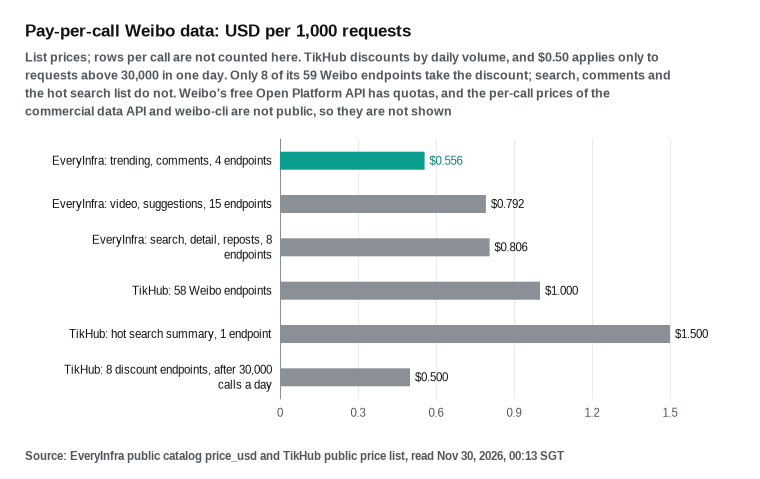
| EveryInfra | Per call | $0.556 (4), $0.792 (15), $0.806 (8) | Trending $0.0111; search $0.0192 to $0.0299 (tested) | Errors free; empty results refunded | None; one API key | Yes, remote MCP | 27 capabilities: trending, search, comments, reposts, profiles, video |
| TikHub | Per call; billed only on HTTP 200 | 58 endpoints $1.00, 1 endpoint $1.50 | Rows per call not published | FAQ says failures are free; empty results not stated | Its own key; no Weibo login | Yes, 64 Weibo tools | 59 Weibo endpoints |
Sources: the three official rows come from the docs on open.weibo.com and openapi.sc.weibo.com, read between 00:15 and 00:21 Singapore time on November 30, 2026. The open-source row comes from the GitHub API at 00:20 and from each README. The EveryInfra row comes from the public catalog at 00:13. The TikHub row comes from its public price list at 00:13 and its FAQ page at 00:22.
The three official options differ in who may use them and whose data they read. The free API needs only developer verification, but it reads data that belongs to the signed-in user. The notes for statuses/show say that the post must be from the authorized user. The commercial data API can search all public posts by keyword, but it needs a company contract and has no public price. weibo-cli wraps part of the commercial API as commands. Its public pages do not show the credit cost of each command, so we cannot convert it to a price per 1,000 calls.
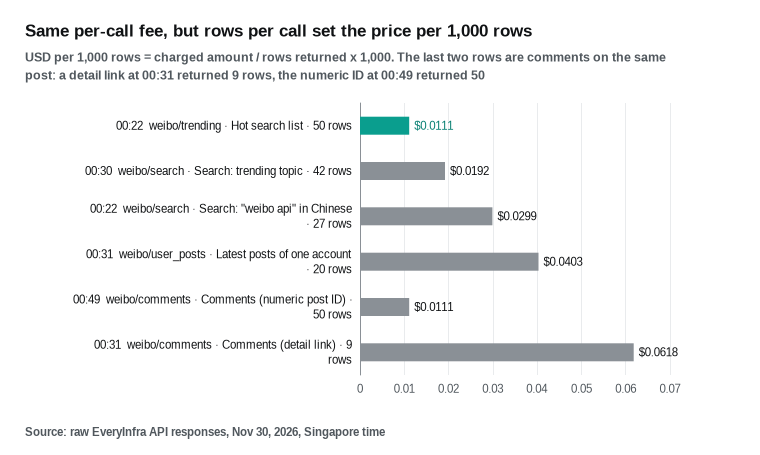
The price per call is only half of the story. You must also divide by the rows that each call returns. One weibo/trending call returns 50 rows, so the hot search list costs $0.0111 per 1,000 rows. At 00:22, a search for "weibo api" (written in Chinese) returned 27 rows. At 00:30, a search for a trending topic returned 42 rows. So search cost between $0.0192 and $0.0299 per 1,000 rows.
TikHub's price list shows the price per call, but not the rows per call. So we cannot calculate its price per 1,000 rows, and we left that cell empty.
TikHub's FAQ, read at 00:22, says that only requests with HTTP 200 are billed. Its discount works in daily bands, like a progressive tax. The day resets at midnight Los Angeles time. The FAQ gives an example: 20,000 requests in one day cost $15.60 in total.
But the discount is set per endpoint. Each endpoint in the price list has an allow_discount field, and only 8 of the 59 Weibo endpoints have it set to true. They include post detail, user info and the hot search summary. The keyword search, comment and hot search list endpoints do not take the discount.
| TikHub requests in one day | Price per request |
|---|---|
| 0 to 1,000 | $0.001 |
| 1,000 to 5,000 | $0.0009 |
| Each later band | About 10% lower than the band before |
| Above 30,000 | $0.0005 |
A new TikHub account gets $0.05 of free credit after email verification, which the FAQ says is about 50 requests at the base price. The same FAQ answer says that not every endpoint accepts free credit. By the allow_free_credit field, 24 Weibo endpoints accept it, and all 23 App endpoints are in that group. But the TikHub Weibo API page says that the App search endpoints are under maintenance. For keyword search, it says to use the Web V2 endpoints. EveryInfra has no daily bands, so your monthly bill is the catalog price times your number of calls.
Does Weibo have an official API?
Yes, and since 2026 it has three official products. The Weibo Open Platform docs list the free Open Platform API for websites and apps. Its Weibo API overview was updated on May 9, 2025. They also list the commercial data API for companies that buy data. The third product is weibo-cli, a command-line tool for AI agents that went live on June 22, 2026.
| Official product | Who it is for | Sign-in | Data scope | Price |
|---|---|---|---|---|
| Free Open Platform API | Websites and apps with "Sign in with Weibo" | Developer verification, app review, user OAuth | The authorized user's own data | Free, 100 calls per user per day |
| Commercial data API | Companies that buy data | Company contract | Keyword search across Weibo, history, subscriptions | By email; not public |
| weibo-cli | People who run their own account with an agent | Face scan, OAuth into your account | 31 own-account commands, 21 that read other accounts | Credit packs from CNY 69 |
All official docs are in Chinese, and so are the sign-up pages. If you work outside mainland China, this matters before you write any code. The FAQ page asks individual developers for resident ID card details and companies for a business license. weibo-cli adds a face scan in the Weibo mobile app. A pay-per-call API removes these steps, because you do not use a Weibo account at all.
The free Open Platform API reads the authorized user's data
The read endpoints on the overview page include users/show, statuses/user_timeline, statuses/repost_timeline, statuses/show and comments/show. statuses/user_timeline returns posts by the authorized user. statuses/show returns no data for posts by other users. Topic search, search/topics, is an advanced endpoint that searches only hashtag text and returns the latest 200 posts.
You must apply for advanced endpoints in the console. The advanced endpoint application page, updated February 26, 2013, says that your app must pass review first. Weibo then reviews the request within 3 working days.
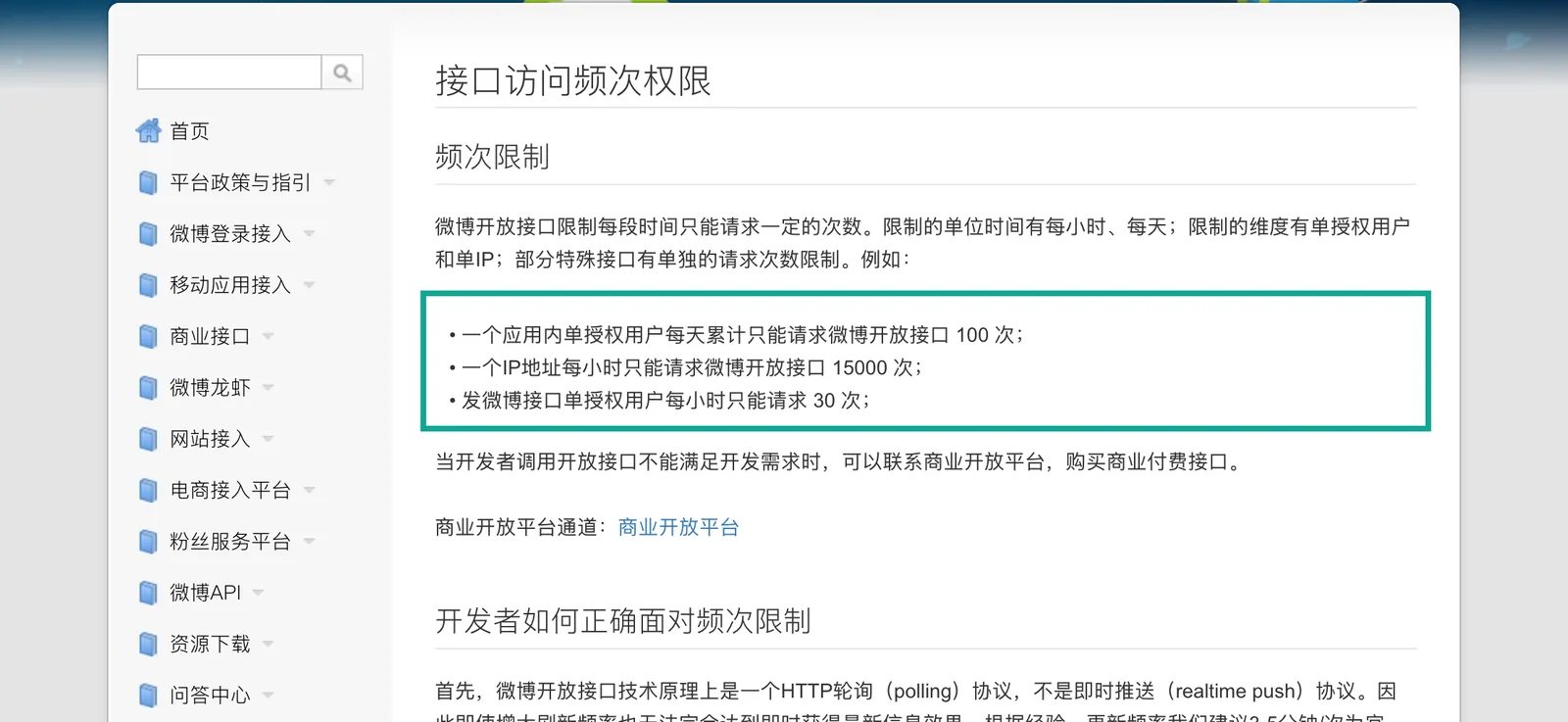
The rate limit page was updated on May 15, 2025. The FAQ page was updated on December 21, 2022. Together they give these limits.
| Free API rule | Value |
|---|---|
| Calls per authorized user per day | 100 |
| Calls per IP address per hour | 15,000 |
| Posts per user per hour through the API | 30 |
| Test accounts for an app that has not passed review | 15 |
| Identity verification time | 1 to 3 working days |
| Token life for an app that has not passed review | 24 hours |
| Token life for a reviewed web or mobile app | At least 30 days |
The rate limit page also has two more rules. First, third parties must not store user data on their servers; they may cache it only on the client. Second, calls above the limits, or frequent calls that the user did not start, can get your app key and IP blocked as a bot. So a server-side job that copies other people's posts into your database does not match these rules.
The commercial data API needs a contract and has no public prices
For keyword data across all of Weibo, the platform points you to the commercial data API. The developer agreement, updated June 9, 2022, makes it the only path in clause 2.7.8. Developers whose business is data collection, analysis and service to third parties may do this work only through the commercial data API. Section 2.5 forbids requests for platform data on the grounds of government opinion monitoring, unless you show an original letter of authorization. Clause 2.5.15 says that you must delete all platform data when you stop using the platform.
The commercial API home page lists three billing models. A row quota covers posts and comments found by keyword, user or check-in location: "one row of data uses one row of quota". Per-query billing covers account analysis, follower profiles and keyword mention counts. Per-permission billing covers repost and comment lists of authorized users and publishing tools. None of these pages shows a price, and the contact options are an email address and an official Weibo account.
At 00:21 we read the row-quota list. It had 22 endpoints plus a subscription service. They include search/statuses/limited, historical data jobs, comments/show/all and statuses/repost_timeline/all.
The docs for search/statuses/limited are detailed. Each IP gets 50,000 calls per hour, and each page holds 10 to 50 posts. You can filter by province and city, original posts, posts with images and posts by verified users. Sorting by reposts or comments works only for posts from the last month. comments/show/all returns 50 comments per page by default and can filter commenters by "people I follow" or "strangers".
In the EveryInfra catalog, weibo/search takes only keyword and a row limit, with no such filters. To filter by region, original posts or verified users, you need this endpoint and a company contract.
weibo-cli went live in June and moved to credits in August
On June 26, 2026, IT Home reported that the Weibo Open Platform had launched weibo-cli on June 22. The tool wraps more than 70 endpoints, prints JSON, YAML or tables, and supports MCP. Its npm package, @weibo-ai/weibo-cli, was created on May 25 under the MIT license. Version 0.9.9 came out on November 18. At launch it was a subscription with five plans.
| weibo-cli plan in June 2026 | Monthly fee | Credits |
|---|---|---|
| Free | CNY 0 | 5 calls per hour, own data only |
| Basic | CNY 29 | 3,000 |
| Plus | CNY 69 | 7,500 |
| Pro | CNY 299 | 32,000 |
| Ultra | CNY 899 | 100,000 |
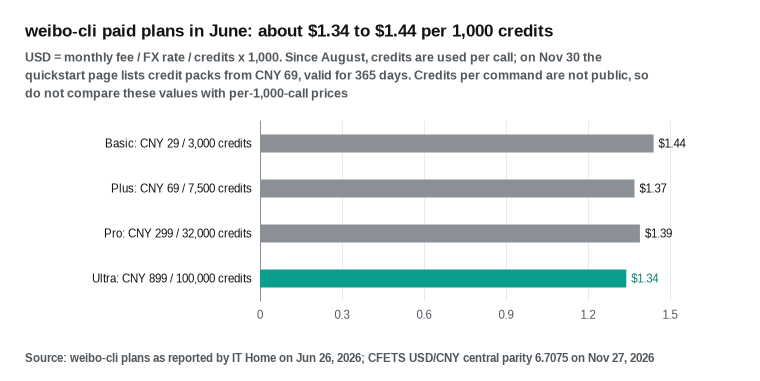
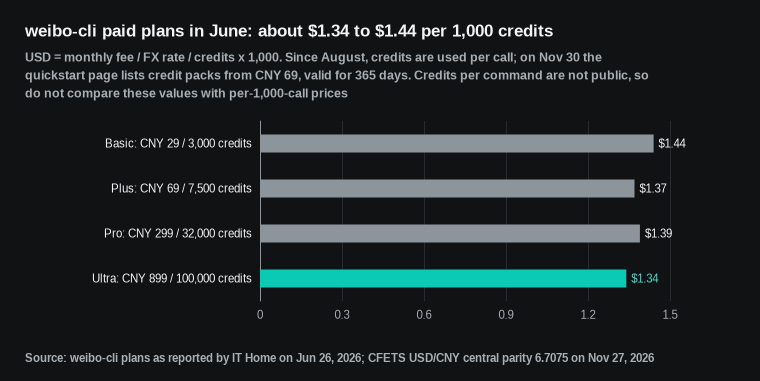
On August 14, the official "Weibo Open Platform" account published a post that announced pay-per-use credits. All permissions that had been locked by plan level became available, and new users got a 7-day free trial. The quickstart page, which we read at 00:20 on November 30, matches that post. First you scan your face in the Weibo app to verify as a developer. Then you start the 7-day trial or buy a credit pack.
During the trial, each read endpoint allows 5 calls and each write endpoint allows 3 calls, at no charge. The trial does not include multi-image posts, statistics or trends. Paid credit packs start at CNY 69 and are valid for 365 days. Write endpoints that use HTTP POST also share a limit of 60 calls per hour.
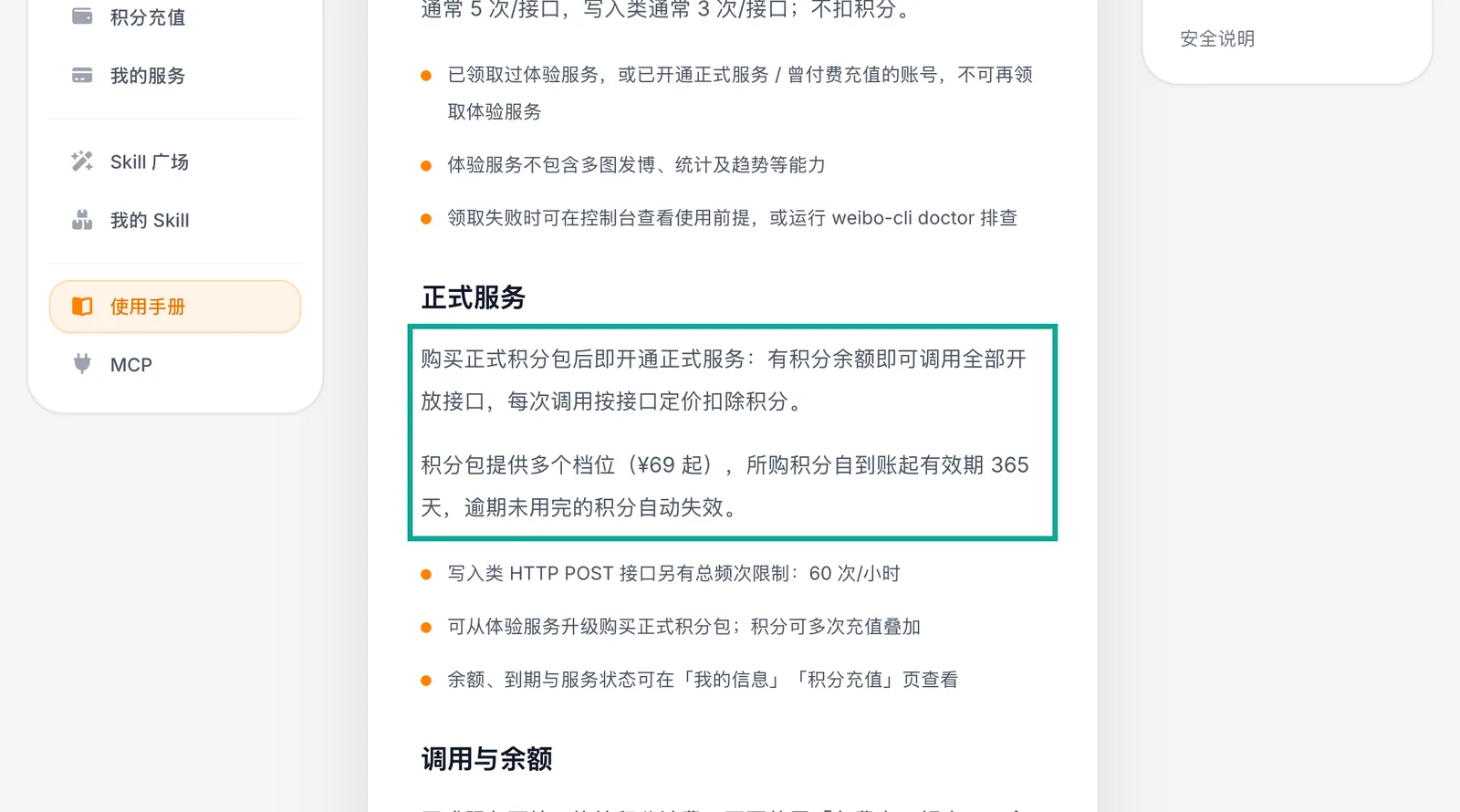
The plan page, read at 00:20, lists 52 commands. Of these, 31 are marked "own account only". They read and write only the posts, comments, followers and articles of the signed-in user. The other 21 commands can read other accounts.
| weibo-cli command that reads other accounts | What it returns |
|---|---|
search/statuses/limited | Posts that match a keyword |
comments/show/all | All comments on a post |
statuses/repost_timeline/all | All reposts of a post |
statuses/user_timeline/other | Posts by another user |
attitudes/show/biz | The like list of a post |
To see the credit cost of each command, the quickstart page tells you to run commands show. The endpoint behind it, /cli/api/cli/commands, returned HTTP 401 without a login token. So you must verify and sign in before you can calculate a price per 1,000 calls for weibo-cli.
Think about two points before you use weibo-cli. First, it signs in as your own Weibo account, and write actions appear on Weibo under your name. The quickstart page also suggests a human check before each write action. Second, developer verification needs a face scan, so decide who owns that account if your team changes.
Weibo's AI assistant and Skill read your own account
Weibo also has a small entry point for agents. The AI assistant guide, updated May 21, 2026, explains how to connect an OpenClaw-type agent to Weibo. You send a direct message to the official assistant account in the Weibo app. Other agents can install a Skill package. The open tools include seven hot search lists, Weibo's AI search, and reading one post by its ID or link.
Everything else in the assistant reads your own data. That includes your own posts, creator center reads, follower data and a style analysis. It suits a person who runs one account. It does not suit bulk reads of other people's comments and reposts.
Weibo scraper on GitHub: open-source options
There are many open-source Weibo tools. At 00:20 we used the GitHub API to read 14 Weibo repositories, sorted by stars. The set includes 2 MCP servers and 1 project that reads only the hot search list. For each one, we noted the last commit, the license and what the README says about login.
| Repository | Stars | Last commit | License | Needs your Weibo login (from the README) |
|---|---|---|---|---|
| NanmiCoder/MediaCrawler | 71,951 | 2026-11-26 | Custom (learning only, no commercial use) | Yes, keeps a Playwright login session |
| DIYgod/RSSHub | 47,449 | 2026-11-29 | AGPL-3.0 | Most Weibo routes yes; tries a guest cookie if unset |
| dataabc/weiboSpider | 9,758 | 2026-02-04 | No license file | Yes, cookie version |
| vikiboss/60s | 5,973 | 2026-10-28 | MIT | No, trending only |
| SpiderClub/weibospider | 4,779 | 2019-12-24 | MIT | Yes, account login and captcha solving |
| dataabc/weibo-crawler | 4,714 | 2026-11-06 | No license file | Optional; keyword search needs a cookie |
| nghuyong/WeiboSpider | 4,122 | 2026-06-30 | MIT | Yes, replace cookie.txt |
| LiuXingMing/SinaSpider | 3,281 | 2017-07-21 | No license file | Yes, cookie pool |
| dataabc/weibo-search | 2,340 | 2026-06-05 | No license file | Yes |
| lucasjinreal/weibo_terminater | 2,312 | 2019-10-25 | No license file | Yes, rotates account cookies |
| Python3Spiders/WeiboSuperSpider | 1,708 | 2026-08-01 | Apache-2.0 | Not stated |
| stay-leave/weibo-public-opinion-analysis | 1,060 | 2026-10-24 | No license file | Not stated |
| qinyuanpei/mcp-server-weibo | 68 | 2026-09-16 | MIT | Gets a guest cookie; does not read yours |
| shibing624/weibo-api-sdk | 4 | 2025-10-30 | MIT | Summary says no login; body says a cookie is required |
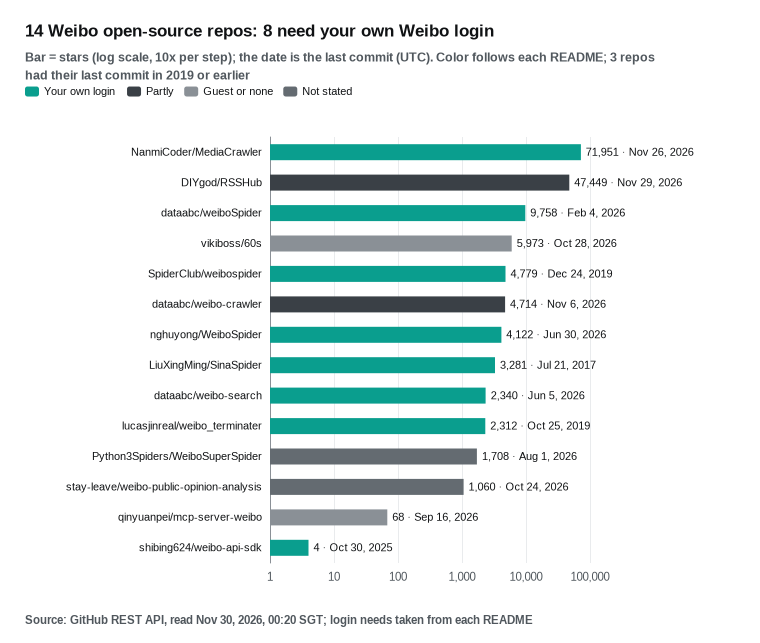
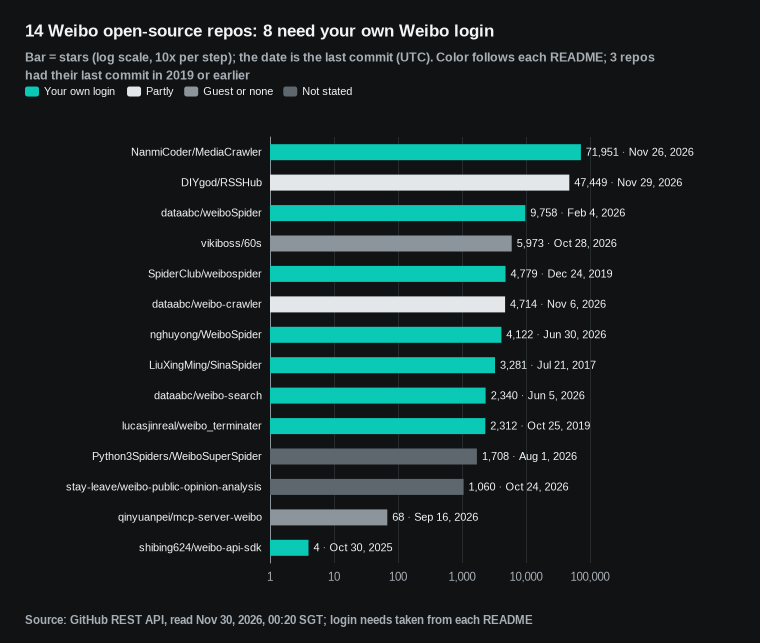
So 8 of the 14 need your own login. MediaCrawler keeps a browser login. weiboSpider, weibo-search and WeiboSpider ask you to copy a cookie from your browser's developer tools. SinaSpider and weibo_terminater keep a pool of cookies and switch to spare accounts when one gets blocked. The SpiderClub README uses a timer because "Weibo cookies expire after 24 hours".
Two projects need a login for only part of their work. dataabc/weibo-crawler reads user pages without a cookie, but line 429 of its README says that keyword search needs one. The RSSHub Weibo namespace says that most routes need cookies; without them, it uses Puppeteer to get a guest cookie. The summary of shibing624/weibo-api-sdk promises Weibo data without login. The same README then says that anti-bot checks make a cookie necessary, so always read the full README.
Maintenance and license matter too. Three repositories have no commit since 2019 or earlier: SinaSpider in 2017, and weibo_terminater and SpiderClub in 2019. These three have had no update for more than five years, so test them before you use them. Six repositories have no license file, so under GitHub's default terms the author keeps all rights. The MediaCrawler README forbids commercial use. For a commercial project, check the license first, then the platform rules, then the technical side.
There are few open-source MCP servers for Weibo. The top result for "weibo mcp" on GitHub is qinyuanpei/mcp-server-weibo with 68 stars. It gets a guest cookie automatically, and its CLI can sign in with a QR code. Our own everyinfra/everyinfra-agent-plugins connects to the EveryInfra remote MCP server; it is not a scraper that you run yourself. For code samples, read our Weibo API Python tutorial, which covers the open-source, official and pay-per-call paths. We do not repeat that code here.
What YouTube tutorials about Weibo scrapers teach
At 00:23 we used youtube/search from the EveryInfra YouTube API, with 20 results per keyword. One search was for "weibo api scraper" and one was for "Weibo scraper" in Chinese. Most of the top Chinese videos were Python tutorials from 2021 to 2023. Two newer videos from 2026 showed a tool that exports 29 fields to Excel, and a comment scraper written with AI in two days.
We asked youtube/transcript for the captions of the first three videos. None of them had captions, so each call returned an empty result and the hold was refunded. At 00:27 youtube/comments returned 1, 0 and 1 comments for the same videos. One of the two comments asked the author to cover paginated comment scraping. That is the only pain point we could confirm from the videos.
weibo/comments returns up to 50 comments per call. For more, send the page token from the response. Replies inside a thread use weibo/comment_replies at $0.000806 per call.
Ready-made Weibo APIs: how pay-per-call options compare
If you do not want a contract or cookie maintenance, you are left with pay-per-call APIs. They do not use your Weibo account, and you pay per request. Ask five questions when you compare them. How much does one call cost? How many rows does one call return? Do failed and empty calls cost money?
Two more questions follow. Must you upload your own Weibo login? Can you connect it to an AI tool directly? A service that wants your cookies puts the risk of a blocked account back on you.
EveryInfra: 27 Weibo capabilities
At 00:13 Singapore time on November 30, we read the catalog. The Weibo API had 27 capabilities, all available, in three price tiers.
| Tier | Per call | Per 1,000 calls | Includes | Max per call |
|---|---|---|---|---|
| Lists and comments | $0.000556 | $0.556 | weibo/trending, weibo/comments, weibo/profile, weibo/feed_channels | 200 trending rows, 50 comments |
| Video, relations and suggestions | $0.000792 | $0.792 | weibo/search_suggest, weibo/popular_posts, weibo/likers, weibo/followers_list, video and collections, 15 in total | All suggestions in one call |
| Search, detail and reposts | $0.000806 | $0.806 | weibo/search, weibo/post_detail, weibo/user_posts, weibo/reposts, weibo/comment_replies, weibo/topic_search, 8 in total | 50 search rows, 20 reposts |
Compared with the free Open Platform API, you can read any public object. That includes the details, comments and reposts of any public post. It also includes the latest posts of any user, a keyword search and the hot search list. Trending rows include rank, title, category, heat score and the "new" or "hot" label. The board parameter switches to six category lists: society, entertainment, life, sports, tech and ACG.
A request that fails costs nothing, and an empty result refunds the hold. A wrong parameter returns HTTP 422 with the allowed values. The remote MCP address is https://api.everyinfra.com/mcp. Your AI tool calls everyinfra_list_capabilities to find capabilities and everyinfra_call_api to run them.
TikHub: 59 Weibo endpoints and 64 MCP tools
The TikHub FAQ lists Weibo among its platforms. It says to use the App endpoints first and keep the Web V2 endpoints as a fallback. Its Weibo API page offers $0.05 of free credit on sign-up and prices "from $0.001 per request". At 00:13 its public price list had 59 endpoints under /api/v1/weibo: 36 in the Web V2 group and 23 in the App group. Of these, 58 cost $0.001 per call, and fetch_hot_search_summary costs $0.0015. Every endpoint lists a limit of 10 requests per second and the type "self-operated".
The endpoints cover post details, comments and replies, user profiles, followers and search. They also cover the trending lists for entertainment, life and society. The docs site has one page per endpoint, for example the Weibo comments endpoint. The MCP section of the FAQ says that Weibo has 64 tools.
Each successful response includes a cache_url that you can open again within 24 hours at no charge. The FAQ says that this link is for recovering a response that your code mishandled. It is not a cheaper way to fetch data again, and a repeat request with the same parameters is billed again.
We read only TikHub's public docs, price list and FAQ, and we did not create an account. The public material does not say how many rows each Weibo endpoint returns. It also does not say whether empty results are billed. We have no test data for these points, so we do not compare them. For more, read our TikHub alternatives page and our TikHub pricing guide.
When you compare pay-per-call APIs, also ask whether the provider documents its response fields. For example, the EveryInfra catalog says that some weibo/search requests do not return the author bio, follower count and verification fields. Notes like this decide whether your downstream tables will line up.
A live test: 23 requests, 14 billed, $0.009228 in total
On November 30, from 00:22 to 00:50 Singapore time, we called 6 EveryInfra Weibo capabilities and 3 YouTube capabilities in three rounds. We sent 23 requests in total, and 14 were billed, for $0.009228. Five empty results were refunded. Three calls hit the rate limit of our test key and returned HTTP 429. One call had a wrong parameter on purpose and returned HTTP 422. The 12 Weibo calls had 10 billed calls, for $0.006560.
curl -X POST https://api.everyinfra.com/api/v1/social \
  -H "Authorization: Bearer $EVERYINFRA_API_KEY" \
  -H "Content-Type: application/json" \
-d '{"platform":"weibo","action":"trending","params":{"limit":50}}'| Time (SGT) | Capability | Parameters | Result | Charge |
|---|---|---|---|---|
| 00:22 | weibo/trending | limit 50 | 50 rows | $0.000556 |
| 00:22 | weibo/search | "weibo api" in Chinese, limit 50 | 27 rows, 37 s | $0.000806 |
| 00:23 | youtube/search | Two keywords, one call each | 20 rows each | $0.000778 each |
| 00:23–00:25 | youtube/transcript | 3 Chinese tutorial videos | Empty, refunded | $0 |
| 00:25 | youtube/comments | 3 calls in a row | HTTP 429 | $0 |
| 00:27 | youtube/comments | Same 3 videos | 1, 0 and 1 rows | $0.000556 × 2; the empty call refunded |
| 00:30 | weibo/search | Trending topic about bank rates, limit 50 | 42 rows, 44 s | $0.000806 |
| 00:31 | weibo/user_posts | CCTV News account | 20 rows with a page token | $0.000806 |
| 00:31 | weibo/comments | Detail link, limit 50 | 9 rows | $0.000556 |
| 00:32 | weibo/search_suggest | "Weibo scraper" in Chinese | Empty, refunded | $0 |
| 00:32 | weibo/trending | limit 50 | 50 rows | $0.000556 |
| 00:49 | weibo/trending | limit 50 | 50 rows | $0.000556 |
| 00:49 | weibo/post_detail | Same post | 259 comments, 1,480 likes, 138 reposts | $0.000806 |
| 00:49 | weibo/comments | Numeric post ID, limit 50 | 50 rows | $0.000556 |
| 00:50 | weibo/trending | board set to finance | HTTP 422 with 7 allowed values | $0 |
| 00:50 | weibo/trending | board set to tech, limit 20 | 20 rows | $0.000556 |
Trending: 8 of 50 entries changed in 27 minutes
We read the main hot search list at 00:22, 00:32 and 00:49 Singapore time on November 30, 2026. Each call returned 50 rows for $0.000556. Between 00:22 and 00:32, 5 entries changed, and 29 of the 45 that stayed moved to a new rank. By 00:49, 8 entries had changed since the first call. Three entries from the first top 10 fell the most.
| Topic (translated) | 00:22 | 00:32 | 00:49 |
|---|---|---|---|
| New rules that take effect in December | 3 | 37 | Out of the top 50 |
| How hard is the 2027 national civil service exam | 9 | 44 | 45 |
| Official works undercover as a delivery rider for 14 days and finds 145 problems | 8 | 9 | 42 |
| Number 1 topic, about a character in a TV drama | 1 | 1 | 1 |
The number 1 topic stayed at the top all three times. Its heat score fell from 960,781 to 882,721 and then to 755,174, a drop of 21.4% in 27 minutes. The heat score at rank 50 was 104,058, 107,177 and 87,454.
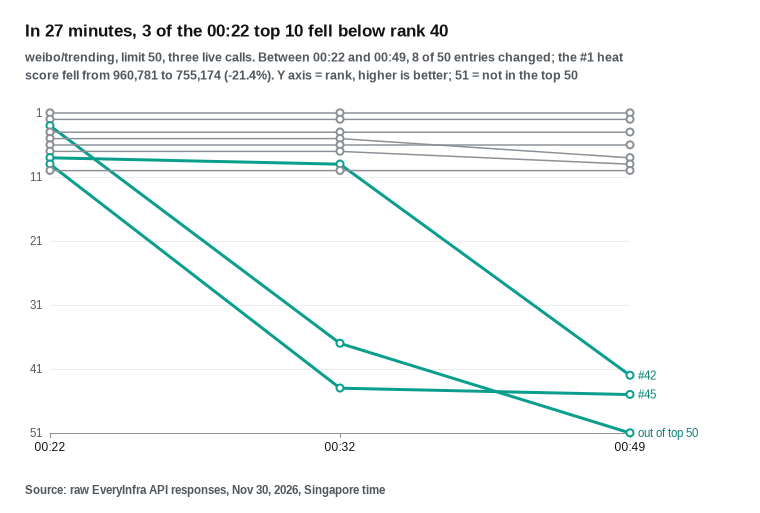
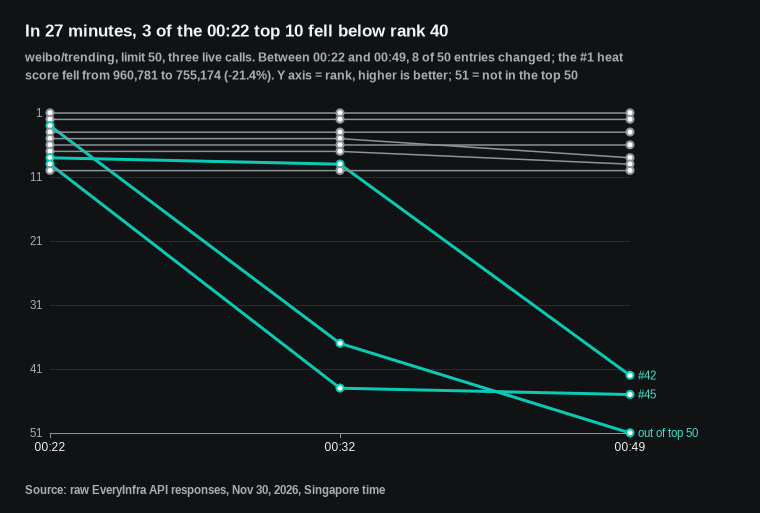
These numbers matter if you plan to read the hot search list once an hour. The topic at rank 3 at 00:22 may stay in the top 10 for less than 10 minutes, so an hourly job can miss it. But 7 of the top 10 hardly moved in half an hour, and an hourly job records them well. To catch topics that rise and fall fast, read every 10 minutes: 4,320 calls and $2.40 a month. For a daily report, the hourly job at $0.40 a month is enough.
You can add category lists when you need them. At 00:50, board set to tech returned 20 rows. The top tech topic was about three astronauts who began their journey home. Its heat score of 151,968 was higher than rank 50 on the main list. In the 00:49 response, the label field marked 14 of the 50 entries as "new" and 7 as "hot". You can use it to filter topics that just entered the list.
Together, the three snapshots held 58 different topics in 27 minutes, 8 more than any single read of 50. The top 10 held 13 different topics.
One topic was about the Shenzhou-23 crew returning to Earth. It was not in the top 50 at 00:22. It was at rank 40 at 00:32 and at rank 5 at 00:49, and its heat score went up from 137,745 to 416,599. A topic about a South Korean leader's hiking boot sole coming off rose from rank 29 to rank 8 in 10 minutes.
An hourly job that reads only at 00:22 can see these 8 new topics no earlier than 01:22. The three snapshots cannot tell whether they will still be on the list then. If you alert on new topics, the read interval sets the upper limit of what you miss. A 10-minute interval costs $2.00 more each month.
Search: limit 50, 27 rows, one charge
At 00:22, weibo/search for "weibo api" in Chinese, with limit 50, returned 27 rows. It cost $0.000806 and took 37 seconds. By posted_at, the oldest post was from December 5, 2025.
Of the 27 posts, 11 were posted after weibo-cli went live on June 22. One of them was the August 14 pricing post from the official Open Platform account. Another user wrote that Weibo's open API makes it fast to get creator data and hot search lists. On June 28, a third user wrote that after Weibo launched its data CLI, "the API broke today" with many HTTP 503 errors. That post had 138 likes and 25 comments.
Results are sorted by time by default. The limit value is a maximum, so you get as many posts as exist for the term. You pay once per call, so rare keywords cost more per 1,000 rows.
At 00:30, we searched for the rank 2 topic on the hot search list. It was about the central bank, which revised its deposit and loan rate rules for the first time in 26 years. The call returned 42 rows from 21:52 to 00:30 Singapore time, about two and a half hours of posts. Seven posts had images and 4 had videos. None of the 42 rows had the author's follower count or verification fields. To check whether a poster is an influential account, call weibo/profile with the author_id, at $0.000556 per call.
Both searches were slow, but the other capabilities were fast.
| Capability | Calls | Response time |
|---|---|---|
weibo/trending | 4 | 0.39 to 2.2 seconds |
weibo/post_detail | 1 | 3.1 seconds |
weibo/user_posts | 1 | 4.4 seconds |
weibo/search | 2 | 37 and 44 seconds |
At this speed, 20 keyword searches in a row take 12 to 15 minutes. With 5 parallel requests, inside the test key limit of 10 calls per minute, one round takes about 3 minutes. When you schedule searches, set the request timeout to 60 seconds or more. A 10-second default treats normal slow requests as failures, and each retry is billed again.
Comments: 9 rows with a link, 50 rows with an ID
At 00:31 we used weibo/user_posts to read the latest 20 posts of the CCTV News account. We chose a post with many comments: the original post for the rank 5 trending topic. It was about a water project that cost 28 million yuan but left villagers without drinking water. At that time it showed 242 comments. Then we called weibo/comments twice for the same post.
| Call | `url` value | Rows | Likes on the rows | Top comment | Charge |
|---|---|---|---|---|---|
| 00:31 | Full m.weibo.cn/detail/… link | 9 | 344 | 206 likes | $0.000556 |
| 00:49 | 16-digit numeric post ID | 50 | 553 | 220 likes | $0.000556 |
All 9 comments from 00:31 were in the 00:49 set. Two of the 9 had the same text but different IDs. At 00:49, weibo/post_detail showed 259 comments, 1,480 likes and 138 reposts on the post. The account had 141 million followers. The 50 comments were posted from 21:29 to 00:44 Singapore time.
The difference came from the parameter format. The catalog notes for weibo/comments allow two forms: a /detail/ link with the numeric ID, or the numeric ID alone. In this test, the ID returned 41 more rows than the link. Per 1,000 rows, the link cost $0.0618 and the ID cost $0.0111, so the link cost 5.6 times as much for the same post. Pass the numeric ID to weibo/comments. When you calculate the cost per comment, divide by the rows you received, not by limit. With 259 comments, one page of 50 covers 19%. To read them all, follow the page token about 5 more times, for about $0.003 at catalog prices.
For opinion sampling, call weibo/post_detail first to get the comment count. Then decide how many pages to read. A post with fewer than 50 comments needs one page. For a hot post with thousands of comments, read the first few pages and spend the rest of your budget on more posts.
Empty results, rate limits and parameter errors
Several requests in these three rounds cost nothing, and you can handle them the same way in your own code.
| Time | Request | Response | Billed | What to do |
|---|---|---|---|---|
| 00:23–00:25 | youtube/transcript for 3 videos | Empty, empty_result_refunded | No | Treat as "no captions" |
| 00:25 | youtube/comments 3 times in a row | HTTP 429, retry_after 8, 5 and 1 s | No | Wait, then resend |
| 00:32 | weibo/search_suggest for "Weibo scraper" | Empty list, hold of $0.000792 refunded | No | Try another keyword |
| 00:50 | weibo/trending with board finance | HTTP 422 with 7 allowed values | No | Change board only, then resend |
The 422 response listed acg, entertainment, hot, life, society, sports and tech as allowed values. Its next-step hint said to change only board and send again. We resent the YouTube comment calls at 00:27, and they worked. For 422, change the parameter and send again. For 429, wait for retry_after, then resend. Do not put both in the same retry loop.
Monthly cost for two common Weibo jobs
Here are the two most common jobs, at the catalog prices that we read at 00:13, for a 30-day month. For TikHub we use its base price of $0.001 per call. Both jobs stay under 1,000 calls a day, so its volume discount does not apply. Also, its search, comment and hot search list endpoints do not take the discount.
| Job | Calls per month | EveryInfra | TikHub base price | weibo-cli |
|---|---|---|---|---|
| Opinion monitoring: 20 keywords a day, one search each | 600 × weibo/search | $0.48 | $0.60 | Credits per command visible only after login |
| Same, plus comments on the top 3 posts per keyword | 600 + 1,800 | $1.48 | $2.40 | Same |
| Hot search list every hour | 720 × weibo/trending | $0.40 | $0.72 | Same |
| Both jobs, with comments | 3,120 | $1.88 | $3.12 | Same |
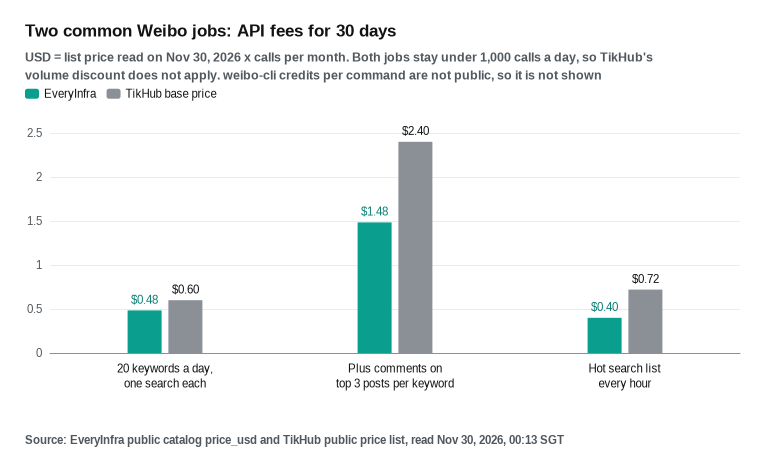
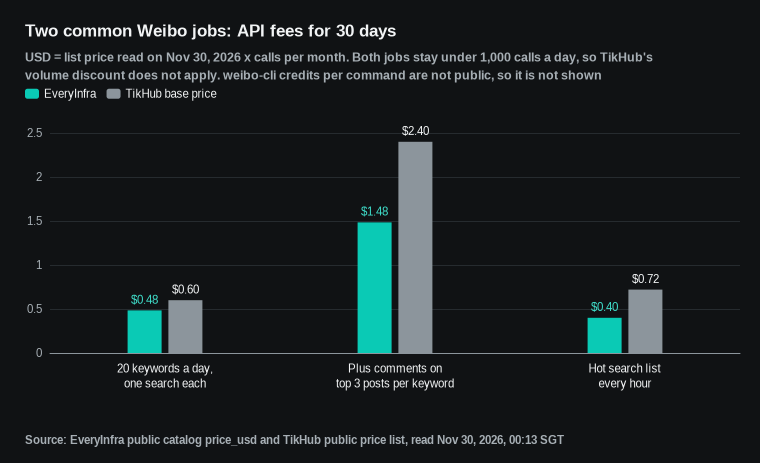
The math is simple. Opinion monitoring is 20 × 30 = 600 searches at $0.000806, which is $0.4836. Comments add 20 × 3 × 30 = 1,800 calls at $0.000556, which is $1.0008. The total is $1.4844. The hourly trending job is 24 × 30 = 720 calls at $0.000556, which is $0.4003. For TikHub, multiply the same counts by $0.001.
Every EveryInfra total is under $2, and the highest TikHub total is $3.12. When you choose, compare three more things. Rows per call decide how many calls you need. Billing rules for empty and failed calls decide the true cost of rare keywords. Field coverage decides how many extra calls you need.
weibo-cli credit packs start at CNY 69 for 365 days. At the November 27, 2026 central parity rate of 6.7075, that is about $10.29. So the smallest weibo-cli pack costs more than any monthly total in the table. Its credits per command are not public, so we do not calculate a price per 1,000 calls for it.
Which Weibo API to choose for your use case
| Your goal | Start with | Why |
|---|---|---|
| "Sign in with Weibo", posting, reading your own comments in a website or app | Free Open Platform API | Free, and its OAuth model is built for this job |
| Long-term opinion monitoring and reports for clients, with history and push updates | Weibo commercial data API | Clause 2.7.8 of the developer agreement sends data services here; only it has history jobs and subscriptions |
| Running your own Weibo account with an agent that reads data, drafts and schedules posts | weibo-cli or the Weibo AI assistant | 31 commands are built for your own account, and write actions use your identity |
| Tens to thousands of reads a day of trending lists, keywords and comments, sent to your sheets or AI | Pay-per-call API | No contract, no login, monthly cost follows call volume |
| Learning Python, academic projects, and you can fix things when cookies expire | GitHub open source | Free and transparent; check the license and the last commit first |
A common mix looks like this. Use a pay-per-call API to read trending lists and keyword searches every hour. When a topic needs a closer look, read its comments and reposts. Use weibo-cli for posts and replies on your own account, because write actions should use your own identity. When you need history and real-time push at scale, talk to the commercial data API team.
If you study Chinese public opinion from a university outside China, the open-source tools above are a natural first step. They are free, and the code is visible. The cost is time: cookies expire, accounts get limited, and the page structure changes. If your project has a fixed deadline, check the last commit date before you build on a repository. A pay-per-call API costs money, but for a few thousand posts the bill stays under a few dollars.
When another option is a better fit
EveryInfra is not the right choice in some cases.
| You need | Better option | Why |
|---|---|---|
| Every post for a keyword from a year ago | Commercial data API | It has historical search jobs: create, check progress, download |
| A push as soon as a new post appears | Commercial data API | Its subscriptions push by keyword and user; pay-per-call APIs can only poll |
| Creator center reads, follower profiles, posting or replies | weibo-cli or the Open Platform | This is the authorized user's own data and actions |
| Tens of thousands of calls a day and extra endpoints | Compare with TikHub | It has more Weibo endpoints, and 8 of them, such as post detail and user info, reach half price in daily bands |
| Learning how Weibo pages work, or one account once a week | GitHub open source or RSSHub | Free, and the code shows every step |
Our weibo/search reads only what the platform search page returns now, so it cannot replace a history job. A pay-per-call API also cannot get your own account's back-office data, and it should not act for you. That is why the third row points to weibo-cli and the Open Platform.
TikHub also has things that we do not have. Its 59 endpoints include a hot search summary and separate endpoints for the entertainment and life lists. They also include search filtered to images or videos, and a user's super topic list. Its MCP server has one tool per endpoint.
Eight endpoints, such as post detail, user info and the hot search summary, take the daily discount. Above 30,000 calls a day, their price drops to half. If your system needs those endpoints at high volume, compare sample responses from both services field by field.
Open source also wins in some cases. The code in the dataabc repositories shows how Weibo's web and mobile pages paginate and use cookies. For one account checked once a week, an RSSHub Weibo route and an RSS reader are enough. If no pay-per-call API returns a field that you need, you can change open-source code yourself. The cost is the login: eight of the 14 READMEs say that you must supply your own cookies.
Weibo platform rules and data limits
The following is not legal advice. Clause 1.6 of the Weibo developer agreement defines user data as a trade secret of Weibo. Section 2.5 requires user consent before you collect user data and limits collection to what is necessary. It also forbids collecting social graphs and friend lists.
In 2016, the Beijing Intellectual Property Court ruled on appeal in a case between Weibo and the professional network Maimai. The case number is (2016) Jing 73 Min Zhong No. 588. The court held that the use of Weibo user data beyond the Open Platform authorization was unfair competition.
Article 13 of China's Personal Information Protection Law allows reasonable processing of personal information that is already lawfully public. Article 27 adds two conditions. The person must not have clearly refused, and you need consent if the processing has a major effect on the person's rights. The Regulations on Network Data Security Management took effect on January 1, 2025.
On November 2, 2026, the Supreme People's Procuratorate published a set of typical personal information protection cases. One case involved a scraper that broke into a hospital server and stole patient data. Our practice is as follows. We read only content that is publicly visible, and we do not sign in to anyone's account. We do not read direct messages or content visible only to its author. In this article we leave out the names of ordinary users.
Recent changes (October and November 2026)
On November 17, 2026, Weibo published its third-quarter 2026 results. In September it had 551 million monthly active users and 254 million daily active users. Net revenue was $410.2 million, down 7% year over year. What this means for you: trending lists and comments still give enough samples for opinion research. Falling ad revenue may push the platform to earn more from data and AI tools, so Open Platform pricing may change again.
On November 18, 2026, weibo-cli version 0.9.9 came out on npm. It is the 13th version since June 22, and the package has 25 versions since May 25. What this means for you: the command list changes with the platform. The quickstart page says that commands list shows a version number, so your automation must handle renamed commands.
On November 6, 2026, dataabc/weibo-crawler got a new commit. MediaCrawler followed on November 26 and RSSHub on November 29. What this means for you: the main open-source projects still follow Weibo's changes. But each change can leave a gap when the tools do not work, so include that gap in your maintenance time.
On November 2, 2026, the Supreme People's Procuratorate published typical cases about personal information. They focus on doxxing, online abuse and toxic fan culture. One case involved a scraper that broke into a server to steal data. What this means for you: collecting public information is different from breaking into a system. When you choose a provider, ask which of the two it does.
FAQ
Does Weibo have an official API?
Yes. The Weibo Open Platform offers three products: the free Open Platform API, the commercial data API and weibo-cli. The free API reads only the data of users who authorize your app, with 100 calls per user per day. The commercial data API searches all public posts by keyword but needs a company contract. weibo-cli needs a face scan and a credit pack from CNY 69. Question from Google autocomplete for "weibo api", read November 30, 2026.
Which Weibo API is best for data collection?
It depends on the data and on who you are. For your own account, use weibo-cli or the free API. For a company data service, the developer agreement sends you to the commercial data API. For pay-per-use reads without a contract, use a pay-per-call API. In our test, EveryInfra weibo/trending cost $0.0111 per 1,000 rows. Question from Google autocomplete for "weibo api", read November 30, 2026.
Is there a ready-made Weibo API I can call today?
Yes. On GitHub, 8 of the 14 popular repositories need your own Weibo login. A pay-per-call API needs no Weibo login, only an API key. Question from Google autocomplete for "weibo api github" and "weibo scraper github", read November 30, 2026.
How do I apply for Weibo API access?
Register as a developer at open.weibo.com and complete identity verification, which takes 1 to 3 working days. Create an app to get an App Key. Apply for advanced endpoints in the console; review takes up to 3 working days. For weibo-cli, verify with a face scan in the Weibo app, then start the trial or buy credits. Question from Google autocomplete for "weibo api key", read November 30, 2026. A SegmentFault question from March 16, 2024, also offered payment for help with a developer account.
Can the Weibo API search posts by keyword?
The free Open Platform API has no keyword search across Weibo. search/topics searches only hashtag topics and is an advanced endpoint. The commercial data API has search/statuses/limited, with up to 50 posts per page, and weibo-cli wraps it. EveryInfra has weibo/search, with up to 50 rows per call. Question from Google autocomplete for "weibo api documentation", read November 30, 2026.
Is it legal to scrape Weibo?
The Weibo developer agreement forbids server-side storage of user data. It also sends third-party data services to the commercial data API. Most open-source tools need your own login cookies. Whether your case is lawful depends on the data and its use, and this is not legal advice. Question from Google autocomplete for "weibo scraper", read November 30, 2026. A 2017 SegmentFault article noted that a normal token could get very little data.
Getting started
- Sign up in the EveryInfra console, create an API key, and add balance.
- Read the free catalog at
GET https://api.everyinfra.com/api/v1/social/catalog?platform=weibo. Check the names and prices of the 27 Weibo capabilities. The parameter notes forweibo/commentsshow which post ID form to use. - Run the curl command above for
weibo/trending. Check that you get 50 rows and abilling.charged_usdvalue. - To connect Claude, Cursor or another AI tool, add the remote address to your MCP configuration. See the MCP server guide.
{
  "mcpServers": {
    "everyinfra": {
      "url": "https://api.everyinfra.com/mcp",
      "headers": { "Authorization": "Bearer ${EVERYINFRA_API_KEY}" }
    }
  }
}
After you connect, let the AI call everyinfra_list_capabilities to see the 27 Weibo capabilities. Then it can call everyinfra_call_api to run them. Prices follow the pricing page and the catalog of the day. You can also browse the same APIs by platform in the API market. For similar guides, read Zhihu API options, WeChat Channels API options and Xianyu API options.
References
- Weibo Open Platform: API rate limits and permissions (updated May 15, 2025): <https://open.weibo.com/wiki/%E6%8E%A5%E5%8F%A3%E8%AE%BF%E9%97%AE%E9%A2%91%E6%AC%A1%E6%9D%83%E9%99%90>
- Weibo Open Platform: developer agreement (version of June 9, 2022): <https://open.weibo.com/wiki/%E5%BC%80%E5%8F%91%E8%80%85%E5%8D%8F%E8%AE%AE>
- EveryInfra capability catalog (compact), read 00:13 SGT, November 30, 2026: <https://api.everyinfra.com/api/v1/social/catalog?compact=1>
- TikHub public endpoint and price list, read 00:13 SGT, November 30, 2026: <https://api.tikhub.io/api/v1/tikhub/user/get_all_endpoints_info>
- TikHub FAQ (billing and refunds): <https://tikhub.io/faq>
- Weibo Open Platform: statuses/show docs: <https://open.weibo.com/wiki/2/statuses/show>
- Weibo Open Platform: Weibo API overview (updated May 9, 2025): <https://open.weibo.com/wiki/%E5%BE%AE%E5%8D%9AAPI>
- Weibo commercial data API home page: <https://openapi.sc.weibo.com/>
- Weibo Open Platform: weibo-cli overview: <https://open.weibo.com/cli>
- Weibo Open Platform: search/topics docs: <https://open.weibo.com/wiki/2/search/topics>
- Weibo Open Platform: advanced endpoint application (updated February 26, 2013): <https://open.weibo.com/wiki/%E9%AB%98%E7%BA%A7%E6%8E%A5%E5%8F%A3%E7%94%B3%E8%AF%B7>
- Weibo Open Platform: FAQ (updated December 21, 2022): <https://open.weibo.com/wiki/%E5%B8%B8%E8%A7%81%E9%97%AE%E9%A2%98>
- Weibo commercial data API: row-quota endpoint list: <https://openapi.sc.weibo.com/api/list?type=1>
- Weibo commercial data API: search/statuses/limited docs: <https://openapi.sc.weibo.com/api/detail?t=search/statuses/limited>
- Weibo commercial data API: comments/show/all docs: <https://openapi.sc.weibo.com/api/detail?t=comments/show/all>
- IT Home: Weibo Open Platform launches weibo-cli (June 26, 2026): <https://www.ithome.com/0/969/170.htm>
- npm: @weibo-ai/weibo-cli (0.9.9 published November 18, 2026): <https://www.npmjs.com/package/@weibo-ai/weibo-cli>
- Official Weibo Open Platform post on pay-per-use credits (August 14, 2026): <https://m.weibo.cn/detail/5331770849624841>
- Weibo Open Platform: weibo-cli quickstart: <https://open.weibo.com/cli/quickstart>
- Weibo Open Platform: weibo-cli plans and commands: <https://open.weibo.com/cli/plan>
- Weibo Open Platform: AI assistant guide (updated May 21, 2026): <https://open.weibo.com/wiki/%E6%99%BA%E8%83%BD%E5%8A%A9%E6%89%8B%E7%8E%A9%E6%B3%95%E6%8C%87%E5%8D%97>
- GitHub: NanmiCoder/MediaCrawler, read 00:20 SGT, November 30, 2026: <https://github.com/NanmiCoder/MediaCrawler>
- GitHub: DIYgod/RSSHub: <https://github.com/DIYgod/RSSHub>
- GitHub: dataabc/weiboSpider: <https://github.com/dataabc/weiboSpider>
- GitHub: vikiboss/60s: <https://github.com/vikiboss/60s>
- GitHub: SpiderClub/weibospider: <https://github.com/SpiderClub/weibospider>
- GitHub: dataabc/weibo-crawler: <https://github.com/dataabc/weibo-crawler>
- GitHub: nghuyong/WeiboSpider: <https://github.com/nghuyong/WeiboSpider>
- GitHub: LiuXingMing/SinaSpider: <https://github.com/LiuXingMing/SinaSpider>
- GitHub: dataabc/weibo-search: <https://github.com/dataabc/weibo-search>
- GitHub: lucasjinreal/weibo_terminater: <https://github.com/lucasjinreal/weibo_terminater>
- GitHub: Python3Spiders/WeiboSuperSpider: <https://github.com/Python3Spiders/WeiboSuperSpider>
- GitHub: stay-leave/weibo-public-opinion-analysis: <https://github.com/stay-leave/weibo-public-opinion-analysis>
- GitHub: qinyuanpei/mcp-server-weibo: <https://github.com/qinyuanpei/mcp-server-weibo>
- GitHub: shibing624/weibo-api-sdk: <https://github.com/shibing624/weibo-api-sdk>
- GitHub: everyinfra/everyinfra-agent-plugins: <https://github.com/everyinfra/everyinfra-agent-plugins>
- EveryInfra capability catalog (Weibo), read 00:13 SGT, November 30, 2026: <https://api.everyinfra.com/api/v1/social/catalog?platform=weibo>
- TikHub: Weibo API page: <https://tikhub.io/zh/weibo-api>
- TikHub docs: Weibo comments endpoint: <https://docs.tikhub.io/381269409e0>
- China Foreign Exchange Trade System: RMB central parity rates (USD/CNY 6.7075 on November 27, 2026): <https://www.chinamoney.org.cn/chinese/bkccpr/>
- Judgment summary, Weibo v. Maimai unfair competition case, (2016) Jing 73 Min Zhong No. 588: <https://www.ciplawyer.cn/articles/126011.html>
- Personal Information Protection Law of the People's Republic of China (full text, Cyberspace Administration of China): <https://www.cac.gov.cn/2021-08/20/c_1631050028355286.htm>
- Regulations on Network Data Security Management (Chinese government website): <https://www.gov.cn/zhengce/content/202409/content_6977766.htm>
- Xinhua: Supreme People's Procuratorate publishes typical personal information protection cases (November 2, 2026): <https://app.xinhuanet.com/news/article.html?articleId=20261102d9257586d4b74b9eab9cf990907f38c8>
- Weibo Announces Third Quarter 2026 Unaudited Financial Results (November 17, 2026): <https://www.prnewswire.com/news-releases/weibo-announces-third-quarter-2026-unaudited-financial-results-302941787.html>
- SegmentFault: developer questions tagged Weibo: <https://segmentfault.com/t/%E5%BE%AE%E5%8D%9A>
- SegmentFault: article on Weibo Open Platform API access (2017): <https://segmentfault.com/a/1190000012548487>
Reference BL-238