Zhihu API Options in 2026: Official, Open Source, Paid
Zhihu API options in 2026: the official search returns 10 results per call, several GitHub repos need your login, and paid calls start at $0.556 per 1,000.

Yes, Zhihu has an API now, and you can choose from three types of access. EveryInfra sells one of the pay-per-call APIs in this comparison, so read our numbers with that in mind. The three types are the official Zhihu Open Data Platform, open-source code and MCP servers on GitHub, and pay-per-call data APIs.
Zhihu is the largest Chinese question-and-answer site. People ask questions there, other users write long answers, and readers upvote the answers they like. Columns hold longer articles. A hot list ranks the questions that get the most attention each hour. For market research, product feedback and AI retrieval in Chinese, Zhihu is one of the richest public text sources.
Each type of API fits a different job. The official platform suits an AI assistant that searches Zhihu a few thousand times a day. It also suits apps that read the data of users who log in with Zhihu. Open-source code suits learning and small personal research. But 6 of the 16 projects we read need your own Zhihu login. A pay-per-call API suits bulk reads of public answers, comments, user profiles and search results with one API key.
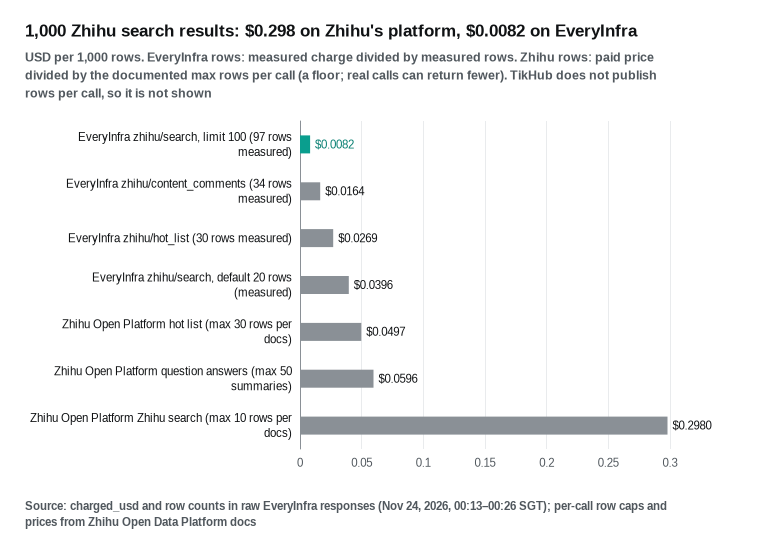
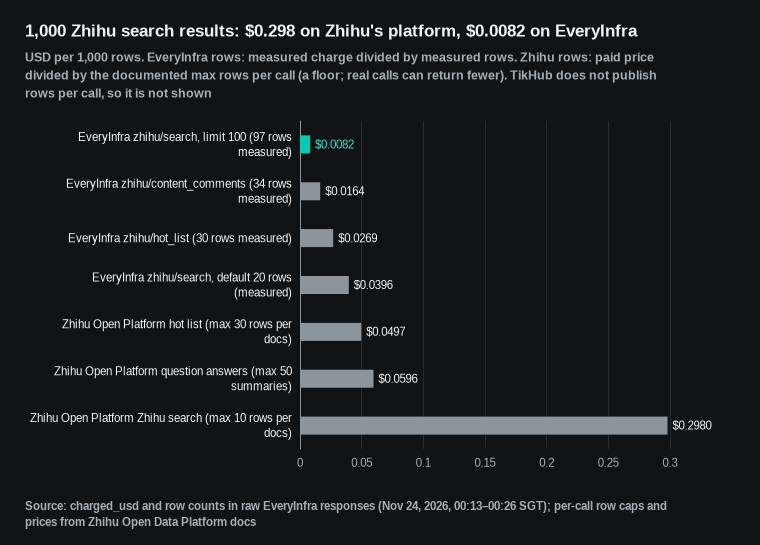
On November 24, 2026, we read the official price page. After the free daily quota, Zhihu search costs 20 yuan per 1,000 calls. At the November 23 central parity rate of 6.7120 yuan to the dollar, that is $2.98 per 1,000 calls. The official search returns at most 10 results per call, so the cost per 1,000 results is $0.298 at the documented maximum. For one keyword, those 10 results are all you can get. At 00:20 SGT the same day, one EveryInfra zhihu/search call with a limit of 100 returned 97 results for $0.000792.
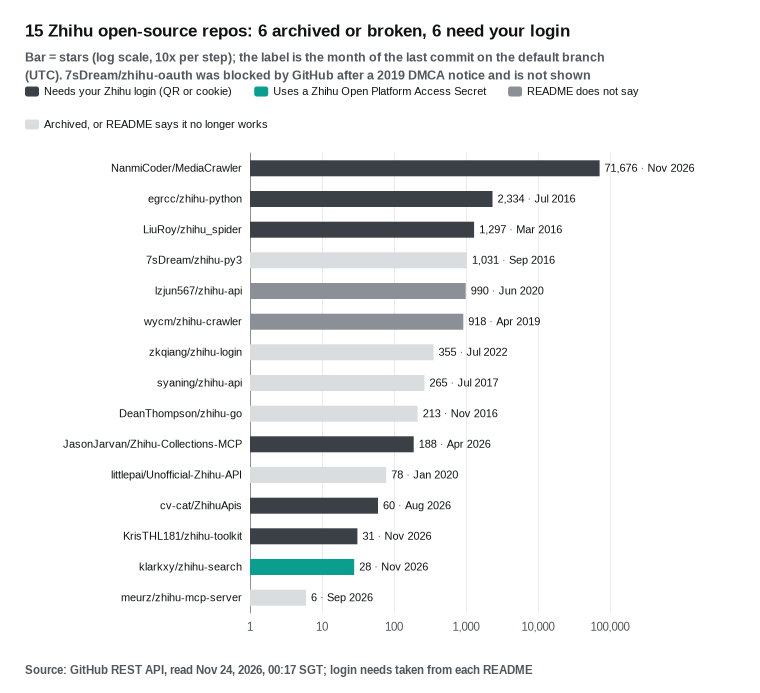
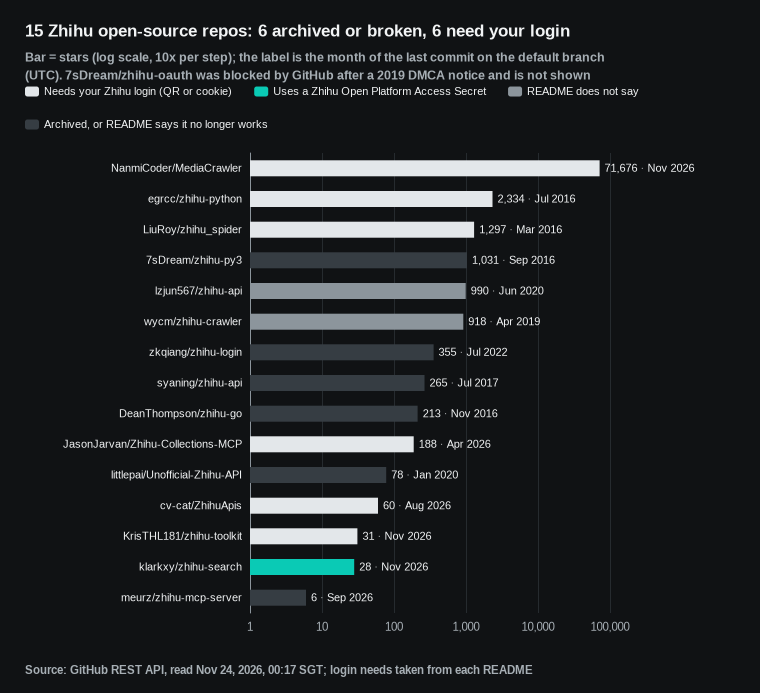
That is $0.0082 per 1,000 results. Per 1,000 results, the official paid price is 36 times higher. Also, the official API cannot return result 11 or later for a keyword. We also read 16 Zhihu repositories on GitHub. Six are archived or say in the README that they no longer work. One was blocked after a DMCA notice from the company that runs Zhihu.

Which Zhihu API is best: the three types side by side
The official row comes from the Zhihu Open Data Platform docs and price page. The open-source row comes from each repository README and the GitHub API. The EveryInfra row comes from the public catalog we read at 00:12 SGT on November 24, 2026. The TikHub row comes from its public price endpoint, read at 00:17 the same day, and its FAQ page. "Per 1,000 calls" is the list price for 1,000 requests. "Per 1,000 results" divides that price by the number of results one call can return.
| Option | Billing unit | USD per 1,000 calls | Search, per 1,000 results | Failed and empty results | Zhihu account or cookie | MCP | Data you can get |
|---|---|---|---|---|---|---|---|
| Zhihu Open Data Platform | Successful calls, after a daily free quota | Zhihu search $2.98, hot list $1.49, answers $2.98, web search $0.745 | $0.298 (10 per call at most) | No charge for auth errors, bad parameters or rate limits | A Zhihu account for the Access Secret; OAuth from each other user | Yes, official MCP | Search, hot list, Zhida, answer summaries, your own data or authorized users |
| GitHub open source | Free; you pay for servers and accounts | $0 | — | Not billed; you retry | 6 of 16 need your login | 3 have MCP | Depends on the project; 6 archived or broken |
| EveryInfra | Per call | $0.556 (13), $0.792 (9), $0.806 (5) | $0.0082 (97 per call, measured) | Failed calls free; empty results refunded | No; one API key | Yes, remote MCP | 27 capabilities, including comments, answers and profiles for any public item |
| TikHub | Per call; billed only on status 200 | $1.00 for 42 endpoints; $5.00 for 1 stream endpoint | Results per call not stated in public docs | FAQ says failures are free; empty results not stated | Its own key; not your Zhihu login | Yes, 32 Zhihu tools | 43 Zhihu endpoints |
The official platform has a low entry bar. Any Zhihu account can create an Access Secret in the platform's personal center, and you do not need a company account. The limits are in the result count, the fields and the scope. Zhihu search returns 10 results per call, and HasMore is always false.
The hot list returns only a title, a link, a thumbnail and a summary. Answers come back as summaries. To read another user's posts or favorites, that user must approve your app through OAuth. In the public doc list we checked on November 24, we did not find an API for comments on any item that is not yours.
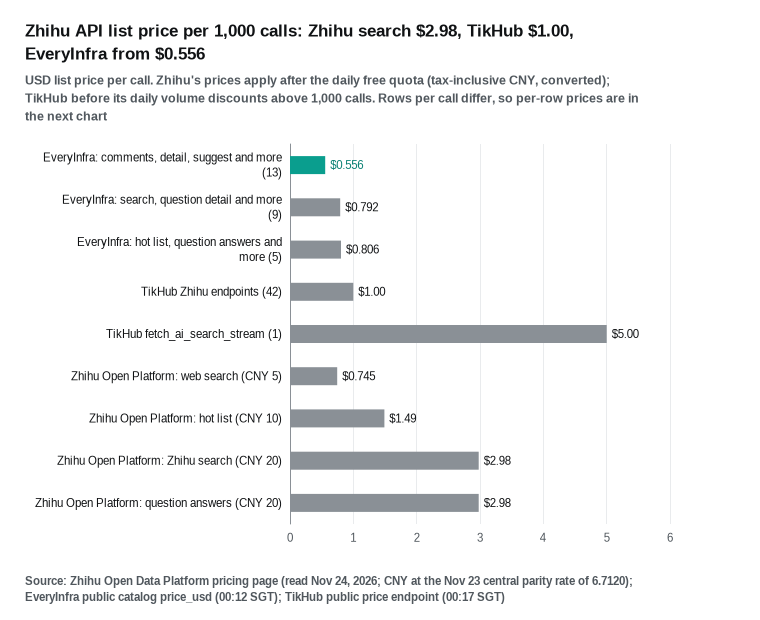
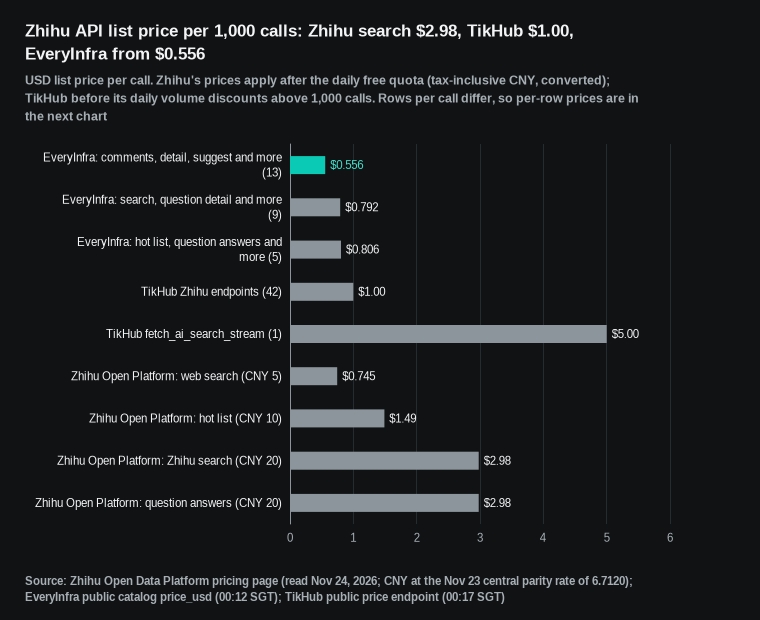
For the same single call, the official Zhihu search returns 10 results, and EveryInfra zhihu/search accepts a limit of up to 100. Divide the charge by the number of results and multiply by 1,000. The gap is 3.8 times per 1,000 calls and 36 times per 1,000 results. For the three official rows, we used the maximum per call from the docs. Real calls can return fewer, so the official cost per 1,000 results is a lower limit. For official search, 10 results are all that one keyword gives, so more results need more keywords.
The TikHub FAQ, which we saved at 01:29 SGT on November 24, says that billing depends only on the status code. You pay when a call returns 200, and failed calls are free. It gives volume discounts by daily request count, and the day resets at midnight Los Angeles time.
| Calls per day | Price per call at the $0.001 base | Per 1,000 calls |
|---|---|---|
| 0 to 1,000 | $0.001 | $1.00 |
| 1,000 to 5,000 | $0.0009 | $0.90 |
| 5,000 to 10,000 | $0.0008 | $0.80 |
| 10,000 to 20,000 | $0.0007 | $0.70 |
| 20,000 to 30,000 | $0.0006 | $0.60 |
| Above 30,000 | $0.0005 | $0.50 |
The FAQ says the same discount percentages apply to endpoints with a different base price. A new account gets $0.05 of free credit after email verification, which is about 50 calls at the base price. Each account gets 10 requests per second by default. More speed is a monthly add-on: 20 requests per second cost $5 a month, and 100 per second cost $55 a month. EveryInfra has no daily tiers, so its monthly cost is the list price times the number of calls.
Does Zhihu have an official API? The Open Data Platform
Yes. The home page of the Zhihu Open Data Platform says it works with Skills, API and MCP. It also says a new account gets 5,000 free calls a day. The earliest public report we found is a Zhihu column post from May 16, 2026, titled "Zhihu API and MCP are officially open" (link). The author's screenshot shows quotas for four services: web search, Zhihu search, the hot list and Zhida.
Two days later, an AI news video said that a new account got 1,000 free searches a day. On November 11, the official Zhihu product account published a post about the search API. It said web search cost as little as 5 yuan per 1,000 calls, with 5,000 free calls a day during the promotion. In six months, the free quota grew from 1,000 to 5,000 calls. The price page also says that the daily free quota is a limited-time offer and can change with the promotion.
This reverses an old answer. In May 2013, Zhihu founder Zhou Yuan answered a question about third-party clients. He wrote that Zhihu had no open API at the time and did not encourage unofficial clients. In July 2016, a user asked "Does Zhihu have an open API?" At 00:25 SGT on November 24, we read that question with zhihu/question_detail. It sits under the topics "open API" and "open data", has 32,902 views, and has only 3 answers.
Authentication, endpoints and results per call
Every official endpoint uses Authorization: Bearer <Access Secret> and a timestamp header, X-Request-Timestamp, in seconds. You create the Access Secret in the personal center. The price page says that all Access Secrets under one Zhihu account share that account's quota, so extra secrets do not add free calls.
| Official endpoint | Path | Max per call | Paid price | Who authorizes | What it means for you |
|---|---|---|---|---|---|
| Zhihu search | /api/v1/content/zhihu_search | 10, no next page | 20 yuan per 1,000 | You | Only the first 10 results for each keyword |
| Web search | /api/v1/content/global_search | Listed separately | 5 yuan per 1,000 | You | Results include pages outside Zhihu |
| Hot list | /api/v1/content/hot_list | 30 | 10 yuan per 1,000 | You | Title, link, thumbnail and summary only |
| Question answers | /api/v1/content/question_answers | 50 summaries, with paging | 20 yuan per 1,000 | You | Summaries, not full text; 100 calls a day by default |
| User contents | /api/v1/user/contents | 50 | 10 yuan per 1,000 | You, or the user through OAuth | You cannot read users who did not approve your app |
| Comments on my posts | Creator group in the docs | — | 10 yuan per 1,000 | You only | No endpoint for comments on other items |
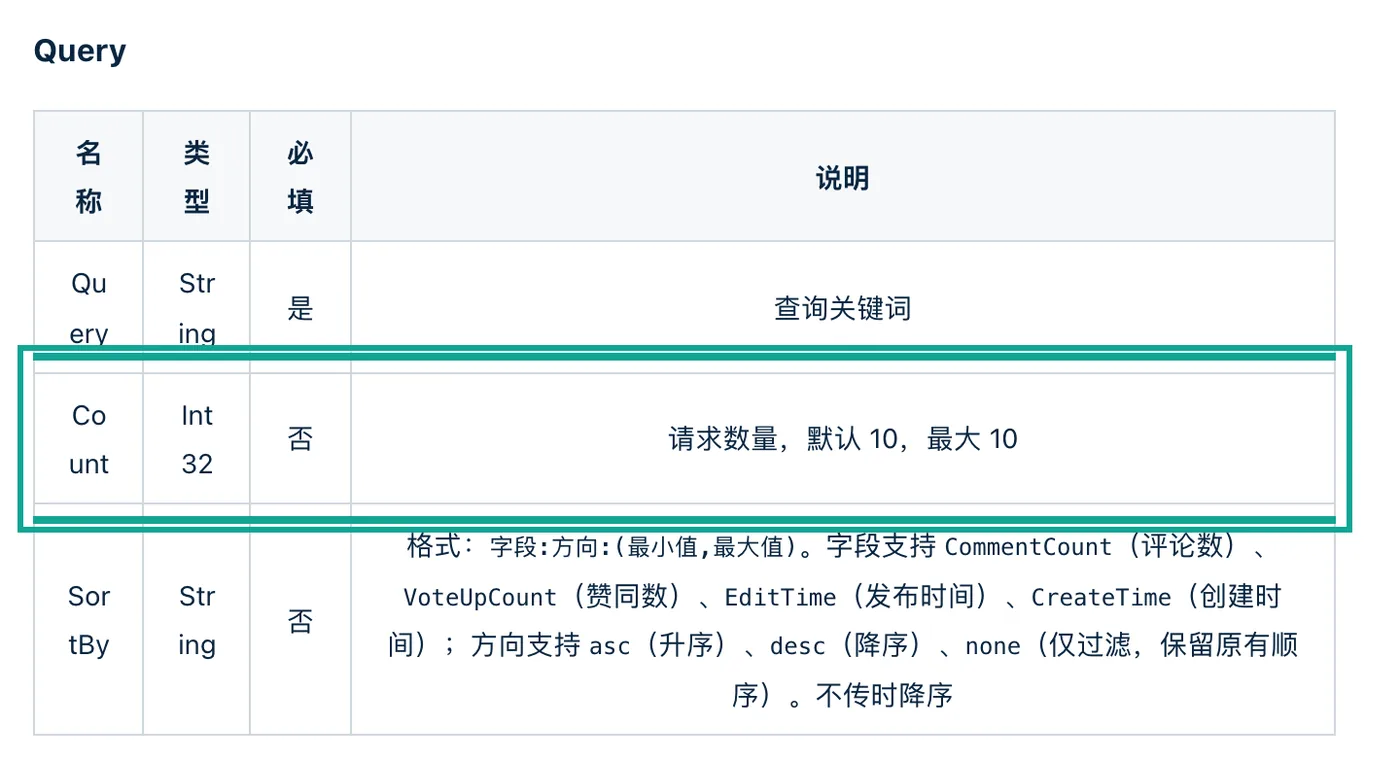
The Zhihu search page also says this: if you send a Count above 10, the service cuts it to 10. In the current version, HasMore in the response is always false. So, for one keyword, the official API gives you only the first 10 results. To get more, you must split the keyword into narrower ones and search again.
The author of the May column post also noted the limit of 10 results. There is a good side. Each result has an AuthorityLevel and a RankingScore, plus selected comments in CommentInfoList. These fields help a model cite good sources. The links carry a tracking parameter such as utm_medium=openapi_platform.
The hot list API returns at most 30 items per call. A Limit of 0 or above 30 becomes 30. The doc says it returns only questions and articles. Each item has four fields: Title, Url, ThumbnailUrl and Summary. It has no heat value, no answer count and no creation time. If you want to know how long an item stays on the list or how hot it gets, the official fields are not enough.
The question answers API returns up to 50 items per call and supports paging with Offset. The doc describes the Summary field as a summary or excerpt from the service, not an AI summary and not the full answer. This API shares the "question discovery" quota with the question recommendations API. The default is 100 calls per tenant per day, and 10 for accounts with a low quota, such as accounts without a real-name check. When the daily quota runs out, the API returns error 30001. Error 30003 means that risk control rejected the request.
The user contents API reads answers, articles, videos, pins and questions. Its scope is clear. Without an OAuth token, it reads the caller's own data. To read another user, you must first get that user's Zhihu OAuth approval.
The OAuth integration doc asks you to email openplatform
RFC 6749 defines the general OAuth 2.0 authorization code flow. The user clicks approve on the provider's page, and your callback URL gets a one-time code. You exchange the code and your app secret for an access token. In practice, each user must approve your app one time. That fits a product where users connect their own Zhihu accounts. It does not fit research on many accounts that you do not know.
Prices and the daily free quota
The price page says that Zhihu bills successful calls only. Calls that fail authentication, have bad parameters or hit the rate limit are free. A streaming service counts as one successful call when it starts to send valid output. The free quota resets at 00:00 Beijing time, and unused calls do not carry over.
Some services share one quota group, so a call to any service in the group uses the same remaining count. After the free quota, Zhihu takes the charge from your trial balance first and then from your paid balance. One call never splits across the two balances. If the balance is too low, the call does not run.
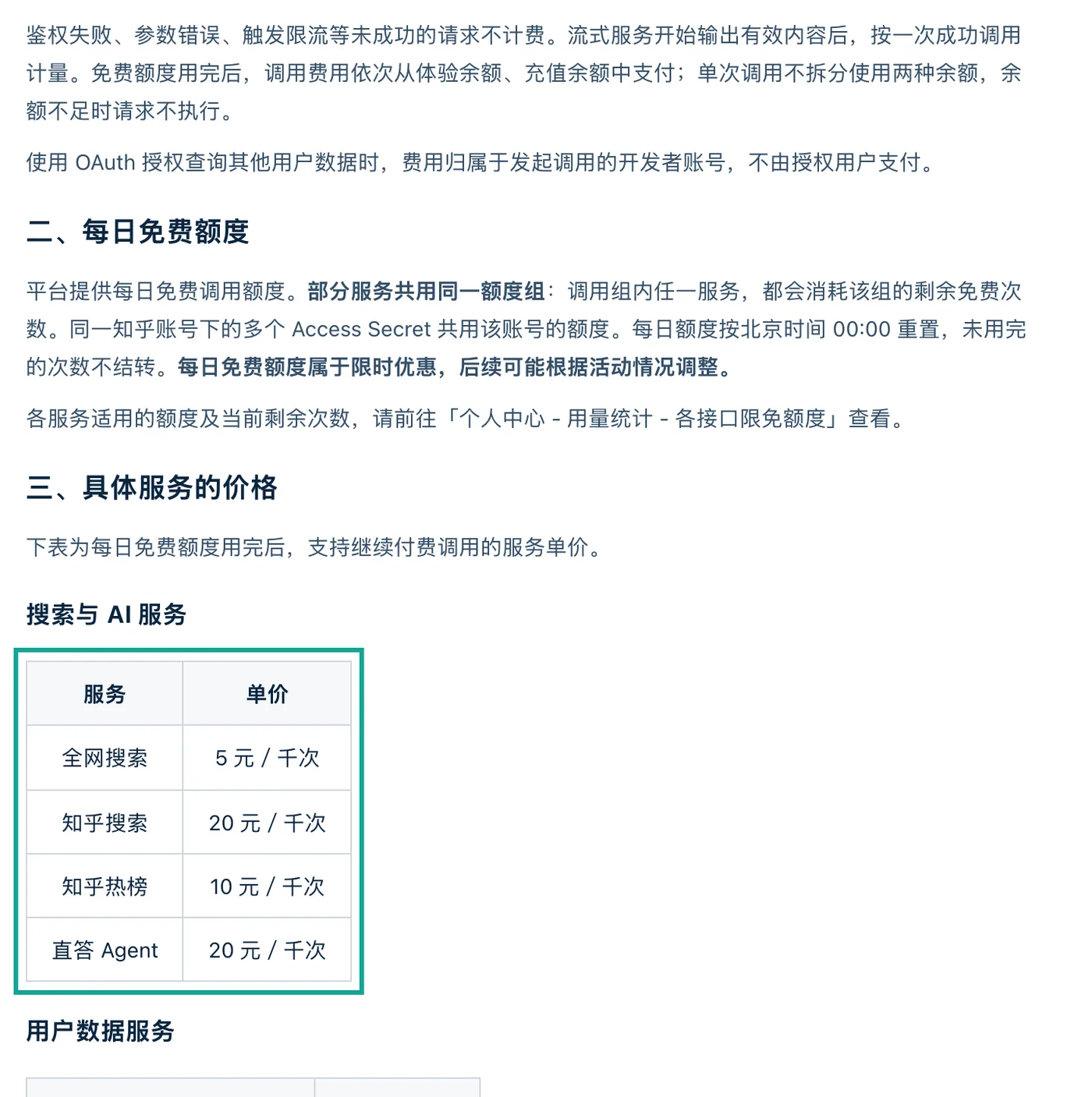
| Official service | Yuan per 1,000 calls | USD per 1,000 calls | Max results per call | USD per 1,000 results |
|---|---|---|---|---|
| Web search | 5 | $0.745 | Listed separately | — |
| Zhihu search | 20 | $2.98 | 10 | $0.298 |
| Hot list | 10 | $1.49 | 30 | $0.0497 |
| Question answers | 20 | $2.98 | 50 (summaries) | $0.0596 |
| User content summaries | 10 | $1.49 | 50 | $0.0298 |
| Knowledge base search | 10 | $1.49 | — | — |
We used the rate of 6.7120 yuan per dollar that the China Foreign Exchange Trade System published on November 23. For the cost per result, we used the documented maximum per call. Real calls can return less. The answers doc says that the API filters out invalid answers and answers without a summary. So one page can have fewer items than the Limit, or none.
Official MCP, CLI and Skills
Zhihu gives AI clients three ways to connect. The Zhihu MCP server has one endpoint, and the doc gives setup steps for Codex, WorkBuddy, Claude Code and Cursor. It has four tools: zhihu_search, global_search, hot_list and zhida. Zhida supports three models: zhida-fast-1p5, zhida-thinking-1p5 and zhida-agent.
Zhihu CLI is the official command-line tool, with a Skill package for agents. It keeps your credential in macOS Keychain, Windows Credential Manager or the Linux Secret Service. Its data and security section says that it reads only the account that owns the credential. It does not take an OAuth token, a user ID or any other parameter to read someone else.
On August 7, a Zhihu author tested both methods and wrote about it in "Zhihu CLI is here". The post has 96 upvotes and 151 saves. It lists early MCP endpoints with one path per tool, such as an SSE path for Zhihu search. The current doc uses a single endpoint for all tools.
The four official MCP tools are enough for an AI assistant that looks things up. It can search Zhihu for experience, check today's hot list, or ask Zhida for a combined answer. They do not cover collection work. You cannot get all answers under a question or the comments under a popular answer. You also cannot get the latest posts of a competitor account, or content by topic or column. In the docs we checked, these tasks either have no endpoint or work only for your own account or users who approve your app.
Is there a ready-made Zhihu API on GitHub?
GitHub has many Zhihu repositories, but few of them can still collect public data. At 00:17 SGT on November 24, we used the GitHub API to read the stars, last commit and license of 15 repositories. Then we read each README to check if it needs a login. We could not read one more, 7sDream/zhihu-oauth. The API returned "Repository access blocked" because of a DMCA notice from October 17, 2019.
An employee of Beijing Zhizhetianxia Technology filed that notice. The notice says the company runs zhihu.com and the Zhihu app. It says the repository held the company's confidential copyrighted work, and it lists more than a hundred forks for removal. zhihu-oauth copied the login and API calls of the Zhihu Android app. The GitHub DMCA takedown policy says that GitHub disables a repository after a valid notice, and the owner can send a counter notice.
| Repository | Stars | Last commit | License | Zhihu login | Status |
|---|---|---|---|---|---|
| NanmiCoder/MediaCrawler | 71,676 | 2026-11-21 | Non-commercial learning license | Yes, saved Playwright login | Active; Zhihu is 1 of 7 platforms |
| egrcc/zhihu-python | 2,334 | 2016-07-18 | MIT | Yes, cookie file | Python 2.7; no update for ten years |
| LiuRoy/zhihu_spider | 1,297 | 2016-03-20 | None stated | Yes, user name and password | Scrapy example |
| 7sDream/zhihu-py3 | 1,031 | 2016-09-17 | MIT | Yes, cookie file | Archived |
| lzjun567/zhihu-api | 990 | 2020-06-22 | MIT | Not stated | No update for five years |
| wycm/zhihu-crawler | 918 | 2019-04-02 | Not clear | No login; uses a proxy pool | No update for seven years |
| cv-cat/ZhihuApis | 60 | 2026-08-18 | None stated | Yes, cookie copied from a browser | Computes the x-zse-96 signature |
| klarkxy/zhihu-search | 28 | 2026-11-18 | Not clear | Official Access Secret | Wraps the official API |
| KrisTHL181/zhihu-toolkit | 31 | 2026-11-15 | MIT | Yes, QR code or cookie | Browse Zhihu in a terminal |
| meurz/zhihu-mcp-server | 6 | 2026-09-12 | None stated | Cookie for search | Archived |
MediaCrawler has the most stars, 71,676. In its README feature table, the Zhihu row has all seven boxes checked. They are keyword search, specific posts, nested comments, creator pages, saved login, an IP proxy pool and a comment word cloud. It opens a browser with Playwright. You scan a QR code to log in, and it saves the login.
It runs JavaScript inside the browser to get the signed parameters, so the README says you do not need to reverse the JavaScript. Its LICENSE is a custom "NON-COMMERCIAL LEARNING LICENSE 1.1" that allows only non-commercial learning. The disclaimer at the top of the README links to a repository of Chinese court cases about crawlers. The license text grants only non-commercial learning use. Before you use it in a company project, read the full license yourself.
The next group are old projects whose last push was between 2016 and 2022. egrcc/zhihu-python uses Python 2.7. Its first paragraph says the project exists because Zhihu has no official API. 7sDream/zhihu-py3 is archived, and its README says it is no longer maintained; its successor was the blocked zhihu-oauth.
zkqiang/zhihu-login is archived, and its first line says the code no longer works and is for learning only. littlepai/Unofficial-Zhihu-API says the crawler part no longer works and keeps only a captcha exercise. syaning/zhihu-api and DeanThompson/zhihu-go are archived, with last commits in 2017 and 2016.
The projects that still get updates in 2026 all have to deal with the Zhihu request signature. The cv-cat/ZhihuApis README says it runs an embedded JavaScript runtime to make the x-zse-96 and x-zse-93 parameters. You copy the cookie from your browser's developer tools after you log in. KrisTHL181/zhihu-toolkit gets the cookie from a QR code or a pasted cURL command and signs each request with "ZSE v4".
meurz/zhihu-mcp-server ported the zse96 v2 signature from the third-party client zhihu-plus-plus, and the owner archived it after September 12. When Zhihu changes the signature, these projects must change too, and your collection job stops until they do. cv-cat/ZhihuApis had its last commit in August but a push on 2026-11-20. You can only know if its signature still works if you run it.
We counted the license column from the license field of the GitHub API. Four of the 15 repositories have no license file: LiuRoy/zhihu_spider, cv-cat/ZhihuApis, meurz/zhihu-mcp-server and JasonJarvan/Zhihu-Collections-MCP. For three more, GitHub did not detect a standard license and the API returns NOASSERTION: MediaCrawler, wycm/zhihu-crawler and klarkxy/zhihu-search. MediaCrawler has its own non-commercial license. The GitHub licensing guide says that without a license, default copyright law applies and the author keeps all rights. If you plan to copy or reuse this code, read the license text in the repository, or ask the author.
The archived column matters too. The GitHub archiving guide says an archived repository is read-only, with no new issues or pull requests. If Zhihu changes its API, nobody will fix the code.
Another group wraps the official API. The description of klarkxy/zhihu-search calls it an open-source alternative to the official Zhihu CLI. It had a commit on November 18. It uses your own Access Secret, so the quota and price match the official ones. The benefit is that you can run it with one uvx command or as an MCP server. JasonJarvan/Zhihu-Collections-MCP exports favorites to Markdown, and private favorites need a cookies.json file.
Pay-per-call APIs: EveryInfra, TikHub and others
Pay-per-call APIs have common traits. You do not need a Zhihu account, you do not keep cookies or signatures, you pay per call, and failed calls are free. They differ in coverage, results per call, MCP support and billing details.
EveryInfra: 27 Zhihu capabilities
At 00:12 SGT on November 24, we read the catalog. Zhihu has 27 capabilities, and all of them were available. They fall into three price levels. Thirteen capabilities, such as comments, content detail, profiles and search suggestions, cost $0.000556 per call. Nine cost $0.000792, including keyword search, question detail, user search, topic search, scholar search and Salt (paid content) search. Five cost $0.000806: the hot list, answers under a question, user answers, user pins and pin comments.
| Level | Per call | Per 1,000 calls | Includes | Max per call |
|---|---|---|---|---|
| Content and comments | $0.000556 | $0.556 | zhihu/content_detail, zhihu/content_comments, comment_replies, profile, user_articles, search_suggest and 7 more | 100 comments |
| Search and detail | $0.000792 | $0.792 | zhihu/search, zhihu/question_detail, user_search, topic_search, scholar_search, salt_search and 3 more | 100 search results |
| Lists and answers | $0.000806 | $0.806 | zhihu/hot_list, zhihu/question_answers, user_answers, user_pins, pin_comments | 30 hot items, 20 answers |
Compared with the official platform, EveryInfra adds access to any public item. You can read comments and replies under any answer or article. You can read the profile, answers, articles and pins of any user, and search topics and columns. The hot list returns rank, heat value, answer count, follower count and creation time, which the official hot list does not give.
Failed calls are free. When a call returns no results, EveryInfra refunds the hold. A bad parameter returns 422 with the allowed values.
The EveryInfra remote MCP endpoint is api.everyinfra.com/mcp. At 00:32 SGT, we listed 12 tools. Two of them matter for Zhihu: everyinfra_list_capabilities lists capabilities and parameters, and everyinfra_call_api makes the call. Other tools check jobs, the account, call history and support tickets.
The 27 Zhihu capabilities do not become 27 separate MCP tools. The AI reads the catalog first and then calls. The tool list stays short, and the client uses less context.
TikHub: 43 Zhihu endpoints and 32 MCP tools
The TikHub FAQ lists Zhihu among its platforms. At 00:17 we read its public price endpoint and found 43 endpoints with paths that start with /api/v1/zhihu. Forty-two cost $0.001 per call, and fetch_ai_search_stream costs $0.005. All show a rate limit of 10 per second and the type "self-operated". The endpoints cover search (articles, users, topics, scholar, video, columns, Salt and ebooks), the hot list, comments and sub-comments, user followings and followers, question and answer detail, pins and columns. Its docs have one page per endpoint, such as the hot list endpoint.
The MCP section of the FAQ says each platform has its own server, and Zhihu has 32 tools. The Streamable HTTP address uses the pattern mcp.tikhub.io/{platform}/mcp. Calls through MCP, Zapier or n8n cost the same as direct API calls. We read only the TikHub public docs, price list and FAQ, and we did not create an account. We did not find a public statement of how many results each Zhihu endpoint returns per call, or of how it bills empty results. The FAQ also says that some endpoints return a cache_url, and reads of that URL on the same day cost nothing.
One test: four rounds, 12 charged calls, $0.008866 in total
From 00:13 to 00:51 SGT on November 24, we called 7 EveryInfra Zhihu capabilities in four rounds. 12 calls succeeded and cost $0.008866 in total. One more call returned 422 because we sent a bad parameter on purpose, and it cost nothing.
The most expensive of the 12 calls cost $0.000806 and the cheapest $0.000556. All four rounds together cost less than one cent.
curl -X POST https://api.everyinfra.com/api/v1/social \
  -H "Authorization: Bearer $EVERYINFRA_API_KEY" \
  -H "Content-Type: application/json" \
-d '{"platform":"zhihu","action":"search","params":{"keyword":"API","limit":100}}'| Time (SGT) | Capability | Parameters | Result | Charge |
|---|---|---|---|---|
| 00:13 | zhihu/hot_list | None | 30 items | $0.000806 |
| 00:13 | zhihu/search | "Zhihu API" in Chinese, limit 20 | 20 results | $0.000792 |
| 00:13 | zhihu/search_suggest | "zhihu api" in Chinese | 10 suggestions | $0.000556 |
| 00:19 | zhihu/search | sort set to hot | 422, lists 3 allowed values | $0 |
| 00:20 | zhihu/search | "data collection API" in Chinese, limit 100 | 97 results | $0.000792 |
| 00:20 | zhihu/question_answers | Question 48888923 | 2 answers | $0.000806 |
| 00:25 | zhihu/question_detail | Question 48888923 | 3 answers, 32,902 views | $0.000792 |
| 00:26 | zhihu/content_detail | Column article | 3,905 characters of text | $0.000556 |
| 00:26 | zhihu/content_comments | Same article, limit 50 | 34 comments | $0.000556 |
| 00:26 | zhihu/question_answers | Hot item 2, no limit | 5 answers | $0.000806 |
| 00:51 | zhihu/hot_list | None | 30 items | $0.000806 |
| 00:51 | zhihu/question_answers | Hot item 2, limit 20 | 5 answers | $0.000806 |
| 00:51 | zhihu/question_detail | Hot item 2 | 2,812 answers, 6,088,399 views | $0.000792 |
At 00:19 we set the zhihu/search sort to hot on purpose. The call returned 422, and the response listed three allowed values, so we could fix one field and send again. RFC 9110 defines 422 as a request with a correct format that the server cannot process. RFC 6585 defines 429 as too many requests. In your own code, fix the parameters and send again after a 422. After a 429, wait for the retry_after seconds in the response and then retry. Do not put both into one retry loop.
Search: 97 results in one call, snippets of about 60 characters
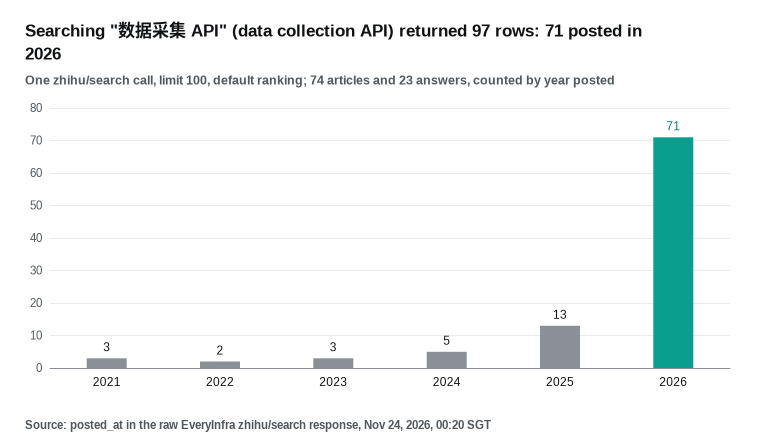
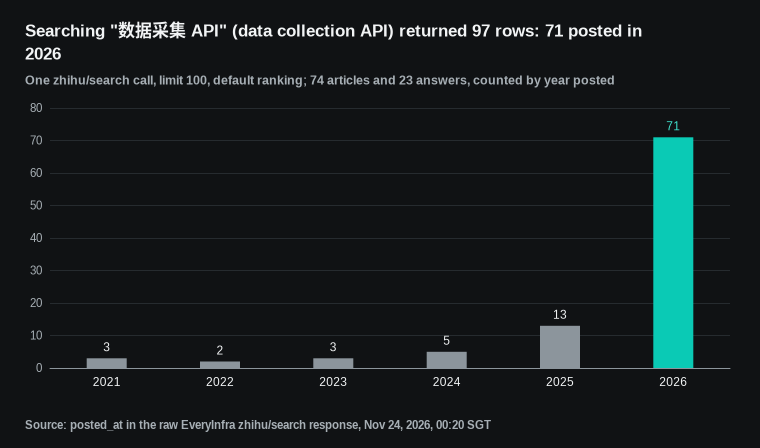
The 00:20 zhihu/search call with a limit of 100 returned 97 results: 74 articles and 23 answers. By posted_at, 71 were from 2026, 13 from 2025 and 13 from 2024 or earlier. With the default sort, almost all results for "data collection API" in Chinese are new this year, and only 3 are from 2021.
The text field in search results is a snippet. Across the 97 results, the shortest is 50 characters, the median is 60 and the longest is 143. That is enough to judge relevance, but not enough for opinion analysis. For full text, pass the result URL to zhihu/content_detail.
At 00:26 we read the column post about the API launch with it. The text has 3,905 characters, with 365 upvotes, 42 comments and 421 saves, and the response includes the author's verification label. The official Zhihu search doc also describes ContentText as a summary, so both routes need a second call for full text.
Comments: 34 plus 8 replies equals the 42 on the page
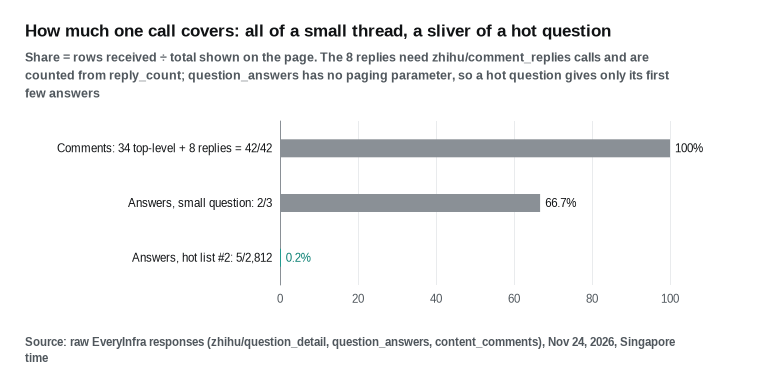
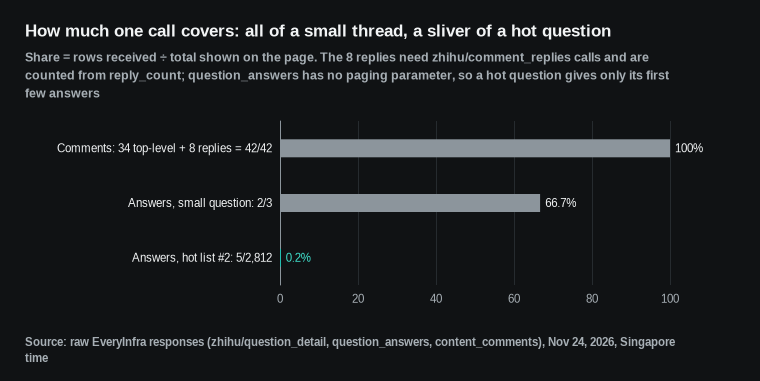
The same column post shows 42 comments on the page. zhihu/content_comments with a limit of 50 returned 34 top-level comments. The sum of their reply_count fields is 8, and 34 plus 8 is 42, which matches the page. Four top-level comments have replies. To read those replies, call comment_replies at $0.000556 each. So one comment call and 4 reply calls read every comment on this post, for $0.00278 in total.
In the official docs we checked, the only comment API is "comments on my posts", which reads comments on the caller's own content. If you want user feedback under a competitor's answer, or complaints under a product topic, the official API cannot read them.
Answers under a question: most of a small question, the first 5 of a hot one
The question "Does Zhihu have an open API?" has 3 answers. At 00:20, zhihu/question_answers with no limit returned 2. Hot item 2, about the Nvidia board restoring Jensen Huang as president, CEO and director, had 2,589 answers at 00:13. At 00:26, a call with no limit returned 5 answers.
At 00:51, a call with a limit of 20 also returned 5. The catalog gives this capability a default of 20 and a maximum of 20. Its field note says a call can return fewer answers than the limit, sometimes 5.
The only optional parameter is sort (default order or newest first), and there is no paging parameter. The 5 answers from 00:26 range from 65 to 1,509 characters, and they are full text. The official answers API returns summaries.
So zhihu/question_answers fits a look at the top answers under a question, or the newest few. It does not fit a full download of the thousands of answers under a hot question. For a full set, go back to the official answers API and page with Offset. You get summaries, and the 100 calls a day limit applies.
Hot list: 5 items changed in 38 minutes
We read the hot list twice. At 00:13, all 30 items were questions. By posted_at, 18 were asked on or after 2026-11-17. Eight were asked before 2026, and the two oldest were from 2015, such as "What is Coca-Cola's moat?" The hot list does not hold only new events. An old question can return to the list when new answers push it up. If you filter hot topics by creation date, you miss these items.
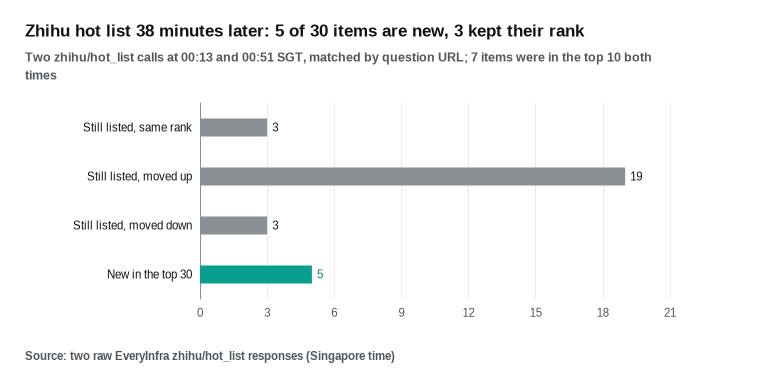
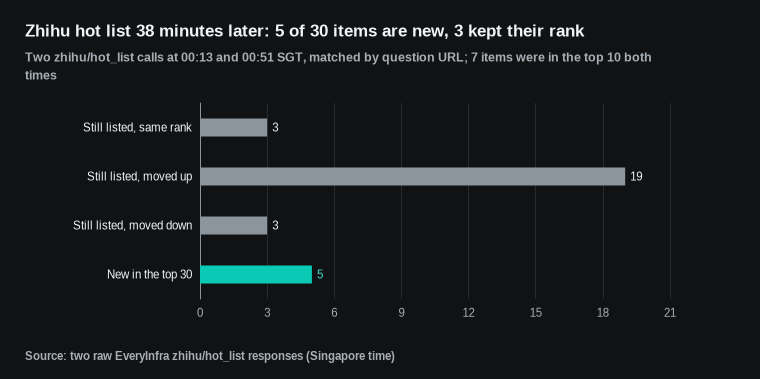
At 00:51 we read it again. 5 of the 30 items were new to the list, and 3 kept their rank. Seven of the top 10 were in the top 10 both times.
Of the 25 items that stayed, 19 moved up and 3 moved down. The 5 items that left had ranks 2, 13, 17, 29 and 30 at 00:13, and rank 2 was the Nvidia question. At 00:13, the Nvidia board question was number 2, with a heat value of 9.31 million. At 00:51 it was not in the top 30.
But its detail at 00:51 showed 2,812 answers, up from 2,589, so it got 223 more answers in 38 minutes. A follow-up question about Nvidia stock after Jensen Huang's return entered at number 20. One of the 5 new items was a 2023 question about why two soy sauce names are replacing an older word. For hot topic monitoring, one read per hour misses changes like these within half an hour. A question can leave the list while its answer count still grows.
| Item | 00:13 SGT | 00:51 SGT |
|---|---|---|
| Number 1, a rebuttal of a Riemann hypothesis proof | Rank 1, heat 16.54 million | Rank 1, heat 17.57 million |
| Nvidia board restores Jensen Huang | Rank 2, heat 9.31 million, 2,589 answers | Not in the top 30, 2,812 answers |
| Follow-up on Nvidia stock | Not in the top 30 | Rank 20, heat 0.70 million |
| Soy sauce question from 2023 | Not in the top 30 | Rank 28, 708 answers |
The official hot list costs 10 yuan per 1,000 calls and returns only a title, a link, a thumbnail and a summary. EveryInfra zhihu/hot_list costs $0.000806 per call and includes the heat value and answer count. One read per hour, 720 calls a month, costs $0.58.
How people on Zhihu ask about this
At 00:13 SGT, we called zhihu/search_suggest for "zhihu api" in Chinese. These are the top 10 suggestions, translated into English.
| Rank | Suggestion (translated) | What the user wants |
|---|---|---|
| 1 | Zhihu API endpoint | Does an API exist |
| 2 | How to activate the Zhihu API | Sign-up steps |
| 3 | Zhihu API lookup | What data it can read |
| 4 | Zhihu API tutorial | First call |
| 5 | Zhihu API calls | Request format |
| 6 | Zhihu API save draft | Post from code |
| 7 | Zhihu API test entry | A place to try it |
| 8 | Where is the Zhihu API | The portal address |
| 9 | Zhihu API format study | Response fields |
| 10 | Zhihu API verify article | Post from code |
The first three ask if an API exists, how to turn it on and what it can read. The sixth and tenth are about posting. Those are creators who want to manage their own accounts with the official CLI, and a collection API does not cover that.
In the same minute, zhihu/search for "Zhihu API" returned 20 results, and 15 were from 2026. Some of them follow, with titles translated.
| Posted | Type | Title (translated) | Upvotes |
|---|---|---|---|
| 2026-05-16 | Article | Zhihu API and MCP are officially open | 365 |
| 2026-07-20 | Answer | The Zhihu search API feels strong; has anyone used the 5,000 free calls a day? | 1 |
| 2026-08-07 | Answer | What can you do with the new Zhihu CLI? | 184 |
| 2026-08-07 | Article | Zhihu CLI is here: two ways to connect, tested | 96 |
| 2026-09-14 | Article | Adding the official Zhihu API to a research assistant | 8 |
| 2026-11-11 | Article | Three Skills for Zhihu smart search | 187 |
| 2019-10-16 | Article | A Zhihu API I found by chance | 97 |
| 2017-03-30 | Article | Notes on calling the Zhihu API | 206 |
The 2026 posts are about the official platform and its CLI. The 2017 and 2019 posts describe web endpoints from a time before the open platform existed.
One more result was a July 18 post about a "Zhihu comment collector v2.0". The author used Python and Playwright to search keywords, collect comments and export them to Excel. It has 3 upvotes. People on Zhihu keep writing their own comment tools, with browser automation and a login. Users want comments, the official API does not give them, so each person writes a new tool.
Choose by use case
| What you want to do | Look at first | Why |
|---|---|---|
| Add Zhihu search, hot list and Zhida to your AI assistant, a few thousand calls a day | Zhihu Open Data Platform | The free daily quota is enough, and the official MCP needs one line of setup |
| Manage your own posts, comments and stats, or add Zhihu login | Zhihu Open Data Platform | Only the official platform gives your own data and OAuth |
| Read answers under any question or comments on any item | Pay-per-call API | The official doc list has no endpoint, and open source needs a login |
| Get 100 or more search results for one keyword | Pay-per-call API | The official search gives 10 per call with no paging |
| Monitor answers, articles and pins of competitor accounts | Pay-per-call API | The official platform needs the other user's approval |
| Learn the signature algorithm or do coursework | Open source | Free, with readable code; check the license and the platform rules |
| You already use TikHub for other platforms and want one bill | TikHub | 43 Zhihu endpoints on the same key and balance |
The main line is whose data you read. For your own data, or for quick lookups by an AI assistant, the official free quota and MCP are the cheapest route. Inside the free quota, they cost $0. For other people's content in bulk, with comments and full answers, the official API either has no endpoint or gives 10 results or a summary. There, a pay-per-call API costs about ten times less per 1,000 results than the official paid price, or more.
You can also mix them. Let your AI assistant use the free official MCP for daily lookups. When it finds a useful question or article, get the full answers and comments from a pay-per-call API. Official links carry UTM parameters. Remove everything after the question mark before you pass a link to zhihu/content_detail. Then the link is clean and your logs are easy to match.
Monthly cost for four common jobs
We used 30 days. For EveryInfra and TikHub, the cost is the list price times the calls. For the official platform, we show the paid price and note when the free quota can cover it. TikHub does not publish results per call, so we used the same call count as EveryInfra. That makes the TikHub figure a lower limit.
| Job | Calls per month | EveryInfra | TikHub | Zhihu Open Data Platform (paid price) |
|---|---|---|---|---|
| Read the hot list every hour | 720 | $0.58 | $0.72 | $1.07; $0 inside the free quota |
| 100 keywords a day, one search each | 3,000 | $2.38 (up to 100 results per call) | $3.00 or more | $8.94 (up to 10 results per call); $0 inside the free quota |
| Follow answers on 20 questions a day | 600 | $0.48 | $0.60 | $1.79; $0 under 100 calls a day |
| Read comments on 200 items a day | 6,000 | $3.34 | $6.00 | No endpoint in the doc list |
| Total | — | $6.78 | $10.32 or more | $11.80 for the first three rows; no endpoint for the fourth |
In the search row, the call count is the same on both sides, but the result count is not. 100 keywords a day, one search each, is 3,000 calls a month. At the official 20 yuan per 1,000 calls, that is 60 yuan, about $8.94, and you get the first 10 results per keyword. EveryInfra costs $2.38 for the same 3,000 calls, with up to 100 results per call; our test call returned 97.
The official API cannot give 100 results for one keyword. You can only split the keyword into a dozen narrower ones and search each, and the results will overlap. If 100 searches a day fit inside the official free quota, the official column is $0. To see the quota of each service, log in to the usage page in the personal center. The price page says that the free quota can change.
To apply this to your own volume, use one formula. Decide how many results you need each day. Divide by the results per call to get the calls. Multiply by the price per call and by 30 days. For comments on 200 items a day with one call each, EveryInfra costs 200 × 30 × $0.000556 = $3.34.
Assume that half of the items have more than 100 comments and need one more call. Add half the calls, and the monthly cost is about $5.00. If you also read replies, use the ratio from our test, where 4 of 34 top-level comments had replies. Plan 1 or 2 more comment_replies calls per item.
When another option is a better fit
The official platform is better in three cases. First, when you read your own account: full posts, comments, account and post stats, and favorites. A pay-per-call API reads only what public pages show. Second, when you need Zhihu login or act for a user: only the official platform has OAuth.
Third, when your volume is small. A few hundred searches and hot list reads a day cost $0 in the free quota, and you get the authority level and selected comments. Zhida is Zhihu's own answer model, and pay-per-call data APIs have nothing like it.
Open source is better in two cases. One is learning how the Zhihu signature and anti-bot checks work. The other is small personal research, when you already have a machine that stays on and an account you accept to risk. Read the MediaCrawler non-commercial license and the Zhihu terms first.
The EveryInfra gaps are in answers and user relations. zhihu/question_answers has no paging parameter and returns at most 20 per call. In our test, a hot question returned only 5. For a question like hot item 2, with more than 2,000 answers, EveryInfra cannot get them all.
The catalog has no follower lists, following lists or favorites, and no write actions. You cannot save drafts, post articles or reply to comments. For those, go back to the official CLI and OAuth.
TikHub fits teams that already use it for other platforms. Its 43 Zhihu endpoints use the same API balance as its other platforms. The FAQ says calls through MCP, Zapier and n8n draw down that same balance, and its MCP has one server per platform. Its daily volume tiers drop the base price to $0.0005 above 30,000 calls a day. It has more Zhihu endpoints than the 27 EveryInfra capabilities. For example, it reads a user's followings, followers, followed questions and favorites, which the EveryInfra catalog does not have.
Zhihu rules and data limits
The Zhihu terms were last updated on March 20, 2025, and took effect on March 25. Two parts relate directly to data collection. The list of banned acts says users must not use any automated program, software or similar tool to access Zhihu. That covers tools that collect or process its information or content.
Another clause says that without written permission from Zhihu, nobody may scrape Zhihu content. Nobody may use scraped content for their own sites, for large language model research or training, or for other commercial purposes. The same page says that third parties who republish user content must get the author's own permission and note that it was published on Zhihu.
The Zhihu robots.txt lets Googlebot, bingbot, Baidu, Sogou and other search engines crawl most pages. For Google-Extended and all other crawlers, it says Disallow: /. The robots rules became RFC 9309 in 2022. The RFC says these rules are not a form of access authorization; they state what the site asks crawlers to do.
Google's common crawlers page says Google-Extended is only a control token in robots.txt, with no separate crawler user agent. It controls whether content can help train Gemini and other models. When Zhihu disallows it, Zhihu says no to that kind of training on its content.
Chinese regulation has a rule on this too. State Council Order No. 790, the Network Data Security Management Regulations, was published on 2024-09-24 and took effect on 2025-01-01. Article 18 is about an impact assessment on the network service when automated tools access or collect network data, and it adds two prohibitions. Read the full article text. When you run open-source crawlers, you set the request rate and concurrency yourself. Check the text yourself, or ask a lawyer, to see how it applies to your use.
| Source | Date | What it says | What it means for you |
|---|---|---|---|
| Zhihu terms | 2025-03-20 | No automated collection; no scraping for sites or model training without written permission | Read the terms yourself before you collect |
| Zhihu robots.txt | Read 2026-11-24 | Search engines allowed; Google-Extended and all others disallowed | Generic crawlers are not welcome |
| RFC 9309 | 2022-09 | Robots rules are not access authorization | Robots.txt states a request, and the terms state the rules |
| Order No. 790, Article 18 | 2025-01-01 | Assess the effect of automated collection; do not disrupt the service | You set the rate and concurrency; read the article |
| PIPL, Article 27 | 2021-08-20 | Public personal data within a reasonable scope; consent for major effects | Keep totals and limit personal fields |
For personal information, Article 27 of China's Personal Information Protection Law covers personal information that is already lawfully public. You can process it within a reasonable scope. The exception is when the person clearly refuses. If the processing has a major effect on the person's rights, you need consent. Three practices help.
Keep user names, avatars and bios only when your analysis needs them, and put only totals in reports. Do not build cross-platform profiles of people. Set a retention period that fits your purpose. These are data handling practices, not legal advice. Ask your own lawyer about your use.
Industry news
| Date | Event | What it means for you |
|---|---|---|
| 2026-11-11 | Official smart search API and three CLI Skills | The official route targets AI assistants |
| 2026-11-18 | klarkxy/zhihu-search commit | Third-party clients for the official API appear |
| 2026-11-21 | MediaCrawler commit, 71,676 stars | Login-based crawlers are still maintained |
On 2026-11-11, the official Zhihu product account announced the new smart search API. Web search costs as little as 5 yuan per 1,000 calls, with 5,000 free calls a day during the promotion. Zhihu CLI also got three new Skills: deep research, Zhihu observation, and a 30-day news brief. For you, this means the official route is moving toward being a source for AI assistants. The free quota helps Zhihu get new users, and the price list can change later.
On 2026-11-18, the open-source project klarkxy/zhihu-search got a new commit. It wraps the official API, and its description calls it an open-source alternative to the official Zhihu CLI. For you, this means third-party tools around the official API are starting to appear. You can use the official quota with a client that suits you better.
On 2026-11-21, MediaCrawler got a new commit on its default branch, and it has 71,676 stars. For you, this means people still maintain open-source crawlers that use a browser login. The non-commercial license has not changed.
FAQ
Does Zhihu have an official API?
Yes. The Zhihu Open Data Platform at developer.zhihu.com opened in May 2026. It offers Zhihu search, web search, the hot list, the Zhida answer model and answer summaries. It also gives your own creator data and the data of users who grant OAuth access. Any Zhihu account can create an Access Secret.
Which Zhihu API is best?
Check three numbers. First, the price per 1,000 results. Second, whether failures and empty results cost money. Third, whether you must give your own Zhihu cookie.
From the public prices we read on November 24, official search costs $0.298 per 1,000 results at its documented maximum. EveryInfra search cost $0.0082 in our test. TikHub costs $1.00 per 1,000 calls and does not publish results per call.
Is there a ready-made Zhihu API on GitHub?
There are many repositories, but few still work without your login. Of the 16 we read, 6 need your Zhihu login, and 6 are archived or say they are broken. One was blocked by a DMCA notice. The newest active tool, klarkxy/zhihu-search, wraps the official API with your own Access Secret.
How do I get Zhihu API access?
For the official platform, log in to developer.zhihu.com with a Zhihu account and create an Access Secret in the personal center. Put it in the Authorization header with a timestamp in seconds. To read other users, email Zhihu for an OAuth app_id. For EveryInfra, sign up, create an API key in the console and follow the quick start.
Can a Zhihu API read comments?
In the official docs we checked on November 24, the only comment API reads comments on the caller's own posts. EveryInfra zhihu/content_comments reads top-level comments on any answer or article, up to 100 per call, and comment_replies reads replies. In our test, one comment call and 4 reply calls read all 42 comments on a column post.
How many free calls a day does the Zhihu API give?
The price page says the platform gives a daily free quota, some services share a quota group, and the quota resets at 00:00 Beijing time. The home page says a new account gets 5,000 free calls a day. Question answers and question recommendations share 100 calls a day, or 10 without a real-name check. Log in to the personal center to see each service's quota.
Get started
- Sign up for EveryInfra and create an API key. You can see prices on the pricing page and in the catalog. Call the free catalog first to check Zhihu capability names and parameters.
- Send the curl request from the test section once with
zhihu/search. Set the limit up to 100. Pass each result URL tozhihu/content_detailfor full text and tozhihu/content_commentsfor comments. - Connect the EveryInfra remote MCP in Claude Code or another MCP client, and let the AI choose the capability. See the MCP page and the Claude Code MCP docs for setup. Here is a configuration example:
claude mcp add --transport http everyinfra https://api.everyinfra.com/mcp \
  --header "Authorization: Bearer $EVERYINFRA_API_KEY"
# After it connects, use everyinfra_list_capabilities to see Zhihu capabilities
# and everyinfra_call_api to make a call- Failed calls and empty results cost nothing. A bad parameter returns 422 with the allowed values. Fix that one field and send again.
For a full script that brings Zhihu data into an AI coding tool, read GLM-5.3 in Claude Code: Zhihu and Weibo monitoring scripts. It runs monitoring scripts for Zhihu and Weibo. For other Chinese platforms, read the Bilibili API comparison and the Douban API comparison. For a full comparison with TikHub, see TikHub alternatives.
References
- Zhihu Open Data Platform home page, Zhihu, read 2026-11-24, https://developer.zhihu.com/
- Service prices, Zhihu Open Data Platform docs, read 2026-11-24, https://developer.zhihu.com/docs?key=billing_price
- Zhihu search API, Zhihu Open Data Platform docs, read 2026-11-24, https://developer.zhihu.com/docs?key=zhihu_search
- Hot list API, Zhihu Open Data Platform docs, read 2026-11-24, https://developer.zhihu.com/docs?key=hot_list
- Question answers API, Zhihu Open Data Platform docs, read 2026-11-24, https://developer.zhihu.com/docs?key=question_answers
- User contents API, Zhihu Open Data Platform docs, read 2026-11-24, https://developer.zhihu.com/docs?key=user_contents
- Zhihu OAuth integration, Zhihu Open Data Platform docs, read 2026-11-24, https://developer.zhihu.com/docs?key=zhihu_oauth_integrated
- Zhihu MCP, Zhihu Open Data Platform docs, read 2026-11-24, https://developer.zhihu.com/docs?key=unified_mcp
- Zhihu CLI, Zhihu Open Data Platform docs, read 2026-11-24, https://developer.zhihu.com/docs?key=zhihu_cli
- Zhihu API and MCP are officially open (column post), Zhihu, 2026-05-16, https://zhuanlan.zhihu.com/p/2033565515994678331
- Three Skills for Zhihu smart search, Zhihu product account, 2026-11-11, https://zhuanlan.zhihu.com/p/2103916806142259391
- Zhihu CLI is here: two ways to connect, tested (column post), Zhihu, 2026-08-07, https://zhuanlan.zhihu.com/p/2069111873161656056
- AI news, May 18, 2026 (Zhihu Open Data Platform), YouTube, 2026-05-18, https://www.youtube.com/watch?v=IawZUmoq53I
- Does Zhihu encourage unofficial third-party clients? Answer by Zhou Yuan, Zhihu, 2013-05-11, https://www.zhihu.com/question/20485462/answer/16994443
- Does Zhihu have an open API? Zhihu, 2016-07-25, https://www.zhihu.com/question/48888923
- Zhihu terms, Zhihu, updated 2025-03-20, https://www.zhihu.com/term/zhihu-terms
- robots.txt, Zhihu, read 2026-11-24, https://www.zhihu.com/robots.txt
- 2019-10-17-Zhizhetianxia (DMCA notice), GitHub, 2019-10-17, https://github.com/github/dmca/blob/master/2019/10/2019-10-17-Zhizhetianxia.md
- DMCA Takedown Policy, GitHub Docs, read 2026-11-24, https://docs.github.com/en/site-policy/content-removal-policies/dmca-takedown-policy
- NanmiCoder/MediaCrawler, GitHub, read 2026-11-24, https://github.com/NanmiCoder/MediaCrawler
- MediaCrawler LICENSE, GitHub, read 2026-11-24, https://github.com/NanmiCoder/MediaCrawler/blob/main/LICENSE
- HiddenStrawberry/Crawler_Illegal_Cases_In_China, GitHub, read 2026-11-24, https://github.com/HiddenStrawberry/Crawler_Illegal_Cases_In_China
- egrcc/zhihu-python, GitHub, read 2026-11-24, https://github.com/egrcc/zhihu-python
- LiuRoy/zhihu_spider, GitHub, read 2026-11-24, https://github.com/LiuRoy/zhihu_spider
- 7sDream/zhihu-py3, GitHub, read 2026-11-24, https://github.com/7sDream/zhihu-py3
- lzjun567/zhihu-api, GitHub, read 2026-11-24, https://github.com/lzjun567/zhihu-api
- wycm/zhihu-crawler, GitHub, read 2026-11-24, https://github.com/wycm/zhihu-crawler
- zkqiang/zhihu-login, GitHub, read 2026-11-24, https://github.com/zkqiang/zhihu-login
- syaning/zhihu-api, GitHub, read 2026-11-24, https://github.com/syaning/zhihu-api
- DeanThompson/zhihu-go, GitHub, read 2026-11-24, https://github.com/DeanThompson/zhihu-go
- littlepai/Unofficial-Zhihu-API, GitHub, read 2026-11-24, https://github.com/littlepai/Unofficial-Zhihu-API
- cv-cat/ZhihuApis, GitHub, read 2026-11-24, https://github.com/cv-cat/ZhihuApis
- KrisTHL181/zhihu-toolkit, GitHub, read 2026-11-24, https://github.com/KrisTHL181/zhihu-toolkit
- meurz/zhihu-mcp-server, GitHub, read 2026-11-24, https://github.com/meurz/zhihu-mcp-server
- zly2006/zhihu-plus-plus, GitHub, read 2026-11-24, https://github.com/zly2006/zhihu-plus-plus
- klarkxy/zhihu-search, GitHub, read 2026-11-24, https://github.com/klarkxy/zhihu-search
- JasonJarvan/Zhihu-Collections-MCP, GitHub, read 2026-11-24, https://github.com/JasonJarvan/Zhihu-Collections-MCP
- EveryInfra public catalog (compact), read 2026-11-24 00:12 SGT, https://api.everyinfra.com/api/v1/social/catalog?compact=1
- EveryInfra public catalog (Zhihu), read 2026-11-24, https://api.everyinfra.com/api/v1/social/catalog?platform=zhihu
- TikHub public price endpoint, read 2026-11-24 00:17 SGT, https://api.tikhub.io/api/v1/tikhub/user/get_all_endpoints_info
- TikHub FAQ, read 2026-11-24, https://tikhub.io/faq
- Zhihu hot list endpoint, TikHub API Docs, read 2026-11-24, https://docs.tikhub.io/262614075e0
- RMB central parity, November 23, 2026, China Foreign Exchange Trade System, 2026-11-23, https://www.chinamoney.org.cn/chinese/ccprnoticecontent/index.html?searchDate=2026-11-23
- Personal Information Protection Law of the People's Republic of China, National People's Congress, 2021-08-20, http://www.npc.gov.cn/npc/c30834/202108/a8c4e3672c74491a80b53a172bb753fe.shtml
- Connect Claude Code to tools via MCP, Claude Code Docs, read 2026-11-24, https://code.claude.com/docs/en/mcp
- Transports, Model Context Protocol Specification 2025-06-18, https://modelcontextprotocol.io/specification/2025-06-18/basic/transports
- REST API endpoints for repositories, GitHub Docs, read 2026-11-24, https://docs.github.com/en/rest/repos/repos
- Licensing a repository, GitHub Docs, read 2026-11-24, https://docs.github.com/en/repositories/managing-your-repositorys-settings-and-features/customizing-your-repository/licensing-a-repository
- Archiving repositories, GitHub Docs, read 2026-11-24, https://docs.github.com/en/repositories/archiving-a-github-repository/archiving-repositories
- RFC 6749 The OAuth 2.0 Authorization Framework, IETF, 2012-10, https://datatracker.ietf.org/doc/html/rfc6749
- RFC 6585 Additional HTTP Status Codes, IETF, 2012-04, https://datatracker.ietf.org/doc/html/rfc6585
- RFC 9110 HTTP Semantics, RFC Editor, 2022-06, https://www.rfc-editor.org/rfc/rfc9110
- RFC 9309 Robots Exclusion Protocol, RFC Editor, 2022-09, https://www.rfc-editor.org/rfc/rfc9309
- Google's common crawlers (Google-Extended), Google Search Central, read 2026-11-24, https://developers.google.com/search/docs/crawling-indexing/google-common-crawlers
- Network Data Security Management Regulations (State Council Order No. 790), Chinese government website, 2024-09-24, https://www.gov.cn/zhengce/content/202409/content_6977766.htm
Reference BL-225