Taobao API in 2026: Open Platform, GitHub or Pay-per-Call
Taobao API in 2026: the Open Platform reads only authorized stores, 8 of 13 GitHub tools need your login, and search costs $0.675 per 1,000 results.

Yes, you can get Taobao data through an API, and you have three types to choose from. EveryInfra sells one of the pay-per-call APIs in this comparison, so read our numbers with that in mind. The three types are the Taobao Open Platform (with its affiliate program), open-source scrapers on GitHub, and pay-per-call data APIs.
Each type answers a different need. The Open Platform gives you data from stores that authorize your app, so it suits brands that run their own Tmall store. The affiliate API gives a free product search with commission links, so it suits deal sites and cashback apps. A pay-per-call API reads public product pages, reviews and buyer questions without a Taobao account, so it suits sourcing, price tracking and product research.
On November 22, 2026, we sent 10 requests to the EveryInfra Taobao API. Five of them returned data and cost a total of $0.050611. The other 5 cost nothing. Two had bad parameters (422), and one asked for a product that does not exist (503). Two went over the rate limit of our test key (429). A plain keyword search returns 20 rows per page for $0.0135, which is $0.675 per 1,000 rows.
We also read 13 Taobao repositories on GitHub. In their own README files, 8 of the 13 ask for your personal Taobao login.

Taobao API options compared in one table
We read the official columns from Taobao Open Platform and affiliate program pages on November 22, 2026. The GitHub column uses star counts and commit dates from the GitHub REST API, read at 12:42 Singapore time on the same day. EveryInfra prices come from its public catalog, read at 12:38. We also read the TikHub public price list. It has no Taobao endpoint, so the table leaves it out. The section on pay-per-call APIs gives the time we read it and the source.
| Item | Taobao Open Platform | Affiliate API (Alimama) | GitHub projects | EveryInfra |
|---|---|---|---|---|
| Whose data | Stores that authorize your app | Products in the affiliate program | Pages your own Taobao account can see | Public products, shops, reviews, buyer questions |
| Billing | No per-call fee | Free | Your servers, proxies and time | Per request; reviews per 20 rows |
| Search per 1,000 | No marketplace search | Free, affiliate items only | You run it | $0.675 (20 per page); sorted $1.35 |
| Reviews per 1,000 | Your own store, last 180 days | No review endpoint | You run it | $0.278 |
| Failed calls | Not applicable | Not applicable | Not applicable | Failures, bad parameters and empty results are free |
| Taobao account or cookie | Company account, Tmall store, store authorization | Alimama publisher account and ad zone | 8 of 13 need your login | No Taobao account; an EveryInfra key |
| MCP for AI tools | No | No | 4 repositories ship one (mcp-cn-commerce, cn-scraper-mcp, chengkit-taobao, taobao_mcp) | Yes, one remote URL |
| Time to start | Review takes 3 to 10 working days | Media filing first; advanced rights by invitation | Install, log in, tune | Create a key and top up |
The official numbers in this table come from the source pages. The merchant back-office app page gives 5,000 calls a day in the test environment and 1,000,000 calls a day after launch. The self-developed merchant solution was updated on November 10, 2026. It says an app that has not launched gets 5,000 calls a day and 50 authorized users. The platform deletes the app if it does not launch within three months.
The two pages give different review times. The first page says 5 to 10 working days, and the second says 3 to 5 working days.
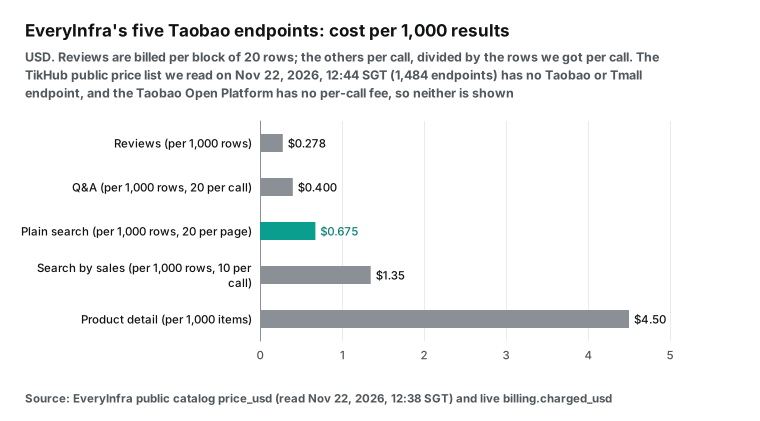
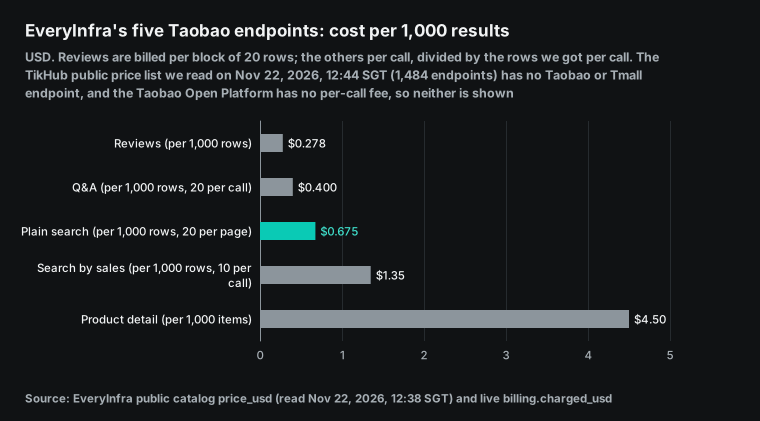
The price per 1,000 rows depends on how many rows each call returns. A plain keyword search returns up to 20 rows and can go to page 50. A search with a price range, sort: "popular", price_desc or tmall_only returns up to 10 rows and cannot go to a second page. Both cost $0.0135 per call, so the sorted search costs twice as much per row.
The catalog states this limit for each parameter. At 12:48 we sent a sorted search with page: 2 on purpose. The API returned 422 before it charged anything. The error message told us to remove the sort and filter parameters or keep sort=relevance.
Does Taobao have an official API?
Yes. The Taobao Open Platform at open.taobao.com has several entry paths. A brand can build its own system for its own store. A software vendor can sell apps to many stores. A publisher can join the affiliate program under Alimama.
All three paths share one rule from the user authorization page. Before your app reads products or orders, the merchant must log in with a Taobao account and authorize your app. The page says the token reads data only for the merchant whose account granted it. An authorization code is valid for 30 minutes and works once.
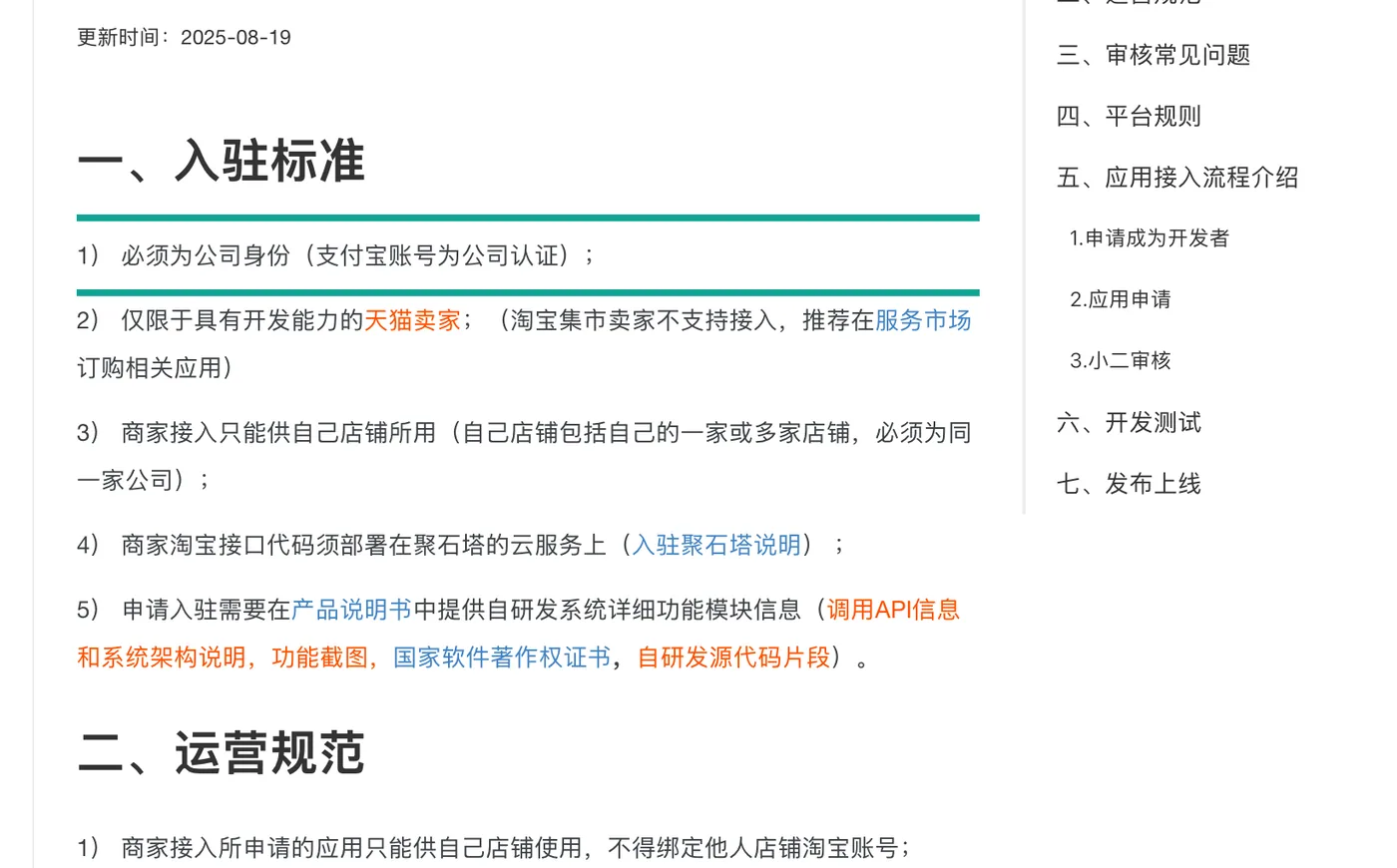
The screenshot shows the bar for the self-built path. The merchant back-office app page asks for a company identity. Only Tmall sellers with development skills can apply, and the page says regular Taobao marketplace sellers cannot. The app serves only your own store, and its code must run on Jushita, the Alibaba cloud for Taobao apps.
The application must include a national software copyright certificate and samples of your own source code. One company can create only one app of this type. The review FAQ adds that the copyright must be for an order management or ERP system. This path is for brands that run a Tmall store and build their own ERP. A research team or a solo seller fails the first item.
The second path is the software vendor route. The ISV access guide asks you to bind an Alipay account, verify your identity and register as a company. Category review takes 5 to 10 working days. Service listing review takes about 5 more working days.
The service market entry rules add more limits. New vendors in traffic promotion and industry or store analysis must be companies and must run on Jushita. Every new app must charge a fee, and free trials can last 15 days at most. The first forbidden feature on that page is the display of user privacy data. A vendor still sees data only from stores that buy its app and authorize it.
| Official entry | Whose data | Key limits from the source | Best fit |
|---|---|---|---|
| Merchant back-office app | Your own Tmall store | Company, Tmall seller, software copyright, Jushita; 5,000 calls a day before launch | Brand ERP and order systems |
| Software vendor (ISV) | Stores that buy and authorize your app | Company status; analysis apps must charge and run on Jushita | SaaS for merchants |
Reviews API taobao.traderates.get | Reviews your authorized store gave or got | Last 180 days only; 1,500 records per time window | After-sales and review management |
| Message service (TMC) | Order, product and refund events of authorized stores | Seller authorization; free messages kept for 24 hours | Real-time order sync |
| Affiliate material search | Products in the affiliate program | Needs an adzone_id; returns affiliate item IDs | Deal sites, cashback, price comparison |
The taobao.traderates.get page says it returns reviews from the last 180 days only. It returns only reviews that the seller gave or received, and it needs authorization. The response notes say one time window returns at most 1,500 records. This API can tell you who left a bad review in your store this half year. It cannot tell you what buyers say about a competitor's product.
There is also a Taobao Global Open Platform for cross-border sellers. Its API reference shows a last update of October 27, 2023, and it starts with the access token flow. It follows the same model of seller authorization. It does not give you a free search of other stores.
Taobao affiliate API: the only official search without store authorization
You may only need a list of products and prices for a keyword. For that, there is one official API that does not need store authorization: the affiliate material search. The page for taobao.tbk.dg.material.optional.upgrade carries two labels: free, and no user authorization required.
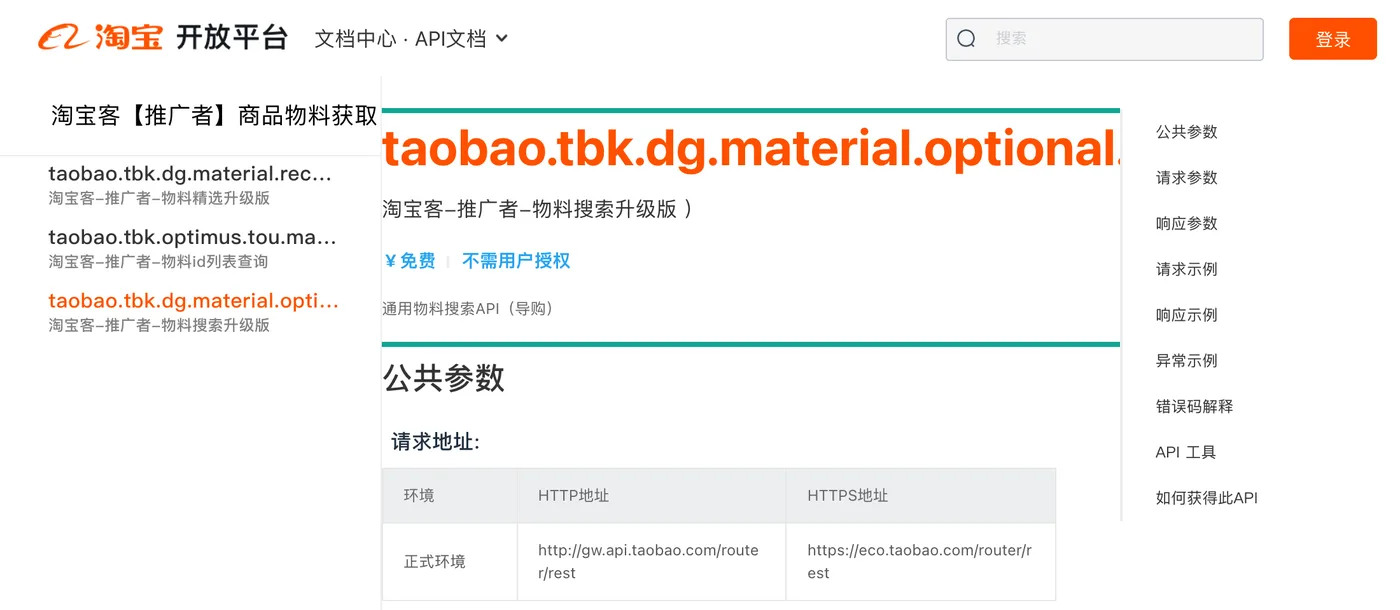
You can filter by keyword, category, price range, location, Tmall only and free shipping. Each page returns 1 to 100 items. The cost hides in two required fields and a set of notes. The adzone_id is your ad zone ID, and you get it from the Alimama publisher console.
The q parameter does not accept affiliate links. A copied product link with a numeric ID needs an extra permission for price comparison. A title search that finds a single item needs the same permission. Without it, the API hides the link and the item ID. The item_id field returns a special affiliate item ID, which is different from the numeric ID in the product URL.
"No user authorization" does not mean anonymous access. The public parameters still need an app key and a signature. The app key comes from a publisher media account that Alimama has approved. The results also follow affiliate logic, so products outside the affiliate program do not appear. There are no reviews and no buyer questions in this API.
The affiliate API introduction (February 1, 2023) says you must register as an Alimama publisher and file a media channel. Then you can apply for an app key. Advanced permissions are by invitation. The affiliate API rules (August 2, 2016) remove API access after 30 days in a row with no calls or no sales. A team that only wants research data will fail that rule.
When the official route is the right one
The official route is strong for write actions and real-time sync on your own store. The self-developed merchant solution lists APIs for product listing, stock sync, order sync, shipping and refunds. One authorization lasts one year.
A third-party data API cannot do any of this. It reads public pages that any visitor can see. It cannot read your order amounts, buyer addresses or refund reasons. It cannot change your listings or stock. For store operations, finance and ERP, use the official route.
Taobao API on GitHub: do the scrapers still work?
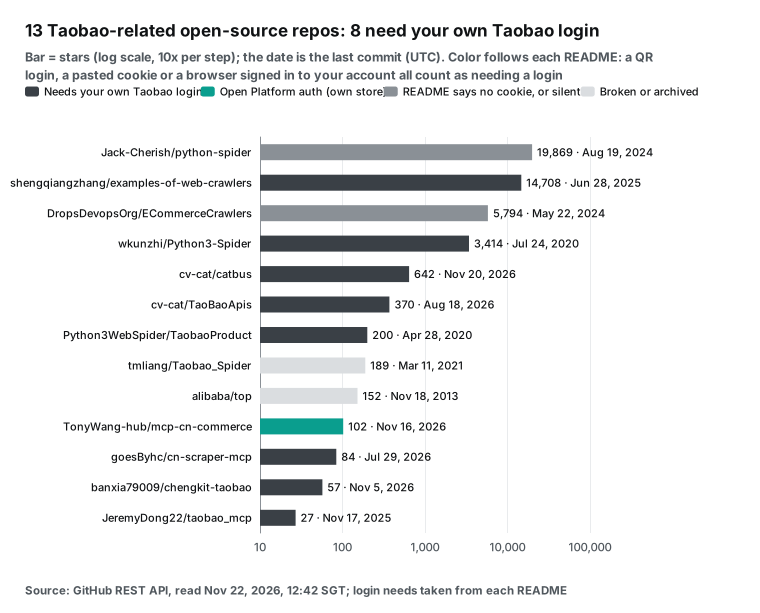
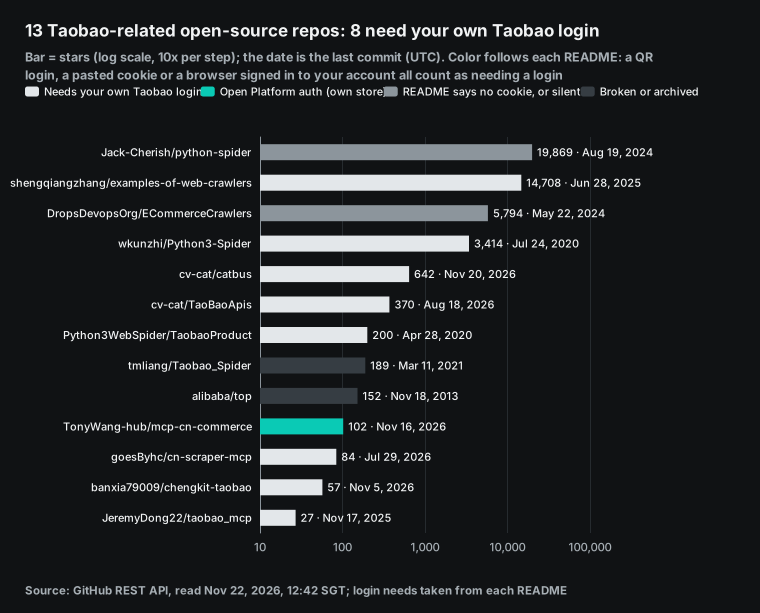
We searched GitHub with 7 queries such as "taobao spider", "taobao mcp" and the Chinese words for Taobao scraper. We kept 13 repositories that really work with Taobao. At 12:42 Singapore time on November 22, we read their stars, last commit and license through the GitHub REST API. Then we read each README to see if it needs a login.
The two largest repositories are collections. Jack-Cherish/python-spider has 19,869 stars and its last commit is from August 19, 2024. Its README does not explain how to run a Taobao part. shengqiangzhang/examples-of-web-crawlers has 14,708 stars and an MIT license. Its first example is a simulated Taobao login with Selenium and a Weibo account that links to Taobao.
| Repository | Stars | Last commit | License | Login needed (from the README) |
|---|---|---|---|---|
| Jack-Cherish/python-spider | 19,869 | 2024-08-19 | None | README does not explain the Taobao part |
| shengqiangzhang/examples-of-web-crawlers | 14,708 | 2025-06-28 | MIT | Yes, simulated Taobao login with Selenium |
| DropsDevopsOrg/ECommerceCrawlers | 5,794 | 2024-05-22 | MIT | README says no cookie, uses mitmproxy to avoid detection |
| wkunzhi/Python3-Spider | 3,414 | 2020-07-24 | None | Yes, simulated logins with slider checks |
| cv-cat/catbus | 642 | 2026-11-20 | MIT | Yes, QR login per platform, stored on your machine |
| cv-cat/TaoBaoApis | 370 | 2026-08-18 | None | Yes, the cookie must be from a logged-in session |
| Python3WebSpider/TaobaoProduct | 200 | 2020-04-28 | None | Yes, README links to an issue about login |
| tmliang/Taobao_Spider | 189 | 2021-03-11 | None | README says the project is dead |
| alibaba/top | 152 | 2013-11-18 | None | Old official SDK, archived |
| TonyWang-hub/mcp-cn-commerce | 102 | 2026-11-16 | MIT | Uses Open Platform authorization for your own store |
| goesByhc/cn-scraper-mcp | 84 | 2026-07-29 | MIT | Yes, needs a browser-like fingerprint and a login cookie |
| banxia79009/chengkit-taobao | 57 | 2026-11-05 | Not stated | Yes, Windows, Chrome and your own Taobao account |
| JeremyDong22/taobao_mcp | 27 | 2025-11-17 | None | Yes, step one is a browser login |
Most older scraper collections have not changed in two years or more. Python3-Spider last changed in July 2020 and TaobaoProduct in April 2020. The author of Taobao_Spider says in the README that the project no longer works.
Most Taobao repositories from late 2025 onward are MCP servers or command-line tools for AI assistants. Almost all of them start with a login to your own Taobao account. The cn-scraper-mcp README says Taobao needs a browser-consistent network fingerprint and a login cookie. chengkit-taobao needs Windows, Chrome and your own account, and it waits about 90 seconds between tasks. The first step in taobao_mcp is "Initialize Login".
catbus is active, with a commit on November 20. It covers ten platforms, including Xiaohongshu, Douyin, Xianyu, Taobao and JD. It stores one login per platform and account in ~/.catbus/.
When you run a scraper on your own account, the risk falls on that account. Sessions expire, so you must scan a QR code again from time to time. High request rates can trigger checks or limits on the account. One account on several machines draws more attention from risk systems.
The TaoBaoApis README says Taobao does not offer an official API for chat messages. The project reverse-engineers the chat WebSocket so sellers can connect an AI agent to their own inbox. Tools like this make sense for your own account. If you use them to read other stores at scale, the account becomes a consumable.
Only mcp-cn-commerce uses the official route. It wraps the Open Platform order and refund APIs as an MCP server. It still reads only the data of the store that authorized it.
Only one of the 13 says in its README that it needs no cookie: ECommerceCrawlers. The same README says that in theory the anti-scraping system does not catch it, and its tool list includes mitmproxy to get around Taobao detection. Its last commit is from May 22, 2024. You skip the login, but you must get around the platform's checks. The law quoted in the legal section below uses the words "avoiding or breaking technical controls". Ask your legal team before you put code like this in a product.
The GitHub API finds an MIT license in only 5 of the 13 repositories. Seven have no license file.
TaoBaoApis shows an MIT badge in its README, but the API finds no license file in the repository. chengkit-taobao returns NOASSERTION, which means GitHub cannot identify the license type. Code without a license gives you no default right to copy, change or sell it. Ask the author first if you plan to ship it in a product.
What one video shows: slider checks need a person
We used youtube/search for a Chinese query about Taobao API data collection. The top 10 videos had between 63 and 436 views. We pulled the transcript of an 11-minute demo of e-commerce data collection from July 5, 2024.
The author shows his own browser extension. You enter an ID and a license code, open a search page and collect products and reviews page by page. On a Southeast Asian marketplace, the page shows slider checks again and again, and the author says you must solve them by hand. The extension costs 99 yuan a month or 598 yuan a year per platform.
A browser extension has the same limit as a scraper on your own account: a person must sit next to it. It cannot run as an unattended scheduled job. A second video about AI product research returned 0 comments through youtube/comments, and that call cost nothing.
Is there a ready-made Taobao API? Pay-per-call compared
Yes. All pay-per-call APIs work the same way. You do not need a Taobao account. You call an HTTP endpoint with a key from the vendor, and you pay per call or per row. At 12:38 Singapore time on November 22, the EveryInfra catalog listed 5 Taobao capabilities, and all showed available: true.
| Capability | Price | Max per call | Fields in catalog | Billing notes from the catalog |
|---|---|---|---|---|
taobao/search | $0.0135 per call | 20 rows (10 when sorted or filtered) | 43 | Each page is one call; a full page repeated within 15 minutes returns the same rows and is billed |
taobao/product_detail | $0.0045 per call | 1 product | 79 | Removed or missing products return an empty result at no charge |
taobao/shop | $0.005556 per call | 20 rows (about 60 per page with page) | 18 | A shop that does not exist is billed once; other empty results are free |
taobao/reviews | $0.005556 per 20 rows | 100 rows | 15 | Up to the first 1,000 reviews per product (page 50) |
taobao/questions | $0.008 per call | 100 rows | 7 | Buyer questions and their answers |
In the pay-per-call group, we also read the TikHub public price list. At 12:44 Singapore time on November 22, 2026, we called its keyless price list endpoint. It returned 1,484 endpoints (its home page says 16 platforms and more than 1,000 endpoints). The price list we read has no Taobao endpoint and no Tmall endpoint.
Most of its endpoints are for Douyin (424), TikTok (246) and Xiaohongshu (95). The closest to Taobao are a Douyin shop product detail at $0.05 per call and a Xiaohongshu product search at $0.01 per call. Its FAQ says it bills only requests that return status 200. There is no Taobao price to compare, so the comparison table leaves it out.
Check four things before you choose any other pay-per-call service:
- Does a failed call or an empty result cost money?
- How many rows does one call return, and can you page?
- Is the price field the page price, the list price or an affiliate price?
- Does the vendor ask for your own Taobao account or cookie?
Some services ask for your own Taobao cookie before they return reviews or details. Then your account has the same risk as with an open-source scraper.
You can test the first two points with three requests. We tested EveryInfra this way.
Send a sort value that is not allowed. See if the service rejects it before it charges. Look up a product ID that does not exist, and see if a charge appears on your bill. Add a page parameter to a request that cannot page. See if you get an error or repeated rows. These three requests should cost $0. If one of them costs money, ask the vendor for its billing rules on failures before you connect.
Here is how EveryInfra answers the four points. Failures, bad parameters and empty results are free. A plain search returns 20 rows per page up to page 50; a sorted or filtered search returns 10 rows and cannot page. Each row has a price_basis field for the price type. You need no Taobao account and no cookie.
Beyond Taobao: JD, Xianyu, 1688 and AliExpress
Product research rarely stops at Taobao. The same EveryInfra catalog lists 7 JD capabilities. On the JD API, search costs $0.002472 per call, reviews $0.008 and a live price check $0.005556. Xianyu, the second-hand market, has search at $0.008 and item detail at $0.005556 per call.
The 1688 API has search at $0.002778 per call. It also has alibaba1688/image_search at $0.005556 per call, which finds the same product from a photo. AliExpress has 6 capabilities, each at $0.001389 per call. All these prices come from the same catalog read at 12:38, and the same no-charge rule for failures applies.
One key and one request format cover all of them. You can put a Taobao retail price, a 1688 wholesale price and a Xianyu resale price in one table. The Open Platform cannot do this. It covers only Taobao and Tmall, and only for authorized stores. For a dropshipper or a sourcing agent, this cross-market view is often the main reason to use a data API.
How to handle errors: 422, 429 and 503
| Status | Meaning | What the body gives | What to do | Charged |
|---|---|---|---|---|
| 422 | Bad parameter | Allowed values and a did_you_mean hint | Fix the parameter; the same request fails again | $0 |
| 429 | Key rate limit (10 a minute on our test key) | Error code rate_limited | Wait 60 seconds, then retry | $0 |
| 503 | No data this time | retry_after (20 s for us); not charged | Retry later or try another product | $0 |
Some jobs are slow, such as 100 reviews in one call. For these, add "mode": "async" to the request body. The API returns 202 and a job_id at once. Poll GET /api/v1/jobs/{job_id} for the result, and you avoid the 85-second limit on synchronous calls.
Fields: plain search and sorted search return different data
The catalog lists 43 fields for taobao/search, but the real count depends on how you search. At 12:38 we ran a plain search for an automatic pet water fountain. Each of the 20 rows had only 10 fields: id, url, title, price, original_price, currency, price_basis, location, image_url and platform. There was no shop name and no sales count. The catalog warns about this: pages 1 and 2 of a plain search may return only these 10 fields.
Seven minutes later we ran the same keyword with sort: "popular". Each of the 10 rows had 25 fields. The extra fields included shop_name, sold_text, is_tmall, three shop scores and seller_positive_rate. All 10 rows showed "1000+" in sold_text. That is a range, not an exact sales count.
| Item | Plain search | Sorted search (`popular`) |
|---|---|---|
| Rows per call | 20 | 10 |
| Fields per row | 10 | 25 |
| Shop name and sales range | No | Yes; all 10 show "1000+" |
| Tmall share | Mixed; 14 of 20 ship from Guangdong | 10 of 10, from 6 flagship stores |
| Price range | 10 to 2,100 yuan, median 131 | 5.8 to 339 yuan |
| Paging | Up to page 50 | No paging |
| Per 1,000 rows | $0.675 | $1.35 |
The two searches barely overlap: only 2 products appear in both. Use the two searches for different jobs. A plain search lets you page deep and see the full price range for a keyword. A sorted search finds the leading stores, but it gives only 10 rows.
Which Taobao API is best for you: choose by use case
| What you need | Option to use | Why |
|---|---|---|
| Orders, stock and shipping for your own Tmall store | Taobao Open Platform (merchant app) | Only the official route reads and writes your orders and stock; one authorization lasts a year |
| Sell ERP, support or analytics software to many stores | Taobao Open Platform (ISV) | Stores authorize your app, so the data source is clear |
| Deal site, cashback or price comparison with commission links | Affiliate material search API | Free, no store authorization, returns affiliate links |
| Watch prices and reviews of tens to hundreds of competitor products a day | A pay-per-call API such as EveryInfra | No Taobao account, failures are free, fits a scheduler or an AI tool |
| Help your own account on your own computer (support inbox, cart comparison) | Open-source MCP or CLI | It is your account, and you take the risk |
| Look at a few dozen products once, with a person present | Browser extension or manual work | Low volume, and a person can solve slider checks |
| Source products across Taobao, 1688 and AliExpress | A pay-per-call API with several marketplaces | One key and one format across markets |
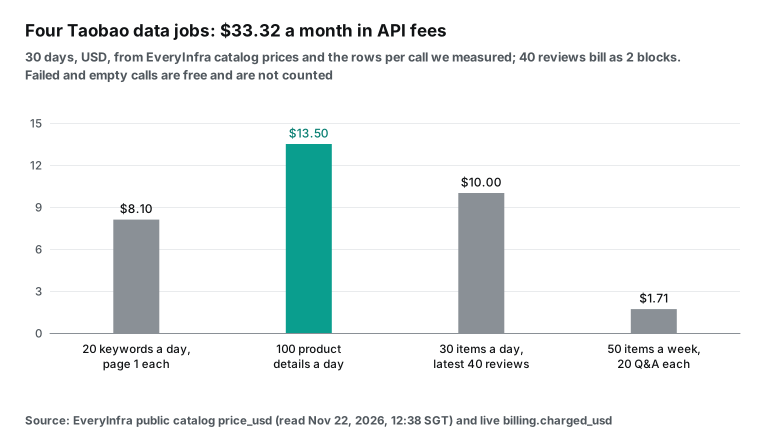
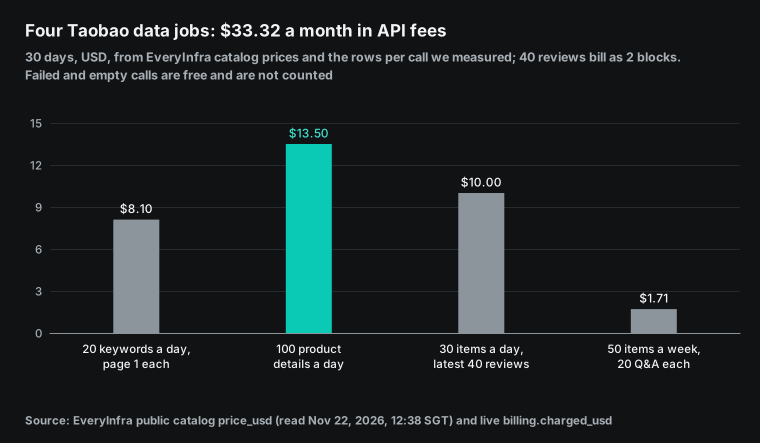
We used the EveryInfra catalog prices and the row counts from our test to price four common monthly jobs.
| Monthly job | Formula | Cost |
|---|---|---|
| 20 keywords a day, page 1 | 20 × $0.0135 × 30 | $8.10 |
| 100 product details a day | 100 × $0.0045 × 30 | $13.50 |
| 30 products a day, 40 reviews each | 30 × 2 × $0.005556 × 30 | $10.00 |
| 50 products a week, 20 questions each | 50 × $0.008 × 30 ÷ 7 | $1.71 |
| Total | $33.32 |
At $13.50, 100 product details a day is the most expensive of the four jobs. It is also the only job that is billed per product, whatever the row count. If you need only the price, the price field in a plain search is enough at $0.675 per 1,000 rows. You need the detail call only for SKU prices and stock.
Fifty products a week of buyer questions cost only $1.71 a month. One call returns up to 100 questions for a flat price, and one product rarely has more. One call usually gets them all.
A self-built scraper has no line for these costs on an invoice. You pay instead for proxies, servers, staff time to keep sessions alive, and new accounts after limits. On a tight budget, cut the detail calls first. Run search every day and call detail only for products whose price changed. Then the detail cost follows the number of changed products, not the size of your watch list.
One live test: one pet fountain, five data types in 10 minutes
We sent these 10 requests to the EveryInfra Taobao API on November 22, 2026, between 12:38 and 12:48 Singapore time. We used our own test key. We passed it only through an environment variable and kept every raw response.
# 1) Plain keyword search: page 1, 20 rows
curl -s https://api.everyinfra.com/api/v1/social \
  -H "Authorization: Bearer $EVERYINFRA_API_KEY" \
  -H "Content-Type: application/json" \
  -d '{"platform":"taobao","action":"search","params":{"keyword":"宠物自动饮水机","limit":20}}'

# 2) One product: details, latest 40 reviews, 20 buyer questions
curl -s https://api.everyinfra.com/api/v1/social \
  -H "Authorization: Bearer $EVERYINFRA_API_KEY" \
  -H "Content-Type: application/json" \
  -d '{"platform":"taobao","action":"reviews","params":{"url":"734073212371","limit":40}}'
# Returns count = 40, billing.units = 2, rows_per_unit = 20, charged_usd = 0.011111| Time (SGT) | Capability | HTTP | Rows | Time taken | Charged |
|---|---|---|---|---|---|
| 12:38:35 | taobao/search plain | 200 | 20 | 1.9 s | $0.0135 |
| 12:43:49 | taobao/product_detail | 200 | 1 (8 SKUs) | 3.4 s | $0.0045 |
| 12:43:55 | taobao/reviews, limit 40 | 429 | none | 0.2 s | $0 |
| 12:43:59 | taobao/search, sort popular | 429 | none | 0.2 s | $0 |
| 12:45:04 | taobao/reviews, limit 40 | 200 | 40 | 5.7 s | $0.011111 |
| 12:45:25 | taobao/search, sort popular | 200 | 10 | 9.3 s | $0.0135 |
| 12:48:10 | taobao/questions, limit 20 | 200 | 20 | 5.4 s | $0.008 |
| 12:48:23 | taobao/search, sort price_asc | 422 | none | 0.2 s | $0 |
| 12:48:31 | taobao/search, sort popular + page 2 | 422 | none | 0.2 s | $0 |
| 12:48:40 | taobao/product_detail, ID that does not exist | 503 | none | 18.0 s | $0 |
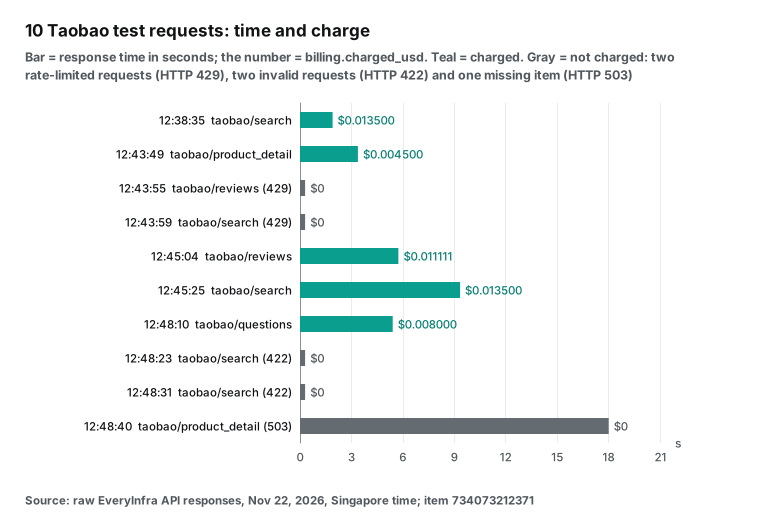
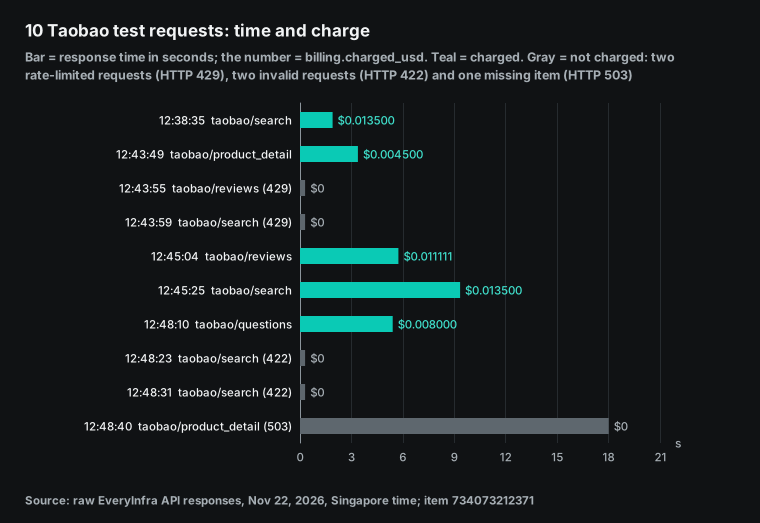
With sort: "price_asc", the API returned invalid_value. It listed the allowed values popular, price_desc and relevance, and did_you_mean suggested price_desc. With page: 2 on a sorted search, the API said that paging works only for a plain keyword search. Both requests failed before any charge. The bodies also carry allowed, catalog_url and next_steps, and the second one adds an example request that works (keyword iphone 15, no sort). An AI tool can fix the parameter from these fields and send again, with no person reading the docs.
For a product ID that does not exist, the API returned 503 and did not charge. The body suggested a retry after 20 seconds. At 12:43:55 and 12:43:59, two requests hit the 10-per-minute limit of the test key and returned 429 with no charge. The retry_after values were 5 and 1 seconds, and next_steps said "Nothing was charged". We sent both again a little over a minute later, and both worked.
The product detail call returned 18 fields. The 8 SKUs ranged from 288 to 459 yuan. The SKU stock added up to 95, which matches the total stock of the product. The listing had 41 description images. The catalog lists 79 fields as the full set, and its notes say not every call returns all of them. Fields such as coupon_price and sold_count appear only in some responses, so an empty field does not mean there is no coupon.
25 of 40 reviews are default system text
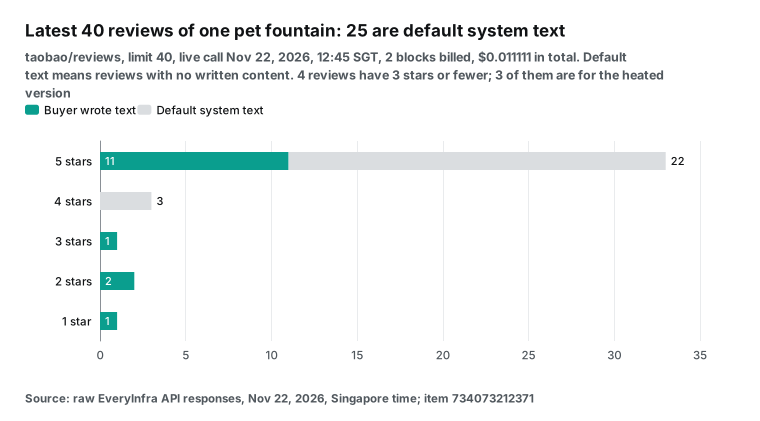
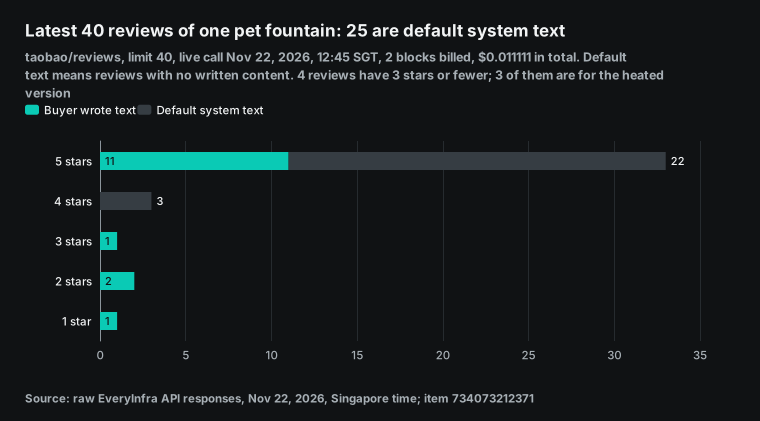
The reviews API bills per block of 20 rows, so 40 reviews cost 2 blocks, or $0.011111. When we counted them, 25 of the 40 were default text from the system. Taobao writes this text when a buyer rates without comment, with lines such as "the user thinks the product is good". All 25 sit at four or five stars.
| Stars | Reviews | With buyer text | Default system text |
|---|---|---|---|
| 5 | 33 | 11 | 22 |
| 4 | 3 | 0 | 3 |
| 3 | 1 | 1 | 0 |
| 2 | 2 | 2 | 0 |
| 1 | 1 | 1 | 0 |
| Total | 40 | 15 | 25 |
Only 15 reviews had buyer text. All 4 reviews at three stars or lower had text. Three of them were for one version: a stainless steel bowl, battery or plug power, and heating. One buyer said the WiFi would not connect. Another said the bowl and filter needed cleaning every day. A third said the unit often clogged until it overflowed.
That version accounts for 20 of the 40 reviews. It is also the most expensive of the 8 SKUs at 459 yuan. The reviews run from June 22 to November 20, 2026. The catalog lists 15 review fields, including images, review_append for follow-up reviews and seller_reply. None of the 40 rows in this response had these three fields, so we cannot count photos or follow-ups for this product.
The one other low review was for a different version, the plug-in app model. That three-star review said the app does not record each water flow. Support blamed an app delay.
The share of default text tells you how many reviews to pull for competitor research. If you take only the latest 20, you may keep six or seven reviews with real text. For 100 reviews with text, this product needs about 270 reviews. That is 14 blocks, or about $0.078. The reviews API returns the first 1,000 reviews per product. Use page or next_page_token to page, and a page past the end returns an empty result at no charge.
20 buyer questions for $0.008: cleaning and heating lead
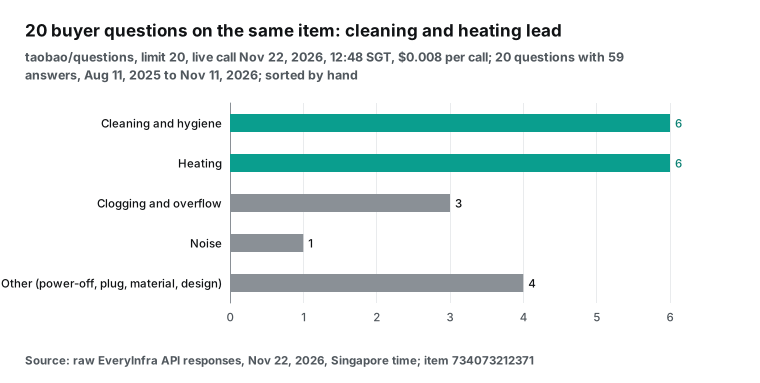
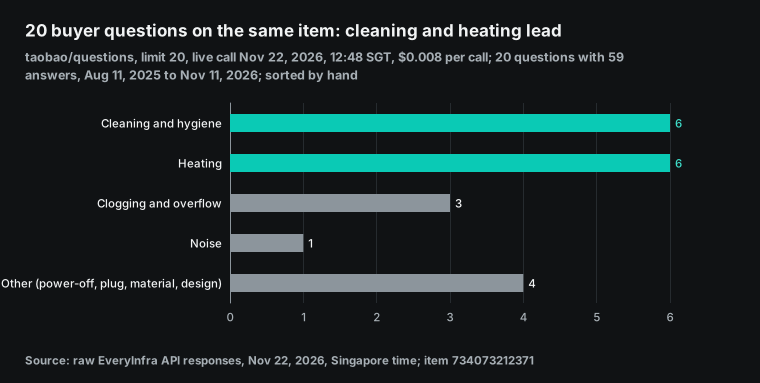
The buyer questions feature on Taobao lets shoppers ask past buyers. We pulled 20 questions for the same product for $0.008. Every question had answers, 59 answers in total, dated August 11, 2025 to November 11, 2026.
We grouped the questions by hand. Six were about cleaning and hygiene: how often to wash it, whether the hidden pipe grows bacteria, whether bugs get in. Six were about heating: can you turn it off, how warm the water gets, is there a shock risk, does the water cool fast.
Three were about clogging and overflow, and one was about noise. The other 4 asked about power off, the plug, the material and the build. Some answers were blunt. One buyer said the unit traps cat hair and dust and now sits unused.
Put the reviews and the questions side by side, and both point to the heated version. Of the 4 reviews at three stars or lower, 3 are for the heated version, and 2 of those 3 are about cleaning and clogging. Among the questions, cleaning and clogging come up 9 times.
The two calls cost $0.0191 together. Analyze e-commerce reviews in bulk with Qwen shows how to let a model read reviews in bulk and write a report. This data pull adds one point: Taobao reviews contain a lot of default text, so remove it before a model reads them.
When another option fits better
The Open Platform wins on push events and write actions. Its message service, updated on November 13, 2026, pushes order, product and refund events of authorized stores to your app. The free TMC subscription keeps messages for 24 hours at most, and broadcast messages need seller authorization and a seller group. A pay-per-call API can only pull public pages on a schedule. It cannot tell you the moment an order changes, and it cannot edit listings or stock. If you build SaaS for merchants, the fee and review rules of the service market are the only way in.
The affiliate API wins on price and filters. It is free, and its filters for category, price, free shipping and above-average ratings are finer than a third-party search. A deal site or cashback app needs commission links anyway. Open-source projects win when you work on your own account. An AI can compare SKU prices for items in your own cart, which is the purpose of chengkit-taobao. It can also answer chat messages for your own store. At low volume, if you can scan a QR code again after a session expires, you do not need to pay per call.
What to change when you switch options
If you switch from the affiliate API to a data API, or the other way, start with the product ID. The affiliate API returns a special affiliate item ID. A data API and the product URL use the numeric ID, such as 734073212371 in our test. To merge the two sources, keep a mapping table or look up both by the product URL.
Next, check the price type. The affiliate API gives an estimated final price and an affiliate price.
A data API marks each row with price_basis. The value page is the current page price, and list is the crossed-out list price. The value promotion is the affiliate price, which is often much lower. All our rows returned page. Align this field before you merge, or you will compare affiliate prices with page prices.
Then check paging. An EveryInfra plain search goes to page 50 at 20 rows per page. A shop product list returns about 60 items per page for up to 35 pages, which is about 2,060 items per sort order. Reviews go to page 50, or 1,000 reviews.
Rankings change in real time, so two pages can repeat a few rows. Deduplicate by id when you merge. If you move from an open-source scraper, drop the session layer (QR logins, account rotation, slider checks) and keep your own deduplication and storage.
Connect Taobao data to AI tools with MCP
The EveryInfra remote MCP server lives at https://api.everyinfra.com/mcp. At 12:53 Singapore time on November 22, we read its tool list without a key, and it showed 12 tools. everyinfra_list_capabilities lists capabilities, everyinfra_call_api sends a request, and everyinfra_get_job gets the result of a slow job. everyinfra_get_account reads your balance. everyinfra_list_requests lists the calls of your key with status code, row count and charge. A model can use it to check which requests of a scheduled job cost money. Add this block to Claude Code, Cursor or any other tool that supports remote MCP. Keep the key in an environment variable, not in the file.
{
  "mcpServers": {
    "everyinfra": {
      "type": "http",
      "url": "https://api.everyinfra.com/mcp",
      "headers": { "Authorization": "Bearer ${EVERYINFRA_API_KEY}" }
    }
  }
}
This block is a configuration example. In this test we read the tool list only; we did not run a full chat in an AI tool. After setup, you can give one plain request to the assistant. For example: search Taobao for automatic pet fountains, page 1. Take the 5 products above the median price and get 40 reviews each. Remove default text and group the problems.
From the tool descriptions, the model should first call everyinfra_list_capabilities to read the parameters of taobao/search and taobao/reviews, then call them one by one. At catalog prices, we estimate this job at 1 search plus 10 review blocks, or about $0.069. Setup is the same as for other platforms; see the MCP server page.
Legal points for China data
China revised its Anti-Unfair Competition Law in 2025. Article 13, paragraph 3 says a business must not get or use data that another business holds lawfully by fraud or force. It also bans getting such data by avoiding or breaking technical controls.
Article 29 sets fines from 100,000 to 1,000,000 yuan. Serious cases face 1,000,000 to 5,000,000 yuan. The Junhe law firm says this paragraph took effect on October 15, 2025.
The Junhe note cites case (2023) Zhe Min Zhong No. 1113. Software there copied product data from a shopping site and listed it on another platform. The court found unfair competition. The note sums up three tests: substantial substitution, a serious imbalance of interests, and whether the technical means were proper.
The Network Data Security Regulations add two duties. Article 18 says automated tools must assess their impact on a service and must not disrupt it. Article 24 says personal information that automated collection picks up without need must be deleted or anonymized.
Buyer nicknames and avatars in review data are this kind of information.
In our test, we left those two fields in the raw responses and did not use them in any count. The use also matters. Price and review research for your own product decisions is one thing in the eyes of the court. Copying another platform's whole catalog to your own store is another. This section quotes public law texts and is not legal advice. If you sell from outside China, ask a lawyer about the rules in your market too.
Recent changes (October and November 2026)
- November 3, 2026. A Taobao Open Platform notice said a system upgrade on November 16 would retire the AI agent and workflow domain
open-agent-runtime.taobao.com. The new domain isopen-ars.taobao.com. If you use these APIs, check your domain settings. - November 10 and 13, 2026. The Open Platform updated its self-developed merchant solution and its message service page. An app that has not launched gets 5,000 calls a day and 50 authorized users, and the platform deletes it after three months. If your app is still in test, plan its launch.
- Singles' Day 2026. Syntun data counted 1,776.4 billion yuan in online sales from October 7 to November 11. Tmall ranked first among general marketplaces, and pet food reached 10.3 billion yuan. The one or two weeks after a big sale show price drops and a wave of new reviews, so plan your review pulls around them.
- November 16 and 20, 2026. mcp-cn-commerce and catbus both got new commits. The first uses Open Platform store authorization, and the second uses personal logins on several platforms. Open source is moving toward MCP, but the question of whose account runs the tool stays the same.
FAQ
Does Taobao have an official API?
Yes. The Taobao Open Platform offers APIs to merchants, software vendors and affiliate publishers. Data access needs store authorization, and the token reads only that store's data. A self-built merchant app needs a company identity, a Tmall store, a software copyright and Jushita hosting. The only official product search without store authorization is the affiliate material search, which needs an Alimama ad zone. Source of the question: search suggestions for "taobao api documentation" and "taobao api key", read on November 22, 2026.
Which Taobao API is best?
Choose by the data you need. Use the Open Platform for your own store orders and stock, and the affiliate API for deal sites. Use a pay-per-call API for public products, reviews and buyer questions of other stores. The TikHub public price list we read at 12:44 SGT on November 22, 2026 has no Taobao endpoint. EveryInfra charges $0.675 per 1,000 search rows and $0.278 per 1,000 reviews, and failures and empty results are free. Source of the question: the Reddit thread in r/taobao "Can anyone use Taobao's API for obtaining product data and place orders?"
Is there a free Taobao API?
The affiliate material search is free and needs no store authorization. You still need an Alimama publisher account, an approved media filing and an ad zone ID. You lose access after 30 days with no calls or no sales. Open-source scrapers are free to download, but you pay with your own account, proxies and time. Source of the question: search suggestions for "taobao api free", read on November 22, 2026.
How do I get a Taobao API key?
For the Open Platform, register a company account, pass category review and create an app to get an app key. For the affiliate API, register on Alimama, file your media channel and then apply for an app key. For a pay-per-call API, create a key in the vendor console and top up your balance. Source of the question: search suggestions for "taobao api key", read on November 22, 2026.
Can I use the Taobao API projects on GitHub?
They run, but plan for three things. You need your own Taobao login, a new login from time to time, and a person to solve slider checks. The two most-starred projects last changed in August 2024 and June 2025. One author says his project is dead, and the old official SDK alibaba/top is archived. Seven of 13 have no license file. Source of the question: search suggestions for "taobao api github", read on November 22, 2026.
How much does a Taobao API cost?
The Open Platform has no per-call fee, but it has entry costs: a company, a Tmall store, a software copyright and Jushita hosting. The affiliate API is free. On EveryInfra, a search call costs $0.0135, a product detail $0.0045, 20 reviews $0.005556 and up to 100 buyer questions $0.008. Our four sample jobs cost $33.32 a month in total. Source of the question: search suggestions for "taobao api price", read on November 22, 2026.
Can a Taobao API give exact sales numbers?
Public data usually gives a range. In our sorted search, all 10 rows showed "1000+" in sold_text. The plain search had no sales field. Only the official API gives exact numbers, and only for your own store orders. Source of the question: search suggestions for Taobao sales API, read on November 22, 2026.
Is there a Taobao search API in English?
The EveryInfra API takes keywords in any language and returns field names in English, but Taobao titles stay in Chinese. Search with Chinese keywords for the best match, then translate titles in your own pipeline. The Taobao Global Open Platform has English documentation, but it is for sellers who authorize apps. Source of the question: search suggestions for "taobao api search", read on November 22, 2026.
Getting started
- Create an API key in the EveryInfra console, top up, and store the key in
EVERYINFRA_API_KEY. - Read the free catalog at
GET https://api.everyinfra.com/api/v1/social/catalog?platform=taobaoto check parameters andavailable. - Send one
taobao/searchwith the curl above and checkbilling.charged_usd. Usesort: "popular"when you need shop names and sales ranges. - Pick products from the results and call
taobao/product_detail,taobao/reviewsandtaobao/questions. Reviews bill per 20 rows, so plan blocks from the number of text reviews you need. - Add the MCP block above to connect an AI tool. For scheduled jobs, keep the interval at 15 minutes or more and deduplicate by
id.
Prices for all platforms are on the pricing page, and the Taobao API page lists every Taobao capability. For other platforms in this series, read Douyin API options in 2026 and Douban data API options. For a full comparison with TikHub, see TikHub alternatives.
References
- ISV access guide, Taobao Open Platform, 2024-07-31, https://open.taobao.com/doc.htm?docId=120867&docType=1
- Self-developed merchant access guide, Taobao Open Platform, 2024-06-17, https://open.taobao.com/doc.htm?docId=120869&docType=1
- Merchant back-office system app, Taobao Open Platform, 2025-08-19, https://open.taobao.com/docV3.htm?docId=101564&docType=1
- Self-developed merchant solution (product listing and more), Taobao Open Platform, 2026-11-10, https://open.taobao.com/docV3.htm?docId=118848&docType=1
- User authorization overview, Taobao Open Platform, read 2026-11-22, https://open.taobao.com/doc.htm?docId=102635&docType=1
- Service market entry rules, Taobao Open Platform, read 2026-11-22, https://open.taobao.com/doc.htm?docId=101612&docType=1
- Message service overview, Taobao Open Platform, 2026-11-13, https://open.taobao.com/doc.htm?docId=101663&docType=1
- Domain retirement notice, Taobao Open Platform, 2026-11-03, https://open.alitrip.com/support/announcementDetail.htm?source=search&id=25854
- taobao.traderates.get (review search), Taobao Open Platform, read 2026-11-22, https://developer.alibaba.com/docs/api.htm?apiId=55
- taobao.tbk.dg.material.optional.upgrade (affiliate material search), Taobao Open Platform, read 2026-11-22, https://open.taobao.com/api.htm?docId=64759&docType=2&scopeId=27939
- Affiliate API introduction and access steps, Taobao Open Platform, 2023-02-01, https://developer.alibaba.com/docs/doc.htm?treeId=713&articleId=118970&docType=1
- Affiliate API management rules, Alimama, 2016-08-02, https://open.alitrip.com/docs/doc.htm?treeId=713&articleId=118972&docType=1
- Jack-Cherish/python-spider, GitHub, read 2026-11-22, https://github.com/Jack-Cherish/python-spider
- shengqiangzhang/examples-of-web-crawlers, GitHub, read 2026-11-22, https://github.com/shengqiangzhang/examples-of-web-crawlers
- DropsDevopsOrg/ECommerceCrawlers, GitHub, read 2026-11-22, https://github.com/DropsDevopsOrg/ECommerceCrawlers
- wkunzhi/Python3-Spider, GitHub, read 2026-11-22, https://github.com/wkunzhi/Python3-Spider
- cv-cat/catbus, GitHub, last commit 2026-11-20, https://github.com/cv-cat/catbus
- cv-cat/TaoBaoApis, GitHub, read 2026-11-22, https://github.com/cv-cat/TaoBaoApis
- Python3WebSpider/TaobaoProduct, GitHub, read 2026-11-22, https://github.com/Python3WebSpider/TaobaoProduct
- tmliang/Taobao_Spider, GitHub, read 2026-11-22, https://github.com/tmliang/Taobao_Spider
- alibaba/top, GitHub (archived), read 2026-11-22, https://github.com/alibaba/top
- TonyWang-hub/mcp-cn-commerce, GitHub, last commit 2026-11-16, https://github.com/TonyWang-hub/mcp-cn-commerce
- goesByhc/cn-scraper-mcp, GitHub, read 2026-11-22, https://github.com/goesByhc/cn-scraper-mcp
- banxia79009/chengkit-taobao, GitHub, last commit 2026-11-05, https://github.com/banxia79009/chengkit-taobao
- JeremyDong22/taobao_mcp, GitHub, read 2026-11-22, https://github.com/JeremyDong22/taobao_mcp
- EveryInfra data API catalog, EveryInfra, read 2026-11-22 12:38 SGT, https://api.everyinfra.com/api/v1/social/catalog
- TikHub endpoint price list, TikHub, read 2026-11-22 12:44 SGT, https://api.tikhub.io/api/v1/tikhub/user/get_all_endpoints_info
- TikHub FAQ, TikHub, read 2026-11-22, https://tikhub.io/faq
- TikHub Pricing, TikHub, read 2026-11-22, https://tikhub.io/pricing
- Anti-Unfair Competition Law of the PRC (2025 revision), CNIPA, 2026-05-20, https://www.cnipa.gov.cn/art/2026/5/20/art_104_206437.html
- Network Data Security Management Regulations (State Council Order 790), Ministry of Ecology and Environment repost, 2024-10-03, https://www.mee.gov.cn/zcwj/gwywj/202410/t20241003_1087417.shtml
- Changes in public data scraping unfair competition cases after the Supreme Court guiding cases, Junhe, 2026-05-19, https://www.junhe.com/legal-updates/2985
- Syntun Singles' Day 2026 online sales report, ifeng Finance, 2026-11, https://finance.ifeng.com/c/8y6AxlXVs5h
- Zhipu opens a Taobao store, Kimi works with Microsoft, Eastmoney, 2026-11-11, https://caifuhao.eastmoney.com/news/20261111165114279135590
- Master Data Collection on Lazada, TikTok, Xiaohongshu, and Taobao (video), YouTube, 2024-07-05, https://www.youtube.com/watch?v=axNhJJVRRYE
- Can anyone use Taobao's API for obtaining product data and place orders?, Reddit r/taobao, read 2026-11-22, https://www.reddit.com/r/taobao/comments/10d04y8/can_anyone_use_taobaos_api_for_obtaining_product/
- A list of official APIs in China, V2EX, read 2026-11-22, https://www.v2ex.com/t/335230
- Which platforms besides Taobao offer product detail APIs?, Zhihu column, read 2026-11-22, https://zhuanlan.zhihu.com/p/2022640079261147292
- Taobao Global Open Platform API Reference, Taobao Global, 2023-10-27, https://open.taobao.global/doc/api.htm
- EveryInfra Taobao catalog (platform filter), EveryInfra, read 2026-11-22, https://api.everyinfra.com/api/v1/social/catalog?platform=taobao
Reference BL-210