RedNote Scraper: Profile, Note and Comment Costs Tested
We tested a RedNote (Xiaohongshu) scraper API: $0.28 per 1,000 notes, $0.37 per 1,000 comments, $5.56 per 1,000 profiles. Failed calls cost $0.

On November 20, 2026, from 00:15 Singapore time, we tested a pay-per-call RedNote (Xiaohongshu) scraper API. We tested four kinds of public data: search results, full notes, comments and account profiles. With the rows that each page actually returned, 1,000 note previews cost $0.28, 1,000 comments cost $0.37, and 1,000 profiles cost $5.56. The full post history of the Singapore Tourism Board account, 419 posts, cost about $0.12. Rate-limited calls, bad parameters and a missing user all cost $0. A nonsense keyword still returned 19 unrelated notes, and that call was billed.
What a RedNote scraper and a Xiaohongshu scraper API do
RedNote is the English name of Xiaohongshu, which means "little red book" in Chinese. Many US users first heard the name in January 2025. Reuters reported on January 14, 2025 that more than 700,000 new users joined in two days. US downloads were up more than 200% year over year in that week.
Researchers then used the platform as a data source. arXiv 2510.18894 studies migrant posting across three phases: before the ban, the surge and stabilization. arXiv 2507.14623 uses 1,862 posts and 403,054 comments for emotion analysis.
A "rednote scraper", a "xiaohongshu scraper" and a "xiaohongshu scraper api" all do one job. They turn public notes, comments and account profiles into rows that a program can read.
The platform is large. A Marketing to China summary from November 8, 2026 says the company reported more than 400 million monthly active users in May 2026. FC Internazionale Milano announced its RedNote account and gave about 350 million monthly users and 600 million searches per day.
| Data you want | EveryInfra capability | Rows per call | Price per call (USD) | Fields in the catalog |
|---|---|---|---|---|
| Notes for a keyword | xiaohongshu/search | 20 | 0.005556 | 30 |
| Full text of one note | xiaohongshu/note | 1 | 0.005556 | 28 |
| Comments on a note | xiaohongshu/comments | 15 | 0.005556 | 20 |
| Account profile | xiaohongshu/profile | 1 | 0.005556 | 21 |
| Posts of an account | xiaohongshu/user_posts | 20 | 0.005556 | 24 |
| Accounts for a keyword | xiaohongshu/search_users | up to 20 | 0.005556 | 10 |
The prices and field counts come from the EveryInfra catalog for Xiaohongshu, read at 00:17 Singapore time on November 20, 2026. Rows per call come from our live calls in the same session. The catalog lists 17 Xiaohongshu capabilities. Sixteen cost $0.005556 per call, and one creator-marketplace search costs $0.016. The Xiaohongshu data API page has the parameters and a test console.
Xiaohongshu is more expensive than other Chinese social platforms in the same catalog. The Douyin data API charges $0.000556 per call for profile, user posts and comments. Bilibili and Weibo profiles are also $0.000556. The Xiaohongshu price is ten times higher. Budget the Xiaohongshu column on its own in a cross-platform study: 1,000 Douyin profiles cost about $0.56, and 1,000 Xiaohongshu profiles cost $5.56.
RedNote and Xiaohongshu share one dataset
Is RedNote a separate international app with separate data? The same Reuters report says that RedNote keeps only one version of its app. It does not split into an overseas app and a domestic app, as other Chinese social apps do. English posts by US users and Chinese posts by Chinese users live in one community. Profiles and comments have one structure. One scraper and one field table cover both languages.
We tested what this means for an English keyword. At 00:36 Singapore time we searched "Singapore travel tips" with xiaohongshu/search. The call returned 20 notes for $0.005556. All 20 notes had Chinese titles and Chinese preview text. Not one row was English only.
The platform matched the English query to Chinese travel guides. A RedNote scraper gives you Chinese text even when your keyword is English, so add a translation step and budget for it.
The English keyword also returned a different set of notes. Only 1 of the 20 notes was among the 40 notes from the Chinese keyword for "Singapore travel guide". The median like count was 73.5, against 541.5 for the Chinese keyword, and the top note had 4,218 likes. The notes were posted between June 19, 2025 and November 14, 2026, and 2 were videos. The previews had 57 to 60 characters, the same cut as for the Chinese keyword.
In a second search with a Chinese keyword, 2 of 40 titles were in English only. The language field in xiaohongshu/note labels each note. The note we opened was labeled "zh". If you need English posts, filter on that field or on the text after collection.
How to tell an official account
To find official accounts by name, read the verification type. At 00:15:29 we searched the Chinese name of the Singapore Tourism Board with xiaohongshu/search_users. That row had is_verified set to true and verification_type set to business. We then read the same account three times with xiaohongshu/profile. All three reads had is_verified set to false, verification_type set to business, and the verification text "overseas tourism board" (our translation).
| Source (Singapore time) | `is_verified` | `verification_type` | `follower_count` |
|---|---|---|---|
search_users, 00:15:29 | true | business | 70,000 (estimate) |
profile, 00:16:06 | false | business | 70,497 |
profile, 00:50:18 | false | business | 70,497 |
profile, 01:35:04 | false | business | 70,499 |
So the two capabilities gave different values of is_verified for one real institution account. A filter on the profile is_verified alone would drop this account. Use verification_type (individual, business, other) and verification_text instead. The catalog says that an account with no verification has no verification_type field.
Follower counts also differ by source. The search_users row showed 70,000 followers, and the profile showed 70,497. The catalog says that the search_users value is an estimate from the display text, and the profile value is exact.
Three routes to RedNote data
There are three practical routes. You can write your own scraper or adapt an open-source script. You can subscribe to a monthly scraping tool. Or you can call a pay-per-call API. The routes differ on three points: whether you need your own account, who pays for failed requests, and who maintains the fields.

| Item | Your own scraper | Monthly scraping tool | Pay-per-call API (EveryInfra) |
|---|---|---|---|
| Authentication | Your accounts and cookies, and accounts get banned | Many tools ask for your cookie or account | An EveryInfra API key |
| What comes back | Yours to define | Defined by the vendor | Fields that a public page shows |
| After a rate limit | You guess the limit and back off | Depends on the tool | 429 with retry_after, retry after that wait |
| Billing unit | Servers, proxies and staff time | Monthly fee plus a quota of rows or run time | $0.005556 per call |
| Failed and empty results | Time and proxy traffic are spent anyway | Depends on the vendor terms | 422, 429 and empty results cost $0 in our test |
| Field format | Yours to define and to fix after each change | Defined by the vendor | response_fields in the catalog |
| AI tools | You build the wrapper | Depends on the tool | Remote MCP with everyinfra_* tools |
| Steps to start | Set up, prepare accounts, follow page changes, tune rate limits | Sign up, add a card, set a task | Get a key, send one POST |
EveryInfra charges $0.005556 per Xiaohongshu call. Failed calls cost nothing, and empty results are refunded. The catalog defines each field. For example, like_collect_count is the "likes and saves" total on a profile, and it equals like_count plus collect_count.
Route 1: your own scraper
The first gate is the Xiaohongshu robots.txt. We read it at 00:24 Singapore time on November 20, 2026. The file has 26 lines. Baidu, Bing, 360, Sogou and Shenma may read the home page, /explore, /download and the sitemaps. Googlebot may read only /worldcup26. Every other crawler gets User-agent: * and Disallow: /.
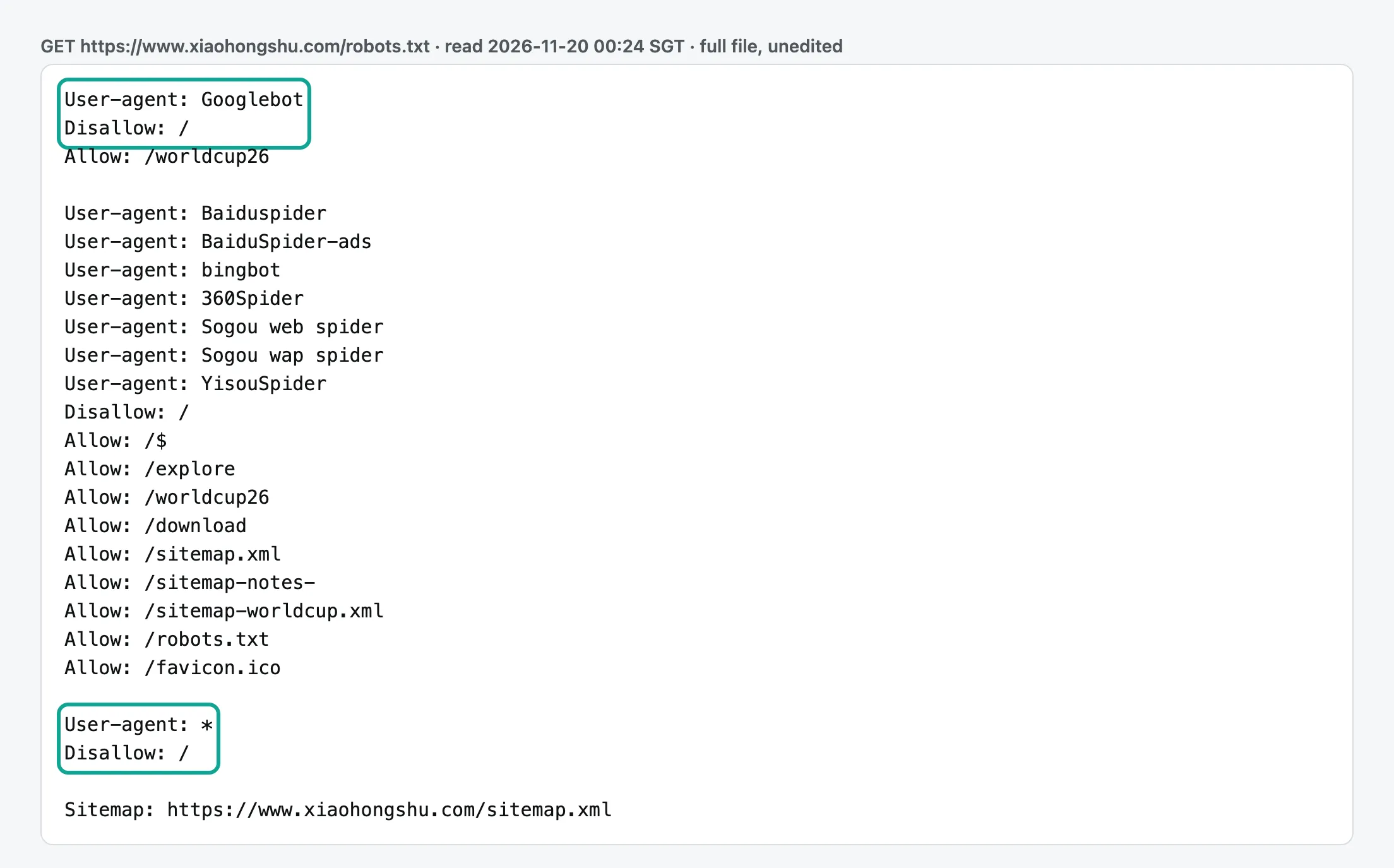
The robots protocol became RFC 9309 in 2022. The RFC says that the rules are not a form of access authorization. Python includes urllib.robotparser, and its can_fetch() method checks one URL for one user agent. We checked a note URL and a profile URL.
A custom crawler name got False for both. Googlebot also got False for both. Bingbot got True for the note page under /explore/ and False for the profile page under /user/profile/. Even the search engines that the file allows cannot read account profiles.
| User agent | Note under `/explore/` | Profile under `/user/profile/` |
|---|---|---|
| Custom crawler (made-up name) | False | False |
| Googlebot | False | False |
| bingbot | True | False |
The second gate is the login wall. The Xiaohongshu user agreement prohibits getting videos, posts or user information by "illegal scraping, simulated downloads, deep links or fake registration" (our translation). The web app shows a login dialog before search and note pages. A beginner on r/webscraping hit that dialog. The web app showed it, and the mobile web page did not.
The third gate is account risk. A post on r/DataHoarder calls the Xiaohongshu rate limits the strictest that the poster had seen. The poster used open-source tools with cookies. After a month without scraping, a click on the first note in the web app logged the account out. The mobile app still worked.
The fourth gate is page changes. Data requests from the web app carry check values that front-end code calculates. That code is obfuscated and changes with app versions, so a self-built scraper must change with each version.
Some scrapers drive a real browser with a general browser automation framework such as Playwright. The W3C WebDriver specification sets navigator.webdriver to true in an automated browser, and any site can read that flag. The Chrome headless mode documentation describes how the new and old headless modes differ.
The Playwright authentication guide warns that a saved browser state file holds cookies that can impersonate you. Do not commit that file to a repository. With your own scraper, the safety of your accounts and cookies is your job.
The legal context
Below are the main points of the laws, court rulings and platform rules. They are not legal advice.
China revised its Anti-Unfair Competition Law in 2025. Article 13 now prohibits getting or using data that another business lawfully holds by fraud, coercion, or by avoiding or breaking technical management measures. The revised law took effect on October 15, 2025. The Network Data Security Management Regulations took effect on January 1, 2025. The Personal Information Protection Law also limits how you can process personal information that is already public.
Courts have ruled on Xiaohongshu cases. A report on a Shanghai IP Court appeal describes a company that went around the robots file, login checks and rate limits. It sold Xiaohongshu notes and user data as an "API bundle". The bundle had more than 2.94 million data calls and earned more than CNY 110,000.
The court ordered damages of CNY 1.1 million. A second report describes a company that cracked the app encryption, forged requests and sent bulk private messages. Three people received criminal sentences. The Supreme People's Court published its typical anti-unfair competition cases of 2026 on September 9, 2026. Read the original text for how courts decide such cases. EU readers who process data about people in the EU should also read the GDPR, which applies to public personal data too.
The Xiaohongshu Security Response Center rules of August 18, 2026 accept threat reports about "scraping tools, platforms or services that can prove they still get Xiaohongshu data" (our translation).
Our data method for this article: we read only fields that a public page shows. We did not read private messages or content that needs a login. We do not show the names or avatars of private users. Whichever route you take, check your use case against the current Xiaohongshu user agreement and the laws above, and ask your own legal counsel.
What your own scraper costs
Most of the cost is staff time. The US Bureau of Labor Statistics lists a 2025 median pay of $64.44 per hour for software developers, quality assurance analysts and testers. Assume that one developer spends 16 hours each month on page changes and rate-limit changes. This is an assumption, not a statistic.
That is $1,031 per month before servers, proxies and lost accounts. The same $1,031 buys about 185,000 API calls at $0.005556. As search pages of 20 notes, that is about 3.7 million note previews.
Route 2: a monthly scraping tool
The second route is a monthly tool. You click through a web interface, enter keywords or account links, and the tool runs on a schedule. Billing usually takes one of three forms. A monthly fee includes a fixed number of rows, with a higher price for extra rows.
Or the tool charges run time or compute units. Some tools also set tiers by concurrency. For a login-walled platform such as RedNote, many tools ask you for a cookie. The account risk stays with you.
When you compare tools, check three points. Does an empty run use quota? Does unused quota expire at the end of the month?
Does the export come with field definitions? Also divide the monthly fee by the rows that you will actually use, not by the plan limit. If you use 30% of the quota, your real price per row is more than three times the list price.
Check the export format too. One tool can export a like count as Chinese display text for "12 thousand", and another as the integer 12000. Only the integer is ready for math.
Test 1: search returns 20 notes per page with 60-character previews
At 00:15:16 Singapore time we searched the Chinese keyword for "Singapore travel guide" with xiaohongshu/search. The first page took 4.07 seconds and returned 20 notes for $0.005556. At 00:15:26 we sent back the next_page_token from the response. The second page took 2.78 seconds and returned 20 more notes. The 40 notes had no duplicates. With 20 rows per page, 1,000 notes cost $0.28.
curl -s https://api.everyinfra.com/api/v1/social \
  -H "Authorization: Bearer $EVERYINFRA_API_KEY" \
  -H "Content-Type: application/json" \
  -d '{"platform":"xiaohongshu","action":"search","params":{"keyword":"Singapore travel tips"}}'
The 40 notes were posted between June 3, 2025 and November 17, 2026. Thirty-three were from 2026. Without a sort value, the search uses relevance, and only 4 notes were from the last 30 days. For recent posts, set sort to newest, or set date_range to one of five time windows from last_24_hours to last_1_year.
Nine of the 40 notes were videos (is_video), but only 4 of the 9 carried a video_url. If you analyze video, count the coverage of video links on each page that you get. Five had the goods flag (is_goods_note), and one had the brand partnership flag (is_cooperation_note). The median like count was 541.5, and the top note had 12,376 likes. The 9 video notes had a median of 926 likes, and the 31 image notes had a median of 328. The 5 goods notes had 6 to 1,218 likes, so the goods flag did not mean more engagement.
The text field needs care. The catalog says that search returns a cut preview of about 60 characters. Our 40 rows had a median preview of 59 Chinese characters and a maximum of 60. For the full text, call xiaohongshu/note with the note ID or link.
At 00:17:04 we opened the note with the most comments, a review of a Singapore hostel. The response had 638 characters of text, 13 images, 6 hashtags and the IP location "Jiangsu". Full text costs one call per note, or $5.56 per 1,000 notes. That is 20 times the preview price.
| What you need | Capabilities | Calls for 1,000 notes | Cost for 1,000 notes (USD) |
|---|---|---|---|
| Title, preview, engagement | xiaohongshu/search | 50 | 0.28 |
| Plus full text | add xiaohongshu/note | 1,050 | 5.83 |
| Plus the first comment page | add xiaohongshu/comments | 2,050 | 11.39 |
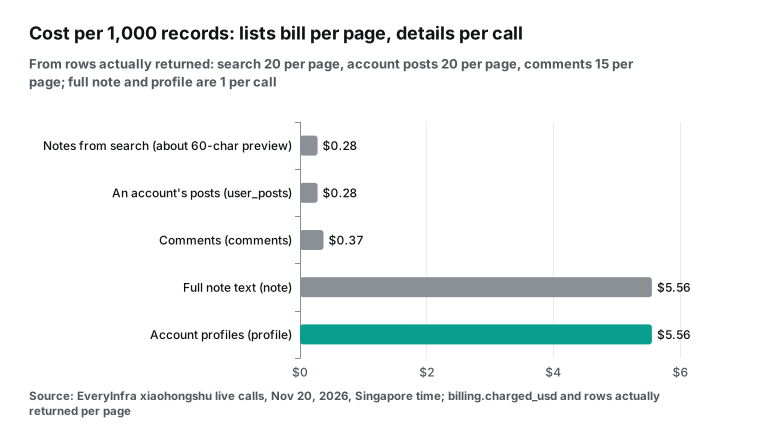
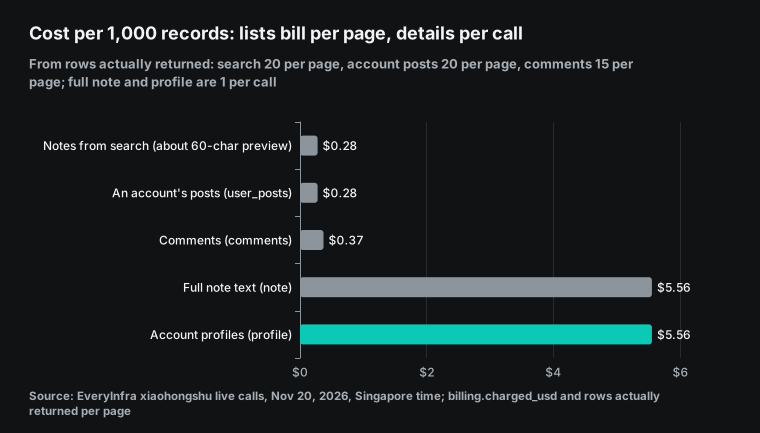
For trend and topic work, the title, preview and engagement counts are usually enough. Full text matters for content analysis and for training a classifier.
We also tested a nonsense keyword. At 00:19:07 we searched a random string plus "rednote" in the last 24 hours. The call returned 19 notes. None of them contained the random string in the title or text. They were casual posts from that day.
The call was billed $0.005556. The platform search tries to return something, and a non-empty result is billed. If you monitor keywords, filter the rows for relevance on your side. If you do not, unrelated posts inflate your share-of-voice numbers.
We ran the same search again 80 minutes later, and most results were new. At 01:35:17 we sent the same keyword with no sort value and got page 1 again. It took 3.56 seconds and returned 20 notes for $0.005556.
Only 2 of the 20 notes were in the 40 notes from 00:15. The note at position 1 at 00:15 was now at position 18. The note at position 7 moved to position 4. The authors of the other 18 notes were not among the 39 authors from the first search.
The new page had more recent posts. Ten notes were from the last 30 days, against 4 of 40 in the first search. The median like count was 149.5, against 539 on the first page at 00:15.
A relevance search changes from call to call, so treat one search as one sample. For share-of-voice or rank tracking, run the search several times and merge the rows by note id. Or set sort=newest with a date_range, so that each count covers a known time window. To collect more unique notes, you can also repeat a search later at the same price per page.
| Same keyword ("Singapore travel guide" in Chinese) | Page 1 at 00:15:16 | Page 1 at 01:35:17 |
|---|---|---|
| Notes returned | 20 | 20 |
| Notes in both searches | 2 | 2 |
| Posted in the last 30 days | 2 | 10 |
| Posted in 2026 | 15 | 18 |
| Posting dates | 2025-07-26 to 2026-11-16 | 2025-03-07 to 2026-11-19 |
| Median likes | 539 | 149.5 |
| Notes with 1,000+ likes | 7 | 3 |
| Video notes | 4 | 0 |
| Time / charge (USD) | 4.07 s / 0.005556 | 3.56 s / 0.005556 |
Test 2: comments come 15 per page and span eight months
At 00:17:13 and 00:17:24 we called xiaohongshu/comments twice on the hostel note, with sort set to newest. Each page returned 15 comments, so 30 comments in total with no duplicates. At this rate, 1,000 comments cost $0.37. The note detail reported 221 comments, so two pages covered 13.6%.
The newest comment was from November 10, 2026. The 30th comment was from March 12, 2026. The note was posted on November 30, 2025, and its comments came in slowly over the year.
The 30 comments had a total sub_comment_count of 22. That is 22 replies inside threads, which need xiaohongshu/sub_comments calls. Only 3 of 30 comments had an ip_location value: Guangdong, Beijing and Hebei. The other 27 were empty.
If you plan a location analysis on comments, expect much less location data than you see on notes. The median comment had 0 likes, and the top comment had 1. Two comments had images. The note author did not reply to any of the 30 comments.
The catalog describes the sort options in detail. default is the platform ranking. It reorders on each request, so paging can skip or repeat comments. newest is stable for paging, but for some notes the platform gives only the latest part.
A missing next_page_token means that the platform has no next page. It does not prove that you have every comment. To get as many as possible, page through default several times and merge on the comment id.
Rednote profile scraper: profiles and full post history
A rednote profile scraper reads the account page: followers, likes and saves, post count and verification. It usually also reads the list of the account's posts. We first used xiaohongshu/search_users with the Chinese name of the Singapore Tourism Board. At 00:15:29 it returned one business-verified account. At 00:16:06 we called xiaohongshu/profile on that account.
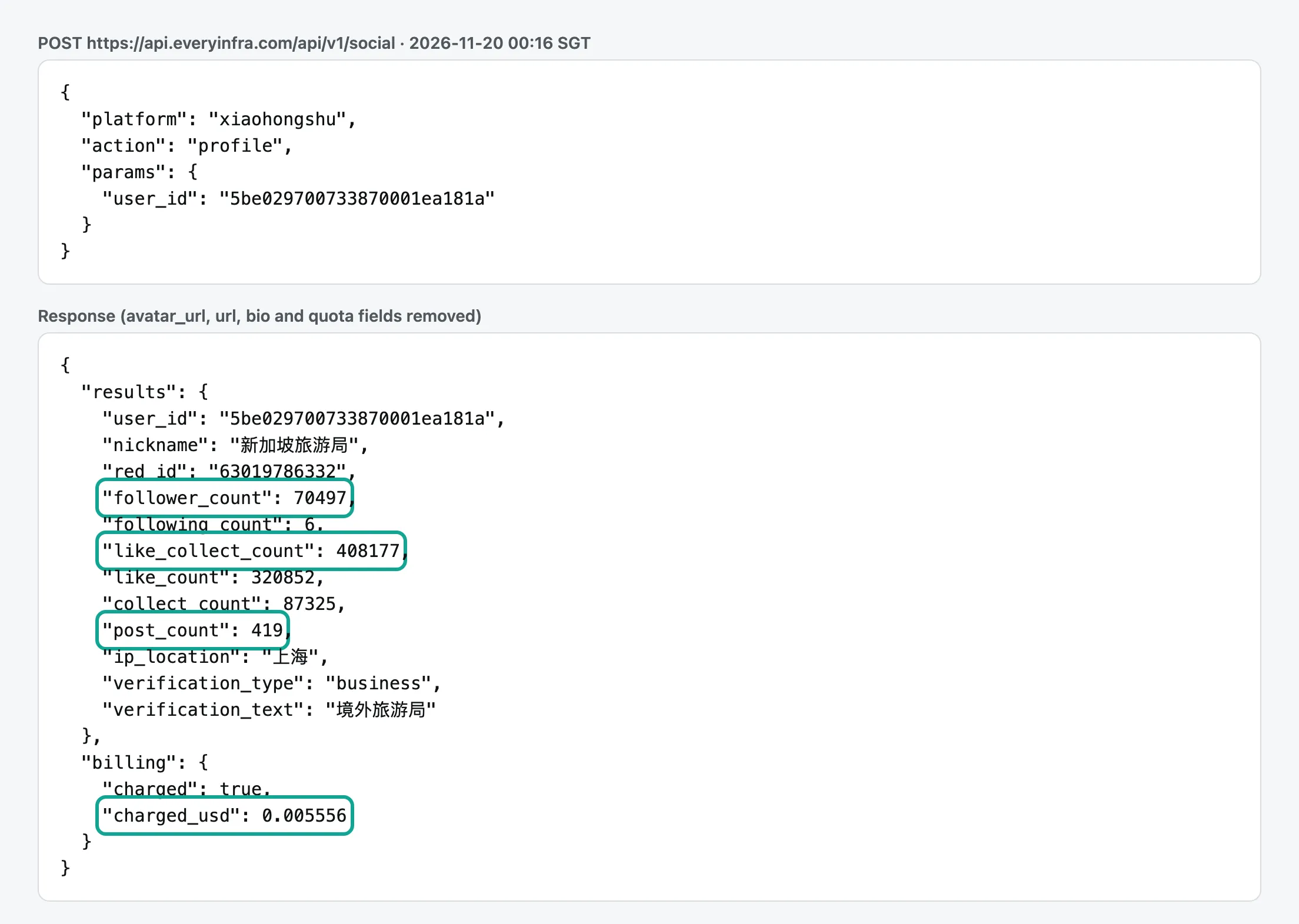
The profile showed 70,497 followers and 6 accounts followed. It had 408,177 likes and saves, which is 320,852 likes plus 87,325 saves. It had 419 posts. The verification text was "overseas tourism board" (our translation), and the IP location was Shanghai. The catalog lists 21 profile fields, and 18 had values.
The three empty fields were tags, real_name_info and location. This brand account shows no personal tags or region, and brand accounts do not show real-name data. We do not show the names, avatars or bios of private users in this article. Brand and institution accounts are fine to name.
At 00:16:16 we called xiaohongshu/user_posts. The first page returned 20 posts from September 17 to November 18, 2026, about two months. Three posts were videos. None was pinned, as is_pinned was false for all 20.
The catalog warns that pinned posts come first, so remove them before you analyze by date. Only 1 post had an ip_location value. This matches the catalog note that only some user_posts rows carry that field.
| Test | Rows | Newest date | Oldest date |
|---|---|---|---|
xiaohongshu/search, 2 pages, relevance order | 40 | 2026-11-17 | 2025-06-03 |
xiaohongshu/user_posts, page 1 | 20 | 2026-11-18 | 2026-09-17 |
xiaohongshu/comments, 2 pages, newest | 30 | 2026-11-10 | 2026-03-12 |
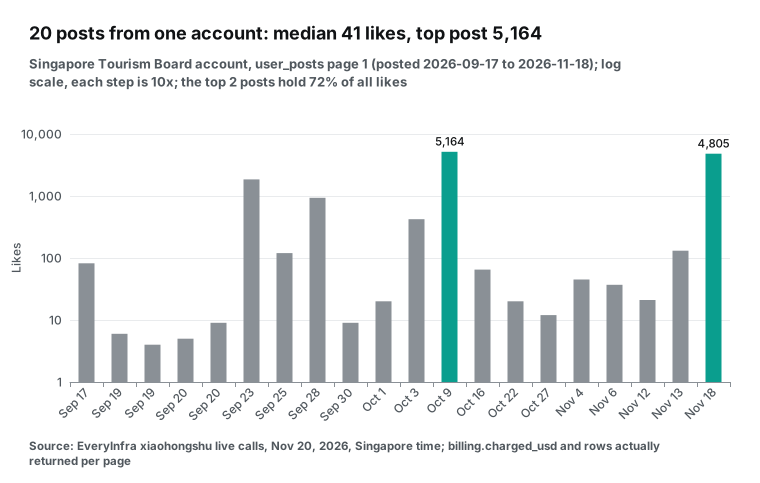
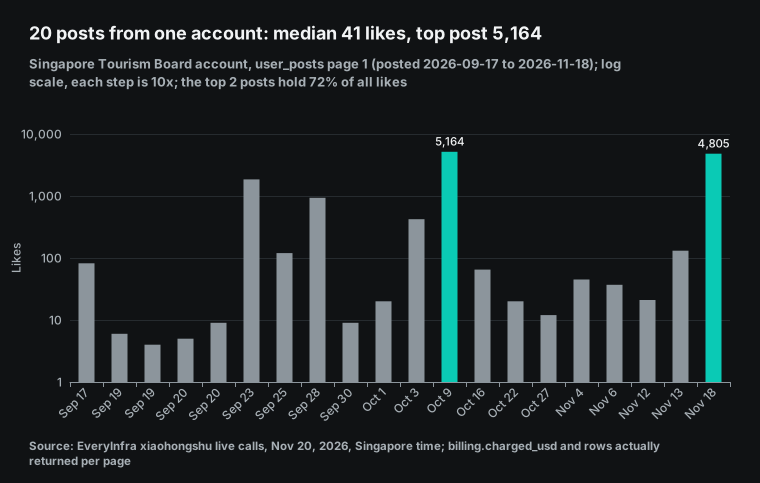
The 20 posts had a median of 41 likes and a median of 2.5 comments. The top two posts had 5,164 likes (October 9) and 4,805 likes (November 18). Together they held 72% of all likes in the 20 posts. An average would make this account look far more active than it is. Use the median when you compare accounts.
The lifetime likes and saves of 408,177 over 419 posts is about 974 per post. That is more than 20 times the recent median of 41. Older viral posts carry most of the lifetime total. A profile number alone overstates current engagement.
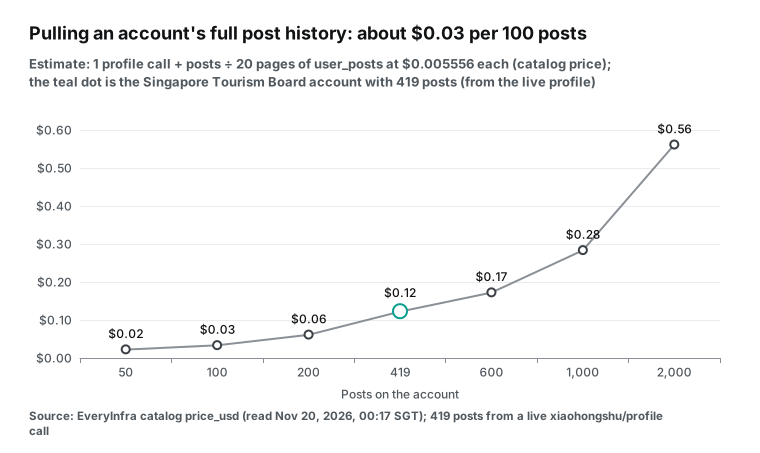
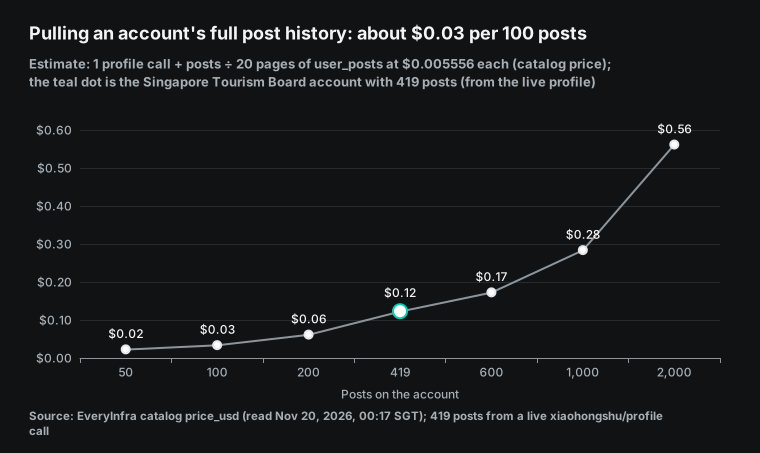
The cost of a full history is one xiaohongshu/profile call plus one xiaohongshu/user_posts call per 20 posts. For 419 posts that is 21 pages plus the profile, 22 calls, $0.12. Each extra 100 posts adds about $0.03.
At 00:50:28 we sent the next_page_token from page 1 and got page 2. It had 20 more posts with no overlap, from July 10 to September 16, 2026. That follows directly on September 17, the oldest post on page 1. The response still had a token for the next page. The median like count on page 2 was 301, more than 7 times the page 1 median of 41. Eleven of the 20 posts were videos.
The difference comes mostly from post age. Posts from two to four months ago had more time to collect likes, and recent posts are still growing. Compare posts of similar age. Do not average new and old posts together.
Paging is simple. Each row carries the same next_page_token. Send it back unchanged to get the next page, and stop when it is empty. The catalog says that the other parameters must not change while you page.
The Python code below collects all posts of one account. It waits for retry_after on a 429. It stops on a 422, because a bad parameter does not get better with a retry.
import os, time, requests

API = "https://api.everyinfra.com/api/v1/social"
HEAD = {"Authorization": f"Bearer {os.environ['EVERYINFRA_API_KEY']}"}

def call(action, params):
    while True:
        r = requests.post(API, headers=HEAD, timeout=120,
                          json={"platform": "xiaohongshu", "action": action, "params": params})
        if r.status_code == 429:
            time.sleep(r.json()["error"].get("retry_after", 30) + 1)
            continue
        r.raise_for_status()
        return r.json()

def all_posts(user_id):
    rows, token, spent = [], None, 0.0
    while True:
        p = {"user_id": user_id, **({"page_token": token} if token else {})}
        d = call("user_posts", p)
        rows += d["results"]
        spent += d["billing"]["charged_usd"]
        token = d.get("next_page_token")
        if not token:
            return rows, spent
RFC 6585 defines 429 as "Too Many Requests". A server can send Retry-After to tell the client how long to wait, and RFC 9110 defines that header. Our response puts the wait time in the JSON field retry_after, which is the same idea as in the MDN 429 reference. The key in this test had a limit of 10 requests per minute, and retry_after gave waits of 9 to 34 seconds. The extra second in the code keeps the retry clear of the boundary.
One profile read three times in 79 minutes
How often a profile changes tells you how often to read it. We read the same profile at 00:16, 00:50 and 01:35 Singapore time. The post count did not change, followers rose by 2, and likes and saves rose by 26.
| Read time (Singapore time) | follower_count | like_collect_count | like_count | collect_count | post_count |
|---|---|---|---|---|---|
| 00:16:06 | 70,497 | 408,177 | 320,852 | 87,325 | 419 |
| 00:50:18 | 70,497 | 408,190 | 320,862 | 87,328 | 419 |
| 01:35:04 | 70,499 | 408,203 | 320,872 | 87,331 | 419 |
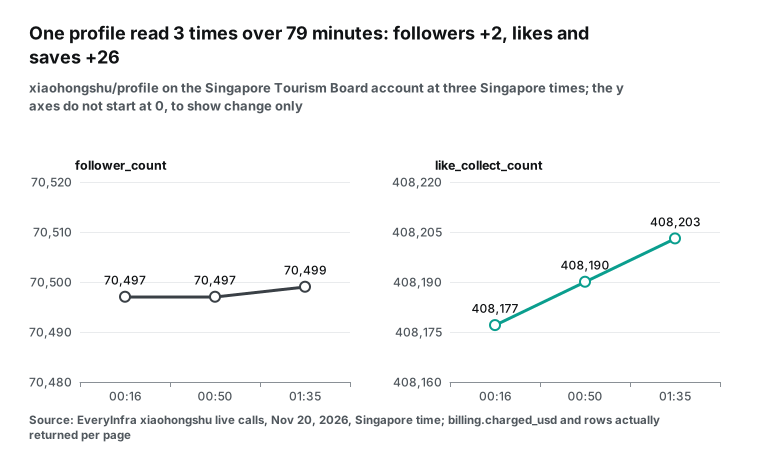
The post count stayed at 419 in all three reads. Followers rose by 2, and only in the second interval. Likes and saves rose by 13 in each interval, 26 in total over 79 minutes. That is 20 likes and 6 saves, or 0.006% of the total.
These reads were late at night in China, so the daytime rate can be different. For an account of this size, an hourly read shows followers that barely move and likes and saves that rise by about 20 per hour. A daily read shows the trend more clearly.
When you store profile snapshots, do not let an empty value replace the last good value. Treat it as "not returned this time", the same rule as for null in the field section below. The three profile reads cost $0.0167 in total.
Three uses for profile data and how often to read
The first use is creator due diligence. Before a campaign, a brand checks that a creator's followers, likes and saves, posting rate and recent engagement fit together. One read is enough. Pull the profile and the latest two or three pages of posts, and judge engagement by the median.
A due-diligence check costs 3 or 4 calls, about $0.02 per account. Our article on creator data due diligence lists the full steps.
The second use is competitor and creator monitoring. You track follower growth and new posts for a list of accounts. Read the profile once a day. New posts show up on the first page of xiaohongshu/user_posts.
Our test account posted 20 times in about two months, roughly once every three days. A weekly read of page one catches every new post. A daily read finds them on the day they appear. For a weekly brand report built on this kind of data, read our Xiaohongshu share-of-voice report for Southeast Asian brands.
The third use is research sampling. You start from a topic, find a set of authors and study their profiles. Coverage matters more than refresh here. One read per account is enough, and the cost scales with the number of authors.
Profiles cost $5.56 per 1,000 authors, and one page of posts per author adds another $5.56. Researchers should first check public datasets. Qilin is a multimodal search dataset from Xiaohongshu app sessions. RedNote-Vibe covers five years of posts with engagement counts.
| Use | What to read per account | Suggested rate | Calls per account per month | Cost per account per month (USD) |
|---|---|---|---|---|
| Creator due diligence | Profile + latest 3 pages of posts | Once | 4 | 0.02 |
| Monitoring | Profile + page 1 of posts | Daily | about 61 | 0.34 |
| Monitoring, low budget | Profile + page 1 of posts | Weekly | about 9 | 0.05 |
| Research sampling | Profile | Once | 1 | 0.0056 |
Field table: what the catalog lists and what came back
We compared the live responses of five capabilities with the response_fields list in the catalog. No response had a field outside the catalog. The table shows which listed fields were empty in every row of this test.
| Capability | Rows in this test | Fields in the catalog | Fields with a value in at least one row | Fields empty in every row |
|---|---|---|---|---|
xiaohongshu/profile | 1 | 21 | 18 | tags, real_name_info, location |
xiaohongshu/user_posts | 20 | 24 | 24 | none |
xiaohongshu/search | 40 | 30 | 25 | poi_id, poi_name, updated_at, video_width, video_height |
xiaohongshu/note | 1 | 28 | 24 | mentioned_users, lat, lng, updated_at |
xiaohongshu/comments | 30 | 20 | 18 | mentioned_users, comment_tags |
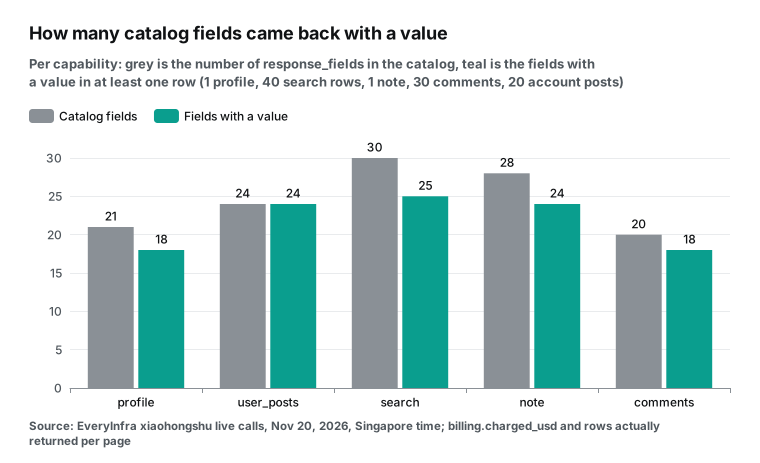
Most empty fields reflect the data, not a defect. In search, poi_id and poi_name appear only when a note card has a place tag, and none of the 40 notes had one. video_width and video_height apply to video notes, and the 9 video notes in this sample did not carry them. updated_at can be missing when a note was never edited.
A note has lat and lng only when its images carry a location. Empty values come back as null. The catalog says that null means "not public or not returned this time, not zero". Do not count null as zero when you calculate averages.
One more point affects comment analysis. In note results, author_id has 24 characters and matches the ID in the profile link. In comment results, it usually has 29 characters in a different format. One person can appear under two IDs. Before you deduplicate people across data sets, call xiaohongshu/profile and use the user_id that it returns. Do this before a cross analysis such as "which commenters also posted notes on this topic".
Clean the data before you store it
First, store null and zero apart. Allow nulls in columns such as like_count and collect_count, and exclude nulls in statistics. Do not fill them with zero.
Second, links expire. The url from search, note and profile carries an access token called xsec_token. A browser without login can open it, but the token has a time limit. video_url carries a signature and also expires.
Download what you must keep. Or store only the note ID and call xiaohongshu/note for a fresh link when you need one. Links from user_posts have no token and do not open in a browser, which is different from search.
Third, deduplicate people on one ID type, as the field section explains.
Fourth, handle pinned posts and time zones. Remove rows with is_pinned set to true before you plot by date. posted_at and updated_at are in UTC. A note posted at 15:30 UTC falls on the next day in Singapore and in most of Asia.
On page 1 of our test account, 12 of 20 posts went out between 10:00 and 10:45 UTC, about 18:00 in Singapore. Five went out at 04:01 or 04:02 UTC, which is noon in Singapore. Daily totals by UTC date are correct for this account, but an hourly chart of posting times needs the time zone conversion first.
Fifth, filter search rows for relevance on the title and preview, for the reason in the nonsense-keyword test. With English keywords, that check runs on Chinese text, so translate the keyword first.
Sixth, record the source of each follower count. For one account, search_users gave 70,000 and profile gave 70,497. If you mix the two in one column, one change of source adds 497 "new followers". Add a source column and compute growth only from values of one source.
Failed and empty results: what gets billed
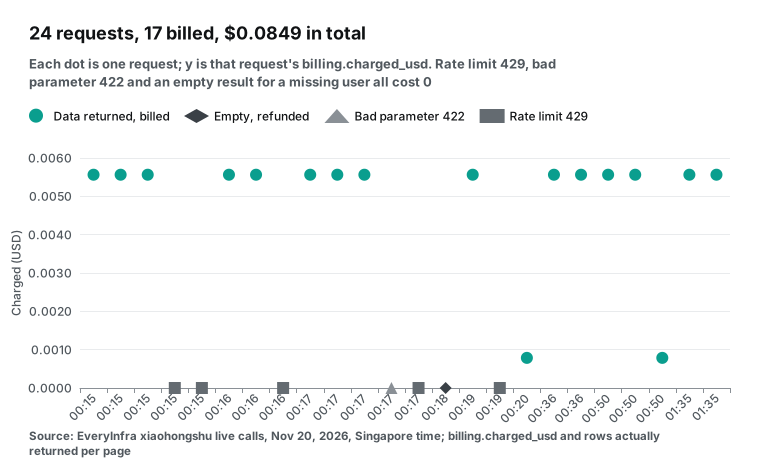
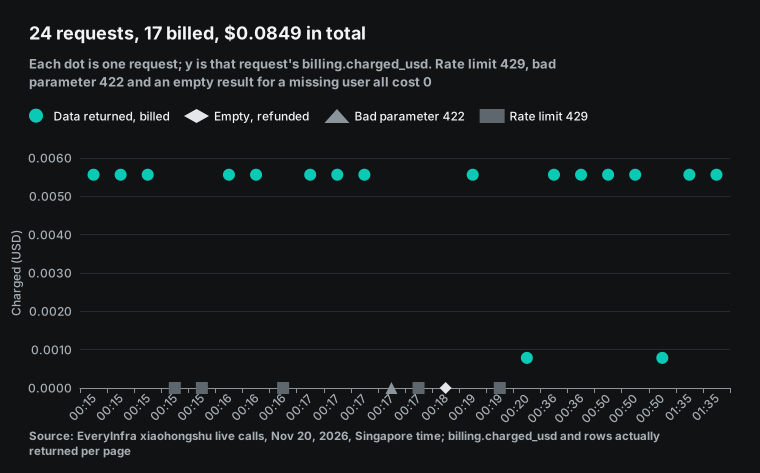
Three kinds of request in this test returned no data. Five were 429 rate-limit responses that we hit during consecutive calls. One was a 422 from a parameter that we added on purpose. One was an empty result for an ID that does not exist, also on purpose. We read billing.charged_usd each time.
| Time (Singapore time) | Request | HTTP status | What came back | Charged (USD) |
|---|---|---|---|---|
| 00:15:37, 00:15:45, 00:16:26, 00:17:43, 00:19:51 | profile, user_posts, note, profile, youtube/search (this key's limit of 10 requests per minute) | 429 | rate_limited, retry_after 22, 15, 34, 16 and 9 s | 0 |
| 00:17:35 | profile with an extra fields parameter | 422 | unknown_param, only user_id allowed, plus a working example | 0 |
| 00:18:03 | profile with a 24-character ID that does not exist | 200 | empty results, reason: empty_result_refunded, refund.status: succeeded | 0 |
| 00:19:07 | search with a nonsense keyword, last 24 hours | 200 | 19 unrelated notes | 0.005556 |
The 422 response has three parts. The message says that fields is not a parameter of xiaohongshu/profile, that user_id is required, and that there are no optional parameters. It gives the catalog URL and a request example that works. Its next_steps field says "Nothing was charged".
A program or an AI model can read that response and fix the call. The 429 response carries retry_after. We waited that long and the retry worked each time. The empty result is charged and then refunded, and the refund status is in the same response.
The full billing rules are in our failure refund reconciliation guide.
From one topic to a list of accounts
The r/OSINT question asks two things. How do you find users who post about a topic, and how do you scrape their profiles and post history? The capabilities above answer both. Our 40 search results for the Singapore keyword came from 39 different authors.
Only one author appeared twice. Fourteen of the 40 notes had 1,000 likes or more. At that rate, 10 pages (200 notes) give close to 200 authors.
The flow has four steps, all on public data. Search 10 pages with xiaohongshu/search for $0.056, which gives 200 notes and their author_id values. Deduplicate on author_id, sort by engagement and keep the top 50 authors. Call xiaohongshu/profile on each of the 50 for $0.28. Then call one page of xiaohongshu/user_posts for each author, another $0.28. The whole list costs about $0.61.
Two details matter in this flow. Relevance sorting mixes in old notes, and our oldest note was from June 3, 2025. For recently active authors, add sort=newest or date_range=last_30_days. The catalog says that a last_30_days page can have fewer than 20 rows, and an empty page is free.
Brand and institution accounts also enter the list. In our 40 search rows, author_is_verified was false for every row, so the search layer did not separate them. Read the profile and use verification_type (individual, business, other) and verification_text. Do not use is_verified alone. The Singapore Tourism Board example above shows why.
A monthly budget: 200 accounts read every week
A brand team tracks 200 competitor and creator accounts. Each week it reads the profile, the first page of posts and the first comment page of the 3 newest posts. The calls and the cost are fixed. The number of comments depends on each note, so the table gives two comment rows. The full-page row assumes 15 comments on every page. The measured row uses the median comment_count of 2.5 on the 20 newest posts of the Singapore Tourism Board account.
| Action | Calls per week | Rows per week | Cost per week (USD) |
|---|---|---|---|
xiaohongshu/profile | 200 | 200 profiles | 1.11 |
xiaohongshu/user_posts page 1 | 200 | 4,000 posts | 1.11 |
xiaohongshu/comments page 1 × 3 posts (full pages) | 600 | up to 9,000 comments | 3.33 |
xiaohongshu/comments page 1 × 3 posts (measured median) | 600 | about 1,500 comments | 3.33 |
| Total (either comment row) | 1,000 | 5.56 |
The measured row comes from page 1 of user_posts. Seven of those 20 posts had 0 or 1 comment. Ten had 2 to 19 comments. The last three had 114, 150 and 1,586. The median was 2.5, 17 posts had fewer than 15 comments, and 3 posts had none. The 3 newest posts had 1,586, 3 and 1 comments, so the first pages could hold at most 15 + 3 + 1 = 19 comments, not 45.
On the measured row, the real price is about $2.22 per 1,000 comments, 6 times the full-page price of $0.37. A note with no comments returns an empty result, and empty results are not billed. At 3 of 20, about 90 of the 600 pages would be free. That brings the comment cost to about $2.83 per week, and the total to about $5.06 per week.
At 4.33 weeks per month, the full-page budget is about $24.08 per month, or about $21.91 after the free empty pages. For the self-built cost, see the staff-time estimate in Route 1: about $1,031 per month in US developer time before servers, proxies and banned accounts. To compare a monthly tool, check its quota against these rows. Each week the job reads 200 profiles and 4,000 posts. Add the comments that your own accounts really get, about 1,500 for this account.
The right comment row depends on the targets. The 40 travel notes from our search had a median of 27 comments, and 28 of them had 15 or more. For popular notes like these, first pages are mostly full, and the full-page row is closer.
Post age matters too. Page 2 of the account (posts from July 10 to September 16, 2026) had a median of 11.5 comments and a maximum of 201. That is 4.6 times the page 1 median of 2.5. A weekly read of the 3 newest posts gets few comments. To study comment threads, pick older posts as well.
Comments are 60% of this budget. If you only need to know which account grew and which post went viral, skip comments at first. That brings the monthly cost to about $9.63. Pull comments only for a post with likes far above the account median, for example 10 times the median. Our test account has a median of 41, so the line is 410 likes, and 5 of its last 20 posts crossed it.
Recent platform and policy news
- November 16, 2026: the Taipei Times reported that Taiwan has blocked Xiaohongshu with DNS restrictions since December 4, 2025. The interior ministry expects to extend the restriction for one more year from December 3.
- November 13, 2026: TechNode and Ebrun reported that Xiaohongshu is testing Dada, a standalone app where users turn their experience into AI agents. With the user's permission, an agent can read public Xiaohongshu profile information.
- November 16, 2026: CNBC wrote that local fashion brands use Xiaohongshu for discovery. The article compared brands by the follower counts of their official accounts, from 200,000 to more than 300,000 for one account.
- November 10, 2026: DoNews reported that a well-known charity blogger was thinking of leaving Xiaohongshu. The reason: posting contact details required a CNY 10,000 advertising deposit. A Sohu timeline added that the self-service ad account needs a first top-up of CNY 10,000. If a monitored account stops posting, a platform rule can be the cause, not the account itself.
When a pay-per-call API is the wrong choice
A pay-per-call API has limits. It reads only what a public page shows. Some data is behind a login, such as private messages, your own account analytics or creator rate cards. For that data, use the Xiaohongshu open platform or your own dashboard.
For a real-time stream at second-level latency, per-call latency and a per-minute rate limit do not fit. In this test, calls that returned data took 1.3 to 13.8 seconds each. At tens of millions of rows per day, with your own legal and data-compliance team, a self-built system can cost less. Count the long-term staff time for the gates above when you compare.
Our sample is small. It covers two keywords, one note and one brand account. Some ratios can be very different on another note or account. Examples are 3 of 30 comments with a location, 4 of 9 videos with a link, and a median of 2.5 comments per post. Run one round on your own targets before you plan a budget.
FAQ
How do I write search terms that find users who post about a topic?
This is the first part of an r/OSINT question. In our test, the Chinese keyword for "Singapore travel guide" gave 40 notes from 39 authors. The English keyword "Singapore travel tips" gave 20 notes, all in Chinese, and only 1 of them overlapped. Write search terms in Chinese for the most direct match. To find an account by name, use xiaohongshu/search_users. The full flow is in the section "From one topic to a list of accounts".
How do I scrape user profiles and post history on RedNote?
This is the second part of the same r/OSINT question. Call xiaohongshu/profile once per account, then page through xiaohongshu/user_posts with next_page_token. The 419-post Singapore Tourism Board account took 22 calls, about $0.12. The paging code is above.
Do I need to log in to scrape RedNote?
For a self-built scraper, almost always. The r/webscraping question is about the registration dialog on the web app. EveryInfra authenticates each call with an EveryInfra API key. Our 24 test calls carried only that key, and the responses held fields that a public page shows.
Why does my RedNote scraper get logged out?
The r/DataHoarder post describes this: after a scraper with cookies ran for a while, one click in the web app logged the account out. Route 1 above covers the self-built side. With the API, the limit that you meet is the key limit of 10 requests per minute. It returns 429 with retry_after, and our 5 rate-limited calls cost $0.
Is there a YouTube tutorial for a rednote scraper?
At 00:20 Singapore time on November 20, 2026, we searched "rednote scraper" with youtube/search. All 10 results were app tutorials, sign-in guides and news clips from early 2025. One example is a RedNote beginner tutorial uploaded on November 14, 2026. None of them showed scraping.
At 00:50 we also searched "xiaohongshu scraper". The first result was a 75-second demo of a desktop scraping tool from 2023, with 432 views. The next two were a video-downloader demo and a news clip from early 2025. None covered profile scraping or API calls.
Get started
- Get an API key in the quickstart. New accounts get a trial credit.
- Open the Xiaohongshu data API page. Select profile, user posts, comments or search, and run one test call.
- Connect your program with the curl example above, or connect an AI tool with the MCP configuration below.
MCP is an open protocol. The specification and the server concepts guide are public. Our endpoint and tool list are on the MCP server page. With this configuration, you can ask Claude or Cursor to "show the engagement of this account's last 20 posts".
{
  "mcpServers": {
    "everyinfra": {
      "type": "http",
      "url": "https://api.everyinfra.com/mcp",
      "headers": { "Authorization": "Bearer ${EVERYINFRA_API_KEY}" }
    }
  }
}
Two earlier articles cover nearby topics. Xiaohongshu data collection: search, notes and comments explains the collection flow, and Xiaohongshu API pricing explains the billing units. For official and third-party API options, read Xiaohongshu API: official vs third-party.
References
- Xiaohongshu robots.txt, Xiaohongshu, read Nov 20, 2026, <https://www.xiaohongshu.com/robots.txt>
- Xiaohongshu user agreement, Xingyin Information Technology, version of Mar 23, 2026, <https://agree.xiaohongshu.com/h5/terms/ZXXY20220331001/-1>
- Xiaohongshu Security Response Center reward rules, Xiaohongshu Security, Aug 18, 2026, <https://security.xiaohongshu.com/announcements/23>
- Xiaohongshu open platform API documentation, Xiaohongshu, read Nov 20, 2026, <https://open.xiaohongshu.com/document/api>
- EveryInfra data API catalog (Xiaohongshu), EveryInfra, read Nov 20, 2026, <https://api.everyinfra.com/api/v1/social/catalog?platform=xiaohongshu>
- EveryInfra data API catalog (all), EveryInfra, read Nov 20, 2026, <https://api.everyinfra.com/api/v1/social/catalog>
- Anti-Unfair Competition Law of the PRC (2025 revision), CSRC Beijing Bureau, Sep 10, 2025, <https://www.csrc.gov.cn/beijing/c105536/c7582544/content.shtml>
- Network Data Security Management Regulations (State Council Decree 790), Ministry of Ecology and Environment, Oct 3, 2024, <https://www.mee.gov.cn/zcwj/gwywj/202410/t20241003_1087417.shtml>
- Personal Information Protection Law of the PRC, Cyberspace Administration of China, Aug 20, 2021, <https://www.cac.gov.cn/2021-08/20/c_1631050028355286.htm>
- Typical anti-unfair competition cases of 2026, Supreme People's Court, Sep 9, 2026, <https://www.court.gov.cn/zixun/xiangqing/511301.html>
- Scraping Xiaohongshu user data for profit, damages of CNY 1.1 million, ciplawyer.cn, Oct 28, 2025, <https://www.ciplawyer.cn/articles/157825.html>
- Illegal scraping of Xiaohongshu data, three people sentenced, ipeconomy.cn, Mar 14, 2025, <https://www.ipeconomy.cn/dongtai/9167.html>
- Taiwan to extend RedNote restrictions again: sources, Taipei Times, Nov 16, 2026, <https://www.taipeitimes.com/News/taiwan/archives/2026/11/16/2003867815>
- Xiaohongshu tests standalone app for users to build and share AI agents, TechNode, Nov 13, 2026, <https://technode.com/2026/11/13/xiaohongshu-tests-standalone-app-for-users-to-build-and-share-ai-agents/>
- "Diandian" then "Dada": Xiaohongshu adds another AI app, Ebrun, Nov 13, 2026, <https://www.ebrun.com/20261113/720097.shtml>
- As Nike, Lululemon struggle in China, Xiaohongshu helps local brands, CNBC, Nov 16, 2026, <https://www.cnbc.com/2026/11/16/as-nike-lululemon-struggle-in-china-xiaohongshu-helps-local-brands.html>
- Inter: new official channels in China on Bilibili and REDnote, FC Internazionale Milano, read Nov 20, 2026, <https://www.inter.it/en/news/inter-new-official-channels-china-bilibili-rednote>
- Over half a million 'TikTok refugees' flock to China's RedNote, Reuters, Jan 14, 2025, <https://www.reuters.com/technology/over-half-million-tiktok-refugees-flock-chinas-rednote-2025-01-14/>
- Refugees of the Digital Space: Platform Migration from TikTok to RedNote, arXiv 2510.18894, Oct 19, 2025, <https://arxiv.org/abs/2510.18894>
- Rejection or Inclusion in the Emotion-Identity Dynamics of TikTok Refugees on RedNote, arXiv 2507.14623, Jul 19, 2025, <https://arxiv.org/abs/2507.14623>
- RedNote-Vibe: A Dataset for Capturing Temporal Dynamics of AI-Generated Text, arXiv 2509.22055, v2 Apr 11, 2026, <https://arxiv.org/abs/2509.22055>
- Qilin: A Multimodal Information Retrieval Dataset with APP-level User Sessions, arXiv 2503.00501, Mar 1, 2025, <https://arxiv.org/abs/2503.00501>
- RFC 9309: Robots Exclusion Protocol, IETF, Sep 2022, <https://www.rfc-editor.org/rfc/rfc9309.html>
- RFC 6585: Additional HTTP Status Codes, IETF, Apr 2012, <https://datatracker.ietf.org/doc/html/rfc6585>
- RFC 9110: HTTP Semantics, IETF, Jun 2022, <https://datatracker.ietf.org/doc/html/rfc9110>
- WebDriver, W3C, read Nov 20, 2026, <https://www.w3.org/TR/webdriver2/>
- urllib.robotparser, Python documentation, read Nov 20, 2026, <https://docs.python.org/3/library/urllib.robotparser.html>
- playwright 1.65.2, PyPI, read Nov 20, 2026, <https://pypi.org/project/playwright/>
- Authentication, Playwright documentation, read Nov 20, 2026, <https://playwright.dev/docs/auth>
- Model Context Protocol Specification 2025-06-18, MCP, <https://modelcontextprotocol.io/specification/2025-06-18>
- Understanding MCP servers, MCP documentation, read Nov 20, 2026, <https://modelcontextprotocol.io/docs/learn/server-concepts>
- Headless Chrome, Chrome for Developers, read Nov 20, 2026, <https://developer.chrome.com/docs/chromium/headless>
- 429 Too Many Requests, MDN, read Nov 20, 2026, <https://developer.mozilla.org/en-US/docs/Web/HTTP/Reference/Status/429>
- Software Developers, Quality Assurance Analysts, and Testers, US Bureau of Labor Statistics, read Nov 20, 2026, <https://www.bls.gov/ooh/computer-and-information-technology/software-developers.htm>
- Euro foreign exchange reference rates, European Central Bank, Nov 19, 2026, <https://www.ecb.europa.eu/stats/eurofxref/eurofxref-daily.xml>
- Has anyone had success scraping chinese ig/xiaohongshu?, Reddit r/DataHoarder, read Nov 20, 2026, <https://www.reddit.com/r/DataHoarder/comments/1mp1t8p/has_anyone_had_success_scraping_chinese/>
- get past registration or access the mobile web version for scrap, Reddit r/webscraping, read Nov 20, 2026, <https://www.reddit.com/r/webscraping/comments/1kmbow1/get_past_registration_or_access_the_mobile_web/>
- Rednote (Xiaohongshu) help? Crafting better search terms, scraping user profiles, Reddit r/OSINT, read Nov 20, 2026, <https://www.reddit.com/r/OSINT/comments/1jcyu18/rednote_xiaohongshu_help_crafting_better_search/>
- Xiaohongshu Statistics and User Demographics for 2026, Marketing to China, Nov 8, 2026, <https://marketingtochina.com/xiaohongshu-statistics-and-trends/>
- How to Use RedNote App for Beginners (2026), YouTube, Nov 14, 2026, <https://www.youtube.com/watch?v=La3LBsnGb4I>
- Regulation (EU) 2016/679 (GDPR), EUR-Lex, <https://eur-lex.europa.eu/eli/reg/2016/679/oj>
- Well-known charity blogger considers leaving Xiaohongshu over a CNY 10,000 deposit to post contact details, DoNews, Nov 10, 2026, <https://www.donews.com/news/detail/1/6771424.html>
- Charity blogger considers leaving Xiaohongshu (timeline), Sohu, Nov 10, 2026, <https://timeline.sohu.com/news/NHCzZpqLp4?from=news>
Reference BL-198