Claude Ads Connector: Research Competitor Ads Before You Launch
Claude ads connectors draft paused campaigns from your own data. We pulled live Meta and Google ad library data on 3 shoe brands; one round costs $0.017.
On November 3, 2026, Supermetrics said Claude can now create and edit campaigns on six ad platforms. They are Google Ads, Meta, Microsoft Advertising, TikTok, LinkedIn and Snapchat. Every new campaign stays paused until a person approves it. On November 10 it added ChatGPT Ads, for seven platforms.
This Claude ads connector reads and writes your own ad accounts. It does not show what your competitors run. On November 13, 2026, we used the EveryInfra remote MCP server to pull live data from two public libraries. They are the Meta Ad Library and the Google Ads Transparency Center.
We checked three shoe brands: Allbirds, Vessi and HOFF. Vessi started its Black Friday ads on November 3, six days before Allbirds. A search for the brand name "HOFF" returned 49 ads, and only 18 came from the HOFF Page. One round of pre-launch competitor research (3 capabilities, 7 calls) costs about $0.017 at catalog prices. Three competitors, once a week, cost about $0.22 a month.
This article is for two groups. The first is small direct-to-consumer (DTC) teams that run their own Meta and Google ads. The second is agencies that run ads for brands. Both now have the same new tool. A Claude ads connector can turn "CPA went up last week, try new creative" into a paused campaign that waits for approval.
But the model plans that campaign from your own account history. It cannot see which product your competitor pushes this week or how deep the discount is. It also cannot see if they use video or images, or how long one headline has run. That information is in public ad libraries, not in your ad account.
Our method adds one more connector to the same Claude conversation. Claude uses the EveryInfra remote MCP server to look at competitors first. It writes the findings into a fixed card. Then the ad connector drafts the campaign from that card.
We did not sign in to Claude with a real ad account on our test machine. So the Claude and Supermetrics steps below are a configuration example from their official documents. Every EveryInfra number comes from the raw response of a live call.
What the Claude ads connector is: two Supermetrics announcements
In search suggestions, "claude ads connector" comes with meta, google, facebook and linkedin. In most cases it means the Supermetrics connector for Claude. We checked the two November announcements against the Supermetrics documentation, line by line.
The press release of November 3, 2026 (PR Newswire) says marketers can analyze performance in Claude. Then they can create or change campaigns on the six platforms. It says campaigns created through the integration stay paused until someone reviews and approves them. It also gives two numbers: more than 6,000 customers have used the Claude connector since February, and active users grew 250% a month on average.
PPC Land reported the same day under the phrase "paused by default". The report noted three gaps in the announcement. It did not say which ad types Claude can build or whether it can change bids. It also did not say whether each platform supports the same actions.
One week later the story changed. On November 10, 2026, Supermetrics published Introducing Supermetrics Campaign Management. The list grew to seven platforms with ChatGPT Ads.
The post says Claude can change budgets, bids, targeting, ads and creative. It adds a usage number: from June to October 2026, more than 23,000 teams made more than 570,000 campaign changes through Supermetrics. PPC Land's follow-up on November 10 noticed that the release did not repeat the "paused by default" line.
So we went back to the documentation. The Supermetrics article How to manage ad campaigns with AI tools says all new campaigns are created in a paused state. It lists the same seven platforms as the November 10 post. They are Google Ads, Facebook Ads, Microsoft Advertising, TikTok Ads, ChatGPT Ads, LinkedIn Ads and Snapchat Marketing.
| Item | What the source says | Source and date |
|---|---|---|
| Ad platforms | Nov 3: six (Google Ads, Meta, Microsoft Advertising, TikTok, LinkedIn, Snapchat). Nov 10: ChatGPT Ads added, seven in total | Press release 2026-11-03; Supermetrics blog 2026-11-10 |
| New campaigns | Always created paused; a person turns them on | Supermetrics docs, read 2026-11-13 |
| Write access | Off by default, turned on per ad account by the person who owns the connection | Supermetrics docs, "How to enable campaign write access" |
| Approval modes | No human approval, Going live, Budget + going live, All live changes | Supermetrics blog 2026-11-10; docs |
| Price | Starter $59 monthly or $44 a month billed yearly; Growth $222 monthly or $177 a month billed yearly; both list Campaign Management | Supermetrics pricing page, read 2026-11-13 |
| Extra fee | In October 2026, early access included in current plans at no extra cost | Supermetrics blog 2026-10-08 |
On November 13, 2026, the Supermetrics pricing page showed Starter at $59 billed monthly or $44 a month billed yearly. Starter includes 1 destination (Claude, ChatGPT or Copilot), 2 data sources, 2 accounts per data source and 1 user.
Growth was $222 monthly or $177 a month billed yearly, with 7 data sources and 2 users. Both plans list "Campaign Management". The post What AI agents can change in your ad accounts (October 8, 2026) says AI campaign management was in early access.
It was part of existing plans at no extra cost. The Supermetrics for Claude documentation adds that you do not need an account first. If you have no plan, a trial starts when you sign in.
So the entry cost for drafting ads with Claude is one Starter plan. That plan covers your own accounts and data sources. Competitor data is a separate problem.
What "paused by default" protects, and what it does not
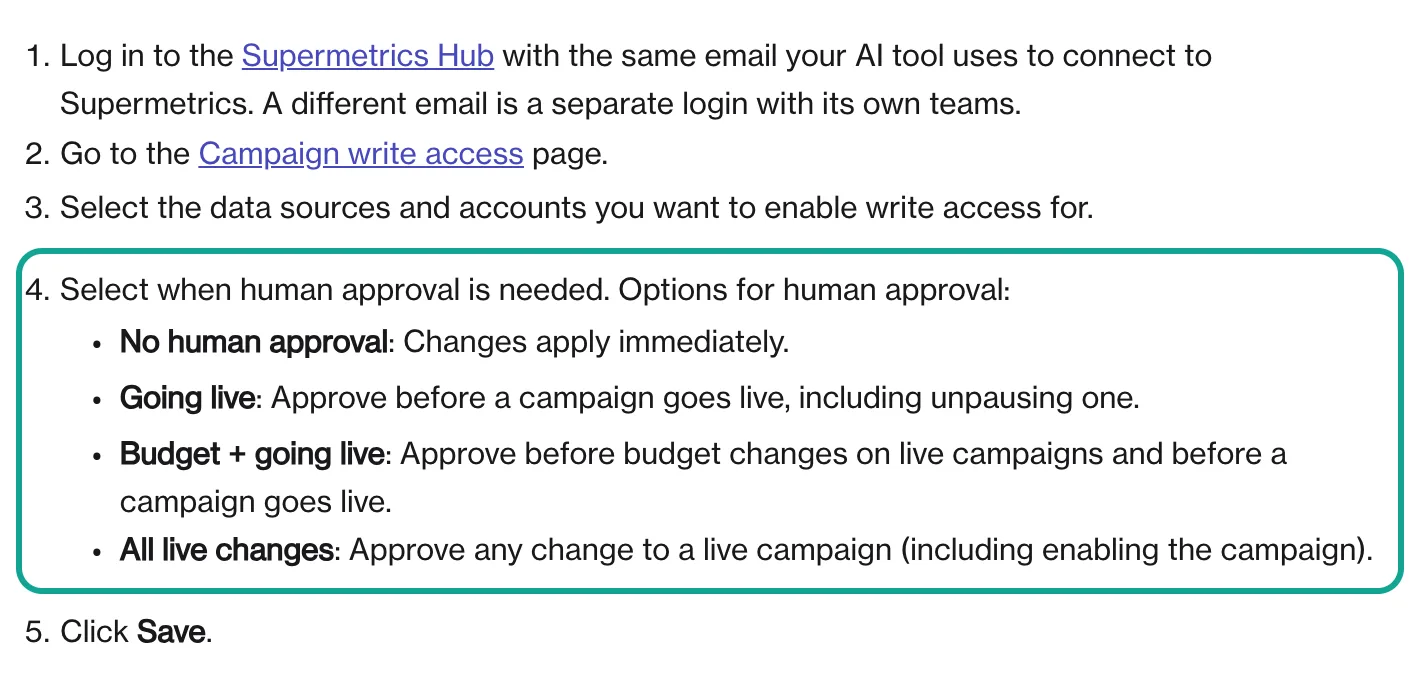
A paused draft answers one question: if the model builds the wrong thing, does it spend money right away? The Supermetrics write-access article says write access is off by default and is turned on per ad account. Until you turn it on, Claude can read and analyze but cannot change anything. Then you choose an approval mode.
With no approval, changes apply at once. "Going live" stops only the step that turns a campaign on. "Budget + going live" also stops budget changes on live campaigns. "All live changes" stops every change to a live campaign.
The Meta campaign article adds a budget limit. The Supermetrics support team sets, per team, how far one change can move a budget, as a percentage. A larger change must be split into steps.
Every change goes into the Campaign change history. The restore article says you can restore budget, status, name, dates, bidding, targeting, URL tags and ad settings. You cannot recover a removed campaign.
Meta's own Ads MCP server uses a different control called rules. The Meta rules guide (updated August 12, 2026) says one rule blocks one kind of agent action on one ad account or catalog. You can block new campaigns, new ad sets, new ads, targeting changes, creative changes, or delivery status changes. For budgets, you can block increases above a percentage, above an amount, or above a ceiling.
The guide's example is "deny any budget increase above 20%". You can set rules one account at a time in Business Suite, or in bulk through the Marketing API. The guide also says rules have limited availability, and a business that is not enrolled gets error code 10. Meta's developer blog of July 16, 2026 recommends that you start an account as read-only or approval-required and widen access as trust grows.
The MCP protocol asks for the same thing. The Tools section of the MCP specification (2025-06-18) says clients should ask the user to confirm sensitive operations. Clients should also show tool inputs to the user before they call the server.
| Control | Supermetrics | Meta Ads MCP | Google Ads MCP (open source) |
|---|---|---|---|
| New campaigns | Always paused | Can be saved as drafts | Cannot create campaigns |
| Who turns on writes | Owner of the data source connection, per account | Permissions granted in OAuth, rules per account | tools_config.yaml on the server |
| Budget guard | Per-team percentage cap set by support | Rules: percentage, amount or ceiling | No budget tools |
| Approval | 4 modes, from none to all live changes | Rules deny actions; read-only start suggested | Propose, then confirm with a checksum |
| Undo | Restore most fields; removed campaigns lost | Activity log | n/a |
All of these controls work after the draft exists. Before the draft, the model's inputs decide where the draft goes. In its "Campaign planning" section, the Supermetrics documentation says "research before you build": pull historical performance data for similar targeting and creatives from your own accounts. Your own history can tell you which creative had the lowest CPA. It cannot tell you what discount a competitor offers this week.
Meta's connector has the same limit. The Meta Business Help Center page on ads AI connectors lists the features. They include reporting, ad creation and editing, custom audiences, catalogs, signal diagnostics, A/B tests and activity logs. All of these work on your own ad account.
Good competitor input has three properties. It comes from a public library that anyone can check, with a link back to each ad. Its fields are fixed, so the model does not guess.
And one check costs so little that you can run it every week. The Meta Ad Library and the Google Ads Transparency Center are the public libraries of the two largest ad platforms. The EveryInfra capability catalog lists four capabilities for them: facebook/advertiser_search, facebook/ads, facebook/ad_detail and google_ads_transparency/ads. Our research round uses the last three.
Claude facebook ads MCP: what each option reads
A search for "claude facebook ads mcp" mixes several things. You see Meta's own Ads MCP and the Supermetrics connector. You also see Google's open-source Google Ads MCP and MCP servers that read public ad libraries. The difference is whose data each one reads and whether it can write. We checked each one against its official documentation.
| Option | Reads | Writes | Sign-in | Source |
|---|---|---|---|---|
| Supermetrics for Claude | Your connected ad accounts and data sources | Yes; write access per account, new campaigns paused | Supermetrics account plus each ad platform | Supermetrics docs |
| Meta Ads MCP (mcp.facebook.com/ads) | Meta ad accounts you can access | Yes; drafts available, admins can block actions per account | Meta account | Meta developer docs, Help Center |
| Google Ads MCP (open source, v0.0.6) | Google Ads accounts you can access | Assets and labels only, propose then confirm | Google Ads authorization | GitHub releases |
| EveryInfra remote MCP | Public data: Meta Ad Library, Google Ads Transparency Center and more | No; read-only | One EveryInfra API key; no ad platform sign-in | EveryInfra capability catalog |
The Meta developer documentation says Meta hosts the Ads MCP server at https://mcp.facebook.com/ads and any MCP-capable agent can connect. Meta put it into open beta together with the ads CLI in its announcement of April 29, 2026. The ads CLI developer post says new campaigns, ad sets and ads are created as PAUSED by default.
On the Google side, the google-ads-mcp releases page shows that v0.0.6 added asset and label management with a propose-and-confirm flow. The Google Ads API MCP integration guide describes reporting, asset creation, video upload and label management. PPC Land reported that it still cannot change budgets.
Meta's MCP overview (updated November 12, 2026) warns that an agent can call anything your permissions allow without asking you first. This includes calls that hidden instructions in tool output cause. So it recommends read-only access unless the agent needs to make changes.
Connect an MCP client to Meta (updated October 29, 2026) gives a useful test. The connection works when the tool list is not empty and a read-only call returns data.
The google-ads-mcp README says every write tool uses two steps, and the second step must send back the checksum from the first. For a strictly read-only server, set labels and assets to false in tools_config.yaml.
You can put all four options in one Claude conversation. EveryInfra looks at others, and Supermetrics or Meta Ads MCP changes your own account.
We read the comments under two YouTube tutorials. Under a Meta Ads MCP setup video with about 45,000 views, one viewer said the connector was added and authorized but showed no tools. Another posted is_ads_mcp_enabled: false from their account, which means Meta had not turned the feature on for that ad account yet. A thread in the Meta Developer Community describes the same case.
OAuth worked and the connection looked active, but the tool list sent to Claude was empty. Under a second video published November 9, 2026, two viewers said automation tools got their ad accounts temporarily blocked. Reading a public ad library needs no sign-in and no ad account, so neither problem applies to that step.
| What users reported | Where | Which step it affects | Does library research avoid it? |
|---|---|---|---|
| Connector authorized, but no tools appear | YouTube comments, Meta Developer Community | Connecting Meta Ads MCP | Yes, no ad account needed |
is_ads_mcp_enabled: false on the account | YouTube comments, Meta Developer Community | Meta rollout per ad account | Yes |
| Ad account temporarily blocked after automation | YouTube comments (not verified) | Writes to your ad account | Yes, research only reads public data |
What public ad libraries show, and what they hide
What Meta and Google make public decides how deep your research can go. We read the original pages from both.
The Meta Ad Library tools page says anyone can search all active ads on Meta products. Ads about social issues, elections or politics stay in the library for 7 years, active or not, with spend, reach and funding details. Ads delivered to the EU and related regions are visible while active and stay archived for one year after their last impression. That one-year archive comes from the EU Digital Services Act.
Article 39 of the DSA requires very large online platforms to keep an ad repository. The repository must hold each ad while it runs and for one year after it last runs. Meta's Ad Library API reference makes ad_reached_countries required. The API gives deep access only to political and issue ads and to ads delivered in the EU.
For a non-EU market such as the US, you see commercial ads only while they are active. Once an ad stops, it leaves the library, and you never see spend or reach. For pre-launch research this means two things. "How long has this ad run" comes only from the start date and whether the ad is still active when you check. "How much did they spend" has no answer for US commercial ads.
When Google launched the Ads Transparency Center on March 29, 2023, it said the center covers Search, YouTube and Display ads from verified advertisers. You can see which ads an advertiser ran, which ads ran in a region, the last date shown and the format. The Google Ads policy page on ads transparency adds that verified advertisers show their legal or brand name and location. A separate payer name shows if it is different. Unverified advertisers show the payment profile name and an "unverified" label.
Google also gives no spend or impressions. The advertiser verification page says all advertisers will be verified in time. Verification makes some data public: name change history and ad creatives. It also shows the dates and regions where ads ran, ads removed for legal or policy reasons, and contact details. This is why our Vessi query showed a few advertisers with personal names: their ads were linked to vessi.com, so the center listed them.
| Item | Meta Ad Library (US commercial ads) | Meta Ad Library (EU) | Google Ads Transparency Center |
|---|---|---|---|
| Which ads | Active only | Active, plus one year after they stop | Ads from verified advertisers, filter by region |
| Time fields | Start date | Start and end dates | First shown, last shown |
| Spend and reach | No | Reach-related details | No |
| Creative | Text, headline, button, landing page, image or video | Same | Format (text, image, video), preview image |
| EveryInfra capability | facebook/ads, facebook/ad_detail | Same | google_ads_transparency/ads |
Add the EveryInfra remote MCP server to Claude (configuration example)
This section is a configuration example. We did not sign in to a Claude account on the test machine. The steps come from the Anthropic Help Center and the Claude Code documentation. Use connectors to extend Claude's capabilities gives the path.
Open Customize, then Connectors, then Add. Hover over Custom and pick Web. Enter a name and the remote MCP URL.
Get started with custom connectors using remote MCP adds two facts. Custom connectors connect from Anthropic's cloud, so your MCP server must be reachable from the public internet. Some connectors use fixed credentials such as an API key instead of OAuth. Claude stores them encrypted.
On Team and Enterprise plans, everyone shares the same credential. The EveryInfra endpoint is https://api.everyinfra.com/mcp. It is public and uses the header Authorization: Bearer <your API key> (see the MCP server page).
In Claude Code, one command adds it. The Claude Code MCP documentation recommends remote HTTP servers:
# Configuration example: keep the key in an environment variable, not in project files
export EVERYINFRA_API_KEY="<API key from the console>"
claude mcp add --transport http everyinfra https://api.everyinfra.com/mcp \
  --header "Authorization: Bearer ${EVERYINFRA_API_KEY}"
On Team and Enterprise plans, an owner adds the connector to the organization first. The Help Center says owners can limit what a connector may do, for example read but not write. EveryInfra tools only read public data, so this limit matters more for the ad connector. When you have 10 or more connectors on, the Help Center suggests loading tools on demand to save room in the conversation.
When both connectors are on, you can split the work in one conversation:
1. Use everyinfra_call_api to check the competitor:
   facebook/ads  keyword=<competitor brand name>  country=US  status=active
   Keep only rows where advertiser_id is the competitor's Page ID.
   google_ads_transparency/ads  advertiser=<competitor domain>  country=us
   Pick the 5 newest ads and run facebook/ad_detail on each to get the format.
2. Write a pre-launch competitor card: active ad count, start date spread,
   first promo date, formats, landing page types, button text.
   Put the ad library link next to every claim.
3. Then ask the ad connector to draft 1 campaign from this card.
   Keep it paused until I approve it.
One live round trip: what Claude sends and what comes back
MCP sends JSON-RPC messages. Remote servers use Streamable HTTP (MCP specification 2025-06-18, Transports). When Claude calls a tool, it sends a tools/call request. On November 13, 2026, at 21:34 SGT, we sent this request to https://api.everyinfra.com/mcp to get the details of one Allbirds Black Friday ad:
{"jsonrpc":"2.0","id":3,"method":"tools/call",
 "params":{"name":"everyinfra_call_api",
  "arguments":{"platform":"facebook","action":"ad_detail",
   "params":{"url":"1682258116615291"}}}}
The server answered with HTTP 200 in about 2 seconds. Inside result.content[0].text was JSON. The ad ID was 1682258116615291, is_active was true and started_at was 2026-11-10T08:00:00+00:00. The headline was "Black Friday: Up to 70% Off" and the button was "Shop now". The landing page was allbirds.com/collections/bfcm-all and display_format was IMAGE.
The ad ran on Facebook, Instagram, Audience Network and Threads. billing.charged_usd was 0.000958. One tool, everyinfra_call_api, can call every data capability in the catalog.
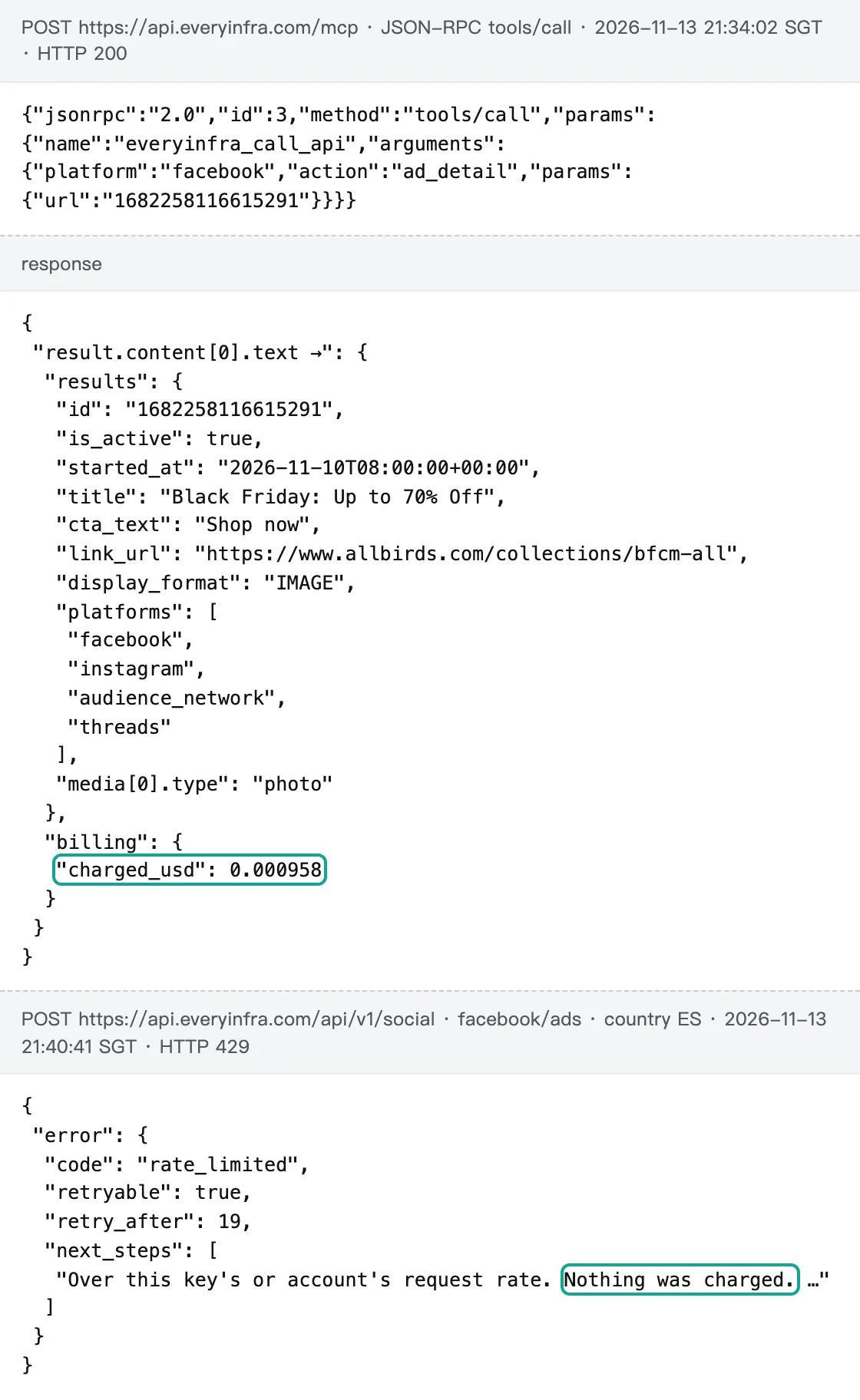
The capability catalog says facebook/advertiser_search finds a Meta Page ID by brand name. At 21:32 SGT we called it for Allbirds. It returned 503 and said the call was not charged. We have no live result for it, so the flow below does not use it. Take the brand Page ID from advertiser_id in the facebook/ads results.
The flow of one research round
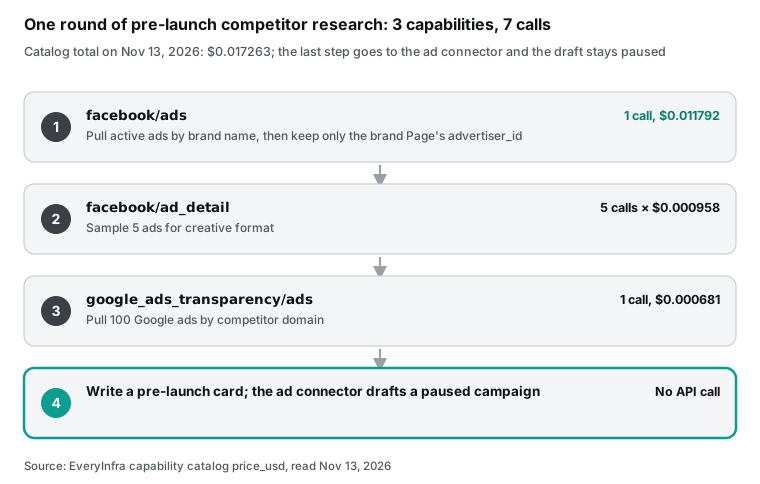
We use four steps. Each step maps to one capability that we tested live and one catalog price. First, facebook/ads pulls active ads by brand name. Keep only the rows with the brand Page's advertiser_id. Next, facebook/ad_detail shows the format of a few new ads.
On the Google side, google_ads_transparency/ads pulls ads by competitor domain. Last, Claude writes all of it into one card. The full capability lists are on the Facebook Scraper API and Google Ads Transparency Center Scraper API pages.
Why only 5 samples in step two? The facebook/ads list does not include the format; display_format is only in ad_detail.
Five samples are enough to see whether a brand leans to video or images, and more samples only add cost. Why query Google by domain in step three? The Transparency Center groups data by verified advertiser, and a domain is less ambiguous than a brand name.
Test 1: what Allbirds runs on Meta (21:33 SGT)
At 21:33 SGT on November 13, 2026, we called facebook/ads with the keyword "allbirds", country US and active ads only. This call returned 20 ads. They are not all of Allbirds' active ads on Meta. All 20 came from the Allbirds Page (267,021 Page likes). The 20 ads were very uniform.
Every button said "Shop now". Every ad ran on Facebook, Instagram, Audience Network and Threads. Thirteen ads linked to a single product page and seven to a collection page.
The start dates were the difference. Ten were single-product ads that started between October 27 and October 31, for the Men's Cruiser, Dasher NZ, Wool Runner NZ Waterproof and Varsity. The other ten went live on November 9 (one) and November 10 (nine), and all ten were discount ads. Eight had Black Friday in the headline or linked to a bfcm collection.
Two showed a struck price for one product, such as "Slides $16.50 (Was $55)" and "Varsity Airy $36 (Was $120)". At call time, the median ad had run 8.8 days. The oldest had run 17.3 days and the newest 3.2 days.
| Start date (2026) | Ads | What the headlines say |
|---|---|---|
| Oct 27 | 3 | Men's Dasher NZ |
| Oct 29 | 4 | Men's Cruiser Dark Navy, Wool Runner NZ Waterproof, Wool Runner NZ Mid Waterproof, Men's Varsity |
| Oct 30 | 2 | Men's Cruiser Dark Navy, Wool Runner NZ Waterproof |
| Oct 31 | 1 | Wool Runner NZ Waterproof |
| Nov 9 | 1 | Black Friday: $63 Wool Cruiser |
| Nov 10 | 9 | Black Friday Under $40, Black Friday: Up to 70% Off, two struck-price product ads, and more |
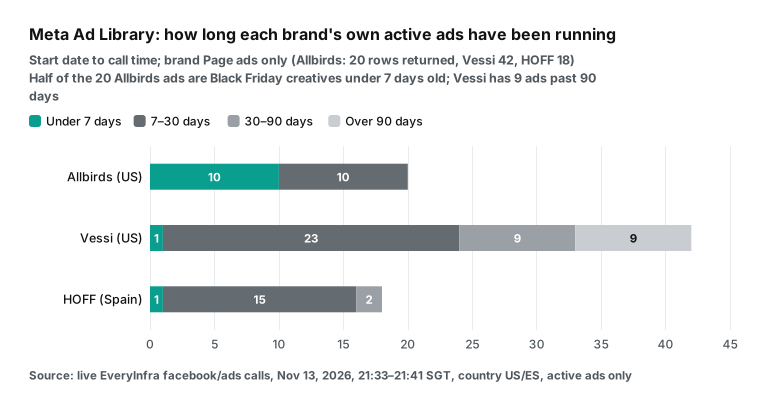
Of the 20 ads returned, the oldest had run 17.3 days, and half were Black Friday creative. These are only 20 of Allbirds' active ads. They do not show that all its Meta creative runs for only two or three weeks, so put the sample size on the card. Two facts are useful for pre-launch research. First, the competitor's Black Friday timing: most promo ads went live on November 10.
Second, its evergreen creative: single-product video ads (see the ad_detail results below) for waterproof and winter styles. If your brand will draft Black Friday ads this week, compare three fields of your draft with this table. The fields are launch date, hero product and discount wording.
We sampled 3 ads with ad_detail at 21:34 SGT. Two single-product ads (Men's Cruiser Dark Navy and Men's Dasher NZ) had display_format VIDEO with a video in media. The Black Friday collection ad was IMAGE with one image.
Three samples are a small set. The safe conclusion is "evergreen product ads use video, promo ads use an image". For a ratio, sample more ads.
Test 2: Vessi started Black Friday six days before Allbirds (21:39 SGT)
At 21:39 SGT we ran the query for Vessi. This call returned 50 ads and cost $0.011792, the same as the call that returned 20. facebook/ads bills per call. The cost per 1,000 rows is the call price ÷ rows returned × 1,000. For 50 rows, that is $0.011792 ÷ 50 × 1,000 ≈ $0.24. For 20 rows, it is about $0.59.
Of the 50 ads, 42 came from the Vessi Page. The other 8 came from other Pages. Four were a shoe store's ads for its own shop, with landing pages that had nothing to do with Vessi.
Four came from two creator or blog Pages, linking to vessi.com with an affiliate parameter in the URL (the Page names belong to individuals, so we leave them out). Of Vessi's own 42 ads, 12 were Black Friday promos, with headlines such as "Black Friday came early. Run.", "This is the discount.
No bigger one." and "Weekend Classic, now $119". Eleven of them started on November 3 and one on November 9. The earliest start was six days before Allbirds' November 9.
Twelve ads had the headline {{product.name}}, which is the Meta catalog ad template. At delivery, Meta puts in the product name (Meta Help Center: add product information to ad copy).
| Start date (2026) | Vessi Page ads | What the headlines say |
|---|---|---|
| Jul 1 | 4 | Over 2.5 Million Pairs Sold, a travel shoe review, the North America collection |
| Jul 23 to Oct 6 | 8 | Catalog template {{product.name}} |
| Oct 9 to Oct 31 | 17 | New limited edition fall colors, gloves, rainy day lines, more catalog ads |
| Nov 3 | 11 | Black Friday came early. Run. / This is the discount. No bigger one. / Weekend Classic, now $119 |
| Nov 4 and Nov 9 | 2 | One catalog ad, one more discount ad |
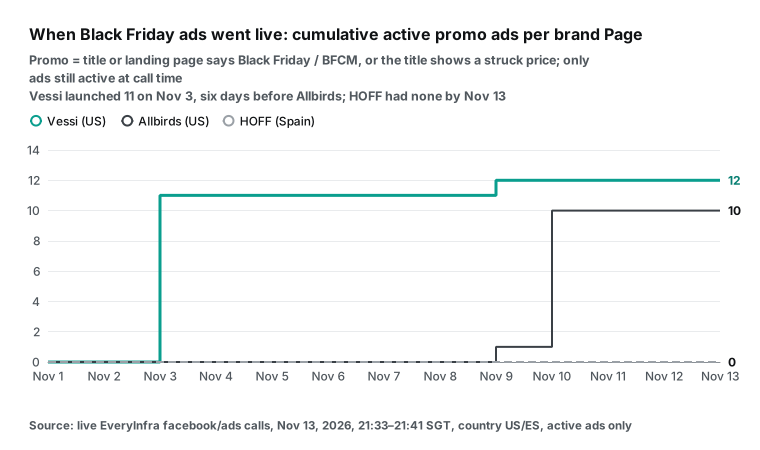
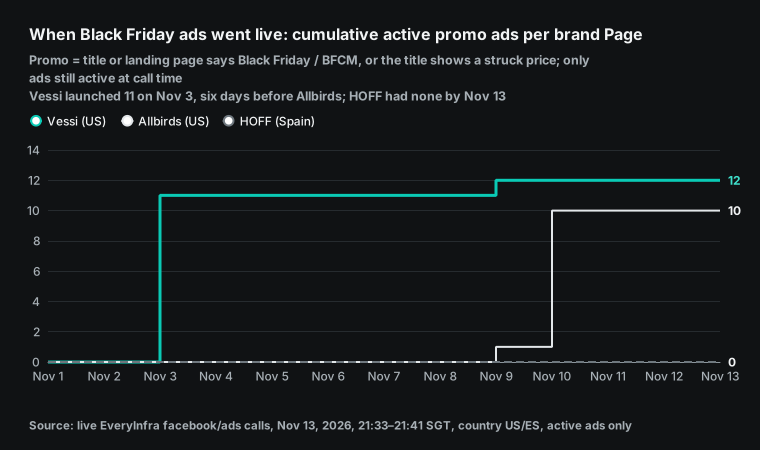
Vessi's active ads were much older than Allbirds'. Eighteen of the 42 had run more than 30 days. The four oldest started on July 1 and had run 135 days at call time. They used evergreen lines such as "Over 2.5 Million Pairs Sold", a travel shoe review and a North America collection.
We sampled 3 ads with ad_detail: one catalog template ad, one Black Friday ad and one new fall color ad. All three had display_format DCO with 2 creative versions each. DCO is Meta's dynamic creative: you upload several images and headlines, and the system combines them at delivery (Meta Help Center: dynamic creative).
Vessi launches ads in batches. Count by start date: 11 of its 42 ads started on November 3, 6 on October 9 and 4 on July 1. The rest are spread from late July to early November.
The 20 Allbirds ads that came back also form two batches: 10 from October 27 to 31, and 10 on November 9 and 10. HOFF's largest batch is 4 ads on November 6. For pre-launch research, the day of a batch launch tells you more about timing than the total count. In the next round, a new same-day batch marks the start of a new push.
Put the two brands side by side, and your pre-launch card can say this. Vessi's Black Friday ads went live from November 3, six days before the first Allbirds promo on November 9. All 3 sampled Vessi ads were dynamic creative, and 12 of its 42 ads used the catalog headline template.
Allbirds launched most promo ads on one day (November 10), and its sampled promo ad used a single image. The library has no conversion data, so it cannot say which approach works better, and the card should say so.
Test 3: a brand-name search for HOFF returned 18 HOFF ads out of 49 (21:41 SGT)
For a Spanish-language market, we picked HOFF, a sneaker brand from Spain, with country ES. The first request at 21:40 SGT returned 429 and said nothing was charged. The next query, 19 seconds later, worked and returned 49 ads. Only 18 came from the HOFF Page.
Three more came from other Pages that linked to thehoffbrand.com. The other 28 came from Pages unrelated to the brand. One was a shoe store's own shop ad. Others came from personal Pages with surnames that contain "Hoff", an AI chat app, short drama series, a cookware brand and a chemical company.
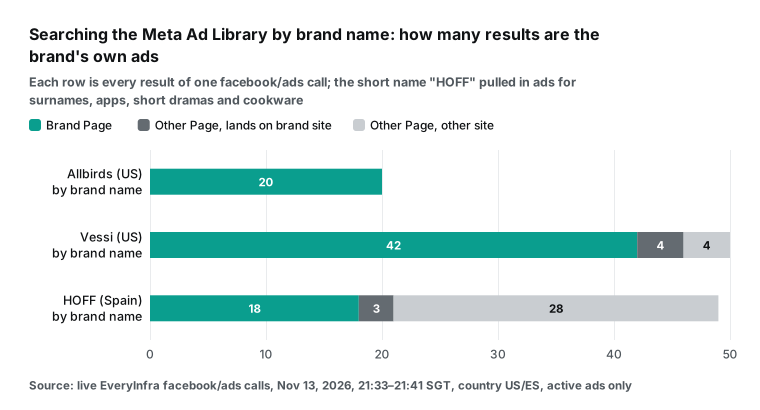
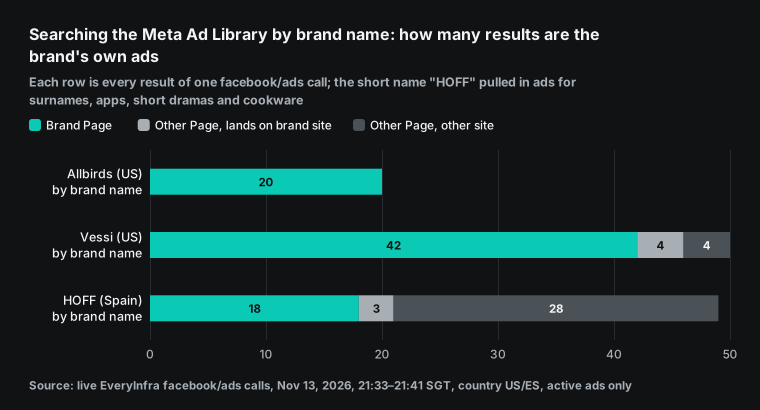
The reason is the keyword. The Meta Ad Library keyword search matches words in ad text and headlines. "HOFF" is short and is part of common surnames. Made-up names such as "allbirds" and "vessi" rarely collide. If you hand all 49 ads to a model, it will count the timing of drama series and cookware ads as HOFF's strategy.
The fix is to filter by advertiser_id before you count. Every result includes advertiser_id, and the HOFF Page ID is 1105633242835047. Keep only the rows with this ID. These are the 18 rows that the HOFF numbers here use.
The capability catalog also says the keyword parameter accepts a Page's Ad Library URL, for example one with view_all_page_id=1105633242835047. We did not test this method in this round.
HOFF's own 18 ads had no Black Friday creative yet. Four ads, which started on November 6, were for the Velvet capsule. Six, from October 27 to November 4, were for the Soft Leather Capsule. The rest promoted new FW26 colors, a nylon ballet sneaker sold online only, and best sellers.
Sixteen ads linked to collection pages, one to the home page and one to a styling collaboration page. None linked to a single product page. Every button said "Shop now". Compared with the two US brands, HOFF was promoting new collections at this point, not discounts.
Test 4: how old the Google creative is
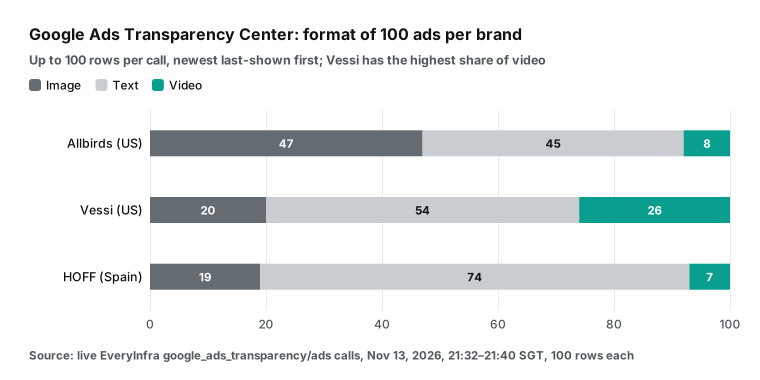
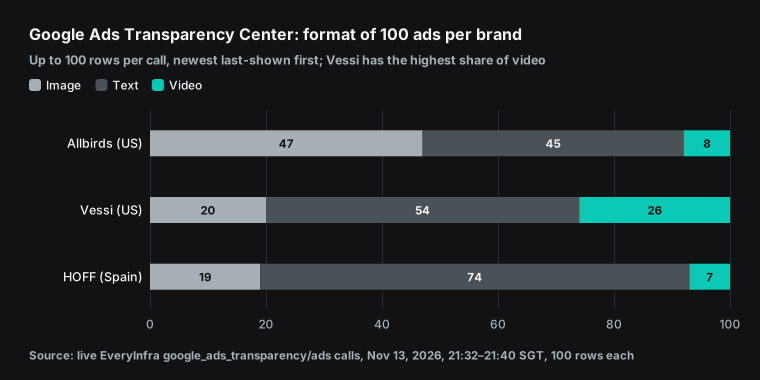
On Google, one call returns up to 100 ads, sorted from the most recent last-shown date. At 21:32 SGT we queried allbirds.com with country us. Of 100 ads, 99 came from "Allbirds Inc" and 1 from another company that also listed allbirds.com. Formats: image 47, text 45, video 8.
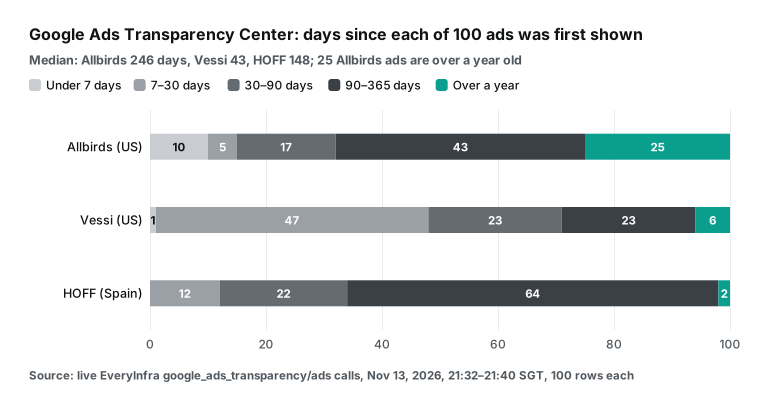
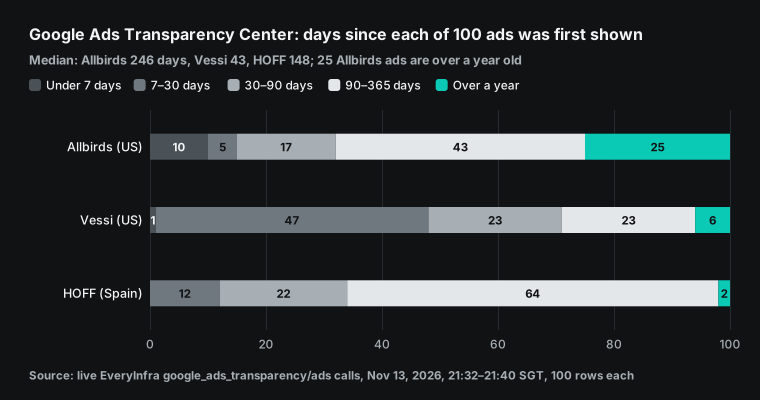
First-shown years: 2026 had 64, 2025 had 32, 2024 had 1 and 2022 had 3. The oldest ad was first shown on March 18, 2022. All 100 had a last-shown date within two days of the call, so all were still running. The median ad was first shown 246 days before the call, and 25 ads were more than a year old.
At 21:39 SGT we queried vessi.com. Ninety-four ads came from "Vessi Footwear Ltd." and 6 from six other advertisers, including accounts under personal names (left out here) and a digital marketing agency. The center lists them because their ads link to the domain, so filter by advertiser_name before you count. Vessi's formats were text 54, video 26 and image 20, and the median first-shown age was 42.6 days, much newer than Allbirds.
At 21:40 SGT we queried thehoffbrand.com with country es. Eighty-six ads came from THE HOFF BRAND SL, 12 from HOFF USA CORP and 2 from a company named GLOBERADA SL. Text ads made up 74 of 100, and only 43 had been shown within two days of the call.
By first-shown year, 94 of Vessi's 100 ads are from 2026, 5 from 2025 and 1 from 2022. For HOFF, 98 are from 2026, and 2023 and 2024 have 1 each. The oldest HOFF ad was first shown on November 19, 2023. Allbirds has 36 ads from 2025 or earlier. So almost all Google creative from Vessi and HOFF is new this year.
The two platforms gave samples of different sizes, so state the size when you compare them. On Meta, the call returned 20 active Allbirds ads, and the oldest had run 17.3 days. On Google, the call returned 100 ads, and 25 of them were first shown more than a year ago.
Forty-five of the Google ads were text ads, and search ad copy can run for a long time. This can explain part of the gap. The 20 Meta ads are not all active ads, so older creative can be in the rows that did not come back. Keep the two platforms separate on your card, each with its sample size. Then Claude will not apply the creative timing of one platform to the other.
Three more comparisons from the same data: placements, repeated headlines and new Google creative
The same raw responses allow three more comparisons. They need no extra call.
Placements. All 20 Allbirds ads that the call returned ran on four placements: Facebook, Instagram, Audience Network and Threads. Of Vessi's 42 ads, 36 ran on Facebook, Instagram and Threads only. Five added Messenger, and one added WhatsApp. None ran on Audience Network.
Of HOFF's 18 ads, 11 ran on the same three placements, and 7 added Messenger. If your draft turns on all placements by default, note on the card which placements each competitor picked. Then a person can decide whether to follow.
Repeated headlines. The 20 Allbirds ads used 15 different headlines, so almost every ad had its own. Vessi's 42 ads used only 17 different headlines, and 12 ads shared the catalog template {{product.name}}. HOFF's 18 ads used only 7 different headlines, so one line of copy ran with different images. When a brand has far fewer headlines than ads, it tests creative under the same copy. Put this in the format field of the card.
New Google creative. The newest first-shown date in the Transparency Center was November 12 for Allbirds, November 9 for Vessi and October 23 for HOFF. So HOFF had added no new Google creative for three weeks at call time.
Only 43 of HOFF's 100 Google ads were shown in the two days before the call. Vessi had 78 and Allbirds had 100. HOFF launched its Velvet capsule on Meta on November 6, but its Google side did not get new creative at the same time. The two platforms move at different speeds, so keep them separate on the card.
Test 5: the Google query again, 24 minutes later
Each of the first four tests ran once. At 21:56 SGT we ran the Google query for Allbirds again. We wanted to see if the same query changes after 24 minutes. For Meta, we use the result from 21:33 SGT.
| Query | Time (SGT) | Rows | Brand's own | Shown in last 2 days | Charged |
|---|---|---|---|---|---|
facebook/ads allbirds, US, active | 21:33 | 20 | 20 | all 20 active | $0.011792 |
google_ads_transparency/ads allbirds.com, us | 21:32 | 100 | 99 | 100 | $0.000681 |
google_ads_transparency/ads allbirds.com, us | 21:56 | 100 | 99 | 100 | $0.000681 |
At 21:56 SGT we also queried allbirds.com on Google again. Compared with the call 24 minutes earlier, 99 of 100 ad IDs were the same. One text ad came in (first shown September 30, 2025, and shown again shortly before the call). One image ad dropped out (last shown November 12). Only one row changed, but the median first-shown age jumped from 246 to 273 days.
The count over one year went from 25 to 26. The reason is the sort order. The 100 rows are sorted by last-shown date. When an old ad enters at the edge and a new one leaves, the median can cross a large gap. On the Google side, put bucket counts on your card, not one median, and compare buckets week to week.
How to pick competitors and which ads to sample
In one round, facebook/ads costs the most, and picking competitors and samples takes the most judgment. We watch three competitors per round. The first is a direct rival at your price and in your category. The second is a larger brand whose timing others copy. The third is a local brand in the new market you want to enter.
This round fits that pattern. Vessi and Allbirds both sell light everyday shoes and advertise in North America, and Allbirds is larger. HOFF is a Spanish brand and shows the EU market. All three are public brands, and all the data is what anyone can see on the Meta Ad Library and Google Ads Transparency Center websites.
For ad_detail samples we use three rules. Pick one of the newest ads and one of the longest-running ads. Then pick one with a promo word in the headline or landing page. The newest ad shows what the competitor tests this week. The longest-running ad is likely their steadiest evergreen creative.
The promo ad shows discount wording and format. Our 3 Allbirds samples and 3 Vessi samples followed these rules. The budget for the fourth and fifth samples stays for the next round. Each sample costs $0.000958, so 5 samples cost less than half a cent, under half the price of one facebook/ads call.
Filter before you count. Our analysis script puts each facebook/ads row into one of three groups. If the advertiser is the brand Page, it is "brand". If another Page ran it but it links to the brand site, it is "linked". All other rows are "other".
Vessi's 4 linked ads were creator promotions with affiliate parameters. They are worth a separate look, because they show that the brand runs a creator affiliate program. But they should not count toward the brand's own creative timing. On Google, keep only the brand's own legal name in advertiser_name.
When Claude writes the card, give it a fixed structure. Then each week's card has the same fields, and you can compare weeks. This is the structure we use, with sample values from the live Vessi calls:
{
  "competitor": "Vessi",
  "market": "US",
  "checked_at_sgt": "2026-11-13 21:39",
  "meta": {
    "brand_page_rows": 42,
    "promo_rows": 12,
    "promo_first_start": "2026-11-03",
    "median_age_days": 16.3,
    "sampled_formats": {"DCO": 3}
  },
  "google": {"rows": 100, "brand_rows": 94, "formats": {"text": 54, "video": 26, "image": 20}},
  "cannot_see": ["spend", "impressions", "conversions"],
  "sources": ["facebook/ads", "facebook/ad_detail", "google_ads_transparency/ads"]
}
Add a cannot_see field to the card. When a model sees "Vessi uses a lot of dynamic creative", it can easily write "dynamic creative performs better". If the card lists what the library cannot show, the model has a reason to say "the ad library cannot tell us this" when it drafts.
Give the results to Claude: one pre-launch competitor card
The output of the research is one card. Its fields are fixed and every claim has a source link, so Claude can cite each one when it drafts. This is the card for the three brands, from the live data above:
| Item | Allbirds (US) | Vessi (US) | HOFF (Spain) |
|---|---|---|---|
| Meta active ads (brand Page) | 20 (rows returned, not all) | 42 (brand part of 50 rows returned) | 18 (brand part of a keyword search) |
| Black Friday promos | 10, live Nov 9 and 10 | 12, first on Nov 3 | 0 |
| Format (ad_detail samples) | Product videos, promo single images | All 3 samples DCO | Not sampled |
| Landing pages | 13 product pages, 7 collections | 21 collections, 14 product pages, 7 home or landing pages | 16 collections, 0 product pages |
| Google formats | Image 47, text 45, video 8 | Text 54, video 26, image 20 | Text 74, image 19, video 7 |
| Google median creative age | 246 days | 42.6 days | 147.9 days |
| Card field | Safe to use as fact | Needs a person's judgment |
|---|---|---|
| Promo start date | Yes, from started_at | When to answer it |
| Discount wording | Yes, from the headline | Whether to match the depth |
| Format mix | Yes, from display_format samples | Whether to copy the format |
| Creative age | Yes, from start or first-shown dates | Whether old means "works" |
| Spend, reach, conversions | Not in the library | Do not guess |
Before you hand the card to the ad connector, put three limits in the prompt. One: the library shows only active ads and start dates, with no spend, impressions or conversions, so the card's "strategy" lines are a reference only. Two: facts such as Black Friday dates and discount depth are safe to use, but inferences such as "they use video, so we should too" need a person's judgment.
Three: the drafted campaign stays paused and goes live through the Supermetrics or Meta approval flow. The Supermetrics documentation adds a note after its creation steps. You are responsible for what the AI does and for the ad spend it causes, so check before you go live.
To refresh this card every week, see two earlier guides. One covers weekly competitor price and review pulls with Claude Cowork scheduled tasks. The other covers a live competitor dashboard with Claude Artifacts and MCP. To turn competitor monitoring into a data product you sell, see how to sell web change monitoring. To check a remote MCP setup, see remote MCP setup and checks.
Cost: one round of pre-launch competitor research
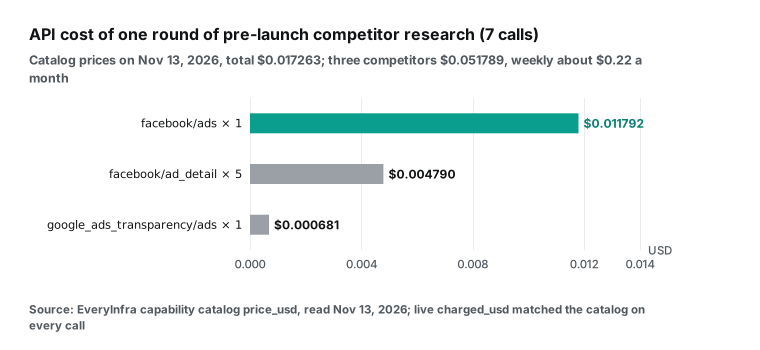
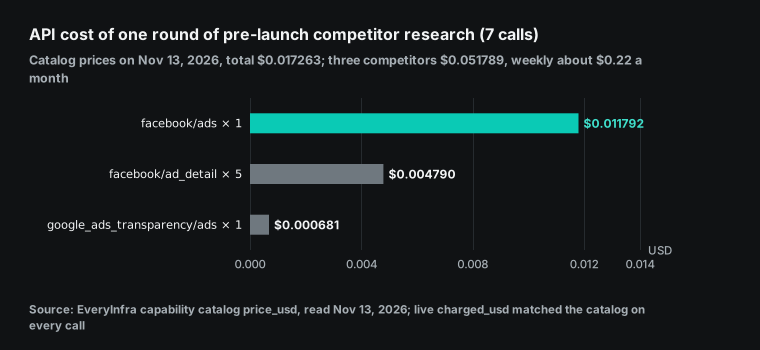
We priced one round with the capability catalog as read on November 13, 2026. facebook/ads once at $0.011792, facebook/ad_detail five times at $0.000958 each, and google_ads_transparency/ads once at $0.000681. The total is $0.017263. One round for each of three competitors is $0.052.
Weekly, with 52/12 weeks per month, that is about $0.22 a month. In our live calls, charged_usd matched the catalog price on every call. facebook/ads charged $0.011792 for the call that returned 20 rows and for the call that returned 50. The catalog also lists facebook/advertiser_search at $0.000875 a call. We got no live result from it, so it is not in this round.
| Unit | `facebook/ads` | `facebook/ad_detail` | `google_ads_transparency/ads` |
|---|---|---|---|
| Per call | $0.011792 | $0.000958 | $0.000681 |
| Rows returned per call in our tests | 20 or 50 | 1 | 100 |
| Per 1,000 rows (call price ÷ rows returned × 1,000) | $0.24 (50 rows) / $0.59 (20 rows) | $0.958 | $0.0068 |
| Failures and empty results | Not billed | Not billed | Not billed |
For an agency, the math scales in a straight line. Ten clients with three competitors each, one round per week, is 30 rounds a week: $0.518 a week, or about $2.24 a month.
| Setup | Rounds per week | Per week | Per month (52/12 weeks) |
|---|---|---|---|
| 1 brand, 3 competitors | 3 | $0.052 | $0.22 |
| 1 brand, 3 competitors, 2 markets | 6 | $0.104 | $0.45 |
| Agency, 10 clients x 3 competitors | 30 | $0.518 | $2.24 |
| Agency, 40 clients x 3 competitors | 120 | $2.072 | $8.98 |
Compare this with the Supermetrics side: Starter is $59 a month and covers analysis and drafting for your own accounts. Competitor research is a different kind of data. The two do not overlap and do not replace each other. In this test, 16 calls were charged (2 of them read YouTube comments), for a total of $0.056752. Calls that returned an error were not charged. The total is higher than one round because we checked three brands and ran two extra queries.
Limits and things to watch
First, you cannot see spend or results. For commercial ads in non-EU markets such as the US, the Meta Ad Library gives only active status and start date. The Google Transparency Center gives first-shown and last-shown dates and no spend.
You can compute how long an ad ran. You cannot compute what it cost or which ad converted. Say this on the card, and do not let the model fill the gap.
Second, keyword search mixes in other advertisers. For HOFF, only 18 of 49 ads came from the brand Page. Vessi's 50 ads included 4 unrelated shoe store ads.
Before you count, filter by advertiser_id or advertiser_name. The capability catalog says you can also pass a Page's Ad Library URL as keyword. We did not test this method. On Google, a domain query also lists other advertisers, as with the 6 extra Vessi rows. Filter by advertiser_name.
Third, the rows returned are not "all". The Allbirds facebook/ads call returned 20 rows, so we counted only those 20. Allbirds can have more active ads on Meta.
google_ads_transparency/ads returns at most 100 rows per call. All three brands returned 100 rows, so each brand can have more ads in the center. Put the sample size on the card next to every conclusion from these samples.
Fourth, read time fields carefully. For active Meta ads, ended_at was always the day of the call. It means "still running today", not a real end date. Only stopped EU ads have a meaningful end date. Google's first_shown_at and last_shown_at are in UTC.
| Limit | What you see | What to do |
|---|---|---|
| No spend or results | Dates and status only | Write it on the card |
| Keyword noise | Other advertisers in results | Filter by Page ID or name |
| Sample size | 20 or 50 rows on Meta, 100 on Google in our calls | Treat counts as "at least" |
ended_at on active ads | Equals the call date | Ignore it for active ads |
| Error responses | Not charged, retry_after given | Wait, then query again |
Fifth, know the purpose. Ad libraries are public transparency tools. They are good for a competitor's timing and formats. Copying another brand's text or creative raises copyright and ad policy issues. Meta's Advertising Standards and Google's policies apply to the ads you run.
Industry changes in the last 60 days
- November 10, 2026: Supermetrics launched Campaign Management with 7 platforms, including ChatGPT Ads, and 4 approval modes (Supermetrics blog). What it means for you: the connector can draft on more platforms, so your research must cover more competitor channels.
- November 3, 2026: Supermetrics announced that Claude can create and edit campaigns on 6 platforms, paused by default (PR Newswire). What it means for you: draft, pause, approve is now the default flow, and the approval step needs inputs.
- Around November 2, 2026: Google's open-source Google Ads MCP reached v0.0.6 with propose-and-confirm asset and label writes (GitHub releases). What it means for you: Google's own tool still keeps write access narrow; budget changes need a third party or a person.
- October 29 to November 12, 2026: Meta updated its MCP client guide and its MCP overview. The overview lists validated clients (Meta developer docs). What it means for you: check that your client is on the list before you debug an empty tool list.
- October 2026: PPC Land reported on a Meta bulk upload tool. The tool said AI agents sent 17.5% of the 36,289 batches it processed in September, through MCP or the command line. What it means for you: agents that change ad accounts are now a measurable share of traffic, and approvals and audit logs matter more.
FAQ
Is the Claude Meta ads connector made by Meta or by a third party?
Both exist. Meta's own Ads MCP server went into open beta on April 29, 2026, at mcp.facebook.com/ads. The Supermetrics connector for Claude is a third party and covers 7 ad platforms, Meta included. Both work only on ad accounts you can access. Source: search suggestion "claude meta ads connector"; Meta developer documentation.
Can the Claude Google Ads connector change budgets?
It depends on the option. Supermetrics says it can change Google Ads budgets and status under the approval mode you choose. Google's open-source Google Ads MCP, as of v0.0.6, writes only assets and labels, and PPC Land reported that it cannot change budgets. Source: search suggestion "claude google ads connector"; Supermetrics documentation, PPC Land.
Facebook ads library MCP for Claude: can Claude read the Meta Ad Library directly?
Meta's Ads MCP reads your ad accounts, and its tool list does not include Ad Library search. To read the library, add a remote MCP server that queries public ad libraries. EveryInfra's facebook/ads and facebook/ad_detail are one option; see the configuration example above. Source: search suggestion "facebook ads library mcp claude"; Meta Help Center list of Ads MCP features.
Is the Meta Ad Library API free, and does it cover US commercial ads?
The Ad Library API has no fee. But the Meta Transparency Center says it covers ads about social issues, elections and politics, and ads delivered to the EU and related regions. Ordinary US commercial ads are outside the API's deep search. You can see them only while they are active, on the Ad Library website. Source: search suggestions "meta ad library api free" and "meta ad library api access token"; Meta Ad Library tools page.
I added Meta Ads MCP but it shows no tools. What now?
In YouTube comments and in the Meta Developer Community, users posted is_ads_mcp_enabled: false. This means Meta has not turned the feature on for that ad account. Meta's Help Center also says you may not have these tools yet.
You can wait for Meta, or use a third-party connector such as Supermetrics. For competitor research only, you do not need ad account access. Source: YouTube tutorial comments; Meta Developer Community.
Can AI automation get my ad account banned?
Under one video, two viewers said their ad accounts were temporarily blocked after they used automation. They gave no cause or details, so we cannot verify it. Reading a public ad library does not sign in to your ad account and does not affect its status. For changes to your account, use the official Meta or Supermetrics connection. Source: YouTube video comments.
Get started
- Create an API key in the EveryInfra console. New accounts get trial credit. The catalog and prices are on the pricing page.
- Add
https://api.everyinfra.com/mcpto Claude as a custom connector. In Claude Code, useclaude mcp add. - Check one competitor. Call
facebook/adswith the brand name andstatus=active. Keep only the rows from the competitor's Page ID. Then callgoogle_ads_transparency/adswith the domain. If a call returns an error, waitretry_afterseconds and query again. - Ask Claude to fill the pre-launch card, then give the card to your ad connector to draft a paused campaign.
References
- Supermetrics Advances Marketing AI from Analysis to Approved Campaign Action Through Claude, Supermetrics (PR Newswire), 2026-11-03, https://www.prnewswire.com/news-releases/supermetrics-advances-marketing-ai-from-analysis-to-approved-campaign-action-through-claude-302927039.html
- Supermetrics lets Claude build ad campaigns on 6 platforms, paused by default, PPC Land, 2026-11-03, https://ppc.land/supermetrics-lets-claude-build-ad-campaigns-on-6-platforms-paused-by-default/
- Introducing Supermetrics Campaign Management, Supermetrics, 2026-11-10, https://supermetrics.com/blog/supermetrics-campaign-management-launch
- Supermetrics AI campaign tool gains ChatGPT Ads, its 7th ad platform, PPC Land, 2026-11-10, https://ppc.land/supermetrics-ai-campaign-tool-gains-chatgpt-ads-its-7th-ad-platform/
- How to manage ad campaigns with AI tools, Supermetrics docs, 2026-10-30, https://docs.supermetrics.com/docs/how-to-manage-ad-campaigns-with-ai-tools
- How to enable campaign write access, Supermetrics docs, read 2026-11-13, https://docs.supermetrics.com/v1/docs/how-to-enable-campaign-write-access
- How to create and edit Meta Ads campaigns (Facebook and Instagram), Supermetrics docs, read 2026-11-13, https://docs.supermetrics.com/v1/docs/how-to-create-and-edit-meta-ads-campaigns-facebook-and-instagram
- How to review and restore campaign changes, Supermetrics docs, read 2026-11-13, https://docs.supermetrics.com/v1/docs/how-to-review-and-restore-campaign-changes
- Supermetrics Pricing, Supermetrics, read 2026-11-13, https://supermetrics.com/pricing
- What AI agents can change in your ad accounts (2026 guide), Supermetrics, 2026-10-08, https://supermetrics.com/blog/what-ai-agents-can-change-ad-accounts
- Is AI campaign management safe?, Supermetrics, 2026-10-13, https://supermetrics.com/blog/ai-campaign-management-safety
- Supermetrics for Claude, Supermetrics, read 2026-11-13, https://supermetrics.com/products/claude
- Manage ads from an AI agent with Meta ads AI connectors, Meta Business Help Center, read 2026-11-13, https://www.facebook.com/business/help/1456422242197840
- Introducing Meta Ads AI Connectors, Meta, 2026-04-29, https://www.facebook.com/business/news/meta-ads-ai-connectors
- Ads MCP Server, Meta for Developers, read 2026-11-13, https://developers.facebook.com/documentation/ads-commerce/ads-ai-connectors/ads-mcp-server/ads-mcp-server-overview
- Introducing Ads CLI, Meta for Developers blog, 2026-04-29, https://developers.facebook.com/blog/post/2026/04/29/introducing-ads-cli
- Releases, googleads/google-ads-mcp, GitHub, v0.0.6 released 2026-11-02, read 2026-11-13, https://github.com/googleads/google-ads-mcp/releases
- Google Ads MCP server: Developer integration guide, Google for Developers, read 2026-11-13, https://developers.google.com/google-ads/api/docs/developer-toolkit/mcp-server
- Google Ads MCP server gains 4 write tools, still can't change budgets, PPC Land, 2026-11, https://ppc.land/google-ads-mcp-server-gains-4-write-tools-still-cant-change-budgets/
- Meta Ad Library tools, Meta Transparency Center, read 2026-11-13, https://transparency.meta.com/researchtools/ad-library-tools/
- Graph API Reference: Ads Archive, Meta for Developers, read 2026-11-13, https://developers.facebook.com/docs/graph-api/reference/ads_archive/
- Regulation (EU) 2022/2065 (Digital Services Act), EUR-Lex, 2022-10-19, https://eur-lex.europa.eu/eli/reg/2022/2065/oj/eng
- Announcing the launch of the new Ads Transparency Center, Google, 2023-03-29, https://blog.google/innovation-and-ai/technology/ads/announcing-the-launch-of-the-new-ads-transparency-center/
- Ads transparency, Google Advertising Policies Help, read 2026-11-13, https://support.google.com/adspolicy/answer/13733850?hl=en
- Use connectors to extend Claude's capabilities, Anthropic Help Center, read 2026-11-13, https://support.claude.com/en/articles/11176164-use-connectors-to-extend-claude-s-capabilities
- Get started with custom connectors using remote MCP, Anthropic Help Center, read 2026-11-13, https://support.claude.com/en/articles/11175166-get-started-with-custom-connectors-using-remote-mcp
- Connect Claude Code to tools via MCP, Claude Code docs, read 2026-11-13, https://code.claude.com/docs/en/mcp
- Transports (MCP specification 2025-06-18), Model Context Protocol, https://modelcontextprotocol.io/specification/2025-06-18/basic/transports
- MCP connector, Claude Developer Platform docs, read 2026-11-13, https://platform.claude.com/docs/en/agents-and-tools/mcp-connector
- About dynamic creative in Meta Ads Manager, Meta Business Help Center, read 2026-11-13, https://www.facebook.com/business/help/170372403538781
- Add product information to your ad copy in ads showing product media, Meta Business Help Center, read 2026-11-13, https://www.facebook.com/business/help/540926669756571
- Meta Advertising Standards, Meta Transparency Center, read 2026-11-13, https://transparency.meta.com/policies/ad-standards/
- Ads Uploader: 17.5% of 36,289 Meta ad batches came from AI agents, PPC Land, 2026-10, https://ppc.land/ads-uploader-17-5-of-36-289-meta-ad-batches-came-from-ai-agents/
- EveryInfra capability catalog (facebook/ads, facebook/ad_detail, facebook/advertiser_search, google_ads_transparency/ads), EveryInfra, read 2026-11-13, https://api.everyinfra.com/api/v1/social/catalog
- How To Connect Claude To Your Facebook Ads Account In 2026, comments, YouTube, 2026-05-12, https://www.youtube.com/watch?v=KhI1s63Zo70
- How to Run Meta Ads with Claude, comments, YouTube, 2026-11-09, https://www.youtube.com/watch?v=q4ypq81lLos
- Connect AI agents to Meta with MCP, Meta for Developers, updated 2026-11-12, https://developers.facebook.com/documentation/mcp
- Connect an MCP client to Meta, Meta for Developers, updated 2026-10-29, https://developers.facebook.com/documentation/mcp/connect-an-mcp-client
- Rules best practices (Ads MCP server), Meta for Developers, updated 2026-08-12, https://developers.facebook.com/documentation/ads-commerce/ads-ai-connectors/ads-mcp-server/ads-mcp-server-rules-best-practices
- Meta's ads MCP server is now available for developers, Meta for Developers blog, 2026-07-16 (updated 2026-09-22), https://developers.facebook.com/blog/post/2026/07/16/meta-ads-mcp-server/
- How to enable is_ads_mcp_enabled for Meta Ads MCP open-beta?, Meta Developer Community, read 2026-11-13, https://developers.facebook.com/community/threads/1274500931517191/
- Supermetrics for Claude (documentation), Supermetrics docs, read 2026-11-13, https://docs.supermetrics.com/docs/supermetrics-for-claude
- googleads/google-ads-mcp (README), GitHub, read 2026-11-13, https://github.com/googleads/google-ads-mcp
- Advertiser verification, Google Advertising Policies Help, read 2026-11-13, https://support.google.com/adspolicy/answer/9703665?hl=en
- Tools (MCP specification 2025-06-18), Model Context Protocol, https://modelcontextprotocol.io/specification/2025-06-18/server/tools
Reference BL-138