Bilibili API Options in 2026: Compared and Tested
Bilibili API options in 2026: the Open Platform reads only authorized creators, 3 of 14 GitHub repos are archived, and calls start at $0.556 per 1,000.

Yes, you can get Bilibili data through an API, and there are three types to choose from. EveryInfra sells one of the pay-per-call APIs in this comparison, so read our numbers with that in mind. The three types are the Bilibili Open Platform, open-source libraries and MCP servers on GitHub, and pay-per-call data APIs.
Each type fits a different job. The Open Platform gives you data for creator accounts that authorize your app, so it suits agencies that manage Bilibili creators. Its separate live platform is the only route for interactive live-stream games. Open-source code suits learning and one-off research, but most active projects need your own Bilibili login. A pay-per-call API reads public videos, comments, danmaku (the comments that fly across the video), subtitles and creator profiles with one API key.
On November 23, 2026, between 00:13 and 00:26 SGT, we tested 14 EveryInfra Bilibili capabilities. Fourteen requests returned data and cost a total of $0.008506. One request with a bad parameter, sent on purpose, returned 422 and cost nothing.
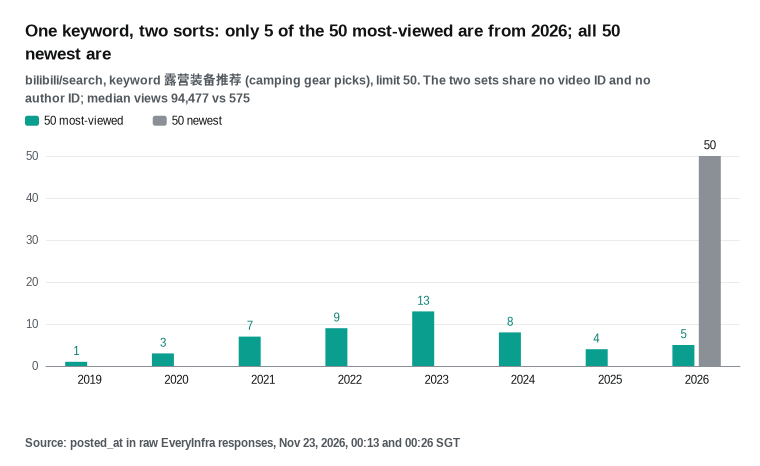
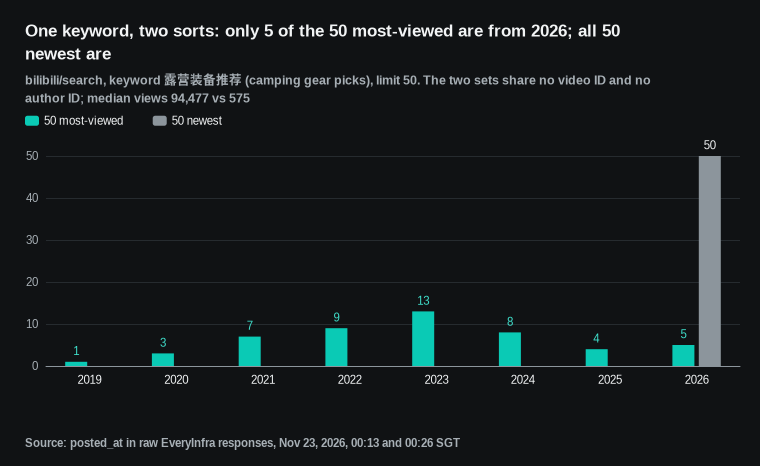
We searched one Chinese keyword, "lùyíng zhuāngbèi tuījiàn" (camping gear picks), sorted two ways. The 50 most-viewed results and the 50 newest results had zero videos in common. The most-viewed set had a median of 94,477 views, and only 5 of the 50 were from 2026. The newest set had a median of 575 views. We also read 14 Bilibili repositories on GitHub; 3 are archived, two of them after legal letters in 2026.
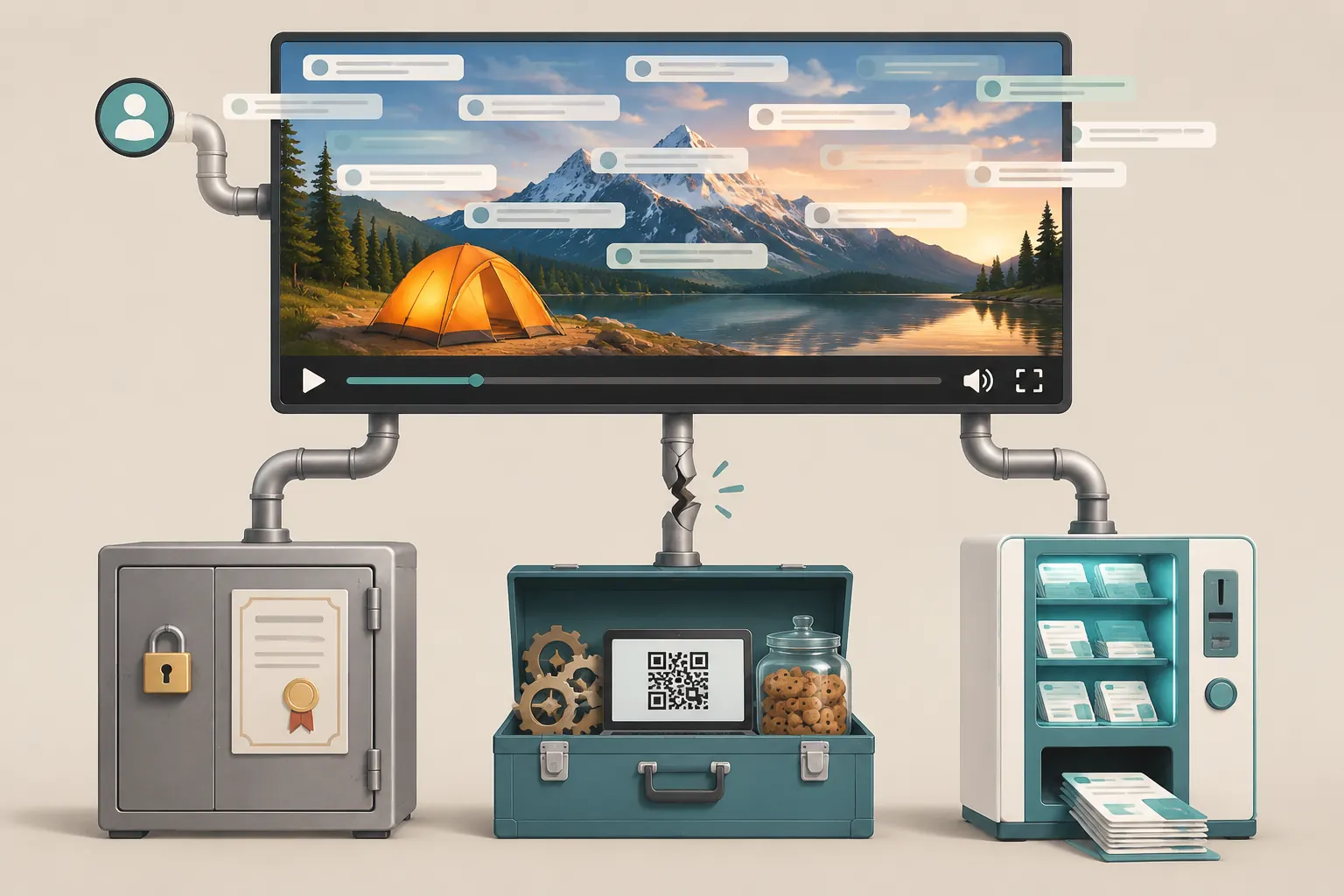
Bilibili API options compared in one table
The Open Platform row comes from its docs and its management rules. The open-source row comes from each README and the GitHub API. The EveryInfra row comes from the public catalog that we read at 00:12 SGT on November 23, 2026. The TikHub row comes from its public price endpoint and its FAQ page, both read at 00:17 SGT the same day.
"Per 1,000 calls" means the list price for 1,000 requests. Each vendor returns a different number of rows per request, so we convert to cost per 1,000 rows in the TikHub section.
| Option | Billing unit | USD per 1,000 calls | Failures and empty results | Bilibili account or cookie | MCP | Data you get |
|---|---|---|---|---|---|---|
| Bilibili Open Platform | No per-call fee in the docs | — | Not applicable | Company sign-up plus creator consent | No | Authorized creators' own uploads, stats and live-room messages |
| GitHub open source | Free, you run it | $0 | You retry yourself | 6 of 14 need your login | 4 ship an MCP server | Depends on the project; 3 are archived |
| EveryInfra | Per call | $0.556 (11 capabilities), $0.792 (subtitles, general search), $0.806 (popular) | Failures free, empty results refunded | No, one API key | Yes, remote MCP | 14 types of public data |
| TikHub | Per call, billed on status 200 | $1.00 web and app series; $6.00 and $10.00 Huahuo series | FAQ says failures are free; empty results not covered | Its own key; HD video needs your SESSDATA cookie | Yes, 41 Bilibili tools | 88 Bilibili endpoints, including Huahuo business data |
| Other pay-per-call services | Usually per call or per row | Varies | Check their terms | Check their terms | Check their terms | Check their catalog |
The Open Platform has no call fee. Its gate is identity and consent. You first join as a company. Then each creator must approve your app on a consent page. After that, you read only that creator's own uploads.
You cannot use it to watch a rival creator or to read danmaku on any video. Its doc center has no keyword search endpoint.
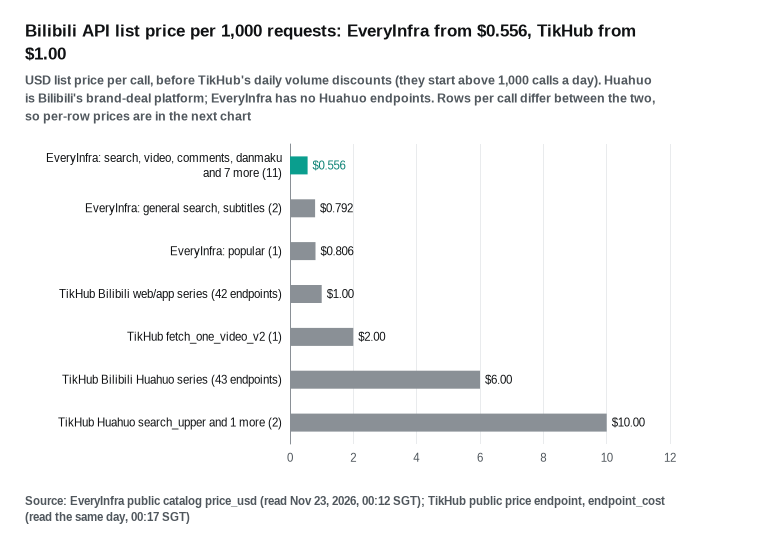
The TikHub FAQ gives daily volume discounts. Up to 1,000 requests a day cost $0.001 each, 1,000 to 5,000 cost $0.0009, and 5,000 to 10,000 cost $0.0008. Its day resets at Los Angeles midnight.
The same FAQ lists a top-up fee: 2.6% plus $0.30 on Alipay, and 5% plus $0.30 on PayPal and USDT. On the EveryInfra side, we use the catalog list price times the number of calls. Every monthly figure below uses list prices.
The Bilibili Open Platform: what it gives and what it asks for
The Bilibili Open Platform at openhome.bilibili.com offers account login, user info, upload management, data access and live features. Every data endpoint needs user authorization.
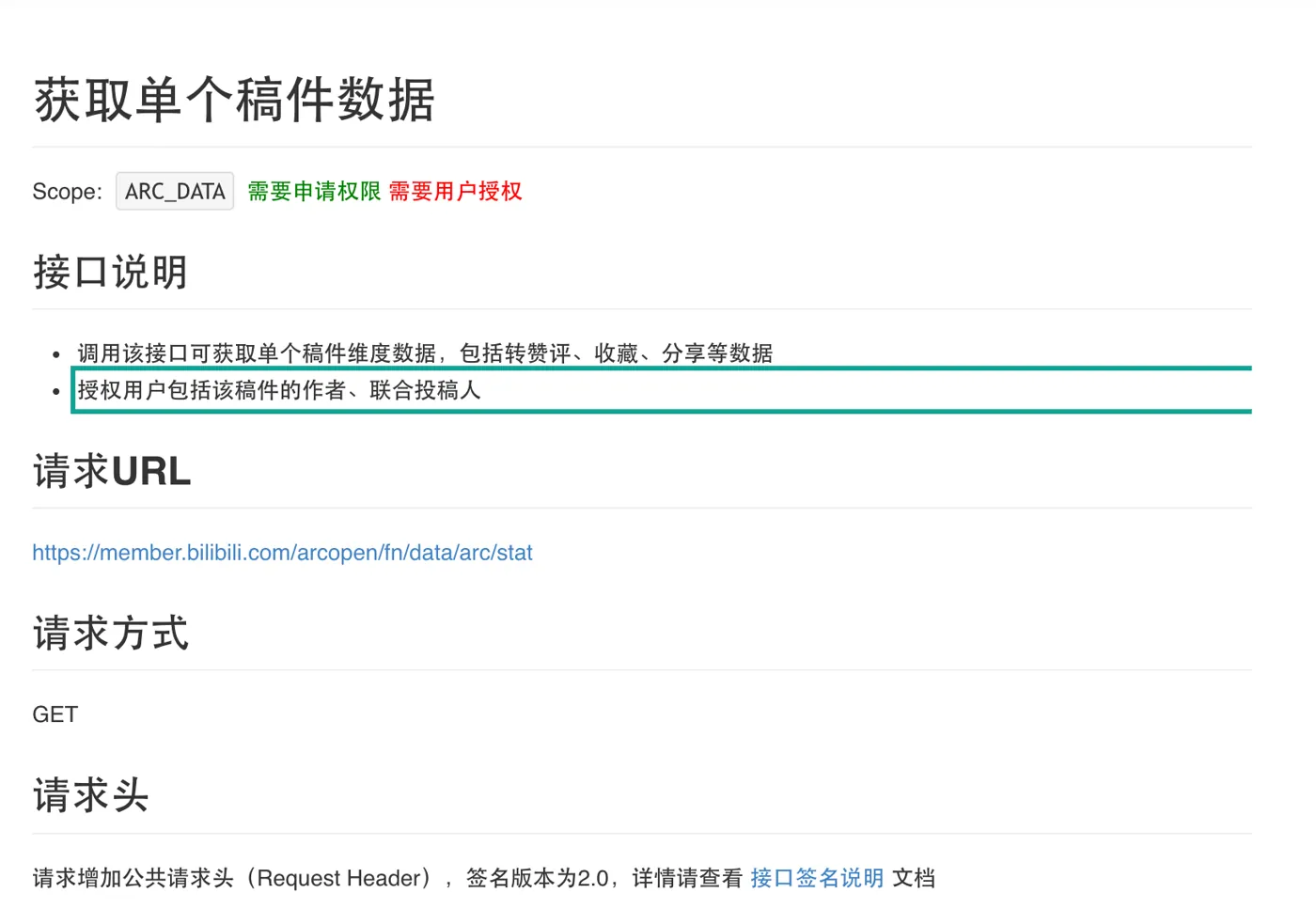
On November 23, 2026, we opened the page "get stats for a single upload". Its tags say the endpoint needs a permission request and user authorization. Its notes say the authorizing user can be the uploader or a co-uploader. The related page for 30-day totals across all uploads gives the same user's recent gains.
So the Open Platform can tell a creator how many views and coins their own videos gained this month. It cannot tell you how other people's videos perform for a keyword.
On eligibility, the management rules were updated on July 22, 2022 and took effect on July 29. They require a legal entity set up and operating in mainland China. Its business license must stay valid for more than one month, and it must sign a stamped commitment letter.
The same page says the platform requires you to delete the data when you leave. It forbids leaking a linked creator's upload data. It also forbids claims of a partnership with the platform in marketing. The developer agreement was last updated on May 28, 2025, and took effect on June 4, 2025.
Under that entity rule, individual developers and companies outside mainland China are not in scope. Our guide to the Bilibili API in Python shows the clauses with screenshots.
Web apps use OAuth to get an access_token. Each request carries a signature computed with HMAC-SHA256.
After authorization, the basic public user info endpoint returns an open_id. It does not return the site-wide user ID (mid), so you cannot join its results with public profile pages directly. The video detail and category endpoints serve posting tools. Sign-up steps are in the onboarding guide, and data handling is in the privacy policy.
| Open Platform feature | Who authorizes | Good for | What to know |
|---|---|---|---|
| Upload stats (ARC_DATA) | Uploader or co-uploader | Agencies building dashboards for signed creators | Reads only the authorizing account's uploads |
| Upload management (ARC_BASE, categories) | The creator | Posting tools, batch uploads | Write features, not data collection |
| Basic public user info | The signed-in user | "Log in with Bilibili" on your site | Returns open_id, not the site-wide mid |
| Live open platform | The streamer, with an identity code | Danmaku games, live plugins | Separate developer key, 3 to 5 working days |
| Keyword search, comments and danmaku on any video | — | — | Not in the docs |
The live open platform: a separate key in 3 to 5 working days
A danmaku game for Bilibili live streams goes through the live open platform. It has its own authorization system.
Its quick start page says the live creator center and the open platform now use separate authentication. You must apply for developer access on its own. After sign-up, the developer key arrives by email within 3 to 5 working days.
Once connected, danmaku, gifts and likes from the live room reach you over a long-lived connection. There is a client mode and a server mode, and you apply in advance for each message type.
Its FAQ adds more limits. Project review takes 3 to 5 working days. The streamer authorizes with an identity code. A live room can run only one interactive game at a time, and up to 5 plugins can connect. A connection that stays open for more than 7 days goes silent.
The same FAQ says open_id replaces the UID so that users cannot be tracked across apps and rooms. A new developer or app gives the same user a new open_id.
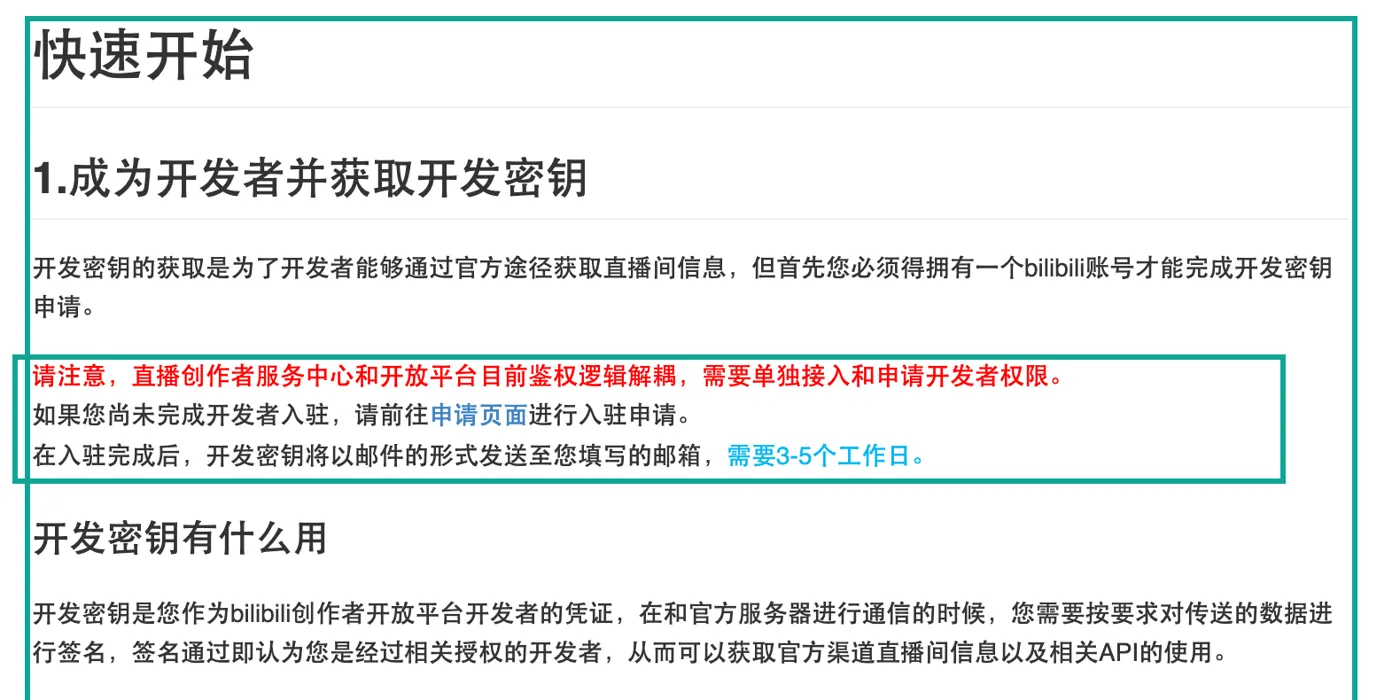
Only the live open platform sends real-time danmaku and gift messages, with the streamer's consent. Pay-per-call APIs and open-source scrapers read public data after the fact. To look back at a past stream or count danmaku on replays, you do not need the live platform.
Bilibili repositories on GitHub: upkeep and login needs
At 00:15 SGT on November 23, 2026, we used the GitHub API to read 14 Bilibili repositories. We recorded stars, last commit, license and archive status. Then we read each README to see whether it needs your own Bilibili login. The result: 3 are archived, 6 need a QR-code login or a cookie, 4 state or imply no login, and 1 is docs only.
| Repository | Stars | Last commit | License | Login |
|---|---|---|---|---|
| SocialSisterYi/bilibili-API-collect | 20,116 | 2026-01-30 | None declared | Archived |
| Nemo2011/bilibili-api | 4,151 | 2026-07-06 | None declared | Archived |
| fython/BilibiliAPIDocs | 2,526 | 2017-01-06 | None declared | Archived |
| NanmiCoder/MediaCrawler | 71,608 | 2026-11-21 | Non-commercial learning license 1.1 | Browser QR login, saved session |
| Evil0ctal/Douyin_TikTok_Download_API | 21,517 | 2026-11-20 | Apache-2.0 | Guest identities, no login |
| Panniantong/Agent-Reach | 113,938 | 2026-11-22 | MIT | Search without login; subtitles need QR login |
| cv-cat/catbus | 642 | 2026-11-20 | MIT | QR login |
| kukemc/bili-cli | 411 | 2026-11-14 | MIT | QR login |
| 1dyer/bilibili-comment-crawler | 202 | 2026-03-25 | None declared | Cookie |
| adoresever/bilibili-mcp | 200 | 2026-03-11 | MIT | QR login |
| 34892002/bilibili-mcp-js | 198 | 2026-10-23 | MIT | README does not mention login |
| huccihuang/bilibili-mcp-server | 192 | 2025-04-21 | MIT | README does not mention login |
| WShihan/blblcd | 148 | 2026-11-22 | BSD-2-Clause | Cookie; IP location needs login |
| lovelyyoshino/Bilibili-Live-API | 1,337 | 2026-08-03 | MIT | Docs only |
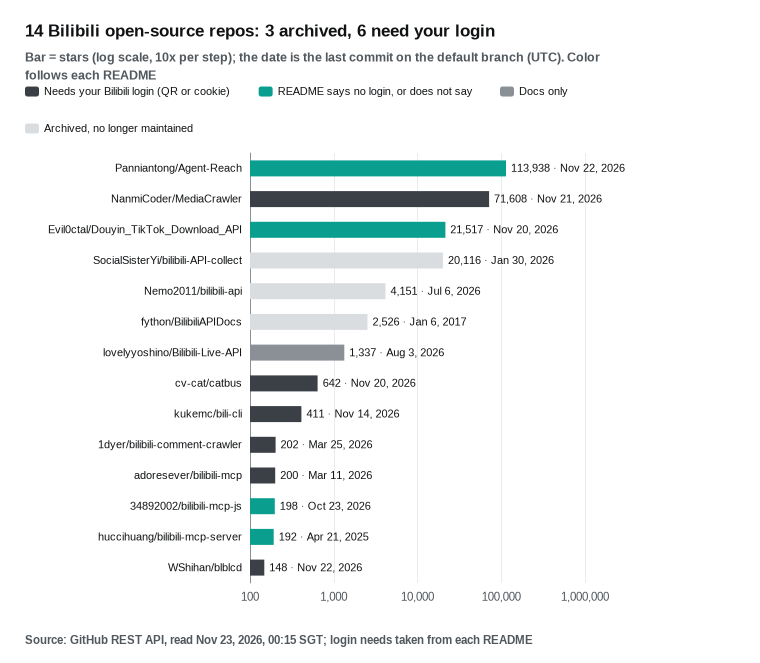
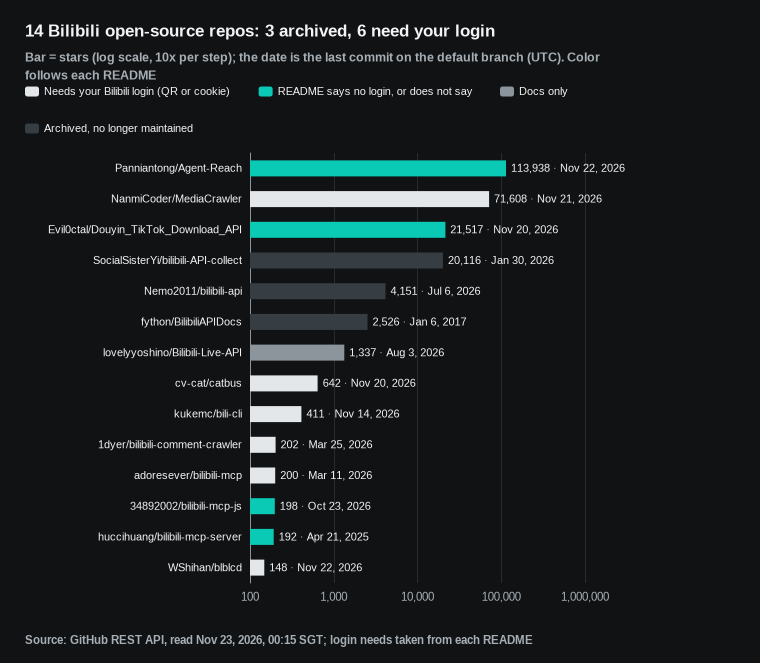
Three archived repositories: two legal letters and one report
The best-known Bilibili API reference, bilibili-API-collect, has 20,116 stars and 2,916 forks. Its README now opens with the word "Deprecated". It says that on January 28, 2026, the maintainer received a legal letter from a law firm that Bilibili had hired. The letter image is in reason.jpg in the same repository.

The Python library bilibili-api has 4,151 stars. Its README shows a letter from Shanghai Hong'an Law Firm on behalf of Bilibili, and its last commit is dated July 6, 2026. The older BilibiliAPIDocs stopped in 2017; its author wrote that an earlier project had been reported to Bilibili. Our Python article covers both letters. A new Bilibili project that starts from these three repositories starts from reference docs that no longer get updates.
The bilibili-api repository is archived, but the bilibili-api-python package on PyPI still installs. Its last version is 17.4.2, uploaded on June 19, 2026. pip install works, but the package will not follow future changes on Bilibili's side. If an old project breaks, check first whether it still pins 17.4.2.
Active repositories: most need your Bilibili account
The two most-starred active projects cover many platforms. Agent-Reach has 113,938 stars, an MIT license, and a repository created on February 24, 2026. Its README table lists search, video info, popular and subtitles for Bilibili, and notes that subtitles need a QR-code login. The README also says it reads Bilibili videos with bili-cli first and falls back to public Bilibili endpoints when that fails.
MediaCrawler has 71,608 stars and 13,486 forks. It logs in with a QR code through Playwright and saves the session. By default it connects over CDP to a Chrome that is already signed in. Its license is a non-commercial learning license, and its README says it is not for commercial use. If you plan to use it in a company project, check the license terms yourself first.
Douyin_TikTok_Download_API has 21,517 stars and an Apache-2.0 license. For Bilibili, it creates guest identities and needs no cookie. Its README also says a guest sees only the 3 hottest comments.
Forks show how people use these projects. MediaCrawler has about 1 fork for every 5 stars. catbus has 642 stars and 199 forks, close to 3 to 1, and its repository dates from September 27, 2026. Each fork must follow Bilibili changes on its own.
Three projects are Bilibili MCP servers, each with about 200 stars, created between March 2025 and March 2026. adoresever/bilibili-mcp has 27 tools and needs a QR login. The READMEs of bilibili-mcp-js and bilibili-mcp-server do not mention login; the second one last changed on April 21, 2025.
The command-line tool bili-cli has 411 stars, and its repository dates from October 19, 2026. Its PyPI package is bili-agent. Its changelog lists version 1.4.0 on November 14, 2026, and 1.3.0 on November 4, 2026. On a risk-control check or a captcha, it returns the error code risk_control, and the agent must stop. The README also suggests an older account in normal use, because its author's new test account hit risk control right after its first login.
The comment scrapers blblcd and bilibili-comment-crawler both need a cookie. blblcd also says the IP location field needs a login.
Open source has no call fee, but you maintain accounts and code. You keep Bilibili accounts, scan QR codes again, handle risk checks by hand and fix code when Bilibili changes. Bulk requests from your own account can get that account limited, as the bili-cli author saw.
Pay-per-call APIs: EveryInfra and TikHub
A pay-per-call API gives you an API key, and you pay per request. You do not need a Bilibili account, and you do not deal with logins or risk checks. We looked at two vendors here, EveryInfra and TikHub. Other pay-per-call services exist with their own pricing and terms, and we do not name them.
EveryInfra: 14 Bilibili capabilities, all available
The EveryInfra catalog we read at 00:12 SGT on November 23, 2026, lists 718 capabilities on 110 platforms. All 14 Bilibili capabilities are marked available. The prices and row counts below come from that catalog.
| Capability | What it returns | Price per call | Per 1,000 calls | Rows per call | Paging |
|---|---|---|---|---|---|
bilibili/search | Keyword search | $0.000556 | $0.556 | 20 by default, up to 50 | No |
bilibili/video | Video details | $0.000556 | $0.556 | 1 video | — |
bilibili/comments | Comments | $0.000556 | $0.556 | Up to 10 | No |
bilibili/comment_replies | Comment replies | $0.000556 | $0.556 | 20 per page | page_token |
bilibili/danmaku | Danmaku | $0.000556 | $0.556 | 50 by default, up to 200 | No |
bilibili/subtitles | Subtitles | $0.000792 | $0.792 | Whole video | — |
bilibili/profile | Creator profile | $0.000556 | $0.556 | 1 account | — |
bilibili/user_posts | Creator uploads | $0.000556 | $0.556 | 20 by default, up to 50 | No |
bilibili/user_search | Account search | $0.000556 | $0.556 | 20 per page | page_token |
bilibili/followers | Follower count | $0.000556 | $0.556 | 1 account | — |
bilibili/popular | Popular videos | $0.000806 | $0.806 | 20 per page | page_token |
bilibili/general_search | General search | $0.000792 | $0.792 | 20 per page | page_token |
bilibili/video_parts | Video parts | $0.000556 | $0.556 | All parts | — |
bilibili/resolve_links | Link resolver | $0.000556 | $0.556 | 1 link | — |
The catalog also lists limits for Bilibili video streams. Without a login, the best quality is 480P, links expire after about 120 minutes, and downloads need a Referer header. All capabilities and fields are on the Bilibili Scraper API page, and all prices are on the pricing page.
TikHub: 88 Bilibili endpoints, higher prices for Huahuo
We read only TikHub's public material. At 00:17 SGT on November 23, 2026, we called its price endpoint without a key. It returned 1,484 endpoints, and 88 are for Bilibili: 32 in the web series, 11 in the app series and 45 in the Huahuo series.
Of the 43 web and app endpoints, 42 cost $0.001 per request, and video detail v2 costs $0.002. Of the 45 Huahuo endpoints, 43 cost $0.006 and 2 cost $0.01, for example the creator search search_upper. Huahuo is Bilibili's brand-deal platform. All 88 Bilibili endpoints accept free credit and volume discounts, and each has a limit of 10 requests per second.
The Huahuo endpoint names show creator business data. upper_fans_trend gives follower trends, and upper_busy_time shows a creator's schedule. upper_similar and upper_overlap_uppers find similar creators and creators with shared fans. popular_goods_list ranks promoted products, live_commerce_info covers live selling, and mcn_drop filters by MCN agency.
For brand campaigns, these numbers are closer to a booking decision than public follower counts. EveryInfra has no matching capability.
| TikHub Bilibili series | Endpoints | Price per request | Per 1,000 |
|---|---|---|---|
| web | 32 | $0.001 (one at $0.002) | $1.00 |
| app | 11 | $0.001 | $1.00 |
| Huahuo | 45 | $0.006 (two at $0.01) | $6.00 |
Its FAQ, read at 00:17 SGT, says it bills only requests that return status 200, and failed requests are free. Prices run from $0.001 to $0.01. A verified email unlocks $0.05 of free credit, about 50 requests at the base price. Each account starts at 10 requests per second.
The Bilibili section of the FAQ says the video API cannot return HD links. HD and 4K need login cookies such as SESSDATA, and 1080P or higher needs a premium membership. Video comes as DASH .m4s segments, needs a Referer header and expires after about 2 hours.
The FAQ also says its MCP has more than 990 tools, 41 of them for Bilibili. Its datasets include more than 9 million Bilibili videos, with a $150 minimum order. Endpoint parameters are on its API docs site. For more on its free credit, see TikHub free credits explained and the TikHub alternatives page.
We matched the TikHub endpoint names against the 14 EveryInfra capabilities. The TikHub web and app series cover several Bilibili data types that EveryInfra does not have today. These are user feed posts (fetch_user_dynamic, plus feed detail and feed comments), live rooms (fetch_live_room_detail, live streamers, live areas), trending search terms (fetch_hot_search), favorite folders (fetch_collect_folders), anime and film tabs, and following and upload stats. Each EveryInfra capability has an endpoint with a similar name in the TikHub web series.
| Bilibili data | EveryInfra capability | TikHub endpoint (by name) |
|---|---|---|
| Keyword and general search | bilibili/search, bilibili/general_search | fetch_general_search, app fetch_search_all |
| Video details, parts | bilibili/video, bilibili/video_parts | fetch_one_video (v2 at $0.002), fetch_video_parts |
| Comments, replies | bilibili/comments, bilibili/comment_replies | fetch_video_comments, fetch_comment_reply |
| Danmaku, subtitles | bilibili/danmaku, bilibili/subtitles | fetch_video_danmaku, fetch_video_subtitle |
| Profile, uploads, popular | bilibili/profile, bilibili/user_posts, bilibili/popular | fetch_user_profile, fetch_user_post_videos, fetch_com_popular |
| Feed posts, live rooms, trending terms, favorites, anime | None | fetch_user_dynamic, fetch_live_room_detail, fetch_hot_search, fetch_collect_folders, fetch_bangumi_tab |
| Huahuo business data | None | 45 Huahuo endpoints, from $0.006 |
The two vendors differ in fields, page sizes and sort options. We did not buy TikHub's service for a side-by-side test. So the monthly costs below compare list prices for the same number of requests. They do not mean the two vendors return the same data.
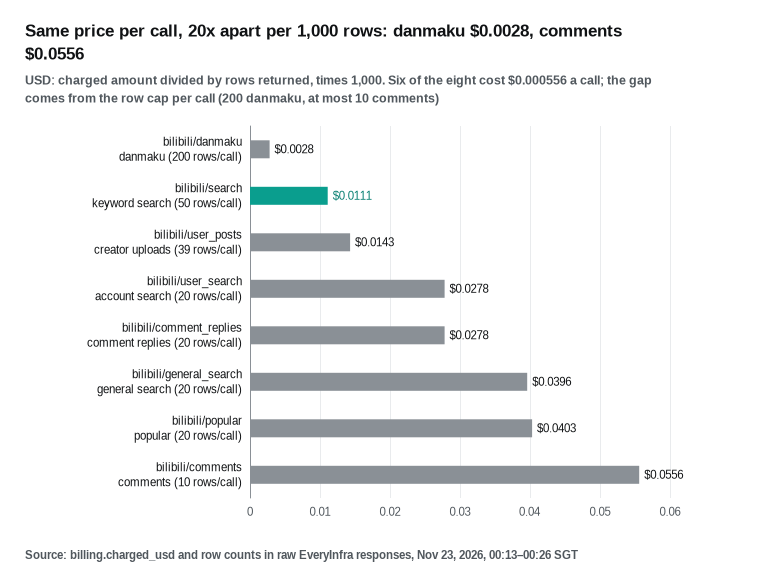
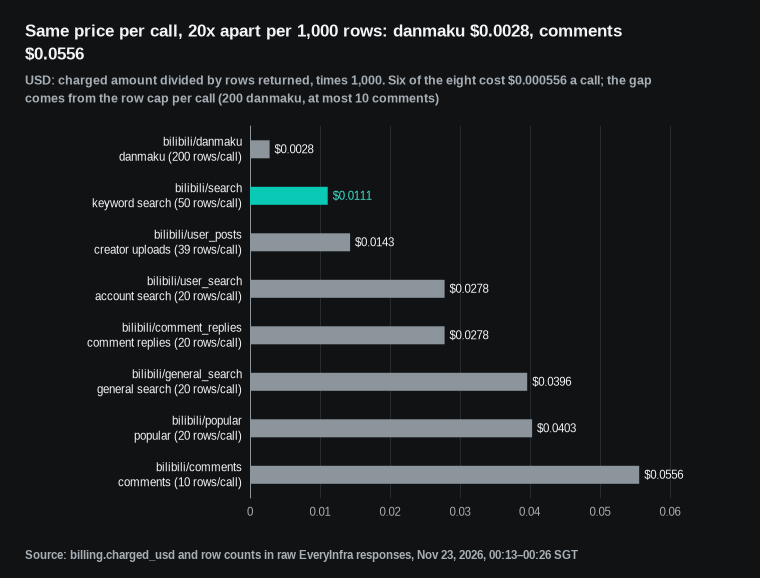
Per 1,000 rows, the difference comes mostly from rows per call. Bilibili danmaku returns 200 rows, so 1,000 rows cost $0.0028. Comments return at most 10 rows, so 1,000 rows cost $0.0556, 20 times as much.
How Bilibili failures, empty results and rate limits are billed
EveryInfra has three rules. A rate limit returns 429 at no charge; wait for the time in retry_after and send the request again. A bad parameter returns 422 at no charge, with the valid parameters and a working example request. A 200 with an empty result is refunded under the same charge_id. In our Bilibili test, some requests got a 429, cost nothing, and worked when we sent them again in the next minute.
Here is the 422 example. We sent the camping gear keyword to bilibili/resolve_links on purpose, and that capability accepts only video links. The error said the url parameter was missing and listed BV IDs, av numbers and b23.tv short links as valid input. It also gave a working example request.
A 422 means the parameters are wrong, so the same request fails each time until you fix it. A 429 is about speed, not parameters. In a Bilibili batch job, handle the two in different ways, and retry only the 429s.
Choose a Bilibili data option by use case
Three questions decide the type: whose data you need, how much you need, and whether you will maintain accounts.
| Your job | Type to pick | Why |
|---|---|---|
| Show signed creators their 30-day gains | Open Platform | Creator consent unlocks back-office data |
| Build a live danmaku game | Live open platform | Real-time messages and streamer consent |
| Learn how Bilibili endpoints work | Open source | Code and docs are public, even archived ones |
| Brand monitoring: daily keyword search plus comments, danmaku and subtitles | Pay-per-call | No account, predictable cost per call |
| Vet creators: profiles, follower counts and recent uploads in bulk | Pay-per-call | One key, batch calls |
| Creator business profiles, product placements, Huahuo data | TikHub Huahuo series | EveryInfra has no such data |
| Feed posts, live room info, trending search terms | TikHub web series or open source | Not in the 14 EveryInfra capabilities |
| Buy millions of historical video rows at once | Dataset | Buying rows beats calling page by page |
| Let Claude or Cursor query Bilibili directly | Pay-per-call API with MCP, or an open-source MCP | No calling code to write |
We priced three common jobs over 30 days. Brand monitoring searches 20 keywords a day and reads comments, danmaku and subtitles for 10 videos: 1,500 requests in 30 days. Creator vetting reads the profile, follower count and recent uploads of 200 accounts a week: about 2,571 requests. Popular tracking reads 1 page of popular videos every hour: 720 requests.
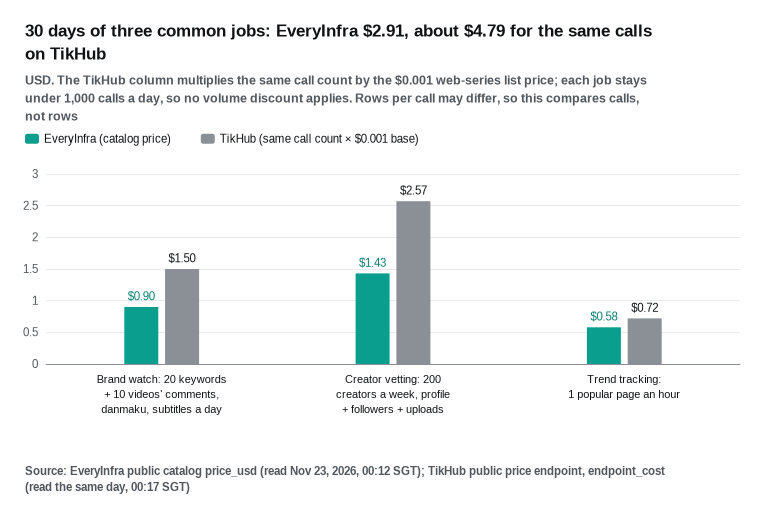
Here is the brand monitoring job line by line. It makes 600 keyword searches at $0.000556, which is $0.334. It reads comments and danmaku 300 times each, at $0.167 each. It reads subtitles 300 times at $0.792 per 1,000, which is $0.238. The total is $0.905.
In rows, at the catalog limits, a month of that job gives 30,000 search rows (50 per call) and 60,000 danmaku (200 per call). It gives only 3,000 comments (10 per call), plus 300 full subtitle files. Comments are the thinnest part of this job. To see the long tail of a comment section, move some calls to bilibili/comment_replies.
Creator vetting makes 3 requests per creator for 200 creators a week, over 30/7 weeks: 2,571 requests, or $1.43. That is $0.001668 to check one creator. Popular tracking makes 720 requests at $0.000806, which is $0.58.
For the three jobs together, EveryInfra costs $2.91. The same requests at the TikHub $0.001 web base price cost $4.79. Each job stays under 1,000 requests a day, so the TikHub volume discount does not apply, and the top-up fee is not included. When the gap is a few dollars, check coverage first. Feed posts, live rooms and Huahuo data are not in the 14 EveryInfra capabilities.
At 100,000 Bilibili requests a month, about 3,333 a day, the numbers change. EveryInfra base capabilities cost $55.60. TikHub falls in its 1,000 to 5,000 daily band; at $0.0009 per request it costs about $90 plus the top-up fee. Above 5,000 a day its discount grows. On the Huahuo series, the same volume costs $600 or more.
| Monthly volume | EveryInfra (base capabilities) | TikHub web series | TikHub Huahuo series |
|---|---|---|---|
| 4,791 requests (the three jobs above) | $2.91 | $4.79 | Not used |
| 100,000 requests | $55.60 | About $90 at $0.0009 | $600 or more |
One test: one keyword, one video, one creator, 14 capabilities
Below are the requests we sent to the EveryInfra Bilibili API between 00:13 and 00:26 SGT on November 23, 2026. We used an EveryInfra API key from an environment variable and kept every raw response. First we searched the camping gear keyword for the 50 most-viewed results. We took the top video and read its details, comments, danmaku, subtitles and parts. Then we followed its creator to the profile, follower count and uploads.
# 1) Keyword search: 50 most-viewed results
curl -s https://api.everyinfra.com/api/v1/social \
  -H "Authorization: Bearer $EVERYINFRA_API_KEY" \
  -H "Content-Type: application/json" \
  -d '{"platform":"bilibili","action":"search","params":{"keyword":"露营装备推荐","sort":"most_viewed","limit":50}}'

# 2) Danmaku for one video, up to 200 per call
curl -s https://api.everyinfra.com/api/v1/social \
  -H "Authorization: Bearer $EVERYINFRA_API_KEY" \
  -H "Content-Type: application/json" \
  -d '{"platform":"bilibili","action":"danmaku","params":{"url":"BV1hcwCzbEDr","limit":200}}'
# returns 200 rows, billing.charged_usd = 0.000556| Time (SGT) | Capability | HTTP | Rows | Charged |
|---|---|---|---|---|
| 00:13:42 | bilibili/search, most_viewed, limit 50 | 200 | 50 | $0.000556 |
| 00:13:55 | bilibili/popular | 200 | 20 | $0.000806 |
| 00:16:10 | bilibili/video | 200 | 1 | $0.000556 |
| 00:16:24 | bilibili/comments | 200 | 10 | $0.000556 |
| 00:18:07 | bilibili/danmaku, limit 200 | 200 | 200 | $0.000556 |
| 00:18:18 | bilibili/subtitles | 200 | 486 lines | $0.000792 |
| 00:24:32 | bilibili/user_search | 200 | 20 | $0.000556 |
| 00:24:44 | bilibili/profile | 200 | 1 | $0.000556 |
| 00:25:03 | bilibili/followers | 200 | 1 | $0.000556 |
| 00:25:15 | bilibili/user_posts | 200 | 39 | $0.000556 |
| 00:25:37 | bilibili/comment_replies | 200 | 20 | $0.000556 |
| 00:25:58 | bilibili/resolve_links, given a keyword | 422 | — | $0 |
| 00:26:07 | bilibili/general_search | 200 | 20 | $0.000792 |
| 00:26:18 | bilibili/video_parts | 200 | 1 | $0.000556 |
| 00:26:28 | bilibili/search, newest, limit 50 | 200 | 50 | $0.000556 |
| — | Requests that hit the rate limit | 429 | — | $0; worked when sent again in the next minute |
The 14 successful requests cost $0.008506 in total. Search and comment requests took 10 to 16 seconds, while popular and video parts came back in under 1.5 seconds. Write Bilibili batch jobs as async calls or a queue.
Same keyword, most-viewed and newest share zero videos
The 50 most-viewed results for the camping gear keyword at 00:13:42 SGT ranged from 59,532 to 1,240,410 views, with a median of 94,477. They were posted from 2019 to 2026. 2023 had the most, with 13, and only 5 were from 2026. The 50 newest results at 00:26:28 SGT were all posted between October 17 and November 22, 2026, with a median of 575 views.
Matched by video ID, the two sets had zero overlap. Matched by creator ID, they also had zero overlap: 36 creators in the most-viewed set and 35 in the newest set.
The content differs too. In the most-viewed set, 29 of the 50 are in the Travel category. Their median length is 185.5 seconds, and 24 run under 3 minutes. Their medians are 183.5 comments, 65 danmaku and 1,137 favorites.
In the newest set, the top categories are Digital with 14 videos and Film Edits with 10, and only 3 are in Travel. Their median length is 793.5 seconds, and 32 run over 10 minutes. Their medians are 1.5 comments, 0 danmaku and 5 favorites, and 5 videos have fewer than 100 views.
The newest titles match the keyword more often. Of the newest 50, 41 have "camping" in the title, against 25 in the most-viewed set. But those 41 spread over 10 categories, and only 2 sit in Travel. A filter by category would drop most of them. A filter by title and tags works better: 47 of the 50 most-viewed results carry a "camping" tag.
| Measure | 50 most-viewed | 50 newest |
|---|---|---|
| Median views | 94,477 | 575 |
| Posted in 2026 | 5 | 50 |
| Median length | 185.5 s | 793.5 s |
| Median comments / danmaku / favorites | 183.5 / 65 / 1,137 | 1.5 / 0 / 5 |
| "Camping" in the title | 25 | 41 |
| In the Travel category | 29 | 3 |
| Distinct creators (shared: 0) | 36 | 35 |
So pick the sort by the question. Use newest for brand monitoring and most viewed for topic research; one page in relevance order shows neither in full. bilibili/search supports five sorts: relevance, newest, most viewed, most commented and most liked, with up to 50 rows per call. bilibili/general_search returns 20 rows per page with a page_token. All 20 rows on page 1 of our general search were videos.
Danmaku: 200 rows cover only the first 6 minutes
The top video in the most-viewed set is about a winter in a camper van in deep cold, and the gear for it. It runs 13 minutes 31 seconds. It has 1,240,410 views, 12,728 likes, 1,656 coins, 6,366 favorites, 321 shares, 492 comments and 400 danmaku. It was posted on March 19, 2026. The creator is a verified travel creator with 518,000 followers; we leave out the name. Our danmaku request at 00:18:07 SGT asked for 200 rows and got 200, half of the video's 400.
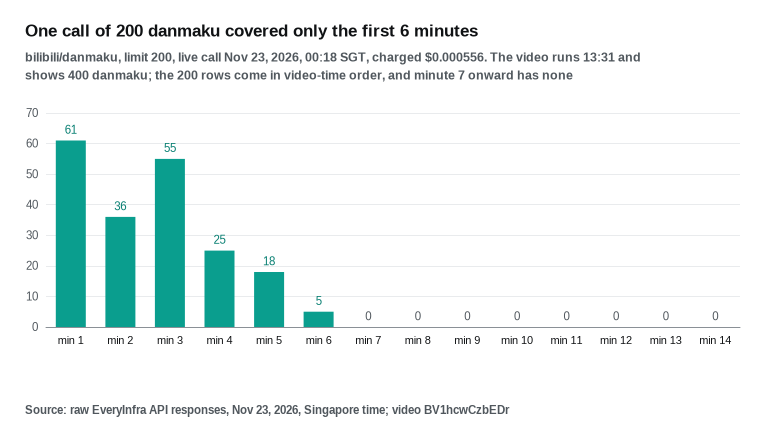
Counted by minute of video time, all 200 rows fall in the first 6 minutes. Minute 0 has 61, minute 2 has 55, minute 5 drops to 5, and nothing comes after minute 6. The rows come back in video-time order, so one request gets the opening part.
Of the 200 rows, 166 are scrolling danmaku and 34 are pinned to the top. There are 196 unique texts, sent between March 19 and September 4, 2026. Most are white: 167 white, 25 yellow and 5 red. All 200 sit in the normal pool, and the median text length is 8 Chinese characters. Such short texts work for word counts, but a sentiment study needs a much larger sample.
By send date, 86 of the 200 came in the first 3 days after upload (March 19 to 21, UTC), and 131 in the first 7 days. March had 141, April 31 and May 23; June to September had only 5 in total. For brand monitoring, read the danmaku of a new video in its first week. A few months later, few new danmaku arrive.
For a video with 400 danmaku, this sample shows what viewers said in the first minutes. bilibili/danmaku cannot draw a heat curve for the whole video in one call. Our Python article tested repeated danmaku calls on videos with tens of thousands of danmaku.
Gear words in the subtitles and the danmaku
The subtitle request at 00:18:18 SGT returned AI-generated Chinese subtitles: 486 lines and 4,806 characters, or 355.6 characters per minute. It covers the whole video. We picked 11 gear words and counted each one in the subtitles, the 200 danmaku and the 10 comments with a script.
| Word (English) | In subtitles | Danmaku rows | Comment rows |
|---|---|---|---|
| Knife | 13 | 12 | 0 |
| Lamp or light | 8 | 3 | 0 |
| Pliers | 6 | 0 | 0 |
| Flashlight | 4 | 1 | 1 |
| Fleece | 4 | 0 | 1 |
| Power bank | 2 | 0 | 0 |
| Alarm | 1 | 1 | 0 |
| Stove | 1 | 1 | 0 |
| Radio | 0 | 1 | 0 |
| Sleeping bag, tent | 0 | 0 | 0 |
The knife comes up 13 times in the subtitles and in 12 danmaku rows, so viewers reacted to it the most. The creator mentioned pliers 6 times, and no danmaku row picked them up. Five of the 200 danmaku rows say "tóngkuǎn" (same one), which viewers use to ask where to buy an item.
The subtitles are complete, but the danmaku are an opening sample, so we checked the timing. The subtitles carry time stamps. All 13 knife mentions and all 6 pliers mentions fall in minutes 0 to 2, where danmaku are densest. So the silence on pliers is not a sampling gap.
The lamp is different. Seven of its 8 mentions fall in minutes 10 to 12, and all 4 flashlight mentions fall in minutes 7 to 10. Our 200 danmaku do not reach those minutes. Their low danmaku counts (3 and 1) do not show that viewers ignored them. Only 44% of the 486 subtitle lines fall in the first 6 minutes. For gear in the second half, get more danmaku before you judge it.
10 comments per call, but replies page through
The comment request at 00:16:24 SGT returned 10 rows, 2.03% of the video's 492 comments. Their likes ran from 1,238 down to 1, and their replies added up to 99. bilibili/comments returns at most 10 rows with no paging. It suits a quick look at top comments, not a full export.
Replies do page. At 00:25:37 SGT we read the replies to the comment with 1,238 likes, which has 46 replies. Page 1 returned 20 rows and a page_token for the next page. The 20 replies came from 14 provinces and regions, with 3 each from Jiangsu and Zhejiang, and 1 was from the creator.
The 20 replies have 1,277 likes in total. The top reply has 617, the top 3 hold 1,096, and the last 10 have fewer than 10 each. All 20 repliers are at account level 5 or higher. The replies were posted from March 19 to 22, in the first 4 days after upload. So for comment tracking, read often in the first days and less often after that.
The 10 comments do not come back in order of likes. The first one has 41 likes, the one with 1,238 likes is second, and then 10, 2 and 5 likes follow. They were posted from March 19 to June 13, 2026. To rank top comments, sort by like_count yourself after the call. To hear the long tail, follow the replies on the comments with the most replies. On this video, the 10 comments carry 99 replies, almost 10 times their own count.
The creator side: profile, followers and uploads
At 00:24:44 SGT the profile request returned 17 fields plus a few recent uploads. It showed 518,511 followers, 145 videos, level 6 and a verified travel creator badge. Nineteen seconds later the follower request returned 518,513, two more.
At 00:24:32 SGT we also searched accounts for "camping gear" in Chinese. The 20 results had 9 to 2,710 followers, with a median of 118.5, and only 3 above 1,000. They are ranked by name relevance, so big accounts do not always come first. To find leading creators, search videos first and then follow their creators to the profile.
At 00:25:15 SGT the uploads request returned this creator's 39 uploads, posted from February 6 to November 9, 2026. From February to October, the creator posted 3 to 5 videos a month. November had 1 by the 9th. The median gap between two uploads is 6 days.
The 39 uploads have 89,064 to 3,925,320 views, with a median of 484,528. Their median length is 1,254 seconds, about 21 minutes. For creator vetting, these numbers say more about recent form than the follower count. They show whether uploads are steady, whether each video holds its views, and whether the length suits a product placement. One profile, one follower count and one uploads call cost $0.001668 per creator.
The popular request at 00:13:55 SGT returned 20 videos from 15 categories, with 57,440 to 4,700,399 views and a median of 843,824. Single-player games had the most, with 4. All 20 were posted between November 17 and 22, with a median length of 585 seconds. Their median ratio of likes to views is 7.65%, against 1.6% for the 50 most-viewed camping results. One was a BLG championship vlog, which matches the news section below.
Popular costs $0.000806 per call, $0.00025 more than a base capability. It returns 20 rows per page with a page_token. If you read 1 page every hour, you see the chart move, and 720 calls in 30 days cost $0.58. To look by category, read several pages in the same hour and group them by the category field.
Fields: search results have no coins or shares
The catalog lists 22 fields for bilibili/search. Each row in our test had 20. The two missing fields are coin_count and share_count, and the catalog field notes say these two can be absent. The 20 fields include views, likes, comments, danmaku, favorites, length, category, tags, post time and creator.
For coin and share counts, call bilibili/video once per video. It returns 22 fields, including coin_count and share_count. At $0.556 per 1,000 calls, adding coins and shares to 50 search rows costs $0.0278 more.
Page 1 of bilibili/general_search had 20 video rows with 21 fields each, one more than plain search: type. The catalog lists 40 fields for it. Besides videos, it lists account rows (followers, badge, live status, live room ID) and anime series rows (episode count, rating).
Comment rows have 10 fields and reply rows have 16. Video parts return the cid, part number, title, length and resolution; our video was 3840×2160.
All time fields are in UTC. The first row of the newest search has a posted_at of 2026-11-22T11:29:31+00:00, which is 19:29 the same day in Beijing time. Convert the time zone before you group Bilibili posts or danmaku by day, or rows near midnight land on the wrong day.
| Capability | Fields per row in our test | Fields to note |
|---|---|---|
bilibili/search | 20 (22 in the catalog) | coin_count and share_count can be absent |
bilibili/video | 22 | Has coin_count and share_count |
bilibili/general_search | 21 (40 in the catalog) | type; account and anime rows possible |
bilibili/comment_replies | 16 | ip_location, is_by_uploader, root_comment_id |
bilibili/danmaku | 10 | video_time_seconds, mode, sent_at |
What to change when you switch: BV IDs, open_id and paging
The three types use different IDs. EveryInfra video capabilities accept BV IDs, av numbers and b23.tv short links, as the 422 message says. The Open Platform returns open_id, which does not match the mid on public profiles, so you keep your own map at authorization time. Most open-source tools use BV IDs, aid and cid. Danmaku is keyed by cid, which you can get from bilibili/video_parts.
Paging differs too. EveryInfra account search, comment replies, popular and general search use a page_token: pass the token from the last page to get the next one. Keyword search and creator uploads have no token and return up to 50 rows. Open-source tools often page by number, and the Open Platform list endpoints use their own paging. When you move from a Bilibili open-source tool, change "page plus one" to "send the token back" and convert time fields to UTC.
Connect AI tools: MCP setup
At 00:19 SGT we searched YouTube for the Chinese query "Bilibili API data collection". In the top 6 results, 2 titles show a Bilibili MCP set up with OpenClaw for chart collection and comment replies. One more is a tutorial on an AI assistant built on popular Bilibili topics.
The EveryInfra remote MCP endpoint is https://api.everyinfra.com/mcp. Around 00:12 SGT we listed its tools with tools/list and got 12. For data, everyinfra_list_capabilities lists capabilities and parameters, and everyinfra_call_api sends requests. everyinfra_get_job gets the result of a slow request, everyinfra_get_account shows the balance, and everyinfra_list_requests lists past calls. In a tool that supports remote MCP, such as Claude Code or Cursor, add this config:
{
  "mcpServers": {
    "everyinfra": {
      "type": "http",
      "url": "https://api.everyinfra.com/mcp",
      "headers": { "Authorization": "Bearer ${EVERYINFRA_API_KEY}" }
    }
  }
}
This is a config example. We listed the tools but did not run a full chat in an AI tool. After setup you can ask: "Search Bilibili for camping gear videos from the last month, read the danmaku on the most-viewed one, and list the gear viewers mention." Per the tool descriptions, the model first calls everyinfra_list_capabilities for parameters. Then it calls bilibili/search with sort set to newest and bilibili/danmaku. The two requests cost $0.001112 at catalog prices.
Our newest search spread over 10 categories, with only 3 videos in Travel. So ask the model to pick videos by title and tags, not by category.
The protocol is described at modelcontextprotocol.io, and the EveryInfra side is on the MCP server page.
Compliance and limits
Three legal texts relate to Bilibili data collection. China's Anti-Unfair Competition Law was revised on June 27, 2025, and the new text took effect on October 15, 2025. Article 13, paragraph 3 says a business must not get or use other businesses' lawfully held data through improper means. Its examples are fraud, coercion, and avoiding or breaking technical controls. The valid version is in the national laws and regulations database.
Article 18 of the Network Data Security Management Regulations covers automated tools that access or collect network data. It requires an assessment of the impact on the service and forbids disruption of normal operation. Bilibili comments and danmaku carry ordinary users' names, avatars and IP locations, and rules on personal data apply. Check the terms yourself, or ask a lawyer, for your own use case.
EveryInfra Bilibili capabilities read public data that anyone can see without logging in. They do not need or accept your Bilibili account. Open Platform data falls under its management rules, which require deletion when you leave. Open-source tools run on your own account under the Bilibili user agreement. The bili-cli disclaimer says the user carries the results of use.
Industry news (October to November 2026)
On November 15, 2026, BLG won the League of Legends World Championship. A Leida Caijing article on The Paper, published November 17, gives the numbers. More than 20 million people watched the final on Bilibili, and the stream drew more than 3.3 million danmaku. Bilibili then gave every user 7 days of free premium membership, and 22.8 million claimed it. The popular page 1 we read at 00:13 SGT on November 23 included a BLG championship vlog.
What it means for you: a big live event produces millions of danmaku. Check how many rows a tool returns before you plan a study. EveryInfra bilibili/danmaku returns 200 per call, in video-time order.
On November 14, 2026, the command-line tool bili-cli released version 1.4.0 (changelog). That came 10 days after version 1.3.0 on November 4, and the repository dates only from October 19. What it means for you: Bilibili tools for AI agents ship new versions fast. They log in with your own account, and this one puts a risk-control stop into its error codes. Check how a tool handles risk control before you pick it.
On November 13, 2026, Index-Translate, the translation model that Bilibili built, reached NativeLong 9B v1.1. Its GitHub README says it was released on September 30, 2026. A free public API with an OpenAI-compatible format opened on October 4, and an Omni release followed on November 5. The repository home has model downloads and API examples. What it means for you: a search for "bilibili official api" can show this free API, but it translates text and returns no videos, comments or danmaku.
On November 21 and 22, 2026, the multi-platform tools MediaCrawler and Agent-Reach got new commits; they have 71,608 and 113,938 stars. In the same year, the reference projects bilibili-API-collect and bilibili-api were archived after legal letters. What it means for you: active open-source Bilibili tools are now mostly multi-platform scrapers and agent tools that need your login. Stand-alone Bilibili API reference projects are shrinking.
FAQ
Can a Bilibili API post danmaku, reply to comments or upload videos?
The 14 EveryInfra Bilibili capabilities only read data. They do not post danmaku, reply to comments or upload. Uploads go through the upload management endpoints of the Open Platform, with the creator's consent. The "one-click posting" and "auto-replies" in the YouTube tutorials we found use open-source MCP servers that log in to the creator's account with a QR code.
Can a Bilibili API get live-stream danmaku in real time?
Danmaku on a video and danmaku in a live room are not the same. Live-room danmaku, gifts and likes come over a long-lived connection from the live open platform. The streamer authorizes with an identity code, and a connection goes silent after 7 days, so you reconnect. Danmaku on a video can be read later: bilibili/danmaku returns up to 200 rows in video-time order.
Can a Bilibili comments API get every comment?
Not in one call. bilibili/comments returns at most 10 rows with no paging. Replies page through with bilibili/comment_replies, 20 per page. The open-source Douyin_TikTok_Download_API says a guest sees only the 3 hottest comments, and you need a login for more.
Can I download Bilibili videos from the links an API returns?
The EveryInfra catalog says the best quality without a login is 480P, stream links expire after about 120 minutes, and downloads need a Referer header. The TikHub FAQ says HD and 4K need a login cookie such as SESSDATA, and 1080P or higher needs a premium membership. Its video comes as DASH .m4s audio and video segments, and links expire after about 2 hours. With both, download before the link expires; do not store links for the next day.
How do I get a Bilibili API key?
For the Open Platform, join as a company with a business license and a stamped commitment letter, then create an app after review. The live platform key arrives by email in 3 to 5 working days. A pay-per-call API gives you a key in its console.
Do failed Bilibili API calls cost money?
Not on EveryInfra: 429 and 422 responses cost $0, and a 200 with an empty result is refunded under the same charge_id. The TikHub FAQ says it bills only status 200 and failed requests are free; it does not cover empty results. The Open Platform docs list no per-call fee.
Get started
- Sign up in the EveryInfra console, create an API key, and put it in the environment variable
EVERYINFRA_API_KEY. - Read the free catalog once with
GET /api/v1/social/catalog?platform=bilibilito check parameters and prices for all 14 capabilities. - Run
bilibili/searchwith the curl above to get video BV IDs, then readbilibili/comments,bilibili/danmakuandbilibili/subtitles. - To connect an AI tool, add the remote MCP config above. For more platforms, the Douyin API and the YouTube API use the same key.
- For similar platform comparisons, read Douyin data API options and Taobao API options.
References
- Get stats for a single upload, Bilibili Open Platform, read 2026-11-23, https://openhome.bilibili.com/doc/4/3f46ac2e-1318-3aa0-5548-0d9fd624d520
- Get 30-day totals across all uploads, Bilibili Open Platform, read 2026-11-23, https://openhome.bilibili.com/doc/4/708a4ce5-5a6e-d8ce-b2e8-ff8a26a83b05
- Doc center, Bilibili Open Platform, read 2026-11-23, https://openhome.bilibili.com/doc
- Onboarding guide, Bilibili Open Platform, read 2026-11-23, https://openhome.bilibili.com/doc/4/cbdcee3b-f57e-5c7b-cf27-83892fb811c4
- Management rules, Bilibili Open Platform, updated 2022-07-22, https://openhome.bilibili.com/agreement/management-protocol
- Developer service agreement, Bilibili Open Platform, updated 2025-05-28, https://openhome.bilibili.com/agreement/developer-service
- Privacy policy, Bilibili Open Platform, read 2026-11-23, https://openhome.bilibili.com/agreement/privacy-policy
- Web app OAuth, Bilibili Open Platform, read 2026-11-23, https://openhome.bilibili.com/doc/4/aac73b2e-4ff2-b75c-4c96-35ced865797b
- Signature rules, Bilibili Open Platform, read 2026-11-23, https://openhome.bilibili.com/doc/4/8673959e-f7bb-56e6-6e68-d225f971b81b
- Basic public info of an authorized user, Bilibili Open Platform, read 2026-11-23, https://openhome.bilibili.com/doc/4/feb66f99-7d87-c206-00e7-d84164cd701c
- Single video upload details, Bilibili Open Platform, read 2026-11-23, https://openhome.bilibili.com/doc/4/d9554788-dcef-f139-6217-b487d41c3826
- Category list, Bilibili Open Platform, read 2026-11-23, https://openhome.bilibili.com/doc/4/4f13299b-5316-142f-df6a-87313eaf85a9
- Bilibili live open platform home, read 2026-11-23, https://open-live.bilibili.com/
- Live open platform quick start, read 2026-11-23, https://open-live.bilibili.com/document/849b924b-b421-8586-3e5e-765a72ec3840
- Live open platform FAQ, read 2026-11-23, https://open-live.bilibili.com/document/5dffc297-6fd2-41ff-bd45-6e8b89e2a68e
- Index-Translate README, bilibili, read 2026-11-23, https://github.com/bilibili/Index-Translate/blob/main/README_zh.md
- SocialSisterYi/bilibili-API-collect, GitHub, read 2026-11-23, https://github.com/SocialSisterYi/bilibili-API-collect
- Nemo2011/bilibili-api, GitHub, read 2026-11-23, https://github.com/Nemo2011/bilibili-api
- fython/BilibiliAPIDocs, GitHub, read 2026-11-23, https://github.com/fython/BilibiliAPIDocs
- NanmiCoder/MediaCrawler, GitHub, read 2026-11-23, https://github.com/NanmiCoder/MediaCrawler
- Evil0ctal/Douyin_TikTok_Download_API, GitHub, read 2026-11-23, https://github.com/Evil0ctal/Douyin_TikTok_Download_API
- Panniantong/Agent-Reach, GitHub, read 2026-11-23, https://github.com/Panniantong/Agent-Reach
- cv-cat/catbus, GitHub, read 2026-11-23, https://github.com/cv-cat/catbus
- kukemc/bili-cli, GitHub, read 2026-11-23, https://github.com/kukemc/bili-cli
- 1dyer/bilibili-comment-crawler, GitHub, read 2026-11-23, https://github.com/1dyer/bilibili-comment-crawler
- adoresever/bilibili-mcp, GitHub, read 2026-11-23, https://github.com/adoresever/bilibili-mcp
- 34892002/bilibili-mcp-js, GitHub, read 2026-11-23, https://github.com/34892002/bilibili-mcp-js
- huccihuang/bilibili-mcp-server, GitHub, read 2026-11-23, https://github.com/huccihuang/bilibili-mcp-server
- WShihan/blblcd, GitHub, read 2026-11-23, https://github.com/WShihan/blblcd
- lovelyyoshino/Bilibili-Live-API, GitHub, read 2026-11-23, https://github.com/lovelyyoshino/Bilibili-Live-API
- EveryInfra public catalog (compact), read 2026-11-23 00:12 SGT, https://api.everyinfra.com/api/v1/social/catalog?compact=1
- EveryInfra public catalog, read 2026-11-23 00:12 SGT, https://api.everyinfra.com/api/v1/social/catalog
- EveryInfra remote MCP, read 2026-11-23, https://api.everyinfra.com/mcp
- TikHub public price endpoint, read 2026-11-23 00:17 SGT, https://api.tikhub.io/api/v1/tikhub/user/get_all_endpoints_info
- TikHub FAQ, read 2026-11-23 00:17 SGT, https://tikhub.io/faq
- Model Context Protocol specification, 2025-06-18, https://modelcontextprotocol.io/specification/2025-06-18
- Anti-Unfair Competition Law of the PRC, NPC website, 2025-06-27, http://www.npc.gov.cn/npc/c2/c30834/202506/t20250627_446247.html
- Network Data Security Management Regulations, Cyberspace Administration of China, 2024-09-30, https://www.cac.gov.cn/2024-09/30/c_1729384452307680.htm
- BLG wins and what Bilibili gains, Leida Caijing on The Paper, 2026-11-17, https://www.thepaper.cn/newsDetail_forward_34492804
- Index-Translate repository home, bilibili, read 2026-11-23, https://github.com/bilibili/Index-Translate
- bilibili-API-collect archive notice image, GitHub, read 2026-11-23, https://github.com/SocialSisterYi/bilibili-API-collect/blob/master/reason.jpg
- bilibili-api-python 17.4.2, PyPI, uploaded 2026-06-19, https://pypi.org/project/bilibili-api-python/
- bili-agent 1.4.0, PyPI, uploaded 2026-11-14, https://pypi.org/project/bili-agent/
- bili-cli changelog, GitHub, read 2026-11-23, https://github.com/kukemc/bili-cli/blob/main/CHANGELOG.md
- MediaCrawler license, GitHub, read 2026-11-23, https://github.com/NanmiCoder/MediaCrawler/blob/main/LICENSE
- Agent-Reach license, GitHub, read 2026-11-23, https://github.com/Panniantong/Agent-Reach/blob/main/LICENSE
- TikHub API docs, read 2026-11-23, https://docs.tikhub.io/
- National laws and regulations database, NPC Standing Committee, read 2026-11-23, https://flk.npc.gov.cn/
Reference BL-218