Apify TikTok Shop Scraper Alternative: Cost per 1,000 Rows, Measured
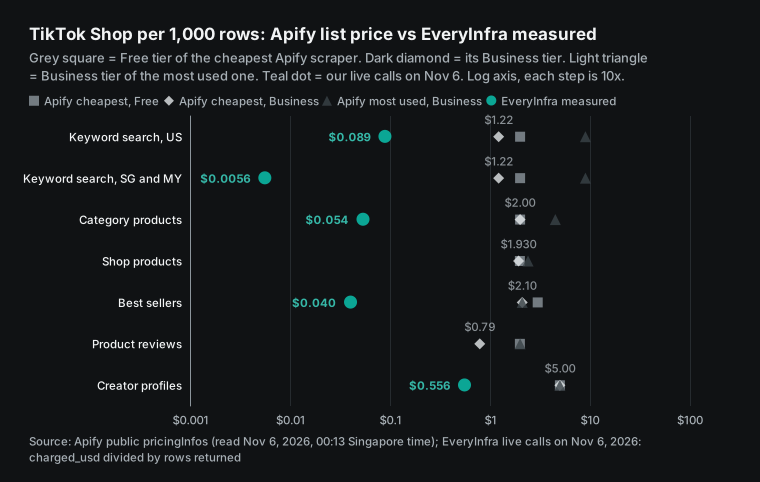
1,000 TikTok Shop products cost $1.22 to $15 at Apify Store list prices. Our live calls: $0.089 in the US store and $0.0056 in Singapore and Malaysia.
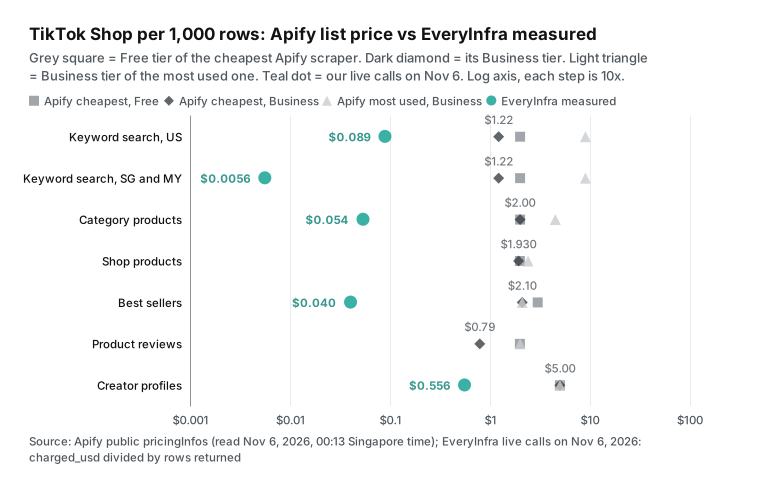
You want 1,000 products from the US TikTok Shop. In Apify Store, the cheapest search scraper on the Business tier lists $1.22 per 1,000. The most used search scraper lists $9.00 on Business and $15.00 on Free. On November 6, 2026, our live calls to tiktok/shop_search in the US store returned 10 to 15 products per call for $0.000556. That is $0.089 per 1,000 unique products. The cheapest Apify scraper costs 13.7x as much.
In the Singapore and Malaysia stores, the same price returned 100 products per call: $0.0056 per 1,000. There, the Apify price is more than 219x ours. Category products cost $0.0537 per 1,000, best sellers $0.0403 and creators $0.556. Similar Apify scrapers cost 37x, 52x and 9x as much. Shop products and reviews returned 503 for all 17 requests in our two rounds, with no charge, so we have no price for them.
"Price per 1,000" here is the charge for one request, divided by the rows that came back, times 1,000. EveryInfra charges per request. Apify Store scrapers charge per result (per event). Only the same denominator makes them comparable. We divide by rows returned, not by limit, and we count repeated rows once.
So short or repeated pages can only make our price look higher. For Apify, we use only public material: Store pages, the pricing page, the docs and the public API. We did not sign up or run its actors (Apify calls a cloud scraper an actor). So every Apify number is a list price, not a bill.
The prices come from our second test round, which started at 00:13 Singapore time on November 6, 2026. The first round, on November 4, ran into an outage on our side and gave no prices; the section on failed calls tells that story. The two rounds have 108 requests and $0.011452 in charges.
In this article, we refer to third-party Store scrapers by number (#1 to #15, see the price table). The developer names and links are in the references at the end.
The summary table: seven kinds of TikTok Shop data, cost per 1,000 rows
All EveryInfra numbers come from live calls on November 6, 2026: the charge is billing.charged_usd, and the rows are the length of results. Calls with 0 rows or errors are not in the denominator. For Apify, we took two scrapers per kind of data: the lowest Business price and the most users. Prices come from pricingInfos in the public API, read at 00:13 Singapore time on November 6, 2026 (Get Actor API docs). The # numbers refer to the price table in the next section. Tier discounts are in Actor pricing and costs.
| Data | EveryInfra capability | Measured: calls with data / rows / charge | Our price per 1,000 | Apify cheapest (Free → Business) | Apify most used (Free → Business) | Ratio (Business tier) |
|---|---|---|---|---|---|---|
| Keyword search, US | tiktok/shop_search | 4 / 25 unique (45 rows) / $0.002224 | $0.089 | #10 $2.00 → $1.22 | #2 $15.00 → $9.00 | 13.7x–101x |
| Keyword search, SG and MY | tiktok/shop_search | 2 / 200 / $0.001112 | $0.0056 | #10 $2.00 → $1.22 | #2 $15.00 → $9.00 | 219x–1,619x |
| Category products | tiktok/shop_category_products | 6 / 90 / $0.004836 | $0.054 | #6 $2.00 → $2.00 | #3 $4.50 → $4.50 | 37x–84x |
| Shop products | tiktok/shop_products | 0 / 0 / $0 (6 × 503 in two rounds) | not measured | #13 $1.99 → $1.93 | #5 $4.00 → $2.40 | — |
| Best sellers | tiktok/shop_hot_products | 2 / 40 / $0.001612 | $0.040 | #12 $3.00 → $2.10 | same | 52x |
| Product reviews | tiktok/shop_product_reviews | 0 / 0 / $0 (11 × 503 in two rounds) | not measured | #14 $1.99 → $0.79 | #11 $2.00 → $2.00 | — |
| Creator profiles | tiktok/shop_creator | 1 / 1 / $0.000556 | $0.556 | #7 $5.00 → $5.00 | same | 9x |
The ratio is the Apify price divided by our price. It depends almost fully on rows per request. Our price per request is fixed by the catalog: $0.000556 for search and creators, $0.000806 for category, shop and best-seller pages, $0.000764 for review pages. So 100 rows per call in Southeast Asia give a gap of hundreds of times. 10 rows per call in the US give about ten times, and one creator per call gives 9 times.
Apify also has start fees per run, and some actors charge platform usage separately (details after the price table). Shop products and reviews have no measured number from us: all 17 requests in the two rounds returned 503, with no charge and no data. We did not use catalog prices to make a ratio for them.
Price is not the only difference. The table below compares the other terms.
| Item | TikTok Shop scrapers in Apify Store | EveryInfra |
|---|---|---|
| Billing unit | Per event: mostly per row (product, review); #7 per run; some add a start fee per run | Per request: one page per call, $0.000556 to $0.000806 in the catalog |
| Failures and empty results | Depends on the actor; start fees and rows written before a failure are charged | 503, time-out, 0 rows and bad parameters are not charged (108 requests in this article) |
| Monthly fee | Free plan with $5 credit; Starter $19, Scale $199, Business $999 per month; unused credit expires | No monthly fee; minimum top-up $10 |
| Free credit | $5 per month on the Free plan | $1 for a GitHub star, valid 24 hours |
| Steps to first data | Sign up, open the actor, fill the input, start, download the dataset | Get a key, send one POST; the response has the data |
| AI tools | Apify MCP server (mcp.apify.com, OAuth) | Remote MCP at https://api.everyinfra.com/mcp, tools named everyinfra_* |
| Stores | Differs per actor; Clockworks US only; some cover Europe and Brazil | 9 stores: US, Mexico, Japan, 6 in Southeast Asia; no Europe or Brazil |
Sources: Apify pricing page, the Clockworks Store page for the steps, Apify MCP server and our capability catalog.
Apify TikTok Shop scraper pricing: 16 popular scrapers, one table
We searched Apify Store for "tiktok shop" through its public Store search API. The API returned 1,665 matches. When we first read it on November 4, 2026, it returned 1,626, so 39 new matches came in two days. All 39 of the first items that the API returned have "TikTok Shop" in the title (Store search API, read November 6, 2026, 00:13 Singapore time). Third-party developers publish almost all of these scrapers.
Apify maintains only one of them, under the Clockworks name. Almost all of them use pay-per-event pricing. The developer defines events, and you pay each time an event occurs (pay-per-event docs). The usual events are "one result" and "one run start". Apify calls a cloud scraper an actor.
Its docs tell you to read the public Get Actor endpoint to see all charge events of an actor (Get Actor). That endpoint needs no account. We read the pricingInfos field for the 16 scrapers with the most users.
| Number and type | Users, total / last 30 days | Main event | Free | Starter | Scale | Business | Fee per run | Price since | Last change (UTC) |
|---|---|---|---|---|---|---|---|---|---|
| #1 All-in-one (most users) | 3,064 / 410 | result | $25.00 | $20.00 | $18.00 | $15.00 | $0.002 | June 26, 2026 | October 4, 2026 |
| #2 Search (most used search scraper) | 2,592 / 221 | result | $15.00 | $12.00 | $10.00 | $9.00 | $0.002 | April 1, 2026 | June 12, 2026 |
| #3 All-in-one with categories | 2,502 / 220 | result | $4.50 | $4.50 | $4.50 | $4.50 | — | May 13, 2026 | October 25, 2026 |
| #4 Search | 1,374 / 13 | search result | $30.00 | $10.00 | $7.50 | $5.00 | $0.14 (Free) / $0.014 | May 13, 2026 | October 29, 2026 |
| #5 Products and shops | 1,384 / 204 | product | $4.00 | $3.20 | $2.80 | $2.40 | — | July 27, 2026 | November 5, 2026 |
| #6 All-in-one with categories | 935 / 255 | result | $2.00 | $2.00 | $2.00 | $2.00 | — | April 30, 2026 | October 9, 2026 |
| #7 Creators | 784 / 79 | run (one creator) | $5.00 | $5.00 | $5.00 | $5.00 | main event | April 19, 2026 | October 24, 2026 |
| #8 Products (mobile API) | 644 / 174 | result | $10.00 | $10.00 | $10.00 | $10.00 | $0.05 | April 15, 2026 | October 19, 2026 |
| #9 Product data | 563 / 64 | result | $2.00 | $2.00 | $2.00 | $2.00 | $0.00005 | March 18, 2026 | November 2, 2026 |
| #10 Search (cheapest on Business) | 564 / 132 | product | $2.00 | $1.60 | $1.34 | $1.22 | $0.00005 | August 5, 2026 | November 5, 2026 |
| #11 Reviews (most used review scraper) | 360 / 75 | review | $2.00 | $2.00 | $2.00 | $2.00 | $0.01 | October 28, 2026 | October 28, 2026 |
| Clockworks (run by Apify) | 235 / 40 | product | $30.00 | $20.00 | $15.00 | $13.00 | — | June 22, 2026 | November 5, 2026 |
| #12 Top products | 266 / 191 | product | $3.00 | $2.70 | $2.40 | $2.10 | $0.005 | October 22, 2026 | November 4, 2026 |
| #13 Products and shops (cheapest on Free) | 225 / 61 | product | $1.99 | $1.97 | $1.95 | $1.93 | — | June 12, 2026 | November 4, 2026 |
| #14 Reviews (cheapest) | 63 / 40 | review | $1.99 | $1.49 | $0.99 | $0.79 | $0.005 | September 22, 2026 | October 29, 2026 |
| #15 Reviews | 48 / 10 | review | $2.70 | $2.65 | $2.25 | $1.40 | — | October 17, 2026 | October 19, 2026 |
All prices are US dollars per 1,000 main events. The #7 row is per 1,000 runs. That scraper takes one creator username per run, so the price is also $5.00 per 1,000 creators. The four columns follow the Apify plans. Free gives $5 of usage each month.
Starter costs $19, Scale $199 and Business $999 each month (Apify pricing page). The plan fee is prepaid usage, and higher plans get lower Store prices. In the Store, these tiers have the names Bronze, Silver and Gold. Each developer decides if a scraper takes part in the discounts (Actors in Store).
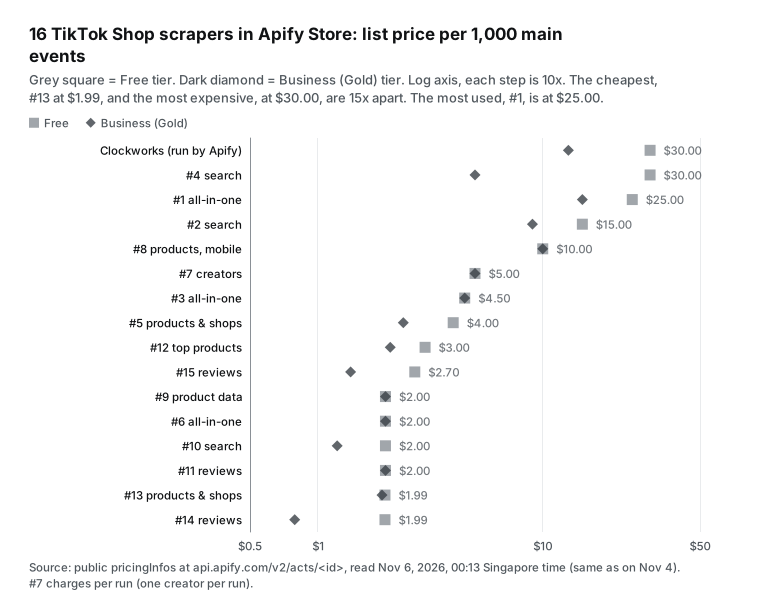
The table shows three facts. First, the range is 15x. On the Free plan, #13 costs $1.99 per 1,000 products, and Clockworks and #4 cost $30.00. Second, the most popular scraper is not the cheap one. #1 has 3,064 users and costs $25.00 per 1,000 results on Free.
That is 12.6x the #13 price. Third, the Clockworks TikTok Shop Scraper is one of the two most expensive scrapers on Free. Its own page also says that it supports the United States only (see the screenshot).
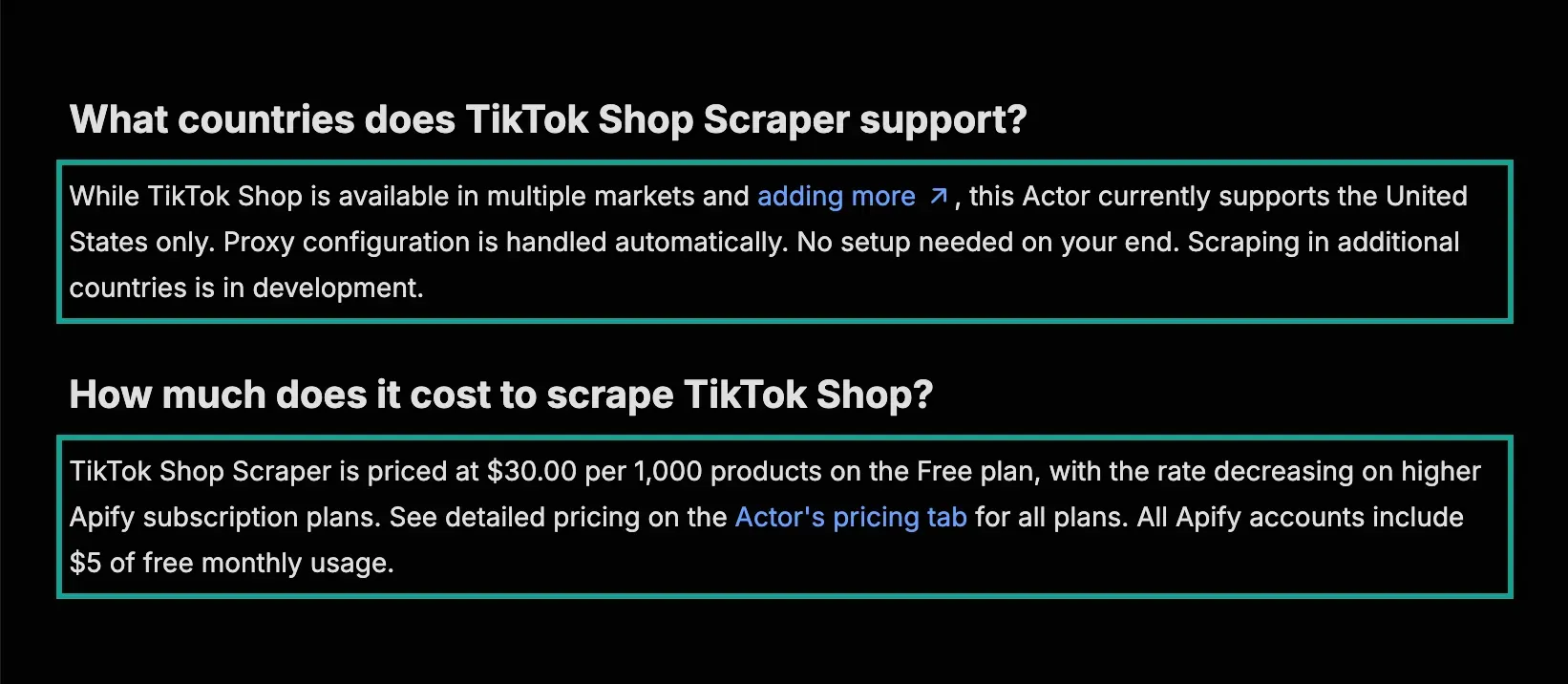
The $30.00 on the page agrees with the public API. The result event costs $0.03 on Free, $0.013 on the Gold (Business) tier and $0.003 on the enterprise Diamond tier (Clockworks TikTok Shop Scraper metadata).
Two more costs are not in the price per row. The start fee, in the "Fee per run" column: #1 and #2 charge $0.002 per run, #12 $0.005, #11 $0.01, #8 $0.05, and #4 $0.14 on Free ($0.014 on paid plans). So 50 keywords a day means 50 start fees a day. And platform usage: most pay-per-event actors include it, but some charge compute, storage, residential proxies and data transfer separately (Actors in Store, Usage and resources). Residential proxies cost $8 per GB on Free and Starter (Apify pricing page).
One more signal: the modifiedAt field in the public API shows when the developer last changed the scraper. 14 of the 16 scrapers changed in the last 30 days, and 5 of them changed again in the two days between our reads (read at 00:13 Singapore time on November 6, 2026; dates in the last column of the price table). Pages change often, so scrapers must change too, and prices follow: see #11 and #12 in "Recent changes".
How we tested, and what counted as a pass
We fixed the rules before we wrote, and we did not change them after the results came in. The price per 1,000 rows is the money that we paid, divided by the rows that we got, times 1,000. The money is billing.charged_usd in the response. The rows are the items in results. When we tested one data type many times, we added the money and the rows first, and then divided.
A call with 0 rows is not in the divisor. We check its charge on its own line. We always count the rows that came back, not the limit in the request. So a call with few rows can only make our price look higher.
On the Apify side, we used only public material that needs no account. This material is the Store search API, the public metadata API of each actor and the Store pages and Apify docs. The metadata API is api.apify.com/v2/acts/<user>~<name>. Its pricingInfos field is the price history, and we used the last entry that was in effect when we read it. We did not sign up for Apify, and we did not run its actors. So the Apify numbers in our tables are public prices, not real invoices.
We also fixed how we picked the Apify scrapers. A Store search for "tiktok shop" gave 1,626 results on November 4, 2026. We took the top results by total users. We added the special scrapers for reviews and creators, and the Clockworks scraper, which Apify maintains.
That made 16 scrapers. For each data type, we compare the cheapest one and the most used one. We do not compare only with expensive ones.
A ratio below 3 goes into the table but not into the title. The cases where Apify is cheaper or better have their own section. All times are in Singapore time (UTC+8), with UTC in brackets where it helps. We read the Apify prices two times: at 00:13:46 Singapore time on November 4, 2026, and at 00:13:35 on November 6, 2026.
All charge events and tier prices of the 16 scrapers were the same both times, and no future price change was scheduled. For values that change, such as user counts, run statistics and change dates, this article uses the November 6 values. We used an internal test key. It pays the public catalog price, the same price as any customer.
| Criterion | Pass | If it fails |
|---|---|---|
| Live calls | Search, category, shop, best sellers, reviews and creator each succeed at least once | We report the failure or empty result and check the charge |
| No charge on failure | No key, bad parameter, unsupported store and service failure all cost $0 | We report any charge |
| Regions | The US store and at least one Southeast Asian or Latin American store | We mark the others as "in the catalog, not tested" |
| Budget | Live calls cost $0.10 or less in total | We stop |
Store coverage: US, Southeast Asia and Mexico tested; gaps in Europe and Brazil
TikTok Shop is a set of country stores. The same keyword gives different products, currencies and sellers in each store. So the real question is which stores a tool supports, and which ones its developer tested. We read the input definitions of 9 Apify scrapers that name their stores, and compared them with the country notes in our catalog.
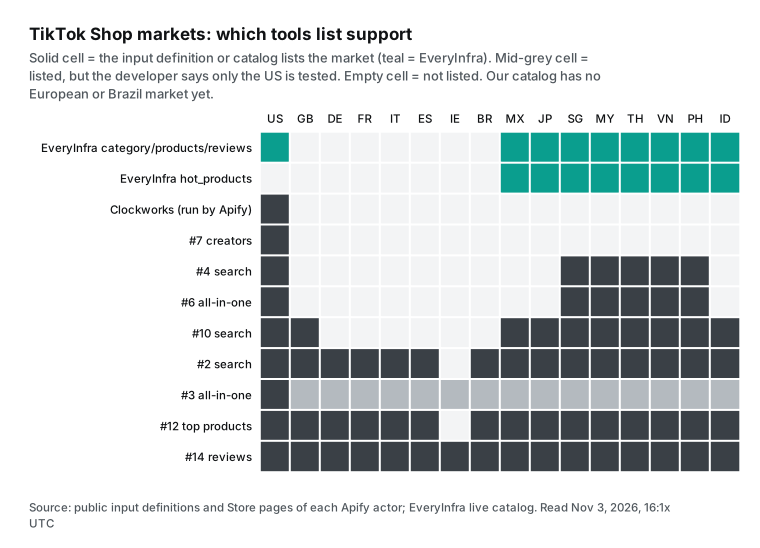
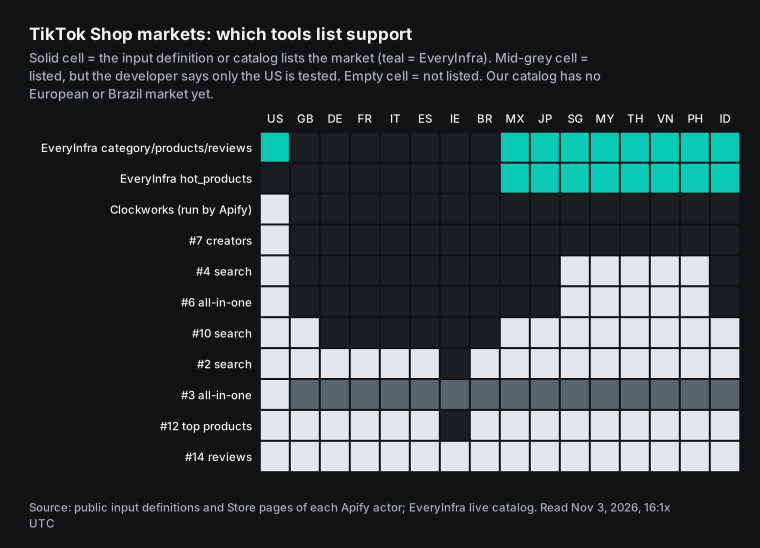
The Clockworks scraper, which Apify maintains, supports only the US store. Its FAQ says so, and the text was the same when we read it again on November 6, 2026. The #7 creator scraper is also US only. #3 lists 16 stores, but its developer writes that only the US is "fully supported and tested". #10 lists 10 stores, but keyword search works only in the US and 5 Southeast Asian stores.
Our catalog lists 9 stores for category, shop and review data: the US, Mexico, Japan, Singapore, Malaysia, the Philippines, Thailand, Vietnam and Indonesia. Best sellers cover the same stores without the US. A best-seller request for the US, UK or Brazil is rejected before any charge (capability catalog, read November 6, 2026). We have no UK, continental Europe or Brazil store. For those, use the #2 search, #12 best-seller or #14 review scrapers.
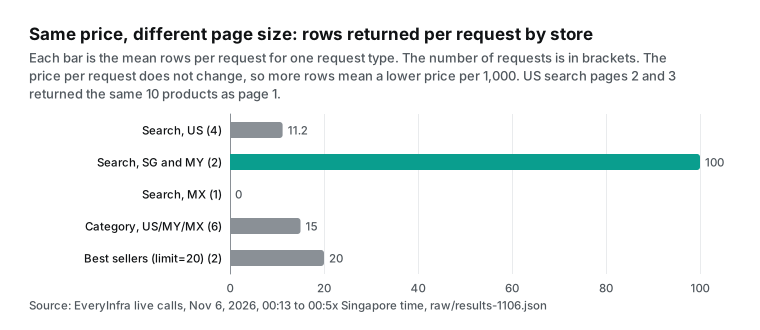
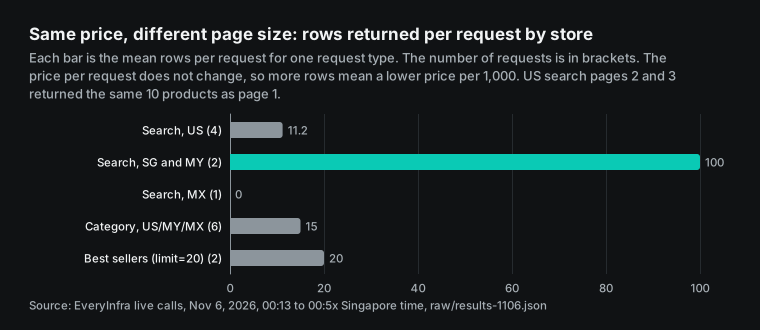
The most useful finding is about page size. The same capability, at the same price, returned up to 10x more rows in some stores:
| Store | Request (November 6, Singapore time) | Rows | Charge | Price per 1,000 rows |
|---|---|---|---|---|
| US | search "lip gloss" and "phone case" (4 calls, 00:13) | 10 to 15 per call | $0.000556 per call | $0.049 (rows), $0.089 (unique) |
| Singapore, Malaysia | search "lip gloss" (2 calls, 00:13–00:14) | 100 per call | $0.000556 per call | $0.0056 |
| Mexico | search "brillo labial" (00:14:47) | 0 | $0 (empty result refunded) | — |
| US, Malaysia, Mexico | category 601450 (6 calls, 00:15) | 15 per page | $0.000806 per call | $0.0537 |
| Malaysia, Singapore | best sellers, limit=20 (2 calls, 00:28–00:29) | 20 per call | $0.000806 per call | $0.0403 |
In Mexico, the Spanish keyword "brillo labial" (lip gloss) returned 0 rows, but a category call in the same minutes returned 15 products. Either this keyword had no results, or search coverage in Mexico is not complete. We cannot tell which.
Tests by use case: search, category, best sellers, shops, reviews and creators
Each test shows the request, the time (Singapore time), the rows and the charge. Next to them are the list prices of two Apify scrapers for the same data: the cheapest on the Business tier and the most used. All raw responses are saved.
TikTok Shop keyword search: 10 to 15 products per call in the US, 100 in Southeast Asia
tiktok/shop_search needs keyword. country (the store) and page (from 1) are optional. We sent 7 calls on November 6, 2026:
| Time | Store / keyword | Rows | Charge | Note |
|---|---|---|---|---|
| 00:13:16 | US / lip gloss, page 1 | 10 | $0.000556 | |
| 00:13:28 | US / lip gloss, page 2 | 10 | $0.000556 | Same 10 products as page 1 |
| 00:13:38 | US / lip gloss, page 3 | 10 | $0.000556 | Same 10 products as page 1 |
| 00:13:48 | US / phone case | 15 | $0.000556 | |
| 00:13:59 | Singapore / lip gloss | 100 | $0.000556 | 17.2 seconds |
| 00:14:22 | Malaysia / lip gloss | 100 | $0.000556 | 17.8 seconds |
| 00:14:47 | Mexico / brillo labial | 0 | $0 | empty_result_refunded |
One result surprised us. In the US store, pages 2 and 3 returned the same 10 product IDs as page 1. We paid for 3 calls and got 10 unique products. For US keyword search, plan for 10 to 15 products per call, and do not expect page to go deeper. For more US products, use category paging (next test).
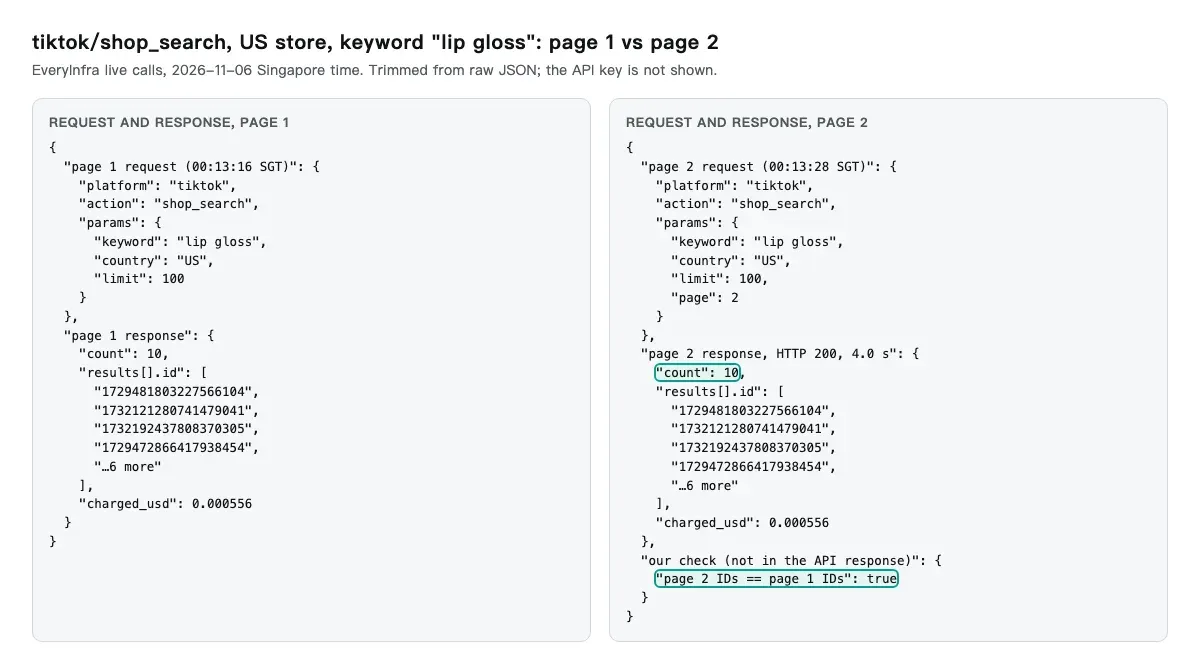
The 4 US calls cost $0.002224 for 25 unique products: $0.0890 per 1,000 ($0.0494 per 1,000 rows). Singapore and Malaysia gave 200 products with no repeats: $0.0056 per 1,000.
On Apify, #10 has the lowest Business price: $2.00 per 1,000 on Free and $1.22 on Business, plus $0.00005 per run. The most used search scraper, #2 (2,592 users), costs $15.00 on Free and $9.00 on Business, plus $0.002 per run. #13 has the lowest Free price ($1.99), but $1.93 on Business. US ratios: 13.7x (#10 Business) and 101x (#2 Business). Southeast Asia: 219x and 1,619x.
To be fair: an Apify scraper collects as many rows as you ask for. The Clockworks input productsPerSearch has a default of 10 and no maximum (Clockworks Store page). If you need 300 US products for one keyword, Apify can do it in one run. We could not in this test.
TikTok Shop category products: 15 per page, 60 unique products in 4 pages
tiktok/shop_category_products returns one page per call. The last row has next_page_token; send it back for the next page. We used Beauty & Personal Care (category_id=601450):
| Time | Store | Page | Rows | Charge |
|---|---|---|---|---|
| 00:15:01 | US | 1 | 15 | $0.000806 |
| 00:15:10 | US | 2 | 15 | $0.000806 |
| 00:15:19 | US | 3 | 15 | $0.000806 |
| 00:15:28 | US | 4 | 15 | $0.000806 |
| 00:15:38 | Malaysia | 1 | 15 | $0.000806 |
| 00:15:50 | Mexico | 1 | 15 | $0.000806 |
The 4 US pages gave 60 products with no repeated ID. The 6 calls returned 90 products for $0.004836: $0.0537 per 1,000, in 2.5 to 5.9 seconds per call. The first product was a men's shaver with 24,201 units sold, a 3.7 rating and 2,140 reviews. The catalog lists a category field, but it was empty in these rows, so keep the category_id that you sent. On Apify, #6 costs $2.00 per 1,000 on all tiers, and the most used, #3, $4.50. The ratios are 37x and 84x.
TikTok Shop best sellers: limit=100 timed out, limit=20 worked
tiktok/shop_hot_products returns the best-seller list of one store, with rank. The time-out error suggested a smaller limit or "mode":"async", so we tried limit=20:
| Time | Store | `limit` | Result | Seconds | Charge |
|---|---|---|---|---|---|
| 00:16:08 | Malaysia | 100 | 503 unavailable | 17.3 | $0 |
| 00:16:32 | Thailand | 100 | 503 unavailable | 17.3 | $0 |
| 00:17:03 | Singapore | 100 | 503 timeout | 15.2 | $0 |
| 00:17:25 | Mexico | 100 | 503 timeout | 15.2 | $0 |
| 00:28:56 | Malaysia | 20 | 20 products | 6.8 | $0.000806 |
| 00:29:10 | Singapore | 20 | 20 products | 5.7 | $0.000806 |
| 00:42:55 | Thailand | 100 | 503 unavailable | 17.3 | $0 |
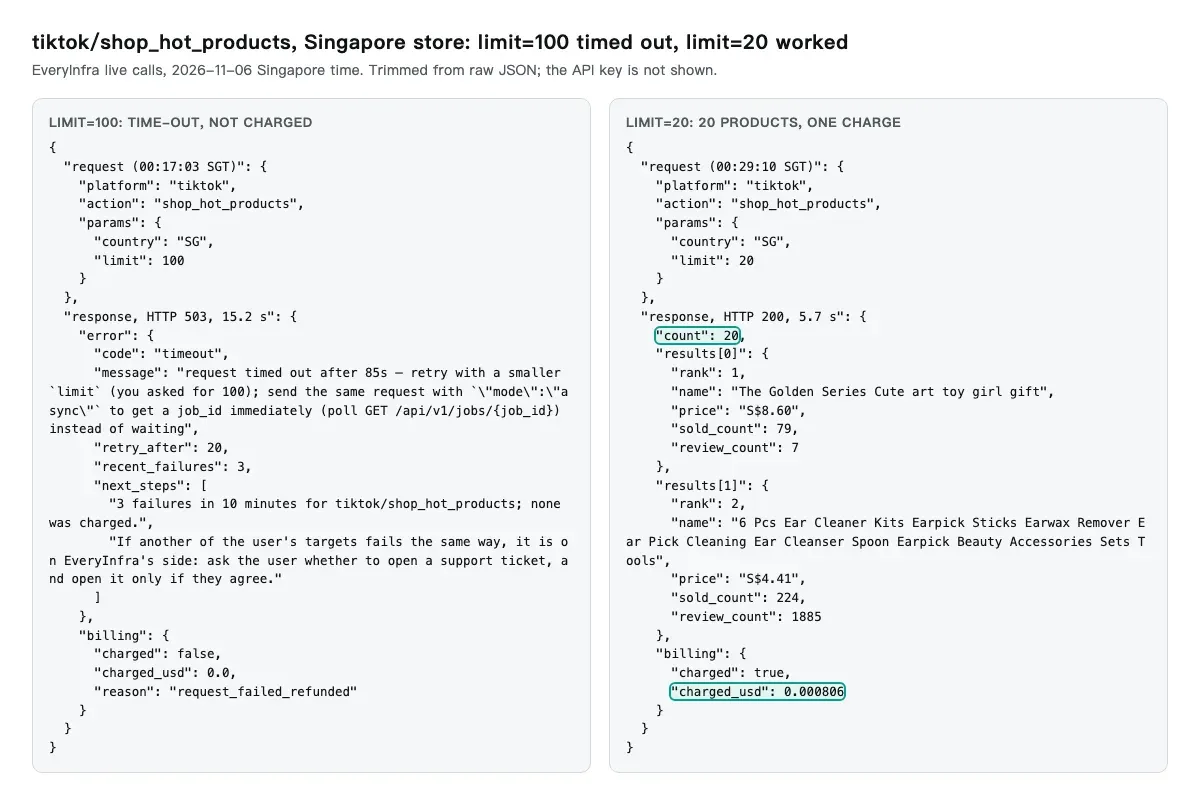
Rank 2 in Malaysia was a garlic chili oil with 348,113 units sold and 53,742 reviews. That is $0.0403 per 1,000. #12 costs $3.00 per 1,000 on Free and $2.10 on Business, plus $0.005 per run, or $0.04 per product with analytics. The ratio is 52x to 74x. #12 also sorts by 30-, 7- or 1-day revenue and estimates GMV. We give only rank and total units sold.
TikTok Shop shop products: 6 calls in two rounds, all 503
tiktok/shop_products takes a shop ID; the catalog says up to 30 products per page, with next_page_token. We used the Disney Store shop in the US store: twice on November 4, and at 00:15, 00:28, 00:43 and 00:58 on November 6. All 6 calls returned 503 unavailable with charged: false. The call at 00:58 came back in 0.2 seconds, so the service refused new calls at once instead of a slow time-out. We have no measured price here.
On Apify, #13 costs $1.99 per 1,000 on Free ($1.93 on Business), and the most used, #5, $4.00 ($2.40). In the last 30 days, 2,065 and 2,572 of every 10,000 of their runs did not succeed. At 30 products per page, our catalog price would give about $0.027 per 1,000. That is an untested estimate, so it is not in any ratio.
TikTok Shop product reviews: 11 calls in two rounds, all 503
tiktok/shop_product_reviews takes a product ID. The catalog says 20 reviews per page (size can change), with rating (1 to 5), sort (newest or recommended) and next_page_token. We chose a phone case in the US store (330 reviews), a lip tint in Malaysia (34,789) and a lip gloss in Singapore (776). 1 call on November 4 and 9 calls on November 6 all returned 503 unavailable, mostly in 0.2 seconds, with no charge.
At the 3rd failure (00:43), next_steps said "3 failures in 10 minutes; none was charged", and the response included a ready example request with another product ID.
If the example works, the target is the problem. If it fails, the problem is on our side, and the AI must ask the user before it opens a support ticket. At 01:02, we sent the example. It also returned 503, with no charge. So by its own rule, the problem was ours. On November 4, rating=6 got a 422 at once ("must be 1 to 5"), also free.
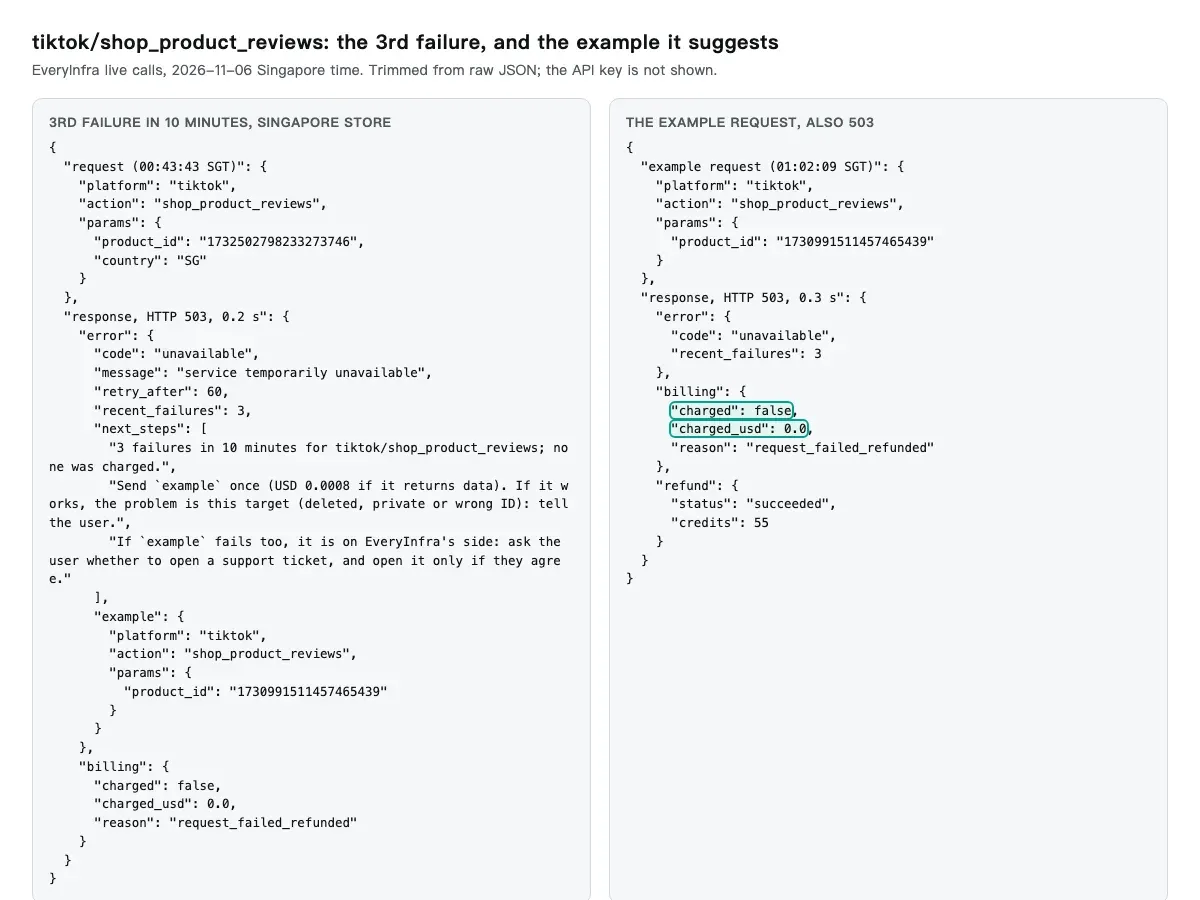
On Apify, #14 costs $1.99 per 1,000 reviews on Free and $0.79 on Business, plus $0.005 per run. It lists 16 stores with a star breakdown per product (Store pages in the references). The most used, #11, costs $2.00 per 1,000 plus $0.01 per run. Reviews are the one case here where Apify has a low price, wider coverage, and a working tool.
TikTok Shop creators: 1 of 6 calls worked, $0.000556 per creator
tiktok/shop_creator looks up one creator per call, in the US store:
| Time | User name | Result | Charge |
|---|---|---|---|
| 00:17:46 | colourpopcosmetics | 503, temporarily unavailable | $0 |
| 00:18:01 | elfcosmetics | 503, temporarily unavailable | $0 |
| 00:18:12 | tartecosmetics | 2,064,277 followers, 121 products, 248 average views | $0.000556 |
| 00:18:25 | a user name that does not exist | 503, temporarily unavailable | $0 |
| 00:29:37 | colourpopcosmetics (retry) | 503, temporarily unavailable | $0 |
| 00:43:50 | elfcosmetics (retry) | 503, temporarily unavailable | $0 |
On November 4, the only call that worked in the whole first round was also tarte, at 00:55.
Two caveats. The fake user name also returned 503, not "not found", so a caller cannot tell a missing person from a temporary failure. And the tarte row did not have video_count or sold_count, which the catalog lists. We cost $0.556 per 1,000 creators; #7 costs 9x as much ($5.00 per 1,000, one creator per run). But #7 gives 30-day GMV and audience data, and we do not.
Do failed and empty calls cost money? 503s, time-outs and empty results in two test rounds
A real outage started in the first minute of our first test round. From 00:14 Singapore time on November 4, 2026 (16:14 UTC on November 3), all six of our TikTok Shop capabilities returned 503. At the same time, tiktok/profile, which is not a shop capability, worked and was charged as usual. We did not hide this event, because it was the best test of the question "do failures cost money?"
From 00:14 to 02:01, the six capabilities were mostly down for 1 hour 47 minutes. We sent 67 TikTok Shop requests in that time. 33 of them were the same search request, sent every 3 minutes to check for recovery. 63 requests returned 503, and 3 were rejected before any charge (one 401, two 422). None of these 66 was charged. One creator lookup (tarte) at 00:55 returned data and was charged $0.000556.
| Round 1, November 4 (00:14–02:01 Singapore time) | Calls | Charge | What the response says |
|---|---|---|---|
| 503, temporarily unavailable | 63 | $0 | 16 were refused in 0.2 seconds with a hint to retry after 60 seconds; 47 had a hint to retry after 20 seconds, at most 2 times. Each one has charged: false and reason: request_failed_refunded |
| 401, no key | 1 | $0 | Auth comes first. No schema leaks to unauthenticated calls |
| 422, bad parameter | 2 | $0 | country=US for best sellers lists the 8 allowed stores and says the US, UK and Brazil stores have no best-seller list; rating=6 says the value must be 1 to 5 |
| 200, creator tarte (00:55:50) | 1 | $0.000556 | The only success in round 1, one normal charge |
Control: tiktok/profile (00:15:20) | 1 | $0.000556 | Not a shop capability, one normal charge |
In the second round, search, category, best sellers and creators worked; shop products and reviews did not. Round 2 has 40 requests, including the one example request that we sent at 01:02:
| Round 2, November 6 (00:13–01:02 Singapore time) | Calls | Result | Charge |
|---|---|---|---|
tiktok/shop_search | 7 | 6 with data; 1 in Mexico with 0 rows, empty_result_refunded | $0.003336 |
tiktok/shop_category_products | 6 | All with data | $0.004836 |
tiktok/shop_hot_products | 7 | 2 with data at limit=20; 5 returned 503 at limit=100 (3 temporarily unavailable, 2 time-outs that suggest a smaller limit or "mode":"async") | $0.001612 |
tiktok/shop_creator | 6 | 1 with data; 5 returned 503, temporarily unavailable, including the fake user name | $0.000556 |
tiktok/shop_products | 4 | All 503, temporarily unavailable | $0 |
tiktok/shop_product_reviews | 10 | All 503, temporarily unavailable. From the 3rd failure, the response has an example request; that one also returned 503 | $0 |
Three points stand out. First, a 503 is more than an error code. At the 4th failure, next_steps said "4 failures in 10 minutes for tiktok/shop_search; none was charged". It also told the caller's AI to try the example once, then ask the user before it opens a ticket. So the AI can decide to wait or change the target, and it does not retry forever.
Second, bad parameters are stopped before any charge: country=US for best sellers and rating=6 for reviews both got a 422 with the allowed values. Third, each failed response has billing.charged=false and a refund reason, so you do not wait for an invoice to check.
On Apify, the charge for a failed run depends on the event design of each actor. The Apify pay-per-event docs say that the actor author decides when to record an event. The platform charges the user for the recorded events. Most authors include compute and storage in the event price, but some authors charge platform usage separately (pay per event, usage and resources).
The start fee is an event that the platform records when a run starts. The docs call it apify-actor-start. If a run fails halfway, you still pay the start fee and the results that were written before the failure. So "no charge on failure" is not a platform rule on Apify.
It depends on each actor. Some scrapers had high failure rates in the last 30 days, such as #5 and #13 in the next section. Test them with a small batch first.
How many Apify runs do not finish: last 30 days per 10,000 runs
Price is not the only cost of a pay-per-result scraper. Failed runs are also a cost. The public API of each actor includes publicActorRunStats30Days. It counts runs that succeeded, failed, timed out or were aborted in the last 30 days.
We read it for all 16 scrapers and counted the runs that did not succeed per 10,000 runs. #5 had 9,269 runs, and 2,373 of them failed. That is 2,572 runs per 10,000 that did not succeed. #13 had 2,107 runs, with 269 failures and 165 time-outs, or 2,065 per 10,000. We read these numbers on November 6, 2026, at 00:13 Singapore time. Two days before, #5 was at 2,563, so the numbers are stable.
The #15 review scraper is at 1,633 per 10,000, but it had only 98 runs in 30 days (16 did not succeed), so this number is weak. The #7 creator scraper is at 912 per 10,000. It also had 627,168 runs in 30 days, the most in this group. At the other end, #1, #2 and #3 had 3 or fewer per 10,000.
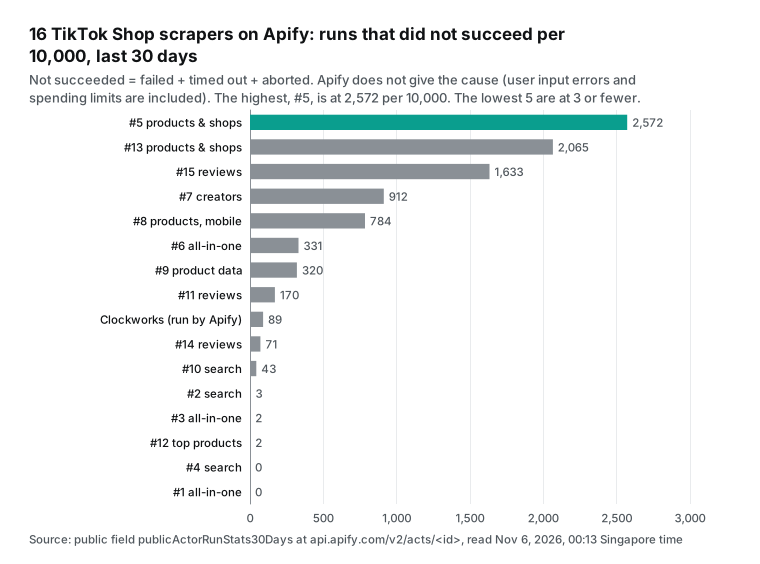
Do not read this number as a pure failure rate. Some runs fail because the user gave a bad input or set a very low spending limit. The Apify statistics do not show the cause, and each run collects a different number of rows. The number does show that stability is very different between developers. If a quarter of the runs of a tool fail, a low unit price is not the full cost. You must also count the time for reruns and the extra start fees.
Apify also runs its own health check. Each day, it runs every actor with its default input. If more than half of the runs in the last three days fail, the actor gets the "Under maintenance" label (Actor testing). After about one more month of failures, Apify marks it as deprecated. An actor under maintenance can fail or return incomplete results (Actors in Store).
You can set a maximum charge when you start a run, and Apify never charges above that limit. The docs do not say if Apify refunds events that occurred before a run failed. We do not have an account, so we did not check this. We mark it as "not verified".
TikTok Shop API: what the official APIs give you
Many people who search for "tiktok shop api" want an official path first. TikTok has two official APIs for TikTok Shop, and neither one gives public product data to a general developer.
The TikTok Shop Partner API is for sellers and service providers. You create an app in Partner Center, and a seller, creator or partner authorizes it. Then you can read and write the products, orders, shipments and payments of that account only (Partner Center developer guide, authorization overview). It manages your own shop, not the shops of others.
The TikTok Research API has three TikTok Shop endpoints (shop info, products and reviews), with docs updated on Sep 1, 2026 (shop info, products, reviews). It covers only shops and products in the EU and returns 10 rows or fewer per call. Only qualified academic and not-for-profit researchers can apply, and approval takes about 4 weeks (Research Tools access). It comes from Article 40 of the EU Digital Services Act; the Commission adopted the detailed rules on Jul 2, 2025 (European Commission: delegated act on data access, researcher data access FAQ). So for public data from many shops in the US or Southeast Asia, the real choice is a pay-per-result scraper or a pay-per-request data API.
Compliance: public data, platform terms and review rules
The TikTok US Terms of Service (updated July 15, 2026) forbid data extraction with any automated system without written approval from TikTok USDS Joint Venture in writing (TikTok Terms of Service, US). This applies to Apify scrapers and data APIs in the same way. Collection of public data is not automatically illegal in many countries, but personal data law still applies. Our catalog says reviewer names come masked (like n**h), but treat them as personal data. This article is not legal advice.
The US FTC rule on consumer reviews and testimonials is in effect from October 21, 2024. It bans fake reviews and incentives that depend on a positive review (FTC announcement, 16 CFR Part 465, FTC questions and answers). So two review fields are useful: is_incentivized (for example, a coupon for a photo) and is_verified_purchase. In a competitor review study, separate the incentivized reviews first.
Monthly cost: four common jobs
For a budget, you need a monthly number. The four jobs below use 30 days. Our cost is the catalog price times the requests, from the rows per call that we measured. The Apify cost is the list price times the rows, plus start fees, without separate platform usage.
| Job | Rows per month | EveryInfra requests × price | EveryInfra per month | Apify (cheapest on Business → most used) | Ratio |
|---|---|---|---|---|---|
| US product research: 5,000 category products per day | 150,000 products | 15 per page, 334 calls per day × $0.000806 | $8.08 | #6 $300.00 → #3 $675.00 | 37x–84x |
| 5 Southeast Asian stores: 20 keywords per day, 100 products each | 300,000 products | 100 per call, 100 calls per day × $0.000556 | $1.67 | #10 $366.15 → #2 $2,706.00 | 219x–1,622x (with start fees) |
| Weekly reviews: 3 pages for each of 20 products | about 5,160 reviews (estimate) | 60 calls per week × $0.000764, 4.3 weeks | $0.20 | #14 $4.51 → #11 $11.18 | 23x–57x (estimate) |
| Creator list: 500 creators per month | 500 creators | 500 calls × $0.000556 | $0.28 | #7 $2.50 | 9x |
In the Southeast Asia row, #10 is 300,000 × $1.22 / 1,000 = $366, plus $0.15 of start fees. #2 is $2,700 plus $6 of start fees. The review row is an estimate: reviews did not work for us, so the page size of 20 comes from the catalog. #14 adds $0.005 per run and #11 $0.01 per run, with 20 runs per week.
For US research, we used category paging, not keyword search. US search returned only 10 to 15 products per call, and page gave no new products. If your job is "300 results for one keyword in the US store", a pay-per-row Apify scraper is the better fit.
The Apify plan is also a cost. Starter is $19, Scale $199 and Business $999 per month, as prepaid usage that does not carry over (Apify pricing page). You get the Business prices only at $999 per month. On Free, #10 in the Southeast Asia row costs $600 per month; on Bronze (Starter), $480. We have no monthly plan; each request takes its charge from your balance.
TikTok Shop scraper API: calls from code and from AI clients
You can call both tools through an API, but the call model is different. On Apify, you start a run and then read the dataset of that run. Apify deletes unnamed datasets after the retention period (Dataset). Its synchronous endpoint returns 408 when a run takes more than 300 seconds (run sync endpoint).
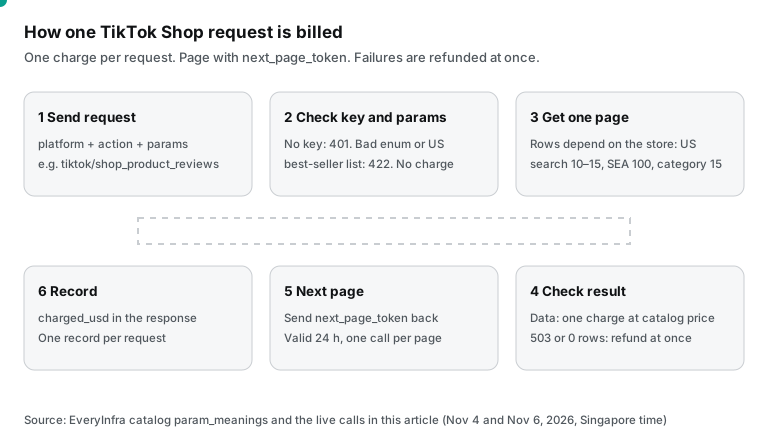
On EveryInfra, one request gets one page. The request body has platform, action and params. The response contains the page of data, billing.charged_usd and the next_page_token for the next page. These two calls get page 1 and page 2 of the reviews of one product:
# Page 1: the 20 newest reviews
curl -s https://api.everyinfra.com/api/v1/social \
  -H "Authorization: Bearer $EVERYINFRA_API_KEY" \
  -H "Content-Type: application/json" \
  -d '{"platform":"tiktok","action":"shop_product_reviews","params":{"product_id":"<product_id>","country":"US","sort":"newest"}}'

# Page 2: send back next_page_token from the last response (valid for 24 hours, one call per page)
curl -s https://api.everyinfra.com/api/v1/social \
  -H "Authorization: Bearer $EVERYINFRA_API_KEY" \
  -H "Content-Type: application/json" \
  -d '{"platform":"tiktok","action":"shop_product_reviews","params":{"product_id":"<product_id>","country":"US","page_token":"<next_page_token>"}}'
The fields of the six TikTok Shop capabilities match response_fields in the catalog (capability catalog, read November 6, 2026, 00:12 Singapore time):
| Capability | Most rows per page | Main fields | Paging |
|---|---|---|---|
tiktok/shop_search | measured: 10–15 products in the US store, 100 in SG and MY | id, name, price, original_price, currency, sold_count, rating, review_count, category, shop_name, image_url | page, from 1. In our US test, pages 2 and 3 were the same as page 1 |
tiktok/shop_category_products | measured: 15 products per page | same, plus shop_id | page_token |
tiktok/shop_products | 30 products | same, plus shop_id | page_token |
tiktok/shop_hot_products | limit up to 100. Measured: 100 timed out, 20 worked | same, plus rank | none |
tiktok/shop_product_reviews | 20 reviews, size can change | rating, text, posted_at, variant, is_verified_purchase, is_incentivized, image_urls, author_name (masked), country | page_token |
tiktok/shop_creator | 1 creator | follower_count, video_count, product_count, sold_count, avg_views, categories | none |
In an AI client, EveryInfra is a remote MCP server. MCP is the Model Context Protocol, the protocol that AI clients use to call external tools (specification). All tool names start with everyinfra_. Add this configuration:
{
  "mcpServers": {
    "everyinfra": {
      "url": "https://api.everyinfra.com/mcp",
      "headers": { "Authorization": "Bearer ${env:EVERYINFRA_API_KEY}" }
    }
  }
}
Then you can ask the model in plain words. For example: "Use EveryInfra to search TikTok Shop US for lip gloss, 100 products. Keep products with a rating of 4.5 or more, and sort them by sold_count. Get 3 pages of the newest reviews for the top 3. Group the 1-star and 2-star reviews by variant." Apify also has an MCP server at mcp.apify.com.
It recommends OAuth sign-in, and the model can search the Store for an actor and run it (Apify MCP server, source on GitHub). Actor ranking in that search uses parameters similar to the Apify quality score, not the price (Apify MCP server). In the price table above, the same data type has a 15x price range. If the model picks the actor, it can pick an expensive one.
Both tools work in AI clients. The difference is still the billing. When the model reads more pages, Apify adds a charge for each row, and we add a charge for each call. For setup details, see MCP in Cursor for TikTok, Instagram and Amazon data and TikTok creator data in practice. The full tool list is on the MCP server page.
When Apify is the better choice
Per 1,000 rows, we cost less for each data type in this test. But price is not the only criterion. In the cases below, a scraper in Apify Store is the better choice.
First, European and Brazil markets. TikTok Shop now has 10 European markets (TikTok Newsroom). Our catalog has none of them yet, and it has no Brazil market. The #14 review scraper lists 16 markets, including the UK, Germany, France, Italy, Spain, Ireland and Brazil. The #2 search scraper and the #12 top-products scraper also list the main European markets (Store pages in the references).
For European data today, use one of them. But read the developer notes. The #3 scraper lists 16 markets, but its input notes say that only the US is fully supported and tested. The other markets "sometimes return data" but are unreliable (Store pages in the references).
Second, sales estimates and creator GMV. The #12 top-products scraper can sort by revenue in the last 30 days, 7 days or 1 day. With "analytics" on, each product gets more analysis fields, at $0.04 per row on Free (Store pages in the references). The #7 creator scraper returns 30-day GMV, GMV per 1,000 views, follower age and gender, and the number of brand deals (Store pages in the references).
Our catalog lists follower count, video count, product count, sold count and average views for tiktok/shop_creator (our one row had no video or sold count). It has no GMV and no audience data. Our tiktok/shop_hot_products has rank and total sold count, but no revenue for a time window. If you need GMV, use those scrapers.
Third, variants and stock. The Clockworks scraper gives the price, stock status and remaining units of each variant, for example each color and size (Clockworks). #5 has a "product detail" event with variants, stock, shipping and the seller profile, at $0.005 each on Free and $0.003 on Business (Store pages in the references). Our product rows have no stock or variant details. Only our review rows show the variant that the buyer bought.
Fourth, you already use Apify. Your team can already run other jobs with Apify schedules, datasets and integrations such as Google Sheets (Schedules). If you need only a few thousand TikTok Shop rows each month, the $5 monthly credit of the Free plan can be enough (Apify pricing page). At the #13 price of $1.99, that is about 2,500 rows. Then a move to a new tool can cost more work than it saves.
Fifth, reviews and shop products, at least on our two test days. All 17 of our requests for them returned 503, with no charge. If you need a review analysis this week, #14 ($0.79 per 1,000 on Business, 16 stores) or #11 ($2.00) works today.
Sixth, deep US keyword search. Our US search returned 10 to 15 products per call, and page gave no new ones. Clockworks and #10 can get hundreds of results for one keyword in one run. They cost more, but they give that depth. Our option for US volume is category paging.
Recent changes (June to November 2026)
| Date | Change | What it means for you |
|---|---|---|
| November 6, 2026 | Our second test round: search, category, best sellers and creators worked; shop products and reviews still returned 503 (this article) | Test a capability with a small batch before a full run; failed calls are free |
| November 11 to 30, 2026 | Black Friday and Cyber Monday on TikTok Shop US; TikTok reports more than 100 billion shopping searches in the US in 2025 (TikTok Newsroom) | During a sale, rank and sold count change fast; fetch more often, and redo your monthly budget at that rate |
| October 28, 2026 | #11: $0.003 to $0.002 per review, start fee $0.005 to $0.01 (public metadata, see the references) | Store prices can change at any time; check your budget each month |
| October 22, 2026 | #12: "with analytics" from $0.02 to $0.04 per row, new $0.005 start fee (public metadata, see the references) | Same as above |
| September 1, 2026 | TikTok updated its Research API docs for TikTok Shop: EU only, 10 rows or fewer per call (reviews endpoint) | The official research path does not cover the US or Southeast Asia |
| July 15, 2026 | TikTok US Terms of Service name TikTok USDS Joint Venture; the ban on automated extraction stays (Terms of Service) | Your choice of tool does not change the compliance question |
| From June 15, 2026 | TikTok Shop opened in Austria, Belgium, the Netherlands and Poland: 10 European markets (TikTok Newsroom) | For Europe, use Store scrapers that list European markets; our catalog has none yet |
Get started: from a trial to a weekly job
Star the everyinfra/everyinfra-agent-plugins repository on GitHub. After you sign up, claim the $1 trial credit in the console under Balance & top-ups. It is valid for 24 hours. At the prices in this article, $1 pays for about 1,798 search calls, or 1,240 category or best-seller calls. Do these steps:
- Get a key in the quickstart.
- Open the TikTok Scraper API page to see all capabilities.
- Run each playground once:
- TikTok Shop search scraper API
- TikTok Shop shop products scraper API
- TikTok Shop product reviews scraper API
- TikTok Shop best sellers scraper API
- TikTok Shop creator scraper API
- For products by category, use the TikTok Shop category products scraper API.
- To read the video comments for the same products, use the TikTok comments scraper API.
The same method works for the Amazon Scraper API and the Shopee Scraper API. All capabilities and prices are on the data market and the pricing page. After the trial, the minimum top-up is $10.
A weekly job is simple. On Monday morning, get the products for your keywords or category. Compare sold_count with last week. For the 20 products that grew fastest, get 3 pages of the newest reviews.
Then group the bad reviews by rating and variant. You can schedule this with cron, n8n or Make. You can also ask an AI client with MCP to run it each week. At the prices in this article, 10 category pages plus 3 review pages for 20 products cost about $0.054 per week, or $0.23 per month. On Apify, the same at the #10 and #14 Business prices is about $1.23 per week. The review part is an estimate, because reviews did not work in our tests.
We use the same per-1,000-rows method to compare Apify in two other articles. Read the Apify TikTok Scraper alternative for videos, comments and accounts. Read the Apify Amazon Scraper alternative for Amazon. For the full Apify price model, read Apify pricing explained. Alternatives for each platform are in Apify alternatives and on the alternatives page.
FAQ: Apify TikTok Shop scraper, TikTok Shop scraper API and TikTok Shop product scraper
Is the Apify TikTok Shop scraper free?
The Apify Free plan gives $5 of platform credit each month (Apify pricing page). Pay-per-result scrapers take their charges from this $5. At the public prices of November 4, 2026, $5 buys about 166 products on the Clockworks TikTok Shop Scraper ($30 per 1,000 on Free), which Apify maintains.
On #13 ($1.99 per 1,000 on Free), it buys about 2,500 products. Start fees are extra, and a few actors also charge platform usage. The Clockworks page also says that it supports only the US store (see the screenshot above). On our side, you get a $1 trial credit when you star the project, valid for 24 hours. That is about 1,240 category calls (about 18,600 products), or 1,798 Singapore or Malaysia search calls (about 180,000 products). (Question source: search suggestions "tiktok shop scraper apify" and "tiktok shop scraper free", read on November 4, 2026.)
What is the difference between a TikTok Shop scraper API and the TikTok Shop Open API?
The TikTok Shop Open API in Partner Center lets sellers and service providers manage the shops that authorize them. The seller must approve your app before you get an access token (authorization overview). It does not give you the products or reviews of other shops.
TikTok also has a TikTok Shop Research API for public shops, products and reviews. But it is open only to non-profit academic researchers in the EU, and they must apply (Research API, products). A commercial team that tracks competitors cannot use either path, so third-party TikTok Shop scraper APIs exist. (Question source: search suggestions "tiktok shop api documentation" and "tiktok shop api key", read on November 4, 2026.)
Is there a free TikTok Shop scraper on GitHub?
A GitHub search for "tiktok shop scraper" gave 56 repositories. The one with the most stars has only 13 stars. The tiktok-shop-scraper topic has only 1 public repository. It was created on November 2, and its description says "runs on Apify".
It is sample code that calls a scraper on Apify (both repositories are in the references). Most real open-source scripts open product pages in a headless browser and parse the HTML. The scripts are free. But TikTok Shop blocks data-center IP addresses and high request rates. To keep a script running, you usually need residential proxies.
Apify's own residential proxies cost $8 per GB on the Free and Starter plans (residential proxy docs). When the page layout changes, you must fix the script.
On Reddit r/webscraping, one user wanted all product IDs of one seller. The product links were inside videos and hard to list (thread). Our capability for this need is tiktok/shop_products: you send a shop ID and page through it. The catalog says up to 30 products per page. But all 6 of our calls returned 503, so we have not measured it. Start with a small batch; failed calls are free. (Question source: search suggestion "tiktok shop scraper github", read on November 4, 2026.)
Can a TikTok Shop review scraper get all reviews of a product?
It depends on how many pages you can get. Our catalog says 20 reviews per page, with next_page_token and a rating filter. But all 11 of our calls returned 503, so we did not measure how deep one product goes, and we make no promise.
The #14 scraper states that it gets all buyer reviews of a product in 16 stores. It costs $0.79 per 1,000 on Business plus $0.005 per run, and #11 costs $2.00 per 1,000 plus $0.01 per run (Store pages in the references). With any tool, test one or two products first, and compare the rows with the review count on the product page. (Question source: search suggestion "tiktok shop review scraper", read on November 4, 2026.)
Can a TikTok Shop product scraper get exact units sold and revenue?
Units sold is the field that most users want. Our product rows have sold_count, the total units sold that the product page shows.
The best-seller list also has rank.
In our test, the first US Beauty & Personal Care product had a sold_count of 24,201, and rank 2 in Malaysia had 348,113. These are totals, not daily changes. For daily sales, read the data each day and take the difference. We do not give estimates such as "revenue in the last 30 days" or "creator GMV". For those, use a scraper with analytics, such as #12 or #7. See "When Apify is the better choice" above. (Question source: search suggestions "tiktok shop product scraper" and "tiktok shop data scraper". Also a Reddit r/apify post in which a developer promotes a scraper with the title "Exact Sold Counts, No Login": thread.)
Is it legal to scrape TikTok Shop data?
The TikTok US Terms of Service, updated on July 15, 2026, forbid the collection of platform data by automated means without permission (Terms of Service). Reviews also contain personal data of buyers, so in the EU the GDPR applies.
The FTC rule against fake reviews took effect on October 21, 2024. It bans fake reviews and the sale of reviews, not the reading of reviews (FTC press release). The answer depends on your jurisdiction, the data and the use. Ask a lawyer. (Question source: search suggestions "is it legal to scrape tiktok shop data" and "is it legal to scrape tiktok shop products". Also a Reddit r/DataHoarder thread: thread.)
References
- Apify Docs. Actors in Store: pricing models in the Store. Read November 4, 2026.
- Apify Docs. Pay per event. Read November 4, 2026.
- Apify Docs. Actor pricing and costs: tiers and discounts. Read November 4, 2026.
- Apify Docs. Monetize your Actor. Read November 4, 2026.
- Apify Docs. Usage and resources. Read November 4, 2026.
- Apify Docs. Runs and builds: run states. Read November 4, 2026.
- Apify Docs. Input and output. Read November 4, 2026.
- Apify Docs. Automated tests in the Store. Read November 4, 2026.
- Apify API. Get Actor (public metadata and pricingInfos). Read November 4, 2026.
- Apify API. Store search API. Read November 4, 2026.
- Apify API. Run Actor synchronously and get dataset items (300-second limit). Read November 4, 2026.
- Apify API. Run Actor. Read November 4, 2026.
- Apify Docs. Dataset and retention. Read November 4, 2026.
- Apify Docs. Schedules. Read November 4, 2026.
- Apify Docs. Apify MCP server. Read November 4, 2026.
- Apify Docs. Residential proxy. Read November 4, 2026.
- Apify Docs. Proxy overview. Read November 4, 2026.
- Apify Docs. Billing. Read November 4, 2026.
- Apify Docs. Actor quality score. Read November 4, 2026.
- GitHub. apify/apify-mcp-server source code. Read November 4, 2026.
- Apify. Pricing page (plans and proxy prices). Read November 4, 2026.
- Apify API. Raw Store search results for tiktok shop. Read again November 6, 2026.
- Apify API. Clockworks TikTok Shop Scraper public metadata. Read again November 6, 2026.
- Apify API. lergassy top products scraper public metadata (price history) (#12 in this article). Read again November 6, 2026.
- Apify API. vistics review scraper public metadata (price history) (#11 in this article). Read again November 6, 2026.
- Apify Store. Clockworks TikTok Shop Scraper. Read again November 6, 2026.
- Apify Store. pratikdani/tiktok-shop-scraper — Store page (#1 in this article). Read November 4, 2026.
- Apify Store. pratikdani/tiktok-shop-search-scraper — Store page (#2 in this article). Read November 4, 2026.
- Apify Store. unseenuser/TikTok-Shop-Scraper — Store page (#3 in this article). Read November 4, 2026.
- Apify API. sian.agency/tiktok-shop-scraper,
api.apify.com/v2/acts/sian.agency~tiktok-shop-scraper— public metadata (#4 in this article). Read November 6, 2026. - Apify Store. coregent/tiktok-shop-product-scraper — Store page (#5 in this article). Read November 4, 2026.
- Apify API. pro100chok/tiktok-shop-scraper-usage,
api.apify.com/v2/acts/pro100chok~tiktok-shop-scraper-usage— public metadata (#6 in this article). Read November 6, 2026. - Apify Store. lemur/tiktok-shop-creators — Store page (#7 in this article). Read November 4, 2026.
- Apify API. cunning_soil/tiktok-shop-product-scraper-mobile-api,
api.apify.com/v2/acts/cunning_soil~tiktok-shop-product-scraper-mobile-api— public metadata (#8 in this article). Read November 6, 2026. - Apify API. devcake/tiktok-shop-data-scraper,
api.apify.com/v2/acts/devcake~tiktok-shop-data-scraper— public metadata (#9 in this article). Read November 6, 2026. - Apify API. trakk/tiktok-shop-search-scraper,
api.apify.com/v2/acts/trakk~tiktok-shop-search-scraper— public metadata (#10 in this article). Read November 6, 2026. - Apify Store. vistics/tiktok-shop-product-reviews — Store page (#11 in this article). Read November 4, 2026.
- Apify Store. lergassy/tiktok-shop-top-products-scraper — Store page (#12 in this article). Read November 4, 2026.
- Apify Store. bovi/tiktok-shop-scraper — Store page (#13 in this article). Read November 4, 2026.
- Apify Store. zen-studio/tiktok-shop-review-scraper — Store page (#14 in this article). Read November 4, 2026.
- Apify API. maximedupre/tiktok-shop-reviews-scraper,
api.apify.com/v2/acts/maximedupre~tiktok-shop-reviews-scraper— public metadata (#15 in this article). Read November 6, 2026. - TikTok for Developers. Research API product page. Read November 4, 2026.
- TikTok for Developers. Research API: query TikTok Shop info. Read November 4, 2026.
- TikTok for Developers. Research API: query TikTok Shop products. Read November 4, 2026.
- TikTok for Developers. Research API: products endpoint (English page). Read November 4, 2026.
- TikTok for Developers. Research API: query TikTok Shop reviews. September 1, 2026.
- TikTok for Developers. Research API: getting started. Read November 4, 2026.
- TikTok. Privacy Policy (US). Read November 4, 2026.
- TikTok. Terms of Service (US). July 15, 2026.
- TikTok. Terms of Service (EEA). Read November 4, 2026.
- TikTok Shop Partner Center. Authorization overview. Read November 4, 2026.
- TikTok Shop Partner Center. Developer guide. Read November 4, 2026.
- TikTok Shop Partner Center. Open API overview. Read November 4, 2026.
- TikTok Newsroom. TikTok Shop expands across Europe. May 27, 2026.
- TikTok Newsroom. What's shaping the holiday season on TikTok Shop. Read November 4, 2026.
- FTC. FTC announces final rule banning fake reviews and testimonials. August 14, 2024.
- FTC. Consumer Reviews and Testimonials Rule: Q&A. Read November 4, 2026.
- eCFR. 16 CFR Part 465. Read November 4, 2026.
- European Commission. Delegated act on data access under the DSA. July 2, 2025.
- European Centre for Algorithmic Transparency. FAQs: DSA data access for researchers. July 3, 2025.
- EUR-Lex. General Data Protection Regulation (GDPR). Read November 4, 2026.
- EUR-Lex. Digital Services Act (DSA). Read November 4, 2026.
- Model Context Protocol. MCP specification 2025-06-18. Read November 4, 2026.
- EveryInfra. Capability catalog (free, no key). Read again November 6, 2026.
- GitHub. tiktok-shop-scraper topic. Read November 4, 2026.
- GitHub. vooltex8egp/tiktok-shop-scraper. Read November 4, 2026.
- GitHub. voidd0/tiktok-shop-scraper. Read November 4, 2026.
- Reddit r/webscraping. Scraping all product IDs of one seller. Read November 4, 2026.
- Reddit r/apify. TikTok Shop scraper with exact sold counts, no login. Read November 4, 2026.
- Reddit r/DataHoarder. How legal is bulk scraping from TikTok?. Read November 4, 2026.
Reference BL-83