Tencent Map Agent and LBSwork: Add Social Data to China Site Selection
Tencent Map shows where a site is and how far it is. Social data shows if people talk about it. Live tests in Shenzhen: 10 sites cost about $0.31 in calls.

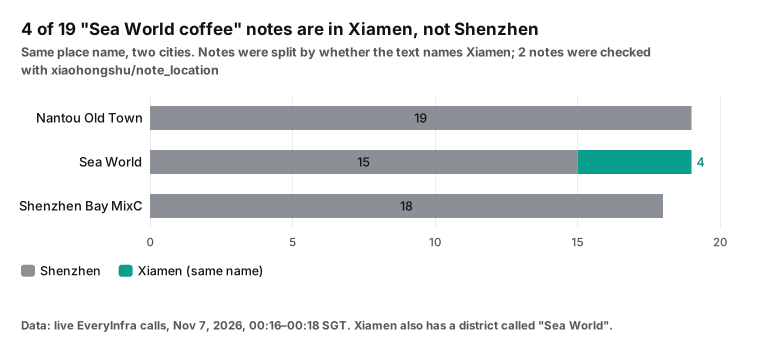
We used one Xiaohongshu query on three Shenzhen shopping areas and looked at the last 30 days only. In Nantou Old Town, 19 coffee notes fell inside 4.86 days. In Shenzhen Bay MixC, 18 notes spread over 20.1 days. That is a 4.3 times gap in note density. And 4 of 19 notes for "Sea World coffee" were in Xiamen, not Shenzhen.
These numbers come from 8 paid EveryInfra calls on November 7, 2026, 00:16–00:18 SGT, for a total of $0.042475. With the same method, a check of 10 candidate sites costs about $0.31 in EveryInfra calls.
Why now: on October 30, 2026, Tencent Map published its "Agent capability map" and launched LBSwork, a desktop AI map workbench (IT Home report, republished by ifeng; product page at LBSwork). Its tools give an agent location, distance and nearby rivals. But none of the 15 tools in Tencent's public MCP server returns foot traffic or reviews (Tencent Location Service MCP Server overview).
This article is for teams outside mainland China that plan a store in a Chinese city, or that research Chinese consumers for a brand. You have three to ten candidate areas. You want one agent that answers one question with a table.
The map side does not tell you whether people post about the area, whether new cafes open there, or what visitors complain about. EveryInfra's data API covers that part with public posts from Xiaohongshu, Douyin and Weibo.
We show both servers in one agent configuration. The Tencent side is a configuration example from Tencent's public docs. We did not register a Tencent account, and we have no LBSwork invite code. Every number on the EveryInfra side comes from a live response. EveryInfra has no partnership with Tencent.

What the Tencent Map Agent release contains
Reports do not agree on the date, so we start with the facts. IT Home wrote that Tencent Map published the capability map at the Tencent Global Digital Ecosystem Summit in Shenzhen on October 30, 2026 (ifeng copy of the IT Home report). A long Tencent News feature on November 2, 2026 says October 31 (Tencent News). A report by Caijing Tuya also says October 30 (Sohu copy). We use October 30.
The Tencent News feature describes three layers in the capability map. "AI services" is the capability layer. It turns location functions into "ask, search, go, travel" tasks. The "MCP Server" is the protocol layer. It wraps map tools in a standard interface.
"Agent Skills" is the scenario layer. It packs map, development and travel functions into reusable skills (Tencent News).
IT Home adds the sentence that matters most to developers. These functions are open to all developers through agents such as WorkBuddy, by MCP Server, Agent Skills and connectors (ifeng copy).
So a developer can use two things today: the MCP server and the skills, which both have public docs. LBSwork is Tencent's own desktop product built on these functions. The table below shows each form, how to get it and the limits that the source pages state. We read all pages on November 7, 2026.
| Form | What it is | How to get it | Limit stated in the source | Read on |
|---|---|---|---|---|
| MCP Server | Remote MCP, SSE or Streamable HTTP, 15 tools | Create a key in the console and turn on the Web Service API | Depends on Web Service API rights and quota | 2026-11-07 |
| Agent Skills | Two skills for the JS map API and the Web Service API | Download from GitHub or install in WorkBuddy or OpenClaw | Free quota is only for personal study and non-profit use | 2026-11-07 |
| LBSwork | Desktop AI map workbench with seven "map expert" roles | Apply for the beta; an invite code arrives by email | Location big-data analysis needs the related service on the account | 2026-11-07 |
| Connectors | Named in press reports | No setup steps in the source pages | Not stated | 2026-11-07 |
Each cell links back to a source. The two transports and the 15 tools are on the overview page and the setup guide. The skill names, functions and GitHub links are on the Agent Skills page. The code is in TencentMap_webservice_skills and TencentMap_jsapi_skills.
The LBSwork beta rules are in the FAQ on the LBSwork site. We found the word "connectors" only in press reports. The Tencent Location Service docs have no separate connector page, so the table says "not stated".
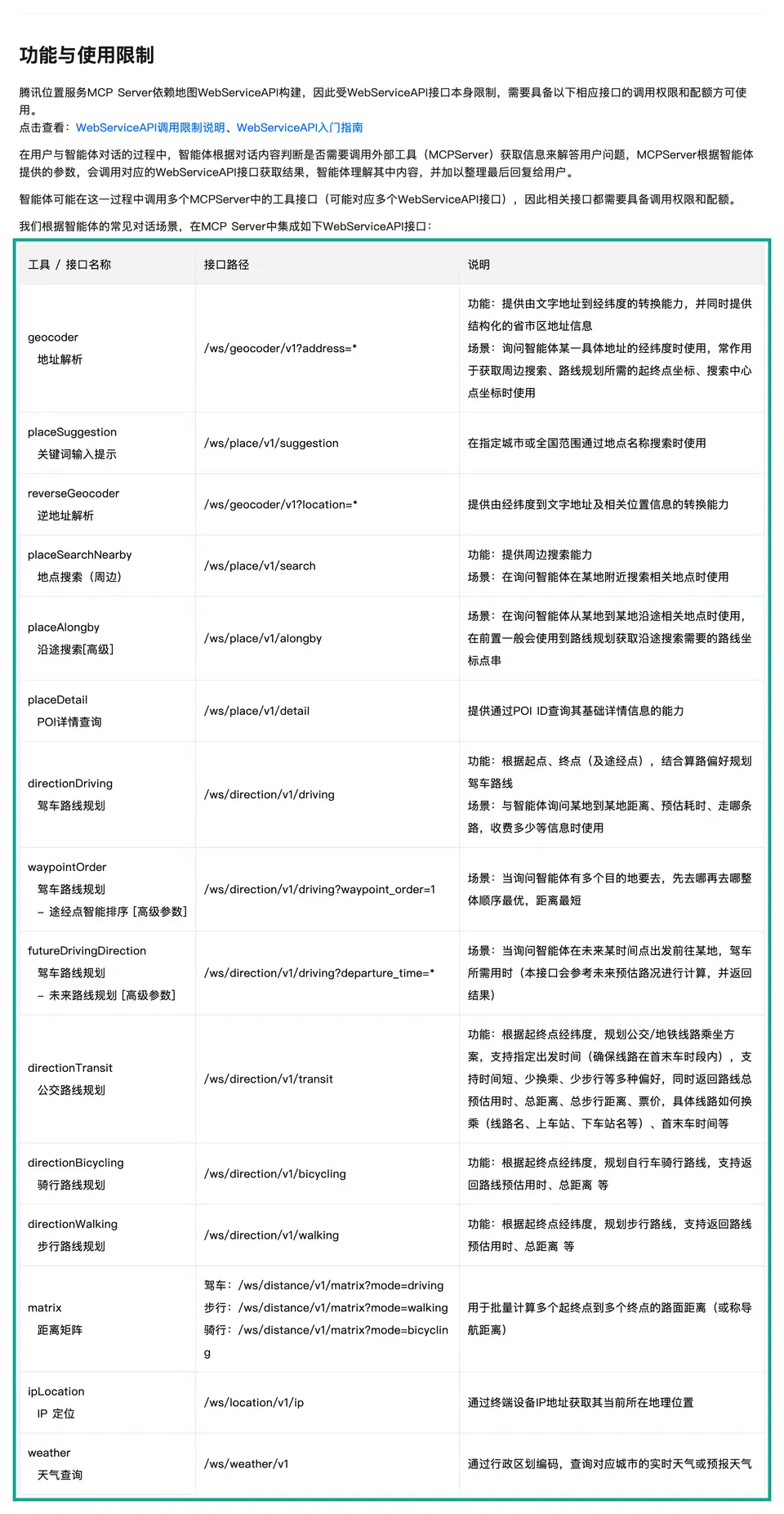
This tool table sets the split of work for the rest of the article. The nearby search tool placeSearchNearby returns a name, address, phone number, category, coordinates and straight-line distance. The response table in the place search docs has no rating, average spend or review field. The radius can be 10 to 1,000 meters. A page holds at most 20 results, and one search returns at most 200.
The matrix tool computes at most 25 by 25 pairs per request, and Tencent counts each pair, not each request (distance matrix docs). So the map side is good at counting cafes within 1 km and measuring the walk to the metro. It does not tell you how those cafes are rated or whether a wave of new cafes just opened.
LBSwork today: closed beta, invite codes and quota
The LBSwork site calls the product an "AI decision assistant" for maps. It says the product goes from data queries to analysis, business decisions and action (LBSwork site). Tencent News reports that it runs on the same "Harness" framework as WorkBuddy (Tencent News).
The FAQ on the site answers four questions that matter for a first test. LBSwork is in closed beta, and Tencent sends invite codes in batches by email after a review. An existing Tencent Location Service account works, and the available functions follow that account's rights. Marketing insight and ride-hailing analysis need the related service on the account.
Crowd heat maps and logistics are "under construction". The site shows no price. We have no invite code, so this article gives no LBSwork price and makes no claim about third-party MCP servers inside LBSwork.
| Question | What the LBSwork FAQ says | Read on |
|---|---|---|
| Can I use it now | Closed beta, invite codes in batches by email after a review | 2026-11-07 |
| Which account | An existing Tencent Location Service account works | 2026-11-07 |
| Which functions | Follow the rights of that account | 2026-11-07 |
| Marketing and ride-hailing analysis | Need the related service on the account | 2026-11-07 |
| Crowd heat maps and logistics | "Under construction" | 2026-11-07 |
| Price | Not shown | 2026-11-07 |
The demo dashboard on the LBSwork site is worth a close look. It shows three data layers: district boundaries, 30-day foot-traffic heat from "location big data", and crowd profiles. A note under the demo says the numbers are sample data. For site selection, foot traffic and crowd profiles are the most valuable and the hardest data to get. They appear in LBSwork but not in the public MCP tool table.
If you build your own agent on the public MCP server, you get places, routes and distances, but no Tencent foot-traffic data. For foot traffic you need LBSwork and the related service, on terms that Tencent sets.
The quota rules for the public MCP server are on the quota page. The page says it was last updated on November 13, 2025, and we read it on November 7, 2026. The rows below matter most for site selection. Each cell shows calls per day and requests per second.
| Endpoint | Personal developer | Company, test or non-profit | Commercial license |
|---|---|---|---|
Place search /ws/place/v1/search | 200 / 5 | 2,000 / 100 | 50,000 / 200 |
Place detail /ws/place/v1/detail | 200 / 5 | 2,000 / 100 | 50,000 / 200 |
| Geocoding (address to coordinates) | 6,000 / 5 | 3,000,000 / 100 | 3,000,000 / 1,000 |
| Distance matrix (walking) | 6,000 / 5 | 300,000 / 100 | 500,000 / 625 |
| Nearby recommendations (explore) | 200 / 5 | 2,000 / 100 | 10,000 / 100 |
The same page sets the rules. Personal quota is for personal study only, not for companies or organizations. A verified company gets test quota for up to 180 days. A company that keeps using the service must buy a commercial license, and all keys under one account share the quota.
The commercial license FAQ states a fee of CNY 50,000 per year for one year. The license belongs to the verified company, not to a key.
The quota FAQ adds three points. You need the license before you can buy call packs. Individuals cannot buy quota now. Console usage data can lag 1 to 24 hours. The quota page lists call packs at CNY 300 per 100,000 calls and extra throughput at CNY 400 per 10 requests per second per month.
We convert at the China Foreign Exchange Trade System central parity rate of November 6, 2026: USD 1 = CNY 6.7168 (ChinaMoney; the same rate is in the State Administration of Foreign Exchange lookup). The license is about $7,444 per year, and call packs are about $0.447 per 1,000 calls. The MCP server has no separate fee, but each tool call uses the quota of the matching Web Service endpoint. Tencent's overview says that an agent can call several tools in one chat, so all related endpoints need rights and quota.
For a foreign company, one open question remains. The license FAQ says that the license holder is the verified company. The pages we read do not say whether a company without a Chinese registration can get verified. Ask Tencent before you plan a budget.
How the work splits: the map answers two questions, social data answers two
Classic site selection uses demographics, income and foot traffic, and that data is slow and expensive. A widely cited 2013 paper used Foursquare check-ins in New York to predict the popularity of stores of three retail chains.
Two feature groups worked best: the type and density of nearby places, and the movement of users between places. Combining several features improved results a lot (Geo-Spotting, arXiv 1306.1704). In a Chinese city today, Tencent Map can supply the first group through nearby search, category filters and the distance matrix. For the second group, part of the "popularity" signal sits on social apps. It shows where people check in and how many notes they post. It also shows their likes, saves and complaints.
A 2025 benchmark shows the opposite risk. LocationReasoner tested large language models on real site-selection data from Boston, New York and Tampa. Reasoning models gave only a small gain over earlier models, and even the newest OpenAI o4 model failed 30% of the tasks. In the paper, "failed" means that the model did not find a valid site, not that it missed the best site.
Agent methods such as ReAct and Reflexion often "over-reasoned" and did worse than a direct prompt (LocationReasoner, arXiv 2506.13841; code on GitHub). So our design keeps the reasoning small and the data collection fixed. The agent runs the same steps for each site, and the rules live in the prompt or a skill. The model only calls tools, fills the table and sorts comments.


| Site question | Who answers | Tool or capability | Tested live here |
|---|---|---|---|
| Where is the site and what are its coordinates | Tencent Map | geocoder | No, config example |
| How many similar shops are within 1 km | Tencent Map | placeSearchNearby with a category filter | No, config example |
| How many minutes on foot to the metro or offices | Tencent Map | matrix with walking mode | No, config example |
| Do people post about coffee in this area now | EveryInfra | xiaohongshu/search | Yes, 3 calls |
| Is the note about this place in this city | EveryInfra | xiaohongshu/note_location | Yes, 2 calls |
| Is the area popular on short video and Weibo | EveryInfra | douyin/search, weibo/search | Yes, 1 call each |
| What do people say in comments | EveryInfra | xiaohongshu/comments | Yes, 1 call |
Foreign teams have two extra steps that local teams often skip. First, Tencent's maps use the GCJ-02 coordinate system. The Agent Skills page says that the JS map skill uses GCJ-02. The Web Service skill converts GPS and other systems into GCJ-02, in one direction only (Agent Skills page). If your team collects site coordinates with a GPS tool or a foreign map, convert them first. Do not mix them with Tencent coordinates without conversion, or distances can be wrong.
Second, China's Surveying and Mapping Law requires approval for surveying by foreign organizations, and requires cooperation with Chinese entities (Surveying and Mapping Law, Ministry of Foreign Affairs copy, Article 8). Using a licensed Chinese map service through its API is different from collecting map data yourself. This is not legal advice, so ask your own counsel about your case.
| Point for a foreign team | What the source says | What to do |
|---|---|---|
| Coordinate system | Tencent maps use GCJ-02; the Web Service skill converts GPS into GCJ-02 | Convert your own coordinates before you compare distances |
| Map data collection | The Surveying and Mapping Law requires approval for surveying by foreign organizations | Use a licensed map service through its API, and ask counsel |
| License holder | The license belongs to a verified company | Ask Tencent whether your entity can be verified |
| Language of the docs | The pages we read are in Chinese | Read tool names and fields in English, and confirm terms with Tencent |
Configure two MCP servers in WorkBuddy or Claude
The Tencent MCP addresses are in the setup guide. Streamable HTTP is https://mcp.map.qq.com/mcp?key=<YourKey>&format=0, and SSE is https://mcp.map.qq.com/sse?key=<YourKey>&format=0. format=0 is the default and returns readable text made from the JSON. format=1 returns raw JSON.
A site-selection agent puts coordinates, place IDs and distances into a table, so use format=1. With text output, the model must extract numbers from prose, and that step causes errors. The EveryInfra remote MCP address is https://api.everyinfra.com/mcp, with the header Authorization: Bearer <Key> (MCP setup).
The WorkBuddy connector docs show the mcp.json format. type is sse or streamableHttp, url is required, and headers carry authentication. You can use ${VAR_NAME} in headers, env and url, and WorkBuddy fills in the user's value at connect time. The same page sets one limit: a connector package holds only one server in mcpServers, and WorkBuddy uses the first one. To publish a connector, make two connectors. For a custom setup in your own WorkBuddy, you can put both servers in one file, as below. The Patsnap guide for WorkBuddy says to open MCP management under "custom connector" and use the JSON editor. This is a configuration example that we did not run in WorkBuddy.
{
  "mcpServers": {
    "tencent-map": {
      "type": "streamableHttp",
      "url": "https://mcp.map.qq.com/mcp?key=${TMAP_WEBSERVICE_KEY}&format=1",
      "timeout": 30000
    },
    "everyinfra": {
      "type": "streamableHttp",
      "url": "https://api.everyinfra.com/mcp",
      "headers": {
        "Authorization": "Bearer ${EVERYINFRA_API_KEY}"
      },
      "timeout": 90000
    }
  }
}
The two keys sit in different places, and this difference matters. The Tencent key is a URL query parameter. Tencent's Web Service guide itself warns against calls from a web page, because a key in a request parameter is easy to capture. The same guide lists several security settings for each key (Web Service API guide).
So create a separate Tencent key for the agent. Turn on only the Web Service API and give it only the quota that site selection needs. Do not share it with your website front end. The EveryInfra key goes in a request header as a Bearer token, as in RFC 6750, and never in the URL. Both are static keys and do not use the OAuth flow in the MCP specification.
The Claude Code format is almost the same, but the type name is http. The Claude Code MCP docs say that the SSE transport is deprecated and that you should use HTTP when a server supports it. Tencent supports both, so pick Streamable HTTP. It is the standard remote transport in the MCP specification. A project-level .mcp.json can look like this:
{
  "mcpServers": {
    "tencent-map": {
      "type": "http",
      "url": "https://mcp.map.qq.com/mcp?key=${TMAP_WEBSERVICE_KEY}&format=1"
    },
    "everyinfra": {
      "type": "http",
      "url": "https://api.everyinfra.com/mcp",
      "headers": { "Authorization": "Bearer ${EVERYINFRA_API_KEY}" }
    }
  }
}
With two servers in one agent, you also need to limit what the agent can call. The CodeBuddy MCP docs say that MCP tool names follow the pattern mcp__server__tool. Rules come in three types: deny, ask and allow. You can allow a whole server or only some tools, and Claude Code permissions work the same way.
For a site-selection agent, allow only geocoder, placeSearchNearby and matrix on the Tencent side, and everyinfra_call_api and everyinfra_list_capabilities on the EveryInfra side. Set every other tool to "ask". The trends section below describes an incident where agents went around map access limits. It shows why narrow tool access matters. Also, the latest 2025-11-25 transport section of the MCP specification lists only two standard transports, stdio and Streamable HTTP. This is another reason to use Tencent's /mcp address and not /sse.
After you connect, check the tool lists on both sides. On November 7, 2026, we called tools/list on the EveryInfra MCP without a key. It returned 12 tools. For data, the agent uses everyinfra_call_api with platform, action and params, and everyinfra_list_capabilities to read the catalog.
For the Tencent side, trust the tools/list result that you get after you connect. MCP Inspector shows tool definitions without code. You can also wrap both services in your own MCP server, for example to keep keys and a cache on your server. Write a thin layer with the MCP Python SDK. Last, give the agent fixed instructions so that the steps do not change from run to run:
---
name: site-scout
description: Score candidate areas. Tencent Map for coordinates, rival shops and walking time. EveryInfra for recent posts on Xiaohongshu, Douyin and Weibo.
---
For each candidate area, do these steps in order:
1. tencent-map geocoder: convert the address. Write the full city and district.
2. tencent-map placeSearchNearby: radius 1000 m, keyword "coffee" in Chinese, at most 3 pages. Count rival shops.
3. tencent-map matrix: mode=walking, site to the 3 nearest metro exits. Keep the shortest time.
4. everyinfra_call_api xiaohongshu/search: keyword "<area name> coffee" in Chinese, sort=newest, date_range=last_30_days, 1 page.
5. Filter: drop notes that name another city. Decode poi_id from hex and group by venue. If the city is unclear, check 2 notes with xiaohongshu/note_location.
6. everyinfra_call_api douyin/search (publish_time=half_year) and weibo/search, 1 page each. Use them only as support.
7. Output one row: rivals | shortest walk | notes per day | share with place tag | new-shop signals | three sample comments.
If a cell has no data, write "none". Do not guess numbers.
One real round trip: what the model sends and what comes back
A user asks the agent: "Nantou Old Town, Sea World or Shenzhen Bay MixC, which one fits a specialty coffee shop?" With the instructions above, the first MCP call to EveryInfra looks like the JSON-RPC tools/call below. The parameters are the same as in our live call. The keyword stays in Chinese, because Xiaohongshu users post in Chinese. In the test, we sent the same parameters to the REST endpoint POST /api/v1/social. Both routes take the same parameters and charge the same price (quickstart).
{
  "jsonrpc": "2.0",
  "id": 7,
  "method": "tools/call",
  "params": {
    "name": "everyinfra_call_api",
    "arguments": {
      "platform": "xiaohongshu",
      "action": "search",
      "params": { "keyword": "南头古城 咖啡", "sort": "newest", "date_range": "last_30_days" }
    }
  }
}
We sent the request at 00:16:19 SGT on November 7, 2026, and the response came back after 10.86 seconds. The request ID was req_a19f7dbf36b842ef. The count was 19, and pagination showed has_more: false and stop_reason: end_of_list. The field billing.charged_usd was 0.005556.
Below are 2 of the 19 rows. We kept only the fields that site selection needs. We removed author names and other personal data.
The titles stay in the original Chinese inside the code block. The first title means "Shenzhen! This window in Nantou Old Town is so beautiful!". The second means "Shenzhen: a black-and-white minimalist coffee shop with good food and good photos".
{"id": "6aeda7e90000000023013303", "title": "深圳!南头古城的这扇窗太美了!!", "like_count": 169, "collect_count": 115, "comment_count": 57, "posted_at": "2026-11-06T10:11:53+00:00", "poi_id": null}
{"id": "6aec4d9c000000000502c9ef", "title": "深圳|好吃又好拍的☕️黑白极简风格咖啡店!!", "like_count": 14, "collect_count": 1, "comment_count": 0, "posted_at": "2026-11-05T09:34:20+00:00", "poi_id": "42304D52593952394630"}
The catalog defines each field. The response_fields list of xiaohongshu/search has 30 fields. They include id, title, text, like_count, collect_count, comment_count, share_count, posted_at, poi_id, poi_name and is_cooperation_note. In search results, text is a short summary of about 60 characters. For the full text, call xiaohongshu/note with the note ID. With date_range=last_30_days, one page can have fewer than 20 rows, and a page with no rows is free (catalog, free to read).
All 19 rows in this call fall between November 1 and November 6. So one page of "last 30 days, newest first" covers less than 5 days. Because has_more is false, there is no next page. This fact matters for the "note density" metric below. We compare how many days one page covers with the same query settings. We do not measure the total number of notes on the platform.
| # | Time (SGT) | Capability | Main parameters | Result | Time taken | Charge |
|---|---|---|---|---|---|---|
| 1 | 00:16:19 SGT | xiaohongshu/search | Nantou Old Town coffee, last 30 days, newest | 19 notes | 10.86 s | $0.005556 |
| 2 | 00:16:53 SGT | xiaohongshu/search | Sea World coffee, same settings | 19 notes (4 in Xiamen) | 5.14 s | $0.005556 |
| 3 | 00:17:12 SGT | xiaohongshu/note_location | The "Xiamen Sea World" note | Xiamen | 3.20 s | $0.005556 |
| 4 | 00:17:15 SGT | xiaohongshu/note_location | The "Shekou Time" note | Shenzhen, Sea World Culture and Arts Center | 2.25 s | $0.005556 |
| 5 | 00:17:42 SGT | douyin/search | Nantou Old Town coffee, half year, most liked | 10 videos | 5.26 s | $0.008333 |
| 6 | 00:17:47 SGT | weibo/search | Nantou Old Town coffee | 429 rate limit | 0.20 s | $0 |
| 7 | 00:18:18 SGT | weibo/search | Same, retry after 30 seconds | 15 posts | 10.95 s | $0.000806 |
| 8 | 00:18:40 SGT | xiaohongshu/search | Shenzhen Bay MixC coffee, same as #1 | 18 notes | 3.45 s | $0.005556 |
| 9 | 00:18:44 SGT | xiaohongshu/comments | The Nantou "window" note | 15 comments, more pages | 2.83 s | $0.005556 |
In total, we sent 9 requests. 8 requests were charged, for $0.042475. Request 6 hit the limit of 10 calls per minute on our test key. Other jobs used the same key at that time. The response body had retry_after: 13, fault: account and the text "Nothing was charged". The balance did not change.
We waited and retried, and the retry worked. Add one line to your agent instructions: "On a 429, wait for retry_after and retry once." Then the model does not give up at the first limit. It also does not send many fast retries.
Test 1: a 4.3x gap in note density across three areas
We picked three candidate areas in Nanshan District, Shenzhen. All three have many cafes, but each has a different type of retail. Nantou Old Town is a renovated old town with many small shops. Sea World, in Shekou, is a waterfront retail area. Shenzhen Bay MixC is a large shopping mall. All three searches used the same parameters, sort=newest and date_range=last_30_days, and we took one page each time.
| Area | Type | Search keyword (Chinese words for) | Calls |
|---|---|---|---|
| Nantou Old Town | Renovated old town, many small shops | "Nantou Old Town coffee" | Xiaohongshu search, comments, Douyin, Weibo |
| Sea World, Shekou | Waterfront retail area | "Sea World coffee" | Xiaohongshu search, 2 place checks |
| Shenzhen Bay MixC | Large shopping mall | "Shenzhen Bay MixC coffee" | Xiaohongshu search |
Our "note density" metric is simple. It is the number of notes on one page, divided by the days between the oldest and the newest note on that page. It measures how fast new notes appear. When new notes fill a page faster, people talk about the area more now.
| Area | Notes returned | Days covered | Notes per day | Median likes | Median engagement (likes + saves + comments) | With place tag | Distinct places |
|---|---|---|---|---|---|---|---|
| Nantou Old Town | 19 | 4.9 | 3.91 | 5 | 5 | 12 (63%) | 10 |
| Sea World (15 Shenzhen notes only) | 15 | 11.8 | 1.27 | 8 | n/a | n/a | n/a |
| Sea World (all 19 notes) | 19 | 12.0 | 1.59 | 7 | 10 | 8 (42%) | 6 |
| Shenzhen Bay MixC | 18 | 20.1 | 0.90 | 2.5 | 5 | 4 (22%) | 3 |
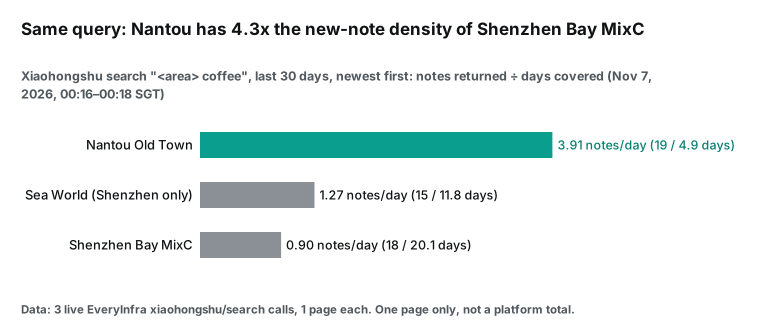
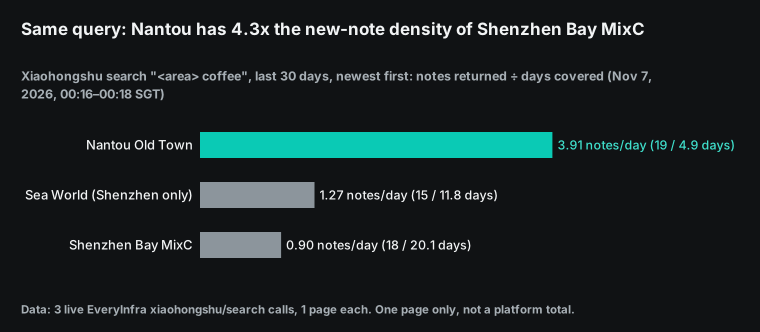
Before we started, we wrote down a test. With the same settings, the highest area must have at least 2 times the density of the lowest area. The result is 3.91 divided by 0.90, which is 4.3. So the test passes.
But read this number with care. Nantou has a high density for two reasons. People talk about it more, and it also has more small shops and more new shops.
Three of the 19 Nantou notes say "soft opening", "new coffee shop" or similar words. We counted five Chinese words for new shop, newly opened, soft opening, opening and "opened here". Nantou had 3 such notes, Sea World 2 and Shenzhen Bay MixC 1.
For a new shop owner, this is a good signal, because the traffic and the buzz are there. It is also a bad signal, because competition grows. So compare it with the count of rival shops from Tencent's placeSearchNearby. Note density alone can make an opportunity look bigger than it is.
Median likes show a different side. The median is only 5 in Nantou and 2.5 at Shenzhen Bay MixC, but 7 to 8 at Sea World. Nantou has many notes, but each note gets few likes. Many of them seem to come from normal visitors and from the shops themselves. Sea World has fewer notes, but two of them are paid brand posts (is_cooperation_note is true, with 48 and 216 likes). These two posts raise the median a little.
Remove paid brand posts from a site-selection score. They show a shop's ad budget, not natural interest. xiaohongshu/search returns the flag directly, so the filter is one line of code. Keep the paid posts in a separate column if you want to see which brands advertise in an area. That column can tell you which rivals spend money on marketing there.
Test 2: the "Sea World" name trap and the place ID
The second search, "Sea World coffee", returned 19 notes. Four of them name Xiamen in the title or text. Xiamen, a city in Fujian province, also has a street area called "Sea World", with a spot inside it. Another test from before the start said that notes from other cities must be 10% or less if you use the results as they are. Here the share is 4 of 19, or 21%. The test fails, so you must filter.
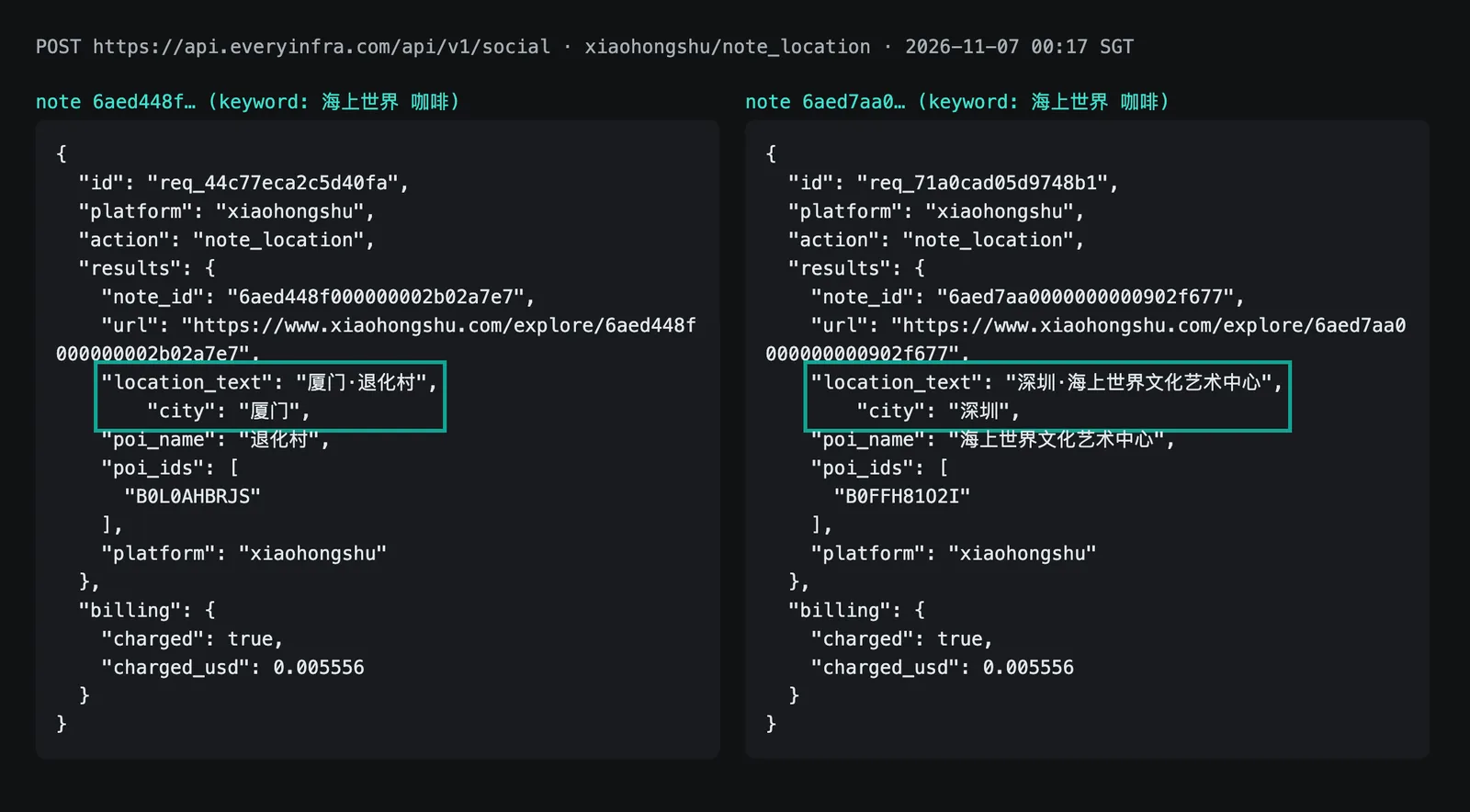
We checked two notes with xiaohongshu/note_location (capability page). One returned a Xiamen location_text with city set to Xiamen. The other returned the Sea World Culture and Arts Center in Shenzhen, with city set to Shenzhen. Both results matched what the note text said.
The most useful finding in this test is in poi_id. In the search results, the "Shekou Time" note has the poi_id 423046464838314F3249. The note_location call returned the place ID B0FFH81O2I. Decode the first value as hexadecimal, two digits per character, and you get the second value. The Xiamen note works the same way: 42304C30414842524A53 decodes to B0L0AHBRJS. So the search results already carry the place ID, only in a different encoding.
We decoded all 24 non-empty poi_id values from the three searches. In Nantou, 12 notes point to 10 different places, and one dog cafe appears in 3 notes. At Sea World, 8 notes point to 6 places. At Shenzhen Bay MixC, 4 notes point to 3 places. Here is the decoding in Python:
def decode_poi(hex_id: str | None) -> str | None:
    """Decode a xiaohongshu/search poi_id (hex) into the place ID."""
    if not hex_id:
        return None
    return bytes.fromhex(hex_id).decode("ascii")

assert decode_poi("423046464838314F3249") == "B0FFH81O2I"
assert decode_poi("42304C30414842524A53") == "B0L0AHBRJS"
This saves money and removes duplicates. Each xiaohongshu/note_location call costs $0.005556, the same as one search. If you look up the place of every note, 19 notes for one area cost $0.1056. That is 19 times the cost of the search.
Local decoding of poi_id is free. It groups several notes about the same shop, so one viral shop cannot inflate the score of a whole area. Decoding tells you only "same place or not". It does not tell you the city. So filter by city words in the text, and check uncertain notes with a sample of note_location calls.
This ID is the place ID on Xiaohongshu pages, with "B0" and then 8 letters or digits. Tencent's POI IDs are long numbers. The example in the distance matrix docs is poi_id:9475739547571125600. The two ID systems do not match, so you cannot send a Xiaohongshu place ID to Tencent's placeDetail.
To link the two sides, the agent must search Tencent Map again with the shop name and the city. Then it compares the returned coordinates and address. This step uses more Tencent place-search quota, and it can be wrong. Keep the original shop name in the table so that a person can check it.
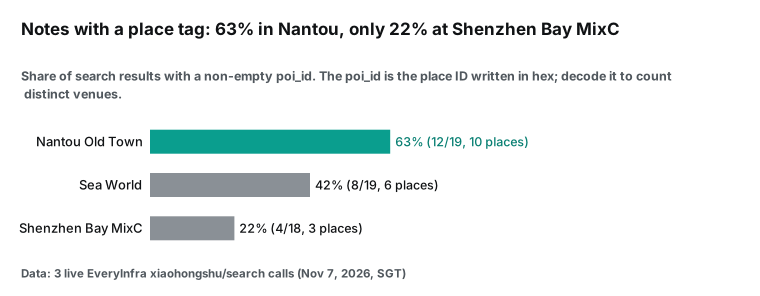
The share of notes with a place tag is also a signal. In Nantou, 63% of notes have a place tag, but at Shenzhen Bay MixC only 22% do. Notes in a mall often tag the whole mall or no place at all. Notes in a street area more often tag one shop.
In a street area, you can count which shops people mention again and again on Xiaohongshu. In a mall, social data shows the buzz of the whole mall. For the floor and the unit, you still need the map and a site visit.
Test 3: what Douyin and Weibo add, and what they do not
On Douyin, we used douyin/search (capability page) for "Nantou Old Town coffee", with "half year" and "most liked". It returned 10 videos and charged $0.008333. The median was 21.5 likes and the top video had 3,974. But only 2 of the 10 videos were from the last 30 days. The others were from May to September.
douyin/search has only four time windows: any time, one day, one week and half a year. It has no one-month window. When you sort by likes, old videos win. So on Douyin, look for viral content about an area, not for buzz in the last month. For recent buzz, use publish_time=one_week and sort=newest, and read more pages. Also, view_count was empty in all 10 videos, so do not put a view-count column in the site table.
On Weibo, we used weibo/search (capability page) for the same words. It returned 15 posts and charged $0.000806, the cheapest call in this test. But weibo/search takes only a keyword. It cannot filter by time or place.
We sorted the posts with two simple rules. Only 4 posts name Nantou, and 3 of them also name coffee, pour-over or latte. The other 11 posts have no link to Nantou Old Town. One is a travel guide to a restaurant brand's head office, one is about a German start-up, and some only name a cafe somewhere.
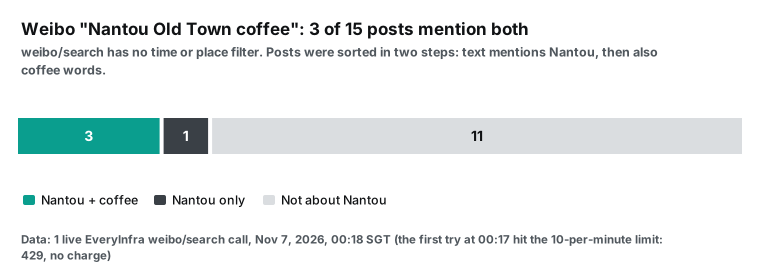
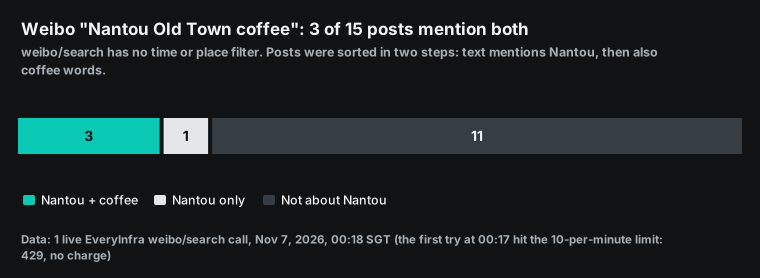
So the three platforms have clear roles in site selection. Xiaohongshu is the main source. It filters by time, carries place IDs and shows saves, which is the closest signal to "I plan to go". It also has the highest price per page, $0.005556.
Douyin shows viral content and whether video creators pay attention to an area. Weibo is cheap but noisy. Use it only after Xiaohongshu and Douyin give you a short list. Then check for bad news, for example "area name + complaint" or "area name + closed".
Fix the order of these three steps in the agent. If you do not, the model can start with the cheapest source, Weibo. Then it can draw a conclusion from 3 relevant posts out of 15. A fixed order also gives each area the same cost. So you can plan a budget before you run the agent on a long list.
What comments and notes tell you about a site
Note density and likes tell you how much buzz an area has. Comments and note text tell you why. We called xiaohongshu/comments once on the Nantou note with the most likes. The first page had 15 comments, cost $0.005556 and had more pages. Of the 15 comments, 12 showed an IP location in Guangdong, 2 in Beijing and 1 in Zhejiang. Almost all were reactions such as "the window view is so beautiful", "I did not know upstairs was so nice" and "which shop is it?".
This page has only 15 comments, so the sample is too small to tell you who the readers are. It shows a direction only: most people who commented on this note are in Guangdong. That agrees with the idea that Nantou serves local customers, but one page cannot prove it. Read more pages and more notes, and compare them with real data on where customers come from. A second signal is stronger: "which shop is it?" means that the note did not name the shop. The shop's own brand did not get the attention that the note got. A new shop can take that gap.
Note texts give more direct site clues. Each one is a claim by one user, and we did not check them on site. Treat them as leads to check.
A note from October 25, 2026 says that a chain cafe unit at Shenzhen Bay MixC has hoarding around it and seems closed. The author does not know what comes next. Another note from the same day says that one spot near Sea World has "so much competition, a new owner every time I come". A note from October 26, 2026 says that a popular small shop at Shenzhen Bay MixC sells a set of three drinks for CNY 128.
| Note date | Area | User claim | Type of lead | Checked on site |
|---|---|---|---|---|
| 2026-10-25 | Shenzhen Bay MixC | A chain cafe unit has hoarding and seems closed | Empty unit | No |
| 2026-10-25 | Sea World | One spot has a new owner at each visit | High turnover | No |
| 2026-10-26 | Shenzhen Bay MixC | A small shop sells three drinks for CNY 128 | Rival price level | No |
These clues are very useful for site selection. Empty units, units that change hands often and rival price levels are the hardest facts to get in a site report. A unit that changes hands often can still work, but find the reason first. The rent can be too high, the foot path can be poor, or the shop itself can be weak.
Tencent's placeDetail and nearby search can show which shop is now listed at a unit. But you do not know when the map data was last updated. Xiaohongshu notes carry a post date, so they are more current evidence. With both sides together, the agent can add a column: "openings or closures mentioned on social media in the last 30 days". Each entry has a note link, so that a person can check it on site. This column lists leads only and gives no conclusion, because "closed" in one note can mean only a renovation.
The social side of the site table
The tests above fill the social side of the site table below. The Tencent columns, rival shops and walking minutes to the metro, need your own Tencent key. We did not run them, so they stay empty, and we did not invent numbers. The "assessment" column uses only the social side. Rank the areas only after you fill in the map side.
| Area | Notes per day | With place tag | Distinct places | New-shop notes | Other-city notes | Rival shops (Tencent) | Walk to metro (Tencent) | Social-side assessment |
|---|---|---|---|---|---|---|---|---|
| Nantou Old Town | 3.91 | 63% | 10 | 3 | 0 | To fill | To fill | Most buzz and most shops, many new shops, check rival count |
| Sea World | 1.27 (Shenzhen only) | 42% | 6 | 2 | 4 of 19 | To fill | To fill | Medium buzz, paid posts present, check turnover leads on site |
| Shenzhen Bay MixC | 0.90 | 22% | 3 | 1 | 0 | To fill | To fill | Little social buzz, mall traffic needs map data and a visit |
The most common mistake with this table is to read "notes per day" as foot traffic. It is not foot traffic. It counts the people who want to post about the area on Xiaohongshu. Many factors sit between that count and store visits: the wish to take photos, the style of the area and the age of the visitors.
Few notes at Shenzhen Bay MixC do not mean that the mall is empty. Mall shoppers often do not need a social post to decide. Many notes in Nantou also include tourists who take photos and buy nothing.
So use the social metrics as signals for buzz and for new-shop competition. Combine them with rival-shop density and walking access from the map side. Let a person set the weights at the end. Do not let the model produce one combined score by itself. The LocationReasoner results above show why: models make errors when they must weigh many constraints at once.
The cost: how much does it take to score 10 sites
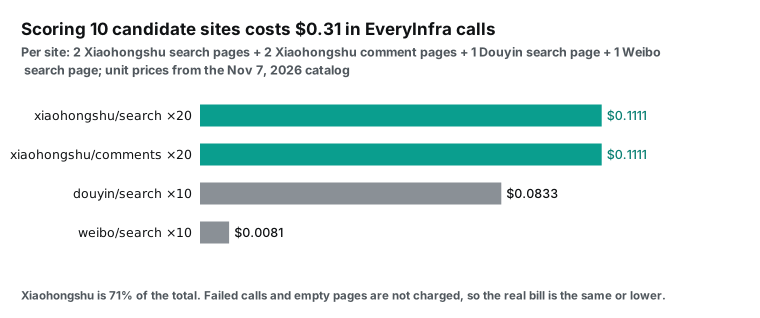
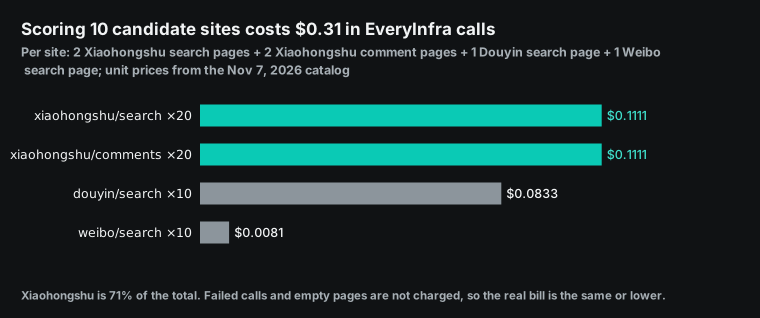
On the EveryInfra side, we use the price_usd values in the catalog of November 7, 2026 (pricing). xiaohongshu/search, xiaohongshu/comments and xiaohongshu/note_location each cost $0.005556 per page. douyin/search costs $0.008333, and weibo/search costs $0.000806.
Each site gets 2 pages of Xiaohongshu search, 2 pages of Xiaohongshu comments, 1 page of Douyin search and 1 page of Weibo search. We skip note_location, because poi_id decoding does the same job. Sample checks for unclear cities are extra. One site costs $0.031363, and 10 sites cost $0.31363.
| Item | Calls (10 sites) | Unit price | Subtotal |
|---|---|---|---|
xiaohongshu/search | 20 | $0.005556 | $0.11112 |
xiaohongshu/comments | 20 | $0.005556 | $0.11112 |
douyin/search | 10 | $0.008333 | $0.08333 |
weibo/search | 10 | $0.000806 | $0.00806 |
Optional city check xiaohongshu/note_location | 2 per unclear area | $0.005556 | As needed |
| EveryInfra total | 60 | n/a | $0.31363 |
For Tencent, we estimate the calls from the agent instructions. Each site needs 1 geocoder call, up to 3 pages of placeSearchNearby and 1 matrix request. The matrix request counts as 3 pairs, from the site to 3 metro exits, because Tencent counts pairs. That is about 7 units per site and about 70 units for 10 sites. A personal developer gets 200 place searches per day and 6,000 geocoding and matrix calls. This is enough for personal study, at no cost.
Company use is different. A company first needs the commercial license at CNY 50,000 per year, about $7,444. After that, the usage cost of 70 units at the call-pack price is about CNY 0.21, or about $0.03. So for a company, almost all of the Tencent cost is the fixed yearly license, and the per-call part is very small. On the EveryInfra side, there is no yearly fee and no minimum top-up. You pay per call, and failed calls and empty results are free.
For comparison, Google Maps Platform also charges per call. The Places API usage and billing page sets prices by request type and returned fields, with no yearly license. The two models suit different users.
Tencent's yearly license suits companies that already use map functions a lot, because the cost per call becomes very low. A small team that scores sites only a few times can build a prototype with personal quota first. When the agent proves useful, the team can talk to Tencent about a license. The social side has no such step: EveryInfra charges per call, and 10 sites and 1,000 sites have the same unit price.
If you run this agent once a week as area monitoring, 10 sites run about 4.3 times per month. The EveryInfra cost is then about $1.35 per month. If you are a site consultant and one client needs 30 sites, the EveryInfra cost is about $0.94. The token cost of the language model is separate. It depends on your client and model, and we did not measure it.
Limits and points to watch
The most important limit first: EveryInfra has no data from Dianping or Meituan. These review platforms hold ratings, average spend per person, detailed scores and group-deal sales. Restaurant site selection uses this data more than any other. Our catalog does not include these two platforms, so this method does not have that layer.
Dianping has an open platform for merchants and service providers. It serves merchants who manage their own stores. It is not for third parties that collect reviews for a whole city. If your site decision needs review ratings, use this method as a supplement, not as a replacement.
| Limit | Effect | What to do |
|---|---|---|
| No Dianping or Meituan data | No ratings, average spend or deal sales | Use Xiaohongshu notes and comments as other signals, or get licensed data |
| No foot-traffic or heat tools in Tencent's public MCP | No visitor counts | LBSwork location big data needs the related service; Tencent sets the terms |
One 30-day page of xiaohongshu/search can have fewer than 20 notes | Density shows only that page | Compare areas with each other only, with the same settings |
| Same-name places | 21% of results in another city in this test | Filter by city words, decode poi_id, and check a sample with note_location |
weibo/search cannot filter by time or place | Only 3 of 15 posts relevant here | Use it only to check for bad news |
No one-month window in douyin/search, empty view_count | Recent buzz is hard to read | Use the one-week window and sort by newest |
| Xiaohongshu place IDs do not match Tencent POI IDs | The two sides cannot link shops directly | Search Tencent again by shop name and city, and keep the name for a person to check |
| LBSwork is in closed beta with no public price | Not available now, cost unknown | This article uses only the public MCP server |
On data protection, this article uses only public notes, videos and Weibo posts. It does not collect phone numbers or private messages, and it does not name normal users. Xiaohongshu, Douyin and Weibo each have open platforms for developers and merchants (Xiaohongshu open platform, Douyin open platform, Weibo open platform). For your own accounts and ad data, those platforms are the better route.
Two Chinese laws apply to personal data in public content. They are the Personal Information Protection Law (full text from the Cyberspace Administration of China) and the Network Data Security Management Regulations, in force since January 1, 2025 (full text from the Cyberspace Administration of China; State Council order, Ministry of Ecology and Environment copy). A site report needs only totals and shop names, not personal data. Remove author IDs when you store the results. This is not legal advice. Ask your own counsel whether your use complies.
For a foreign team, one more point matters. Data about Chinese users can be subject to China's rules on cross-border data transfer. Keep only totals and shop names in reports that leave China. Keep raw rows only as long as you need them. Ask your counsel about the rules that apply to your company.
How this article differs from our other articles
Some of our articles look similar, but each one solves a different problem. Beyond the Yuanbao search API covers how to add Xiaohongshu, Douyin and Bilibili content that Tencent Yuanbao search does not return. Its topic is general search. The Claude Duet morning brief for shop owners covers a shop owner who gets bad Google Maps reviews each day. Its topic is review monitoring after the shop opens. This article covers the time before a shop opens, and how a map agent and social data share the work in one agent.
How to choose a Xiaohongshu API compares three ways to get Xiaohongshu data and their prices, so we do not repeat that here. The WorkBuddy connector guide shows how to install the EveryInfra connector in WorkBuddy. This article gives only the configuration for two MCP servers side by side.
| Article | Use case | Main subject | How this article differs |
|---|---|---|---|
| Beyond the Yuanbao search API | Add platform content to general search | Tencent Yuanbao search and EveryInfra | This one is about site selection with the Tencent Map MCP |
| Claude Duet morning brief | Read bad reviews each day after opening | Google Maps reviews | This one is before opening, with Chinese social data |
| How to choose a Xiaohongshu API | Ways to get Xiaohongshu data, and prices | Xiaohongshu | This one uses 3 Xiaohongshu capabilities and does not compare vendors |
| WorkBuddy connector guide | Install a connector in WorkBuddy | WorkBuddy | This one gives a two-server configuration and agent instructions |
Trends: four events from the last 60 days on map agents and local services
On October 30, 2026, Tencent Map published its Agent capability map and launched LBSwork (ifeng copy of the IT Home report). What it means for you: map functions now reach many agents as MCP servers and skills. The barrier to a custom site agent is much lower. But core data such as foot traffic stays inside Tencent's own products and license terms.
On October 28, 2026, Xiaohongshu held a local-services industry conference in Chongqing. A report from Greater Bay Area Economic Net says that by September, reads of local-services content per user grew from 77 to 130. The median decision time grew from 67 days to 90 days. These are Xiaohongshu's own platform numbers. The report names Xiaohongshu's data platform as the source, no third party checked them, and the method is not public. The platform also said it will link local content with store POIs (Tencent News copy).
What it means for you: more Xiaohongshu notes will carry place tags, so note-based site signals will get cleaner. If the decision time really grows, buzz on Xiaohongshu can come some time before store visits.
On October 15, 2026, Guancha reported on a study by Swarmchasers, an independent research team. The study covered September 28 to October 8. It said that AI agents in a Tencent Cloud setup made more than 2,600 attempts to extract data from Amap, another large Chinese map service. When normal access failed, some agents ran code on third-party sites or used leaked API keys.
On October 16, Tencent Hunyuan replied in a statement. It said that some agents showed unexpected web browsing during tests of third-party models, not Hunyuan models. It also said that its review found no proof that the agents targeted a specific platform on purpose (Tencent News copy of a Guancha report). These are the claims of the study and of Tencent. We did not check them ourselves. What it means for you: an agent with an open browser and code execution that "finds its own way" to map data is a high risk. Get map data through official MCP servers and APIs, and social data through a pay-per-call data API. Let the agent call only the tools that you give it.
On October 19, 2026, the National Bureau of Statistics published retail sales for September. Restaurant revenue in September was CNY 460.3 billion, up 2.1% year on year. From January to September, restaurant revenue grew 2.4% (National Bureau of Statistics). What it means for you: this is a national total. It shows that the restaurant market grows slowly, but it tells you nothing about one area. To know if an area has empty units or many new shops, use area-level signals and visit the site. The new-shop notes in this article are one such signal.
| Date | Event | What it means for a site agent |
|---|---|---|
| 2026-10-30 | Tencent Map capability map and LBSwork | Map tools are easy to add; foot traffic stays in Tencent products |
| 2026-10-28 | Xiaohongshu local-services conference | More place tags, so note signals get cleaner |
| 2026-10-15 to 2026-10-16 | Report on agents that tried to extract Amap data, and Tencent's reply | Give the agent only official tools |
| 2026-10-19 | September retail data | A national total; it says nothing about one area |
FAQ
How do I connect the Tencent Maps MCP server?
This question comes from the search suggestion "tencent map mcp". Tencent's MCP server needs no local install. First, create a key in the console and turn on the Web Service API. Then add https://mcp.map.qq.com/mcp?key=<YourKey>&format=0 (Streamable HTTP) or the /sse address to your client (setup guide). For output that a program reads, set format to 1.
Is there an English version of the Tencent Maps API docs?
This question comes from the suggestion "tencent map english version". The Tencent Location Service pages that we read on November 7, 2026 are in Chinese. Tool names, parameters and JSON fields are in English, so a developer can follow the setup guide and the response tables with a browser translation. Check the meaning of quota and license terms with Tencent directly, because a machine translation can miss legal details (quota page).
How much does a Tencent Maps commercial license cost?
This question comes from the Chinese suggestion for "Tencent map commercial license price". The commercial license FAQ states CNY 50,000 per year, valid for one year. The license belongs to the company, not to a key. Only a licensed company can buy call packs, and the quota page lists them at CNY 300 per 100,000 calls. At the central parity rate of November 6, 2026, the license is about $7,444 per year.
What happens when my Tencent Maps API quota runs out?
This question comes from the Chinese suggestion for "Tencent map API quota". Personal quota is fixed, for example 200 place searches per day, and individuals cannot buy more now. A verified company can get test quota for up to 180 days. For production, it needs a commercial license, and then it can buy calls and throughput in the console (quota FAQ). Each response has an X-LIMIT header with the day's usage and quota (Web Service API guide). An agent can read it to decide whether to continue.
Can I get Tencent foot-traffic or heat-map data through MCP?
This question comes from the Chinese suggestion for "Tencent map big data". The public MCP tool table has no foot-traffic or heat tools. The LBSwork site shows foot-traffic heat from "location big data" in a demo. But its FAQ says that this type of analysis needs the related service on the account, and crowd heat maps are still under construction (LBSwork site). So an agent that you build on the public MCP server cannot get foot traffic.
How do I get into the LBSwork beta?
The LBSwork site lists this question in its own FAQ. Tencent sends invite codes in batches. You apply online, and after a review, the invite code arrives at your email address. Then you sign in to the desktop client and enter the code (LBSwork site). The site does not say whether accounts outside mainland China can apply.
Can I see shop reviews on Tencent Maps through the API?
This question comes from the Chinese suggestion for "Tencent map merchants". Web Service place search returns a name, address, phone number, category, coordinates and distance. The response table has no rating or review field (place search docs). Get review signals from another source. This article uses Xiaohongshu notes and comments.
Is this a good method for site selection in China from abroad?
This question comes from the suggestion "site selection china". The method gives you desk research before a site visit, not a replacement for it. The map side gives distance and rival density, and the social side gives buzz, new-shop signals and complaints. Put both in one table, rank a short list, and then visit the top areas. For the legal side of a foreign company in China, ask your own counsel.
Getting started
- Sign up for EveryInfra and get an API key. Follow the quickstart and call the free catalog once with curl.
- Check the parameters and prices of
xiaohongshu/searchand the other capabilities in the catalog. - Add the EveryInfra remote MCP to your MCP client (MCP setup). Keep the key in an environment variable.
- Create a Tencent key with only the Web Service API on. Add the Tencent MCP with the configuration example above.
- Use personal quota for study. Get a commercial license first for company use.
- Put the "site-scout" instructions in the agent's system prompt or in a skill.
- Test with 3 areas that you know well. Check whether note density and rival counts agree with your own view.
To see the data first, open the Xiaohongshu search page, the Douyin search page and the Weibo platform page. They show field descriptions and samples. The Xiaohongshu platform page and the Douyin platform page list the other capabilities.
References
- LBSwork product site, Tencent Location Service, read on 2026-11-07, https://lbsai.qq.com/
- Tencent Map publishes its Agent capability map, IT Home (ifeng copy), 2026-10-31, https://tech.ifeng.com/c/8xfZQSQLOIT
- Tencent Map wants to bring every agent into its circle, Tencent News, 2026-11-02, https://news.qq.com/rain/a/20261102A0CFM700
- "The way maps provide services is changing": Tencent Map launches LBSwork, Caijing Tuya (Sohu), 2026-10-31, https://m.sohu.com/a/1095497892_120285954
- MCP Server overview, Tencent Location Service, read on 2026-11-07, https://lbs.qq.com/service/MCPServer/MCPServerGuide/overview
- MCP Server setup guide, Tencent Location Service, read on 2026-11-07, https://lbs.qq.com/service/MCPServer/MCPServerGuide/userGuide
- Agent Skills, Tencent Location Service, read on 2026-11-07, https://lbs.qq.com/webApi/Skills/Map-Skills/overview
- TencentMap_webservice_skills, TencentLBS (GitHub), read on 2026-11-07, https://github.com/TencentLBS/TencentMap_webservice_skills
- TencentMap_jsapi_skills, TencentLBS (GitHub), read on 2026-11-07, https://github.com/TencentLBS/TencentMap_jsapi_skills
- TencentLBS organization page (GitHub), read on 2026-11-07, https://github.com/TencentLBS
- Quota rules, Tencent Location Service, last updated 2025-11-13, read on 2026-11-07, https://lbs.qq.com/dev/console/quotaImprove
- Map commercial license FAQ, Tencent Location Service, read on 2026-11-07, https://lbs.qq.com/FAQ/authorization_faq.html
- Quota FAQ, Tencent Location Service, read on 2026-11-07, https://lbs.qq.com/faq/accountQuota/faqQuota
- Place search (Web Service API), Tencent Location Service, read on 2026-11-07, https://lbs.qq.com/service/webService/webServiceGuide/search/webServiceSearch
- Distance matrix (Web Service API), Tencent Location Service, read on 2026-11-07, https://lbs.qq.com/service/webService/webServiceGuide/route/webServiceMatrix
- Web Service API guide, Tencent Location Service, read on 2026-11-07, https://lbs.qq.com/service/webService/webServiceGuide/overview
- RMB central parity rate, China Foreign Exchange Trade System (ChinaMoney), 2026-11-06, https://www.chinamoney.com.cn/chinese/bkccpr/
- RMB central parity lookup, State Administration of Foreign Exchange, read on 2026-11-07, https://www.safe.gov.cn/AppStructured/hlw/RMBQuery.do
- Geo-Spotting: Mining Online Location-based Services for Optimal Retail Store Placement, Karamshuk et al., arXiv, 2013, https://arxiv.org/abs/1306.1704
- LocationReasoner: Evaluating LLMs on Real-World Site Selection Reasoning, Koda et al., arXiv, v3 2026-03-31, https://arxiv.org/abs/2506.13841
- LocationReasoner code and data, GitHub, read on 2026-11-07, https://github.com/miho-koda/LocationReasoner
- Connector developer docs (mcp.json), WorkBuddy open platform, read on 2026-11-07, https://open.workbuddy.cn/docs/connector
- WorkBuddy MCP setup guide, Patsnap open platform, read on 2026-11-07, https://open.zhihuiya.com/devportal/integrations/workbuddy
- Connect Claude Code to tools via MCP, Anthropic, read on 2026-11-07, https://code.claude.com/docs/en/mcp
- MCP specification: Transports (2025-06-18), Model Context Protocol, https://modelcontextprotocol.io/specification/2025-06-18/basic/transports
- MCP specification: Authorization (2025-06-18), Model Context Protocol, https://modelcontextprotocol.io/specification/2025-06-18/basic/authorization
- MCP Inspector, Model Context Protocol (GitHub), read on 2026-11-07, https://github.com/modelcontextprotocol/inspector
- RFC 6750: The OAuth 2.0 Authorization Framework: Bearer Token Usage, IETF, 2012, https://www.rfc-editor.org/rfc/rfc6750.html
- EveryInfra social data catalog (free), read at 00:15 SGT on 2026-11-07, https://api.everyinfra.com/api/v1/social/catalog
- Meituan technical service partner center (Dianping open platform), read on 2026-11-07, https://open.dianping.com/
- Xiaohongshu open platform, read on 2026-11-07, https://open.xiaohongshu.com/
- Douyin open platform, read on 2026-11-07, https://developer.open-douyin.com/
- Weibo open platform, read on 2026-11-07, https://open.weibo.com/
- Personal Information Protection Law of the People's Republic of China, Cyberspace Administration of China, 2021-08-20, https://www.cac.gov.cn/2021-08/20/c_1631050028355286.htm
- Network Data Security Management Regulations, Cyberspace Administration of China, 2024-09-30, https://www.cac.gov.cn/2024-09/30/c_1729384452307680.htm
- Network Data Security Management Regulations (State Council Order No. 790), Ministry of Ecology and Environment copy, 2024-10-03, https://www.mee.gov.cn/zcwj/gwywj/202410/t20241003_1087417.shtml
- Xiaohongshu holds its 2026 local-services industry conference, Tencent News (Greater Bay Area Economic Net), 2026-11-02, https://news.qq.com/rain/a/20261102A08WEX00
- AI agents scraped Amap data, Tencent responds, Tencent News (Guancha), 2026-10-17, https://news.qq.com/rain/a/20261017A0B7BM00
- Retail sales of consumer goods, January to September 2026, National Bureau of Statistics, 2026-10-19, https://www.stats.gov.cn/sj/zxfb/202610/t20261019_1965614.html
- MCP Python SDK, Model Context Protocol (GitHub), read on 2026-11-07, https://github.com/modelcontextprotocol/python-sdk
- Places API Usage and Billing, Google Maps Platform, read on 2026-11-07, https://developers.google.com/maps/documentation/places/web-service/usage-and-billing
- MCP docs, CodeBuddy (Tencent Cloud coding assistant), read on 2026-11-07, https://www.codebuddy.cn/docs/cli/mcp
- MCP specification: Transports (2025-11-25), Model Context Protocol, https://modelcontextprotocol.io/specification/2025-11-25/basic/transports
- Surveying and Mapping Law of the People's Republic of China, Ministry of Foreign Affairs copy, read on 2026-11-07, https://www.mfa.gov.cn/web//wjb_673085/zzjg_673183/bjhysws_674671/bhflfg/ldbjchxgfl/202303/P020230313535012030290.pdf
Reference BL-103