Claude Duet for Shop Owners: A Morning Brief of New Bad Reviews
Three US shops tested: new Google reviews came on 4 to 8 of the last 90 days. Claude Duet connector setup, morning brief prompt, and about $0.024 a month.

On November 5, 2026, from 00:16 to 00:27 Singapore time, we pulled live reviews for three small US shops. The shops are Flitch Coffee (East Austin), Chun Yang Tea (Flushing, New York) and Taquería Chabelita (East End, Houston). Their newest Google reviews were 13.5, 41.8 and 22.9 days old. In the last 90 days, new reviews came on only 7, 8 and 4 different days. So a proactive assistant that checks bad reviews each morning should stay quiet on most mornings. With since set to a recent date, a call with no new review returned an empty result and cost nothing.
This article answers one practical question for a shop with no developer. The owner wants one message on the phone each morning. Did a new bad review show up on Google Maps or Yelp yesterday? What does it say, and should I reply? Did anything change at the shops down the street? The tool is Claude Duet, which Anthropic opened as a research preview on October 21, 2026.
The data comes from four EveryInfra capabilities: google_maps_reviews/reviews, google_maps_reviews/search, yelp/reviews and yelp/search. Every EveryInfra number below comes from a raw response of a live call. We do not have a Duet account, and we did not sign in to Claude on the web for this test. So every Duet screen and behavior below is a configuration example. Each Duet fact links to claude.com or support.claude.com, and we read all of those pages on November 5, 2026.
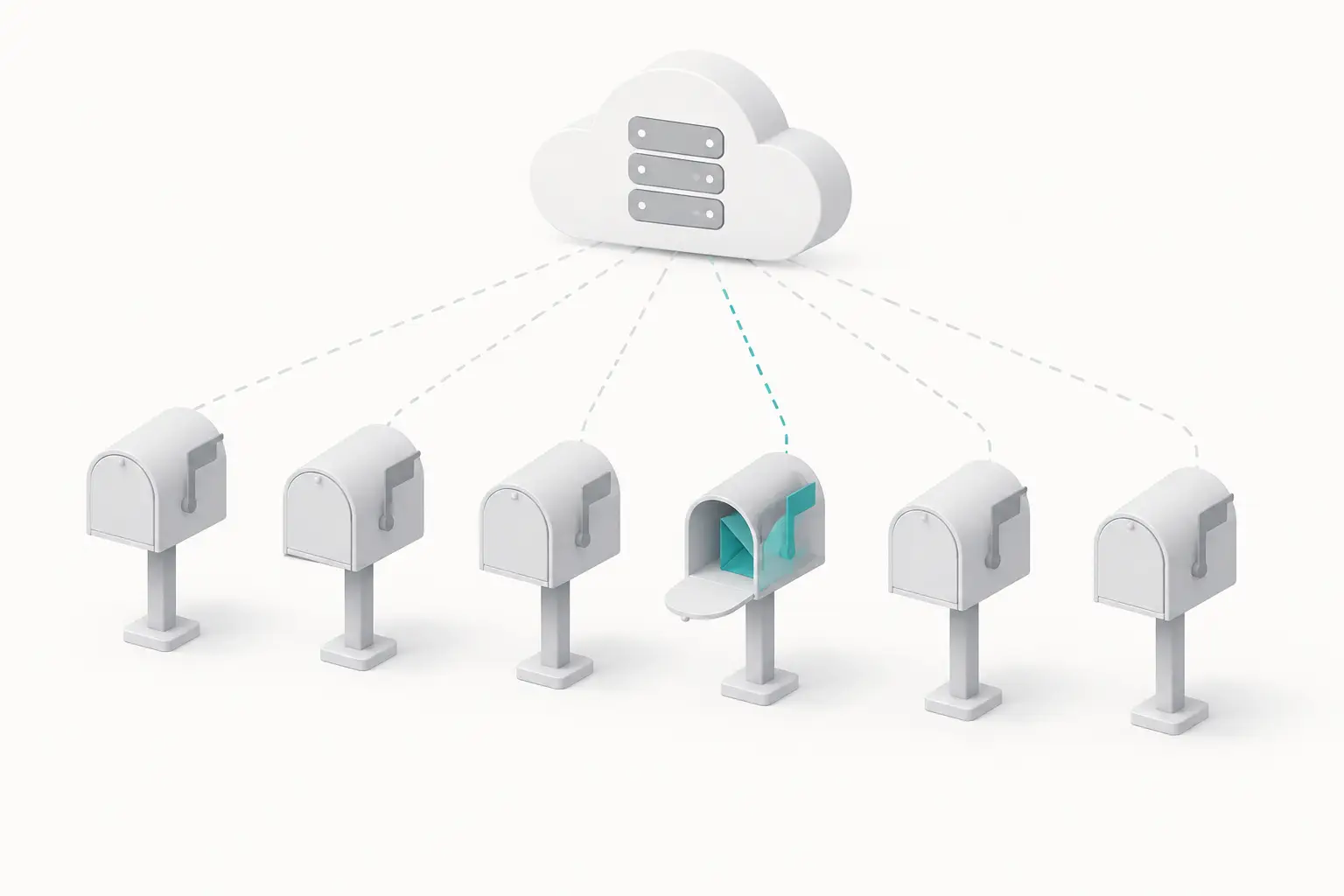
The job: one morning message for an owner who does not code
Two other articles on this site cover map reviews, so here is the difference. How to scrape Google Maps reviews is for developers who want to export reviews to a table. It compares Google's own API, a home-made scraper and a pay-per-call data API. Nightly review monitoring with Claude Managed Agents is for a restaurant group with an engineer. It runs an unattended job in Anthropic's cloud (scheduled deployment, vault and webhook). Its sample is Katz's Delicatessen in New York, which gets more than twenty new reviews a day.
The reader of this article does not write code. The reader has a phone, a Claude plan and a much smaller shop. That shop gets a few new reviews a month and maybe a few bad reviews a year. The assistant must stay silent when nothing happened. It must never miss the one bad review that matters. It must also not pay for empty checks.
Anthropic's launch post says Duet is for professionals and small business owners with too much to track (Introducing Claude Duet). Flitch Coffee, a coffee trailer in East Austin, is the main sample in this English version. We wrote three test criteria before we made any call. First, the brief sends a message only for a new 1 to 2 star review or a clear change at a rival. Second, the brief never reports the same bad review twice. Third, on a morning with no new review, the API fee is zero or close to zero.
What Claude Duet is: a proactive assistant opened on October 21
Anthropic released Claude Duet as a research preview on October 21, 2026 (2026-10-21). The launch post calls it a proactive agent. It reaches out to tell you what needs your attention, and it keeps working after you leave. It asks before it acts on your behalf (Introducing Claude Duet). The Claude account on X said the waitlist opens first to US Pro and Max users (Claude launch post on X). CNBC framed Duet as a rival to OpenAI's dots and Meta's Muse (CNBC, 2026-10-21).
Four features matter most for a review brief. First, Duet sends a short brief every morning with the most important items from your connected apps. During the day it watches those apps and messages you only when something needs you. Second, it has its own virtual machine and browser in the cloud, so your phone does not need to stay on. Third, it checks your connected accounts every few hours. The post gives the reason: nonstop checks would use up your plan limits faster.
Fourth, Duet shows you the full action and waits for approval before it sends, pays, signs or deletes (Introducing Claude Duet). You can also tell it what you want to hear about and how often. The help page says Duet checks at set intervals. Its list of limits adds that urgent items can arrive between two checks (Get started with Claude Duet). For a review brief, that delay is usually fine.
| Feature | What the source says | What it means for a review brief | Source (read 2026-11-05) |
|---|---|---|---|
| Morning brief | Looks across your email and calendar each morning, picks what needs you, can draft replies | The examples are email and calendar only, so you must ask for reviews by name | Help page |
| Check rate | Every few hours; the help page says "set intervals" and gives no number | Calling the API on every check costs more, so the prompt limits it to once a day | Launch post |
| Model | Runs on Claude Opus 5.5; you cannot pick the model | Reading, sorting and drafting replies all use the same model | Help page |
| Approvals | Asks before it sends messages, pays, signs or deletes | Posting a reply needs your approval; the source does not say if reading data does | Safety post |
| Usage | Shares your plan limits with the rest of Claude; background checks count | The more review text it reads, the more of your limit it uses | Help page |
| Browser | Uses its own cloud browser for sites with no connector; you cannot watch or take over | It can open a Google Maps page, but you cannot see what it read | Help page |


This chart is the flow we suggest, and the sections below use live data to explain steps 1, 3 and 5. One caution comes first. The launch post says Duet decides what needs you and what can wait. It also says Anthropic still tunes that judgment with feedback from testers (Introducing Claude Duet). So we do not expect Duet to think of Google Maps by itself. The task tells it exactly what to read every day and when to send a message.
Claude Duet waitlist: who can apply and which plan you need
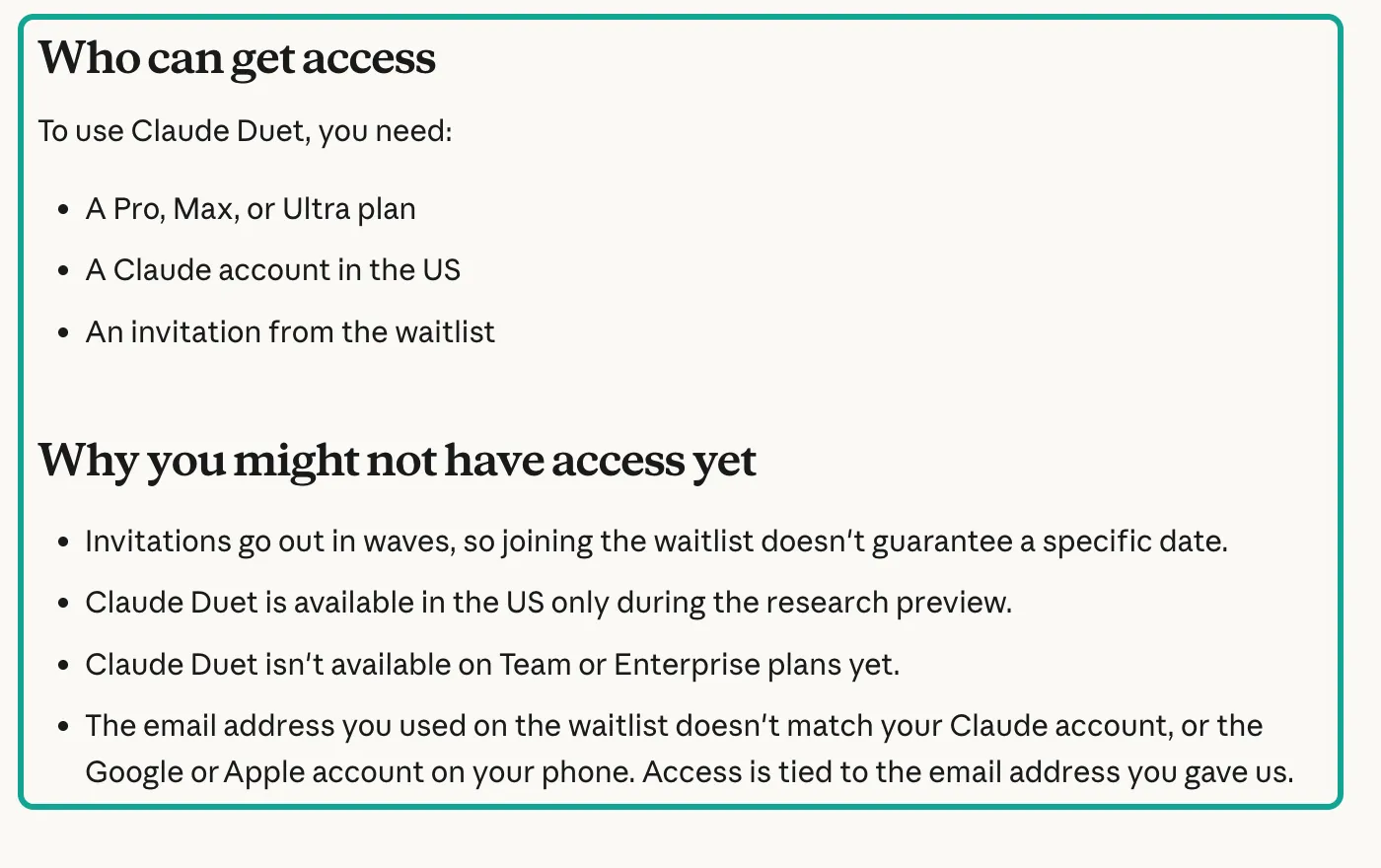
The "Who can get access" section of the help page lists three conditions. You need a Pro, Max or Ultra plan, a Claude account in the US, and an invitation from the waitlist. The next section gives four reasons you may still wait. Invitations go out in waves, and the preview is US only. Team and Enterprise plans are not supported yet. The waitlist email may also not match your Claude account or the account on your phone.
We took a screenshot of both sections on November 5, 2026 at 00:38 Singapore time:
One detail can confuse readers. The X post on October 21 said Pro and Max. The help page and the product page on November 5 say Pro, Max and Ultra (product page). Duet did not widen its audience; the plans got new names. On October 30, 2026, Anthropic renamed Max 5x to Max and Max 20x to Ultra. The prices stayed at $100 and $200 a month (The New Stack, 2026-10-30; see also the Ultra plan help page).
For a shop owner, the lowest entry is Pro. The pricing page shows $20 a month on monthly billing, or $17 a month on annual billing (Claude pricing). The Pro help page says local prices show in local currency, and tax rules differ by region. It also says Pro has a five-hour limit and a weekly limit (What is the Pro plan?). Max costs $100 a month and gives five times the usage of Pro (What is the Max plan?). Pro is enough for a review brief.
The help page also gives the steps to apply. You go to the product page and click "Join the waitlist". You enter your name and the email on your Claude account, then pick your plan and phone type. When it is your turn, you get an email. You install the app with the Apple or Google account tied to that email (help page).
There is a small bonus for new users. When you join the preview, you get one full reset of your five-hour and weekly limits. The reset is available until November 30, 2026 (help page; what a limit reset is). A Reddit user applied on 2026-10-22 and still had no reply when he posted. He asked if anyone had got in (Reddit thread). That fits the help page, which gives no set date for invitations.
| Condition | What the help page says | What a shop owner should note |
|---|---|---|
| Plan | Pro, Max or Ultra; no extra charge during the preview | From $20 a month (Pro, monthly billing) |
| Region | US only during the research preview | The account must be in the US; no date for other countries |
| Team plans | Team and Enterprise not yet; planned for later | A shop that shares one workspace cannot use it yet |
| Invitation | Sent in waves, no set date | The waitlist email must match your Claude account |
| Usage | Shares limits with the rest of Claude; background checks count | One limit reset on joining, valid until November 30 |
Which connectors Duet inherits: custom connectors are not named
Duet can read EveryInfra data only if it can use a custom connector that you add in Claude. The help page says Duet runs on your Claude account. So the memory, skills and connectors you set up in Claude are there from the first message. Its examples are Gmail, Google Calendar, Google Drive, Slack, QuickBooks, HubSpot, Docusign and Calendly (help page). The safety post says connected apps carry over to Duet, and turning one off turns it off in both places (safety post). The launch post mentions more than 6,000 connectors and plugins in the Claude Marketplace (Introducing Claude Duet; Claude Marketplace).
None of these pages use the words "custom connector". None of them say that Duet is limited to directory connectors either. The only direct evidence we found comes from one user on Reddit. He built his own MCP server to connect several Google accounts, and Duet could use it right away (Reddit thread). That is one person's report, not a promise from Anthropic.
Our reading follows the help page at its word. An EveryInfra custom connector that you add in Claude should show up in Duet. Check it in your own Duet before you rely on it. The help page also lists two known limits. Some connectors have limits in Duet (Slack is the example), and Microsoft 365 is not available yet (help page).
Custom connectors themselves work on every Claude plan. Remote MCP custom connectors work on Claude, Cowork and Claude Desktop for all plans, and Free users can add one (connectors help page). The network path also matters. A custom connector connects from Anthropic's cloud to your MCP server, not from your phone (custom connector help page). The EveryInfra remote MCP address https://api.everyinfra.com/mcp is on the public internet, so this does not block you.
Why not let Duet open Google Maps in its own browser
Many people first ask this question. Duet has a browser, so why not let it open Google Maps every morning? Why add a data API at all? The sources give three reasons, and our live tests add detail to each one.
First, you cannot see what the browser read. The help page says you cannot watch Duet work in its browser, and you cannot take it over (help page). The launch post also says Duet cannot show you its browser yet (Introducing Claude Duet). The worst failure of a review brief is a missed review. An API returns structured records with id, posted_at, rating and owner_response, and you can trace each one.
Second, sites can say no. The safety post says Duet's browser sends a distinct User-Agent from published IP addresses. Before launch, Anthropic offered several large websites a way to block Duet, and some chose to block it (safety post). The post does not name those sites. We do not know if Google Maps or Yelp is on the list. Still, it shows that "let the browser look" is not a stable path.
Third, the page order is not reliable. Yelp's default sort mixes recency, user votes and review quality, so older reviews can appear above newer ones. Only signed-in users can pick "Newest First" (Yelp Support). On Flitch Coffee's first Yelp page, the 10 reviews were not in date order. On Google, reviews pass a policy check first and can take a few days to appear (missing or delayed reviews). If a customer edits a review after your reply, the date changes to the last edit (manage customer reviews).
We saw that effect in the data. In Taquería Chabelita's newest 50 Google reviews, a 2023 review sat at position 6 among 2026 reviews. We counted 5 such breaks in date order there. Chun Yang Tea had two old reviews from 2022 and 2019 mixed into its 2024 reviews. A browser that reads "from the top down to yesterday" would trip on those reviews.
Google's own API does not solve it. The Places API returns at most 5 reviews per place, sorted by relevance (Places API reference). The Yelp Fusion reviews endpoint returns up to three review excerpts (Yelp developer docs). For your own shop, the Google Business Profile API can list all reviews and post replies. But you must register an app and get OAuth 2.0 credentials first (Google Business Profile API). That is a high bar for an owner who does not code, and it cannot read rivals.
Some readers will ask if Google already tells owners about new reviews, and it does. Business Profile notifications include a "customer activity" type for new reviews and photos. It arrives by email, in Search or in the Maps app, and each type can be off or on (manage your notifications). A review brief adds three things to that alert. It adds Yelp reviews and puts unanswered 1 to 2 star reviews at the top. It also adds a reply draft and a note on rivals.
| Way to read reviews | What you get | Can it see rivals? | Main limit |
|---|---|---|---|
| Duet's own browser | Whatever the page shows | Yes | You cannot see what it read; sites can block it |
| Google Places API | At most 5 reviews, by relevance | Yes | Not the newest reviews |
| Yelp Fusion reviews | Up to 3 excerpts | Yes | Excerpts only |
| Business Profile API | All reviews of your shop, with replies | No | App registration and OAuth |
| Business Profile alerts | A note for each new review | No | Google only, no draft |
| EveryInfra review data | Structured rows with id, date and reply | Yes | Billed per call; empty since is free |
Configuration example: add the EveryInfra connector in Claude
The steps below follow the Claude help page and Claude docs. We did not click through the screens ourselves, so trust the menu names you see. On Pro, Max and Ultra, you go to Customize, then Connectors, and click Add. You hover over Custom, pick Web, enter a name and the remote MCP URL, and click Continue. Under Authentication you pick "No sign in", and under Request headers you add your API key (connectors help page).
The Claude docs warn about two things. Claude sends header values exactly as written and does not add "Bearer" for you. So the Authorization value must be Bearer , one space, then the key. You also cannot change the authentication after you save. To change the key, you remove the connector and add it again (Add a connector that isn't in the directory).
# Configuration example (Claude on the web -> Customize -> Connectors -> Add -> Custom -> Web)
Name:            EveryInfra review data
MCP server URL:  https://api.everyinfra.com/mcp
Authentication:  No sign in
Request headers:
  Authorization: Bearer <a separate EveryInfra key just for Duet>

# Tool permissions (Customize -> Connectors -> EveryInfra review data -> Tool permissions)
everyinfra_list_capabilities   Always allow     # free, lists capabilities and parameters
everyinfra_call_api            Always allow     # the daily data call; it is billed, see next section
everyinfra_get_job             Always allow     # free, reads async job results
all other tools                Blocked          # the brief does not need them
Use a separate key for Duet. An EveryInfra key can allow only some capabilities and carry a total spend limit in US dollars. When the key reaches the limit, requests are refused and not billed. The fields are in the OpenAPI document. The setup is covered in the remote MCP setup guide and on the MCP server page. By our cost math below, one shop costs less than $0.30 a year, so a $2 limit covers several years.
Tool permissions: why everyinfra_call_api has destructiveHint
This is the largest open question in the setup. On November 5, 2026 at 00:15 Singapore time, we read the MCP tool list (tools/list) once with no key. That call is free. It lists 12 tools, and each tool carries the behavior hints (annotations) that the MCP specification defines. Here are the three tools that the brief uses.
| Tool | readOnlyHint | destructiveHint | What it does | Suggested setting in Claude |
|---|---|---|---|---|
everyinfra_list_capabilities | true | false | Lists capabilities, parameters and prices, free | Always allow |
everyinfra_call_api | false | true | Calls any data capability, billed per call | Always allow (with a capped key) |
everyinfra_get_job | true | false | Reads async job results, free | Always allow |
everyinfra_call_api does not change your data on any review site. So why does it say "may be destructive"? It takes money from your wallet, and under the MCP definition that is an outside change that cannot be undone. The specification says clients must treat these hints as untrusted unless the server is trusted (MCP specification, Tools). An MCP blog post from March gives an example. A client may auto-approve a read-only tool and add a confirm step for destructiveHint: true (MCP blog, 2026-03-16).
Will Duet stop every morning for your approval because of this hint? The sources do not say. We can confirm three facts. First, Duet asks before it sends messages, pays, signs documents or deletes anything. A separate automatic check judges if each action matches your intent (safety post). That check is built on the classifier behind Claude Code auto mode (Anthropic Engineering: auto mode).
Second, Claude connector permissions can be set per tool to "Always allow", "Needs approval" or "Blocked" (connectors help page). Third, routines that run while you are away get the same protections (safety post). So the safest setup is "Always allow" for everyinfra_call_api, plus a capped key. If your Duet still asks each time, approve it once on the first morning. Then see if it offers a choice such as "allow for this task".
The help page adds a useful detail. If you do not approve in time, Duet finishes the rest of the task and brings the approval back later (help page). In the worst case, the brief comes late, and no money is lost. A late brief is a small cost for a shop that gets a few reviews a month. A wrong charge would be worse, and the capped key prevents a large one.
Now compare the other two products. OpenAI says the proactive research of dots uses only read-only tools (Introducing dots). It does not send messages or change app content. By that rule, a data tool with readOnlyHint: false can only run in a task you assign. Our ChatGPT dots product research radar article covers this in detail. Meta's Muse asks before every write and important read if you pick "Ask for some actions" (Muse guidance and approvals).
The morning brief prompt and format
The help page says you can give Duet a task the way you would text a person (help page). You can also tell it what you want to hear about and how often (Introducing Claude Duet). Below is a task we wrote from the live test results, and you can send it to Duet as is. Three parts are there to save money and to avoid misses. Google uses since and is read once a day. Yelp and rivals run on fixed days each week, and "new" is judged only by review id.
Starting tomorrow, check my shop's new reviews once each morning at 7 a.m. Austin time.
Use only the EveryInfra review data connector. Do not use the browser.

1. Call everyinfra_call_api: platform=google_maps_reviews, action=reviews,
   params={url: "<my shop's Google Maps link>", sort: "newest", since: "<yesterday, YYYY-MM-DD>", limit: 20}.
   If count is 0, stop this step for today and do not message me.
2. Every Monday and Thursday, also call platform=yelp, action=reviews, params={url: "<my shop's Yelp link>"}.
   Yelp is not sorted by date, so read all 10 reviews on the page.
3. Every Monday, call platform=google_maps_reviews, action=search,
   params={keyword: "coffee shop", location: "East Austin, TX", limit: 20}.
   Note each shop's rating and review_count and compare with last week.
4. Use the review id to decide what is new. Remember the ids you already told me about. Never report the same one twice.
5. Message me only in three cases: a new 1-2 star review; a new 3 star review that mentions service or cleanliness;
   a rival whose rating moved by 0.1 or more, or that gained 10 or more reviews in a week.
6. Message format:
   - First line: how many bad reviews to handle today.
   - For each bad review: site, stars, date, the text, whether I replied,
     and a suggested reply (at most 3 sentences; apologize first; never offer a discount or a gift).
     Do not promise or invent an action that I did not take. If you do not know what I changed, leave the slot [what you actually changed] for me to fill in.
   - Last line: one sentence on rivals this week.
7. Show me reply drafts only. Never post anything to any site for me.| Case | Send a message? |
|---|---|
No new review (count 0) | No |
| New 4 to 5 star review | No, keep the id only |
| New 1 to 2 star review | Yes, with text and a reply draft |
| New 3 star review about service or cleanliness | Yes |
| Rival rating moved by 0.1 or more | Yes, one line on Monday |
The rule "never offer a discount or a gift" in step 6 is not about tone. The FTC announced its consumer review rule in August 2024 (FTC announcement). It bans incentives on the condition that a review shows a certain sentiment. It also bans threats or intimidation to get bad reviews removed (16 CFR Part 465). The FTC staff Q&A says the rule took effect on October 21, 2024, and courts can impose civil penalties (FTC rule Q&A). Firms that write reviews or manage reputation for a business can also be liable (Federal Register text).
Google's policy bans free or discounted goods in exchange for posting, editing or removing a review. Merchants must not discourage negative reviews or ask only the customers likely to give good ones (Google Maps prohibited and restricted content). For replies, Google advises you to protect privacy, avoid personal attacks, be honest and reply in time (tips to get more reviews). Yelp goes further and discourages asking customers for reviews at all (Yelp: Don't Ask for Reviews). When Duet drafts a reply, an automated tool speaks for you, so read each draft before you post it. We only quote these sources here, and this is not legal advice.
Here is a sample brief built from Flitch Coffee's real data. It uses the 2 star Google review from September 27, as if it came in yesterday.
1 bad review to handle today. Google Maps, 2 stars, September 27: the customer says the cold brew tasted bad for the price and added a photo. You have not replied. Suggested reply (you fill in the part in square brackets): "Thank you for telling us, and we are sorry the cold brew missed the mark. [What you changed, if anything.]" Rivals this week: The Brew and Brew (1,186 reviews) and Desnudo Coffee (938) lead East Austin on review count.
One real round trip: what the model sends and what the API returns
We cannot run the Duet side. But the request that Duet sends through the connector is a standard MCP tools/call. On November 5, 2026 at 00:24 Singapore time, we sent that same request to the remote MCP endpoint ourselves. It reads Chun Yang Tea's Google reviews after October 1. The full request body is below, and you can paste it into any MCP client to repeat the test.
{"jsonrpc":"2.0","id":7,"method":"tools/call","params":{"name":"everyinfra_call_api",
 "arguments":{"platform":"google_maps_reviews","action":"reviews",
  "params":{"url":"https://www.google.com/maps/search/?api=1&query=Chun%20Yang%20Tea%20Flushing&query_place_id=ChIJnzbAWQ5hwokRCFXB8oE55cg",
            "sort":"newest","since":"2026-10-01","limit":20}}}}
The response was only 1,274 bytes. results was an empty array, and count was 0. billing.charged was false, charged_usd was 0.0, and reason was empty_result_refunded. refund.status was succeeded, so the 100 credits on hold came back at once. At 00:26 Singapore time, we used REST to read Flitch Coffee's reviews after 2026-10-15. It returned 2 reviews, both 5 stars with no owner reply, and it cost $0.001389.
The two cards below show the raw responses, with only the balance fields removed:
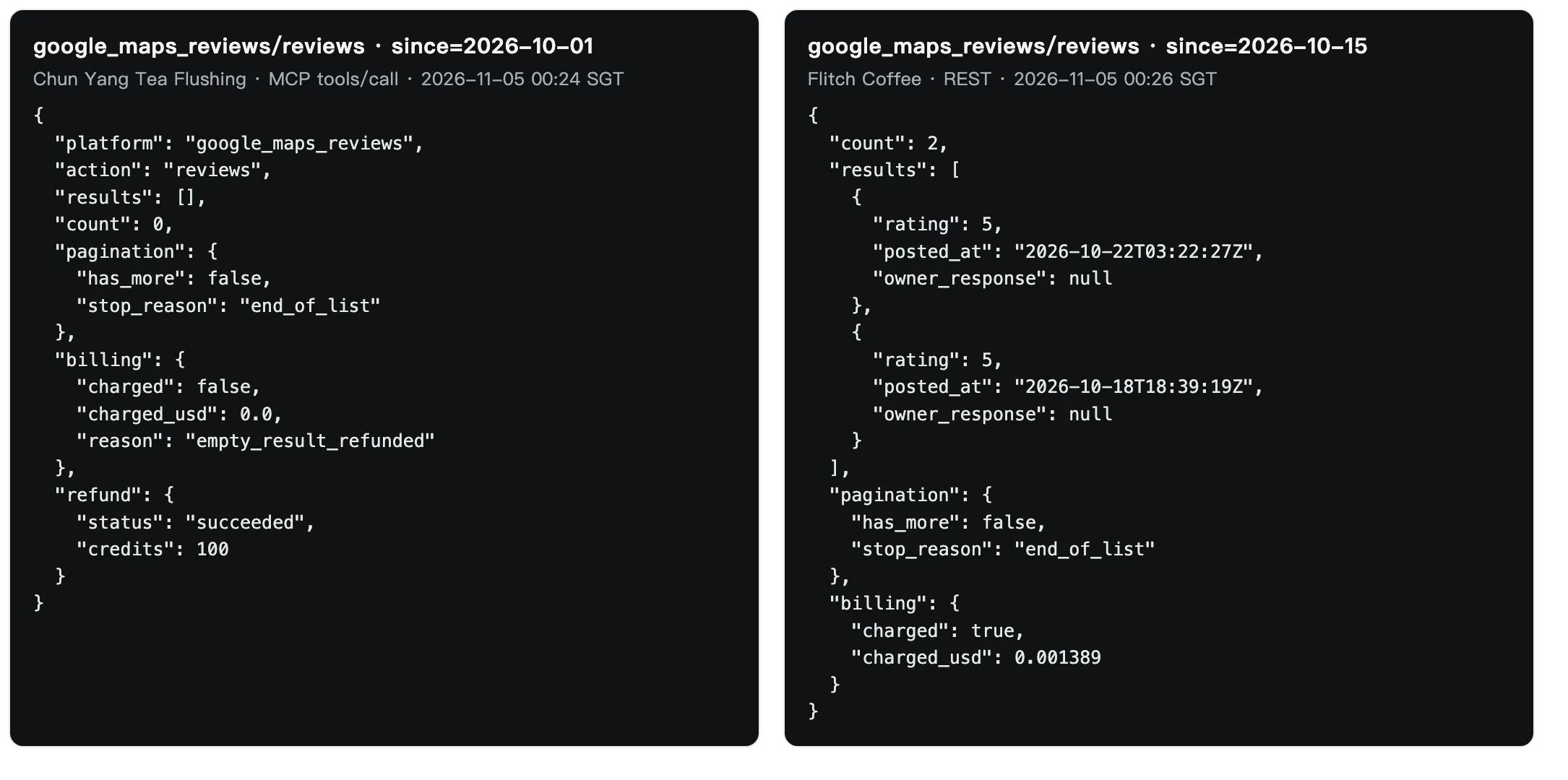
These two round trips show two things. First, "no charge for an empty result" does not mean a refund that takes days. The same response says the refund succeeded, so Duet can stop as soon as it reads count: 0. Second, a call with results is billed per call, not per row. Two rows and 50 rows both cost $0.001389, so limit: 20 costs nothing extra. The fields match the response_fields list in the catalog, and reviewer_name is a private nickname that the brief does not need.
| Time (Singapore) | Call | Rows | Fee |
|---|---|---|---|
| 00:17 | google_maps_reviews/reviews, Chun Yang Tea, newest 50 | 50 | $0.001389 |
| 00:20 | google_maps_reviews/reviews, Flitch Coffee, newest 50 | 50 | $0.001389 |
| 00:24 | MCP everyinfra_call_api, Chun Yang Tea, since=2026-10-01 | 0 | $0 |
| 00:26 | REST, Flitch Coffee, since=2026-10-15 | 2 | $0.001389 |
We also hit failures during the test. Requests at 00:22, 00:24 and 00:25 returned 429, because this test key allows 10 calls a minute. Other jobs shared the same key at that time. A retry after 60 seconds worked, and a 429 is not billed. For refund and reconciliation details, see failure refunds and reconciliation.
Test one: how sparse new Google reviews are at a small shop
We called google_maps_reviews/reviews once per shop with sort=newest and limit=50. Then we counted back by each review's posted_at. All three calls ran on November 5, 2026, from 00:17 to 00:22 Singapore time. Each call cost $0.001389, so the three calls cost $0.004167 in total.
| Shop | Google rating / reviews | Newest review | Last 30 days | Last 90 days | Days with a new review in 90 | Time span of the 50 reviews |
|---|---|---|---|---|---|---|
| Flitch Coffee (East Austin) | 4.7 / 475 | 2026-10-22, 13.5 days ago | 2 | 8 | 7 days | 551 days |
| Chun Yang Tea (Flushing) | 4.4 / 229 | September 23, 41.8 days ago | 0 | 8 | 8 days | about 6.9 years (incl. 2 old reviews out of order) |
| Taquería Chabelita (East End, Houston) | 4.6 / 217 | 2026-10-12, 22.9 days ago | 2 | 5 | 4 days | 1,291 days |
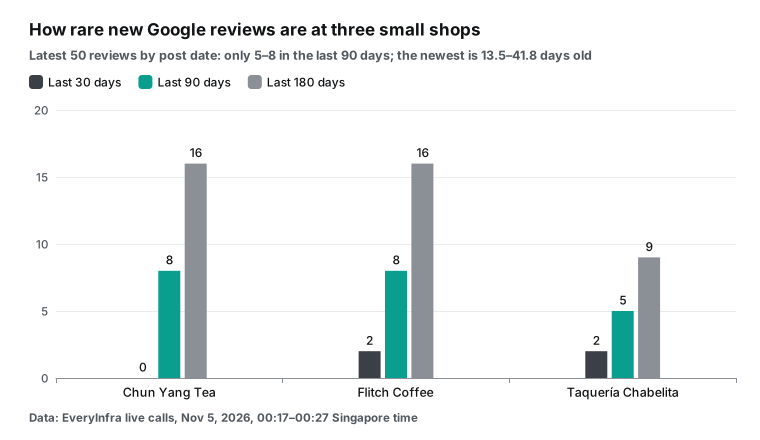
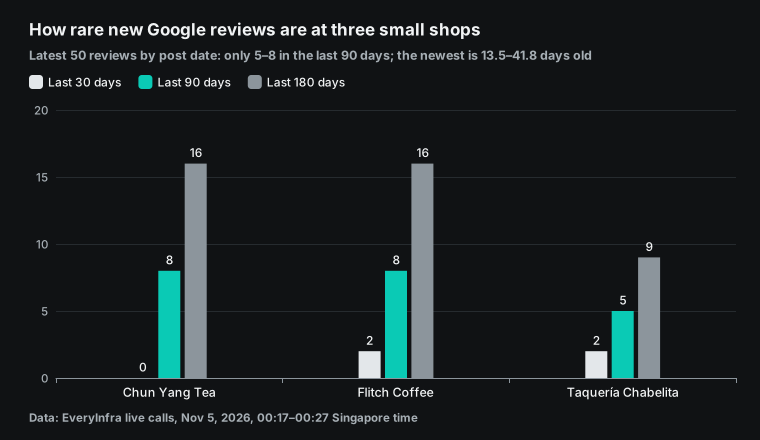
These numbers shape the brief. Over the last 90 days, Flitch Coffee saw a new review on about one day in thirteen. Taquería Chabelita saw one on about one day in twenty-two. A daily "no new bad reviews today" message would reach the owner more than twenty times a month. The owner would soon stop reading it. Duet was built to reach out only when something needs you (product page), so step 1 of the prompt stays silent on count: 0.
One more detail matters. Some of the 50 reviews have stars but no text: 17 at Flitch Coffee, 6 at Chun Yang Tea and 20 at Taquería Chabelita. A 1 to 2 star review with no text is still a bad review. You cannot answer a specific point, but the brief should still flag it. It does not need a long reply draft.
These numbers have limits. We picked the three shops from public search results, and none of them has any link to us. Review volume changes with the season, and our 90 days run from late summer into fall. Google shows the date of the last edit, so our counts use the shown date. Our article Nightly review monitoring with Claude Managed Agents found that the newest 100 Google reviews at Katz's Delicatessen covered less than 4 days. A big deli and a small coffee trailer need different brief designs.
Test two: does anyone reply to the bad reviews?
In the same 150 reviews, we counted the reviews with an owner_response. Then we looked at the 1 to 2 star reviews alone. The table below shows the reply rate, the median delay and the newest bad review per shop. A blank reply field on a bad review is the signal the brief should push to the top.
| Shop | Replies in 50 | Replies to 1-2 stars | Median reply delay | Last reply | Newest bad review |
|---|---|---|---|---|---|
| Flitch Coffee | 13 of 50 | 0 of 4 | about 130 hours | May 31 | September 27, 2 stars, no reply |
| Chun Yang Tea | 43 of 50 | 4 of 5 | about 47 hours | September 24 | August 31, 1 star, no reply |
| Taquería Chabelita | 0 of 50 | 0 of 1 | none | none in the 50 | March 11, 2025, 2 stars, no reply |
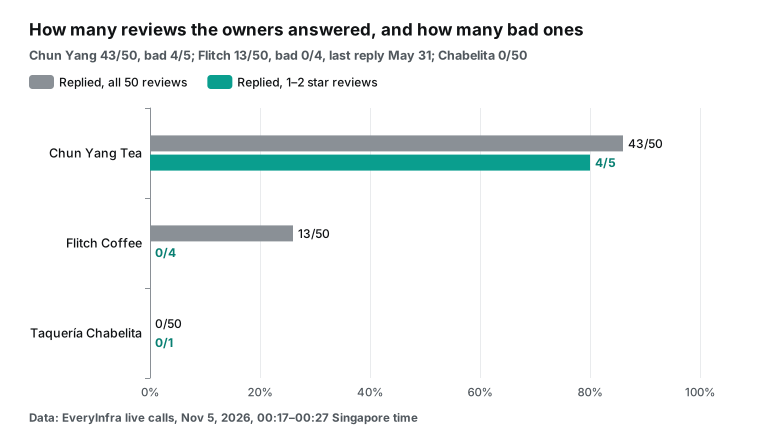
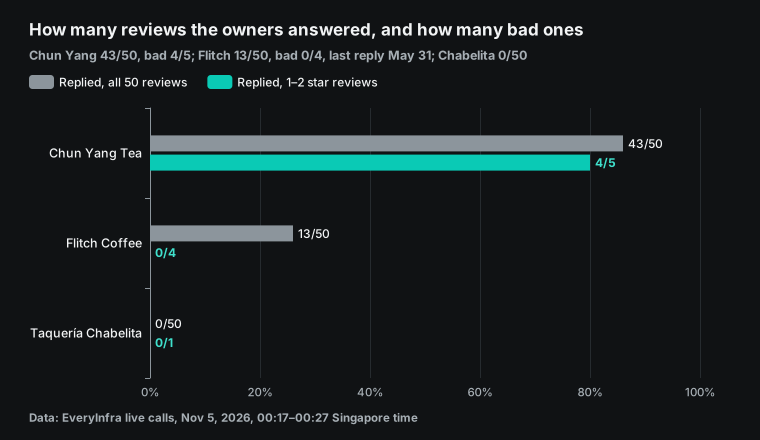
The three shops show three common patterns. Flitch Coffee replied to a batch of reviews up to May 31 and then stopped. Two 2 star reviews from September 13 and September 27 both say the coffee is bad. Both still have no reply. A 1 star review from May 2025 mentions a fly in a drink, and it has no reply either.
Chun Yang Tea replies to almost everything, mostly with a short thank-you. But its 1 star review from August 31 (no restroom and no Wi-Fi) got no reply. The 5 star reviews before and after it did get replies. Google's tips say a useful answer to the right review beats the same thank-you for everyone (tips to get more reviews). Taquería Chabelita is a small family kitchen with no replies in three and a half years. It has only one bad review in that set.
For a brief, the owner_response column is more useful than the star rating. It pushes the bad reviews that nobody handled to the top. Duet can draft a reply, but it cannot post it to Google, because Duet has no Business Profile connector. You must sign in to Business Profile and post the reply yourself (manage customer reviews). Google checks replies first, usually within 10 minutes and sometimes up to 30 days. The customer gets a notice and may then edit the review.
Test three: what Google shows and what Yelp shows
Is Google alone enough? For each shop, we called yelp/search once to find the business page. Then we called yelp/reviews once to read the 10 reviews on page one. The calls ran from 00:18 to 00:23 Singapore time: 6 calls for $0.008334 in total. The table compares page one of Yelp for the three shops.
| Shop | Yelp rating / reviews | Newest on page one | Page one, last 90 days | Page one, 1-2 stars | Page one in date order? |
|---|---|---|---|---|---|
| Flitch Coffee | 4.6 / 134 | 2026-10-29 | 4 | 1 (July 12, 2 stars) | No |
| Chun Yang Tea | 4.4 / 250 | September 29 | 1 | 2 (September 29, 2 stars; April 25, 2025, 1 star) | No |
| Taquería Chabelita | 4.6 / 13 | June 19, 2026 | 0 | 0 | No |
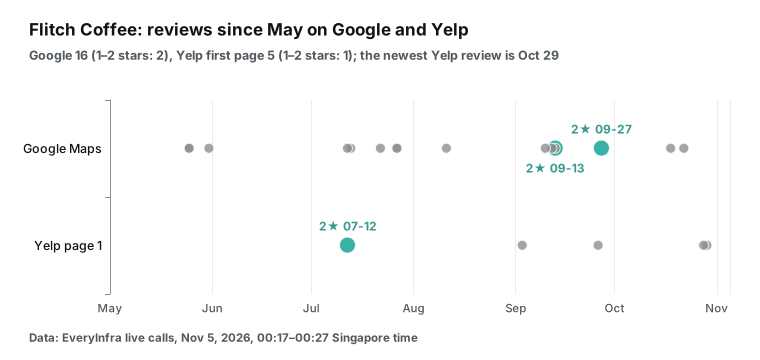
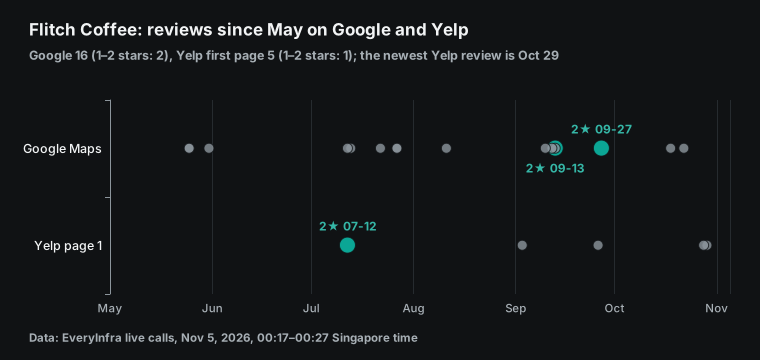
At Flitch Coffee, the two sites tell different stories. On Google, the newest review is from October 22, and the newest bad ones are from September. On Yelp, the newest review is from October 29, a week later than anything on Google. The Yelp bad review is a 2 star from July 12 that calls the coffee too milky. A Google-only brief never sees it.
Chun Yang Tea shows the risk more sharply. Its newest Google review is a 5 star from September 23, and its newest bad Google review is from August 31. On Yelp, a 2 star review from September 29 says the customer waited almost 30 minutes. Finished drinks sat on the counter during that wait. That review is newer than any Google review of the shop, and it is the only recent bad review. A Google-only brief would have said "no new bad reviews" on the morning of September 30.
The Yelp side has two limits you must design for. First, yelp/reviews has no since parameter, so every call returns a full page and costs $0.001389. Daily Yelp reads become the largest item in the monthly bill. Second, page one is not in date order at any of the three shops. The newest review can sit at position 2 or 3, or even on page two. At Katz's, that article found 5 reviews on page two that were newer than the oldest one on page one.
For a shop with a few Yelp reviews a month, the trade is clear. Read page one twice a week and judge "new" by id. That costs little and misses little. A busy shop should read two pages each time. The cost section below uses the twice-a-week plan.
Test four: 20 nearby rivals in one search
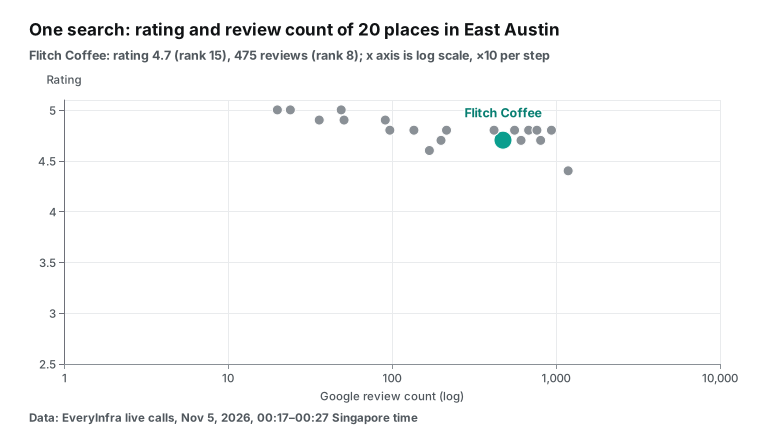
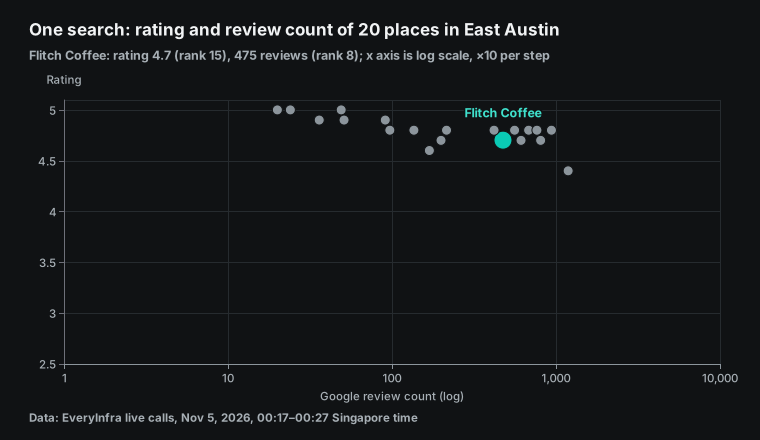
For rivals, the cheapest read is google_maps_reviews/search. One call returns 20 shops with name, rating, review_count and permanently_closed for $0.001389. At 00:19 Singapore time, we searched "coffee shop" in "East Austin, TX" and got 20 shops. Flitch Coffee's 4.7 rating ranked 15th of 20 by rating, tied with three other shops, and its 475 reviews ranked 8th. The median of the 20 was a 4.8 rating and 207 reviews. The leaders by review count were The Brew and Brew (1,186, rated 4.4), Desnudo Coffee (938, rated 4.8) and Figure 8 Coffee Purveyors (806, rated 4.7).
One snapshot shows rank but not change. To see what happens over time, we ran the same three searches again at 01:08 to 01:09 Singapore time. That was about 50 minutes after the first run, around noon on 2026-11-04 in New York, and the three calls cost $0.004167.
| Area (keyword) | Shops in both lists | Rating or count changed | Shops that changed position | Largest position change | Sample shop's position in search results |
|---|---|---|---|---|---|
| Flushing (bubble tea) | 20 of 20 | 0 | 11 | 8 places | Chun Yang Tea, 11th to 12th |
| East Austin (coffee shop) | 20 of 20 | 0 | 5 | 2 places | Flitch Coffee, 16th to 16th |
| East End, Houston (taqueria) | 16 of 20 | 0 | 15 | 8 places | Taquería Chabelita, 11th to 15th |
In 50 minutes, none of the 56 shops in both lists changed its rating or review count. That matches test one: small shops get only a few new reviews a month. What changed was the order. In Flushing, 11 of 20 shops moved, and in Houston 4 shops left the list. For example, Bodegas Taco Shop (2,526 reviews, 14th) dropped out, and a new shop with 3 reviews came in.
So the order of search results is not stable, and neither is the list itself. Do not use "rank in search" as a rival metric. Do not read "not in the list this week" as "closed". In the first week, save your rivals' place_id values as a fixed list. Each week after that, compare rating and review_count by place_id only. If a shop is missing, search again with another keyword or check its permanently_closed field.
With this design, the cost of watching rivals does not grow with the number of rivals. Twenty shops cost $0.001389 per search, so a weekly search is about $0.006 a month. Reading each rival's review text costs much more: 20 shops at one call each is $0.0278. So the brief reads a rival's reviews only when its rating moves or its review count jumps. On other weeks it looks at the counts only.
Daily and monthly API fees
Prices come from the free catalog at https://api.everyinfra.com/api/v1/social/catalog, read on November 5, 2026 at 00:12 Singapore time. The four capabilities are all available at 100 credits a call, which is $0.001389 ($1.39 per 1,000 calls). The four plans below all use 30 days. For the Google since line, we use an upper bound. A new review can show up on two mornings (the day it posts and the day after), so we bill "days with a new review times 2". Mornings with no new review cost nothing.
| Plan | Calls a month | API fee a month | Note |
|---|---|---|---|
| Full read of all 3 on every background check | 540 | $0.7501 | Assumes 6 checks a day; Duet does not state its interval, so this is an assumption |
| Full read of all 3 every morning | 90 | $0.1250 | Google 50 reviews, Yelp page one, rival search |
| Google with since, Yelp daily, rivals weekly | about 39.0 | $0.0541 | Yelp has no since, so it is billed every day |
| Suggested: Google with since, Yelp twice a week, rivals weekly | about 17.5 | $0.0243 | Flitch Coffee had new reviews on 7 of the last 90 days |
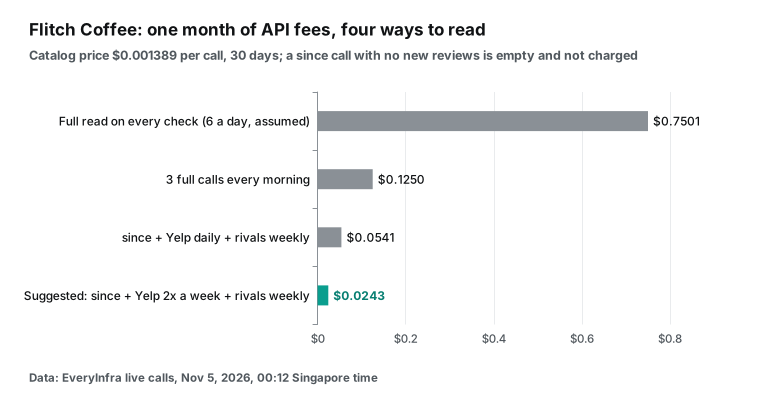
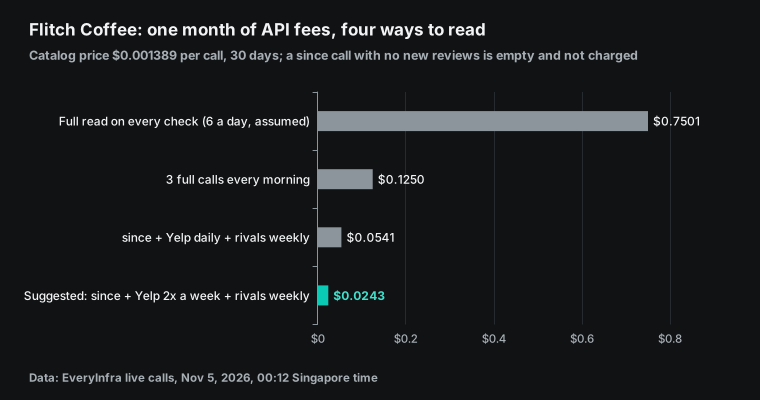
Every plan stays under one dollar a month, and two other costs matter more. The first is Duet itself. During the research preview, it is included in Pro, Max and Ultra at no extra cost (help page). Pro is $20 a month on monthly billing (pricing page). The second is your plan usage, and it is more worth saving than the API fee.
The help page says Duet uses your five-hour and weekly limits at the same rate as the rest of Claude. The morning brief and background checks both count (help page; usage and length limits). The raw response with Flitch Coffee's newest 50 reviews was 44,564 bytes as a saved file. An empty since response was 1,274 bytes, about 35 times smaller. A full read every morning pushes a long block of old reviews into Duet's context for no reason. The suggested plan saves both the API fee and your usage.
| Cost item | Amount | Source |
|---|---|---|
| Claude Pro plan | $20 a month, monthly billing | Claude pricing page |
| Duet during the preview | No extra charge | Duet help page |
| EveryInfra API, suggested plan | about $0.0243 a month | Catalog price times calls |
| Plan usage | Shared with the rest of Claude | Usage limits help page |
If you run several shops, multiply by the number of shops. Ten shops on the suggested plan cost about $0.24 a month in API fees. Rival searches go by area, so shops in the same area can share one search. A group of three coffee trailers on one street needs only one weekly search. The Google and Yelp reads stay per shop.
Claude Duet vs Muse: three proactive assistants compared
Claude Duet, Meta Muse and ChatGPT dots all launched between September and October 2026. All three promise to reach out first. The table lists only what each source says, and "not public" means the source says nothing. We read every source on November 5, 2026.
| Item | Claude Duet | Meta Muse | ChatGPT dots |
|---|---|---|---|
| Launch | 2026-10-21 research preview, waitlist (launch post) | 2026-09-08 launch (Meta Newsroom); 2026-09-29 small business skills and connectors (Muse for Small Business) | 2026-09-29 at DevDay; 2026-11-03 adds the GPT-6.1 Terra model (Introducing dots) |
| Who can use it | US Pro, Max, Ultra; not Team or Enterprise | US and Canada; most features free, with subscriptions | Pro and Business Premium, 18 and older; personal Pro excludes the EEA, Switzerland and the UK (Help Center) |
| Price | Included in the plan; Pro from $20 a month | Free with a usage cap; Power $20 a month, Maximum $100 a month (Muse subscriptions) | Pro from $100 a month (see our dots article) |
| How it reaches out | A morning brief; checks every few hours and messages you when something needs you | Comes back when something changes or needs approval; can run weekly or daily tasks (Meta Business Help) | Proactive research while idle brings back ideas or questions; assigned tasks can run on a schedule (developer docs) |
| Custom connectors | Sources say it inherits Claude connectors; custom ones not named | Muse can build a custom connector for you; Meta does not review it (Muse connectors) | Supports custom MCP plugins (see our dots article) |
| What background work can call | Not public | Follows the read and write permissions you set, including "Always allow" | Proactive research uses read-only tools only |
| Approvals | Asks before messages, payments, signatures, deletions; a separate automatic check | Writes and important reads can be set to ask first; a separate Sentinel agent reviews outreach | Docs live under Codex; Codex auto-review uses a separate reviewer agent for calls that need approval, including MCP calls flagged by their annotations (auto-review) |
| Where messages arrive | Duet app (iOS, Android) and claude.ai | Muse app, WhatsApp, muse.ai | ChatGPT, Slack, Teams; US Pro can text over iMessage and RCS (beta, 9to5Mac, 2026-10-28) |
| Small business examples in the source | Stripe unpaid invoices, QuickBooks, Gusto payroll, Shopify | Instagram professional accounts, Facebook Pages, Meta ad accounts | Invoice reminders (an early tester example) |
For a daily bad review brief, the three products differ in two places. The first is whether background work can call a billed data tool. dots is the clearest: its proactive research is read-only, so the data call must go into a task you assign. Muse offers an "Always allow" choice. Duet has no public rule, so you must test it.
The second difference is where the built-in connectors point. Muse goes deepest into Meta's own Facebook and Instagram. dots leans toward office and developer tools. Duet's examples center on bookkeeping, invoices and contracts. None of the three has a built-in Google Business Profile or Yelp connector, so review data must come in through a custom connector. One heavy Duet user on Reddit says it is good at inbox triage, dropped threads, reply drafts and daily briefings (Reddit thread).
Compared with Nightly review monitoring with Claude Managed Agents, the shops differ in size by two orders of magnitude. So the conclusions point in opposite directions. A big shop must read many reviews in one night. A small shop must avoid empty checks every day. For review analysis instead of a daily alert, see competitor review analysis with Agent Skills.
What it cannot do, and what to watch
Duet has four limits that affect this job. It is US only, for personal plans only, and the waitlist has no set date. Every Duet screen in this article is a configuration example from the sources, not a test in a real Duet. The sources do not say if custom connectors work in Duet or if destructiveHint triggers approvals. Duet checks at intervals, and urgent items can arrive between checks (help page). Duet also does not make phone calls or text other people, so you post replies on Google and Yelp yourself.
The data side has limits too. since is a date, not a time, so you must remove repeats by id. Some Google reviews wait a few days for a policy check, so the shown date can be earlier than the day the review appears. A since of the day before covers one extra day; two days before is safer but repeats more. Yelp has no since, and page one is not in date order. Our three samples are all shops with sparse reviews, so a busy shop should follow Nightly review monitoring with Claude Managed Agents instead.
| Limit | What to do |
|---|---|
| Waitlist, US only | Apply with your Claude account email |
| Custom connector support not stated | Test it in your own Duet on day one |
| Checks at intervals | Do not rely on it for instant alerts |
since is a date, not a time | Remove repeats by review id |
Yelp has no since and mixed order | Read page one twice a week, judge by id |
Reviewer nicknames are personal data of private people. Leave the name out when the brief quotes a review. We did not name any reviewer in this article. The brief needs the stars, the date, the text and the reply status, and nothing about the person. That rule also keeps the message short on a small phone screen.
Recent changes
- 2026-10-21: Claude Duet opens as a research preview (launch post). For shop owners, a Claude app now reaches out by default.
- 2026-10-30: Claude renames Max 20x to Ultra (The New Stack; Ultra help page). The three Duet tiers are the same as before.
- 2026-11-30: the limit reset for new Duet users ends (help page). Use the reset in your first week of prompt tuning.
FAQ
How long after the Claude Duet waitlist do I get access?
This question comes from the search suggestion "claude duet waitlist" and a Reddit thread (Reddit thread). The help page only says invitations go out in waves with no set date (help page). The most common block is a waitlist email that does not match your Claude account. Use your Claude account email when you apply.
Claude Duet vs Muse: which one fits a small shop?
This question comes from the search suggestion "claude duet vs muse". It depends on where your customers and books live. If your customers are mostly on Instagram and Facebook, Muse connects to those accounts most easily. Most of Muse is free (Muse for Small Business). If your books are in QuickBooks or Stripe and you already use Claude, Duet saves a setup step. Neither has a built-in Google Maps or Yelp connector.
Claude Duet review: what do real users say?
This question comes from the search suggestions "claude duet review" and "claude duet reddit". Reddit opinions split in two. One group says it is good at daily briefings, dropped threads and reply drafts (Reddit thread). Another group says it cannot pick up tasks from Claude Code or Cowork, so you must rebuild them (Reddit thread). For a new review brief, the second point matters little.
Do I pay API fees on a morning with no new review?
This question comes from our own live test. A Google review read with since that returns 0 rows is not billed. The response shows empty_result_refunded and a successful refund. Yelp has no since, so each read costs $0.001389, and the suggested plan reads Yelp only twice a week.
Getting started
- Sign up at EveryInfra and get an API key. Follow the quickstart, then run
google_maps_reviews/searchonce in the playground. Note the links for your shop and nearby rivals, and useyelp/searchfor your Yelp page. - Call
google_maps_reviews/reviewsfor your shop once withsinceset to a week ago (MCP server page). Read the Google Maps Reviews Scraper API and reviews capability pages. Also read the search capability, Yelp Scraper API and Yelp reviews capability pages. - Create a separate key for Duet. Allow only
google_maps_reviews/*andyelp/*, and set a total limit of $2. - Add the custom connector in Claude from the configuration example above. Set
everyinfra_call_apito Always allow and set unused tools to Blocked. - Send the task above to Duet when your invitation arrives. Check the EveryInfra console call log each day for the first week. Confirm one call a day and no charge for empty results (pricing page).
References
- Anthropic: Introducing Claude Duet (announcement, 2026-10-21), read 2026-11-05
- Claude on X: Claude Duet launch post (2026-10-21), read 2026-11-05
- CNBC: Anthropic previews Claude Duet personal AI agent (2026-10-21), read 2026-11-05
- Claude Help Center: Get started with Claude Duet, read 2026-11-05
- Anthropic: Claude Duet safety, privacy and security, read 2026-11-05
- Anthropic: Claude Duet product page and waitlist, read 2026-11-05
- The New Stack: Report on the Claude Ultra plan and session limits (2026-10-30), read 2026-11-05
- Claude Help Center: What is the Ultra plan?, read 2026-11-05
- Anthropic: Claude pricing page, read 2026-11-05
- Claude Help Center: What is the Pro plan?, read 2026-11-05
- Claude Help Center: What is the Max plan?, read 2026-11-05
- Claude Help Center: What is a limit reset?, read 2026-11-05
- Reddit r/ClaudeAI: Thread: has anyone actually gotten into Claude Duet yet, read 2026-11-05
- Anthropic: Claude Marketplace connectors and plugins, read 2026-11-05
- Reddit r/claude: Thread: Claude Duet first takeaways, read 2026-11-05
- Claude Help Center: Use connectors to extend Claude's capabilities, read 2026-11-05
- Claude Help Center: Get started with custom connectors using remote MCP, read 2026-11-05
- Yelp Support: How is the order of reviews determined?, read 2026-11-05
- Google Business Profile Help: Missing or delayed reviews, read 2026-11-05
- Google Business Profile Help: Manage customer reviews, read 2026-11-05
- Google Maps Platform: Places API (New) Place resource reference, read 2026-11-05
- Yelp developer docs: Reviews endpoint reference, read 2026-11-05
- Google Business Profile API: Work with review data, read 2026-11-05
- Google Business Profile Help: Manage your notifications, read 2026-11-05
- Claude docs: Add a connector that isn't in the directory, read 2026-11-05
- EveryInfra: OpenAPI document, read 2026-11-05
- Model Context Protocol: Specification 2025-11-25: Tools, read 2026-11-05
- MCP blog: Tool annotations (2026-03-16), read 2026-11-05
- Anthropic Engineering: How we built Claude Code auto mode, read 2026-11-05
- OpenAI: Introducing dots (with the 2026-11-03 update), read 2026-11-05
- Meta Help Center: Guidance and approvals in Muse, read 2026-11-05
- U.S. Federal Trade Commission: Final rule banning fake reviews and testimonials (2024-08-14), read 2026-11-05
- eCFR: 16 CFR Part 465, read 2026-11-05
- U.S. Federal Trade Commission: The Consumer Reviews and Testimonials Rule: Questions and Answers, read 2026-11-05
- Federal Register: Trade Regulation Rule on the Use of Consumer Reviews and Testimonials (2024-08-22), read 2026-11-05
- Google Maps contribution policy: Prohibited and restricted content, read 2026-11-05
- Google Business Profile Help: Tips to get more reviews, read 2026-11-05
- Yelp Support: Don't Ask for Reviews, read 2026-11-05
- EveryInfra: Capability catalog (prices and parameters), read 2026-11-05
- Claude Help Center: How do usage and length limits work?, read 2026-11-05
- Meta Newsroom: Introducing Muse (2026-09-08), read 2026-11-05
- Meta Newsroom: Muse for Small Business (2026-09-29), read 2026-11-05
- OpenAI Help Center: Getting started with your dot, read 2026-11-05
- Meta Help Center: Muse subscriptions, read 2026-11-05
- Meta Business Help Center: Scheduled tasks in Muse, read 2026-11-05
- OpenAI developer docs: dots: tasks and memory, read 2026-11-05
- Meta Help Center: Connectors in Muse, read 2026-11-05
- ChatGPT Learn: Auto-review, read 2026-11-05
- 9to5Mac: dots expands to iMessage and RCS (2026-10-28), read 2026-11-05
- Reddit r/ClaudeAI: Thread: what's the point of Claude Duet, read 2026-11-05
Reference BL-88