Gemini Data Cloud Connectors: Sales vs Social Data
Gemini Data Cloud connectors (preview) query BigQuery sales in plain English. Add public Reddit and TikTok data to see what happened the week sales fell.
Google released Gemini Data Cloud connectors on November 6, 2026. They let business users ask Gemini about data in BigQuery, Spanner, Cloud SQL and AlloyDB. The BigQuery federated query mode carries a Preview label. Each query runs with the identity of the person who asks. A first-party Google MCP server sits behind each connector.
Your sales table can tell you how much sales fell. It cannot tell you why. On November 30, 2026, between 00:14 and 00:46 Singapore time, we pulled public Reddit, TikTok and YouTube data about The North Face. We made 10 billable calls for a total of $0.006712.
Under one TikTok review video with 547,600 views, 38 of 50 comments (76%) named a different brand. One comment asked the creator to review a Lidl puffer, and it got 1,450 of all 1,881 likes. On Reddit, 18 of the 25 posts from a relevance search fell in the week of November 23. Five of them were about price, and two of those said prices went up before Black Friday.
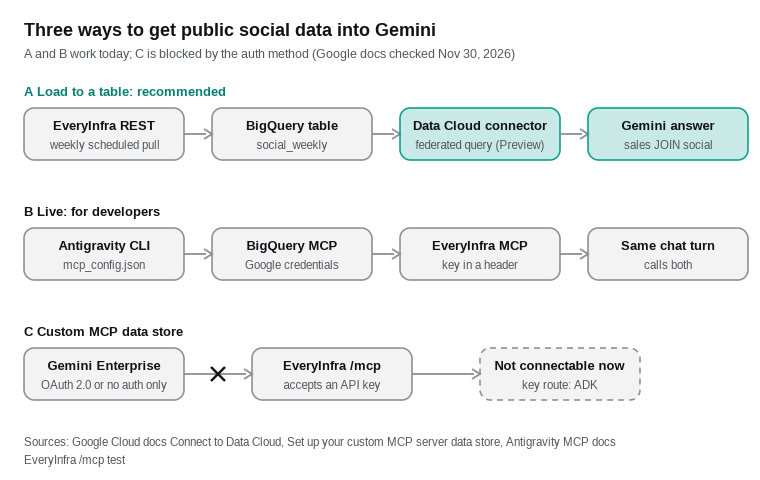
There is one problem. The Gemini Enterprise custom MCP data store accepts only OAuth 2.0 or no authentication. The EveryInfra remote MCP server uses an API key in a request header. So the two do not connect directly today. The path that works is simple: load the social data into a BigQuery table first. Then the Data Cloud connector can join sales and social data in one question.

What gemini data cloud connectors are: the November 6 blog post and the docs
The Google Cloud blog post "Query enterprise data in Gemini with Data Cloud connectors" opens with a clear statement. Data Cloud connectors in Gemini for business are "now in preview". Their job is to let business users and analysts query live enterprise data in natural language (Google Cloud blog, 2026-11-06). The post gives a sample question about sales of cold weather products this month.
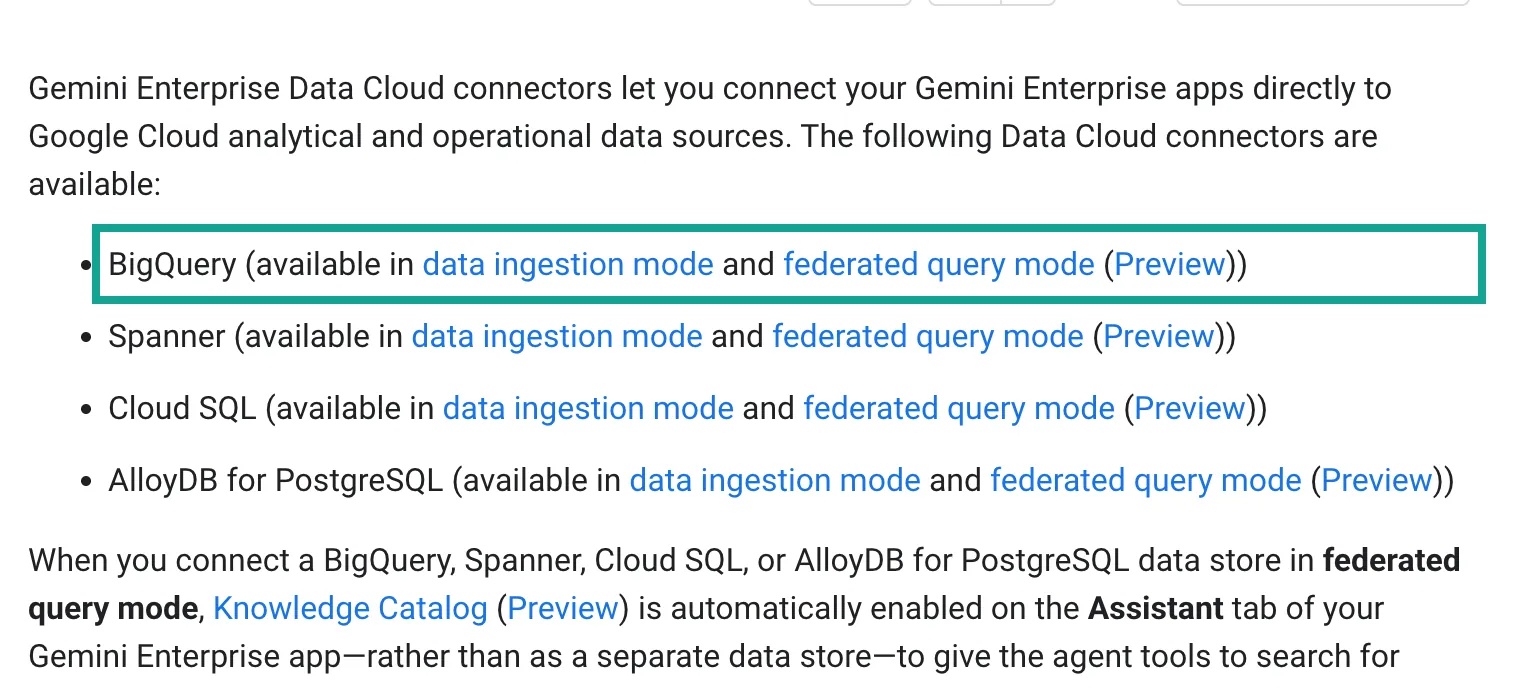
The product page "Connect to Data Cloud" lists four sources: BigQuery, Spanner, Cloud SQL and AlloyDB for PostgreSQL. Each source has a data ingestion mode and a federated query mode. Every federated query mode carries a Preview tag. Google last updated the page on 2026-11-10 (Connect to Data Cloud).
We read it again on November 30 and saw no change. Federated query is a preview feature. You can test it, but read the preview terms before you use it in production.
The docs explain federated query in three steps. First, a first-party MCP server powers each connector. Gemini Enterprise authenticates each request with the user's own IAM permissions or OAuth 2.1 credentials. Second, the root agent uses Knowledge Catalog tools to find tables and context that the user can access. Third, the agent writes SQL from that context and runs it through the connector's MCP tools (Connect to Data Cloud).
The Knowledge Catalog page adds useful detail. The catalog turns on automatically in federated query mode. It shows up on the Assistant tab of the app and is not a separate data store. A table drops out of search results when the user lacks roles/bigquery.dataViewer or roles/bigquery.metadataViewer on it (Connect to Knowledge Catalog). That means the agent never sees tables that the user cannot read.
The blog section "Why use Data Cloud connectors over custom MCP" gives two reasons. First-party connectors include preset skills for each data engine, such as advanced SQL and AI function generation for BigQuery. They also include guided setup and managed authentication, so you do not deploy MCP middleware or manage an OAuth client (Google Cloud blog).
The best practices page calls these skills a "default analytical harness". It lists BigQuery functions that the harness can call, such as AI.FORECAST, AI.DETECT_ANOMALIES and AI.CLASSIFY. Google controls these skills, and you cannot edit them. You can steer them with a billing project, Knowledge Catalog metadata and custom skills (Data Cloud connectors best practices). For our use case, this is good news. Once social data sits in BigQuery, Gemini can query it with the same skills.
The docs also compare connectors with Conversational Analytics data agents. Connectors are broad and fast to set up.
One connector covers every table the user can read, and it can join across several sources in one chat. Data agents are narrow and precise. They use curated tables and verified queries. Each agent connects to one source and incurs data token charges (Connect to Data Cloud, Conversational analytics overview). Our question spans two tables, so we pick the connector.
How to set up a gemini data cloud connector for BigQuery (configuration example)
The steps below come from the "Connect to BigQuery" page. We do not have a paid Gemini Enterprise tenant. We did not click through the console, so treat this section as a configuration example. You need the Gemini Enterprise Admin role (roles/discoveryengine.agentspaceAdmin) or the Discovery Engine Admin role (roles/discoveryengine.admin) (Connect to BigQuery).
Some projects sit inside a VPC Service Controls perimeter or enforce organization policies. In that case, add bigquery_mcp to the allowedDataSources parameter of the managed constraint discoveryengine.managed.allowedDataSources (Secure Data Cloud connectors). To change that constraint, you need the Organization Policy Administrator role. The entry point is the Organization Policies page in the console (Configure allowed data sources).
The console flow goes like this. Open the Gemini Enterprise page and go to Data stores. Click Create data store and pick BigQuery under First-party data sources. On the Data page, choose the connector mode. With "Federated query (recommended)", Advanced options shows a Billing Project ID field. With a value there, all connector queries run and bill in that project. Without a value, Gemini asks the user for a billing project at query time (Connect to BigQuery).
Next, the Actions page lets you pick which BigQuery actions to enable. Then the Configuration page asks for a region, a connector name and an optional sensitive data protection policy. You cannot change the region or the name after you create the data store. For an analyst app, enable only read actions. The security page notes that write actions let the agent change data in place, within the user's IAM rights (Secure Data Cloud connectors).
The roles below come from the BigQuery, Knowledge Catalog, org policy and MCP pages that this article cites.
| Who | Role or setting | Why |
|---|---|---|
| Gemini Enterprise admin | roles/discoveryengine.agentspaceAdmin or roles/discoveryengine.admin | Create the BigQuery data store |
| Organization policy admin | roles/orgpolicy.policyAdmin | Add bigquery_mcp or custom_mcp to allowed sources |
| Each analyst | roles/bigquery.dataViewer on the tables | Find and query the tables in federated mode |
| Loader job | roles/bigquery.dataEditor and roles/bigquery.jobUser | Load the social table |
| Developer on route B | roles/mcp.toolUser and roles/bigquery.jobUser | Call BigQuery remote MCP tools |
The "Data ingestion" mode adds two choices. You pick "BigQuery table with your own schema" or "with metadata", and a sync frequency of One time or Periodic. The sync frequency is fixed after creation. The docs warn that this mode incurs egress costs. They also state that existing BigQuery IAM permissions do not copy into the Gemini data store (Connect to BigQuery).
A thread on r/googlecloud shows what that means in practice. A test user could not read a table in BigQuery, but could see all of it in the Gemini Enterprise app. A reply explained that ingestion runs under the Gemini service account. Per-user control then needs an acl_info column on every table (r/googlecloud thread, access control docs). Social data is public, but sales tables often hold sensitive fields. Federated query avoids that problem for both tables.
| Item | Federated query (recommended, Preview) | Data ingestion |
|---|---|---|
| Where the data stays | In BigQuery, queried in place | Copied into a Gemini data store |
| Whose permissions | The asking user's IAM, row-level security applies | BigQuery IAM does not copy over |
| Scope | Every dataset and table the user can read | One selected table |
| Fresh data | Visible on the next question | Depends on sync frequency, fixed at creation |
| Cost | BigQuery compute when users ask | BigQuery and Gemini indexing at import, plus egress |
| Knowledge Catalog | On by default | Not used |
| Org policy value | bigquery_mcp | Depends on import type |
Every row comes from Connect to BigQuery and Connect to Knowledge Catalog, read on 2026-11-30. The docs list two more limits. Google recommends one connector type of actions per data store. Federated queries on relational databases have no table scoping and no verified queries, so accuracy can vary on complex schemas (Connect to Data Cloud).
Region, encryption and perimeter: three questions from your data admin
The page "Secure Data Cloud connectors" covers three topics: data location, encryption and the perimeter. Where does data live? In federated mode, data stays in its source. Results go back to the region of your Gemini Enterprise app, and data residency covers the us and eu multi-regions.
How is it encrypted? You set customer-managed keys in each source service. On the Gemini side, Cloud KMS keys can protect query results, connector settings and user credentials (Secure Data Cloud connectors).
What about the perimeter? Inside VPC Service Controls, add each connector ID to the organization policy. The IDs are bigquery_mcp, spanner, cloudsql and alloydb. The social table holds only public posts and comments, so it adds little risk next to a sales table. Comment text still comes from ordinary users, though. Drop user name fields when you load the table, and keep the text, like count and time.
Can you also attach a remote MCP server? Gemini Enterprise, Gemini CLI and agents, one by one
Can you attach a remote MCP server for live public social data, next to the Data Cloud connector? The answer is different in Gemini Enterprise, Gemini CLI and a custom agent. We read the source docs for each place. Then we compared them with how EveryInfra remote MCP authenticates.
Place one is the Gemini Enterprise custom MCP data store. Google updated "Set up your custom MCP server data store" on 2026-11-19. The page says the connector supports only the StreamableHTTP transport, not the older SSE. The server needs a TLS certificate from a public CA. Private servers behind Agent Gateway are the exception, and Agent Gateway works only in us-central1 and europe-west1 (custom MCP data store docs).
The same page sets more limits. Keep the number of enabled actions in one data store at 100 or fewer. You can create this data store only inside an app, under Connected Data Stores.
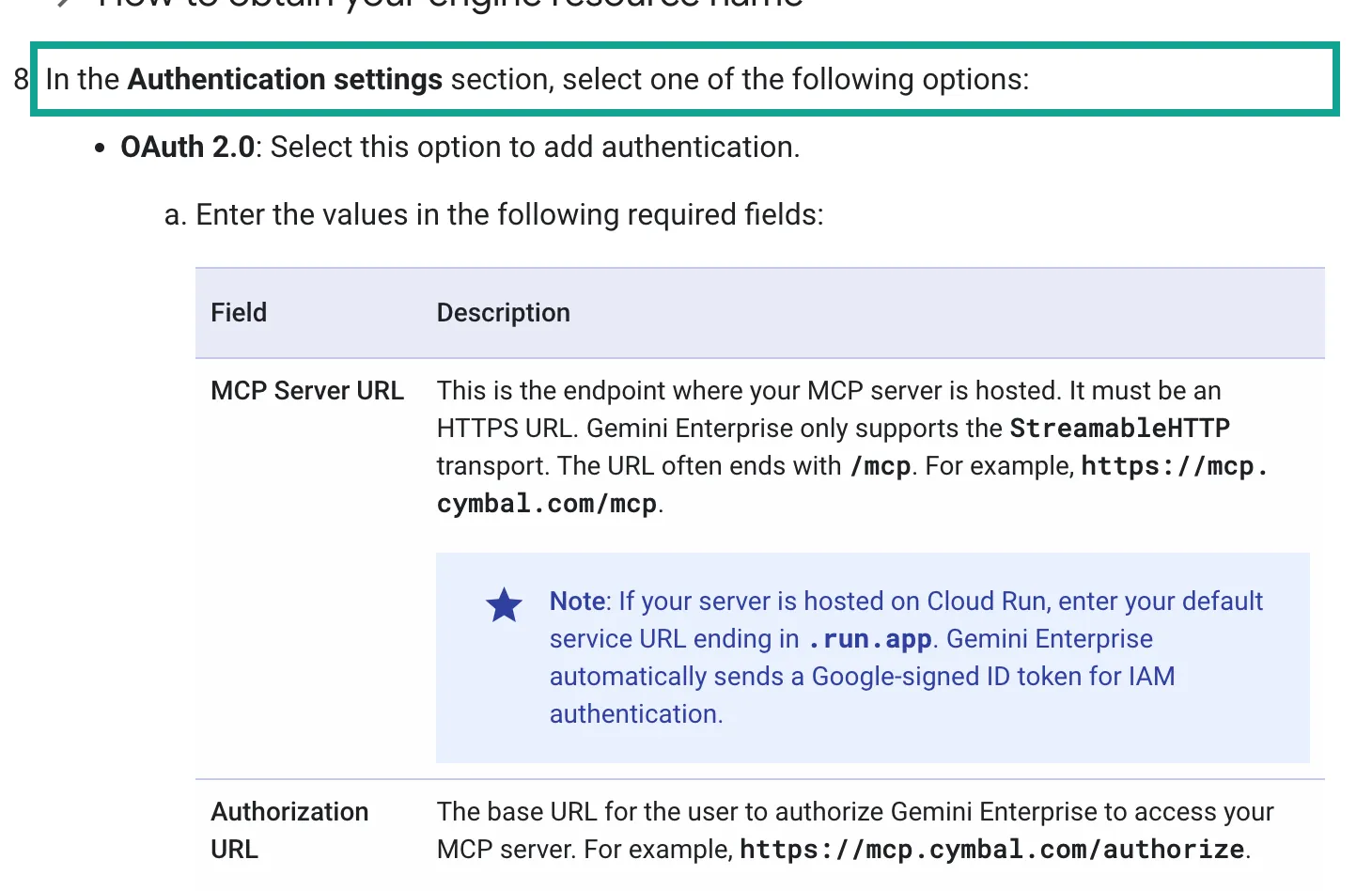
The authentication settings offer two options and no third. The first is OAuth 2.0 with an authorization URL, token URL, client ID, client secret, scopes and optional PKCE. The redirect URL must be https://vertexaisearch.cloud.google.com/oauth-redirect. The second is No authentication. The form has no field for a fixed header or an API key.
Two admin gates also apply here. By default, a managed organization constraint blocks custom MCP data stores. An organization policy admin must turn off "Disable custom MCP server connector for Gemini Enterprise" first. Inside VPC Service Controls, also add custom_mcp to allowedDataSources. Then add the domains of the server URL, authorization URL and token URL to allowedEgressFqdns (override the custom MCP constraint, allowed egress FQDNs).
After import, every tool becomes an action, and each action call asks the user to confirm by default. A tool with readOnlyHint: true in its definition skips that confirmation (custom MCP data store docs). Remember this rule. It matters when we look at the EveryInfra tool list below.
Place two is Gemini CLI. Google announced on its developer blog that Gemini CLI moves to Antigravity CLI. From June 18, 2026, Gemini CLI stopped serving Google AI Pro, Ultra and free individual users. Organizations with Gemini Code Assist Standard or Enterprise licenses keep access (Google developer blog). The old Gemini CLI reads mcpServers from settings.json. It supports Stdio, SSE and Streamable HTTP (Gemini CLI MCP docs).
The new Antigravity CLI reads mcp_config.json. A remote server uses serverUrl and can send any header through headers. You can also set "authProviderType": "google_credentials" to use Google Application Default Credentials. For servers that support CIMD or dynamic registration, it runs OAuth 2.0 with PKCE on its own. By default it waits 5 minutes for a server to connect and 3 minutes per tool call. The timeoutSeconds setting changes both limits (Antigravity MCP docs).
Place three is a custom agent. Agents built with the Agent Development Kit (ADK) can use MCP tools. You can deploy them to Cloud Run or to Agent Runtime on Gemini Enterprise Agent Platform (ADK repository). On November 13, 2026, Gemini Enterprise made three-legged OAuth through Agent Identity auth manager generally available for A2A agents. ADK agents on Agent Runtime can now reach downstream MCP servers for the signed-in user (Gemini Enterprise release notes, register A2A agents).
Your agent code sends its own requests, so it can send any header. A remote MCP server with a key works fine here. The cost is code and a deployment. Our article on Gemini Enterprise Agent Platform with remote MCP covers that path in depth.
| Place | Remote MCP? | Auth options (from docs) | Works with a key-based MCP server? |
|---|---|---|---|
| Gemini Enterprise custom MCP data store | Yes, StreamableHTTP only | OAuth 2.0 or No authentication | No, the form has no header field |
| Gemini Enterprise Data Cloud connector | Built-in Google MCP only | User IAM or OAuth 2.1 | Not applicable |
| Gemini CLI (individual plans stopped June 18) | Yes | headers in settings.json | Yes, on enterprise licenses |
| Antigravity CLI | Yes, several at once | headers, google_credentials, OAuth | Yes |
| ADK custom agent | Yes | Set in code | Yes, needs code and a deploy |
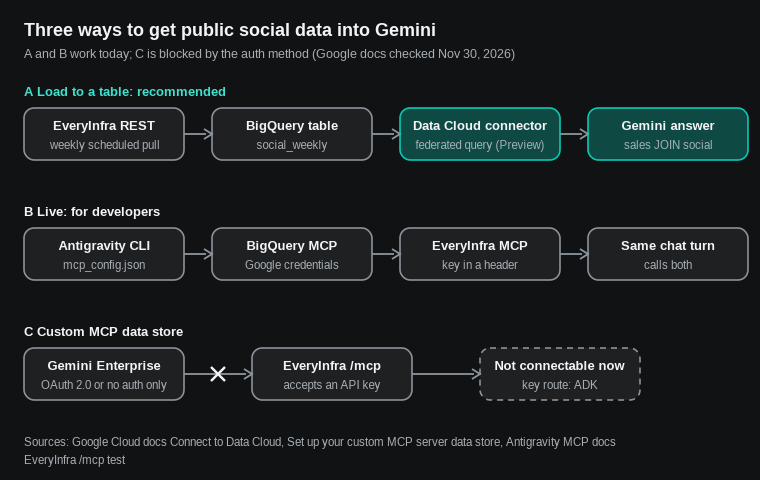
How EveryInfra remote MCP authenticates: one handshake without a key
To confirm the cross in row C, we sent one tools/list request to https://api.everyinfra.com/mcp without a key. That was at 00:13 Singapore time on November 30. The server returned 12 tools, all named with the everyinfra_ prefix. Eleven of them carry readOnlyHint: true. Only everyinfra_create_ticket carries false (EveryInfra MCP endpoint, MCP tools spec). That fits the Gemini Enterprise rule: read-only tools would skip the confirmation step.
A real data call on /mcp needs an API key in the Authorization header. Setup steps live on the MCP server page. EveryInfra also runs an OAuth entry point at /mcp/all. Its protected resource metadata names auth.everyinfra.com/oidc as the authorization server. Scopes include data:call and search:call, and tokens go only in the header (protected resource metadata).
The MCP authorization spec requires RFC 9728 protected resource metadata on the server. Clients get a client ID through CIMD, pre-registration or dynamic registration (MCP authorization spec). The Gemini Enterprise form asks an admin to type in a client ID and secret. That is pre-registration. It needs a client on the EveryInfra side that lists the Gemini Enterprise redirect URL. When we checked on November 30, no such client existed.
So the answer today is no for the Gemini Enterprise web app. Routes A and B below do work. Route A loads a table. Route B uses Antigravity CLI.
| Item | What the custom MCP data store needs | What EveryInfra remote MCP offers |
|---|---|---|
| Transport | StreamableHTTP over HTTPS, public CA certificate | Streamable HTTP over HTTPS |
| Auth | OAuth 2.0 with a typed client ID and secret, or none | /mcp: API key header. /mcp/all: OAuth with a separate client list |
| Redirect URL | vertexaisearch.cloud.google.com/oauth-redirect | Not registered as of November 30 |
| Action count | 100 or fewer enabled at once | 12 tools in tools/list |
| Skip confirmation | Tool has readOnlyHint: true | 11 of 12 tools |
The main use case: what happened out there the week sales dropped
Picture yourself as an analyst at an outdoor apparel retailer. BigQuery holds a table called sales_weekly with week, brand, category, units and average price. On Monday you ask Gemini how much The North Face down jacket sales fell last week. The Data Cloud connector finds the table in Knowledge Catalog, writes SQL and gives a number. Then you ask the next question: what happened out there that week?
The sales table cannot answer that. Were people angry about prices on social media? Did a collaboration drop pull attention away? Did review videos keep naming cheaper rivals? Those signals live on Reddit, TikTok and YouTube.
We do not hold any brand's sales data. So the sales columns below stay empty for your own table, and we do not invent numbers.
Every social number comes from live calls. We picked The North Face as a public example for two reasons. VF Corporation named it in its fiscal 2027 second quarter results on October 28, 2026, with revenue up 4% (VF press release). Late November also brought Black Friday and the Supreme x The North Face fall "Bones" collection. Hypebeast gives the release date as November 27 on the Supreme webstore and in stores, and November 28 in Asia (Hypebeast release note).
We made calls at three moments: 00:14, 00:21 and 00:45 Singapore time, 32 minutes in total. We used reddit/search, reddit/comments, tiktok/search, tiktok/comments, youtube/search and youtube/transcript. The tiktok/comments call went through the remote MCP tool everyinfra_call_api. The free catalog lists every parameter, price and response field (EveryInfra catalog). We read it once at 00:13 and used those prices.
| Time (Singapore) | Capability | Path | Results | Charged |
|---|---|---|---|---|
| 00:14 | youtube/search | REST | 10 | $0.000778 |
| 00:14 | reddit/search (newest) | REST | 5 | $0.000792 |
| 00:14 | tiktok/search | REST | 30 | $0.000556 |
| 00:21 | tiktok/comments | MCP | 50 | $0.000556 |
| 00:21 | reddit/search (relevance) | REST | 25 | $0.000792 |
| 00:21 | youtube/transcript | REST | 1 video | $0.000556 |
| 00:45 | reddit/comments | REST | 14 | $0.000792 |
| 00:45 | youtube/search (newest) | REST | 20 | $0.000778 |
| 00:46 | youtube/transcript ×2 | REST | 2 videos | $0.001112 |
| Total | 10 billable calls | $0.006712 |
Test one: a month of Reddit posts about The North Face, by week and type
The first capability is Reddit search. At 00:14 we searched "north face jacket" with sort=newest and limit 25. We got only 5 posts, all between 15:06 and 16:09 UTC on November 29. Three of the 5 named the brand: a weekend deals thread, a used gear sale post and a haul post in a replica community. The other two were about a cosplay armor build and a 66 North parka.
So the newest sort gave us only the last hour of posts. That is not enough for a weekly sample. The call still cost $0.000792, because reddit/search bills per call, not per result. Check how many useful results each call gives you.
At 00:21 we searched "the north face" with sort=relevance and limit 25. We got 25 posts from November 10 to November 29, all inside the last month.
The two calls changed both the sort and the phrase. So the comparison only shows that the newest window is too narrow. It does not show which phrase is better. Here is the request. The key comes from an environment variable and never sits in the script.
curl -s https://api.everyinfra.com/api/v1/social \
  -H "Authorization: Bearer $EVERYINFRA_API_KEY" \
  -H "Content-Type: application/json" \
  -d '{"platform":"reddit","action":"search",
       "params":{"keyword":"the north face","sort":"relevance","limit":25}}' \
  | jq '{count, charged_usd: .billing.charged_usd,
         first: .results[0] | {community, title, like_count, comment_count, posted_at}}'
We sorted the 25 posts into four groups with a keyword rule. "Replicas and resellers" covers community names or titles with replica or haul terms. "Price and waiting for sales" covers titles about price, discount or sale. "Collabs" covers Supreme and limited drops. "Buying help" covers sizing and which-one questions. A script applies the rule to the raw response, so you can rerun every number.
| Week (starts Monday) | Replicas and resellers | Price and waiting for sales | Collabs | Buying help | Total |
|---|---|---|---|---|---|
| Nov 9 | 1 | 0 | 0 | 1 | 2 |
| Nov 16 | 2 | 1 | 0 | 2 | 5 |
| Nov 23 | 8 | 5 | 3 | 2 | 18 |
| Total | 11 | 6 | 3 | 5 | 25 |
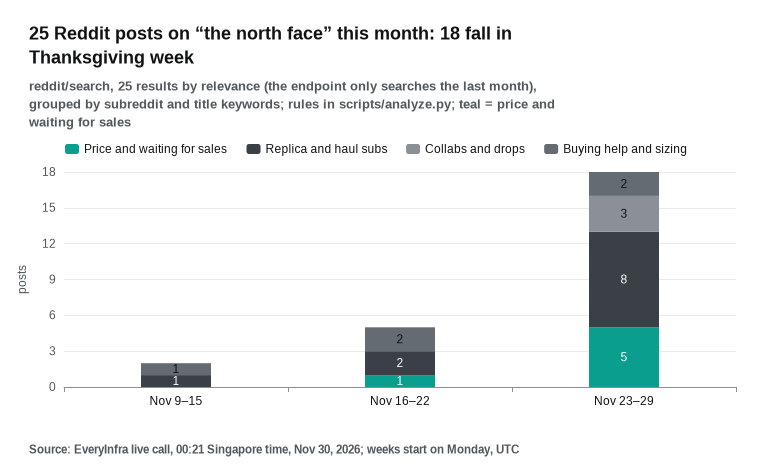
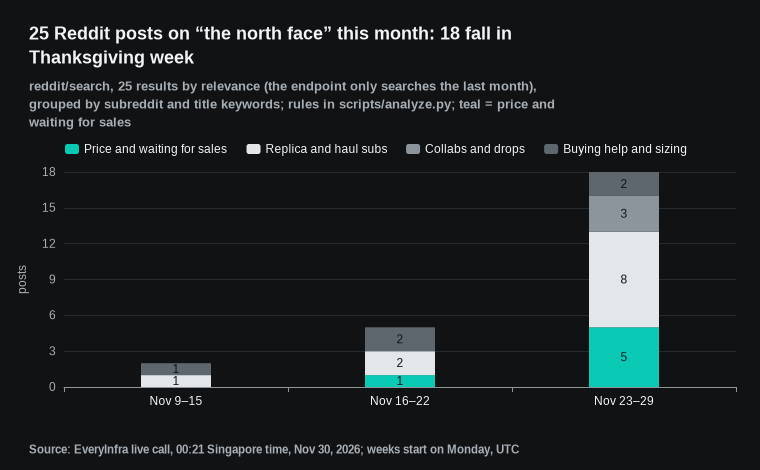
This table is one sample from a relevance sort. Of the 25 posts, 18 fell in the week of November 23. We think the relevance sort may favor new posts, but we did not run a same-phrase test to prove it. So "18" shows that the week fills most of the sample. It is not a 260% growth rate.
The five price posts in the week of November 23 do not all say the same thing. Only two say that prices went up before Black Friday. The table lists all five (first post).
| Post title | Community | Upvotes | What it says |
|---|---|---|---|
| North Face raised prices for Black Friday | r/mildlyinfuriating | 105 | Price went up before the sale |
| Increased prices to give discount | r/TheNorthFace | 31 | Price went up before the sale |
| For all the Nuptse never goes on sale people | r/TheNorthFace | 19 | Answers the "never on sale" claim |
| Got the Shoes I Wanted for Half Price! Worth It? | r/TheNorthFace | 12 | Deal found, asks if it is worth it |
| Found this Nuptse for 250$, should I return it... | r/TheNorthFace | 4 | Asks whether to wait for Black Friday |
The keyword rule puts all five in one group. When you read it, keep price complaints, deal posts and wait-or-buy questions apart.
In the brand's own r/TheNorthFace community, a November 16 post asked "This isn't gonna go on sale is it?" and drew 47 comments (post). That was the only price post in the week of November 16. The November 24 post that answers the "never on sale" claim is here (post).
Two of the three collab posts went up on November 23, after the collection was shown and before the November 27 release. One had 611 upvotes. The other had 268 upvotes and 173 comments (r/supremedrops post). The third is "THE NORTH FACE ARCHIVE DROP" on r/trekkingIndia. It is about old styles back in stock, not a collab. The word "drop" in the rule put it in this group, so the true collab count is 2.
By group, the three collab posts had 888 upvotes and 249 comments, the most upvotes of the four groups. The five buying help posts had only 168 upvotes but 255 comments, the most comments. Sizing and which-one questions get few upvotes and many replies.
Put these titles next to the sales question and you get three ideas that you can test. First, in the week of November 23, two posts say prices went up before Black Friday, and one asks whether to wait. A "raise then discount" feeling may push some buyers to wait.
Second, the collab was shown in the same week and released on November 27. It may pull search attention from core styles. Third, haul posts in replica communities came to 8 that week, against 2 the week before. Both samples are small. Compare them with your own channel data before you call it a shift in demand. Each idea needs your own category, channel and price data.
Test two: what the recent TikTok search results are doing
The second capability is TikTok search. At 00:14 we searched "north face puffer" and got 30 videos for $0.000556. Only 18 were posted after October 31. The other 12 went back as far as April 2024.
TikTok ranks search results by relevance and popularity, not date. So you must filter by posted_at after each pull. The price is per call, so the old videos cost nothing extra. Still, only 60% of the sample is useful.
We sorted the 18 recent videos by title, hashtags and caption. Shop and promo videos, with product links, codes or Black Friday prices, came to 9 videos and 1.02 million views. Outfit videos came to 5 videos and 1.15 million views. "Tutorial on my profile" bait videos came to 3 videos and 659,000 views. Reviews came to 1 video with 547,600 views.
| Type | Videos | Total views | Share of recent sample |
|---|---|---|---|
| Shop and promo | 9 | 1,018,527 | 50% |
| Outfit | 5 | 1,153,700 | 28% |
| "Tutorial on my profile" bait | 3 | 658,755 | 17% |
| Review | 1 | 547,600 | 6% |
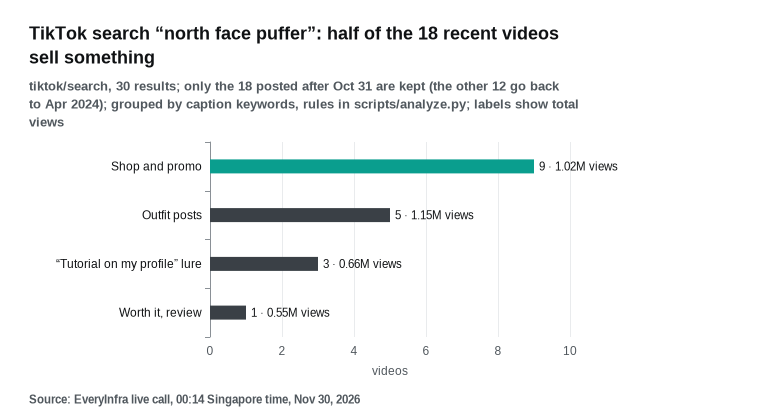
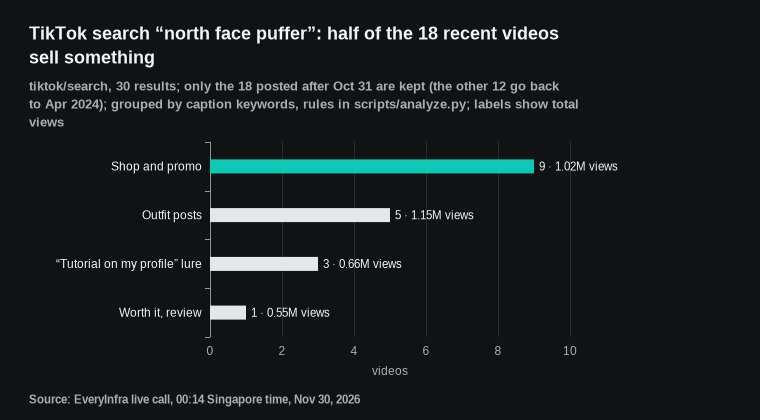
By week, total views for the three weeks were 671,800, 1,247,200 and 1,459,582. Five shop videos fell in the week of November 23. The single review had 547,600 views and 221 comments, posted on November 17. Next, we pulled the comments under that review to see what shoppers compare it with.
The query phrase leans toward shopping intent, which may explain why reviews were rare. A phrase such as "north face nuptse review" would bring more review videos. Each extra phrase costs one more call at $0.000556. The real limits are the total calls per run and the rate limit.
Test three: one real MCP round trip, 50 comments under a review video
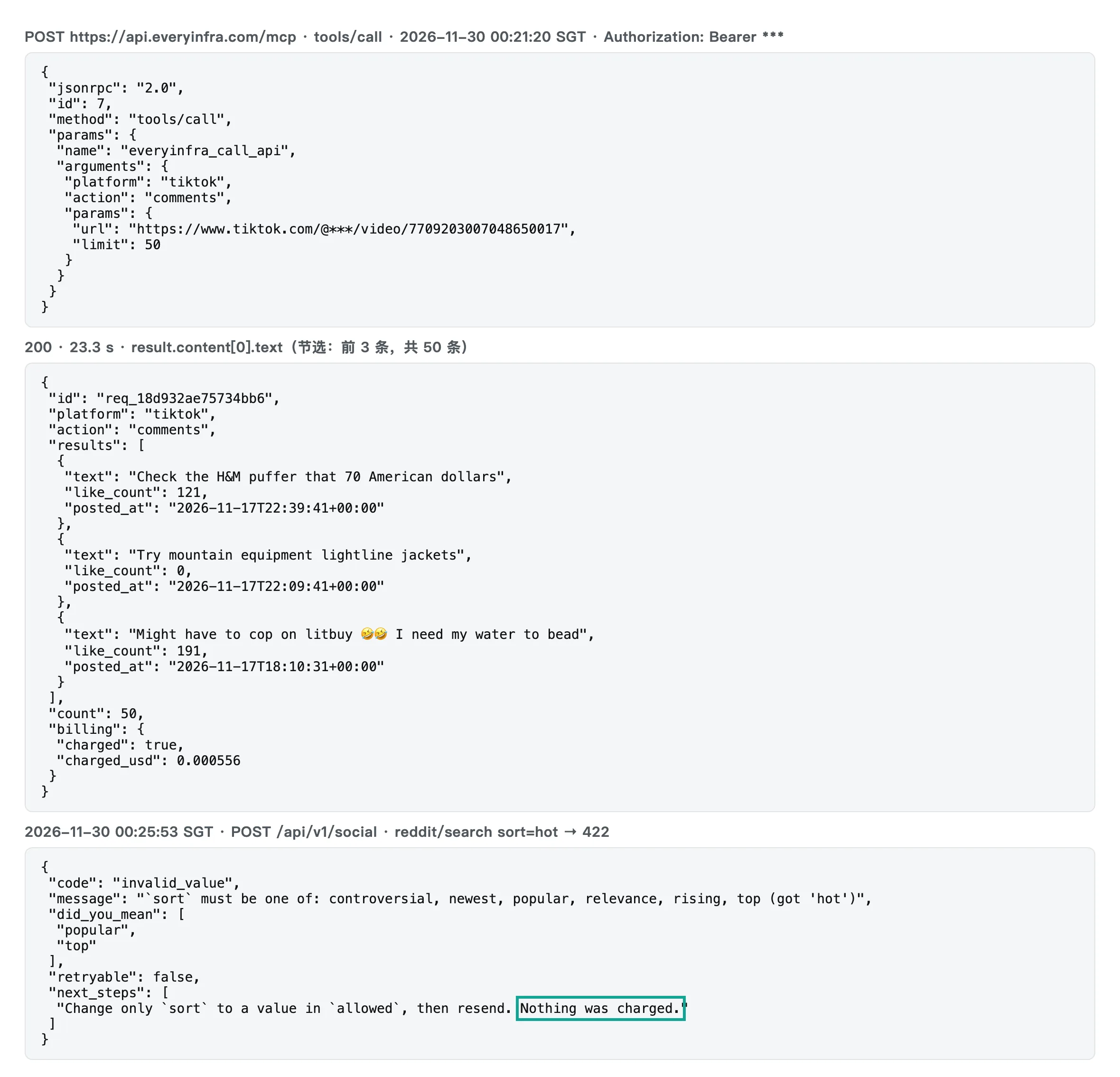
The third capability is TikTok comments. We sent this call through remote MCP on purpose, so it matches what a model sends from Antigravity CLI. At 00:21 Singapore time we sent tools/call with the tool everyinfra_call_api. The answer came back in 23.3 seconds with HTTP 200. Here is an excerpt. We hid the creator handle and all commenter user names.
{"jsonrpc":"2.0","id":7,"method":"tools/call",
 "params":{"name":"everyinfra_call_api",
  "arguments":{"platform":"tiktok","action":"comments",
   "params":{"url":"https://www.tiktok.com/@<hidden>/video/7709203007048650017","limit":50}}}}

// excerpt of result.content[0].text after parsing
{"platform":"tiktok","action":"comments","count":50,
 "results":[{"text":"Check the H&M puffer that 70 American dollars",
             "like_count":121,"reply_count":3,"posted_at":"2026-11-17T22:39:41+00:00"}, "..."],
 "billing":{"charged":true,"charged_usd":0.000556}}
The text payload held 16,649 characters and 50 comments, and the charge was $0.000556. The screenshot below shows the same round trip. Teal boxes mark the count and the charge. The last block shows a different moment, when we sent a bad sort on purpose. The API returned 422 with the allowed values and two suggestions, "popular" and "top". It also said that nothing was charged.
Of the 50 comments, 38 (76%) named another brand or store. Suvene, Ralph Lauren and Canada Goose came up most, three times each. Likes were very concentrated.
Of 1,881 likes in total, one comment took 1,450: "day 4 of asking for the lidl puffer". A comment about buying from a replica site took 191. A comment pointing to a $70 H&M puffer took 121. Those three hold 93% of all likes. They all ask the same thing: is a cheaper option good enough?
With our brand list, the 50 comments named 29 brands or stores. Only the three above came up three times. Most of the other 26 came up once.
They run from budget retail such as Lidl, H&M and Bershka to pricier down brands such as Canada Goose, Moose Knuckles and Parajumpers. The 38 comments that named a brand hold 1,850 likes, or 98% of the total. The 12 others hold 31 likes. Six comments talk about a cheap or low price, and they hold 1,580 likes, including the Lidl comment.
| Comment (paraphrased) | Named | Likes |
|---|---|---|
| Day 4 of asking for a review of the Lidl puffer | Lidl | 1,450 |
| Might have to buy it from a replica site | Replica site | 191 |
| Check the H&M puffer at 70 dollars | H&M | 121 |
| The other 47 comments | Various | 119 |
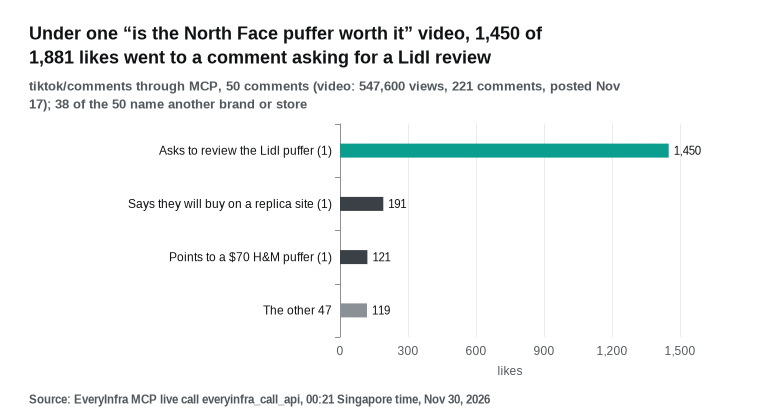
These are 50 comments under one video. The Reddit posts are a different platform and a different sample, so do not join them into one cause. Suppose your sales_weekly shows budget down jackets up and premium styles down in the same week. Then this comment table is supporting evidence for the weekly report. If you see no such shift, it is just chatter under one video.
Test four: what people said under the Black Friday price post
At 00:45 Singapore time we used Reddit comments on the "North Face raised prices for Black Friday" post from test one. We got 14 comments for $0.000792. The top comment, with 47 upvotes, said many online stores mark prices up and then claim a cut. The next one, with 30, called the company scummy. The third, with 12, said this is now normal before Black Friday.
One more comment suggested asking Gemini for an item's lowest price of the year before you buy. Five of the 14 comments were about tax and fees on the screenshot, not the price. One asked why there was no sales tax. Replies said Minnesota does not tax clothing. Another asked about a delivery fee. If you count every comment as price anger, you count one third too many.
At the same moment we ran YouTube search for "north face nuptse black friday" with sort set to newest. We got 20 videos for $0.000778. Only one was from the last 30 days: a Supreme x The North Face video from November 28 with 8,959 views. Of the rest, 18 dated from 2011 to 2025, with three each from 2017, 2018, 2021 and 2022. One had no posted date.
The catalog note for youtube/search says the sort parameter does not apply on some requests (EveryInfra catalog). We hit that case. So filter YouTube results by posted_at too, or pull by channel.
Load the data: write social results into BigQuery social_weekly (configuration example)
The key step in route A is turning these results into a BigQuery table. BigQuery batch loads newline-delimited JSON for free. You need bigquery.tables.create, bigquery.tables.updateData and bigquery.jobs.create. The roles roles/bigquery.dataEditor and roles/bigquery.jobUser cover them (batch loading docs, loading JSON docs).
The script below flattens one Reddit search and one TikTok search into one record per line. Then bq load appends the file to social_raw. We ran the first half (the jq step) on our machine. We did not run bq load against a real project.
# 1) Pull: one brand, two platforms, one call each
for body in \
 '{"platform":"reddit","action":"search","params":{"keyword":"the north face","sort":"relevance","limit":25}}' \
 '{"platform":"tiktok","action":"search","params":{"keyword":"north face puffer","limit":30}}'; do
  curl -s https://api.everyinfra.com/api/v1/social \
    -H "Authorization: Bearer $EVERYINFRA_API_KEY" -H "Content-Type: application/json" -d "$body"
done | jq -c --arg brand "The North Face" '
  .platform as $p | .results[] |
  {brand:$brand, platform:$p, id, title:(.title // .text // "")[:300],
   community:(.community // null), like_count, comment_count,
   view_count:(.view_count // null), posted_at}' > social_raw.ndjson

# 2) Load (configuration example)
bq load --source_format=NEWLINE_DELIMITED_JSON --autodetect \
  my_project:market.social_raw ./social_raw.ndjson
The raw table has too many loose fields for Gemini. Build a view called social_weekly on top of it that adds a category to each record. Put the classification rule in the view SQL, so a rule change touches one place. Knowledge Catalog reads table and column descriptions. Give the category column a short description, for example "groups social posts into price, collab, replica and buying help". The best practices page recommends this kind of metadata (Data Cloud connectors best practices).
Our article on Google Data Agent Kit with BigQuery social data covers the full load flow. It includes Cloud Scheduler triggers, partitioned tables and duplicate handling. We do not repeat it here.
Sample comparison table: sales JOIN social in one SQL query
With sales_weekly and social_weekly in place, a user can ask Gemini what happened the week down jacket sales fell. The connector then writes SQL much like the query below. We wrote this sample to show the shape of the comparison table. Gemini's own SQL will differ, based on your Knowledge Catalog metadata.
WITH s AS (
  SELECT week, SUM(units) AS units, AVG(avg_price) AS avg_price
  FROM `my_project.sales.sales_weekly`
  WHERE brand = 'The North Face' AND category = 'down_jacket'
  GROUP BY week
), m AS (
  SELECT DATE_TRUNC(DATE(posted_at), WEEK(MONDAY)) AS week,
         COUNTIF(platform = 'reddit') AS reddit_posts,
         COUNTIF(platform = 'reddit' AND category = 'price') AS price_posts,
         COUNTIF(platform = 'reddit' AND category = 'collab') AS collab_posts,
         COUNTIF(platform = 'tiktok' AND category = 'shop_promo') AS tiktok_promos
  FROM `my_project.market.social_weekly`
  WHERE brand = 'The North Face'
  GROUP BY week
)
SELECT s.week, s.units,
       SAFE_DIVIDE(s.units - LAG(s.units) OVER (ORDER BY s.week),
                   LAG(s.units) OVER (ORDER BY s.week)) AS units_wow,
       m.reddit_posts, m.price_posts, m.collab_posts, m.tiktok_promos
FROM s LEFT JOIN m USING (week)
ORDER BY s.week;
Here is the table with our live social data in place. The two sales columns come from your own table. We leave them blank.
| Week | Units (your table) | Week over week (your table) | Reddit posts | Price posts | Collab posts | TikTok promo videos |
|---|---|---|---|---|---|---|
| Nov 9 | — | — | 2 | 0 | 0 | 2 |
| Nov 16 | — | — | 5 | 1 | 0 | 2 |
| Nov 23 | — | — | 18 | 5 | 3 | 5 |
With this table, Gemini can write an answer like this one.
"Sales fell X% in the week of November 23. That week Reddit had 5 price posts, and 2 of them said prices went up before Black Friday. The Supreme collab was shown that week and released on November 27. Top comments under a TikTok review asked about Lidl and H&M options." Your data sets X. You can also ask Gemini to use AI.DETECT_ANOMALIES to flag an odd week. The built-in skills will try it, but three weeks of data is only a demo.
Route B: Antigravity CLI with BigQuery MCP and EveryInfra MCP together (configuration example)
Some developers want to pull data inside the chat without a table. Antigravity CLI fits that need. BigQuery has a Google-managed remote MCP server at https://bigquery.googleapis.com/mcp. Tool calls need roles/mcp.toolUser, and queries need roles/bigquery.jobUser. The execute_sql and execute_sql_readonly tools return at most 3,000 rows. They cannot query Google Drive external tables (BigQuery MCP docs, MCP roles).
The execute_sql reference says the tool waits 20 seconds by default. A slower query returns a job_id, and you poll with get_query_results (execute_sql reference). The file below follows the Antigravity docs.
{
  "mcpServers": {
    "bigquery": {
      "serverUrl": "https://bigquery.googleapis.com/mcp",
      "authProviderType": "google_credentials"
    },
    "everyinfra": {
      "serverUrl": "https://api.everyinfra.com/mcp",
      "headers": { "Authorization": "Bearer ${EVERYINFRA_API_KEY}" },
      "timeoutSeconds": 300
    }
  }
}
This mcp_config.json is a configuration example. We did not install Antigravity CLI on our machine. We set timeoutSeconds to 300 for a reason. Our tiktok/comments call took 23.3 seconds, well inside the 3-minute default. Large Reddit threads or a high limit can take longer, so extra room helps.
Check whether your Antigravity version expands environment variables in headers. If it does not, write the key directly and keep the file out of version control. In this route, the model first pulls social data with everyinfra_call_api. Then it runs execute_sql on sales, and it compares both results in the chat. Nothing lands in a table. This suits ad hoc questions, not a fixed weekly report.
Cost: API calls, BigQuery and Gemini Enterprise seats
API pricing comes from price_usd in the catalog, one price per call, whatever the result count. reddit/search and reddit/comments cost $0.000792 each. tiktok/search, tiktok/comments and youtube/transcript cost $0.000556 each. youtube/search costs $0.000778 (EveryInfra catalog, read at 00:13).
Our 10 billable calls cost $0.006712 in total. The shared test key allows 10 requests per minute. Six requests hit that limit and got 429, and one got 422 for a bad parameter. All seven said "Nothing was charged", and none showed up on the bill. Each 429 response gives a retry_after value, so your script can back off on it.
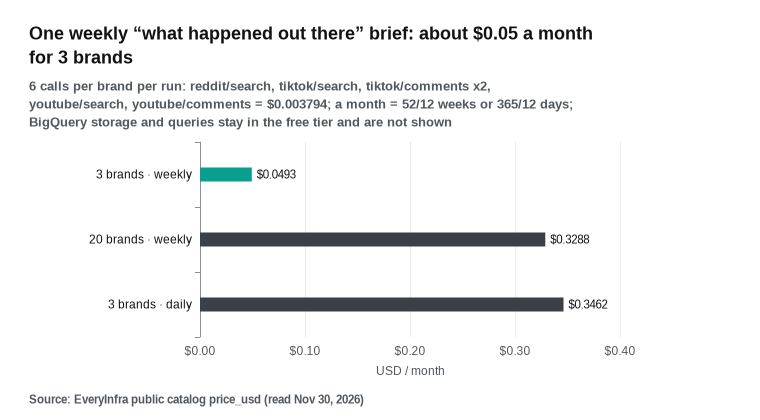
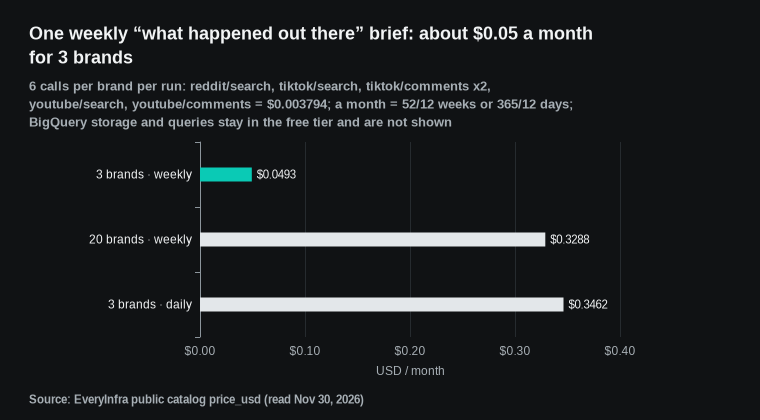
For a weekly report, budget 6 calls per brand per run. That means one Reddit search, one TikTok search, two TikTok comment pulls for the two busiest videos, one YouTube search and one YouTube comment pull. The total is $0.003794 per brand per run.
| Scenario | Calls per run | API cost per month | BigQuery | Gemini Enterprise |
|---|---|---|---|---|
| 3 brands, weekly | 18 | about $0.05 | Free tier | Per seat, Business from $21 per seat per month |
| 20 brands, weekly | 120 | about $0.33 | Free tier | Same |
| 3 brands, daily | 18 | about $0.35 | Free tier | Same |
On the Google side, BigQuery on-demand queries are free for the first 1 TiB each month, then $6.25 per TiB. Each query bills at least 10 MB. Storage is free for the first 10 GiB each month, and batch loading is free (BigQuery pricing, read 2026-11-30). One brand's monthly social data is under 1 MB. Even at the 10 MB minimum, a few hundred questions a month stay inside the free tier.
To schedule the pulls, Cloud Scheduler costs $0.10 per job per 31 days. Each billing account gets 3 free jobs a month (Cloud Scheduler pricing). Most of the cost sits in Gemini Enterprise itself. The Business page lists a starting price of $21 per seat per month with a 30-day trial (Gemini Enterprise Business).
Quotas pool by edition. For example, each Standard license adds 160 Assistant queries per day to a shared pool (quotas docs, editions). In federated mode, each question also incurs BigQuery compute, so set the billing project (Connect to BigQuery).
What the top YouTube videos show that the top web pages do not
We searched YouTube for "gemini data cloud connectors" with YouTube search. Three of the top 10 results dealt with connecting outside data to Gemini. We pulled their captions with YouTube transcripts. The videos were "Customize Gemini Enterprise BYO MCP Connector" (2026-08-24, 161 views), "Gemini's NEW Custom Connectors: Build a GA4 Dashboard With One Prompt" (2026-11-04, 103 views) and "Connect Gemini & Salesforce with MCP: Developer Tutorial" (2026-09-17, 230 views) (video one, video two, video three).
The three transcripts cost $0.001668. None of the top 10 videos covered Data Cloud connectors directly. Promo films and custom connector tutorials filled the list. The phrase is only a few weeks old, and video coverage has not caught up.
| Video | Date | Views | What it shows |
|---|---|---|---|
| Customize Gemini Enterprise BYO MCP Connector | 2026-08-24 | 161 | OAuth fields in the admin console, and time rules in connector instructions |
| Gemini's NEW Custom Connectors: GA4 Dashboard | 2026-11-04 | 103 | Customize, Connectors, Custom in the Gemini app, then OAuth sign-in |
| Connect Gemini & Salesforce with MCP | 2026-09-17 | 230 | External client app, callback URL, two scopes, consumer key and secret |
Video one shows a step that we did not find on the top 10 web pages. You add "system time" and time range rules to the custom MCP connector instructions. Then the model states which date range it used.
That helps our use case a lot. A phrase like "that week" must turn into real dates, or the SQL may pick the wrong week. Add one line to your assistant instructions or custom skill. Say that weeks start on Monday and that each answer shows start and end dates. That matches WEEK(MONDAY) in social_weekly.
Videos two and three show a different entry point: custom connectors in the Gemini app (Customize, Connectors, Custom). You paste an MCP server URL, accept a security notice and complete an OAuth sign-in.
The Salesforce video lists the hard parts. You first create an external client app in Salesforce and enter the Gemini callback URL. You select two scopes, MCP API and refresh token. You turn on JWT-based access tokens for named users. Then you paste the consumer key and secret back into Gemini.
Both videos use OAuth, and neither screen has a field for an API key. That matches the custom MCP data store docs. A post on r/googlecloud records one more snag. The custom MCP data store showed ACTIVE, but "Reload custom actions" always returned 401. The poster traced the console call to a SAPISIDHASH header instead of an OAuth bearer token. The thread had no fix when we read it (r/googlecloud thread).
An r/mcp table from early July shows how much agent clients differ on the MCP auth spec. Some run the full OAuth flow. Others accept only a ready bearer token (r/mcp thread). Check the auth model of each client before you plan an integration.
How to ask: get Gemini to use the right tables and the right dates
The connector finds tables on its own, which also means it can pick the wrong one. The best practices page gives two fixes. One is a custom skill that limits sales and revenue questions to one dataset. The other is a curated glossary and verified queries in Knowledge Catalog, so the agent invents fewer joins (Data Cloud connectors best practices).
For our use case, the custom skill can say this. "For brand sales, use sales.sales_weekly. For social discussion, use market.social_weekly. Align both tables on weeks that start on Monday. Show start and end dates in every answer. Social counts are a sample of public posts, not total volume." The last sentence stops the model from calling 18 posts "a 260% surge".
"Why did sales drop last week?" is too wide. The agent must guess the week, the column and the tables. A better question names the brand, the category and the week of November 23. It also asks for the count of price and collab posts in social_weekly. Then the agent writes one JOIN. Save that SQL as a verified query, and reuse it for the next brand.
The Knowledge Catalog page uses the same idea. A user asks about cold weather products. The agent looks up the glossary, maps the phrase to sweaters and coats, and then writes SQL (Connect to Knowledge Catalog). You can add a glossary term such as "pre-Black Friday chatter" that maps to category IN ('price','collab').
If your sales live in Cloud SQL, Spanner or AlloyDB, keep the social table in BigQuery, where loading is free. Leave the sales data in its operational database. Relational sources have no table scope, so pin the scope with a custom skill (Connect to Data Cloud).
No Gemini Enterprise seats yet
The BigQuery console includes conversational analytics. Add sales_weekly and social_weekly to one data agent and ask the same question. Answers come with SQL, tables and charts (BigQuery conversational analytics). Data agents can publish to Gemini Enterprise later, so your tuned questions and verified queries carry over when you buy seats.
From zero to your first comparison question
Get a key from the quickstart and put it in an environment variable. Read the free catalog once. Confirm that available is true for each capability, and note each price_usd. Run the script above for one brand on Reddit and TikTok. Check the result counts and the spread of posted_at, and then pick a filter window.
In BigQuery, create a dataset called market. Load the first batch with bq load and create the social_weekly view. Write descriptions for the table and the key columns. The Google side needs an admin. Ask your Gemini Enterprise admin to create a BigQuery federated query data store with a billing project and read-only actions. Attach it to your app.
If the project sits inside VPC Service Controls, ask the policy admin to add bigquery_mcp first. Then write a custom skill with the table names and the week rule. Test it with one question that has a real date. After that works, schedule it. Pull every Monday morning, load the data and let analysts ask questions. At the prices above, a year of API calls for 3 brands costs under $0.60.
What does not connect, what to filter, where the rules are rough
Federated query is a preview feature. Preview terms differ from general availability terms, so read them before you build a fixed weekly report on it. Keep an exit that does not depend on the connector. social_weekly is a plain BigQuery table, so Looker Studio or any SQL client can read it.
The custom MCP data store cannot reach EveryInfra remote MCP today. The reason is auth. One side offers OAuth 2.0 with a typed client or no auth. The other side uses a key header, and its OAuth client list does not include the Gemini Enterprise redirect. For live pulls in the web app, write an ADK agent that sends the key and register that agent with Gemini Enterprise.
Social search results do not come sorted by date. TikTok returned 12 of 30 videos older than a month. YouTube returned only 1 recent video even with newest. Reddit's newest sort returned only the last hour, 5 posts. Always filter by posted_at. Also say in each chart note that the sample comes from a relevance sort. Do not read a share of the sample as a growth rate.
The classification rule is a rough keyword rule. "Replicas and resellers" depends on community names and title words. A post about a genuine item in a replica community still counts. "Collabs" also caught an archive restock post because of the word "drop". "Price" mixes price complaints, deal posts and wait-or-buy questions.
"Named another brand" uses a brand list and misses small brands. For better accuracy, run the titles and comments through BigQuery AI.CLASSIFY. BigQuery bills its AI functions separately.
Related articles on this site
These are our other Gemini articles:
- AdMob MCP for app reviews and ads
- Gemini 4 Hydrogen API
- Gemini Enterprise Agent Platform with remote MCP (ADK agent with a key)
- Google Data Agent Kit with BigQuery social data (load, schedule and dedup)
- Gemini connected apps and platform data tools
- Gemini managed agents with remote MCP
New to EveryInfra? Start with the quickstart. The three platforms used here have full capability lists on the Reddit API, TikTok API and YouTube API pages. Prices are on the pricing page.
Industry updates (November 2026)
| Date | Change | Source |
|---|---|---|
| 2026-11-06 | Data Cloud connectors preview | Blog |
| 2026-11-10 | Connect to Data Cloud and Connect to BigQuery pages updated | Docs |
| 2026-11-13 | Three-legged OAuth for A2A agents generally available | Release notes |
| 2026-11-19 | Custom MCP data store page updated | Docs |
On November 6, 2026, the Google Cloud blog announced the Data Cloud connectors preview (Google Cloud blog). What it means for you: if your sales sit in BigQuery, Spanner, Cloud SQL or AlloyDB, you can ask Gemini about them now. Federated query is still a preview.
On November 13, 2026, three-legged OAuth through Agent Identity auth manager became generally available for A2A agents. ADK agents can now reach downstream MCP servers for the signed-in user. Single-user quota limits also extended to AI developer tools such as Antigravity (release notes). What it means for you: the ADK route for a key-based MCP server now has a generally available way to act for the user.
On November 19, 2026, Google updated the custom MCP data store page. Auth still offers only OAuth 2.0 or no authentication (custom MCP data store docs). What it means for you: the Gemini Enterprise web app still needs an OAuth layer in front of a key-based MCP server.
On the brand side, VF reported on October 28 that The North Face revenue grew 4% in the quarter (VF press release). Supreme x The North Face released its fall "Bones" collection on November 27, and on November 28 in Asia (Hypebeast). What it means for you: a sale event and a collab release fell in the same week. Read their social signals apart.
FAQ
Are gemini data cloud connectors generally available or in preview?
The Google Cloud blog of November 6, 2026 says "now in preview". In the docs, the federated query mode for BigQuery, Spanner, Cloud SQL and AlloyDB carries a Preview label. The data ingestion mode has no label. Nothing had changed when we checked on November 30. (Question source: search suggestion "gemini data cloud connectors". Evidence: blog, Connect to Data Cloud.)
How much does the gemini enterprise bigquery connector cost?
The connector has no separate price. In federated mode, each question incurs BigQuery compute in your billing project. In ingestion mode, import incurs BigQuery and Gemini indexing costs. Gemini Enterprise bills per seat, from $21 per seat per month for Business. (Question source: search suggestions "gemini data cloud connector pricing" and "gemini enterprise bigquery connector". Evidence: Connect to BigQuery, BigQuery pricing, Business page.)
Can a gemini enterprise custom mcp server use an API key?
Not according to the docs as of November 30, 2026. The auth settings offer OAuth 2.0 with a typed client ID, secret, URLs and scopes, or No authentication. A key-based MCP server needs an OAuth layer in front of it. Or use an ADK agent or Antigravity CLI. (Question source: search suggestions "gemini enterprise custom mcp server" and "add mcp to gemini enterprise". Evidence: custom MCP data store docs, r/mcp thread.)
Why can everyone see my BigQuery table in Gemini Enterprise?
That is ingestion mode. Import runs under the Gemini service account, and BigQuery IAM does not copy over. Per-user control needs an acl_info column. In federated mode, queries run with the asking user's permissions, and row-level security applies. (Question source: an r/googlecloud post. Evidence: r/googlecloud thread, Connect to BigQuery.)
Can Gemini CLI still connect to MCP servers?
Yes, but Gemini CLI stopped serving individual users on June 18, 2026. Organizations with enterprise licenses can still use it. For new work, use Antigravity CLI. Put serverUrl and headers in mcp_config.json, or use google_credentials for Google's own MCP servers. (Question source: search suggestion "gemini enterprise mcp". Evidence: Google developer blog, Antigravity MCP docs.)
Can I put Reddit and TikTok data into BigQuery?
Yes. Call EveryInfra capabilities such as reddit/search and tiktok/search, convert the results to newline-delimited JSON and load them with bq load. Loading is free. One brand costs about $0.0038 per weekly run, and the queries stay in the BigQuery free tier. (Question source: search suggestion "bigquery social media data". Evidence: batch loading docs, EveryInfra catalog, our tests.)
References
- Query enterprise data in Gemini with Data Cloud connectors, Google Cloud blog, 2026-11-06, https://cloud.google.com/blog/products/data-analytics/query-enterprise-data-in-gemini-with-data-cloud-connectors
- Connect to Data Cloud, Gemini Enterprise docs, updated 2026-11-10, read 2026-11-30, https://docs.cloud.google.com/gemini/enterprise/docs/connectors/connect-data-cloud
- Connect to BigQuery, Gemini Enterprise docs, updated 2026-11-10, https://docs.cloud.google.com/gemini/enterprise/docs/connectors/connect-bigquery
- Connect to Knowledge Catalog, Gemini Enterprise docs, https://docs.cloud.google.com/gemini/enterprise/docs/connectors/connect-knowledge-catalog
- Best practices for Data Cloud connectors that use conversational analytics, https://docs.cloud.google.com/gemini/enterprise/docs/connectors/data-cloud-best-practices
- Secure Data Cloud connectors, updated 2026-11-10, https://docs.cloud.google.com/gemini/enterprise/docs/connectors/data-cloud-security
- Configure allowed data sources, https://docs.cloud.google.com/gemini/enterprise/docs/connectors/configure-allowed-data-sources
- Configure allowed egress FQDNs for data stores, https://docs.cloud.google.com/gemini/enterprise/docs/connectors/configure-allowed-egress-fqdns
- Set up your custom MCP server data store, updated 2026-11-19, https://docs.cloud.google.com/gemini/enterprise/docs/connectors/custom-mcp-server/set-up-custom-mcp-server
- Override the organization policy for Custom MCP data stores, https://docs.cloud.google.com/gemini/enterprise/docs/connectors/custom-mcp-server/override-constraint-for-custom-mcp-data-stores
- Gemini Enterprise release notes, entries 2026-11-03 to 2026-11-20, https://docs.cloud.google.com/gemini/enterprise/docs/release-notes
- Compare editions of Gemini Enterprise, https://docs.cloud.google.com/gemini/enterprise/docs/editions
- Quotas and pay-as-you-go usage, https://docs.cloud.google.com/gemini/enterprise/docs/quotas-and-pay-as-you-go-usage
- Register and manage A2A agents, https://docs.cloud.google.com/gemini/enterprise/docs/register-and-manage-an-a2a-agent
- Configure access controls for custom data sources, https://docs.cloud.google.com/gemini/enterprise/docs/identity#acl-structured-bq
- Use the BigQuery remote MCP server, https://docs.cloud.google.com/bigquery/docs/use-bigquery-mcp
- MCP Tools Reference: execute_sql, https://docs.cloud.google.com/bigquery/docs/reference/mcp/tools_list/execute_sql
- Google Cloud MCP servers roles and permissions, updated 2026-11-17, https://docs.cloud.google.com/iam/docs/roles-permissions/mcp
- Batch load data, BigQuery docs, https://docs.cloud.google.com/bigquery/docs/batch-loading-data
- Load JSON data from Cloud Storage, BigQuery docs, https://docs.cloud.google.com/bigquery/docs/loading-data-cloud-storage-json
- Conversational analytics overview, BigQuery docs, https://docs.cloud.google.com/bigquery/docs/conversational-analytics
- Conversational analytics overview, Data Agents docs, updated 2026-11-11, https://docs.cloud.google.com/gemini/data-agents/conversational-analytics
- Use MCP servers, Data Agent Kit docs, https://docs.cloud.google.com/data-agent-kit/use-mcp-servers
- MCP, Antigravity docs, https://antigravity.google/docs/mcp/
- An important update: transitioning Gemini CLI to Antigravity CLI, Google developer blog, https://developers.googleblog.com/an-important-update-transitioning-gemini-cli-to-antigravity-cli/
- MCP servers with Gemini CLI, https://geminicli.com/docs/tools/mcp-server/
- google/adk-python, GitHub, https://github.com/google/adk-python
- Authorization, Model Context Protocol specification, https://modelcontextprotocol.io/specification/latest/basic/authorization
- Tools, Model Context Protocol specification, https://modelcontextprotocol.io/specification/latest/server/tools
- Transports, Model Context Protocol specification, https://modelcontextprotocol.io/specification/latest/basic/transports
- BigQuery pricing, read 2026-11-30, https://cloud.google.com/bigquery/pricing
- Cloud Scheduler pricing, read 2026-11-30, https://cloud.google.com/scheduler/pricing
- Gemini Enterprise Business, read 2026-11-30, https://cloud.google.com/gemini-enterprise/business
- EveryInfra social data catalog (reddit, tiktok and youtube entries for search, comments and transcript), read 2026-11-30 00:13 Singapore time, https://api.everyinfra.com/api/v1/social/catalog
- EveryInfra remote MCP endpoint, https://api.everyinfra.com/mcp
- EveryInfra protected resource metadata (/mcp/all), https://api.everyinfra.com/.well-known/oauth-protected-resource/mcp/all
- VF Corporation Exceeds Guidance in Second Quarter Fiscal 2027, 2026-10-28, https://www.vfc.com/news/press-releases/detail/1872/vf-corporation-exceeds-guidance-in-second-quarter-fiscal-2027
- Supreme x The North Face Fall 2026 Bones collection, Hypebeast, https://hypebeast.com/2026/11/supreme-the-north-face-fall-2026-bones-collection-release-info
- BigQuery table in Gemini Enterprise is fully accessible despite no access permissions, r/googlecloud, https://www.reddit.com/r/googlecloud/comments/1pd43fv/bigquery_table_in_gemini_enterprise_is_fully/
- Gemini Enterprise custom MCP: Reload custom actions always 401s, r/googlecloud, https://www.reddit.com/r/googlecloud/comments/1uj3o4g/gemini_enterprise_custom_mcp_reload_custom/
- MCP authentication across the big agents, r/mcp, https://www.reddit.com/r/mcp/comments/1uosmck/mcp_authentication_across_the_big_agents/
- North Face raised prices for Black Friday, r/mildlyinfuriating, 2026-11-29, https://www.reddit.com/r/mildlyinfuriating/comments/1y83ldv/north_face_raised_prices_for_black_friday/
- This isn't gonna go on sale is it?, r/TheNorthFace, 2026-11-16, https://www.reddit.com/r/TheNorthFace/comments/1xxxghx/this_isnt_gonna_go_on_sale_is_it/
- For all the Nuptse never goes on sale people, r/TheNorthFace, 2026-11-24, https://www.reddit.com/r/TheNorthFace/comments/1y4nyxt/for_all_the_nuptse_never_goes_on_sale_people/
- Supreme x The North Face, r/supremedrops, 2026-11-23, https://www.reddit.com/r/supremedrops/comments/1y3g7an/supreme_x_the_north_face/
- Customize Gemini Enterprise BYO MCP Connector, YouTube, 2026-08-24, https://www.youtube.com/watch?v=85PlYBOqqGE
- Gemini's NEW Custom Connectors: Build a GA4 Dashboard With One Prompt, YouTube, 2026-11-04, https://www.youtube.com/watch?v=FzhBzykSdNU
- Connect Gemini & Salesforce with MCP: Developer Tutorial, YouTube, 2026-09-17, https://www.youtube.com/watch?v=JtZSwmeHhVg
Reference BL-237