ChatGPT Wallet - Let Your Dot Check Prices and Reviews Before It Pays
ChatGPT Wallet lets a dot pay after you approve. We checked two products first: big stores matched at $378, and cheaper offers were imports or renewed.

On November 13, 2026, OpenAI launched ChatGPT Wallet. A US ChatGPT Pro user can save a credit card, and their dot can then pay at a merchant checkout. Every purchase needs your own approval with Face ID or Touch ID (OpenAI announcement, Help Center). The approval screen shows the merchant, the items, the total and the card. It does not show if the item is new, if another store sells it for less, or what buyers complain about.
Black Friday Week on Amazon runs from November 19 to November 30. That is the first big shopping test for dots with a wallet. So we ran the check that a careful buyer would want before that approval tap. On November 15, 2026, from 00:30 to 00:51 Singapore time, we called six EveryInfra data capabilities for two real products. The products were the Sony WH-1000XM6 headphones and the Ninja AF141 air fryer.
The result was simple. The big stores agreed on price at $378. Only three new offers were cheaper, by $8, and all three were international versions from third-party sellers. Every other cheaper offer was renewed, used, off-brand or another model.

What ChatGPT Wallet does and who can use it today
The Help Center describes Wallet as a secure way for your dot to pay on your behalf. Wallet stores your card details. After you approve a purchase, Wallet creates a payment token with its own card number, security code and expiry date. The merchant and the agent never see your real card number (Help Center).
OpenAI says it built Wallet with American Express, Mastercard and Visa (OpenAI). CNBC reported on launch day that OpenAI takes no cut of transactions to start. The same report gives 1.2 billion weekly ChatGPT users (CNBC). TechCrunch, Reuters and Help Net Security also covered the launch on November 13 (TechCrunch, Reuters, Help Net Security).
The table below lists the availability facts from the Help Center, read on November 15, 2026. One point conflicts with what some users saw. A launch post shared on Reddit says Wallet is for agents in ChatGPT Work, Codex and dots (Reddit thread). The Help Center says Wallet is not available in Chat, Work or standalone Codex threads. We follow the Help Center. If you cannot find Wallet in Work, that is the expected behavior.
| Topic | What the Help Center says |
|---|---|
| Launch | November 13, 2026. Gradual rollout, so an eligible Pro user may not have it yet |
| Who | ChatGPT Pro users in the United States, 18 or older, with a US billing address |
| Cards | US-issued American Express, Chase, Mastercard and Visa cards. Chase cards need the primary cardholder |
| Where | Only in conversations with a dot. Not in Chat, Work or standalone Codex threads |
| Approval | Check merchant, items, total, card, shipping and recurring terms. Then tap Approve and use biometrics |
| After approval | The dot pays with a virtual card number. "Ready to check out" means you approved, not that the order exists |
| Problems | Orders and refunds go to the merchant. Disputed charges go to the card issuer. Wallet errors go to OpenAI |
| Balance | Wallet cards are separate from your subscription payment and your ChatGPT balance |
Pro now has three tiers: Pro 100 at $100 per month, Pro 200 at $200 and Pro 500 at $500 (Pro tiers, read 2026-11-15). Section 4 of the Wallet terms lists what the approval screen shows. It names the merchant, the items, the total, the card and any recurring payment. The same section says "AI systems can make mistakes". Section 6 says the merchant is the seller and OpenAI is not responsible for the merchant's prices (Wallet terms).
The terms also mention an option to let ChatGPT approve purchases in advance. The announcement says spending limits by amount, category and time period will come later. When that arrives, you may skip the approval screen for small purchases. Then the check before payment must live inside the dot's own rules.
How dots and Wallet split the work
A dot is OpenAI's always-on agent. It has its own cloud computer and browser. It connects to more than 4,000 apps through plugins. An update on November 3, 2026 added GPT-6.1 Terra to the models that power dots (Introducing dots).
The same page sets two rules that matter for shopping. First, when you are not talking to it, a dot does "proactive research" in the background. During that work it can use only read-only tools. It cannot send messages, change app content or control a browser.
Second, actions that touch your accounts go through "auto-review". Auto-review checks the action against your instructions, your Custom Rules and the safety rules. The auto-review docs say that MCP tool calls need approval based on their tool annotations (Auto-review).
The Help Center adds some limits. Dots started with Pro, Business Premium and Enterprise plans. They are not offered in the European Economic Area, Switzerland or the UK. Plugin permissions are shared between dots, ChatGPT, Work and Codex (Getting started with dots, dots privacy and safety FAQ). Business workspace admins get a preview from November 4 to November 18. On Reddit, a Business seat holder said they could not see dots, so they could not use Wallet either.
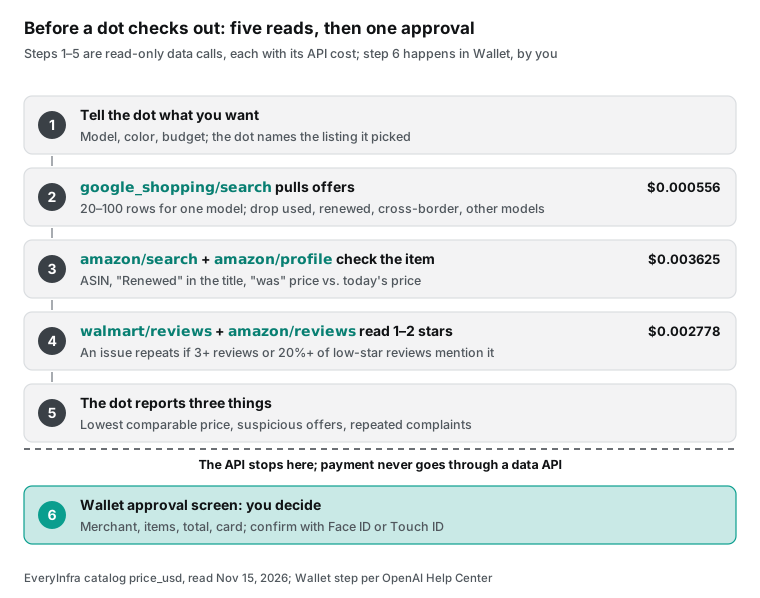
For shopping, the split looks like this. The dot finds the item, compares options, fills the cart and reaches checkout. Wallet appears only at the last step. There, you look at the screen, press your fingerprint and the dot gets a one-time card number. Price checks and review reading belong to the first part. The data the dot uses depends on the plugins you connect and the rules you write.
The merchant side: who welcomes dots and who blocks them
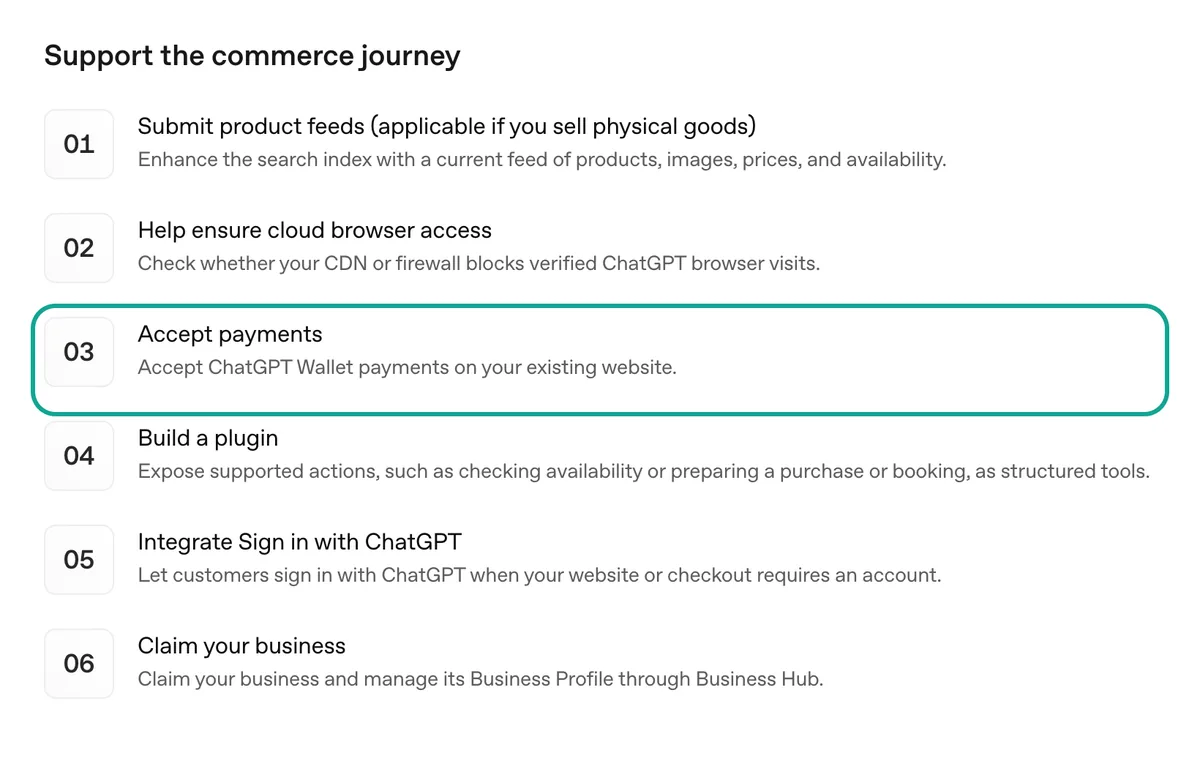
OpenAI's Commerce Partner Playbook lists six steps for merchants. They submit product feeds, allow cloud browser access, accept Wallet payments, build a plugin, add Sign in with ChatGPT and claim a business profile. The product feed guide asks merchants to send prices, stock, images and condition. ChatGPT product search uses that data (Commerce overview, Submit product feeds, Enable browser access).
Some large stores push the other way. Amazon's Conditions of Use, dated August 14, 2026, say Amazon may limit agent access, including with technical measures. eBay's user agreement bans "buy for me" agents, and a November 12 update in The Verge says eBay calls this something other than a blanket ban. United Airlines started to block agents on November 11 (Amazon Conditions of Use, The Verge, Business Insider). So the store where your dot can check out may not be the cheapest one or the one you trust. The approval screen shows that store's name, and you need prices and reviews from other stores to judge it.
Visa's benchmark: more than half of failed runs still bought something
On November 5, 2026, Visa published a benchmark for agent shopping. It tested 22 models from 12 labs on 15 shopping tasks. The overall pass rate was 57.2%, and the fail rate was 42.8%. The best model passed 82.2% of runs and the worst passed 28.9%. Only 34.2% of tasks passed on all three tries (Visa press release).
One number stands out for Wallet users. In 54% of the failed runs, the agent still finished with a purchase. The five most expensive models passed 67.1% of runs, and the five cheapest passed 50.2%. The five best models at finding hidden conditions passed 70.2%, against 44.4% for the rest.
| What you need to know | Shown on the Wallet approval screen? | Where the check gets it |
|---|---|---|
| Merchant, items, total, card | Yes | Not needed |
| New, renewed or used | Only if the item name says so | Title, seller and rank category |
| Price at other big stores | No | Google Shopping, Amazon and Walmart search |
| Real discount | No | Current price at big stores, not the "was" price |
| Repeated complaints | No | 1 and 2 star reviews, with sample size |
Models often choose the wrong item, and they often buy it anyway. Wallet puts the last gate in your hands, but at that gate you see only merchant, item name, total and card. Suppose the name says "Sony WH-1000XM6" and the price is $82 below other stores. You would probably approve. That listing could be a renewed unit.
The test: two products, four sources
We wanted products that are common in the US, with public prices, many reviews and the same model at several stores. The Sony WH-1000XM6 is this year's flagship noise-canceling headphone. Amazon, Walmart, Best Buy and Sony all sell it, in several colors, and renewed units exist. That makes it a good test for "is this the same item?".
The Ninja AF141 is a 5-quart air fryer. It is cheap and has many reviews. Amazon's Black Friday release lists up to 40% off select Ninja kitchen appliances (Amazon press release). So it is a likely purchase for a dot during the event.
All calls go to POST https://api.everyinfra.com/api/v1/social. Parameters and prices come from the public catalog (API catalog). Our plan named an amazon/product capability. In the catalog, the Amazon product detail capability is amazon/profile, at $0.001389 per call, so we use that name. The ebay/search capability is also in the catalog. We tried it three times and got no results, as the failure section shows.
| Time (Singapore time) | Capability | Target | Result | Charged (USD) |
|---|---|---|---|---|
| 00:30 | google_shopping/search | "Sony WH-1000XM6", US | 36 offers | 0.000556 |
| 00:32 | amazon/search | same keyword | 20 rows, 11 are XM6 over-ear | 0.002236 |
| 00:32 | amazon/profile | B0F3PQHWTZ, black, sold by Amazon | 1 detail record | 0.001389 |
| 00:33 | amazon/reviews | B0F3PQHWTZ on amazon.com | 503, login needed | 0 |
| 00:33-00:40 | amazon/reviews | same ASIN on .ca, .co.uk and .es | 13, 8 and 13 featured reviews | 0.001389 x 3 |
| 00:34 | walmart/search | "Sony WH-1000XM6" | 20 rows, 17 unique | 0.001389 |
| 00:35 | walmart/reviews | XM6 from Adorama at $378 | 85 reviews in 73 seconds | 0.001389 |
| 00:37 | walmart/product_detail | the $189.90 listing | brand field "Unbranded" | 0.001389 |
| 00:41-00:42 | three searches | "Ninja AF141" | 29, 20 and 1 rows | 0.004181 |
| 00:42 | walmart/reviews | Shark Ninja store at $89.99 | 160 reviews in 88 seconds | 0.001389 |
| 00:50 | MCP everyinfra_call_api | Google Shopping AF141, lowest price first | 20 offers | 0.000556 |
Prices: the big stores match, and every cheaper offer has a reason
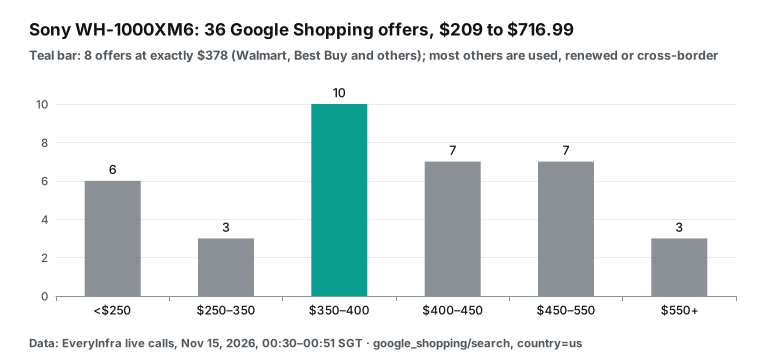
Google Shopping returned 36 US offers for "Sony WH-1000XM6". The lowest was $209 and the highest was $716.99, with a median of $383.50. That range looks wide, but it falls apart on inspection. Eight offers sat at exactly $378, including Walmart's Video & Audio Center, World Wide Stereo and Best Buy.
Amazon also sold it at $378 with a list price of $459.99. Sony's own store page showed $379.99 against $459.99 when we opened it (Sony store, read 2026-11-15). So the four big sellers differed by less than $2.
The six offers under $250 came from Mercari ($209 and $235), one Bonanza booth ($217.79), Reverb ($229) and two eBay sellers ($237.45 and $239.95). All six are resale marketplaces or individual sellers on them. The Google Shopping response has no condition field, so we sorted these rows by merchant.
The three offers from $250 to $350 were Microless.com at $309.86, with a $411 "was" price, and two cross-border shops at $337.51 and $337.60. The next section covers their "was" prices. The highest offer, $716.99, also came from eBay, which supplied 12 of the 36 offers.
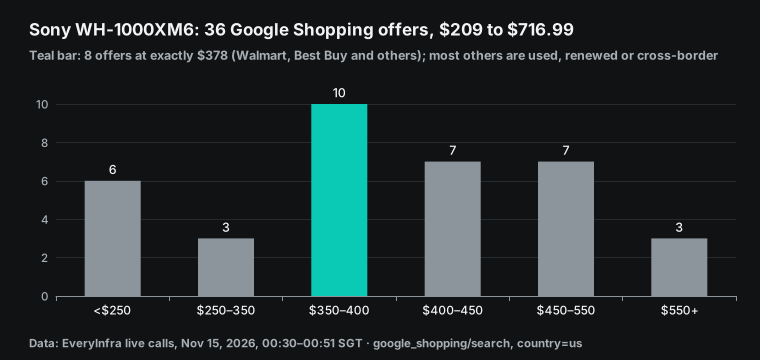
Google Shopping groups offers for the same product under one product cluster ID. The black XM6 cluster held five sellers. Video & Audio Center on Walmart asked $378 with a $450 "was" price. An eBay seller asked $449.80. World Wide Stereo asked $378 with a $450 "was" price. FlexShopper asked $467.63, and Best Buy asked $378 with a $458 "was" price.
FlexShopper is a lease-to-own service, so its price includes lease cost. You cannot compare it with a one-time purchase. In this cluster, the three stores that sell new units outright all asked $378. That is the new price at big US stores this week. Any "new" offer below it needs a second look at the seller and the version.
The Amazon search showed the problem most clearly. Row one was ASIN B0H4HMVDDW at $295.99, with a $378 list price, a 3.8 rating and 15 ratings. The title was long, and it ended with "(Renewed)". The renewed unit cost 21.7% less than the new unit sold by Amazon. Amazon's Renewed page says renewed products are tested and cleaned, and batteries keep at least 80% of new capacity (Amazon Renewed).
A renewed unit can be a fine choice. The risk is a dot that sorts by price alone and reports it as "the lowest price". On a phone, the approval screen may not show all of a long name.
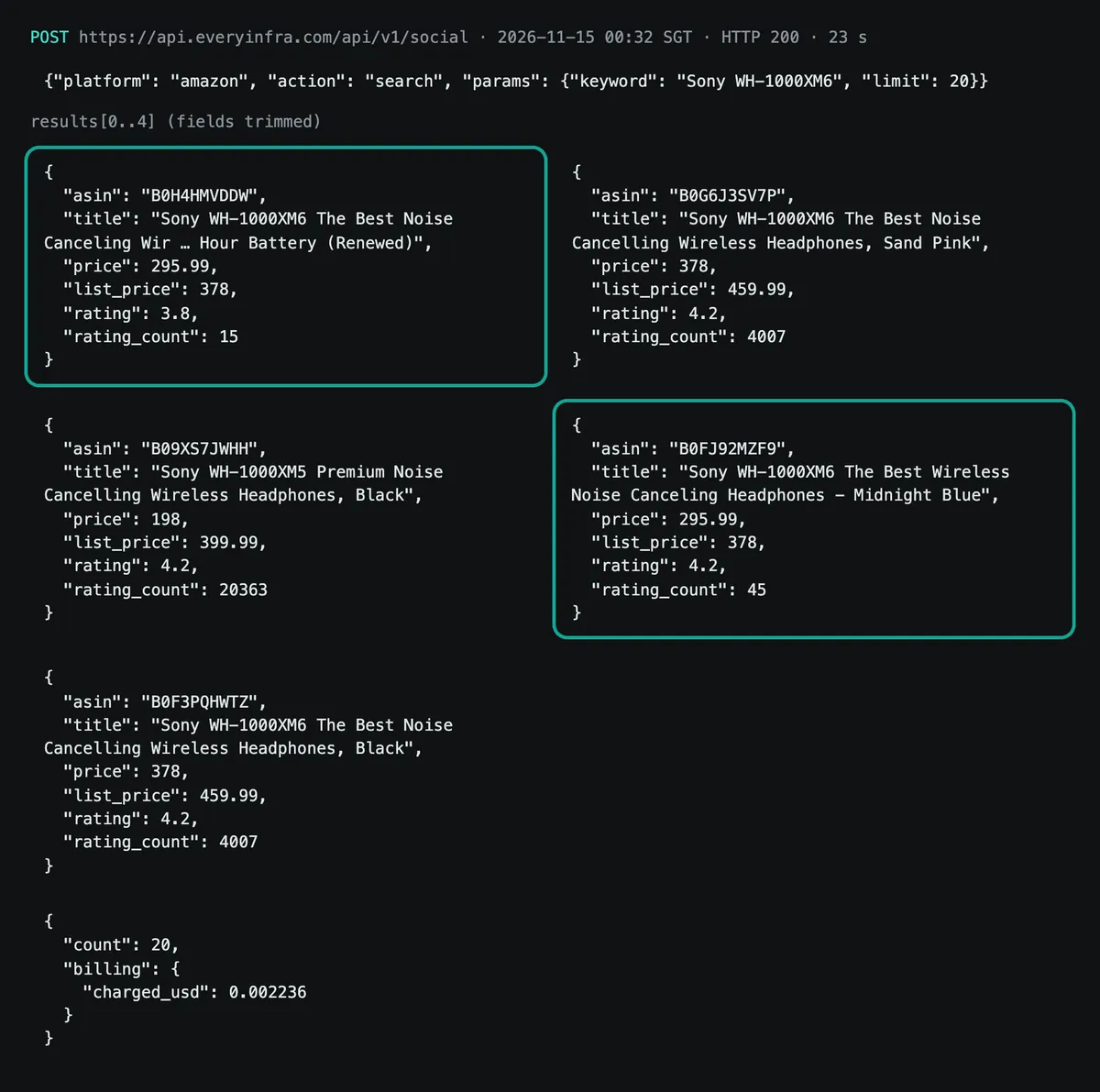
The same response held a listing whose title does not say renewed. B0FJ92MZF9, in Midnight Blue, also cost $295.99 with a $378 list price. It had a 4.2 rating from 45 ratings, and its title did not say "Renewed". But the seller_name field in the search response already said Secondipity, the same seller as the renewed listing.
Row 11, B0FBTN8YJ5, was also from Secondipity. It was silver, at $295.99 with a $378 list price, with a 4.4 rating from 97 ratings, and its title ended in "(Silver) (Renewed)". So one seller had three colors at the same price and the same list price. The three listings had 157 ratings together, against 4,007 for the new units. We treat B0FJ92MZF9 as renewed, and it does not need a detail call.
We did run amazon/profile on the renewed listing B0H4HMVDDW at 00:33 Singapore time. The detail title matched the search title and ended in "(Renewed)". The seller was Secondipity. The bestseller ranks listed #1,226 in "Amazon Renewed" and #93 in "Renewed Headphones". The new black unit, B0F3PQHWTZ, showed Amazon.com as seller and ranks of #282 in Electronics and #14 in Over-Ear Headphones.
So a dot must read three places: the title, the seller name and the rank categories. If one of them points to renewed, the dot treats the listing as renewed. B0FJ92MZF9 shows why: the title says nothing, but the seller name does.
Also note the search mix. Only 11 of the 20 Amazon rows were XM6 over-ear headphones. The other 9 rows were other products. Two were the older WH-1000XM5, and two were WF-1000XM6 earbuds with almost the same name. One was WF-1000XM5 earbuds and one was a Bose QuietComfort Ultra. Two were the cheaper WH-CH720N, and one was a WH-CH520.
Walmart looked similar. walmart/search returned 20 rows with 3 duplicates, so 17 unique listings. Adorama sold the XM6 at $378 with a $449.99 "was" price, a 4.1 rating and 166 reviews. Secondipity sold a "Restored" unit, Walmart's word for renewed, at $295.99 with a 3.8 rating and 54 reviews.
Two rows were WF-1000XM6 earbuds at $298 and $304.99. One row was "Restored Sony 1000X THE COLLEXION" at $375.99, a different renewed headphone priced almost like a new XM6. The cheapest XM6 over-ear row was Pure Home Essentials at $189.90, with one 5-star rating. We ran walmart/product_detail on it, and the brand field said "Unbranded". The title says Sony WH-1000XM6, but the brand does not. A dot should never present it as the lowest price.
Three new offers were cheaper than $378, all from third-party sellers. All three titles end in "International Version". On Walmart, Techmate Intl. listed "Sony WH-1000XM6 (Brand New)" at $369.99, which is 2.1% less. This listing has no ratings, and the title puts six feature phrases between "Brand New" and "International Version".
Tri State Camera listed a black international version at $370, with a 3.4 rating from 24 ratings. The same seller also listed a silver international version at $379.99 and a black one at $380.99 with a one-year warranty and a power adapter.
On Amazon, B0F2TT8Q7M is an international version at $370 with a $390 list price, sold by Pioneer Innovations. It has a 4.2 rating from 1,140 ratings. That count differs from the 4,007 of the Amazon units, so it is a separate listing. The warranty on an international version depends on the seller's terms. Do not assume it matches a US unit.
Some offers at or near $378 include extras. A sort by lowest new price puts them next to the plain new unit, so the dot must report version, bundle and warranty separately.
| Store and seller | Price | Extra in the title | Ratings |
|---|---|---|---|
| Walmart, Beach Camera | $378 | Two-year "CPS Enhanced Protection Pack" and earbuds | 3.4 from 22 |
| Amazon, Beach Camera (B0FV4WGQLZ) | $378 | Accessory bundle | 4.4 from 280 |
| Google Shopping, Walmart seller Walts TV | $378 | Two-year "Amber Protection Plan" | 5 from 1 |
| Google Shopping, Lowe's | $388.99 | Two-year repair and replace plan | none shown |
| Offer | Price | "Was" price | Condition or flag | Decision |
|---|---|---|---|---|
| Amazon, B0F3PQHWTZ | $378 | $459.99 | New, 4.2 from 4,007 (all colors) | Baseline |
| Sony store | $379.99 | $459.99 | New | Comparable |
| Best Buy (Google Shopping) | $378 | $458 | New | Comparable |
| Walmart, Adorama | $378 | $449.99 | New, 4.1 from 166 | Comparable |
| Amazon, B0H4HMVDDW | $295.99 | $378 | "(Renewed)", seller Secondipity | Renewed, separate column |
| Amazon, B0FJ92MZF9 | $295.99 | $378 | No "Renewed" in title, seller Secondipity, 45 ratings | Treat as renewed |
| Amazon, B0FBTN8YJ5 | $295.99 | $378 | Silver, "(Renewed)", seller Secondipity | Renewed, separate column |
| Walmart, Secondipity | $295.99 | none | "Restored" | Renewed, separate column |
| Walmart, Techmate Intl. | $369.99 | none | "Brand New", ends in International Version, 0 ratings | International, separate column |
| Amazon, B0F2TT8Q7M | $370 | $390 | International Version, Pioneer Innovations, 1,140 ratings | International, separate column |
| Walmart, Tri State Camera | $370 | none | International Version, 24 ratings | International, separate column |
| Walmart, Pure Home Essentials | $189.90 | none | Brand "Unbranded", 1 rating | Exclude |
| Mercari, Bonanza, Reverb, eBay sellers | $209 to $239.95 | none | Resale marketplaces | Exclude from new-price comparison |
The rule for the dot fits in four lines. Find new US units with the right brand and model. Take their lowest price as the baseline. List international versions in a separate column, and say that the warranty depends on the seller. List renewed and used offers in another column with the saving against new. Drop any offer whose brand field does not match its title.
With that rule, the XM6 answer is short. New US units cost $378 at the big stores. Third-party sellers offer international versions at $369.99 to $370, which saves $8, and the warranty depends on the seller. If you want to save more, a renewed unit saves $82.
"Was" prices: same headphones, very different stories
Merchants fill in the strike-through price themselves. Google Shopping calls it old_price, and Amazon calls it list_price.
The big US stores told similar stories. Sony's store showed $459.99 against $379.99, or 1.21 times. Amazon showed $459.99 against $378, or 1.22 times. Best Buy showed $458 against $378, also 1.21 times. A Walmart marketplace seller showed $450 against $378, or 1.19 times.
Three cross-border shops told a different story. papita.co listed a "was" price of $1,240 against $337.60, which is 3.67 times. Yoho in Hong Kong listed $2,648 against $337.51. HKairport Shop listed $2,799 against $356.76. Both of those are 7.85 times. Those two numbers look like Hong Kong dollar prices shown as US dollars, which turns into "87% off" on a comparison page.
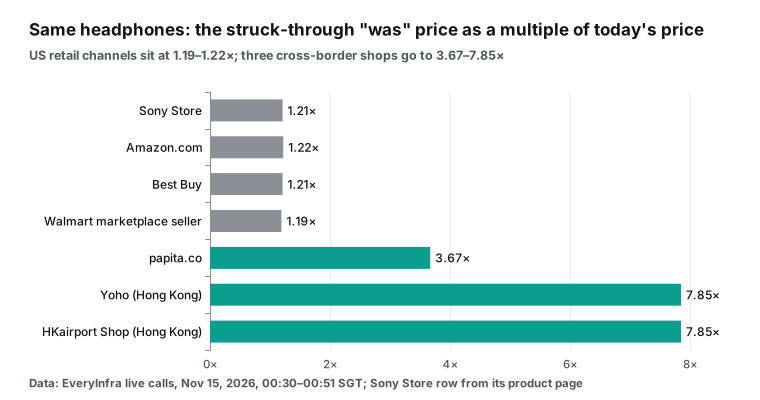
The FTC's Guides Against Deceptive Pricing cover this case. A "former price" must be a price the seller offered in good faith for a reasonable time. Otherwise, a discount based on it is fictitious and can mislead buyers (16 CFR Part 233). Google's Merchant Center also has rules for its sale price attribute (Google Merchant Center sale_price).
For a dot, the practical rule is this. Compute discounts only from the same store's earlier price or from the current price at big US stores. Do not use the merchant's own "was" price. Flag any "was" price above 1.5 times the current price as "unreliable list price", and never present it as a saving.
The opposite case also appeared. For the Ninja AF141, Google Shopping showed an offer from littlewoods.com at $112.31 with a "was" price of only $85. The "was" price sits below today's price. A currency mismatch or an old snapshot probably caused it. Again, the field is a hint, not a fact.
Pooled ratings: 4.7 stars from 10,987 reviews may not be for your model
On Amazon, the Ninja AF141 cost $89.99 with a $129.99 list price. amazon/search showed 4.7 stars from 10,987 ratings. The AF142 at $109.99, the AF181 at $129.99 and an Amazon Exclusive variant showed the same 4.7 from 10,987. Amazon pools ratings across a product family, so this number covers several models.
The XM6 works the same way. The black, silver, Midnight Blue, Sand Pink, Olive Gray and Sandstone listings all showed 4.2 from 4,007. Google Shopping showed an aggregate of 4.7 from 6,200 for the XM6, collected from several stores.
| Product | Source | Rating shown | What it covers |
|---|---|---|---|
| Ninja AF141 | Amazon search | 4.7 (10,987) | Same as AF142, AF181 and an exclusive variant |
| Ninja AF141 | Walmart, Shark Ninja store | 4.6 (590) | This one listing |
| Sony XM6 | Amazon search | 4.2 (4,007) | Shared by six colors |
| Sony XM6 | Walmart, Adorama | 4.1 (166) | This one listing |
| Sony XM6 | Google Shopping aggregate | 4.7 (6,200) | Several stores combined |
Pooled ratings are not always bad. Products in one family often share build quality and support. The risk is in the dot's summary. If the dot writes "4.7 stars from over ten thousand reviews", you assume that number describes the exact model you buy. The rule: say if a rating is for one listing or for a family. Prefer a single-listing rating where one exists, such as a Walmart listing page. To learn about specific problems, read the low-star reviews for that model.
Reviews: featured reviews and API samples tell different stories
We first called amazon/reviews on amazon.com for the black XM6, B0F3PQHWTZ. It returned HTTP 503 access_blocked: the item needs a login or is restricted. The call was refunded. The catalog lists 11 Amazon domains for amazon/reviews, so we read Canada, the UK and Spain instead.
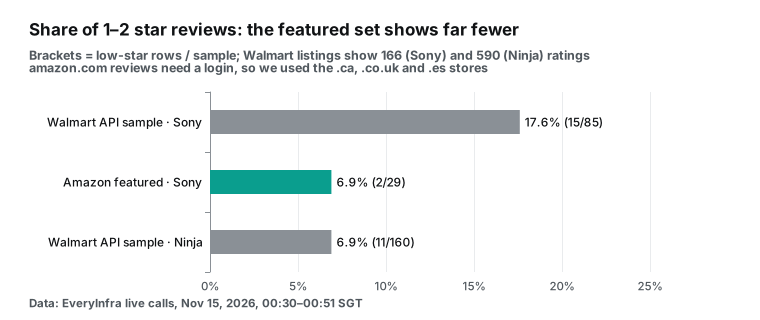
Those calls returned 13, 8 and 13 reviews. After we removed reviews that appeared on more than one domain, 29 were left. These are the featured reviews that Amazon shows by default, about a dozen per domain. The 29 split into 23 five-star, 3 four-star, 1 three-star, 1 two-star and 1 one-star review. So 6.9% were low-star. The reviewers came from Canada (8), Spain (8), the UK (6), Australia (2) and one each from the US, Brazil, South Africa, Turkey and Egypt.
On Walmart, we called walmart/reviews for the Adorama XM6 listing with limit 200. It returned 85 reviews with text, from May 18, 2025 to November 4, 2026. They split into 52 five-star, 13 four-star, 5 three-star, 7 two-star and 8 one-star reviews. That is 15 low-star reviews, or 17.6%.
Each returned row also carries the listing's rating count, product_review_count, which is 166. The response has no field that says "end of list". The other 81 may be ratings without text, but we did not check this in this round. The Ninja AF141 listing from the Shark Ninja store returned 160 reviews, from January 10, 2026 to November 9, 2026. That listing shows 590 ratings. Of the 160, 11 had 1 or 2 stars, which is 6.9%.
The two samples do match their listings on average score. The 85 XM6 reviews average 4.11, and the listing shows 4.1. The 160 Ninja reviews average 4.61, and the listing shows 4.6. So the returned rows do not lean clearly toward praise or toward complaints. They are still samples, 85 of 166 and 160 of 590. The dot must report both numbers: rows returned and ratings on the listing.
The response also has an is_verified_purchase field. Can a dot use it to drop weak reviews? Of the 85 XM6 reviews, only 31 are marked as verified. Only 2 of the 15 low-star reviews are verified, against 25 of the 65 four- and five-star reviews. If the dot reads only verified reviews, the 15 low-star reviews drop to 2, and none of the three repeated issues passes the rule. For the Ninja, 130 of 160 reviews are verified, and 7 of the 11 low-star reviews are verified, so the filter changes less. Use this field as a note, not as a filter.
Length is another useful signal. The median low-star XM6 review has 424 characters of text, and the median four- or five-star review has 181. Complaints are longer and carry more detail, so the dot should quote low-star text first.
| Review set | Source | Rows | 1 and 2 star | Share |
|---|---|---|---|---|
| Sony XM6, featured | amazon.ca, amazon.co.uk, amazon.es | 29 unique | 2 | 6.9% |
| Sony XM6, API sample | Walmart, Adorama listing | 85 of 166 ratings | 15 | 17.6% |
| Ninja AF141, API sample | Walmart, Shark Ninja store | 160 of 590 ratings | 11 | 6.9% |
| Sony XM6, amazon.com | Amazon US | none, login needed | none | none |
For the same headphones, the low-star share was 17.6% in the Walmart sample and 6.9% in Amazon's featured set. The two samples come from different sources, so do not divide one by the other. Amazon picks featured reviews by rules such as helpfulness, which favors long and popular reviews. The Walmart sample is reviews with text that the API returned in date order.
We can compute a floor. Suppose all 81 ratings that did not come back are four or five stars. Then the XM6 low-star share on Walmart is still 15 of 166, or 9.0%, which is above the 6.9% in Amazon's featured set. The same method gives the Ninja a floor of 11 of 590, or 1.9%. So the Ninja set cannot support a comparison with other numbers.
A dot that reads only the default reviews on a product page sees fewer complaints. So the rule must require at least one source that returns many reviews in date order. It must also report rows returned, ratings on the listing and the low-star share.
One more detail came up. Two of the 85 Walmart XM6 reviews start with traces of an AI rewriting tool. One begins "Here's a polished version of your review". The other begins "Gemini said". From the context, both look like buyers who ran their own text through an AI tool, so the content may still be honest.
The FTC rule on fake reviews, announced in August 2024, bans buying or faking reviews. It names AI-generated fake reviews directly (FTC press release, 16 CFR Part 465). A dot can count reviews with rewrite traces as a separate group. It should keep them, but it should not let them drive the conclusion.
Three issues that repeat in the XM6 low-star reviews
We read and labeled all 15 low-star reviews by hand. One review can carry more than one topic. We set the rule before the test. An issue "repeats" if at least 3 different reviews mention it, or if it covers at least 20% of the low-star sample. Three XM6 issues passed that rule.
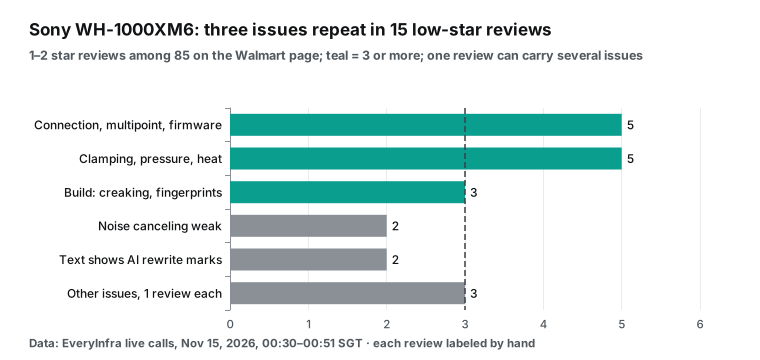
The first issue is connection, multipoint switching and firmware, in 5 reviews, or a third of the sample. Several buyers say switching between two devices is unreliable or drops the connection. One review, dated August 15, 2025, says a firmware update broke the headphones for meetings. In Zoom or Teams, any other sound stopped the microphone until the buyer reconnected. The buyer wrote that months passed without a fix.
The second issue is fit, also in 5 reviews. Buyers say the headband clamps too hard, presses on the ears and gets hot after a while. The third issue is build quality, in 3 reviews. Two mention creaking when the cups move, and one says the surface holds fingerprints.
Weak noise canceling appeared in 2 reviews, so it did not pass the rule. Loud voice prompts, sound taste and a wrong color each appeared once. In the color case, the buyer chose Midnight Blue and received silver. The listing had small text that said "actual color".
Amazon's featured reviews held only 2 low-star reviews. One 1-star review from Canada, dated January 22, 2026, says the sound and noise canceling are great but the shell feels like a $150 product. One 2-star review from October 3, 2025 says the ear cups tilt and do not seal. Both fit the build and fit issues from Walmart. With only two reviews, they cannot prove anything alone.
Timing also matters. By month, January 2026 had the most Walmart reviews, 14, and 5 of them were low-star. That is right after the holiday gift season.
After July 17, 2026, the listing had only 7 more reviews, and none was low-star. A drop in complaints can mean the product improved. It can also mean fewer people wrote reviews. The dot should report the time range, for example "repeated issues cluster from late 2025 to January 2026, and recent reviews are few".
How does this help someone about to spend $378? It depends on how they use headphones.
A person who switches between laptop and phone all day and joins video calls needs the connection and firmware warning. A person with a large head or glasses who wears them for hours needs the fit warning. A good dot matches the issues to what you told it. For example: "You said you use them for daily meetings. Five low-star reviews mention multipoint or meeting drops, one after a firmware update."
Ninja AF141: no repeated issue is also an answer
We labeled the 11 low-star Ninja reviews from Walmart in the same way. The reviews ran from January 10, 2026 to November 9, 2026. Uneven cooking had 2 reviews, loud noise had 2 and a missing manual or signs of an opened box had 2. Each is 18.2% of the sample. Damage claims, smell and heat, basket fit, a leak, hard cleaning and one vague review had one each. No issue reached 3 reviews or 20%, so the AF141 has no repeated issue by our rule.
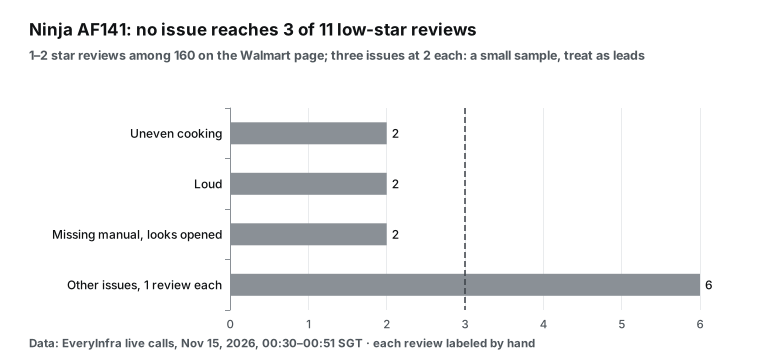
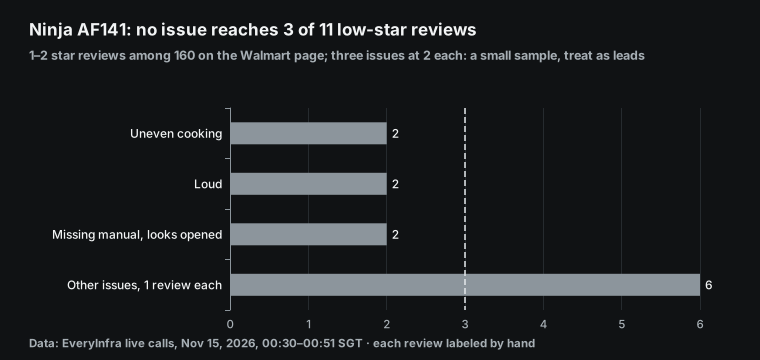
This changes how the dot reports. With no repeated issue, it should say "11 low-star reviews out of 160, no issue appears three times, small sample, leads only". It should not pick the scariest single review and lead with it.
The two "missing manual, looks opened" reviews deserve one line next to the prices. Walmart's Shark Ninja store sold the AF141 at $89.99 with a $129.99 "was" price. Target asked $89.99, and Amazon asked $89.99 too. Google Shopping also showed a third-party seller on Newegg with "Air Fryer Pro, 5 Qt, 4-in-1, Grey, AF141" at $87.99. The model matches and it is $2 cheaper, but the dot must check the seller first. The three big stores match, so buying from the brand store lowers the chance of an opened box.
The price side had traps too. Of the 29 Google Shopping results for the Ninja search, 23 were other models. The third Google Shopping result was "Air Fryer Pro XL 5-Qt 3-in-1" at $79.97, sold by Walmart. It is cheaper than the AF141, but it is a different product.
We also asked Google Shopping, through our remote MCP server, to sort by lowest price. Row one was "Ninja 6-in-1 Pro XL Air Fryer" at $66 from a store named "Les Appartements de Juju". Neither the model nor the merchant fits. Rows two and three were $69.99 on eBay and $80.91 from a Walmart marketplace seller. When results sort by price, the top rows need the strictest model check.
Failures, timeouts and empty results
Five calls in this round did not return what we wanted. None of them cost anything. We list them because a dot will see the same cases in real use. It needs to tell "no data" apart from "no offer".
| Time (Singapore time) | Capability | Result | Charged |
|---|---|---|---|
| 00:33 | amazon/reviews on amazon.com | 503 access_blocked, US reviews need a login | 0 |
| 00:37 | ebay/search, XM6, new | 503 after an 85-second timeout | 0 |
| 00:39 | walmart/reviews, Secondipity restored listing | 0 reviews, empty result refunded | 0 |
| 00:41-00:43 | ebay/search as an async job | Job failed and was refunded | 0 |
| 00:50 | ebay/search with limit 10 | 503 timeout | 0 |
All three eBay attempts failed. The timing matches eBay's tighter rules for agents, but we cannot show a link between the two. We only record the result. Our key also has a limit of 10 calls per minute. Parallel jobs hit HTTP 429 twice (RFC 6585). We waited for the retry_after value and the retry worked.
For the dot, a failed source needs its own line in the summary. "eBay returned no data this time" is correct. "eBay has nothing cheaper" is wrong. In HTTP terms, a 503 means the service is temporarily unavailable, not that the resource does not exist (RFC 9110).
Time matters too. Google Shopping took 11 and 23 seconds on our two calls. amazon/search took 23 seconds. The two Walmart review calls took 73 and 88 seconds. Each eBay attempt waited the full 85 seconds before it timed out.
In a row, a six-call standard check can take two to three minutes. A better plan is to send calls in parallel and use async mode for slow review calls. The dot then reports prices first and adds the review part when it arrives.
What one check costs
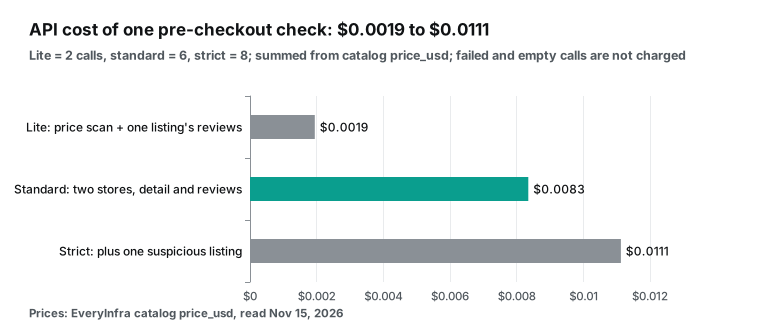
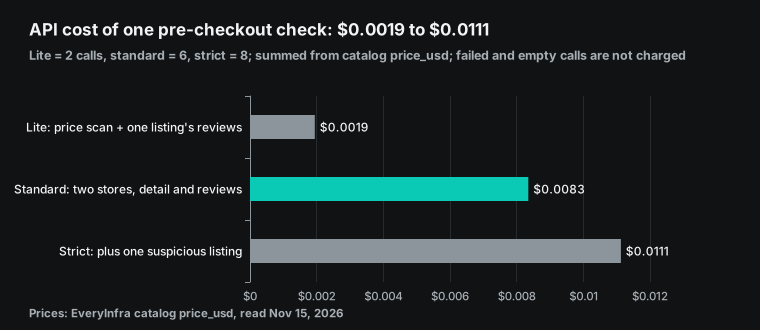
We used catalog prices to define three check levels. The light check uses two calls: Google Shopping plus reviews from one listing, for $0.001945. The standard check uses six calls: Google Shopping, Amazon search, Amazon detail, Amazon reviews, Walmart search and Walmart reviews, for $0.008348. The strict check adds two detail calls for suspicious offers, for eight calls and $0.011126.
Failed and empty calls are free, so the real cost can only be the same or lower. Our full round covered two products with 24 response files, including retries and failures. The saved responses show charged_usd values that add up to $0.020586. Our local script failed to save the responses of two more MCP calls. We add them at the catalog price of $0.000556 each, so the total is $0.021698.
| Level | Calls | Count | API cost (USD) | Good for |
|---|---|---|---|---|
| Lite | google_shopping/search + walmart/reviews | 2 | 0.001945 | Items under $50 where you want price and complaints |
| Standard | adds amazon/search, amazon/profile, amazon/reviews, walmart/search | 6 | 0.008348 | Electronics and appliances from $100 to $500 |
| Strict | adds one more amazon/profile and walmart/product_detail | 8 | 0.011126 | Searches with renewed, off-brand or odd-priced offers |
For the XM6, the standard check costs $0.0083, or 0.0022% of the price. Twenty purchases a month with a standard check each cost about $0.17 in API fees. The cheapest Pro tier costs $100 per month. The check protects you from a $295.99 renewed unit with an unclear title, or a $189.90 off-brand pair. You can see prices and fields for each capability on the Amazon API, Walmart API and Google Shopping API pages.
Connect the data in ChatGPT: custom MCP and write-action prompts
ChatGPT connects to outside data through custom MCP servers. On the plugins page in ChatGPT, choose "Add custom MCP server" and enter the server URL. ChatGPT supports SSE and streaming HTTP. Auth can be OAuth, no auth or mixed (Help Center: custom MCP, developer guide).
Our remote MCP address is https://api.everyinfra.com/mcp. The MCP server page shows setup steps, and OAuth follows the MCP authorization spec (MCP authorization). Our earlier post on weekly product research with ChatGPT covers the ChatGPT side of OAuth, so we skip it here.
One detail matters for dots. At 00:48 Singapore time we called tools/list on that address and got 12 tools. The data tool, everyinfra_call_api, carries readOnlyHint: false, destructiveHint: true and openWorldHint: true. In the MCP spec, these hints say the tool is not read-only, may be destructive and reaches outside systems (MCP tools spec).
The ChatGPT Help Center says tools without readOnlyHint count as write actions. Each call then needs your confirmation. Dots' proactive research can use only read-only tools.
So this tool cannot run during background research. It runs only while you talk to your dot, with one confirmation per call. So the pre-checkout check must run in the conversation, after you say "buy it" and before the approval screen.
Here is one MCP call as the dot sends it. It uses the same arguments as our 00:50 run. The response held 20 offers in 16,242 characters of text and cost $0.000556.
{
  "jsonrpc": "2.0",
  "id": 7,
  "method": "tools/call",
  "params": {
    "name": "everyinfra_call_api",
    "arguments": {
      "platform": "google_shopping",
      "action": "search",
      "params": { "keyword": "Ninja AF141 air fryer", "country": "us", "sort": "price_low", "limit": 20 }
    }
  }
}
You can also run the check from a script without ChatGPT. The Python example below uses only the standard library. It reads the key from an environment variable and pulls Amazon search results. Then it splits renewed rows from the rest. It flags rows that share a price or a seller with a renewed row, and rows that say International. See the quickstart for your first key and call.
import json, os, urllib.request

def call(platform, action, params):
    body = json.dumps({"platform": platform, "action": action, "params": params}).encode()
    req = urllib.request.Request(
        "https://api.everyinfra.com/api/v1/social", data=body,
        headers={"Authorization": "Bearer " + os.environ["EVERYINFRA_API_KEY"],
                 "Content-Type": "application/json"})
    with urllib.request.urlopen(req, timeout=120) as r:
        return json.load(r)

rows = call("amazon", "search", {"keyword": "Sony WH-1000XM6", "limit": 20})["results"]
renewed = [r for r in rows if "renewed" in r["title"].lower()]
new = [r for r in rows if r not in renewed and "WH-1000XM6" in r["title"] and r.get("price")]
renewed_prices = {r["price"] for r in renewed}
renewed_sellers = {r.get("seller_name") for r in renewed}
for r in renewed:
    print("renewed:", r["asin"], r["price"])
for r in sorted(new, key=lambda r: r["price"]):
    flag = ""
    if r["price"] in renewed_prices or r.get("seller_name") in renewed_sellers:
        flag = "same price or seller as a renewed row: treat as renewed"
    elif "international" in r["title"].lower():
        flag = "international version: check warranty"
    print("new?", r["asin"], r["price"], flag)
Parameter details live on the Google Shopping search, Amazon search, Amazon product detail, Amazon reviews and Walmart reviews pages. Review calls are slow, from 73 to 88 seconds on Walmart. Let the dot wait, or add "mode": "async" to the request body and poll the job ID that comes back.
Rules for the dot
Here are the findings as rules a dot can run. You can paste them into the dot's Custom Rules or into each shopping prompt.
| Check | Field to use | Pass | What the dot does on fail |
|---|---|---|---|
| Same item? | ASIN, model in title, brand field | Model and brand match | Move to "other models" |
| New or renewed? | Renewed, Restored or Refurbished in title, Google condition, Amazon seller and rank categories | New | Put in a renewed column with the saving against new |
| Odd price? | Gap to the new price at big US stores | Within 15% | If more than 15% lower, run one detail call on seller and brand |
| "Was" price | old_price, list_price | At most 1.5 times current | Flag as unreliable and do not count a discount |
| Rating for this model? | Same rating count on different ASINs | Single-listing rating | Say "family rating" |
| International version? | International in title, warranty text on the seller page | US unit | Put in a separate column and say the warranty depends on the seller |
| Complaints | Full text of 1 and 2 star reviews, with one source that returns many reviews in date order | Read and grouped by the 3 or 20% rule, with rows returned and listing rating count | Under 10 low-star reviews, say "leads only" |
| All sources answered? | Status code and row count per source | Every source returned rows | Say "no data from this source" |
Google Merchant Center defines product condition in a way a dot can reuse. New means never used, in original packaging and unopened. Refurbished means professionally restored to working order, looking new and covered by a warranty. Used covers products that were worn, opened or have missing packaging (Google Merchant Center condition). By that definition, the two Ninja "looks opened" reviews describe units that were not new.
A rule table is for people. A dot needs text it can follow. We put the text below into the dot's Custom Rules. It never mentions payment. It only says that after you say "buy", and before Wallet shows the approval screen, the dot must deliver a check. The dot proceeds to checkout only after you pick a store.
Shopping check (run after I ask you to buy something, before checkout):
1. Run google_shopping/search for the same model in the US, up to 40 offers.
2. Run amazon/search and walmart/search once each. Keep rows where model and brand match.
3. Split new from renewed and used. Renewed, Restored or Refurbished in a title means renewed.
4. If the title does not say, read the seller in the search row and the rank categories in the detail record. The same seller as a known renewed row, or Renewed in a rank category, also means renewed. International in a title goes in a separate column.
5. Use the lowest new price as the baseline. For offers 15% or more below it, run one detail call.
6. Read walmart/reviews with limit 200, and report rows returned and listing ratings. If amazon.com reviews fail, read amazon.ca or amazon.co.uk.
7. Count only 1 and 2 star reviews. An issue repeats at 3 reviews or 20% of the sample.
8. Report the new baseline and store, the renewed price, flagged offers and repeated issues.
9. Include the ASIN or item ID you checked. If a source fails, say it returned no data.
With this round's XM6 data, the dot's report would read like this. New baseline: $378 at Amazon, Best Buy and Adorama on Walmart, and $379.99 at Sony. Checked item: ASIN B0F3PQHWTZ, black. International versions: $369.99 to $370 from three third-party listings, $8 below new, with the warranty set by each seller. Renewed: $295.99 on Amazon and Walmart, $82 below new. The Amazon renewed listing has a 3.8 rating from 15 ratings and Secondipity as seller.
Flagged offers: the $189.90 Walmart listing has the brand "Unbranded" and was excluded. The $295.99 Midnight Blue listing on Amazon does not say renewed. Its seller is Secondipity, the same as the renewed listing, so treat it as renewed. Two Hong Kong shops show "was" prices at 7.85 times the current price, so ignore them.
Complaints: 15 of the 85 Walmart reviews that came back (166 ratings on the listing) are low-star. Repeated issues are multipoint and connection (5, one after a firmware update), fit and heat (5) and creaking build (3). Amazon US reviews returned no data, and eBay returned no data.
You can read that report in about a minute and decide between new and renewed. At the Wallet approval screen, you then check three things. Is the merchant the store you picked? Does the item name end in "Renewed"? Is the total $378 plus tax and shipping? If anything does not match, decline and ask the dot to check again.
What this check does not do
The check does not touch payment. The process ends when the dot delivers its report. Payment happens in Wallet, with your own fingerprint, and our API has no part in that step.
The check also does not help a dot get around any merchant's access rules. When Amazon US reviews need a login, we read other Amazon domains. When eBay times out, we report "no data". Whether to allow agents is each merchant's decision.
The samples are small. The XM6 had 15 low-star reviews and the Ninja had 11. The three repeated issues hold for these two products and these two listings only.
Prices are from early on November 15, 2026. During Black Friday Week, Amazon says new deals drop at midnight and at 8 a.m. Pacific Time on Black Friday and Cyber Monday. So run the check a few minutes before you approve, not a day before.
Wallet is US-only for now. Dots are not offered in the EEA, Switzerland or the UK. Readers in those places can still run the price and review parts of the check before they buy themselves.
One gap remains that we cannot close. The item on the approval screen may differ from the item the dot checked. The dot may check ASIN B0F3PQHWTZ, then land on another listing at checkout because of stock or a seller change. The Help Center says to contact OpenAI support if a purchase differs from what you approved. Our advice is to make the dot name the ASIN or item ID it checked, so you can compare it on the approval screen. Our post on Amazon price tracking false positives shows how sellers and stock change under one ASIN.
What changed in the last 30 days
| Date | Event | Why it matters for a pre-checkout check |
|---|---|---|
| 2026-11-03 | dots add the GPT-6.1 Terra model | The model behind the dot changes, so its choices can change too |
| 2026-11-04 to 2026-11-18 | Business admins preview dots | Company accounts will also have agents that can buy |
| 2026-11-05 | Visa publishes its agent shopping benchmark | 54% of failed runs still paid for something |
| 2026-11-11 | United Airlines blocks AI agents | Merchants start to allow or block agents by list |
| 2026-11-12 | eBay says its agent rules are not a blanket ban | eBay data and checkout for agents stay unreliable |
| 2026-11-13 | ChatGPT Wallet launches | A US Pro user's dot can pay after approval |
| 2026-11-19 to 2026-11-30 | Amazon Black Friday Week | Prices can change twice a day, so check close to approval |
Frequently asked questions
Who can use ChatGPT Wallet now, and when will more people get it?
Search suggestions include "chatgpt wallet coming soon". The Help Center says Wallet is rolling out gradually to eligible Pro users in the United States. Even eligible users may not have it yet. You must be 18 or older, live in the US and have a US billing address. You use Wallet only in a conversation with a dot. The Help Center gives no schedule for other countries or plans (Help Center).
Does ChatGPT Wallet have a balance I can top up?
Search suggestions include "chatgpt wallet balance". On Reddit, one user said a $10 top-up to Wallet failed twice (Reddit, we could not verify this). Per the Help Center, Wallet stores credit cards and pays with a token charged to the card. ChatGPT has a separate US dollar balance for ChatGPT purchases such as subscriptions. The Help Center says Wallet cards are separate from that balance (ChatGPT balance).
Is ChatGPT Wallet connected to Google Wallet or PayPal?
Search suggestions include "chatgpt google wallet" and "paypal chatgpt wallet". The OpenAI announcement names American Express, Mastercard and Visa. The Help Center lists American Express, Chase, Mastercard and Visa cards. None of the sources we read says you can add Google Wallet or PayPal to ChatGPT Wallet. Whether a merchant's own checkout takes PayPal is up to that merchant.
Can ChatGPT Wallet hold crypto?
Search suggestions include "chatgpt crypto wallet". The Help Center lists only US-issued credit cards and no crypto wallets. Some people who search this phrase look for crypto wallet plugins for ChatGPT, which is a different thing from OpenAI's Wallet.
Can ChatGPT dots shopping place orders on Amazon directly?
Suggestions under "chatgpt dots shopping" include "cart", "plugin" and "marketplace". OpenAI's sources do not list which merchants accept Wallet. They only say merchants can join through the Commerce playbook. Amazon's Conditions of Use say Amazon may limit agents with technical measures. So a dot may fail to check out there and buy elsewhere (Amazon Conditions of Use). That is why the dot should read Amazon's price and reviews first, as a reference when you pay at another store.
Can my dot run price checks in the background?
Partly. Proactive research in dots can use only read-only tools. Our everyinfra_call_api tool is marked as reaching the outside world and possibly destructive, so ChatGPT treats it as a write action. It does not run in background research. It runs while you talk with the dot, and each call asks for your confirmation (Introducing dots, MCP tools spec).
References
- OpenAI: Introducing ChatGPT Wallet, 2026-11-13. <https://openai.com/index/introducing-chatgpt-wallet/> (accessed 2026-11-15)
- OpenAI Help Center: Making purchases with ChatGPT Wallet. <https://help.openai.com/en/articles/20001654-making-purchases-with-chatgpt-wallet> (accessed 2026-11-15)
- OpenAI: ChatGPT Wallet Terms. <https://openai.com/policies/chatgpt-wallet-terms/> (accessed 2026-11-15)
- OpenAI: ChatGPT Wallet Privacy Notice. <https://openai.com/policies/chatgpt-wallet-privacy-notice/> (accessed 2026-11-15)
- OpenAI: Introducing dots, with the 2026-11-03 update. <https://openai.com/index/introducing-dots/> (accessed 2026-11-15)
- OpenAI Help Center: Getting started with dots. <https://help.openai.com/articles/20001530> (accessed 2026-11-15)
- OpenAI Help Center: dots privacy and safety FAQ. <https://help.openai.com/articles/20001529> (accessed 2026-11-15)
- OpenAI Help Center: About ChatGPT Pro tiers. <https://help.openai.com/en/articles/9793128-about-chatgpt-pro-tiers> (accessed 2026-11-15)
- OpenAI Help Center: Connecting custom MCP servers in ChatGPT. <https://help.openai.com/en/articles/12584461-connecting-custom-mcp-servers-in-chatgpt> (accessed 2026-11-15)
- OpenAI Developers: Building a custom MCP server. <https://developers.openai.com/api/docs/guides/custom-mcp-server> (accessed 2026-11-15)
- OpenAI Developers: Commerce in ChatGPT. <https://developers.openai.com/commerce> (accessed 2026-11-15)
- OpenAI Developers: Commerce overview. <https://developers.openai.com/commerce/guides/overview> (accessed 2026-11-15)
- OpenAI Developers: Submit product feeds. <https://developers.openai.com/commerce/guides/submit-product-feeds> (accessed 2026-11-15)
- OpenAI Developers: Enable browser access. <https://developers.openai.com/commerce/guides/enable-browser-access> (accessed 2026-11-15)
- OpenAI Developers: Build a plugin. <https://developers.openai.com/commerce/guides/build-a-plugin> (accessed 2026-11-15)
- OpenAI Help Center: Cloud browser allowlisting. <https://help.openai.com/en/articles/11845367-chatgpt-works-cloud-browser-allowlisting> (accessed 2026-11-15)
- OpenAI Help Center: Using your ChatGPT balance. <https://help.openai.com/articles/20001508> (accessed 2026-11-15)
- ChatGPT Learn: Auto-review. <https://learn.chatgpt.com/docs/sandboxing/auto-review> (accessed 2026-11-15)
- Visa: Visa Releases First-of-Its-Kind Industry Benchmark, 2026-11-05. <https://investor.visa.com/news/news-details/2026/Visa-Releases-First-of-Its-Kind-Industry-Benchmark/default.aspx> (accessed 2026-11-15)
- Amazon: Conditions of Use, version of 2026-08-14. <https://www.amazon.com/gp/help/customer/display.html?nodeId=508088> (accessed 2026-11-15)
- Amazon: Amazon Renewed. <https://www.amazon.com/Amazon-Renewed/b?node=12653393011> (accessed 2026-11-15)
- Amazon: Black Friday Week and Cyber Monday return November 19-30. <https://press.aboutamazon.com/2026/11/amazons-black-friday-week-and-cyber-monday-return-november-19-30-with-millions-of-deals-to-deliver-joy-this-holiday-season> (accessed 2026-11-15)
- Sony US store: WH-1000XM6 product page. <https://electronics.sony.com/audio/headphones/headband/p/wh1000xm6-b> (accessed 2026-11-15)
- eCFR: 16 CFR Part 233, Guides Against Deceptive Pricing. <https://www.ecfr.gov/current/title-16/chapter-I/subchapter-B/part-233> (accessed 2026-11-15)
- eCFR: 16 CFR Part 465, Use of Consumer Reviews and Testimonials. <https://www.ecfr.gov/current/title-16/chapter-I/subchapter-D/part-465> (accessed 2026-11-15)
- FTC: Final rule banning fake reviews and testimonials, 2024-08. <https://www.ftc.gov/news-events/news/press-releases/2024/08/federal-trade-commission-announces-final-rule-banning-fake-reviews-testimonials> (accessed 2026-11-15)
- Google Merchant Center: Sale price [sale_price]. <https://support.google.com/merchants/answer/6324471> (accessed 2026-11-15)
- Google Merchant Center: Condition [condition]. <https://support.google.com/merchants/answer/6324469> (accessed 2026-11-15)
- Model Context Protocol: Tools, 2025-06-18. <https://modelcontextprotocol.io/specification/2025-06-18/server/tools> (accessed 2026-11-15)
- Model Context Protocol: Authorization, 2025-06-18. <https://modelcontextprotocol.io/specification/2025-06-18/basic/authorization> (accessed 2026-11-15)
- RFC 6585: Additional HTTP Status Codes (429). <https://www.rfc-editor.org/rfc/rfc6585> (accessed 2026-11-15)
- RFC 9110: HTTP Semantics. <https://www.rfc-editor.org/rfc/rfc9110> (accessed 2026-11-15)
- EveryInfra: API catalog. <https://api.everyinfra.com/api/v1/social/catalog> (accessed 2026-11-15)
- EveryInfra: remote MCP server, tools/list. <https://api.everyinfra.com/mcp> (called 2026-11-15 00:48 Singapore time)
- TechCrunch: ChatGPT's new Wallet lets AI agents shop and check out for you, 2026-11-13. <https://techcrunch.com/2026/11/13/chatgpts-new-wallet-lets-ai-agents-shop-and-check-out-for-you/> (accessed 2026-11-15)
- CNBC: OpenAI ChatGPT Wallet, 2026-11-13. <https://www.cnbc.com/2026/11/13/openai-chatgpt-wallet-dot-purchases.html> (accessed 2026-11-15)
- Reuters: OpenAI launches ChatGPT Wallet, 2026-11-13. <https://www.reuters.com/technology/openai-launches-chatgpt-wallet-letting-ai-agents-pay-purchases-2026-11-13/> (accessed 2026-11-15)
- Help Net Security: OpenAI ChatGPT Wallet, 2026-11-13. <https://www.helpnetsecurity.com/2026/11/13/openai-chatgpt-wallet/> (accessed 2026-11-15)
- The Verge: eBay and AI agents, updated 2026-11-12. <https://www.theverge.com/tech/1030838/ebay-ai-agents-meta-muse-agentic-shopping> (accessed 2026-11-15)
- Business Insider: Companies banning AI agents, 2026-11. <https://www.businessinsider.com/list-companies-banning-ai-agents-retail-travel-united-amazon-target-2026-11> (accessed 2026-11-15)
- Reddit r/ChatGPT: ChatGPT Wallet discussion thread. <https://www.reddit.com/r/ChatGPT/comments/1xveyh4/> (accessed 2026-11-15)
Reference BL-158