AWS Quick Flows: weekly Amazon price and review checks with a data API
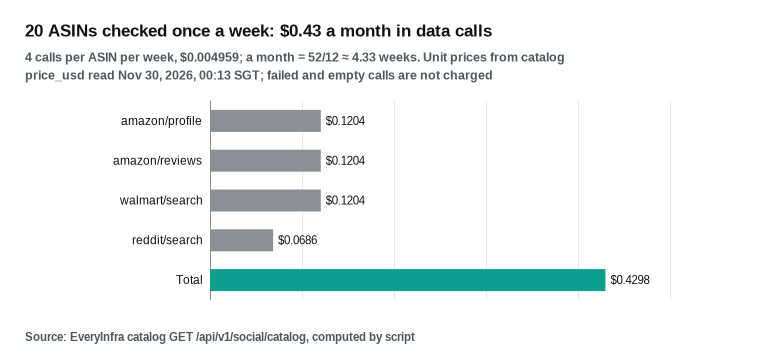
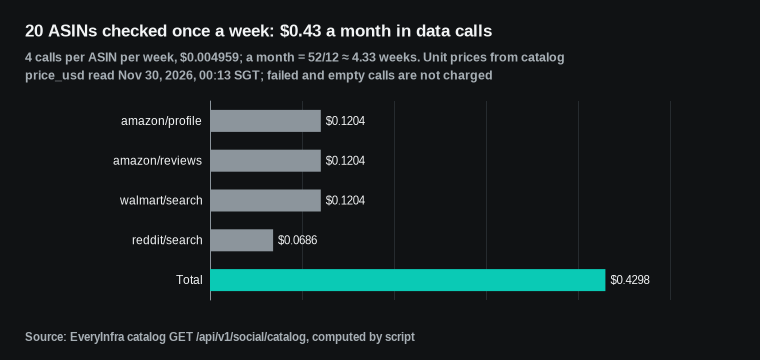
Build a weekly Amazon price and review check in AWS Quick Flows. Connect a data API with OpenAPI. 20 ASINs cost about $0.43 a month in API fees.

Today is Cyber Monday in the US. On 2026-11-20 AWS gave Quick Flows chat-built flows, deterministic steps and longer runs (AWS Machine Learning Blog).
We used the AWS documentation to design a weekly flow for a new product launch. The flow checks prices and finds complaints for three Bluetooth earbuds. Two of its steps get data from the EveryInfra data API. While we wrote this article, we made 20 live calls between 00:13 and 00:25 Singapore time (SGT) on 2026-11-30. 15 of them were for the weekly check.
The Amazon product pages showed 30 featured reviews for the three products, and all 30 had four or five stars. In the same month, Reddit had 21 unique posts about these products. 6 of them described faults such as dropouts, charging failures and one silent earbud. At catalog prices, a weekly check of 20 ASINs costs about $0.43 a month in API fees.

What AWS Quick Flows is after the November 20 update
AWS Quick started as Amazon QuickSight. AWS launched it as Amazon Quick Suite on 2025-10-09 (AWS News Blog). The current documentation calls the product AWS Quick. It has several parts: Quick Sight, Quick Flows, Quick Automate, Quick Index, Quick Research and Apps (What is AWS Quick). Flows lets business users automate repeated work without code, and Automate is for complex processes with approvals across teams.
Scheduled runs came to Flows on 2025-11-25. At launch, only three Regions had them: US East (N. Virginia), US West (Oregon) and Europe (Ireland) (What's New). On 2025-12-08 AWS added Quick Research as a step type inside a flow (What's New). The 2026-11-20 release is the largest change so far.
The November release note says that you describe a process in chat and Quick builds a flow. The flow can coordinate agents, skills and tools, and Quick shows a step diagram next to the chat. The new deterministic steps give results that you can repeat and check. Flows can also run longer and handle more data (What's New, November 2026). Unite.AI reported the same release date in its news story (Unite.AI).
The Flows page of the user guide has the rules that matter for this job (Flows). A flow can have up to 50 inputs and 50 outputs. Input types include text, number, boolean, list, group and file. Flow logic includes Condition, Match, Loop, While and Parallel. Agent steps can have validation rules, and a failed rule makes the step run again one time by default.
Each run starts with no memory of earlier runs. Only a published version can be shared or scheduled, and publishing clears the draft and its version history. The page also warns that a test run performs real actions, so read each step before you test. The table shows how each rule affects a weekly price and review check.
| Quick Flows rule | What the documentation says | Effect on the weekly check |
|---|---|---|
| Step types | Agent steps decide how to do the task. Deterministic steps run code that Quick writes, the code is read only and has no direct internet access | Put data calls in steps that can use connectors. Put discount math in deterministic steps |
| Inputs and outputs | Up to 50 each, with a list type | Use one list input for 20 ASINs |
| Flow logic | Loop can run items at the same time. Parallel runs paths together | Loop over ASINs for detail and review calls |
| Validation | A failed rule reruns the step, one time by default | Require 20 rows and a number in the price column |
| Memory | Runs do not use memory | Save last week's table to a Space and read it back |
| Publishing | Publish before you share or schedule. Publishing clears drafts and history | Test first, then publish |
| Quotas | 100 flows for each user, 10,000 for each account | One flow for each store is enough |
The job: a weekly price and complaint check after a launch
Think about a US brand manager who just launched a sports Bluetooth earbud on Amazon.com. She also watches two competitor earbuds at a similar price. Every Monday she wants one table. It shows the price and list price of all three and any new reviews on the product page. It also shows the Walmart price for the same product and new Reddit complaints.
At 00:14 SGT on 2026-11-30 we searched Amazon with amazon/search for "wireless earbuds noise cancelling". We took three ASINs from the first 10 results. B0HMQLM3H2 is a new sports earbud with only 307 ratings. B0FNWCYLZN is the soundcore P31i, and B0CRTR3PMF is the soundcore P30i.
In the first 10 results, only these three showed a price below $30. The P30i had the most ratings (48,521). The P31i had 12,770, fewer than the Space A40 at $51.99 (25,786). So we chose the two competitors by price, not by sales.
Amazon gives sellers good tools for their own store data. On 2026-11-19 AWS described the Amazon Selling Partner plugin for Quick (AWS Machine Learning Blog, 2026-11-19). You sign in to Seller Central one time. Then you can read your listings, inventory and sales in chat, with "none, view or edit" access for each data type. US stores have it first, as a beta.
The Amazon developer page says the plugin works with AWS Quick and with Claude from Anthropic (Selling Partner plugin). Brand owners can also use the SP-API Customer Feedback API. It returns the top positive and negative review topics for each of your ASINs (Customer Feedback API). The data refreshes each week, is English only and covers seven marketplaces: US, UK, France, Italy, Germany, Spain and Japan.
These tools cover your own data: your orders, inventory, ads and review topics. They do not show a competitor's public price or list price. They do not show the reviews on a competitor's product page, the Walmart price for the same item or Reddit posts from buyers. The AWS blog post also says that you connect other channels and tools for each role.
Public data fills this gap. On the API side we used the Amazon scraper API with amazon/profile and amazon/reviews. We also used walmart/search from the Walmart scraper API and reddit/search from the Reddit scraper API.
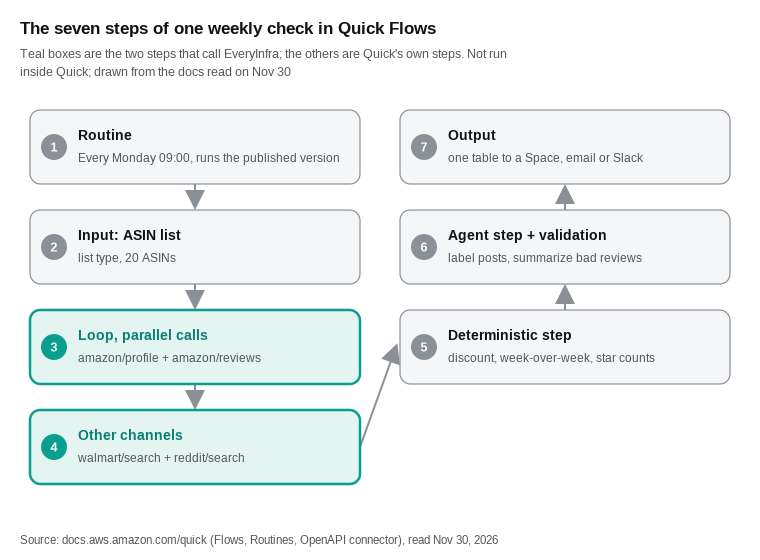
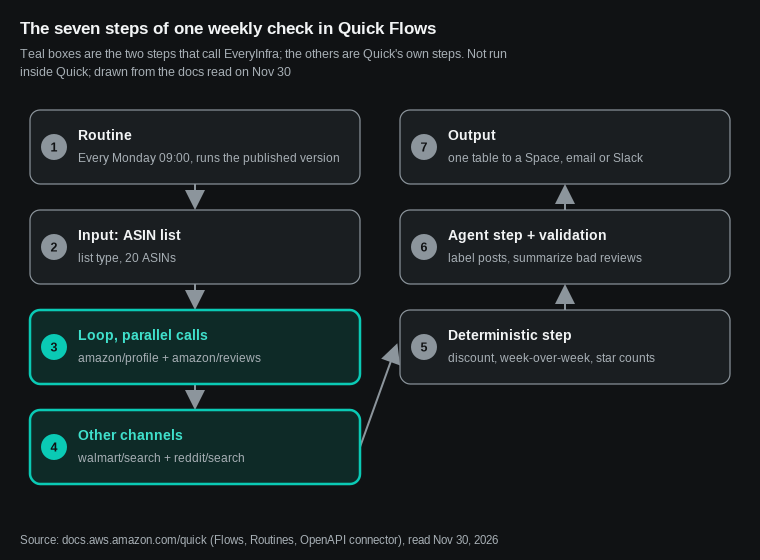
Only steps 3 and 4 touch outside data. The other five steps use features that Quick already has. A routine sets the schedule, and a list input holds the ASINs. A deterministic step does the math, and an agent step reads post titles and text to sort them. The output can go to a Space, email or Slack (Routines).
A deterministic step has no direct internet access, so it uses only the data that earlier steps give it. The discount and the week-over-week change use the same code every week. The agent works only on the step that needs reading and judgment.
How amazon quick flows calls an outside HTTP API or MCP server
The Flows page lists what a step can use (Flows). A step can use agents, skills and connectors, including cloud and local MCP connectors. It can also use system tools, Spaces, knowledge bases, the data that you give the flow and other flows. The system tools include web search and fetch URL. A step can use them only when you give them to that step (Built-in system tools).
For structured price and review fields, a connector is the better choice. Quick has four kinds of connectors: cloud connectors, system tools, local connectors and coding agents (Connectors). We looked at three paths for this job. The table after the three paths compares them.
The first path is a cloud MCP connector. The MCP integration page says that Quick supports only remote servers and prefers streamable HTTP. It does not support local stdio servers. Authentication has three options: user OAuth, service-to-service OAuth with client credentials, or no authentication (MCP integration).
Quick first sends a request with no credentials. It reads the resource_metadata address from the WWW-Authenticate header of the 401 response. Then it follows RFC 9728 to find the authorization server. It registers itself when the server supports dynamic client registration, or DCR (RFC 9728). The page also lists an AWS Quick Enterprise subscription as a requirement. The version that we read on 2026-11-30 has no option to put a fixed API key in a header.
The EveryInfra remote MCP endpoint https://api.everyinfra.com/mcp uses an API key. EveryInfra also has an OAuth endpoint, https://api.everyinfra.com/mcp/all, which the MCP server page describes. At 01:45 SGT on 2026-11-30 we did the steps from the Quick docs against this endpoint.
First, a POST with no credentials returned 401. The WWW-Authenticate header had a resource_metadata address for /.well-known/oauth-protected-resource/mcp/all. Second, that protected resource metadata named the authorization server https://auth.everyinfra.com/oidc, and bearer_methods_supported had only header. Third, the authorization server metadata had no registration_endpoint field, so Quick has no place to register a client.
The metadata lists client_credentials in grant_types_supported, and client_id_metadata_document_supported is true. Both of these need a client that EveryInfra already knows. Steps one and two work, but step three stops the connection. Today the cloud MCP connector cannot connect to EveryInfra until EveryInfra opens an OAuth client for Quick. For a weekly schedule, this leaves only the OpenAPI connector, because a local connector needs your computer on.
The Quick cloud connector is a client that follows the 2025-06-18 MCP authorization specification (MCP authorization). It follows the 401, finds the authorization server, registers and gets a token. It does not accept a key that you issued before. So an MCP server that accepts only a fixed Bearer key can use only a local connector or the OpenAPI connector in Quick. Both configurations below keep the key as a secret in Quick, not in a file.
The second path is a local connector in the Quick desktop app. The connectors page says that local connectors do not support OAuth or DCR, because the desktop app does not store or refresh tokens for them. To authenticate a URL server, you add a header such as an API key and save its value as a secret (Connectors). The EveryInfra /mcp endpoint uses this type of header key.
The cost of this path is in the Flows and Routines pages. A step that uses a local connector runs only in the desktop app. It runs only when the app is open and online. If your computer is off at the scheduled time, Quick marks the run as Skipped (Routines).
The third path is an OpenAPI connector. You upload an OpenAPI 3.0.0 or later spec in JSON, and Quick turns its operations into actions. Authentication can be OAuth 2.0, an API key in a header or query parameter, or none (OpenAPI Specification integration). It is a cloud connector, so scheduled runs do not need your computer.
Quick also has a REST API Connection connector. It accepts custom authentication headers, but the page says that it supports only actions, not data access or knowledge bases (REST API Connection). We keep it as a fallback.
| Path | Authentication (from the docs) | Scheduled run with your computer off | EveryInfra status on 2026-11-30 |
|---|---|---|---|
| Cloud MCP connector | User OAuth, service OAuth or none, with DCR | Runs | Does not connect: /mcp uses a key and the OAuth server has no DCR |
| Local desktop connector | No OAuth. URL servers accept an API key header | Skipped | Connects. Good when you run it at your desk |
| OpenAPI connector | OAuth 2.0, API key in header or query, or none | Runs | Connects. Spec below. Good for a weekly schedule |
| REST API Connection | User OAuth, service OAuth, custom auth header | Runs | Fallback. Docs say actions only |
The way that Quick separates reads from writes decides one thing. It decides if a scheduled run stops and waits for you. The connectors page gives the defaults: read actions are "Always allow" and write actions are "Ask each time" (Connectors). For MCP tools, only a tool that the server marks with readOnlyHint is a read action (MCP specification: tools).
At 00:20 SGT we sent tools/list to the EveryInfra /mcp endpoint without a key. Of the 12 tools, 11 had readOnlyHint: true. The only tool without it was everyinfra_create_ticket, which opens a support ticket. So with a local connector, the data tool everyinfra_call_api runs as a read action with no approval.
The OpenAPI connector uses a different default. GET is a read, and every other HTTP method is a write. The EveryInfra data endpoint is POST /api/v1/social, so by default each Monday run stops at "Needs input". The fix is the extension field x-amzn-operation-type, set to "read" on that operation.
The AWS Quick channel video "Your First Flow in 5 Minutes" shows the same issue (YouTube, AWS Quick channel). By default a flow asks you to approve actions. When you schedule it, you can change the action permission of a step so that it runs with no confirmation.
Configuration example 1: OpenAPI connector for EveryInfra
We do not have a Quick account, so we did not run this flow inside Quick. So the two configurations and every Quick step here are configuration examples, not test results. The facts about Quick come from aws.amazon.com and docs.aws.amazon.com, read on 2026-11-30.
This is the spec that we wrote for Quick. The full file is 3,560 bytes. It has only two operations, to stay inside the limits in the Quick docs. One is POST /api/v1/social for data, with enums that limit the platform and the action. The other is GET /api/v1/jobs/{job_id} for slow calls. The response body is a plain object, with no array inside.
{
  "openapi": "3.0.3",
  "info": {"title": "EveryInfra public data (review and price watch)", "version": "2026-11-30",
           "description": "Read-only calls to EveryInfra public data capabilities."},
  "servers": [{"url": "https://api.everyinfra.com"}],
  "components": {"securitySchemes": {"EveryInfraKey": {
    "type": "apiKey", "in": "header", "name": "Authorization",
    "description": "Enter: Bearer <your EveryInfra API key>"}}},
  "security": [{"EveryInfraKey": []}],
  "paths": {
    "/api/v1/social": {"post": {
      "operationId": "call_public_data",
      "description": "Calls one EveryInfra data capability. amazon/profile for price, amazon/reviews for page reviews, walmart/search, reddit/search. Failed and empty calls are not charged.",
      "x-amzn-operation-type": "read",
      "requestBody": {"required": true, "content": {"application/json": {"schema": {
        "type": "object", "required": ["platform", "action", "params"],
        "properties": {
          "platform": {"type": "string", "enum": ["amazon", "walmart", "reddit"], "description": "Data platform."},
          "action": {"type": "string", "enum": ["profile", "reviews", "search"], "description": "Capability."},
          "params": {"type": "object", "description": "url for profile and reviews, keyword for search.",
            "properties": {
              "url": {"type": "string", "description": "Product page URL."},
              "keyword": {"type": "string", "description": "Search words."},
              "limit": {"type": "integer", "description": "Maximum rows."}}}}}}}},
      "responses": {"200": {"description": "Rows in results; billing.charged_usd.",
        "content": {"application/json": {"schema": {"type": "object"}}}}}}},
    "/api/v1/jobs/{job_id}": {"get": {"operationId": "get_job", "description": "Result of a 202 call.",
      "parameters": [{"name": "job_id", "in": "path", "required": true, "description": "job_id from a 202.", "schema": {"type": "string"}}],
      "responses": {"200": {"description": "Job status and rows.", "content": {"application/json": {"schema": {"type": "object"}}}}}}}
  }
}
We checked the spec two times, and each check used rules from outside our own code. First, the open source tool openapi-spec-validator checked it against OpenAPI 3.0 (PyPI, OpenAPI 3.0.3). It passed.
Second, a rule script that we wrote line by line from the Quick docs checked it. The rules are: 1 MB or less, 1 to 100 operations, and paths and operation IDs that match the patterns in the docs. Each operation and parameter needs a description of 5,000 characters or less. Only application/json is allowed, with no array type and no allOf, oneOf, anyOf or not.
Our spec had 0 problems. To prove that the script finds errors, we also made a bad spec with one array field and one oneOf. The script found both of them.
| Limit in the Quick docs | Our spec | Result |
|---|---|---|
| OpenAPI 3.0.0 or later, JSON only | 3.0.3, JSON | Pass |
| 1 MB or less | 3,560 bytes | Pass |
| 1 to 100 operations | 2 | Pass |
| No array types | No arrays in request or response | 0 found. The bad spec's 1 was found |
| No allOf, oneOf, anyOf or not | Not used | 0 found. The bad spec's 1 was found |
| Each operation and parameter has a description of 5,000 characters or less | All have one | Pass |
| Non-GET is a write by default | x-amzn-operation-type: read | Set |
We could not test two points on our own machine, so they are open items. First, the auth scheme puts apiKey in the Authorization header, and you enter "Bearer", a space and your key. The Quick docs say that an API key in a header or query is supported. They do not say if Quick handles the Authorization header name in a special way.
Second, the docs say that Quick ignores an unsupported auth scheme and treats the connector as no auth. If your first call returns 401, change to a REST API Connection with a custom auth header. The EveryInfra REST API accepts a key only as Authorization: Bearer (quickstart).
Configuration example 2: local MCP connector on the desktop
Maybe you run the check yourself each Monday at your desk. Then a local connector is easier. In the Quick desktop app, select Create, then Local connector. You can paste a standard MCP server JSON block, or import one from tools such as Claude Code or Kiro (Connectors). This example uses the fields in the docs. Keep the key as a secret in Quick, not in the file.
{
  "mcpServers": {
    "everyinfra": {
      "type": "http",
      "url": "https://api.everyinfra.com/mcp",
      "headers": { "Authorization": "Bearer ${EVERYINFRA_API_KEY}" }
    }
  }
}
The troubleshooting part of the MCP integration page lists a common failure. Discovery passes, but publishing fails with "Creation failed". The usual cause is a tool inputSchema in JSON Schema Draft 3 style, with required as a boolean inside a property. Quick validates against Draft 7 or later, and it retries for 2 to 5 minutes before it shows the error (MCP integration).
We checked the inputSchema of all 12 EveryInfra tools against the Draft 7 meta-schema (JSON Schema Validation, Draft 7 era). There were 0 meta-schema errors and 0 boolean required fields. The data tool everyinfra_call_api has ["platform", "action"] as a root-level required array.
The same page describes MCP Sync. Built-in connectors sync their tool lists at 9 AM Pacific time on the first and third Monday of each month. For a custom connector, the owner must select Sync by hand. A custom connector that uses a VPC connection cannot sync, so you must delete it and make it again (MCP integration).
On 2025-10-30 a developer asked about this on the Quick community forum (Quick community). At that time the docs said that the tool list stays fixed after the first registration. The only fix was to delete and add the integration again. Now there is a manual Sync. New tools that a sync finds are off by default until the owner reviews them.
One real round trip: what the flow sends and what comes back
The OpenAPI path and the local MCP path send the same request on the network. This is the call that we sent at 00:15 SGT on 2026-11-30, for the detail page of the new sports earbud.
curl -s -X POST https://api.everyinfra.com/api/v1/social \
  -H "Authorization: Bearer $EVERYINFRA_API_KEY" \
  -H "Content-Type: application/json" \
  -d '{"platform":"amazon","action":"profile","params":{"url":"https://www.amazon.com/dp/B0HMQLM3H2"}}'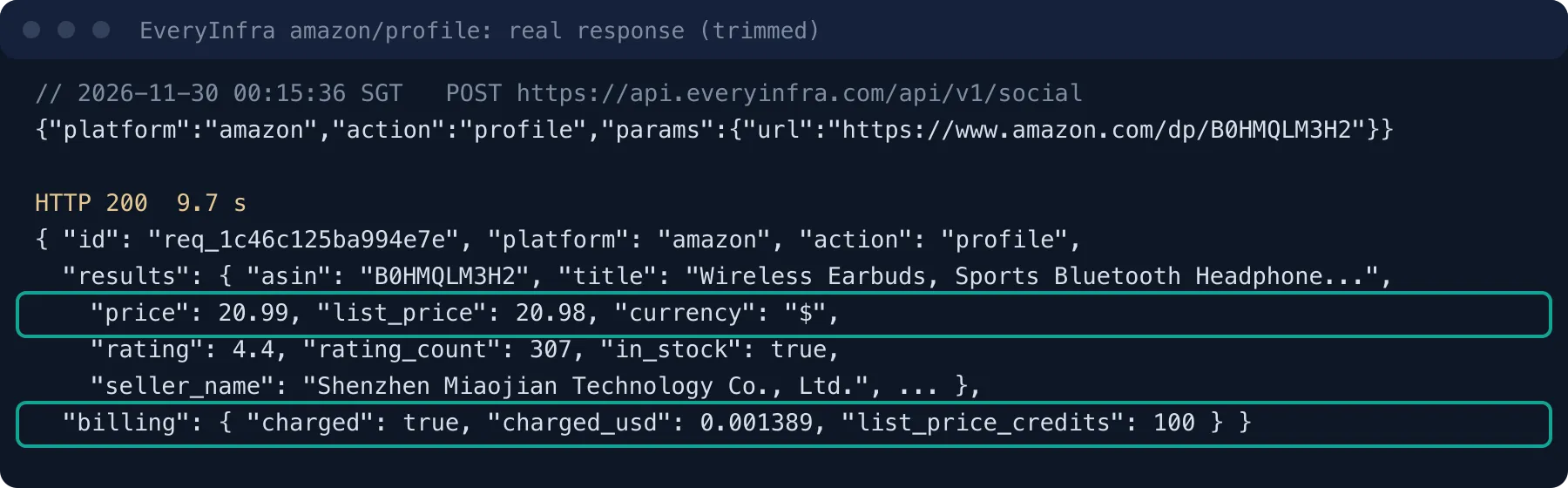
The response came back in 9.7 seconds. results held one object, and billing.charged_usd was 0.001389, the same as the catalog price (catalog). Each column of the weekly table maps to a field in the catalog response_fields.
| Table column | Capability | Fields |
|---|---|---|
| Price, list price, currency | amazon/profile | price, list_price, currency |
| Rating, rating count, in stock | amazon/profile | rating, rating_count, in_stock |
| Category rank | amazon/profile | bestseller_ranks (each has rank and category) |
| Review stars, date, verified purchase | amazon/reviews | rating, posted_at, is_verified_purchase, is_vine |
| Walmart price for the same item | walmart/search | name, price, rating, review_count, seller_name |
| Forum complaints | reddit/search | title, text, community, posted_at, comment_count |
Test 1: no critical reviews in the Amazon featured reviews
Between 00:16 and 00:17 SGT on 2026-11-30 we called amazon/reviews one time for each of the three ASINs. We set limit: 100, but each call returned 10 rows and cost $0.001389. The catalog explains this. On all marketplaces the capability returns only the featured reviews that the product page shows, usually ten to twenty for each product (amazon/reviews page). It cannot return the full review history.
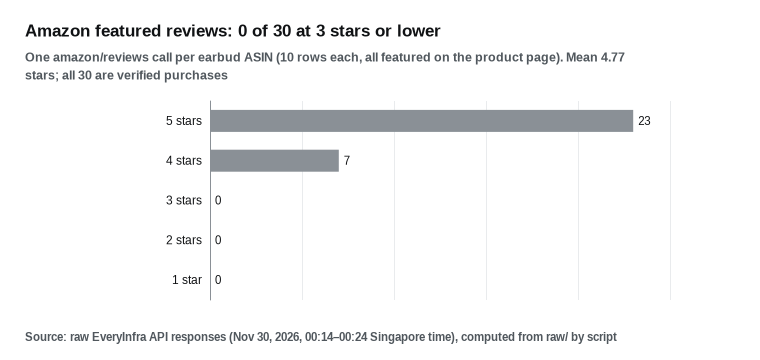
Of the 30 reviews, 23 had five stars and 7 had four stars. None had three stars or lower, and the average was 4.77 stars. All 30 were verified purchases, and none came from Amazon Vine. 16 of them were posted after 2026-10-31.
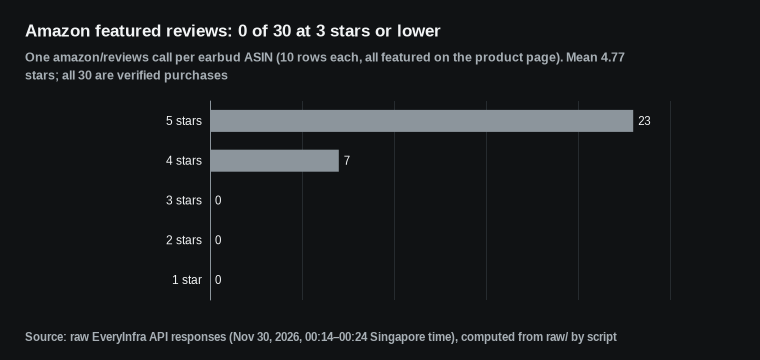
| ASIN | Product | Overall rating (`amazon/profile`) | Rating count | Featured reviews: 5 / 4 / 3 or fewer stars |
|---|---|---|---|---|
| B0HMQLM3H2 | New sports earbud | 4.4 | 307 | 10 rows, no review at 3 stars or fewer |
| B0FNWCYLZN | soundcore P31i | 4.4 | 12,770 | 10 rows, no review at 3 stars or fewer |
| B0CRTR3PMF | soundcore P30i | 4.3 | 48,521 | 10 rows, no review at 3 stars or fewer |
| All three | 23 / 7 / 0, average 4.77 |
The three products have overall ratings of 4.4, 4.4 and 4.3 stars from amazon/profile. Their rating counts go from 307 to 48,521. Products with 4.3 to 4.4 stars usually have some low-star reviews, and none of them were in the featured reviews. But 4.4 stars is also possible with only four-star and five-star reviews. The amazon/profile response has only rating and rating_count, with no star histogram, so the API cannot confirm this point.
The Amazon help page says that a machine learning model calculates product star ratings. It does not take a simple average, and it looks at factors such as review age and verified purchase (Amazon Help).
Amazon does not publish how it selects featured reviews, so we only record what the 30 reviews look like. Split by spaces, the median review text has 190.5 words. The shortest has 42 words and the longest has 775. The median number of "helpful" votes is 7.5, and 3 reviews have 0 votes. The top review is a P30i review from 2025-06-05 with 2,188 votes, and the second has only 58.
The three ASINs are also different. The median text length is 80 words for the new sports earbud, 288 words for the P31i and 153 words for the P30i. The 10 P30i reviews go from 2025-06-05 to 2026-11-26, but all reviews for the new earbud are from 2026-10-05 or later. 3 ASINs and 30 reviews are too few to show how Amazon selects reviews. We can say only that all 30 have four or five stars and all 30 are verified purchases.
At 00:25 SGT we called amazon/reviews again for B0HMQLM3H2. The 10 reviews were the same 10 as nine minutes before, a full overlap. The 10 reviews in this window cover several months, and Amazon decides which ones to replace. So a change from one week to the next does not tell you which reviews are new this week.
This changes how the flow uses amazon/reviews. Use it to record what the product page shows buyers now. Compare review IDs with last week's table, and count only new IDs as a change. Look for critical reviews in other channels.
Brand owners have one more option for their own ASINs. The SP-API Customer Feedback API returns the most positive and most negative review topics for each ASIN (Customer Feedback API). You can sort topics by mentions and by star impact, and you get monthly trends. It covers only ASINs that you have rights to, so it cannot show the two competitor products. Public data and this API work together.
Test 2: fault posts on Reddit in the same weeks
At 00:21 SGT on 2026-11-30 we ran reddit/search two times. "soundcore p31i" returned 9 posts, and "soundcore p30i problem" returned 14 posts. Each call cost $0.000792. Together they gave 23 rows, or 21 unique posts by post ID. The posts are dated from 2026-11-02 to 2026-11-26, with 6, 6, 5 and 4 posts in the four weeks. 15 of the 21 posts are in r/soundcore and r/Earbuds. The other 6 are in communities such as r/deals, r/CPAP and r/iPodTouch, and the keywords found them by chance.
We read the title and the start of the text of each post. The rules are in our analysis script. A post about a fault, a return, a warranty claim or strange behavior is a fault post. Then we sorted the fault posts by model.
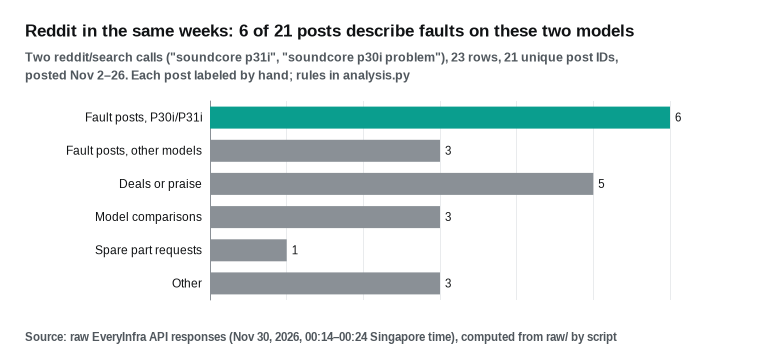
Of the 21 posts, 6 were fault posts for the P30i or P31i. The same LDAC text appeared in r/soundcore and in r/Earbuds, so the 6 posts describe 5 different problems. The table lists them with the post date.
| Post date | Community | Model | Problem in the post | Link |
|---|---|---|---|---|
| 2026-11-07 | r/soundcore | P31i | Unstable LDAC connection with an Android phone, thinking about a return | post |
| 2026-11-08 | r/Earbuds | P31i | Same text as the post above | post |
| 2026-11-06 | r/soundcore | P30i | Heartbeat-like thump in one ear in noise cancelling mode, also on the replacement | post |
| 2026-11-09 | r/soundcore | P30i | Stopped charging after about six months | post |
| 2026-11-18 | r/soundcore | P30i | With an iPad and an iPhone, sound in only one ear on each device | post |
| 2026-11-23 | r/soundcore | P30i | Right earbud always shows 10% less battery | post |
This step gives the flow four rules. First, remove duplicate Reddit posts by post ID and by text, because one person can post in two communities. Second, the search with "problem" also returned 3 fault posts for other models, such as the Sleep A30, P20i and A25i. An agent step that reads the text and finds the model does this better than a keyword filter in a deterministic step.
Third, Reddit gives only a few posts each week, 4 to 6 in this test. That is good for a summary that a person reads, but too few to calculate shares. "N new fault posts this week, with links" is enough for the table. Fourth, keep only posts from r/soundcore and r/Earbuds. In this test that keeps 15 of the 21 posts and all 6 fault posts for the P30i and P31i (5 in r/soundcore and 1 in r/Earbuds). The agent step then reads almost 30% less text.
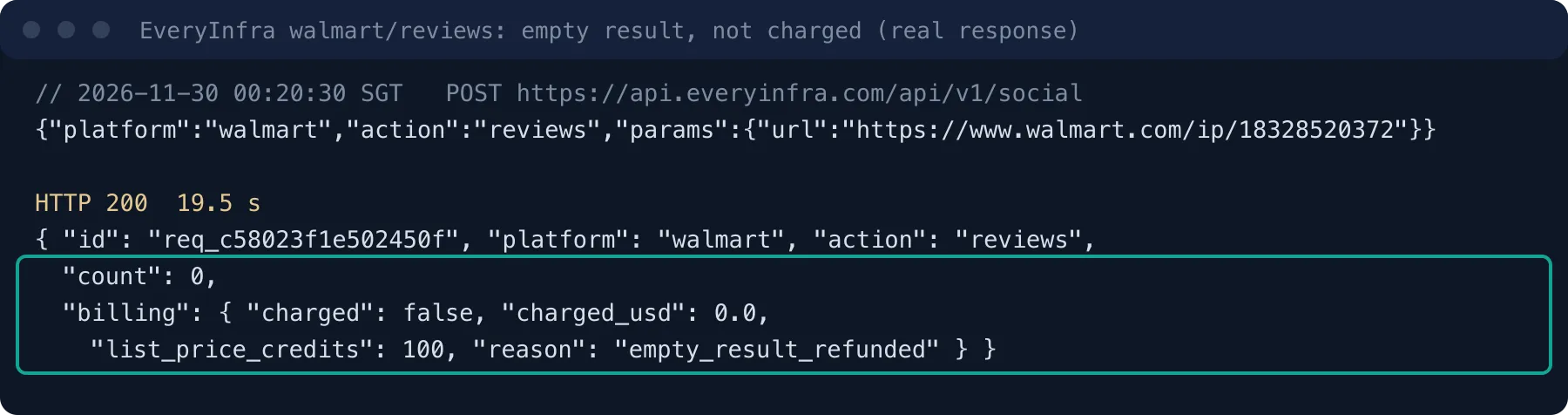
In the same round we also tried Walmart reviews. At 00:20 SGT we called walmart/reviews for the black P31i on Walmart, item 18328520372. After 19.5 seconds it returned 200 with count 0 and billing.charged_usd 0. The reason field said empty_result_refunded.
An empty result costs nothing, and this helps the flow. When some products in the loop return no reviews in a week, you do not pay for them. But the output table must show "0 rows" and "call failed" as two different states.
Test 3: price, list price and the Walmart listing
For prices, we read amazon/profile for the same ASINs at 00:15, 00:21 and 00:25 SGT. The P31i was $29.99 each time, with a list price of $59.99, a 50.0% discount. The P30i was $25.64 both times, with a list price of $49.99, a 48.7% discount. The new sports earbud was $20.99 both times, but its list price was $20.98, 1 cent below the price.
| Product | Price at 00:15 SGT | Price at 00:21–00:25 SGT | List price | Discount |
|---|---|---|---|---|
| soundcore P31i (B0FNWCYLZN) | $29.99 | $29.99 | $59.99 | 50.0% |
| soundcore P30i (B0CRTR3PMF) | $25.64 | $25.64 | $49.99 | 48.7% |
| New sports earbud (B0HMQLM3H2) | $20.99 | $20.99 | $20.98 | Not valid: list price below price |
| P31i black on Walmart (item 18328520372) | $29.99 at 00:17 SGT | Same price as Amazon |
A gap of a few minutes does not show a price trend. It shows only that the API gives stable readings in a short window. The weekly table shows the trend over time.
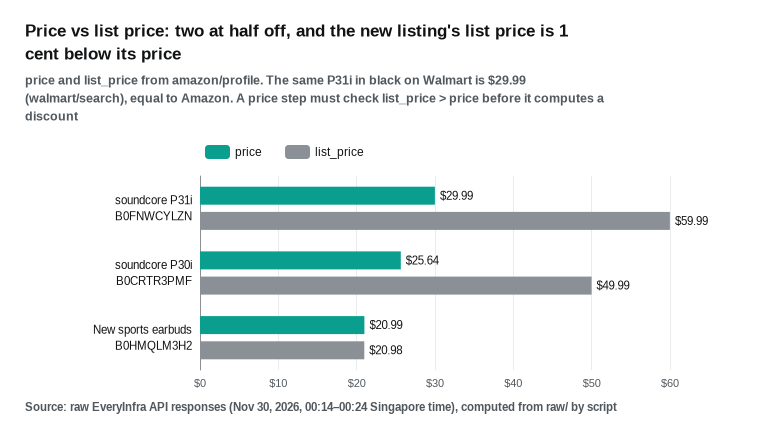
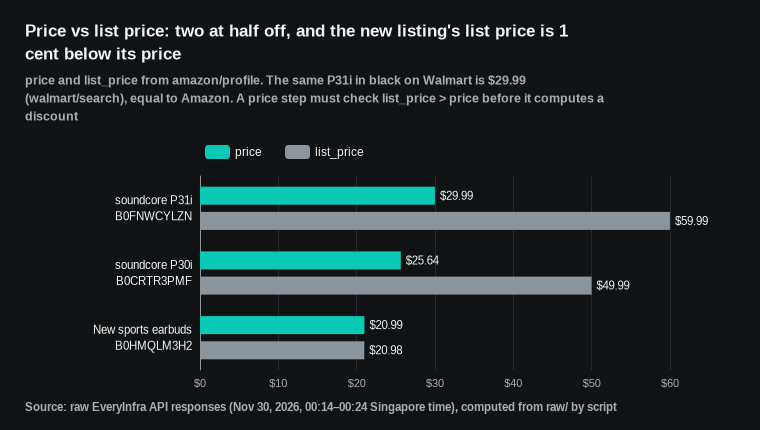
A list price below the price gives a discount of -0.05% if you use it directly. In a weekly report this looks like a price increase. Put this check in a deterministic step. Calculate a discount only when list_price is higher than price. Otherwise leave the cell empty and add a flag.
The Flows page says that Quick writes the code of a deterministic step. The code is read only and runs the same way each time (Flows). You write the rule one time, and it applies every week. This is the type of check where a fixed rule is better than an agent.
On the Walmart side, at 00:17 SGT we searched walmart/search for "soundcore P31i earbuds". It returned 20 rows for 18 different products. The black P31i was $29.99 with 4.3 stars and 78 reviews, sold by AnkerDirect, the same price as on Amazon.
There were only two P31i items. The white version came with a USB-C charger, cost $33.49 and had no rating. A refurbished P30i cost $17.99, which is $7.65 below the new P30i on Amazon at $25.64. The other 15 items were other soundcore models, such as the Q30, Space One, Q20i and AeroClip.
| Walmart item in the `walmart/search` results | Item ID | Price | Stars | Reviews |
|---|---|---|---|---|
| soundcore P31i, black | 18328520372 | $29.99 | 4.3 | 78 |
| soundcore P31i, white, with USB-C charger | 20815673443 | $33.49 | none | none |
| Refurbished soundcore P30i | 20128955163 | $17.99 | 5 | 1 |
| 15 other soundcore models | various | $41.47 to $144.69 | various | various |
Search results come from keywords, so another color, a bundle with accessories or a refurbished unit can appear in them. If the flow takes the price of any title that has "P30i", the P30i row can show the $17.99 refurbished price. Add a fixed rule to the deterministic step. Rows with Restored or Refurbished in the title do not go into the price comparison. Put them at the end of the table.
On the first run, have a person match each ASIN to one Walmart item ID and save it in the input table. Then each week read it directly with walmart/profile, which also costs $0.001389 for each call.
Reuters, citing Adobe Analytics, reported that US online spending on Black Friday 2026 was $13.1 billion, up 11% from a year before (Reuters, 2026-11-28). Adobe expected $15.1 billion for Cyber Monday, up 6.2%. Traffic from chatbots and AI browsers converted 68% better than a year earlier.
We read the prices on the morning of Sunday, November 29, US Eastern time. The P31i and the P30i both had discounts of about half. One P31i review from 2026-11-24 says that the buyer paid only $30, and that it seemed to be an early Black Friday deal. In the weeks around a big sale, one reading each week can miss a short price drop. To catch those drops, run the price step more often.
Who does each step: agent steps and deterministic steps
The Flows page gives the split. Use agent steps for judgment and deterministic steps for exact work that must be the same each time. Agent steps have core tools such as code execution, file operations and date and time. You must add web search and browser automation separately (Flows).
The 2026-11-20 release note uses accounts payable as its example. An agent reads invoices and matches purchase orders. A deterministic step checks totals and finds duplicates (What's New). We used the same rule for each step of the weekly check.
| Step | Type | Uses | Reason |
|---|---|---|---|
| Read the ASIN list and last week's table | Input and Space | List input, Space file | Runs have no memory, so last week's table must come from a Space |
| Get detail and reviews for each ASIN | Agent (Loop, items at the same time) | OpenAPI connector call_public_data | Builds a request for each ASIN and handles 202 slow calls |
| Walmart and Reddit | Agent | Same connector | Reddit keywords depend on the model |
| Discount, week-over-week change, star counts | Deterministic | Code execution | Fixed math. Leave the discount empty when list price is below price |
| Sort Reddit posts, write a complaint summary | Agent with validation | No outside tools | Must read text to find the model and the problem |
| Make the table and send it | Output | Space, email or Slack connector | Sending is a write action and needs approval on the first run |
We suggest three validation rules. The table must have exactly 20 rows. The price column must hold a number or say "not found". Each fault post must have a link to the source post.
If validation fails, run the step one more time. If it fails again, continue and mark the table header in red, so one failure does not block the full report. Smart Approvals can approve some low-risk actions for you. Today it is only in the desktop and mobile apps, not on the web (Smart Approvals). Actions that send content outside your organization, change permissions, delete data or make payments always go to a person.
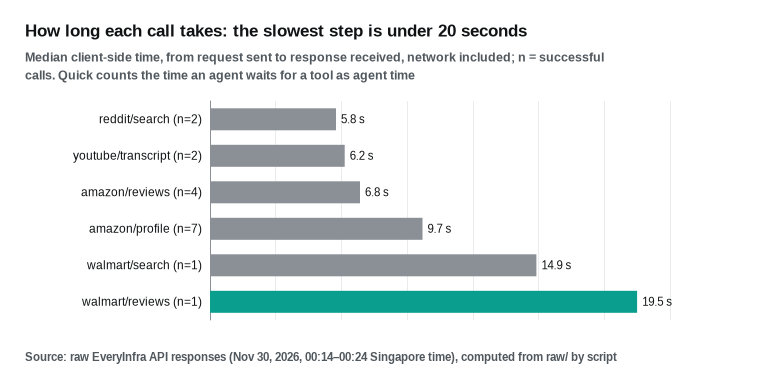
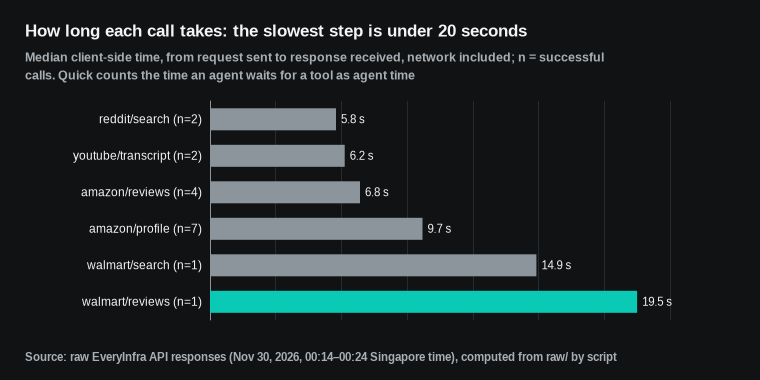
Wait time is also a cost. The Quick pricing FAQ says that agent wait time for an outside tool usually counts as agent time (AWS Quick pricing). With our median times, one ASIN waits about 37.2 seconds for amazon/profile, amazon/reviews, walmart/search and reddit/search in sequence. 20 ASINs in sequence wait about 12.4 minutes.
A loop can run items at the same time, which shortens the clock time. The pricing page does not say how waits that overlap count toward agent hours. So we use the sequential time as the upper limit.
After the schedule starts: identity, logs and data paths
A manual run and a weekly run use two different identities in Quick. The security page separates two kinds of calls. An on-demand action starts in a chat session and uses the user's own credentials, with a person present. An automated workflow starts on a schedule or an event and uses service-level authentication (AI and agent security).
The same page gives a two-condition model for risk. The risk is highest when the agent reads content from outside your trust boundary and can also take an action with real effects. If you narrow either condition, you reduce the exposure.
This weekly check meets the first condition. Reddit posts and product page reviews are text from strangers, and the agent step reads them. So narrow the second condition. Allow only two write actions: save the report to a team Space and post it to an internal channel. Do not give the flow actions that email outside addresses or change listings.
The data tool call_public_data is already marked as a read, and it changes nothing. The outbound connections page lists each path out of Quick (Outbound connections). Connectors send chat context and structured parameters to the connected service. Remote MCP servers get tool parameters from the chat, and an administrator can set them up only with an Enterprise subscription.
The desktop security page also says where each request starts (Quick on desktop security). Calls to cloud connectors start in the Quick service and go over the internet or a VPC, not from the user's device. Code runs in a sandbox with no network access. Web search and fetch URL start on AWS infrastructure, so your own proxy and firewall do not see them.
For EveryInfra, an OpenAPI connector call comes from an AWS address. A local connector call comes from your own network.
The CloudWatch Logs page lists the log types that Quick can send (Monitoring with CloudWatch Logs). AGENT_HOURS_LOGS records agent hours for each agent. TOOL_CALL_LOGS records permission decisions and approvals for tools. You need an Enterprise or Professional subscription, and logs start only after you set up delivery.
| Log type or tool | What it records | Use in this flow |
|---|---|---|
AGENT_HOURS_LOGS | Agent hours for each agent | Compare real use with the 12.4-minute estimate |
TOOL_CALL_LOGS | Permission decisions and approvals for tools | See which step waited for approval |
CHAT_LOGS | User message, response and status | Check what the agent step wrote |
| Analytics dashboard | Flow runs, action calls, agent hours (IAM administrators only) | Monthly review of the check |
Administrators can also see flow runs, action calls and agent hours in the analytics dashboard. Today only IAM administrators can open it (Analytics dashboard). Send both log types to CloudWatch before the first publish. Then you can see how many agent hours the first week used and which step waited for approval.
Everyone with access to a Space can see and download its files (Spaces). Before you save last week's competitor price table, decide which Space it goes in and who can see it.
Monthly cost: 20 ASINs, one check each week
API fees use the catalog price_usd that we read at 00:13 SGT on 2026-11-30 (catalog). amazon/profile, amazon/reviews and walmart/search each cost $0.001389 for each call. reddit/search costs $0.000792. One ASIN each week needs 4 calls for $0.004959.
For 20 ASINs and 52 ÷ 12 ≈ 4.33 weeks each month, the total is $0.4298, or about $0.43. If you read prices every day and keep reviews and other channels weekly, the total is about $1.15. Daily prices for 20 ASINs cost $0.84, with 365 ÷ 12 ≈ 30.4 days in a month. Weekly reviews, Walmart and Reddit cost $0.31. If the full flow runs every day, a month costs about $3.02. So in sales weeks, run only the price step every day and save about $1.86.
The other steps change slowly. In this test the 10 featured reviews did not change in nine minutes. The two Reddit searches gave only 4 to 6 posts each week. The empty Walmart review result in this test cost $0. The catalog says that failed calls and rate-limited calls (429) are also free. So if some ASINs return nothing in a week, the monthly cost is less than $0.43.
| Item | Unit price | Calls each month | Monthly cost |
|---|---|---|---|
amazon/profile | $0.001389 | 86.7 | $0.1204 |
amazon/reviews | $0.001389 | 86.7 | $0.1204 |
walmart/search | $0.001389 | 86.7 | $0.1204 |
reddit/search | $0.000792 | 86.7 | $0.0686 |
| Total API fees | 346.7 | $0.4298 | |
| Live calls for this article (20 successful, 19 charged) | $0.022934 |
The Quick side uses the pricing page that we read on 2026-11-30 (AWS Quick pricing). The three plans for organizations need an AWS account and add $250 each month for each account as an infrastructure fee. Essentials is $3 for each user each month with 1 agent hour, or 3 hours until 2027-01-31. Professional is $20 with up to 8 agent hours. Enterprise is $40 with up to 18 agent hours.
Extra agent hours cost $3 each, billed by the second. For people and small teams, Plus is $20 for each user each month with yearly billing or $25 with monthly billing. Max is $100 or $125. New customers get a 30-day free trial for up to 25 users, with no subscription or infrastructure fee.
| Quick plan | Each user each month | Account infrastructure fee | Agent hours for each user each month | Fit for this flow |
|---|---|---|---|---|
| Plus | $20 (yearly) / $25 (monthly) | None | Not listed in hours | Includes Flows. The docs that we read do not say if Plus can make OpenAPI connectors |
| Essentials | $3 | $250 | 1 (3 until 2027-01-31) | Includes Flows. An admin must set an overage tier first |
| Professional | $20 | $250 | Up to 8 | A weekly check fits inside the hours |
| Enterprise | $40 | $250 | Up to 18 | The MCP integration page lists Enterprise as a requirement |
Put the two sides together. One Professional user costs $20 plus $250, or $270 a month. The API fees for 20 ASINs in the same month are about $0.43.
Our estimate of agent time uses the sequential upper limit from the last section. One run is about 12.4 minutes, so a month is about 0.90 agent hours, inside the 8 hours of Professional. At the overage price, those hours would cost about $2.7. Real use depends on the Fast, Balanced and Smart modes and on how much reasoning the agent steps do. The pricing page says that stronger modes use hours faster, and we did not run the flow in Quick. Use this number only as a rough size.
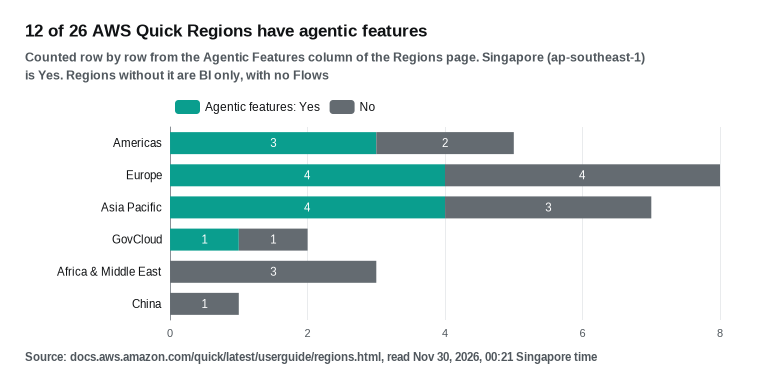
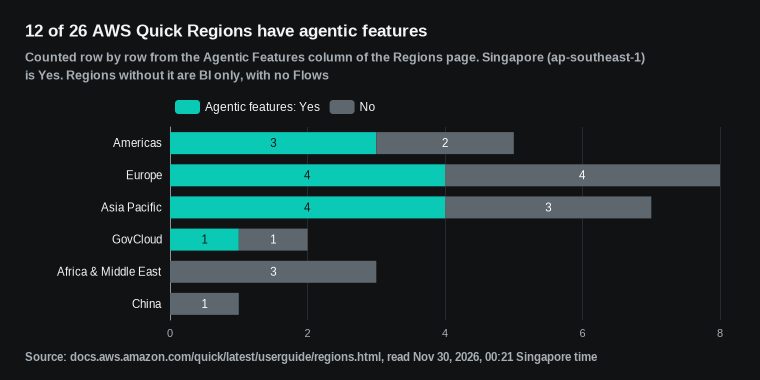
Your Region also decides if you can use Flows. The Regions table in the docs has an "Agentic Features" column, and we counted each row (AWS Regions). 12 of 26 Regions say Yes. They include Singapore ap-southeast-1, Tokyo, Sydney, Mumbai, Frankfurt, Ireland, London, Paris, São Paulo, N. Virginia, Oregon and GovCloud (US-West).
Web search requests can go to another Region. For example, Mumbai requests go to Tokyo and London requests go to Ireland. If your team has data residency rules, read this table before you open an account. In November 2025 scheduled runs had only three Regions. The 2026-11-20 update says that the new features are in all Regions where AWS Quick is available.
Where this weekly check can go wrong
| Limit | Effect | What to do |
|---|---|---|
| Featured reviews only | No full history and no star histogram | Add Reddit, YouTube comments or the Customer Feedback API |
| Local connector needs your computer | Scheduled runs are Skipped when it is off | Use the OpenAPI connector for schedules |
| No memory between runs | No week-over-week change by default | Save a dated table to a Space |
| No arrays in OpenAPI connectors | Array parameters such as urls are not available | Call one item at a time |
| Reruns start at step one | Successful ASINs are called again | Expect about $0.10 for a full rerun of 20 ASINs |
Featured reviews show only part of the picture. amazon/reviews returns only the ten to twenty reviews on the product page, not the full history or the star histogram. A complaint check that uses only this data can say "no complaints this week" when that is false.
There are two ways to fill the gap. Brand owners can use the Customer Feedback API for negative topics on their own ASINs. For competitors and the wider web, look at public channels such as Reddit and YouTube comments. The YouTube scraper API returns comments at $0.000556 for each call.
A local connector needs that computer. The Routines page says that steps with local tools need the computer on, the app open and a network connection. If not, the run is skipped and shows as Skipped in Mission Control (Routines). A schedule can run every 15 minutes or less often, on days of the week, but not on a day of the month. A Monday 09:00 schedule works, but a first-of-month report needs another design.
The flow does not remember last week. The Flows page says that runs do not use memory, so a week-over-week change needs storage. Save a dated table to a Space, and read it back in the first step next week.
Compare reviews as sets of review_id. Only IDs that are in this week's table and not in last week's table go into the "new" column. In this test the two readings for B0HMQLM3H2 at 00:16 and 00:25 SGT had no difference. A failed run starts again from step one, so it also calls the ASINs that already succeeded. A full rerun of 20 ASINs costs about $0.10 more, which is small, but you should expect it.
In the AWS Quick channel video, the presenter describes a flow that reads email (YouTube, AWS Quick channel). He says that Quick first chose the wrong action connector, and he had to change the prompt. He also says that list APIs often return only IDs and titles, so you need a second call to a detail API.
For this flow, open each step after the first test run. Check that it calls call_public_data and that the ASIN in the parameters is correct. A walmart/search result is also only a list. After you choose the item, change to the detail API.
There are a few smaller points. The OpenAPI connector does not support arrays. Some EveryInfra capabilities take array parameters, such as urls for many links in one call. In Quick you must call these one item at a time. A limit of 100 still returns ten to twenty rows for amazon/reviews, and you are not charged more for it. Reddit usernames are personal data, so the weekly report should hold only post links and summaries.
In the first week, compare the flow output with a manual table. After the Monday run, open the product pages of 3 ASINs and write down the price and list price. Then search Reddit with the same keywords and compare the two results. Do the manual check at the same time as the flow. Prices can change in one day during sales weeks.
If a price does not match, first check if the flow read another color, a bundle or a refurbished unit. Then check the ASIN. If the Reddit count does not match, first check the deduplication, and then check if the agent counted another model.
In our test, the readings from 00:15 to 00:25 SGT had the same prices, and the 10 featured reviews matched fully. This shows only that the readings did not change in 10 minutes. It does not show where a difference after one week comes from. After the first week, check only the validation flags in the table header. Also check the tool call records in CloudWatch.
Related articles
For operations, read AWS DevOps Agent with MCP. For advertising, read Amazon Ads MCP. To load reviews into a database for sentiment analysis, read the Amazon review pipeline guide. To choose comparable offers when you track prices, read Amazon price tracking. Quick Flows fits a fixed weekly report for coworkers who do not write code. For a large, daily data warehouse with full history, call the API from code.
Industry updates (last 60 days)
| Date | Event | Effect on this weekly check |
|---|---|---|
| 2026-09-23 | Amazon announced the Selling Partner plugin at Amazon Accelerate, in beta in Quick (per the AWS blog, 2026-11-19) | Your own store data has a first-party chat entry. Public data covers competitors and other channels |
| 2026-10-26 | Quick docs added Smart Approvals (document history) | Low-risk actions can get approval without you, but not on the web |
| 2026-11-16 | Quick web, desktop and mobile became one experience, with always-on agents on the web (same source) | You can manage scheduled flows on the web and see runs in Mission Control |
| 2026-11-19 | AWS described the Selling Partner plugin. Quick Plus is free for 12 months for primary Amazon seller accounts that claim it by 2026-12-31 | Sellers can try Quick at no cost, and they will need outside data next |
| 2026-11-20 | Flows added chat-built flows, deterministic steps and agents that work together (AWS blog) | Data calls and math can be separate, and the math gives the same result each time |
| 2026-11-28 | Adobe: US Black Friday online spending was $13.1 billion, up 11% (Reuters) | Prices change fast in sales weeks, and one weekly reading can miss short drops |
| 2026-11-30 | Quick docs added TOOL_CALL_LOGS. re:Invent 2026 starts today and ends 12-04 (re:Invent guide) | Tool approvals can go to CloudWatch for audit. More releases may come this week |
FAQ
What is the difference between amazon quick flows and Quick Automate?
This question comes from the Google suggestion "amazon quick flows vs automate" (read on 2026-11-30). The AWS launch post of 2025-10-09 says that Quick Flows handles simple processes (AWS News Blog). Quick Automate is for complex processes such as customer onboarding, procurement and compliance, with approvals, system integration and work across teams. It has more monitoring, debugging, versioning and deployment features. On the pricing page, Automate for multistep processes needs the Enterprise plan. A fixed seven-step weekly check fits Flows.
Does amazon quick flow have an API?
This question comes from the suggestion "amazon quick flow api" (read on 2026-11-30). Yes. The Flows page lists CreateFlow, UpdateFlow, DescribeFlow, ListFlows, SearchFlows, DeleteFlow and some permission operations, and they work only on published flows (Flows). CreateFlow makes a draft and a published version in one call. A ClientToken lets you retry safely without a duplicate flow (CreateFlow).
FlowDefinition uses an internal format that can change, so get the latest definition from DescribeFlow before you edit it. DescribeFlow reads the DRAFT, PUBLISHED or PENDING_APPROVAL version and returns 429 when you are throttled (DescribeFlow). You can use the same check in several seller accounts. Export it with DescribeFlow, and create it in each account with CreateFlow. This API manages flows. To call an outside API inside a flow, you still use a connector.
Can aws quick flows run every week on its own?
This question comes from schedule searches around "aws quick suite flows" (read on 2026-11-30). Yes. Add the published flow to a routine schedule. It can run every 15 minutes or less often, on the days of the week that you choose (Routines). Scheduled runs happen in the cloud while your computer is off, except for steps with local tools. The schedule has no extra fee, but run time counts as agent hours.
Where are the amazon quick flows documentation and tutorials?
This question comes from the suggestions "amazon quick flows documentation" and "amazon quick flow tutorial" (read on 2026-11-30). The Flows page of the user guide has the most complete rules (Flows). For a step-by-step guide, read "Automate repetitive tasks with AWS Quick Flows" on the AWS Machine Learning Blog (AWS blog). For video, see "Automate Tasks with Quick Flows" on the AWS Quick channel (YouTube) and the product introduction on the AWS channel (YouTube).
How do I refresh Quick after my MCP server adds a new tool?
This question comes from a Quick community forum post on 2025-10-30 (Quick community). At that time the author had to delete the integration and add it again. The current docs say that the owner of a custom MCP connector selects Sync on the connector detail page (MCP integration). Built-in connectors sync two times each month. A custom connector with a VPC connection cannot sync, and new tools are off by default.
The Amazon product page shows only good reviews. Where are the complaints?
This question comes from our test at 00:16 SGT on 2026-11-30. The 30 featured reviews for 3 ASINs had zero reviews at three stars or lower. In the same weeks, 6 of 21 Reddit posts were fault posts. For your own ASINs, use the SP-API Customer Feedback API for negative topics. For competitors, look at public discussions such as Reddit and YouTube comments.
The FTC rule of August 2024 bans fake reviews and the suppression of negative reviews (FTC). The text is in 16 CFR Part 465 (eCFR). When you read review data, also ask if the source is reliable.
Get started
- Sign up for EveryInfra and get an API key from the quickstart. Call
amazon/profileone time with curl and findbilling.charged_usdin the response. - Check the unit price of the four capabilities in the API market or on the pricing page. Calculate the monthly cost for your number of ASINs.
- Save the OpenAPI spec above as JSON. In Quick, select Connectors, Create for your team, then OpenAPI Specification. Import the file and check the actions. Enter "Bearer", a space and your key as the auth value.
- Describe the seven steps in chat and let Quick build a draft. Limit the data steps to this connector. Change the discount step to deterministic, then run one test.
- Publish after the test passes. In Routines, add a schedule for Monday 09:00, with output to a team Space or a Slack channel.
References
- Flows, AWS Quick User Guide, AWS, read on 2026-11-30, https://docs.aws.amazon.com/quick/latest/userguide/working-with-flows.html
- Model Context Protocol (MCP) integration, AWS, read on 2026-11-30, https://docs.aws.amazon.com/quick/latest/userguide/mcp-integration.html
- OpenAPI Specification integration, AWS, read on 2026-11-30, https://docs.aws.amazon.com/quick/latest/userguide/openapi-integration.html
- REST API Connection integration, AWS, read on 2026-11-30, https://docs.aws.amazon.com/quick/latest/userguide/rest-api-integration.html
- Authentication methods, AWS, read on 2026-11-30, https://docs.aws.amazon.com/quick/latest/userguide/quick-action-auth.html
- Connectors, AWS, read on 2026-11-30, https://docs.aws.amazon.com/quick/latest/userguide/integrations-connectors.html
- Built-in system tools, AWS, read on 2026-11-30, https://docs.aws.amazon.com/quick/latest/userguide/system-tools.html
- Routines, AWS, read on 2026-11-30, https://docs.aws.amazon.com/quick/latest/userguide/working-with-routines.html
- AWS Regions and related information, AWS, read on 2026-11-30, https://docs.aws.amazon.com/quick/latest/userguide/regions.html
- Document history for the AWS Quick User Guide, AWS, read on 2026-11-30, https://docs.aws.amazon.com/quick/latest/userguide/doc-history.html
- Smart Approvals, AWS, read on 2026-11-30, https://docs.aws.amazon.com/quick/latest/userguide/smart-approvals.html
- What is AWS Quick?, AWS, read on 2026-11-30, https://docs.aws.amazon.com/quick/latest/userguide/what-is.html
- CreateFlow, AWS Quick API Reference, AWS, read on 2026-11-30, https://docs.aws.amazon.com/quicksight/latest/APIReference/API_CreateFlow.html
- DescribeFlow, AWS Quick API Reference, AWS, read on 2026-11-30, https://docs.aws.amazon.com/quicksight/latest/APIReference/API_DescribeFlow.html
- Monitoring AWS Quick using CloudWatch Logs, AWS, read on 2026-11-30, https://docs.aws.amazon.com/quick/latest/userguide/monitoring-cloudwatch-logs.html
- Using the AWS Quick analytics dashboard, AWS, read on 2026-11-30, https://docs.aws.amazon.com/quick/latest/userguide/incident-response-logging-and-monitoring-quick-suite.html
- Organize, collaborate, and share resources with spaces in AWS Quick, AWS, read on 2026-11-30, https://docs.aws.amazon.com/quick/latest/userguide/working-with-spaces.html
- What is AWS Quick on desktop?, AWS, read on 2026-11-30, https://docs.aws.amazon.com/quick/latest/userguide/what-is-desktop.html
- AI and agent security in AWS Quick, AWS, read on 2026-11-30, https://docs.aws.amazon.com/quick/latest/userguide/sec-agentic-security.html
- Security, privacy, and architecture of AWS Quick on desktop, AWS, read on 2026-11-30, https://docs.aws.amazon.com/quick/latest/userguide/desktop-security.html
- Outbound connections and data egress in AWS Quick, AWS, read on 2026-11-30, https://docs.aws.amazon.com/quick/latest/userguide/outbound-connections.html
- AWS Quick pricing, AWS, read on 2026-11-30, https://aws.amazon.com/quick/pricing/
- New in AWS Quick: More capable flows, an updated web experience, and agents that work together, AWS Machine Learning Blog, 2026-11-20, https://aws.amazon.com/blogs/machine-learning/new-in-aws-quick-more-capable-flows-an-updated-web-experience-and-agents-that-work-together/
- Build more capable automations through chat with Flows in AWS Quick, AWS What's New, November 2026, https://aws.amazon.com/about-aws/whats-new/2026/11/aws-quick-flows-automations-chat
- Run your whole selling business in AWS Quick, AWS Machine Learning Blog, 2026-11-19, https://aws.amazon.com/blogs/machine-learning/run-your-whole-selling-business-in-aws-quick/
- How skills and agents work in AWS Quick, AWS Machine Learning Blog, 2026-11-04, https://aws.amazon.com/blogs/machine-learning/how-skills-and-agents-work-in-aws-quick/
- Your complete guide to AWS Quick at AWS re:Invent 2026, AWS Machine Learning Blog, November 2026, https://aws.amazon.com/blogs/machine-learning/your-complete-guide-to-aws-quick-at-aws-reinvent-2026/
- Announcing Amazon Quick Suite, AWS News Blog, 2025-10-09, https://aws.amazon.com/blogs/aws/reimagine-the-way-you-work-with-ai-agents-in-amazon-quick-suite/
- Amazon Quick Suite introduces scheduling for Quick Flows, AWS What's New, 2025-11-25, https://aws.amazon.com/about-aws/whats-new/2025/11/amazon-quick-suite-scheduling-quick-flows/
- Amazon Quick Suite integrates Quick Research with Quick Flows, AWS What's New, 2025-12-08, https://aws.amazon.com/about-aws/whats-new/2025/12/amazon-quick-suite-research-flows-report-automation/
- Automate repetitive tasks with AWS Quick Flows, AWS Machine Learning Blog, read on 2026-11-30, https://aws.amazon.com/blogs/machine-learning/automate-repetitive-tasks-with-amazon-quick-flows/
- Refreshing an mcp integration with quicksuite, Quick community forum, 2025-10-30, https://community.amazonquicksight.com/t/refreshing-an-mcp-integration-with-quicksuite/50361
- Your First Flow in 5 Minutes, Amazon Quick Flows, YouTube (AWS Quick channel), transcript read on 2026-11-30, https://www.youtube.com/watch?v=1EeAti4K8gM
- Automate Tasks with Quick Flows, YouTube (AWS Quick channel), transcript read on 2026-11-30, https://www.youtube.com/watch?v=ki_MHsn0HqI
- Introducing Amazon Quick Flows, YouTube (Amazon Web Services channel), 2025-10-09, https://www.youtube.com/watch?v=nUUS3iYUQi0
- Amazon Selling Partner plugin, Amazon seller developer site, read on 2026-11-30, https://developer.amazonservices.com/amazon-selling-partner-plugin
- Customer Feedback API, Amazon SP-API documentation, read on 2026-11-30, https://developer-docs.amazon.com/sp-api/docs/customer-feedback-api
- Connecting to the Amazon Ads MCP Server (Lite), Amazon Ads, read on 2026-11-30, https://advertising.amazon.com/API/docs/en-us/mcp/get-started-lite
- Understanding Customer Reviews and Ratings, Amazon Help, read on 2026-11-30, https://www.amazon.com/gp/help/customer/display.html?nodeId=G8UYX7LALQC8V9KA
- FTC Announces Final Rule Banning Fake Reviews and Testimonials, US Federal Trade Commission, 2024-08-14, https://www.ftc.gov/news-events/news/press-releases/2024/08/federal-trade-commission-announces-final-rule-banning-fake-reviews-testimonials
- 16 CFR Part 465: Rule on the Use of Consumer Reviews and Testimonials, eCFR, read on 2026-11-30, https://www.ecfr.gov/current/title-16/chapter-I/subchapter-D/part-465
- MCP Specification: Tools, Model Context Protocol, version 2025-06-18, https://modelcontextprotocol.io/specification/2025-06-18/server/tools
- MCP Specification: Authorization, Model Context Protocol, version 2025-06-18, https://modelcontextprotocol.io/specification/2025-06-18/basic/authorization
- MCP Specification: Transports, Model Context Protocol, version 2025-06-18, https://modelcontextprotocol.io/specification/2025-06-18/basic/transports
- RFC 9728: OAuth 2.0 Protected Resource Metadata, IETF, 2025, https://www.rfc-editor.org/rfc/rfc9728
- RFC 6750: OAuth 2.0 Bearer Token Usage, IETF, October 2012, https://www.rfc-editor.org/rfc/rfc6750
- RFC 7591: OAuth 2.0 Dynamic Client Registration Protocol, IETF, July 2015, https://www.rfc-editor.org/rfc/rfc7591
- RFC 8414: OAuth 2.0 Authorization Server Metadata, IETF, June 2018, https://www.rfc-editor.org/rfc/rfc8414
- OpenAPI Specification v3.0.3, OpenAPI Initiative on GitHub, https://github.com/OAI/OpenAPI-Specification/blob/main/versions/3.0.3.md
- openapi-spec-validator, PyPI, read on 2026-11-30, https://pypi.org/project/openapi-spec-validator/
- JSON Schema Validation (draft-handrews-json-schema-validation-01, Draft 7 era), IETF, 2018-03-19, https://datatracker.ietf.org/doc/html/draft-handrews-json-schema-validation-01
- US Black Friday online spend rises 11% to a new high of $13.1 billion, Reuters, 2026-11-28, https://www.reuters.com/business/retail-consumer/black-friday-online-shopping-rises-131-billion-us-adobe-analytics-data-shows-2026-11-28/
- AWS Quick Adds Chat-Built Flows and Multi-Agent Orchestration, Unite.AI, 2026-11-20, https://www.unite.ai/aws-quick-adds-chat-built-flows-and-multi-agent-orchestration/
- Soundcore p31i LDAC issues, Reddit r/soundcore, 2026-11-07, https://www.reddit.com/r/soundcore/comments/1xptpqo/soundcore_p31i_ldac_issues/
- Soundcore p31i LDAC issues, Reddit r/Earbuds, 2026-11-08, https://www.reddit.com/r/Earbuds/comments/1xrbm8r/soundcore_p31i_ldac_issues/
- One soundcore p30i headphone making thumping heartbeat-like sound, Reddit r/soundcore, 2026-11-06, https://www.reddit.com/r/soundcore/comments/1xpiihs/one_soundcore_p30i_headphone_making_thumping/
- P30i not charging, Reddit r/soundcore, 2026-11-09, https://www.reddit.com/r/soundcore/comments/1xrgt27/p30i_not_charging/
- Strange problem with Soundcore P30i, Reddit r/soundcore, 2026-11-18, https://www.reddit.com/r/soundcore/comments/1xzk4rp/strange_problem_with_soundcore_p30i/
- Soundcore P30i right-side bud always has 10% less battery, Reddit r/soundcore, 2026-11-23, https://www.reddit.com/r/soundcore/comments/1y3qpfw/soundcore_p30i_rightside_bud_always_has_10_less/
- EveryInfra data catalog, GET /api/v1/social/catalog, read at 00:13 SGT on 2026-11-30, https://api.everyinfra.com/api/v1/social/catalog
Reference BL-235