Age Verification Weekly Report: Tests on 1,800 App Reviews
Can a weekly data report show how age verification rules land in real apps? We read 1,800 Google Play reviews and all 2,604 public EU KIDS Act comments. We kept every personal field out of the data.

Yes, you can build a weekly report on how age verification rules land in real apps. But the report must track the rollout, not the users. It must never become a list of people who are probably minors.
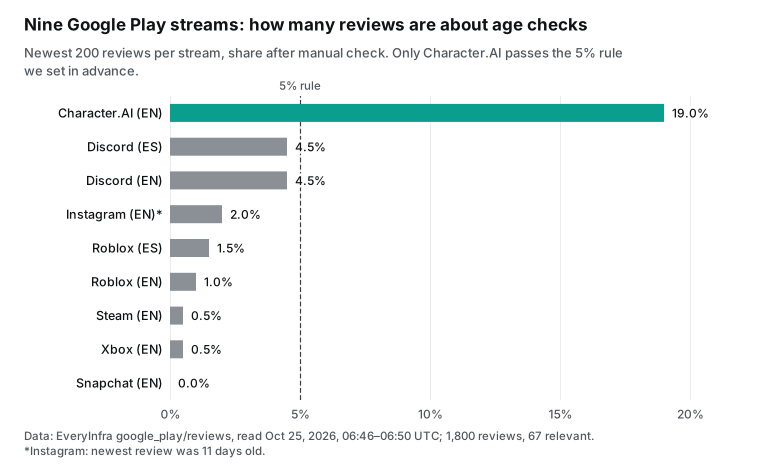
We tested this on October 25, 2026, from 06:46 to 06:52 UTC (14:46–14:52 Singapore time). We sent 19 EveryInfra requests, and 18 were billed, for a total of $0.020837. We read the newest 200 Google Play reviews for nine app and language pairs, 1,800 reviews in total. After a manual check, 67 reviews (3.7%) were about age verification. Character.AI had the highest share at 19.0%. Discord had 4.5% in English and 4.5% in Spanish.
Roblox, Instagram, Snapchat, Steam and Xbox were all below 2%. On the same day, we also read all 2,604 public comments on the EU KIDS Act consultation. 67.9% of them arrived in four days, October 3 to 6. 58.3% mention games.
In this article, an "age verification rollout report" is a one-page weekly brief for compliance and trust and safety teams at apps and platforms. It counts public, aggregate signals only. These are the share of app store reviews that mention age checks, the types of complaints, and changes to platform announcements and help center pages. They also include discussion volume on forums and social media, and the status of laws and consultations. It answers one question: "How far has this rule got in the market, and where do users get stuck?" It does not answer "How old is this user?"


Why compliance teams need this now
Three regulators moved on age rules within a few weeks of each other:
- European Union. On September 17, the European Commission adopted the KIDS Act proposal. It bans social media accounts under 13, allows guardian-managed "mini accounts" at 13 and 14, and allows independent accounts from 15 (Commission press release IP/26/1890). The Commission Q&A says that self-declared age is "explicitly not enough". Platforms must check existing accounts within six months after the rules apply (The KIDS Act explained). The proposal is COM(2026)681; the text is on the Commission proposal page. In the European Parliament it is procedure 2026/0286(COD). The plenary announced the committee referral on October 22 (Legislative Observatory).
- Australia. The under-16 social media account rule started on December 10, 2025. eSafety runs a study with the Stanford Social Media Lab. After three months, account ownership among children aged 10 to 15 fell from 52.4% to 42.1%. But use of age-restricted platforms only fell from 85.9% to 81.5%. Of the children who still had accounts, 50.2% said the platform had not asked them to confirm their age. 18.2% said a check estimated their age incorrectly (eSafety report). The panel is 803 children who answered both waves (eSafety media release). In its March update, eSafety named five platforms. One problem was that some platforms prompted children who had declared an age under 16 to "attempt" age assurance (eSafety compliance update, March 2026). Technology.org put these numbers next to the KIDS Act on October 20 (technology.org, secondary).
- China. On September 18, the Cyberspace Administration of China opened a consultation on draft State Council rules for minors' internet use. The draft says that services for users under 16 must run in a "minor mode", and that providers must be able to identify minor users. Comments closed on October 17 (CAC notice, in Chinese).
The message for a compliance team is the same in all three places. The law says what platforms must do. Only observation tells you how far they got.
The eSafety figure "50.2% were not asked" is a typical rollout signal. It is a share, not one child's data. It describes how platforms enforce the rule, not who the children are. Our weekly report collects only this type of signal.
The boundary comes first: public, aggregate signals only
We put this section before the method because it decides what the product may collect.
The product does not collect or infer any personal information about minors. Four rules put this into practice:
- Remove author fields before saving. The review endpoints return author names and avatar links. X and Weibo search return author IDs, bios and mentions. Our call script deletes these fields before it writes any file. It keeps only a SHA-256 hash of the original response, for audit. Across the 18 billed responses in this test, the script removed 4,609 author fields.
- No age guessing. The report has no "written by a minor" field. We do not train or call any age estimation model.
- Do not quote self-stated ages. Reviews often say "I'm 16" or "my 9 year old son". The report counts these reviews but never quotes them. In this test, 6 of the 67 relevant reviews contained a self-stated age. Our pattern rule, written in advance, caught only 2. It missed an age written as a word ("seventeen"), a birth year, and "18+". So a person must check every quote before it goes into a report.
- Mask handles in the text. 2 of the 67 reviews included the writer's own account name in the text. The report replaces these with "[handle]".
Why so strict? Look at Character.AI.
Its parent company filed for Chapter 11 on October 12 to sell its assets under court supervision (Character.AI blog; case filings).
PPC Land reports that attorneys general for 39 states and the District of Columbia filed a notice on October 14. The notice quotes company records: by March 13, 2025, there were 21.6 million US accounts. Of these, 2.1 million had a declared age under 18. The states set nine conditions for any buyer, including effective age checks (PPC Land, secondary).
When a company stores age data, that data becomes an asset that a court and a buyer must deal with. A monitoring vendor that never stores it cannot become part of that problem.
The pass/fail rules we wrote first
We wrote three rules at 14:45 Singapore time. The first data call was at 14:46.
- Density. In the newest reviews, at least 5% must be about age verification (manual check). At least 2 apps must pass. Below 5%, each app gives only a few reviews per week, and the complaint types show no trend.
- Classification. We wrote a keyword dictionary in advance. It must assign the same complaint type as a human reader in at least 70% of cases. Below 70%, a person must read every review, and the report is neither cheap nor repeatable.
- Boundary. Zero author fields in the deliverable and in the stored files. Zero quoted reviews with a self-stated age.
Results: rule 3 passed. Rule 1 failed: only Character.AI was above 5%. Rule 2 failed: agreement was 42.3%. These two failures changed the product design, as we explain below.
One caveat on rule 1: we judged it on point estimates. For Discord, 9 of 200 gives a 95% Wilson interval of 2.4% to 8.3%. This interval crosses 5%, so a larger sample could change the result.
Test 1: nine Google Play streams, 67 of 1,800 reviews mention age checks
From 14:46 to 14:50 Singapore time, we used the Google Play Reviews API to read the newest 200 reviews for each app and language. We chose apps that started age checks in the last year or that are on an age-restriction list. The time window is the span between the oldest and newest review in each batch:
- Character.AI (English): 38/200, 19.0%. The 200 reviews cover 53.3 hours. All 38 relevant reviews gave 1 star. Since November 24, 2025, the app has removed open-ended chat for users under 18 (Character.AI help center). Many reviews say users must verify before they can chat.
- Discord (English): 9/200, 4.5%, covering 29.9 hours. On September 22, Discord started to place users into age groups from account signals. It said that "more than 90%" of users will not be asked to confirm their age (Discord blog). Ars Technica reports that this plan replaced a February plan after user backlash. One cause of the backlash was a 2025 breach at a third-party verification service that exposed about 70,000 ID images (Ars Technica, secondary). One month later, 4.5% of new reviews still discuss it.
- Discord (Spanish): 9/200, 4.5%, covering 114.7 hours.
- Instagram (English, Australian storefront): 4/200, 2.0%. This stream had a problem: its newest review was from October 14, 269.5 hours before our read. It was not this week's data.
- Roblox (English, Australian storefront): 2/200, 1.0%. 200 reviews cover only 2.7 hours.
- Roblox (Spanish, Mexican storefront): 3/200, 1.5%, covering 5.2 hours.
- Snapchat (English, Australian storefront): 0/200.
- Steam (English, Australian storefront): 1/200, 0.5%. 200 reviews cover 321 hours. The one review complains that a credit card is the only way to verify age. In Australia, age-restricted material codes for six service types, including app distribution, took effect on March 9, 2026 (eSafety).
- Xbox (English, UK storefront): 1/200, 0.5%, covering 289.7 hours.
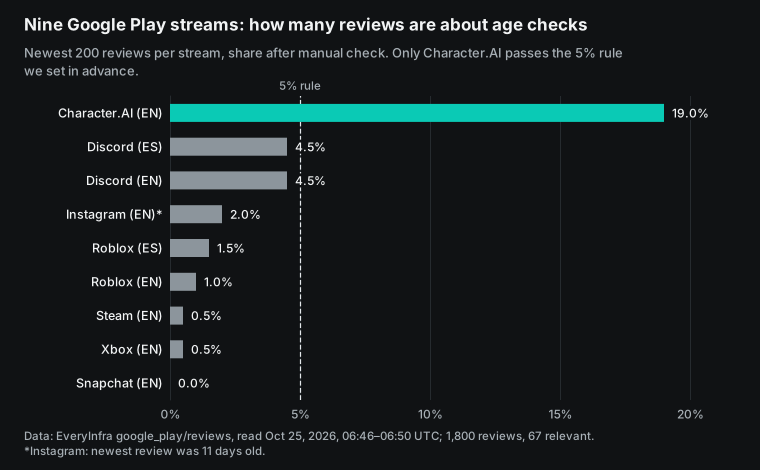
Three conclusions follow. Each has a limit:
- The signal fades after launch. Roblox announced face-based age checks for chat on November 19, 2025 (Roblox newsroom). It made them global on January 9, 2026 (Roblox developer forum). Nine months later, both Roblox streams are at 1.0–1.5%. Discord, one month after launch, is at 4.5%. Character.AI, where the restriction still causes anger, is at 19.0%. The evidence is a same-day comparison with the same method. The limit: this is one day, not a time series. We cannot say how fast the signal fades each month.
- A storefront is not a country. We read Discord English reviews through the US and the UK storefronts. The two sets of 200 review IDs were identical. Google Play returns reviews by language, and the country parameter did not change the result. So "Roblox on the Australian storefront" really means "Roblox reviews in English". It does not show what Australian users feel. For country views, use country signals such as regulator data or local forums.
- The data is about one day behind. In 8 of 9 streams, the newest review was 24.1 to 26.4 hours older than our read. Instagram was 11 days behind. The report should say "data up to day T-1" and flag any stream whose newest review is more than 48 hours old.
The App Store Reviews API did not suit a weekly report in this test. We asked for the newest 500 Roblox reviews on the Australian storefront and got 10, dated from June 2020 to April 2026. For a large game on the Chinese storefront we also got 10, all from May to July. 7 of them were the same template text. Use the App Store stream for ratings and release notes, not for weekly review samples.
Test 2: is a keyword dictionary good enough?
This test answers rule 2. We ran our dictionary (English, Spanish and Chinese, fixed and filed before the calls) over the 1,800 reviews and compared it with a manual read:
- Precision. The dictionary matched 55 reviews. 52 were really about age verification: 94.5% precision. All 3 false positives were Spanish. The cause was one vendor name in the English list, "persona". In Spanish, "persona" is the common word for "person" ("la persona bloqueada", "hacia una persona"). Roblox names this same vendor in its own announcement, which is why we had added it.
- Recall. A manual search of the non-matches found 15 more relevant reviews: 77.6% recall. Missed phrasings include the typo "ages verification", "verify our age" (a pronoun we did not list), "face verification", "can't chat until you're over 18" (no "verify" at all), and Spanish phrases such as "grupo de edad incorrecto".
- Classification. Of the 52 true matches, the dictionary gave the same complaint type as the human reader in only 22 cases: 42.3%. It put 19 into "other". After the manual read, the 67 relevant reviews split into six types. Feature locked: 17. Privacy and ID: 17. Wrong age or check failed: 15. Against the rule itself: 11. No detail: 6. Supportive or neutral: 1.
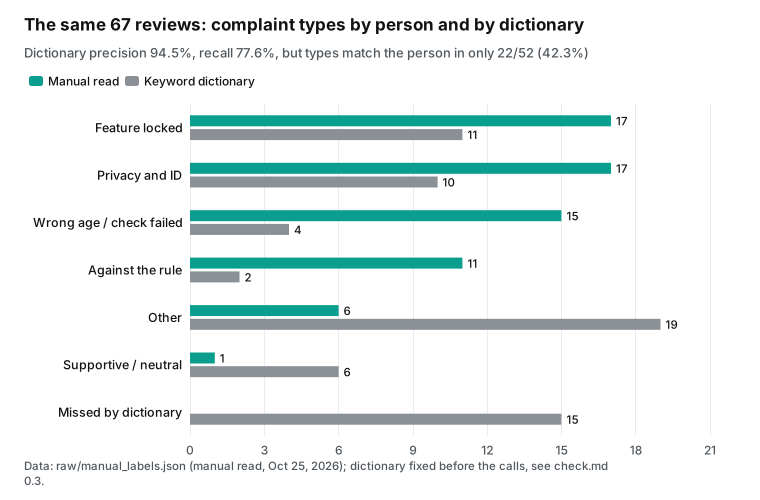
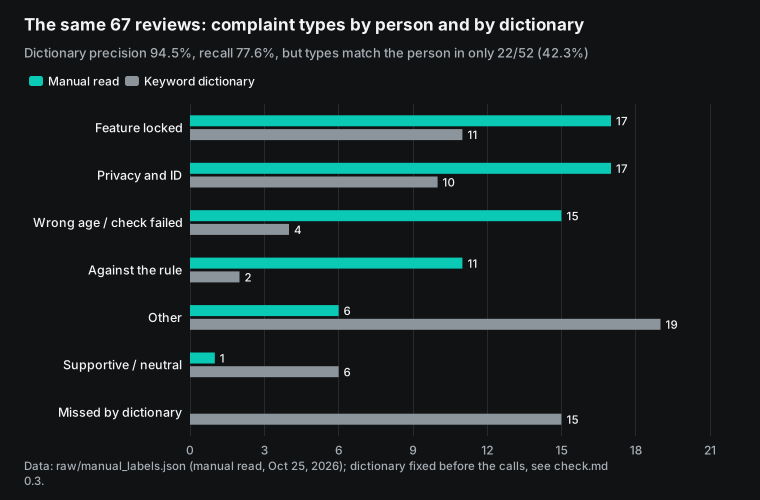
So the dictionary is a first filter. It finds candidates with 94.5% precision. A person, or a separate model step, must assign the type. We estimate the weekly reading load from this test: relevant reviews in each batch × 168 hours ÷ hours covered. For these nine streams, that is about 530 relevant reviews per week. This is the largest labor cost in the product.
One finding links directly to the boundary. The "wrong age or check failed" group has 15 reviews. One is from an adult who says a selfie check did not recognize them. Others say the account was placed in the teen group and support did not answer.
Compliance teams care most about this group, because it matches the 18.2% "age estimated incorrectly" figure in the eSafety study. The report can count and track it. It must not repeat the ages or handles inside it.
Test 3: 2,604 EU consultation comments, two thirds in four days
A public consultation is itself a public, aggregate signal. The Commission's "Have your say" page gives the KIDS Act feedback period as October 1 to December 3, nine weeks (Have your say initiative page). At 14:37 Singapore time on October 25, we read the public feedback list behind that page: 2,604 comments (all feedback). We removed the name fields before saving. By the date shown on each comment:
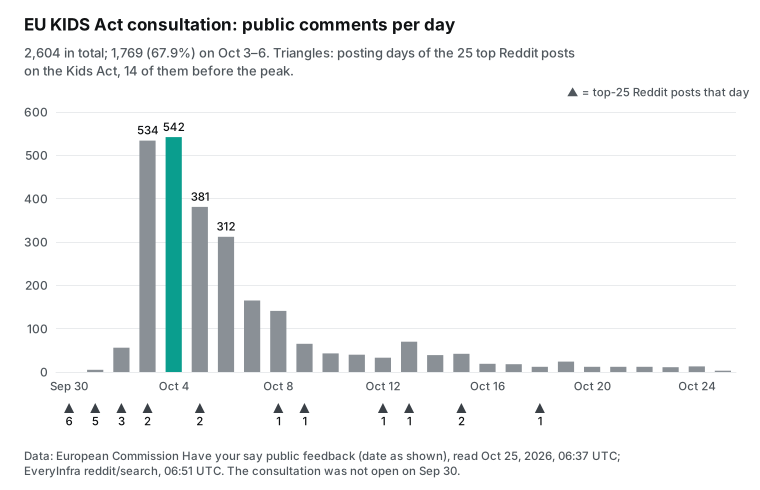
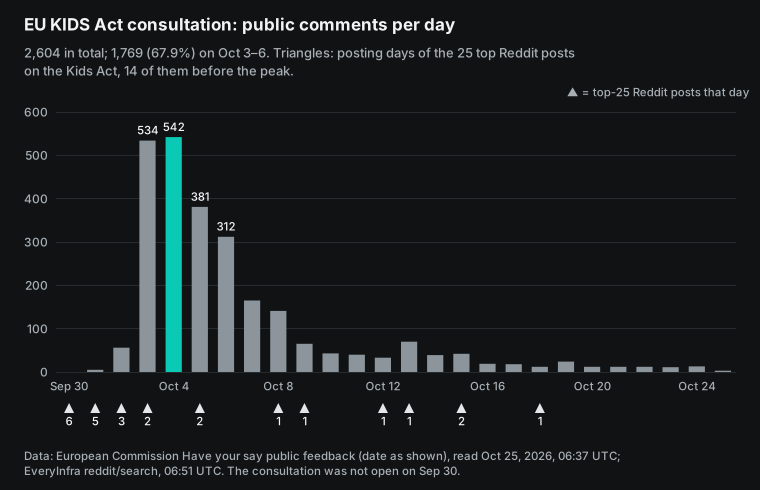
- Timing. October 3: 534. October 4: 542. October 5: 381. October 6: 312. Those four days hold 1,769 comments, 67.9% of the total. The first week (October 1–7) holds 1,995, or 76.6%. The last seven days (October 19–25) hold only 87.
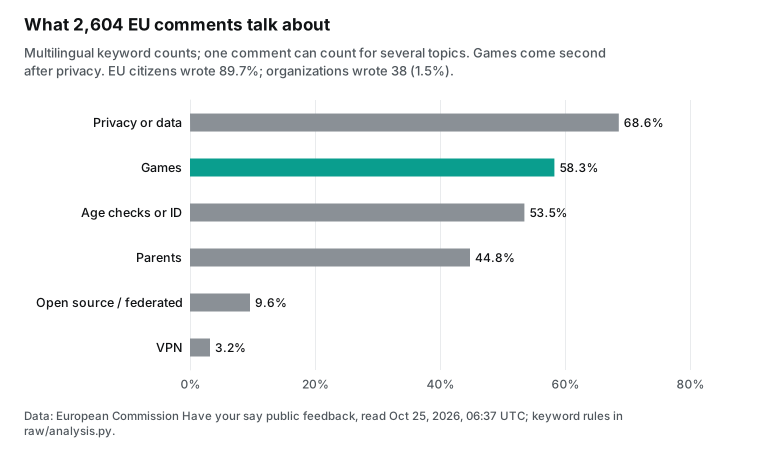
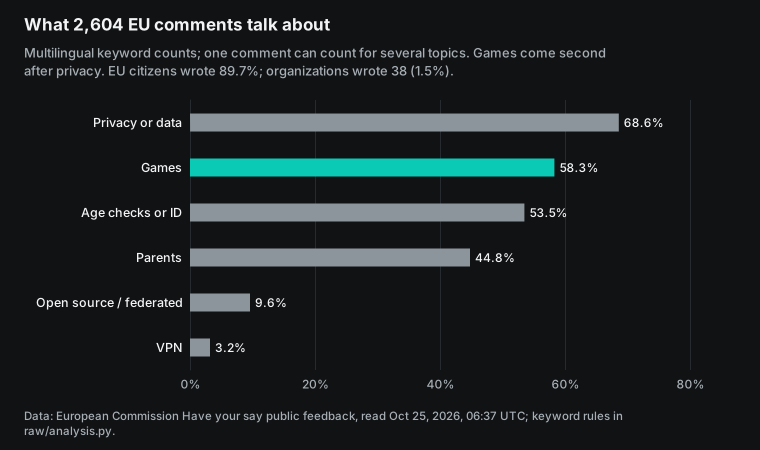
- Who. EU citizens wrote 2,335 (89.7%) and non-EU citizens 231. Companies, business associations, NGOs, academic bodies and public authorities together wrote only 38 (1.5%).
- Where and language. Germany sent the most (410), then Sweden 198, the Netherlands 189, Finland 177 and Poland 158. 85.2% are in English.
- Topics (multilingual keyword counts; one comment can count for several topics): privacy or data 68.6%, games 58.3%, age verification or ID 53.5%, parents 44.8%, open source or federated services 9.6%, VPN 3.2%.
- Copy-paste check. Exact duplicates add only 13 extra copies. 41 comments share a 120-character opening with another comment, 1.6% of the total. The median comment has 969 characters. Most comments at the peak are long and written by their authors.
Where did the peak come from?
At 14:51 Singapore time, we used the Reddit Search API for "Kids Act" and took the 25 top posts of the past month. 14 were posted from September 30 to October 2. The top posts are in gaming communities such as r/gaming, r/valve, r/Terraria, r/Minecraft and r/indiegames. Many titles say the law would make private game servers illegal. The 25 posts have a combined score of 67,371.
With the X Search API, we found a post from October 3 at 15:54 UTC that shared the consultation link. It asked readers to "write in your own words" and to say that video games should not have strict age verification. It had 920 likes and 12,511 views.
The order is clear. Gaming communities start on September 30. A call to action appears on October 3. On that day, comments jump from 56 to 534. This is a correlation, not proof. We cannot confirm where each comment author came from.
For a compliance team, the lesson is that consultation volume shows which group was mobilized. It is not general public opinion. When you split by sender type, only 38 comments come from organizations. Game companies and platforms should read those one by one. The weekly report can list the organization comments, and new ones, every week.
EU pages disagree on the deadline.
The Commission news page "Commission seeks feedback on EU KIDS Act" says in one line that the feedback period "closes on 26 November 2026". In the next line it says to give feedback "until 3 December 2026" (Commission news page). The "EU Child Participation" page for children still says November 26 (EU Child Participation). The Have your say page and the Q&A say December 3. Two X posts from October 2 and 4 in our sample also say November 26.
Nine weeks from October 1 is December 3, so December 3 matches the Have your say page. This type of conflict between government pages belongs in the "regulatory pages" section of the report.
Results: when the signal works
It works in three cases:
- Tracking for 2–4 weeks after a launch. The signal is dense after a launch and thin some months later (Roblox at 1.0–1.5%). Plan the sampling with an event calendar. When an app announces a new age check, add it to the watch list for four weeks.
- Complaint counts after manual typing. The dictionary filters (94.5% precision). A person or a model step assigns the type. The report gives counts by type and quotes with personal details removed.
- Regulatory status and page consistency. Consultation volume, organization comments, deadlines and committee steps are public records. You can check them one by one.
It does not work in four cases:
- Reading Google Play reviews as country data. Reviews come back by language; the US and UK Discord sets were identical.
- Publishing dictionary types without review. Agreement was 42.3%.
- Treating consultation counts as public opinion. 67.9% came from one mobilized group in four days.
- Deciding whether any review was written by a minor. This is outside the product, and it is the first line we drew.
What the product looks like: one page, five sections


The five sections:
- Rollout table. One row per tracked app. Each row shows reviews read this week, hours covered, and the share that mention age checks. It also shows the change from last week and the age of the newest review (red if more than 48 hours).
- Complaint types. Counts for feature locked, privacy and ID, wrong age or check failed, and against the rule, with 1–2 quotes per type. Personal details are removed and self-stated ages are never quoted.
- Platform and help center changes. Which apps changed their age check text, options or scope this week. Example: Discord's September 22 post added two ways to confirm age: a credit card or an app store age range (Discord blog). The last two use Apple's Declared Age Range API and Google's Play Age Signals API.
- Regulatory status. Proposals, consultations, deadlines and the next step in each jurisdiction, with any conflicts between government pages.
- Data notes. Read times, coverage and deduplication rules for each stream, and a statement that the report does not estimate anyone's age.
Delivery can be a one-page PDF, a CSV of the counts, or the same workflow inside the client's own AI client (see the MCP setup below). The raw responses stay with us for audit and do not go out with the report.
The cost: about $0.27 per week for the sample plan
Prices come from the capability catalog, read on October 25 at 14:34 Singapore time; the pricing page is the reference. Google Play reviews cost $0.001389 per call, with up to 200 reviews per call. Reddit, X and Weibo search cost $0.000556 per call. Reads per week for each review stream = 168 hours ÷ hours covered by one batch of 200, rounded up:
- Roblox English covers only 2.7 hours per 200 reviews, so it needs 63 reads a week. Roblox Spanish needs 33, Instagram 32, Snapchat 14, Discord English 6, Character.AI 4, Discord Spanish 2, and Steam and Xbox 1 each. That is 156 calls × $0.001389 = $0.216684.
- Social: 5 Reddit terms and 5 X terms once a day, plus 3 Weibo terms once a day. That is 91 calls × $0.000556 = $0.050596.
The total is $0.267280 per week, or $1.069120 for four weeks. Failed calls and empty results are not billed, so the real cost can only be lower. The EU, eSafety and other public pages are free.
The data cost is small. The real cost is the manual review of about 530 reviews a week and writing the page. So price the product by tracked apps × languages × jurisdictions, and include manual review per item. Do not price it per API call. The final price depends on how much staff time it saves your client; we do not set a number for you.
Get the same data with code or an AI client
One curl call reads the newest 200 English reviews for Character.AI. Replace the key placeholder with your own key:
curl -s https://api.everyinfra.com/api/v1/social \
  -H "Authorization: Bearer <API Key>" \
  -H "Content-Type: application/json" \
  -d '{"platform":"google_play","action":"reviews","params":{"app_id":"ai.character.app","language":"en","sort":"newest","limit":200}}'
Put limit inside params. In our first test call we put it at the top level. At that time the API returned 10 reviews, billed one call, and showed no error. Since the evening of October 25, a top-level limit returns 422 unknown_param. The error points to params.limit, and nothing is charged.
Fields the report uses (they match response_fields in the catalog):
id: review ID, for deduplication across weeks;text,title: review body and title, used only for keyword filtering and manual typing;score: 1 to 5 stars; all 38 relevant Character.AI reviews had 1 star;posted_at: post time, used for hours covered and the age of the newest review;app_version: app version, to link complaints to a release;reply_text,reply_at: developer reply and time, to see if the platform explains its age checks in the review section;thumbs_up: likes on the review;language,url,app_id,platform: language, review link, package name and platform;author_name,author_avatar_url: author name and avatar. The report does not use them. Delete them before saving.
In Claude Code, create a key with the quickstart and add the remote MCP server (Claude Code MCP docs):
claude mcp add --transport http everyinfra https://api.everyinfra.com/mcp \
  --header 'Authorization: Bearer ${EVERYINFRA_API_KEY}'
Then ask: "Use everyinfra_call_api to read the newest 200 English reviews for com.discord. Count only the share that mention age verification and the complaint types. Do not output any author data. Do not quote reviews that state an age."
Errors and billing we saw in this test:
- More than 10 requests per minute: HTTP 429
rate_limited. The response says "Nothing was charged". Waitretry_afterseconds and try again. Our first request hit this because another session used the same test key at the same time. limitin the wrong place: 422unknown_param. The error shows the correct field,params.limit, and nothing is charged. (Before the evening of October 25, the API ignored it, returned the default count and billed the call.)- Google Play
paginationreturnshas_more: falseandstop_reason: depth_limit. One call gives at most 200 reviews. For more coverage, read more often. - Failed calls and empty results are not billed. To check each charge, see failure refunds and reconciliation.
Compared with other methods
- Regulator reports only. eSafety and Ofcom reports are the most authoritative. Ofcom's July report says that no single age assurance method removes the risk of circumvention (Ofcom, Use of Age Assurance Report 2026). It also notes that credit card checks can show an adult. They do not work for the 16 and 17 age line. This matters because Discord and Steam both offer credit cards. But these reports come out every few months and cannot follow weekly platform changes.
- A third-party social listening service. Wide coverage, but many services profile accounts and people. That conflicts with the "no inference about minors" boundary. Ask for the exact data fields before you buy.
- Staff read reviews by hand. Low cost, but no fixed sample or rules. Each person counts differently, and you cannot check the result later.
- The method in this article. Fixed sampling, personal fields removed before saving, a hash of every raw response, and manual typing. Every number goes back to a file we keep. What it cannot do: show how users in one country feel, or measure whether a rule works. For effect, you need a panel study with a comparison group, such as the eSafety study.
Recent changes (September–October 2026)
- End of October: Ofcom is due to give Parliament a rapid assessment of over-16 age checks. The UK plans restrictions for under-16s that could start in 2027 (Ofcom). UK teams should expect guidance in the coming months.
- October 22: the European Parliament sends the KIDS Act to committee (Legislative Observatory). For compliance teams, the text will change. Today's work is preparation, not delivery.
- Around October 20: Australia says eSafety is preparing court cases against five platforms. It uses evidence powers from September (Tech Times, secondary). The Parliamentary Library has a summary of the bill. Platforms must prove they took "reasonable steps", so records of announcements and help center changes become more important.
- October 14: Mexico publishes a decree on safe digital spaces for children. Platforms, including app stores, must use age checks that do not rely on self-declaration. They must report their measures within 30 calendar days (decree text). Apps with users in Mexico have a first report due in mid-November.
- October 12: Character.AI files for Chapter 11 and plans a sale (Character.AI blog). Declared-age data is now part of the sale conditions.
- September 21 to October 12: EFF and the Internet Society criticize the KIDS Act's age checks. These are the positions of the two groups, not facts. EFF says age gates harm the privacy of all users and can lock out people without ID (EFF, September 21; EFF, October 8). The Internet Society supports the safety-by-design parts but warns that age tokens must not become an "internet badge" (Internet Society, October 12). For technical discussion, see the IAB/W3C workshop report draft (draft-iab-agews-report-03) and the Commission's age verification blueprint. You can compare the report's "privacy and ID" complaints with these arguments.
Limits of this test
- We read one day, nine streams and 200 reviews per stream. This is a snapshot, not a trend. Intervals are wide: Character.AI 38/200 has a 95% interval of 14.2% to 25.0%, and Discord 9/200 has 2.4% to 8.3% (Wilson method).
- One person did the manual read. There was no second reviewer. Recall comes from a broad manual search of non-matches and may still miss some reviews.
- EU topic counts use multilingual keywords. One comment can count for several topics. This is not semantic classification.
- This article describes a data method. It is not legal advice. Check the final texts and your lawyers for your obligations.
Frequently asked questions
Is age verification safe on Discord? This report cannot say if a method is safe. It can show what users worry about. In our Discord sample, 1 of the 9 English and 3 of the 9 Spanish relevant reviews were about privacy or ID data. Discord's September post says users can choose methods without an ID or selfie, such as a credit card or an app store age range. (Question source: the search suggestion "is age verification safe on discord".)
Why is Discord age verification not working? In our sample, "wrong age or check failed" was the largest group in Spanish (5 of 9) and 3 of 9 in English. Reviews describe selfie checks that quit after three tries and adult accounts placed in the teen group. A weekly report counts these cases so that the platform's team can see if a fix helps. It does not fix accounts. (Question source: the search suggestion "discord age verification not working".)
How do you analyze age verification app reviews and complaints? Use a keyword dictionary as a first filter. Then use a manual or model step for the complaint type. In our test the dictionary had 94.5% precision and 77.6% recall, but its types matched a human reader only 42.3% of the time. Remove author fields before saving and never quote reviews that state an age. (Question source: the search suggestion "age verification app reviews and complaints".)
Related reading
- Platform pages: Google Play Scraper API, Reddit Scraper API
- Capability pages: Google Play Reviews API, App Store Reviews API, Reddit Search API, X (Twitter) Search API
- More articles: App store review analysis as a paid product, Social media research data: test sample stability first, Health misinformation monitoring
References
- European Commission, "EU KIDS Act to restrict social media platforms' access to children in the EU" (IP/26/1890), 2026-09-17, https://ec.europa.eu/commission/presscorner/detail/en/ip_26_1890
- European Commission, "The KIDS Act explained", read 2026-10-25, https://digital-strategy.ec.europa.eu/en/faqs/kids-act-explained
- European Commission, "Proposal for EU KIDS Act" (COM(2026)681), 2026-09-17, https://digital-strategy.ec.europa.eu/en/library/proposal-eu-kids-act-eu-keeping-internet-digital-spaces-accountable-and-trustworthy
- European Commission, "Commission seeks feedback on EU KIDS Act", 2026-10, https://digital-strategy.ec.europa.eu/en/news/commission-seeks-feedback-eu-kids-act
- European Commission, Have your say, "Child online safety – keeping digital spaces accountable and trustworthy (EU Kids Act)", feedback 2026-10-01 to 2026-12-03, https://ec.europa.eu/info/law/better-regulation/have-your-say/initiatives/19418-Child-online-safety-keeping-digital-spaces-accountable-and-trustworthy-EU-Kids-Act-_en
- European Commission, Have your say, all public feedback on the KIDS Act (2,604 items), read 2026-10-25 06:37 UTC, https://ec.europa.eu/info/law/better-regulation/have-your-say/initiatives/19418-Child-online-safety-keeping-digital-spaces-accountable-and-trustworthy-EU-Kids-Act-_en/feedback?p_id=26173
- European Parliament Legislative Observatory, procedure 2026/0286(COD), read 2026-10-25, https://oeil.europarl.europa.eu/oeil/en/procedure-file?reference=2026/0286%28COD%29
- EU Child Participation, "EU Kids Act – have your say", 2026-10-07, https://eu-for-children.europa.eu/activities-news/latest/eu-kids-act-have-your-say_en
- European Commission, "Commission makes available an age verification blueprint", https://digital-strategy.ec.europa.eu/en/news/commission-makes-available-age-verification-blueprint
- eSafety Commissioner, "Early days, early insights: Understanding experiences of social media age restrictions at the three-month follow-up", July 2026 (published August 2026), https://www.esafety.gov.au/sites/default/files/2026-08/Early-days-Early-Insights-SMMA-Evaluation-Understanding-experiences-of-social-media-age-restrictions-August2026.pdf
- eSafety Commissioner, "Early insights from eSafety's comprehensive evaluation project", 2026-08, https://www.esafety.gov.au/newsroom/media-releases/early-insights-from-esafetys-comprehensive-evaluation-project
- eSafety Commissioner, "Social Media Minimum Age: Compliance Update", 2026-03-31, https://www.esafety.gov.au/sites/default/files/2026-03/SocialMediaMinimumAgeComplianceUpdateMarch2026.pdf
- eSafety Commissioner, "Social media age restrictions", read 2026-10-25, https://www.esafety.gov.au/about-us/industry-regulation/social-media-age-restrictions
- Parliamentary Library of Australia, Bills Digest, "Online Safety Amendment (Strengthening Enforcement for the Social Media Minimum Age) Bill 2026", 2026-08-16, https://www.aph.gov.au/Parliamentary_Business/Bills_Legislation/bd/bd2627/27bd012
- technology.org (Alius Noreika), "Teen Social Media Ban: What Australia's First Data Shows", 2026-10-20, https://www.technology.org/2026/10/20/teen-social-media-ban-australia-data-eu-kids-act/
- Tech Times, "Australia Prepares to Sue Meta, TikTok, Snap and YouTube Over Under-16 Non-Compliance", 2026-10-21, https://www.techtimes.com/articles/329312/20261021/australia-prepares-sue-meta-tiktok-snap-youtube-over-under-16-non-compliance.htm
- Discord (Stanislav Vishnevskiy), "Safer for Teens, Same Discord for Adults", 2026-09-22, https://discord.com/blog/safer-for-teens-same-discord-for-adults
- Ars Technica (Jon Brodkin), "Discord age verification rolls out today with changes spurred by user backlash", 2026-09, https://arstechnica.com/tech-policy/2026/09/discord-age-verification-rolls-out-today-with-changes-spurred-by-user-backlash
- Roblox, "Roblox Requires Age Checks for Communication, Ushering in New Safety Standard", 2025-11-19, https://about.roblox.com/newsroom/2025/11/roblox-requires-age-checks-limits-minor-and-adult-chat
- Roblox Developer Forum, "Age Check Requirement to Chat Now Live Globally", 2026-01-09, https://devforum.roblox.com/t/age-check-requirement-to-chat-now-live-globally/4226101
- Apple Developer, "Declared Age Range", read 2026-10-25, https://developer.apple.com/documentation/declaredagerange
- Android Developers, "Play Age Signals overview", read 2026-10-25, https://developer.android.com/google/play/age-signals/overview
- Character.AI, "An Update on Character.ai", 2026-10, https://blog.character.ai/an-update-on-character-ai/
- Character.AI Help Center, "Important Changes for Teens on Character.ai", 2025-10-29, https://support.character.ai/hc/en-us/articles/42645561782555-Important-Changes-for-Teens-on-Character-ai
- Stretto (claims and noticing agent), In re Character Technologies, Inc., case page, read 2026-10-25, https://cases.stretto.com/chartech
- PPC Land, "Character.ai faces 40 attorneys general over who can buy its users' chats", 2026-10-14, https://ppc.land/character-ai-faces-40-attorneys-general-over-who-can-buy-its-users-chats/
- Electronic Frontier Foundation, "EU Kids Act Won't Keep the Internet Accountable and Trustworthy", 2026-09-21, https://www.eff.org/deeplinks/2026/09/eu-kids-act-wont-keep-internet-accountable-and-trustworthy
- Electronic Frontier Foundation, "When No ID Means No Internet: Age Verification and the Right to Access Information", 2026-10-08, https://www.eff.org/deeplinks/2026/10/when-no-id-means-no-internet-age-verification-and-right-access-information
- Internet Society, "The EU KIDS Act Should Make Services Safer, Not Create an Internet Badge", 2026-10-12, https://www.internetsociety.org/blog/2026/10/the-eu-kids-act-should-make-services-safer-not-create-an-internet-badge/
- Nottingham and Thomson (IAB/W3C), "Report from the IAB/W3C Workshop on Age-Based Restrictions on Content Access" (draft-iab-agews-report-03), 2026-04, https://www.ietf.org/archive/id/draft-iab-agews-report-03.html
- Ofcom, "Use of Age Assurance Report 2026", 2026-07-15, https://www.ofcom.org.uk/online-safety/protecting-children/use-of-age-assurance-report-2026
- Cyberspace Administration of China, notice on the draft State Council rules on minors' safe internet use (in Chinese), 2026-09-18, https://www.cac.gov.cn/2026-09/18/c_1791482017777471.htm
- Government of Mexico, "DECRETO de entornos digitales seguros para niñas, niños y adolescentes" (DOF 2026-10-14), https://www.gob.mx/cms/uploads/attachment/file/1109462/DECRETO_ENTORNOS_DIGITALES.pdf
- Anthropic, "Connect Claude Code to tools via MCP", read 2026-10-25, https://code.claude.com/docs/en/mcp
- EveryInfra, capability catalog
GET /api/v1/social/catalog, read 2026-10-25 06:34 UTC, https://api.everyinfra.com/api/v1/social/catalog
Reference BL-41