Health Misinformation Monitoring: Tylenol Data, One Year On
How drug makers, device makers, hospitals and public health teams can use public social and search data to watch health misinformation and possible adverse event reports. We ran 13 live calls on the Tylenol and autism topic and measured who posts, when, and how reach is spread.
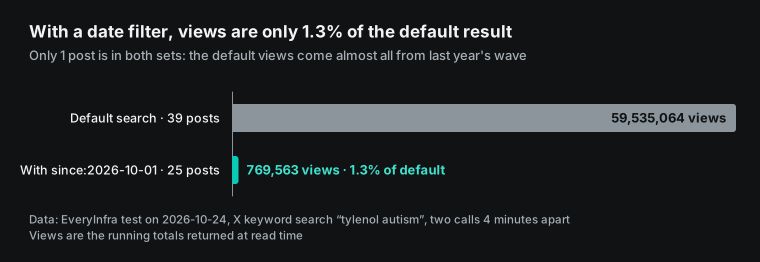
Drug makers, device makers, hospitals and public health agencies can use public social and search data to watch health misinformation and possible adverse event reports. But a default keyword search returns the most popular posts of the past year, not the posts of this week. You need a time window, and you need two separate tracks: one for misinformation narratives and one for possible safety cases. On October 24, 2026, from 04:34 to 04:41 UTC, we made 13 live EveryInfra calls on "Tylenol and autism" for a total of $0.007505. A default X search returned 39 posts. Of these, 32 were from the wave of September 22 to November 30, 2025, and only 1 was from the last 30 days. With a date filter, we got 25 posts since October 1, with 769,563 views in total. One news agency post had 70% of those views.
This article is about data methods only. It does not give medical advice. For questions about medicines in pregnancy, speak to a doctor or pharmacist.
Health signal monitoring means this: on a fixed schedule, you pull public posts and search results with written keywords, platforms, time windows and review rules. You sort each item into "a narrative that may need a public response" or "a case that needs a pharmacovigilance review". You keep a record of each step.


Why this topic
On September 22, 2025, the FDA started a label change for acetaminophen. It sent a letter to physicians that said use in pregnancy "may be associated" with autism and ADHD. The same release said that "a causal relationship has not been established" (FDA news release). One day later, the European Medicines Agency said that EU advice on paracetamol in pregnancy did not change (EMA). Two regulators gave two different messages about the same medicine. Thus the reference for "misinformation" is not the same in each market.
One year later, the topic still produces new primary material. This makes it a good test case:
- September 23, 2026: *Developmental Medicine & Child Neurology* published an umbrella review of 7 meta-analyses with more than 3 million participants. When the authors used only high-quality studies, the association approached null (paper; Wiley release; CIDRAP summary). An earlier Swedish sibling study of 2,480,797 children also found no association (JAMA, 2024).
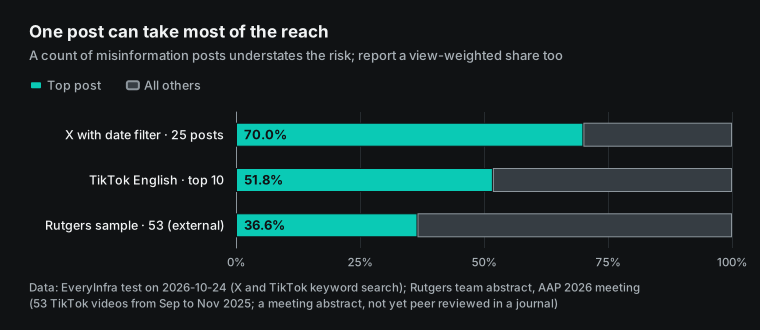
- October 2–6, 2026: At the American Academy of Pediatrics (AAP) conference, a Rutgers team reported on 53 TikTok videos from September to November 2025. Videos with misinformation were 28.3% of the sample but had 52.4% of 28.13 million total views. One misinformation video had 10.3 million views, which was 36.6% of all exposure (abstract release).
- The same team checked 65 Instagram accounts of hospitals, medical societies and state health departments. Only 14 (21.5%) posted about the controversy. Some hospitals were up to 51 days behind the AAP. No state health department posted about it (AAP news release; CIDRAP summary). Both studies are conference abstracts and are not yet peer reviewed.
- March 2026: *The Lancet* published an analysis of medicine use after the White House briefing (The Lancet). HealthDay reports that emergency department prescriptions of acetaminophen for pregnant women fell after the briefing (US News reprint). Changes in the information environment can change real prescribing.
- October 16, 2026: A US appeals court refused to rehear a ruling that revived about 500 lawsuits (Reuters). Court news can start a new wave of posts.
The rules that apply before you start
Pharmacovigilance and social platforms. ICH E2D(R1) reached Step 4 on September 15, 2025, and replaces the 2003 version. It adds a new section on digital platforms (ICH). The ICH training slides state three points (ICH Step 4 slides):
- A marketing authorization holder (MAH) has no obligation to screen external digital platforms.
- An MAH must screen its own platforms regularly.
- If an MAH reads external platform data in a planned way, that activity is an organized data collection system (ODCS). Cases from an ODCS are solicited reports, and they need a causality assessment.
The guideline came into effect in the EU on March 18, 2026. EMA asks for detailed documents for an ODCS that does not follow a protocol (EMA). The FDA also issued the final guidance, which names social media and patient support programs as newer places where safety data appears (FDA). A social media agency dates it to March 2026 and lists five items for ODCS documents: objective, data channels, dataset and look-back period, review method, and the process for adverse events (ICUC summary). Use the guideline text as the final reference.
China. The 2018 NMPA guideline on individual adverse drug reaction reports says that an MAH must check the websites it runs. It also says that, in principle, an MAH does not have to search external websites. But if an MAH learns of a case on an external site, it must assess it. A valid report needs four items: an identifiable patient, an identifiable reporter, a suspect drug and an adverse reaction. A screenshot can be the original record (guideline reprint).
Responses to misinformation. The FDA revised draft guidance of July 2024 supports "tailored responsive communications" by companies. These are replies to misinformation about their own approved products that an independent third party, such as an influencer, posts (FDA). Thus monitoring has two outputs: a public response and a safety review.
Platform rules. TikTok Community Guidelines in effect from September 24, 2026, do not allow misinformation that can cause significant harm. Content that can cause moderate harm cannot go into the For You feed (TikTok). YouTube's medical misinformation policy uses "local health authority guidance" as its reference (YouTube Help). When the FDA and EMA give different messages, one post can get different treatment in different markets. Record the market and the language for each item. In China, the Cyberspace Administration started a two-month campaign on September 30, 2026, against fake short-video personas, including accounts that pose as doctors (CAC).
Our test: 13 calls
Time: October 24, 2026, 04:34–04:41 UTC (12:34–12:41 Singapore time). Endpoint: POST /api/v1/social. We read each price from the capability catalog at that time. Keywords: tylenol autism in English, paracetamol autismo and paracetamol embarazo autismo in Spanish, and the Chinese drug name plus "autism" for Weibo and Douyin.
twitter/search, default sort: 39 posts, 19.47 s, $0.000556.twitter/searchwithsince:2026-10-01: 25 posts, 20.74 s, $0.000556.tiktok/search(English): 10 videos, 11.82 s, $0.000556.youtube/search, relevance sort andnewestsort: 10 videos each, $0.000556 each.reddit/search: 3 posts, 51.13 s, $0.000556. The time range is fixed to the last month.web/search(US, English): 10 results, 1.83 s, $0.001389.weibo/searchanddouyin/search(relevance, and "last six months, newest"): 20, 10 and 10 items, $0.000556 each (price at the time of writing; since 2026-10-28douyin/searchcosts $0.008333 per call, $8.33 per 1,000).tiktok/searchandyoutube/search(Spanish): 10 and 9 items, $0.000556 each.douyin/transcriptfor one video: empty result, hold refunded, $0.
Before these calls, we sent 18 requests with the wrong body format. All 18 returned 422 and had no charge. The second error type included a request example that we could copy. We count post dates by the UTC date from the platform. One editor coded the stance of each post from the post text. There was no second coder. The codes show the method only. They do not describe a population.
Finding 1: search shows the stock, not the flow
- Of the 39 posts in the default X search, 32 (82%) were from September 22 to November 30, 2025. Five were older. Only 1 was from the last 30 days. These 39 posts had 59,535,064 views.
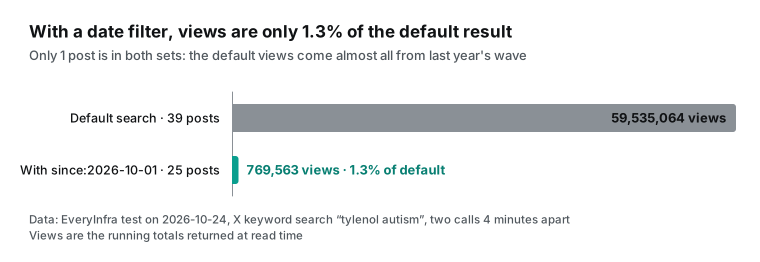
- With
since:2026-10-01, we got 25 posts. Only 1 was also in the default result. They had 769,563 views, about 1.3% of the default set. - The YouTube
newestsort and the relevance sort had 9 of 10 videos in common. The newest video was from December 12, 2025. In this read, a different sort did not find new content. - The Douyin "newest, last six months" filter had only 1 item in common with the relevance result. Five of its 10 items were from the last 30 days.
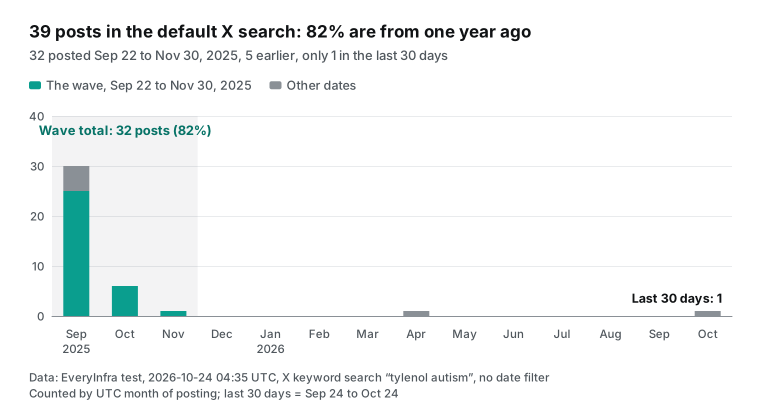
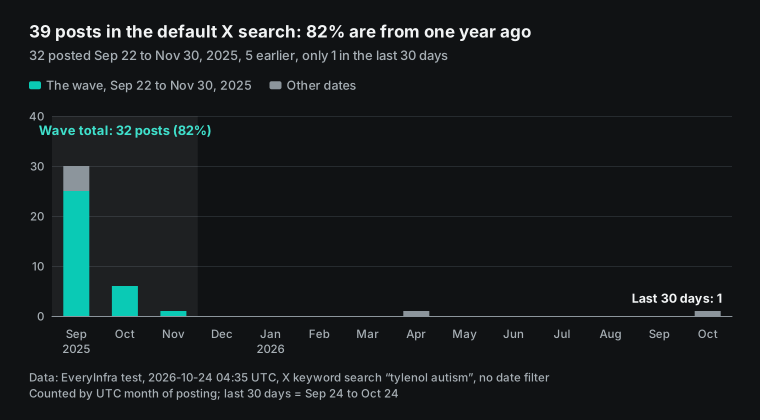
Result: to answer "is there a new wave now?", a default keyword search takes you back one year. Use the time syntax or time parameter of each platform. Save a daily snapshot and calculate the change yourself.
Finding 2: who posts changes by platform and language
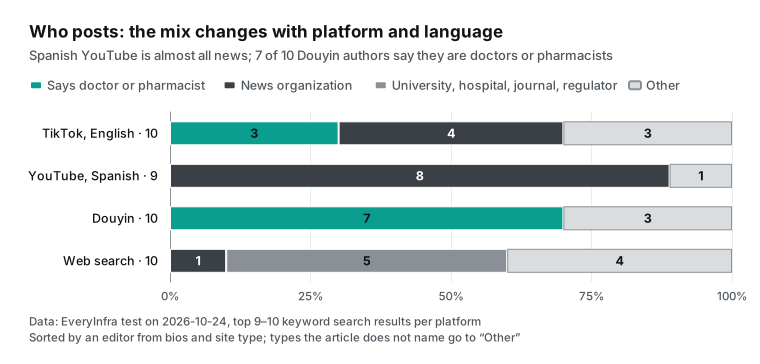
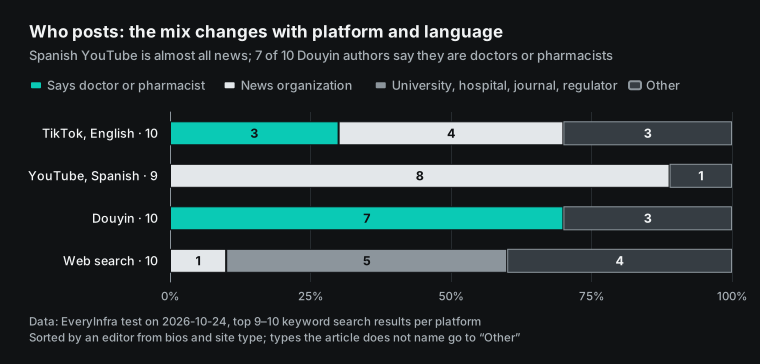
- TikTok (English), top 10: 4 from news organizations (CBC News, Global News, ABC World News, Daily Mail), 3 from accounts whose bio says "doctor" or a medical specialty, 3 from other people.
- YouTube (English): median views 370,355. YouTube (Spanish): 8 of 9 videos were from news organizations (El País, RTVE, El Comercio and others), with median views of 4,067.
- TikTok (Spanish keyword): the
languagefield showed Portuguese for 3 of 10 videos. Three videos were from before September 2025. Spanish and Portuguese use the same word, "paracetamol". Without a language filter, Brazilian content gets into a Spanish sample. - Web search, top 10: 4 results from universities, hospitals or journals. The 2025 FDA release was at rank 2. The other results were a patient group, a manufacturer FAQ page, a legal site, a news site and a video.
- Douyin: all 10 authors were verified, and 7 bios named a doctor or pharmacist role. Weibo: 20 posts had 363 likes in total, and 6 of the 20 came from one account that relays US news.
Finding 3: reach is concentrated
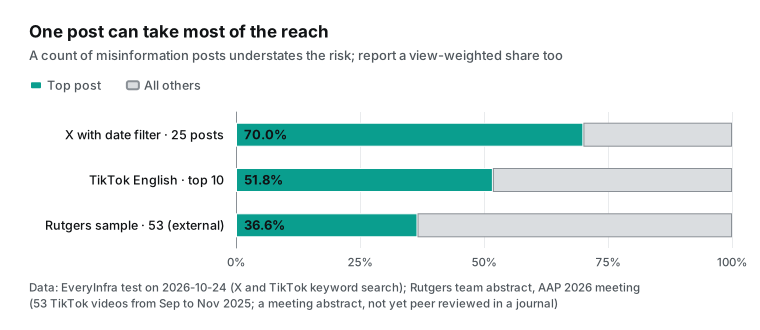
The top 10 English TikTok videos had 11,585,194 views. The top video had 51.8% of them. In the 25 date-filtered X posts, one news agency post had 70.0% of the views, and the median was only 214. This agrees with the Rutgers finding that one video had 36.6% of exposure. A count of misinformation posts can thus understate the risk. Report a view-weighted share as well.
Finding 4: an account label is not a content check
In the default X result, 7 accounts said "doctor" or "MD" in the username or the text. Four disputed the link. One supported it. One disputed it but moved the blame to vaccines. One only asked a question. The Rutgers team found that health professionals on TikTok posted only evidence-consistent content. In our X sample, that pattern did not hold. The top Douyin result came from a verified neurologist. Its title asks why acetaminophen in pregnancy "increases" autism risk. We asked for the transcript to check the content, but the result was empty and the hold was refunded. A title and a verified badge do not tell you what a video says. A person must watch it before coding.
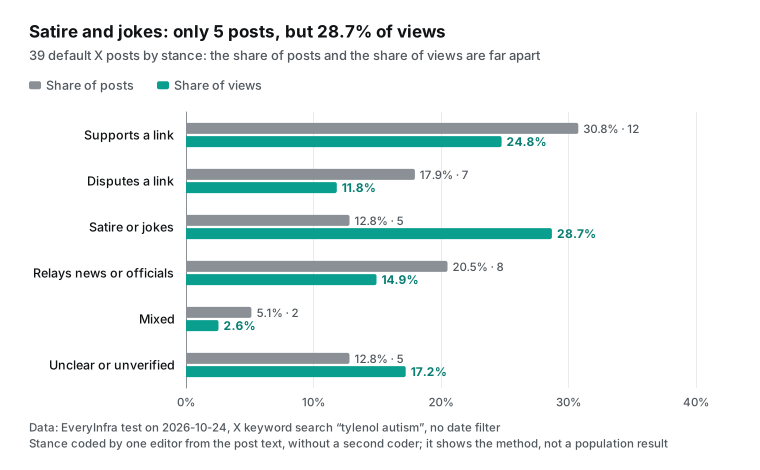
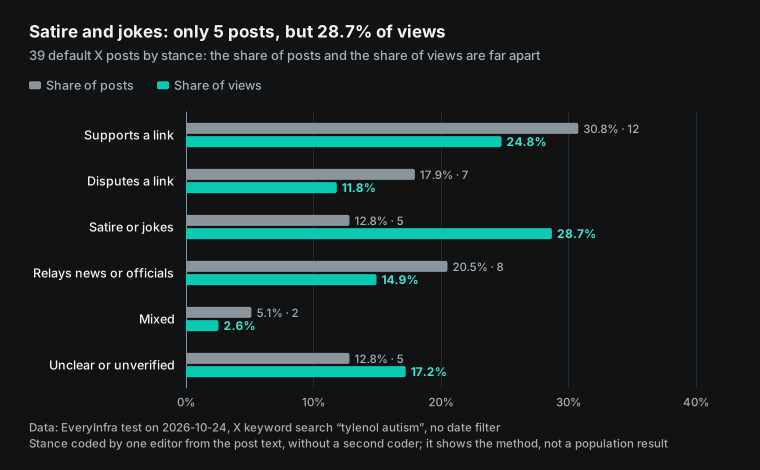
By stance, in the 39 default X posts:
- Supports a link: 12 posts (30.8%), 24.8% of views.
- Disputes a link: 7 posts (17.9%), 11.8% of views.
- Satire or jokes: 5 posts, 28.7% of views.
- Relays news or quotes from officials: 8 posts. Mixed: 2 posts. Unclear or unverified: 5 posts.
In the 25 date-filtered posts, 5 news posts had 77.0% of views. The 6 posts that support a link had only 10.3%.
Finding 5: old text comes back with a new opening
On October 14, 2025, one account quoted a senior health official who said Tylenol is linked to autism, ADHD and liver toxicity. The post started with "JUST IN" and had 2,284,135 views. On October 5, 2026, a different account posted the same text with a new opening, "BOMBSHELL". Only the opening and the line breaks were different. It had 78,044 views and 7,180 likes. Deduplication by text similarity groups these posts as one narrative. Deduplication by post ID counts the second post as new.
Finding 6: one keyword finds two kinds of items
An unverified harm story. Two posts in the default X result repeated one story. It said that a pregnant woman took a large amount of Tylenol to "prove Trump wrong" and went into intensive care with liver failure. The two posts had 8,943,963 views in total. Snopes found that the only source was the narrator, with no evidence (Snopes, 2025-09-30). The story has no identifiable patient and no reporter that you can verify, so it is not a valid case report. But it is a wide narrative, so it goes to the communication track.
Items that can be medication safety cases. In the newest Douyin result, an October 24, 2026, post said that a 5-year-old child took a combination cold medicine and a fever medicine at the same time. Both contained acetaminophen. The child had acute liver injury and went to intensive care. A June 28 post from a TV station account reported a pharmacy dose error for an infant. These posts describe duplicate use and a medication error. E2D(R1) lists overdose and medication error under "other observations" (ICH Step 4 slides). Neither post names a product, so an MAH cannot confirm that it is its product. But these items go to the pharmacovigilance track for review and an attempt to verify.
What this signal can and cannot do
It can:
- Find a new wave. Compare the daily count and views of date-filtered results with your own baseline.
- Show who posts: news organizations, accounts that say they are doctors, individuals and institutions, by market and language.
- Find repeated narratives. Text similarity groups old text with a new opening.
- Route possible cases. Posts that name a drug, a person and an adverse event go to the pharmacovigilance team.
- Help set response times. Rutgers data shows that some institutions answered 51 days late. With a daily baseline, you can set your own target from your own data.
It cannot:
- Represent a population. The result is the order that the endpoint returned at the time of the call. It is not a random sample, and it is not a user's personal feed.
- Decide what is true. A person must code stance against the evidence and record the reason and the coder.
- Replace a case report. Most posts do not identify a patient or a reporter. You must verify before a formal report.
- See closed spaces. Private messages and private groups are not in public data. The GW study of October 15 also used only public Facebook Pages (GW release).
- Give views on every platform. In this read, Douyin
view_countwas 0 for all items, Weibo had no view field, and Reddit search showed 0 likes. Use likes, shares and comments, or call a detail endpoint.
Triage workflow: who reviews, when to escalate, what to record


<ol> <li><strong>Write the scope.</strong> Write the objective, keywords (drug names, brand names and other names in each language), platforms, time windows, look-back period, review method and case process. For an MAH, this is the ODCS document. Without it, you cannot show which posts you reviewed.</li> <li><strong>Pull data at a fixed time each day.</strong> For each keyword and platform, run one date-filtered search (<code>since:</code> on X, <code>publish_time</code> on Douyin, and the fixed one-month range on Reddit) and one default search for comparison. Save the full response with the request ID and the read time.</li> <li><strong>First sort (communication reviewer).</strong> Tag each post as "narrative", "possible case" or "not relevant". If a post names a drug, a person and an adverse event, tag it as a possible case. At this step, do not decide whether it is true.</li> <li><strong>Send possible cases to pharmacovigilance on the same day.</strong> The pharmacovigilance reviewer checks the four items and tries to contact the reporter. Record the reason for no report, or the date the clock starts. The guideline says the clock starts when you have sufficient information (ICH Step 4 slides). Thus the time of each review is important.</li> <li><strong>Escalate narratives against your baseline.</strong> Escalate a narrative when its date-filtered views are clearly above your baseline. Also escalate it when it appears in a new language market. Send it to the medical and communication leads. They decide on a response and the channel. Set the threshold from your own data. Do not copy a number from a different team.</li> <li><strong>Record these fields for each item.</strong> Record the request ID, read time, platform, keyword and time parameter. Record the post URL, post time, and views, likes and shares at read time. Add the screenshot, code, coder and decision.</li> <li><strong>Review each month.</strong> Ask a second person to code a sample again and calculate agreement. Update the keyword list with new names and misspellings.</li> </ol>
For a wider brand view, see the multi-platform reputation monitoring blueprint. For recall notices, which are a different data type, see how to build a product recall notification service.
Run it in code or in an AI client
Request example (date-filtered X search):
curl -s https://api.everyinfra.com/api/v1/social \
  -H "Authorization: Bearer <API key>" \
  -H "Content-Type: application/json" \
  -d '{"platform":"twitter","action":"search","params":{"keyword":"tylenol autism since:2026-10-01","sort":"latest"}}'
Use the parameter names from the capability catalog, and put them in params. These twitter/search fields are the most useful for monitoring:
posted_at: post time, for time distribution and change.view_count,like_count,retweet_count,quote_count,bookmark_count: engagement at read time.author_username,author_follower_count,author_is_verified: who posts. Use these as hints, not as proof of credentials.text,links,language: for coding and language filters.conversation_id,is_reply,is_quote: to group replies and quotes into one thread.
Errors and charges in this test:
- Missing
actionfield: 422validation_error, no charge. - Required parameter not inside
params: 422missing_param, with a request example, no charge. - Empty result (the Douyin transcript): hold refunded,
charged_usdis 0. - See how to handle API errors and how to reconcile refunds.
In Claude Code, add the remote MCP server with one command. Then ask for X and TikTok posts about a drug name from the last 7 days, sorted by views.
claude mcp add --transport http everyinfra https://api.everyinfra.com/mcp \
  --header 'Authorization: Bearer ${EVERYINFRA_API_KEY}'
The model calls everyinfra_call_api. For slow tasks, add mode: "async" and read the result with everyinfra_get_job. To start, see the quickstart.
Endpoints used: X (Twitter) Scraper API and TikTok Scraper API. Capability pages: Twitter (X) Search API, TikTok Search API, YouTube search, Reddit Search API and SERP Search API.
Cost: 10 keywords, every day
We use catalog prices from October 24, 2026, except Douyin search, which uses the price that applies since October 28, 2026. For current prices, see pricing. Each day, run X, TikTok, YouTube, Reddit and Weibo once for each keyword, at $0.000556 each. Add one Douyin search at $0.008333 and one web search at $0.001389. That is $0.012502 per keyword per day. For 10 keywords in English, Spanish and Chinese for 30 days: $0.012502 × 10 × 30 = $3.75. Failed calls and empty results have no charge, so the real cost can be lower. Human coding time is the real cost, so estimate it separately.
Comparison with other methods
- Commercial social listening platforms: they usually have dashboards, sentiment and alerts, and suit brand teams. Make sure that you can export the raw posts and read times. Without them, it is difficult to keep the original records that pharmacovigilance needs.
- Platform research programs: sampling is more transparent, and they suit academic work. Approval takes time, few platforms offer them, and you must apply to each one.
- Manual search: low cost, good for a single event. You cannot repeat it exactly, and it is hard to compare day by day.
- This method (data API): one request format for many platforms, a charge per call, and the raw JSON. It does not code stance or give a dashboard, so you build the coding and the baseline. It sees only public content.
Recent changes (September–October 2026)
- September 23: umbrella review published (DMCN). For you: your coding guide has one more high-quality reference for "consistent with evidence". Update it.
- September 24: new TikTok Community Guidelines in effect (TikTok). For you: the rules say that some content cannot go into the For You feed, but they do not say that it leaves search. Do not estimate feed reach from search data.
- October 5: Zhejiang flu vaccine study (npj Digital Public Health). After two safety-related misinformation events, weekly vaccination trends fell. After a 2024 batch recall event, the trend went from +7.3% to −9.0% per week. For you: you can align social signals with real data such as doses, sales or clinic visits in a time series.
- October 12: WHO dialogue on sexual and reproductive health misinformation and platform governance (WHO). For you: platform governance for health topics is now a WHO agenda item, so expect more platform rule changes.
- October 12: China's joint rumor refutation platform publishes its September science rumor list. One item is the claim that you can take a double dose after a missed dose (rumor list, Chinese). For you: medication error claims and possible case reports often appear together, so add this type of claim to your keyword list.
- October 15: GW network study (Journal of Complex Networks). From 2019 to 2025, anti-vaccine communities lost 33.5% of pages and 52.3% of connections, but the network stayed largely intact. For you: removals do not fix network structure, so monitor the links between communities.
- October 16: ontology-based language models for drug slang (npj Digital Public Health). For you: keep your list of slang and other names up to date.
EMA's safety committee meeting of September 28 to October 1 did not start or close any referral procedure (EMA). A formal regulatory signal and social volume are different things. A review that went online on September 28 describes the role of generative AI at each stage of health misinformation (Frontiers in Medicine). A June 2026 KFF poll found that 31% of US adults use social media for health information at least monthly (KFF).
FAQ
Must a drug company monitor external social platforms? (Source: Google suggestion "social media monitoring pharmacovigilance".) The ICH E2D(R1) slides say that an MAH has no obligation to screen external digital platforms. But if you read external platform data in a planned way, keep ODCS documents and treat cases as solicited reports. Your local rules and your legal and pharmacovigilance teams decide your exact duties.
Is a keyword search a monitoring system? (Source: Google suggestion "health misinformation monitoring tool".) No. In this test, 82% of the default X result came from the wave one year ago, and a YouTube sort change still gave old videos. You need time windows, daily snapshots, text deduplication and human coding to answer "is there a new wave now?".
A post describes a possible side effect. Does it go into the reporting process? (Source: Google suggestion "social media pharmacovigilance".) First check the four items: an identifiable patient, an identifiable reporter, a suspect drug and an adverse event. If one is missing, record the reason and try to verify. Keep the screenshot and the read time. The pharmacovigilance lead decides on the report and the clock under the rules that apply.
Related reading
- Creator due diligence: data beyond follower counts: the same problem as "an account label is not a content check".
- Reddit comment scraping: MoreComments and replace_more: read this before you collect comment threads.
- EverySearch API: web search and source evidence
- YouTube Scraper API
References
- Social Media Analysis Finds Health Institutions Delayed or Did Not Respond to False Claims…, American Academy of Pediatrics, 2026-10. https://www.aap.org/en/news-room/news-releases/aap/2026/social-media-analysis-finds-health-institutions-delayed-or-did-not-respond-to-false-claims-linking-autism-to-acetaminophen-use-during-pregnancy/
- TikTok misinformation content on acetaminophen and autism surged after presidential announcement, AAP via EurekAlert, 2026-10. https://www.eurekalert.org/news-releases/1145255
- Tayebi-Hillali H, et al. Prenatal exposure to paracetamol and the risk of autism and ADHD: an umbrella review and meta-meta-analysis. Developmental Medicine & Child Neurology, 2026-09-23. https://onlinelibrary.wiley.com/doi/10.1111/dmcn.70512
- Does paracetamol/acetaminophen use in pregnancy increase the risk of neurodevelopmental disorders in children?, Wiley via EurekAlert, 2026-09. https://www.eurekalert.org/news-releases/1144629
- Illari L, Restrepo N, Johnson N. Long-term resilience of online battle over vaccines and beyond. Journal of Complex Networks 14(5), 2026-10. https://academic.oup.com/comnet/article-abstract/14/5/cnag038/8916678
- GW Researchers Find Global Distrust Networks Unchanged…, George Washington University, 2026-10. https://mediarelations.gwu.edu/gw-researchers-find-global-distrust-networks-unchanged-despite-6-years-moderation-and-many-millions
- Zhang X, et al. Associations between vaccine misinformation and influenza vaccine uptake. npj Digital Public Health, 2026-10-05. https://www.nature.com/articles/s44482-026-00047-1
- Valdez D, et al. Closing surveillance detection gaps for emerging digital drug discourse with ontology-enhanced large language models. npj Digital Public Health, 2026-10-16. https://www.nature.com/articles/s44482-026-00048-0
- Generative AI and health misinformation: a lifecycle-based communication framework. Frontiers in Medicine, online 2026-09-28. https://www.frontiersin.org/journals/medicine/articles/10.3389/fmed.2026.1801842/full
- SRHR misinformation and digital platform governance, WHO, 2026-10-12. https://www.who.int/news-room/events/detail/2026/10/12/default-calendar/srhr-misinformation-and-digital-platform-governance
- Meeting highlights from PRAC, 28 September – 1 October, EMA, 2026-10-02. https://www.ema.europa.eu/en/news/meeting-highlights-pharmacovigilance-risk-assessment-committee-prac-28-september-1-october
- Community Guidelines: Integrity and Authenticity, TikTok, in effect 2026-09-24. https://www.tiktok.com/safety/en/policies-and-engagement/integrity-authenticity
- Campaign on fake short-video personas (Chinese), Cyberspace Administration of China, 2026-09-30. https://www.cac.gov.cn/2026-09/30/c_1792520301987752.htm
- ICH E2D(R1) Guideline reaches Step 4, ICH, 2025-09. https://www.ich.org/news/ich-e2dr1-guideline-reaches-step-4-ich-process
- ICH E2D(R1) Step 4 Presentation, ICH, 2025-09-09. https://database.ich.org/sites/default/files/ICH%20E2D%28R1%29_Step%204_Presentation_2025_0904.pdf
- ICH E2D post-approval safety data management (EU effective date 2026-03-18), EMA. https://www.ema.europa.eu/en/scientific-guidelines/ich-e2d-post-approval-safety-data-management
- E2D(R1) Post-Approval Safety Data, final guidance, FDA. https://www.fda.gov/regulatory-information/search-fda-guidance-documents/e2dr1-post-approval-safety-data-definitions-and-standards-management-and-reporting-individual-case
- FDA Updates Guidance to Further Empower Companies to Address the Spread of Misinformation, FDA, 2024-07-08. https://www.fda.gov/news-events/press-announcements/fda-updates-guidance-further-empower-companies-address-spread-misinformation
- FDA Responds to Evidence of Possible Association Between Autism and Acetaminophen Use During Pregnancy, FDA, 2025-09-22. https://www.fda.gov/news-events/press-announcements/fda-responds-evidence-possible-association-between-autism-and-acetaminophen-use-during-pregnancy
- Use of paracetamol during pregnancy unchanged in the EU, EMA, 2025-09-23. https://www.ema.europa.eu/en/news/use-paracetamol-during-pregnancy-unchanged-eu
- Barnett ML, et al. Changes in paracetamol and leucovorin use after a White House briefing. The Lancet, 2026-03. https://www.thelancet.com/journals/lancet/article/PIIS0140-6736%2826%2900243-6/fulltext
- Guideline on collection and reporting of individual adverse drug reactions (Chinese), NMPA 2018-12-21, reprint by CCFDIE. https://www.ccfdie.org/cn/yjxx/yphzp/webinfo/2018/12/1546793717944557.htm
- KFF Tracking Poll on Health Information and Trust, KFF, 2026-06. https://www.kff.org/public-opinion/kff-tracking-poll-on-health-information-and-trust-use-of-social-media-and-ai-for-health-information-and-advice/
- Medical misinformation policy, YouTube Help. https://support.google.com/youtube/answer/13813322?hl=en
- Ahlqvist VH, et al. Acetaminophen Use During Pregnancy and Children's Risk of Autism, ADHD, and Intellectual Disability. JAMA, 2024-04-09. https://jamanetwork.com/journals/jama/fullarticle/2817406
- EveryInfra capability catalog, read 2026-10-24. https://api.everyinfra.com/api/v1/social/catalog
- September 2026 science rumor list (Chinese), China Internet Joint Rumor Refutation Platform, 2026-10-12. https://www.piyao.org.cn/20261012/d323698a2fd3446caf7aacc5246984c3/c.html
- Inspecting rumor claiming pregnant woman overdosed on Tylenol…, Snopes, 2025-09-30 (secondary, fact check). https://www.snopes.com/news/2025/09/30/tylenol-overdose-pregnant-woman/
- Tylenol misinformation drew outsized TikTok views…, CIDRAP, 2026-10 (secondary). https://www.cidrap.umn.edu/anti-science/tylenol-misinformation-drew-outsized-tiktok-views-public-health-agencies-largely
- Tylenol during pregnancy not linked to autism, ADHD, major review finds, CIDRAP, 2026-09-23 (secondary). https://www.cidrap.umn.edu/anti-science/tylenol-during-pregnancy-not-linked-autism-adhd-major-review-finds
- Kenvue loses bid for rehearing after Tylenol autism lawsuits revived, Reuters, 2026-10-16 (secondary). https://www.reuters.com/legal/litigation/kenvue-loses-bid-rehearing-after-tylenol-autism-lawsuits-revived-2026-10-16/
- TikTok Flooded With Misinformation After FDA Linked Painkiller With Autism, HealthDay via US News, 2026-10-05 (secondary). https://www.usnews.com/news/health-news/articles/2026-10-05/tiktok-flooded-with-misinformation-after-fda-linked-painkiller-with-autism
- Pharma Social Media Marketing: Strategy & FDA Guide, ICUC, 2026-09 (secondary). https://www.icuc.social/resources/blog/pharma-social-media-strategy
Reference BL-35