News AI Licensing Moves to Pay-Per-Use: 8 Events and a Search Test
In 30 days, Google, Cloudflare and the publisher coalition SPUR moved news licensing toward payment per AI use. Nobody has settled who counts a use. We tested how three search tools surface the original documents behind eight of these events.
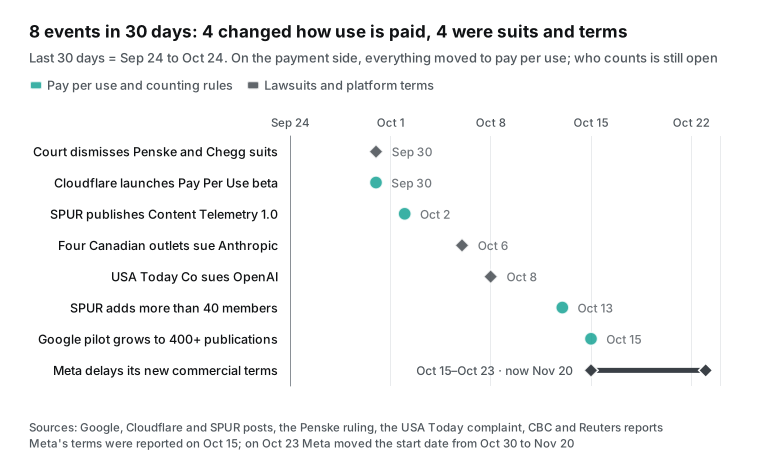
Between September 24 and October 24, 2026, money between news publishers and AI products started to follow each use of an article. On October 15, Google said more than 400 publications now take part in its paid News AI pilot (Google). On September 30, Cloudflare opened a beta of Pay Per Use, which bills AI buyers for each reported use (Cloudflare). On October 2, the publisher coalition SPUR released version 1.0 of its Content Telemetry Standard. It defines how an AI system records that it retrieved, cited or showed an article (SPUR). But each of the three gives a different answer to one question: who counts the uses? None of them has an independent audit yet.
We also ran a test. On October 24, 2026, 04:30–04:44 UTC (12:30–12:44 Singapore time), we searched for these eight events with the EveryInfra search and X data APIs. In the top 10 web results, only 4 of the 8 events showed the original document from the company, court or group involved. For the 4 legal events (a ruling, two lawsuits and a set of platform terms), the original text appeared in none of 12 result lists across three search tools. Three of those four texts are public.
In this article, "pay per use" means that an AI product pays an agreed price each time it uses an article. A use is a retrieval, an answer grounded on the article, a citation or a display to a reader. It does not mean payment per crawl or a one-time license fee.


The eight events, in date order
Each item ends with what it means for newsrooms and data teams.
- September 30: a US court dismissed the Penske and Chegg antitrust suits against Google. Judge Amit Mehta wrote that the publishers had only an "expectation" of traffic. In the opinion, he adds: "an expectation is not an agreement" (Reuters, Oct 1). What it means: in the US, antitrust law does not currently force Google to pay for AI summaries.
- September 30: Cloudflare launched the Pay Per Use beta. Each AI company defines the use it pays for and sets a price. Publishers accept or decline offers in the dashboard. The buyer reports each use, and Cloudflare bills monthly (Cloudflare). On the same day, Cloudflare opened Monetization Gateway, which charges per request for APIs and data (Cloudflare). What it means: small sites that cannot negotiate a license now have one place to see offers.
- October 2: SPUR published Content Telemetry 1.0. The standard splits AI use into events: retrieved, grounded, cited, presented and engaged. Each report must also declare whether its coverage is complete, sampled, aggregated or selected (release notes). What it means: publishers now have a shared unit for license talks, but only if AI companies agree to report.
- October 6: four Canadian news organizations sued Anthropic. Postmedia, Torstar, The Globe and Mail and The Canadian Press filed in an Ontario court. They say Anthropic scraped their sites to develop Claude and went around technical protection measures. CBC reported the claim on October 19. A court has not tested the allegations (CBC). What it means: news lawsuits now reach more model makers than OpenAI.
- October 8: USA Today Co sued OpenAI. The complaint, case 1:26-cv-08892, covers 19 publications. Reuters reports that it seeks damages "in excess of $250 million" (Reuters). What it means: a large US local-news group has joined the copyright cases already grouped in the Southern District of New York.
- October 13: SPUR added more than 40 members. The New York Times, AFP, The Economist and The Atlantic joined. SPUR now has more than 80 members in over 20 countries (SPUR). What it means: more publishers back the standard, but no AI buyer has said in public that it will use it.
- October 15: Google made two changes on the same day. First, the News AI pilot grew to more than 400 publications. New partners include CNN, the Financial Times, Axios, Forbes and several US local outlets (Google). Second, inline links in AI Mode and AI Overviews now appear higher. Article carousels (first launched in May) reach more countries and languages (Google). What it means: Google pays for content and makes links easier to see, but neither post gives click data.
- October 15–23: Meta delayed its new commercial terms. Nieman Lab reported on October 15 that the terms let Meta crawl sites "associated with" business accounts. Meta removed the word "train" the next day (Nieman Lab). On October 23, Meta moved the start date from October 30 to November 20 (Reuters). What it means: almost every newsroom has a Meta business account, so the final text decides whether Meta can crawl its site.
What actually changed: the unit of payment moved from crawl to use
Before, a site had two choices. It let crawlers in and hoped for search traffic, or it blocked them and tried to sign a one-time license.
Cloudflare's own data shows why that choice no longer fits. Fewer than 1% of sites on its network block search crawlers, but 17% block training crawlers (Cloudflare, Sep 15). In spring 2025, 22% of crawler requests declared training as their purpose. By June 2026, the share was 52% (Cloudflare, Sep 30). News sites started to block early: by the end of 2023, 48% of top news sites in ten countries blocked OpenAI's crawlers (Reuters Institute). In 2025, Cloudflare's Pay Per Crawl charged per crawl (Cloudflare, 2025), and Cloudflare Radar shows how each crawler behaves.
The three new models all count "use events." The difference is who does the counting:
- Google counts. The News AI pilot pays for delivery of "enhanced content." A Google spokesperson told Nieman Lab that this pilot does not pay by contribution to an AI answer (Nieman Lab). A separate "AI contribution pilot" does pay by value. Digiday reported on September 14 that Google pays only when it judges that content "significantly" helped an answer in AI Overviews, AI Mode or Gemini. Search Console shows a monthly amount but not the formula (Digiday).
- The buyer reports. In Pay Per Use, each AI company reports its own uses as lines of JSON. Cloudflare checks that each record maps to an enrolled domain, and the program terms require complete reporting. Cloudflare's summary is "pay for the use, not the crawl" (Cloudflare).
- A standard defines the report, but the audit rules are not written yet. SPUR's June draft planned revised versions by August 10 (SPUR draft notice). Version 1.0 came out on October 2. Digiday reported that the technical committee for "auditing and evidencing" was set to meet for the first time on October 15 (Digiday).
All three share one gap. The use data that a publisher sees comes from Google or from the buyer. A method to check it independently is still in development, which is why SPUR lists auditing as its next step.


Conclusions you cannot draw from the announcements
- "400 publications" does not mean 400 publishers, and it does not mean pay by contribution. Google counts publications. Its list includes a single brand such as CNN and a newspaper group such as Shaw Media. The post does not say how it counts a group. In June, Google's policy page said "more than 200" (Google Public Policy). The count doubled in about four months. Google did not disclose terms for any partner (Reuters).
- More visible links do not prove more clicks. Google's October 15 post says it made "continued and substantial increases" to inline links. It gives no click or traffic numbers (Google). The best outside figure is older. In March 2025 browsing data, Pew found clicks on a link inside the AI summary on only 1% of visits to such pages (Pew). That data predates the redesign. On the reader side, the Reuters Institute's 2026 survey shows weekly use of AI chatbots for news up from 7% to 10%. Only 1% call it their main news channel (Digital News Report 2026).
- Chartbeat's 40.2% drop is not all AI. Search Engine Journal summarized Chartbeat's 2026 Publisher Playbook on September 24. Google Search referrals across Chartbeat's network fell 40.2% from July 2025 to July 2026, after a 21.9% fall the year before. The sample leans toward news sites and gives no site count. It also does not say if the yearly figure measures pageviews or share (SEJ). The same report puts AI chatbot referrals at 0.01% of traffic. The Reuters Institute cites a different Chartbeat figure: a 33% fall for more than 2,500 sites from November 2024 to November 2025 (as reported by Reuters). The windows and samples differ, so do not compare the two numbers. The Reuters Institute also notes that Google does not currently show AI Overviews on news queries (Reuters Institute).
- A dismissed antitrust case does not make Google's use of content lawful. The two suits made Sherman Act and unjust-enrichment claims, not copyright claims. The opinion also says the court is not "unsympathetic" to publishers (opinion; Press Gazette summary). In the UK, the Competition and Markets Authority (CMA) acted on June 3. Google must let publishers keep content out of AI features in search, and it has nine months to comply (CMA, June). On September 23, the CMA proposed that every search service on its choice screens must attribute publisher content clearly (CMA, September). The two countries use different legal tools and get different results.
- Removing "train" and delaying the date does not rule out training. The revised text allows crawling to "develop" advertising and business products. Law professor James Grimmelmann told Nieman Lab the wording is "broad enough to drive a truck through" (Nieman Lab). As of October 23, Meta had changed only the date. The terms still had no robots.txt language (Nieman Lab, Oct 23). The UK News Media Association (statement), the News/Media Alliance (statement) and the European Publishers Council (statement) object in public. On October 22, a group asked the European Commission and the CMA for interim measures (Reuters).
- 80 SPUR members do not mean AI companies use the standard. SPUR invited OpenAI, Anthropic, Google, Meta and Microsoft to its advisory board. Google told Digiday only that it "frequently" engages with SPUR and other groups. The others did not reply (Digiday).
- "Sue" and "license" are not two separate camps. We checked the original member and partner lists line by line. All four Canadian plaintiffs against Anthropic are on SPUR's member list. The Canadian Press joined as a new member on October 13, seven days after the filing (SPUR list). The Financial Times, a SPUR founding member, is on Google's October 15 partner list. The Guardian, from founding member Guardian Media Group, was a launch partner of Google's pilot in December 2025 (Google, Dec 2025). Of the 17 publications that Google's two posts name, 2 come from SPUR founding members. One organization can sue one AI company, license to another and help write the counting standard.
Our test: where do search tools send people for this news?
AI products search before they answer.
An arXiv paper from October 10 studied 158,099 answers with 468,037 citations. Every page that ChatGPT cited was one that its own search had retrieved. Retrieval explained far more of the variation (32%) than page features did (2.8%) (arXiv 2610.15033). The paper studied commercial questions, not news, but the order is the same: search first, then cite.
So we tested the search step. For each event, which kinds of sites fill the top 10, and does the original document appear?
We wrote these criteria before the first call (we keep the original on file):
- Four site classes, set by a domain allowlist: original document, newsroom with bylines, social platform, other.
- Hypothesis 1: in news search, newsrooms fill more than half of the results.
- Hypothesis 2: web search shows the original document for at least 6 of the 8 events.
- Hypothesis 3: semantic search returns a higher share of original documents than web search.
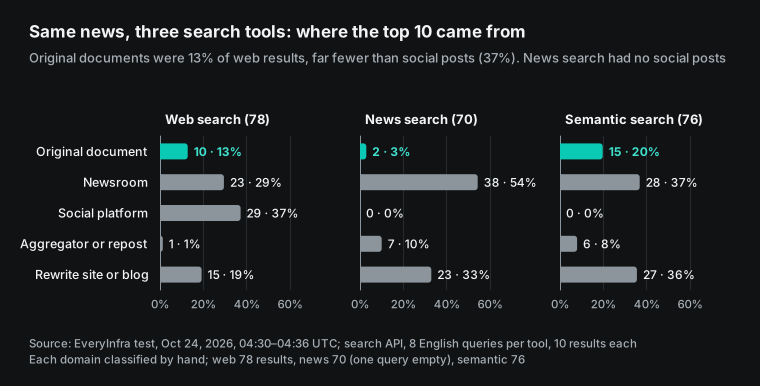
Test 1: which sites fill the results. From 04:30 to 04:36 UTC on October 24, we called three tools of the EveryInfra search API: web, news and semantic. We used one English query per event and 10 results per call, 24 calls in total. We added 2 Spanish and 2 Chinese queries on news. Each call costs $0.000694, and empty results are not charged.
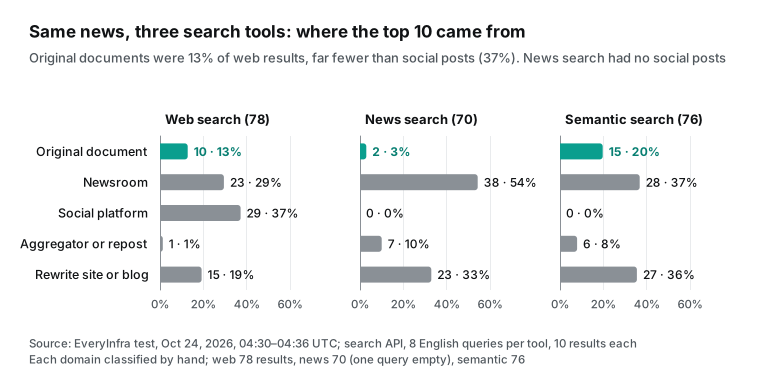
- Web search: after a manual review, 29 of 78 results (37%) were social posts from Facebook, Instagram, LinkedIn, Reddit, Threads, YouTube and X. Newsrooms had 23 (29%). Original documents had 10 (13%).
- News search: none of the 70 results were social posts. With our preset allowlist, newsrooms had only 31%, so hypothesis 1 failed. The allowlist missed outlets such as Forbes, Quartz and AdExchanger. After we reviewed each domain by hand, newsrooms had 54% (we kept a record of every decision). Rewrite sites and personal or vendor blogs had 33%, and aggregators and reposts had 10%.
- Semantic search lagged on the newest events. For "USA Today sues OpenAI," none of 9 results covered the October 8 suit; the top results were court records from a different 2025 case. For Meta's terms, 3 of 8 results mentioned the new terms. Our search tool catalog says
semantichas an indexing delay for very new pages, and the test matched that note. - Chinese and Spanish: the Chinese news query returned 1 newsroom, 5 portals or reposts and 4 rewrite sites. The 2 Spanish queries returned 20 results, 10 from newsrooms. Neither language showed an original document. One more Chinese query returned nothing and was not charged.
How often the event's own original document reached the top 10 (court records from other cases do not count):
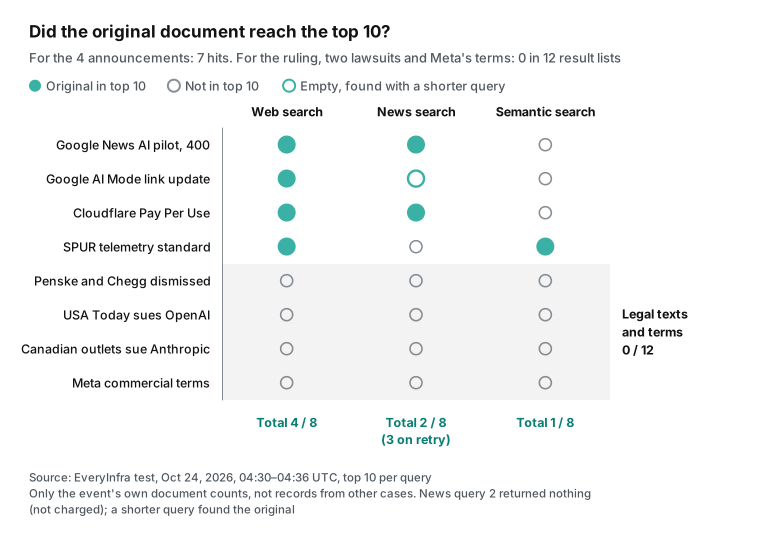
- Web search: 4 of 8, so hypothesis 2 failed. The hits were the posts from Google, Cloudflare and SPUR.
- News search: 2 of 8. One query returned nothing; with a shorter query, the result was 3 of 8.
- Semantic search: 1 of 8, and that hit was SPUR's June draft page, not version 1.0. By raw share, semantic (20%) beat web (13%), but the extra documents were 2025 government reports and other cases. Counted by each event's own document, hypothesis 3 also failed.
- The ruling, the two lawsuits and the Meta terms: 0 of 12 result lists. The ruling PDF and the USA Today complaint PDF are public. Reuters, Forbes and social posts ranked above them.
Test 2: a sample of rewrite pages. From 04:43 to 04:44 UTC, we used the read tool on 6 "other" pages from the news results. Each call costs $0.000694. Then we checked each page by hand.
- 2 pages say in public that a machine wrote them. One is credited to "Noah Wire Services" and lists the headline it was "inspired by" plus paragraph-level citations. The other has an author bio that calls the author "an AI-generated research agent."
- 3 pages link to the event's original document. The other 3 link to neither the original document nor the Reuters story.
Test 3: spread on X. From 04:41 to 04:42 UTC, we called X keyword search. It sorts by top posts by default and costs $0.000556 per call.
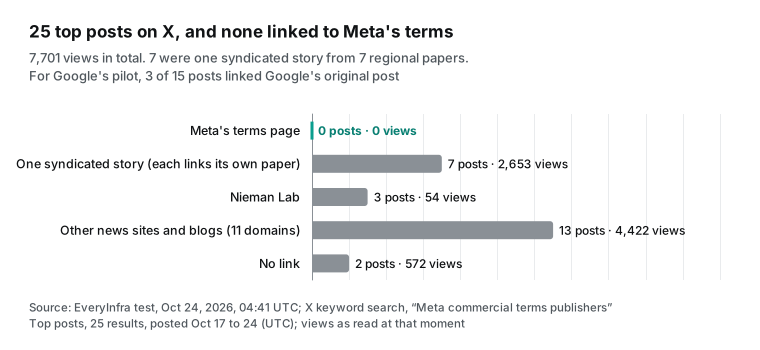
- "Meta commercial terms publishers": 25 posts from October 17 to 24 (UTC). 15 came from newsroom accounts. 7 regional newspapers posted the same syndicated story with the same headline. At the time we read them, the 25 posts had 7,701 views in total (median 178, maximum 1,013), 7 likes, 2 reposts and 1 reply. None linked to Meta's terms. Nieman Lab was the most linked site (3 posts).
- "Google "News AI" pilot publishers": 15 posts from 2026 had 6,052 views in total. One post by an SEO consultant had 57% of them (3,461). 3 posts linked to Google's original post.
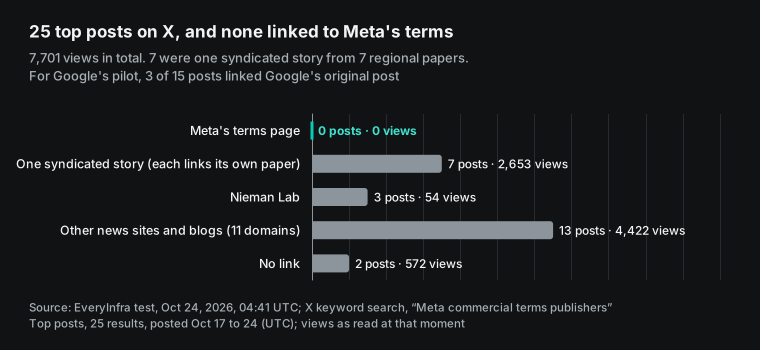
What the three tests show: a newsroom or AI assistant that relies only on search results for this kind of story mostly gets retellings. The closer the event is to a legal text, the harder it is to find the original. Limits: this is one snapshot from October 24; results change daily; we used one query per event; X results are top posts, not all posts. We also ran 4 queries on Reddit search, but the posts covered only the last day, so we left them out of the conclusions.
What newsrooms and data teams can do
- List the original documents first. For each event, write down the announcement, ruling, complaint or terms page. Expected result: a table of events and original URLs.
- Run the same queries every day. Query
webandnewsonce each and record the top 10 domains. Expected result: two rows per event per day. - Record two numbers. Is the original document in the top 10? How many results are rewrites or aggregators? Expected result: you see which events get buried under retellings.
- Read legal texts directly. For rulings, complaints and terms, use
readon the original URL instead of waiting for search. Google's documentation says that Googlebot rules and preview controls such asnosnippetapply to AI Overviews and AI Mode (Google Search Central). Use it to check your own site settings. Expected result: each quote matches a page of the original. - Track the spread. Use the X Scraper API with the same keywords and record views and linked domains. You can run the same terms on Threads search. Expected result: you know which story readers saw.
- Reconcile charges. Each response has
billing.charged_usd, and empty results showempty_result_refunded. See API billing reconciliation.
To choose between search tools, read Search tools for AI agents. To decide what to open to AI crawlers, read AI crawlers and robots.txt.
Reproduce the test
Request (news search for the Google pilot):
curl -s https://api.everyinfra.com/api/v1/search \
  -H "Authorization: Bearer <API Key>" \
  -H 'Content-Type: application/json' \
  -d '{"tool":"news","params":{"q":"Google News AI pilot 400 publications","num":10}}'
Response fields you need:
results[].url,results[].title,results[].snippet: link, title and excerpt.results[].published: publish time (the news tool gives relative times such as "1 week ago").billing.charged,billing.charged_usd: whether the call was charged, and the amount in USD.billing.reason:empty_result_refundedfor an empty result. The held amount goes back.id: the request ID for reconciliation.
For X search, send POST /api/v1/social with {"platform":"twitter","action":"search","params":{"keyword":"...","limit":25}}. The response includes view_count, like_count, links and posted_at; see the capability catalog for all fields. To use the same data in Claude or Cursor, connect the remote MCP server. New users can create a key in the quickstart.
Errors and charges, all from this test:
- Wrong parameters (missing
params, wrong field name): HTTP 422 with a working example request. No charge. We made this mistake 12 times and paid $0. - No results: an empty list with
empty_result_refunded. No charge. This happened 2 times. - Normal results: charged at the catalog price.
Cost
At catalog prices read on October 24 (check the pricing page), daily monitoring of 8 events costs:
- web + news search: 8 × 2 = 16 calls × $0.000694 = $0.011104
- read 8 original documents: 8 calls × $0.000694 = $0.005552
- X search for 2 keywords: 2 calls × $0.000556 = $0.001112
- total per day: $0.017768, or about $0.53 for 30 days. Empty results are free, so the real cost is lower.
All live calls for this article: 53 requests, $0.026238 charged.
FAQ
Does Google pay news sites now? Some, in two ways. The News AI pilot pays for delivered content, not by contribution to an answer, and covers more than 400 publications. The AI contribution pilot pays when Google judges a "significant" contribution, and shows a monthly amount in Search Console. Neither program publishes prices. (The question comes from an X post, "Google is paying publishers again. Sort of.")
Impressions are up but clicks are down. Is it AI Overviews? One number cannot answer that. Since June, Google has opened generative AI impression reports in Search Console to some sites (Google Search Central). Compare your own impressions and clicks first. Then use Pew's 1% figure and Chartbeat's network data, and note that their samples and dates differ. (The question comes from an r/SEO_Experts post title, "Is Google's AI Search reducing organic traffic, even when impressions…")
Do Meta's new terms take effect on October 30? No. Meta told Reuters on October 23 that the date moved to November 20. Only the date changed in the text. If you worry about crawling, check your robots.txt now and read the final text before November 20. (The question comes from several result titles such as "Meta Terms … Oct. 30.")
References
Primary documents:
- Google, "400 publications are now partnering with us on our News AI pilot program," 2026-10-15, https://blog.google/products-and-platforms/products/news/news-ai-pilot-update-publishers/
- Google, "AI Mode and AI Overviews updates to explore the web," 2026-10-15, https://blog.google/products-and-platforms/products/search/updates-ai-mode-overviews-explore-web/
- Google, "New Google web ecosystem tools and partnerships," 2025-12, https://blog.google/products-and-platforms/products/search/tools-partnerships-web-ecosystem/
- Google, "How Google Search helps you find original, quality content," 2026-05, https://blog.google/products-and-platforms/products/search/original-high-quality-content-search/
- Google Public Policy, "Google's ongoing commitment to supporting the information ecosystem," 2026-06, https://publicpolicy.google/article/supporting-information-ecosystem/
- Google Search Central, "AI Features and Your Website," updated 2025-12-10, https://developers.google.com/search/docs/appearance/ai-features
- Google Search Central, "Introducing Search Generative AI performance reports in Search Console," 2026-06-03, https://developers.google.com/search/blog/2026/06/gen-ai-performance-reports
- Cloudflare, "Pay Per Use: when AI uses your work, you should get paid," 2026-09-30, https://blog.cloudflare.com/pay-per-use
- Cloudflare, "The Internet has a second audience," 2026-09-30, https://blog.cloudflare.com/agentic-web
- Cloudflare, "Monetization Gateway beta," 2026-09-30, https://blog.cloudflare.com/monetization-gateway-beta
- Cloudflare, "Have it both ways: stay discoverable in search while disallowing AI training," 2026-09-15, https://blog.cloudflare.com/accountable-mixed-use-ai-crawlers/
- Cloudflare, "Introducing pay per crawl," 2025-07, https://blog.cloudflare.com/introducing-pay-per-crawl/
- Cloudflare Radar, "AI Insights," live page, https://radar.cloudflare.com/ai-insights
- SPUR Coalition, "SPUR Content Telemetry Standard v.1 published," 2026-10-02, https://www.spurcoalition.org/updates/spur-content-telemetry-standard-v1-published
- SPUR Coalition, "Content Telemetry 1.0" release notes, 2026-10-02, https://github.com/SPUR-Coalition/telemetry/releases/tag/v1.0
- SPUR Coalition, "SPUR Telemetry Standard Published for Public Comment," 2026-06, https://www.spurcoalition.org/updates/spur-telemetry-standard-published-for-public-comment-the-spur-coalition
- SPUR Coalition, "The New York Times, Agence France-Presse, The Economist, and The Atlantic join The SPUR Coalition," 2026-10-13, https://www.spurcoalition.org/updates/the-new-york-times-agence-france-presse-the-economist-and-the-atlantic-join-the-spur-coalition
- US District Court for the District of Columbia, memorandum opinion, Chegg v. Google and Penske Media v. Google, 2026-09-30, https://fingfx.thomsonreuters.com/gfx/legaldocs/byvraqlwbpe/Chegg%20Penske%20order%20-%20Google%20antitrust%2020260930.pdf
- US District Court for the Southern District of New York, complaint, USA Today Co. v. OpenAI (1:26-cv-08892), 2026-10-08, https://fingfx.thomsonreuters.com/gfx/legaldocs/movarymwypa/USA%20TODAY%20OPENAI%20COPYRIGHT%20lawsuit.pdf
- News Media Association, statement on Meta's terms, 2026-10-16, https://newsmediauk.org/blog/2026/10/16/nma-condemns-arrogant-metas-shameless-landgrab-attempt-to-plunder-news-publisher-websites/
- News/Media Alliance, "Statement on Changes to Meta Commercial Terms of Use," 2026-10-16, https://www.newsmediaalliance.org/changes-to-meta-commercial-terms-of-use/
- European Publishers Council, statement on Meta's terms, 2026-10-16, https://www.epceurope.eu/post/european-commission-should-be-extremely-concerned-about-meta-s-dilemma-for-european-publishers-hand
- Chartbeat, "The 2026 Publisher Playbook," 2026-09, https://chartbeat.com/resources/general/the-2026-publisher-playbook-9-strategies-to-boost-acquisition-
- UK CMA, "CMA secures fairer deal for publishers and improves Google search services in UK," 2026-06-03, https://www.gov.uk/government/news/cma-secures-fairer-deal-for-publishers-and-improves-google-search-services-in-uk
- UK CMA, "CMA strengthens proposals allowing people choice over their search service," 2026-09-23, https://www.gov.uk/government/news/cma-strengthens-proposals-allowing-people-choice-over-their-search-service
- arXiv 2610.15033, "What Drives AI Citations?," 2026-10-10, https://arxiv.org/abs/2610.15033
- Reuters Institute, "Digital News Report 2026: Emerging uses of AI chatbots for news," 2026-06, https://reutersinstitute.politics.ox.ac.uk/digital-news-report/2026/emerging-uses-ai-chatbots-news-and-what-it-means-journalism
- Reuters Institute, "How many news websites block AI crawlers?," 2024-02-22, https://reutersinstitute.politics.ox.ac.uk/how-many-news-websites-block-ai-crawlers
- Pew Research Center, "Do people click on links in Google AI summaries?," 2025-07-22, https://www.pewresearch.org/short-reads/2025/07/22/google-users-are-less-likely-to-click-on-links-when-an-ai-summary-appears-in-the-results/
- EveryInfra, search tool catalog, read 2026-10-24, https://api.everyinfra.com/api/v1/search/tools
- EveryInfra, data capability catalog, read 2026-10-24, https://api.everyinfra.com/api/v1/social/catalog
Reporting and analysis (secondary; the text links the original document next to each):
- Reuters, "CNN, Axios and other publishers join Google's AI news program," 2026-10-15, https://www.reuters.com/business/media-telecom/cnn-signs-multi-year-ai-partnership-with-google-2026-10-15/
- Nieman Lab, "Google's News AI pilot expands to over 400 publications," 2026-10-15, https://www.niemanlab.org/2026/10/googles-news-ai-pilot-expands-to-over-400-publications-including-u-s-local-news-outlets/
- Digiday, "Google rolls out pay-per-value AI licensing program to publishers," 2026-09-14, https://digiday.com/media/google-rolls-out-pay-value-ai-licensing-program-to-publishers/
- Digiday, "SPUR publishes AI content tracking standard," 2026-10-02, https://digiday.com/media/spur-publishes-ai-content-tracking-standard-pitches-openai-and-google-to-join-advisory-board/
- Reuters, "Google wins dismissal of Chegg, Penske Media lawsuits over AI overviews," 2026-10-01, https://www.reuters.com/legal/litigation/google-wins-dismissal-chegg-penske-media-lawsuits-over-ai-overviews-2026-10-01/
- Press Gazette, "Penske Google AI Overviews lawsuit dismissed," 2026-10-01, https://pressgazette.co.uk/news/penske-ai-overviews-lawsuit-dismissed-because-no-formal-bargain-struck-with-google/
- Reuters, "USA Today sues OpenAI for copyright infringement over AI training," 2026-10-08, https://www.reuters.com/legal/legalindustry/usa-today-sues-openai-copyright-infringement-over-ai-training-2026-10-08/
- CBC News, "Anthropic sued by major Canadian news publishers," 2026-10-19, https://www.cbc.ca/news/business/anthropic-postmedia-torstar-globe-canadian-press-copyright-lawsuit-9.7387205
- Nieman Lab, "Legal experts warn Meta's new terms still grant broad scraping permissions," 2026-10-17, https://www.niemanlab.org/2026/10/legal-experts-warn-metas-new-terms-still-grant-broad-scraping-permissions-despite-language-changes/
- Nieman Lab, "Meta delays rollout of terms that would allow broad scraping of news sites," 2026-10-23, https://www.niemanlab.org/2026/10/meta-delays-rollout-of-terms-that-would-allow-broad-scraping-of-news-sites-legal-experts-are-still-skeptical/
- Reuters, "Meta to delay new commercial terms criticised by publishers, advertisers," 2026-10-23, https://www.reuters.com/business/media-telecom/meta-delay-new-commercial-terms-criticised-by-publishers-advertisers-2026-10-23/
- Reuters, "Publishers, advertisers call EU, UK antitrust regulators to suspend Meta's new commercial terms," 2026-10-22, https://www.reuters.com/legal/litigation/publishers-advertisers-call-eu-uk-antitrust-regulators-suspend-metas-new-2026-10-22/
- Reuters, "NYT, Economist among publishers joining coalition to curb unpaid AI use," 2026-10-12, https://www.reuters.com/legal/litigation/nyt-economist-among-publishers-joining-coalition-curb-unpaid-ai-use-2026-10-12/
- Search Engine Journal, "Google Search Decline Steepened To 40% YoY For Publishers," 2026-09-24, https://www.searchenginejournal.com/google-search-decline-publishers-chartbeat/590681/
- Reuters Institute, "Life after SEO: How newsrooms are adapting to the AI search shift," 2026-10, https://reutersinstitute.politics.ox.ac.uk/news/life-after-seo-how-newsrooms-are-adapting-ai-search-shift
Related reading
- EverySearch API: web search and evidence you can trace
- X (Twitter) Scraper API, Twitter (X) Search API; Reddit Scraper API, Reddit search
- AI crawlers and robots.txt: search, training, user visits
- Search tools for AI agents: discovery to verified answers
- Multi-platform reputation monitoring with comment data
- Reduce API docs drift with a live capability catalog
Reference BL-32