Same Product, 9 Countries: Cross-Border Price Gap Test
We tested 3 AliExpress items in up to 9 countries, plus eBay, Amazon and Shopee. The same SKU varied 1.4x to 4.6x. Here is how to sell that as a data product.

The same AliExpress SKU can cost 1.4 to 4.6 times more in one country than in another. The cheapest country changes from item to item. In 8 views from four EU countries, the product page never showed a strike-through "was" price. In all 11 views from outside the EU, it did, with discounts of 55% to 86%. We measured this on October 26, 2026, from 02:16 to 03:07 UTC (10:16 to 11:07 Singapore time, SGT) with 52 EveryInfra requests, 40 of them billed, for $0.071449.
In this article, a "cross-market price watch" means one thing. You read the public product page of the same SKU in each target country. You keep only rows where the country really switched, the currency matches and the variant is in stock. Then you compare countries with each other and with their own history. The result tells you what a SKU costs in each country, what discount the page shows and what changed since last week. It does not tell you what a shopper paid at checkout, because taxes, shipping and coupons at checkout are not on the product page.


Why now: new charges on cheap parcels in the US, the EU and the UK
Price gaps between countries are not new. What is new is that several governments changed the rules for low-value parcels in the same few months. For a seller or a brand team, that means prices can move in several countries at once, on different dates.
In the United States, U.S. Customs and Border Protection (CBP) is changing how low-value mail enters the country. The proposed rule, the new entry date and the rule they build on are listed with their dates in "Recent changes" at the end. CBP keeps the current guidance on its e-commerce page.
Research shows that US tariffs do reach shelf prices. A paper by Alberto Cavallo, Paola Llamas and Franco Vazquez, dated September 7, 2026, uses daily prices from five large US retailers. It estimates that seven months after the 2025 tariffs, retail pass-through reached 25%. Consumers carried 45% of the tariff burden. Prices rose more for Chinese products and for cheaper varieties.
The Harvard Business School Pricing Lab keeps a tariff tracker that updates these indexes. That research explains a trend across many goods. It cannot explain one product. But it tells you that the US view of a cross-border store has a reason to drift away from other countries.
The European Union added a new fee on top of a new duty. The Commission Delegated Regulation (EU) 2026/2152 was adopted on September 21, 2026. Article 1 sets the Union handling fee at EUR 2 per item. Article 2 applies it from November 1, 2026. The legal base is Article 20 of Regulation (EU) 2026/2108, the new Union Customs Code of September 16, 2026.
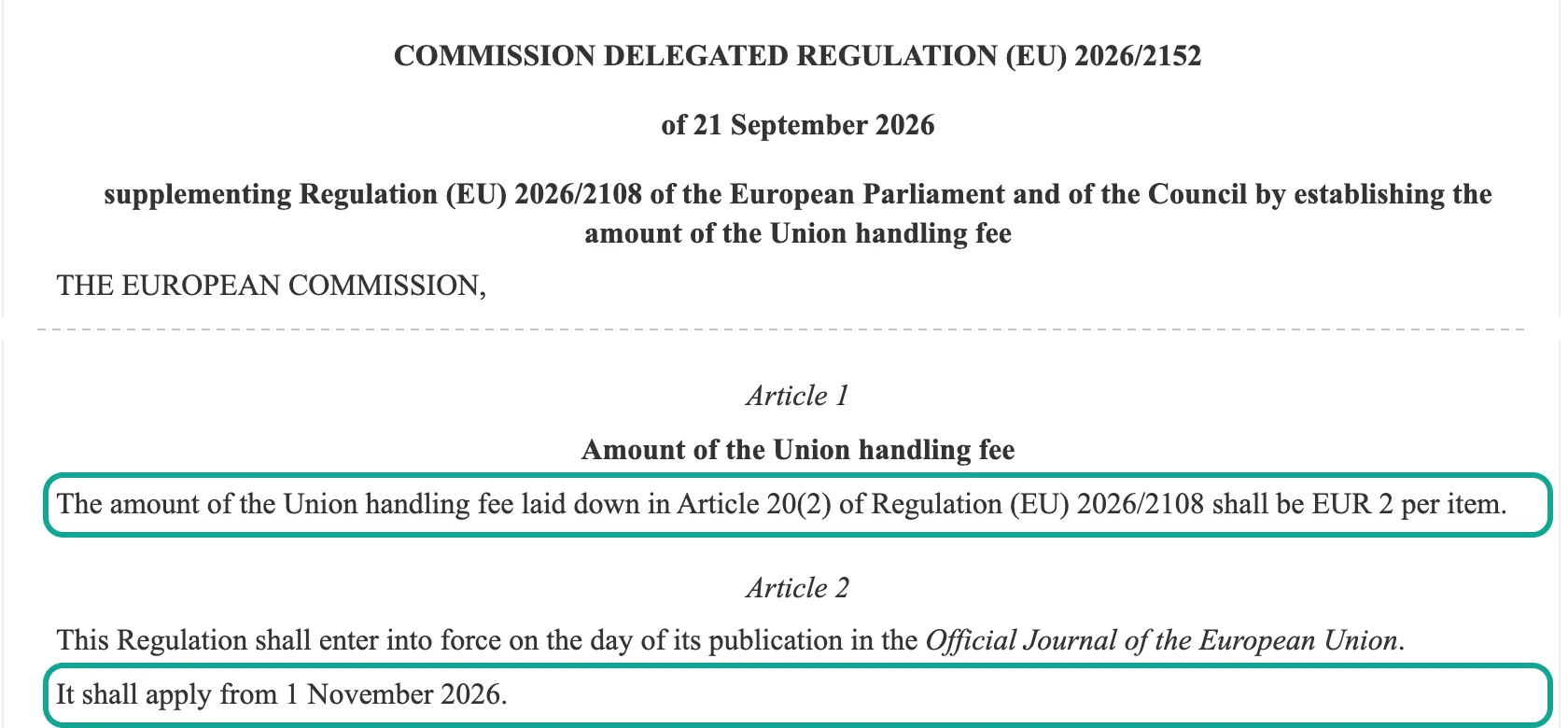
This fee comes on top of the EUR 3 duty that started on July 1, 2026. The Council press release of February 11, 2026 says that the EUR 150 duty relief ends. Until the EU customs data hub is ready, a flat EUR 3 applies to each tariff sub-heading in a small parcel. This applies from July 1, 2026, to July 1, 2028. The same release says that 4.6 billion small packages entered the EU in 2024, and 91% came from China. The Commission explained on June 29, 2026 that five T-shirts pay EUR 3, but three T-shirts and a watch pay EUR 6.
The German Federal Ministry of Finance note of July 1, 2026 adds one point for sellers. Import VAT of 19% or 7% still applies, so the duty and the VAT are two separate charges.
The tax and customs directorate (DG TAXUD) gave the scale on June 8, 2026. In 2025, about 5.9 billion low-value items went directly from third countries to EU consumers. Product identifiers become mandatory from November 1, 2026. DG TAXUD explains the duty and the fee together in its guidance version of October 5, 2026.
The United Kingdom is on the same path. The government's consultation response of July 13, 2026 confirms the removal of the customs duty relief for imports of GBP 135 or less. It also sets out new customs arrangements for these goods. Outside Europe, Brazil signed Law 15,502 on September 10, 2026. It lets the finance ministry cut the import tax on parcels up to $50 to zero. Mexico's 2026 General Foreign Trade Rules set a 33.5% global rate in rule 3.7.35 for simplified courier imports from outside the USMCA area.
| Market | Change in 2026 | Date | What it means for the product page price |
|---|---|---|---|
| United States | Entry type 13 for mail moved to January 20, 2027; low-value shipments rule proposed | October 14; October 8 | Rules still move, so US prices can move too |
| European Union | EUR 3 duty per tariff sub-heading; EUR 2 handling fee per item | July 1; November 1 | Cheap single items feel it most; VAT is separate |
| Germany | Sales of three platforms down 35.5% in Q3 (survey) | October 8 | Price changes already affect demand |
| Italy | National parcel levy moved to January 1, 2027 | October 22 | EU countries do not move together |
| United Kingdom | Duty relief for GBP 135 or less to be removed | July 13 | UK prices can change when the rules start |
| Brazil | Import tax up to $50 can be zero; state ICMS stays | September 10 | Cross-border orders rise, promotions can grow |
| Mexico | 33.5% global rate for simplified courier imports | 2026 rules | Page price and landed cost can differ a lot |
The table shows one practical problem for a data product. Taxes, fees and platform strategy now change the "price" of one SKU in each country, and on different dates. The EU fee on November 1, the November sales season and the US mail change on January 20 all fall in the next three months. If you want to know where a SKU changed price, you must read each country, and you must read the same SKU.
Method: fix the item and the SKU, then change the country
In this article, the product and the SKU stay fixed, and the country changes: one item, one variant, one moment, and a different ship-to country each time. Economists have used this "same item, many countries" method for years. Cavallo, Neiman and Rigobon published a 2014 paper in the Quarterly Journal of Economics. It uses online prices from four global retailers in dozens of countries. Inside a currency union, the same item often has exactly the same price. Across currency unions, prices of the same items differ a lot. The NBER working paper version is free to read.
Network researchers use a similar method. Mikians and co-authors showed in a 2012 HotNets paper that one product can show different prices to visitors from different places. Hannak and co-authors measured 16 e-commerce sites with more than 300 real users in a 2014 IMC paper. They found signs of personalization on 9 sites, and they spent a full section on how to separate noise from real price differences. We use the core of that method: fix the item, control the variables, remove the noise from data collection, and only then compare.
The test criteria we wrote before the data
Before we read the second and third items, we wrote six criteria with pass lines. The four that affect the results are in the table below. Each later section explains one row.
| Criterion | Pass line | Result |
|---|---|---|
| The country really switched | ship_to equals the requested country, and the currency equals the requested currency | 22 of 27 passed; 3 did not switch, 2 were empty |
| A cross-country gap exists | Same SKU, same currency, at least 3 countries, top ÷ lowest ≥ 1.20 | All 3 items passed: 1.4x to 4.6x |
| The headline price is comparable | Headline price and the buyable same SKU differ by less than 20% | Failed: the US charger differed by 41% |
| The pattern repeats | A different store and a different category keep the same direction | Gaps and strike-through pattern repeated; the cheapest country did not |
One note on method. We read the eight country views of the first item before we wrote these criteria. So that the first data set did not set the standard, the pass line is the common "20% is meaningful" rule. We then tested it again with the second and third items. The conclusions below use only the parts where all three items point the same way.
Test 1: one cable, eight countries, eight prices
From 02:17 to 02:20 UTC (10:17 to 10:20 SGT), we used aliexpress/product_detail on a Baseus USB-C cable. The item number is 1005005912594648. The page showed 10,568 reviews and "100K+ sold". Each request fixed currency=USD and changed only country: US, Germany, France, Spain, the Netherlands, the UK, Brazil and Mexico. The item has 8 SKUs that combine wattage (60W or 100W), color (gray or red) and length (1 m or 2 m).
The UK response came back in GBP with ship_to set to US. It did not switch to the UK, so we left it out of the comparison. The other seven countries switched.
Start with the headline price, the price field. It was $1.09 in the US and Mexico, $2.46 in Brazil, $3.41 in Germany, $3.42 in Spain, $3.72 in the Netherlands and $3.75 in France. The top ÷ the lowest is 3.44x. For this item, the headline price is the cheapest SKU, 60W gray 1 m, so the headline stands for one SKU here. But the headline hides one fact.
The gap is not the same for each SKU. As in Test 2, we count only variants with available=true. Across the seven countries, the top ÷ the lowest then goes from 1.5x for the 60W red 2 m cable to 4.6x for the 60W gray 2 m cable.
The 60W red 2 m cable is the exception. It was out of stock in both the US ($2.15) and Mexico ($1.35). The lowest price you could buy was $3.66 in Brazil, so the ratio is only 1.5x. If you count the two out-of-stock prices, you get 4.1x. That is the same mistake as the headline price trap in Test 2. The other seven SKUs could be bought in all seven countries. For them, the ratio goes from 3.0x for the 100W 2 m cables to 4.6x, and in general, the cheaper the SKU, the larger the gap between countries.
| Country | 60W red 2 m price | `available` | `stock` | Counted in the ratio? |
|---|---|---|---|---|
| US | $2.15 | false | 0 | No |
| Mexico | $1.35 | false | 0 | No |
| Brazil | $3.66 | true | 107 | Yes (lowest) |
| Germany | $4.79 | true | 50 | Yes |
| Spain | $5.10 | true | 50 | Yes |
| Netherlands | $5.17 | true | 50 | Yes |
| France | $5.51 | true | 50 | Yes (highest) |
| Country | Headline price | Stock pool (`total_stock`) | Strike-through price | Delivery (days) |
|---|---|---|---|---|
| US | $1.09 | 369 | $7.70, 86% off | 5 to 10 |
| Mexico | $1.09 | 369 | $6.59, 83% off | 9 to 13 |
| Brazil | $2.46 | 4,936 | $5.78, 57% off | 12 to 19 |
| Germany | $3.41 | 2,986 | none | 5 to 8 |
| Spain | $3.42 | 2,986 | none | 5 to 11 |
| Netherlands | $3.72 | 2,986 | none | 6 to 8 |
| France | $3.75 | 2,986 | none | 5 to 10 |
| UK (did not switch) | GBP 0.84 | 369 | GBP 6.02, 86% off | 5 to 10 |
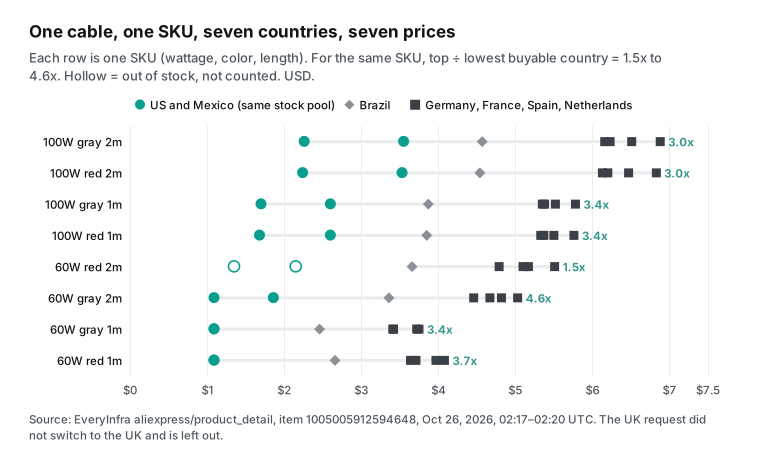
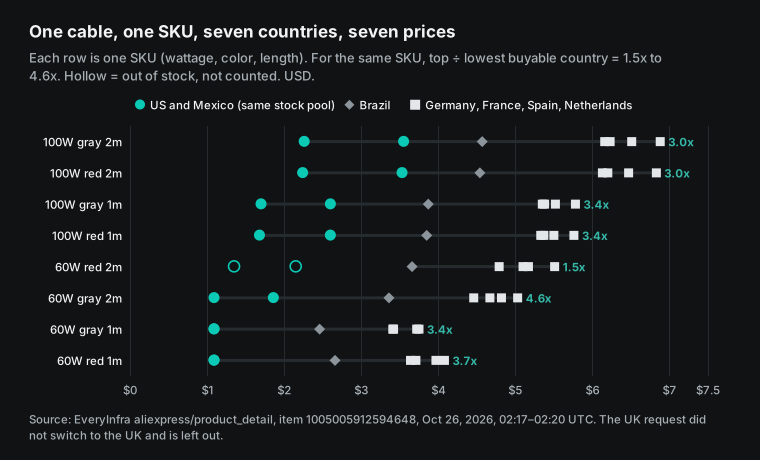
Why were the US and Mexico the cheapest? The response gives one clue. The US, Mexico and the UK request that did not switch all had a total_stock of 369. The four EU countries had 2,986, and Brazil had 4,936. Different stock counts mean that the platform serves these groups of countries from different stock pools.
In the US pool, the 60W gray 1 m cable had only 87 units left and the 60W red 1 m cable had 3. The 60W red 2 m cable was sold out (available=false). So $1.09 is probably a promotion price with a small stock. A price watch should not report "the US is the cheapest" here. It should record how much promotion stock is left, because the price can jump back when that stock runs out.
EU prices include VAT, and that is the next thing to remove. The EU Your Europe VAT rates page lists 19% for Germany, 20% for France and 21% for Spain and the Netherlands. Since 2021, sellers can collect VAT at the point of sale through the Import One-Stop Shop (IOSS) for imports up to EUR 150. So EU product page prices usually include VAT. We removed each country's VAT and compared again with the US.
For the 100W 2 m cable, the median of the four EU prices without VAT was still 1.49x the US price. For the gray one, Germany, France, Spain and the Netherlands were 1.46x, 1.61x, 1.52x and 1.45x on their own. For the 60W 1 m cables, the four-country median was 2.7x (gray) and 2.9x (red). US prices do not include sales tax, which states add at checkout. So this comparison is generous to the EU, and the gap is still large. The EU price is not simply "the US price plus tax".
There is also a difference in the price ladder inside each country. In the US, the most expensive SKU costs 3.26x the cheapest one. In the four EU countries, that ratio is only 1.68x to 1.90x. It is 1.86x in Brazil and 2.07x in Mexico. The US view pushes the cheapest SKU very low and leaves the other SKUs higher.
For a seller, this is the typical shape of a traffic item. One low SKU pulls the headline price down, and the popular sizes stay where they are. For a data product, it means that a report of headline prices makes "the US is cheap" look larger than it is.
One currency, but not one price
Cavallo and co-authors found that one item often has one price inside a currency union. Our cable mostly agrees in the EU. The same SKU in Germany, Spain and the Netherlands differs by 3% to 9%. France is the exception. Each SKU costs more in France than in Germany, and after VAT, France is 7% to 14% higher.
We checked French rules. France had a temporary EUR 2 small-parcel tax from March 2026, but the EU EUR 3 duty replaced it in July, as Connexion reported. So a French-only tax does not explain the gap. We do not know the reason, and we record it as "France premium, cause unknown".
The kitchen set in Test 3 shows a larger gap inside the EU. The same black 12-piece set cost $18.89 in Spain, $24.33 in France, $25.84 in Germany and $26.63 in the Netherlands. The top ÷ the lowest inside the EU is 1.41x. Three of its five SKUs differ by more than 17% inside the EU. The 2014 paper studied large brands that set prices in their own stores.
AliExpress shows third-party stores, and each country can have its own promotions and subsidies. That difference is itself a useful fact to sell. With one currency and one VAT system, the platform still gives one SKU different prices in different countries.
Test 2: the charger's headline price comes from a variant you cannot buy
The second item came from a different store and a different category. From 02:24 to 02:27 UTC (10:24 to 10:27 SGT), we read a UGREEN 65W GaN charger. The item number is 3256803227199742. It showed 643 reviews and "4,000+ sold", and the store is in Hong Kong. We asked for the US, Germany, Spain, Brazil and Mexico.
The item has 24 variants: 8 plug options times 3 ship-from places (mainland China, Russia and Saudi Arabia). Only the 8 variants that ship from mainland China were in stock. The other 16 had available=false and a stock of 0.
The headline prices in the US, Brazil and Mexico were almost equal: $28.53, $28.49 and $28.53. If you look only at the headline, you see "one price in three countries". But the US $28.53 belongs to the "ships from Russia, EU plug" variant. That variant had available=false and stock=0. The same SKU that you can buy in the US, 65W US plug from mainland China, cost $40.30.
That is 41.25% above the headline. In Brazil and Mexico, the same buyable SKU cost $28.49 and $28.53. So this charger costs 41.5% more in the US than in Brazil or Mexico. The bundle with a cable ($47.18 against $33.49) costs 40.9% more.
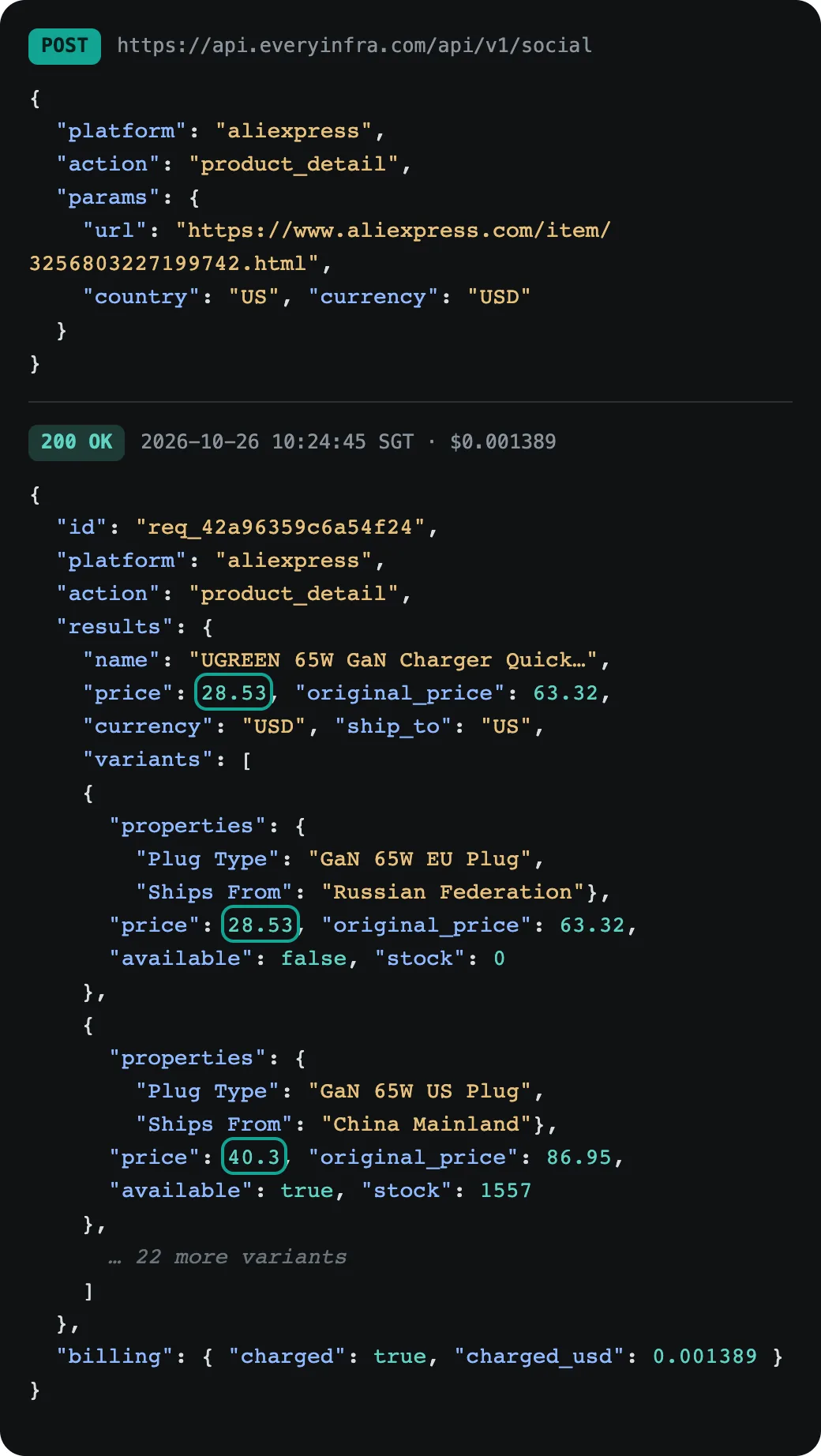
| Country | Headline price | Variant behind the headline | Same buyable SKU (65W US plug, ships from China) | Buyable ÷ headline |
|---|---|---|---|---|
| US | $28.53 | EU plug, ships from Russia, stock 0 | $40.30 | 1.41 |
| Brazil | $28.49 | buyable China variants | $28.49 | 1.00 |
| Mexico | $28.53 | buyable China variants | $28.53 | 1.00 |
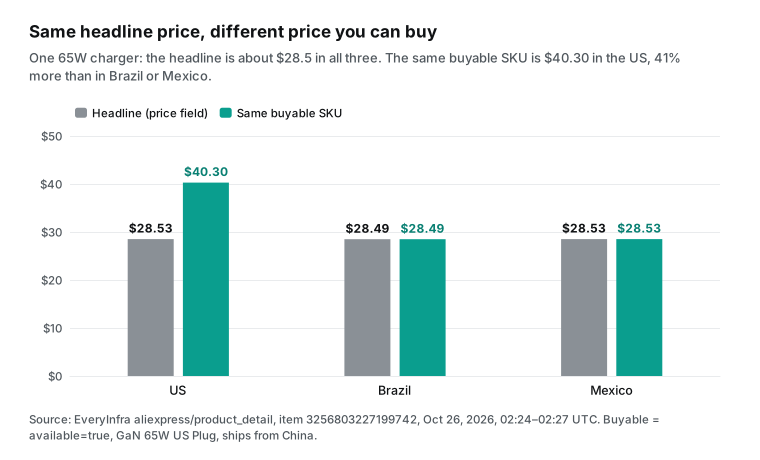
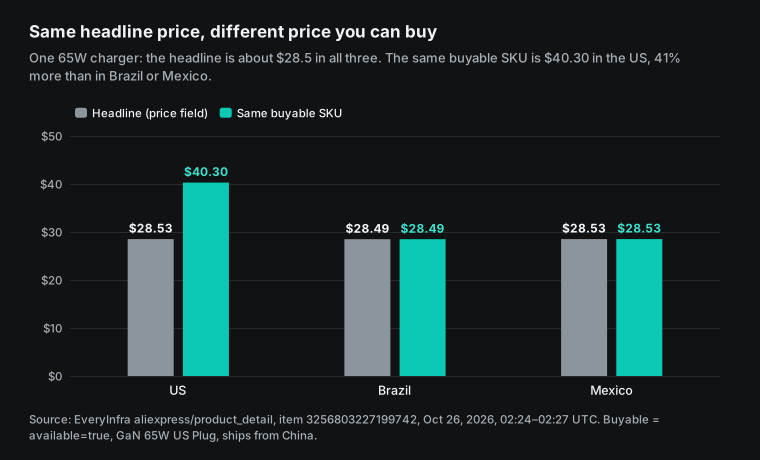
This is the opposite of Test 1. The cable was cheapest in the US, and the charger was most expensive in the US. The product page cannot tell us why. The tariff research above shows a general upward push on imported goods in the US, mainly from China. It does not show why this one charger costs 41% more.
A data product should record facts like "same SKU, US 41% above Brazil" each week. The client then decides what the facts mean.
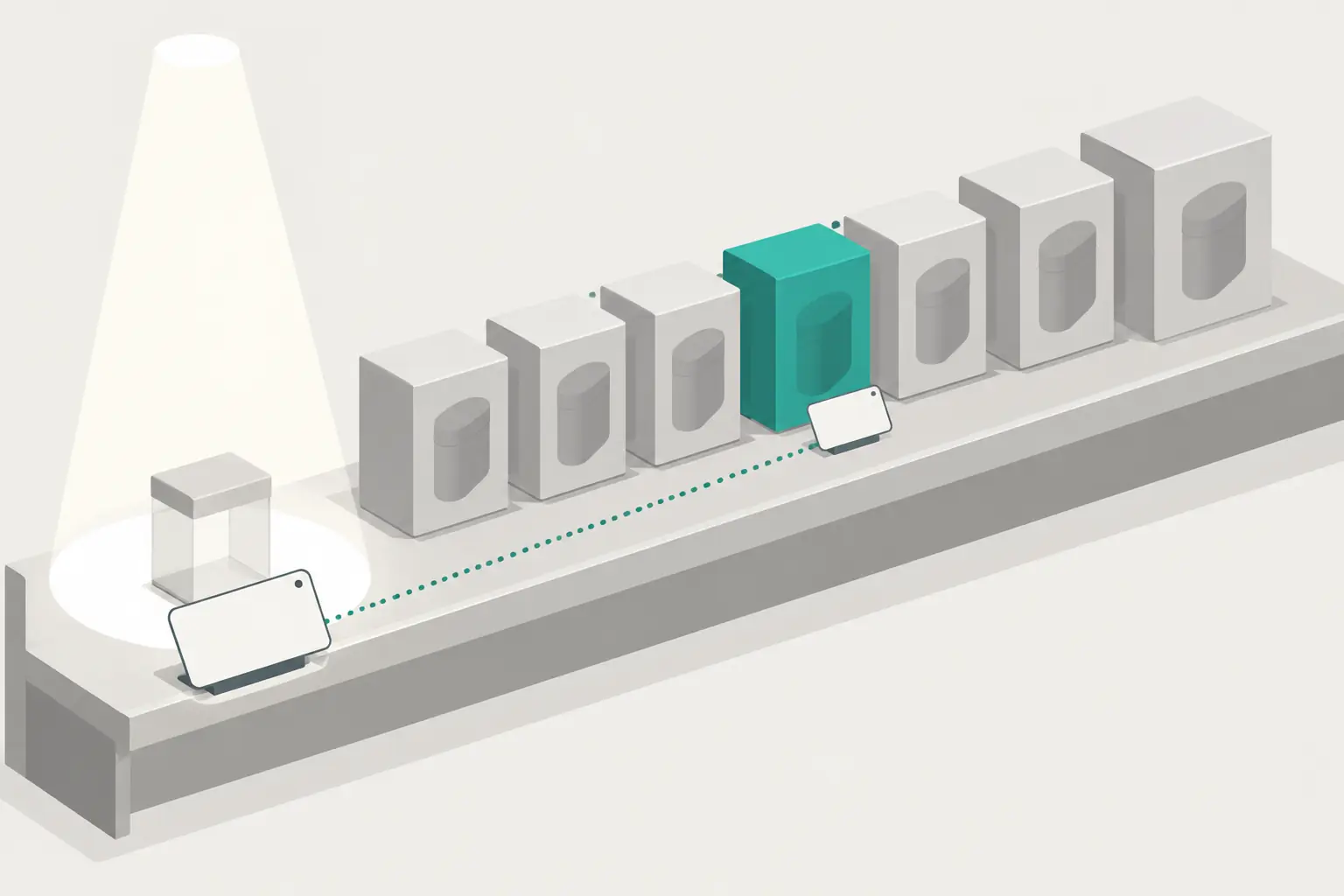
The rule for any cross-country comparison follows from this. Do not compare headline prices. First align SKUs by their variant properties. Then drop each variant with available=false. Only then compare prices. The product section below turns this into a fixed step.
Test 3: a kitchen set in nine countries, and strike-through prices only outside the EU
To test the first two results, we read a non-electronic item from 02:51 to 02:55 UTC (10:51 to 10:55 SGT). It is a 12-piece silicone kitchen utensil set with wooden handles, item 1005006988031051, with 444 reviews and "2,000+ sold". We added Australia, for nine countries. This time all nine switched, including the UK. Four requests first got a 429 response that said "10 requests per minute", with no charge. We waited 15 seconds between retries, and they all worked.
The same pink 12-piece set cost $9.17 in the UK, $13.38 in the US, $13.94 in Mexico, $17.93 in Australia and $18.27 in Brazil. In the EU it cost $23.46 in Spain, $24.17 in Germany, $25.86 in France and $26.20 in the Netherlands. Across nine countries, the top ÷ the lowest for the five SKUs was 2.5x to 3.4x. This time the UK was the cheapest, not the US.
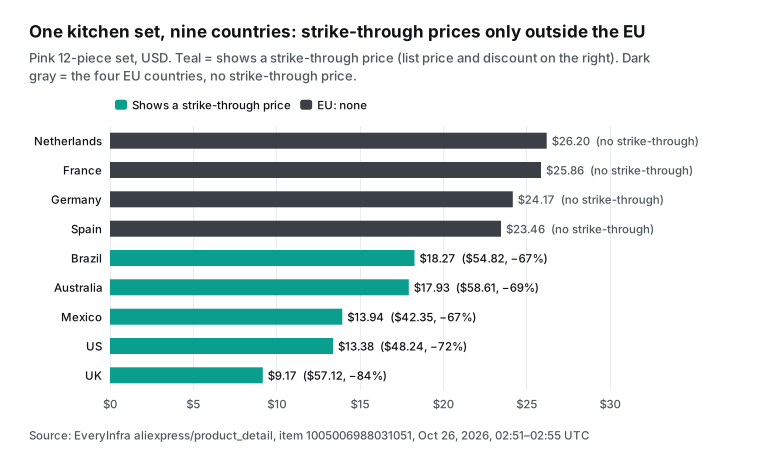
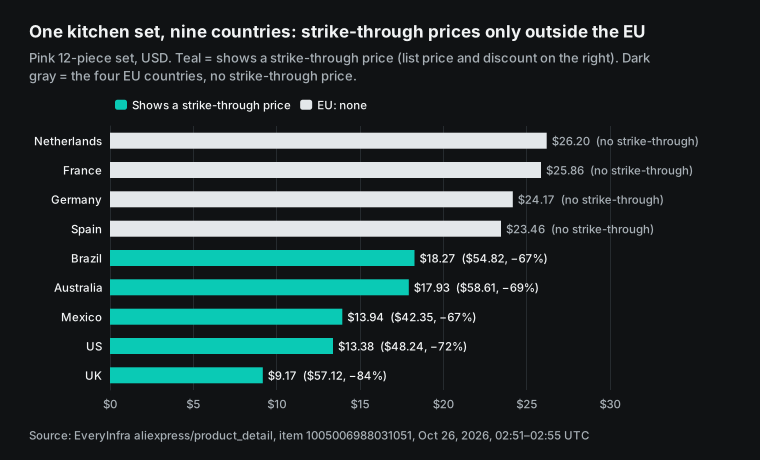
The strike-through price is the more important result. Across all three items, we have 19 valid country views. Eight are from the four EU countries (4 for the cable, 4 for the kitchen set). Eleven are from outside the EU. For the cable and the charger, they are the US, Mexico and Brazil.
For the kitchen set, they are the US, the UK, Brazil, Mexico and Australia. In all 8 EU views, original_price and discount were empty. All 11 non-EU views had a list price, with discounts from 55% to 86%.
| Views | Count | With a strike-through price | Discount shown |
|---|---|---|---|
| EU (Germany, France, Spain, Netherlands) | 8 | 0 | none |
| Outside the EU (US, UK, Mexico, Brazil, Australia) | 11 | 11 | 55% to 86% |
| Total | 19 | 11 | n/a |
We do not draw a legal conclusion from this. We only give the rule texts. Article 6a of the EU Price Indication Directive, added by the 2019 Omnibus Directive, says that each price reduction announcement must show the "prior price". That is the lowest price in at least the 30 days before the reduction. The Commission's 2021 guidance) says the rule aims to stop traders from inflating the reference price.
The EU Court of Justice ruled in case C-330/23 on September 26, 2024 that the announced reduction must be calculated from that prior price. Under such rules, a platform can choose not to show strike-through prices in EU views. We only see the result, not the reason.
One more number puts this in context. The EU price of the 60W gray 1 m cable ($3.41 to $3.75) is 44% to 49% of the US "list price" of $7.70. EU shoppers pay less than half of the list price that US shoppers see crossed out.
This pattern is useful for a price watch in two ways. First, the "discount" field cannot be compared across countries. An empty discount in the EU does not mean that there is no promotion in the EU. Second, it gives brand and compliance teams a clear check. For each SKU, which countries show a strike-through price, and how large is it? Does it match the lowest price of the last 30 days in that country?
The last question needs 30 days of data. One read cannot answer it, and that is a reason to sell a monthly subscription.
Stock pools: price zones and stock zones are not the same
All three items show stock pools. Some groups of countries had exactly the same total_stock and the same stock for each variant. For the cable, the US, Mexico and the UK request that did not switch shared 369 units, and the four EU countries shared 2,986. For the kitchen set, the US and Mexico shared 28 units. The four EU countries and the UK shared 36, and Brazil and Australia shared 51. Even the five variant counts matched: 11, 2, 1, 12 and 10 in the EU and the UK.
The stock pools and the price zones do not match. The UK and the four EU countries share one stock pool for the kitchen set. But the UK price ($7.88 to $10.80) is one third to one half of the EU price. The UK also shows a strike-through price and the EU does not. So the platform can serve several countries from one stock, but it sets prices and promotions for each country.
For a replenishment client, a stock pool helps to estimate how long a promotion price can last. For a comparison client, it shows which countries see the same stock, so they can treat those countries as one group.
Test 4: can you compare reviews and ratings by country?
Many teams also want to know how buyers in each country rate an item. From 02:27 to 02:28 UTC (10:27 to 10:28 SGT), we used aliexpress/reviews with sort=newest on the cable and the charger. Each call returned 20 reviews. All 20 cable reviews came from the US, and all had 5 stars. Of the 20 charger reviews, 14 came from the US, 2 from Chile, and 1 each from Brazil, Russia, Ukraine and Canada.
The average was 4.95 stars. Twenty reviews are 0.19% of the cable's 10,568 reviews and 3.1% of the charger's 643. That sample is too small to compare countries.
The sort order also needs care. The 20 "newest" reviews were not in strict date order. In the cable set, 10 of 19 neighboring pairs had a newer review after an older one, with dates from November 2025 to July 2026. The charger set had 12 such pairs, and its newest review was from October 20, 2026. So treat "newest 20" as "a batch of recent reviews", not as a date series.
From 02:56 to 02:57 UTC (10:56 to 10:57 SGT), we also tried the rating summary with aliexpress/ratings. Both items returned empty results and were refunded automatically, with billing.reason set to empty_result_refunded.
So a country-by-country review comparison from public pages is not possible today. The reviews are still useful for one thing: they show which SKUs people buy. Of the 20 charger reviews, 10 were for the 65W EU plug and 5 for the EU plug with a cable. Only 2 were for the 65W US plug. That helps a client choose which SKUs to watch, instead of all 24 variants.
Test 5: other platforms, eBay, Amazon and Shopee
With one platform, you cannot tell platform strategy from the market itself. From 02:28 to 02:31 UTC (10:28 to 10:31 SGT), we compared the UGREEN Nexode 65W three-port charger on other platforms.
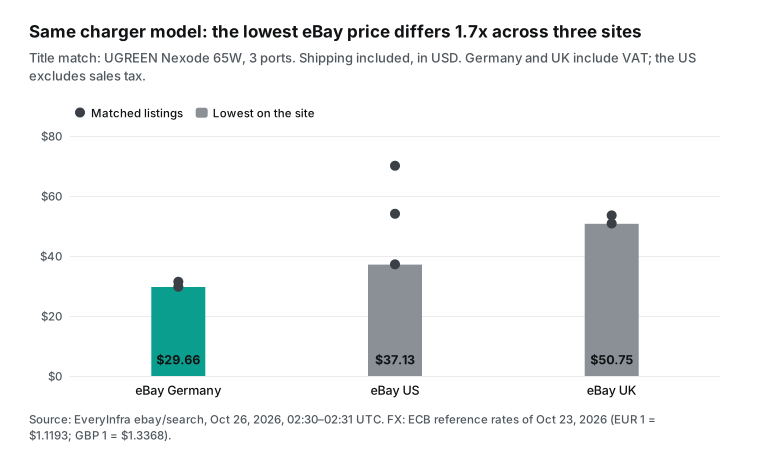
First, eBay. We used ebay/search once each on ebay.com, ebay.de and ebay.co.uk for "UGREEN Nexode 65W". A title rule kept listings with Nexode, 65W and three ports, and dropped Air, Pro, Uno, desktop and four-port models. It matched 3, 2 and 2 new listings. We added the shown shipping and converted to USD at the European Central Bank reference rates of October 23, 2026 (EUR 1 = $1.1193, GBP 1 = $1.3368).
We read the rates from the ECB data API. The lowest price in Germany was EUR 26.50 (about $29.66). In the US it was $30.50 plus $6.63 shipping ($37.13). In the UK it was GBP 35.02 plus GBP 2.94 (GBP 37.96, about $50.75). The top ÷ the lowest is 1.71x.
German and UK listings include VAT, and US listings do not include sales tax. With tax on both sides, the UK gap would be even larger.
A listing price is not a sale price. At 02:58 UTC (10:58 SGT), we used ebay/sold for 30 days of sales on ebay.de. With the same title rule, and after we dropped the Nexode X model and used items, 7 new sales matched. They went from EUR 25.48 to EUR 72.99, with a median of EUR 30.95 (about $34.64). The newest sale was EUR 27.99 on October 25.
The first US request got a 429 with no charge, and it worked at 03:07 UTC (11:07 SGT). Of the 20 US sales, 11 were open-box items, 3 were used and 6 were new. Three new sales matched the rule, from $30.00 to $43.25, with a median of $42.00.
| eBay site | Results | New listings matched | Lowest listing with shipping | New sales matched (30 days) | Median sale |
|---|---|---|---|---|---|
| Germany | 4 | 2 | EUR 26.50 (about $29.66) | 7 | EUR 30.95 (about $34.64) |
| US | 10 | 3 | $37.13 | 3 | $42.00 |
| UK | 10 | 2 | GBP 37.96 (about $50.75) | not read | n/a |
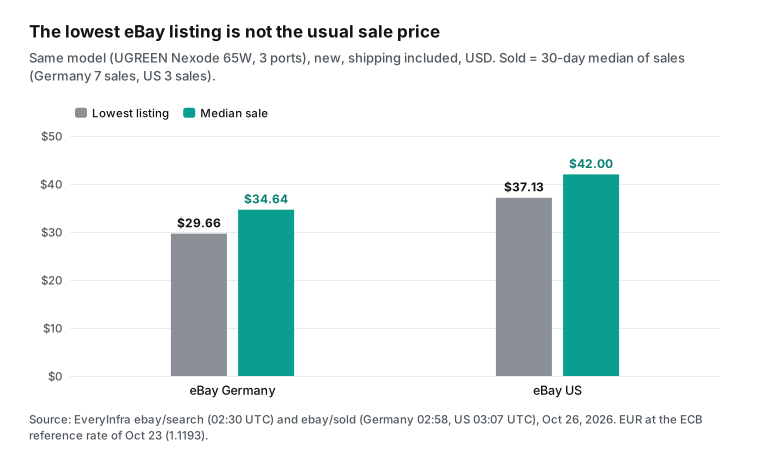
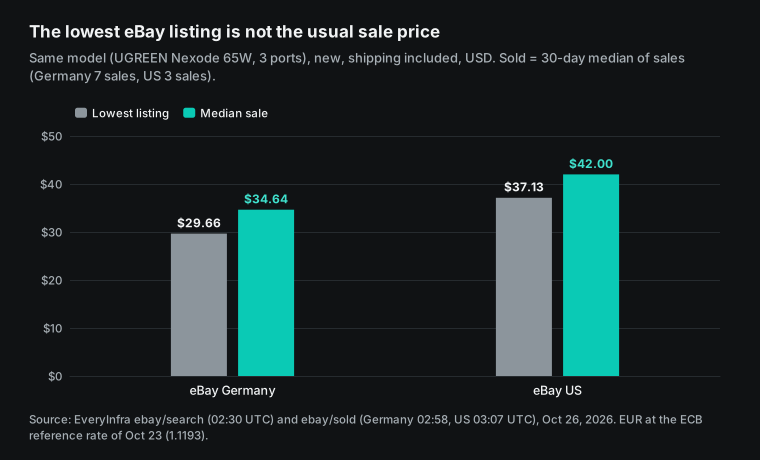
On both sites, the median sale was above the lowest listing: 17% higher in Germany and 13% higher in the US. The lowest listing is often one seller's short-term price. The median sale is closer to what the model usually sells for in that country. By median sale, the US is 21% above Germany. By lowest listing, it is 25% above.
Both say the same thing, but the size differs, so a report must state which one it uses. The US sales also show that the share of open-box and used items differs by country. If you do not filter by condition first, sale prices cannot be compared.
Amazon is different. We used amazon/search on amazon.de for the same model. It returned 10 results, but none had a price. We then used amazon/profile on the top ASIN on the German site, B0CJ4WBJLC. It returned 10,177 ratings, but price was empty and in_stock was false.
The same ASIN on amazon.com returned an empty result, which was refunded. Amazon's catalog API documentation requires marketplaceIds in each request, because ASINs belong to marketplaces. An ASIN on one site is not always on another. So for Amazon, the first step of a cross-country comparison is to find the matching ASIN on each site. One ASIN does not travel the world. Once you have it, Why Amazon price tracking gives false alerts shows how to compare only the same offer on one site.
For Shopee, we read Singapore, Malaysia and Brazil. At 02:58 to 02:59 UTC (10:58 to 10:59 SGT), we used shopee/search for "Baseus 100W USB C cable" once per site. Each search returned 20 results and cost $0.006403, the most expensive capability in this article. All Singapore prices were whole numbers, with a median of SGD 5 (about $3.91). All Malaysia prices were whole numbers too, with a median of MYR 15.5 (about $3.79).
Brazil prices went from 1,598 to 5,990, with a median of 3,534.5. At face value that is $700, which is clearly wrong. The numbers look like cents (3,499 looks like BRL 34.99). We cannot confirm the unit from the response. So the Shopee numbers show one lesson only: check the unit and the precision of each site's price field before you divide one by another.
| Shopee site | Results | All prices whole numbers | Median as returned | Median in USD (ECB, October 23) |
|---|---|---|---|---|
| Singapore | 20 | yes | SGD 5 | about $3.91 |
| Malaysia | 20 | yes | MYR 15.5 | about $3.79 |
| Brazil | 20 | yes | 3,534.5 | $700 as returned; about $7.00 if the unit is cents (not confirmed) |
The Singapore and Malaysia medians are about $3.8 to $3.9. That is the same range as the 100W SKUs of the AliExpress cable in the US ($2.60 to $3.55). Singapore also charges GST at the point of purchase on low-value goods of SGD 400 or less. This applies to goods that come by air or post from registered sellers, as the Inland Revenue Authority of Singapore explains/consumers/gst-on-imported-low-value-goods). So Singapore page prices usually include tax, as in the EU.
27 country-switched requests, and 5 missed that country
Put all product detail requests for the three items together, with retries and the re-reads one hour later. In total, 27 returned 200. In 22 of them, we got the requested country and currency. In 3, the country did not switch (the UK once for the cable, Spain twice for the charger). In 2, the result was empty and was refunded (Germany twice for the charger).
Another 5 requests got a 429 for the rate limit, with no charge. They are not in the 27: 4 were product detail requests and 1 was an eBay sales request.
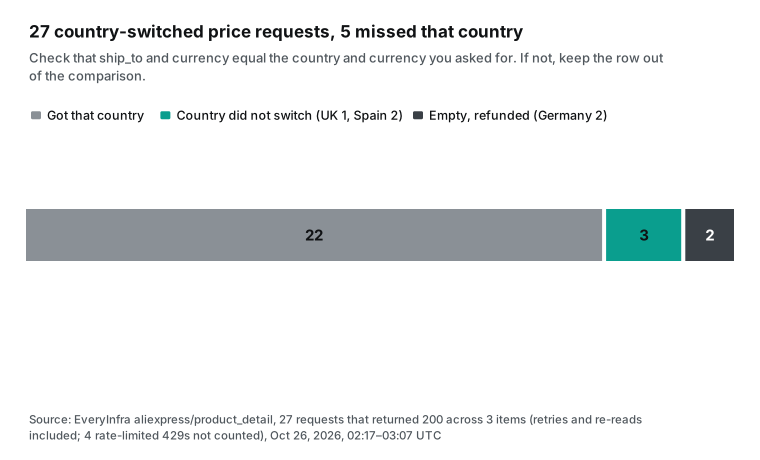
A request that did not switch is not an error. It is a normal 200 response, so it slips into data easily. The charger's Spain view returned EUR prices and ship_to=US at both 02:26 and 02:32 UTC. The same SKU cost $40.30 in the US and EUR 37.99 in this "Spain" view. From these two numbers, the platform used about $1.061 per euro.
The ECB reference rate for the same day was 1.1193. So this euro price was about 5.5% above a conversion at the ECB rate. If you do not check ship_to, you will think that Spain is cheaper than the US. In fact, you see the US price in euros, plus 5.5%. The UK view of the cable was the same case: GBP prices, a US ship-to and the same 369-unit US stock pool.
What should you do with a country that did not switch? Our two retries give a guide. The charger's Spain view did not switch at 02:26 UTC. We retried 6 minutes later, at 02:32, and got EUR prices and ship_to=US again, billed as normal. The Germany view was empty at 02:25 and at 02:32, and both were refunded. So a retry a few minutes later usually gives the same result, and more retries only cost more. Our rule: retry each country once at most. If the retry is still wrong, mark that cell as "missing this round". Do not fill it with another country's price or with search results. List the missing countries and counts in the report. If a country stays missing for several days, try another listing of the same product. The kitchen set did switch to the UK in Test 3, so a missed switch depends on the item, not only on the country.
The AliExpress search capability shows a related effect. We ran aliexpress/search three times. The results came back in EUR (with Italian titles), in USD and in AUD. Search has no country parameter, and its region and currency can change. So use search only to find item numbers. For price comparison, always use product detail and check the country on each row.
This section gives four data rules, and the "validate" step of the product uses them. The response ship_to must equal the requested country. The currency must equal the requested currency. The variant must have available=true. And you must read all countries for one item within one hour. A promotion price in a stock pool can sell out at any time.
One hour later: did the prices change?
From 03:05 to 03:07 UTC (11:05 to 11:07 SGT), we read the cable a second time in the US, Germany and Brazil. That was about 48 minutes after the first read.
| Country | First read (SGT) | Second read (SGT) | Price changes in 8 SKUs | Total stock |
|---|---|---|---|---|
| US | 10:17 | 11:05 | 0 | 369 → 369 |
| Germany | 10:17 | 11:05 | 0 | 2,986 → 2,986 |
| Brazil | 10:19 | 11:06 | 0 | 4,936 → 4,932 |
None of the 24 country and SKU price points changed in 48 minutes, and the list prices did not change either. That shows one thing only: this item does not need reads every few minutes. It does not show that one read a day is enough. The 48 minutes did not cross any promotion boundary. A midnight price switch or the start and end of a sale were not in that window, and the third limit below says that promotion prices expire.
Whether to read daily or hourly must come from repeated reads across midnight. Here is a concrete test. Pick 5 items in 4 countries each and read them every 6 hours for 3 days. That is 5 × 4 × 4 × 3 = 240 calls, about $0.33 at catalog prices. Record the time of the first change for each price point. If the changes cluster at one fixed time, such as local midnight, one read a day after that time is enough. If they spread across the day, read every 6 hours or more often. This choice decides the cost, because hourly reads cost 24 times more than daily reads.
| Schedule | Reads a day | Calls a month, 50 items × 8 countries | Call cost a month | When to pick it |
|---|---|---|---|---|
| Once a day | 1 | 12,000 | $16.67 | The 3-day test shows changes at one fixed time |
| Every 6 hours | 4 | 48,000 | $66.67 | Changes spread across the day |
| Every hour | 24 | 288,000 | $400.03 | Sale days and the hours around a promotion boundary |
The stock did change. Brazil lost 4 units. Each of the four 100W SKUs lost one unit. The US and German stocks did not move. A drop in stock is not proof of a sale, because a cart can also hold units. But it is a signal of demand that you can measure again and again.
In the same period, the Brazil pool moved and the US and German pools did not. The Brazil price was in the middle of the seven countries. A pricing team that reads stock once a day gets a "stock burn rate" for each country and SKU. With prices next to it, that is one more dimension than price alone. One short re-read only shows a first sign. It takes many days of data to make a conclusion.
What to build: uses that match the tests
The five tests show that cross-country gaps are real, that they change and that they are easy to read wrongly. A client who builds this alone must handle country switching, SKU alignment, unit checks and rate limits, and each of these differs by country and platform. Below we list only the uses that match a test in this article. We do not guess who will buy.
A brand's channel and pricing team can check the price ladder and strike-through prices of its own SKUs in each country. Test 1 (the same SKU at 1.5x to 4.6x across countries, a 3.26x ladder in the US) and Test 3 (strike-through prices only outside the EU) are this kind of query. A seller in several countries can read the EU view of the same SKU before and after the EUR 2 fee of November 1, and see whether its own store or stores with the same product changed prices.
Comparison and shopping-guide sites need rows that already passed the ship_to, currency and available checks. In this article, 5 of 27 requests did not return the target country. Without that check, a US price can pass as a Spain price. Researchers need price series of the same item in many countries over many days, and one snapshot is not enough. For the subscription model where a seller watches competitors in one market, see Price monitoring as a subscription product.


The product can have three tiers. The cost in the table is the EveryInfra call cost only, at the catalog price_usd of October 26, 2026.
| Tier | Contents | Calls a month | Call cost a month | How to accept it |
|---|---|---|---|---|
| Basic | 50 items × 8 countries, product detail once a day, weekly report | 12,000 | $16.67 | Each week, 20 sampled raw rows all match on ship_to, currency and available |
| Standard | Basic + reviews once a week per item + a 30-day check of strike-through prices | 12,200 | $16.95 | For each country with a strike-through price, the 30-day lowest price can be found in the saved raw responses |
| Extended | Standard + eBay listings on three sites and German sales, once a week, 20 models | 12,200 + 320 | about $17.39 | The eBay match rule (model, condition) can be re-run; 5 titles are checked each week |
In the extended tier, eBay adds 20 models × 4 calls (three listing searches and one German sales search) × 4 weeks = 320 calls. At $0.001389 each, that is about $0.44. The call cost is not the main cost. The main cost is rule upkeep and human review. Each new country or platform needs a first round of "did the country really switch" checks, and stock pools and units need regular review. So price the product by "SKUs watched × countries", plus a weekly human reading, and not by call volume.
The cost
At the catalog of October 26, 2026, aliexpress/product_detail costs $0.001389 per call. Empty results and failures are not billed. The basic tier reads 50 items × 8 countries = 400 calls a day. A 30-day month has 12,000 calls, and 12,000 × $0.001389 = $16.67. Reviews once a week add 4 calls per item per month, 200 in total, for $0.28. The sum is $16.95.
Retries add a little. Of the 27 product detail requests that returned 200, 3 did not switch the country, and those 3 were billed as normal. Two empty results were refunded. Assume that about 11.1% of requests (3 ÷ 27) do not switch, and you retry each one once. Then the basic tier adds about 1,333 calls a month, about $1.85. So the real call cost of the basic tier is about $17 to $19.
That is small next to the time for human checks. But it is a reminder that each row needs a check, because wrong numbers also cost money.
All test calls for this article, including the rate-limited and failed ones, were 52 requests, 40 of them billed, for a total of $0.071449. The hero image and one explanatory image cost $0.03 each, so the whole article cost $0.131449.
Use the same data in code and AI clients
This article uses four platforms. They are the AliExpress Scraper API, the eBay Scraper API, the Amazon Scraper API and the Shopee Scraper API. Each platform page lists all capabilities, parameters and prices. Below is the US request from Test 2. Change country to read another country. The full parameters and fields are in GET /api/v1/social/catalog, and the quickstart shows how to get a key.
curl -s https://api.everyinfra.com/api/v1/social \
  -H "Authorization: Bearer ${EVERYINFRA_API_KEY}" \
  -H "Content-Type: application/json" \
  -d '{
    "platform": "aliexpress",
    "action": "product_detail",
    "params": {
      "url": "https://www.aliexpress.com/item/3256803227199742.html",
      "country": "US",
      "currency": "USD"
    }
  }'
All fields that this article uses are in the catalog response_fields.
| Field | Meaning | How this article uses it |
|---|---|---|
price / price_max | Headline price (lowest variant) and top of the price range | Reference only, not for cross-country comparison |
original_price / discount | Strike-through list price and discount | Count the countries that show a strike-through price |
currency / ship_to | Response currency and ship-to country | Check that the country really switched |
variants | Variant list with properties, price, original_price, available, stock | Align SKUs by properties and drop variants you cannot buy |
total_stock | Total stock | Find stock pools |
shipping | Method, ship-from, delivery_days_min / delivery_days_max | Record delivery time: 5 to 10 days for the US, 12 to 19 for Brazil |
review_count / rating | Review count and rating | Judge the sample size |
store_country | Store location | Tell stores apart |
In Claude Code, add the EveryInfra MCP server as shown in the Claude Code MCP documentation. For other MCP clients, see the MCP setup page.
claude mcp add --transport http everyinfra https://api.everyinfra.com/mcp \
  --header 'Authorization: Bearer ${EVERYINFRA_API_KEY}'
Then you can ask: "Use everyinfra_call_api to get AliExpress item 3256803227199742 for US, BR and MX. Keep only variants where ship_to equals the requested country and available is true. Align on Plug Type and list the price in each country."
Errors and charges are as we saw them in the tests.
| Case | Response | Charge |
|---|---|---|
| No key | 401 missing_key | No charge |
Wrong parameter name (countri) | 422 unknown_param, with did_you_mean: country and the allowed parameters | No charge |
| More than 10 requests a minute | 429 rate_limited, with retry_after in seconds | No charge |
| Empty result (Germany view, rating summary) | 200, empty results, billing.reason is empty_result_refunded | Refunded automatically |
| Country did not switch | 200, but ship_to differs from the requested country | Billed as normal, so check it yourself |
To reconcile each charge, see failure refunds and reconciliation. The full price list is on the pricing page.
Other ways to get this data
You can build a scraper or use a browser extension and get the same pages. Then you must solve three problems yourself. You must switch the ship-to country and currency in each country. You must handle anti-bot measures, and you must pay for proxy traffic. We measured proxy costs in How proxy traffic costs add up.
The median HTML page was 0.44 MB, and a full page load was 7.96 MB. With eight countries, you also need an exit in each country.
The benefit of building it yourself is full control. You can sign in as a user and add items to a cart to see the checkout price. A public product page API cannot do that.
The official platform APIs are another path. The Amazon catalog API returns data per marketplace with marketplaceIds. It suits sellers who check their own listings with a seller account. It needs seller authorization, and it does not show promotions in other sellers' stores. In this article, we read public product pages with no platform account. We see only what a visitor who is not signed in sees, so member prices and personal coupons are not included.
Limits: when these results do not hold
First, we read the price shown on the product page, not the checkout price. Some charges may or may not be in the page price. Examples are the EU EUR 3 duty, the EUR 2 fee from November, VAT, US sales tax and the 33.5% Mexican rate. The product page fields do not say. So "the US is 41% above Brazil" applies to page prices only.
Second, the sample is small: 3 AliExpress items, up to 9 countries, one morning. We can say that all 3 items had cross-country gaps above 1.2x. We can say that none of the 8 EU views showed a strike-through price. We cannot say that all AliExpress items behave like this. The cheapest country did not repeat across items. It was the US and Mexico for the cable, Brazil and Mexico for the charger, and the UK for the kitchen set.
Third, promotion prices expire. The US cable at $1.09 had 87 units left, and the white kitchen set was sold out in the US. A gap that you see today can come from promotion stock and be gone tomorrow. So watch changes over many days, not one day.
Fourth, exchange rates and units. We always asked for USD, but 3 responses came back in another currency. The platform's own conversion differed from the ECB rate by about 5.5%. Shopee Brazil prices look like cents. Each time you compare currencies, convert yourself with the official reference rate of one day, and write the date in the report.
Recent changes
On September 21, 2026, the European Commission adopted Delegated Regulation (EU) 2026/2152, with a EUR 2 handling fee per item from November 1. For readers, EU prices may change again in early November (regulation text). Save a baseline at the end of October. Then read the same SKUs again in the first week of November. VATCalc wrote on October 22, 2026 that the fee applies per customs item. A parcel with goods under different tariff headings pays it more than once.
On October 5, 2026, DG TAXUD updated its guidance on the EUR 3 duty and the Union handling fee. For readers, it explains how customs counts an "item". It also explains the treatment of goods in customs warehouses, which is the base for a seller's real cost (guidance).
On October 8, 2026, bevh reported that sales of three Asian platforms in Germany fell 35.5% in the third quarter. In its consumer survey, Shein, Temu and AliExpress together sold EUR 566 million in Germany in the third quarter, 35.5% less than a year earlier. Their share of German online retail fell from 5.3% in the second quarter to 3.1%. The data comes from a survey of 40,000 people a year, not from platform sales. A review by wortfilter on October 13, 2026 works back from the same release to about EUR 878 million and a 4.9% share for the third quarter of 2025. So the share fell 1.8 points year on year and 2.2 points from the second quarter, and the size of the drop depends on the base quarter. For readers, price changes already affect demand. Clients of a price watch will ask more often whether a price cut can bring volume back (bevh release).
On October 8, 2026, CBP proposed new rules for low-value shipments. On October 14, it moved the entry type 13 date to January 20, 2027. The two steps have a different scope, so do not read them as one. The proposed rule would put mail shipments of $2,500 or less on a new electronic entry type 13 and add bonds for some informal entries; comments are due on December 7, 2026, and it is still a proposal. The October 14 release moves the mandatory date of the current test, which for now covers only mail subject to Section 201, 232 or 301 duties or to other government agencies (PGA). On October 22, the Federal Register printed a change to the entry type 13 test. The base for all of this is the interim final rule of June 24, 2026, which suspended the de minimis exemption for mail shipments of $800 or less for an indefinite time. For readers, US rules are not final, and US prices may change again around January.
On October 22, 2026, Italy moved its national levy on low-value parcels to January 1, 2027. For readers, national costs inside the EU do not move together. Italy, France and Germany can have different cost structures with the same currency (Italian government release). Digital Watch reported on October 24, 2026, citing Il Sole 24 Ore, that this was the fourth delay.
The European Commission plans to propose a Digital Fairness Act in the fourth quarter of 2026. The Commission's initiative page lists "unfair personalisation practices" among the problems. IAPP reported on October 23, 2026 that the proposal is expected on November 11. For readers, the proposal may cover price differences by place or by person. If it does, cross-country price data can help companies and regulators check prices.
Brazil's import tax cut is pulling cross-border orders back. Mercado&Consumo reported on October 16, 2026 on a BTG Pactual report that uses federal revenue data. Cross-border orders up to $50 rose 82% year on year in September, to 25.2 million. The state ICMS of 17% to 20% still applies. For readers, Brazil prices on cross-border sites can see more promotions in the coming months.
Frequently asked questions
Why is the AliExpress price different in my country than in the US?
This question comes from the search suggestion "aliexpress price different country than us". In our tests, the same SKU in USD, counting only variants you can buy, still differed 1.5x to 4.6x across seven countries. After VAT, the median of the four EU countries was still 1.49x to 2.91x the US price, depending on the SKU. Each country has its own prices, promotion stock and taxes. Sometimes the US is the cheapest (the cable) and sometimes it is the most expensive (the charger). Check the ship_to field too: in 3 of 27 requests, the country did not switch.
Is AliExpress cheaper in USD?
This question comes from the search suggestion "is aliexpress cheaper in usd". The currency changes the number, not the country price. When a view did not switch, the platform showed the US price in euros at about $1.061 per euro. The ECB rate that day was 1.1193, so the euro price was about 5.5% higher. So the display currency can add a small cost. The larger gaps come from the country, not from the currency.
Why is the AliExpress price different in the cart?
This question comes from the search suggestion "aliexpress price different in cart". The product page shows the headline price, which is the lowest variant, and that variant can be out of stock. In Test 2, the US headline was $28.53, but the buyable SKU was $40.30. The cart can also add taxes, fees and shipping that the product page does not show. Examples are the EU EUR 3 duty and, from November 1, the EUR 2 handling fee.
References
- Commission Delegated Regulation (EU) 2026/2152 (amount of the Union handling fee), Official Journal of the EU, 2026-09-21. https://eur-lex.europa.eu/eli/reg_del/2026/2152/oj/eng
- Regulation (EU) 2026/2108 (Union Customs Code and EU Customs Authority), Official Journal of the EU, 2026-09-16. https://data.europa.eu/eli/reg/2026/2108/oj
- The temporary EUR 3 customs duty and the Union handling fee: Guidance for Member States and Trade, European Commission DG TAXUD, version of 2026-10-05. https://taxation-customs.ec.europa.eu/document/download/053e5b4e-f0be-4f20-9a23-3e3b659a6676_en?filename=Customs%20Guidance%20on%20EUR%203%20customs%20duty.pdf
- Guidance and legal text on temporary flat fee on low-value imports, European Commission DG TAXUD, 2026-06-08. https://taxation-customs.ec.europa.eu/news/guidance-and-legal-text-temporary-flat-fee-low-value-imports-which-will-apply-until-1-july-2028-2026-06-08_en
- Ensuring fairness and safety: EUR 3 customs duty for low-value parcels, European Commission, 2026-06-29. https://commission.europa.eu/news-and-media/news/ensuring-fairness-and-safety-eur3-customs-duty-low-value-parcels-2026-06-29_en
- Council gives final green light to new customs duty rules for small parcels, Council of the EU, 2026-02-11. https://www.consilium.europa.eu/en/press/press-releases/2026/02/11/council-gives-final-green-light-to-new-customs-duty-rules-for-small-parcels/
- Zollbefreiung für Warensendungen unter 150 Euro entfällt, German Federal Ministry of Finance, 2026-07-01. https://www.bundesfinanzministerium.de/Content/DE/Standardartikel/Themen/Zoll/wegfall-der-150-euro-zollfreigrenze.html
- Nach Abschaffung der Zollfreigrenze: Asiatische Plattformen verlieren deutlich Marktanteile, bevh, 2026-10-08. https://bevh.org/detail/nach-abschaffung-der-zollfreigrenze-asiatische-plattformen-verlieren-deutlich-marktanteile
- Zollfreigrenze: Temu, Shein & Co. verlieren 35,5 % Umsatz, wortfilter (secondary, review of bevh data), 2026-10-13. https://wortfilter.de/zollfreigrenze-temu-shein-umsatz/
- Comunicato stampa del Consiglio dei Ministri n. 194, Government of Italy, 2026-10-22. https://www.governo.it/it/articolo/comunicato-stampa-del-consiglio-dei-ministri-n-194/32912
- Italy postpones levy on non-EU mini-parcels until 2027, Digital Watch Observatory (secondary), 2026-10-24. https://dig.watch/updates/italy-postpones-miniparcel-levy
- Low-Value Shipments (proposed rule), Federal Register, U.S. Customs and Border Protection, 2026-10-08. https://www.federalregister.gov/documents/2026/10/08/2026-20650/low-value-shipments
- International Mail Entry Type 13 mandatory implementation date extended to Jan. 20, 2027, U.S. Customs and Border Protection, 2026-10-14. https://www.cbp.gov/newsroom/national-media-release/international-mail-entry-type-13-mandatory-implementation-date
- Modification of the Test of the New Electronic Informal Entry Process for Mail, Federal Register, CBP, 2026-10-22. https://www.federalregister.gov/documents/2026/10/22/2026-21570/modification-of-the-test-of-the-new-electronic-informal-entry-process-for-mail
- Indefinite Suspension of the De Minimis Exemption for Mail Shipments and New Postal Informal Entry Process (interim final rule), Federal Register, CBP, 2026-06-24. https://www.federalregister.gov/documents/2026/06/24/2026-12669/indefinite-suspension-of-the-de-minimis-exemption-for-mail-shipments-and-new-postal-informal-entry
- E-Commerce, U.S. Customs and Border Protection, read 2026-10-26. https://www.cbp.gov/trade/basic-import-export/e-commerce
- Lei nº 15.502, Presidency of Brazil, 2026-09-10. https://www.planalto.gov.br/ccivil_03/_ato2023-2026/2026/lei/l15502.htm
- Compras internacionais abaixo de US$ 50 sobem 82%, Mercado&Consumo (secondary, citing BTG Pactual), 2026-10-16. https://mercadoeconsumo.com.br/16/10/2026/noticias/compras-internacionais-abaixo-de-us-50-sobem-82-apos-fim-da-taxa-das-blusinhas/
- Reglas Generales de Comercio Exterior para 2026 y Anexo 13, Diario Oficial de la Federación (SAT), 2025-12-27. https://dof.gob.mx/nota_detalle_popup.php?codigo=5777199
- Reforming the customs treatment of low value imports into the United Kingdom: Consultation response, UK Government, 2026-07-13. https://www.gov.uk/government/consultations/reforming-the-customs-treatment-of-low-value-imports-into-the-united-kingdom/outcome/reforming-the-customs-treatment-of-low-value-imports-into-the-united-kingdom-consultation-response
- Directive (EU) 2019/2161 (Omnibus Directive, adds Article 6a to the Price Indication Directive), Official Journal of the EU, 2019-11-27. https://eur-lex.europa.eu/eli/dir/2019/2161/oj/eng
- Guidance on the interpretation and application of Article 6a of Directive 98/6/EC, European Commission, 2021-12-29. https://eur-lex.europa.eu/legal-content/EN/TXT/?uri=CELEX:52021XC1229(06)
- Judgment in Case C-330/23 (Aldi Süd), Court of Justice of the EU, 2024-09-26. https://eur-lex.europa.eu/legal-content/EN/TXT/?uri=celex:62023CJ0330
- Digital Fairness Act initiative page, European Commission, read 2026-10-26. https://ec.europa.eu/info/law/better-regulation/have-your-say/initiatives/14622-Digital-Fairness-Act_en
- A view from Brussels: Final countdown to the Digital Fairness Act has started, IAPP (secondary), 2026-10-23. https://iapp.org/news/a/a-view-from-brussels-final-countdown-to-the-digital-fairness-act-has-started
- VAT rules and rates, Your Europe, European Union, read 2026-10-26. https://europa.eu/youreurope/business/finance-and-tax/vat/vat-rules-rates/index_en.htm
- Customs formalities for low value consignments (IOSS), European Commission DG TAXUD, read 2026-10-26. https://taxation-customs.ec.europa.eu/customs/customs-procedures-import-and-export/customs-operations/customs-formalities-low-value-consignments_en
- Euro foreign exchange reference rates, European Central Bank, values of 2026-10-23. https://www.ecb.europa.eu/stats/policy_and_exchange_rates/euro_reference_exchange_rates/html/index.en.html
- ECB Data API, EXR series (USD and GBP per EUR), European Central Bank, 2026-10-19 to 2026-10-23. https://data-api.ecb.europa.eu/service/data/EXR/D.USD+GBP.EUR.SP00.A?startPeriod=2026-10-19&endPeriod=2026-10-26&format=csvdata
- GST on Imported Low-Value Goods, Inland Revenue Authority of Singapore, read 2026-10-26. https://www.iras.gov.sg/taxes/goods-services-tax-(gst)/consumers/gst-on-imported-low-value-goods
- Cavallo, Neiman, Rigobon. Currency Unions, Product Introductions, and the Real Exchange Rate. Quarterly Journal of Economics 129(2), 2014. https://doi.org/10.1093/qje/qju008
- The same paper as NBER Working Paper w18563, revised 2013-11. https://www.nber.org/system/files/working_papers/w18563/w18563.pdf
- Mikians et al. Detecting price and search discrimination on the Internet. HotNets 2012. https://doi.org/10.1145/2390231.2390245
- Hannak et al. Measuring Price Discrimination and Steering on E-commerce Web Sites. IMC 2014. https://doi.org/10.1145/2663716.2663744
- Cavallo, Llamas, Vazquez. Tracking the Short-Run Price Impact of U.S. Tariffs, Harvard Business School, version of 2026-09-07. https://www.hbs.edu/ris/Publication%20Files/TrackingTariffs_Cavallo_Llamas_Vazquez-2026_35c9fd9f-0643-4402-8365-6e8469599dcf.pdf
- Tariff Tracker, Harvard Business School Pricing Lab, read 2026-10-26. https://www.pricinglab.org/tariff-tracker/
- getCatalogItem, Amazon Selling Partner API documentation, read 2026-10-26. https://developer-docs.amazon.com/sp-api/reference/getcatalogitem
- France parcels: new EUR 2 EU handling fee adds to small parcel duty, Connexion (secondary), 2026-10. https://www.connexionfrance.com/news/why-small-parcels-coming-into-france-will-cost-more-soon/821203
- EU EUR 2 Customs Handling Fee Confirmed for November 2026, VATCalc (secondary), 2026-10-22. https://www.vatcalc.com/eu/eu-mulls-customs-admin-tax-on-non-eu-sellers/
- Social and commerce data capability catalog, EveryInfra, read 2026-10-26 10:24 SGT. https://api.everyinfra.com/api/v1/social/catalog
- Connect Claude Code to tools via MCP, Anthropic documentation, read 2026-10-26. https://code.claude.com/docs/en/mcp
Reference BL-43